
A complete issue · 16 pages · 1888
Judge — June 9, 1888
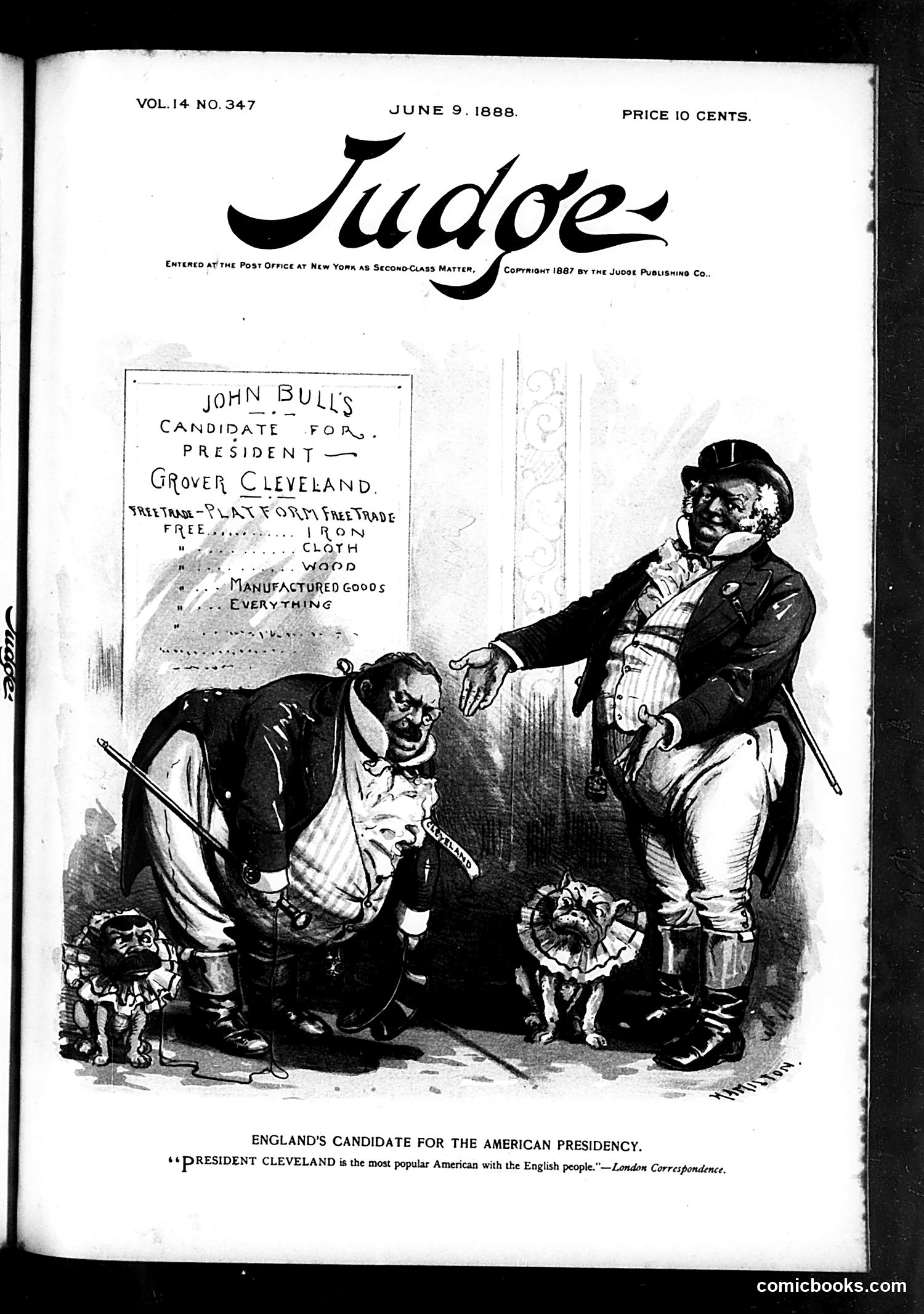
This 1888 Judge magazine cartoon satirizes President Grover Cleveland's popularity with the British. The image shows two caricatured British figures (likely representing England/John Bull) presenting Cleveland as their preferred American presidential candidate. The left panel lists Cleveland's platform: free trade, free iron, free cloth, free wood, and manufactured goods—policies that would benefit British commerce at American expense. The satire suggests Cleveland is essentially England's puppet candidate, compromised by his free-trade positions that favor British interests over American manufacturing and workers. The cartoon warns American voters that Cleveland's policies serve foreign powers rather than domestic industry. The quote from "London Correspondence" reinforces this critique: Cleveland is suspiciously popular with the English.
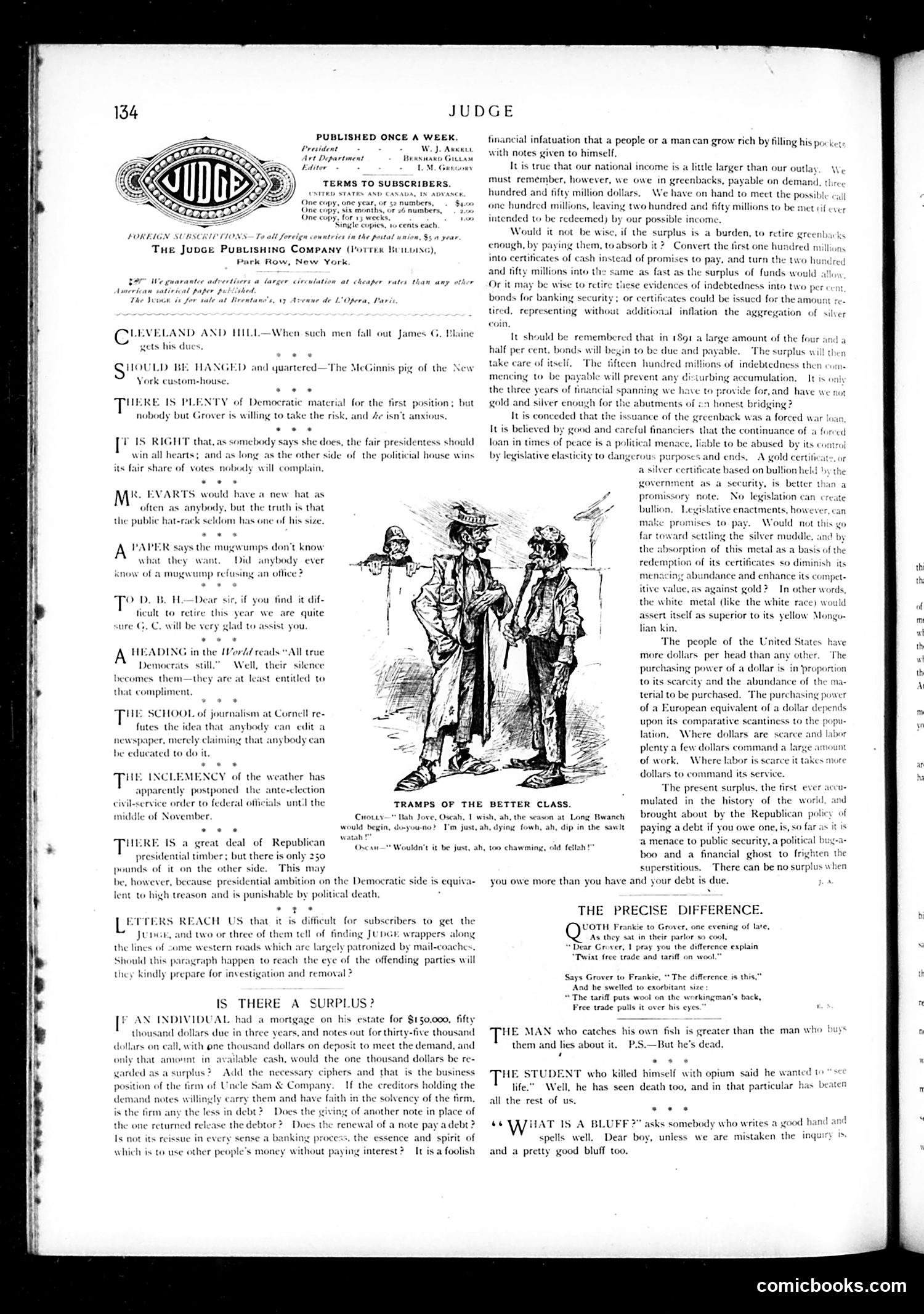
This cartoon satirizes wealthy men experiencing financial hardship—the "better class" now reduced to begging. The three figures, dressed in tattered finery with shabby top hats and coats, represent formerly prosperous gentlemen now impoverished, likely due to the financial crisis referenced in the surrounding text about currency and debt. The joke targets the hypocrisy of the wealthy: they once looked down on actual vagrants, yet economic collapse has made them indistinguishable from street beggars. The caption's irony—calling them the "better class" while depicting them as literal tramps—mocks both their lost status and society's class pretensions. The surrounding editorial discusses currency surplus, financial instability, and debt management, suggesting this cartoon comments on contemporary economic anxiety affecting even the affluent.
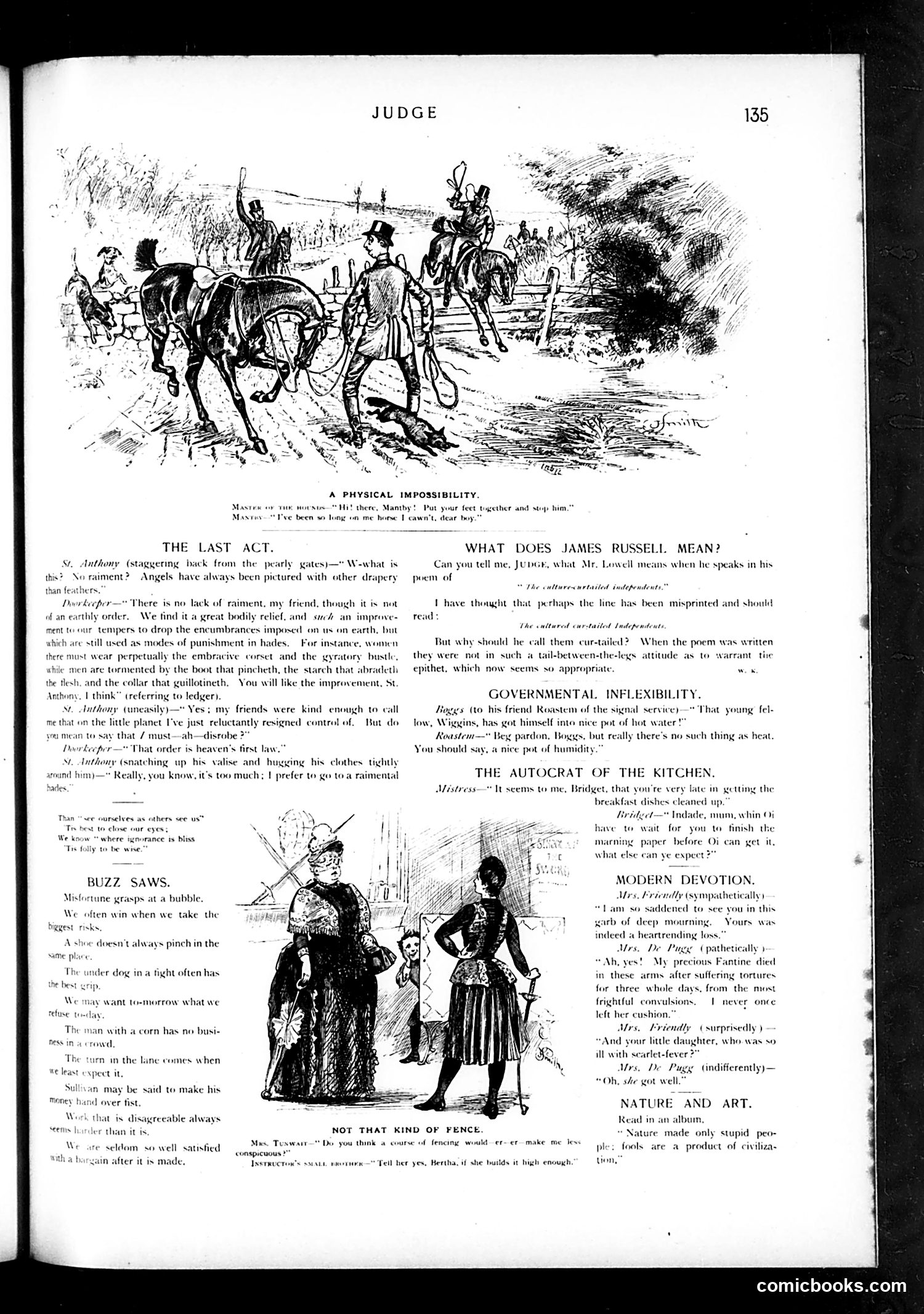
This page contains multiple satirical sketches typical of late 19th-century American humor: **"A Physical Impossibility"** depicts St. Anthony arriving at heaven's gates, distressed to learn that angels must disrobe—contradicting his earthly understanding. The joke mocks Victorian prudishness by suggesting heaven itself enforces modesty, making nakedness seem absurd even to the recently deceased. **"The Autocrat of the Kitchen"** shows a mistress complaining to her servant Bridget about late breakfast dishes. Bridget's excuse—waiting for the mistress to finish reading the morning paper—satirizes the servant's clever deflection of blame, a common domestic comedy trope. **"Modern Devotion"** ridicules upper-class sentimentality: Mrs. De Pug mourns her dog "Fantine" with theatrical grief, while her daughter's scarlet fever recovery gets a dismissive "she got well." The satire targets excessive pet-mourning among wealthy women as vapid and performative. The page also includes "Buzz Saws"—brief philosophical quips—and literary commentary on James Russell Lowell's poetry. The illustrations use period-appropriate wood-engraving style typical of Judge magazine's visual humor.
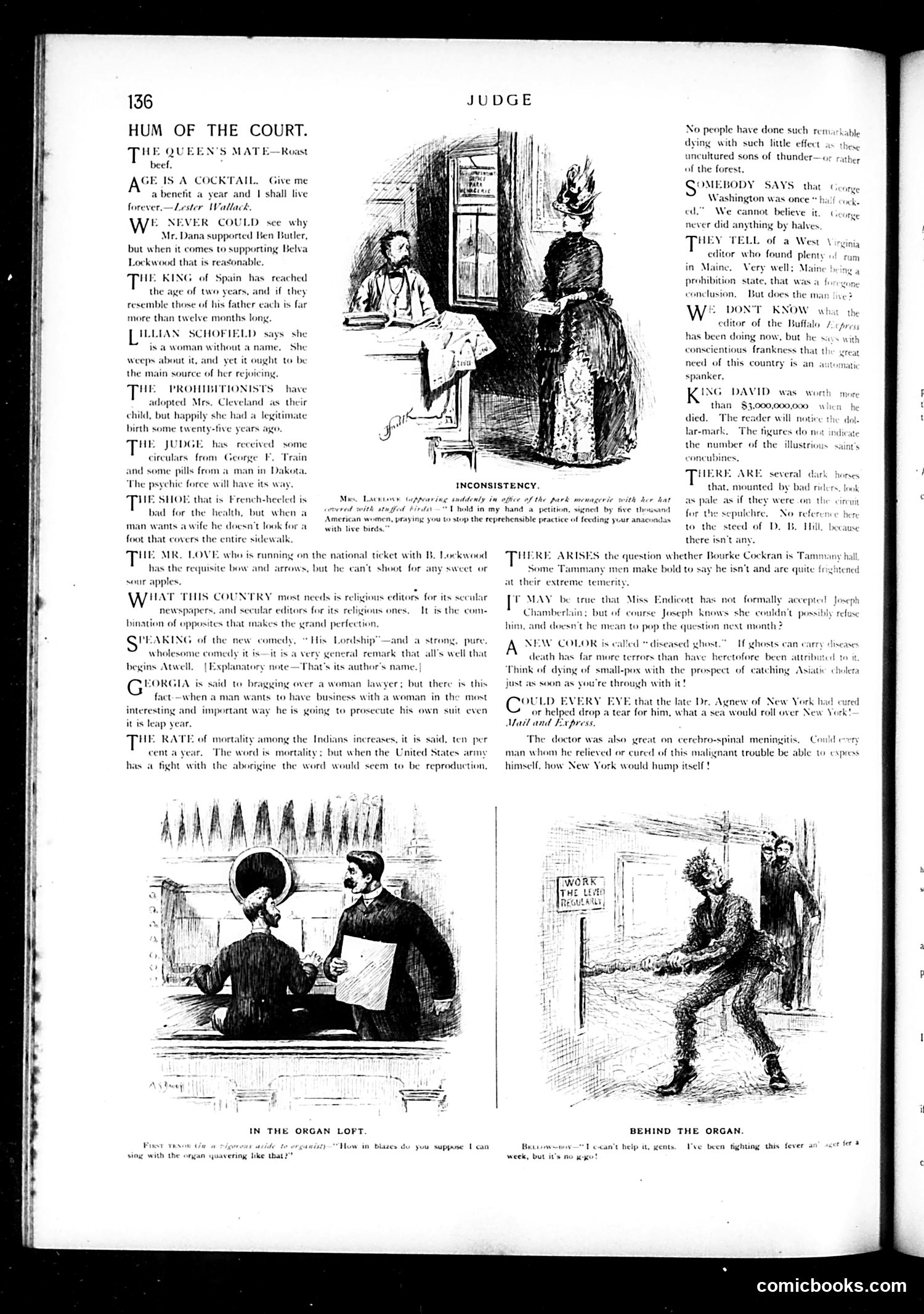
This page from Judge contains brief satirical quips and social commentary typical of the magazine's "Hum of the Court" section, along with three cartoons. **Key References:** The text mocks contemporary figures and issues: Belva Lockwood (early women's rights activist/presidential candidate), Ben Butler (controversial general/politician), Mrs. Cleveland (wife of President Grover Cleveland, adopted by prohibitionists), and George F. Train (eccentric reformer). References to King David's wealth and concubines, Spanish royalty, and a "Bourke Cockran" question (likely about Tammany Hall politics) reflect late-19th-century concerns. **The Cartoons:** - "In the Organ Loft" depicts someone singing poorly with organ accompaniment—a simple joke about bad musical performance - "Behind the Organ" shows a figure apparently hiding, with dialogue suggesting illness ("fighting this fever") - The main illustration shows a woman visitor meeting a seated man, captioned "Inconsistency"—likely satirizing hypocrisy in courtship or social relations The overall tone is gossipy and cynical about politics, marriage, and public figures.
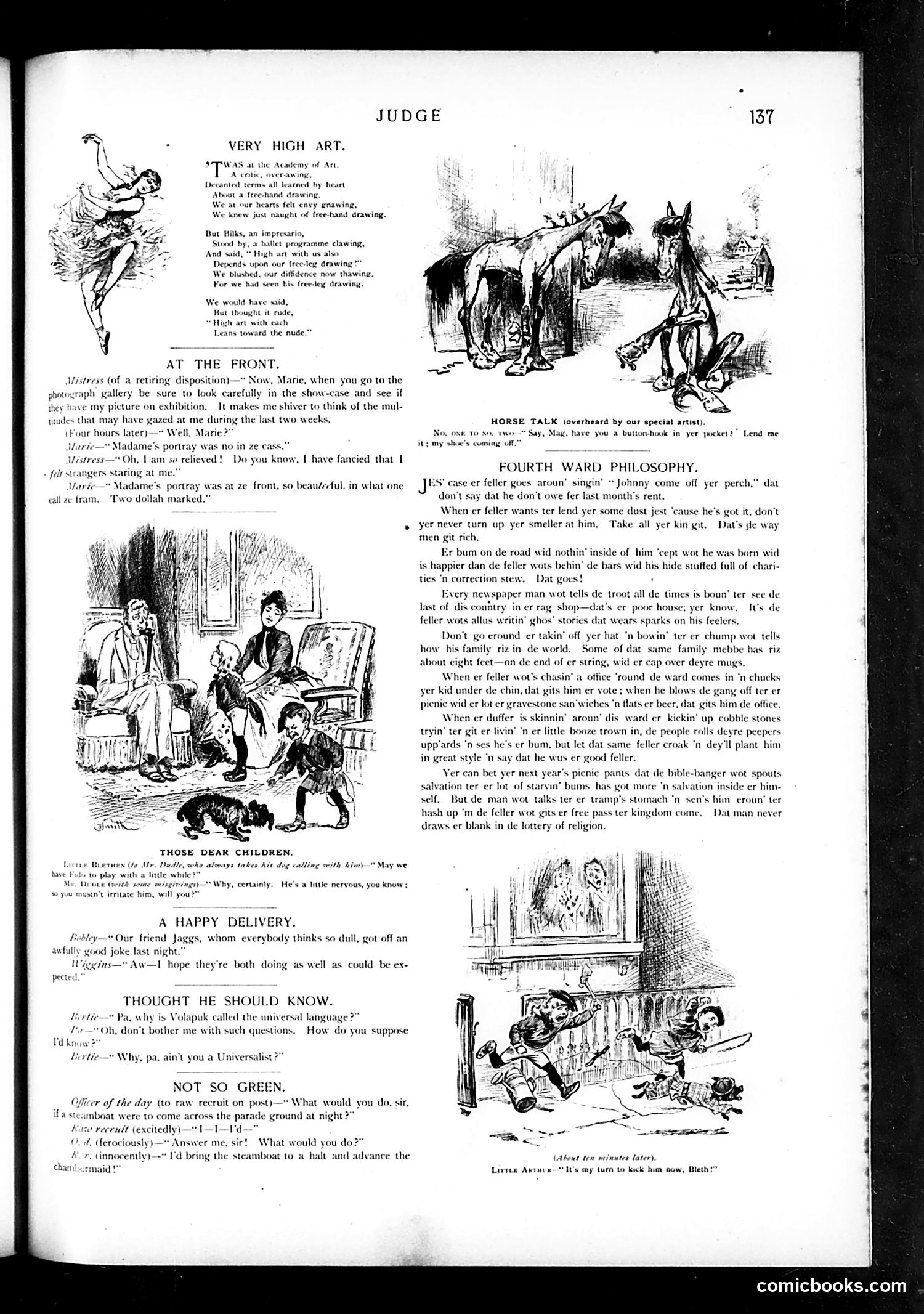
This page contains several satirical sketches mocking various social pretensions and absurdities of the era: **"Very High Art"** ridicules art criticism and ballet terminology—critics use pretentious language about "freehand drawing" while a showman named Bilks cynically refers to dancers' "free-leg drawing" (leg kicks), suggesting entertainment and high art are equally vapid. **"At the Front"** jokes about a woman's vanity at an art exhibition—she worries strangers gazed at her portrait, only to learn it hung at the front in an ornate frame, implying people admired the frame, not her likeness. **"Fourth Ward Philosophy"** presents working-class street wisdom in dialect, offering cynical observations: poor honest men are happier than imprisoned ones; newspapers printing truth go bankrupt; politicians buying votes with beer and sandwiches get elected; even criminals receive respectable burials. The other sketches are brief humorous dialogues about children, jokes, religion, and military incompetence—all characteristic of Judge's light satirical style targeting middle-class vanities and social hypocrisy.
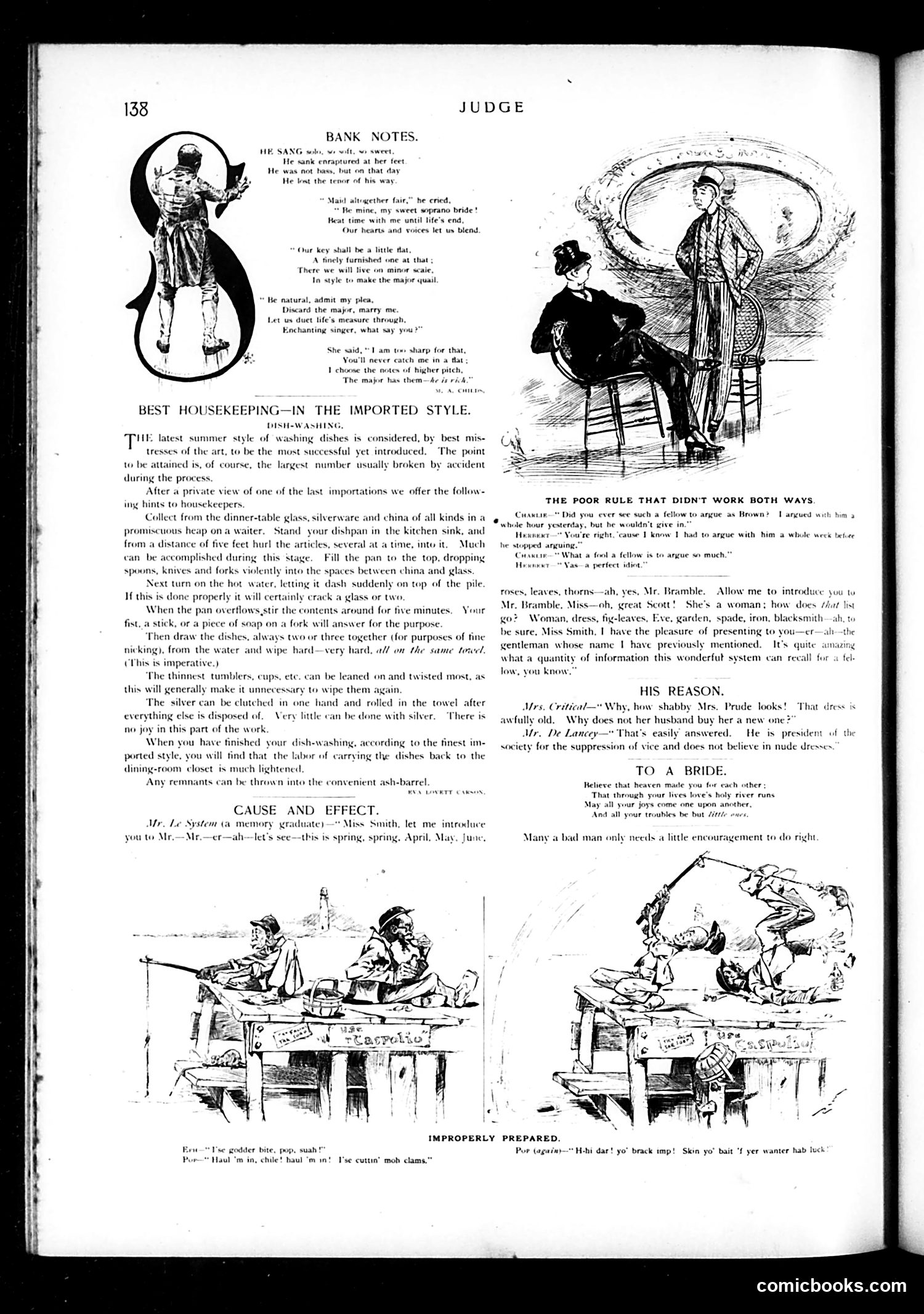
This page contains several satirical pieces typical of early 20th-century American humor: **"Bank Notes"** is a musical pun—a male singer proposes to a female opera singer using musical terminology ("flat," "major," "pitch"). She refuses because she won't be caught "in a flat" (both a musical note and living quarters), preferring "higher pitch" and "the major." **"Best Housekeeping—In the Imported Style"** sarcastically instructs housewives on the "latest summer style" of washing dishes by deliberately breaking them. It's mock advice ridiculing either careless servants or fashionable incompetence. **"The Poor Rule That Didn't Work Both Ways"** depicts two men arguing—one boasts he never loses arguments with "Brown," while the other notes Brown stubbornly refuses to concede even when wrong. The humor lies in the contradiction. **"His Reason"** jokes about Mrs. Prude looking shabby; she dresses shabbily because her husband, a vice-suppression society president, disapproves of fashionable dress. The cartoons use visual exaggeration typical of Judge's style to emphasize social commentary.
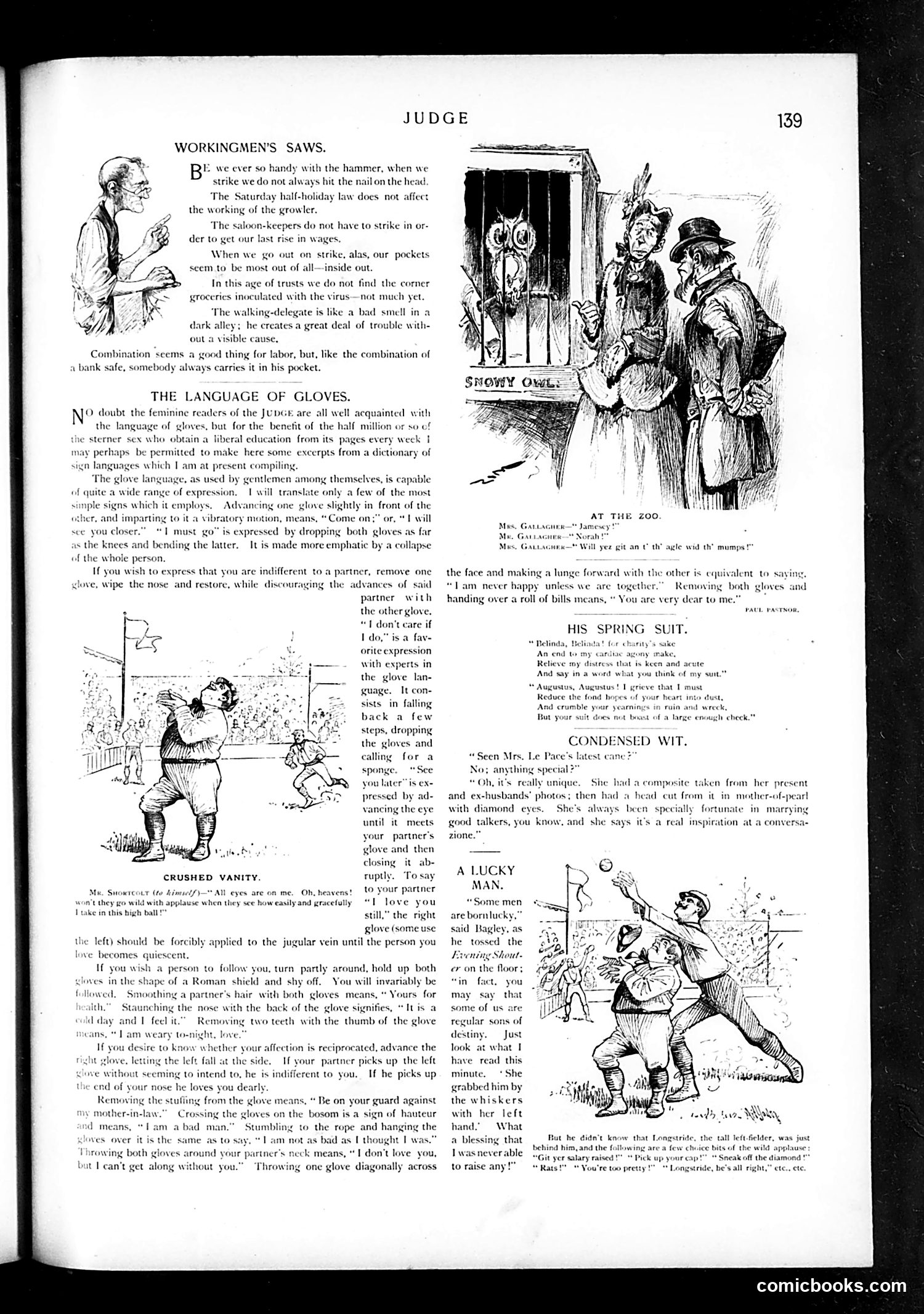
This page collects several satirical pieces mocking American working-class and social life in the Gilded Age. **"Workingmen's Saws"** presents cynical observations about labor organizing and strikes—workers' pockets empty when on strike, walking delegates cause trouble without visible cause, and combinations (trusts/unions) benefit the wealthy who "carry it in his pocket." **"The Language of Gloves"** is humorous pseudo-anthropological satire, describing elaborate "meanings" conveyed through glove gestures (advancing gloves = "come on," dropping them = surrender, etc.). This mocks both courtship rituals and the pretension of "refined" society codes. **"Crushed Vanity"** shows a man admiring himself, unaware of ridicule—typical satire about vanity. **"At the Zoo"** appears to mock working-class visitors to public attractions. **"His Spring Suit," "Condensed Wit,"** and **"A Lucky Man"** are brief humorous observations about fashion, relationships, and luck. Overall, the page satirizes labor disputes, social pretension, courtship conventions, and working-class life with gentle but pointed mockery.
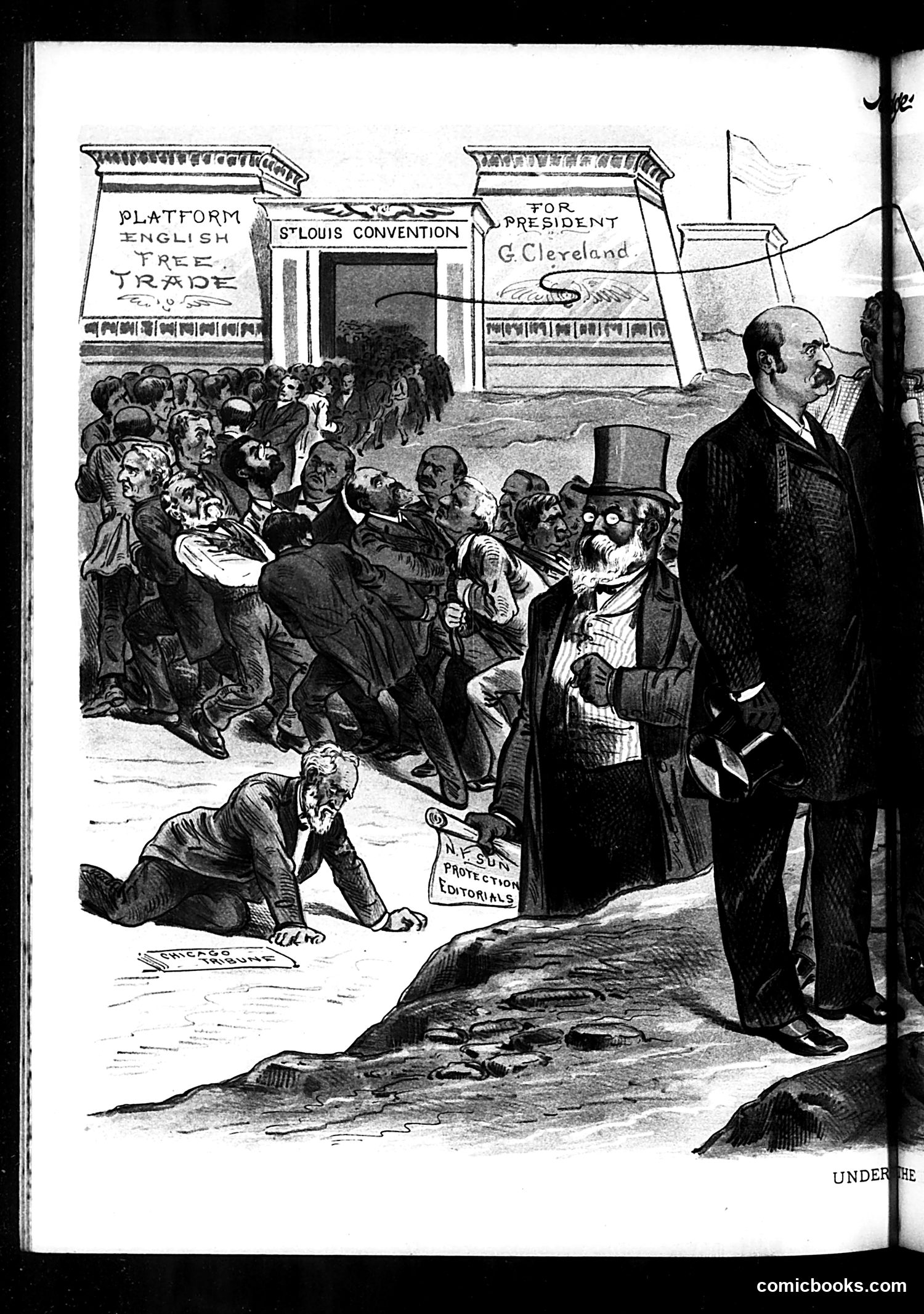
This satirical cartoon depicts the 1884 St. Louis Democratic Convention, where Grover Cleveland was nominated for president. The cartoon shows a crowded, chaotic convention scene with the platform promoting "English Free Trade" on the left and supporting Cleveland's candidacy on the right. The figure crawling on the ground appears to represent opposition to free trade policies—likely depicting concerns about tariff reduction harming American industry. The well-dressed man standing apart on the right observes the turmoil with detachment. The satire suggests the Democratic convention was turbulent regarding economic policy, specifically the tension between free-trade advocates and protectionists. The cartoon critiques either Cleveland's nomination despite trade policy disagreements, or mocks the disarray surrounding trade platform debates at the convention.
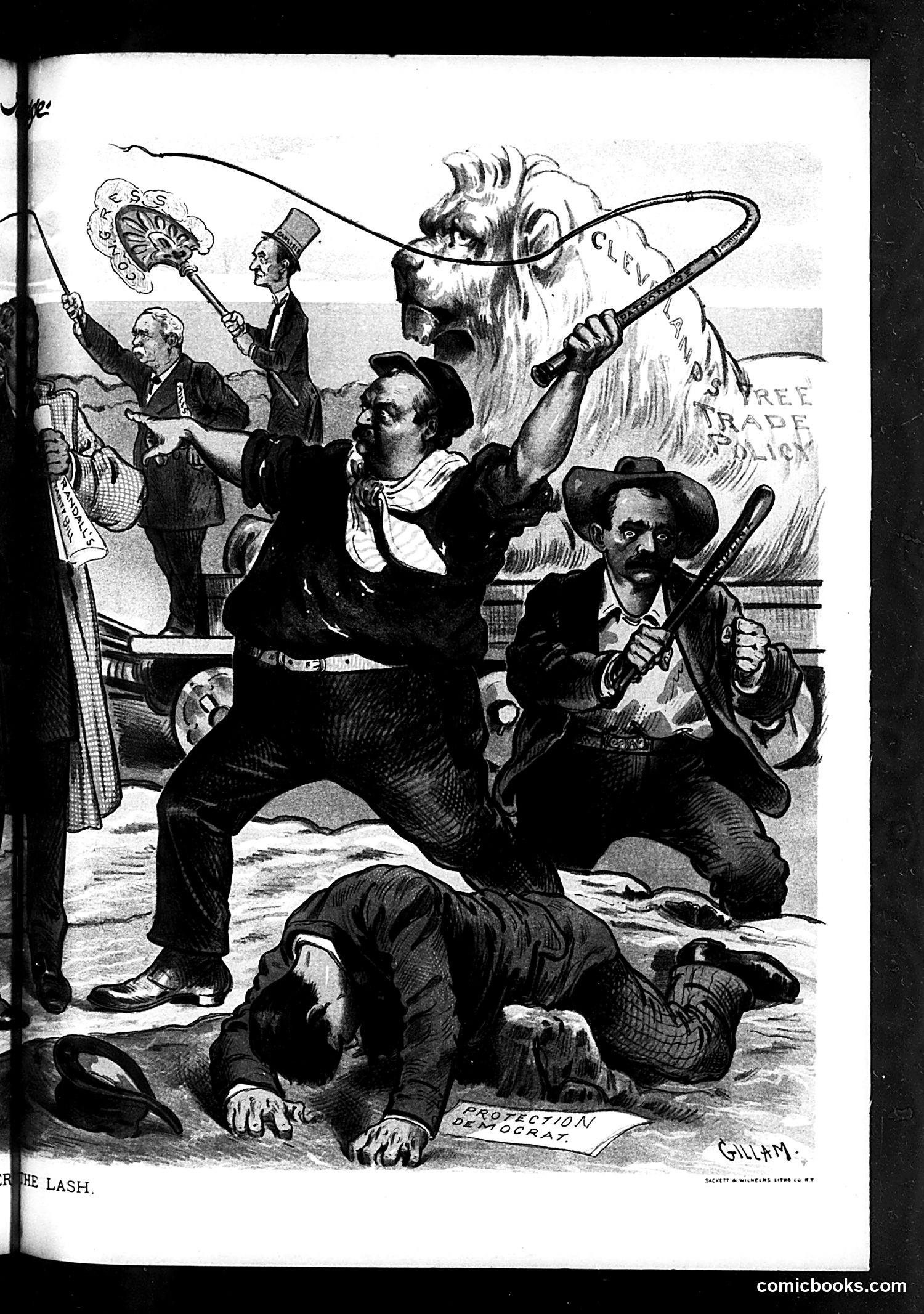
This cartoon depicts what appears to be a violent confrontation between working-class men (wielding bats and fishing rods as weapons) and well-dressed gentlemen in top hats. A large caricatured figure labeled "FREE TRADE" dominates the background, being used as a weapon by the upper-class figures. On the ground lies a figure labeled "PROTECTION OF DEMOCRACY." The satire likely critiques how wealthy elites weaponized free-trade policies against working-class interests and democratic protections during the Gilded Age. The "lash" suggests brutal economic oppression disguised as economic policy. The cartoon attacks the contradiction between claimed democratic values and actual economic practices that harmed ordinary workers.
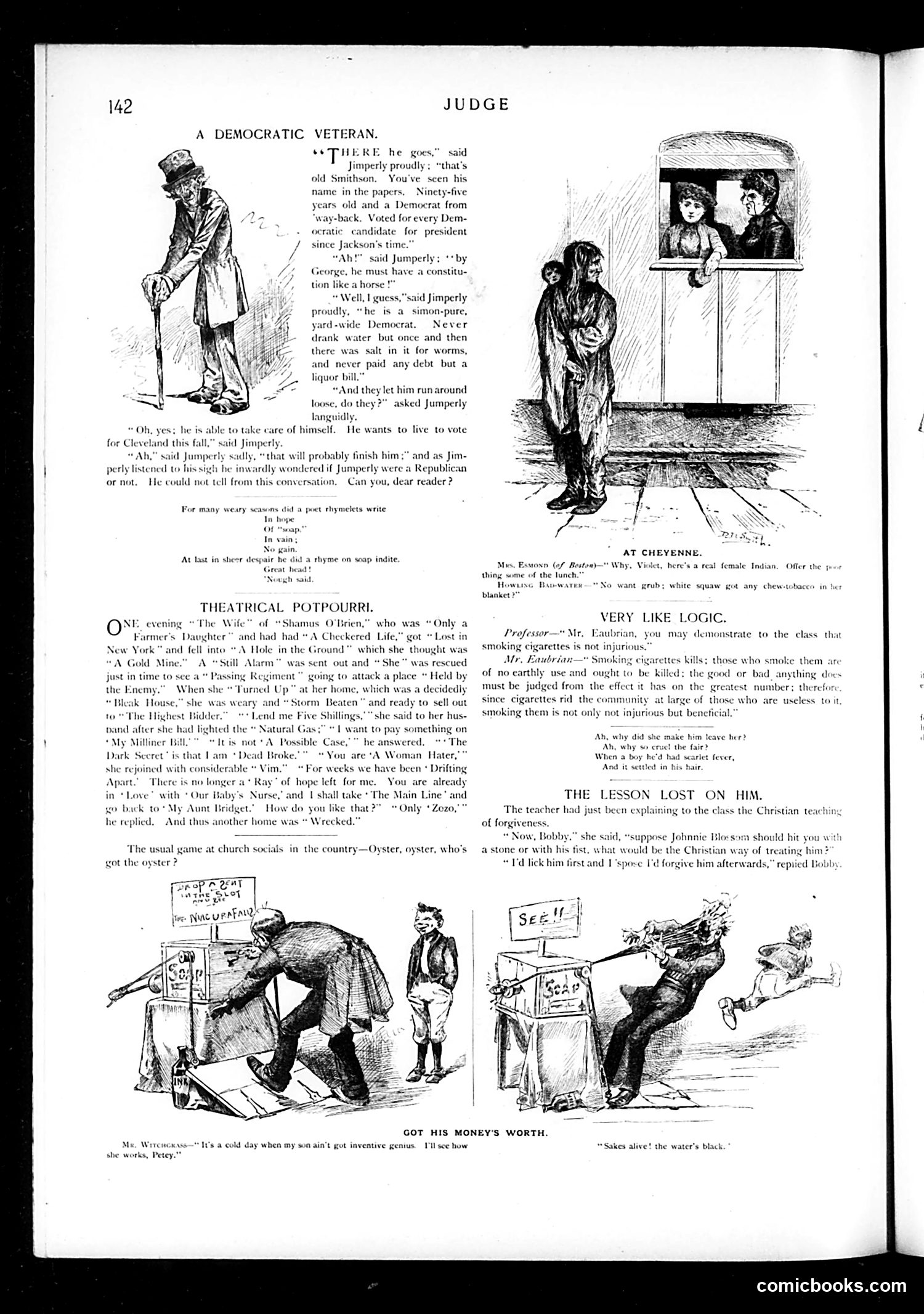
This Judge magazine page contains several satirical pieces: **"A Democratic Veteran"** mocks an elderly Democrat (Smithson) who has voted Democratic since Jackson's time and never paid debts except liquor bills. The humor targets stereotypes of loyal party voters as morally questionable characters, while the dialogue structure leaves readers uncertain whether the speakers themselves are Republican or Democrat—suggesting blind partisanship on both sides. **"Theatrical Potpourri"** is absurdist satire listing melodramatic play titles strung together ("Only a Farmer's Daughter," "A Checkered Life," "A Hole in the Ground"), parodying overwrought Victorian theater plots. **"Very Like Logic"** satirizes faulty reasoning: a student "logically" proves cigarette smoking is beneficial because smokers die, removing "useless" people from society. The other cartoons mock social pretension ("At Cheyenne" features tourists condescending to Native Americans) and parental gullibility ("Got His Money's Worth"). The satire targets period attitudes: partisan politics, melodrama, logical fallacies, and class-based contempt.
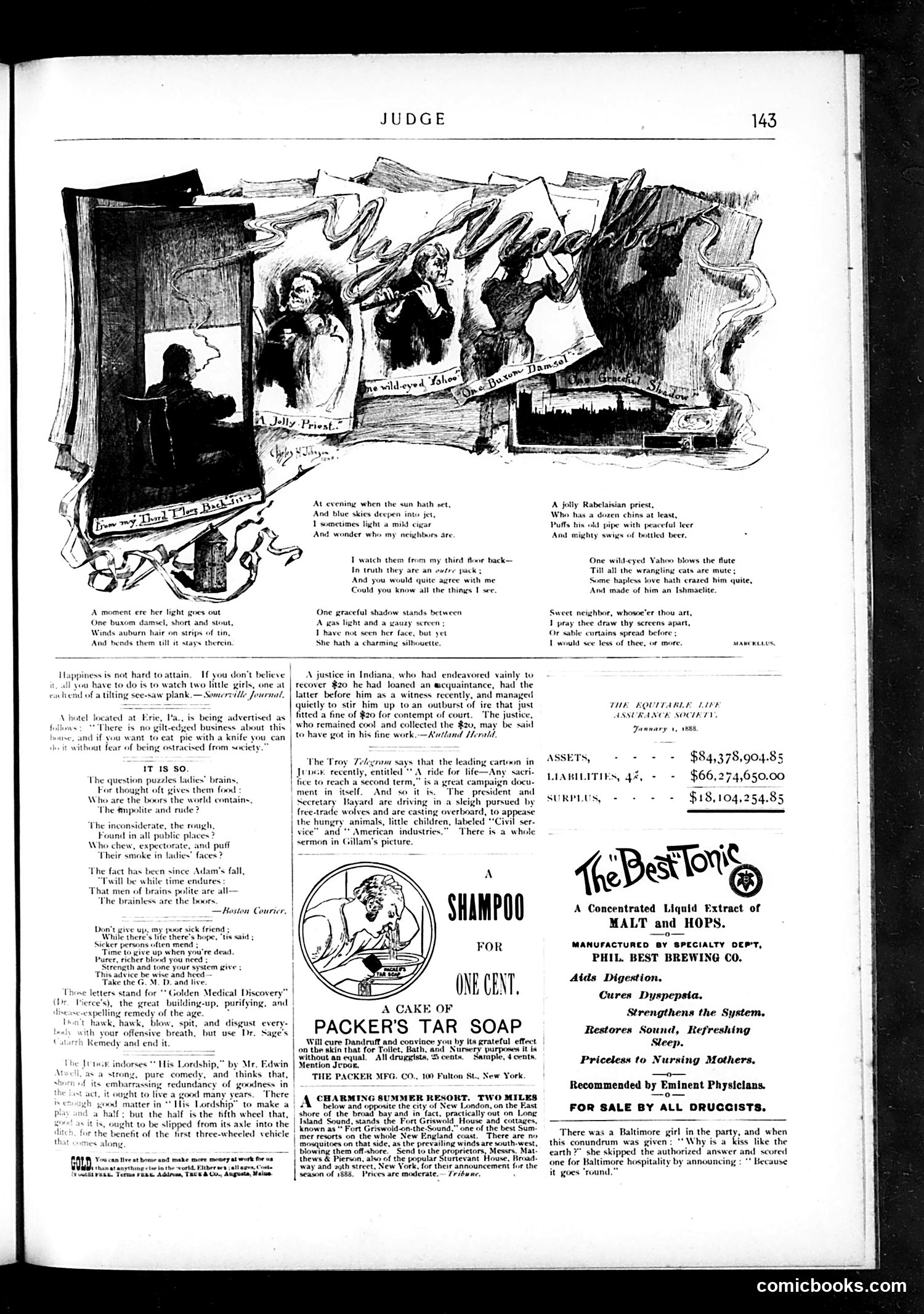
This page combines satirical poetry and advertisements typical of 1880s Judge magazine. **The Main Cartoon:** The illustration at top depicts a man observing his neighbors through windows—voyeuristic vignettes of urban life. The accompanying poem by Makelius mocks the mundane domestic dramas visible from a third-floor window: women curling hair, a fat priest drinking, a lovesick fool playing flute badly, etc. The satire targets Victorian-era nosiness and the absurdity of apartment-dwelling neighbors' exposed lives. **Other Content:** The page includes moralistic short pieces ("IT IS SO" criticizes rude, uncouth men; others mock bad manners), an anecdote about an Indiana judge cleverly tricking a debtor into contempt charges, and references to political cartoonist Gillam's critique of the Cleveland administration's tariff policy. **Advertisements** occupy significant space, promoting Packer's Tar Soap and "The Best Tonic"—typical patent medicines claiming dubious health benefits. The humor assumes readers' familiarity with urban apartment life and contemporary politics.
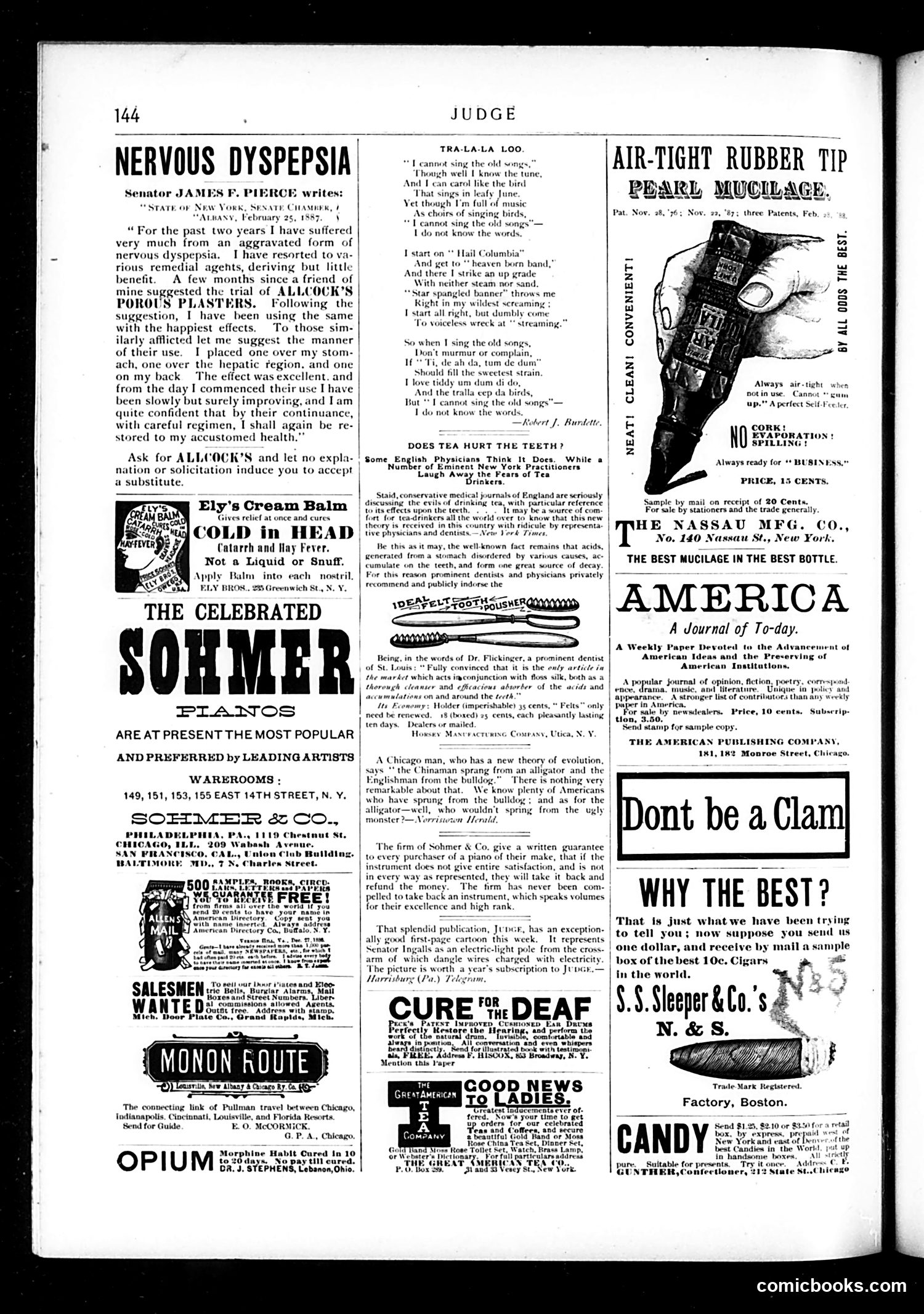
This Judge magazine page (February 1887) is primarily **advertising**, not political satire. The main content includes: **Notable Elements:** - A testimonial from Senator James G. Pierce endorsing Allcock's Porous Plasters for "nervous dyspepsia" (digestive/nervous ailments)—reflecting 19th-century medicine's dubious patent remedies - A poem by Robert J. Burdette about forgetting song lyrics ("Tra-La-La Loo") - Medical debate about whether tea damages teeth - Various product ads: Sohmer pianos, Monon Route railroad, morphine addiction cures, dental products **Historical Context:** This reflects the era's unregulated patent medicine industry, where senators publicly endorsed questionable treatments. The casual advertising of opium and morphine cures is striking to modern readers—these were legal, marketed remedies before federal drug regulation. There are **no political cartoons visible** on this page; it's predominantly classified advertising with some light verse.
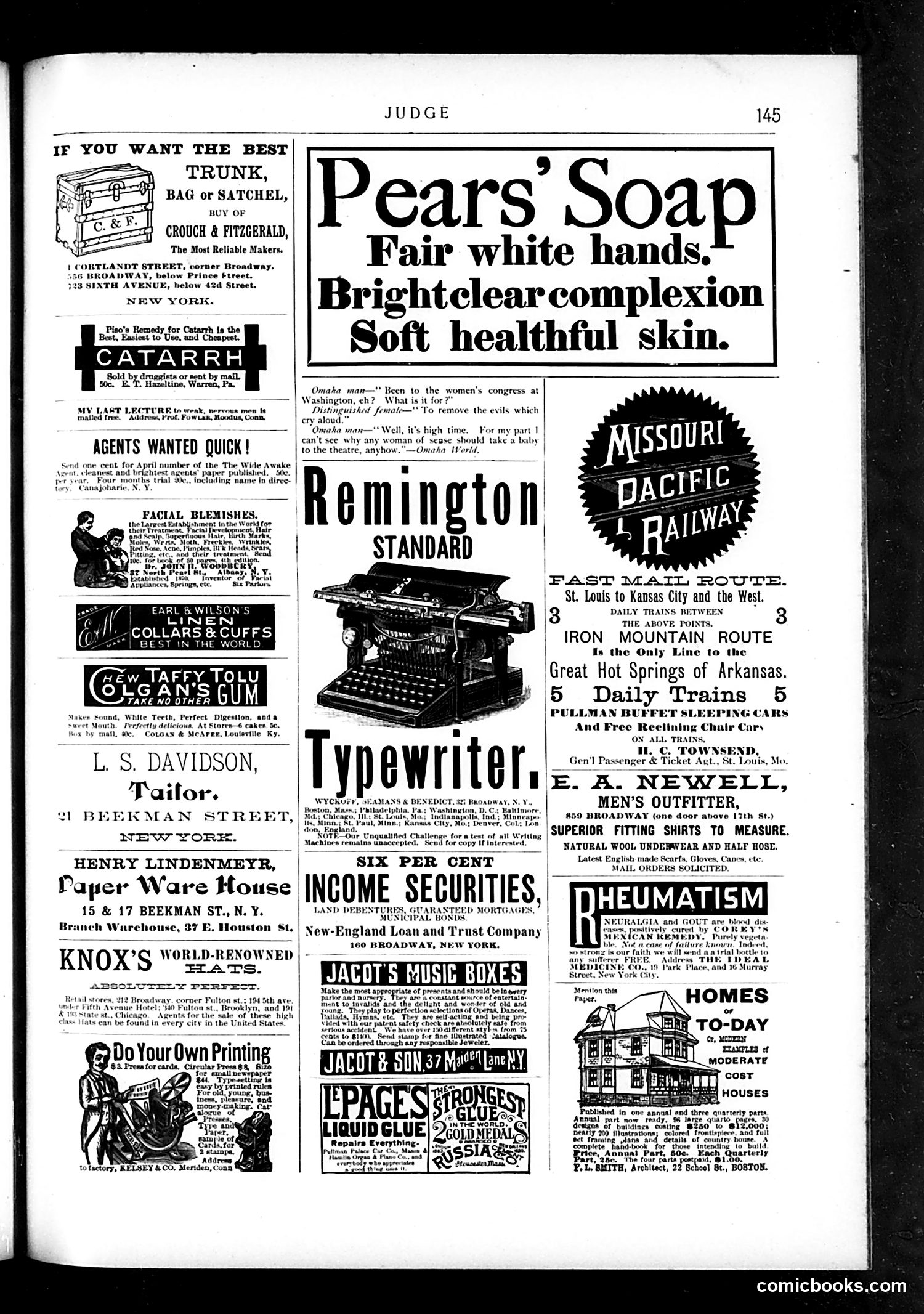
This page is primarily **advertising**, typical of Judge magazine's revenue model. However, it contains one small cartoon joke: ## The Cartoon In the upper right, beneath the Pears' Soap advertisement, there's a brief dialogue: An "Omaha man" asks a woman at a women's congress in Washington: "What is it for?" She responds that the congress exists "to remove the evils which cry aloud." He replies: "For my part I see why any woman of sense should take a baby to the theatre, anyhow." ## The Satire This is a dismissive joke about women's activism and reform movements. The man's non-sequitur response—pivoting to an unrelated complaint about women bringing babies to theaters—mocks the seriousness of women's political organizing. It suggests women's reform efforts are trivial and that men have equally valid (if petty) grievances. The humor relies on belittling women's civic participation, reflecting the magazine's conservative editorial stance on women's suffrage and political engagement.
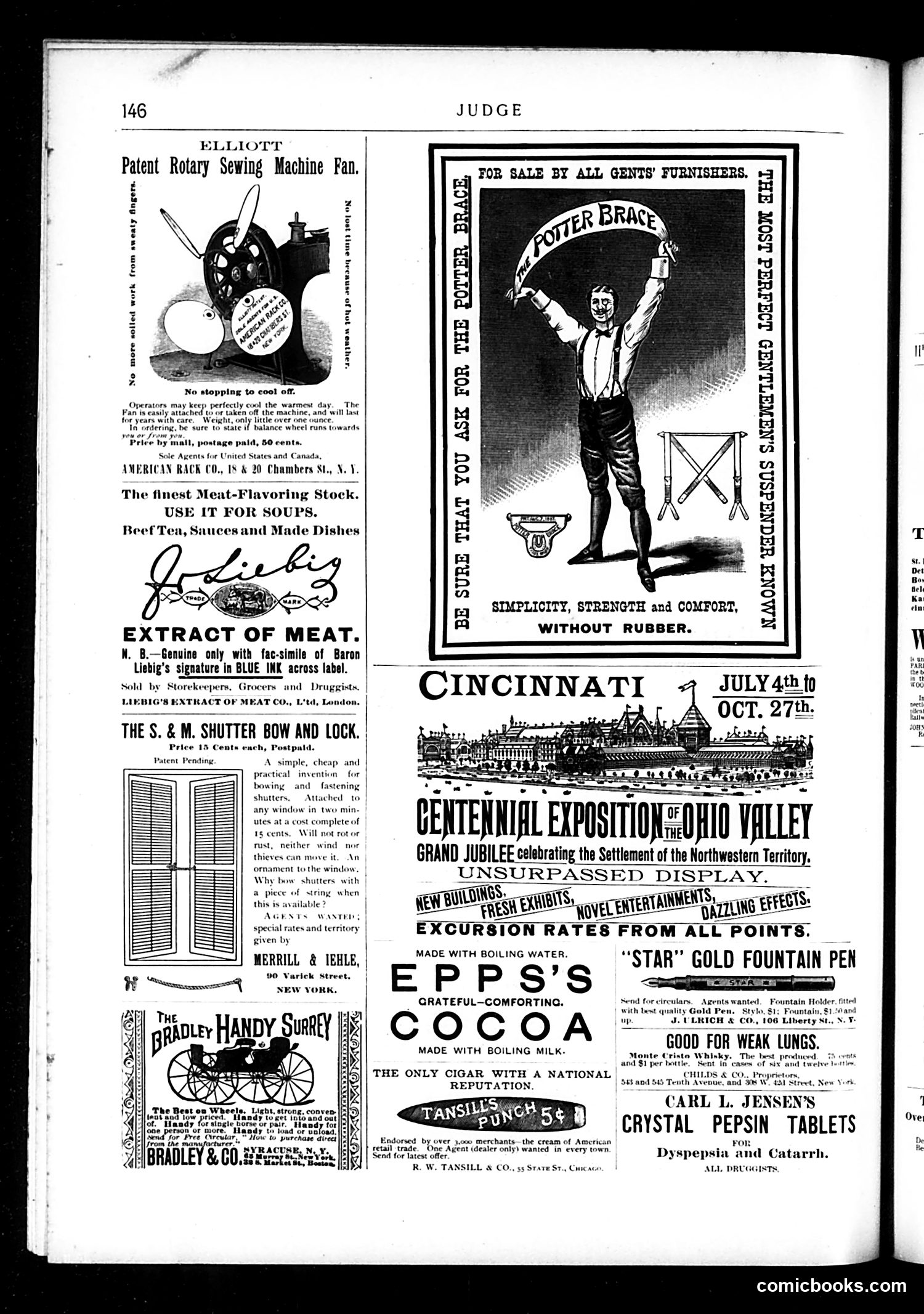
This page is **primarily advertising**, not political satire. It's from Judge's back pages featuring commercial advertisements typical of late 19th-century magazines. The central image—a man in formal dress holding a "Potter Brace" banner—is a product advertisement emphasizing the brace's "simplicity, strength and comfort, without rubber." This was marketed to gentlemen's furnishers as a practical undergarment support. Surrounding ads promote patent products (a sewing machine fan, window locks), food/beverage items (Liebig's meat extract, Epps's cocoa, Tansill's punch cigars), and patent medicines (Crystal Pepsin tablets for "dyspepsia and catarrh"). The Cincinnati Centennial Exposition notice advertises an upcoming fair celebrating Northwestern Territory settlement. **No political cartoon or satire is present.** This appears to be a standard advertising page—common filler in Judge between editorial content. The ads reflect period consumer goods and health products typical of 1880s-90s American commerce.
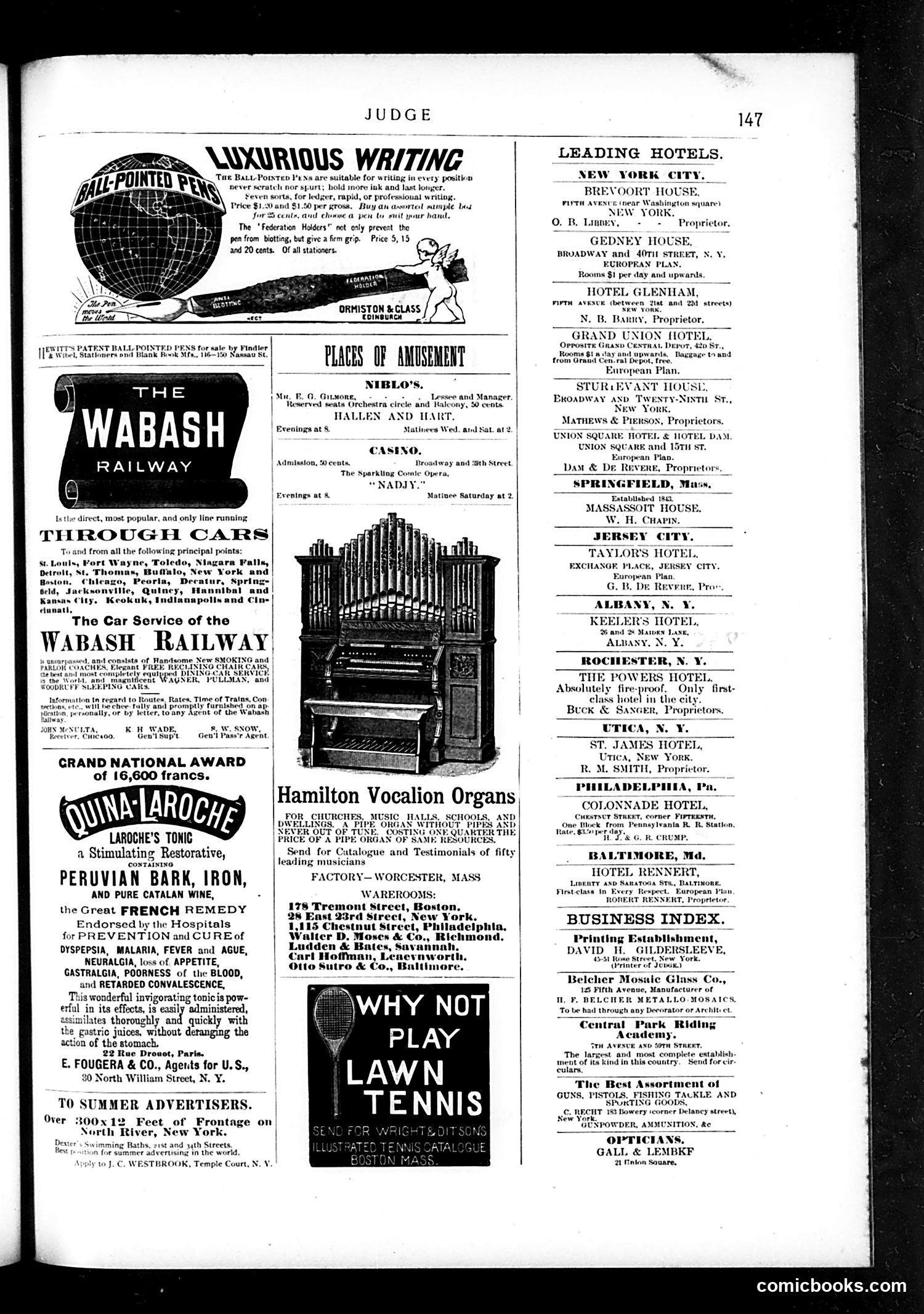
This is primarily an **advertising page** from Judge magazine, not a satirical cartoon page. The content consists almost entirely of commercial advertisements from the late 19th/early 20th century. The largest ads promote: - **Ball-Pointed Pens** — luxury writing instruments - **The Wabash Railway** — transportation service offering through-cars to major American cities - **Hamilton Vocational Organs** — church and music hall instruments - **Laroche's Tonic** — a patent medicine containing Peruvian bark and iron, endorsed by hospitals for treating dyspepsia, malaria, and neuralgia A smaller section titled **"Leading Hotels"** lists accommodations in New York City, Jersey City, Albany, Rochester, Utica, Philadelphia, and Baltimore. The only visual element beyond text is a **pipe organ illustration** advertising Hamilton's instruments. This appears to be a back-of-magazine advertising section rather than editorial content, typical of 19th-century periodicals that relied heavily on advertising revenue.
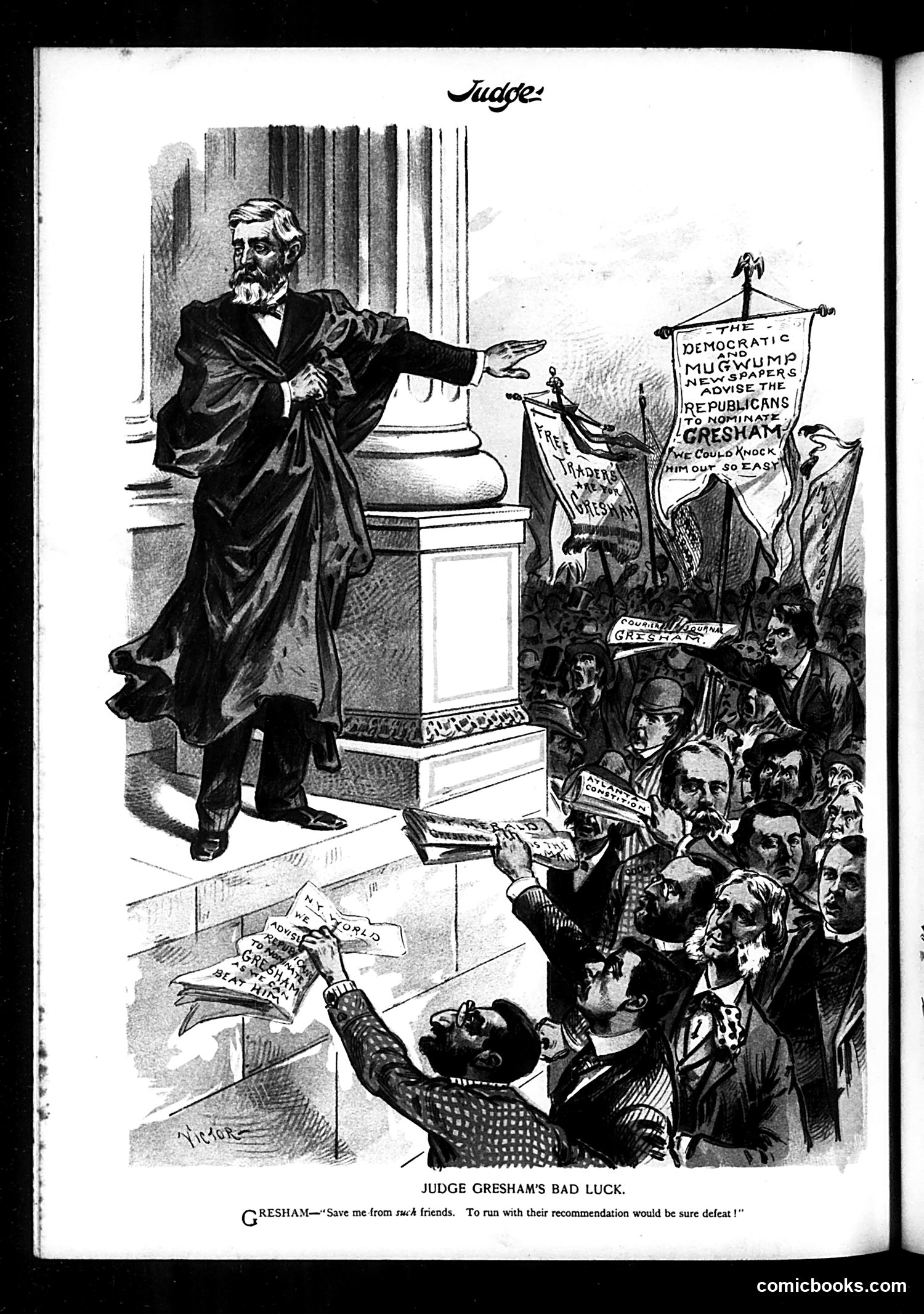
This Judge magazine cartoon satirizes Judge Walter Q. Gresham, a prominent political figure of the late 19th century. The cartoon depicts Gresham standing elevated, rejecting a crowd of Democratic newspaper editors and Republicans who are attempting to nominate him for office. The banners and signs show competing factions—Democratic mugwump newspapers and Republicans—all pushing to support his candidacy. The satire's point: Gresham's dilemma is that endorsement from *either* group would actually harm his chances. He's caught between unwanted supporters, unable to run successfully with backing from either side. This reflects the fractious, unstable political coalitions of the Gilded Age, where party loyalty was fluid and such cross-factional support could be genuinely toxic to a candidate's viability.