
A complete issue · 16 pages · 1888
Judge — June 2, 1888
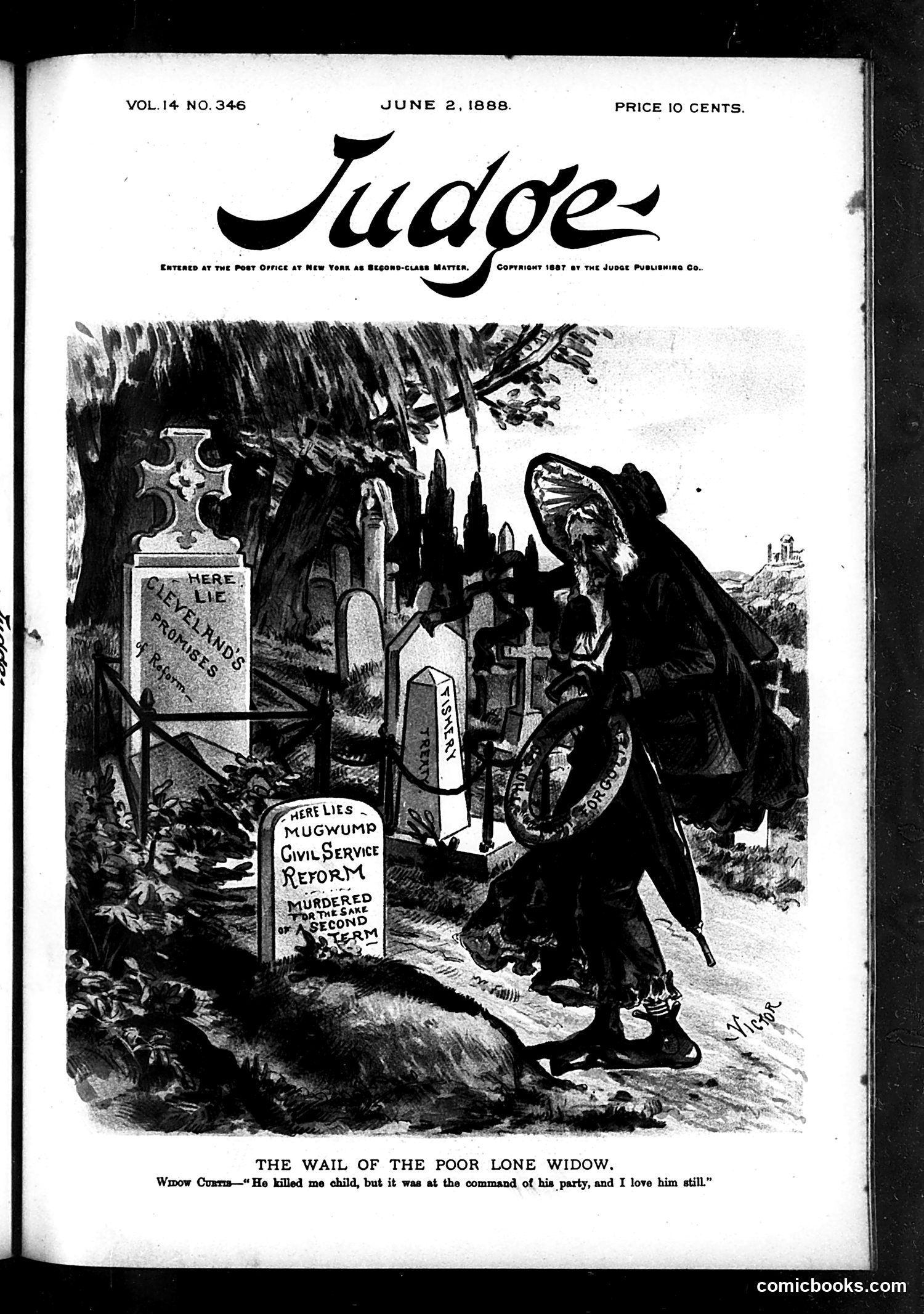
This political cartoon critiques the failure of **Civil Service Reform** in late 19th-century America. The grim reaper stands in a cemetery where reform lies dead, marking its murder "by a second victim." The graves reference a **"Moribund Civil Service Reform"** that despite being championed as a progressive cause, proved ineffective or was killed by political resistance. The widow's lament—"He killed me child, but it was at the command of his party, and I love him still"—suggests the widow Curtis (likely referring to reform advocate George William Curtis) must accept her loss because it served party interests. The cartoon satirizes how patronage and party loyalty continued to override merit-based government hiring despite reform efforts.
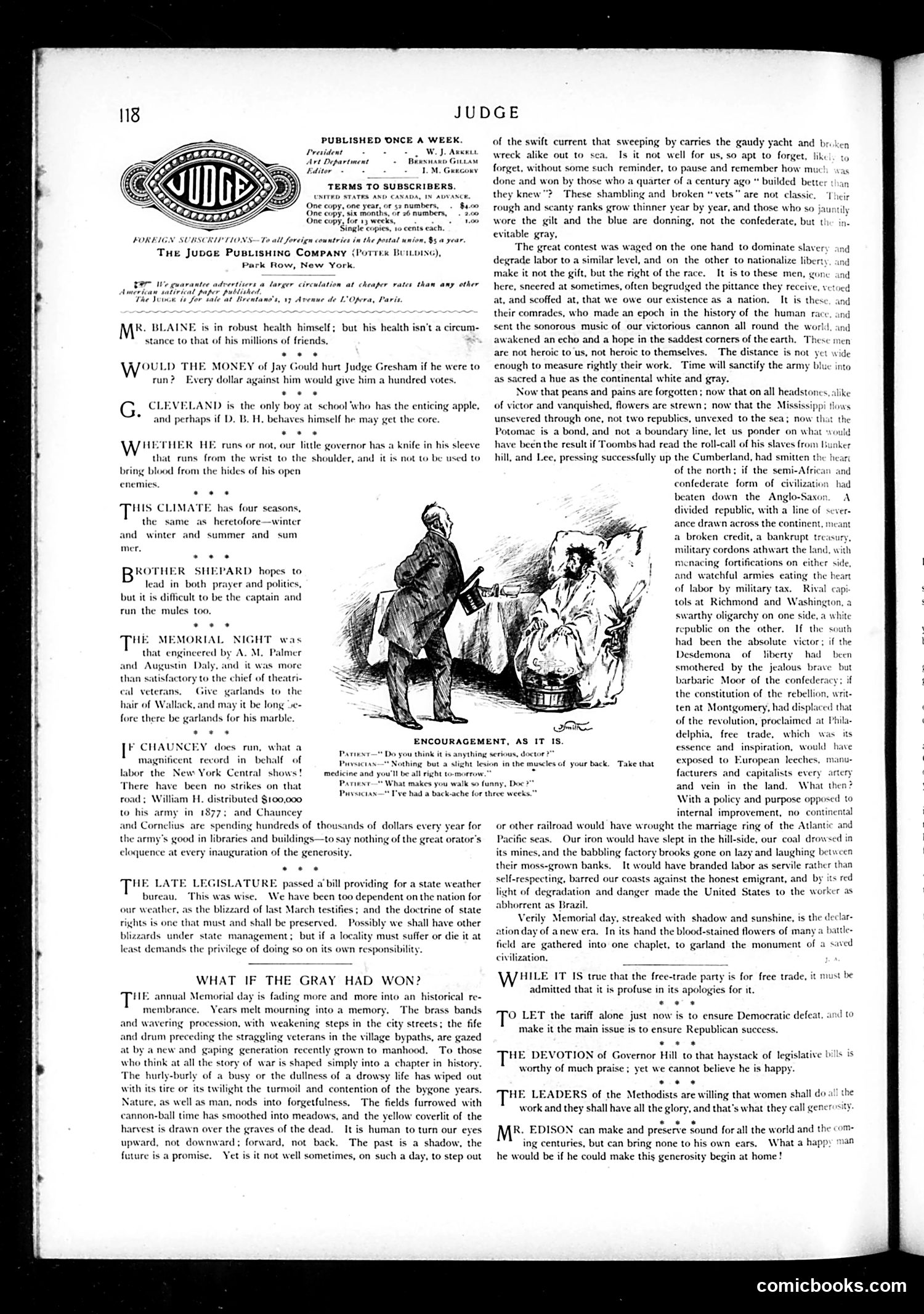
This page contains editorial commentary rather than a cartoon. The illustration shows two figures in what appears to be a Civil War-era scene, depicting "Encouragement, As It Is" — likely satirizing how soldiers were motivated during the conflict. The text discusses post-Civil War issues: Northern vs. Southern reconciliation, economic policy (tariffs), and competing visions for Reconstruction. References to "Lee," "Richmond," and "the confederacy" confirm this setting. Key satire targets include railroad expansion, labor disputes, and whether free trade or protective tariffs best serve the nation. The writing mocks both Democratic and Republican positions on these economic matters, suggesting hypocrisy in how leaders handled post-war recovery and workers' interests. The page reflects Judge's role as a political humor magazine engaging contemporary 1870s-era debates.
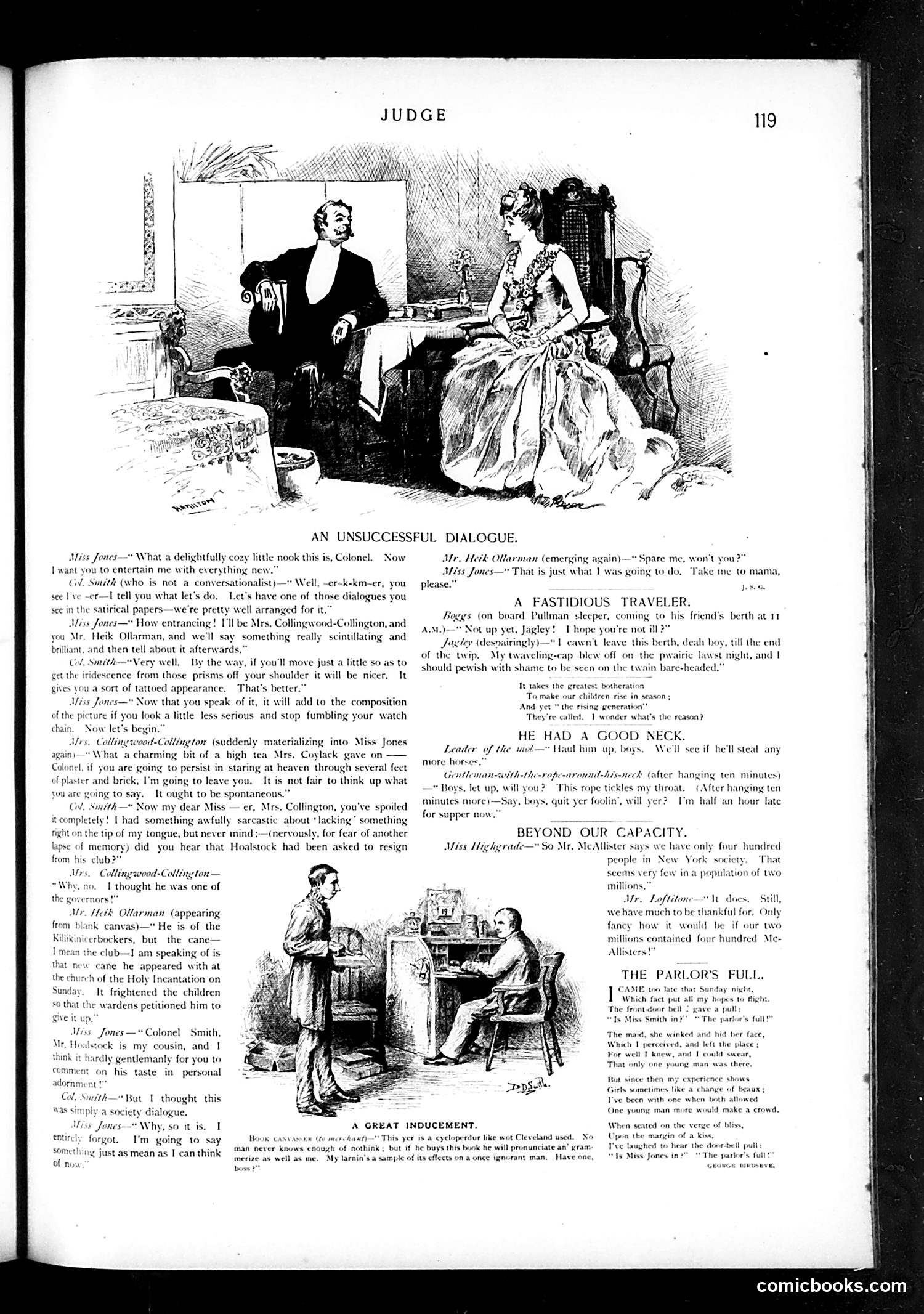
This page contains several short satirical dialogues and vignettes typical of Judge's humor: **"An Unsuccessful Dialogue"** mocks pretentious society conversation. A colonel and Miss Jones attempt to create witty "satirical paper" dialogue but fail—the colonel keeps interrupting with mundane observations (prism iridescence, watch chains) and gossip about someone's resignation from a club, completely derailing any clever repartee. The satire targets both the artificiality of high-society small talk and the magazine's own genre of forced comedic dialogue. The remaining pieces are brief comedic sketches: a fastidious traveler too embarrassed to leave his berth bareheaded after losing his cap; a hangman's victim with a notably tough neck; and social commentary on New York's exclusive "400" society circle versus the broader population. **The satire's target:** Gilded Age pretension—both the stilted conversation rituals of the wealthy and society's obsession with status markers. The humor relies on readers' familiarity with contemporary social conventions and Judge's regular dialogue-format pieces.
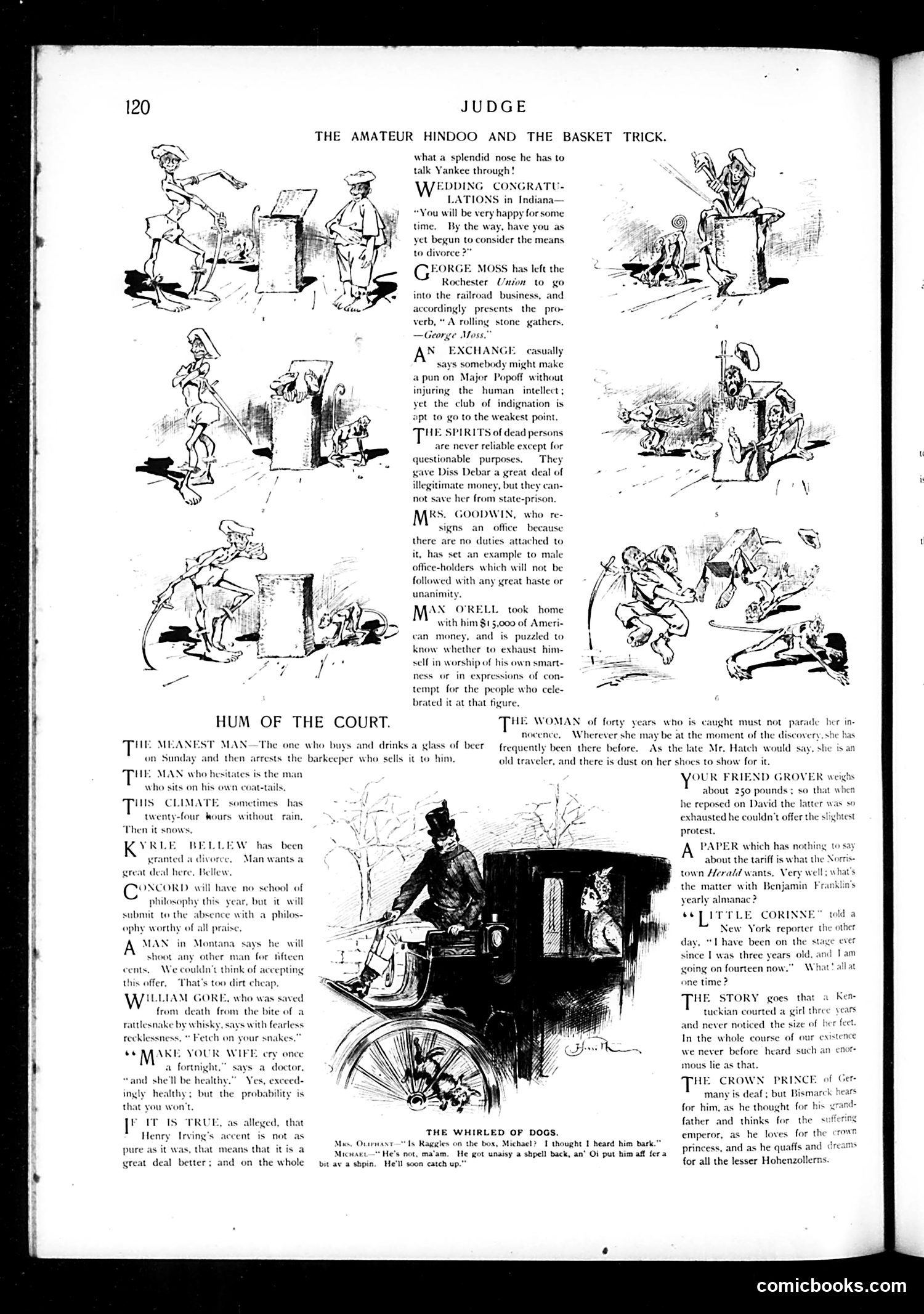
This page from *Judge* contains satirical "court" humor and brief social commentary typical of the publication. The cartoons at top left, labeled "The Amateur Hindoo and the Basket Trick," appear to mock a magician or performer doing illusion tricks—the caricatured figure with exaggerated features represents a stereotyped "Oriental" entertainer, reflecting the period's crude ethnic humor. Below, "Hum of the Court" collects brief witticisms mocking contemporary figures and social types: the meanest man (who arrests bartenders), a man who hesitates, climate extremes, and divorces. References to real people appear—George Moss (left Rochester newspaper for railroads), Kyrie Bellew (actress granted divorce), William Gore (rattlesnake bite survivor), and Benjamin Franklin's almanac. A large illustration shows a carriage scene labeled "The Whirled of Dogs," likely punning on "world." The page's humor relies on wordplay, topical allusions, and period social prejudices rather than sustained narrative, typical of *Judge's* format.
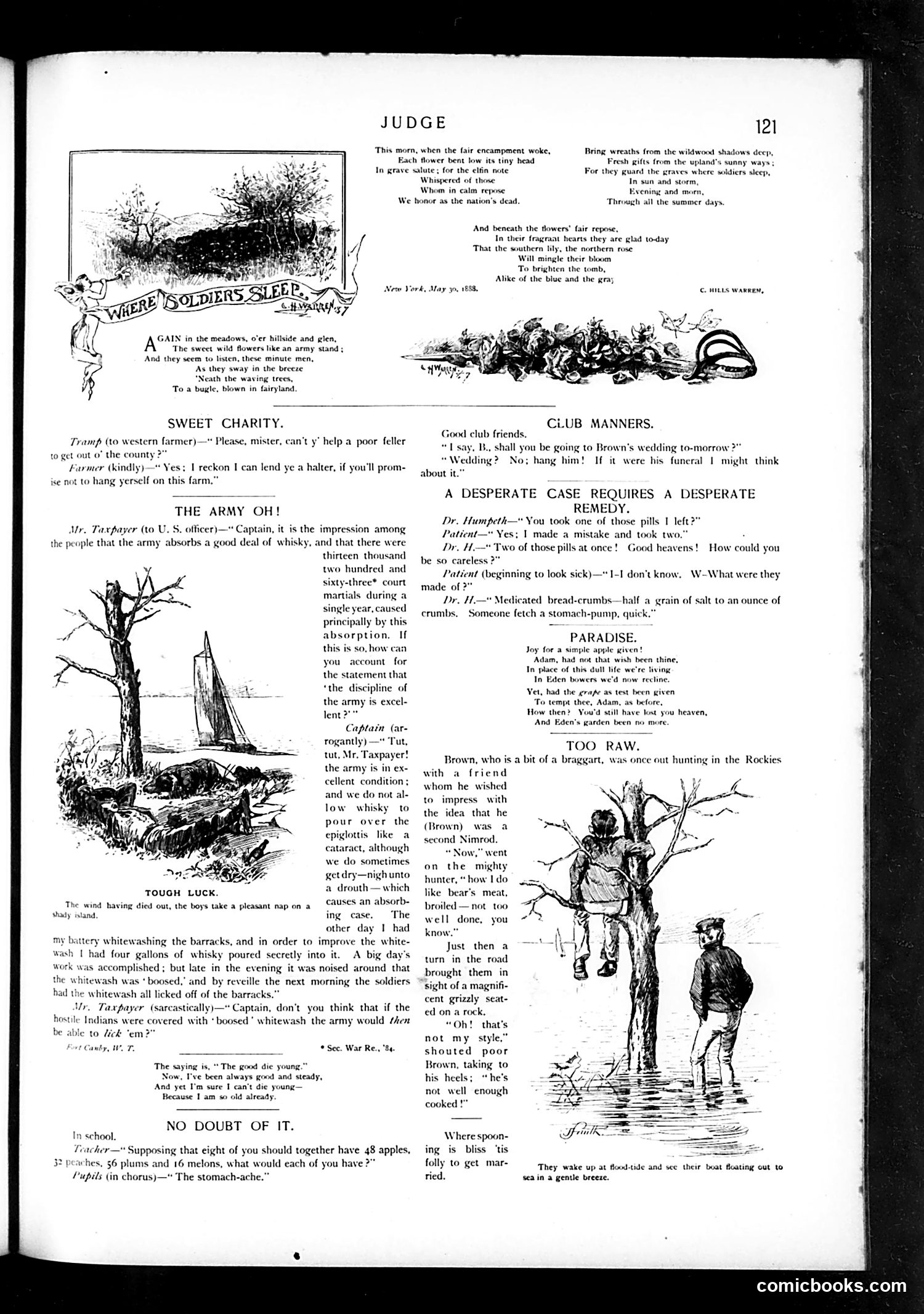
This page contains Civil War memorial verse ("Where Soldiers Sleep"), humorous anecdotes, and satirical commentary typical of Judge's mix. The main satirical content criticizes **military discipline and whisky consumption**. A taxpayer confronts an army captain about widespread drinking, noting 13,260 court-martials supposedly caused by alcohol absorption. The captain deflects, claiming excellent discipline while admitting soldiers get "dry" and consume whisky excessively—a transparent contradiction meant to mock military leadership's hypocrisy and denial of institutional problems. Secondary jokes include club gossip about weddings, a farmer offering a vagrant a suicide halter ("Sweet Charity"), and a doctor's emergency remedy for accidental pill overdose involving stomach-pumps. "Too Raw" mocks a braggart hunter who boasts about liking bear meat "broiled," then flees in terror upon encountering an actual grizzly. The satirical thrust targets military incompetence, drinking culture, and masculine pretension.
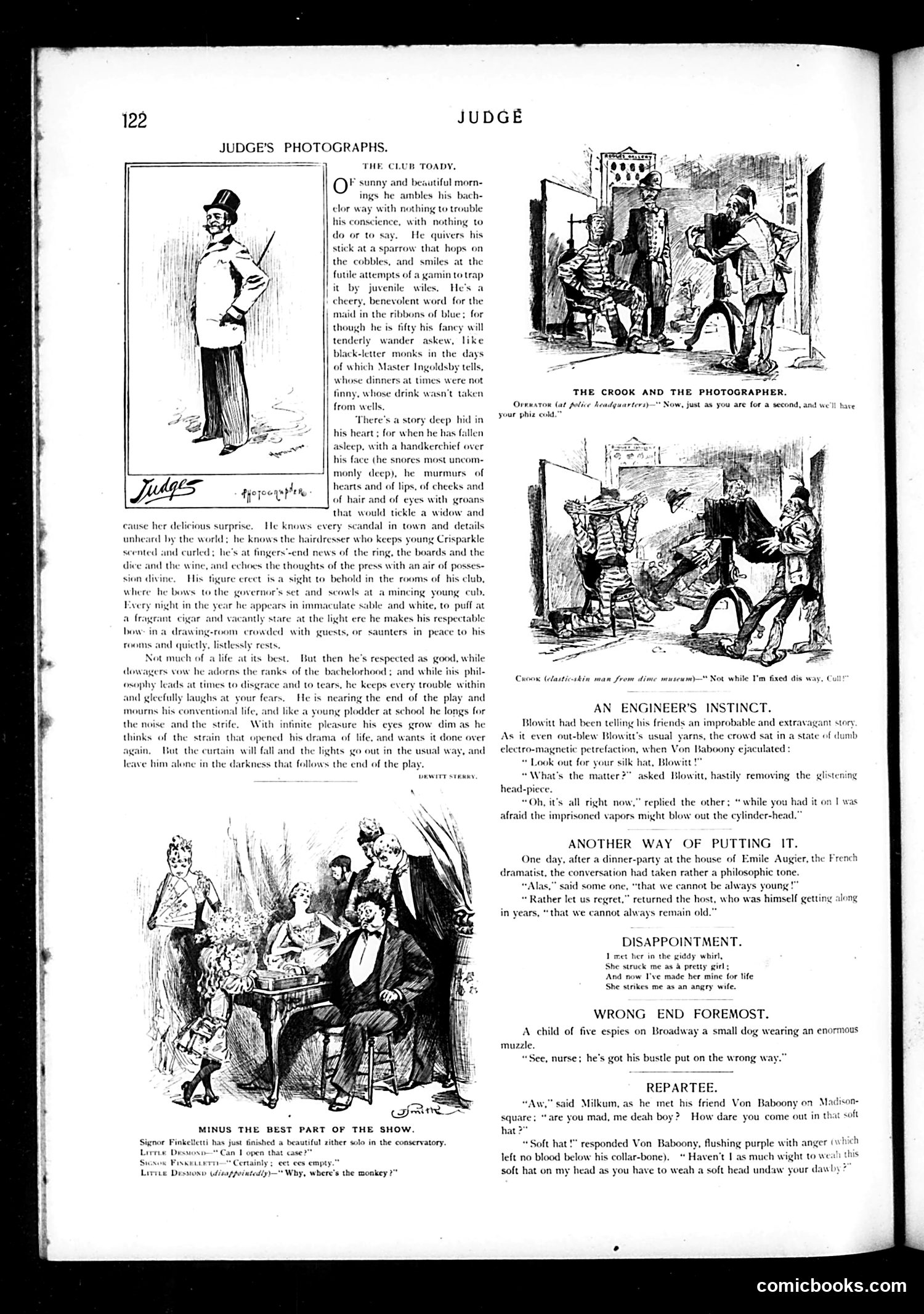
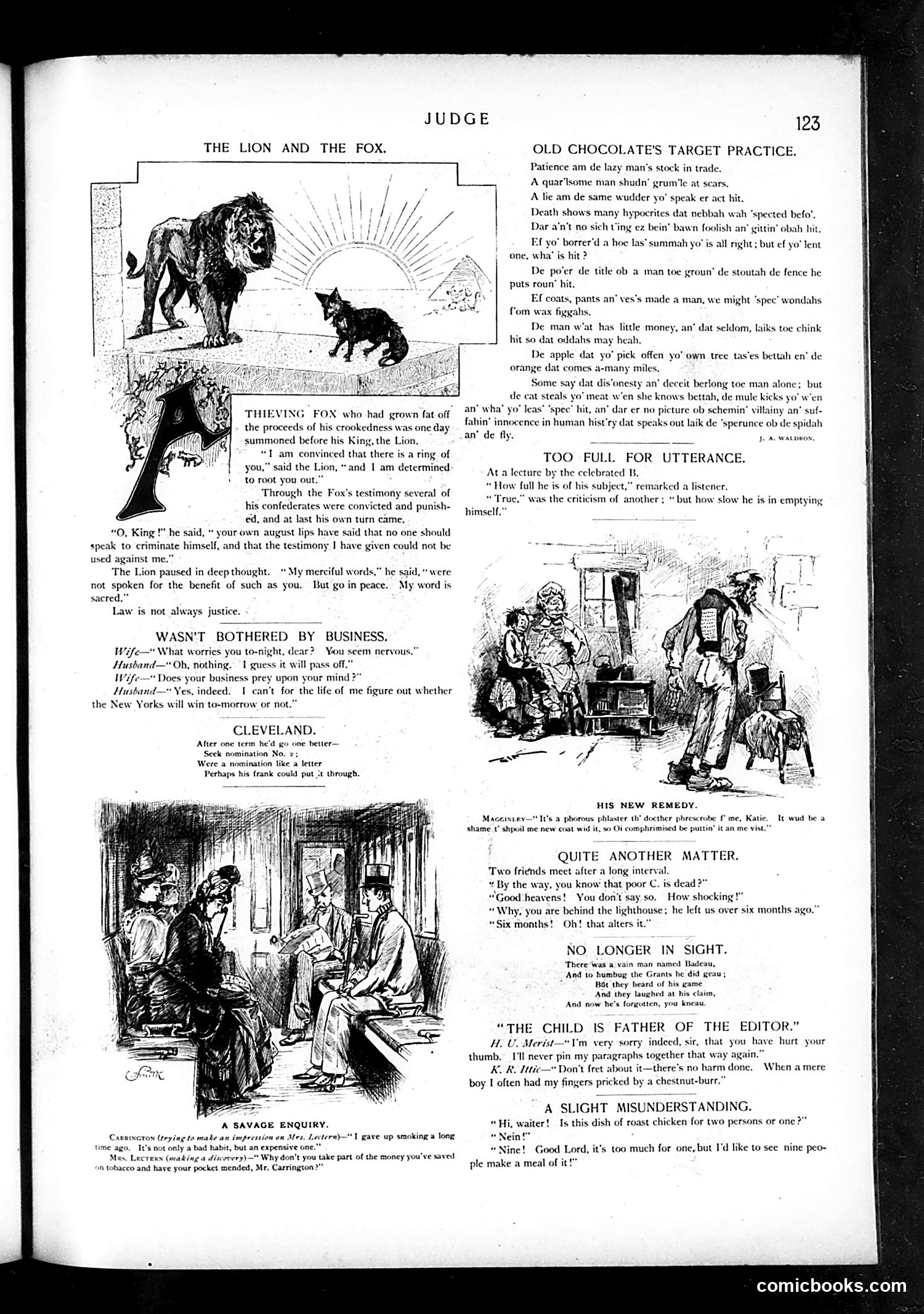
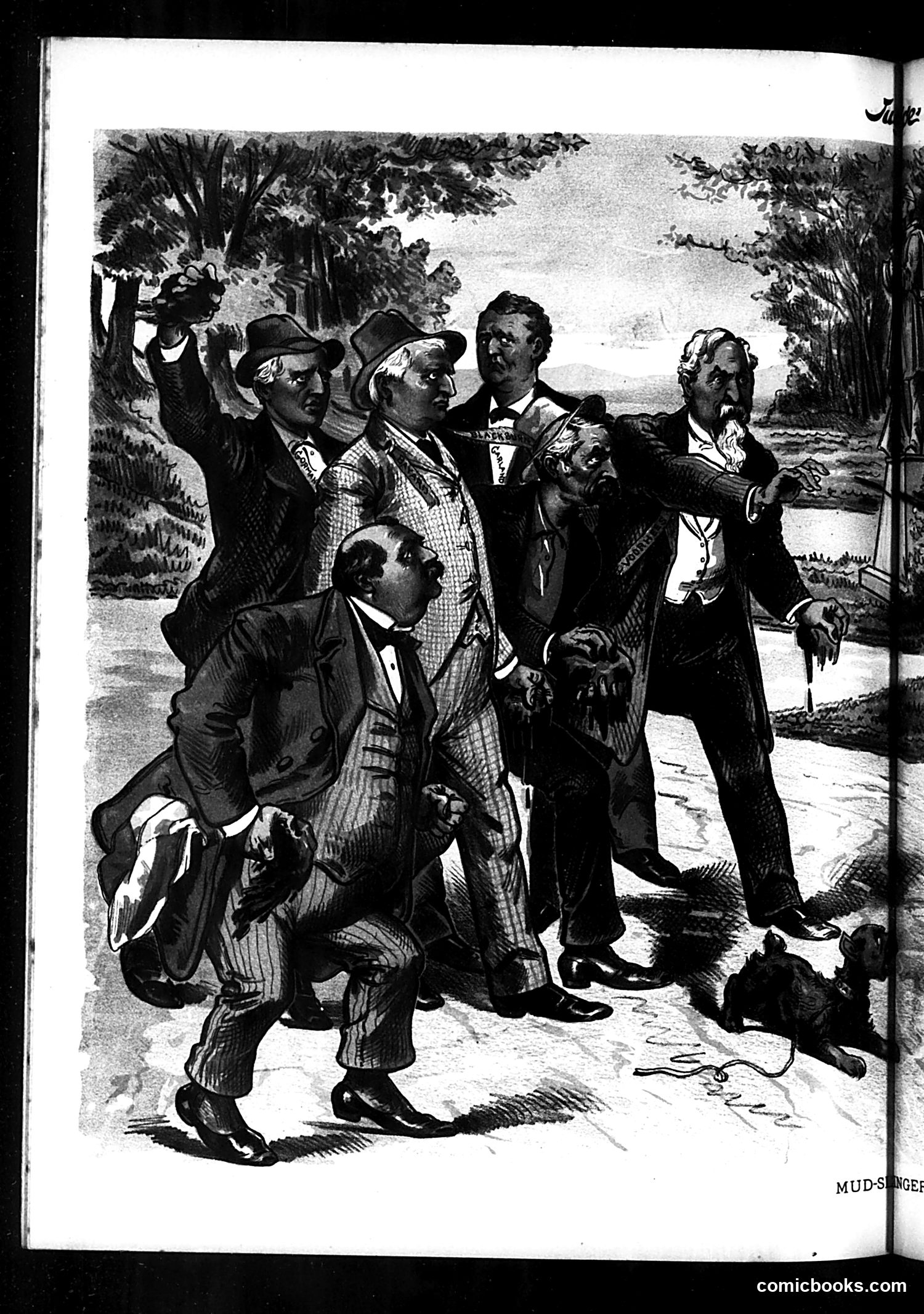
This Judge cartoon satirizes political mudslinging during what appears to be a campaign season. The image depicts six men in formal attire engaged in aggressive gestures and arguments outdoors, with a pastoral landscape behind them. One man crouches in the foreground appearing particularly agitated or combative. The title "MUD-SLINGER" references the practice of making personal attacks and spreading damaging accusations rather than discussing substantive policy. The cartoon mocks politicians who resort to character assassination and dirty tactics instead of dignified debate. The specific figures and election year remain unclear from the visible text, but the satire targets the prevalence of negative campaigning as a widespread political vice—suggesting such behavior was considered unseemly and worthy of ridicule by Judge's readership.
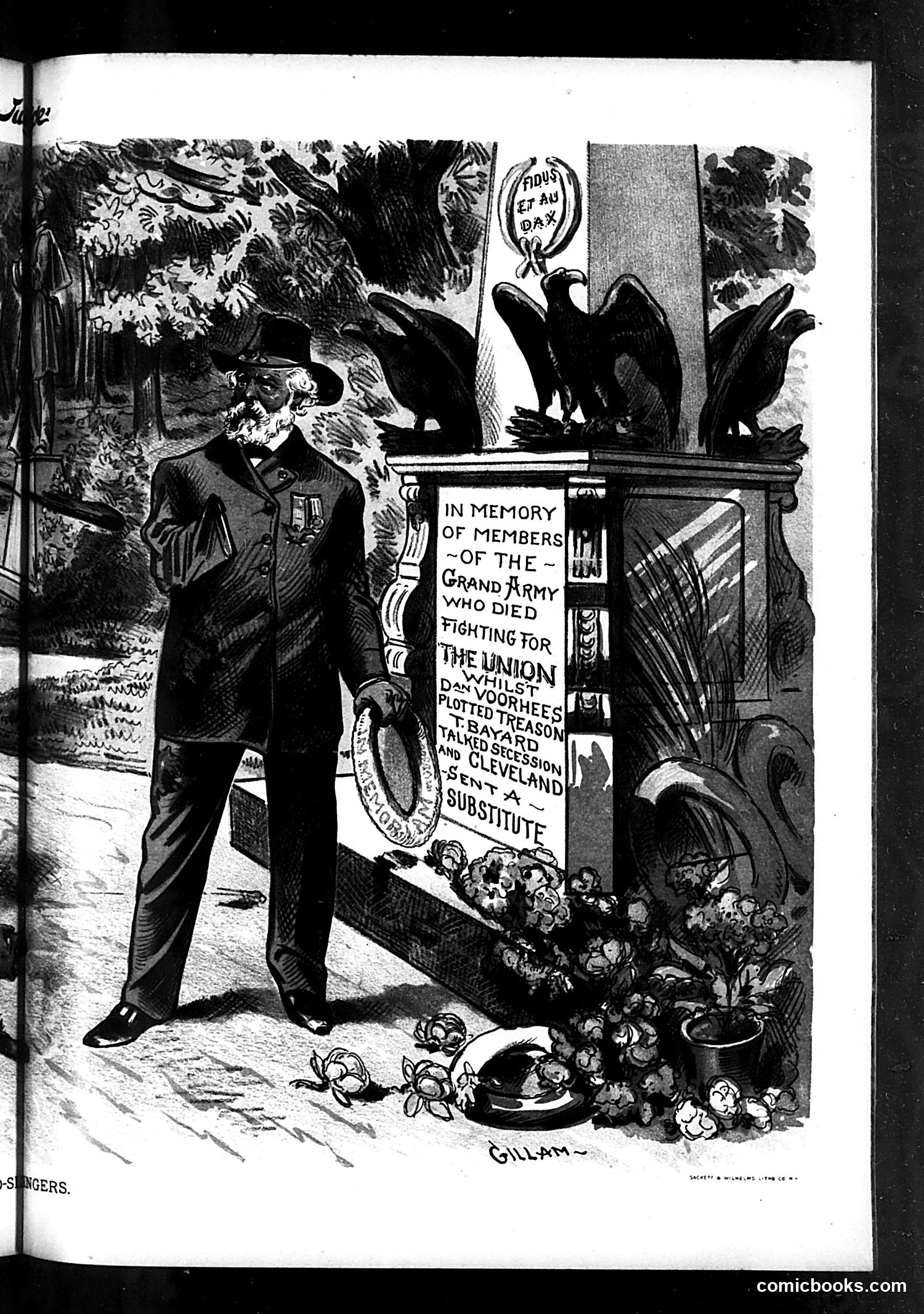
This appears to be a memorial cartoon from *Judge* magazine commemorating members of the Grand Army of the Republic (a Civil War veterans' organization) who died. A uniformed military figure stands at a monument inscribed with names of fallen soldiers, including references to the Union, Dawthiefs, and what appears to be Civil War battles or generals (names partially legible). Eagles perch atop the monument, and flowers lie at its base—traditional symbols of remembrance. The phrase "FIDUS ET AUDAX" (faithful and bold) appears above. The cartoon appears to honor Civil War dead and veteran sacrifice, typical of late-19th/early-20th century commemorative imagery when such memorials were politically and culturally significant in American public discourse.
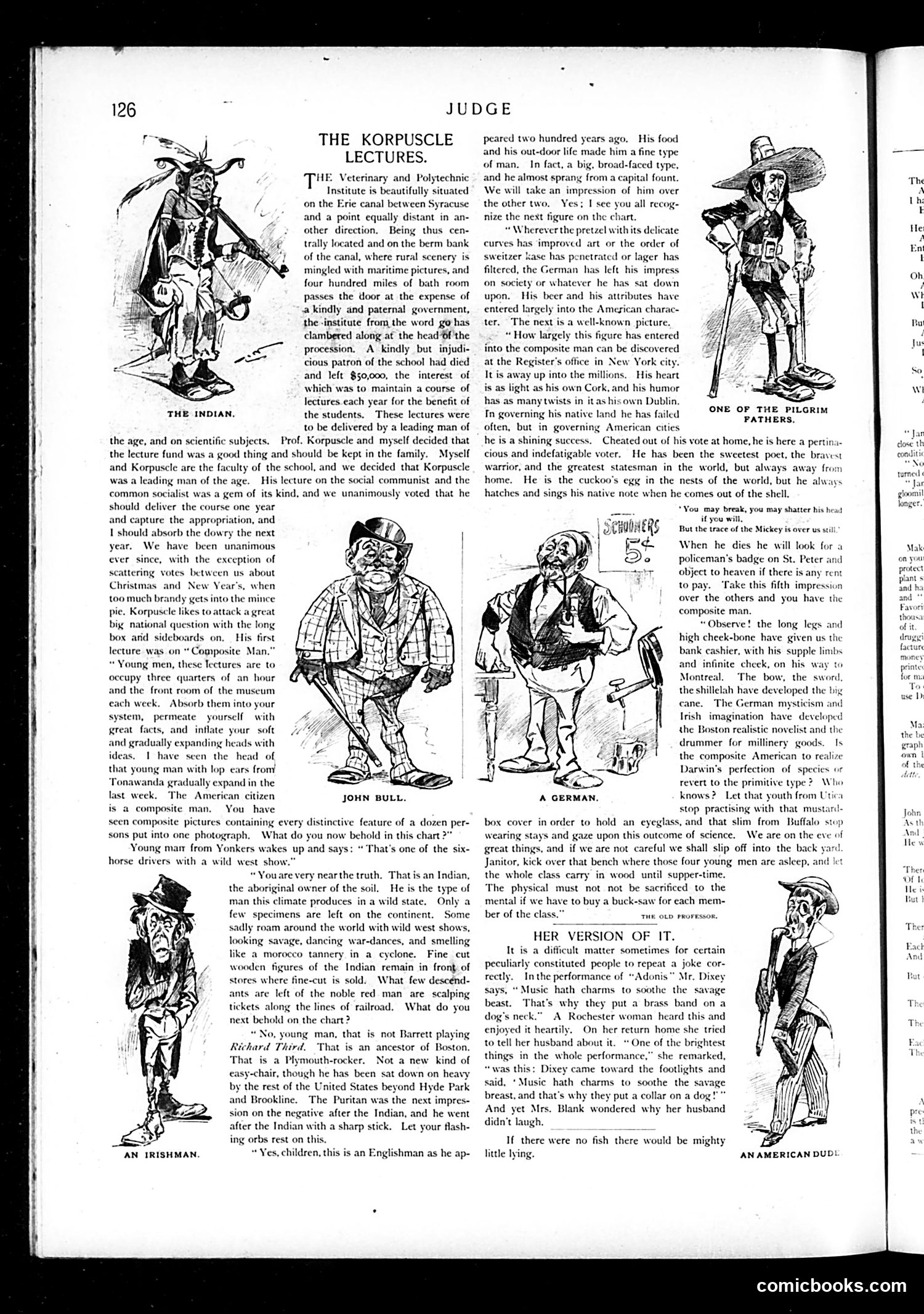
This page satirizes academic pretension and ethnic stereotyping in late 19th-century America. Professor Korpuscle delivers a pseudo-scientific lecture series on the "Composite Man," analyzing different immigrant and native groups through crude racial caricatures. The lecturer breaks down American identity by ethnic/racial type: the Indian (depicted as "broad-faced"), the German (characterized by beer and pretzels), the Irish (noted for voting, humor, and political failure at home), and the Pilgrim Fathers. The satire mocks both the fake scholarly framework ("Korpuscle Lectures") and the crude stereotyping itself—the professor and his colleague essentially embezzled an endowment to deliver these lectures annually. The cartoons illustrate each "type" with exaggerated physical features. The humor targets pseudoscientific racism and nativist attitudes toward immigrants while exposing academic fraud. The concluding Irish song lyric mockingly confirms Irish cultural persistence in America.
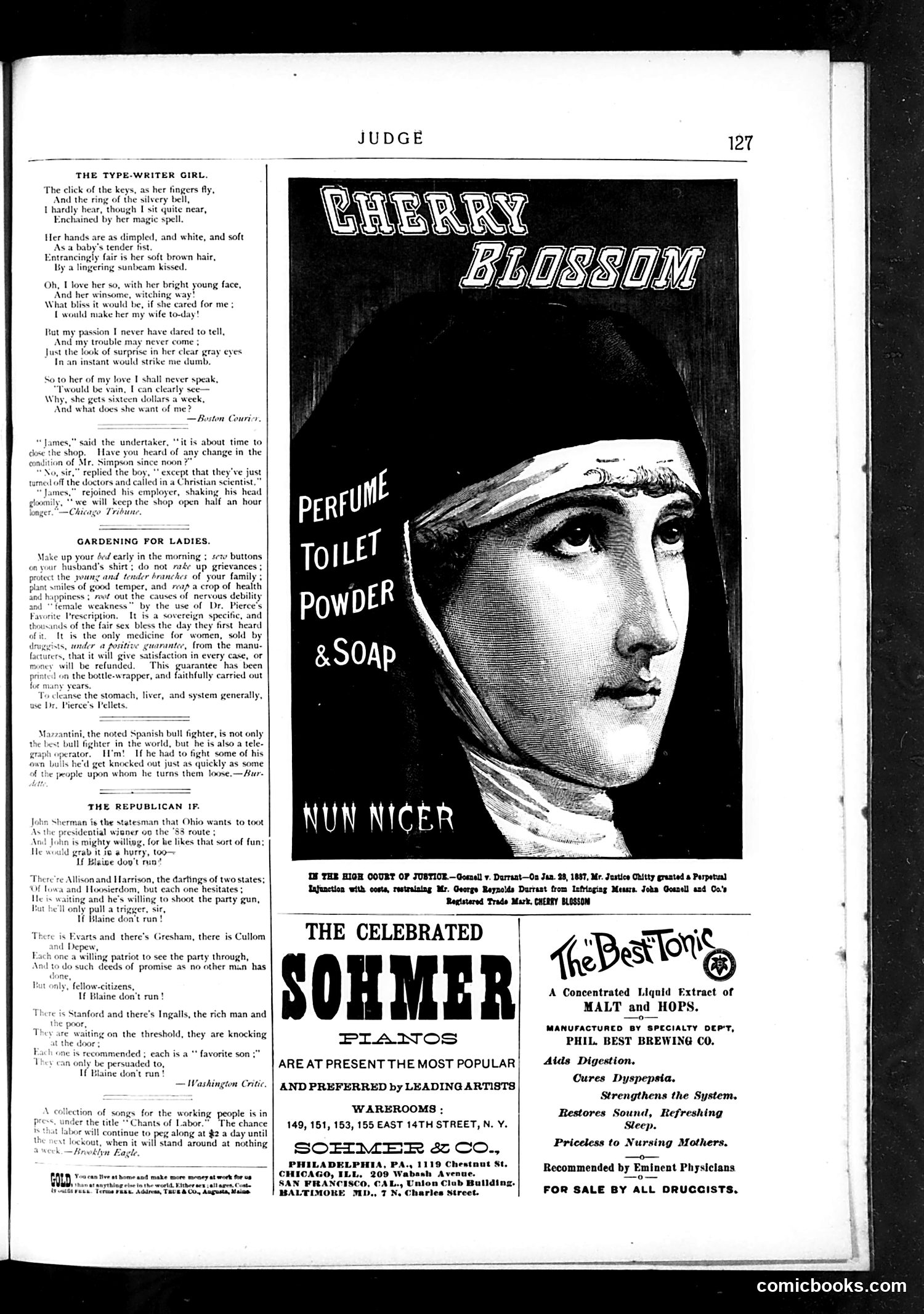
This page from *Judge* magazine contains primarily **advertisements and poetry**, not political cartoons requiring historical context. The main content includes: 1. **"The Type-Writer Girl"** — A sentimental poem romanticizing a female office worker, reflecting late-19th-century attitudes about women entering the workforce. The narrator is infatuated but intimidated, noting she earns "$16 a week" (suggesting economic independence was unusual and perhaps emasculating to male observers). 2. **"The Republican If"** — Political verse speculating on the 1888 presidential race, listing potential candidates (Sherman, Blaine, Harrison, Allison, Evarts, Gresham, Ingalls) and their hesitations, dependent on whether James G. Blaine would run. 3. **Advertisements** dominate the page: Sohmer Pianos, Cherry Blossom Perfume/Toilet Powder, and Best's Malt and Hops tonic. The page offers insight into period concerns: women's changing roles, Republican politics of the 1880s, and consumer product marketing.
This page is primarily **advertisements and filler content** rather than political satire. The main editorial material includes: **"Lumbago"** - A testimonial letter from Congressman F.B. Spinola endorsing Allcock's Porous Plasters for back pain, presented as legitimate medical endorsement. **Humor snippets** ("On the Verandas," etc.) - Brief jokes about contemporary habits and regional oddities, including a reference to Sherman's Civil War "bummers" in Georgia. **The cartoons/satirical content** are minimal and unclear from the image quality. There appears to be a "Don't be a Clam" advertisement with satirical intent, and a section titled "Helps for the Deaf," but the specific targets or meanings aren't legible. The page reflects Judge's format: mixing political/social commentary with extensive paid advertising. Without clearer image resolution of any actual cartoons, specific satirical targets cannot be reliably identified.
This page is primarily **advertising and editorial content**, not political satire. The main feature is an article titled "The Judge and His Young Folks," discussing the magazine's launch of a new children's publication called *Judge's Young Folks*. The article praises President Arkell's leadership of *Judge* magazine and announces construction of new offices on Fifth Avenue. It notes the success of *Judge* as both an artistic and political publication, particularly among Republicans. The piece celebrates the new children's magazine as pure and morally instructive, featuring colored cartoons and illustrations. The remainder of the page consists of period advertisements for products (Pears' Soap, patent medicines, clothing, real estate) and services typical of an 1880s-90s American magazine. **No political cartoon or significant satire appears on this page**—it's a standard editorial/advertising spread celebrating the magazine's expansion and new venture into children's publishing.
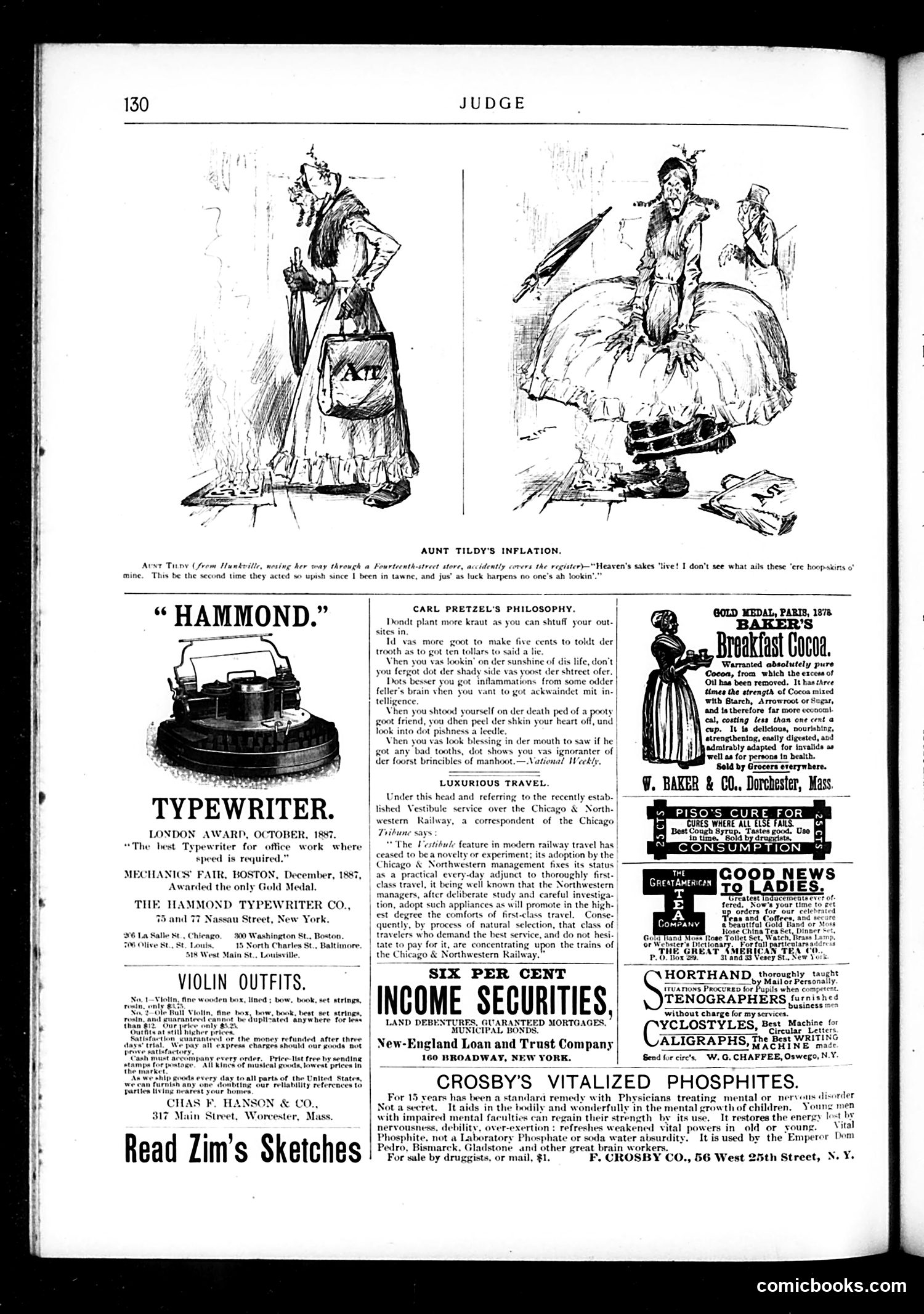
This cartoon satirizes the fashion trend of exaggerated hoop skirts in the 1880s. "Aunt Tildy" from the country (depicted as a rustic visitor) complains that her hoop skirts have become uncontrollably inflated—they're acting "upish" (unmanageable) in stores, and she's had this problem twice since arriving in town. The humor targets both the absurdity of fashion-obsessed urban women and the impracticality of the era's extreme silhouettes, which required large metal hoops to achieve their shape. The cartoon mocks how these skirts were so wide they barely fit through doorways and constantly caused embarrassment in public spaces, treating the fashion as a form of vanity-driven social inflation rather than practical clothing.
This page is primarily **advertising and promotional content** rather than satirical cartoon commentary. The bulk of the space features advertisements for writing implements (fountain pens, ball-pointed pens), patent medicines (rheumatism cure, opium-based "Blind Judge" binder), theatrical performances, and hotels. The most substantial content is a multi-paragraph advertisement for **Judge's Young Folks**, a new illustrated children's magazine. The promotional text emphasizes that it features "no sensational reading or pernicious prints" but instead offers moral, wholesome stories by respected contributors. This reflects late-19th-century anxieties about protecting children from corrupting influences. The page also advertises various New York City hotels and the **Monon Route** railroad, standard business directory content for the period. There are no identifiable political cartoons or satirical commentary visible on this page. It functions primarily as a commercial and institutional advertisement section typical of period magazines.
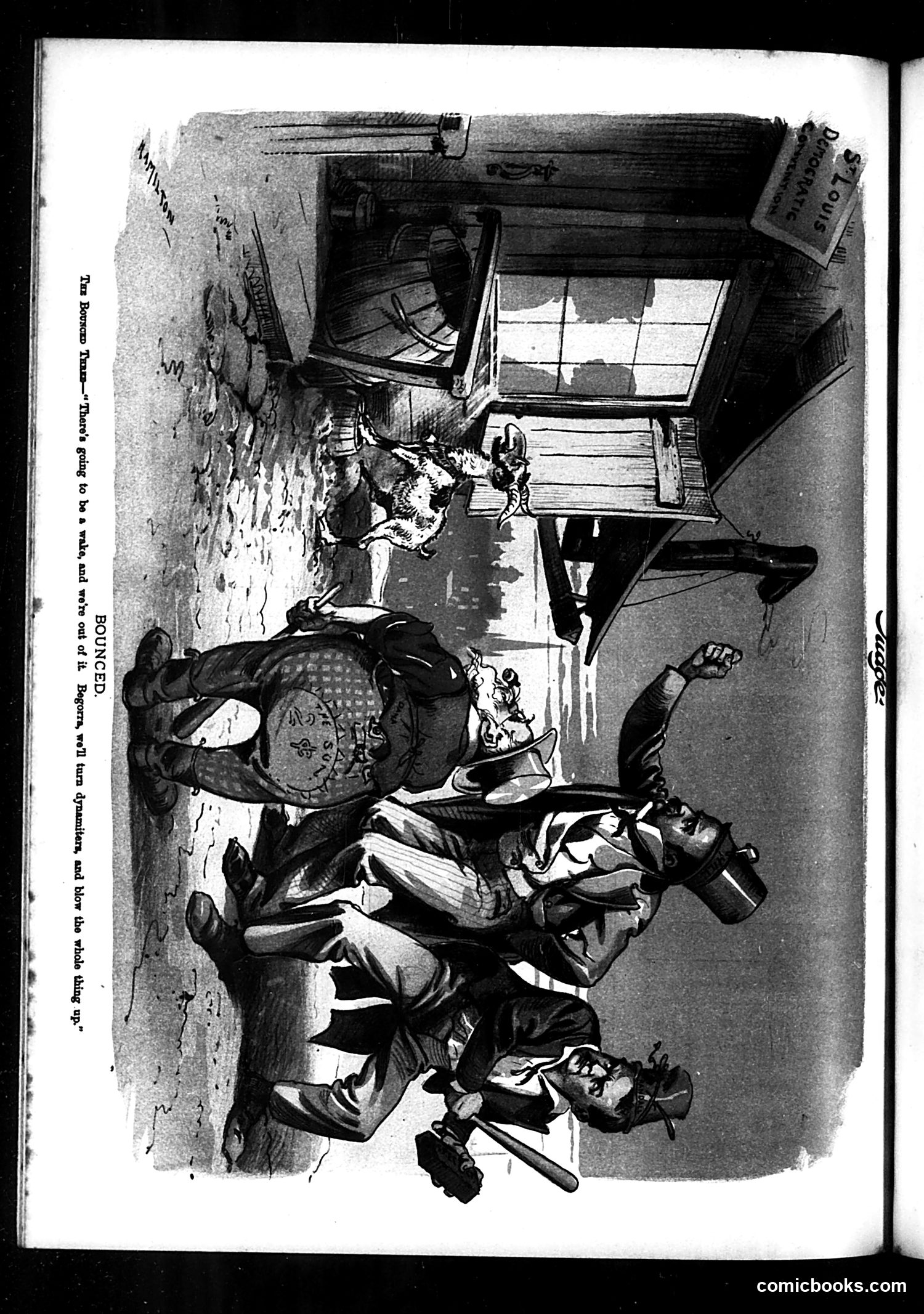
This appears to be a political cartoon satirizing Irish immigrants and their association with radical violence in late 19th-century America. The image shows figures in what looks like a tenement or working-class interior, with the caption "BOUNCED" and dialogue referencing a "wake" (Irish funeral gathering) and threats to "turn dynamiters." The satire trades on common anti-Irish stereotypes of the period: the depiction of Irish people as prone to drunkenness, violence, and anarchist/dynamite-related terrorism. The joke appears to be mocking Irish workers who, excluded from respectable society ("bounced"), threaten violent radicalism as retaliation. This reflects real historical anxiety about Irish immigration and labor activism, though the cartoon presents these concerns through crude ethnic caricature rather than substantive political critique.