
A complete issue · 16 pages · 1888
Judge — May 12, 1888
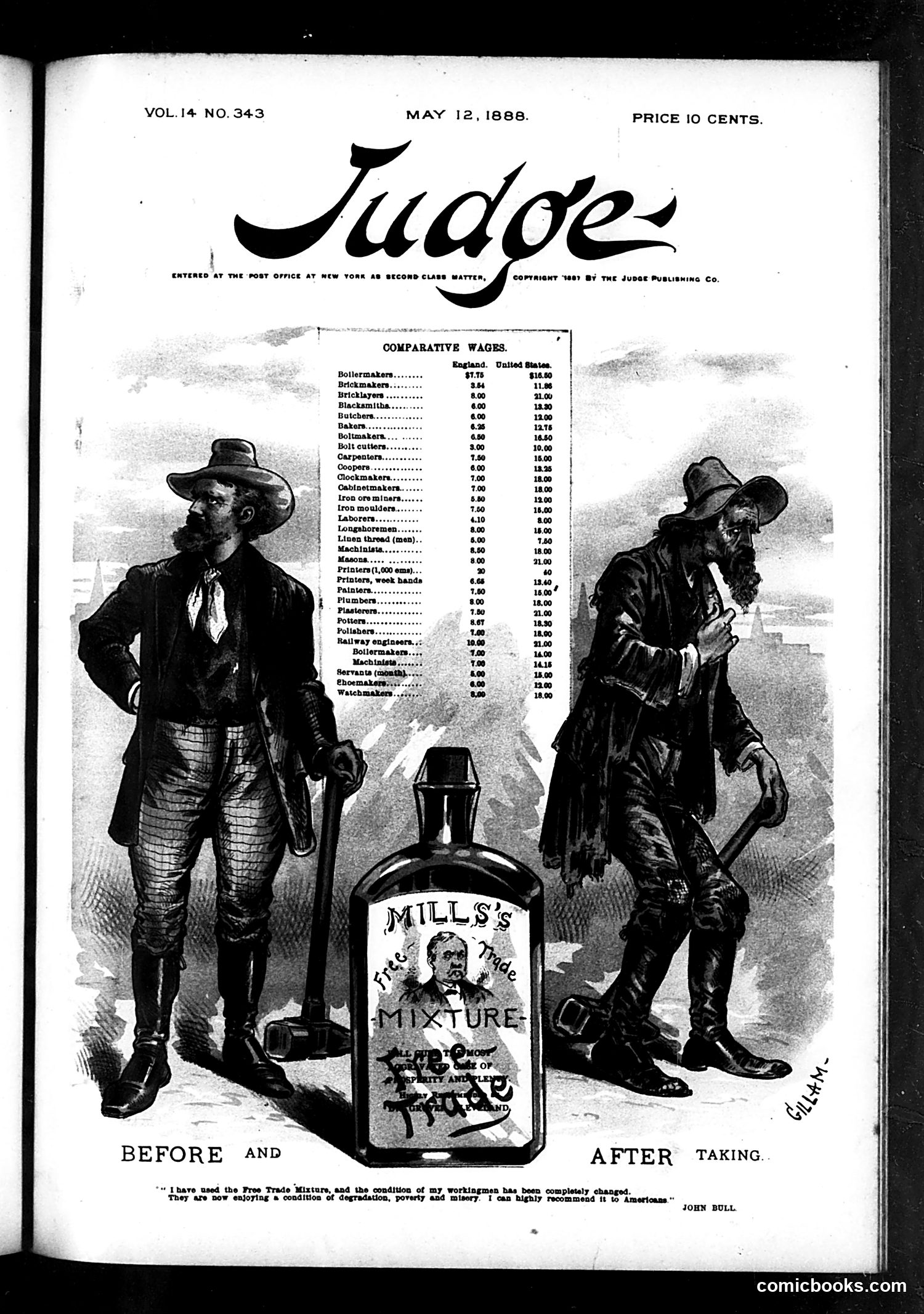
This page features a "Before and After" advertisement for Mills's Free Trade Mixture, a patent medicine. The cartoon shows two working-class men in tattered clothes and poor condition on the left ("BEFORE"), and the same figures dramatically transformed into healthy, well-dressed gentlemen on the right ("AFTER"). The satirical point targets the **Free Trade political debate** of 1888. The quote attributed to "John Bull" (England personified) suggests that free trade policies have harmed British workers, reducing them to poverty and degradation. By framing the "cure" as a commercial product rather than actual policy reform, Judge mocks both the ineffectiveness of free trade rhetoric and the era's reliance on patent medicines as cure-alls.
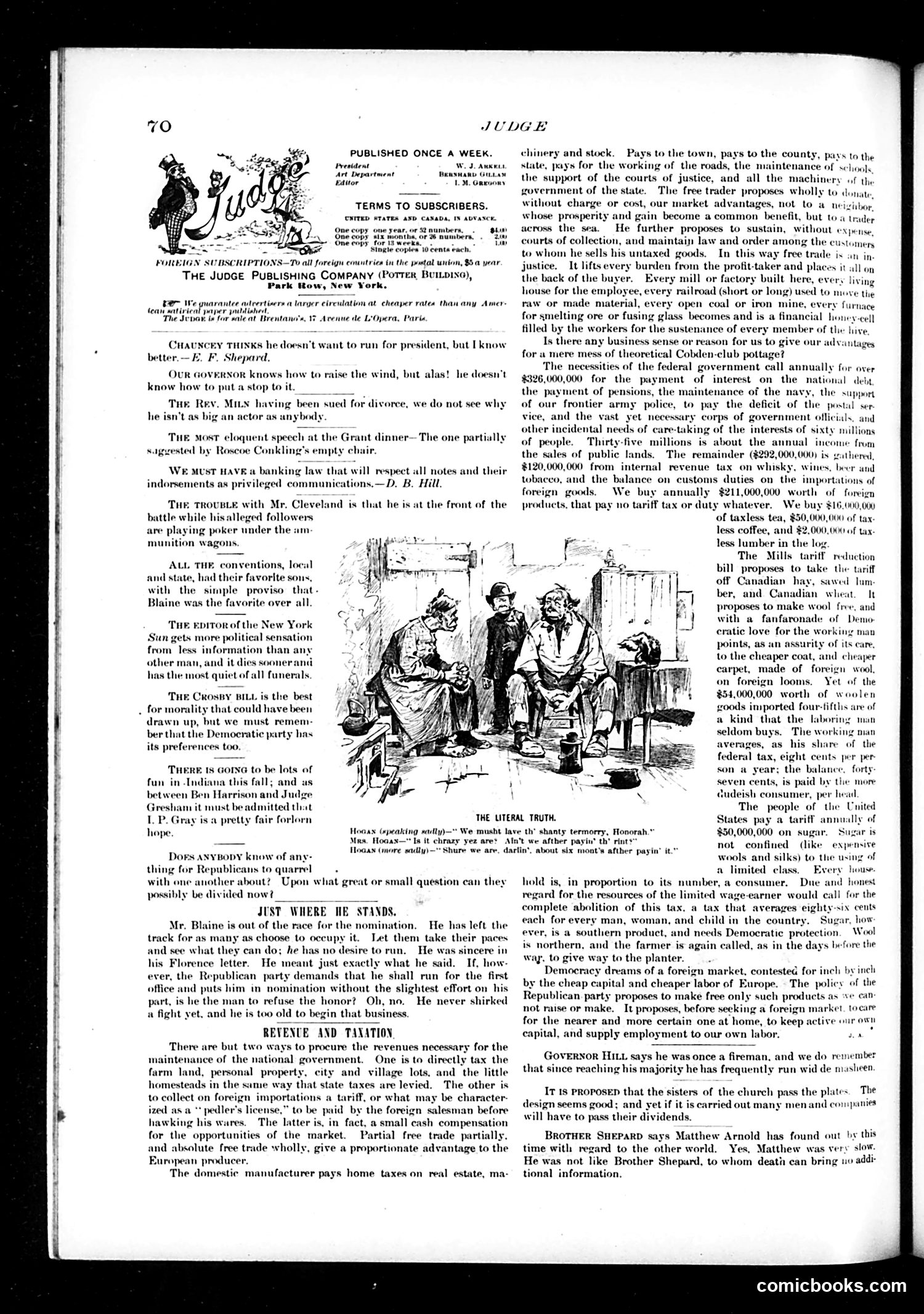
This page contains political commentary and satirical text rather than a prominent cartoon. The main illustration shows working-class men in casual discussion, captioned "THE LITERAL TRUTH" with dialogue about paying tariffs. The text discusses **tariff policy**, a major political issue of the era. References to "the Mills tariff reduction bill," Canadian trade, and debates between Republicans and Democrats indicate this addresses late 19th-century protectionist controversies. Key figures mentioned include **Mr. Blaine** (likely James G. Blaine, Republican politician) and **Governor Hill** regarding nomination politics and free-trade versus protectionist economic philosophy. The satire critiques how tariffs affect ordinary workers and consumers, suggesting Republican promises of prosperity through protective tariffs were hollow. The "literal truth" cartoon emphasizes the disconnect between political rhetoric and working people's actual economic experience.
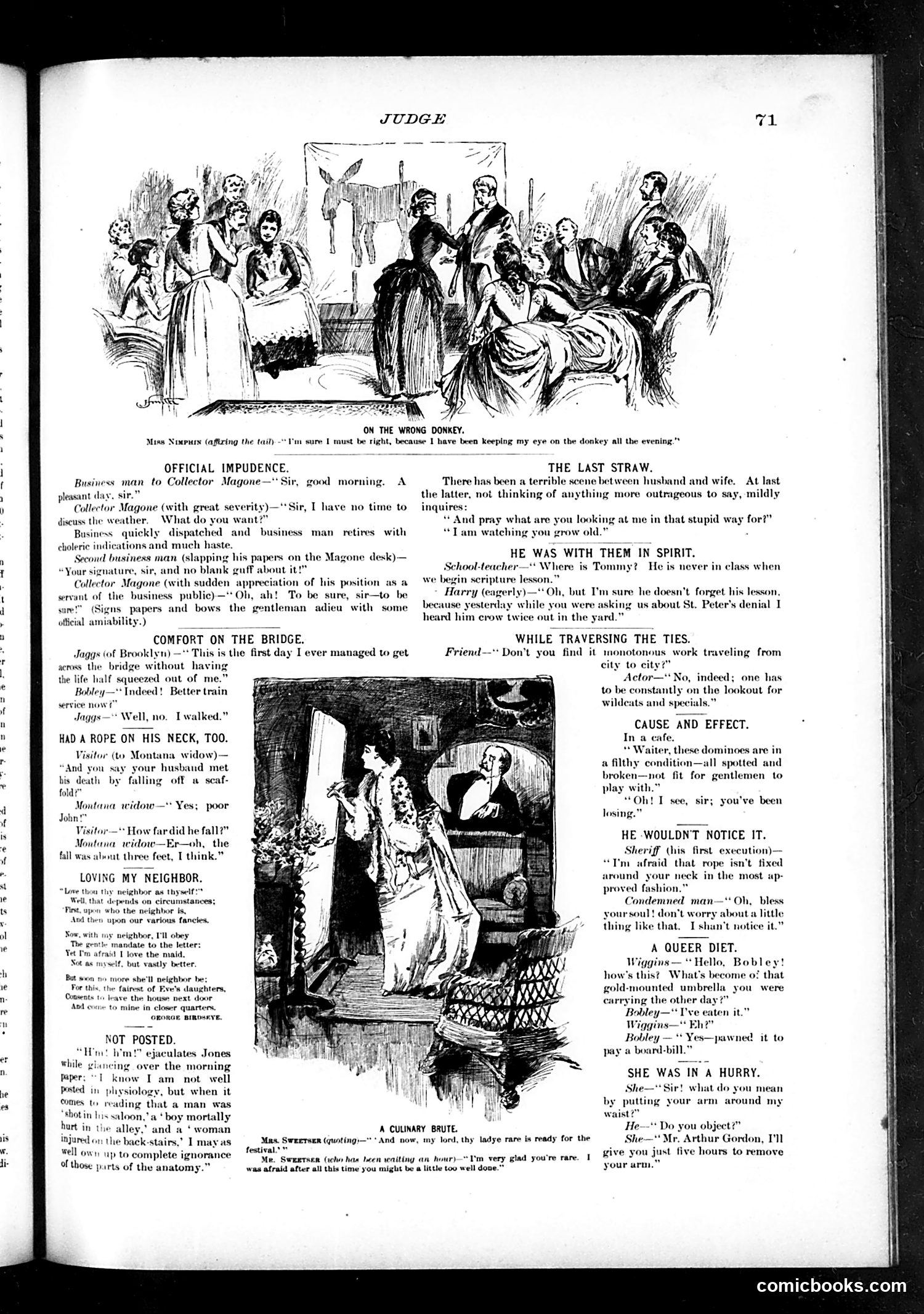
This page collects brief satirical vignettes mocking everyday social hypocrisies and absurdities. Key pieces include: **"Official Impudence"**: A businessman is rudely dismissed by Collector Magone when asking pleasantly about the weather, then Magone suddenly becomes obsequious when the same man demands his signature with attitude. The satire targets inconsistent bureaucratic behavior based on perceived power dynamics. **"On the Wrong Donkey"**: A woman insists she's been watching a donkey all evening to ensure correctness—obviously ridiculous logic. **"The Last Straw"**: A wife, exhausted by marital conflict, retaliates to her husband's criticism by saying she's "watching you grow old"—biting domestic satire. **Other vignettes** mock: incompetent Montana widows, tedious train travel, a teacher's student attending "in spirit" while the rooster crows outside, and a condemned man unconcerned about execution rope etiquette. The humor relies on absurdist logic, social class observations, and marital discord—typical Judge magazine fare satirizing Gilded Age American society.
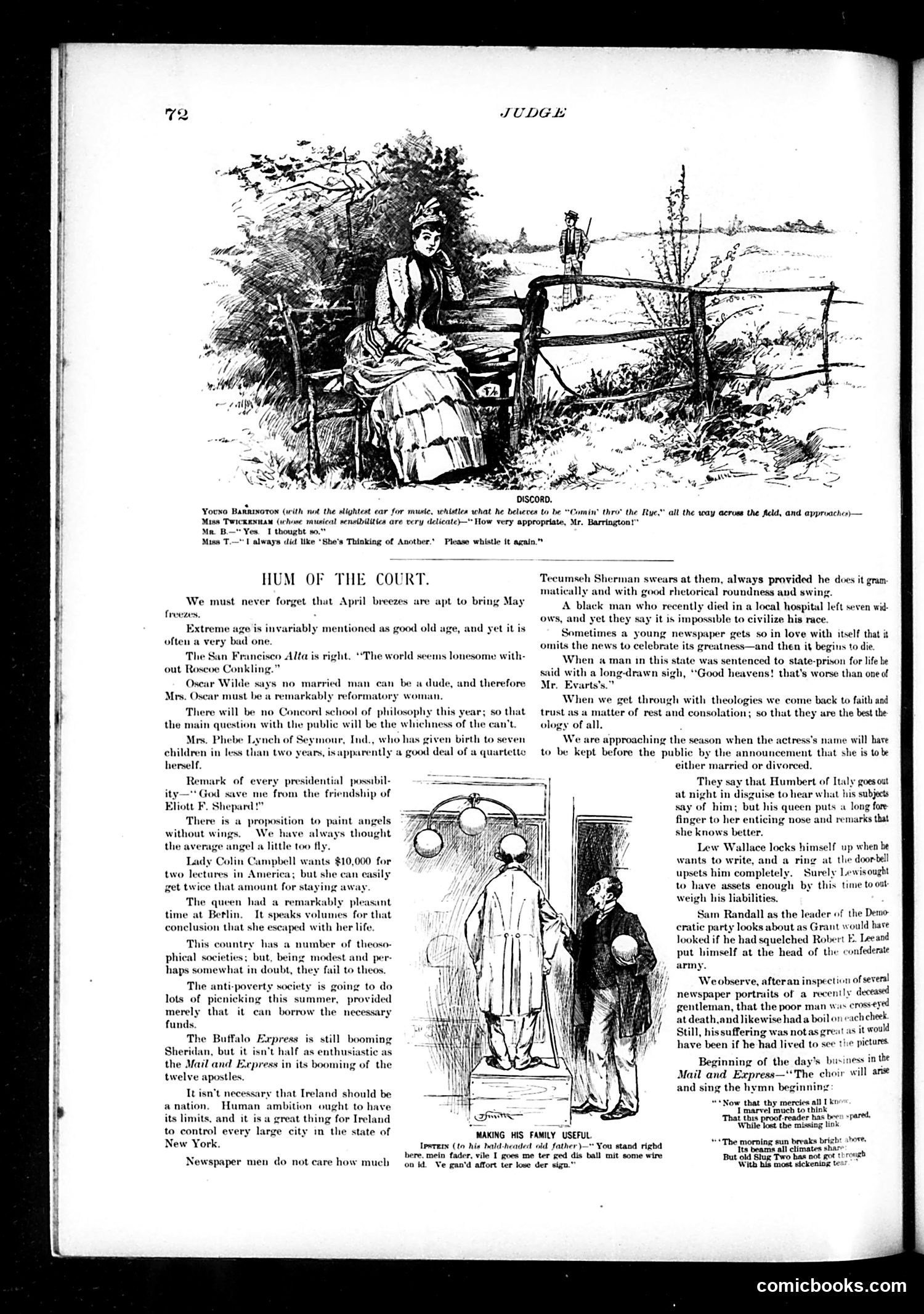
This page contains two distinct satirical items: **Top cartoon**: Young Barrington whistles "Scotch" folk tune "The Rye" to annoy Miss Twickenham, whose refined musical sensibilities he knows will be offended. The joke mocks both his deliberate rudeness and her precious pretension. **"Hum of the Court" column**: A collection of brief social and political jabs typical of Judge's format. Key targets include: - Oscar Wilde (mocking his dandyism) - Roscoe Conkling (a Republican politician) - Lady Colin Campbell (actress demanding lecture fees) - Various theological and political figures **Bottom cartoon**: An immigrant father (suggested by dialect "mein fade," "ger dis ball") instructs his bald-headed son to hold a sign while he holds it with wire—using his son as human advertising. The satire targets both immigrant poverty and commercial exploitation. The page exemplifies Judge's satirical approach: social commentary mixed with ethnic humor reflecting 1880s attitudes.
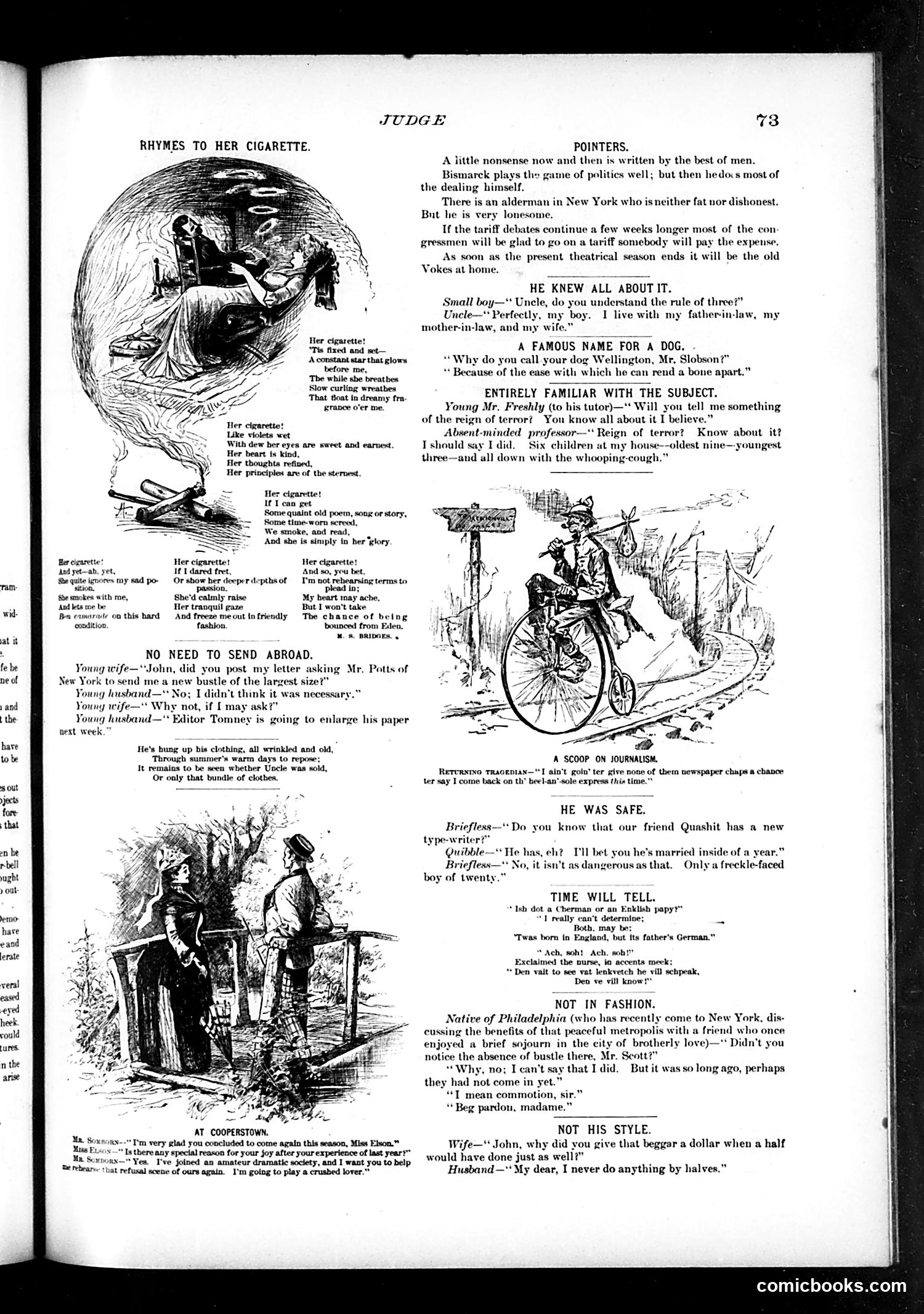
This page contains multiple satirical short jokes and visual cartoons typical of late 19th-century American humor magazines. **"Rhymes to Her Cigarette"** depicts a sentimental poem about a woman smoker—mocking both romantic excess and the then-scandalous sight of women smoking cigarettes publicly. **"No Need to Send Abroad"** jokes about a woman requesting a large bustle from New York, with her husband quipping the local newspaper editor is expanding instead—satirizing both fashion absurdity and newspaper growth. **The brief "Pointers"** section offers political jabs: at Bismarck's political dealings, a supposedly honest but lonely New York alderman, and Congressional expense-padding during tariff debates. Other jokes mock family life ("rule of three" = in-laws), naming conventions, and professional anxieties (lawyers, journalists, tutors). **The cartoons** appear to illustrate rural/domestic scenes with accompanying humorous dialogue, typical of Judge's visual-verbal comedy format. The overall tone reflects genteel satirical humor targeting contemporary social pretension, domestic dynamics, and political corruption.
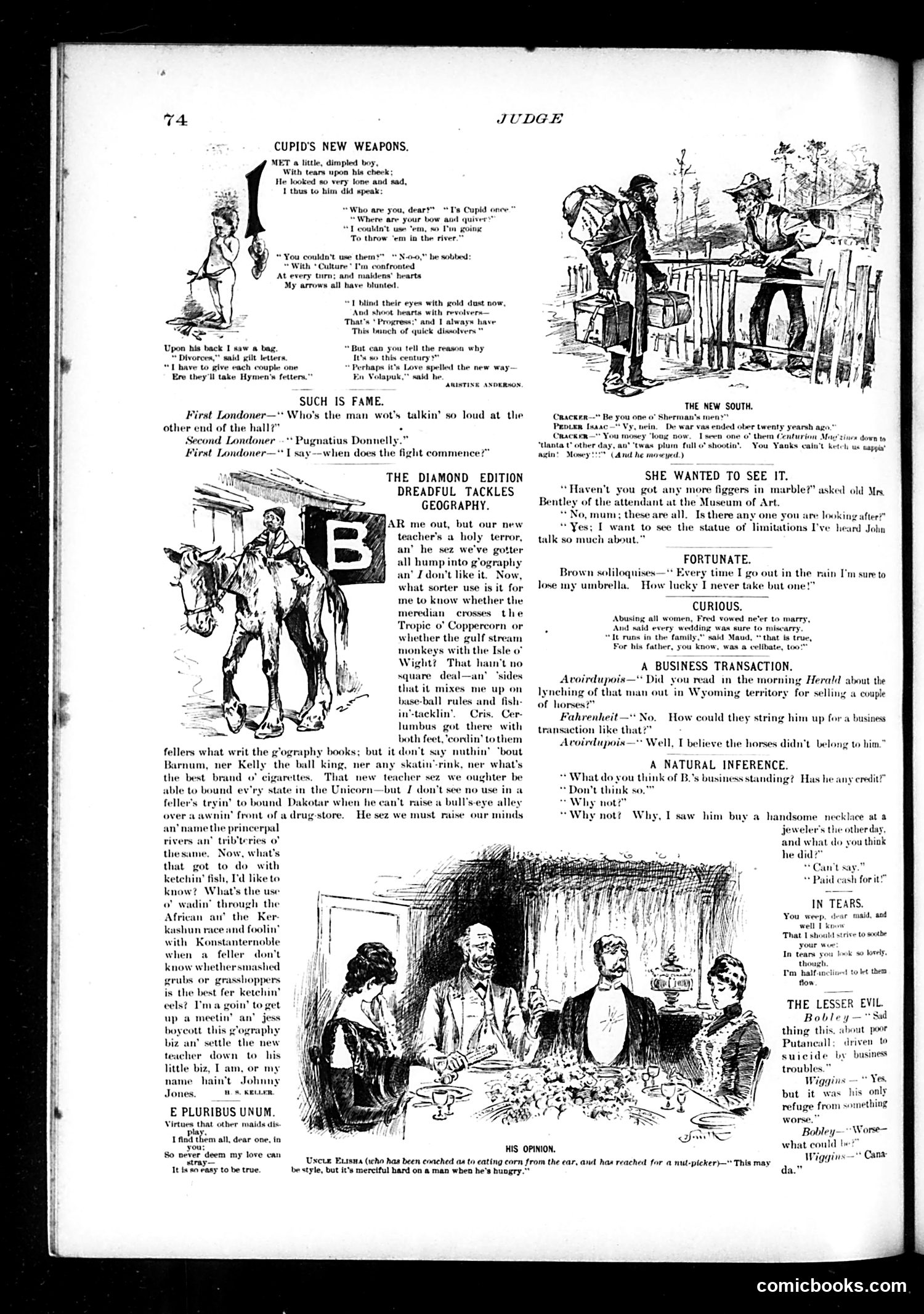
This page from the satirical magazine **Judge** contains several short humor pieces typical of late 19th-century American comedy: **"Cupid's New Weapons"** mocks modern courtship, suggesting Cupid must abandon arrows for contemporary tools like "gold dust" and "revolvers"—satirizing how materialism and commercial values have replaced romance. **"Geography"** features a boy complaining that his teacher's strict geography curriculum is useless for practical life (fishing, baseball). It ridicules rigid educational standards disconnected from everyday concerns. The remaining pieces are brief jokes: one mocks a woman seeking marble statues at a museum; another plays on umbrellas; another on business ethics (implying a man buying jewelry suggests financial dishonesty). **The overall tone** reflects Progressive-era anxiety about how modern life—industrialization, commercialism, changing education—was fundamentally altering traditional values and practical knowledge. The humor targets both educational rigidity and the creeping materialism of American society.
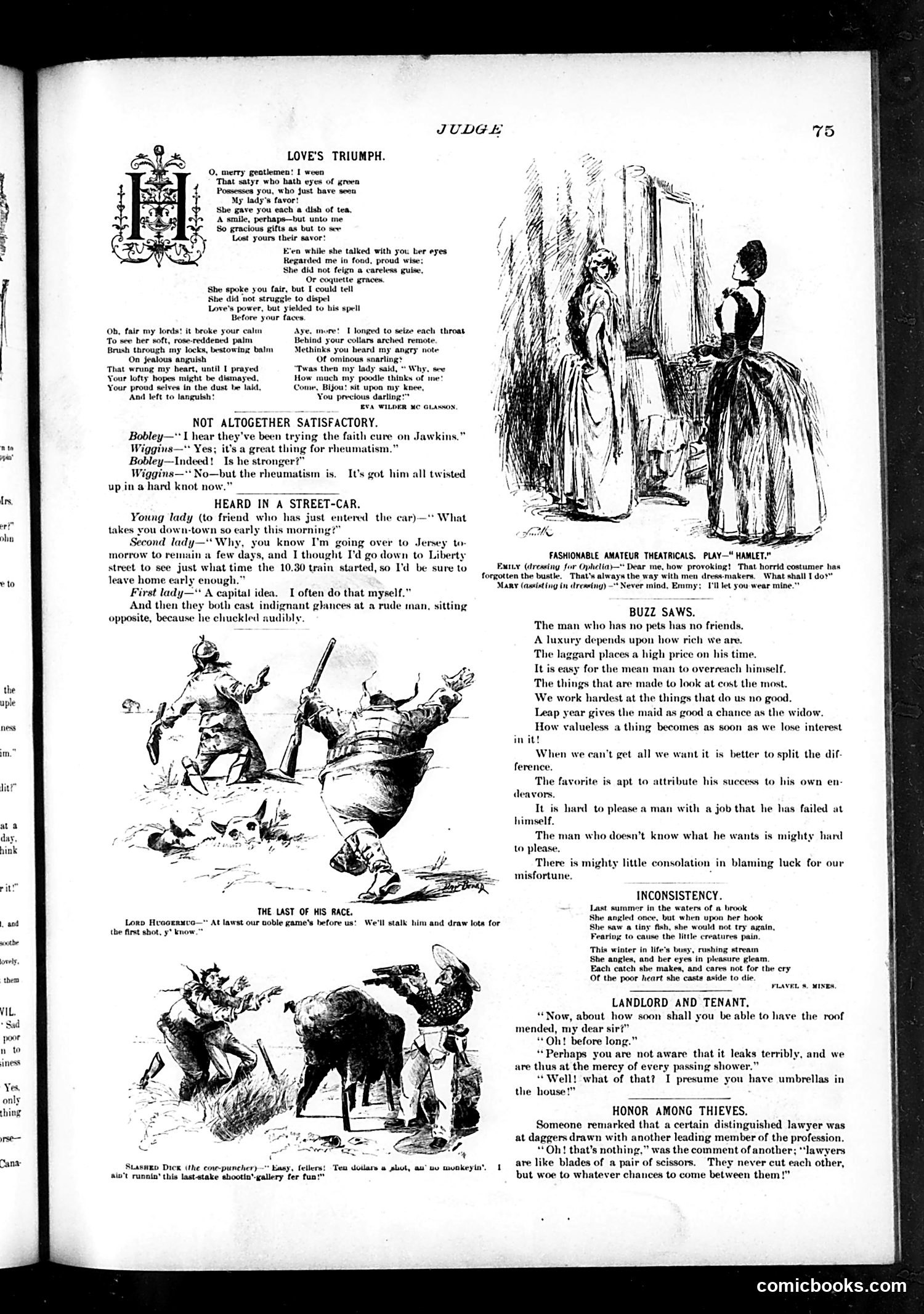
**"Love's Triumph"** (top): A poem satirizing male vanity. A man boasts that a lady's affections truly belong to him despite her polite attention to other gentlemen—but the punchline reveals she was merely distracted by her pet poodle, "Bijou," sitting on her lap. The satire mocks men's self-importance and romantic delusions. **"Not Altogether Satisfactory"**: A brief joke about faith healing. A man with rheumatism tried the "faith cure," which didn't cure him—instead, the rheumatism itself got stronger and twisted him into knots. This mocks the pseudoscientific health fads of the era. **"Heard in a Street-Car"**: Social satire on absurd logic. A woman travels to Jersey tomorrow but goes to Liberty Street today to check when the 10:30 train departs—reasoning that arriving early at the station ensures she'll leave home early enough. A rude man laughs at this circular thinking. **"The Last of His Race"** and other illustrations: Hunting/sporting scenes with accompanying jokes about various human follies ("Buzz Saws" section), including material excess, vanity, and hypocrisy. The page exemplifies Judge's satirical style: puncturing pretension through humor.
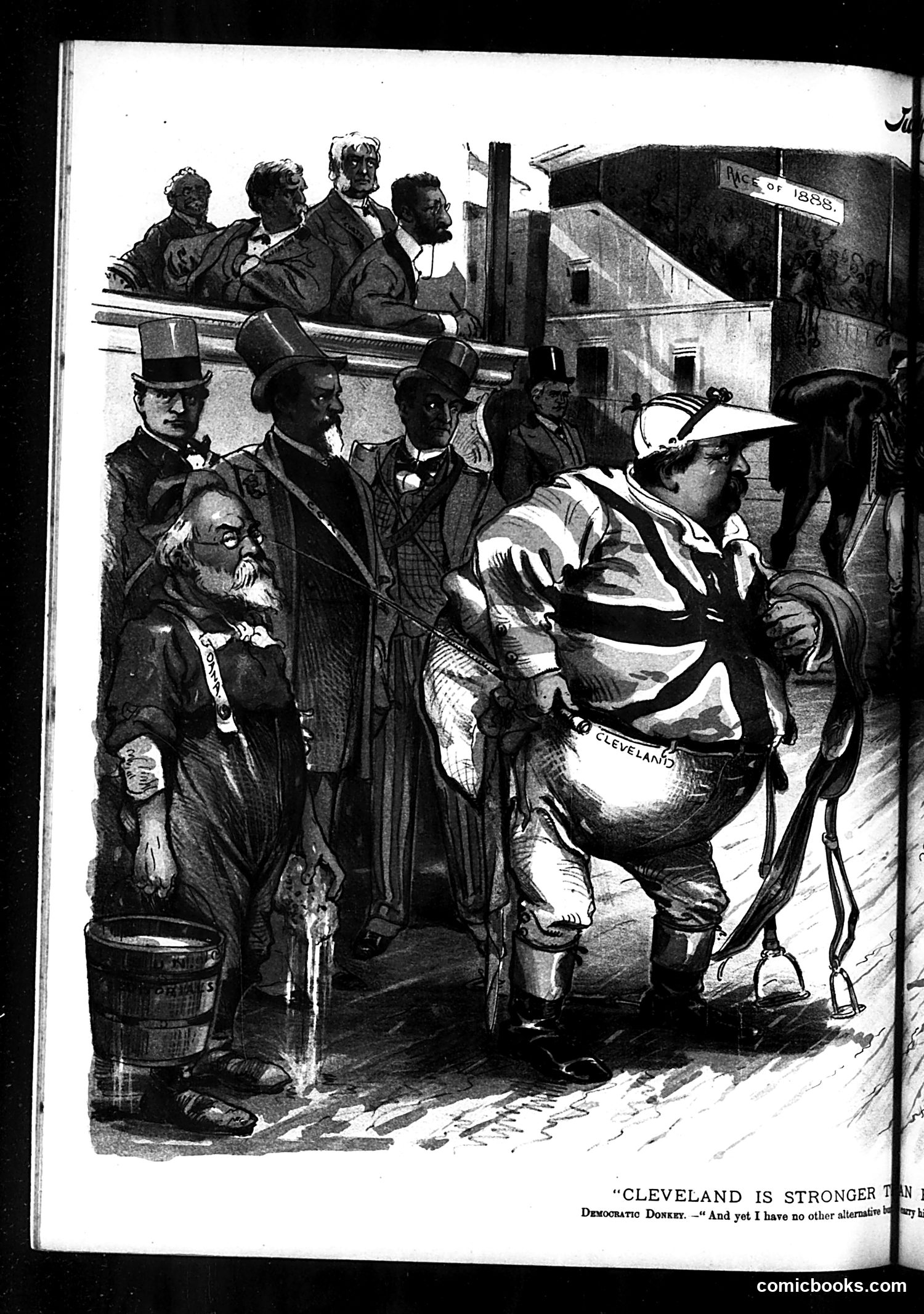
This appears to be a Judge magazine political cartoon from 1888 (visible on the building). The caption reads "CLEVELAND IS STRONGER THAN I" with a Democratic Donkey subtitle: "And yet I have no other alternative." The cartoon depicts President Grover Cleveland (represented as a strong man on horseback, labeled "CLEVELAND") alongside various Democratic Party figures and supporters shown as weaker or compromised individuals. The imagery suggests internal Democratic Party tensions—that despite Cleveland's strength as a leader, party members felt politically trapped or had limited alternatives to supporting him. The elderly bearded figure on the left and the formally-dressed gentlemen observing represent the party establishment wrestling with Cleveland's dominance within Democratic politics during this era.
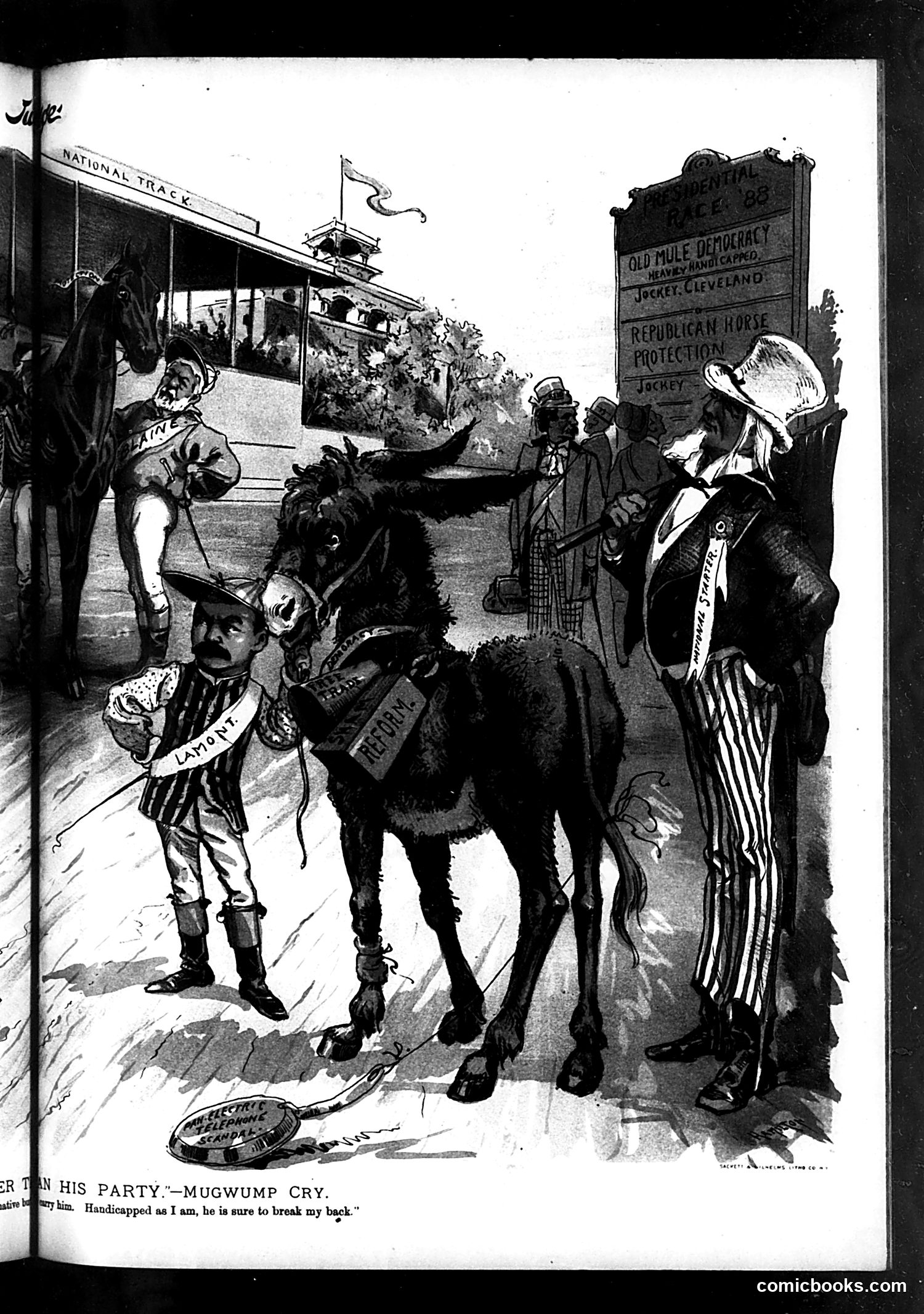
This Judge cartoon satirizes the "Mugwumps"—Republicans who split from the party during the 1884 presidential election to support Democrat Grover Cleveland. The image shows a donkey labeled "REFORM" (representing the Democratic party) being ridden by a small figure labeled "LABOR," while a well-dressed gentleman in a top hat (representing a Republican/Mugwump) complains that he'll "break my back." The satire mocks Mugwumps as unreliable political allies who abandon their own party. The caption suggests they fear the reform donkey—whether carrying labor interests or democratic change—will be too burdensome. Signs visible reference "Old Mule Democracy," "Jockey Cleveland," and "Republican Horse Protection," establishing the election context and criticizing the political realignment.
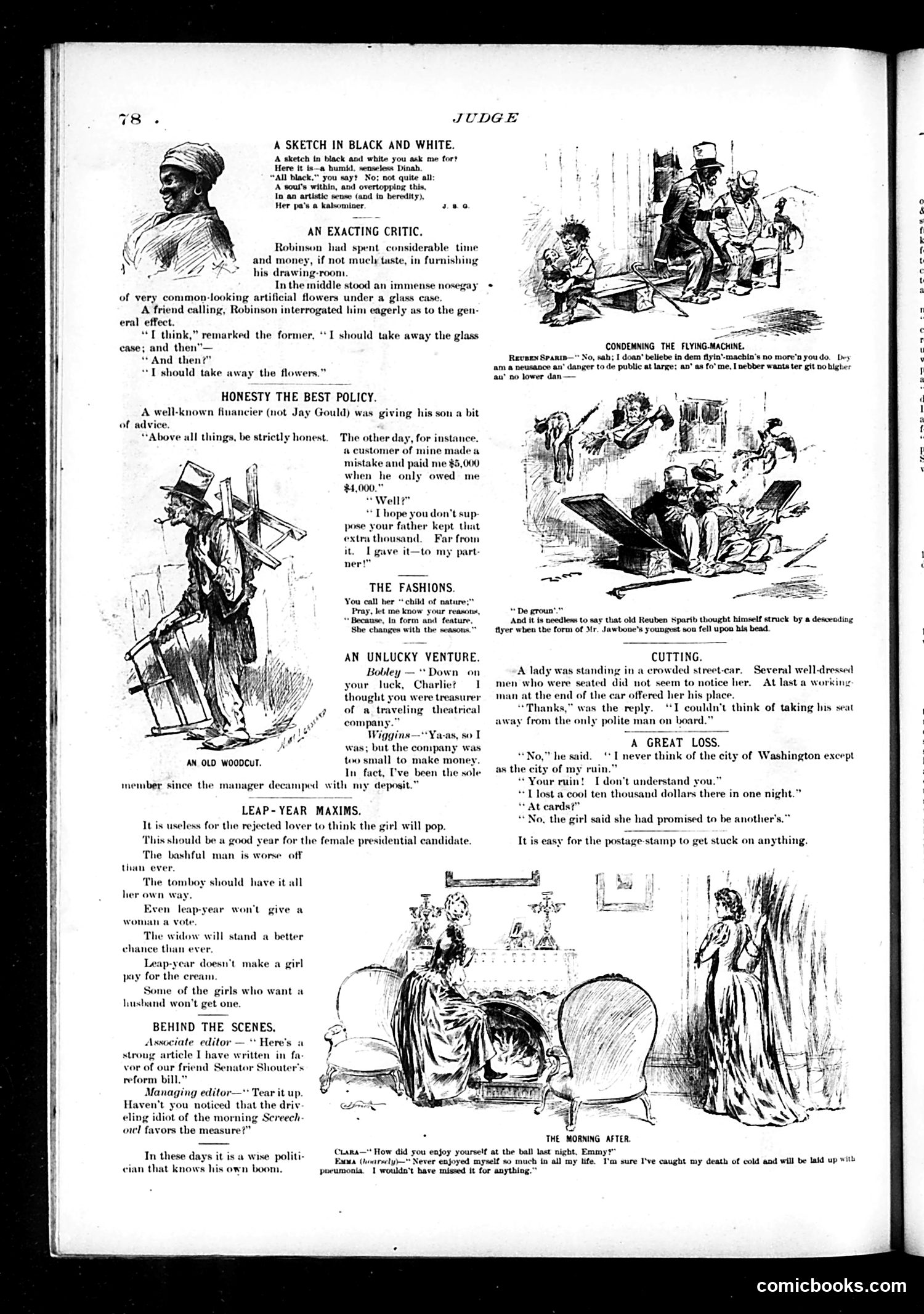
This page contains multiple short satirical pieces typical of Judge's format: **"A Sketch in Black and White"** mocks racist imagery by describing a "sketch" that is "all black" except for the father being a "kalsominer" (whitewasher)—a crude visual pun playing on racial stereotypes. **"An Exacting Critic"** satirizes pretentious interior decoration: a man spends money furnishing his room with artificial flowers under glass, and a visitor suggests removing both the case AND the flowers—implying the whole thing is worthless. **"Honesty the Best Policy"** ironically shows a financier advising his son to be honest, then admitting he kept overcharge money by giving it to his partner—hypocrisy masked as virtue. **"Leap-Year Maxims"** riffs on 1884 (leap year), when women traditionally could propose to men, offering humorous observations about romantic outcomes. **"Behind the Scenes"** satirizes editorial cowardice: an editor kills an article supporting Senator Sholter's reform bill simply because a disliked politician also supports it. The remaining pieces offer standard Victorian-era social humor about fashion, theater, trains, and romance.
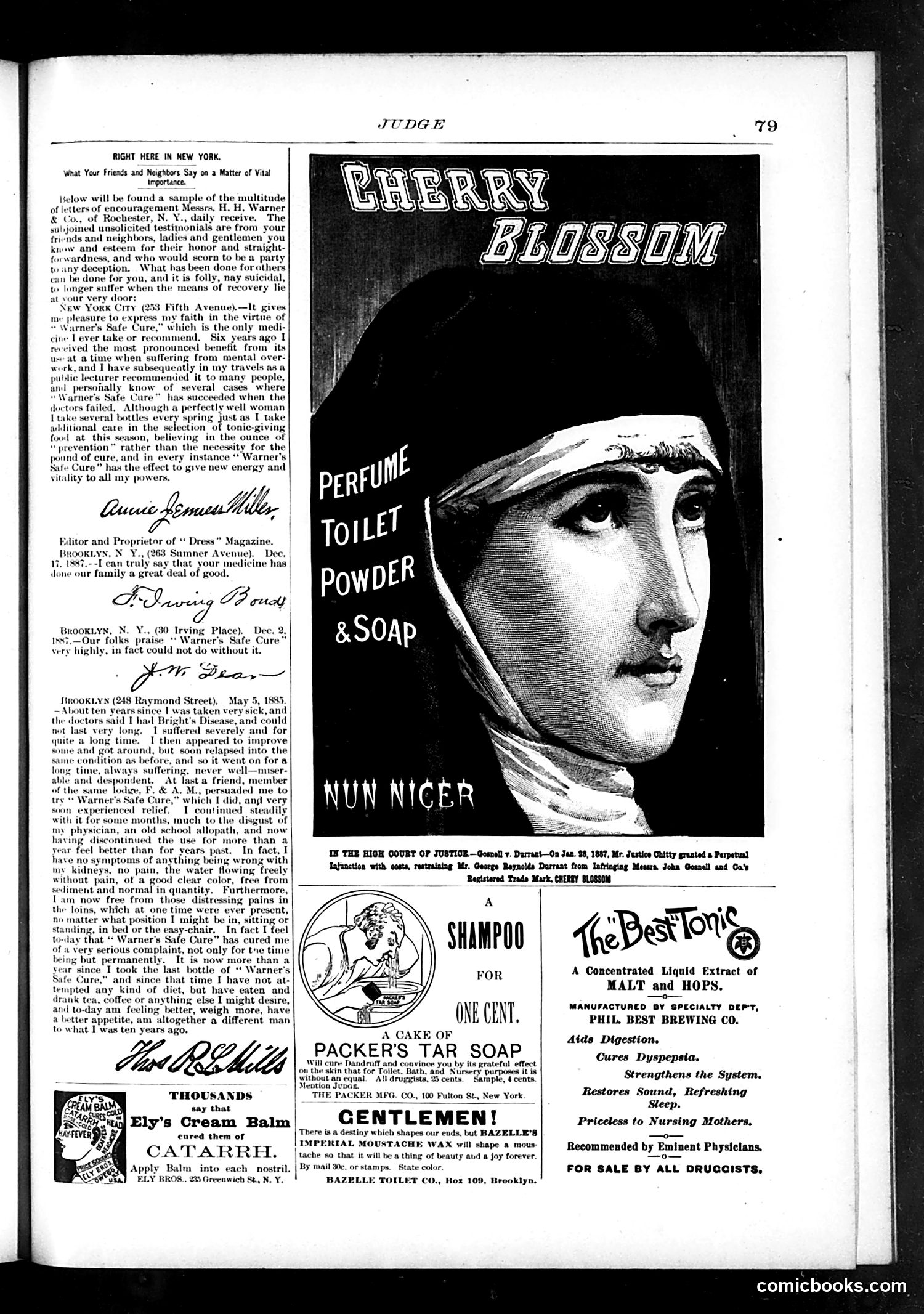
This page is primarily **advertising and testimonials**, not a political cartoon. It features: **Main Content:** A full-page advertisement for "Warner's Safe Cure," a patent medicine, alongside customer testimonials from Brooklyn and New York residents. The testimonials claim the product cured kidney disease and related ailments. One letter is from the editor of "Dress" Magazine. **Historical Context:** This reflects the era of unregulated patent medicines (pre-FDA, early 1900s). Such "cure-all" products were heavily advertised in magazines with unsolicited testimonials that modern readers would recognize as marketing tactics. Warner's Safe Cure was a real, widely-advertised remedy of the period. **Side Advertisements:** Additional patent medicines and toiletries (Ely's Cream Balm for catarrh, Packer's Tar Soap, and "The Best Tonic" malt extract) fill the remaining space—typical of Judge magazine's revenue model. **Notable:** A legal notice references a trademark case for "Cherry Blossom" products, indicating competing manufacturers in this commercial space.
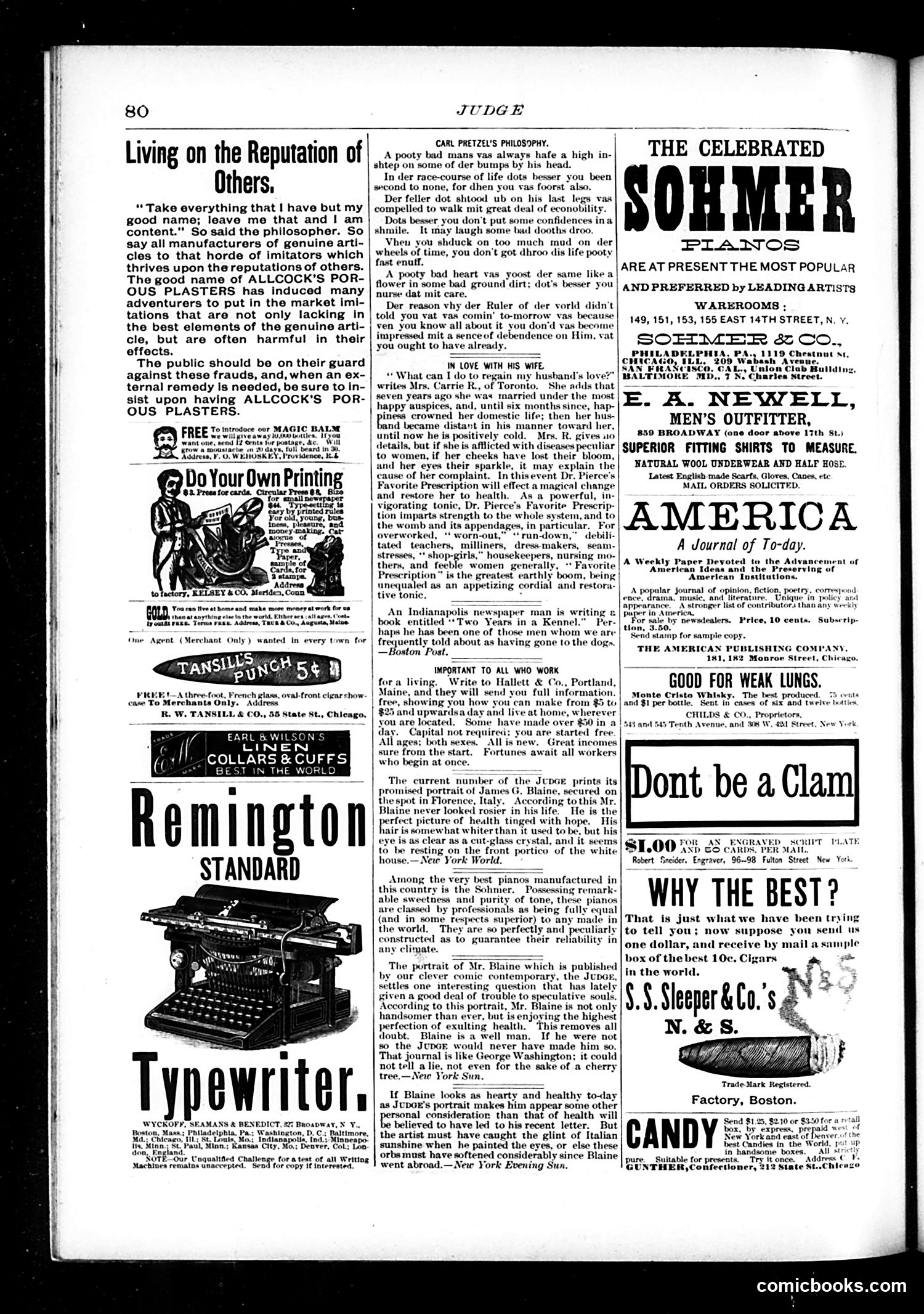
This page is primarily **advertisements and filler content** rather than editorial cartoons. The main elements are: **"Living on the Reputation of Others"** is an advertisement for **Allcock's Porous Plasters**, warning consumers against counterfeit medical plasters that exploit the brand's good reputation. It's a cautionary message about fake remedies in an era before FDA regulation. **"Carl Pretzel's Philosophy"** is a humor column featuring a German-immigrant character (indicated by his dialect spelling: "vat," "dhroo," "shmile") dispensing folksy wisdom in broken English—a common comedic device of the era that played on ethnic stereotypes for contemporary readers' amusement. **"In Love with His Wife"** advertises Dr. Pierce's Favorite Prescription, a patent medicine marketed to women, claiming to cure "diseases peculiar to women" and restore marital harmony through improved health. The page also contains advertisements for typewriters, collars, printing presses, and other consumer goods typical of Judge's revenue model.
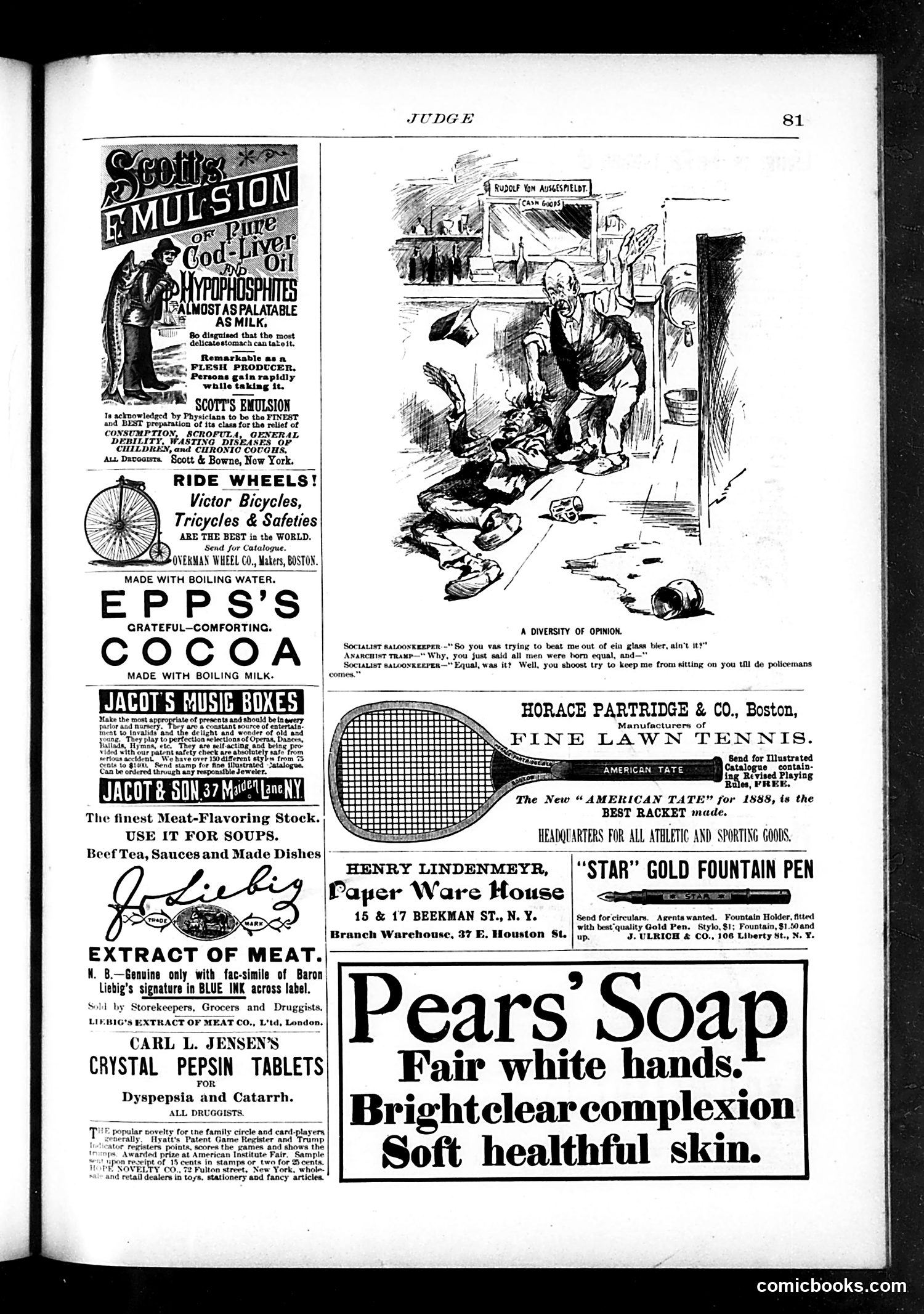
This single-panel cartoon satirizes Socialist hypocrisy regarding equality. A working-class saloonkeeper confronts a Socialist who accused him of cheating ("trying to beat me out of ein glass bler"). The Socialist had just proclaimed "all men were born equal," but when challenged to practice this principle by sitting alongside the saloonkeeper as an equal, he threatens violence instead: "you shoost try to keep me from sitting on you till de policemans comes." The joke mocks Socialists for preaching universal equality while maintaining class superiority in actual conduct. The heavy ethnic dialects (German-inflected English) suggest working-class characters, emphasizing the irony that the Socialist movement claims to champion workers while displaying contempt for them. The cartoon represents typical late-19th-century American skepticism toward Socialist ideology as hypocritical and impractical.
This page is primarily **advertising and announcements** for 1880s New York theatrical venues and consumer products, not political cartoons. The limited satirical content includes brief humorous columns: 1. **"Omaha dame"** joke: A play on the contemporary news story of Dakota schoolteacher Miss Fellows planning to marry an Indian chief. The humor relies on the stereotypical assumption that marriage would "civilize" Native Americans through subjugation by American wives. 2. **"Striking an Average"** and **"Tooth Brush Reform"**: These are genteel domestic humor pieces mocking middle-class life and product innovation—an uncle's wasteful fishing hobby and the introduction of felt toothbrushes respectively. 3. **"Ann O'Delia Diss Debar" / "Nellie Bly"** reference: Appears to reference contemporary women of note, though the specific satire is unclear from the fragmentary text. The page mainly showcases theater advertisements (Clara Morris, Rice's Burlesque), product promotions (stamping outfits, toothbrushes), and classified ads typical of *Judge* magazine's revenue model.
This page is primarily **advertising and business listings**, typical of Judge magazine's revenue model. There are no significant political cartoons or satirical commentary visible. The main content consists of: - **Luxury product advertisements**: Ball-pointed pens, Piso's Catarrh Remedy, Quina-Laroche tonic (a French patent medicine containing iron and Peruvian bark) - **Railroad promotions**: Missouri Pacific Railway, Wabash Railway, and Iron Mountain Route competing for passenger business to western destinations - **Hotel listings**: Prominent New York and Eastern establishments (Brevoort House, Grand Union Hotel, etc.) - **Business directory entries**: Printing firms, glass manufacturers, riding academies The **"Why Not Play Lawn Tennis"** section is a straightforward product pitch with instructional material. No identifiable political figures, caricatures, or satirical commentary appear on this page. It represents Judge's function as a commercial advertising vehicle for upper-class consumer goods and services during this period.
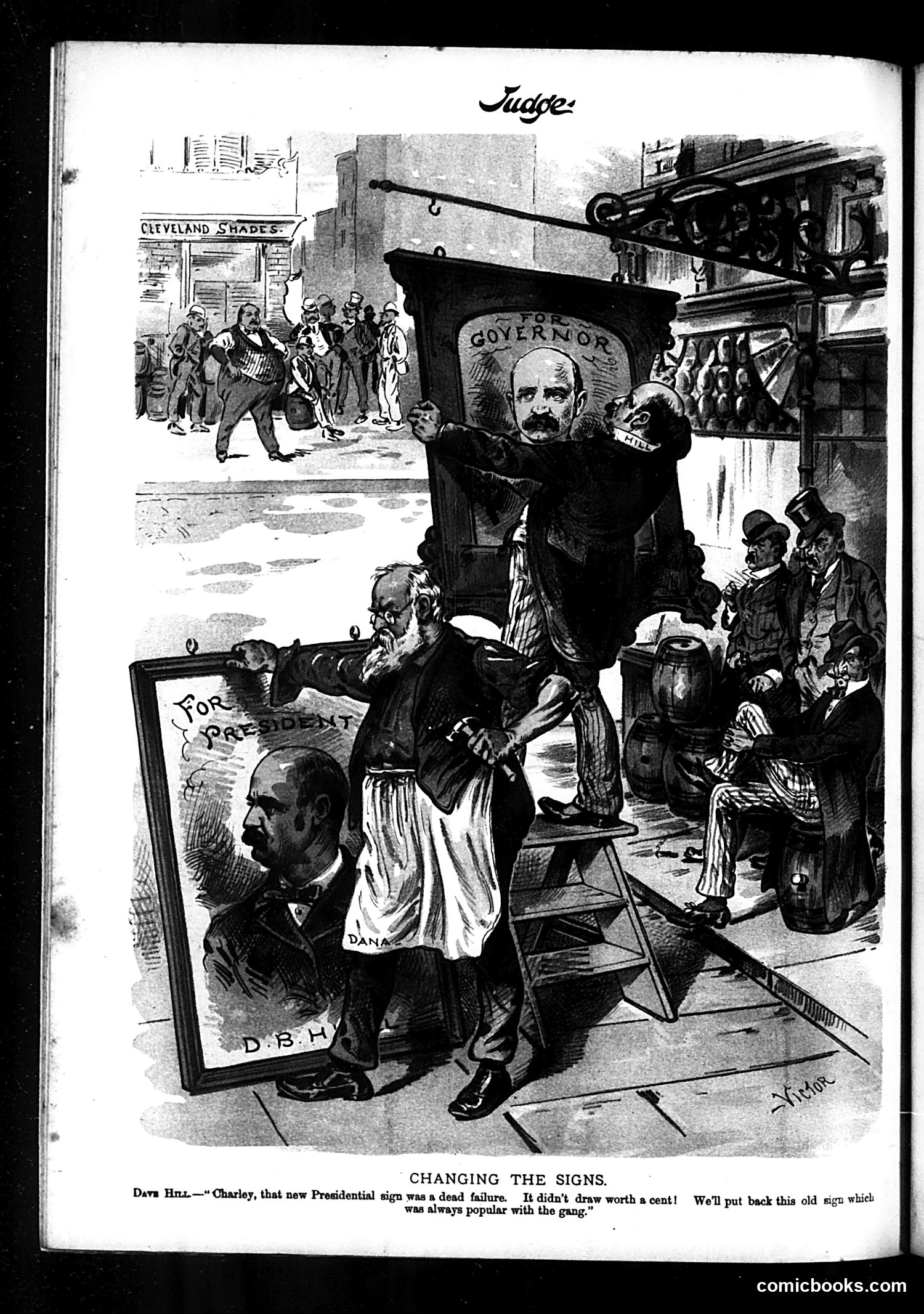
This Judge cartoon satirizes political opportunism and inconsistency. Two men identified as "Dave Hill" and "Charley" are replacing a new "Governor" campaign sign with an older "For President" sign, suggesting a politician's flip-flopping ambitions. The cartoon criticizes how political candidates abandon platforms or positions when they prove unpopular ("didn't draw worth a cent"), reverting to whatever messaging resonates with their base ("popular with the gang"). The crane and storefront setting (including "Cleveland Shades") establish an urban scene. The satire targets the cynical, market-driven nature of political campaigning—where principles matter less than what attracts voters. Without the specific date visible, the exact candidate referenced is unclear, though the Governor/Presidential progression suggests commentary on a real political figure's shifting aspirations.