
Judge, 1888-05-12 · page 2 of 16
Judge — May 12, 1888 — page 2: what you’re looking at
What you’re looking at
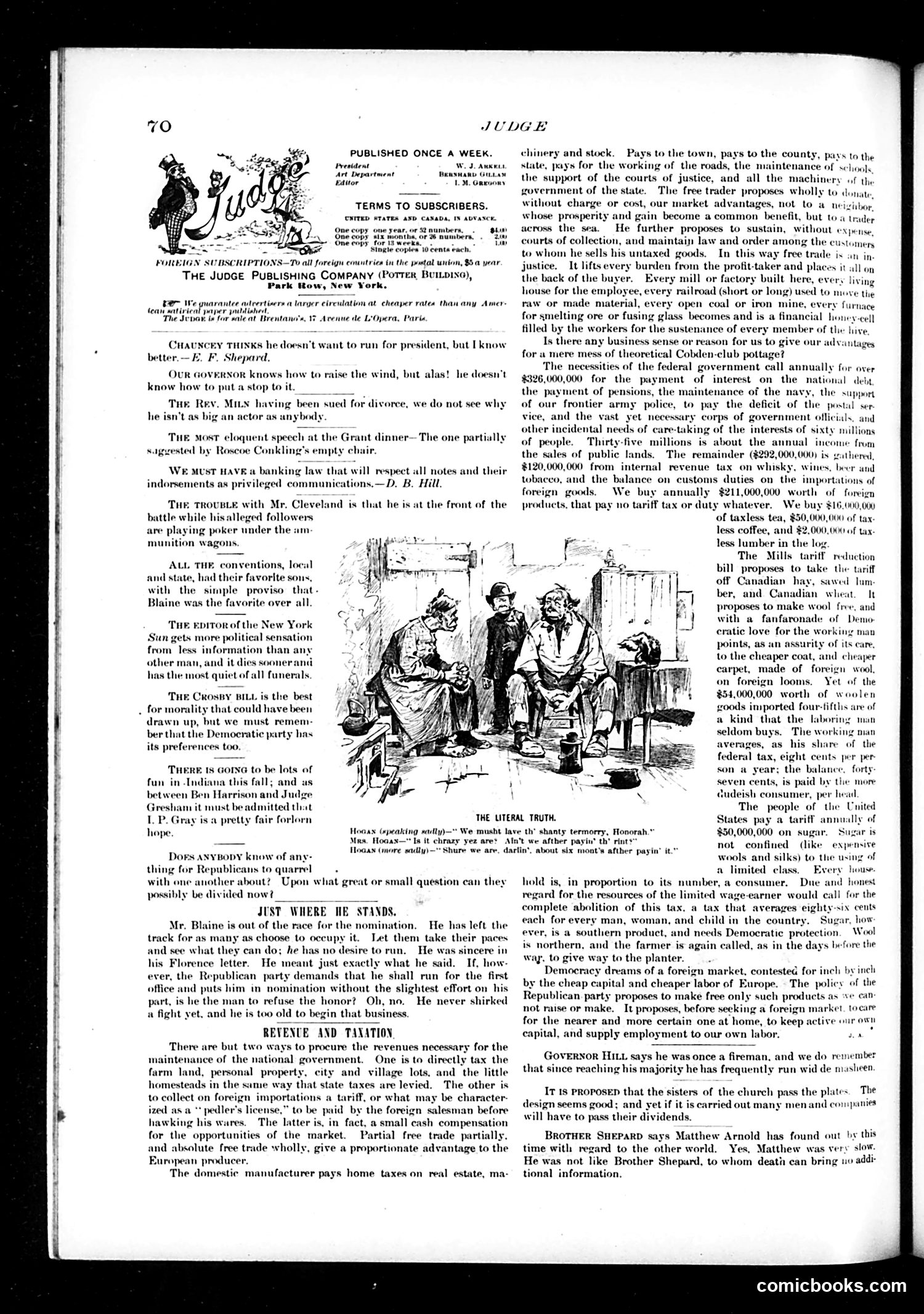
This page contains political commentary and satirical text rather than a prominent cartoon. The main illustration shows working-class men in casual discussion, captioned "THE LITERAL TRUTH" with dialogue about paying tariffs. The text discusses **tariff policy**, a major political issue of the era. References to "the Mills tariff reduction bill," Canadian trade, and debates between Republicans and Democrats indicate this addresses late 19th-century protectionist controversies. Key figures mentioned include **Mr. Blaine** (likely James G. Blaine, Republican politician) and **Governor Hill** regarding nomination politics and free-trade versus protectionist economic philosophy. The satire critiques how tariffs affect ordinary workers and consumers, suggesting Republican promises of prosperity through protective tariffs were hollow. The "literal truth" cartoon emphasizes the disconnect between political rhetoric and working people's actual economic experience.
📄 Transcribed text from this page (OCR, searchable)
Machine-transcribed from the original scan — historical spelling and the odd misread are preserved.
JUDGE PUBLISHED ONCE A WEEK. President Art Department bauwor W. J. Aww Beasnann Gu. 13. Ow TERMS TO SUBSCRIBERS. ONITED STATES AND CANADA, IN ADPANCE. un Ta Single coplen 10 centa each, ea tn the postal union, $5 a year. THE JuoGeE PUBLISHING ComPANy (Potter Buitpiso), Park Row, New York, BR™ We guarantee auteertioers fean satirical paper ymblished, The evar. is for sale at Brentan larger eirenlation at cheaper rates than any Amer 17 Avenue de LOpera, Paris THINKS he doesn't Shepard. Cuau better.— EB. F. OvR GovERNOR knows b know how to put a stop to it. a Tur Rey. MILN having been sued for divorce, we do not see why he isn’t as big an actor ax unybody. THE MosT cloquent speecl sted by Roscoe Conkling’ it to run for president, but I know w to raise the wind, but alas! he doesn't the Grant dinner— The one partially sag: empty ebair twill respect all notes and their ations. —D. B. Hill. We aust HAVE a banking law th indorsements as privileged communi Tue TROUBLE with Mr. Cleveland is that he is at the front of the battle while his alleged followers ying poker under the am jon wagons. ALL THE conventions, local and state, had their favorite sons, with the simple proviso. that- Blaine was the favorite over all. THE EpITOR of the New York Sun gets more political sensation from less information than ar other man, and it dies soonerand has the most quiet of all funerals. THE Crospy BILL is the best . for morality that could have been drawn up, but we must remem- ber that the Democratic party has its preferences too, THERE IS GOING to be lots of fun in Indiana this fall; and as between Ben Harrison and Judge Gresham it must be admitted that 1. P. Gray is a pretty fair forlorn hope. Hooas (peak Mrs. Hogax—" Is it Hoaas (more sad hrazy yez are? Does axyopy know of any- thing for Republicans to quarrel with one another about?) Upon what great or small question can they possibly be divided now? JUST WHERE HIE TANDS. Mr. Blaine is out of the race for the nomination, track for as many as choose to occupy it. and see what they can do; he has no desire to run, his Florence letter. ever, the Republican party demands that he shall run for the first He has left the Tet them take their paces He was sincere in He meant just exactly what he said. If, how office and puts him in nomination without the slightest effort on his part, is he the man to refuse the honor? Oh, no. He never shirked a fight yet, and he is too old to begin that business. REVENUE AND TAXATION. There are but two ways to procure the revenues necessary for the maintenance of the n al government. One is to directly tax the farm land, personal property, city and village lots, and the little homesteads in the sume way that state taxes are levied. The other is to collect on foreign importations a tariff, or what may be character- * pedler's license,” to be paid by the foreign salesman before wk ot his wares. The latter is, in fact, a small cash compensation for the opportunities of the market. Partial free trade partially. and absolute free trade wholly, give a proportionate advantage to the European produce: The domestic manufacturer pays home taxes on real estate, ma- THE UTERAL TRUTH. 1g ncully)—"" We musht lave th* shanty termorry, Ain't we afther pay ure we are, darlin’ chinery and stock. Pays to the town, pays to the county, pays to the state, pays for the working of the roads, the maintenance of schoe the support of the courts of justice, and all the machinery «f thy. government of the state. The free trader proposes wholly to ¢ without charge or cost, our market advantages, not to an whose prosperity and gain become a common benefit, but to cross the sea. He further proposes to sustain, without courts of collection, and maintain law and order among the cus to whom he sells his untaxed goods. In this way free trade is an in. justice. It liftsevery burden from the profit-taker and the back of the buyer. tomers Aces it all o Every mill or factory built here, evers iiviag house for the emple ilroad (short or long) used to move the raw or made mate! ry open coal or iron mine, every f for smelting ore or fusing glass becomes and is a financial honey-cell filled by the workers for the sustenance of every member of the hive. Is there any business sense or reason for us to give our advantages for a mere mess of theoretical Cobden-club pottage? The necessities of the federal government call annually for over $26,000,000 for the payment of interest on the natic the payment of pensions, the maintenance of the na the support of our frontier army police, to pay the deficit of the postal ser vice, and the vast yet necessary corps of government ollici:ls, and other incidental needs of care-taking of the interests of sixty millions of peuple. Thirty-five millions is about the annual income from the sales of public lands. The remainder (%292,000,000) is gathered, 120,000,000 from internal revenue tax on whisky, wines, beer und tobacco, and the balance on customs duties on the importations of foreign goods. We buy annually $211,000,000 worth ¢ reign products, that pay no tariff tax or duty whatever. We buy $16,000,000 xless tea, $50,000,000 of tax nd $2,000,000 of tax s lumber in the log. The Mills tariff reduction es to take the tariff off Canadian ha ber, and Canad) proposes to make wool free points, as an assur to the cheaper coat, carpet, made of fore on foreign looms. Yet $54,000,000 worth ¢ goods imported four. a kind tha seldom bu, The working o averages, as his share of the federal tax, eight cents per per son a year; the balance, forty seven cents, is paid by the more Gudeish consumer, per head The people of the United States pay a tariff ally of $50,000,000 on su; ris not confined (ike wools and silks) to a limited class. E hold is, in proportion to its number, a consumer. Du regard for the resources of the limited wage-earner would call for the complete abolition of this tax, a tax that averages eighty-six cents each for every man, woman, and child in the country ever, is a southern product, and needs Democratic protection is northern, and the farmer is again called, as in the days before the Honorah.* "th? rints™ expensive about six mont’s afther payin’ it.” v and honest 1 and cheaper labor of Europe. Republican. party proposes to make free only such products. not raise or make. It proposes, before seeking a foreign 1 for the nearer and more certain one at home, to keep active our ow capital, and supply employment to our own labor. Governor Hit that since reaching h he was once a fireman, majority he has frequently run wid de masheen: fers of the chureh pass the plites. The nd yet if it is carried out many men and companies their dividends. It 1s PROPOSED that the si: design seems good ; will have to pa BroTHER SHEPARD says Matthew Arnold has found out by this time with regard to the other world. Yes, Matthew was very slow. He was not like Brother Shepard, to whom death can bring uo addi- tional information. comicbooks.com