
A complete issue · 16 pages · 1888
Judge — January 14, 1888
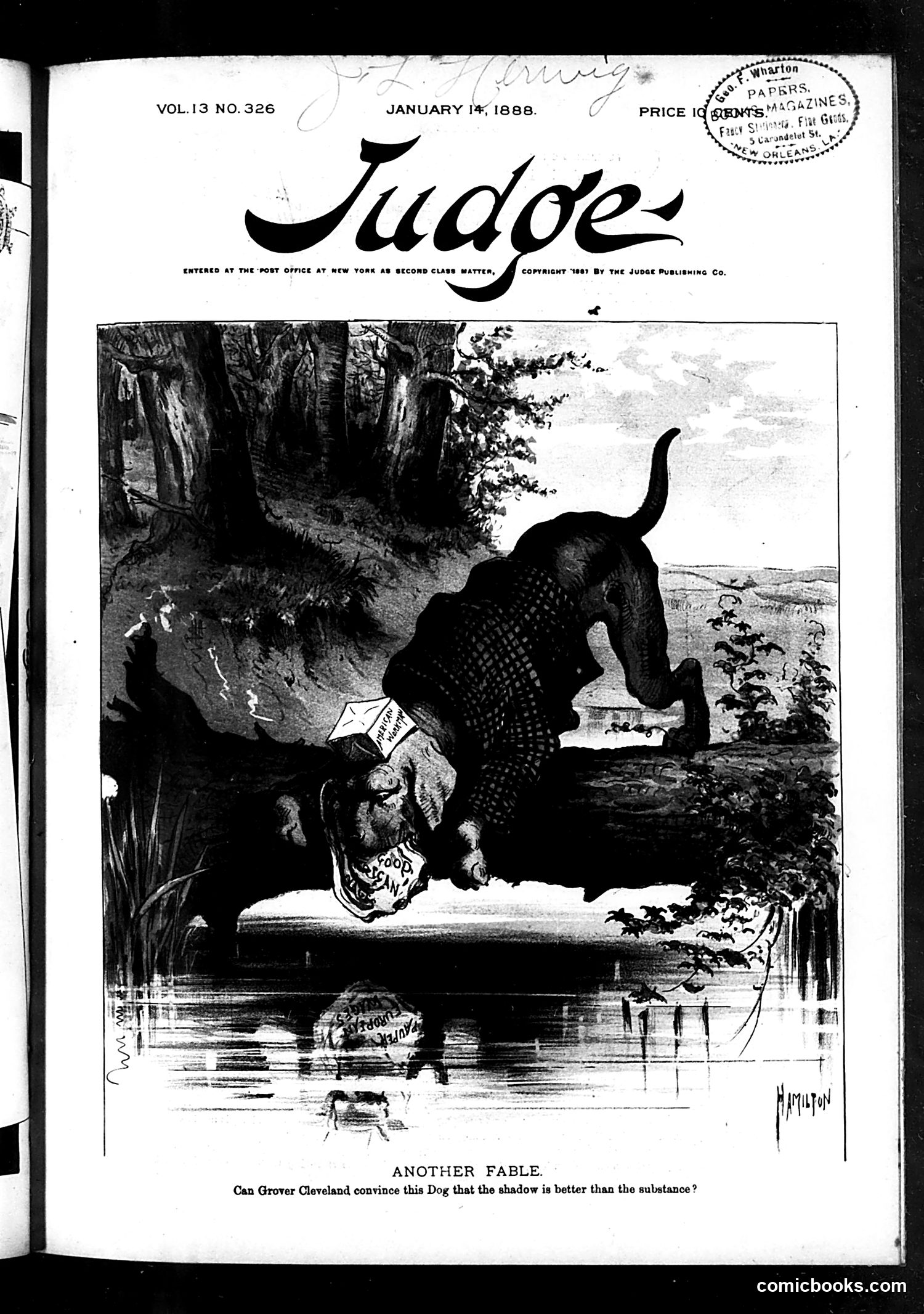
This political cartoon satirizes **Grover Cleveland**, whose name appears in the caption asking if he can convince a dog that "the shadow is better than the substance." The image depicts a dog gazing at its reflection in water—a reference to Aesop's Fable of the Dog and the Shadow, where a greedy dog loses real food while chasing its reflection. The satire appears to criticize Cleveland for pursuing what the cartoonist considers illusory or insubstantial policies or promises ("shadow") while neglecting practical governance ("substance"). The specific political complaint is unclear without additional 1888 context, but it represents typical partisan criticism of Cleveland's presidency. Artist: **Hamilton** (visible signature).
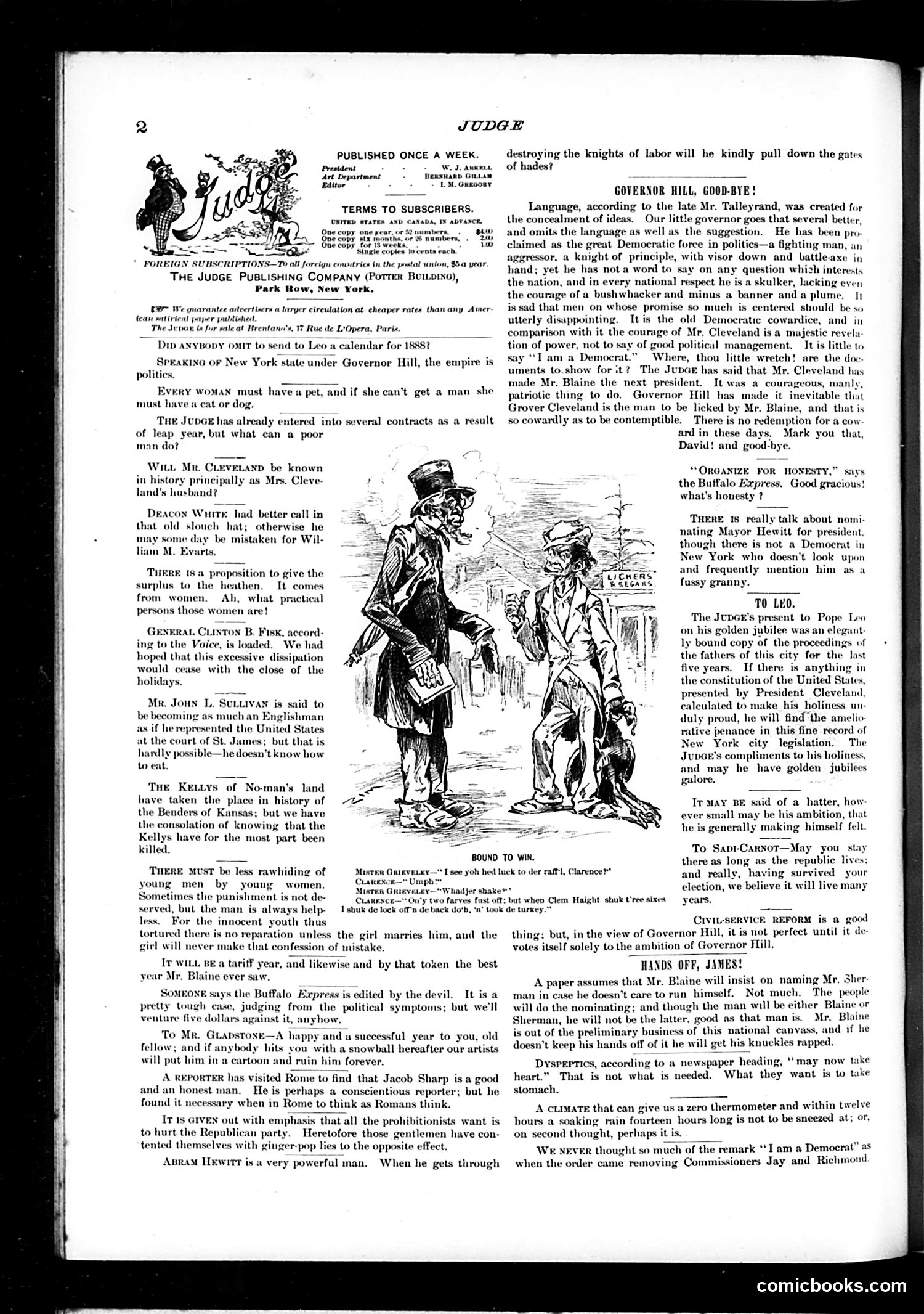
This page contains political commentary and satirical notes rather than a single cartoon. The main illustration, titled "BOUND TO WIN," depicts two figures in conversation, likely representing political or social commentary of the era. The text references Governor Hill (appears to be David B. Hill, New York governor), with the heading "GOVERNOR HILL, GOOD-BYE!" criticizing his political positions and character. Multiple short items mock Democratic politics, mention potential mayoral candidates, and comment on civil service reform. Without clearer identification of specific individuals or dates in the OCR, the exact political figures and events remain uncertain. The overall tone suggests satirizing Democratic Party politics and New York state government during what appears to be the 1880s based on publication style.
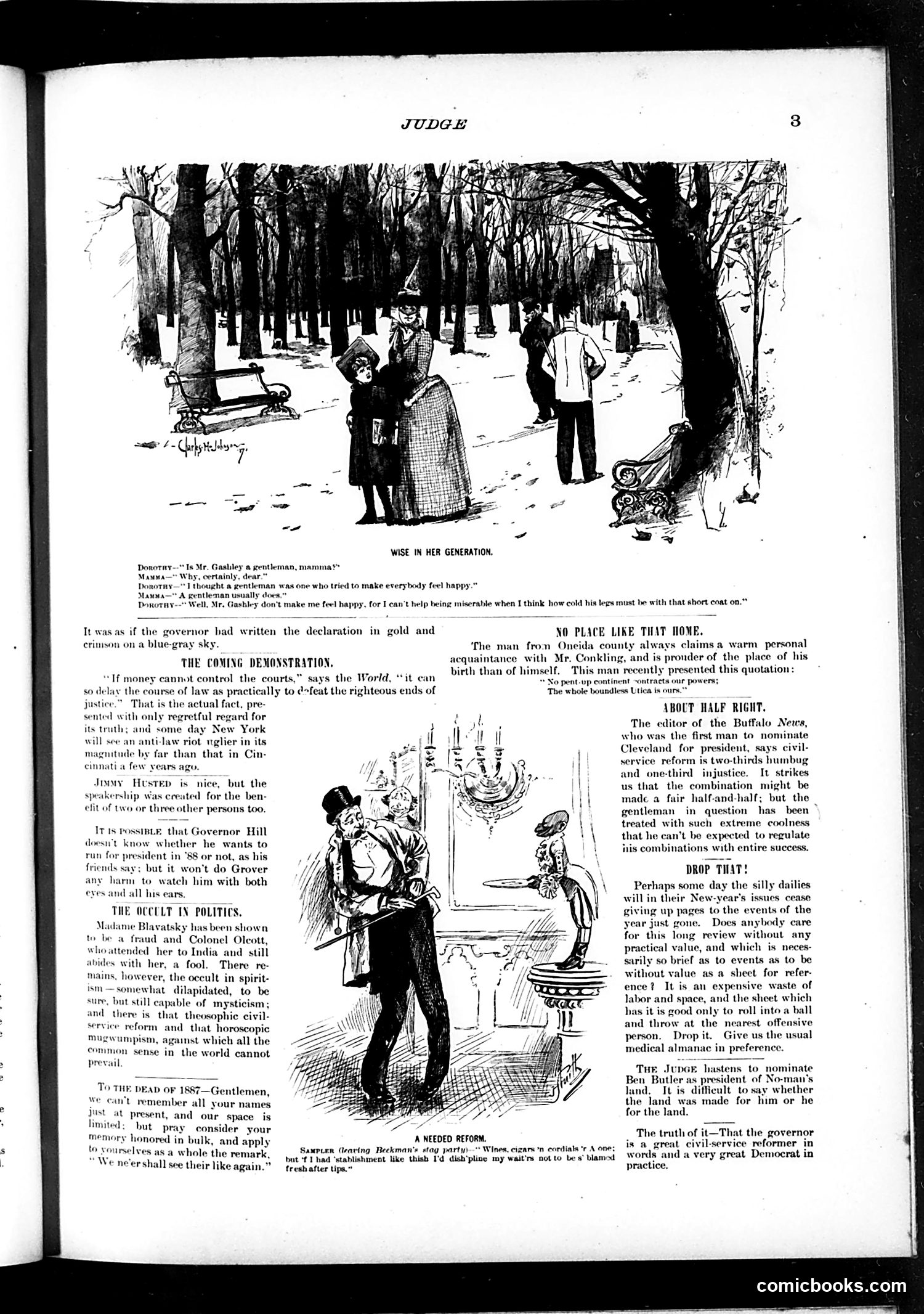
This page contains multiple political commentaries from what appears to be the 1880s, reflecting on New York politics and civil service reform. **Main Figures/References:** - Governor Hill and Grover Cleveland (likely New York politics of the era) - Roscoe Conkling (referenced via "the man from Oneida county") - Ben Butler (nominated as "president of No-man's land"—a derisive non-position) - Madame Blavatsky and Colonel Olcott (theosophists, criticized as frauds) **Key Satire Points:** The cartoons mock corruption in courts, political ambition, and the gap between civil-service reform rhetoric and actual practice. The governor is portrayed as reform-minded in words but Democratic (corrupt) in practice. References to Conkling's vanity and Butler's political irrelevance suggest these were controversial figures. The theosophist references mock spiritualism's influence in politics. **For Modern Readers:** This ridicules backroom political dealing, court manipulation by wealthy interests, and politicians who talk reform while practicing machine politics—themes that remain recognizable today.
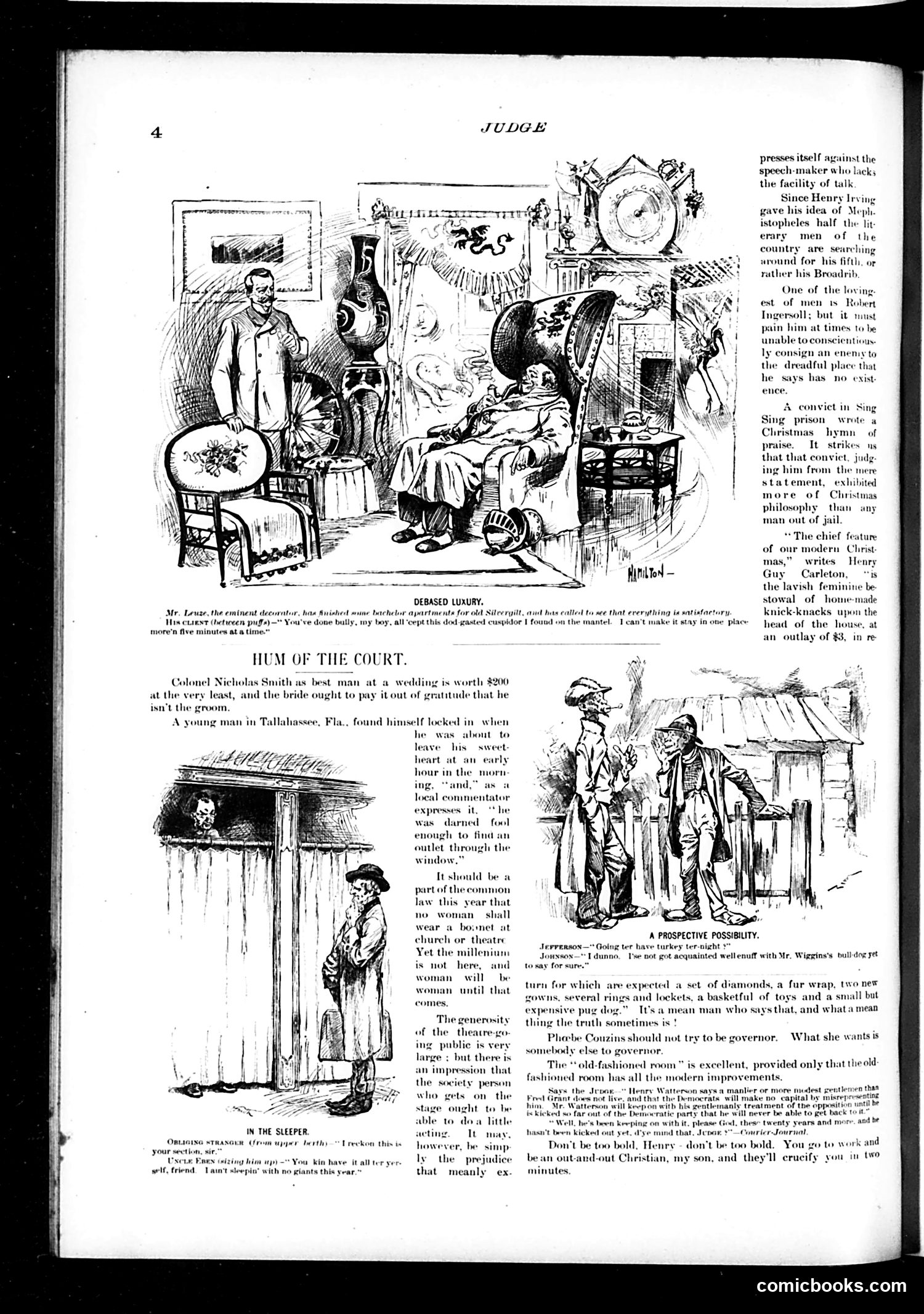
This page contains several satirical pieces typical of Gilded Age humor: **"Debased Luxury"** mocks wealthy bachelors who furnish apartments with expensive decorative items (spittoons, knick-knacks) while claiming poverty—social commentary on nouveau riche ostentation. **"Hum of the Court"** includes anecdotes about marriage customs and social propriety, including a joke about a woman locked in a room with her sweetheart, satirizing Victorian courtship restrictions. **"A Prospective Possibility"** jokes about a man hesitant to marry because he hasn't yet befriended his prospective father-in-law's bulldog—absurdist humor about courtship anxieties. The scattered references to **Phoebe Couzins** (who ran for governor), **Robert Ingersoll** (freethinker), and **Henry Irving** (actor) suggest the magazine engaged contemporary celebrities and political figures in its satire. The overall tone mixes social criticism with genteel absurdist humor typical of 1880s American satire magazines.
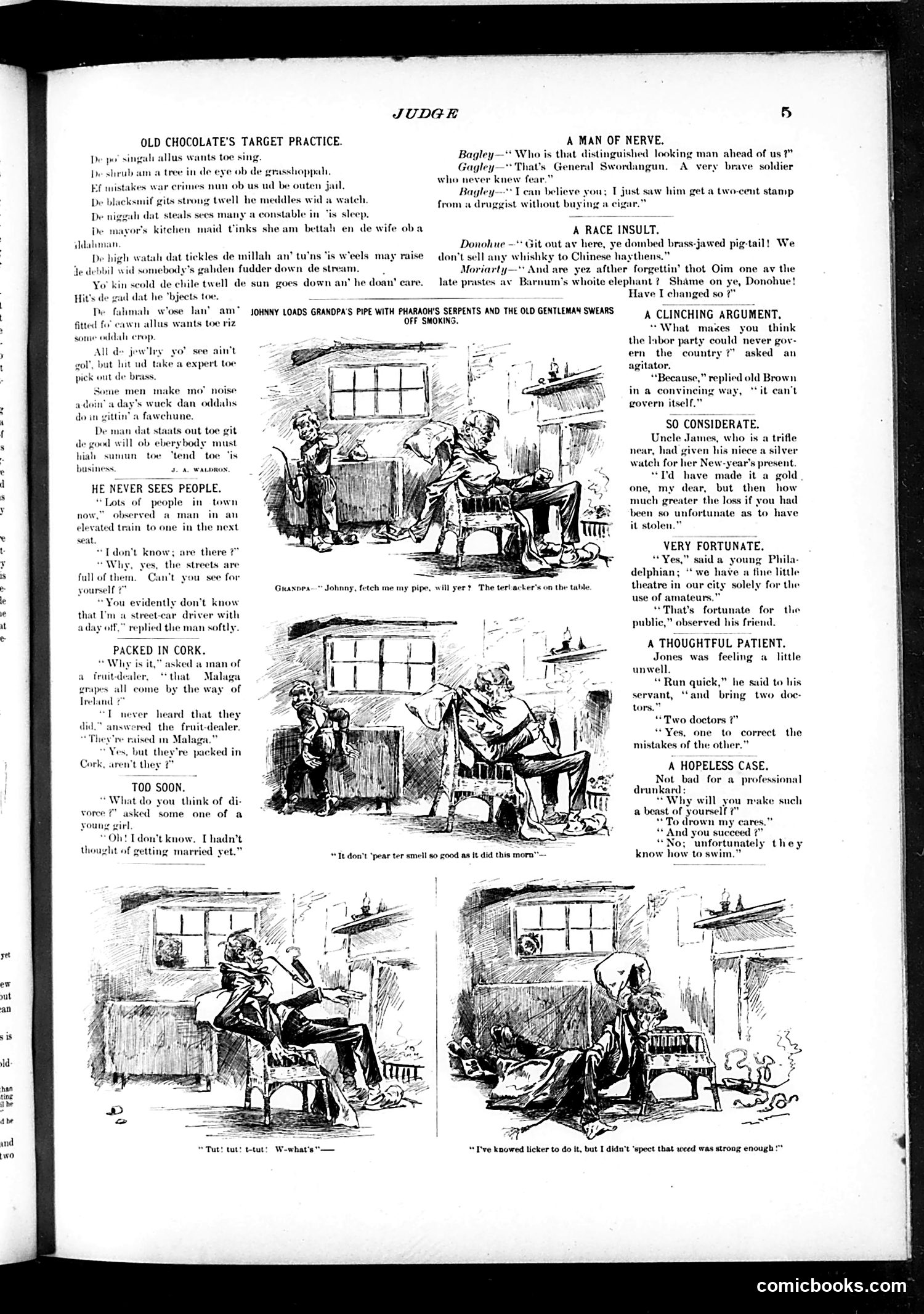
This page from *Judge* (an American satirical weekly) contains multiple short humorous pieces typical of late 19th/early 20th-century comedy: **Main illustrated sequence** ("Old Chocolate's Target Practice"): Shows a grandfather figure smoking a pipe that Johnny has loaded with "Pharaoh's Serpents"—novelty fireworks that coil and writhe when lit. The old man swears off smoking after the startling experience. This is a simple slapstick prank joke. **Surrounding text items** are brief one-liners and short dialogues satirizing: - Dialect humor (African American and Irish vernacular speech patterns, common in period publications) - Class differences and domestic servants - Urban life observations - Romance and divorce attitudes - Professional incompetence (doctors, labor politicians) **Historical context**: The heavy use of phonetic dialect humor reflects attitudes standard to 1890s-1900s popular comedy—material considered acceptable then but offensive today due to its racial and ethnic stereotyping. The illustrations are Victorian-style pen sketches typical of *Judge's* visual format.
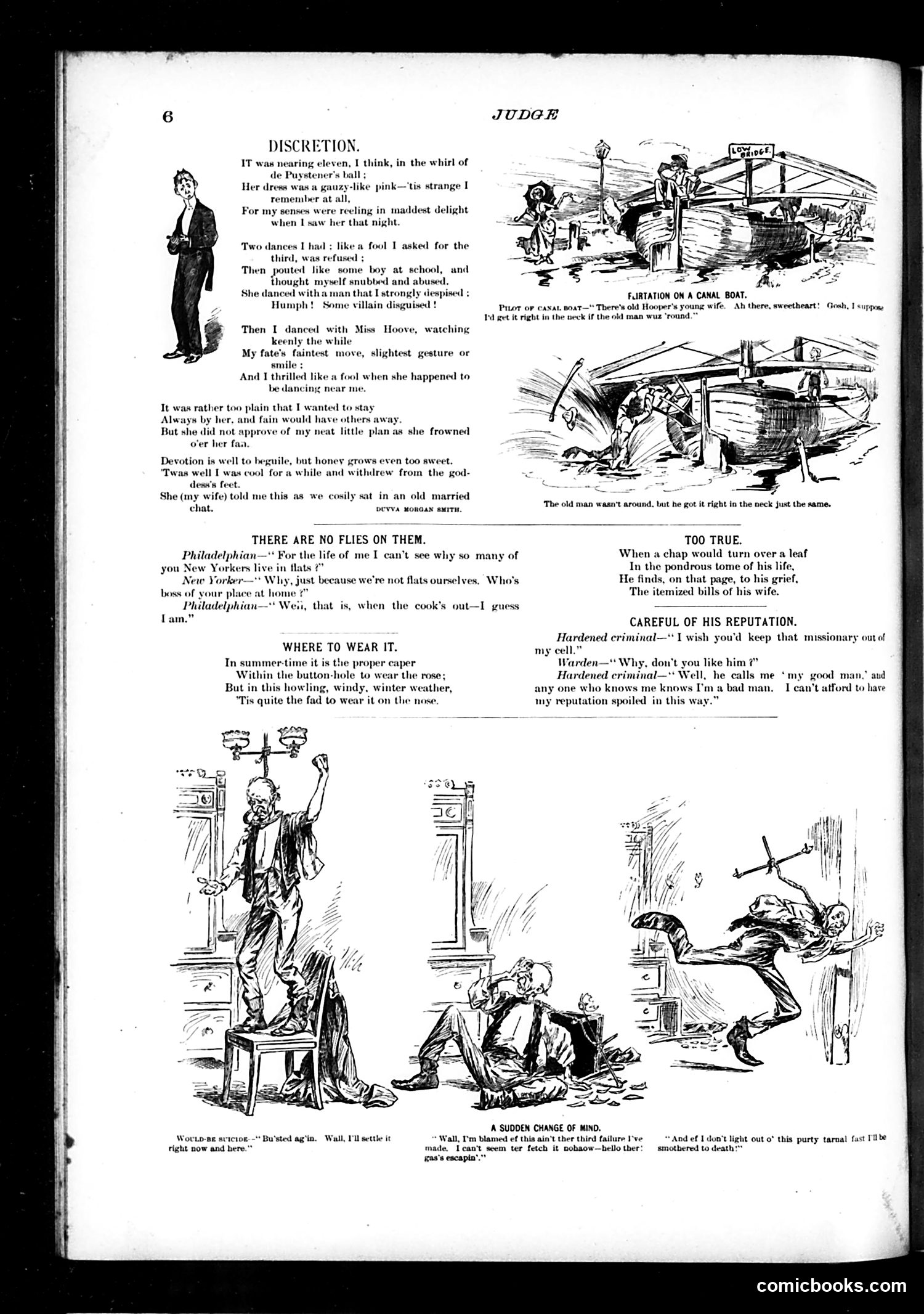
This page from *Judge* contains several unrelated satirical pieces typical of the magazine's format: **"Discretion"** is a narrative poem about a man's jealousy at a ball, presented with the moral lesson that his wife wisely counseled restraint—the accompanying illustrations show flirtation scenes. **"There Are No Flies On Them"** jokes about New York apartment living: a Philadelphian asks why New Yorkers live in cramped flats, and the New Yorker responds it's because they themselves aren't "flats" (implying they have substance/character). **"Where to Wear It"** puns on wearing roses in buttonholes, suggesting in windy winter weather one should wear it "on the nose" instead. The remaining pieces are brief humorous observations: a wife's itemized bills causing grief; a hardened criminal worried a missionary will ruin his "bad man" reputation by calling him "good man"; and slapstick scenes of rural mishaps. The humor relies on period-appropriate social commentary about urban life, marital relations, and character pretense—typical *Judge* fare mixing sophisticated wordplay with broad physical comedy.
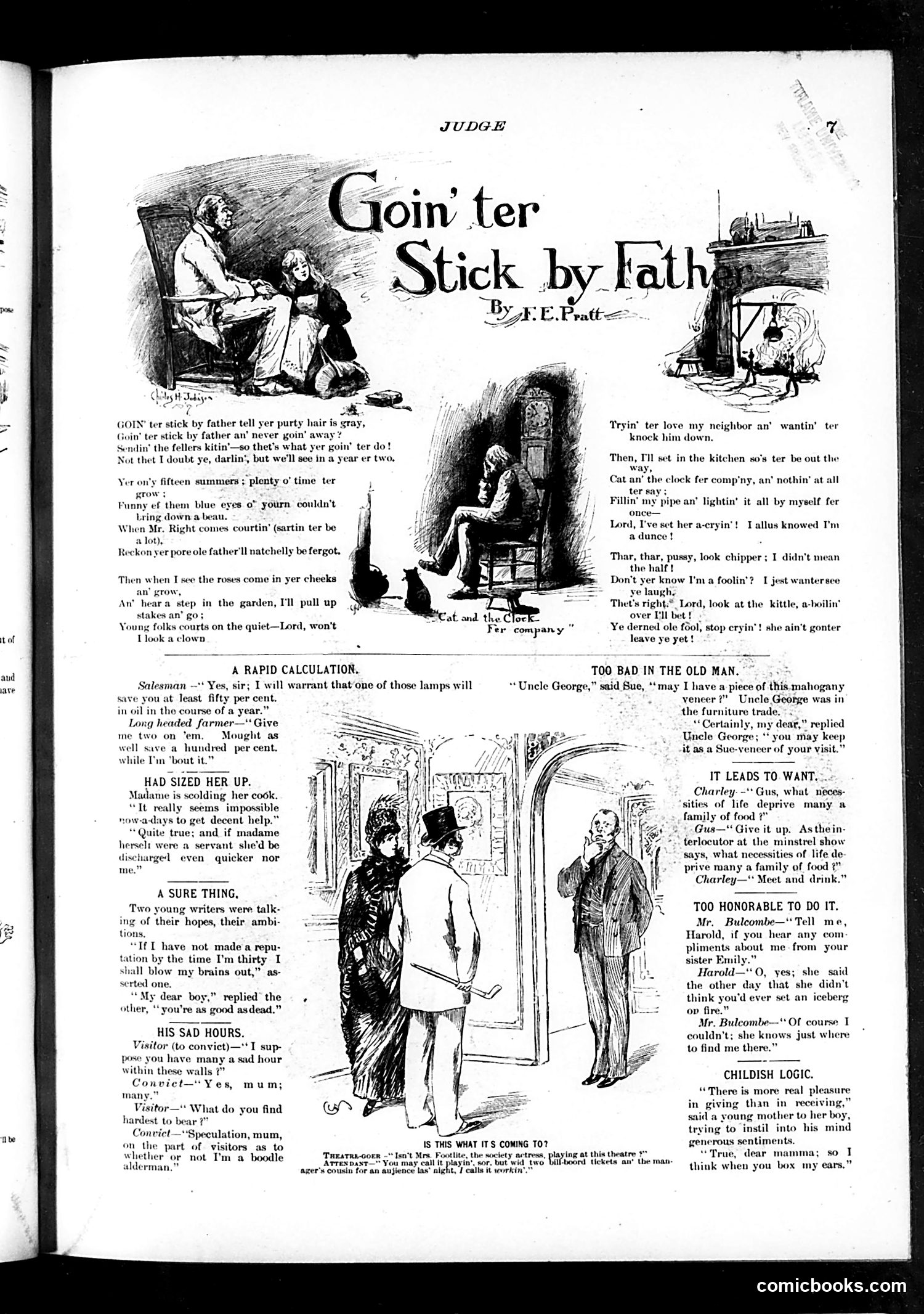
This page from *Judge* magazine contains multiple short satirical pieces typical of late 19th-century humor: **Main feature: "Goin' ter Stick by Father"** depicts a sentimental father-daughter dialogue in rural dialect. The satire lies in the father's assumption his daughter will abandon him once romance arrives—a commentary on women's prioritization of marriage over filial duty, reflecting period anxieties about changing family structures. **Subsidiary sketches** mock various social types: a farmer duped by a lamp salesman's math, a cook who turns employer criticism back on her mistress (class commentary), a convict annoyed by visitors' speculation about his crimes, and a society actress's name-play ("Sue-veneer"). **"Childish Logic"** presents a child logically inverting his mother's maxim about generosity—a common *Judge* format inverting adult moralizing. The humor relies on dialect, irony, and social observation rather than visual satire. No specific political events are referenced; instead, these are timeless observations on human nature and social pretension characteristic of *Judge*'s middlebrow satirical approach.
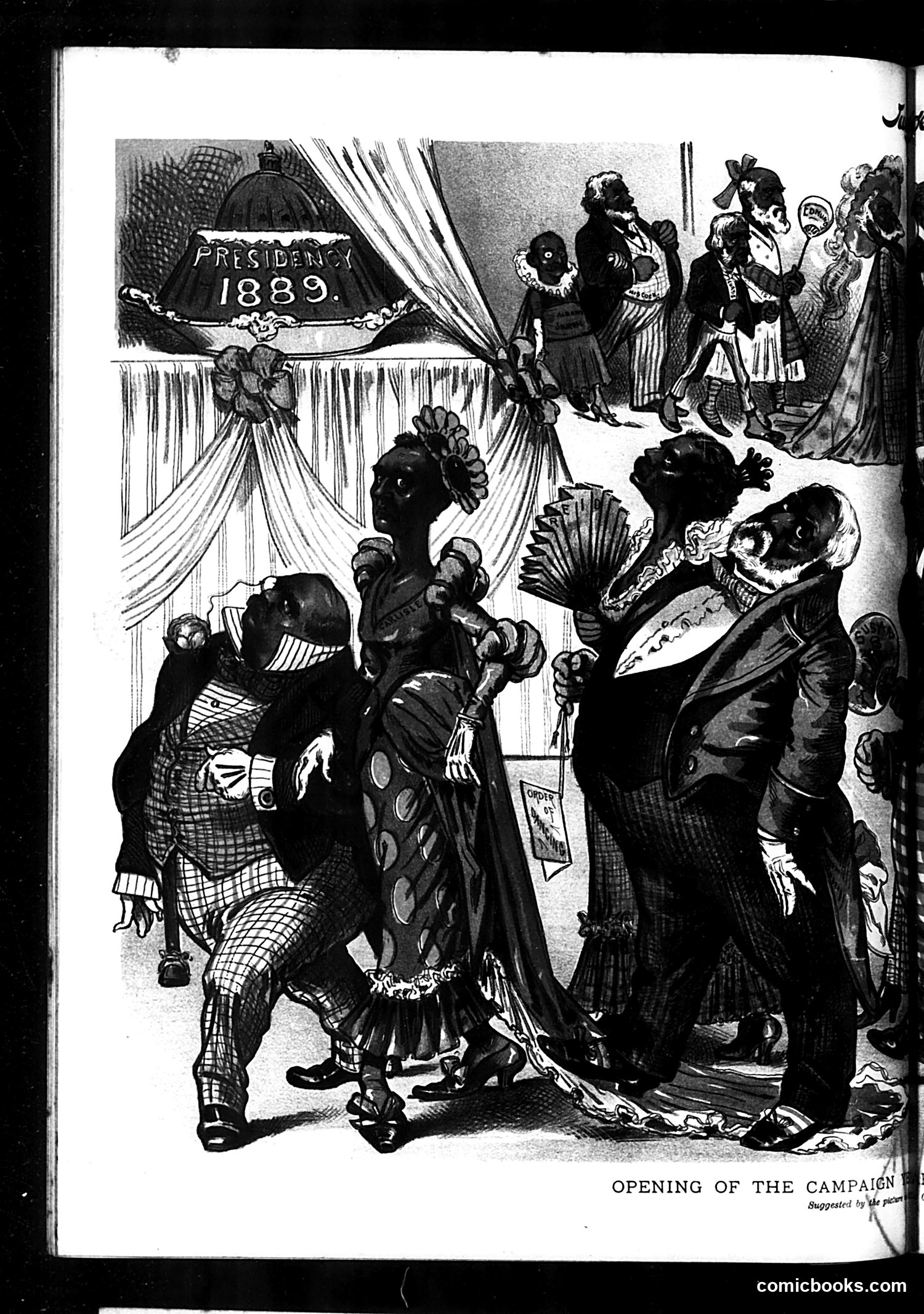
This Judge magazine cartoon satirizes the 1889 U.S. presidential campaign. The banner reads "PRESIDENCY 1889," indicating this depicts the formal launch of electoral activities. The cartoon uses caricatured figures in elaborate period dress—likely representing prominent politicians and society figures—gathered at what appears to be a formal political event or convention. The exaggerated features and grotesque styling typical of Judge's satirical approach suggest mockery of the participating politicians. The caption "Suggested by the press" indicates the cartoon comments on how newspapers were covering campaign politics. The ornate staging with curtains and formal setting parodies the theatrical nature of political campaigns—presenting serious politics as performative spectacle. Without identifying specific individuals, the cartoon conveys Judge's skepticism about political posturing and campaign ritualism.
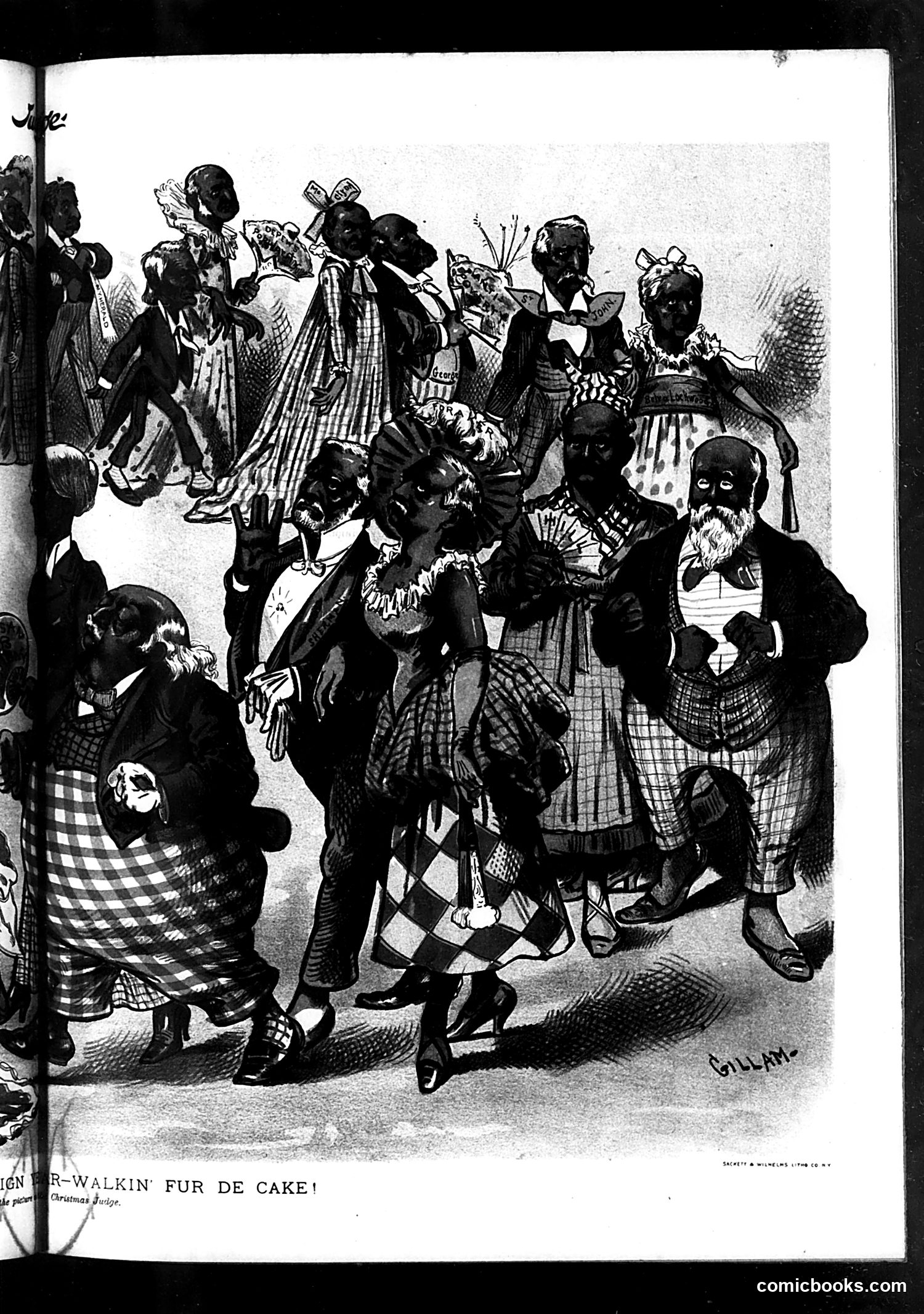
This is a racist caricature from Judge magazine depicting Black people in exaggerated blackface style. The title references the "cakewalk," a dance form with origins in enslaved Black performance that had become a popular entertainment spectacle. The cartoon satirizes Black participation in this dance, using grotesque facial features and dialect spelling ("Fur De") typical of minstrelsy-era racist imagery. The figures wear fancy clothing and formal wear, likely mocking aspirations to respectability or social advancement. The satire appears to target both the cakewalk itself and those performing it, reflecting late-19th/early-20th-century white contempt for Black cultural expression and social mobility. This represents Judge's consistent use of offensive racial caricature as "humor" for its white readership.
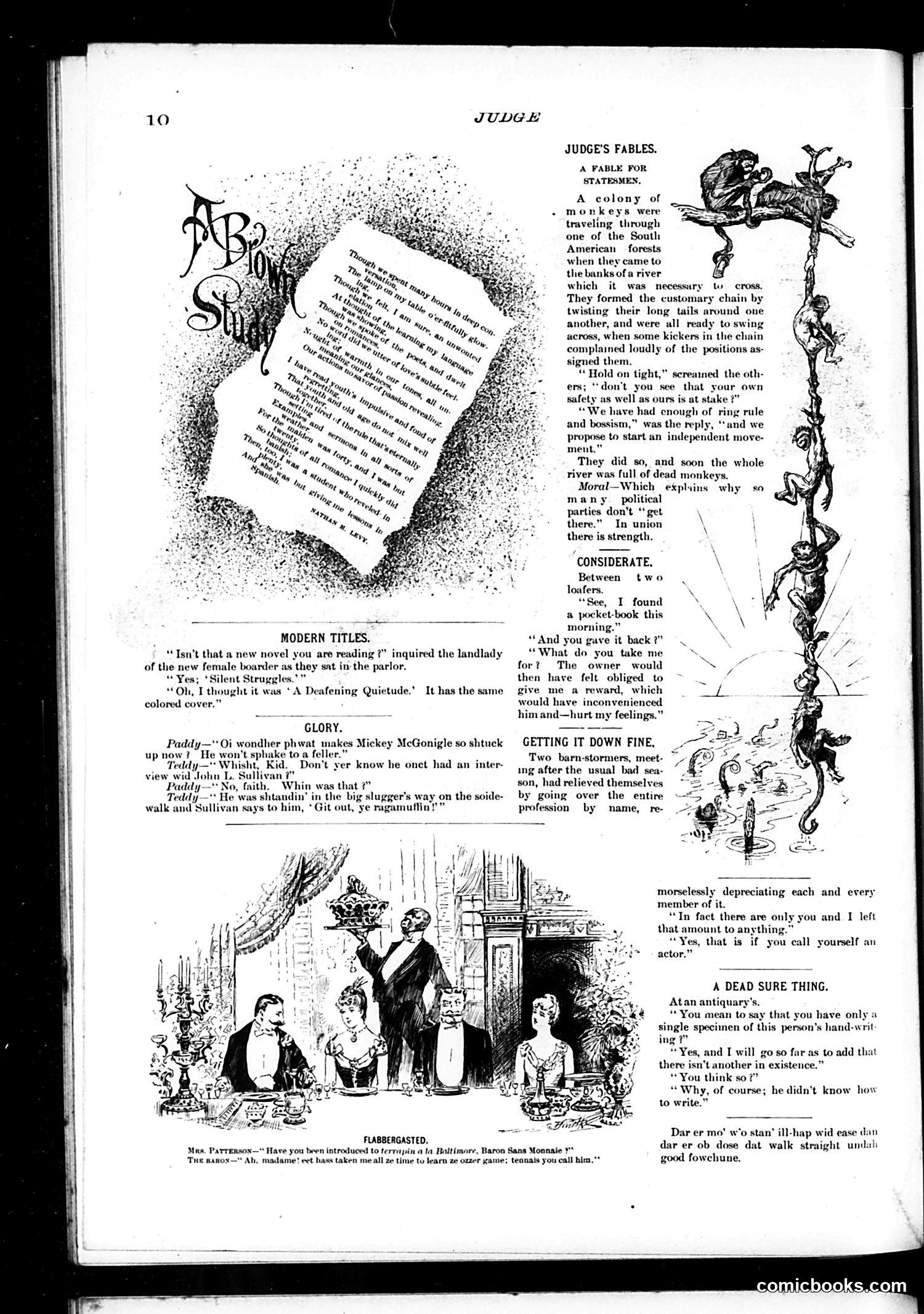
This page contains multiple satirical pieces typical of Judge's social commentary: **"Judge's Fables: A Fable for Statesmen"** uses monkeys crossing a river to mock political parties. When some monkeys reject "ring rule and bossism" and attempt independent action, they all drown. The moral: "In union there is strength"—satirizing splinter political movements and factionalism that weakened parties through division. **"Modern Titles"** mocks pretentious novel titles with wordplay—"Silent Struggles" versus "A Deafening Quietude"—poking fun at contemporary literary affectation. **"Glory"** references boxer John L. Sullivan, a famous heavyweight, suggesting working-class admiration for prizefighters. **"Flabbergasted"** jokes about a French aristocrat struggling to learn English, likely satirizing European pretension or immigration topics. The remaining pieces ("Considerate," "Getting It Down Fine," "A Dead Sure Thing") are conventional joke formats without apparent political content—simply humorous observations about human nature and professional life.
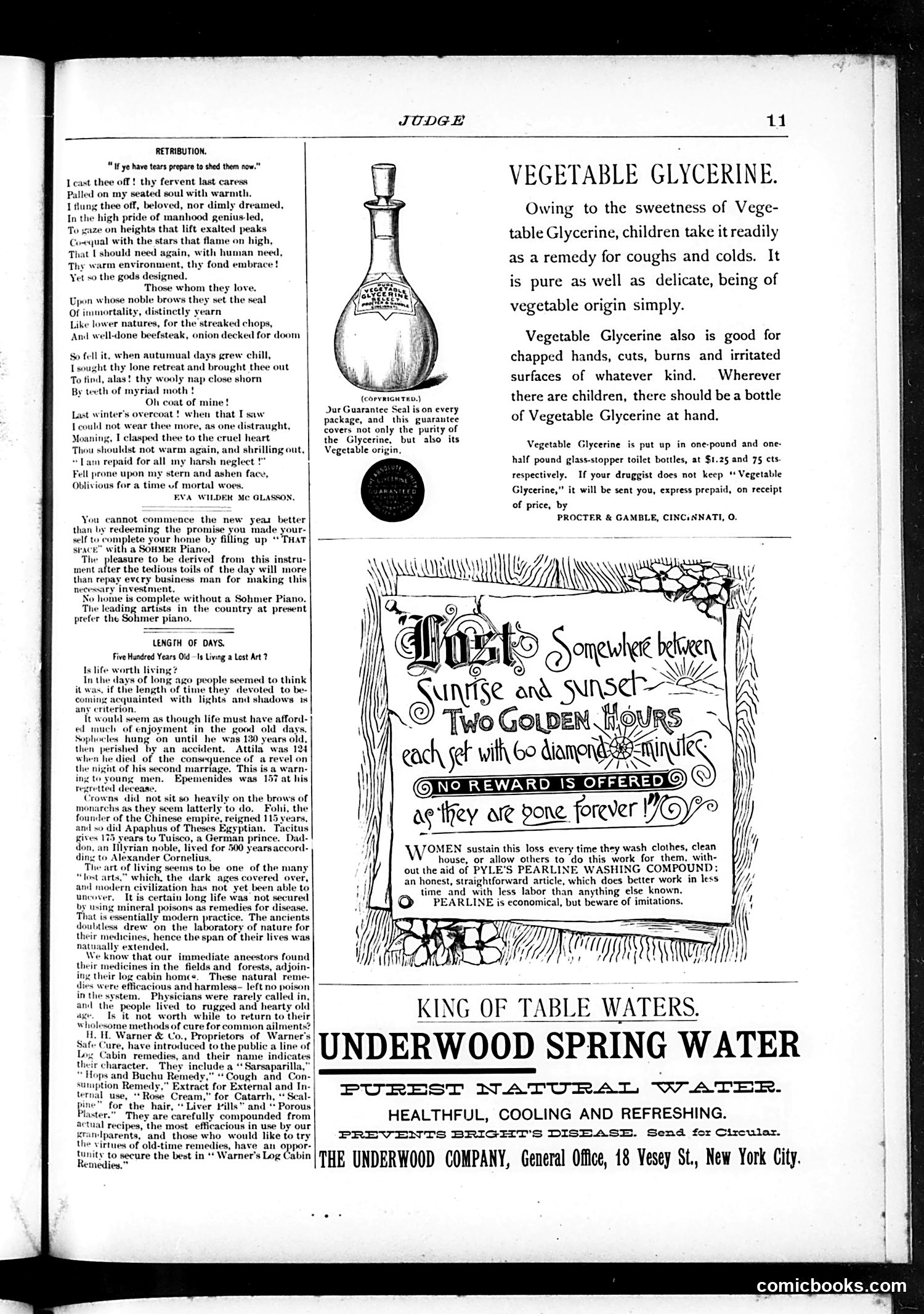
This page is primarily **advertising and promotional content** rather than political satire. The main elements are: **"Retribution"** - A sentimental poem by Eva Wilder McGlasson about regretting discarding a worn garment (likely a shawl or coat), discovering it moth-eaten, then emotionally reuniting with it. It's a melodramatic piece with no political content. **Product Advertisements** dominate the page: - Vegetable Glycerine (cough remedy) - Sohmer Piano (musical instrument) - Underwood Spring Water - Warner's medicines (herbal remedies claiming to restore "old-time" health practices) **Social Context**: The ads reflect late-19th/early-20th-century consumer culture and the era's faith in patent medicines and "natural" remedies. The "Length of Days" article nostalgically promotes returning to ancestral herbal cures over modern "mineral poisons." There is **no political cartoon or satire** visible on this page—it's essentially a magazine back page filled with advertisements and light literary content.
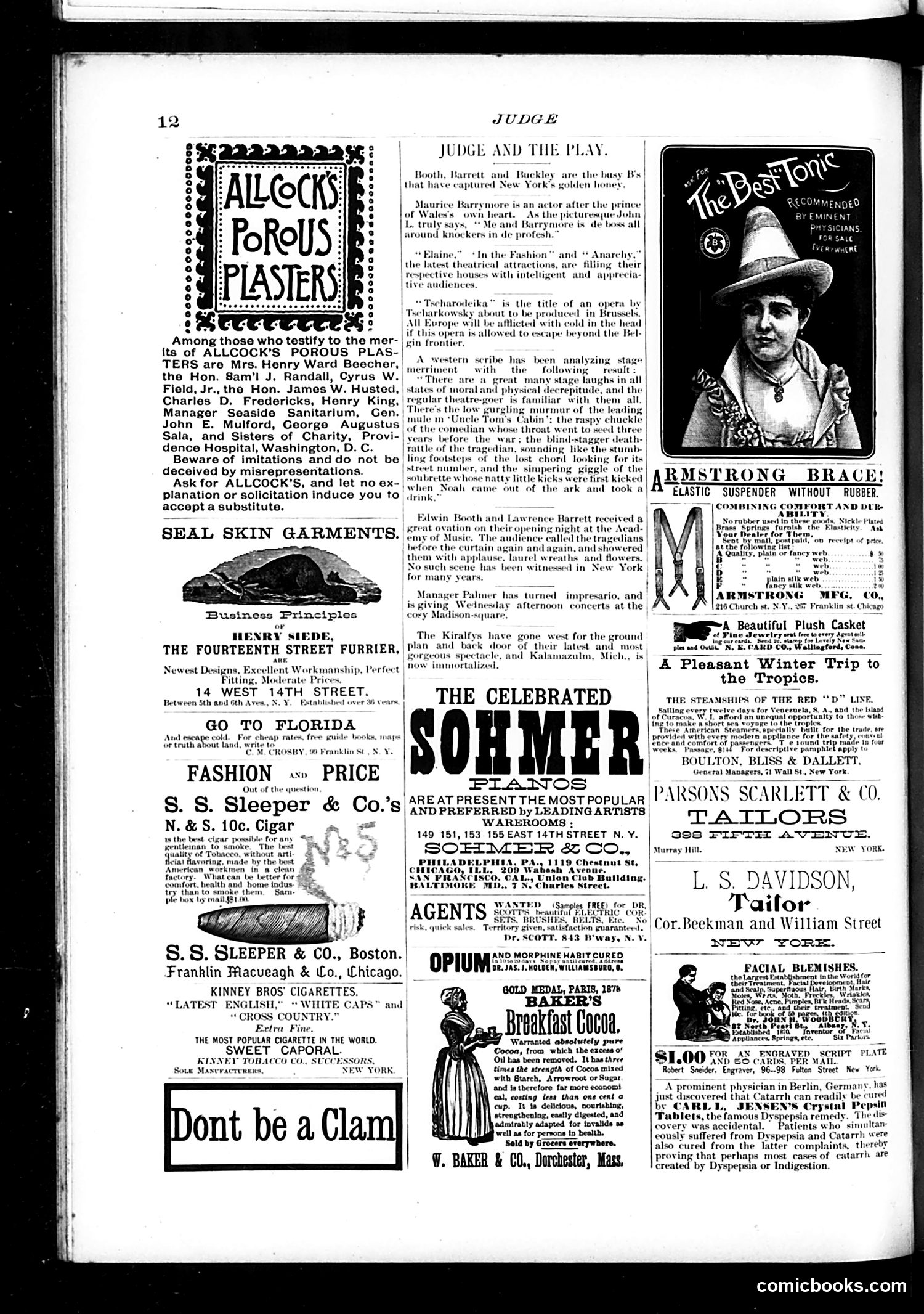
This page is primarily **advertisements** with brief theatrical commentary. The notable content includes: **"Judge and the Play"** section discusses New York theater attractions, including references to productions like "In the Fashion" and "Anarchy," and mentions of performers like Barrymore. It also references an opera "Tacharodeika" coming to Brussels and notes about comedian performances. **Visual element**: A portrait labeled "Armstrong Brace" showing a man in Western attire (cowboy hat), advertising an elastic suspender product. **Advertisements**: The page is dominated by period product ads—Allcock's Porous Plasters (medical), S.S. Sleeper cigars, Kinney Bros cigarettes, Baker's Cocoa, Sohmer pianos, and various tailoring/engraving services. These reflect late 19th-century consumer goods and services. **Tone**: Light and commercial rather than politically satirical. The theatrical commentary is gossipy society journalism typical of Judge's entertainment coverage, rather than satirical commentary on current events. The page represents Judge functioning as an entertainment and advertising vehicle for the urban affluent audience of its era.
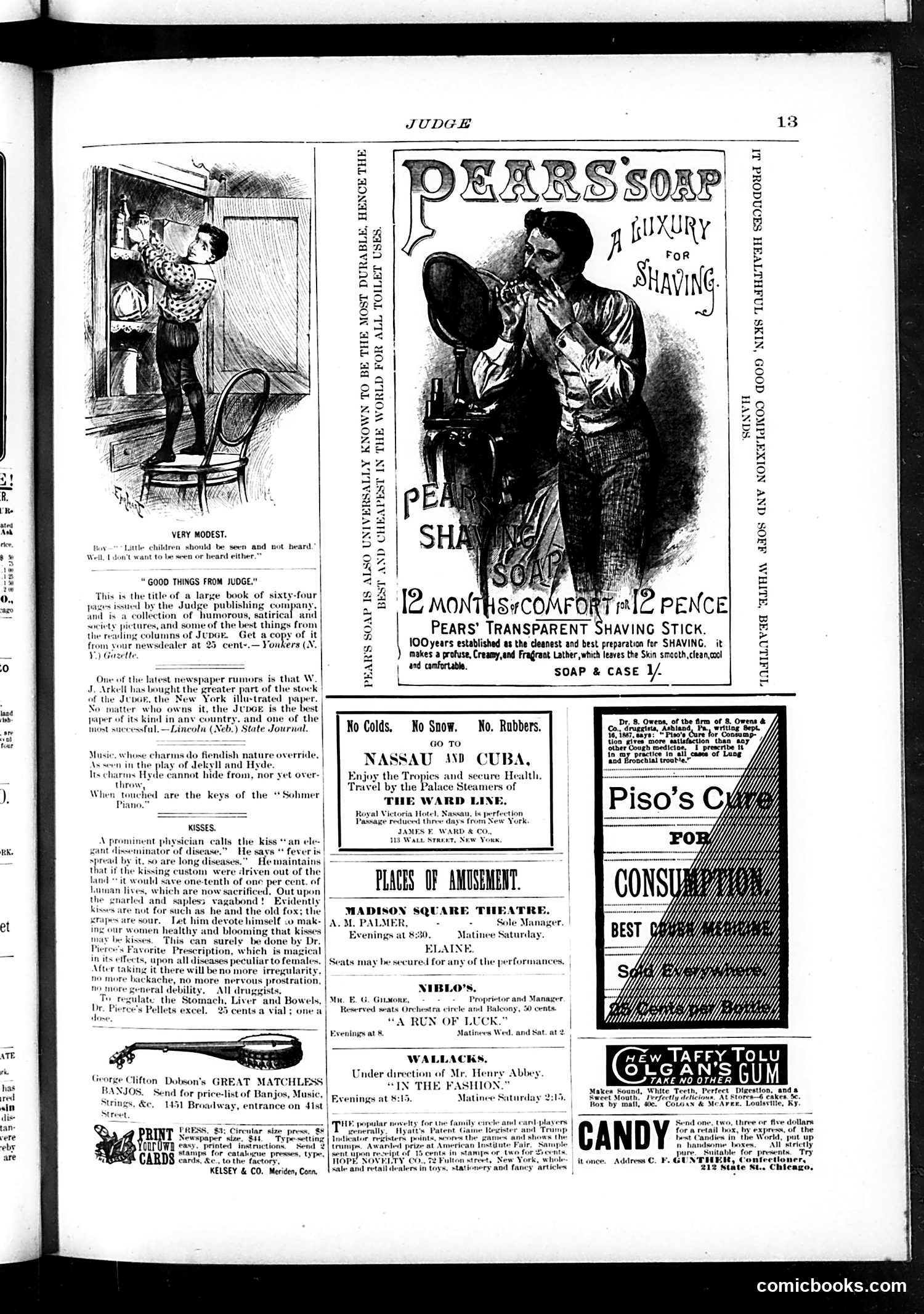
This page is primarily **advertising**, with one small cartoon at the top left. ## The Cartoon: "Very Modest" The single cartoon shows a small boy standing on a stool at a window. The caption references the Victorian-era adage "Little children should be seen and not heard," to which the boy responds he doesn't want to be seen or heard either. This is gentle, domestic humor satirizing childhood modesty or antisocial behavior—a relatable joke about children rejecting social conventions. ## The Advertisements The page is dominated by period product ads typical of late 19th-century magazines: Pears' Transparent Shaving Soap, Nassau and Cuba travel packages, Madison Square Theatre performances, and novelty items like Taffy-Tolu chewing gum and candy. The surrounding text includes editorial content promoting "Good Things from Judge" (a collected book of the magazine's best material) and miscellaneous commentary on kissing customs and medical remedies. **Overall**: A modest entertainment/advertising page with minimal political or social satire—mostly commercial in nature.
This page is primarily **advertising and promotional content** for Judge magazine and related products, rather than political cartoons. The key content includes: 1. **Hotel advertisements** across New York, Philadelphia, and other cities—standard business listings. 2. **A brief humorous exchange** ("Two Fine Chargers") about a man tricked into paying for a cheap horse after paying the bill. 3. **Promotion for "The German Policeman"**—a Judge serial by Julian Ralph, illustrated by Judge's artists. This appears to be satirical fiction about German police, part of Judge's regular humor column. 4. **Product advertisements**: Epps's Cocoa, violin outfits, and the Liebig Company's extract of meat. 5. **Frank Leslie's Popular Monthly** promoted as superior entertainment for 1888. The page reflects Judge's business model: combining lightweight satirical humor with commercial advertising to support the magazine. The "German Policeman" serial likely mocked German culture or authority figures—typical of 1880s American humor—but without seeing the actual cartoon/illustration, the specific satire is unclear.
This page is primarily **advertising and self-promotion** rather than satirical content. The main editorial piece celebrates **William J. Arkell's acquisition of controlling interest in Judge magazine itself**. Multiple reprinted testimonials from newspapers praise Arkell as an capable executive who has made Judge "the best paper of its kind in the world." This is essentially house advertising—Judge promoting its own ownership and success. The remainder consists of period product advertisements: ball-pointed pens, Judge's own 64-page book collection, collars and cuffs, hats, organs, paper goods, patent medicines (balms for skin conditions), and binding equipment. **For modern readers**: This reflects Judge's dual nature as both satirical periodical and commercial venture. The self-congratulatory tone about Arkell's stewardship shows how business interests shaped editorial content. The patent medicine ads are notable—many such products made unsubstantiated health claims typical of the era before FDA regulation.
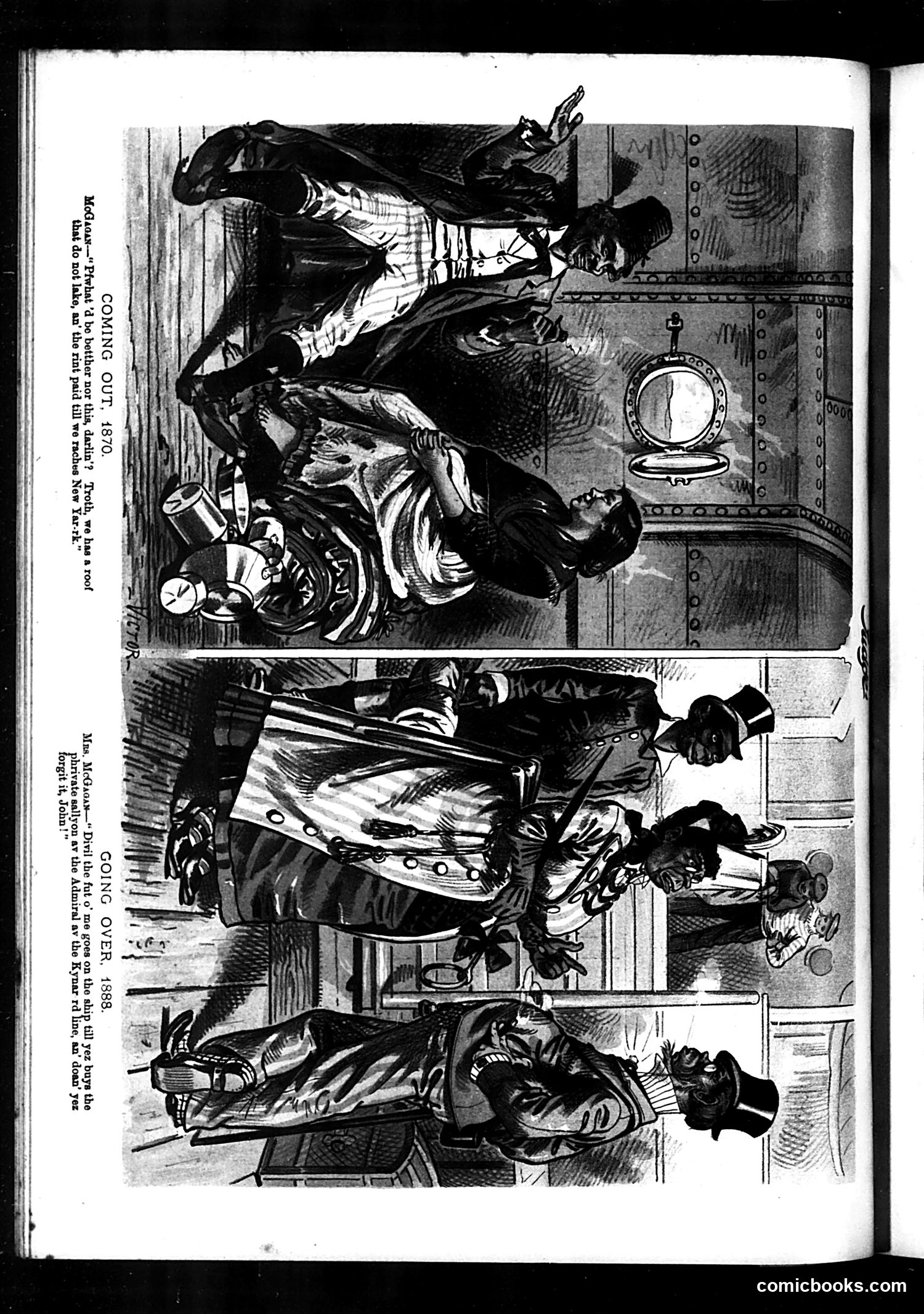
This two-panel cartoon contrasts Irish immigrant experiences across eighteen years. The top panel ("Coming Out, 1870") shows an impoverished Irish family arriving in America, grateful for basic shelter and paid passage to New York. The bottom panel ("Going Over, 1888") depicts the same family (now established) making demands—Mrs. McGaoan insists on a private cabin aboard a ship line before traveling, treating luxury as an entitlement. The satire mocks Irish immigrants' rapid social ascension and newly acquired pretentiousness. The thick dialect and character names emphasize their Irish identity. Judge's point appears critical: the family's transformation from desperate arrivals to snobbish travelers suggests either comedic ingratitude or—less charitably—satirizes what the magazine may have viewed as undeserved social climbing by Irish Americans.