
Judge, 1888-01-14 · page 10 of 16
Judge — January 14, 1888 — page 10: what you’re looking at
What you’re looking at
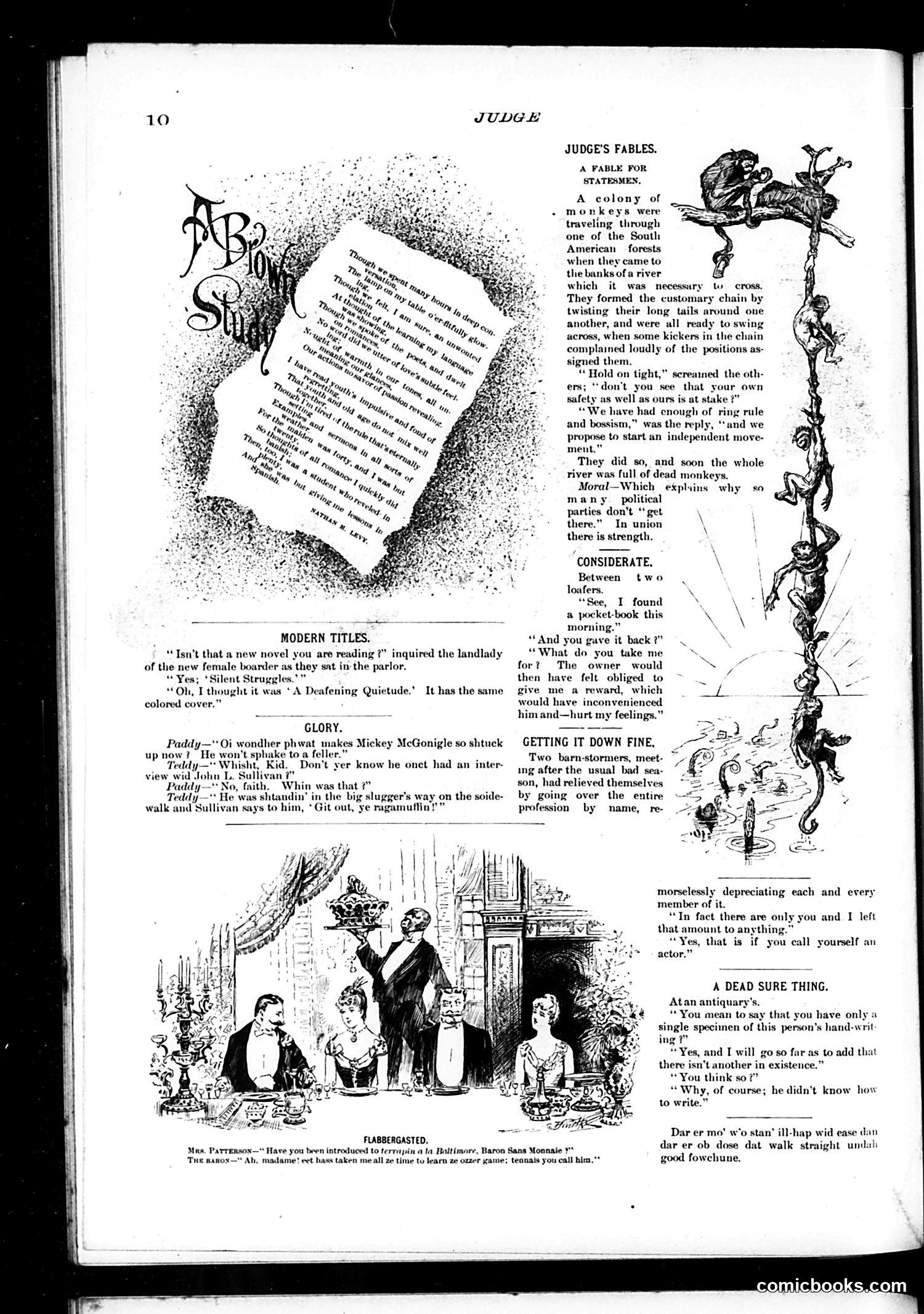
This page contains multiple satirical pieces typical of Judge's social commentary: **"Judge's Fables: A Fable for Statesmen"** uses monkeys crossing a river to mock political parties. When some monkeys reject "ring rule and bossism" and attempt independent action, they all drown. The moral: "In union there is strength"—satirizing splinter political movements and factionalism that weakened parties through division. **"Modern Titles"** mocks pretentious novel titles with wordplay—"Silent Struggles" versus "A Deafening Quietude"—poking fun at contemporary literary affectation. **"Glory"** references boxer John L. Sullivan, a famous heavyweight, suggesting working-class admiration for prizefighters. **"Flabbergasted"** jokes about a French aristocrat struggling to learn English, likely satirizing European pretension or immigration topics. The remaining pieces ("Considerate," "Getting It Down Fine," "A Dead Sure Thing") are conventional joke formats without apparent political content—simply humorous observations about human nature and professional life.
📄 Transcribed text from this page (OCR, searchable)
Machine-transcribed from the original scan — historical spelling and the odd misread are preserved.
JUDGE aging ngioentl fae, “ey 4 ey, MODERN TITLES. “Isn't that a new novel you are reading ?” inquired the landlady of the new female boarder as they sat inthe parlor. “Yes; ‘Silent Struggles.’ “Oh, T thought it was "A Deafening Quietude,” colored cover.” It has the same "GLORY. ondher phwat makes Mickey McGonigle so shtuck sphake to a feller.” Paddy—"0i up now? He won Teddy—" Whisht, Kid. view wid John L. Sullivan ‘Paddy— Teddy walk and Sullivan says to him, Don't yer know he onct had an inter- n_was that ¢” in the big slugger's way on the soide- *Git out, ye ragamuffin!’” FLABBERGASTED. Mus, PaTTERsox—“ Have you been introduced to terrmmpin a ta Baltimore, Baron Sans Monnaie . madame! eet hass taken me all ze time ty learn ze ozzer kame; tennals you call him." Tue arox—" J JUDGE'S FABLES. A FABLE FOR STATESMEN, A colony of monkeys were traveling through one of the South American forests when they came to the banks ofa river which it was necessury to cross. They formed the customary chain by twisting their long tails around one another, and were all ready to s across, when some kickers in the cha complained loudly of the positions as- signed them. “Hold on tight,” screained the oth- ers; ‘don't you see that your own safety as well as ours is at stake ?” “We have had enough of ring rule and bossism,” was the reply, “and we propose to start an independent move- They did so, and soon the whole river was full of dead monkeys, Moral—Which explains why so many political parties don’t “get there.” In union there is strength. CONSIDERATE, Between two loafers. “See, I found a pocket-book this morning.” “And you gave it back ?” “What do you take me for? The owner would then have felt obliged to give me a reward, which would have inconvenienced him and—hurt my feelings.” GETTING IT DOWN FINE, Two barn-stormers, meet- ing after the usual bad sea- son, had relieved themselves by going over the entire profession by name, re- depreciating each and every member of it. “In fact there are only you and I left that amount to anything.” “Yes, that is if you call yourself an actor.” A DEAD SURE THING. Atan antiquary’ “You mean to say that you have only « single specimen of this person's hand-writ ing?” “Yes, and I will go so far as to add that there isn’t another in existence.” “You think so?” “Why, of course; to write.” he didn’t know how Dar er mo’ w'o stan’ ill-hap wid ease dan dar er ob dose dat walk straight undali good fowehune,