
A complete issue · 18 pages · 1887
Judge — December 31, 1887
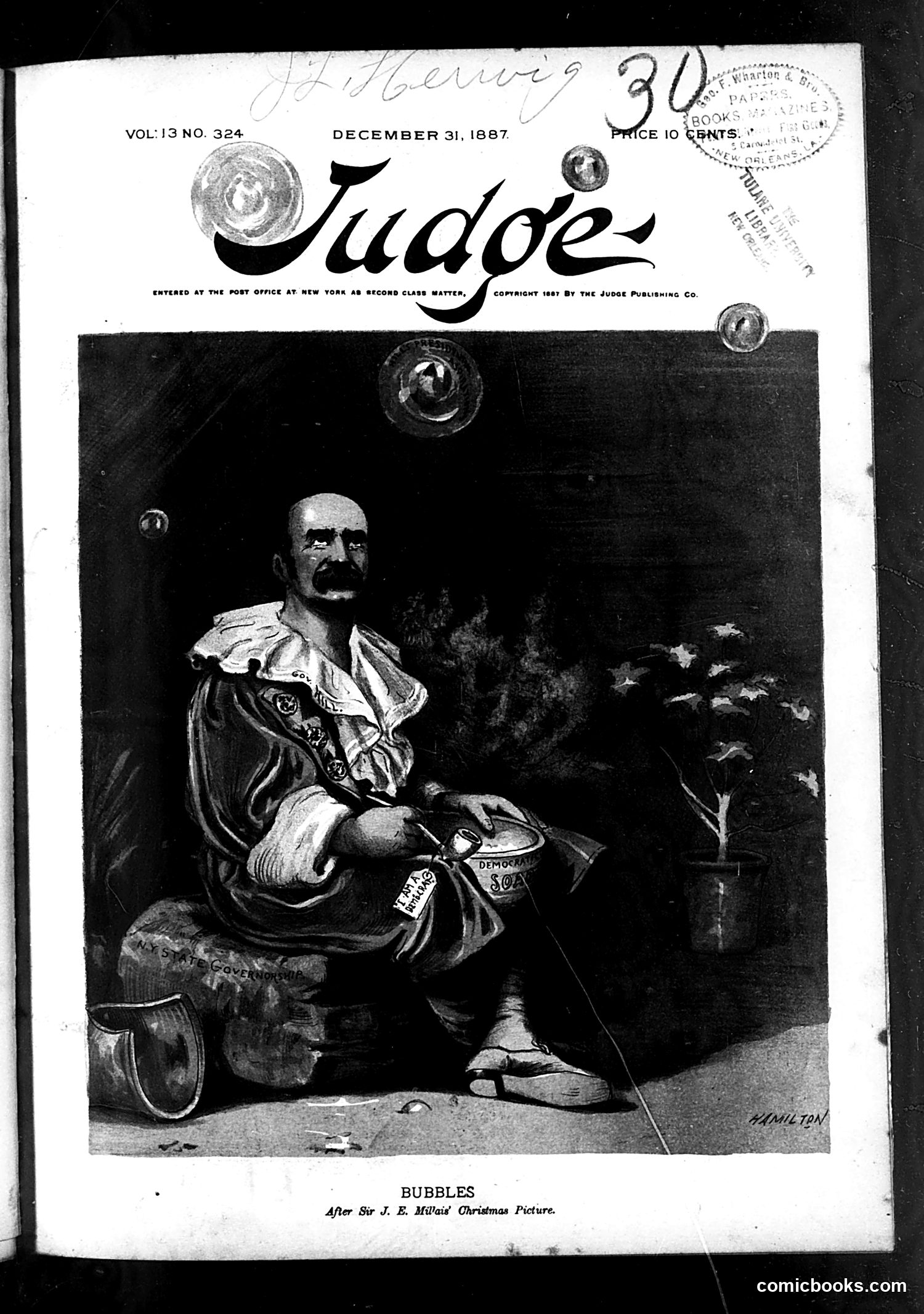
This cartoon, credited to artist Hamilton, satirizes a rotund, mustachioed gentleman in ornate military dress and decorations, blowing bubbles. The title "Bubbles" and subtitle reference "Sir J. E. Milais' Christmas Picture," indicating the artist is parodying a famous contemporary painting. The satire likely mocks either a specific political or military figure of 1887, portraying them as insubstantial or frivolous—bubbles being ephemeral. The elaborate uniform and medals suggest someone of high rank or pretension. The dark, cavernous setting contrasts with the lightness of bubbles, possibly suggesting hollowness behind impressive external trappings. Without identifying the specific figure, the cartoon critiques vanity, military posturing, or political pomposity through the bubble metaphor.
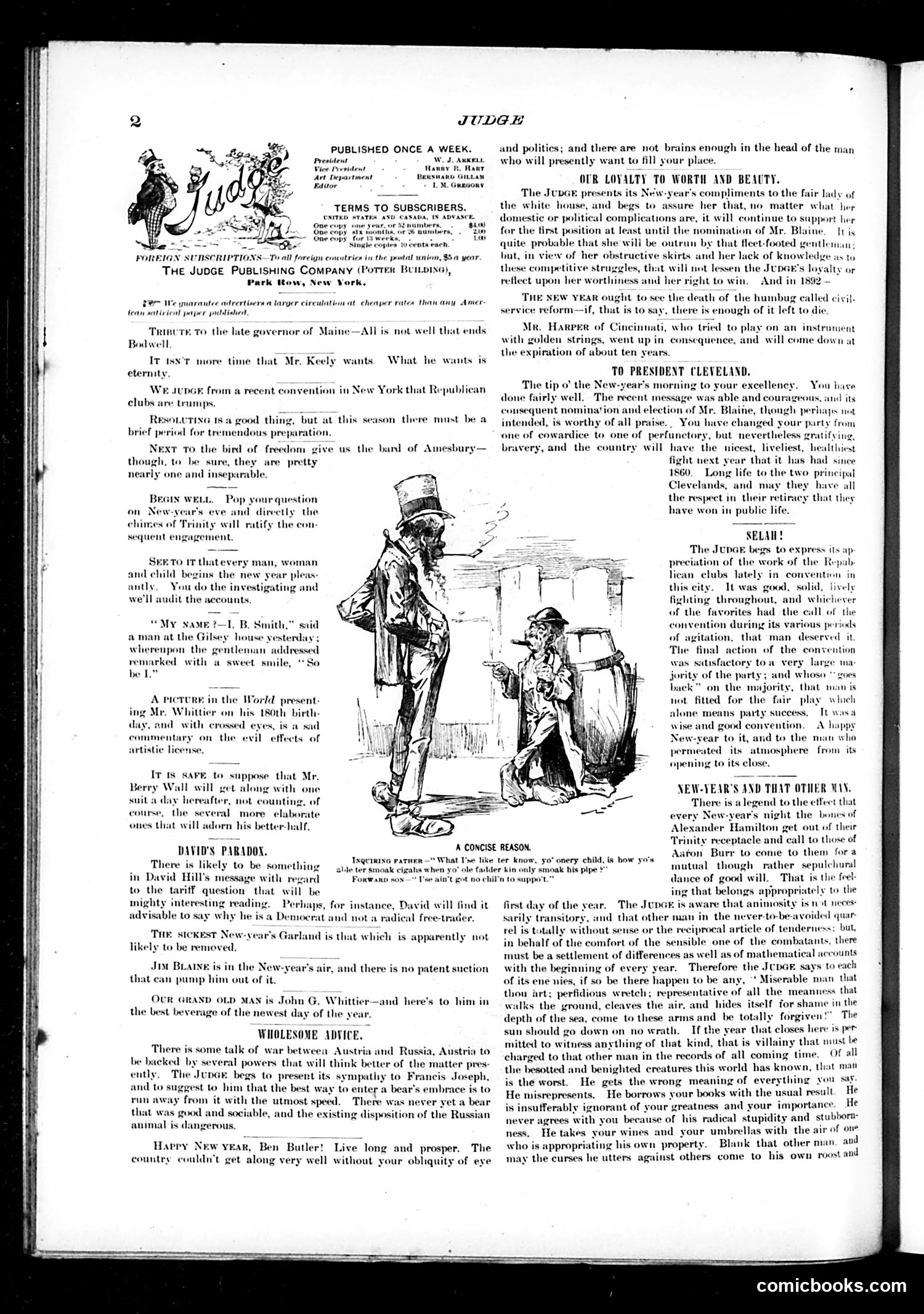
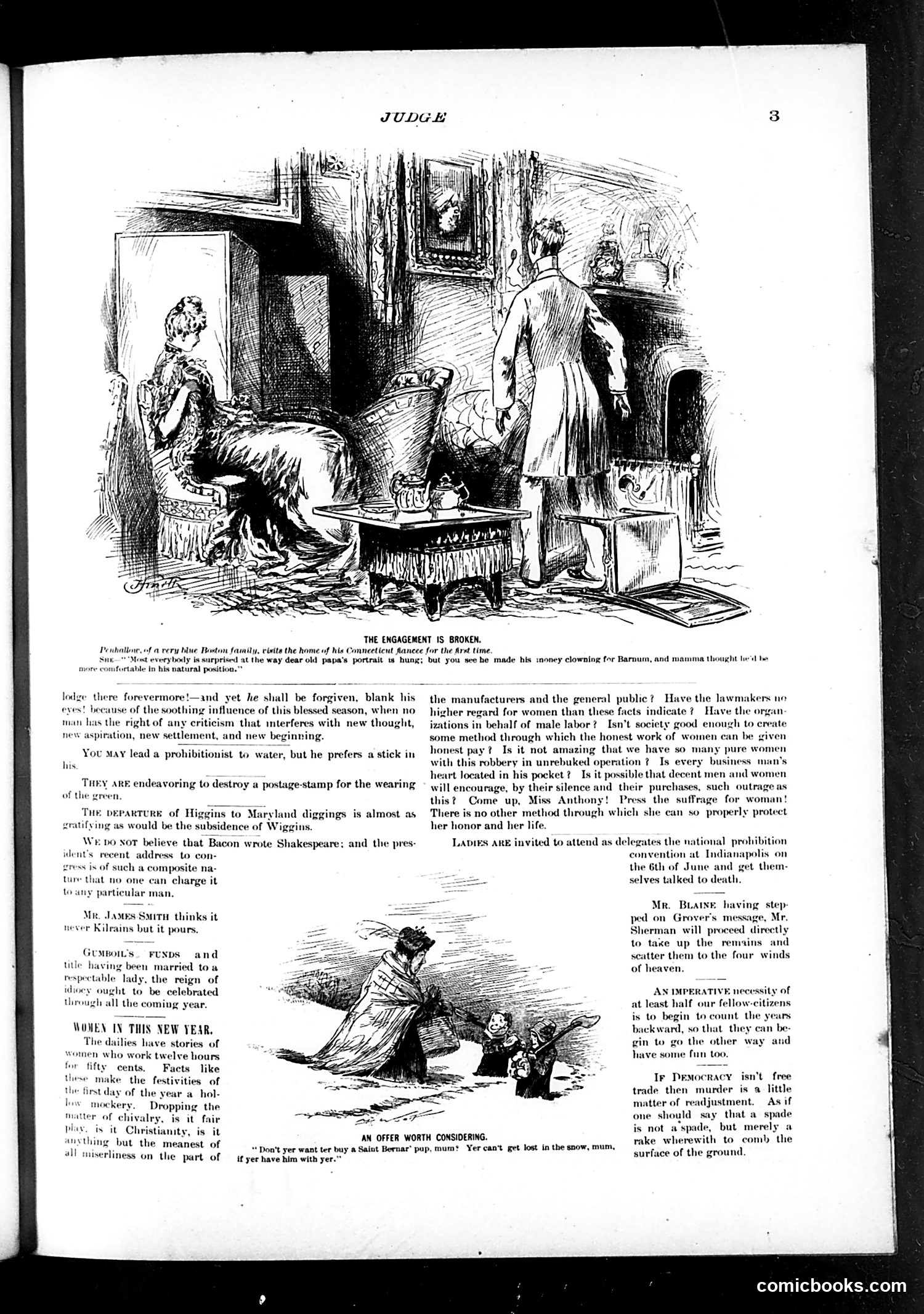
This page contains multiple satirical pieces targeting late 19th-century American social and political issues. **Top cartoon ("The Engagement is Broken"):** A Boston man visits his Connecticut fiancée's home. The humor appears to mock class pretensions and regional differences—the man's natural slouching posture (comfortable for a Bostonian) offends his fiancée's more refined sensibilities, breaking their engagement. **Sidebar commentary** addresses women's labor rights, demanding equal pay and protection from exploitation. It directly invokes Susan B. Anthony, urging her to "press the suffrage for woman"—this page supports women's voting rights as essential to protecting women workers. **Bottom cartoon ("An Offer Worth Considering"):** A street vendor sells a Saint Bernard puppy as a snow-rescue dog—absurdist humor playing on the impracticality of the sales pitch. The page blends light social satire with serious advocacy for women's suffrage and labor protections, typical of Judge's reformist editorial stance during the Progressive Era.
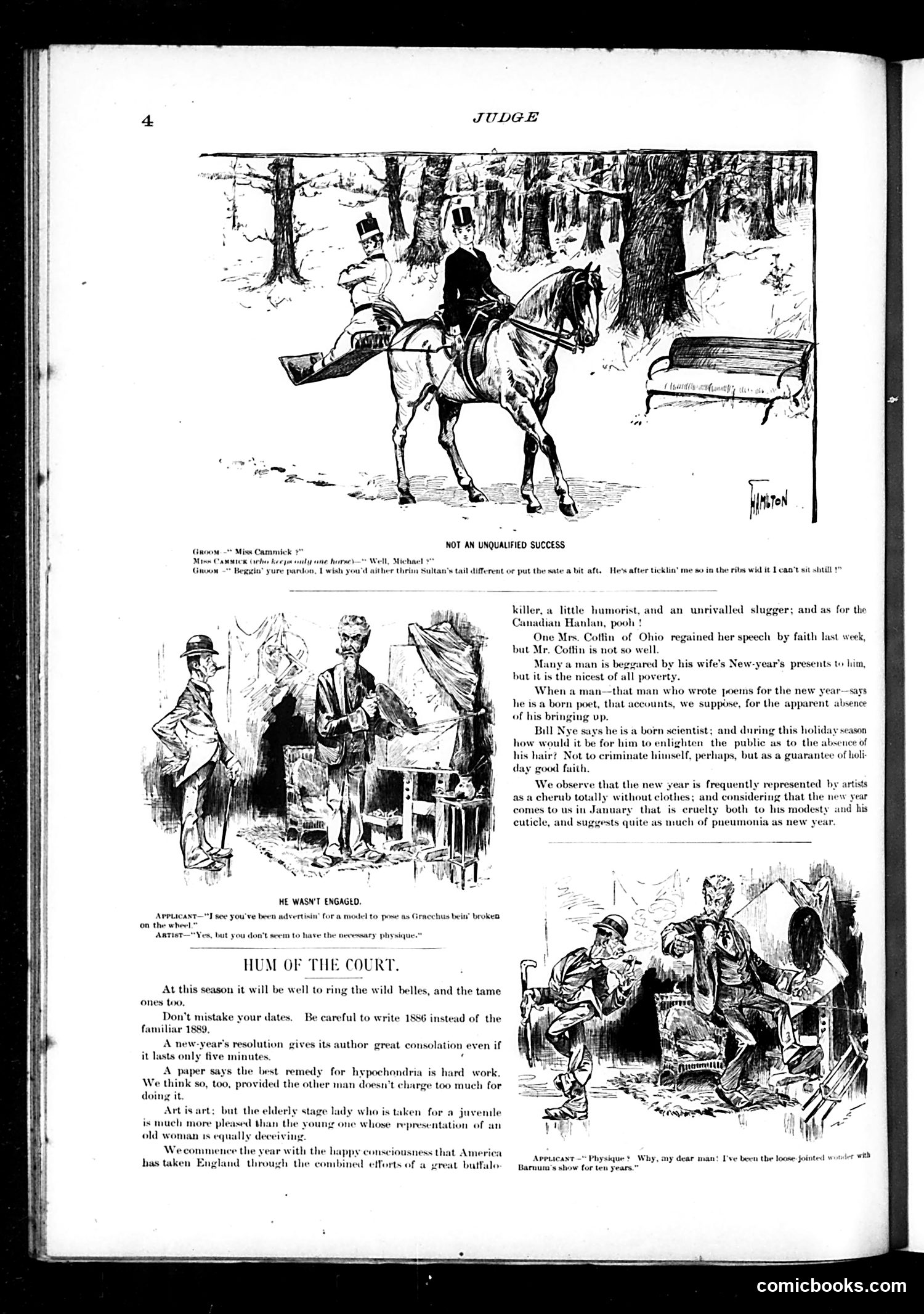
This page contains humorous social commentary typical of 1880s *Judge* magazine. The top cartoon depicts a woman on horseback—the caption suggests she's an inexperienced rider, with the groom commenting she won't sit still. The title suggests the horseback riding lesson is failing. The middle section ("He Wasn't Engaged") shows an artist seeking a model to pose as "Gracchus" (likely the Roman historical figure), but finding the applicant physically unsuitable—satirizing the gap between artistic ideals and reality. "Hum of the Court" offers brief satirical observations on contemporary life: the importance of dating letters correctly (1886, not 1889), the irony of prescribing hard work as a cure for hypochondria, and casting jokes about theatrical performances and New Year's resolutions. References include "Hanlan" (likely Canadian rower Edward Hanlan, famous at this time) and "Bill Nye" (the humorist). The humor targets pretension, physical mishaps, and everyday absurdities of 1880s American society.
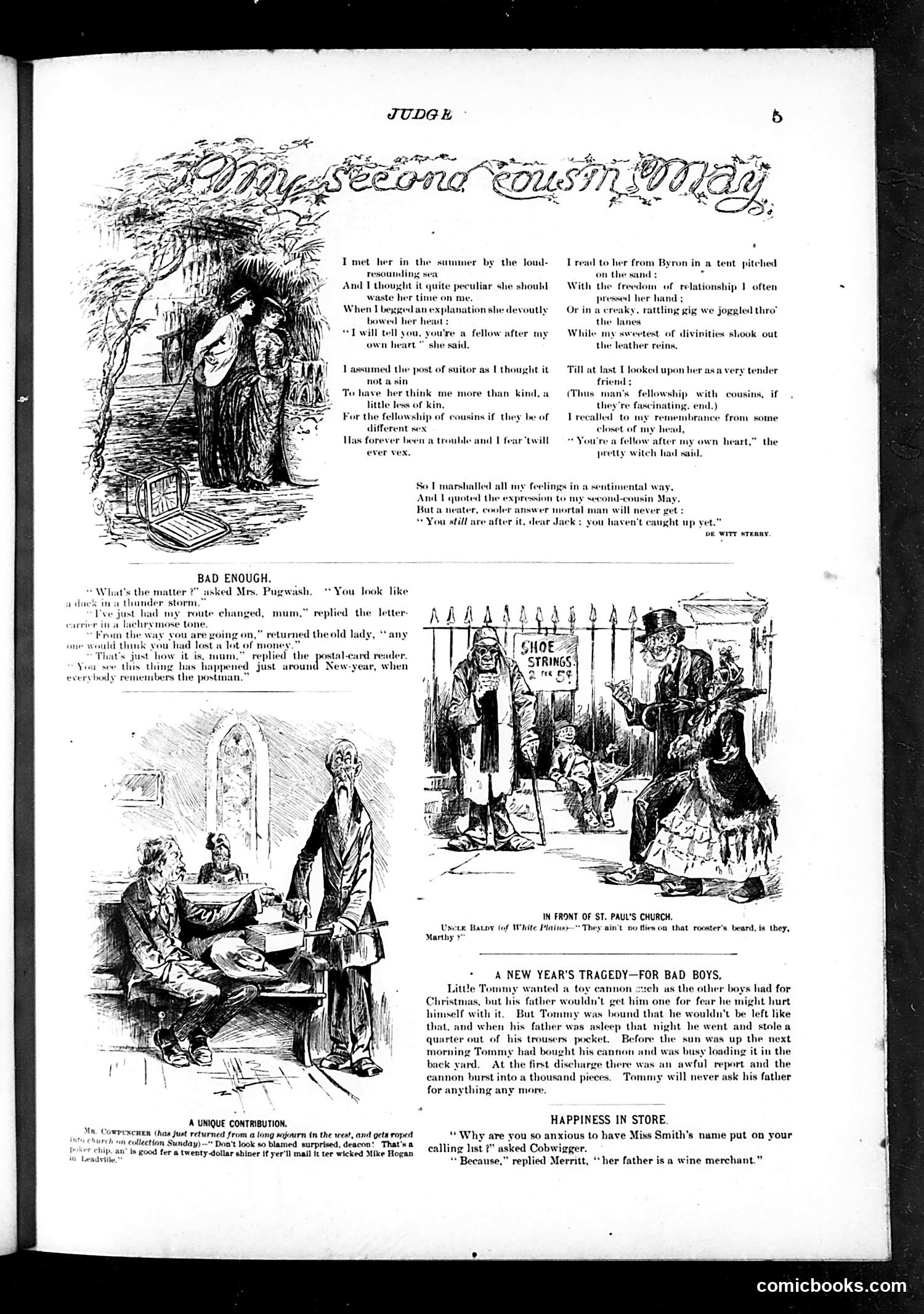
This page contains several unrelated satirical pieces typical of Judge magazine's humor: **"My Second Cousin Mary"** (top): A romantic poem about a man's awkward courtship with his cousin during a seaside holiday. The satire mocks sentimental Victorian romance and the social complications of cousin relationships—a real concern of the era due to marriage eligibility questions. **"Bad Enough"** and related sketches: Brief comic exchanges about mundane disappointments, including a postman's lost mail and a churchgoer's donation. **"A New Year's Tragedy—For Bad Boys"**: A cautionary tale about a boy who steals coins to buy a toy cannon against his father's wishes, resulting in injury when it explodes. This reflects period parental anxiety about dangerous toys and disobedience. **"Happiness in Store"**: A joke about a man pursuing a woman solely because her father is a wine merchant—satirizing mercenary courtship motivations. The drawings show period-appropriate clothing and street scenes. Overall, the page uses humor to comment on Victorian social conventions, courtship, parental authority, and materialism.
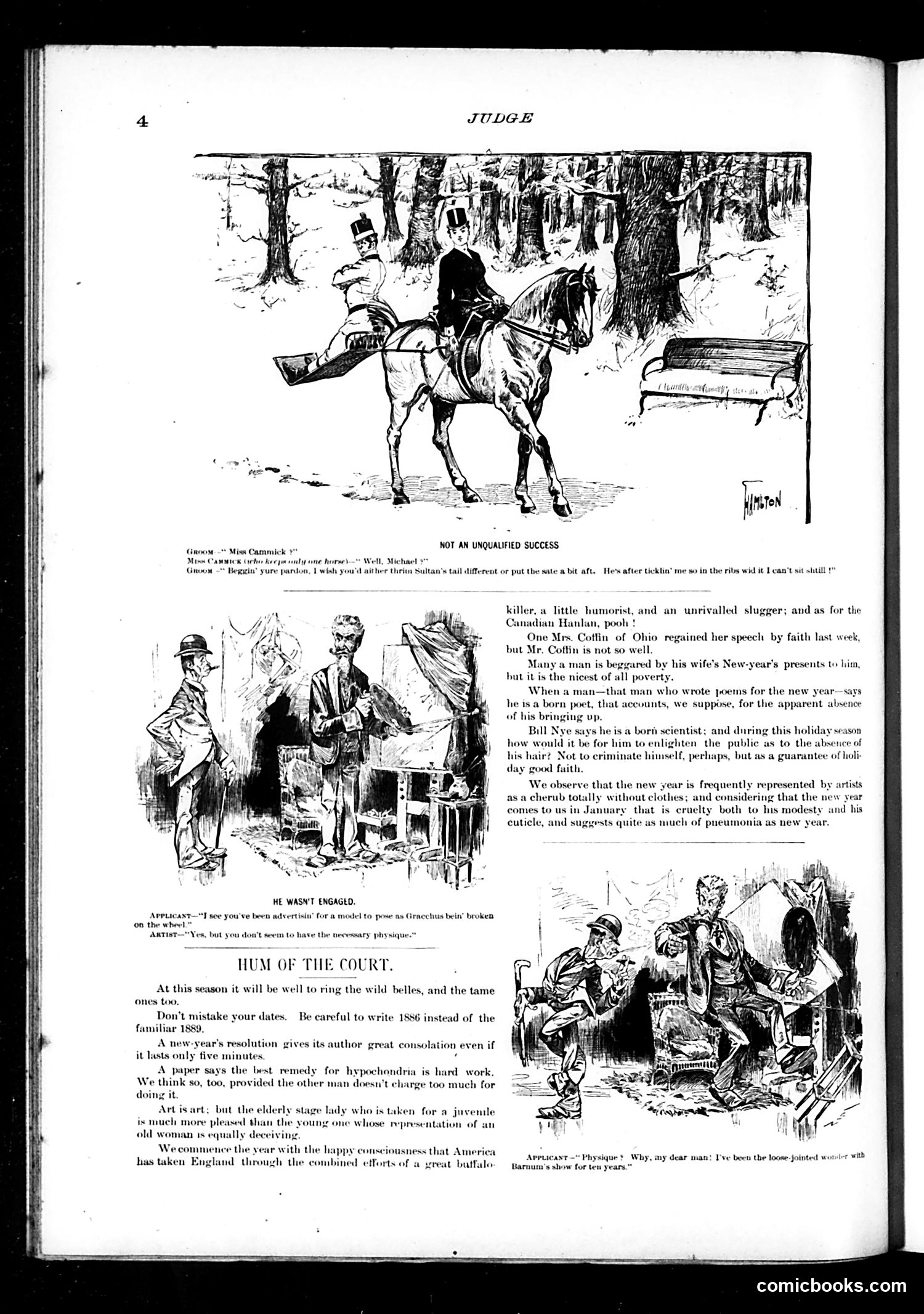
This 1886 Judge page contains several satirical pieces mocking contemporary figures and New Year's customs. **Top cartoon ("Not an Unqualified Success")**: A rider on horseback complains to a woman (labeled Miss Cammick) that his horse won't cooperate. The satire likely targets Miss Cammick's riding instruction or horsemanship. **Text sections** reference: - **Canadian Hanlan**: A famous rower, dismissed dismissively in gossip about Mrs. Coffin of Ohio - **Bill Nye**: A popular humorist and scientist, mocked for never explaining his baldness despite claiming scientific credentials - **New Year conventions**: Judge satirizes the artistic tradition of depicting the new year as a naked cherub, arguing it's cruel to the child's modesty and health (pneumonia risk) **Lower cartoon ("He Wasn't Engaged")**: An artist advertises seeking a model to pose as "Gracchus being broken" but rejects an applicant, claiming he lacks "necessary physique"—likely mocking overly specific artistic demands. The page exemplifies Judge's satirical style: poking fun at public figures, social pretensions, and contemporary customs through both visual and written humor.
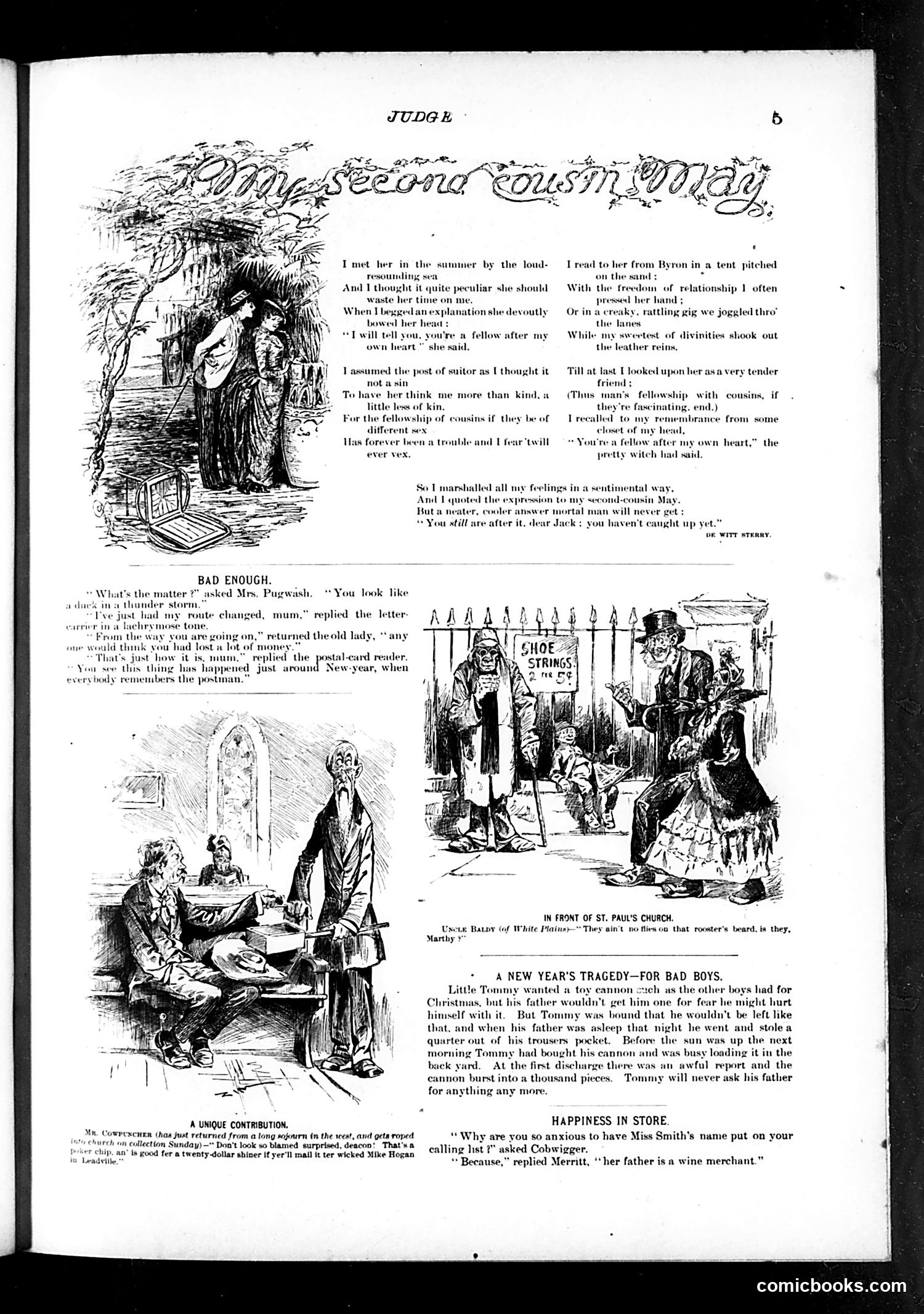
This page contains several satirical pieces typical of Judge's humor: **"My Second Cousin Poppy"** (top): A romantic poem mocking sentimental Victorian courtship. The narrator quotes Byron to a cousin while riding, then proposes marriage using flowery language. She deflates his romanticism with: "you haven't caught up yet"—cutting satire of overwrought male sentimentality. **"Bad Enough"** (middle left): Mrs. Pugwash complains that a letter carrier looks like he's had troubles. An old lady notes he's probably lost money, then observes that people always remember the postman when financial disasters occur—satirizing how the working class gets blamed for society's problems. **Street scenes** (illustrations): Appear to show urban life and church interactions. **"New Year's Tragedy—for Bad Boys"** (bottom): Moralizing tale where young Tommy steals money for a toy cannon, which explodes, teaching him a lesson. Period-typical cautionary fiction. **"Happiness in Store"** (bottom right): Brief joke where a man wants a woman's name on his calling list because her father is a wine merchant—satirizing mercenary courtship motives.
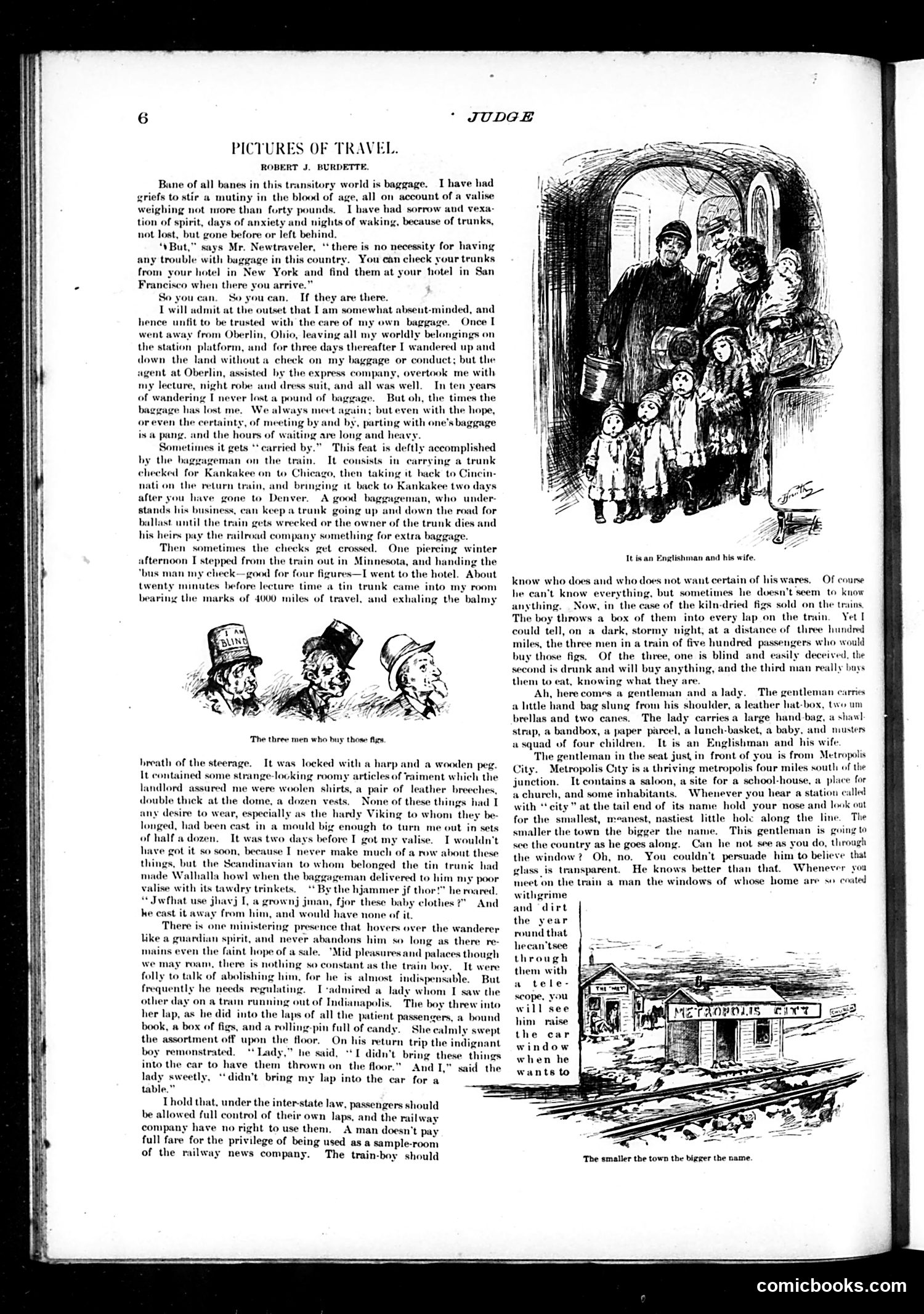
This is a humorous essay about travel frustrations, illustrated with sketches. The main cartoon depicts an English couple boarding a train—the husband carrying minimal luggage (hand bag, hat-box, two umbrellas, canes) while his wife manages an enormous pile (large hand-bag, shawl, bandbox, parcel, lunch-basket, baby, and four children). The satire mocks Victorian gender stereotypes and marital dynamics: the competent, minimalist husband contrasted with the overburdened wife managing chaos. The accompanying text ridicules American railway practices (lost baggage, misrouted trunks, crossed checks) and types of train passengers, including pompous residents of small towns falsely called "cities." The essay combines travel memoir with social commentary on class, nationality, and railway company incompetence—typical Judge magazine humor targeting both travelers' frustrations and American entrepreneurial excess.
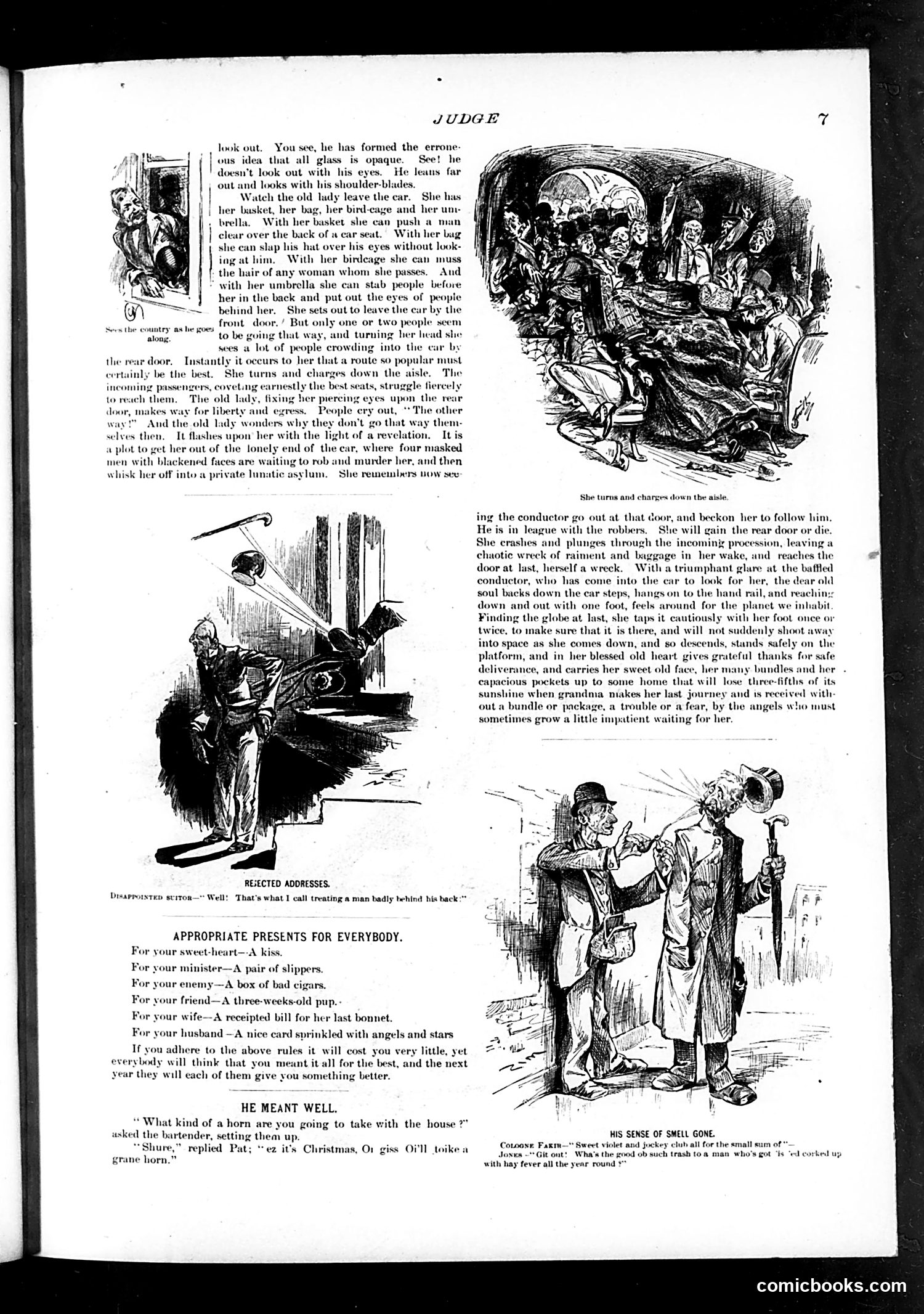
This page satirizes **urban passenger behavior**, particularly elderly women exiting streetcars/trolleys. The main cartoon depicts an old lady with multiple belongings (basket, bag, birdcage, umbrella) treating her exit as a chaotic military operation. She imagines a paranoid plot—that crowds entering the rear door are actually masked robbers waiting to attack her—so she charges violently down the aisle instead, creating actual havoc. The satire mocks how ordinary urban transit becomes inflated into melodrama in the minds of anxious passengers. Her umbrella, basket, and bag become weapons of mass inconvenience to fellow passengers. The piece humorously exaggerates her caution about stepping onto the platform, literally testing the ground exists before descending. The accompanying text and smaller cartoons provide social commentary on gift-giving and absurd excuses, suggesting broader critique of late 19th/early 20th-century American manners and urban life.
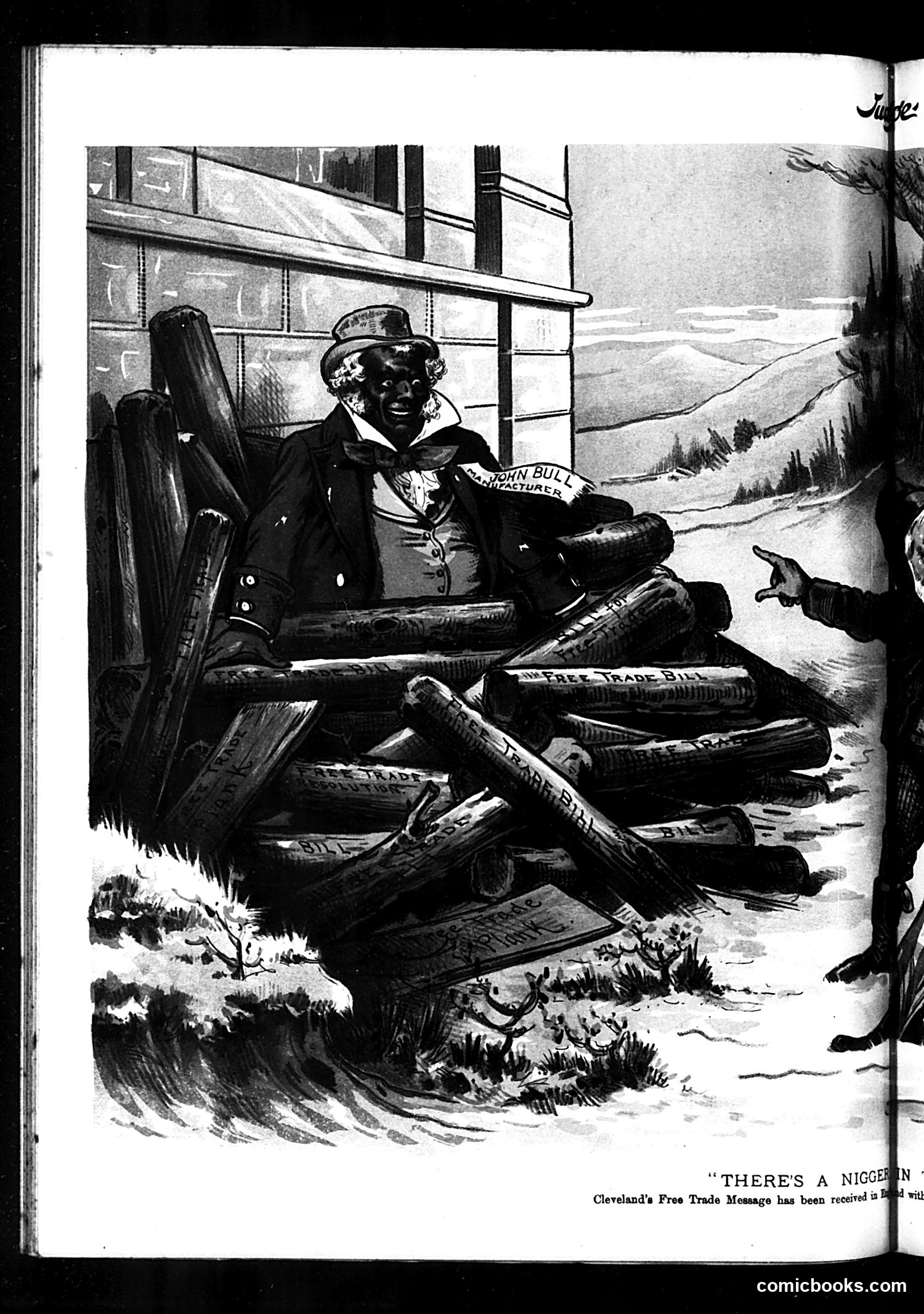
This is a racist political cartoon from *Judge* magazine attacking President Grover Cleveland's free trade policy. The caricatured figure (depicting an African American using a deeply offensive slur in the title) sits amid logs labeled "Free Trade Bill" and "John Bull" (Britain), set in a snowy landscape. The cartoon uses a racial slur as its punchline, equating Cleveland's free trade stance with something contemptible. The "John Bull" reference suggests the cartoonist opposed trade agreements with Britain, likely reflecting protectionist sentiment common in late 19th-century American politics. The satire conflates economic policy disagreement with racist rhetoric—a disturbingly common approach in period political commentary. This represents both the era's virulent racism and intense debate over tariff policy under Cleveland's administration.
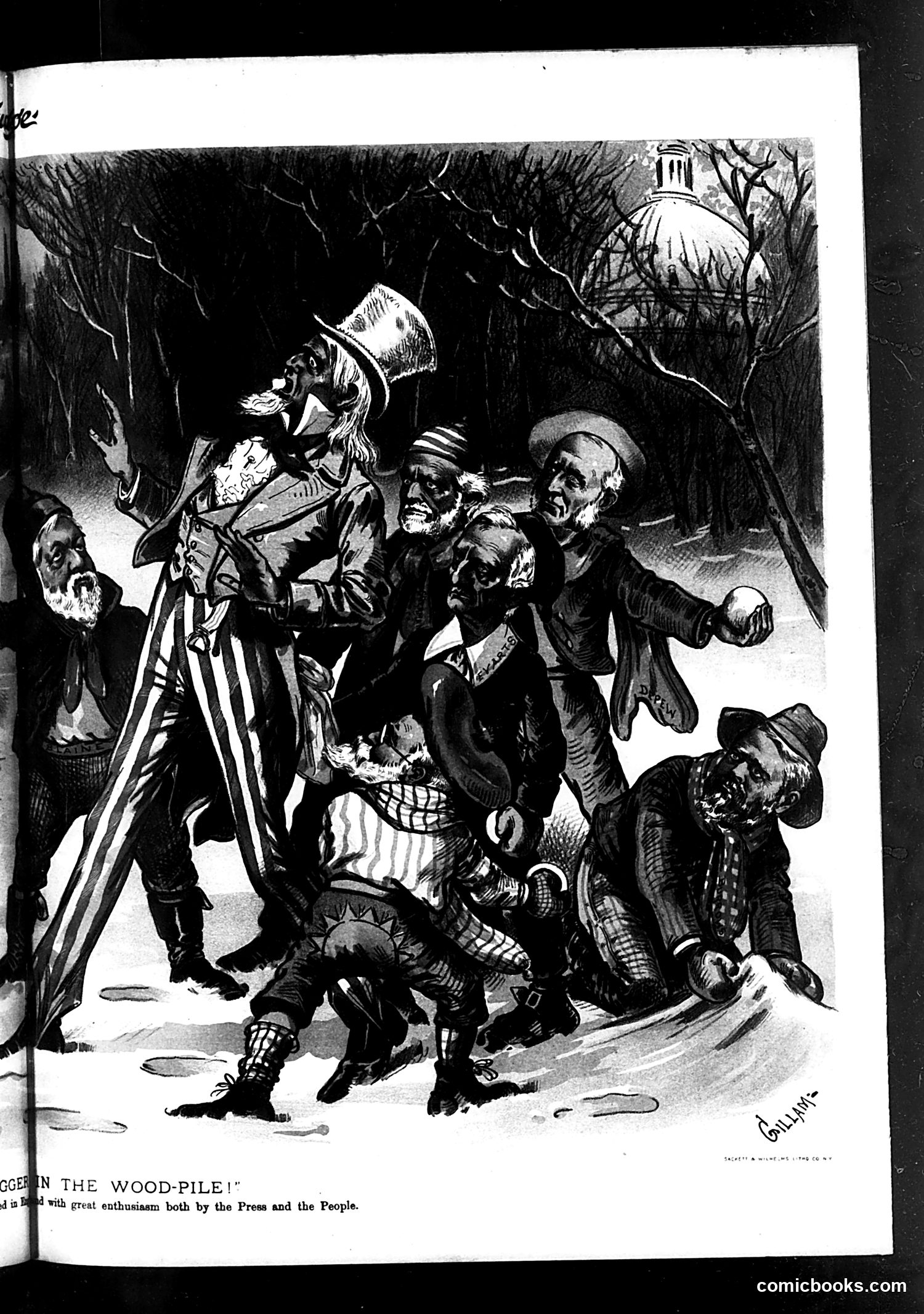
This appears to be a satirical cartoon titled "In the Wood-Pile" (a period phrase meaning "something hidden or suspicious"). The image depicts Uncle Sam (the tall figure in striped pants and top hat) confronting a group of men in winter clothing in a bare, wooded setting. The men appear to be common laborers or immigrants. The cartoon likely satirizes labor unrest, immigration issues, or political corruption of the Gilded Age era. The "wood-pile" reference suggests discovering something undesirable or scandalous. The caption notes the image was received "with great enthusiasm both by the Press and the People," indicating it expressed popular sentiment about contemporary social tensions. Without the specific publication date visible, the exact political context remains unclear, though the artwork style suggests late 19th or early 20th century.
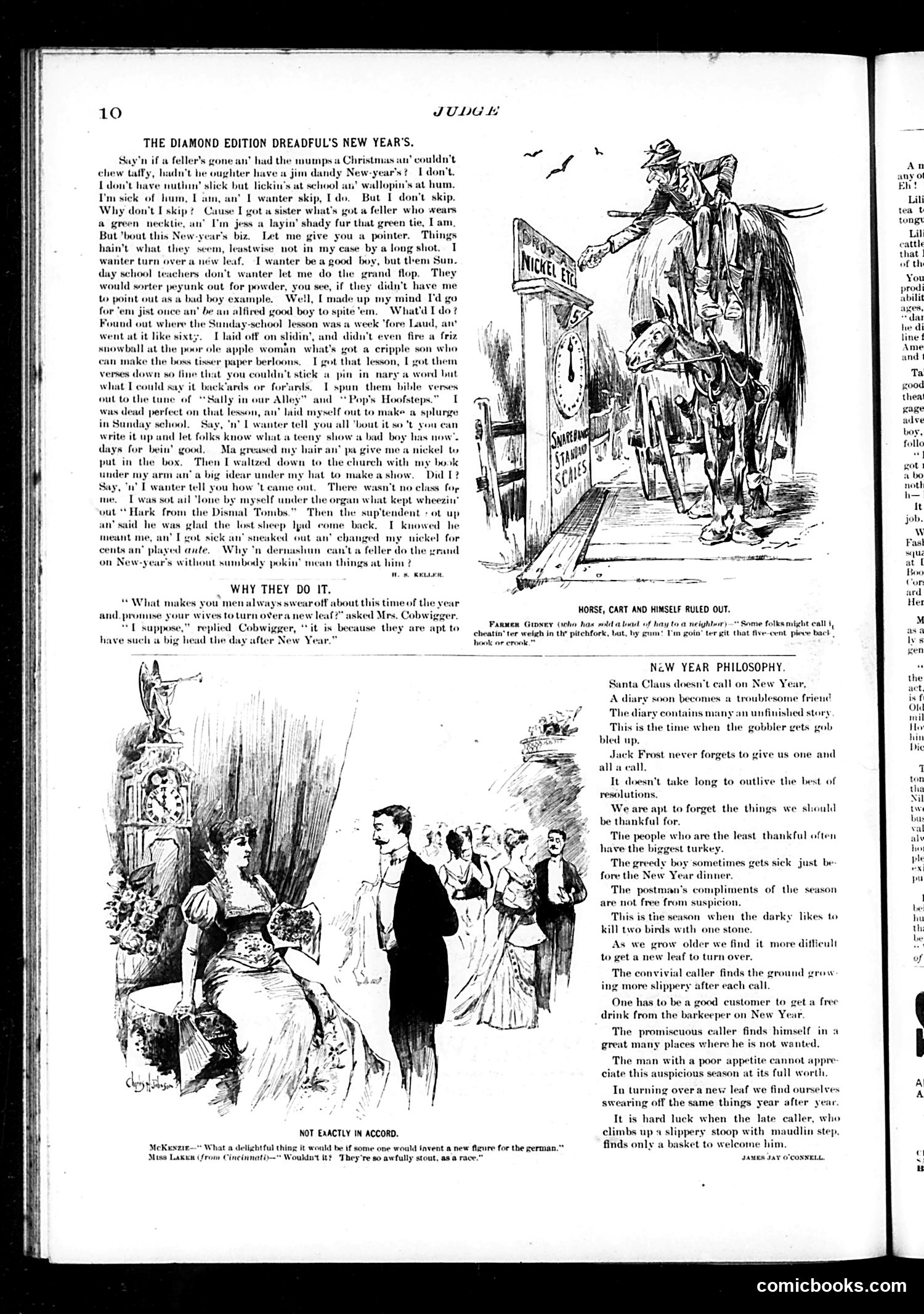
This page contains two distinct satirical pieces about New Year's traditions. **"The Diamond Edition Dreadful's New Year's"** (top) is a humorous monologue by a mischievous boy explaining his failed New Year's resolution to be good. He describes pranks (pulling licks at school, firing a snowball at an apple woman) and his attempt at church reform, ultimately admitting he couldn't maintain goodness. The satire mocks children's insincere resolutions and their inevitable failure. **"Why They Do It"** features a brief dialogue where someone asks why men always promise new leaves on New Year's. The response suggests it's because men "are apt to" make such empty promises—satirizing adult hypocrisy about resolutions. The accompanying illustrations show a street scene with working-class figures and a New Year's Eve gathering, capturing period social life. **"New Year Philosophy"** offers cynical observations about the season: turkeys get eaten, resolutions don't last, people aren't truly thankful, and the intoxicated behavior of holiday revelers. This is straightforward satirical commentary on human nature during celebrations.
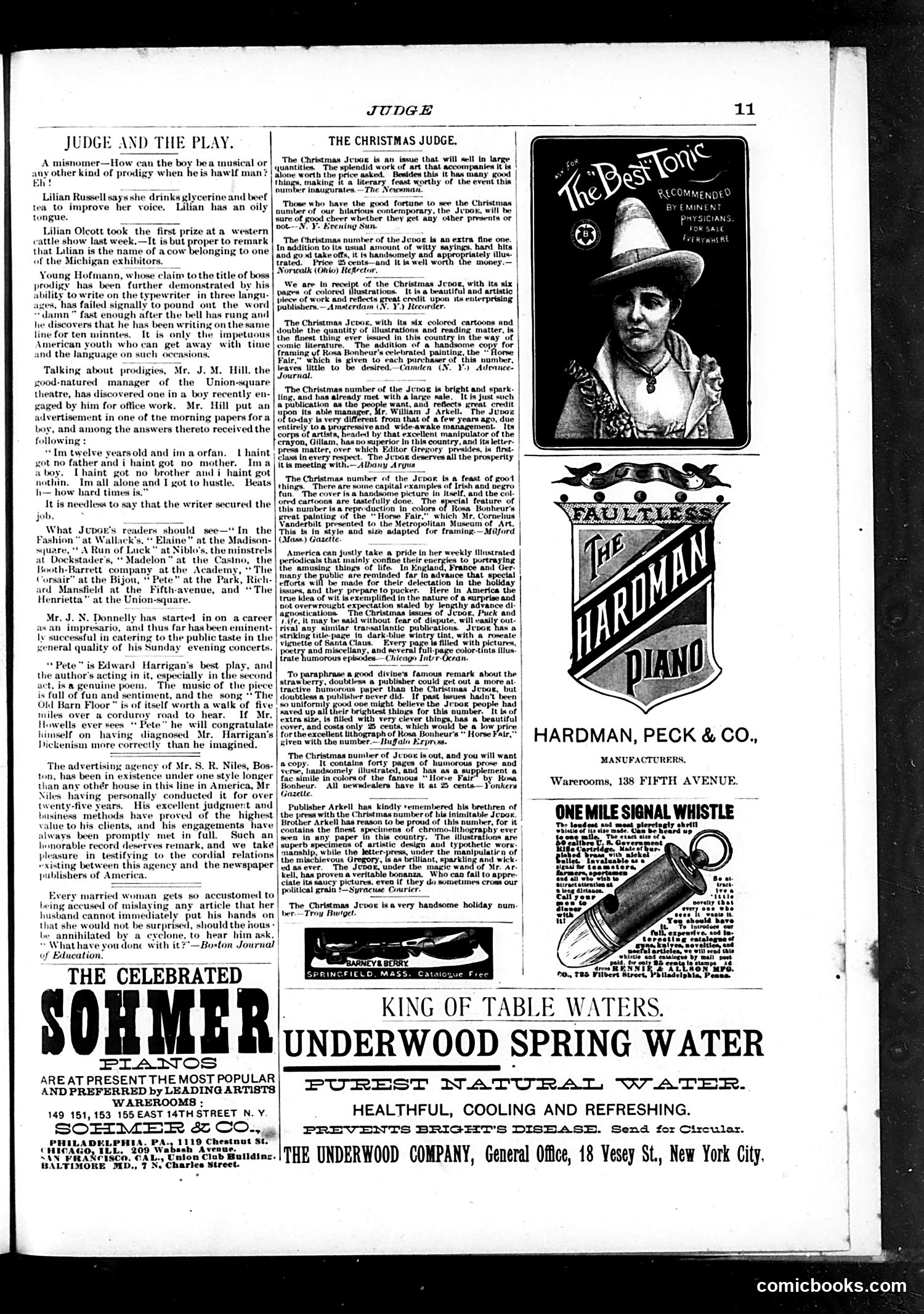
This page contains theater commentary and advertisements rather than political cartoons. The main content discusses contemporary theatrical productions and personalities. **"Judge and the Play" section:** Light satirical commentary on theater and performers of the era. It mocks Lilian Russell's voice-improvement regimen ("oily tongue"), references to now-obscure productions ("Pete," "Elaine," "A Run of Luck"), and includes a humorous anecdote about a twelve-year-old orphan's job application letter—praised for its authentic grammar and spelling errors as superior to typical theater criticism. **The "Christmas Judge" reference** indicates this is a holiday issue, noted as particularly valuable for advertisements. **Advertisements** dominate the page: Sohmer Pianos, Hardman Piano, Underwood Spring Water, and a whistle product. These ads are typical of the era's magazine monetization. The page lacks overtly political satire; instead it offers cultural commentary on American theater and consumer products circa the 1880s-1890s. Without more context on specific theatrical figures referenced, precise identification of some targets remains unclear.
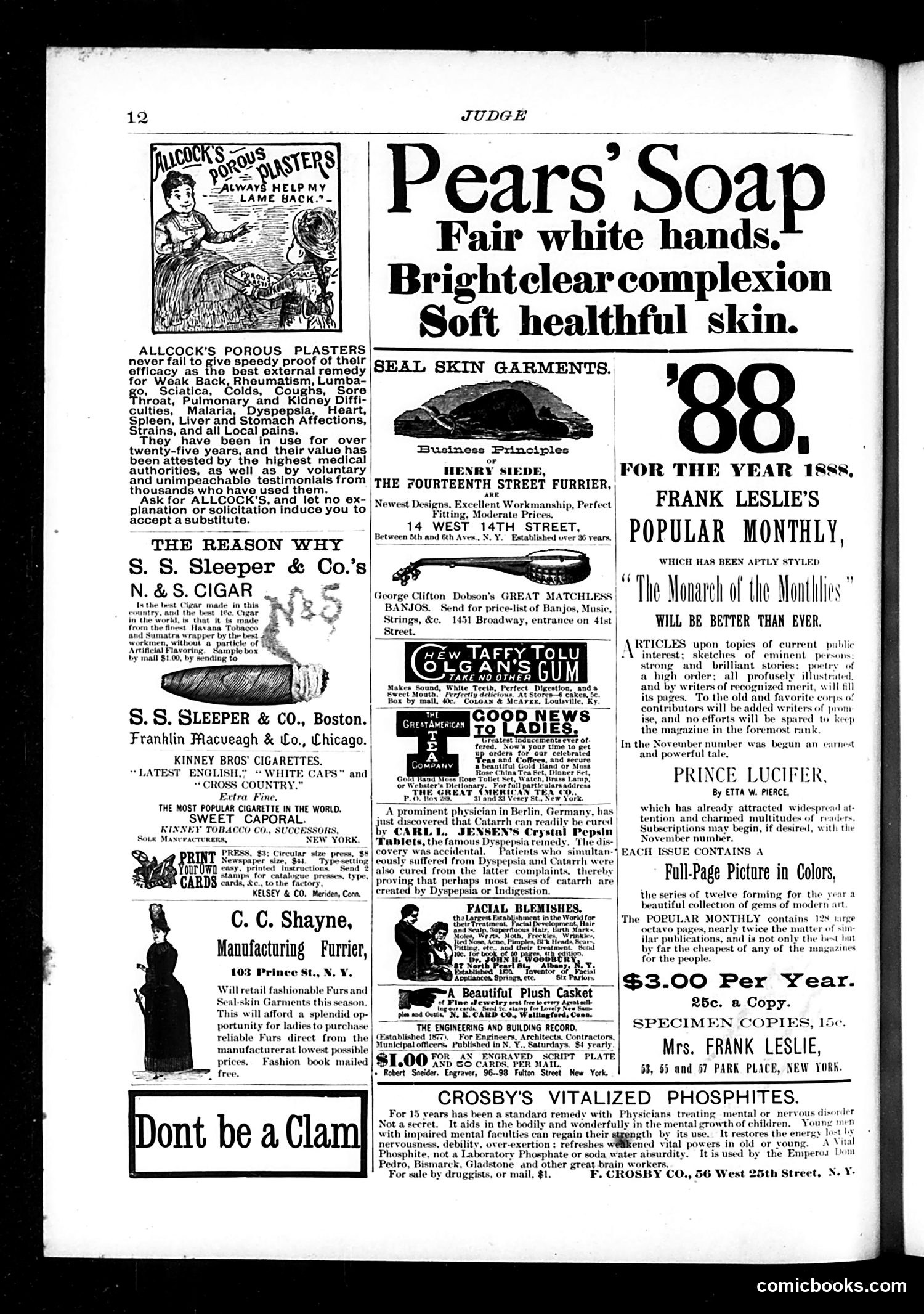
This page is primarily **advertising**, not a political cartoon or editorial content. Judge magazine here functions as a vehicle for patent medicines, consumer goods, and services typical of the 1880s marketplace. The advertisements reveal period attitudes worth noting: Allcock's Porous Plasters promise cure-all benefits (rheumatism, malaria, dyspepsia); S.S. Sleeper cigars market themselves heavily; and Pears' Soap's headline—"Fair white hands, Bright clear complexion"—reflects Victorian beauty standards tied to class and racial anxieties about skin tone. The page includes notice for Frank Leslie's *Popular Monthly* magazine (1888), describing it as "Monarch of the Monthlies" with serialized fiction. Most striking historically is how casually these advertisements assume readers' acceptance of dubious medical claims—there were no FDA regulations yet regulating such therapeutic assertions.
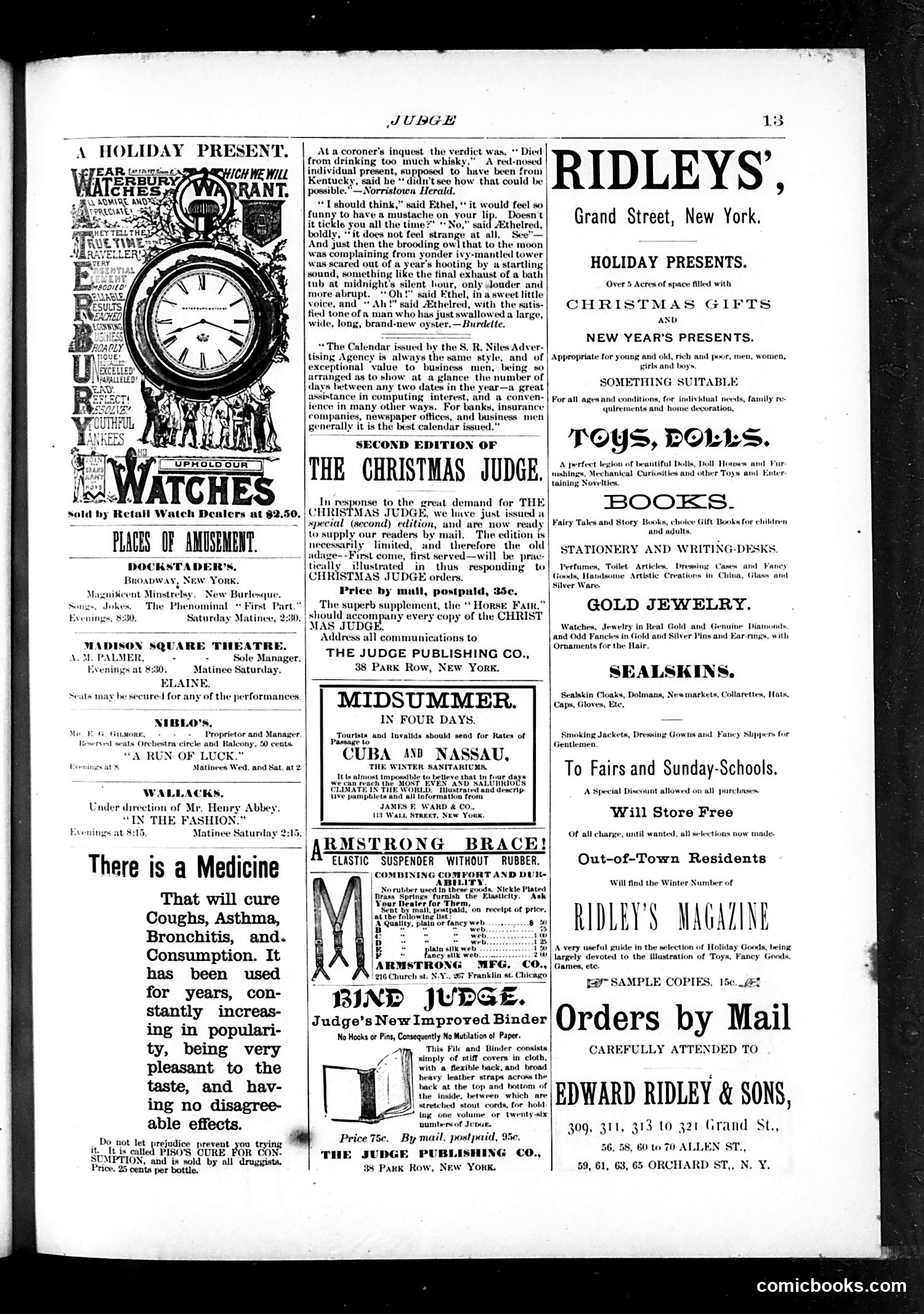
This is primarily an **advertising page** from Judge magazine, not a political cartoon. The page contains various notices and advertisements relevant to Holiday 1880s shopping and entertainment, including theater listings and gift recommendations. The main satirical **short joke-pieces** are brief vignettes appearing under "A Holiday Present": 1. A coroner's inquest joke mocking someone's claim that whiskey couldn't cause death 2. A comedic exchange between "Ethel" and "Ethelred" about mustaches, ending with the absurdist image of him swallowing an enormous oyster—apparently to demonstrate his mustache doesn't tickle The page primarily advertises Judge's own publications (including a "Christmas Judge" special edition and a "Horse Fair" supplement), theatrical entertainments, patent medicines (including "Piso's Cure"), and Ridley's department store offerings for holiday gifts. The humor is light domestic comedy rather than political satire.
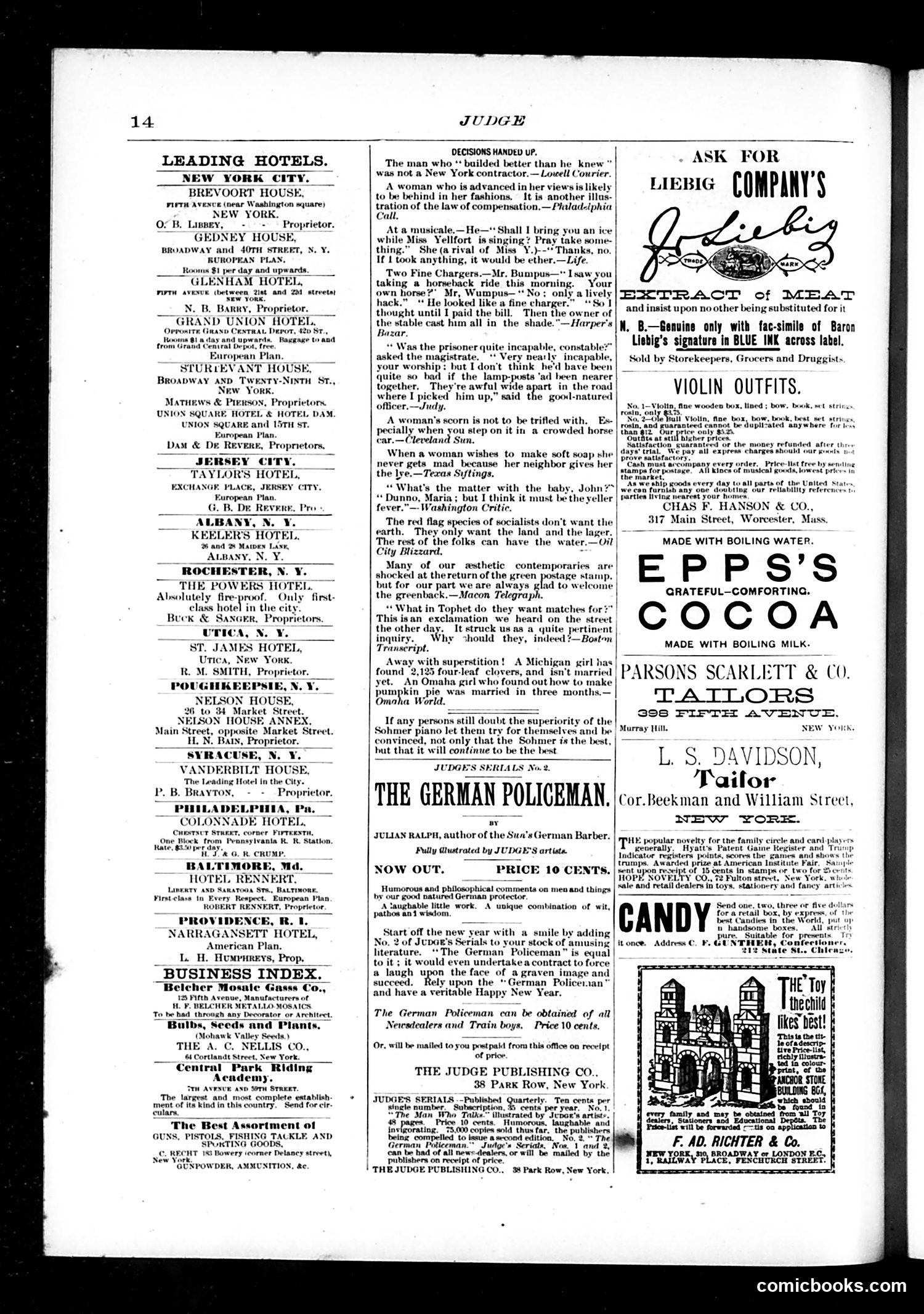
This page is primarily **advertisements and humorous epigrams** rather than a political cartoon. The left half lists **New York hotels and businesses** (standard advertising). The right half contains short, satirical quips on various topics—relationships, urban life, and social behavior—typical of Judge's humor style. Notable items include jokes about: - A woman's contradictory fashion choices versus progressive views - Drunk behavior and lamp-post spacing - Socialists wanting "land and lager" (stereotyping immigrant radicals) - Women and superstition (the four-leaf clover/marriage jokes) There's also an advertisement for **"The German Policeman," a Judge serial** by Julian Ralph, illustrated and priced at 16 cents—a publication the magazine was promoting. The humor reflects **late 19th-century American social attitudes**: mild mockery of women, immigrants, and working-class life, presented as lighthearted observations rather than serious satire.
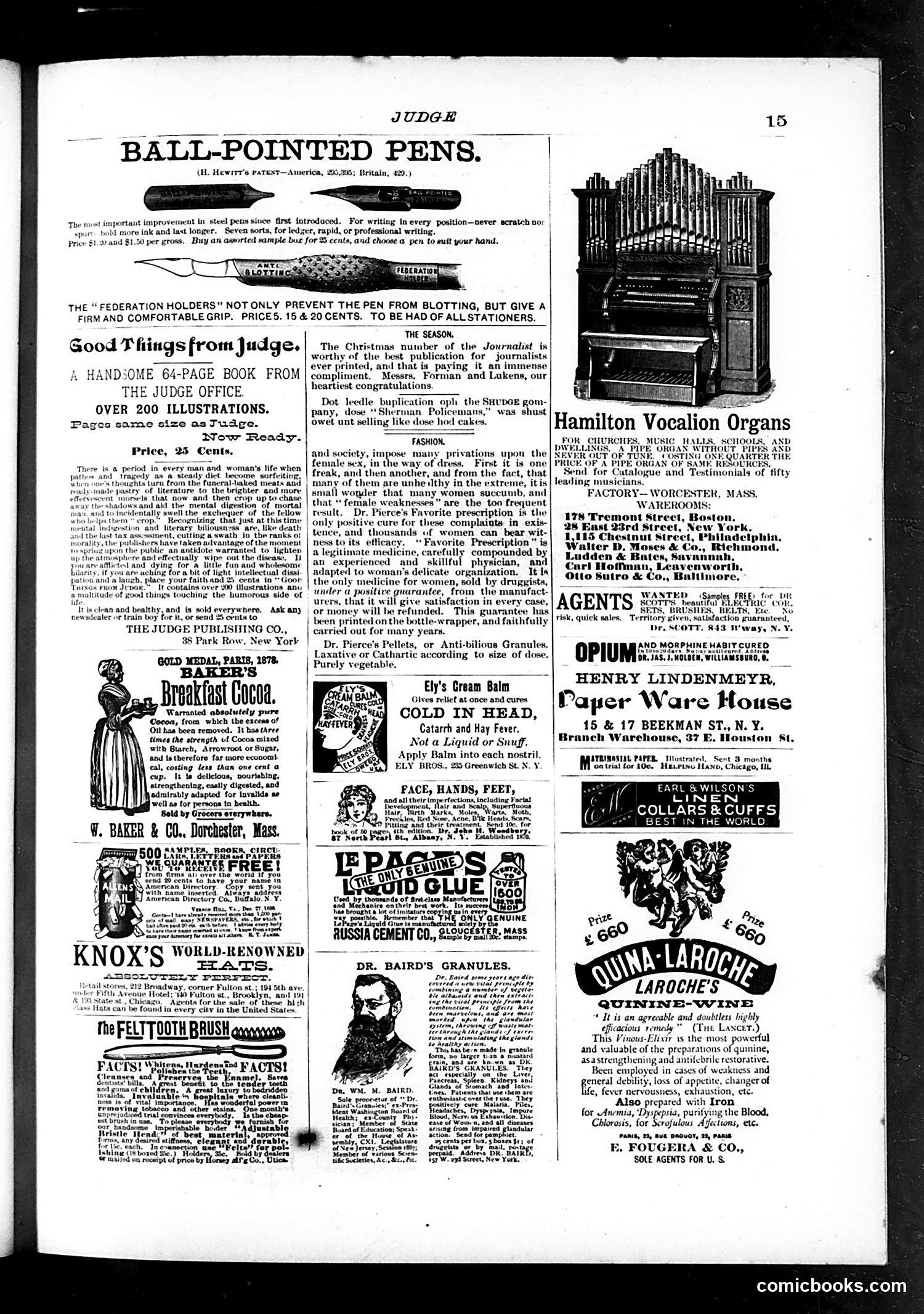
This page is primarily **advertising**, not political satire. It's from Judge magazine and features commercial advertisements for products like ball-pointed pens, Baker's Cocoa, Knox Hats, and patent medicines (Dr. Pierce's "Favorite Prescription" for women's ailments, Dr. Baird's Granules). The only editorial content visible is a brief notice about Judge's Christmas issue of "The Journalist" publication and a short fashion commentary criticizing women's restrictive dress codes as unhealthy—typical late-19th-century social commentary linking fashion to "female weakness." The advertisements reflect period concerns: medicinal remedies for vague complaints, grooming products, and office supplies. There are no identifiable political figures or cartoons on this page—it's a commercial-heavy issue typical of satirical magazines of this era, which relied heavily on advertising revenue.
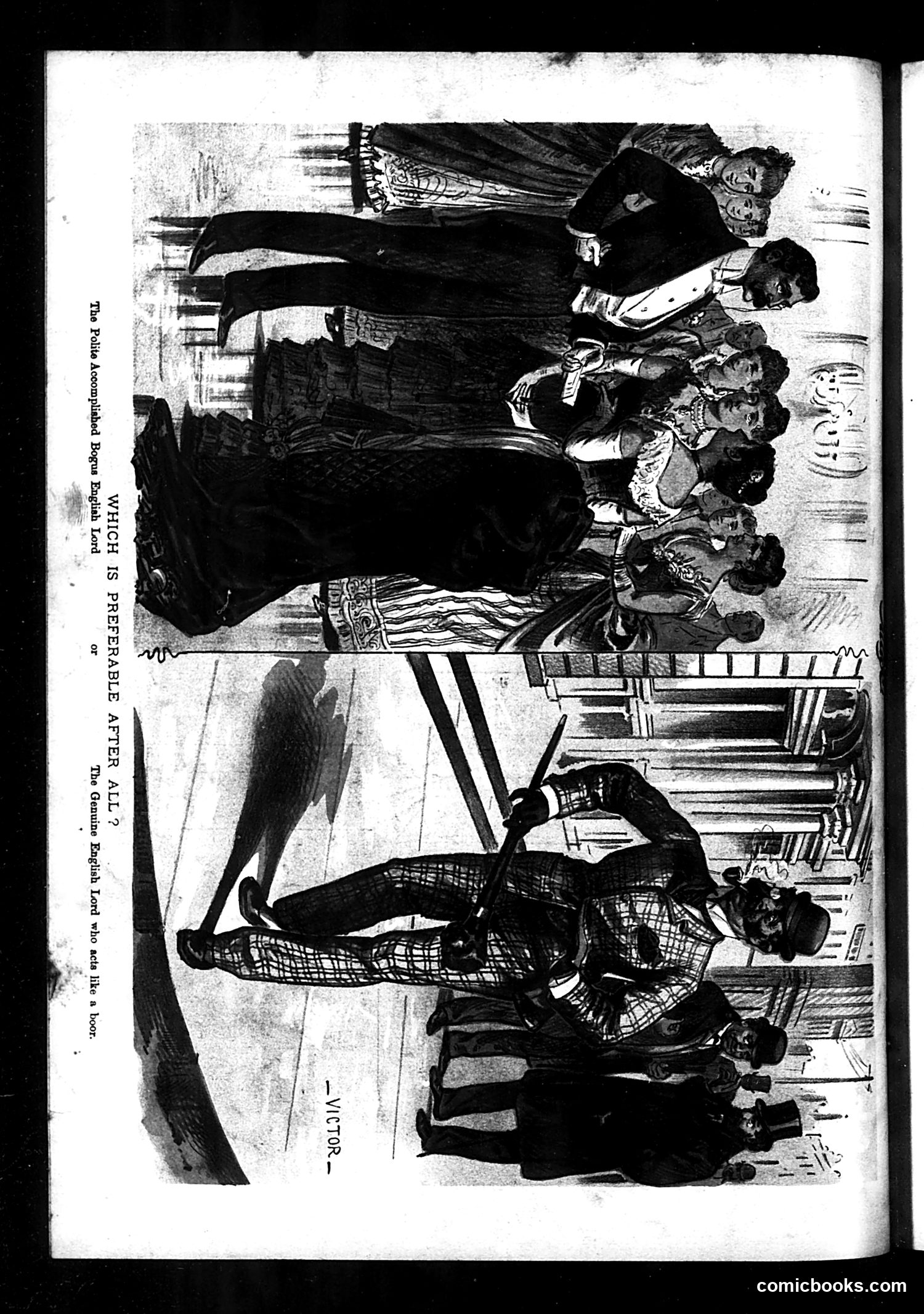
This satirical cartoon presents two contrasting "English Lord" stereotypes common in Gilded Age American humor. The top image shows a refined, well-mannered "bogus" (fake) English lord—likely a con artist or social climber—displaying impeccable etiquette. Below, a "genuine" English aristocrat behaves boorishly and crudely. The satire mocks American fascination with English nobility while highlighting class pretense. The "polite bogus lord" represents the fraud who charms American society through affected manners, while the authentic but uncouth nobleman exposes aristocracy as morally bankrupt. Judge's point appears to be that American society's reverence for English titles blinds them to the actual character of nobility—real or fake—suggesting American gullibility and the worthlessness of inherited status.