
Judge, 1887-12-31 · page 8 of 18
Judge — December 31, 1887 — page 8: what you’re looking at
What you’re looking at
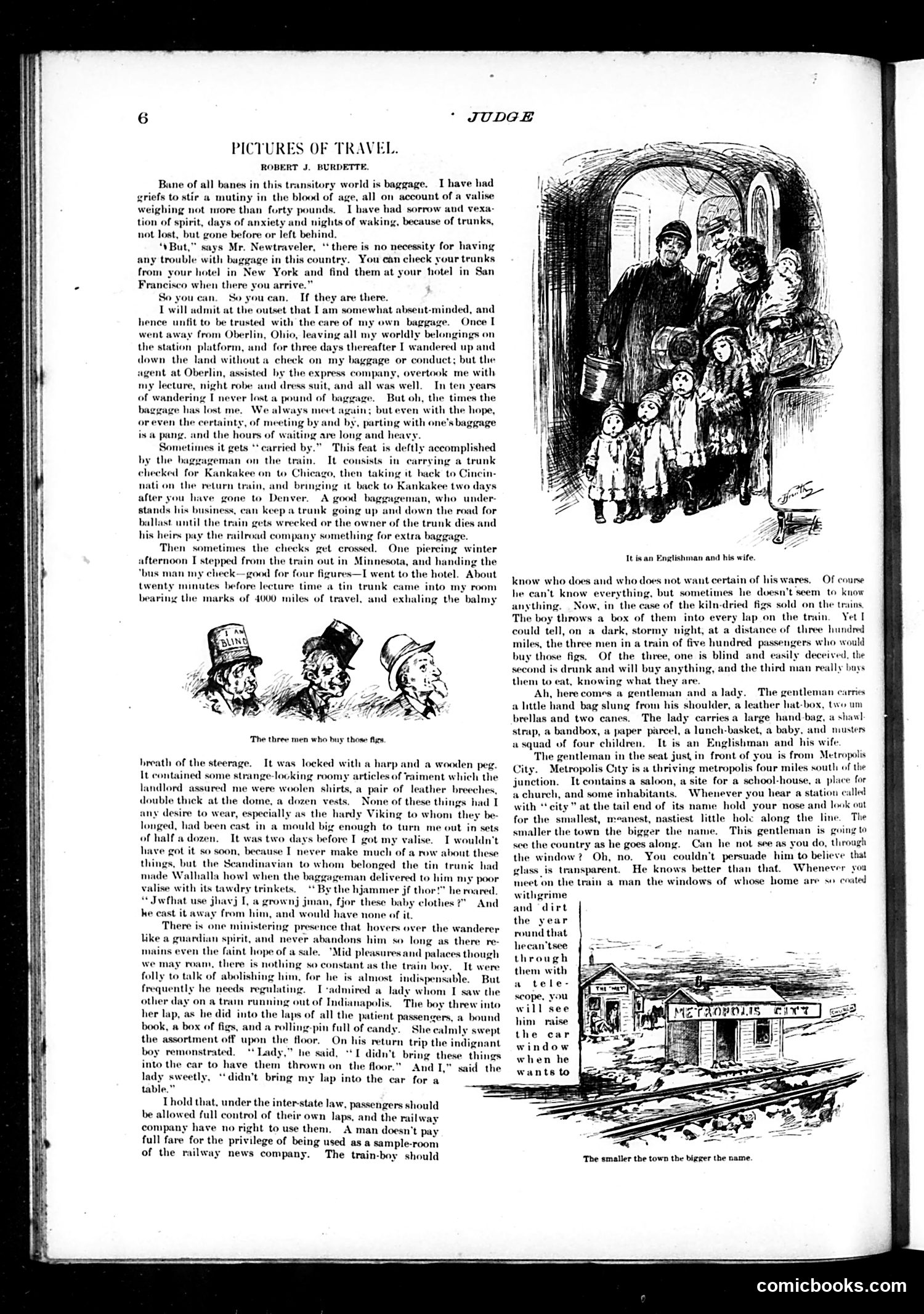
This is a humorous essay about travel frustrations, illustrated with sketches. The main cartoon depicts an English couple boarding a train—the husband carrying minimal luggage (hand bag, hat-box, two umbrellas, canes) while his wife manages an enormous pile (large hand-bag, shawl, bandbox, parcel, lunch-basket, baby, and four children). The satire mocks Victorian gender stereotypes and marital dynamics: the competent, minimalist husband contrasted with the overburdened wife managing chaos. The accompanying text ridicules American railway practices (lost baggage, misrouted trunks, crossed checks) and types of train passengers, including pompous residents of small towns falsely called "cities." The essay combines travel memoir with social commentary on class, nationality, and railway company incompetence—typical Judge magazine humor targeting both travelers' frustrations and American entrepreneurial excess.
📄 Transcribed text from this page (OCR, searchable)
Machine-transcribed from the original scan — historical spelling and the odd misread are preserved.
PICTURES OF TRAVEL. ROBERT J. BURDETTE. Bane of all banes in this transitory world is baggage. I have had griefs to stir a mutiny in the blood of age, all on account of a vali weighing not more than forty pounds. I have had sorrow and vexa- tion of spirit, days of anxiety and nights of waking, because of trunks, not lost, but gone before or left behind. ‘sBut,” says Mr. Newtraveler, “there is no necessity for having any trouble with baggage in this country. You can check your tanks from your hotel in New York and find them at your hotel in San Francisco when there you arrive.” So you c So you can, If they are there. 1 will admit at the outset that Iam somewhat absent-minded, and hence unfit to be trusted with the care of my own baggage. Once I went away from Oberlin, Ohio, lea I my worldly belongings on ’s thereafter I wandered up and land without a check on my baggage or conduct; but tl zent at Oberlin, assisted by the express company, overtook me with lecture, night robe and dress suit, and all was well. In ten years of wandering I never lost a pound of baggage. But oh, the times the has lost me. always meet again; buteven with the hope, en the certainty, of meeting by and by, parting with one’sb is a pang. and the hours of waiting are long and heavy. Sometimes it gets carried by.” This feat is deftly accomplished by the baggageman on the train. It cousists in carrying a trunk checked for Kankakee on to Ch then taking it hack to Cincin- nation the return train, and bringing it back to Kankakee two days. after you have gone to Denver, A good baggageman, who under- stands his business, can keep a trunk going up and down the road for st until the train gets wrecked or the owner of the trunk dies and y the railroad company something for extra baggage. Then sometimes the checks get crossed. One piercing afternoon I stepped from the train out in Minnesota, and handi Tt ivan Englishinan and bis wife. “bus man my check—good for four figures—I went to the hotel. About : is wares. , twenty minutes before lecture time a tin trunk came into my room ieee ie dees exe Who does not want certain of lus wares Of crore bearing the marks of 4000 miles of travel, and exhaling the balmy anything. Now, in the case of the kiln-dri iex sold on the tra The boy throws a box of them into every lap on the train, Ye could tell, on a dark, stormy night, at a distance of three hundred miles, the three men in a train of five hundred passengers who would buy those figs. Of the three, one is blind and easily deceived, the second is drunk and will buy anything, and the third man really them to eat, knowing what they are. Ah, here comes a gentleman and a lady. The gentleman carries a little hand bag slung from his shoulder, a leather hat-box, two um brellas and two canes. The lady carries a large hand-bag, shaw! strap, a bandbox, a paper parcel, a lunch-basket, a baby, and musters a squad of four children, It is an Englishman and his wife. ‘The gentleman in the seat just in front of you is from Metropolis City, Metropolis City is a thriving metropolis four miles south of the junction. It contains a saloon, a site for a school-house, a place for achurch, and some inhabitants. Whenever you hear a station callel with “city” at the tail end of its name hold your nose and look out for the smallest, meanest, nastiest little hole along the line. The smaller the town the bigger the name. This gentleman is going to see the country as he goes along. Can he not see as you do, through the window? Oh, no. You couldn't persuade him to believe that glass is transparent. He knows better than that. Whenever you meet on the train a man the windows of whose home are so coated withgrime and dirt the year . that hovers over the wanderer round that like a guardian spirit, and never abandons him so long as there re [recan'tece mains even the faint hope of a sale. "Mid pleasuresand palaces though — ¢h a we may roam, there is nothing so constant as the train boy. It were tiemeanith folly to talk of abolishin; for he is almost indispensable. But frequently he needs: regul T-admired a lady whom [saw the ote te. other day on a tram running out of Indianapolis, ‘The boy threw into Cob 328 her lap, as he did into the laps of all the patient passengers, a bound jin, aaiee book, a box of figs, and a rolling-pin full of candy. She calmly swept tire ‘ewe the assortment off upon the floor. On his return trip the indignant tne ih a boy remonstrated. “Lady,” he said, “I didn't bring th ings when be into the car to have them thrown on the floor. i wen. 2e lady sweetly, “didn’t bring my lap into the car for a table.” ‘The three men who buy those Ags hh of the steerage. It was locked with a harp and a wooden peg. It contained some strange-locking roomy articl aiment which the landlord assured me were woolen shirts, a pair of leather breeches, double thick at the dome, a dozen vests. one of these things had I any desire to wear, especially as the hardy Viking to whom they be- longed, had been cast in a mould big enough to turn me out in sets of half a dozen, It was two days before I got my valise. I wouldn't lave got it so soon, because I never make much of a row about these things, but the Scandinavian to whom belonged the tin trunk had made Walhalla howl when the baggageman delivered to him my poor valise with its tawdry trinkets,‘ By the hjammer jf thor!” he roared *Jwfhat use jhavj [, a grown] jman, fjor these baby clothes?” And he cast it away from him, and would have none of it. There is one ministering presenc Thold that, under the interstate law, passengers should be allowed full control of their own laps, company have no right to use them, full fare for the privilege of being used as a sample-room of the railway news company. The train-boy should and the railway A man doesn’t pay ‘The smaller the town the bigger the name. comicbooks.com