
A complete issue · 16 pages · 1887
Judge — September 10, 1887
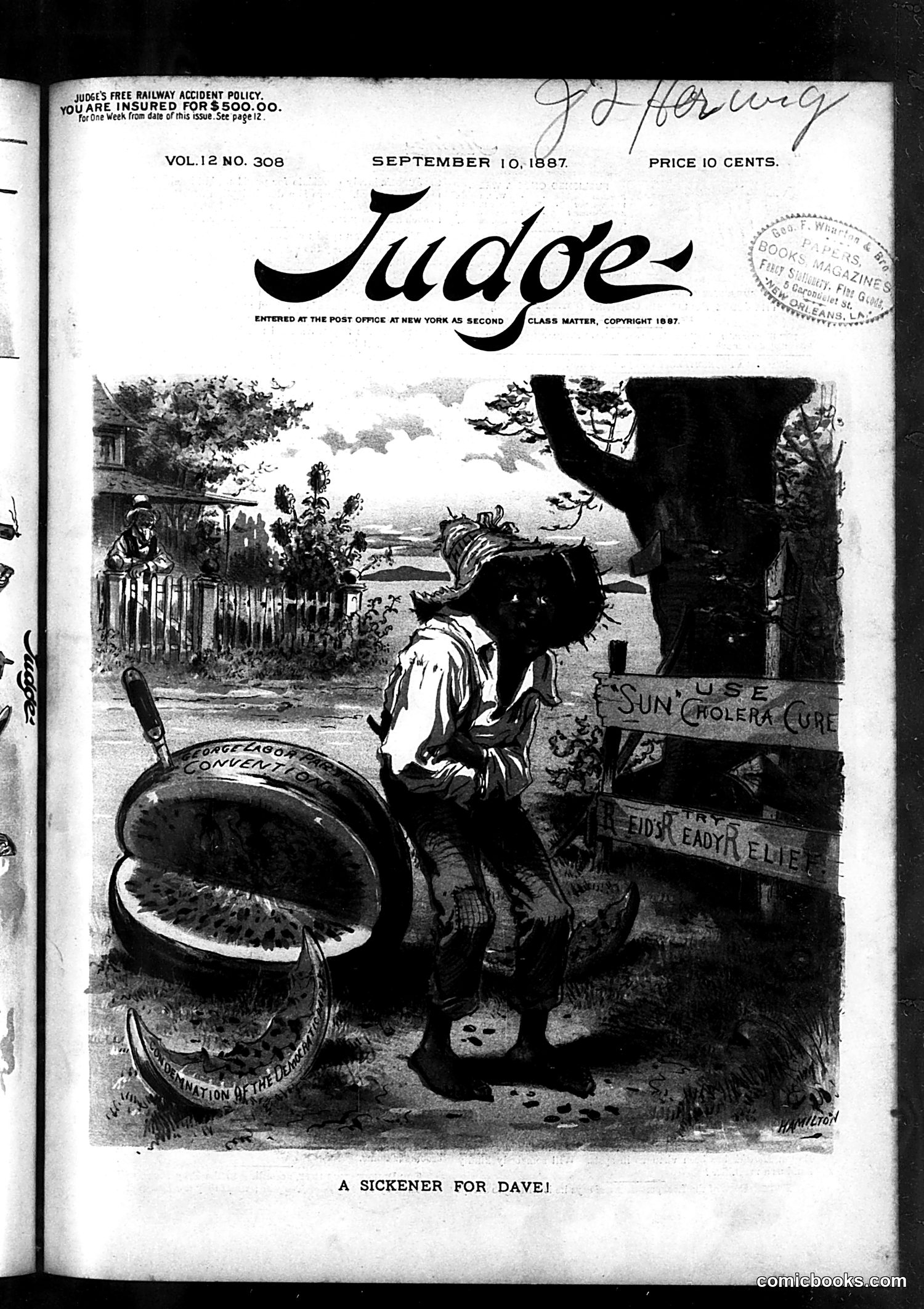
This Judge magazine cover from September 10, 1887 depicts a man using patent medicines—visible bottles labeled "Sun Cholera Cure" and "Eadyh Relief"—apparently to treat illness or cholera. The title "A Sickener for Dave" suggests this is satirizing a specific person named Dave, likely a public figure of 1887. The cartoon appears to mock ineffective or fraudulent patent medicines, which were common targets of satire during this era. The absurd remedies and their grandiose claims ("Cure," "Relief") were often worthless. The satirical point likely critiques both the quack medicines themselves and the gullibility of people who trusted them for serious diseases like cholera. Without additional context, the specific identity of "Dave" remains unclear.
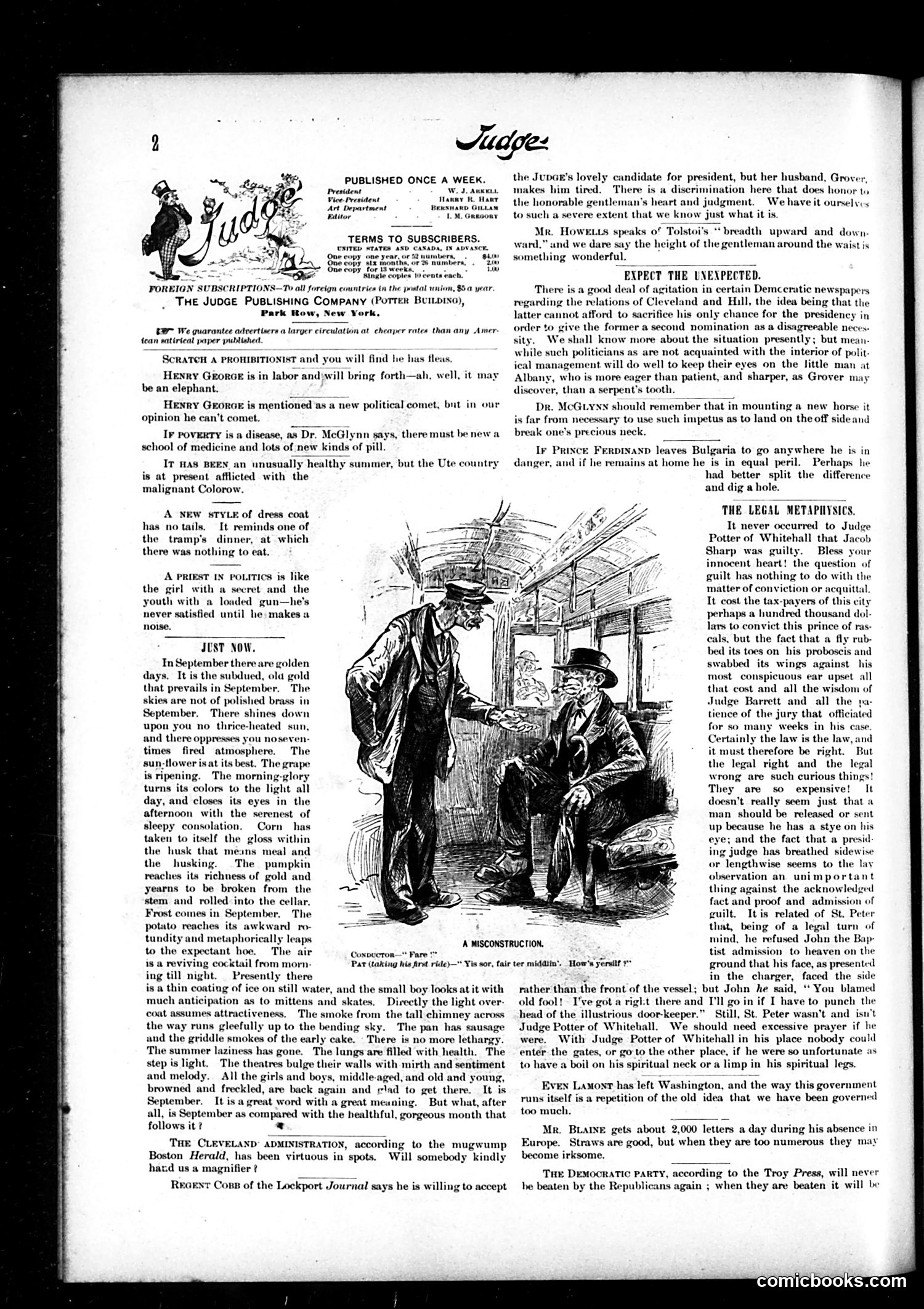
The main cartoon, titled "A MISCONSTRICTION," depicts two men in what appears to be a ship's interior. One figure accuses the other of being "the illustrious door-keeper," blaming him for a fight. The second man protests innocence, claiming "I've got a right here" and offering to punch the accuser's head "if I have to." The satire appears to reference a legal dispute involving **Judge Potter of Whitehall** and someone called "John the Baptist" regarding admission and guilt. The text criticizes how legal technicalities allowed someone's release despite apparent wrongdoing—suggesting the law's procedures can contradict justice. The page also contains brief political commentary on Democratic Party politics and various current events, presented in Judge's characteristic satirical style.
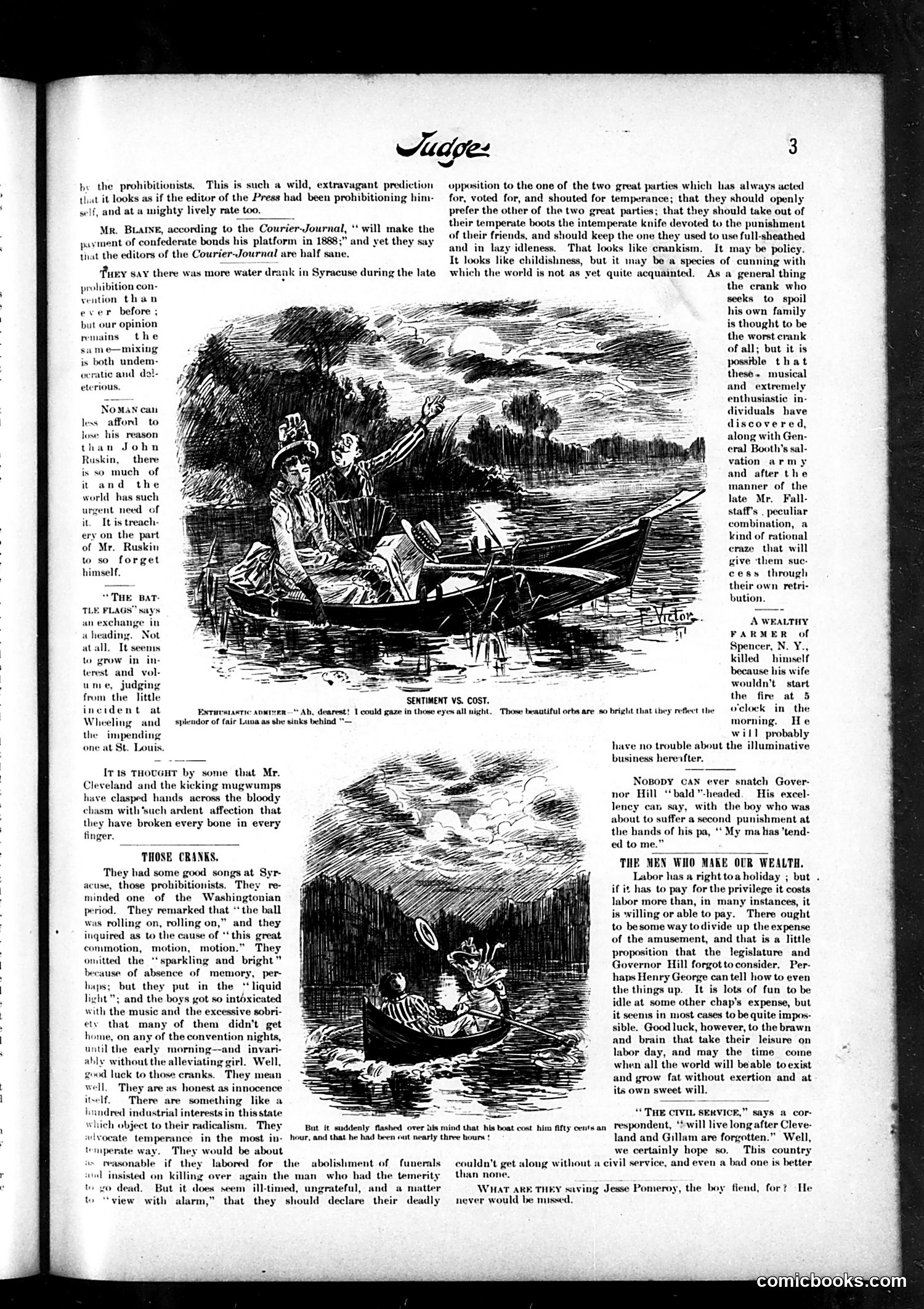
This page contains multiple brief satirical commentaries typical of Judge's style. The main targets appear to be: **Prohibition advocates**: Mocked for their "cranks" attending a Syracuse convention while supposedly drinking water—but arriving home drunk at dawn without female companions. The satire suggests prohibitionists are hypocritical and irrationally oppose the temperance-supporting Republican party out of spite rather than principle. **Political figures**: James G. Blaine is ridiculed for allegedly planning to make Confederate bond judgments his 1888 platform—a nonsensical position used to mock editor sanity. **Social commentary**: Brief items mock John Ruskin for losing his reason, Cleveland and "mugwumps" (reform Republicans) for their political reconciliation, and satirize a farmer's suicide over his wife not starting the fire. The cartoons illustrate sentimental romantic scenes interrupted by practical cost concerns—typical Judge humor contrasting sentiment with material reality.
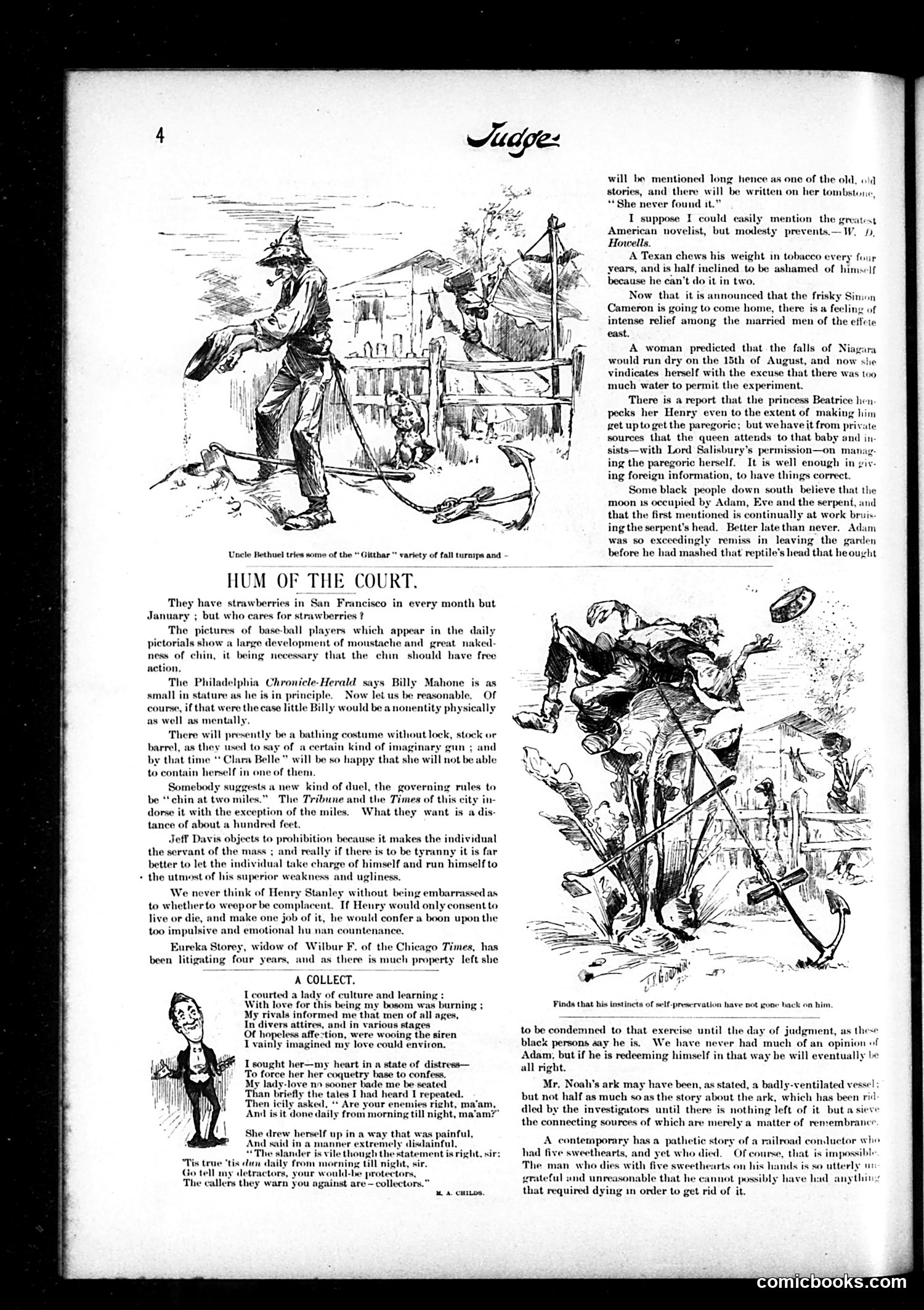
This page from Judge contains satirical commentary on contemporary political and social figures, circa 1880s-90s. **Main Cartoon**: "Uncle Rethuel tries some of the 'Githar' variety of fall turnips" depicts a rural figure attempting acrobatic stunts, likely satirizing rural or unsophisticated behavior. **"Hum of the Court" Section**: Brief satirical jabs at various public figures: - **Billy Mahone**: A Virginia politician mocked for being small in both stature and principle - **Jeff Davis**: Criticized for objecting to prohibition rules - **Henry Stanley**: The explorer criticized for his indecision about living or dying (referencing his African expeditions) - **A widow of Wilbur F.**: Involved in prolonged litigation **"A Collect" Poem**: A humorous verse about a gentleman confronting a lady about her numerous suitors, only to discover she's merely dodging debt collectors. The page uses exaggeration and wordplay typical of Judge's satirical style, targeting politicians, public figures, and social pretensions of the era.
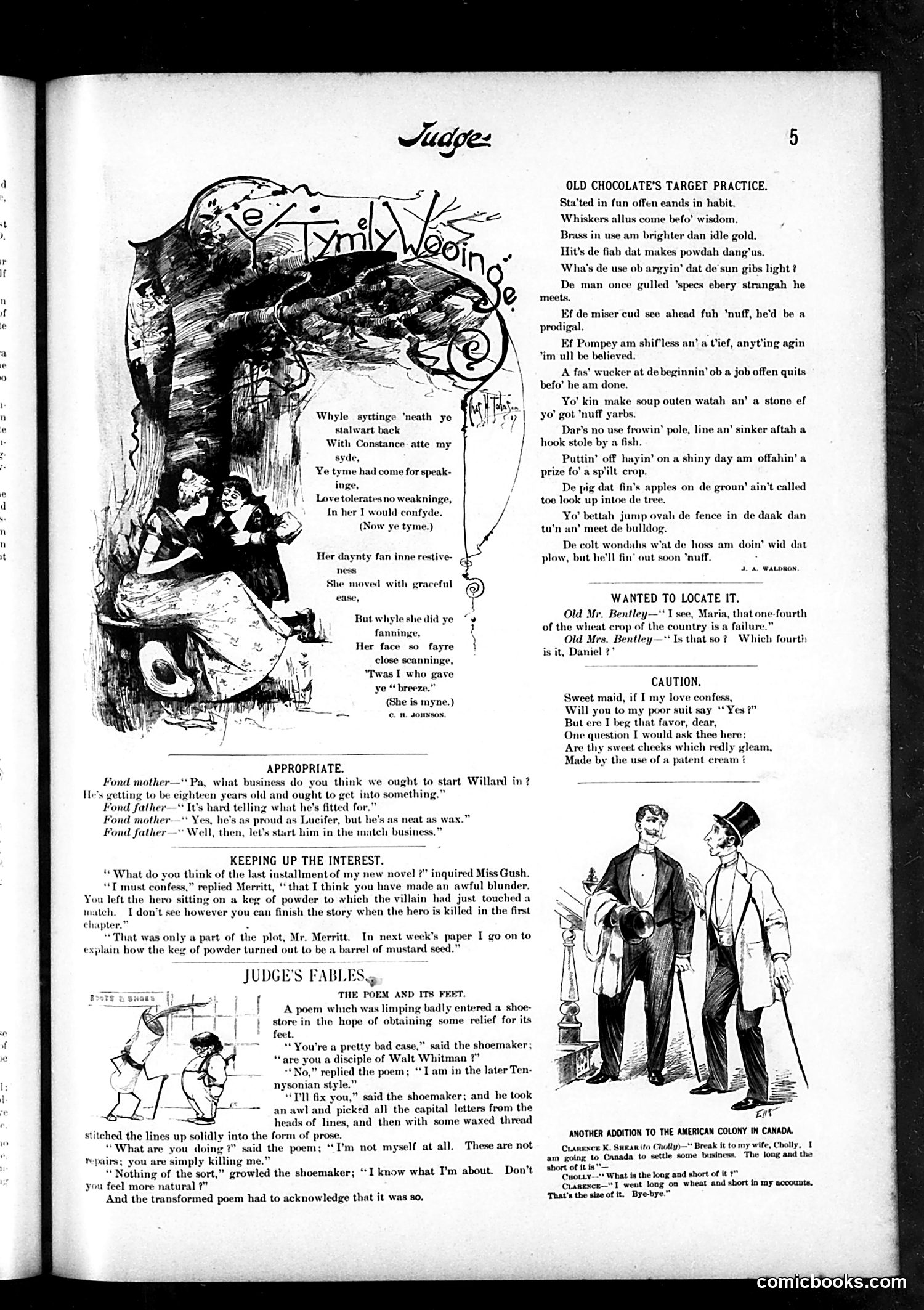
This Judge magazine page contains several satirical pieces mocking late 19th-century American life and literary pretension: **"The Poem and Its Feet"** parodies poetic affectation. A limping poem visits a shoemaker, claiming descent from Walt Whitman and later Tennyson. The shoemaker "fixes" it by removing capital letters and reformatting it as prose, making it "natural"—satirizing how experimental poets like Whitman rejected traditional verse conventions, and suggesting their work, stripped of formatting tricks, loses all merit. **"Old Chocolate's Target Practice"** presents folksy aphorisms in heavy dialect, likely mocking either popular maxim collections or racist caricature humor common to the era. **Other brief pieces** joke about parental ambitions for children, serialized novel cliffhangers, and romantic suitors questioning women's cosmetics use—typical domestic comedy. The cartoons mock literary pretension, parental expectations, and emerging advertising culture around beauty products.
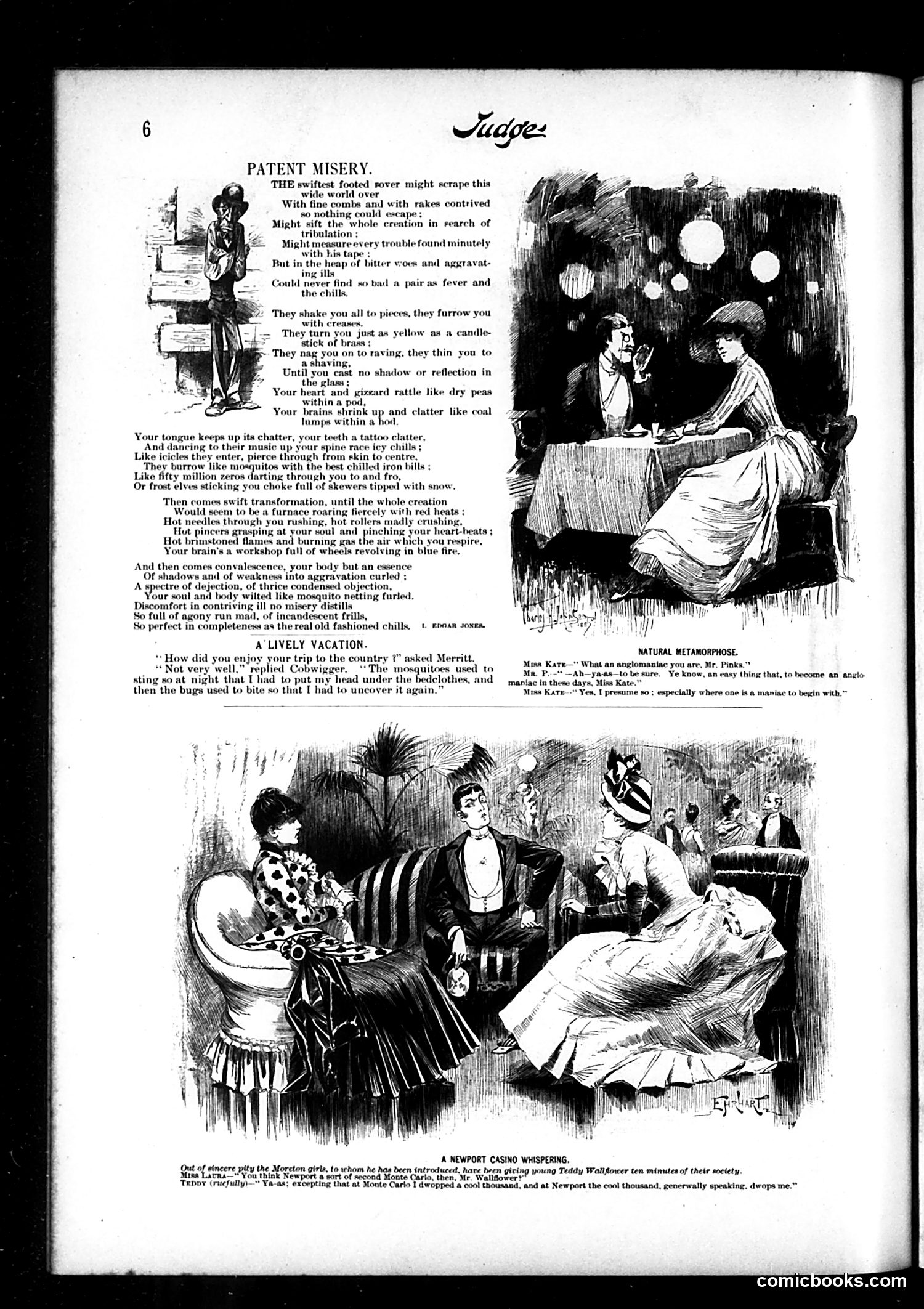
This page contains three satirical pieces lampooning American upper-class life circa the Gilded Age. **"Patent Misery"** is a lengthy poem mockingly describing the horrors of fever and chills—likely malaria or similar illness—with grotesque medical detail. It's social commentary wrapped in dark humor about disease's indignity. **"A Lively Vacation"** jokes about two leisure-class problems: Mr. Pinks is an "Anglomaniac" (absurdly imitating British manners), while Cobwigger's country vacation was ruined by mosquitoes and bedbugs—a jab at the gap between romantic pastoral ideals and rural reality. **"A Newport Casino Whispering"** satirizes wealthy Newport society, where a man brags about courting the "Moreton girls" while casually mentioning losing money ("a cool thousand") at Monte Carlo—the punchline being that wealth drains away as easily as it appears. The cartoons mock affluent pretension, health anxieties, and the leisure class's disconnection from reality.
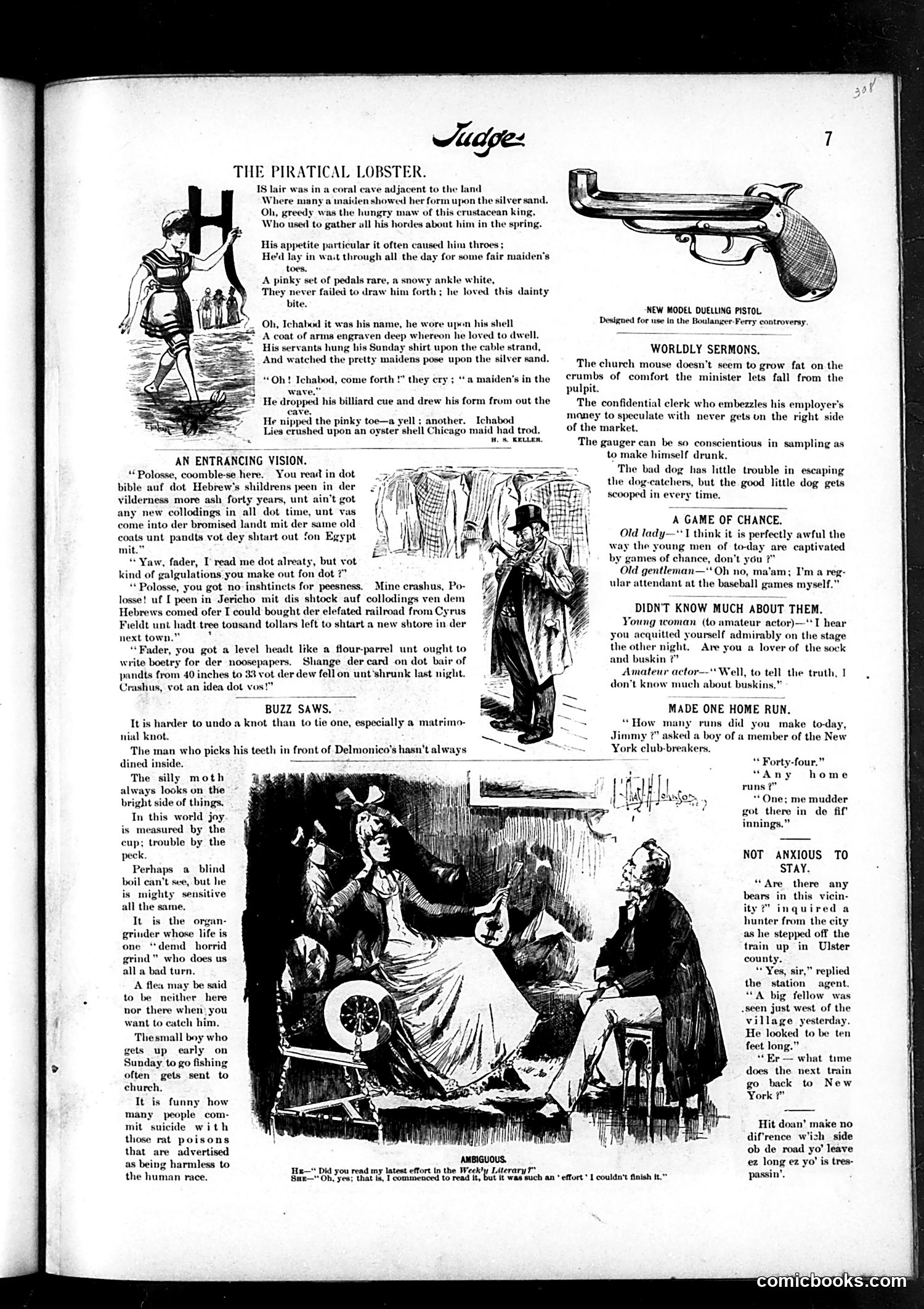
This page from Judge magazine (undated but likely 1880s-90s based on style) contains multiple satirical pieces: **"The Piratical Lobster"** is a whimsical poem about a lobster named Ichabod who preys on maidens' toes—a nonsense fantasy with no deeper political meaning. **"An Entrancing Vision"** features a German-Jewish immigrant character discussing business shrewdly, using heavy dialect humor. The joke stereotypes Jewish merchants as obsessed with profit and commercial advantage, even imagining how to exploit biblical history (selling clothes to the Hebrews). This reflects period antisemitic caricaturing common in 19th-century American humor magazines. **"Buzz Saws"** collects brief aphorisms and observations—mostly generic life commentary without specific satire. The **"New Model Dueling Pistol"** illustration references the Boulanger-Ferry controversy (likely Franco-French political tension), suggesting dueling as satirical commentary on political conflict. **"Worldly Sermons"** offers cynical observations about church, business ethics, and dog-catching—mild social satire rather than political commentary. The page is primarily entertainment-focused rather than engaged with specific current events.
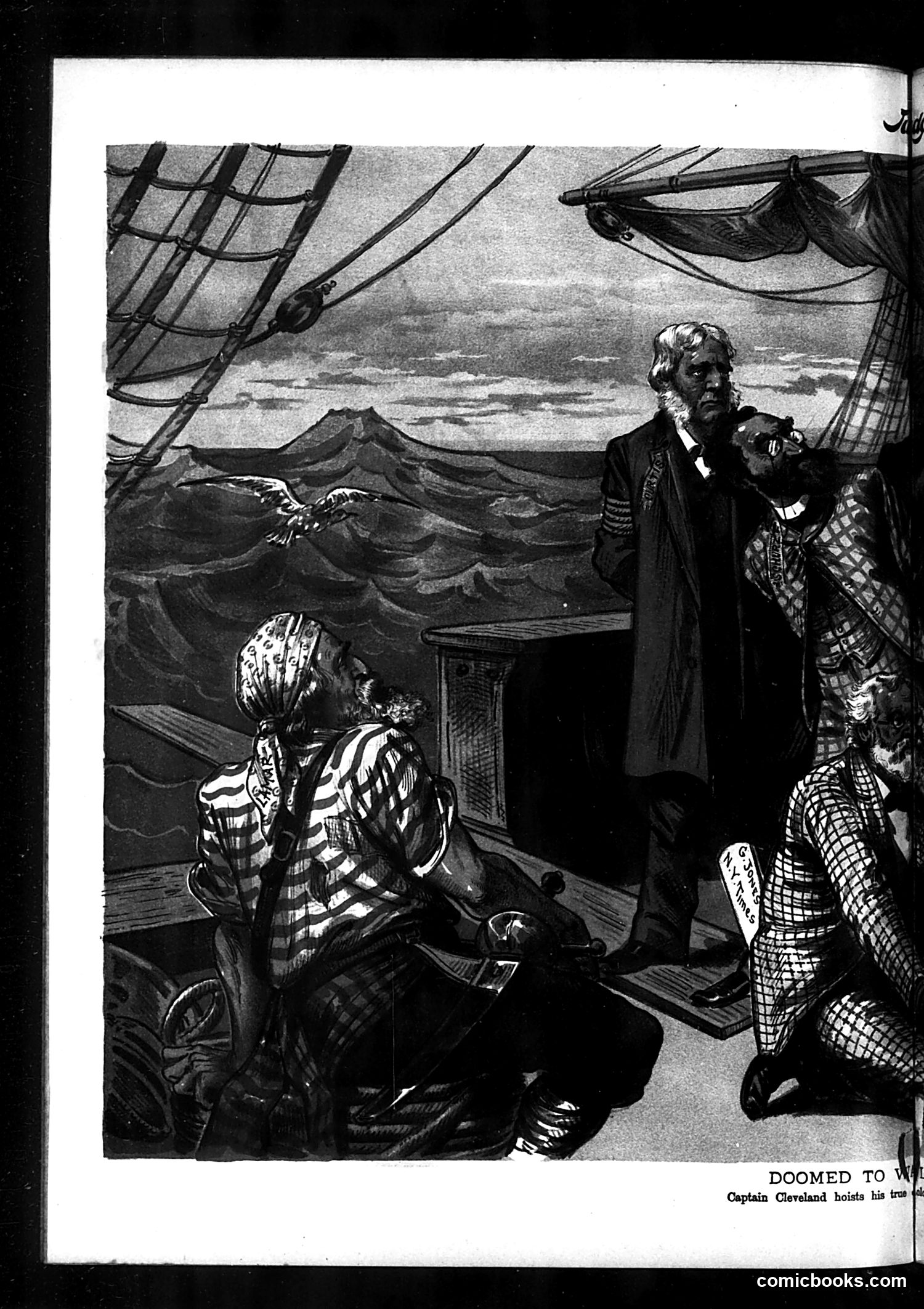
This appears to be an illustration from Judge magazine depicting a dramatic naval scene. The caption references "Captain Cleveland" and mentions something being "hoisted," though the OCR text is incomplete ("DOOMED TO if..."). The image shows what appears to be a military or naval officer in formal dress standing aboard a ship, with crew members visible. The artistic style and composition suggest this is satirical commentary on a political figure—likely President Grover Cleveland—presented in a nautical/maritime metaphor. Without the complete caption text, I cannot definitively explain the specific political joke or event being referenced. The "doomed" language and dramatic staging suggest criticism of Cleveland's policies or political position, but the exact meaning remains unclear from the incomplete OCR transcription.
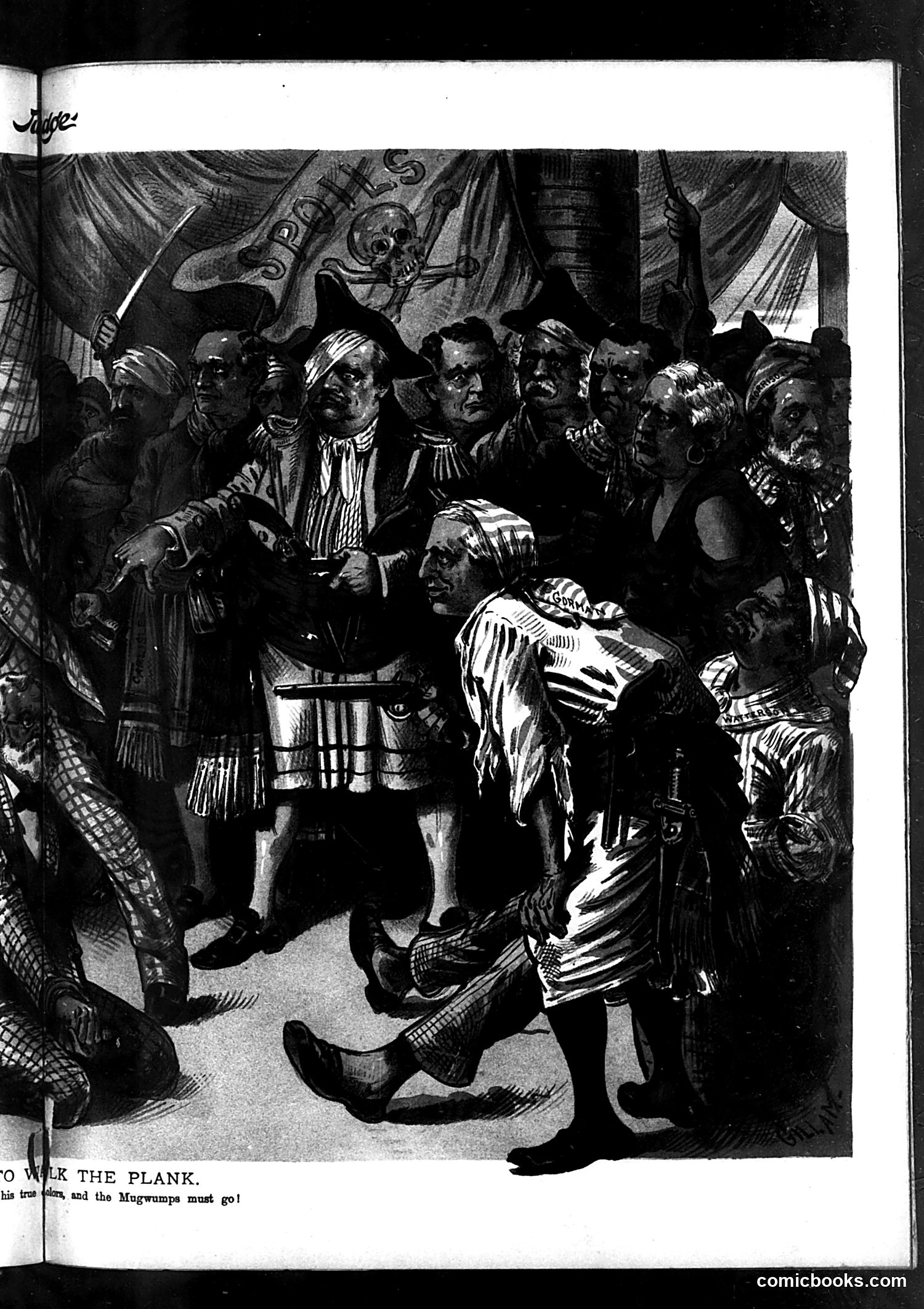
This political cartoon depicts a scene aboard a ship where figures in military uniforms surround a central character forced to "walk the plank." The caption references "Mugwumps"—a term for Republican Party members who defected to support Democratic candidate Grover Cleveland in the 1884 presidential election, viewed as traitors by regular Republicans. The cartoon satirizes internal Republican party conflict, suggesting that certain party members (the Mugwumps) should be expelled or eliminated from the party, depicted through the metaphor of forced execution by pirates. The military uniforms and formal dress suggest this concerns high-ranking political figures or leadership disputes. The crude, violent imagery reflects the harsh partisan politics of the Gilded Age.
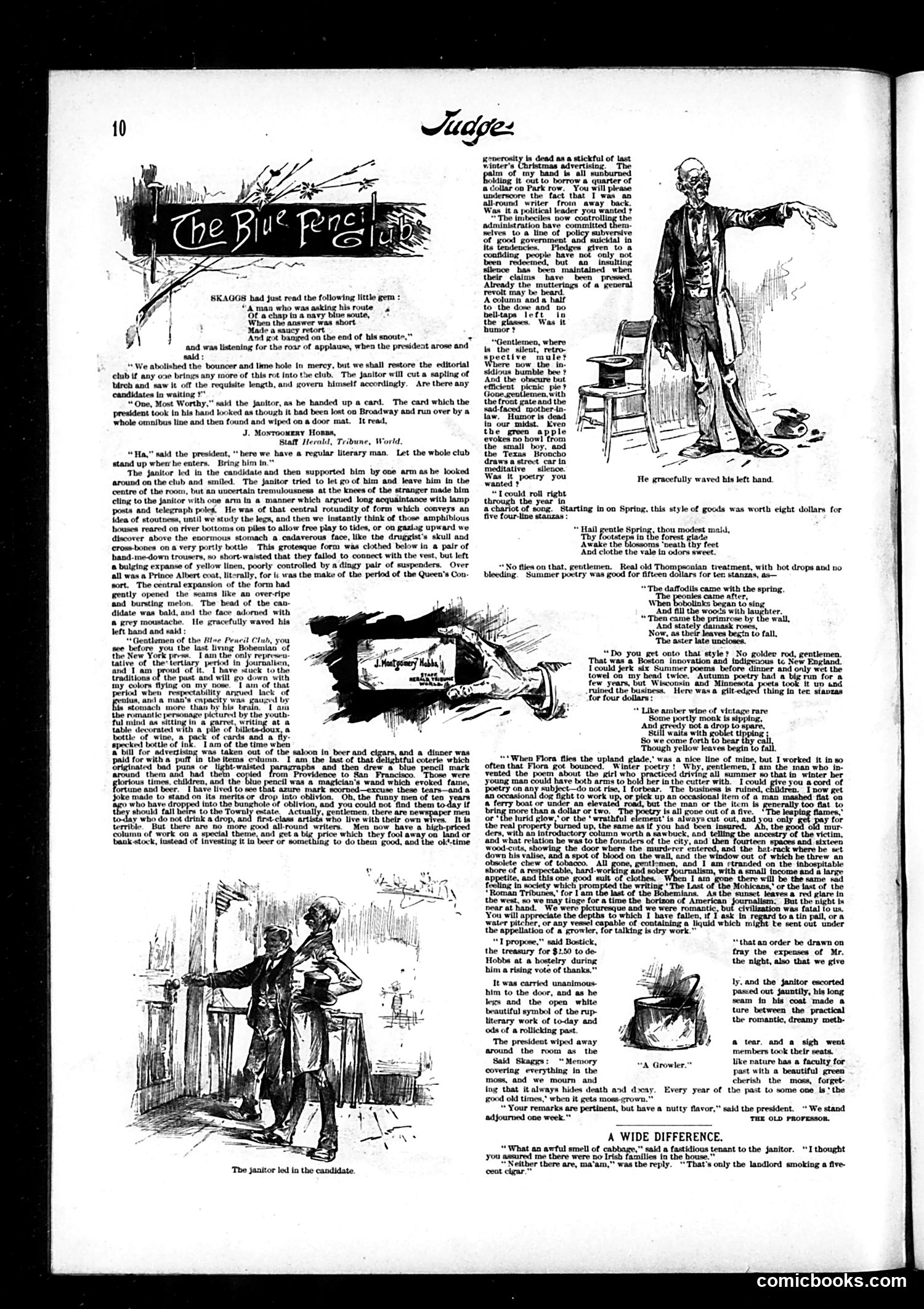
This page satirizes the decline of 19th-century American newspaper journalism. The central cartoon depicts "J. Mowbroom Hons," a disheveled, alcoholic newspaper man seeking admission to a literary club. His appearance—shabby clothes, bloated from drink, cadaverous face—embodies the stereotype of a dissolute "Bohemian" journalist. Hons nostalgically boasts of the "old days" when newspaper editors wielded the "blue pencil" (editing tool) like magic, accepting payment in beer and dinner instead of real money. He laments that modern journalism now requires actual merit and respectability, rather than clever puns and fraud. The satire targets the transformation of American newspapers from disreputable enterprises run by drunken bohemians into more professional, accountability-focused institutions. Judge mocks both the romanticized past and the sentimental nostalgia some held for it, presenting the change as inevitable progress despite romantic loss.
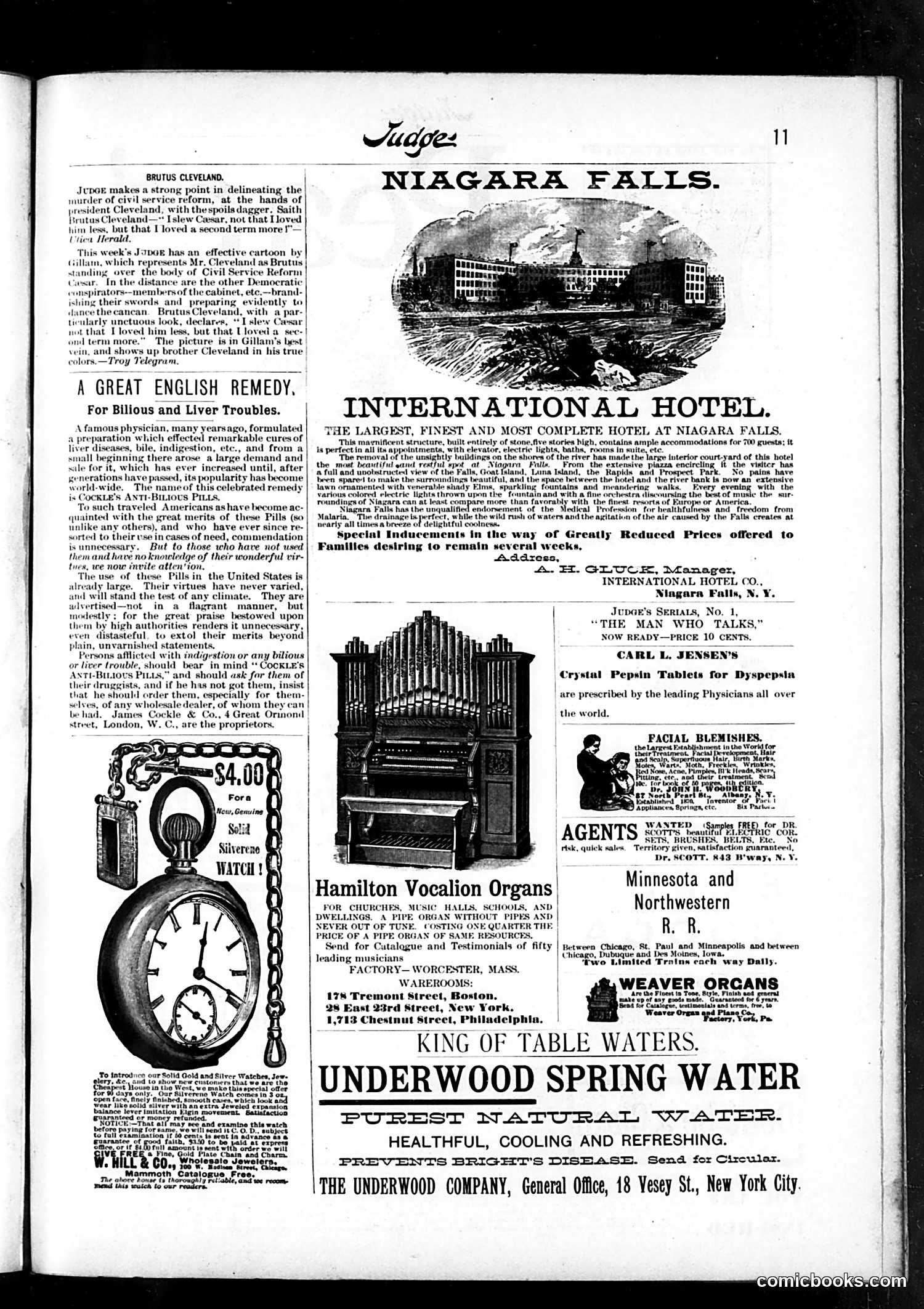
This page is primarily **advertising with one political cartoon** at the top. ## The Cartoon: "Brutus Cleveland" The satire depicts **President Grover Cleveland as Brutus**, the Roman senator who betrayed Caesar. The caption quotes Shakespeare's *Julius Caesar*: "I slew Caesar—not that I loved him less, but that I loved a second term more." **The political reference**: Cleveland had championed **civil service reform** (replacing patronage appointments with merit-based hiring). The cartoon suggests Cleveland abandoned this principle to secure a second presidential term, betraying the reform cause like Brutus betrayed Caesar. Other cabinet members are shown as co-conspirators with daggers—fellow Democrats who similarly compromised their reform ideals for political advantage. **Historical context**: This satirizes the perceived hypocrisy of Democratic leadership during Cleveland's presidency (1885-1889), when patronage politics conflicted with stated reform goals. The rest of the page is **advertisements** for patent medicines, hotels, organs, watches, and railroads—typical of late 19th-century magazines.
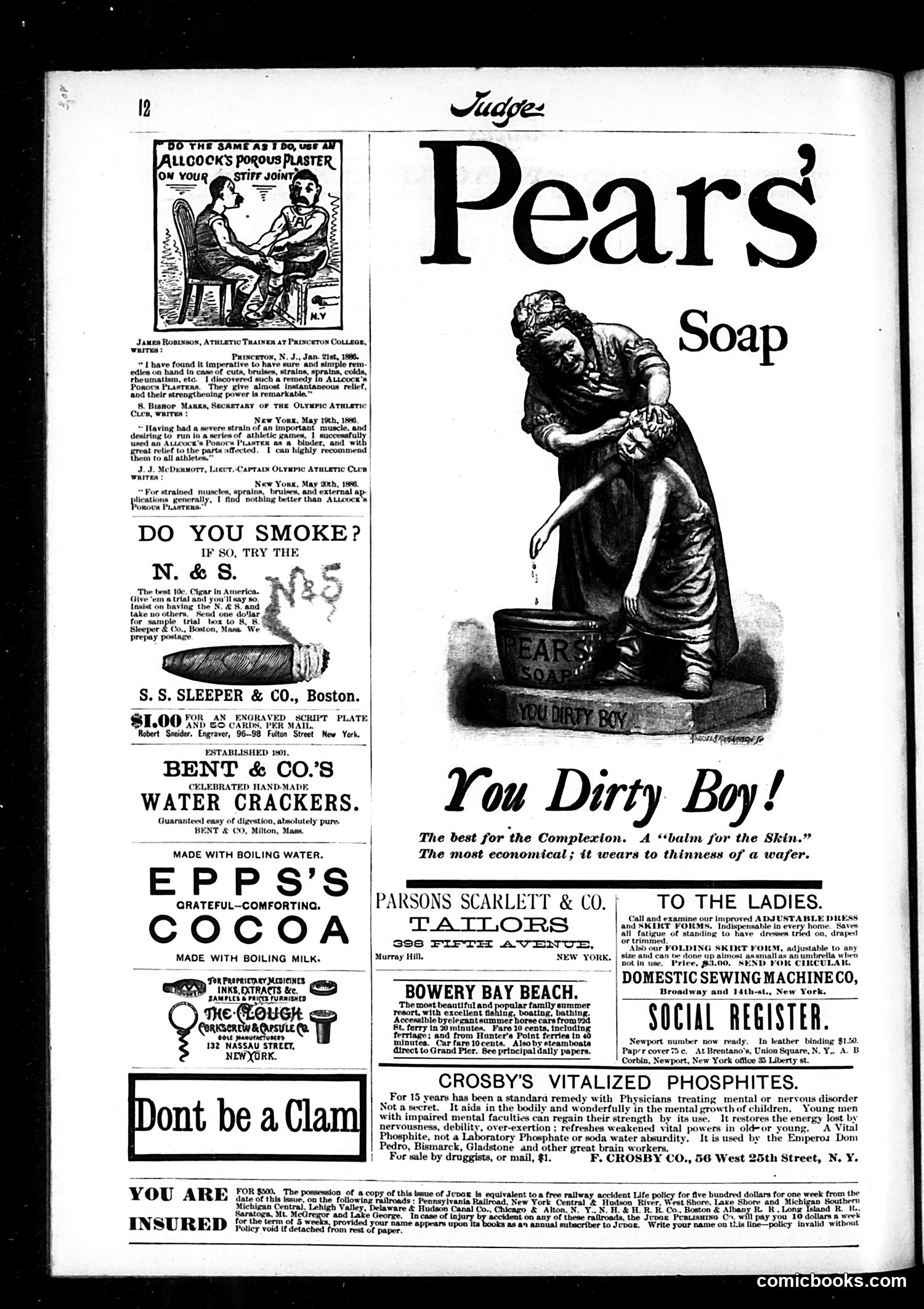
This page is primarily **advertising**, not political satire. The dominant image is a large advertisement for **Pears' Soap** featuring a child labeled "You Dirty Boy!" washing with the product. The main visual joke targets **Victorian sensibilities about childhood cleanliness**. The caption "You Dirty Boy!" is simultaneously scolding and endearing—the soap's marketing pitch claims it's "the best for the Complexion" and "the most economical; it wears to thinness of a wafer." The advertisement plays on parental anxiety about dirt and hygiene while suggesting the soap is gentle enough for children's delicate skin. The surrounding advertisements address **upper-class concerns**: tailors (Parsons Scarlett & Co.), sewing machines, athletic remedies for Princeton athletes, and luxury foods. The page reflects **Gilded Age consumer culture** targeting affluent readers—notably including a "Social Register" advertisement for New York society members. This is a commercial publication showcasing products for the wealthy, not satirical commentary.
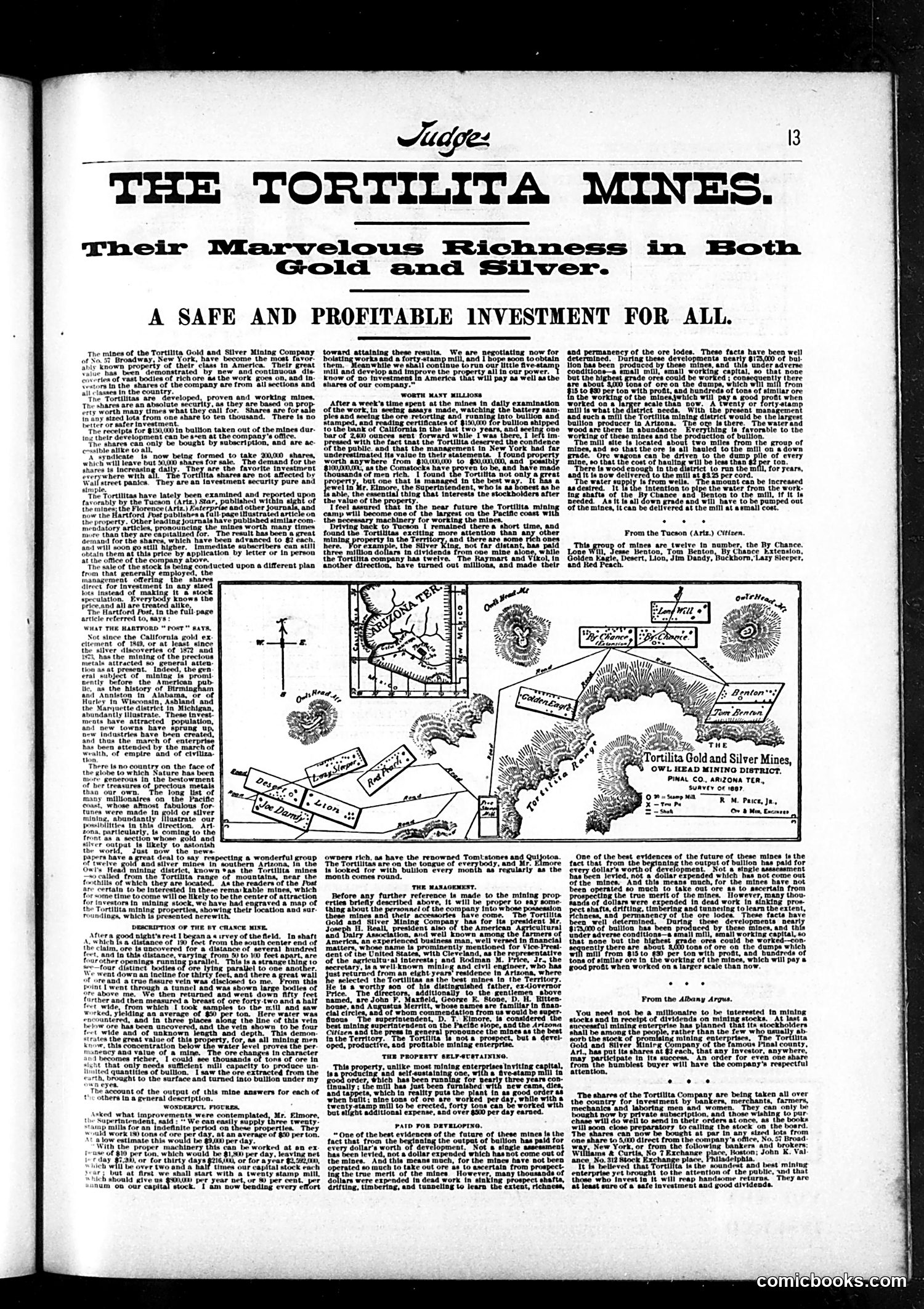
This page is primarily a **promotional advertisement** for the Tortilita Gold and Silver Mining Company in Arizona, not a satirical cartoon. The text describes the mines' profitability and invites investment, emphasizing "safe and profitable" returns. The inclusion in *Judge* (a satirical magazine) appears **ironic**: the glowing testimonials—reprinting favorable articles from the Hartford Post and Tucson Star, along with claims of "$14,000 in bullion" already extracted—read as investment hype typical of mining schemes that often defrauded small investors. The maps and geological descriptions lend false credibility. By 1880s standards, such mining stock promotions were common vehicles for fraud. Publishing this advertisement prominently in *Judge* likely serves as **implicit satire**—letting readers recognize the dubious investment scheme themselves through its over-eager salesmanship and promised wealth.
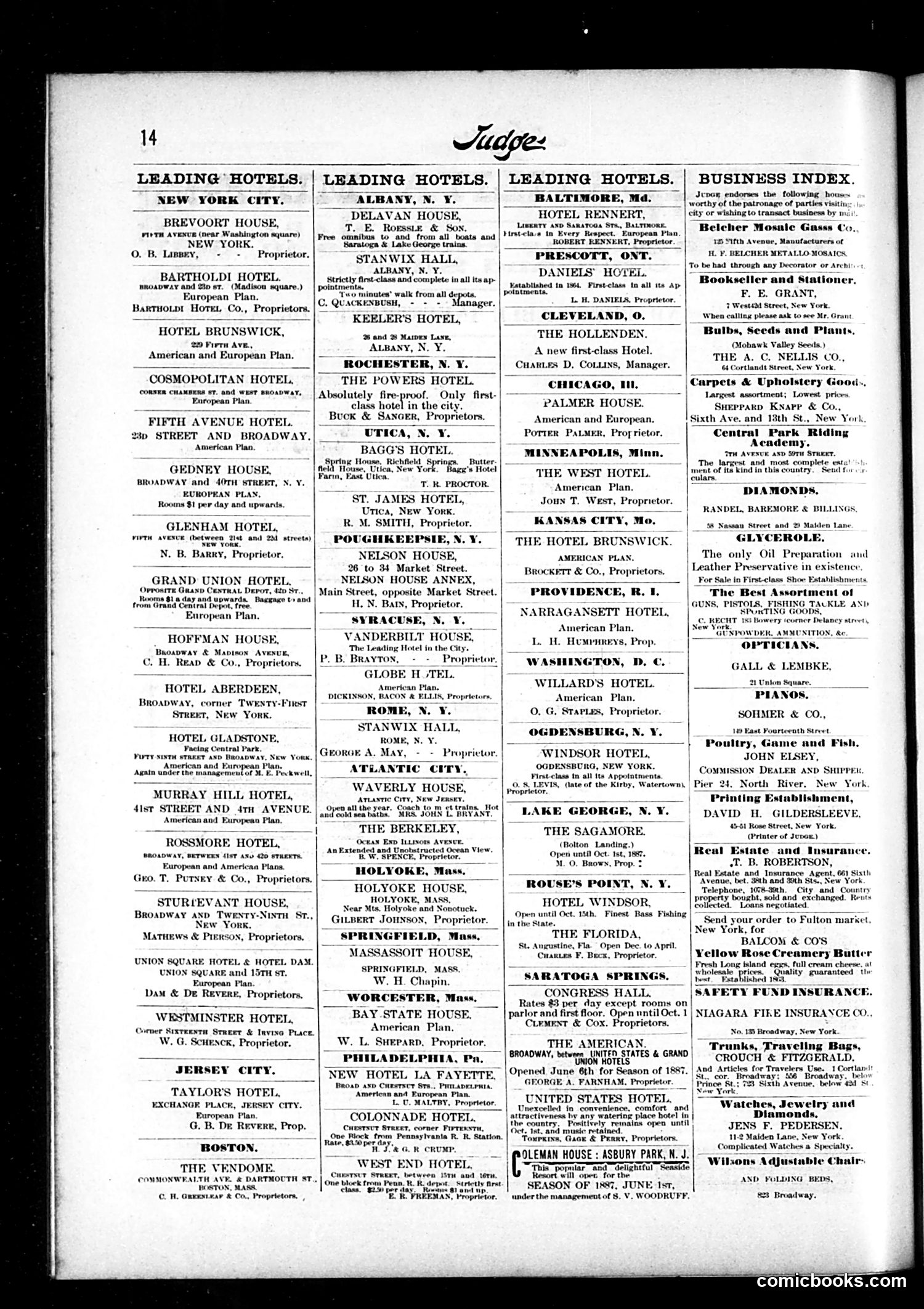
This page is primarily a **business directory of leading hotels** across major American cities, with a small "Business Index" section on the right. There are no political cartoons or satirical illustrations visible. The hotel listings span New York City, Albany, Rochester, Boston, Philadelphia, Baltimore, and other major metropolitan areas, reflecting the magazine's advertiser-supported model. Hotels are identified by proprietor names and architectural features (many emphasizing "fireproof" construction, suggesting recent safety concerns). The Business Index endorses specific commercial enterprises—notably "Belcher Mosaic Gases Co." and "F. E. Grant" bookseller—indicating Judge's practice of mixing editorial content with paid advertising. **No satire or political commentary is present on this page.** It represents standard late-19th-century magazine filler designed to generate revenue while providing practical travel information to readers. The layout and typography are typical of 1880s periodical design.
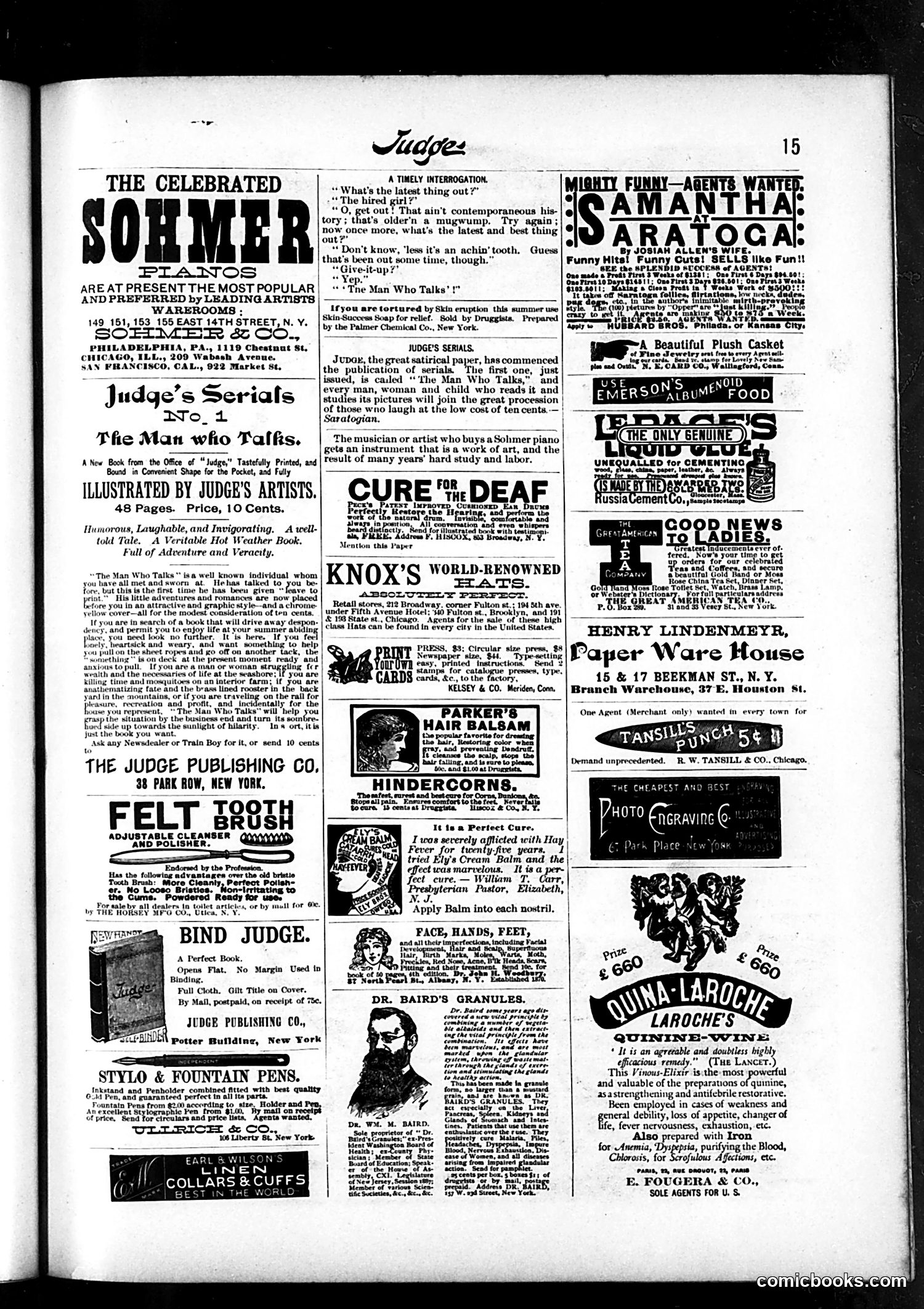
This is primarily an **advertising page** from Judge magazine, with minimal editorial content. The notable satirical element is a brief dialogue at the top titled "A Timely Interrogation." ## The Cartoon/Dialogue The humor hinges on a conversation about "the latest thing out." A character suggests "the hired girl" is out, prompting the response that this is "older'n a mugwump" (referencing the 1884 political split). The punchline reveals the "latest" thing is actually an aching tooth, which leads to promoting Judge's serial "The Man Who Talks." This is **self-promotional satire**—Judge uses topical references (mugwumps) to mock outdated ideas while advertising its own publication as genuinely current entertainment. ## The Rest The page is dominated by period advertisements: Sohmer pianos, skin remedies, books, hats (Knox's), printing supplies, and medical products. These reflect late-19th-century consumer goods and patent medicine advertising typical of satirical magazines of this era. **No political figures or sustained cartoons appear**—this is largely a commercial page using light humor as wrapper.
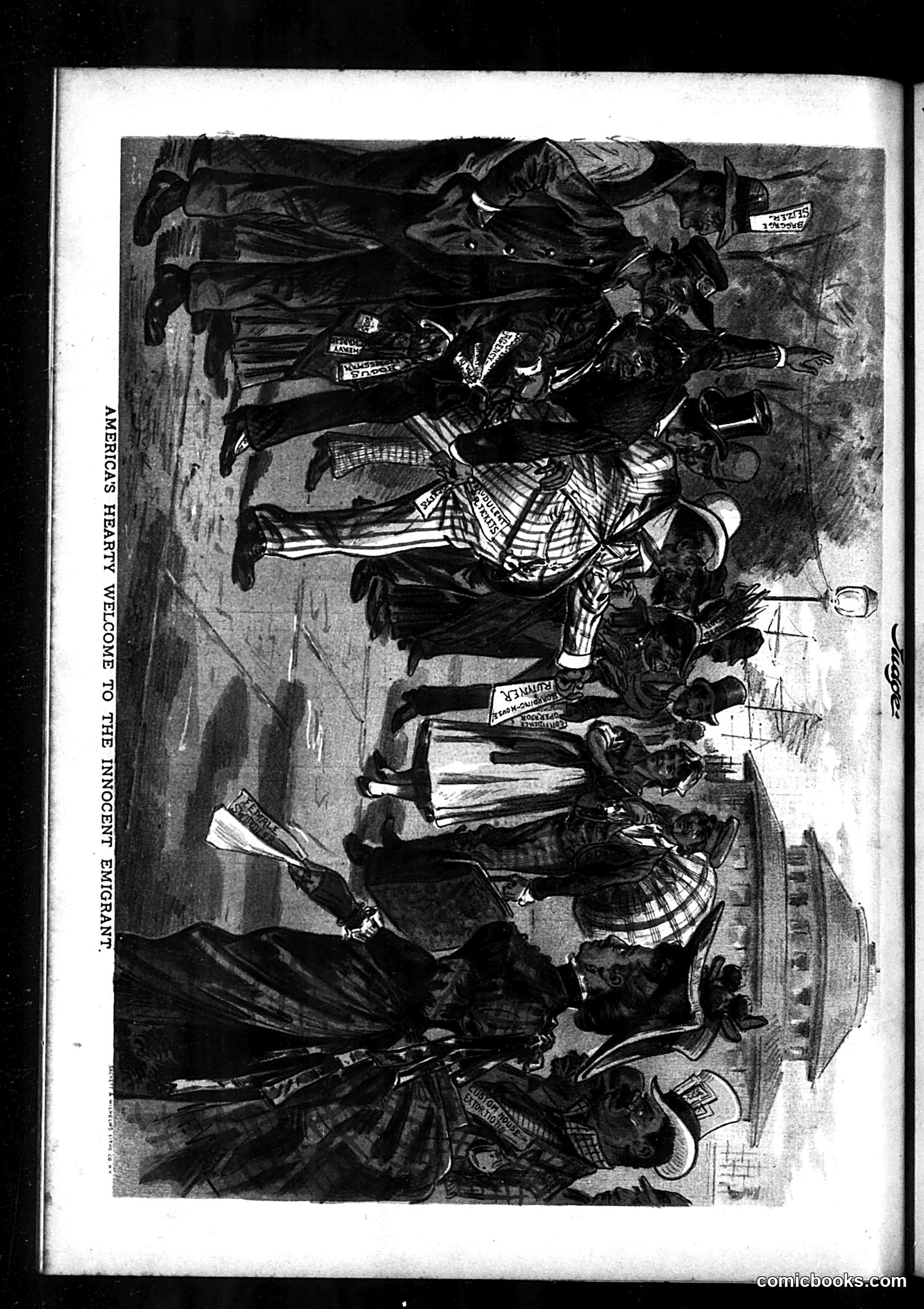
This political cartoon satirizes America's treatment of immigrants. The image shows a chaotic scene of poorly dressed emigrants being roughly handled or jostled by authority figures in what appears to be an immigration processing area. The title "America's Hearty Welcome to the Innocent Emigrant" is deeply ironic—suggesting the cartoon criticizes the gap between America's self-image as a welcoming nation and the actual harsh, undignified treatment immigrants received upon arrival. The scene depicts multiple figures in apparent distress or disorder, likely representing the degrading conditions and rough handling immigrants faced at processing centers (possibly Ellis Island, though not specified). The satire targets the hypocrisy of American immigration rhetoric versus brutal reality—mocking the notion of a "hearty welcome" by showing chaos and mistreatment instead.