
Judge, 1887-09-10 · page 5 of 16
Judge — September 10, 1887 — page 5: what you’re looking at
What you’re looking at
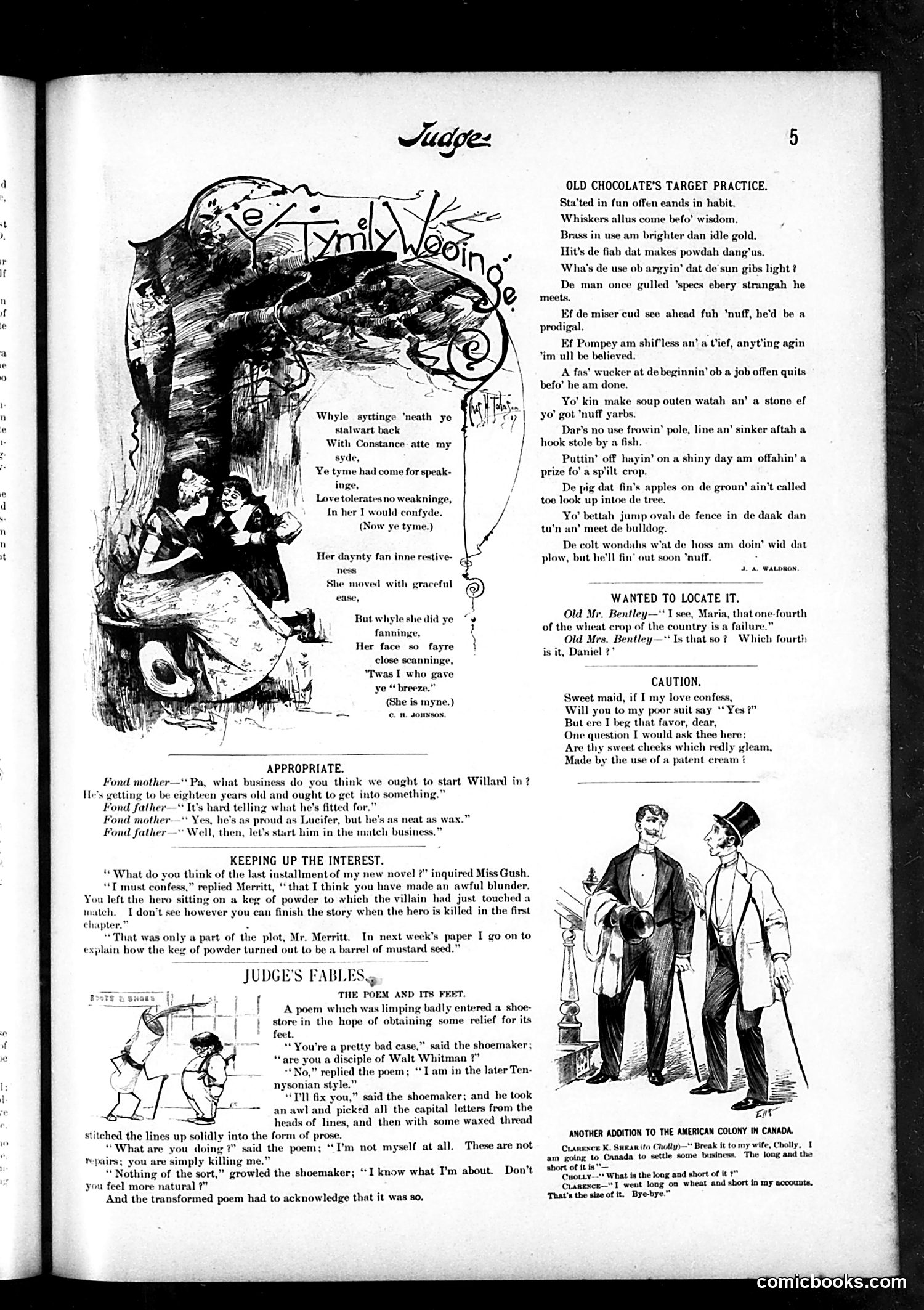
This Judge magazine page contains several satirical pieces mocking late 19th-century American life and literary pretension: **"The Poem and Its Feet"** parodies poetic affectation. A limping poem visits a shoemaker, claiming descent from Walt Whitman and later Tennyson. The shoemaker "fixes" it by removing capital letters and reformatting it as prose, making it "natural"—satirizing how experimental poets like Whitman rejected traditional verse conventions, and suggesting their work, stripped of formatting tricks, loses all merit. **"Old Chocolate's Target Practice"** presents folksy aphorisms in heavy dialect, likely mocking either popular maxim collections or racist caricature humor common to the era. **Other brief pieces** joke about parental ambitions for children, serialized novel cliffhangers, and romantic suitors questioning women's cosmetics use—typical domestic comedy. The cartoons mock literary pretension, parental expectations, and emerging advertising culture around beauty products.
📄 Transcribed text from this page (OCR, searchable)
Machine-transcribed from the original scan — historical spelling and the odd misread are preserved.
Whyle syttinge ‘neath ye stalwart back With Constance: atte my me had come for speak- Love toleratr-sno weakninge, In her I would confy (Now ye tyme.) Her daynty fan inne restive- ness She moved with graceful ease, But whyle she did ye fanninge. Her face so fayre Vine close scannii WY "Twas I who gave a] 4 ye “breeze,” 57 (She is myne.) ©. M. JOUNRON, APPROPRIATE. at business do you think we ought to start Willand in? He's getting to be eig years old and ought to get into something.” Fond father—* I's hard telling what he’s fitted for.” Fond mother. s, he’s as proud as Lucifer, but he's as neat Fond father—* Well, then, let's start him in the match busine KEEPING UP THE INTEREST. “* What do you think of the last installmentof my ne “T must confess,” replied Merritt, ‘‘that I think you hi made an awful blunder. You left the hero sitting on a keg of powder to which the villain had just touched a match, I don’t see however you can finish the story when the hero is killed in the first chapter. : “That was only a part of the plot, Mr. Merritt. In next week’s paper I go on to explain how the keg of powder turned out to be a barrel of mustard seed.” JUDGE'S FABLES THE POEM AND ITS FEET. A poem which was limping badly entered a. shoe- store in the hope of obtaining some relief for its feet. “You're a pretty bad case,” said the shoemaker; “are you a disciple of Walt Whitman ?” * replied the poem; ‘I am in the later Ten- nysonian le.” “DIL fix you,” said the shoemaker; and he took an awl and picked all the capital letters from the heads of lines, and then with some waxed thread stitched the lines up solidly into the form of prose. “What are you doing @” said the poem; ‘I’m not myself at all. These are not pairs; you are simply killing me.” “Nothing of the sort,” growled the shoemaker; ‘I know what I'm about. Don't you feel more natural ?” And the transformed poem had to acknowledge that it was so. OLD CHOCOLATE’S TARGET PRACTICE. Sta’ted in fun offen eands in habit. Whiskers allus come befo’ wisdom. Brass in use am brighter dan idle gold. Hit’s de fiah dat makes powdah dang’ Wha’s de use ob argyin’ dat de'sun gibs light ? De man once gulled ‘specs ebery strangah he meets. Ef de miser cud see ahead fuh ‘nuff, he'd be a prodigal. Ef Pompey ‘im ull be believed. A fas’ wucker at debe befo’ he am done. Yo' kin make soup outen watah an’ a stone ef yo’ got ‘nuff yarbs. shif'less an’ a tief, anyt'ing agin n’ ob a job offen quits Dar’s no use frowin’ pole, line an’ sinker aftah a hook stole by a fish. Puttin’ off hayin’ on a shiny day am offahin’ a prize fo' a sp'ilt crop. De pig dat fin's apples on de groun’ ain't called too look up intoe de tree. Yo" bettah jump oval de fence in de daak dan tu'n an’ meet de bulldog De colt wondahs w'at de hoss am doin’ wid dat plow, but he'll fin’ out soon ‘nuff. J. A. WALDRON. WANTED TO LOCATE IT. Old Mr. Bentley—‘‘ 1 see, ‘ia, that one-fourth of the wheat crop of the country is a failure.” Old Mrs. Bentley—" Is that so? Which fourtiy is it, Daniel ?* CAUTION. Sweet maid, if I my love confess, Will you to my poor suit say “Yes ¢” But ere I beg that favor, dear, One question I would ask thee here: Are thy sweet cheeks which redly gleam, Made by the use of a patent cream ¢ ANOTHER ADDITION TO THE AMERICAN COLONY IN CANADA. Chanexce K. Sneanito Cholly)—" Break it to my wife, Cholly, 1 am going to Canada to settle some business. The long and the short of it is" ‘Couy--* What is the long and short of it 1" Cianexce—"I went long on wheat and short in my accounts, ‘That's the size of it, Bye-bye.”