
Judge, 1887-09-10 · page 3 of 16
Judge — September 10, 1887 — page 3: what you’re looking at
What you’re looking at
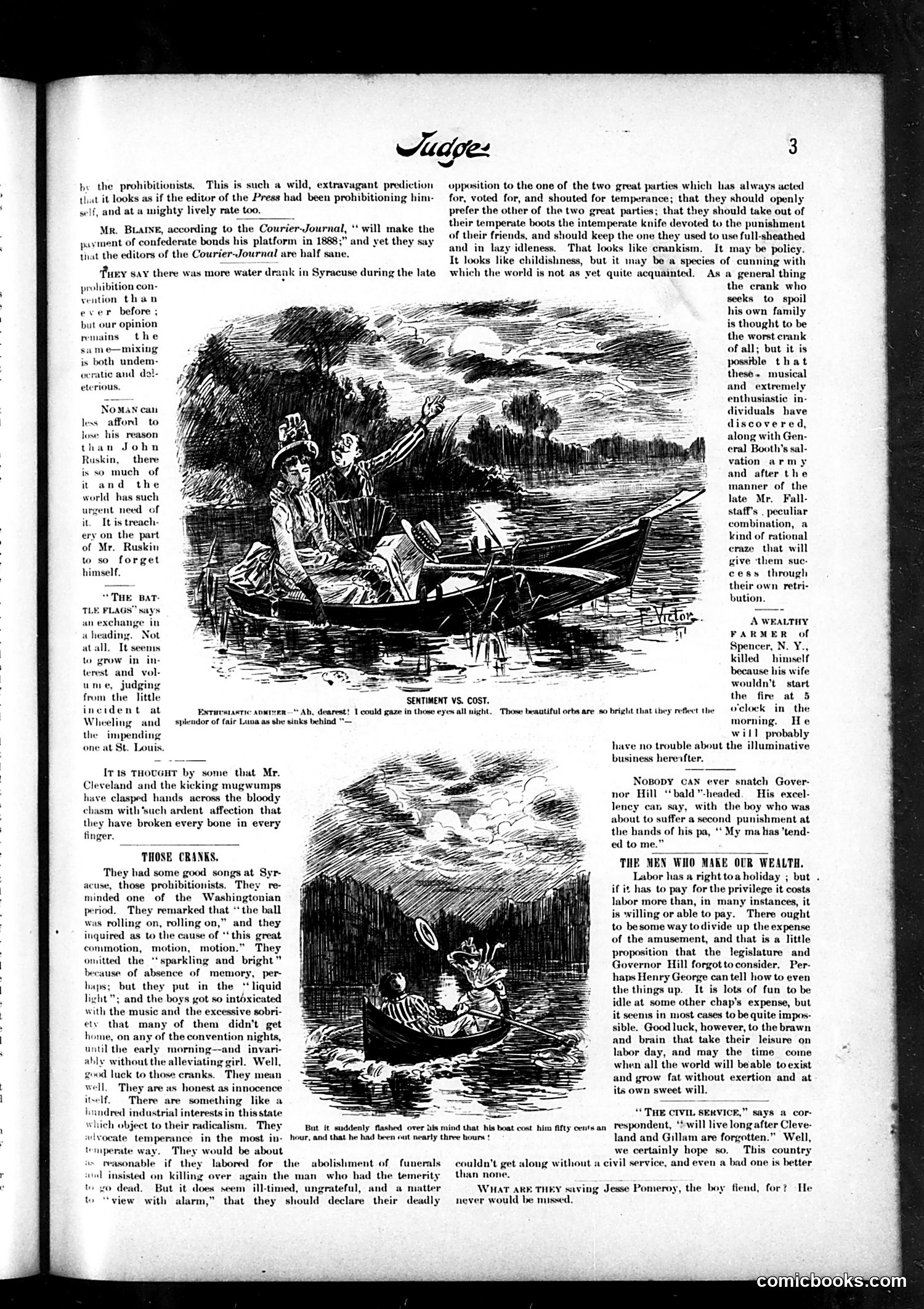
This page contains multiple brief satirical commentaries typical of Judge's style. The main targets appear to be: **Prohibition advocates**: Mocked for their "cranks" attending a Syracuse convention while supposedly drinking water—but arriving home drunk at dawn without female companions. The satire suggests prohibitionists are hypocritical and irrationally oppose the temperance-supporting Republican party out of spite rather than principle. **Political figures**: James G. Blaine is ridiculed for allegedly planning to make Confederate bond judgments his 1888 platform—a nonsensical position used to mock editor sanity. **Social commentary**: Brief items mock John Ruskin for losing his reason, Cleveland and "mugwumps" (reform Republicans) for their political reconciliation, and satirize a farmer's suicide over his wife not starting the fire. The cartoons illustrate sentimental romantic scenes interrupted by practical cost concerns—typical Judge humor contrasting sentiment with material reality.
📄 Transcribed text from this page (OCR, searchable)
Machine-transcribed from the original scan — historical spelling and the odd misread are preserved.
ape: 3 by the prohibitionists. This is such a wild, extravagant prediction that it looks a the editor of the Press had been prohibitioning him- and at a mighty lively rate too, Mr. BLAINE, according to the Courier-Journal, “ will make the juvment of confederate bonds his platform in 1888;" and yet they say that the editors of the Courier-Journal are half sane. ‘Pury sav there was more water drank in Syracuse during the late prohibition con- vention than ever before ; but our opinion remains the sa me—mixing is both undem- ocratic and di eterious OMAN can afford to lose his reason than John Rus there is so much of it and the world has such urgent need of it. It is treach- ery on the part of Mr. Ruskin to so forget himself. ge in Not Tt seems grow in in- nd vol- , judging 1 the little ident at ng and the impending one at St. Louis. splendor of fair Luna as she sinks behind "— Iv is THOUGHT by some that Mr. Cleveland and the kicking mugwumps have clasped hands across the bloody chasm with ‘such ardent affection that they have broken every bone in every finger. THOSE CRANKS. ‘They had some good songs at Syr- acuse, those prohibitionists. They re- minded one of the Washingtonian period. They remarked that ‘the ball was rolling on, rolling on,” and they inquired as to the cause of ‘this great commotion, motion, motion.” They omitted the “sparkling and bright” ause of absence of memory, per put in the ‘liquid wht”; and the boys got so intoxicated with the music and the excessive sobri- ety that many of them didn’t get home, on any of the convention nights, until the early morning—and_invari- ably without the alleviating girl. Well, good luck to those cranks. They mean well. ‘They are as honest as innocence If. There are something like a ndred industrial interests in this state which object to their radicalism. They © temperance in the most in- mite way. They would be about reasonable if they labored for the abolishment of funerals soul insisted on killing over again the man who had the temerity to vo dead, But it does seem ill-timed, ungrateful, and a matter view with alarm,” that they should declare their deadly SENTIMENT VS. COST. Extuvatastic apwrier “Ab, dearest! 1 could gaze in those eyes all night. But it suddenly flashed over his mind that his boat cost him fifty centsan Fespondent, ‘wil hour, and that he had been eut nearly three hours ! couldn't get along without a civil servic than none. opposition to the one of the two great parties which has always acted for, voted for, and shouted for temperance; that they should openly prefer the other of the two great parties; that they should take out of their temperate boots the intemperate knife devoted to the punishment of their friends, and should keep the one they used to use full-sheathed and in lazy idleness. That looks like crankism. It may be policy. It looks like childishness, but it may be a species of cunning with which the world is not as yet quite acquainted. As a general thing the crank who seeks to spoil his own family is thought to be the worst crank of all; but it is possible that these. musical and extre y enthusiastic in- dividuals have discovered, along with Gen- eral Booth’s sal- vation army and after the manner of the late Mr. Fall- staff's . peculiar combinatio1 kind of rati craze that will give ‘them sue: ess through FARMER Spencer, N. Y., killed himself because his wife wouldn't start the fire at 5 o'clock in’ the morning. He will probably have no trouble about the illuminative business herevfter. Nopopy CAN ever snatch Gover- nor Hill “bald ”-headed. His excel- leney can say, with the boy who was about to suffer a second punishment at the hands of his pa, ‘‘ My ma has ’tend- ed to me.” THE MEN WHO MAKE OUR WEALTH. Labor has a right toa holiday ; but . if it has to pay for the privilege it costs labor more than, in many instances, it is willing or able to pay. There ought to besome way todivide up the expense of the amusement, and that is a little proposition that the legislature and Governor Hill forgottoconsider. Per- haps Henry George can tell how to even the things up. It is lots of fun to be idle at some other chap’s expense, but cems in most cases to be quite impos- sible. Good luck, however, to the brawn. and brain that take their leisure on labor day, and may the time come when all the world will beable to exist and grow fat without exertion and at its own sweet will. ‘Those beautiful orbs are so bright that they reflect the ‘THE CIVIL SERV E,” says a cor- ive long after Cleve- Well, This country » a bad one is better land and Gillam are forgotten.” we certainly hope so. ind ev WHAT ARE TI 2 wiving Jesse Pomeroy, the boy fiend, for? He never would be missed,