
A complete issue · 16 pages · 1887
Judge — August 6, 1887
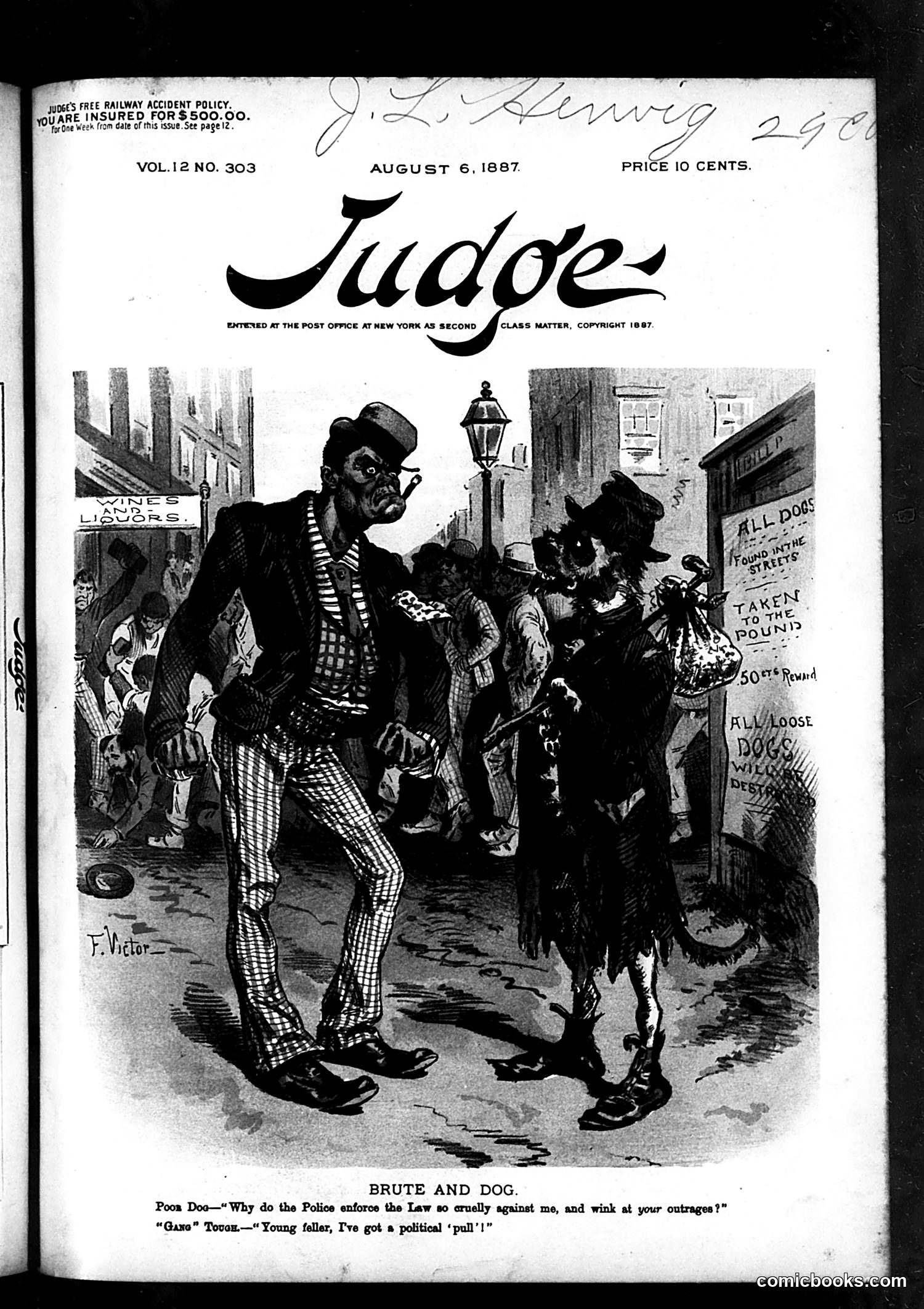
This political cartoon contrasts a brutish, caricatured figure with a dog on a city street. The exaggerated facial features and crude clothing suggest a stereotypical depiction of an Irish immigrant or working-class man. The caption reads: "Foor Doo—'Why do the Police enforce the Law so cruelly against me, and wink at your outrages?' / 'Gaze' Twogs—'Young feller, I've got a political 'pull'!'" The satire critiques selective law enforcement and political favoritism in 1880s urban America. The figure with "political pull" (connections) escapes justice while common people face harsh treatment. The dog-like comparison is dehumanizing, reflecting period prejudices. The cartoon appears to mock both class inequality and immigrant experiences with an unfair justice system.
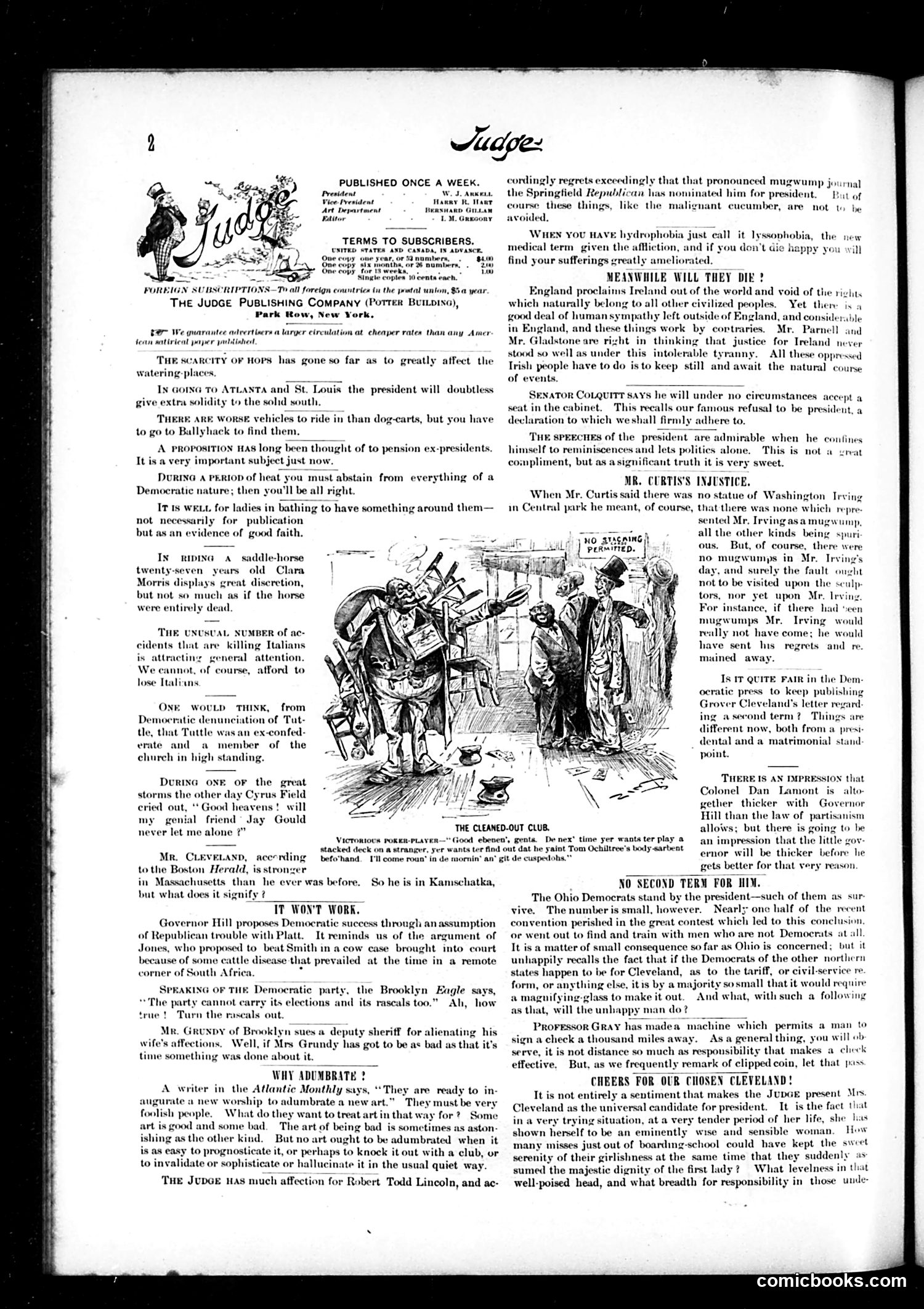
The main cartoon titled "THE CLEANED-OUT CLUB" depicts what appears to be a social or political club where members are being turned away or excluded. The caption references someone named "Tom O'Shaughnessy" being unable to find "old dat to paint," suggesting financial depletion or expulsion from membership. The text discusses various political topics including Democratic Party criticism, references to Cleveland (likely President Grover Cleveland), and commentary on partisan politics. One section titled "NO SECOND TERM FOR HIM" discusses Ohio Democrats' difficulties. Without clear identification of specific figures in the cartoon or precise dates, the satire appears to mock political or social exclusion and financial misfortune among club members, likely reflecting late 19th-century American political divisions. The overall tone is sharply critical of Democratic politics and leadership.
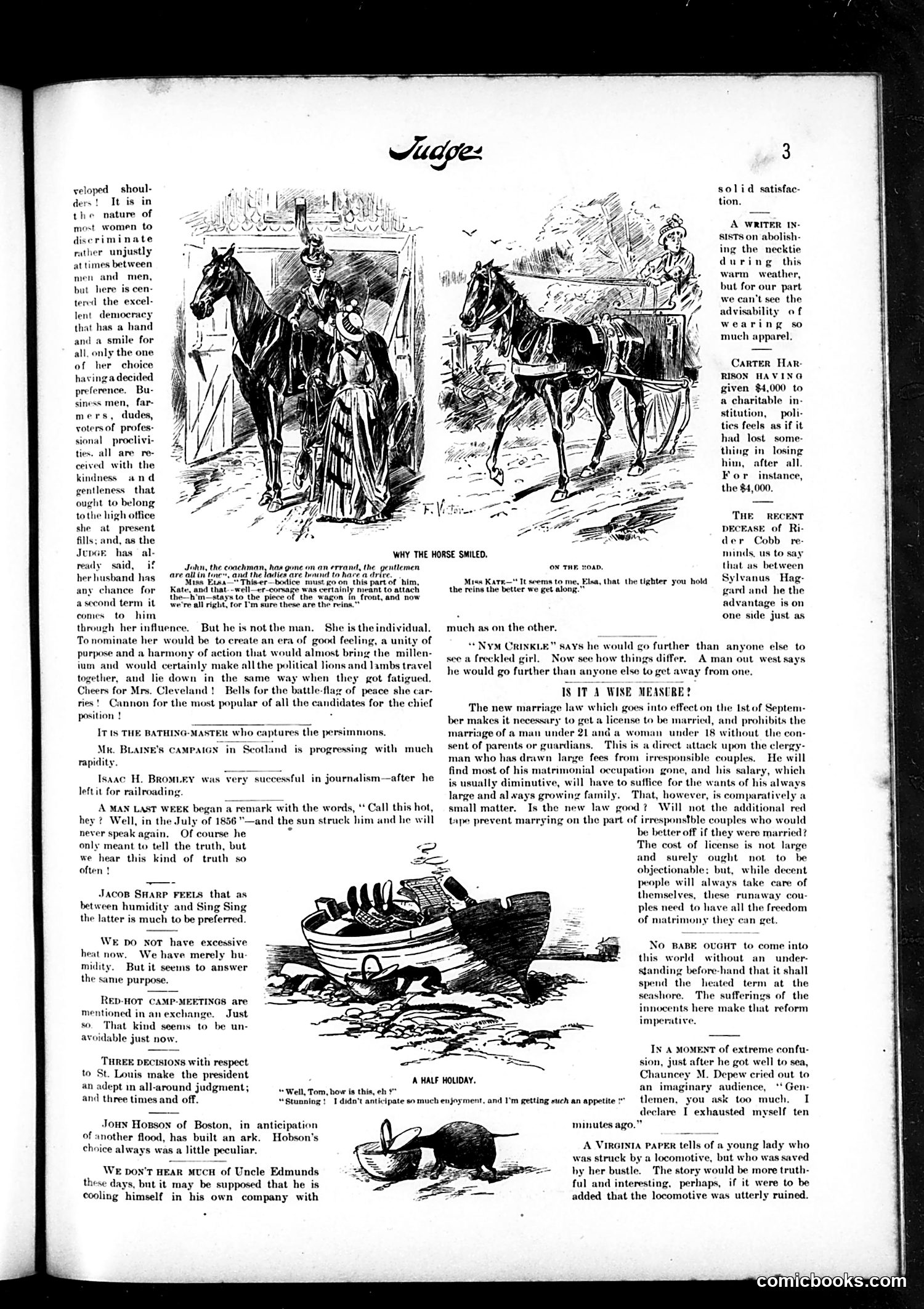
This page from Judge satirizes American social and political life circa the 1880s. The main cartoons depict: **"Why the Horse Smiled"**: Shows a coachman and gentlemen with ladies, illustrating a social scenario where a horse benefits from human leisure activities—likely satirizing how servants or animals profit from upper-class recreation. **"A Half Holiday"**: Features someone enjoying a break, commenting on leisure and appetite during warm weather. The accompanying text discusses various social topics: women's democratic influence in selecting preferred men (including business men, farmers, and professionals), the bathing master's success, and notably, a **new marriage law effective September 1st** requiring licenses and parental consent for couples under 21 (men) and 18 (women). The satire criticizes how this law undermines clergy who profited from hasty, irresponsible marriages. Other brief items mock politicians (presidential decisions about St. Louis), excessive heat complaints using an 1856 reference, and social customs like neckties in summer. The overall tone is light, gossipy social commentary typical of Judge's satirical approach.
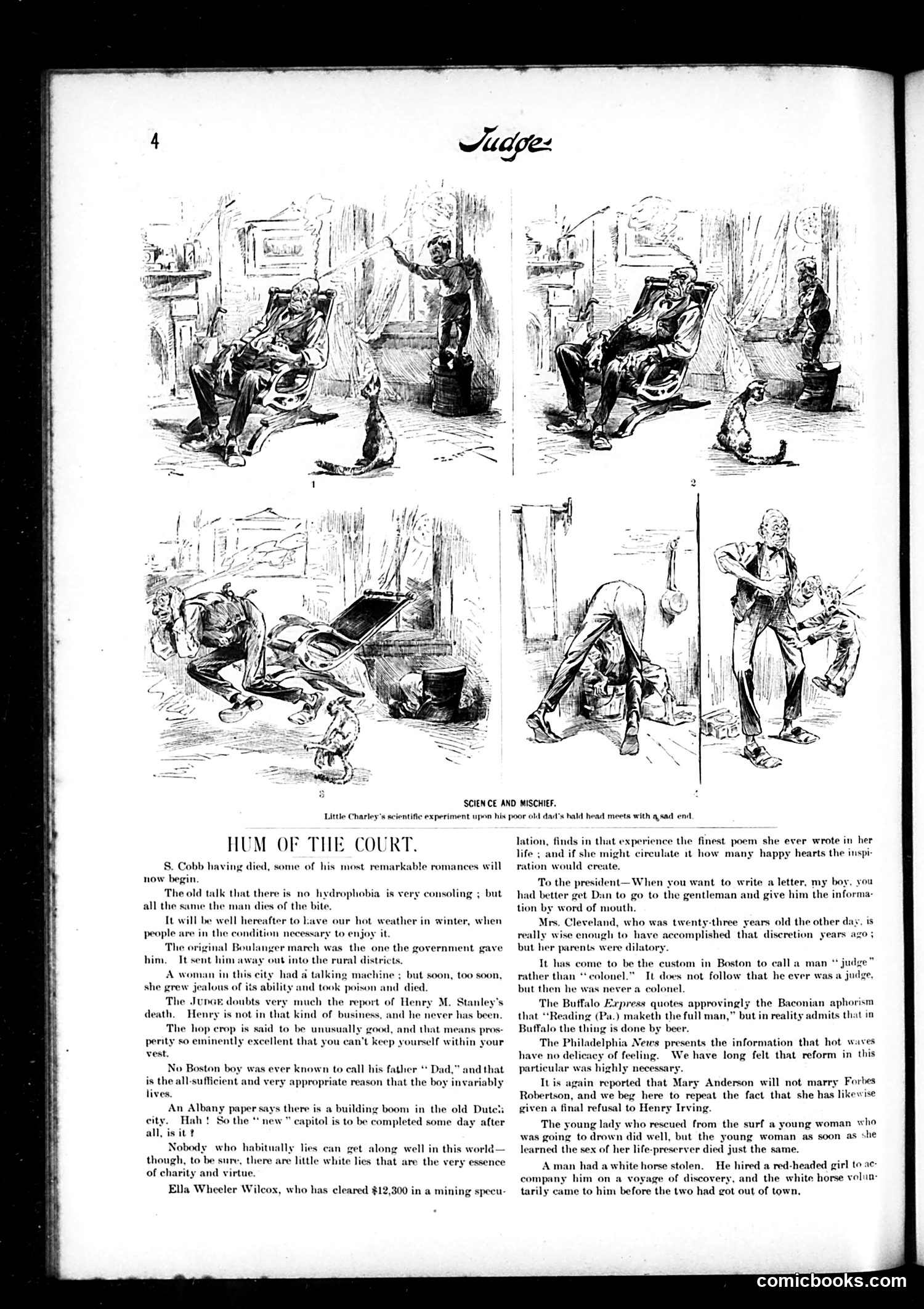
This page contains four cartoon panels labeled "Science and Mischief," depicting a child conducting an experiment on his bald father's head—likely involving some chemical or mechanical mishap that ends badly for the dad. The humor relies on slapstick domesticity and the contrast between childish "scientific" curiosity and its destructive consequences. Below are various brief gossip items and satirical commentary typical of Judge's "Hum of the Court" section. These target contemporary figures and absurdities: S. Cobb's romanticized death, bureaucratic incompetence (the Albany capitol delays), poet Ella Wheeler Wilcox's mining profits, Mrs. Cleveland's youth and discretion, actress Mary Anderson's repeated rejections of suitors (Forbes Robertson and Henry Irving), and a nonsensical anecdote about retrieving a stolen horse. The satire mocks pretension, false wisdom, hypocrisy, and the odd logic of modern life through deadpan commentary.
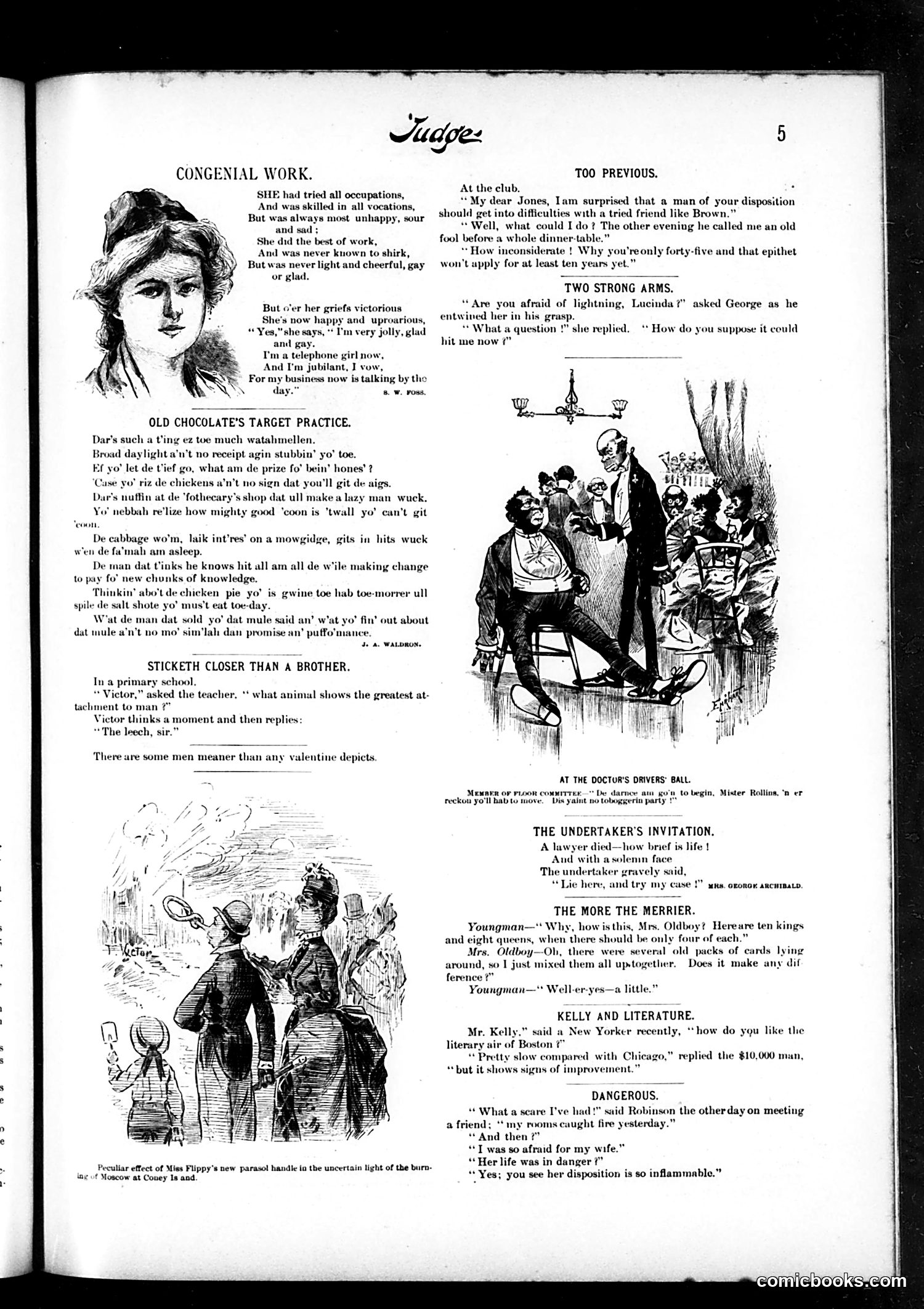
This page from *Judge* contains multiple short satirical pieces typical of the magazine's format: **"Congenial Work"** celebrates a perpetually unhappy woman who finally finds joy as a telephone operator—satirizing both her chronic discontent and perhaps the emerging telephone industry as an employer of women. **"Old Chocolate's Target Practice"** is a dialect piece using African American vernacular to humorously describe farm wisdom about chickens and mules—reflecting period stereotypes common in American humor. **"Sticketh Closer Than a Brother"** is a schoolroom joke where a boy answers that the leech shows greatest attachment to man, a simple pun on "clings." **"Too Previous"** satirizes social climbing—someone offended at being called "old" when he's only forty-five, implying the insult is premature. The remaining pieces are brief jokes about social situations (romantic encounters, card games, Boston's literary pretensions, and domestic fire hazards). The illustrations support these humorous anecdotes with period-appropriate sketches. Overall, the page reflects genteel Victorian-era comedy targeting middle and upper-class readers.
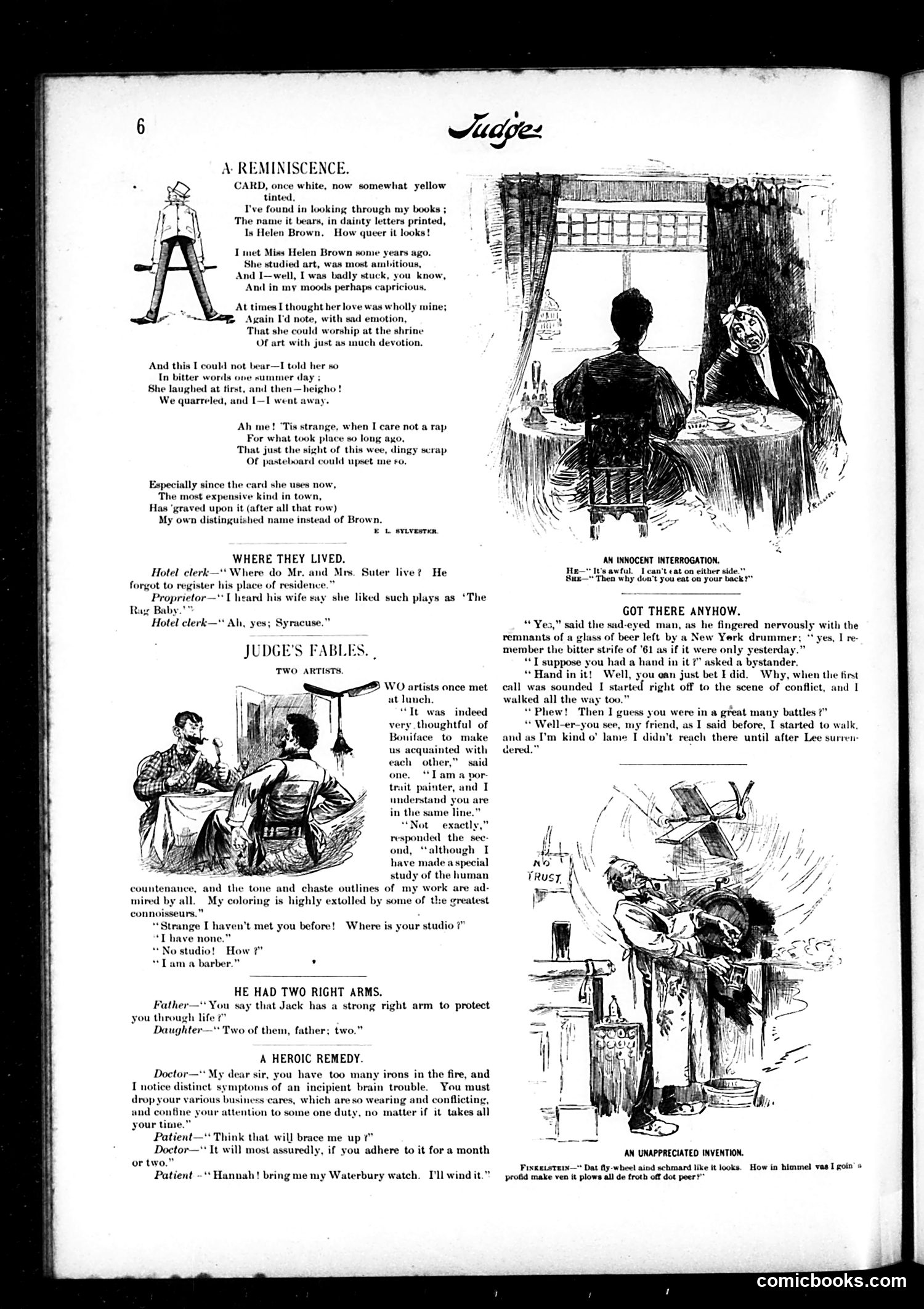
This page from Judge magazine contains several satirical pieces mocking human nature and social pretense: **"A Reminiscence"** — A man discovers an old business card from a woman (Helen Brown) he once loved. Though he's moved on and she's now married, he's irrationally upset seeing his own name printed on her card instead of hers, revealing how petty sentiment can be. **"Two Artists"** — Two men meet and one boasts extensively about his portrait painting, studio, and critical acclaim. The punchline: he's actually a barber, not a fine artist—satirizing pretentious claims to artistic respectability. **"Got There Anyhow"** — A Civil War veteran brags about fighting in many battles, but admits he walked to the front and didn't arrive until *after* Lee surrendered, exposing his false bravado. The other brief jokes mock marital dynamics, medical advice, and technological failure. Overall, the page satirizes vanity, self-deception, and people's tendency to exaggerate their importance or accomplishments.
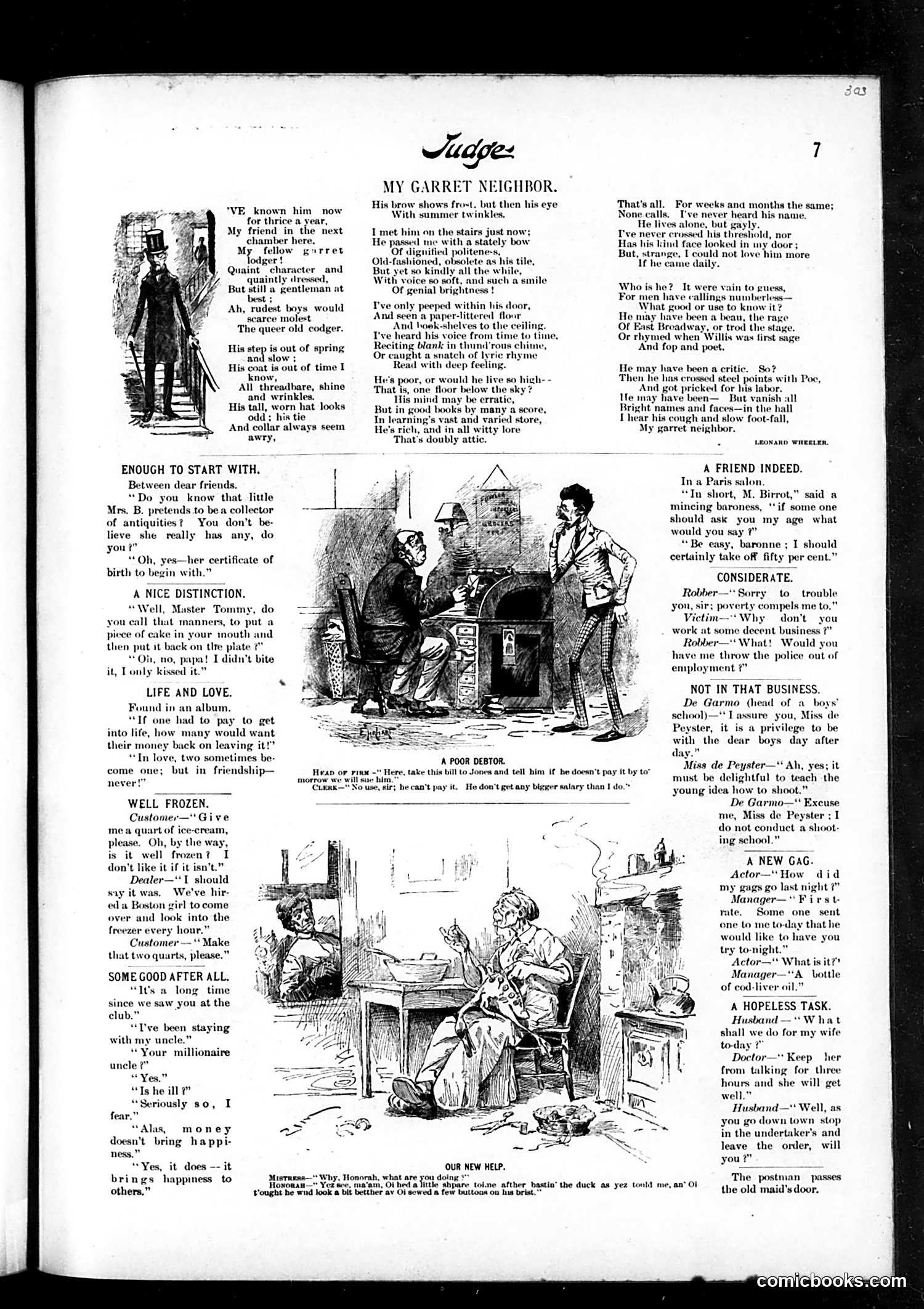
This page contains several satirical sketches typical of Judge magazine's humor. The main piece, "My Garret Neighbor," is a sentimental poem about a poor, elderly lodger—a shabby but dignified man living in poverty in a garret (attic apartment). The satire isn't cruel; rather, it romanticizes genteel poverty: a cultured, book-loving older gentleman fallen on hard times, whose dignity and kindness transcend his threadbare circumstances. The surrounding shorts mock contemporary social pretense: a woman claiming to collect antiquities (her only artifact being her birth certificate), a "millionaire uncle" whose illness somehow proves money brings happiness, and a Boston girl hired to check ice-cream freezers. The humor reflects Victorian-era attitudes about class, respectability, and the moral superiority of the cultured poor over the vulgar wealthy. Nothing here references specific current events—it's general social satire aimed at recognizable character types of the era.
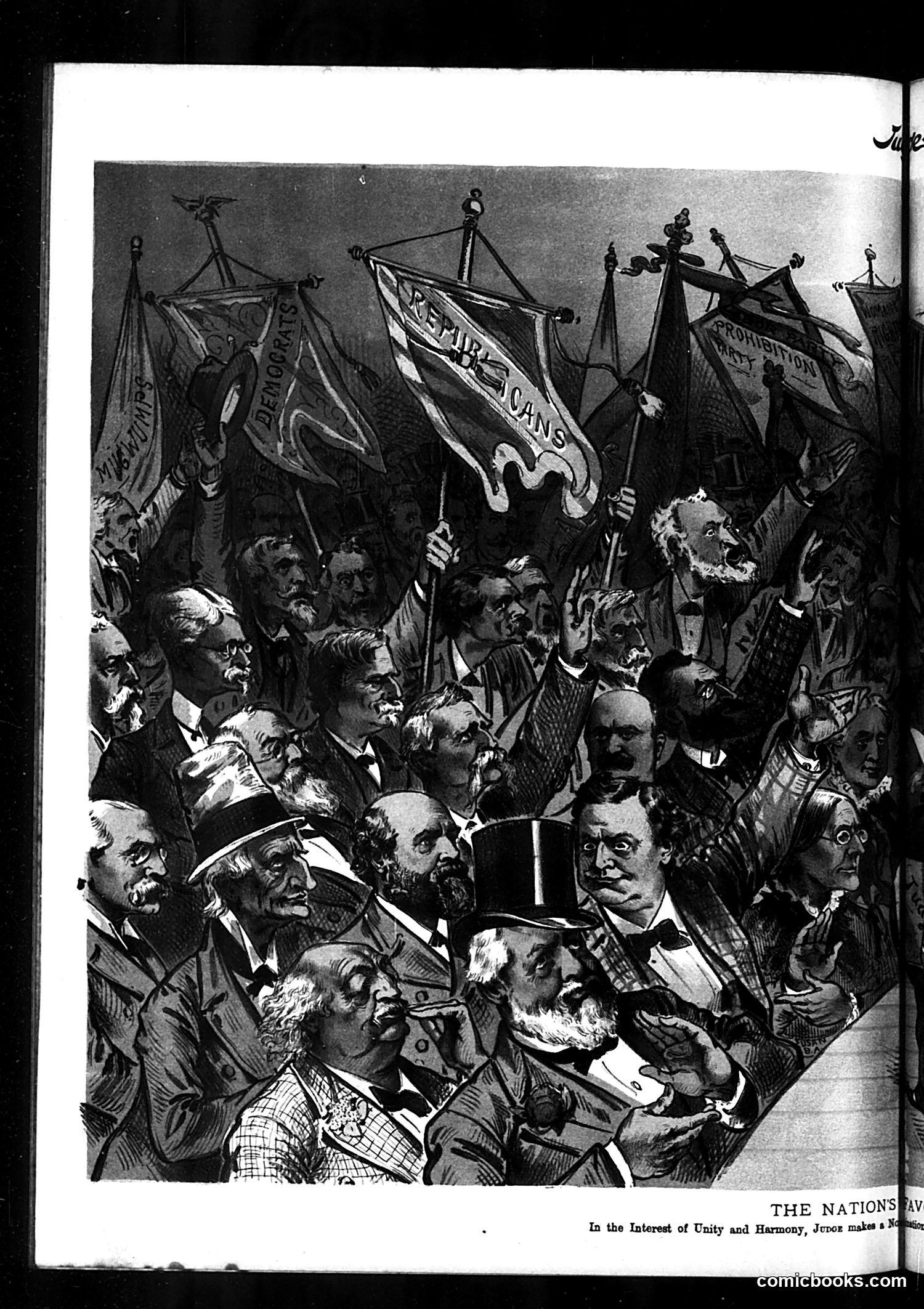
This appears to be a political cartoon titled "The Nations" depicting a large crowd of men in formal 19th-century attire holding various national flags and banners. The OCR text is largely illegible, but the caption references "Unity and Harmony" and mentions someone named "Joor" (possibly corrupted OCR). The image likely satirizes international diplomacy or peace negotiations of its era, showing diverse national representatives gathered together. The prominent flags suggest commentary on nationalism or international relations. Without clearer text or dating information from the Judge magazine, I cannot identify the specific historical event, the individuals caricatured, or the precise satirical point intended. The style and clothing suggest late 19th or early 20th century.
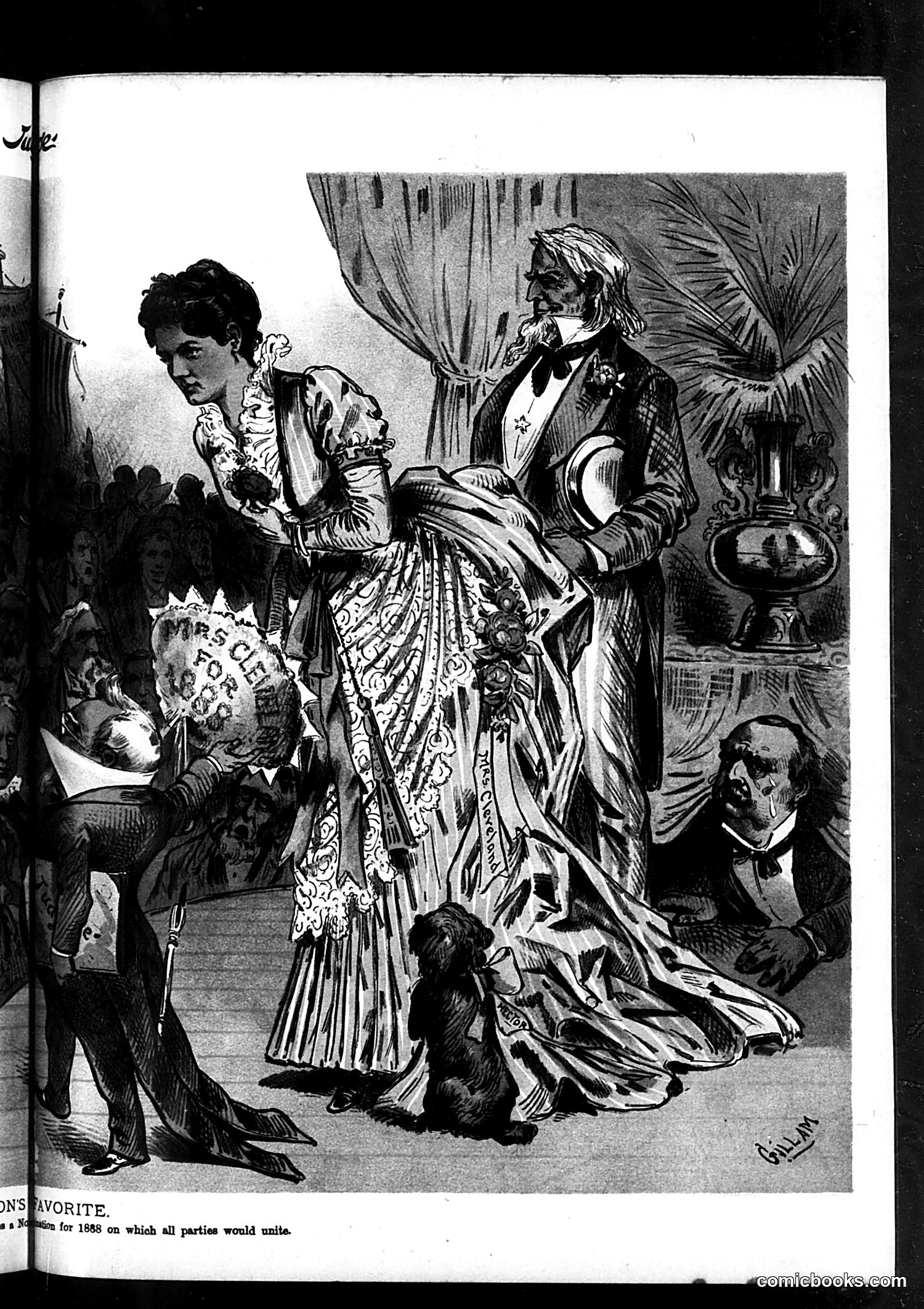
This appears to be a satirical illustration from *Judge* magazine titled "FAVORITE." The OCR text is largely illegible, but the image shows a well-dressed gentleman in formal attire presenting an elegantly gowned woman to an audience. The woman's elaborate dress and the man's formal presentation suggest this depicts a political or social "favorite"—likely a candidate or figure being promoted to the public. The crowd's varied reactions and the theatrical staging suggest satire about political endorsement or favoritism. The small dog at the woman's feet and the ornate interior setting emphasize the spectacle. Without clearer text or date visibility, the specific political figure or event remains unclear, but this appears to mock the pageantry surrounding political or social advancement circa the late 1800s.
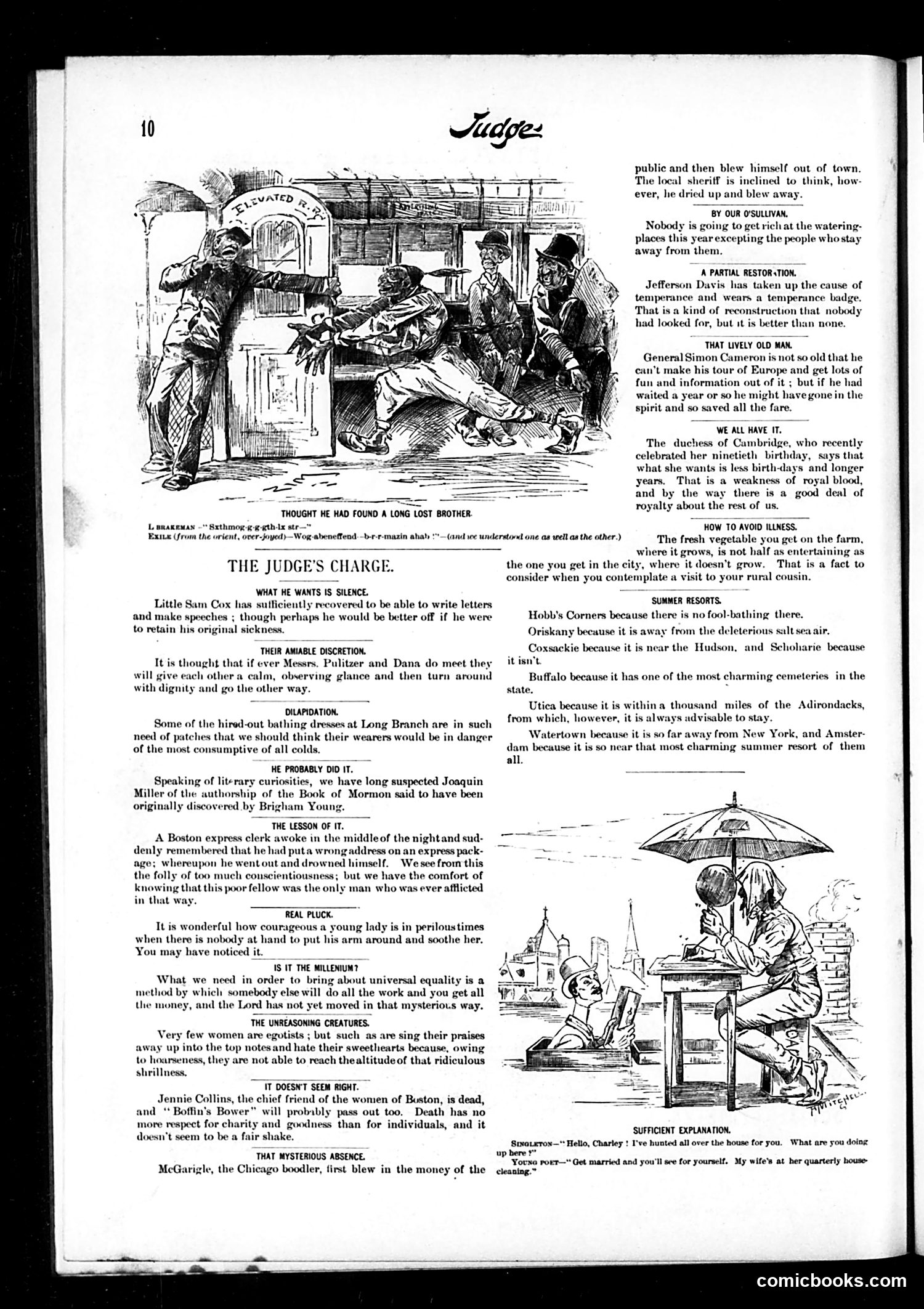
This page contains satirical commentary pieces rather than a single coherent cartoon. The main illustration shows what appears to be a social scene at an "Elevated R[ailroad]" station. The satire targets contemporary figures and issues: - **Jefferson Davis** (former Confederate president) is mocked for adopting temperance—a ironic "reconstruction" given the South's devastation - **General Simon Cameron** is joked about regarding a European tour - **Little Sam Cox** is referenced recovering from illness, with the joke being he'd be better off staying silent - **Pulitzer and Dana** (newspaper editors) are satirized as rivals who would coldly ignore each other - Social commentary targets bathing dress conditions at Long Branch (a resort), questionable literary attributions to Joaquin Miller, and the impracticality of excessive conscientiousness The cartoons mock romantic pretension, urban versus rural produce quality, and choice of summer resorts. The tone is genteel ridicule of Gilded Age society, politics, and human folly.
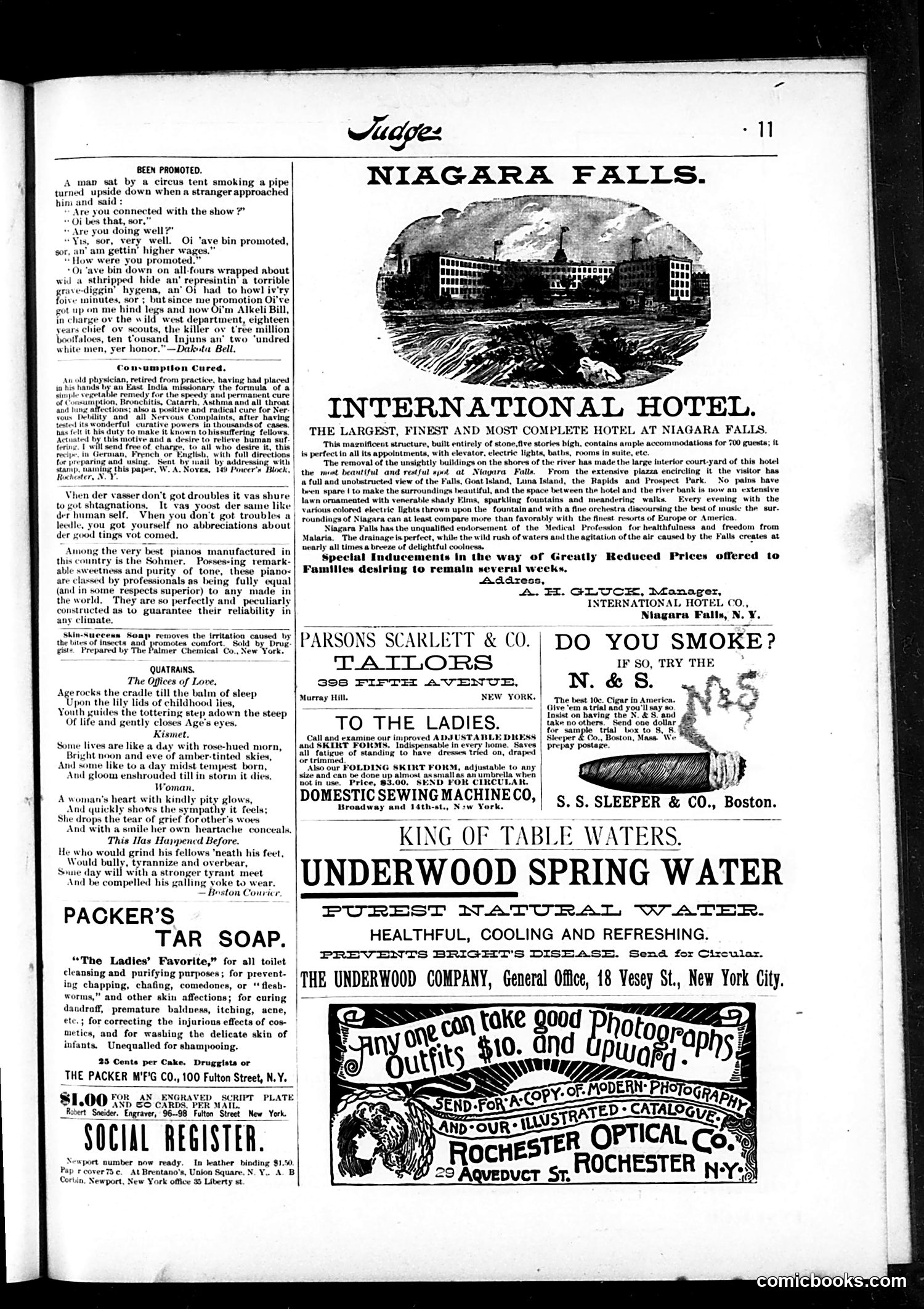
This page is primarily **advertisements and light humor** rather than political satire. The main content includes: **"Been Promoted"** — A brief comedic dialogue between a circus worker and a stranger. The worker, speaking in Irish dialect, describes his promotion from playing a "terrible hygena" (hyena) to becoming "Alkeli Bill" of the Wild West department—a joke about the absurdity of circus hierarchy and exaggerated job titles. The humor relies on the contrast between degrading animal roles and inflated Wild West personas. The remainder of the page consists of **commercial advertisements** for hotels (Niagara Falls International Hotel), soap, sewing machines, spring water, and photography equipment—typical of Judge's revenue model. There are also **sentimental poems** ("Quatrains") about love, life, and human nature. No identifiable political figures or events appear on this page. It's a standard magazine layout mixing modest entertainment with advertising.
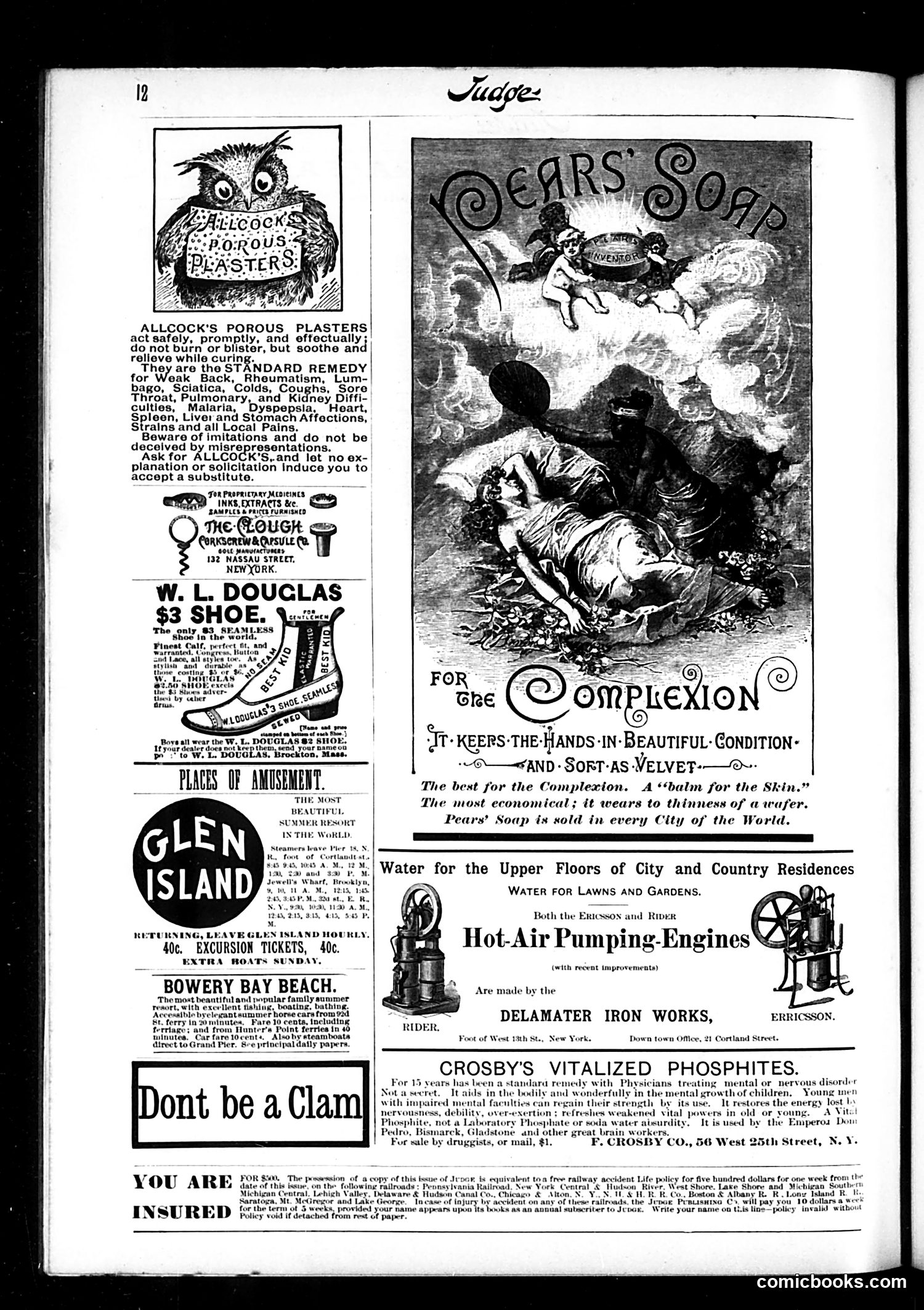
This page is **primarily advertising**, not satirical content. The main cartoon is a Pears' Soap advertisement featuring cherubs (putti) playing on a bar of soap, with the tagline "For the Complexion." The page contains numerous patent medicine and product ads typical of the era: Allcock's Porous Plasters (claimed remedies for rheumatism, kidney problems, etc.), W.L. Douglas shoes, Glen Island resort, and notably **Crosby's Vitalized Phosphites** — marketed as treating "mental or nervous disorder" and boosting mental growth in children and "weakened vital power" in adults. The single editorial feature, "Don't be a Clam," appears to reference insurance, though the text is partially obscured. **Context for modern readers:** These ads represent the pre-FDA era when patent medicines made extraordinary health claims without scientific evidence. The phosphite ad's targeting of children and mental conditions reflects 19th-century pseudoscience. The insurance notice suggests Judge offered subscriber protection — a common magazine practice.
This page is primarily a **business directory** of leading hotels across major American cities (New York, Boston, Philadelphia, Baltimore, etc.) along with a small "Business Index" section advertising various commercial services. There is **no visible cartoon or satirical content** on this page. It is a standard classified advertising section typical of *Judge* magazine, listing hotel names, proprietors, locations, and amenities (European Plan, American Plan, fire-proof construction, etc.). The Business Index at right advertises specialized services: Belcher Mosaic Glass Co., a bookseller named F.E. Grant, and A.C. Nellis Co. (seeds and plants). This appears to be an **advertising/reference page** rather than editorial content, making it unsuitable for satirical analysis. The page serves a purely commercial function—helping readers locate accommodations and services.
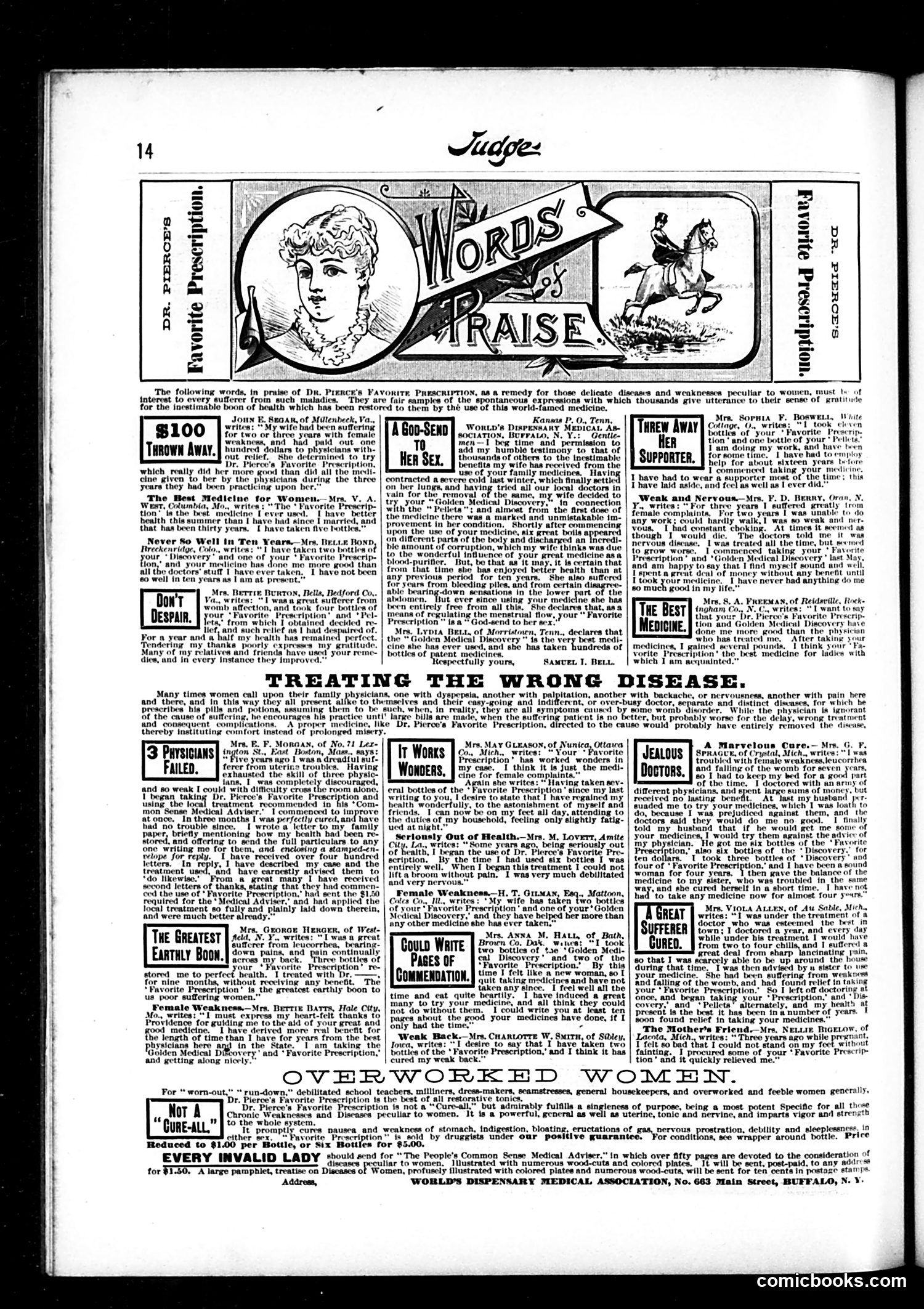
This page is primarily **patent medicine advertising**, not political satire. It promotes "Dr. Pierce's Favorite Prescription," a commercial remedy marketed to women for gynecological and general health complaints. The testimonials—framed as unsolicited letters from satisfied patients—describe vague ailments ("female weakness," "womb affection," "leucorrhea") and claim the medicine outperformed doctors' treatments. One woman reports spending $100 on physicians before finding relief through the product. **Context for modern readers:** This reflects the late 19th/early 20th-century patent medicine industry, when unregulated, often-fraudulent remedies were aggressively marketed directly to consumers (especially women) via testimonials and magazine advertising. The vague symptom descriptions and miraculous-sounding cures are hallmarks of this era's medical quackery. Such products typically contained alcohol, opiates, or other substances creating psychological or chemical dependency—explaining their perceived "effectiveness." This is exploitative marketing disguised as authentic consumer testimony, targeting vulnerable women with limited medical options.
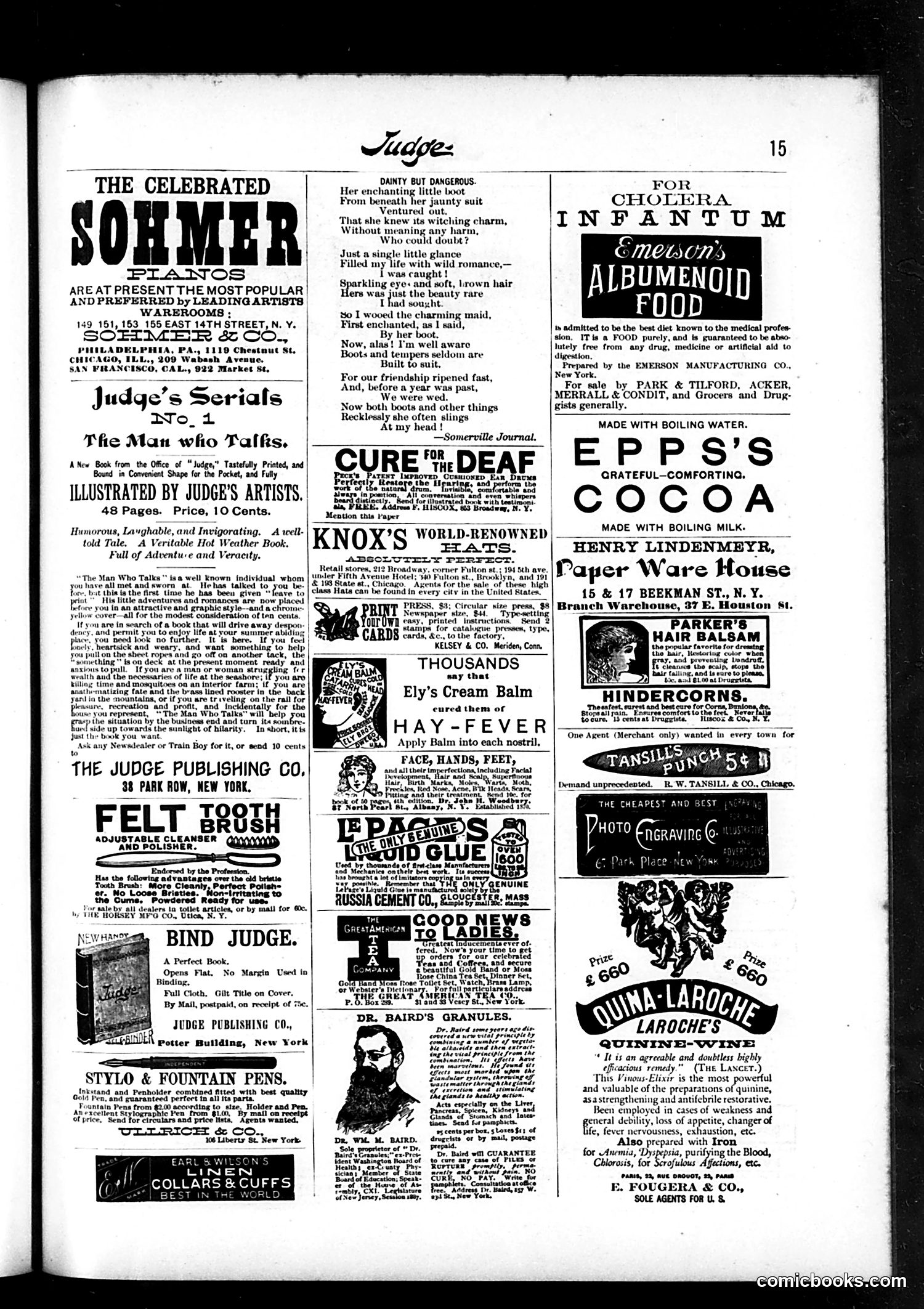
This page is **primarily advertisements** with one poem and minimal editorial content. The dominant feature is "Dainty but Dangerous," a humorous poem from the *Somerville Journal* about courtship and marriage. The poem's satire is straightforward domestic humor: a man becomes enchanted by a woman's attractive ankle (visible when she lifts her skirt—risqué for the era), pursues her, marries her, and discovers her "boots and temper" become weapons used against him. It's a conventional joke about how romantic attraction precedes marital discord, playing on Victorian anxieties about female independence and the "battle of the sexes." The surrounding advertisements hawk patent medicines (hay fever cure, granules for unspecified ailments), grooming products, books, and office supplies—typical of Judge's revenue model. The page reflects late-19th-century consumer culture and attitudes toward women's fashion as both alluring and dangerous.
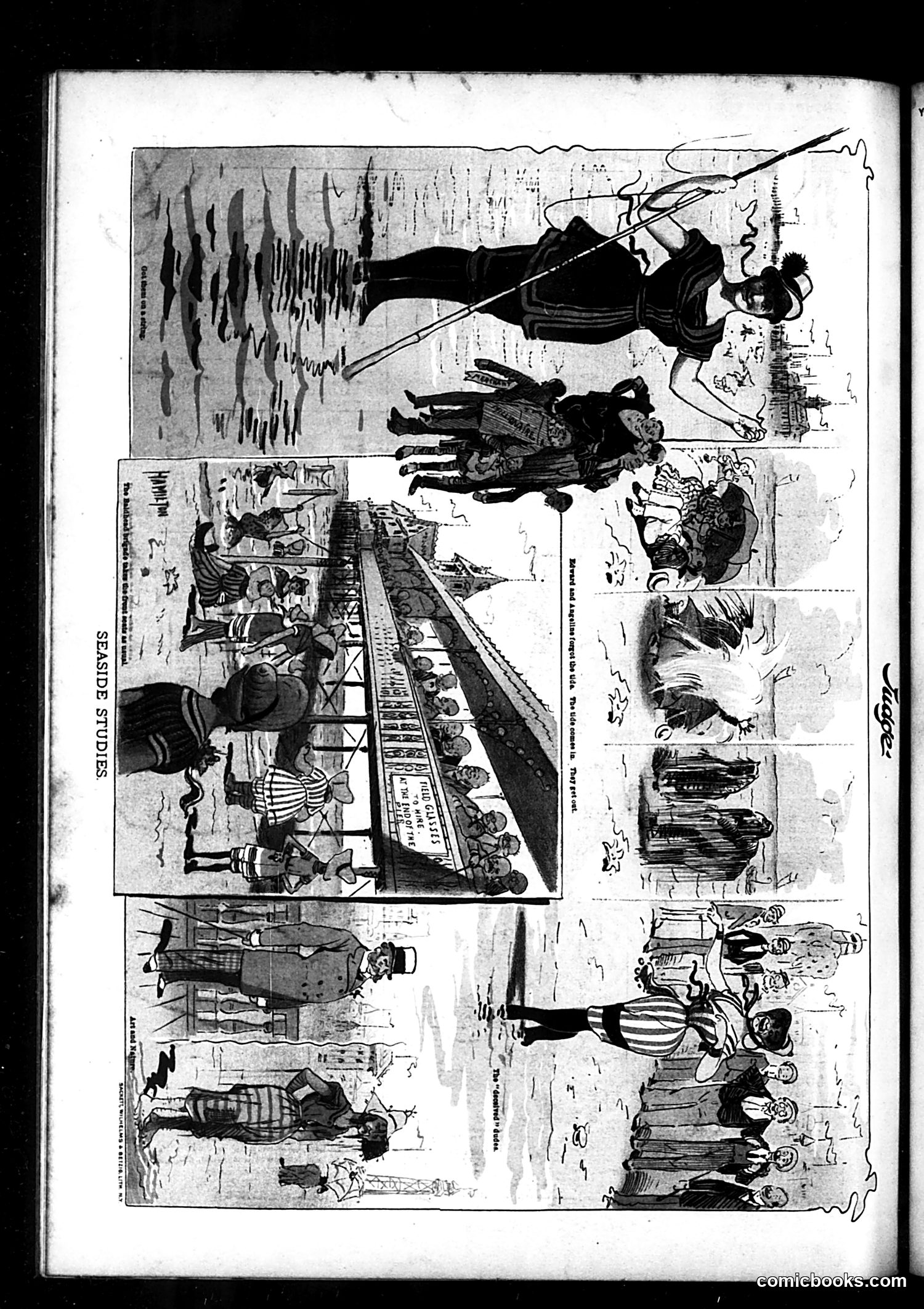
The OCR text is too corrupted to read clearly. However, examining the image itself: this Judge magazine page appears to contain multiple cartoon panels arranged vertically. The illustrations show various figures in late 19th or early 20th-century dress and settings, including what appears to be scenes at a train station or railway, indoor domestic scenes, and street settings. The left side includes text reading "SEASIDE STORIES." Without legible text identifying the specific figures, events, or satirical targets, I cannot reliably explain the political or social commentary intended. The cartoons likely reference contemporary events or social issues of their era, but I cannot specify what without clearer textual evidence.