
Judge, 1887-08-06 · page 3 of 16
Judge — August 6, 1887 — page 3: what you’re looking at
What you’re looking at
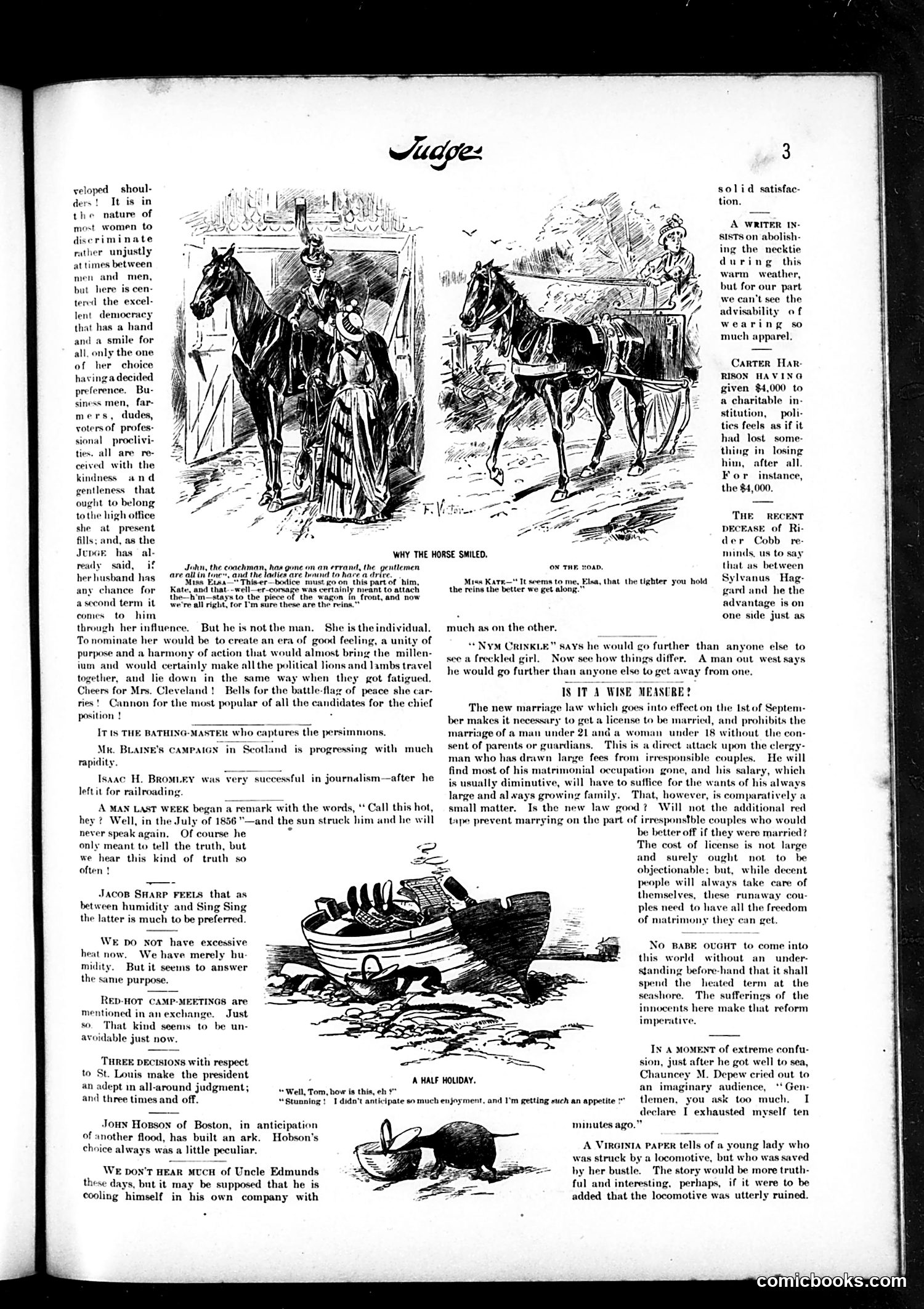
This page from Judge satirizes American social and political life circa the 1880s. The main cartoons depict: **"Why the Horse Smiled"**: Shows a coachman and gentlemen with ladies, illustrating a social scenario where a horse benefits from human leisure activities—likely satirizing how servants or animals profit from upper-class recreation. **"A Half Holiday"**: Features someone enjoying a break, commenting on leisure and appetite during warm weather. The accompanying text discusses various social topics: women's democratic influence in selecting preferred men (including business men, farmers, and professionals), the bathing master's success, and notably, a **new marriage law effective September 1st** requiring licenses and parental consent for couples under 21 (men) and 18 (women). The satire criticizes how this law undermines clergy who profited from hasty, irresponsible marriages. Other brief items mock politicians (presidential decisions about St. Louis), excessive heat complaints using an 1856 reference, and social customs like neckties in summer. The overall tone is light, gossipy social commentary typical of Judge's satirical approach.
📄 Transcribed text from this page (OCR, searchable)
Machine-transcribed from the original scan — historical spelling and the odd misread are preserved.
seloped shoul- ders! It is in the nature of most women to discriminate rather unjustly at times between men and_ men, but here is cen- tered the excel- lent democracy that has a hand and a smile for all, only the one of h choice havinga decided preference. Bu- siness men, far- mers, dudes, voters of profes- sional proclivi- te ceived with the kindness and gentleness that ought to belong tothe high office present id, as the has al- aid, if her husband has any chance for asecond term it comes to him through her influence. But he is not the man. She is the individual. To nominate her would be to create an era of good feeling, a unity of y of action that would almost bring the millen- ake all the political lions and lambs travel n the same way when they got fatigued. nd! Bells for the battl of peace she car- Cannon for the most popular of all the candidates for the chief position | fi IT Is THE BATHING-MASTER who captures the persimmons, Mr. Bua rapidity. Ju, the coachman, haa gone on an errant, the gentlemen ‘and the ladies are bind to hare a dice Thiser bodice must Ko \d that. -weller-cormage was cert —stays to the piece of the wag it, for I'm sure these are the r, and lie down Chee rs for Mrs. Cle ries ! '8 CAMPAIGN in Scotland is progressing with much Isaac H. BromLeY was very successful in journalism—after he left it for railroadin; A MAN LAST WEEK began a remark with the words, “Call this hot, hey ¢ Well, in the July of 1856 "—and the sun struck him and he will never speak again. Of course he only meant to tell the truth, but we hear this kind of truth so often ! (8 that as between humi and Sing Sing the latter is much to be preferred. WE Do NOT have excessive heat now, We have merely bu midity. But it seems to answer the same purpose. Rep-Hor P-MEETINGS are mentioned i nexchange. Just so. That kind seems to be un- avoidable just now. THREE DECISIONS with respect to St. Louis make the president an adept in all-around judgment; Z * Well, Tom, how is this, eh and three times and off. “Stunning ! Joux Hossoy of Boston, in anticipation of another flood, has built an ark. Hobson's choice always was a little peculiar. WE bDoy'T HEAR MUCH of Uncle Edmunds these days, but it may be supposed that he is cooling himself in his own company with ‘WHY THE HORSE SMILED. ‘A HALF HOLIDAY, T didn’t anticipate so much enjoyment, and I'm getting auch an appetite 3 solid satisfac- tion. A WRITER IN- SISTS on abolish- ing the necktie during. this warm weather, but for our part we can't see the advisability of wearing 80 much apparel. Carter Har- RISON HAVING given $4,000 to a charitable in- stitution, poli- feels as if it ad lost some: wg in losing him, after For _ inst the $4,000. de er Cobb re- minds, us to ox THE, noAD, that as between Misa Kare Elna, that the tighter you hold Sylvanus Hag- the reins the better we get along. gard and he the advantage is on one side just as much as on the other. “Ny CRINKLE” Says he would go further than anyone else to see a freckled girl. Now how things differ. A man out west says he would go further than an else to get away from one. IS IT A WISE MEASURE? The new marriage law which goes into effect on the Ist of Septem- ber makes it necessary to get a license to be married, and prohibits the marriage of a man under 21 and a woman under 18 without the con- sent of parents or guardians. This is a direct attack upon the clerg: man who has drawn large fees from irresponsible couples. He will find most of his matrimonial occupation gone, and his salary, which is usually diminutive, will have to suffice for the wants of his always large and always growing family. That, however, is comparati small matter. Is the new law good? Will not the additional red tape prevent marrying on the part of irresponstble couples who would be better off if they were married? The cost of license is not large and surely ought not to be objectionable: but, while decent people will always take care of selves, these runaway cou- ed to have all the freedom of matrimony they can get. No BABE OUGHT to come into this world without an under- standing before-hand that it shall spend the heated term at the seashore. The sufferings of the innocents here make that reform imperative. IN A MOMENT of extreme confu- sion, just after he got well to sea, Chauncey M. Depew cried out to an imaginary audience, tlemen, you ask too much. declare I exhausted myself ten minutes ago.” ‘A ViraINIA PAPER tells of a young lady who struck by a locomotive, but who was saved by her bustle. The story would be more truth- ful and interesting. perhaps, if it were to be added that the locomotive was utterly ruined.