
A complete issue · 16 pages · 1887
Judge — July 23, 1887
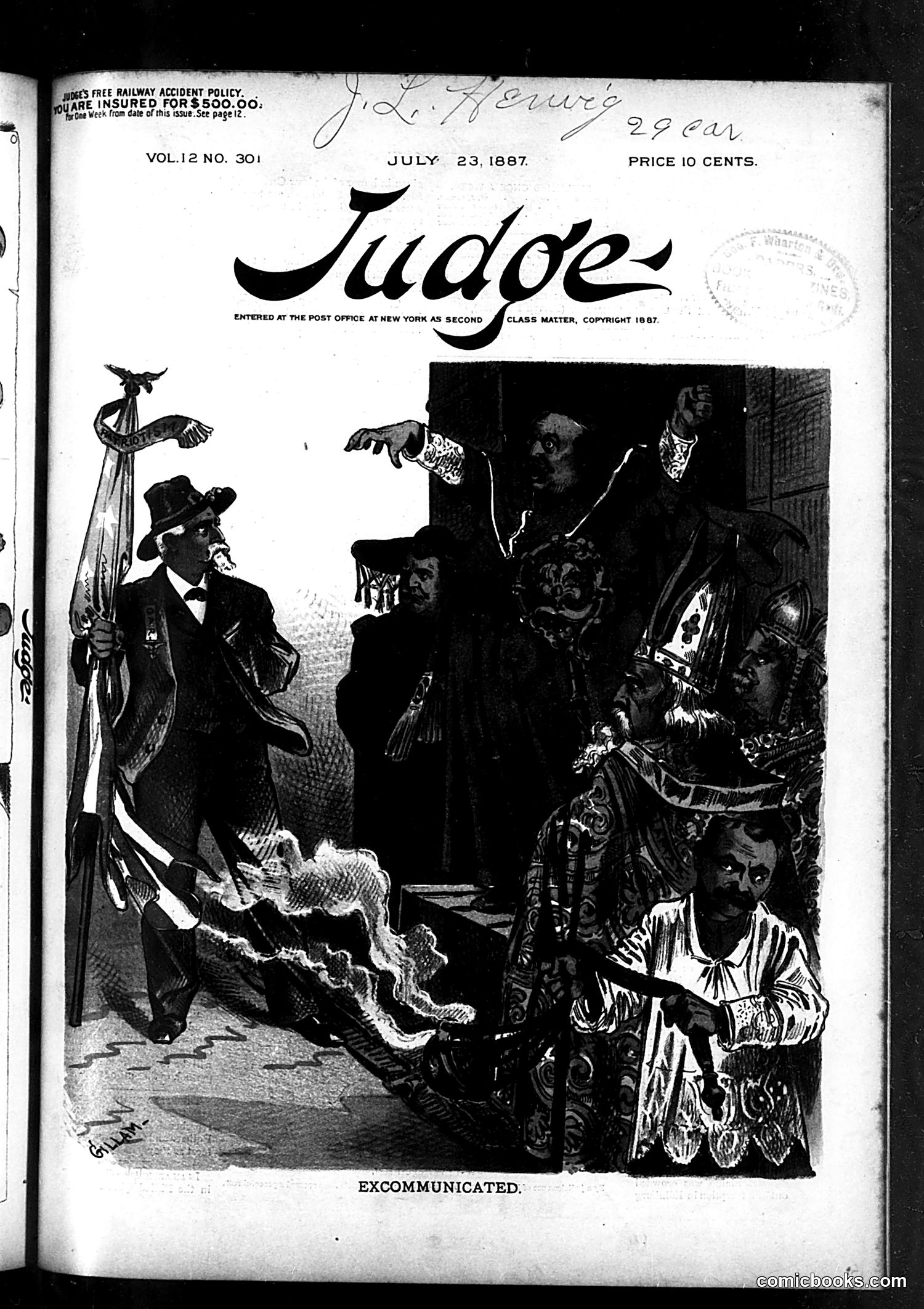
This political cartoon depicts a religious excommunication scene. A stern clergyman on the left, holding a ceremonial staff with ribbons, appears to be formally expelling or condemning a group of elaborately dressed figures on the right—likely representing either political opponents or members of a controversial movement. The cartoon's title, "Excommunicated," suggests this addresses a religious or institutional rejection. The figures being cast out wear ornate, almost theatrical clothing, possibly indicating they're foreign dignitaries, members of a despised political faction, or representatives of a movement Judge's editors opposed. Without clearer historical context from the July 1887 date, the specific political event or controversy remains unclear, though the image clearly employs religious imagery to mock expulsion or rejection of particular groups.
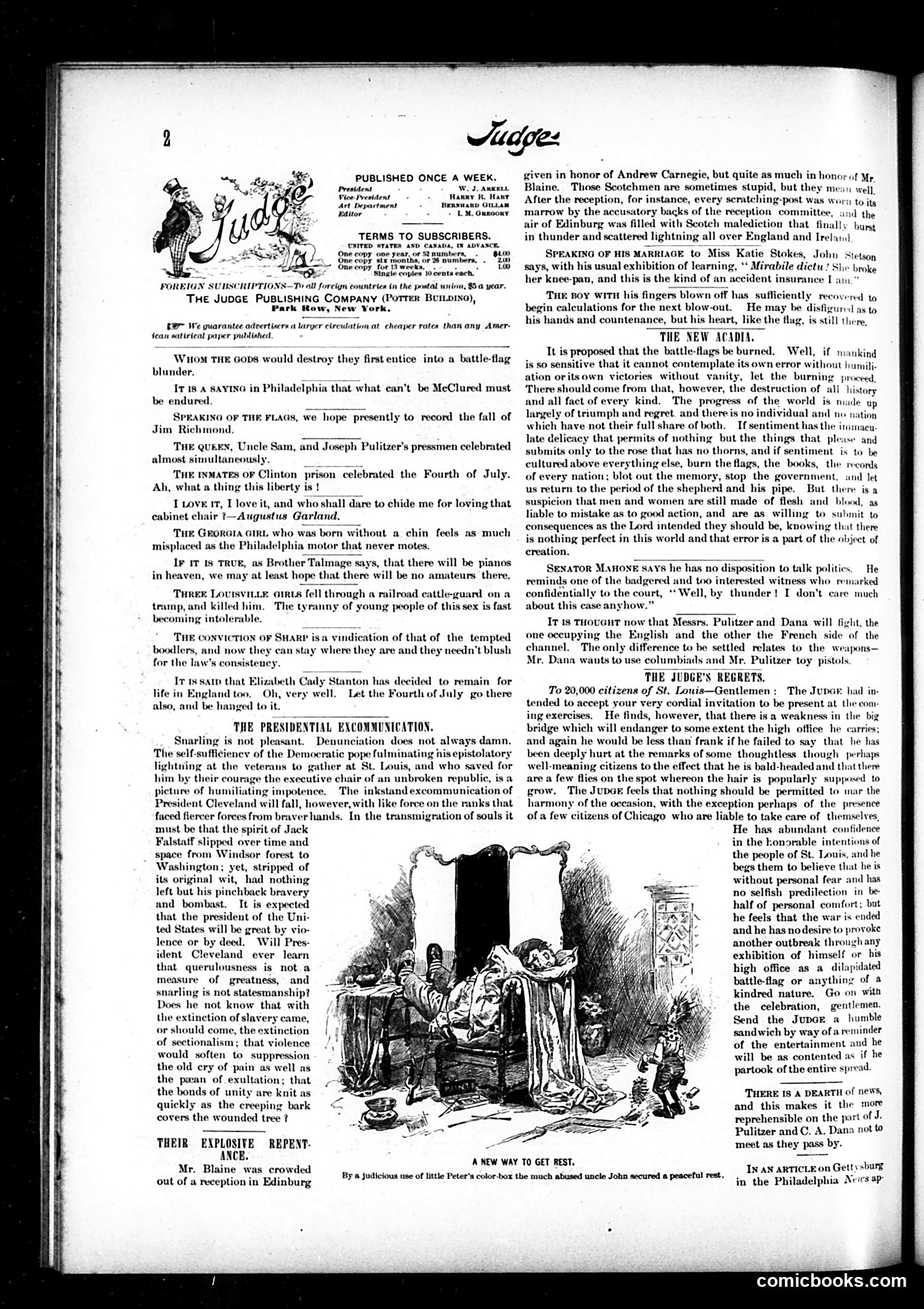
This page contains satirical commentary and a political cartoon titled "A New Way to Get Rest." The cartoon depicts a figure (likely representing a politician or public figure) sleeping peacefully in bed while labeled "uncle Sam" secured a peaceful rest through questionable means. The text discusses various political topics including references to Jim Richmond, Joseph Pulitzer, and presidential matters. One section critiques the "Presidential Enunciation," discussing President Cleveland's character and greatness. The cartoon's caption suggests satire about political corruption or inappropriate methods of gaining peace or advantage. Without clearer identification of specific figures or dating context visible on this page, the precise political targets remain somewhat unclear, though it appears to mock political hypocrisy or dubious political dealings of the era.
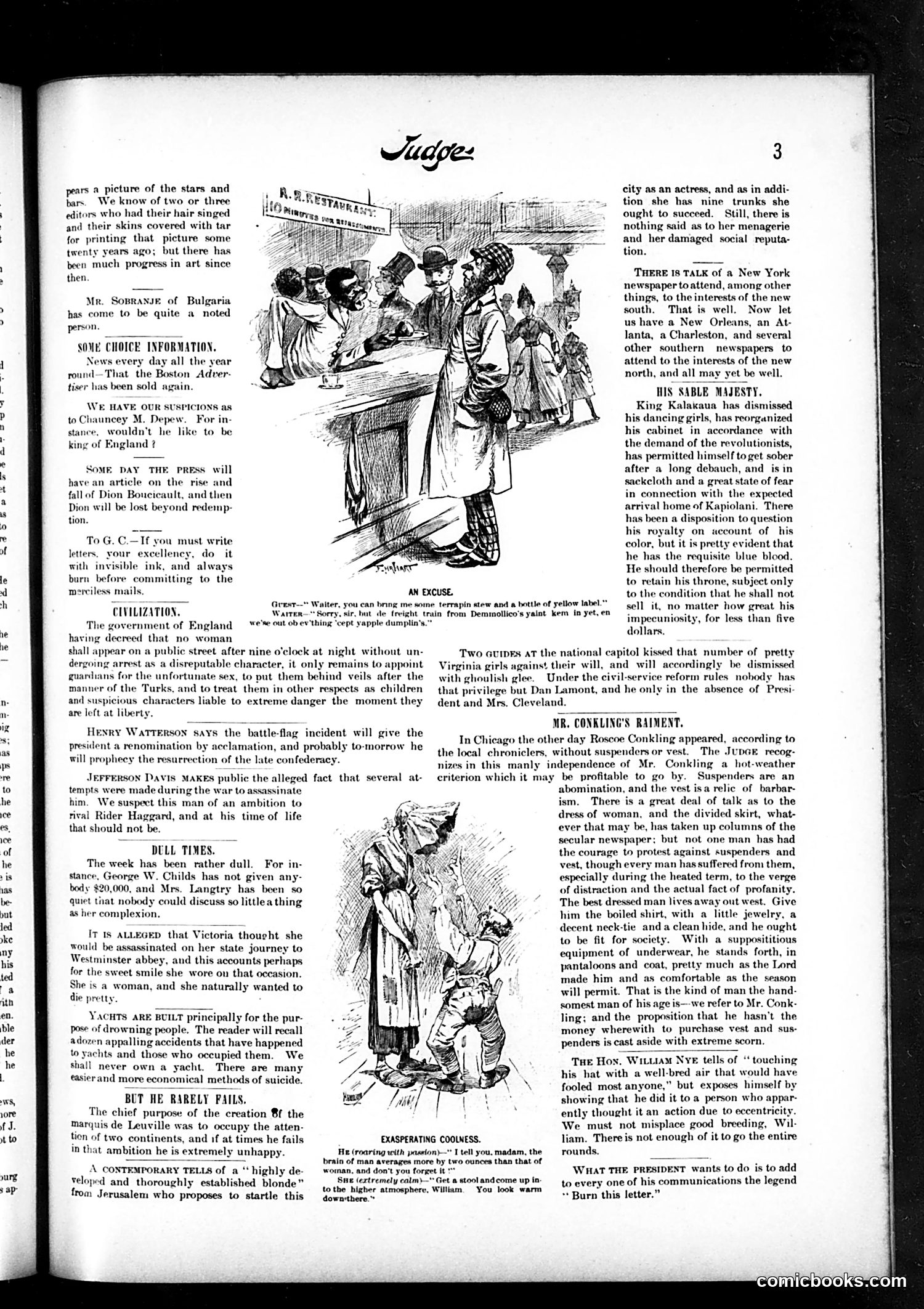
This page from Judge satirizes late 19th-century American politics and social issues through brief commentary and cartoons. **Key References:** - **"Battle-flag incident"**: Alludes to contemporary political disputes over Confederate symbols - **Chauncey M. Depew**: A Republican politician humorously speculated to have monarchical ambitions - **Jefferson Davis**: The former Confederate president's claims of assassination attempts are mocked as vanity-seeking - **King Kalakaua**: Hawaii's monarch, dismissed his cabinet—reflecting American imperial interests in Pacific expansion **Main Cartoons:** 1. **"An Excuse"**: Shows a waiter explaining a food shortage with characteristically elaborate excuses, satirizing servant incompetence 2. **"Exasperating Conduct"**: Depicts a domestic quarrel where a man lectures a woman about male brain superiority while she calmly suggests he needs "higher atmosphere"—mocking masculine pomposity The overall tone targets political figures, social pretension, gender dynamics, and colonial expansion, typical of Judge's satirical mission toward educated readers.
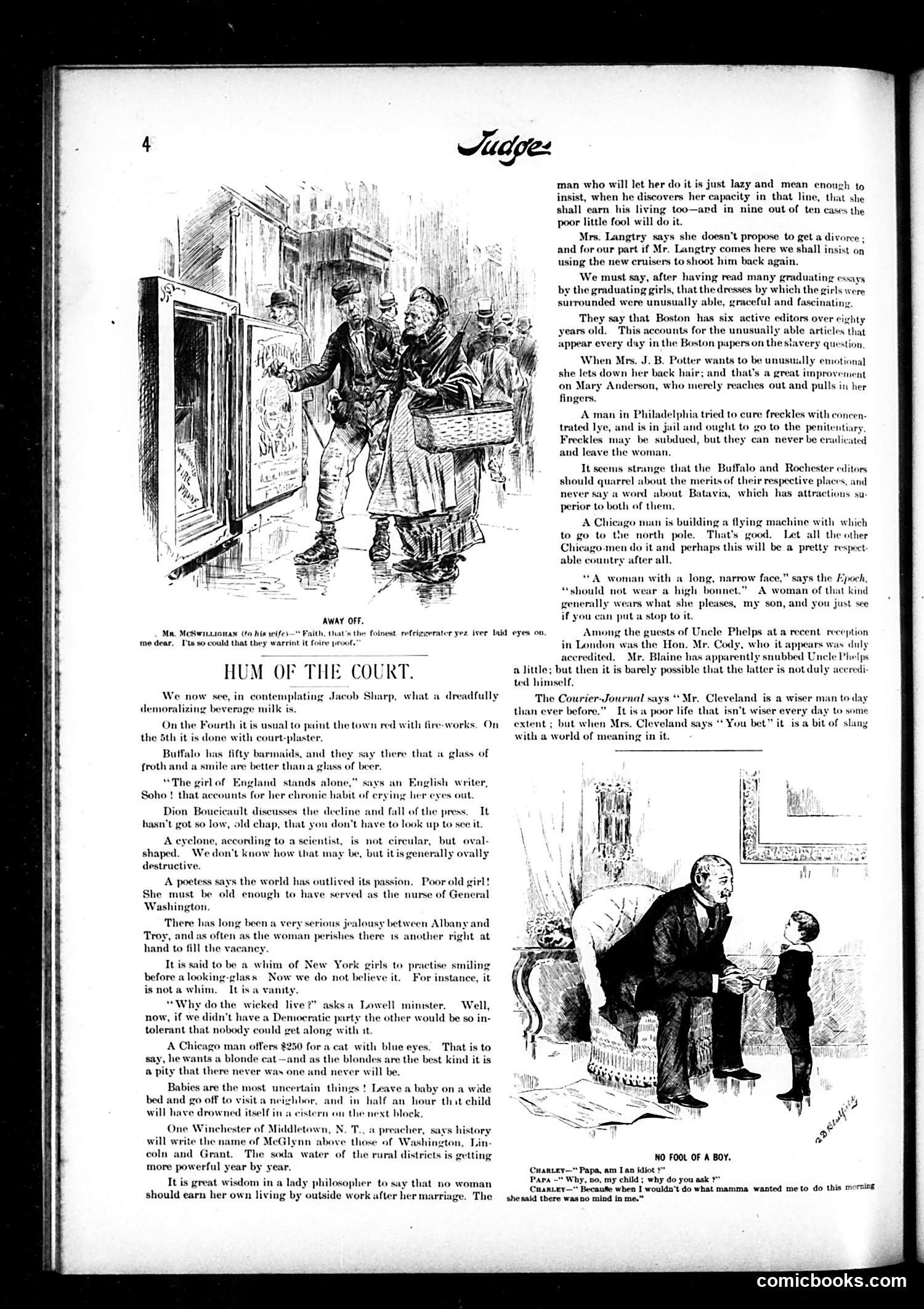
This page contains two cartoon vignettes satirizing American social customs and contemporary figures. **"Away Off"** (top): A husband and wife discuss a refrigerator, with the husband praising its quality. The satire appears to mock either excessive enthusiasm for new technology or Irish immigrant speech patterns (suggested by the dialect). **"Hum of the Court"** (bottom): References Jacob Sharp, a Gilded Age figure involved in notorious scandals. The "court" likely alludes to legal proceedings—possibly Sharp's corruption case—which Judge ridicules through the extended commentary about various social absurdities (Buffalo barmaids, New York girls, etc.). The surrounding text comprises satirical observations on contemporary life: women's fashion choices, American obsessions with technology, and social pretensions. References to "Mrs. Langtry" (a famous actress) and mentions of Boston editors suggest this is from the 1880s. The overall tone mocks American society's vanity, technological fads, and moral hypocrisy while commenting on specific public figures and scandals of the era.
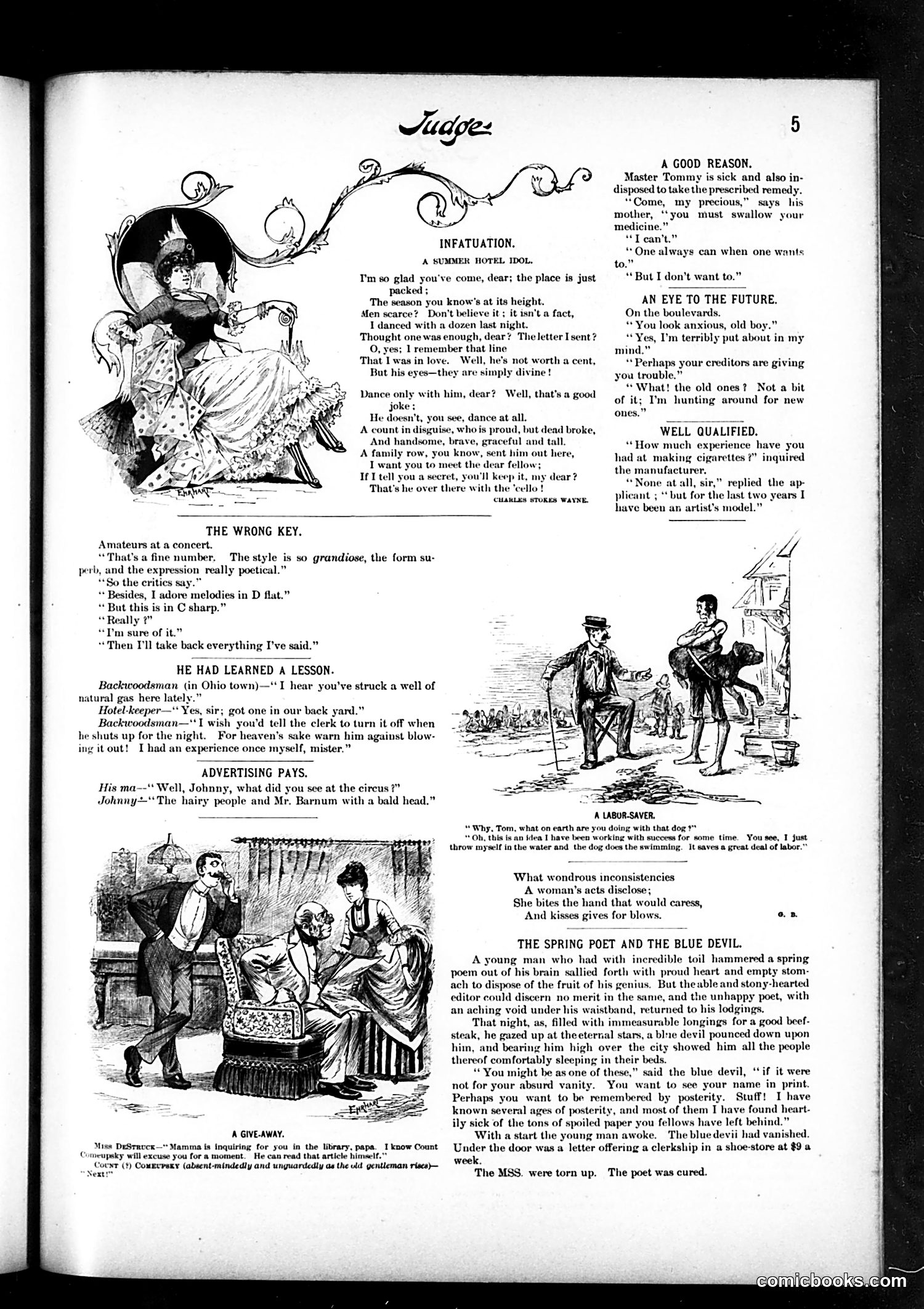
This page from Judge magazine contains several satirical vignettes mocking social pretensions and human foibles of the era. **"Infatuation"** ridicules a young woman at a summer resort who claims to dislike a man while obsessing over his physical appearance—satirizing romantic fickleness and shallow judgment. **"The Wrong Key"** jokes about amateur concert-goers confidently misidentifying musical pieces and making contradictory aesthetic pronouncements. **"He Had Learned a Lesson"** uses a backwoods character to humorously warn about natural gas hazards—likely referencing actual gas well dangers becoming common knowledge. **"An Eye to the Future"** depicts a man deliberately incurring new debts to avoid old creditors—mocking financial irresponsibility. **"A Labor-Saver"** sardonically presents using a swimming dog to avoid personal exertion. **"The Spring Poet and the Blue Devil"** allegorizes a struggling writer's rejection and despair, with the devil taunting him about vanity and wasted paper—critiquing both literary pretension and editorial indifference. The humor targets universal human weaknesses: vanity, inconsistency, and self-deception.
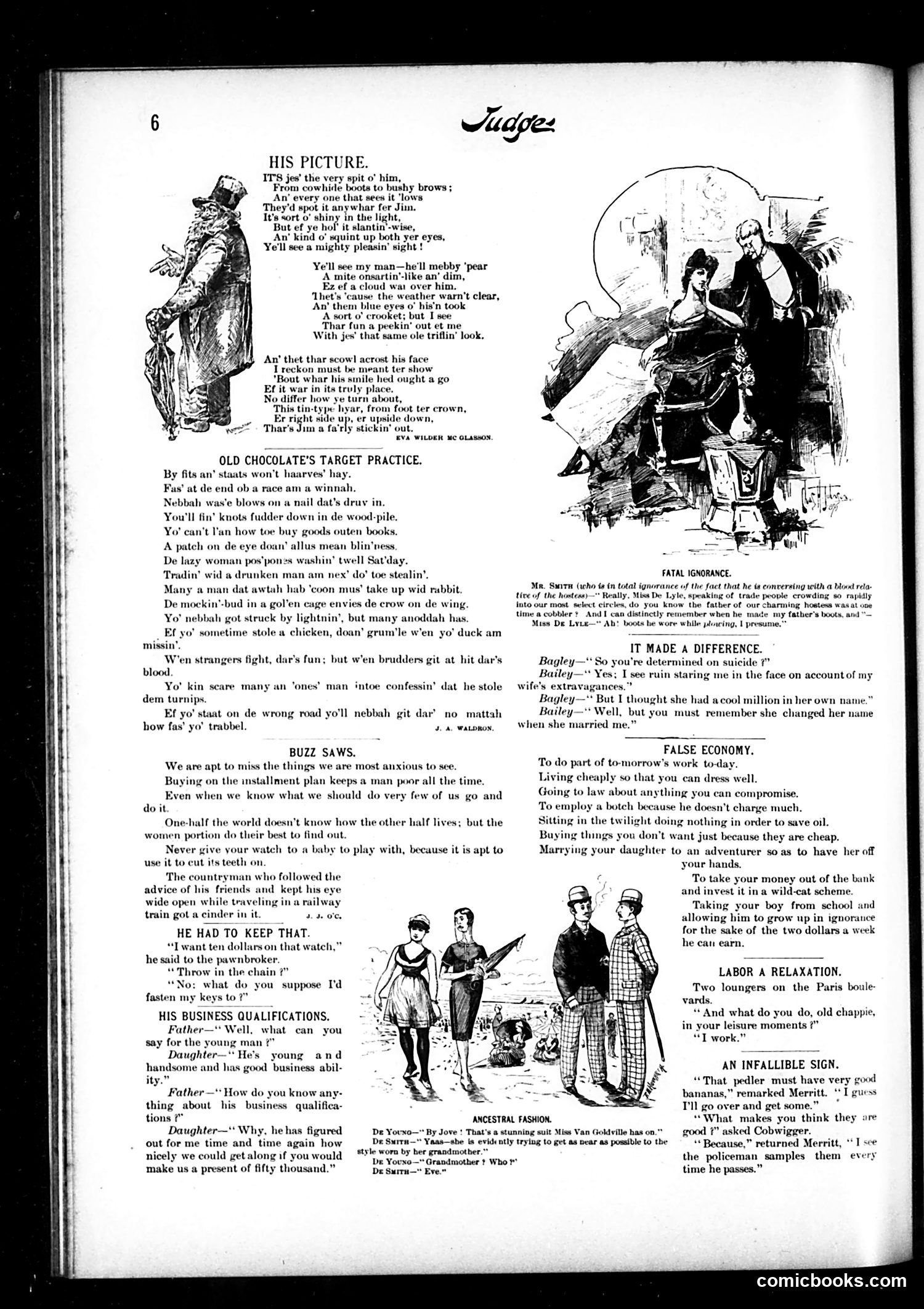
This page contains several short satirical pieces typical of late 19th/early 20th-century American humor: **"His Picture"** depicts a rural woman describing a photograph of her husband—likely a daguerreotype or early photograph. The joke rests on the technology's limitations: the image is unclear and distorted, yet she insists she recognizes his character in it anyway. **"Old Chocolate's Target Practice"** presents folk wisdom in dialect, seemingly mocking or parodying African American vernacular speech patterns common in period humor (and reflecting the era's casual racism). **"Buzz Saws"** offers brief cynical observations about human nature and financial foolishness—typical satirical commentary on contemporary life. The smaller jokes ("He Had to Keep That," "His Business Qualifications," etc.) are standard domestic humor about marriage, money, and social pretension that satirizes middle and upper-class concerns about status and financial strain.
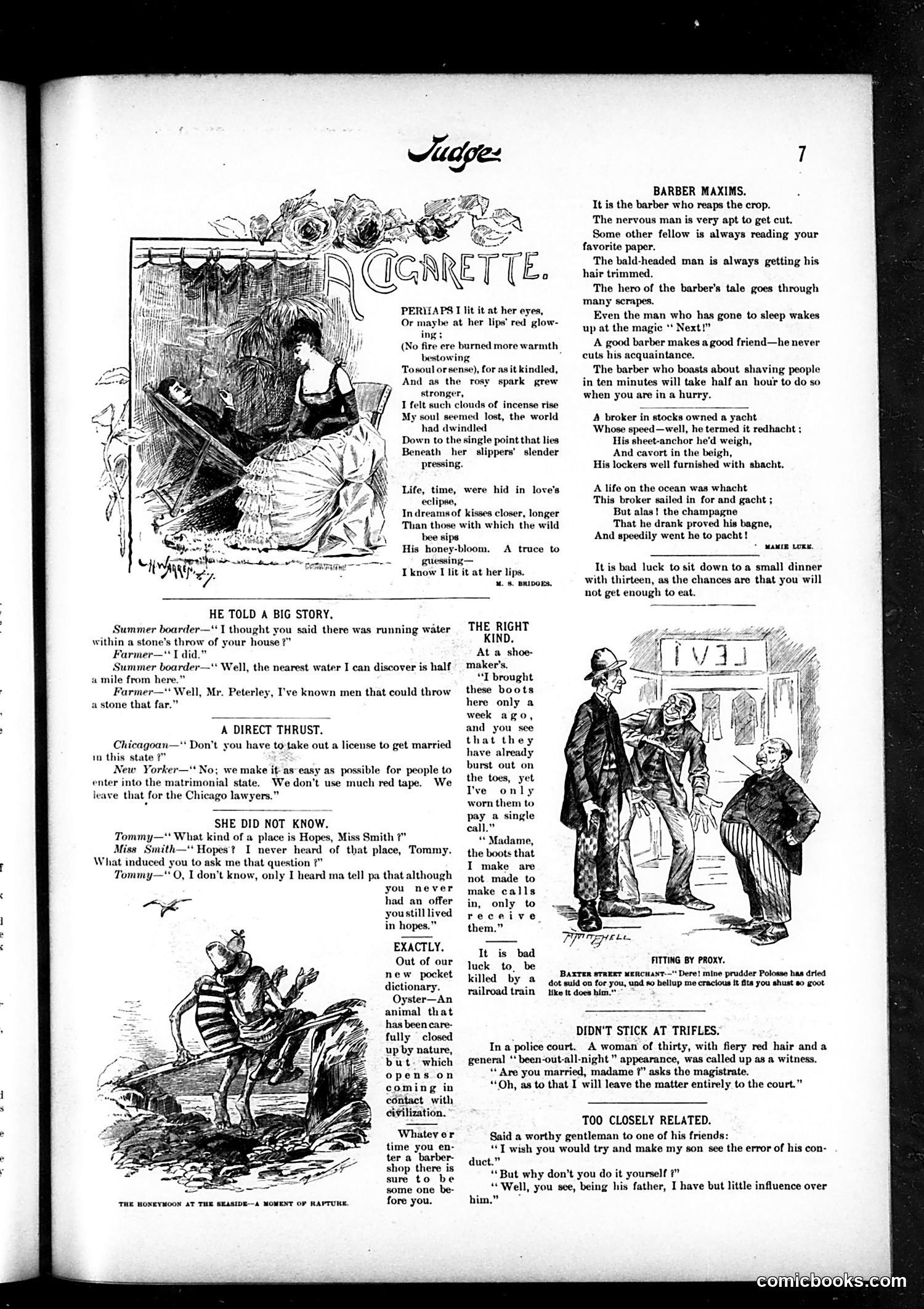
This page contains miscellaneous humor and light satire typical of Judge magazine's format. **Main content includes:** - **"A Cigarette"** — A romantic poem with illustration about lighting a cigarette from a woman's eyes/lips, exemplifying sentimental Victorian verse. - **"Barber Maxims"** — Humorous observations about barbershop culture (nervous customers getting cut, bald men frequent trims, barbers exaggerating speed). - **Social comedy sketches** addressing contemporary issues: - Summer boarder misunderstanding about "stone's throw" distance - Chicago vs. New York attitudes toward marriage licensing (New York portrayed as more permissive) - A woman in court refusing to definitively state marital status - Ethnic humor involving a "Baxter Street Merchant" (immigrant dialect) - **"Oyster" dictionary entry** — Absurdist wordplay **Overall tone:** Light domestic and social satire without sharp political edge. The humor relies on misunderstandings, exaggeration, and period-specific social customs. Regional stereotypes (Chicago lawyers, New York permissiveness) and immigrant dialect humor reflect era-typical attitudes.
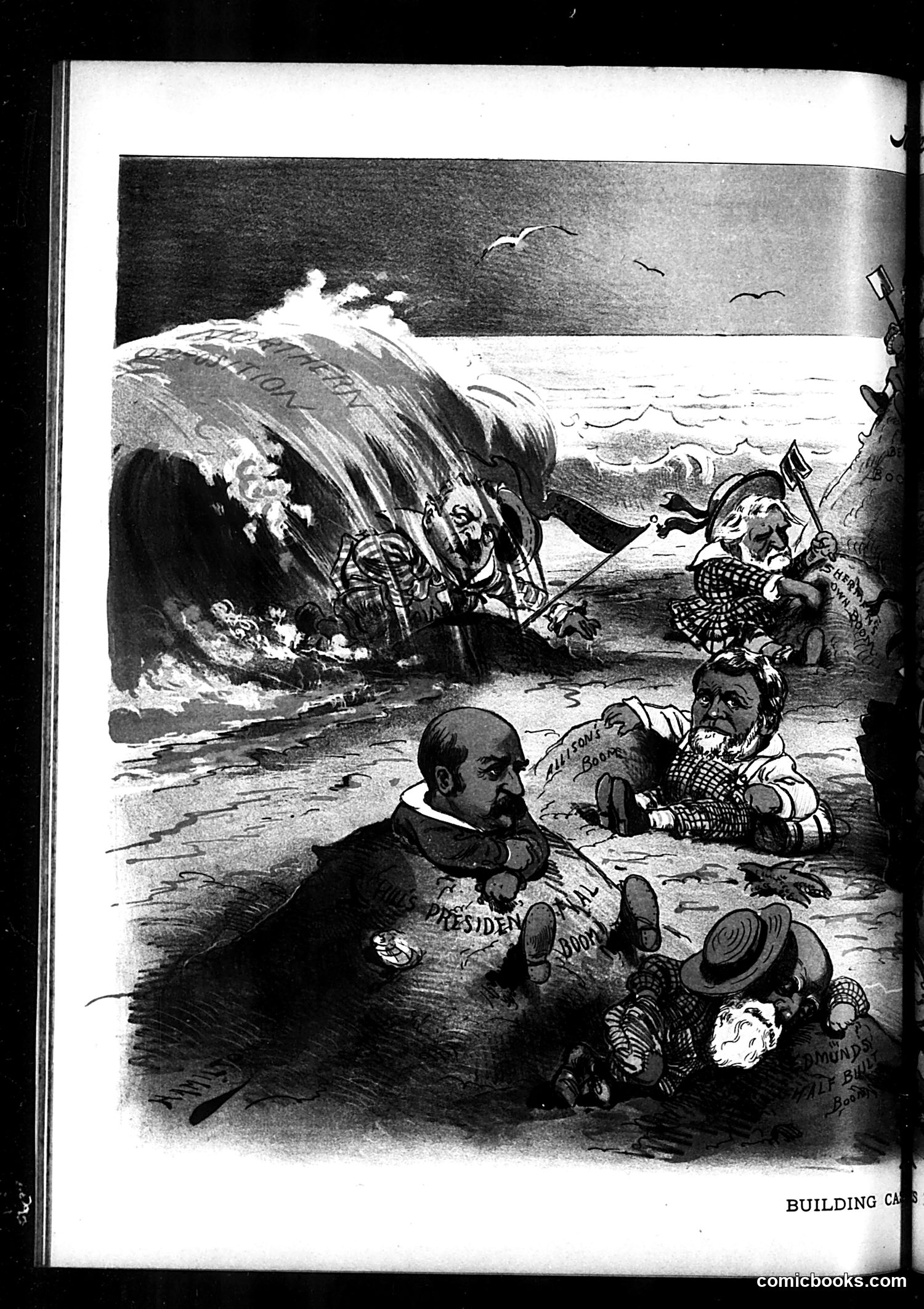
This appears to be a satirical Judge magazine cartoon titled "Building Castles" (visible at bottom). The image depicts a bearded man in formal dress (likely a political figure, possibly labeled "President") sitting on a beach surrounded by toy-like figures and building materials, apparently constructing sand castles. The satire likely mocks the figure's political ambitions or policies as insubstantial and ephemeral—mere "castles in the sand" that will wash away. The childish scale and toy figures suggest the absurdity or futility of the depicted plans or schemes. Without clearer date or text identification, I cannot specify which president or exact political moment this references, though the style suggests late 19th or early 20th century American politics.
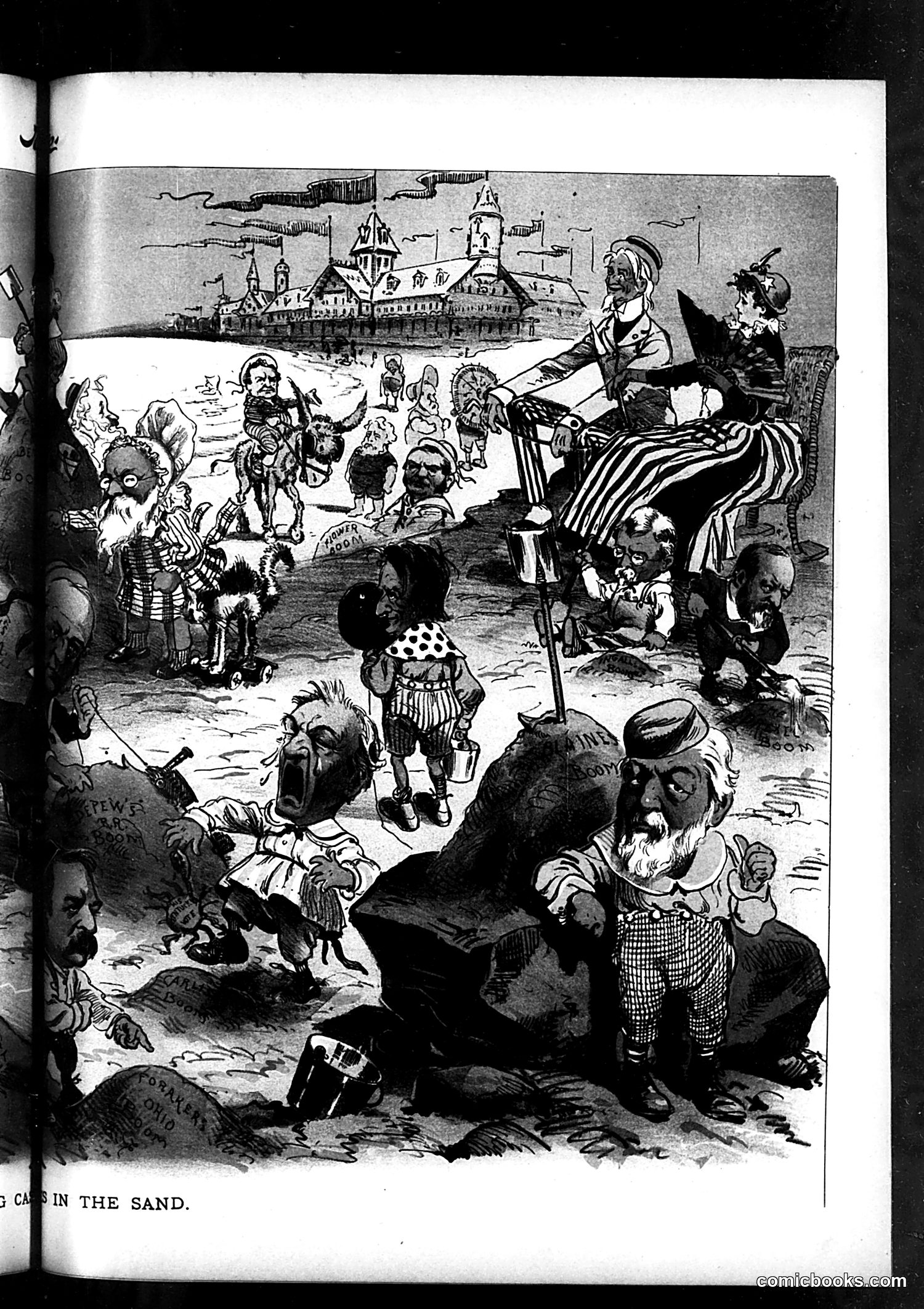
This appears to be a satirical cartoon titled "Castles in the Sand," depicting figures engaged in what looks like political or social maneuvering on a beach. The scene shows caricatured characters—some appear to be politicians or public figures based on their dress and exaggerated features—interacting near a grand building in the background. The "castles in the sand" metaphor suggests the cartoon criticizes impermanent, insubstantial political schemes or promises—structures easily washed away. The beach setting reinforces this idea of instability. Without clearer identification of specific figures or visible dates, the exact political controversy remains unclear, but the satire targets what Judge's editors viewed as hollow political posturing or failed governance.
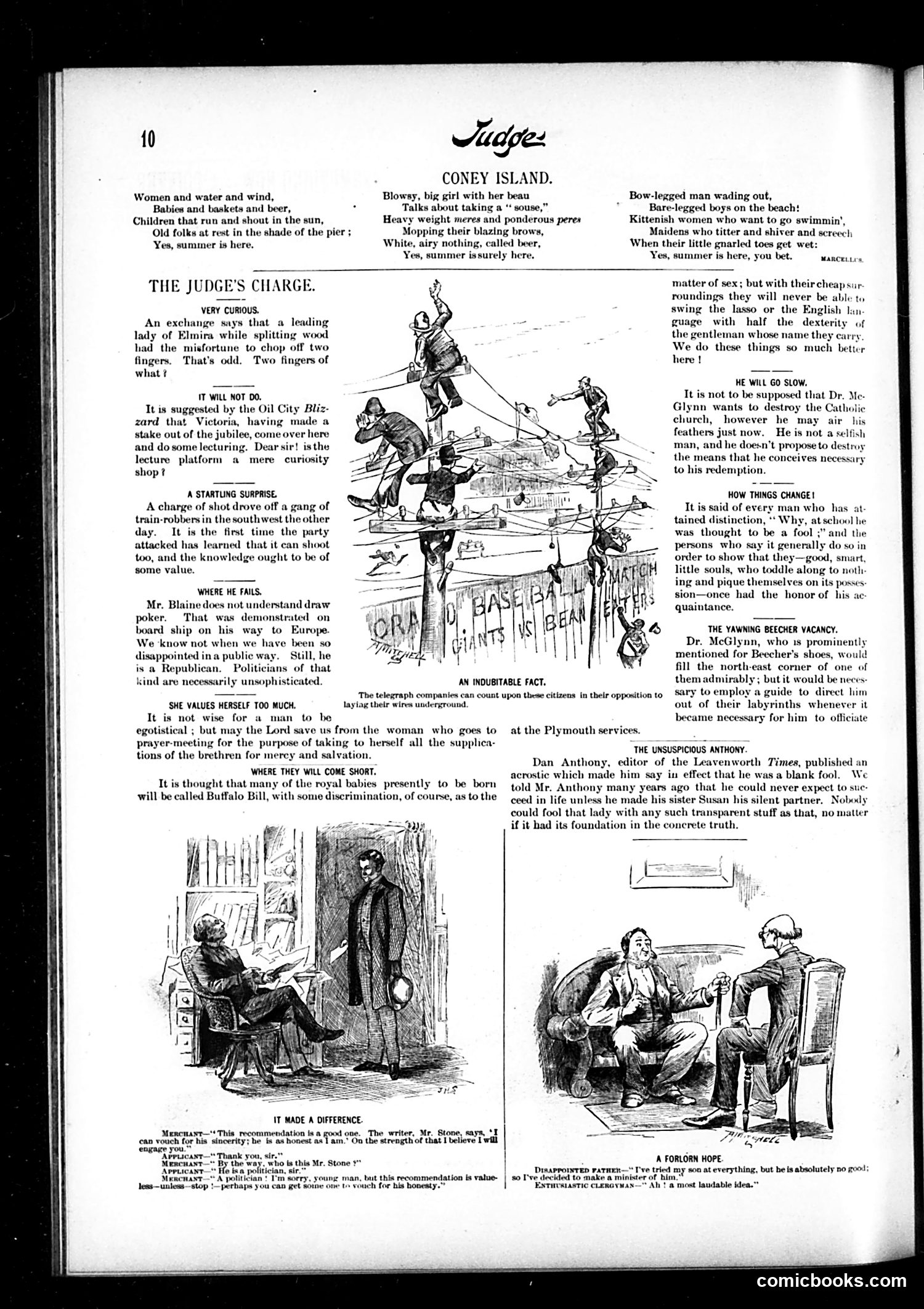
This satirical page from Judge magazine contains several brief humor pieces mocking contemporary figures and social situations (circa 1880s-90s based on references). **Main targets:** - **Victoria (likely Queen Victoria):** Mocked for potentially capitalizing on her jubilee celebrations with American lectures, as if she were a curiosity exhibit rather than a monarch. - **James G. Blaine:** Criticized for poor poker skills demonstrated during European travel, with a jab at Republicans being "unsophisticated." - **Dr. McGlynn:** A Catholic priest involved in controversy with church authority, satirized for wanting to "destroy" the church while claiming devotion to it. Also mocked as unqualified to fill Henry Ward Beecher's pulpit vacancy. - **General social satire:** Including complaints about egotistical women, observations on summer at Coney Island, and commentary on telegraph companies. The cartoons accompanying these pieces use crude sketches to illustrate the absurd situations being described. The humor relies on contemporary political knowledge now largely obscure to modern readers.
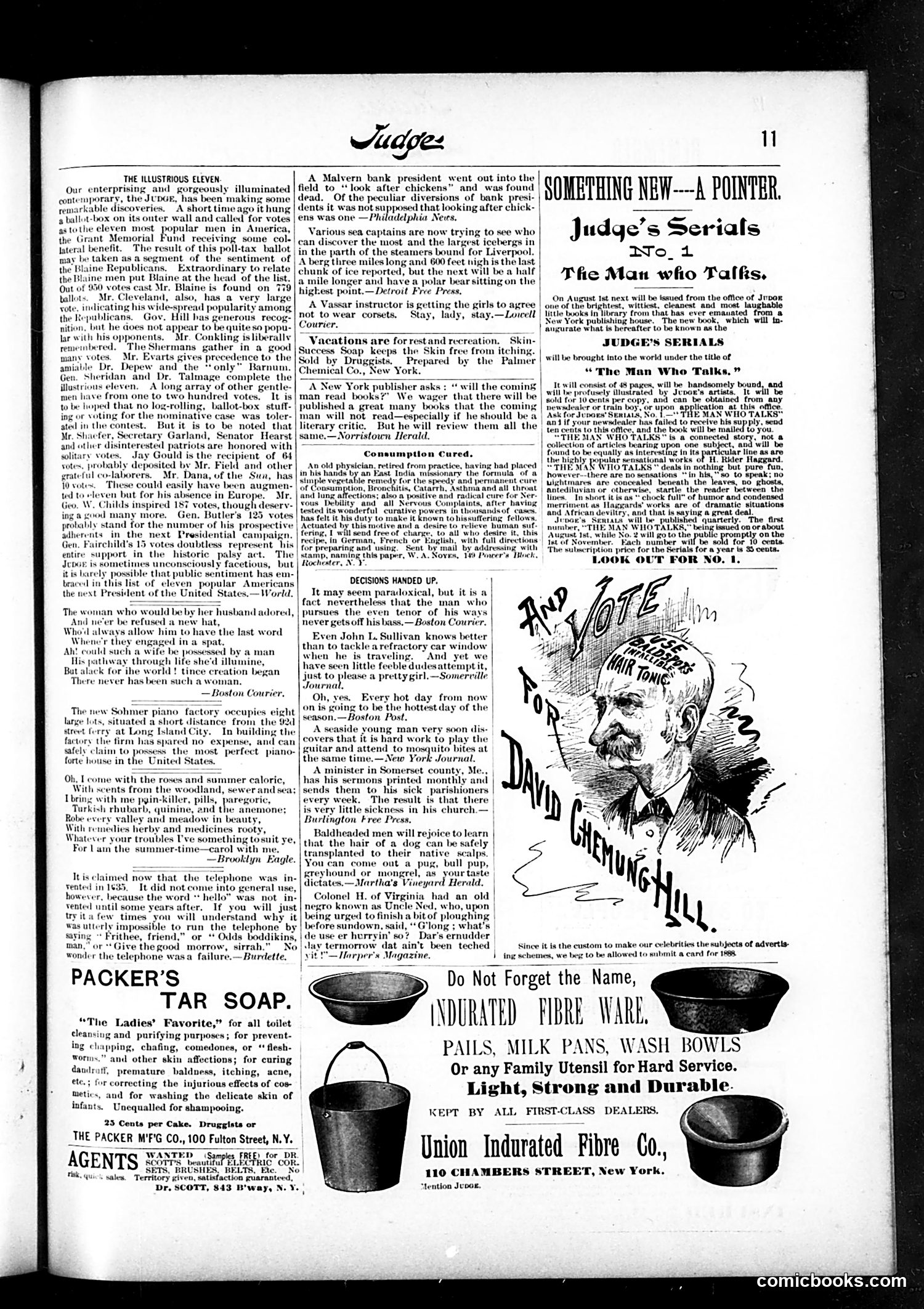
This page contains mixed content: advertisements, general humor columns, and a significant political commentary piece titled "The Illustrious Eleven." **The Main Political Content:** The lead article satirizes a ballot conducted by Judge magazine asking readers to vote on America's eleven most popular men. The results heavily favored **James G. Blaine** (779 of 950 votes), reflecting strong Republican sentiment among Judge's readership. The piece mocks this outcome—Blaine Republicans voting for Blaine—as unsurprising but notes the list also includes figures like **Cleveland**, **Governor Hill**, **Conkling**, the **Shermans**, and **Jay Gould**, along with General Sheridan and preacher Talmage. The satire's point: this supposedly democratic "poll" merely reflects partisan bias and self-interest rather than genuine national sentiment about popularity. **The Cartoon:** The right-side illustration ("Look Out For No. 1") shows a caricatured figure labeled "AND VOTE" with "NO TONIC" and "GENUINE STRENGTH" text—likely satirizing commercial self-promotion and empty political rhetoric of the era. The remaining content comprises period advertising and miscellaneous humor columns.
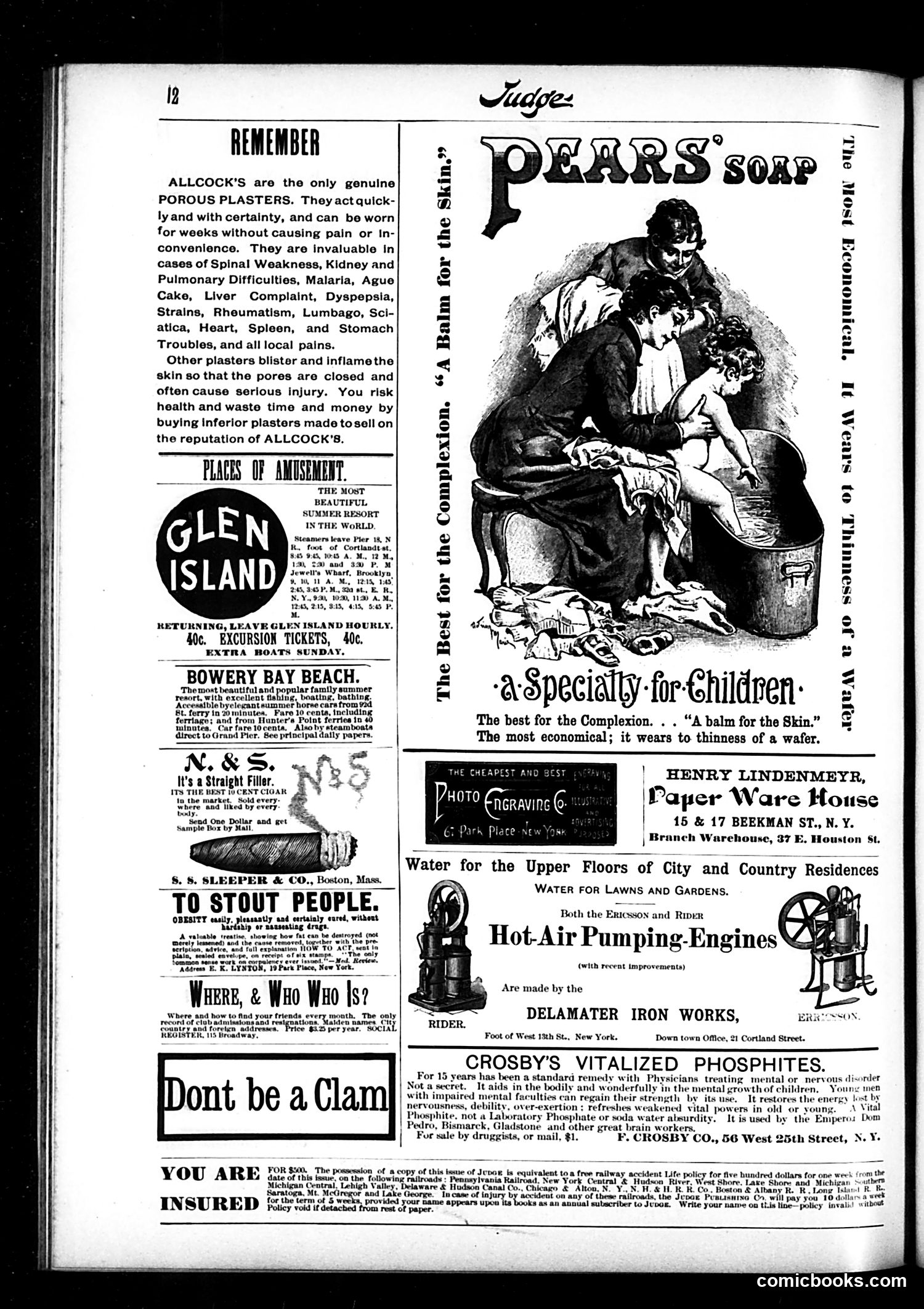
This page is primarily **advertising**, not political satire or comics. It contains various commercial advertisements typical of late 19th-century publications. The most prominent image is a **Pears' Soap advertisement** featuring a Victorian-era illustration of an adult bathing children, labeled "a Specialty for Children." The ad emphasizes the soap's gentleness and economy. This reflects period marketing that treated soap as a medicinal/health product rather than purely cosmetic. Other advertisements include: - **Allcock's Porous Plasters** (medical claim ads) - **Glen Island** amusement resort - **Obesity treatments** - **Hot-air pumping engines** - **Crosby's Vitalized Phosphites** (a brain tonic) A small notice at bottom advertises **Judge magazine's own insurance offer**—readers holding the issue qualify for railroad accident coverage worth $500. There is no discernible political cartoon or satire on this particular page. It functions as a standard advertising section common to 19th-century magazines.
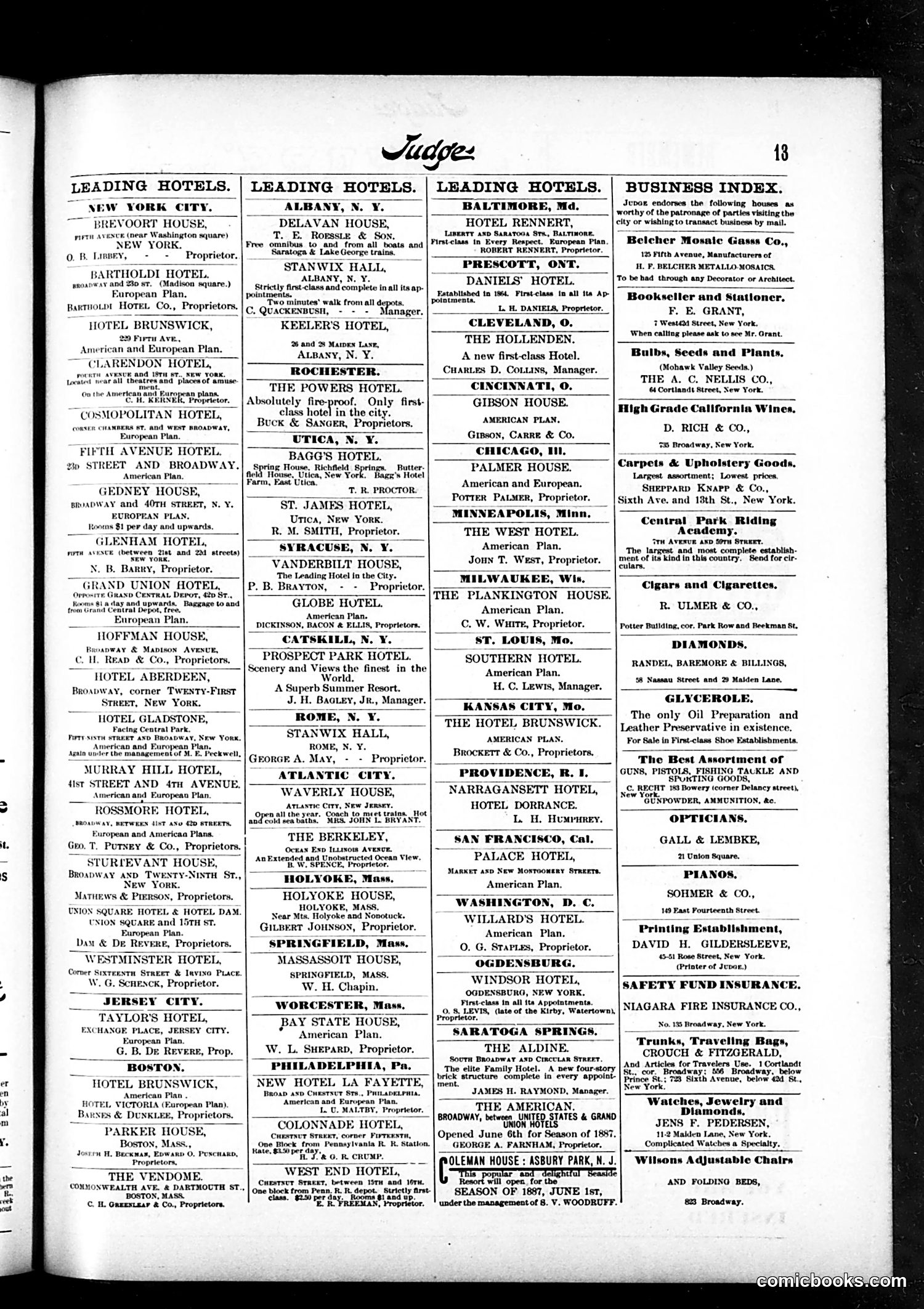
This page is **not a cartoon or satirical content** — it is a **business directory advertising page** from Judge magazine. The page consists almost entirely of paid hotel advertisements organized by city (New York, Albany, Baltimore, Cleveland, Cincinnati, Chicago, Minneapolis, Milwaukee, St. Louis, Kansas City, Providence, San Francisco, Washington D.C., Saratoga Springs, and Boston), along with smaller ads for related businesses: wines, bulbs and plants, carpets and upholstery, building services, diamonds, glycerol, pianos, opticians, jewelry, and insurance. "Mudge" at the top appears to be either the section editor's name or magazine branding. The "BUSINESS INDEX" header indicates this is simply a classified advertising section listing reputable hotels and services — standard commercial content typical of late 19th-century magazines. There is no political satire or social commentary visible on this page.
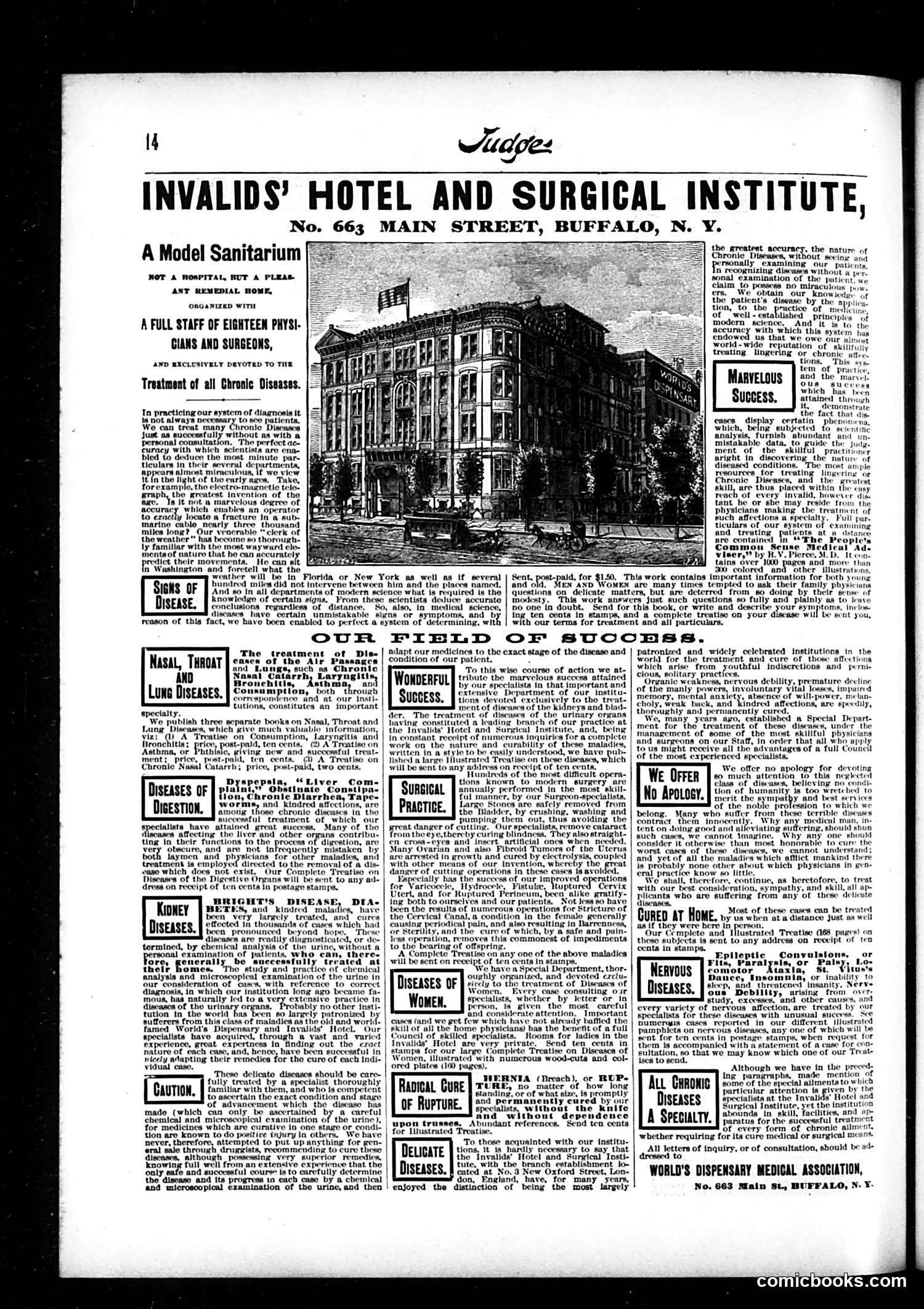
This page is primarily **advertising**, not satire or political commentary. It showcases the "Invalids' Hotel and Surgical Institute" in Buffalo, New York—a real medical establishment from the late 19th century. The advertisement's humor lies in its **grandiose medical claims** rather than in political satire. The institute boasts it can diagnose chronic diseases **without seeing patients**, comparing this ability to telegraph operators locating submarine cable breaks from thousands of miles away. This is clearly absurd—the comparison to weather prediction and telegraphy is meant to sound impressive but highlights the dubious nature of "remote diagnosis." The page mocks **medical pseudoscience** of the era: mail-order medical treatment, diagnosis by mail, and claims of miraculous cures for chronic diseases. The repeated emphasis on treating patients from "any distance" without examination suggests quackery masquerading as modern scientific achievement. No specific political figures or events are referenced. This represents period satire of fraudulent medical practices rather than political commentary.
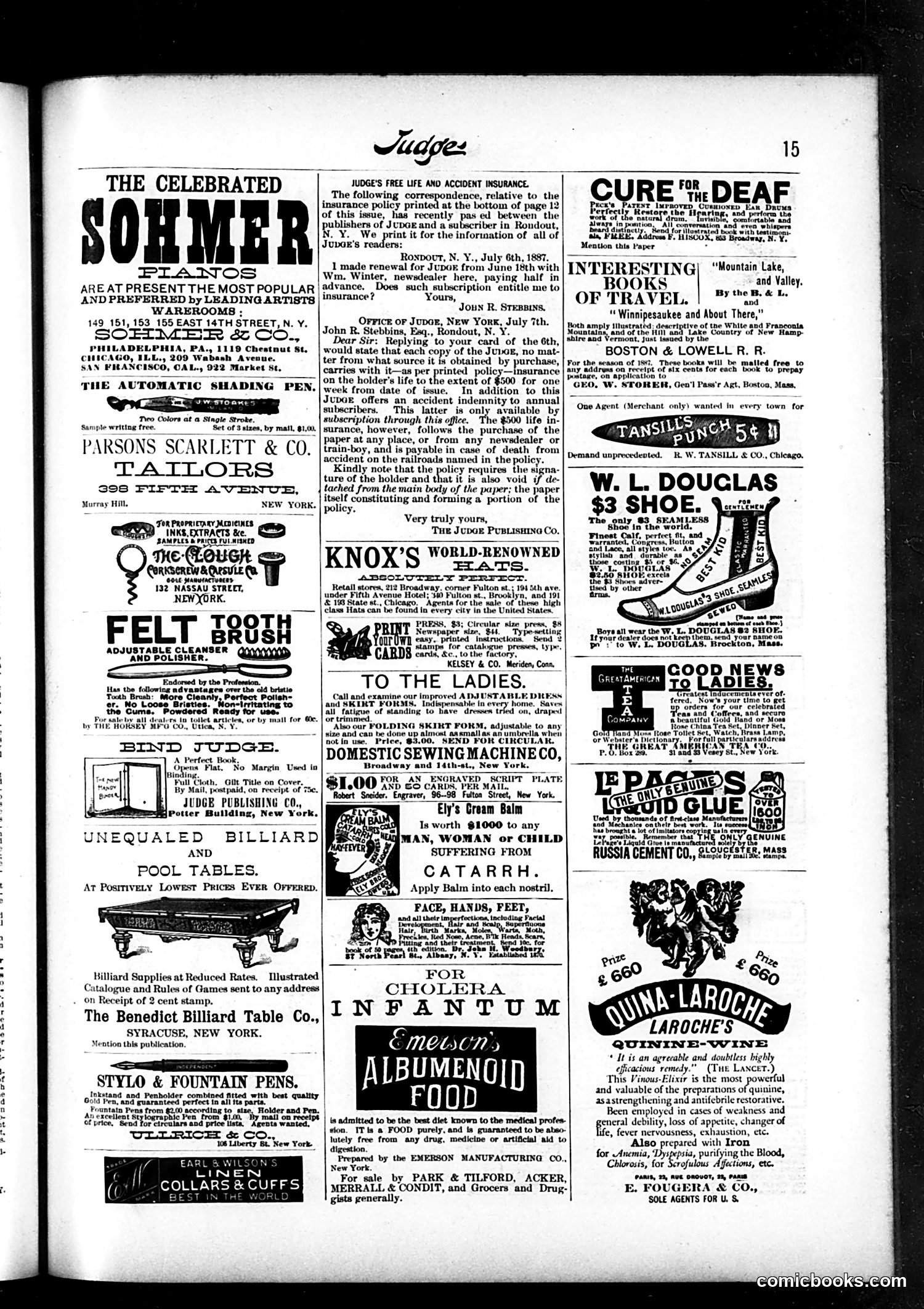
This page is primarily **advertising**, not editorial content or political satire. It contains commercial notices for various products and services typical of 1887: pianos, fountain pens, billiard tables, shoes, hats, medical remedies, and clothing accessories. The substantive editorial content is the **insurance correspondence** between Judge's publisher and a subscriber. It explains Judge magazine's promotional gimmick: each printed copy carried $500 life insurance coverage (payable if the holder died in a railroad accident), with additional accident indemnity available to annual subscribers. The policy required the subscriber's signature and remained void if detached from the paper itself. This was a marketing innovation—essentially free insurance as a circulation booster during the Gilded Age, when railroad accidents were common public concerns. The exchange demonstrates how 19th-century magazines used novel promotional tactics to attract readers. No political cartoon or satirical commentary appears on this page.
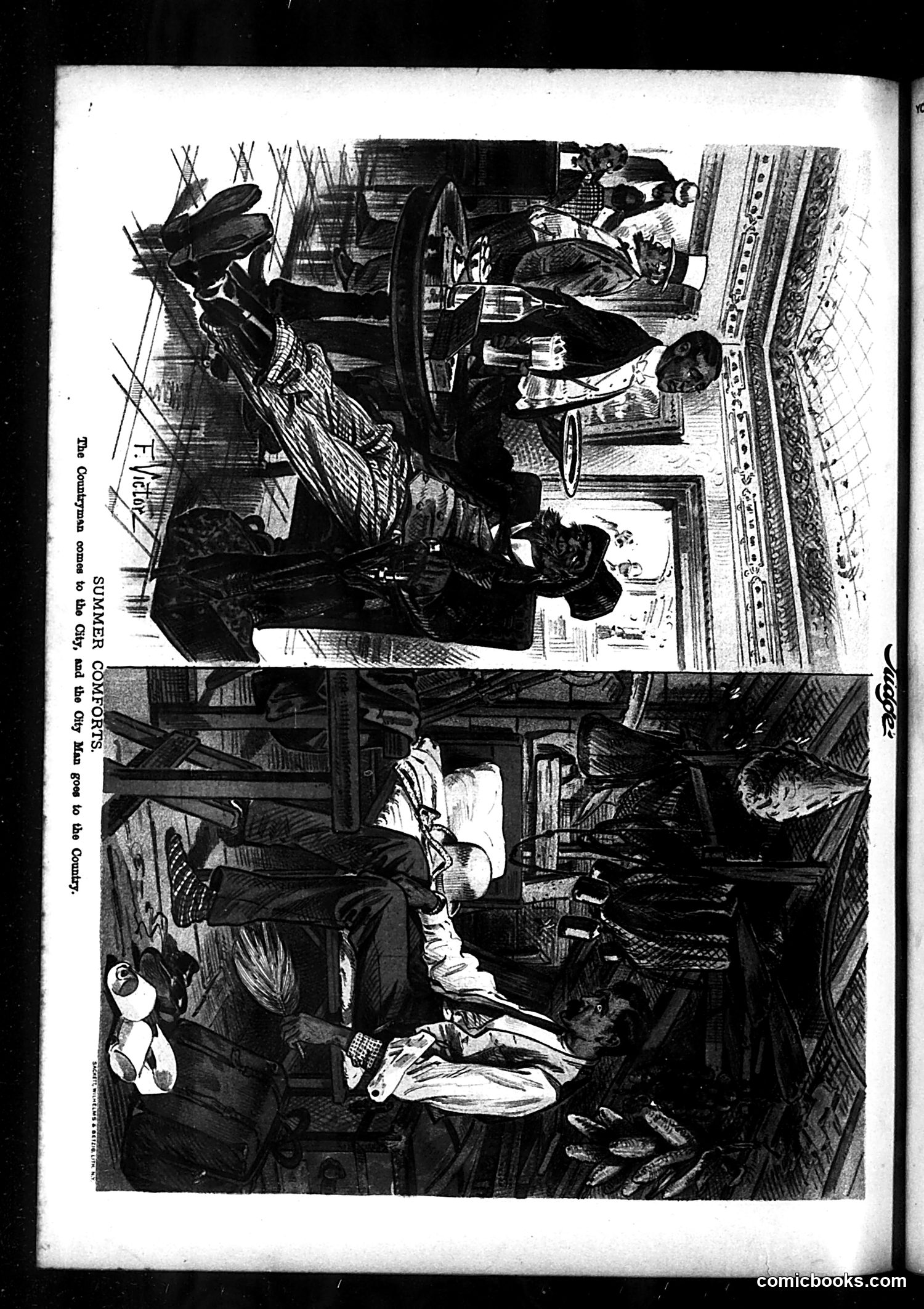
This page contains two contrasting satirical scenes illustrating the social exchange between rural and urban life. The top panel shows a country person arriving in the city—depicted amid automobiles, modern commerce, and urban chaos, presumably overwhelmed or out of place. The bottom panel reverses this, showing a city dweller attempting rural life, likely awkwardly confronting farming or country conditions. The satire mocks the mutual culture shock between urban and rural America—each group's unfamiliarity with the other's environment and values. This was a common Judge magazine theme during the early 20th century, when American urbanization and automobile culture were rapidly changing society. The cartoon satirizes both the countryman's naiveté about city life and the city person's incompetence in agricultural settings, reflecting contemporary anxieties about America's evolving class and geographic divisions.