
A complete issue · 18 pages · 1887
Judge — April 2, 1887
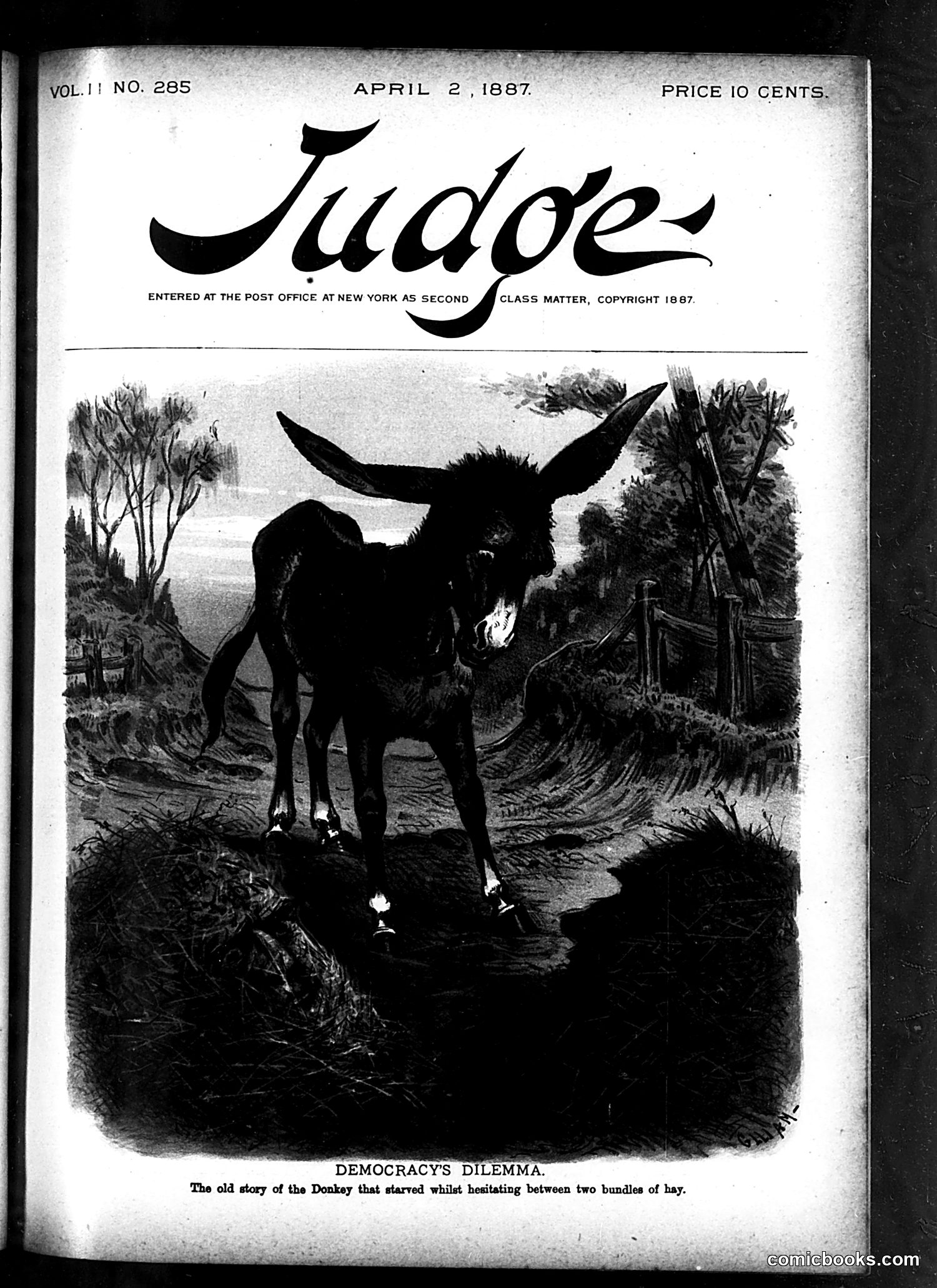
This political cartoon uses Aesop's Fable of the donkey starving between two bundles of hay as satire. The donkey represents the Democratic Party, unable to choose between two competing policy positions or candidate factions—thus paralyzed and ineffectual. The caption references the classic fable where the donkey, unable to decide which bundle to eat first, starves to death. Applied to 1880s politics, this suggests Democrats faced an internal deadlock that prevented decisive action or unified direction. The cartoon mocks the party's indecision during a period of factional disputes that characterized late 19th-century Democratic politics. The imagery transforms political stagnation into literal paralysis—a common Judge strategy for satirizing governmental dysfunction.
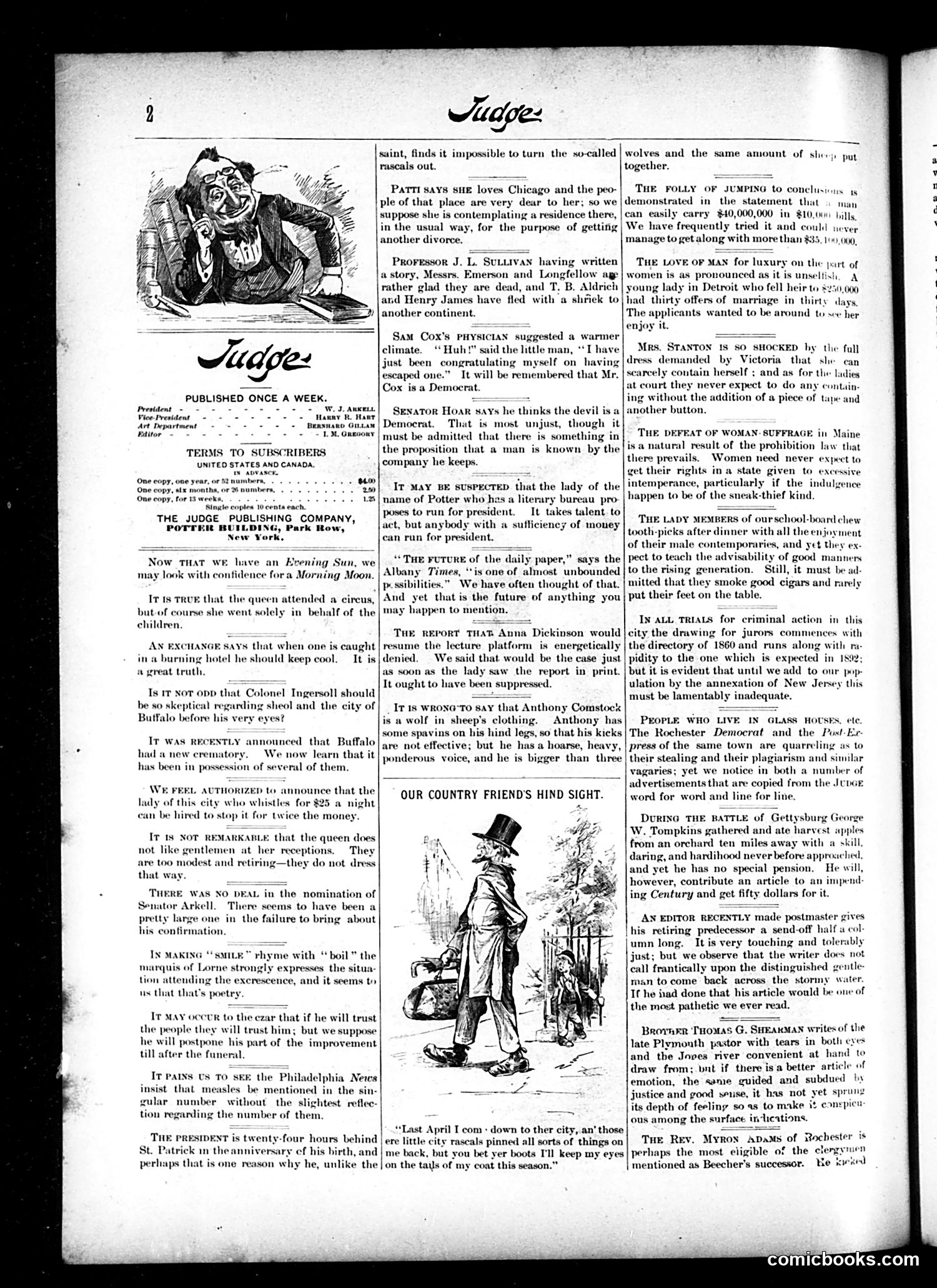
This page contains several satirical commentary items rather than a single cartoon. The main illustrated piece, "Our Country Friend's Hind Sight," shows a rural figure in period dress looking backward—likely satirizing someone's retrospective political judgment or failed predictions. The text sections mock various contemporary figures and issues: a woman contemplating relocation to Chicago for divorce, skepticism about female suffrage in Maine, criticism of Anthony Comstock's moralism, and ridicule of various political and social pretensions among the wealthy. One item references Buffalo's new crematory, treating it as darkly comic. Another mocks Senator Arkell's confirmation failure. The overall tone targets hypocrisy, failed ambitions, and social absurdities among both political and society figures of the era, though specific identities and events are not immediately clear from this excerpt alone.
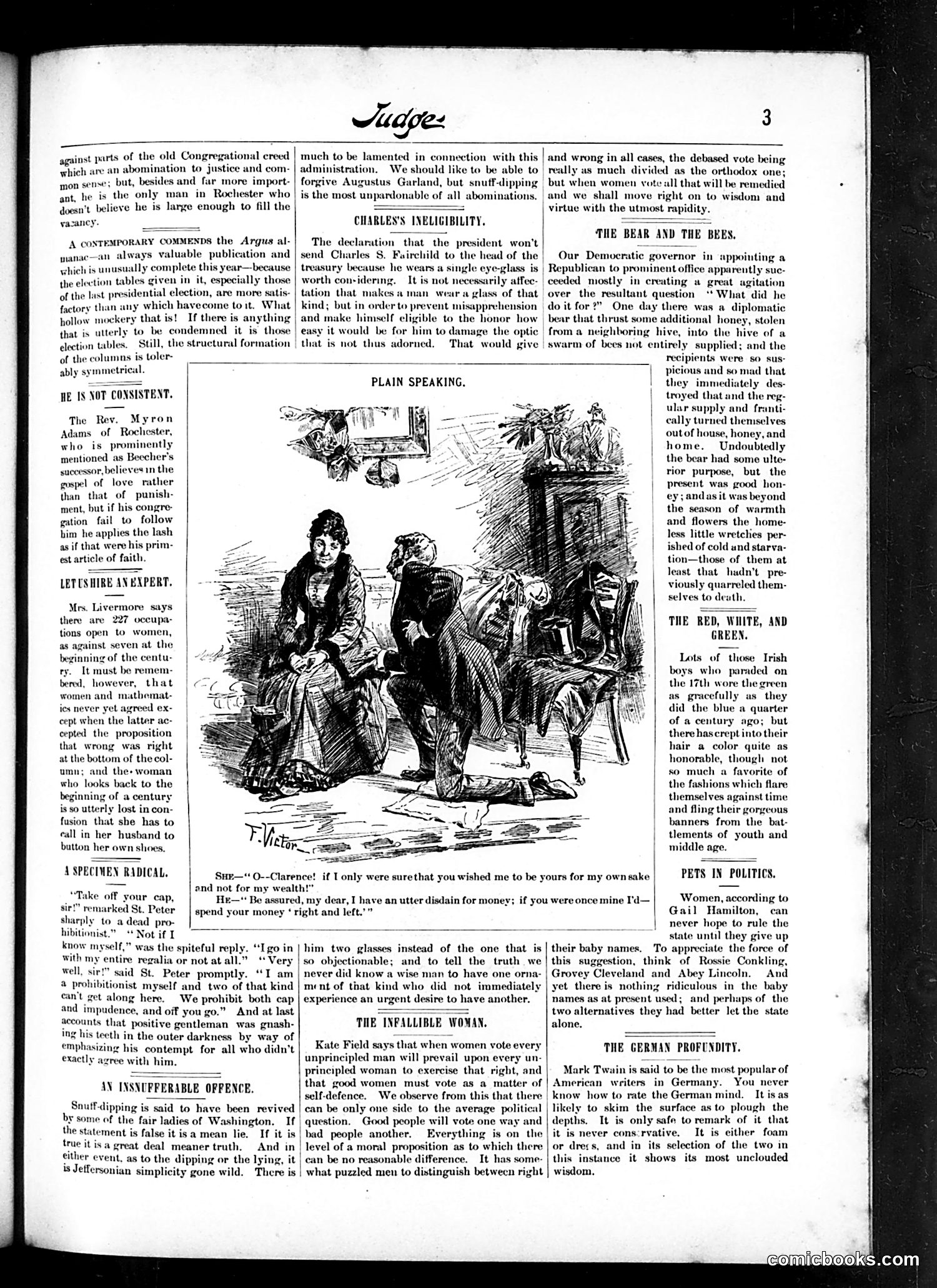
The main cartoon titled "PLAIN SPEAKING" depicts a domestic scene of marital negotiation. A woman and man appear to be discussing money—she demands financial support while he claims to despise wealth but wants her to "spend your money 'right and left.'" The satire mocks the hypocrisy of radical political figures (likely referencing 19th-century prohibition advocates) who preach one ideology while practicing another. The surrounding editorial commentary attacks various targets: Charles Fairchild's eligibility for high office (apparently disqualified by wearing a monocle), Augustus Garland's "snuff-dipping" habit (considered undignified for government officials), and Democratic Governor Cleveland's appointment of a Republican (creating political discord, compared to a bear raiding a beehive). The overall theme satirizes political inconsistency and the gap between public principles and private behavior among Gilded Age politicians and reformers.
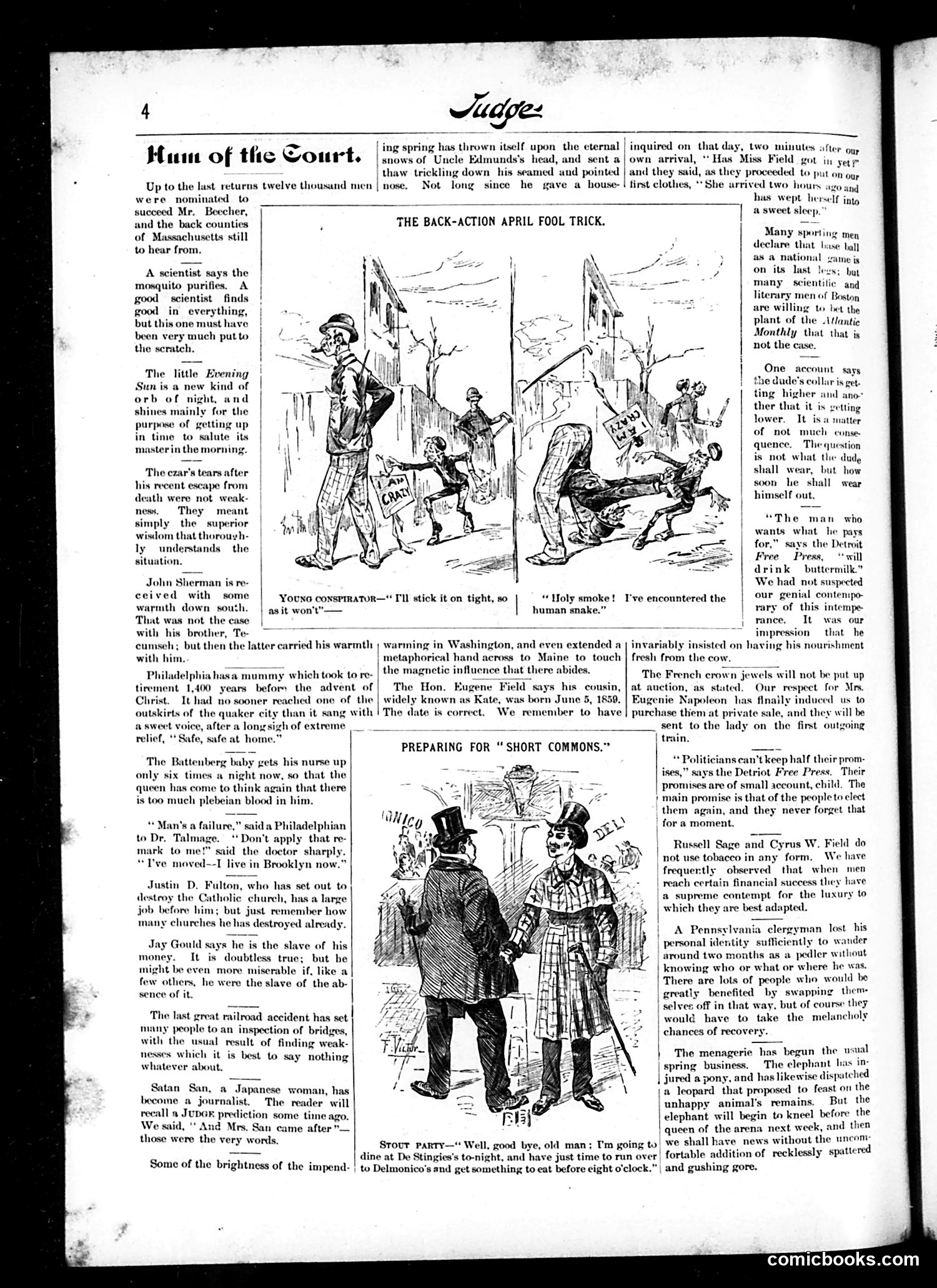
This page from Judge contains two satirical cartoon sequences mocking April Fool's pranks and social pretension. **"The Back-Action April Fool Trick"** (top): Shows a con artist duping a gullible victim with a classic street scam—likely the "human snake" hoax referenced in the caption. The joke satirizes both the trickster's audacity and urban naïveté. **"Preparing for 'Short Commons'"** (bottom): Depicts two fashionably dressed dandies (identifiable by exaggerated top hats and clothing) discussing dinner plans. The satire targets upper-class affectation and the disconnect between pretense and reality—they plan an elaborate social dinner despite financial constraints ("short commons" means meager rations). The surrounding text includes commentary on contemporary figures like John Sherman and Eugene Field, railroad safety concerns, and social observations. The overall tone mocks urban trickery, class pretension, and gullibility—typical Judge satirical targets of the era.
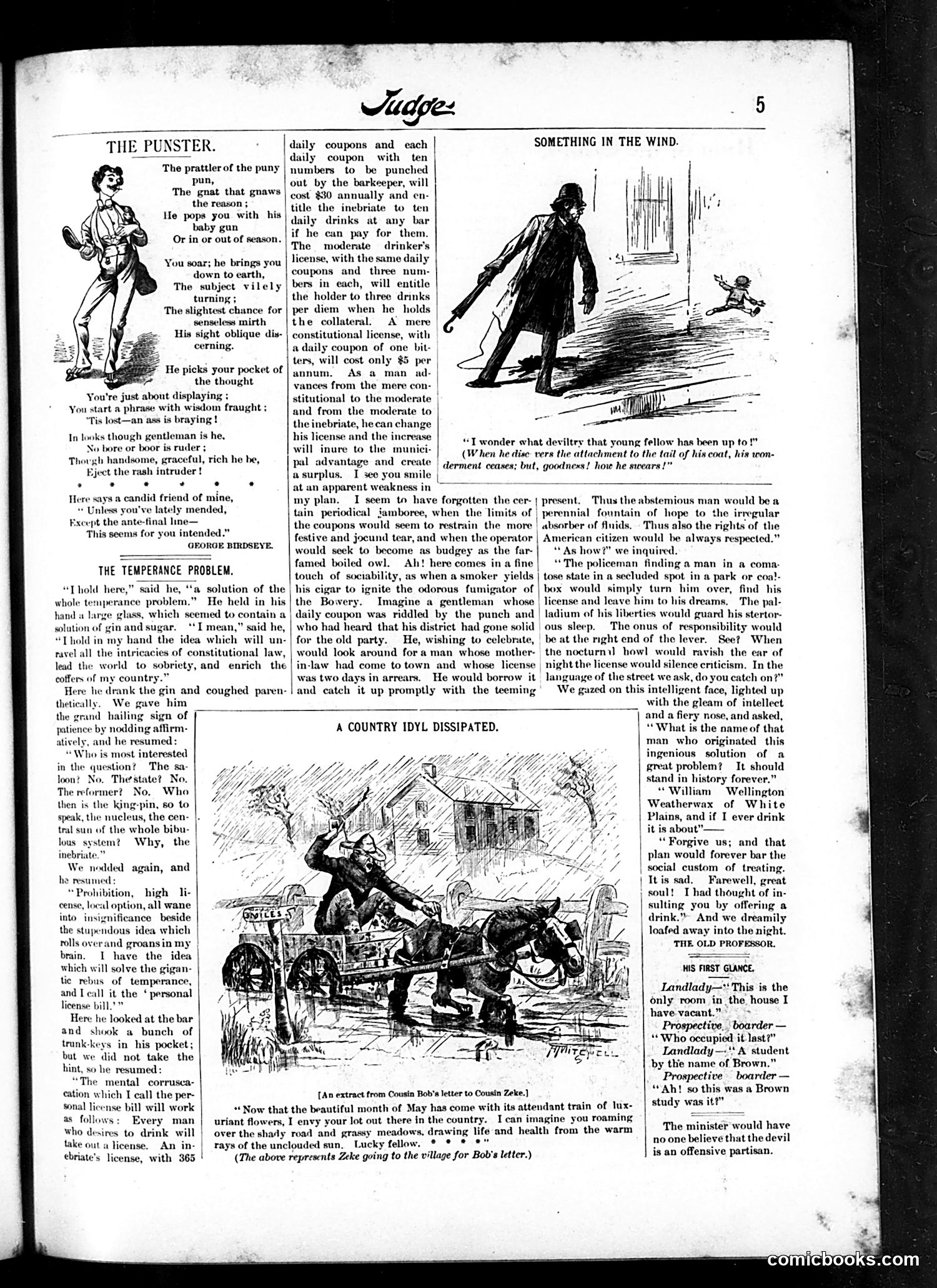
This page contains three satirical pieces targeting American social problems of the era: **"The Punster"** mocks the tedious person who ruins conversations with bad puns and wordplay—a common Victorian social annoyance. **"The Temperance Problem"** satirizes a proposed licensing scheme to regulate alcohol consumption. A drunk proposes tiered permits: expensive licenses for heavy drinkers, moderate licenses, and cheap "constitutional" licenses for minimal drinkers. The satire highlights the absurdity—that such a system would actually generate revenue while enabling alcoholism. The piece mocks both the scheme's obvious logical flaws (what about periodic binges?) and the corruption it would invite. **"Something in the Wind"** shows a cartoon of a man discovering someone has tied something to his coattail—a visual prank that provokes amusement at his expense. The page reflects Gilded Age concerns: temperance advocacy, urban social manners, and public behavior. The alcohol piece particularly critiques proposals to solve drinking problems through bureaucratic licensing rather than genuine moral reform.
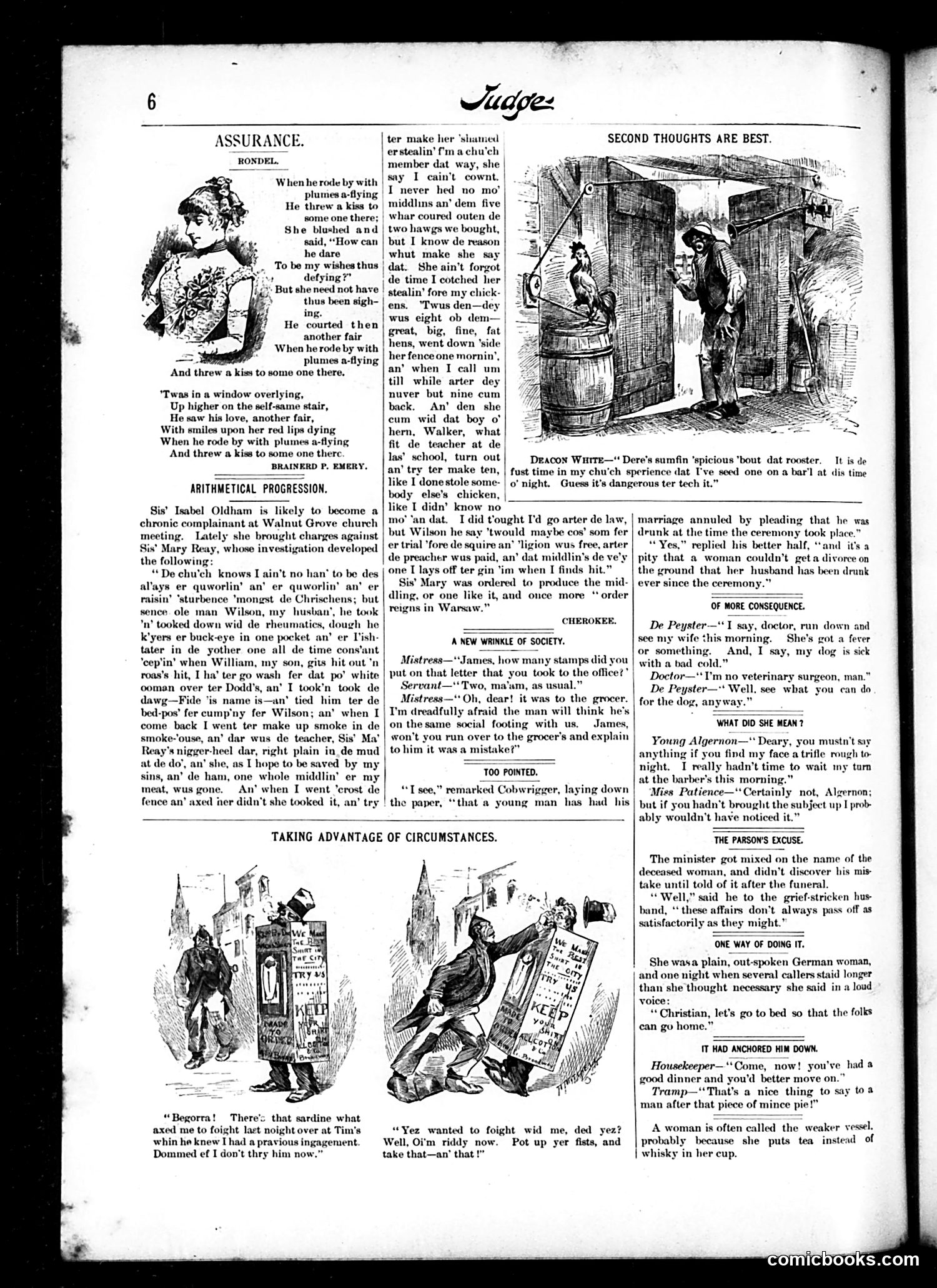
This page from *Judge* contains several satirical pieces mocking rural and working-class speech patterns and social pretensions: **"Arithmetical Progression"** uses heavy dialect humor to ridicule African American church members in what appears to be the post-Reconstruction South. "Sis' Isabel Oldham" complains about stolen food using exaggerated vernacular, the satire targeting both her complaints and implied dishonesty. **"A New Wrinkle of Society"** mocks class anxiety—a mistress fears a grocer might misinterpret receiving stamps as indicating social equality, satirizing obsessive social hierarchy among the middle class. **"Taking Advantage of Circumstances"** depicts Irish immigrants (suggested by "Begorra") fighting over past grievances, stereotyping them as violent and quarrelsome. The cartoons and verses collectively reflect *Judge's* editorial stance: mocking marginalized groups' speech, class-climbing pretensions, and ethnic stereotypes. This represents period attitudes that modern readers would recognize as deeply offensive racial and ethnic caricature presented as humor.
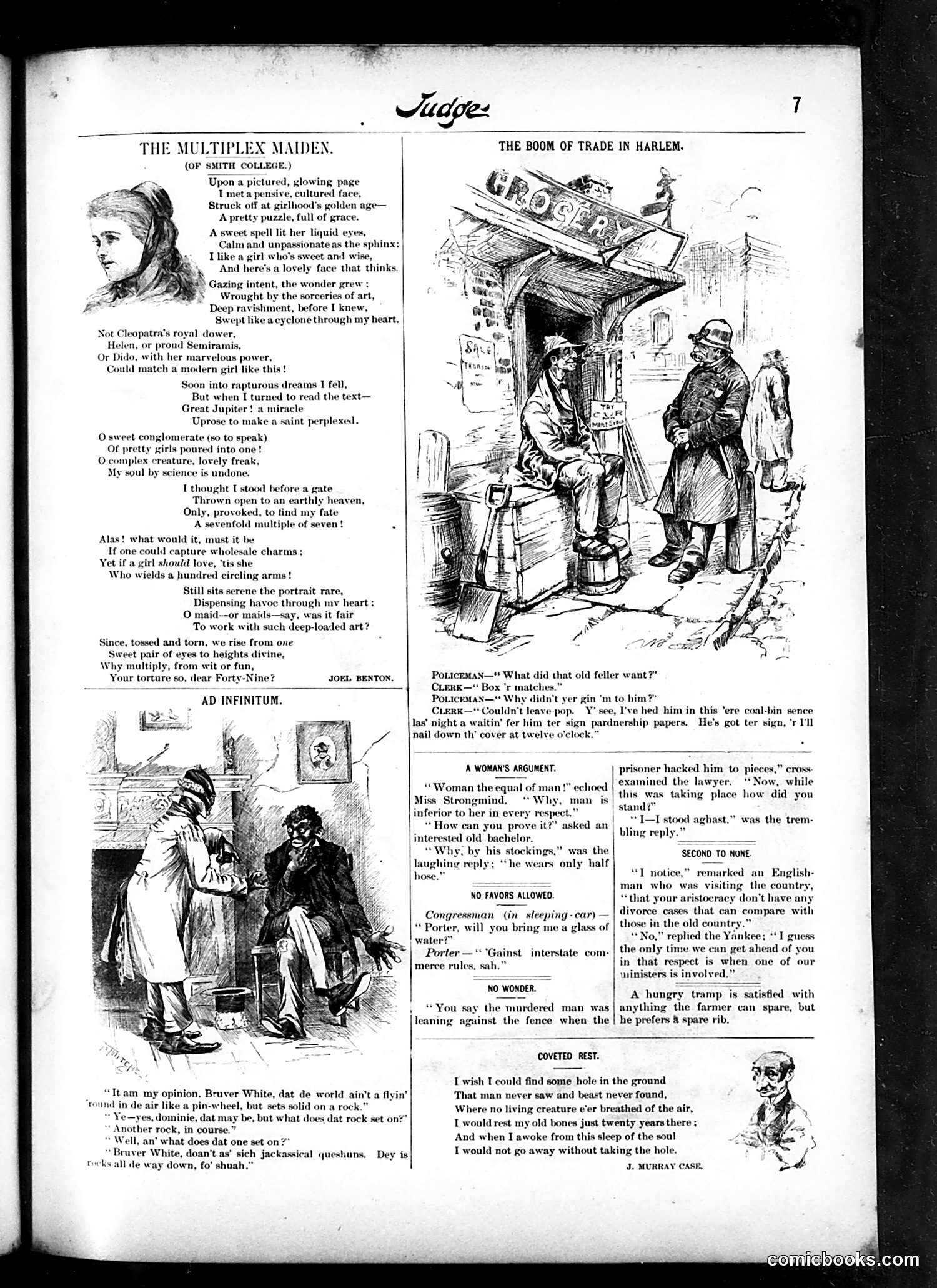
This page contains several satirical pieces reflecting turn-of-the-century social attitudes: **"The Multiplex Maiden" (top left):** A poem mocking women's education at Smith College. The speaker becomes infatuated with a portrait of a beautiful girl, only to discover she represents multiple women—"a sevenfold multiple of seven." The satire suggests that educated women are so intellectually complex or "modern" they're incomprehensible to men; the joke plays on anxieties about women's colleges producing women who don't fit traditional romantic ideals. **"The Boom of Trade in Harlem" (top right):** A sketch depicting a street vendor or peddler with customers. The dialogue references "partnership papers," suggesting commentary on business or labor practices. **Lower sections:** Brief satirical quips about gender equality ("Woman the equal of man"), class differences ("Second to None"), and social absurdities. The "Ad Infinitum" piece uses circular logic for humor. Overall, the page reflects Gilded Age anxieties about women's education, social change, and class distinctions, using humor to reinforce traditional hierarchies.
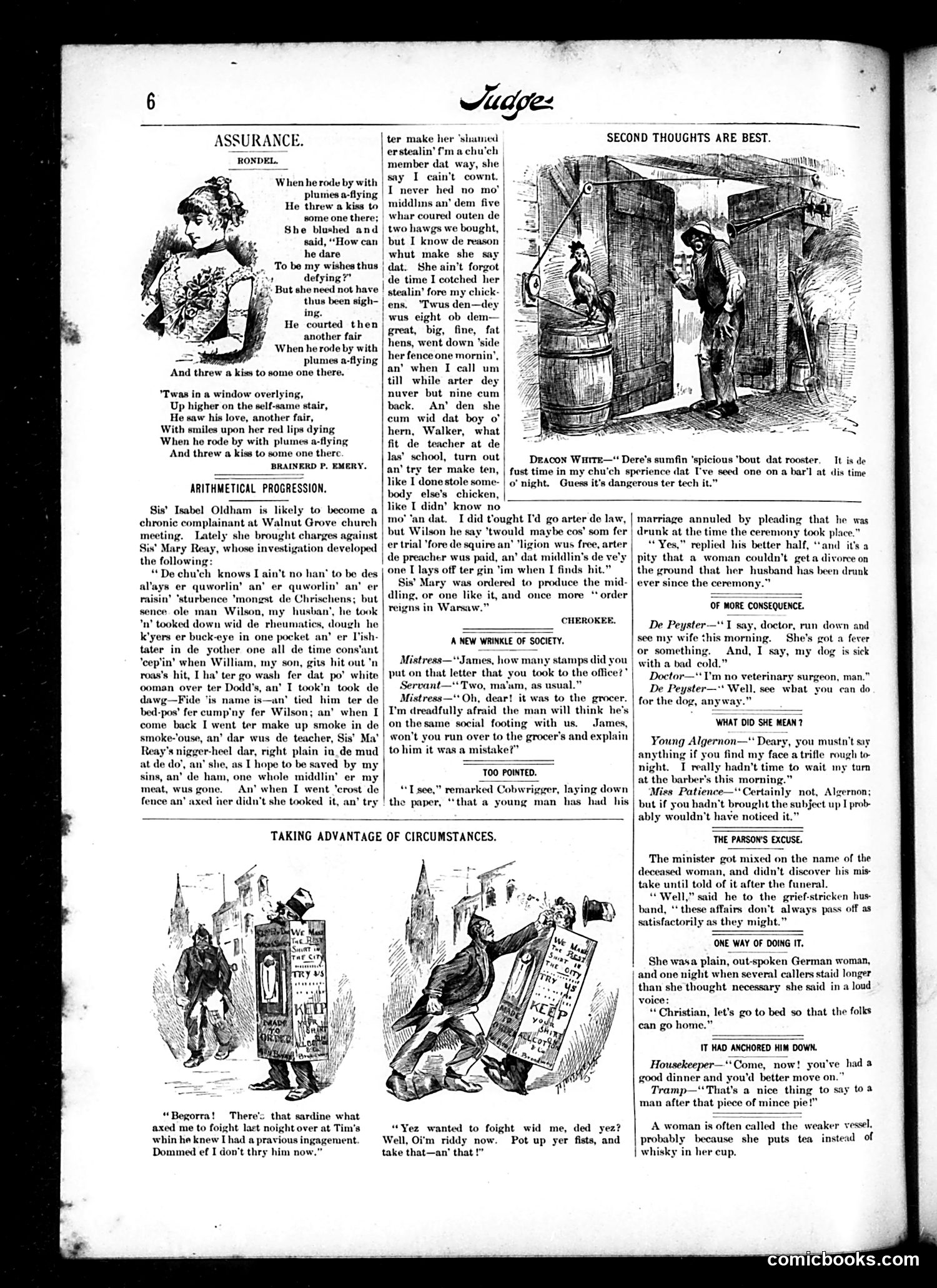
This page contains several satirical pieces mocking rural/working-class dialect and social pretension: **"Arithmetical Progression"** features "Sis' Isabel Oldham" complaining at church, using exaggerated African American Southern dialect to recount a neighbor woman's suspected theft of her chickens. The satire targets both class prejudice and church gossip. **"A New Wrinkle of Society"** mocks nouveau riche anxiety: a mistress fears her grocer might think they're on equal social footing because she forgot extra postage, revealing absurd class consciousness. **"Taking Advantage of Circumstances"** shows a street confrontation between working-class men, stereotyped with Irish dialect ("Begorra," "foight"). The poetry "Assurance" and "Second Thoughts Are Best" appear to be romantic/domestic humor. **Overall**: The page uses ethnic and class caricature (dialect humor, rural/immigrant stereotypes) typical of Gilded Age satire, targeting both lower classes for speech patterns and middle classes for social pretension.
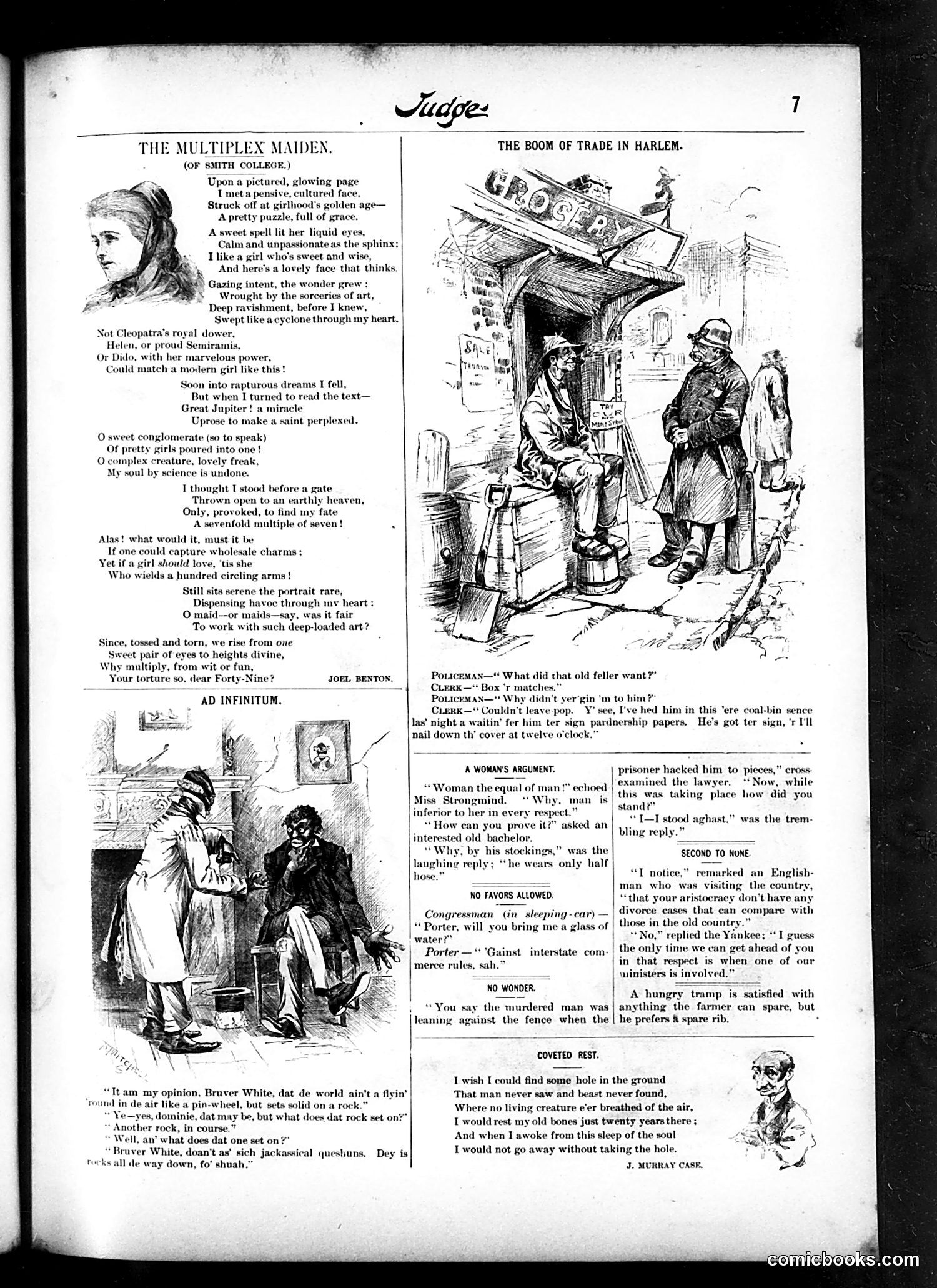
This page contains several satirical pieces typical of late 19th-century American humor: **"The Multiplex Maiden"** (by Joel Benton): A poem mocking the new phenomenon of halftone photographic reproduction in magazines. The narrator falls for a girl's portrait, only to discover it's actually a composite image made from multiple photographs—a cutting-edge but eerie printing technique. The satire targets both the artificial nature of mass-media imagery and the bewilderment it caused readers unfamiliar with modern printing methods. **"A Woman's Argument"** and other brief jokes: These satirize gender relations and class dynamics of the era—aristocratic pretension, legal absurdities (the coal-bin punishment), and marital infidelity. **"Covered Rest"** (by J. Murray Cope): A dialect poem about a weary man wishing to sleep eternally in a hole—dark humor about exhaustion and death. The overall tone reflects Judge's satirical approach: poking fun at modern technology's disorienting effects, social pretension, and the gap between American and European manners. The illustrations use exaggerated caricature typical of the period's visual comedy.
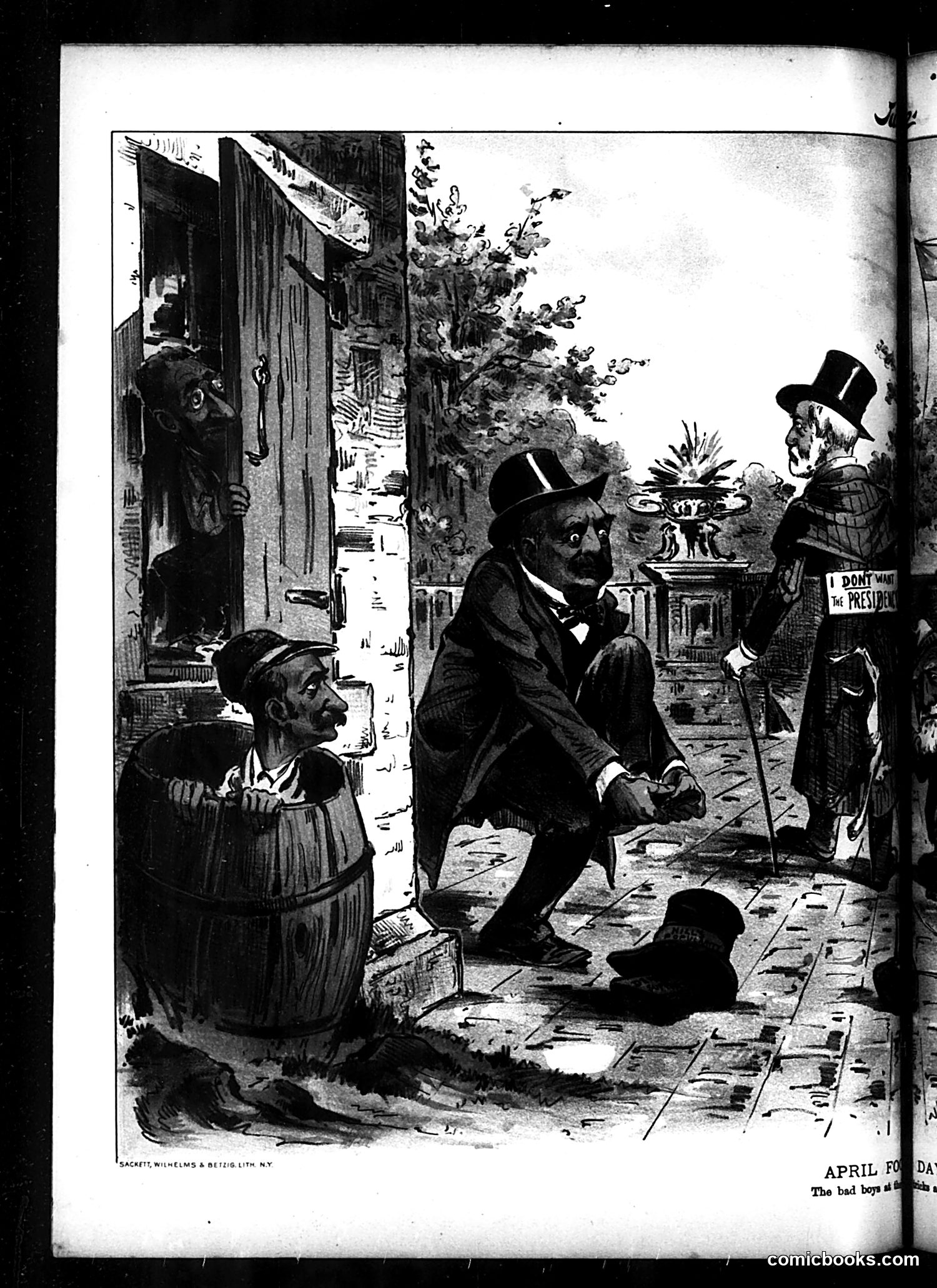
This is a satirical engraving from *Judge* magazine showing what appears to be a street scene with figures in formal dress (top hats) interacting with working-class or poor individuals. The scene suggests social commentary on class divisions or urban inequality. The figure on the right wears a sash reading "I DON'T WANT THE PRESIDENT" (text partially visible), suggesting political satire about presidential politics or public sentiment. The composition contrasts wealthy gentlemen with a barefoot child and someone in a barrel—likely depicting poverty and homelessness contrasted with affluence, a common *Judge* theme criticizing social inequality or political hypocrisy. The OCR text fragment "The bad boys #" is incomplete, making full interpretation difficult. Without the complete caption or date context visible, the specific political reference remains unclear.
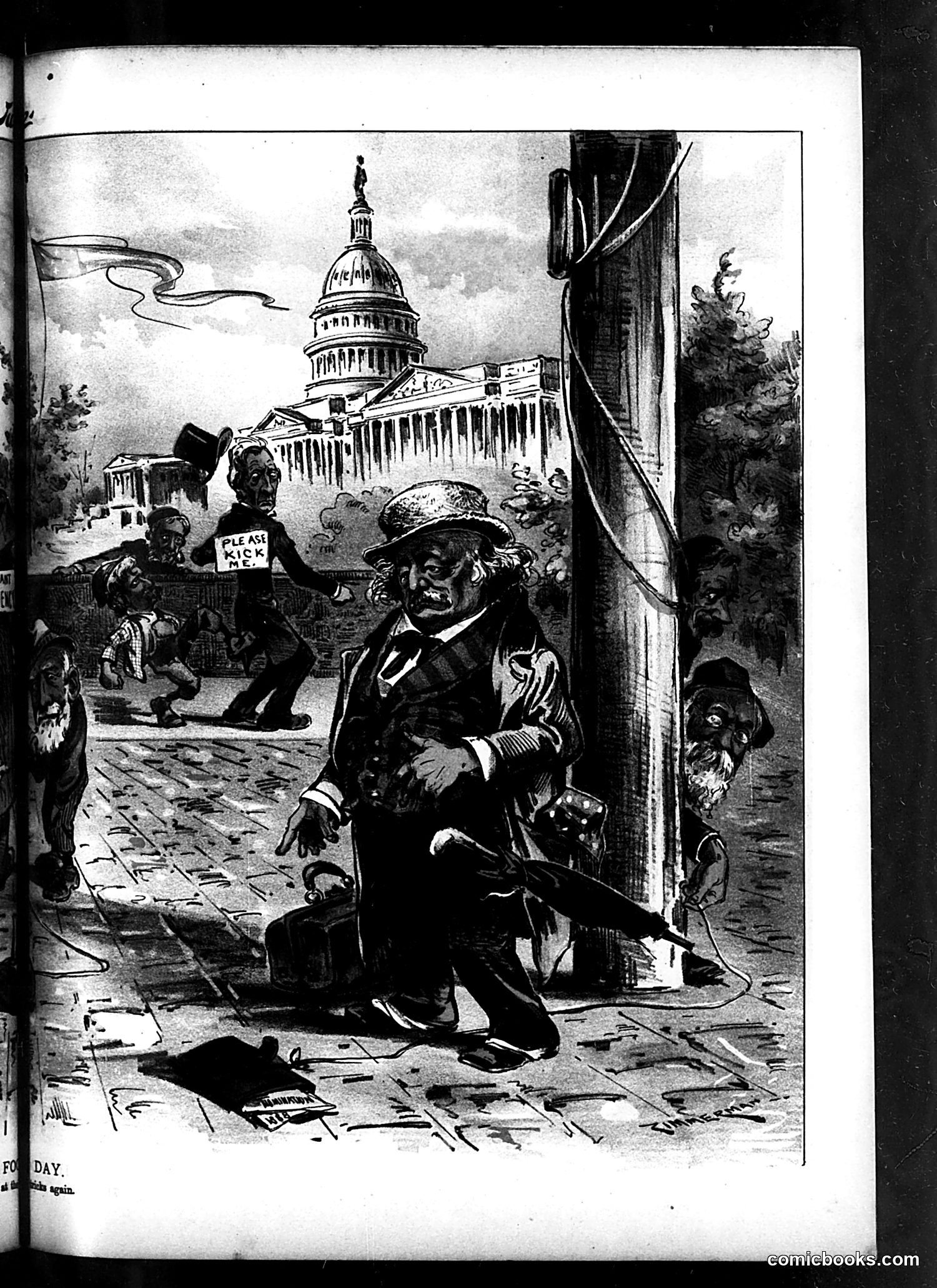
This appears to be a satirical cartoon depicting corruption or scandal at the U.S. Capitol. The central figure is a caricatured man in formal dress with exaggerated features, positioned prominently in front of the Capitol building. Other grotesque figures surround him, suggesting various corrupt or disreputable characters. One figure holds a sign reading "PLEASE KICK ME," implying the central figure deserves public ridicule or punishment. The scattered papers on the ground likely reference documents, legislation, or evidence of wrongdoing. The overall composition suggests commentary on governmental corruption, lobbying, or political misconduct. Without visible date or attribution, the specific scandal remains unclear, but the satirical tone is unmistakable—Judge magazine used exaggerated caricature and visual metaphor to mock what it perceived as governmental malfeasance or ethical failure.
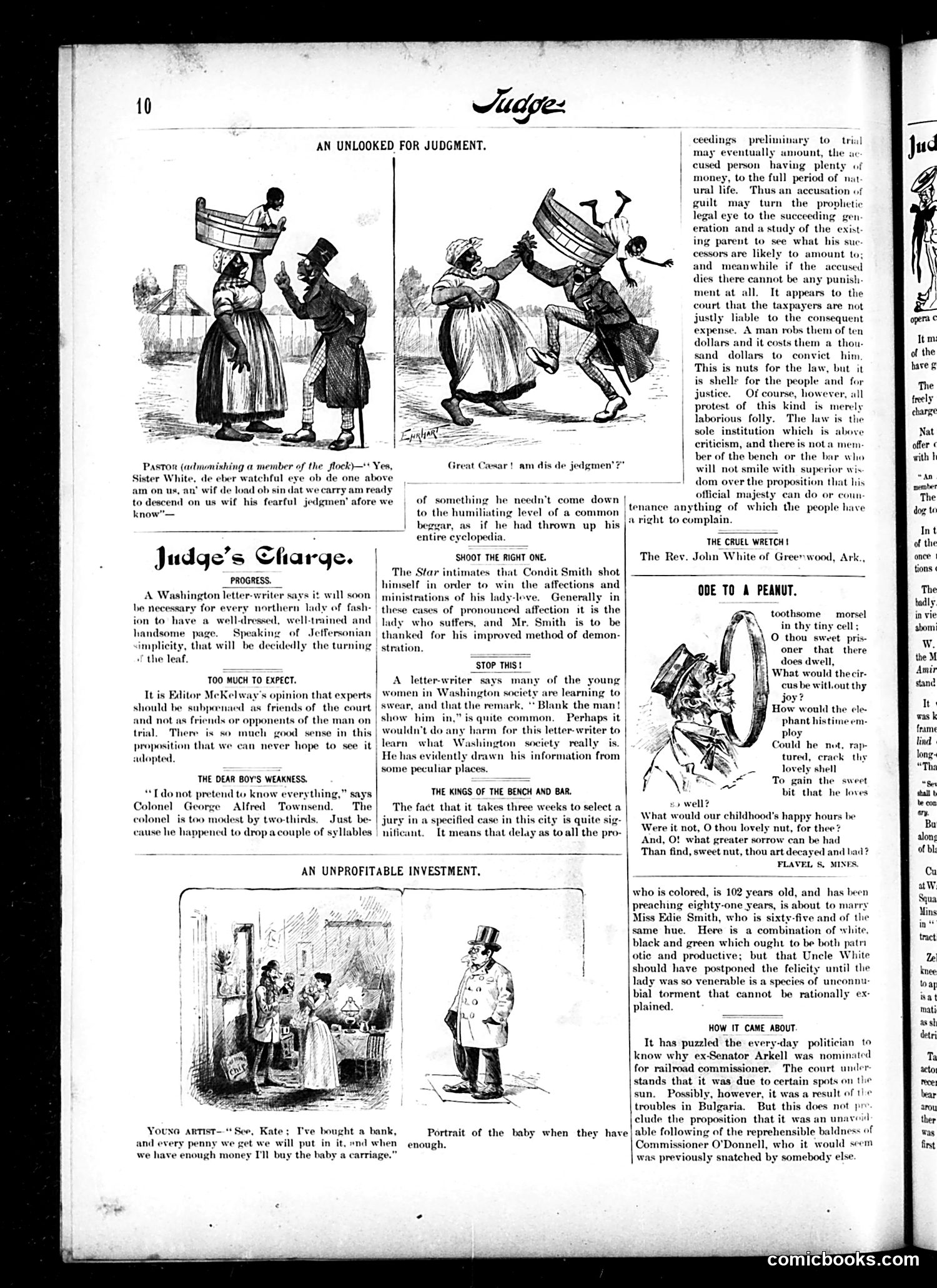
This page contains multiple satirical pieces critiquing American institutions and social absurdities: **"An Unlooked for Judgment"** (top cartoon): A pastor and woman argue about judicial proceedings, mocking the legal system's inefficiency and expense—particularly that prosecuting a minor theft costs more than the crime's value. **"Judge's Charge"** and related pieces: These editorial fragments criticize the legal system's delays, expense, and the jury selection process (taking three weeks to seat a jury). The satire suggests the law protects itself from criticism while being fundamentally unjust to common people. **"Ode to a Peanut"**: A humorous poem romanticizing a peanut, likely satirizing sentimental Victorian poetry through absurd application to a trivial subject. **"An Unprofitable Investment"** (bottom cartoon): A young man discusses purchasing a bank and carriage, apparently oblivious to financial reality—satirizing naive or foolish investment decisions. The overall theme: institutional hypocrisy and human folly, particularly regarding law, finance, and pretension.
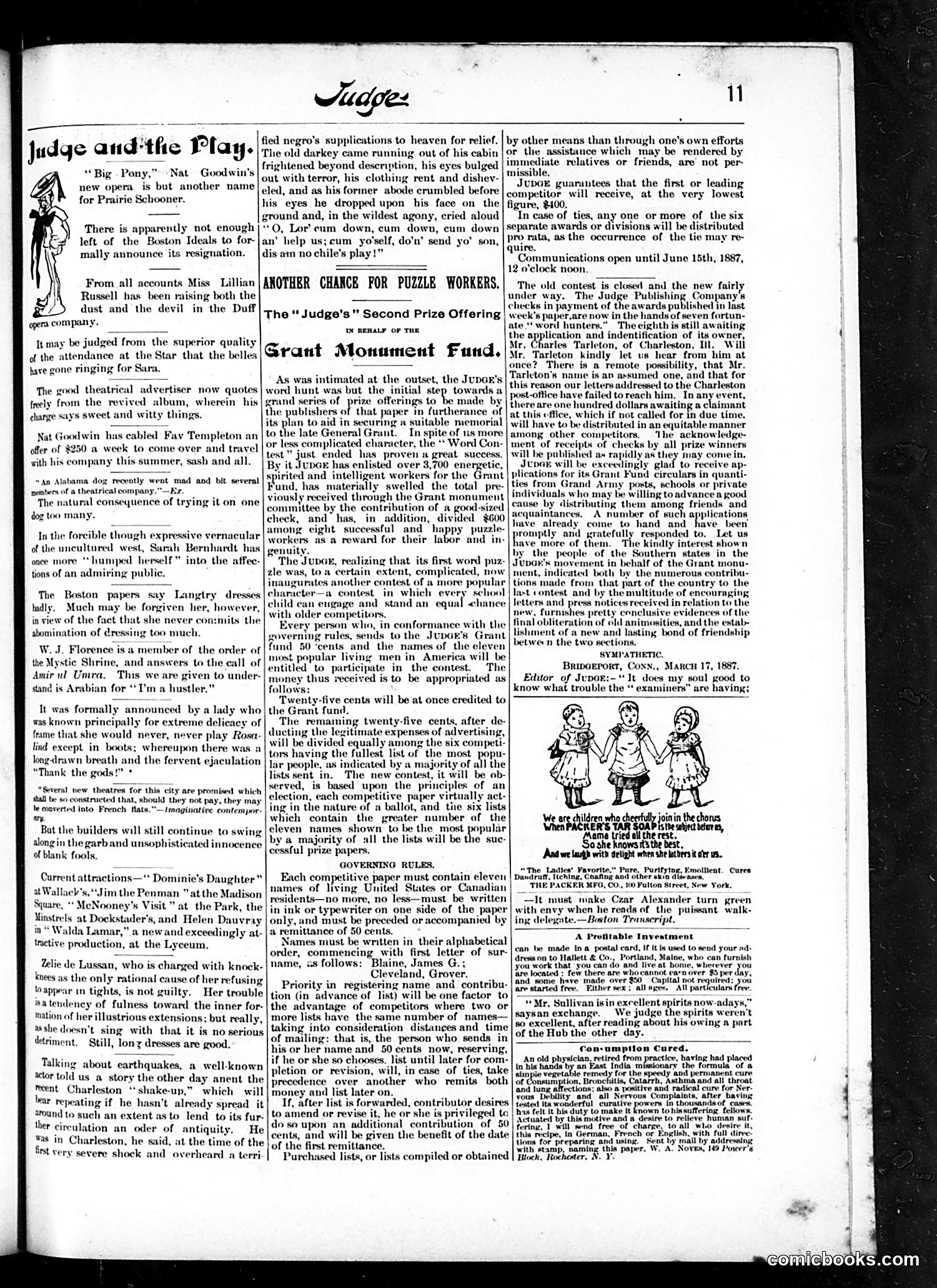
This page from Judge magazine (March 17, 1887) contains theater criticism and satirical commentary on American theatrical life, alongside a fundraising announcement. **The "Judge and the Play" Section:** The opening cartoons mock contemporary theatrical figures and productions. References include Nat Goodwin's opera "Big Pony," actress Lillian Russell's turbulent behavior with the Duff Opera Company, and various performers like Sarah Bernhardt and Lillie Langtry. The humor relies on insider theater gossip—complaints about poor attendance, costume choices, and backstage drama. **The Grant Monument Fund:** The main announcement concerns Judge magazine's fundraising competition for a General Grant memorial. The magazine is offering prizes (including $400 for first place) to readers who submit puzzle solutions and contribute names of "living men in America." This combines charitable fundraising with a puzzle-based contest, distributing prize money equitably among participants. The page primarily targets middle-class readers interested in theater gossip and civic monuments—reflecting Judge's audience of educated, culturally engaged Americans in the Gilded Age.
This page is primarily **advertising**, with minimal editorial cartoon content. The advertisements promote patent medicines and commercial products typical of the 1880s. **Key Content:** The page includes letters to the editor about a word-puzzle contest Judge was running. Readers complain humorously about the difficulty—one writer jokes about being "on our knees, sifting" through dictionaries and the Bible seeking obscure words, expressing hope the puzzle creator suffers similarly. **Advertisements:** Prominent ads include: - **Allcock's Porous Plasters** (claiming to cure "over a million persons") - **Dr. Carter Moffat's Ammoniaphphone** (an inhalation device for respiratory ailments) - **Crosby's Vitalized Phosphites** (a nerve tonic) These reflect period medical quackery—products making extravagant health claims without scientific basis. The ads' prominence suggests Judge's revenue model depended heavily on such advertisers. **Satire Notes:** The puzzle letters contain gentle self-mockery about intellectual strain, but this is reader humor rather than editorial satire.
This is primarily an **advertising and editorial page** from Judge magazine (page 13), not a political cartoon page. The main content is a lengthy article praising the Sohmer & Co. piano factory's expansion to Astoria on Long Island, emphasizing its architectural grandeur and economic importance to the region. The page also contains a brief reference to artist Gillam's recent work, noting his clever depiction of "Democracy as Carmen" (from the opera) paired with a toreador, apparently satirizing Democratic leadership figures including Dana, Pulitzer, and Watterson. The remainder consists of period advertisements (Pears' Soap, Perry Davis' Pain Killer, Epps' Cocoa, etc.) and miscellaneous notices typical of 19th-century magazine pages. **Key point:** This page reflects Judge's dual nature as both satirical publication and general-interest magazine carrying substantial advertising revenue.
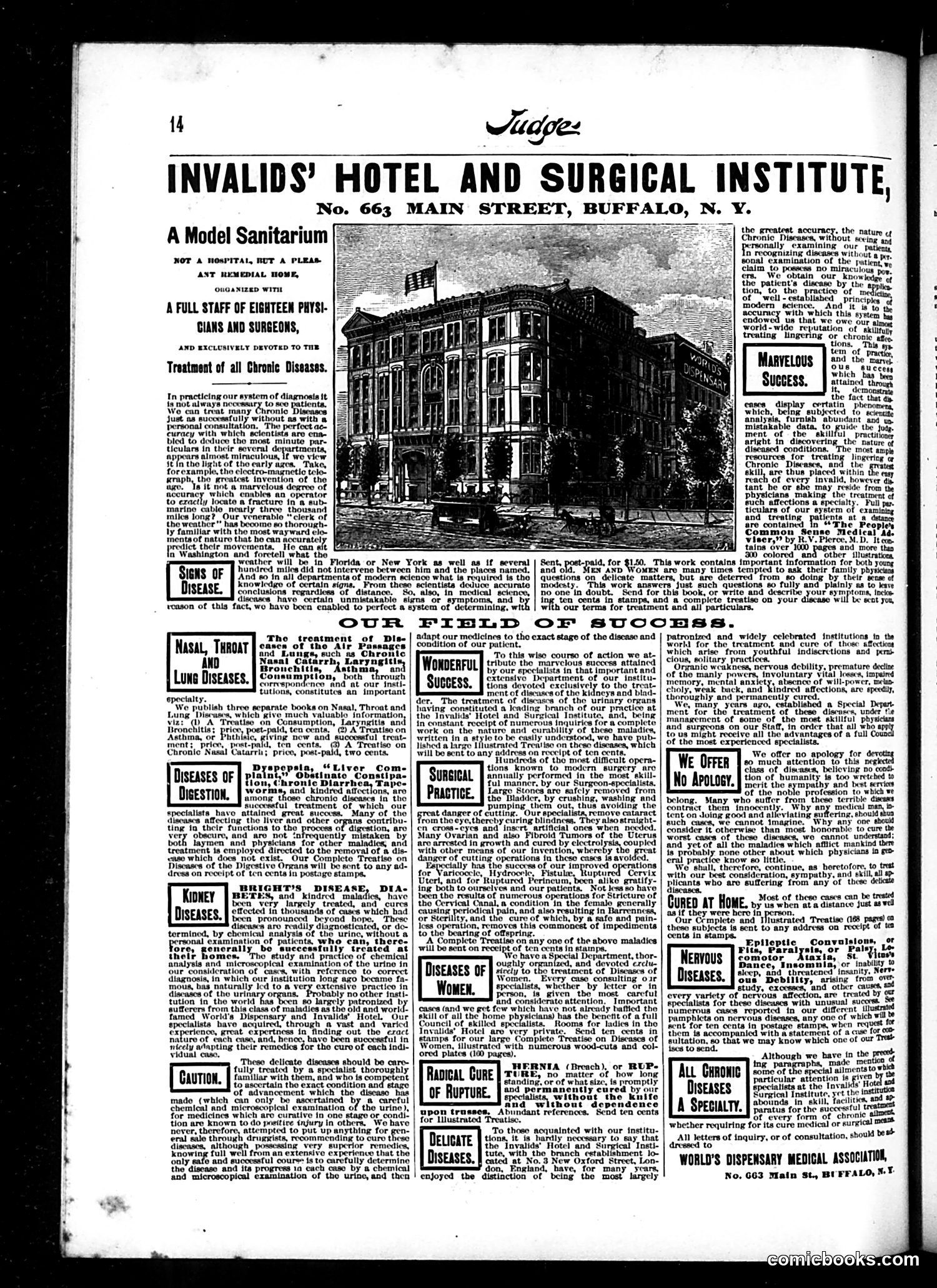
This is primarily **medical advertising**, not a satirical cartoon page. It promotes the "Invalids' Hotel and Surgical Institute" in Buffalo, New York—a real medical facility specializing in treating chronic diseases. The page features testimonials about the institute's diagnostic methods (comparing them to telegraph technology and weather prediction) and lists specialties: respiratory diseases, digestive ailments, kidney disorders, women's diseases, and nervous conditions. There is **no political satire or cartoon** visible on this page. The building photograph serves as institutional promotion. The repeated emphasis on "marvelous success" and distance treatment via correspondence reflects late-19th-century medical claims that modern readers would find dubious. This represents how Judge magazine, while primarily satirical, accepted paid medical advertisements—common practice in period publications, regardless of the advertiser's credibility.
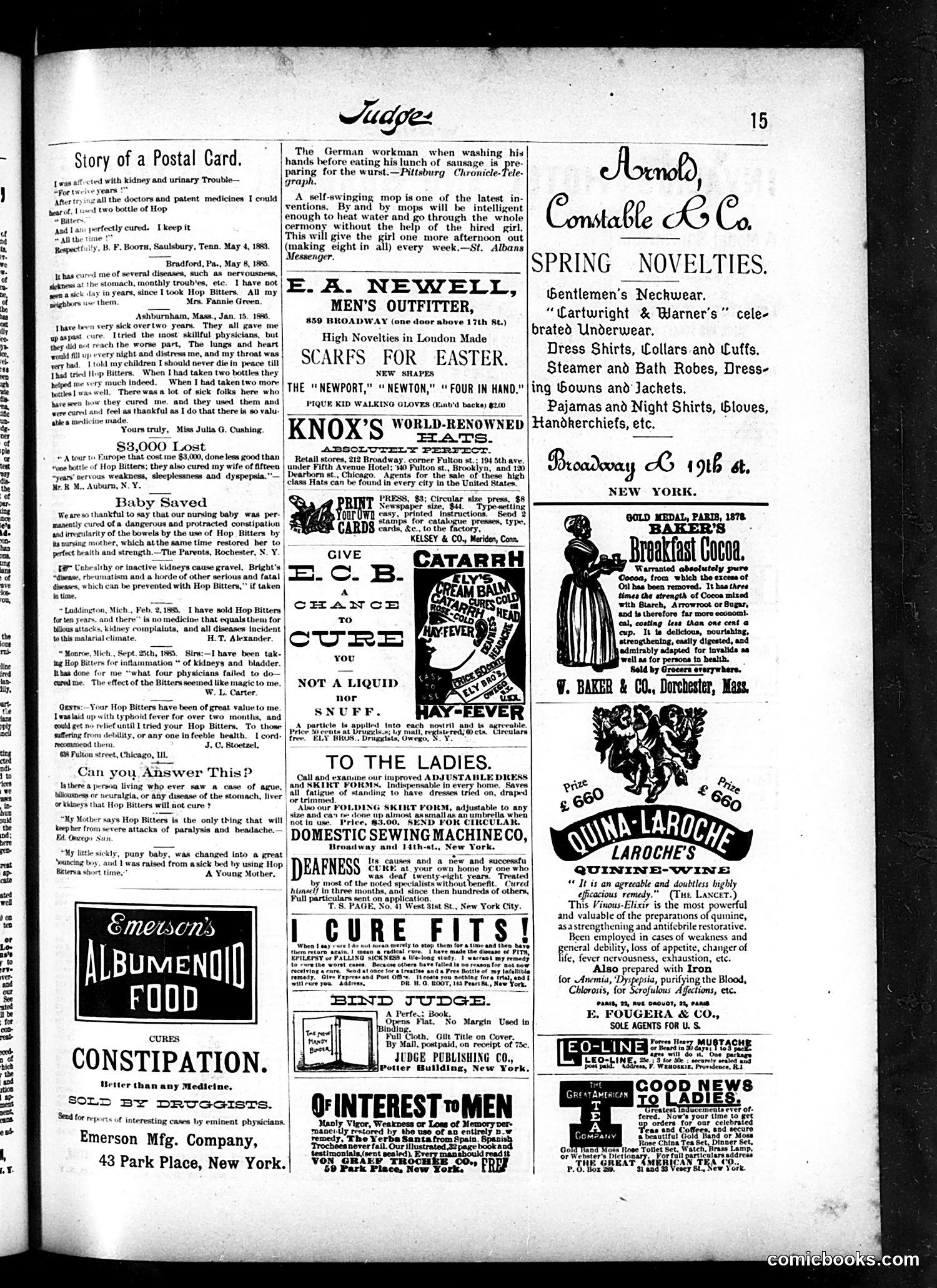
This page is primarily **advertising**, with minimal editorial content. The few small text items that appear are brief jokes and testimonials rather than political cartoons. The visible humor includes: 1. **"Story of a Postal Card"** - A series of testimonial letters praising "Hop Bitters," a patent medicine, for curing various ailments (kidney trouble, constipation, fever). These are satirical in that patent medicine ads of the era made extravagant health claims. 2. **Two brief jokes** about German workers and self-swinging mops—light, topical humor with no deep political content. The page is dominated by **Spring 1880s advertisements** for clothing (Knox Hats, Arnold Constable & Co.), patent medicines (Hop Bitters, various remedies), and other consumer goods. The satirical value here lies in Judge's implicit mockery of the era's **fraudulent medical claims** through exaggerated testimonials, rather than explicit political cartooning. No identifiable political figures or events appear.
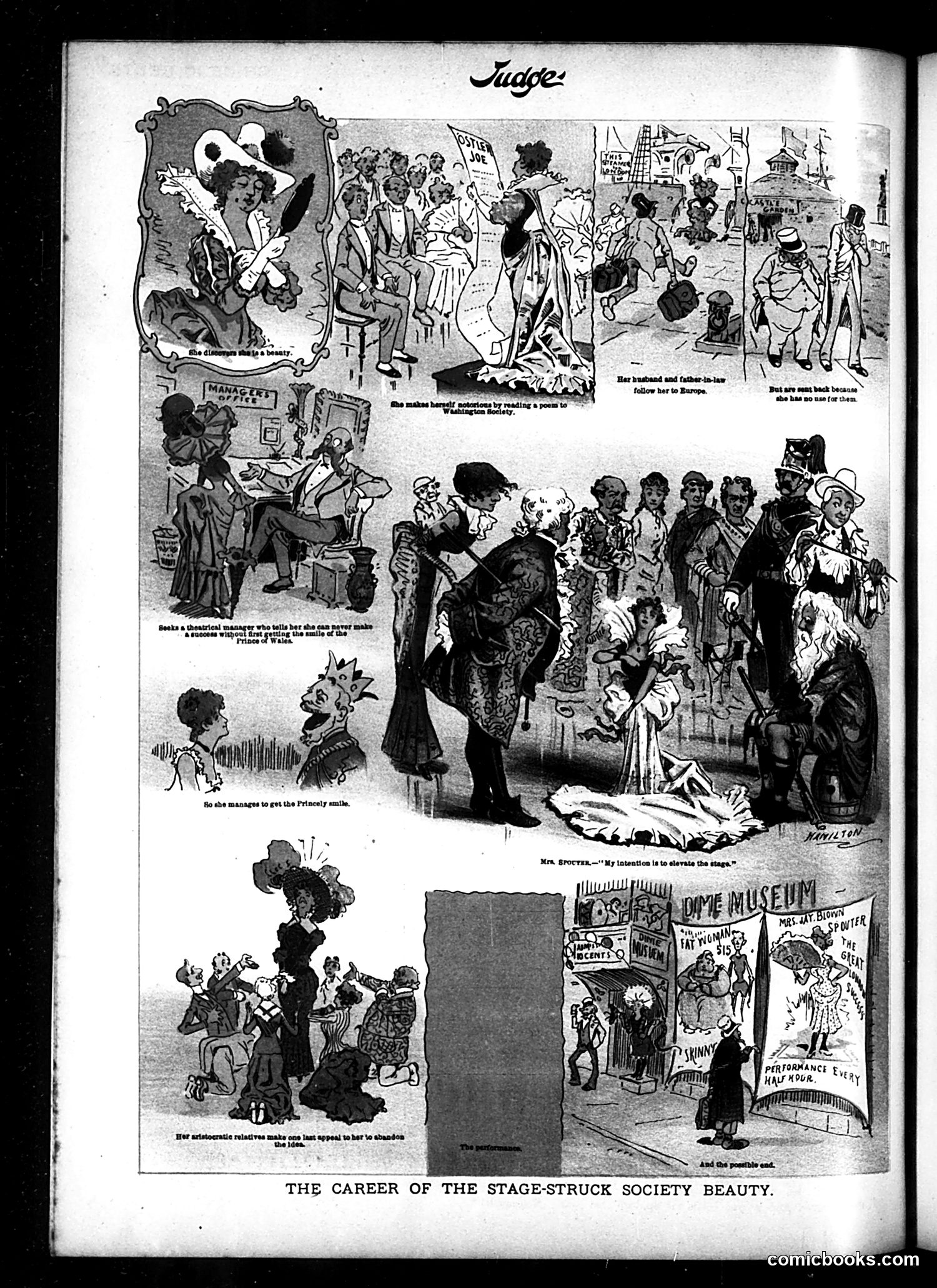
This satirical comic strip mocks wealthy young women who pursue theatrical careers, a phenomenon Judge found ridiculous. The narrative follows a society woman's theatrical ambitions through several scenes: she performs poetry readings to gain notoriety, consults a theatrical manager about success, performs at various venues, and ultimately ends up at a dime museum—the lowest rung of entertainment. The satire targets the assumption that society women believe they can succeed in theater without talent, relying instead on their social status and the approval of aristocratic patrons (the "Prince of Wales" reference suggests European pretension). The dime museum finale mocks her downward trajectory, suggesting that amateur society performers inevitably fail and end up in cheap, degrading entertainment venues. The comic ridicules both the women's delusions and their actual lack of theatrical ability.