
A complete issue · 24 pages · 1887
Judge — March 12, 1887
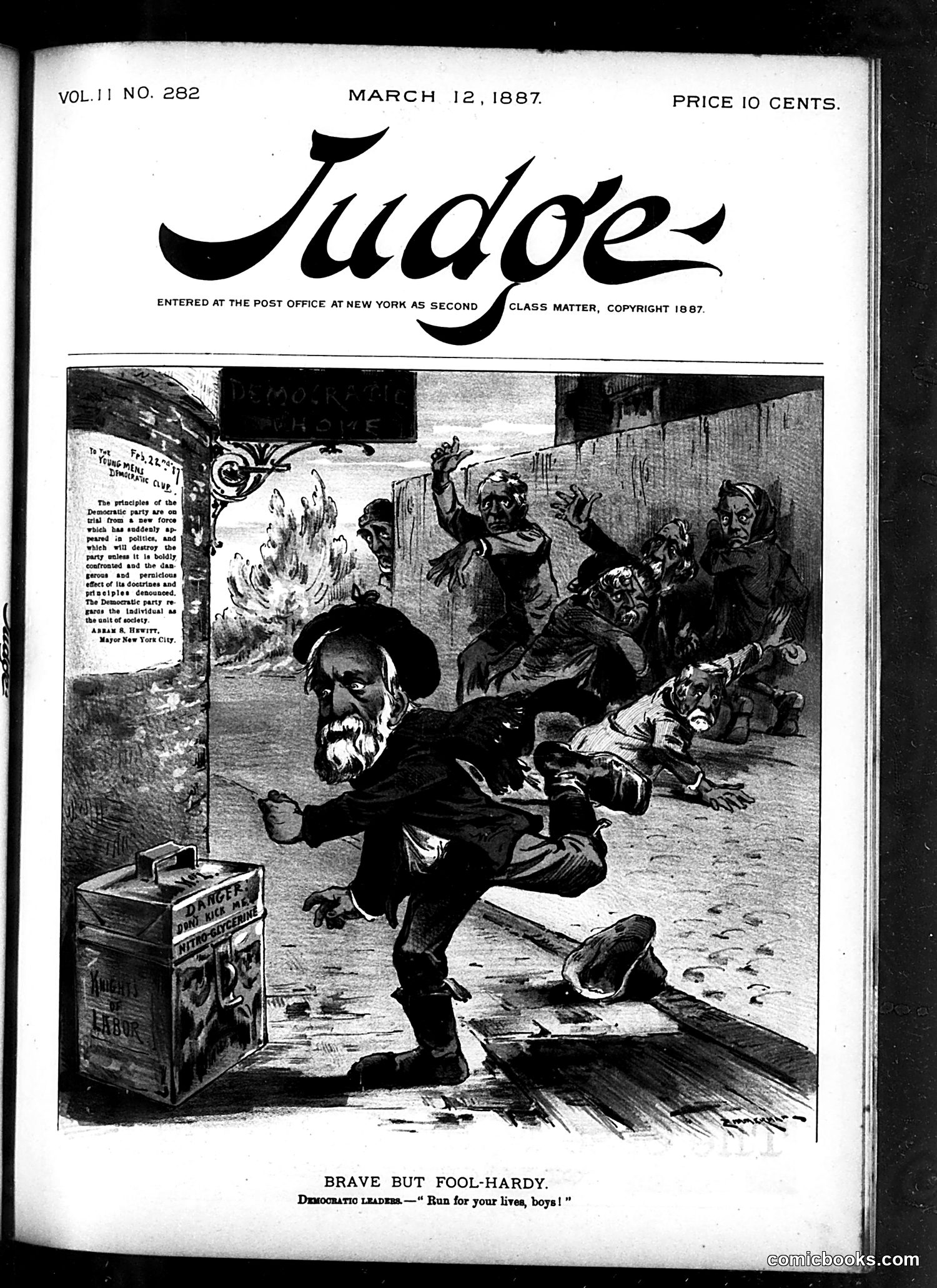
This *Judge* cartoon from March 12, 1887 depicts a bearded man (likely a Democratic political leader) running desperately from a fire while pursued by angry figures. The caption quotes him urging "Run for your lives, boys!" The satire targets Democratic Party leadership during a period of internal conflict. The fire and pursuing mob appear to represent consequences the Democrats face—possibly related to the party's divisive positions or failed policies. The "brave but fool-hardy" title suggests the leader's actions are simultaneously courageous yet strategically reckless. The small text block on the left contains commentary, though it's partially illegible. The overall message criticizes Democratic leadership as simultaneously bold and dangerously misguided, fleeing from the chaos they've created.
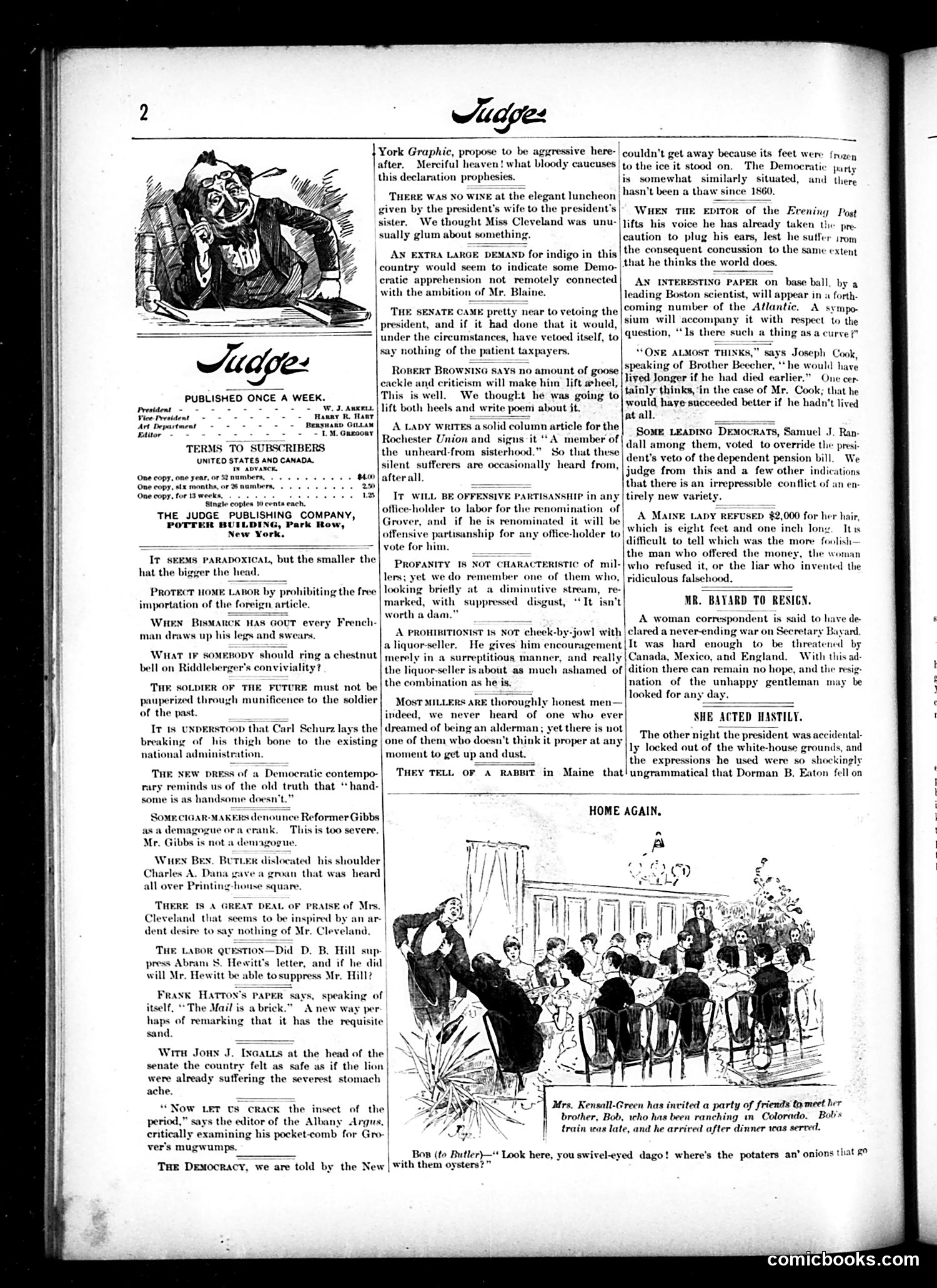
This page contains political commentary and social satire typical of late 19th-century American journalism. The top cartoon depicts a grotesque caricature (likely a political figure, though unclear who specifically) in a disheveled state. The text discusses various political and social issues including: Democratic apprehension about Mr. Blaine, Senate voting on taxation, Robert Browning's poetry criticism, and partisan office-holding disputes. There's commentary on a Maine rabbit incident and references to Secretary Bayard. The bottom illustration titled "HOME AGAIN" shows Mrs. Kimball-Green's dinner party reception—a social scene satirizing domestic life. The magazine's tone mixes political critique with humor about contemporary figures and events, though without dates or bylines, specific references remain difficult to identify with certainty.
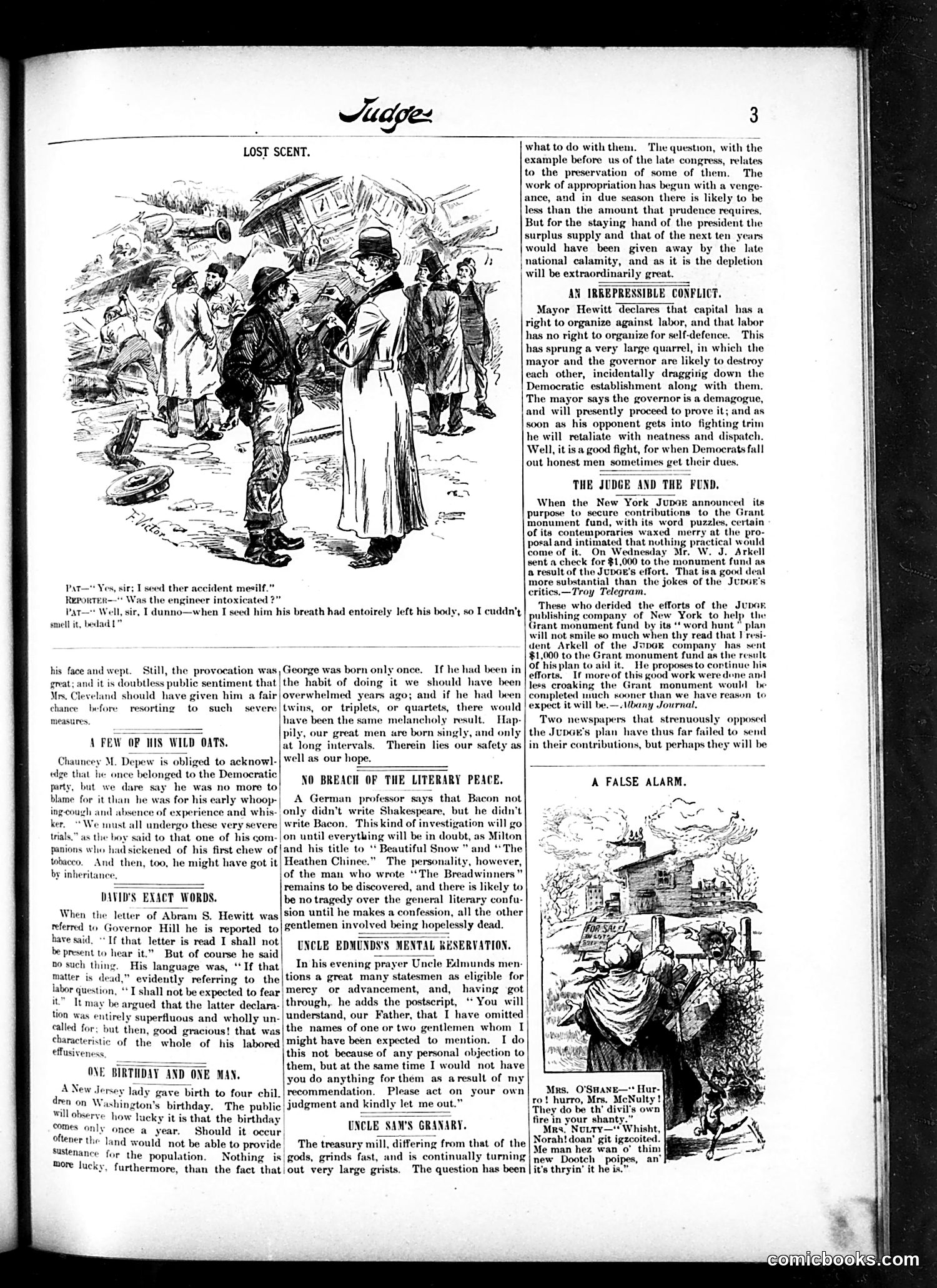
This page from Judge satirizes American politics and social issues circa the 1880s-90s. **"Lost Scent"** (top cartoon): A reporter interviews a witness about a train accident. The humor relies on an Irish dialect joke—the witness says he couldn't tell if the engineer was drunk because he "seed him h[is] face and wept," suggesting the engineer's breath was so strong it made him cry. **"An Irrepressible Conflict"**: Political commentary on New York Mayor Abram Hewitt and Governor David Hill quarreling over labor rights—Hewitt opposed workers organizing while Hill apparently supported them. Judge mocks their conflict as destructive to the Democratic party. **"The Judge and the Fund"**: The magazine reports approvingly that their Grant monument fundraising campaign (using word puzzles) successfully raised $1,000 from W.J. Arkell, proving critics wrong. **"David's Exact Words"**: A brief political jab at Governor Hill, noting he denied saying something about the labor question, though the denial itself was suspicious. The page reflects Gilded Age labor tensions and Democratic Party internal struggles.
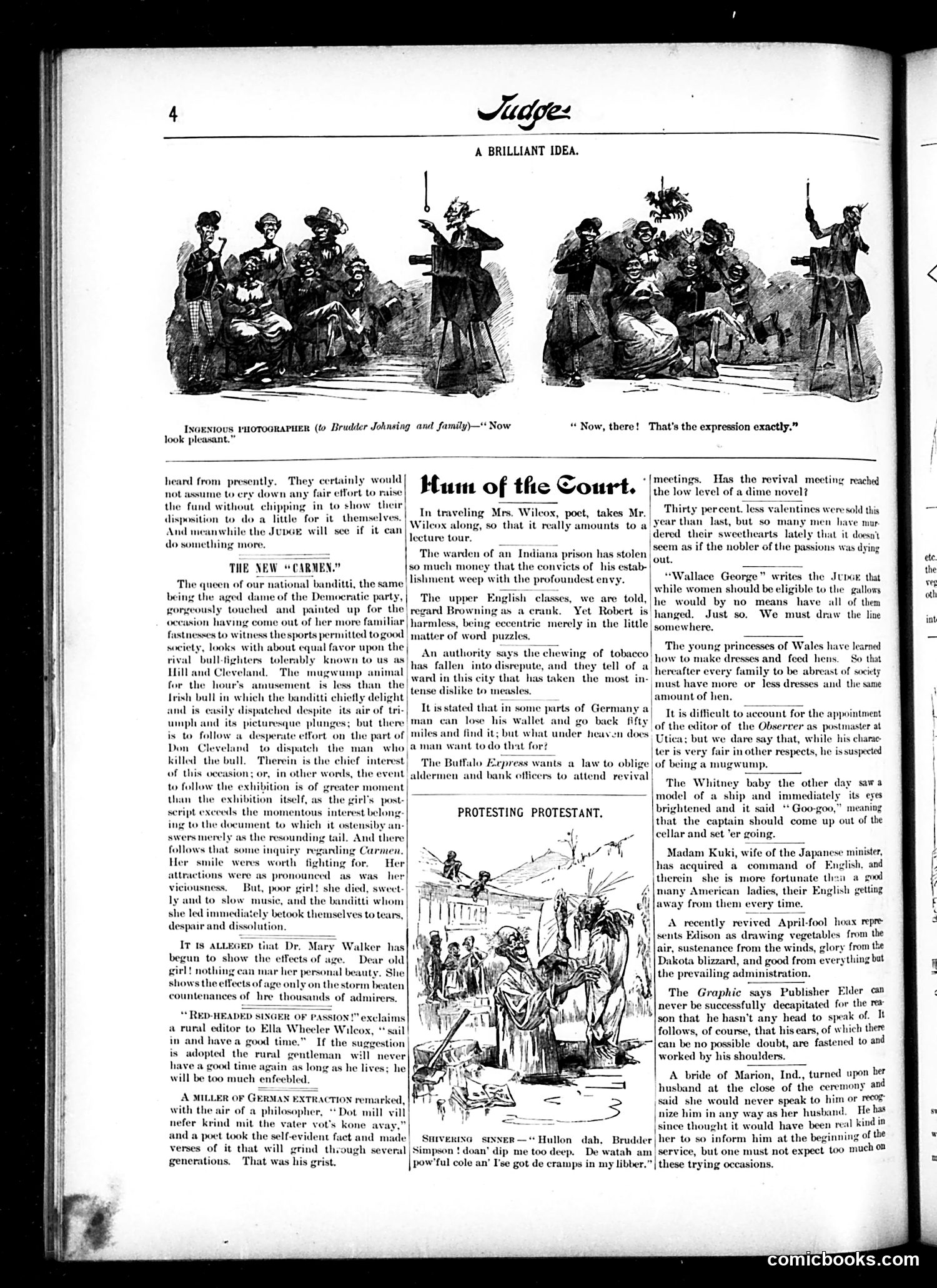
This page from Judge (a Gilded Age satirical publication) contains several brief humor items and two cartoons mocking contemporary figures and social issues. **"A Brilliant Idea"** (top): Shows a photographer instructing subjects to "look pleasant" for a portrait—a joke about the difficulty of achieving natural expressions in early photography. **"Hum of the Court"** (center): A gossip column mixing trivial social observations with mild satire. It mocks literary figure Robert Browning as eccentric, comments on English class pretensions, and reports that Valentine's Day sales dropped because men had "murdered their sweethearts lately"—dark humor referencing domestic violence. **"The New Carmen"** (left): Discusses a female bandit being executed, comparing her to opera's Carmen character. The humor is obscure without fuller context. **"Protesting Protestant"** (bottom): An illustration accompanying text about religious revivals—likely satirizing Protestant camp meetings or revival fervor popular in that era. The page reflects Judge's approach: mixing theatrical/literary mockery with sarcastic social commentary on contemporary news events.
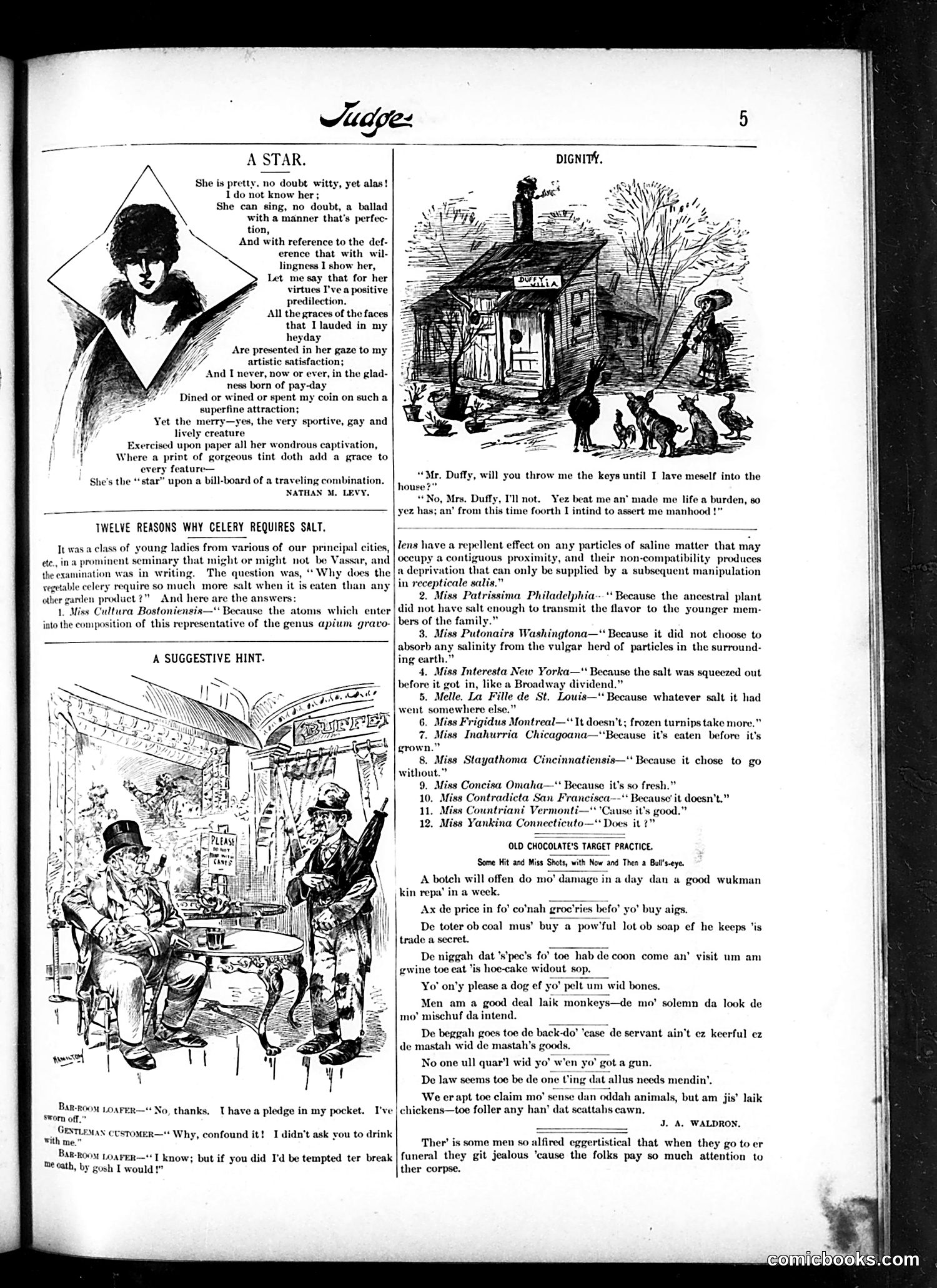
**"A Star"** satirizes the theatrical world. The poem mocks an attractive but talentless actress whose only merit is her appearance on billboards for traveling theater companies. The author admits not knowing who she is, yet acknowledges her "gorgeous" looks compensate for lack of genuine talent. The satire targets the entertainment industry's prioritization of beauty over ability. **"Dignity"** depicts an Irish domestic dispute where Mr. Duffy refuses to give his wife house keys, claiming he's "asserting manhood" after years of mistreatment. The satire ridicules both working-class marital discord and the era's fragile masculinity—the man's petty "assertion" of dominance through key-withholding appears absurdly undignified. **"Twelve Reasons"** humorously mocks educated women, presenting ridiculous pseudo-scientific answers to why celery requires salt. The answers reference cities (Boston, Philadelphia, Washington) and employ pretentious language, satirizing both academic pomposity and women's seminary education as producing overwrought intellectualism divorced from common sense.
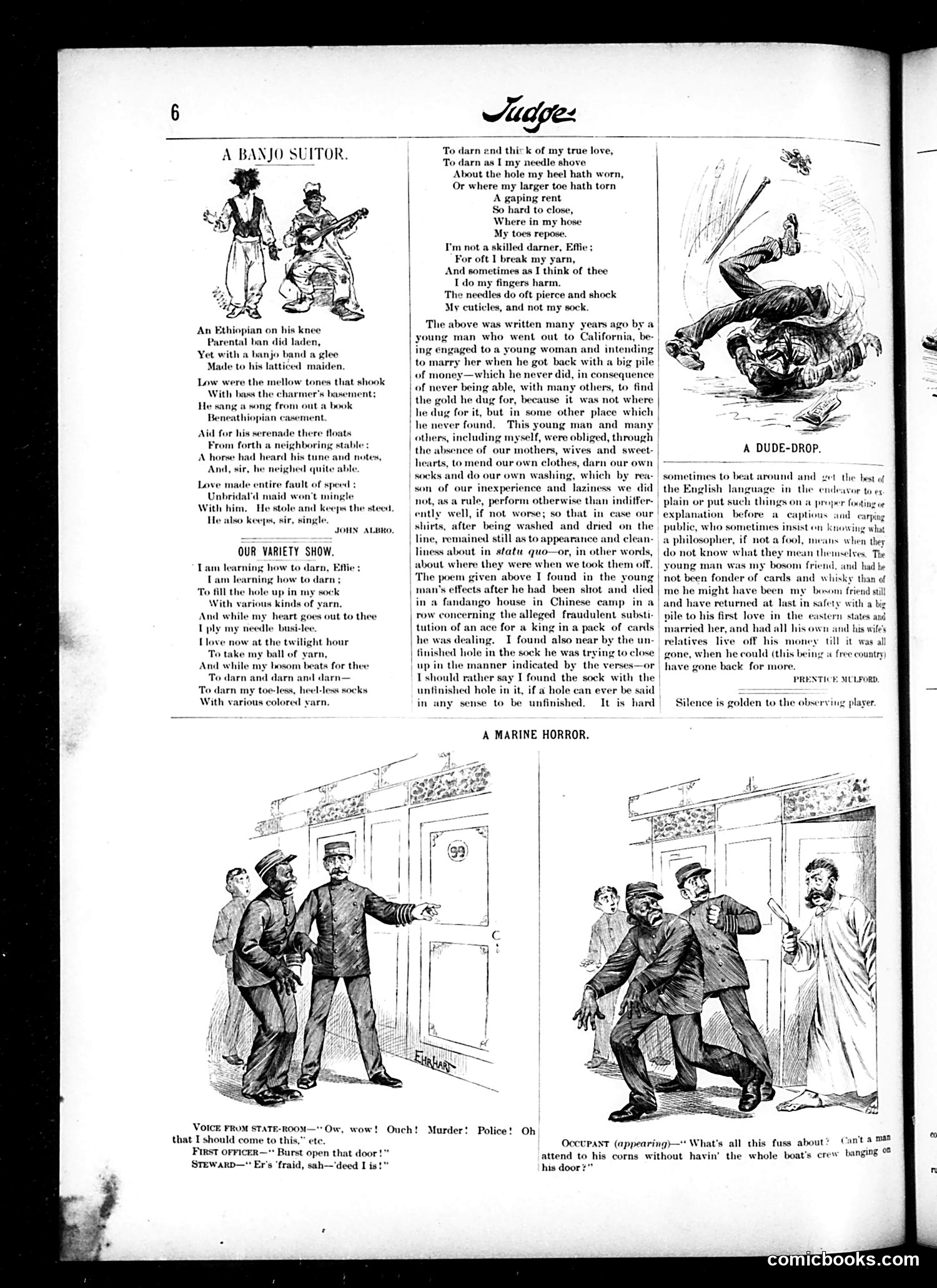
This page contains three satirical pieces typical of late 19th-century American humor: **"A Banjo Suitor"** mocks sentimental courtship songs through exaggerated romantic poetry about a man serenading with a banjo. **"Our Variety Show"** features humorous verse about darning socks. The accompanying prose explains the context: California Gold Rush prospectors lacked wives and mothers to mend clothes, so they attempted it themselves—poorly. The narrator includes a backstory about a young man who died in a gambling dispute in a Chinese mining camp with an unfinished sock hole, treating domestic incompetence as comedic tragedy. **"A Marine Horror"** presents two related shipboard scenes depicting confusion and alarm among crew members, with dialogue suggesting a passenger complaint about cabin access or noise disturbance. The humor relies on Victorian-era sensibilities: sentimentality, domestic mishaps, and maritime mishaps. The Gold Rush narrative adds period color, treating frontier incompetence at "women's work" as inherently amusing.
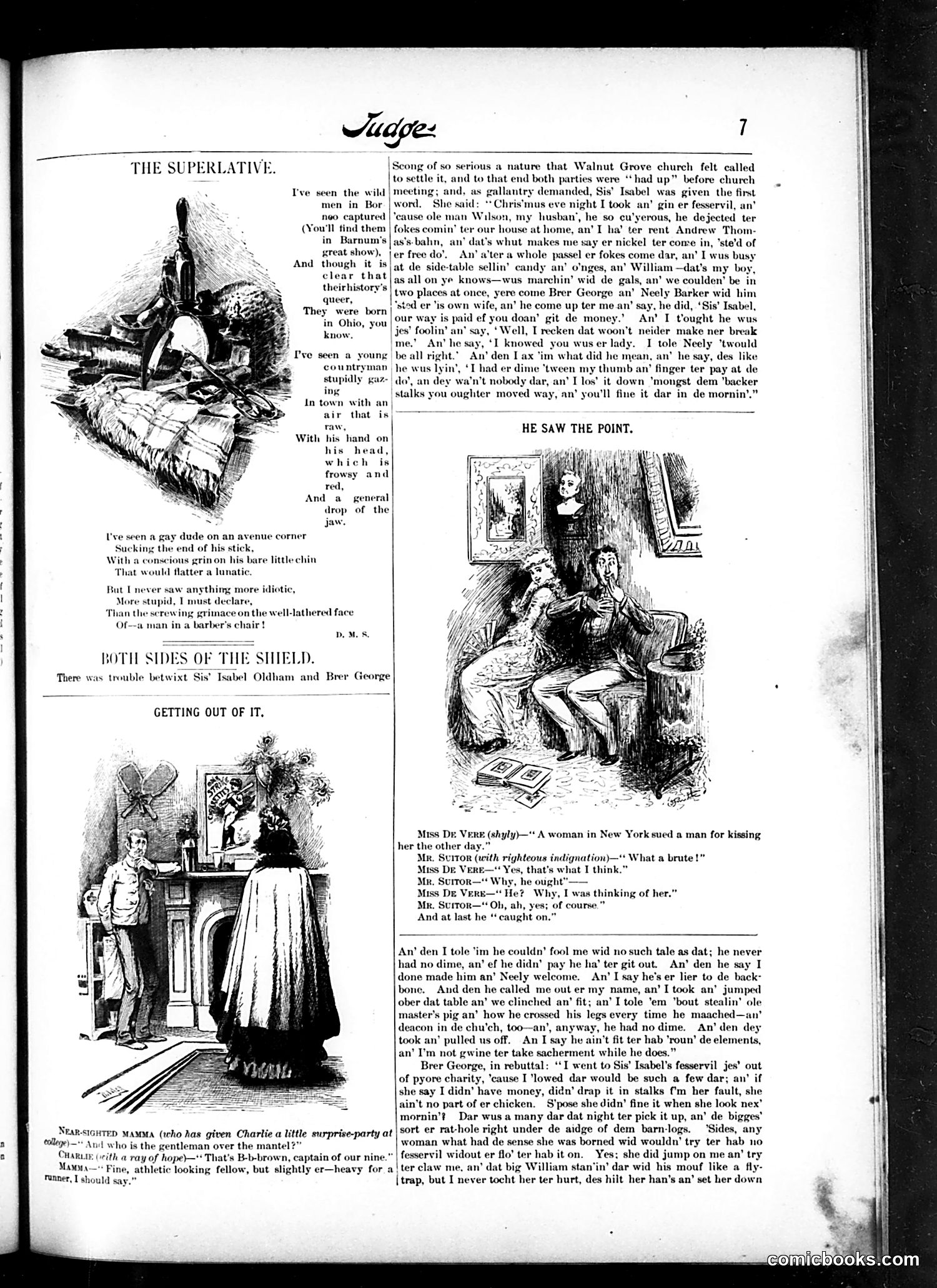
This page contains dialect humor stories typical of late-19th-century American satire, using exaggerated African American vernacular ("Sis' Isabel," "Brer George"). **"Both Sides of the Shield"** depicts a church dispute: Sis' Isabel claims Brer George borrowed money for a church collection but lost it among tobacco stalks. George denies ever having the money. Their conflicting accounts—both plausible, both suspicious—illustrate how truth becomes murky in disputes. **"He Saw the Point"** (right cartoon) shows a man finally understanding a woman's implied criticism after initial confusion. **"Getting Out of It"** depicts social awkwardness: Mr. Sutton righteously condemns a man for kissing a woman, but when Mrs. Sutton mentions thinking of *that woman* fondly, Sutton realizes his wife meant something different—an embarrassing misunderstanding resolved too late. The satire mocks human nature: self-deception, miscommunication, and how people rationalize questionable behavior through plausible denial or convenient misunderstanding.
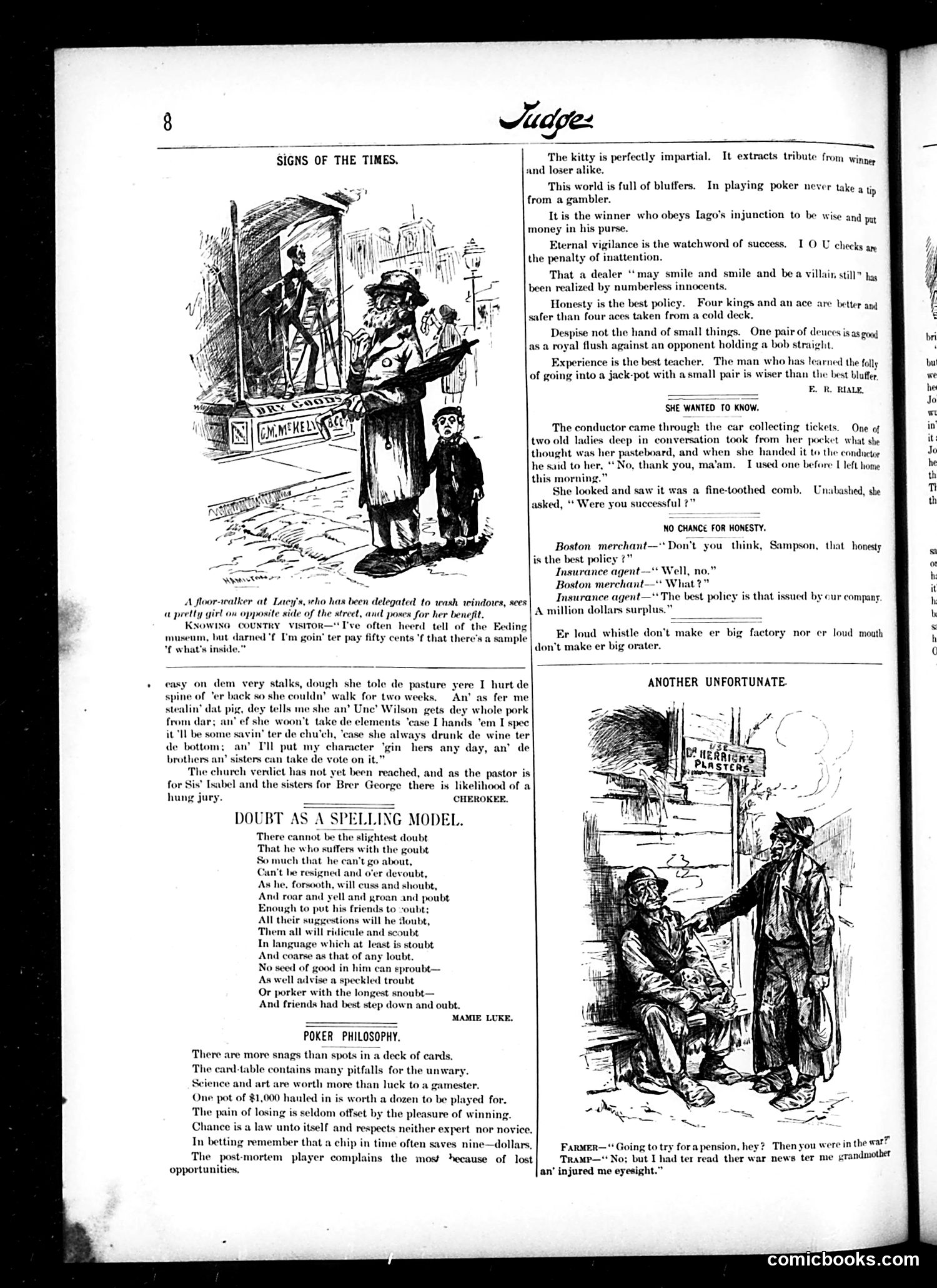
This page from *Judge* magazine contains several satirical pieces typical of late 19th-century American humor: **"Signs of the Times"** features a sketch of a floor-walker posing to impress a woman across the street, with accompanying dialect humor about church scandals—typical working-class social satire. **"Doubt as a Spelling Model"** is a humorous poem mocking someone with gout through forced rhymes (doubt/gout/about/shoubt), poking fun at both the affliction and poor spelling. **"Poker Philosophy"** offers cynical gambling aphorisms—advice that luck matters little and most players lose money, reflecting period concerns about gambling's social dangers. **"She Wanted to Know"** presents a gentle joke about an elderly woman accidentally handing a conductor a comb instead of a ticket, then asking if he was "successful" with it. **"No Chance for Honesty"** satirizes insurance companies as dishonest, with an agent claiming the insurance policy itself (not honesty) is "the best policy"—wordplay mocking corporate ethics. **"Another Unfortunate"** shows a tramp claiming he needs a war pension because he merely *read* war news to his grandmother, not actually serving.
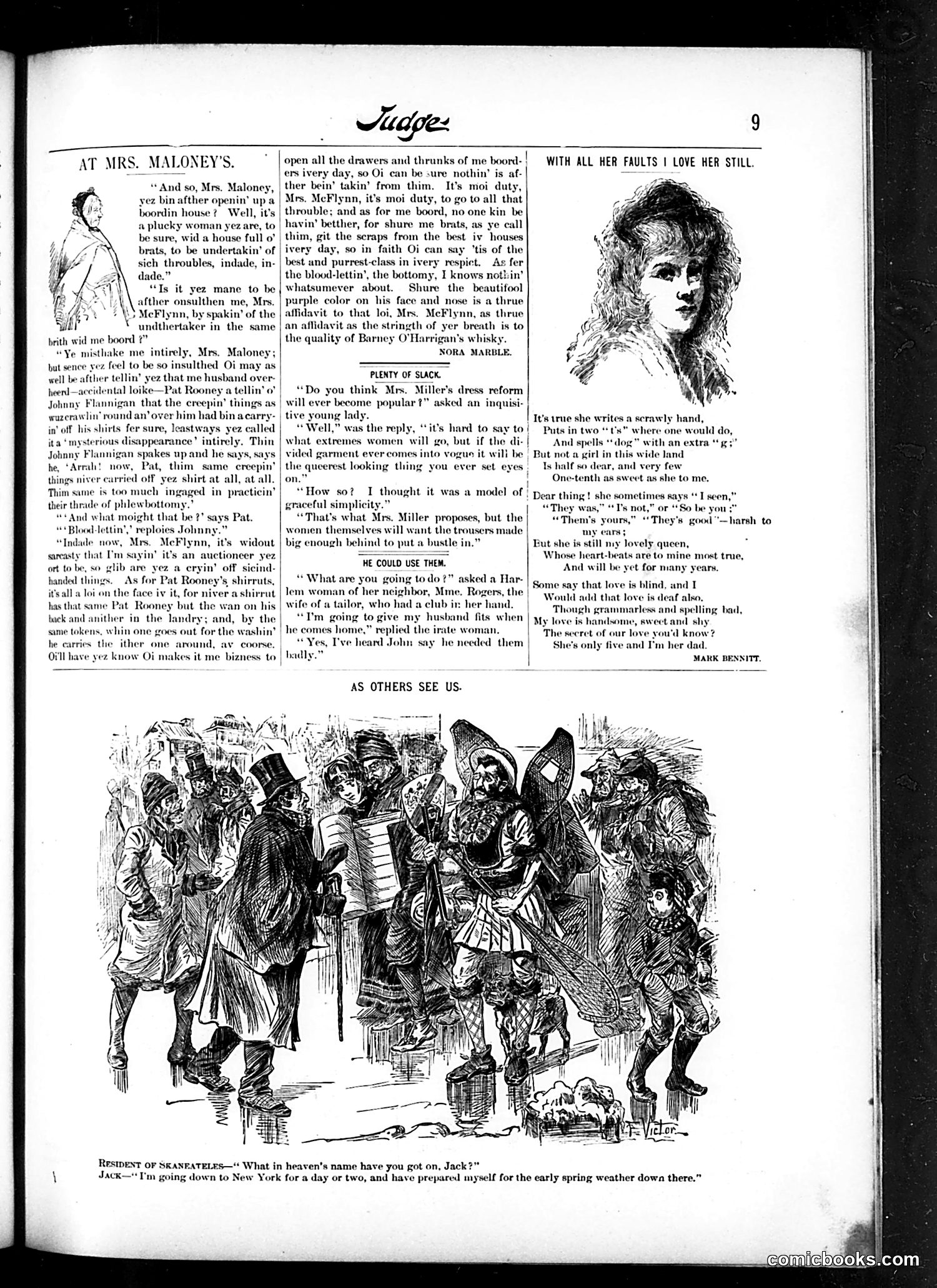
This page contains three separate satirical pieces featuring Irish-American working-class characters, typical of *Judge* magazine's humor: **"At Mrs. Maloney's"**: Two Irish landladies discuss Mrs. Maloney's boarding house. The satire mocks both her claim of high-quality food (boarders eat "scraps from the best iv houses") and her invasive inspections of tenants' belongings. The crude joke about "blood-lettin'" refers to lice infestation causing the boarders' bruised appearance—implying filthy conditions despite her boasts. **"Plenty of Slack"**: Mocks women's dress reform advocates. The joke: reformers propose divided skirts for practicality, but women will demand them oversized to accommodate bustles—defeating the purpose and making them look ridiculous. **"He Could Use Them"**: A brief joke about a tailor's wife planning to hit her husband with his own clubs when he comes home, because he "needed them badly"—implying marital discord. The bottom illustration and caption appear unrelated fragments. These pieces exemplify *Judge's* era-typical stereotyping of working-class Irish immigrants and mockery of women's reform movements.
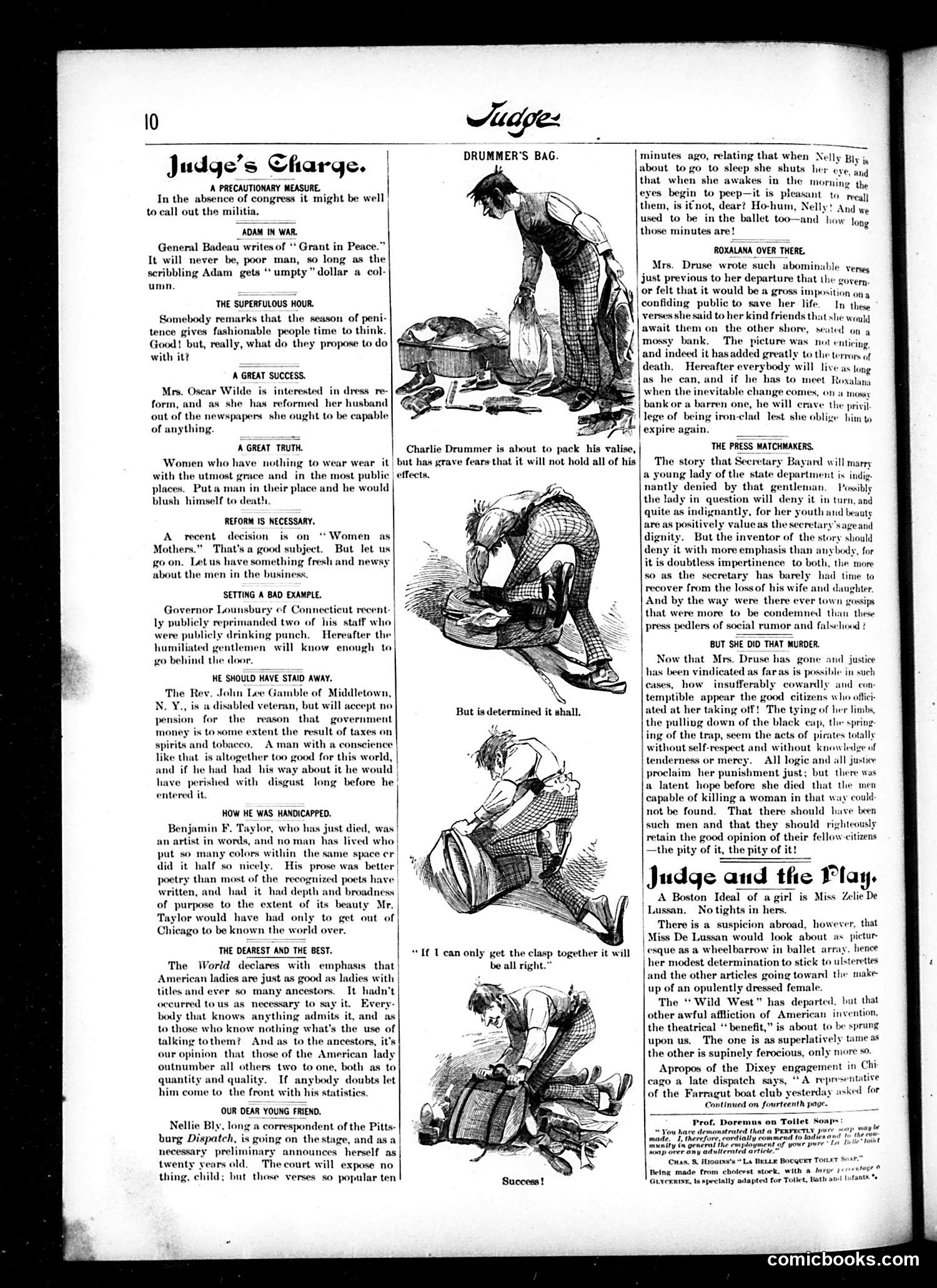
This page contains brief satirical commentary pieces typical of Judge magazine's format. The main visual element is a four-panel cartoon titled "Drummer's Bag" depicting a traveling salesman struggling to pack an overstuffed valise—a relatable joke about excessive luggage. The text pieces mock contemporary figures and social issues: - **Oscar Wilde's wife** is praised for reforming her husband "out of the newspapers" (satirizing his notoriety) - **Nellie Bly**, the pioneering female journalist, is mocked for going on stage and claiming virginity at age twenty-four - **Benjamin F. Taylor**, a deceased writer, is praised for poetic prose but criticized for staying in Chicago rather than achieving wider fame - Various commentary on women's fashion, government pensions, and social hypocrisy The humor relies on Victorian-era sensibilities about propriety, gender roles, and public figures' scandals—references modern readers would need context to fully appreciate.
This page is primarily **promotional content**, not satire or political commentary. It's a lengthy article celebrating the Sohmer & Co. piano manufacturing company, located on Long Island, New York. The text describes the firm's rapid growth since 1872, detailing their expansion from a small factory producing "three to four" pianos weekly to a large operation. It praises their new six-story factory building (150 feet high) as "one of the most magnificent and perfect pianoforte factories in this country." The article emphasizes American industrial achievement and entrepreneurial success—common themes in *Judge* magazine during the 1880s. It notes that the piano was "improved and perfected in the United States," reflecting 19th-century American pride in manufacturing prowess. This appears to be **advertising content** disguised as editorial coverage—a common practice in period publications. There is no visible cartoon on this page; it's straightforward business promotion celebrating industrial progress and a specific company's commercial success.
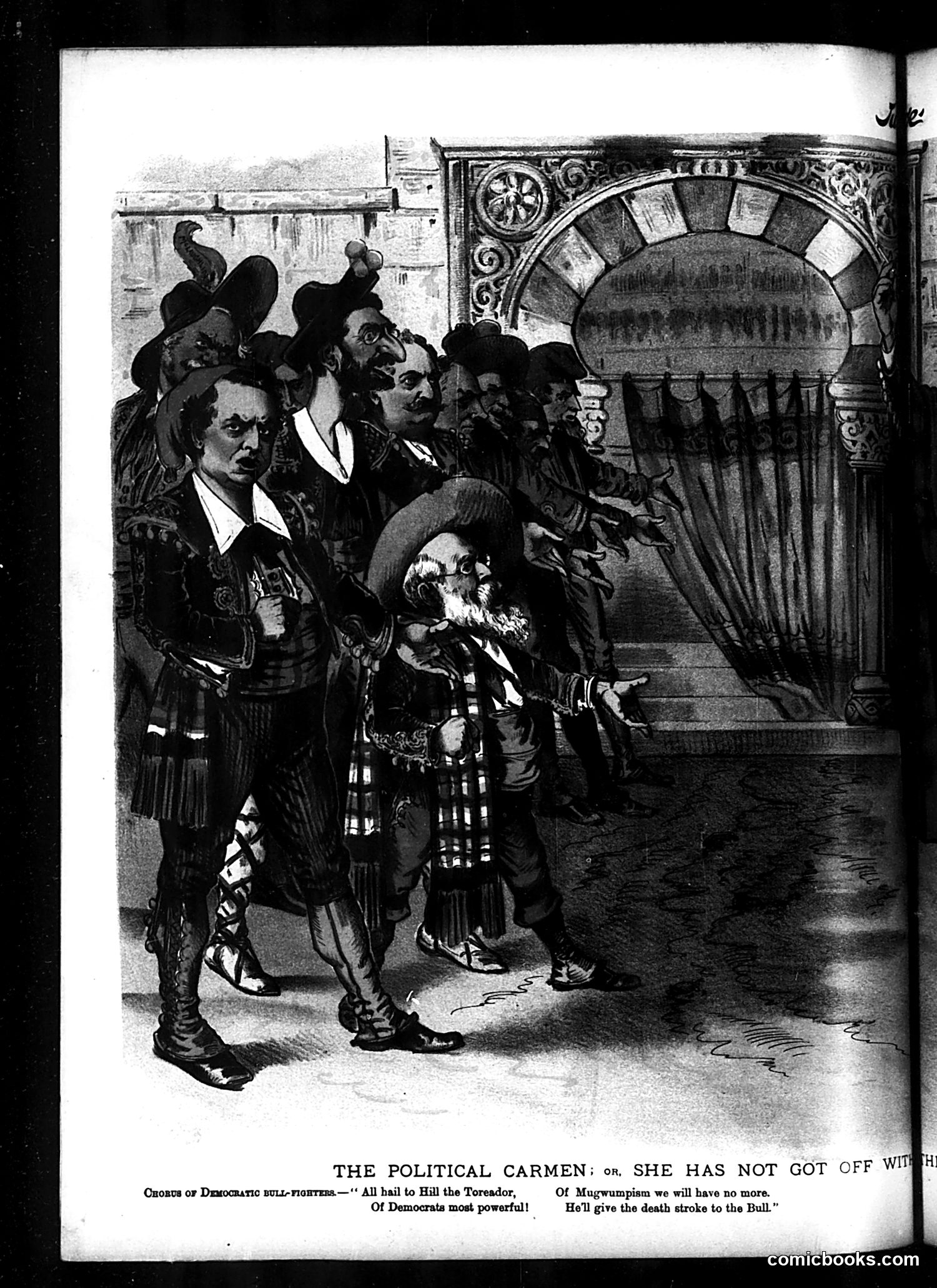
This Judge magazine cartoon satirizes Democratic party leadership during the Mugwump era (late 1880s). The title references a "Carmen" (likely evoking the opera's seductive temptress) who "has not got off with" her political scheme. The text references "Hill the Toreador"—likely David B. Hill, a prominent New York Democrat—as a "bull-fighter" who will eliminate "Mugwumpism" (the reform movement of Republicans who broke ranks to support Democrats). The assembled military and political figures appear to be celebrating this promised purge. The satire mocks Democratic claims of strength and reform while suggesting internal party conflicts. The theatrical staging (ornate hall, dramatic poses) emphasizes the cartoon's view of Democratic political theater as mere performance rather than genuine reform. The OCR is heavily garbled, making complete certainty difficult, but the core message critiques Democratic party machinations during this period of political realignment.
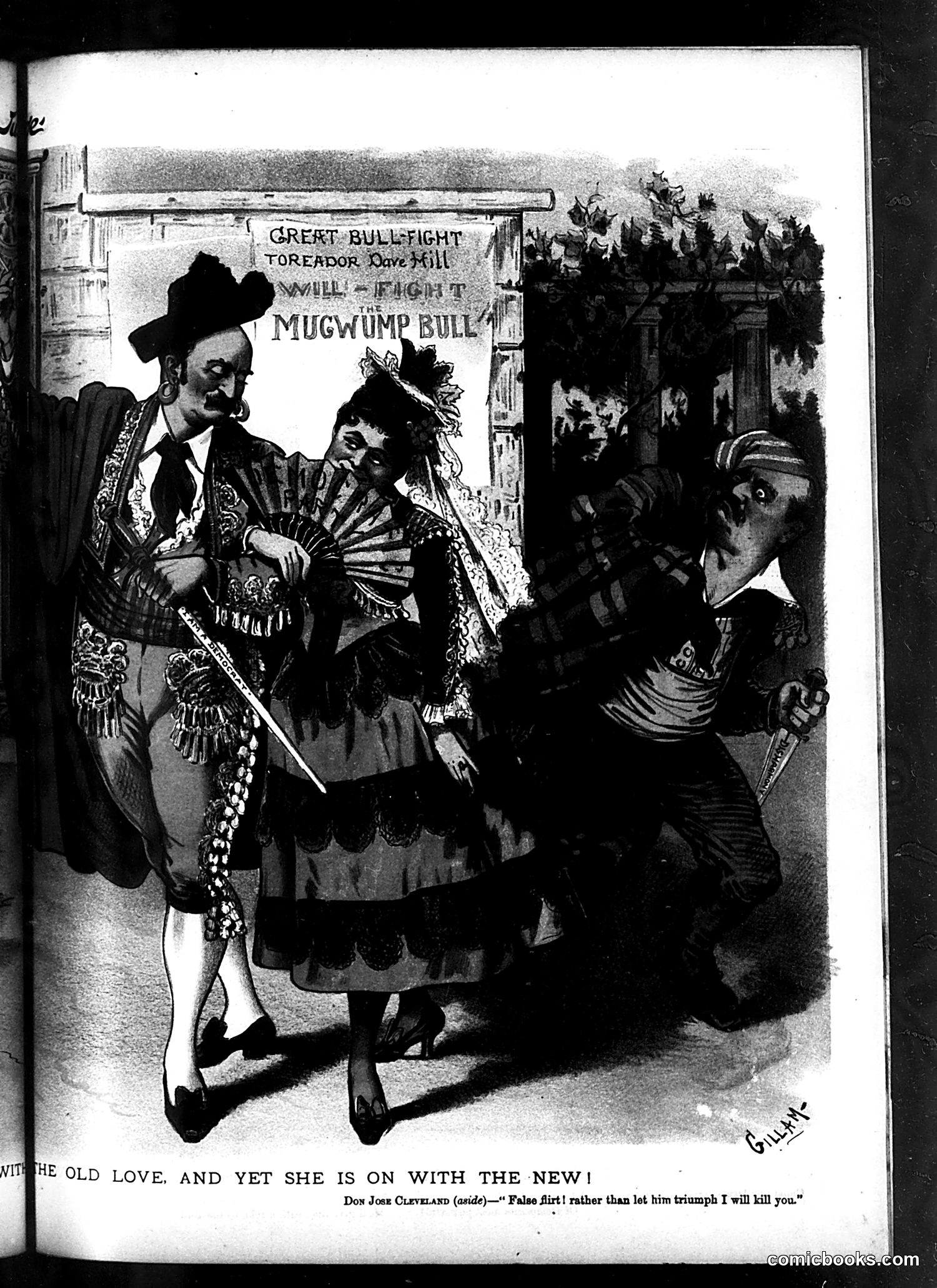
This cartoon satirizes a "Mugwump Bull" — likely referencing the Mugwumps, independent Republicans who split from the party during the 1884 presidential election. The central figure appears to be a woman in elaborate Spanish/Mexican dress, representing either a political prize or allegiance being contested between two suitors. The caption references "Don Jose Clevezang" (possibly a corruption of a Spanish name), suggesting the satire involves romantic/political fickleness — the woman abandons her "old love" for "the new," implying politicians or voters switching allegiances. The bullfighting reference and Spanish elements suggest this concerns American foreign policy or territorial interests, possibly related to Cuba or Spanish colonial affairs that were contemporary political issues. The "Mugwump" label indicates the cartoon mocks independent voters as inconsistent or unreliable.
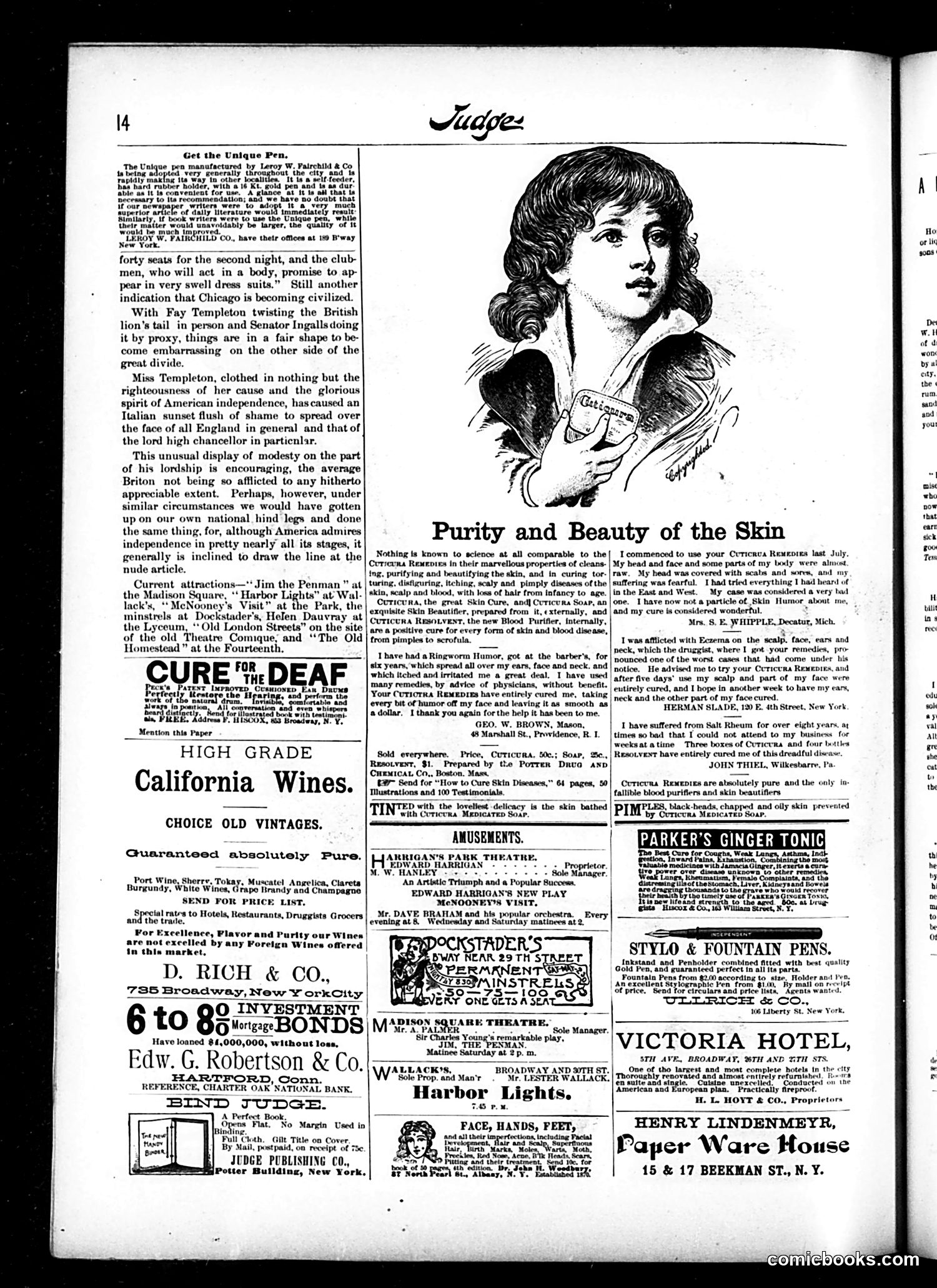
This page is primarily **advertisements and notices** rather than political satire. The main visual element is a portrait labeled "Purity and Beauty of the Skin," accompanying testimonials for Cuticura skincare products. The brief editorial text discusses current theater attractions and mentions **Fay Templeton**, a British-American actress performing in New York. The passage suggests she has caused embarrassment to British leadership through her displays of "American independence," apparently referencing her performing nearly nude—shocking to Victorian sensibilities. The text humorously notes that British nobility's modesty in response is unusual for them. The page otherwise consists of **commercial advertisements** for California wines, investment bonds, writing pens, and other products typical of 1880s-90s Judge magazine. The "Cure the Deaf" advertisement appears prominently. This reflects Judge's business model: satirical content supported by paid advertising.
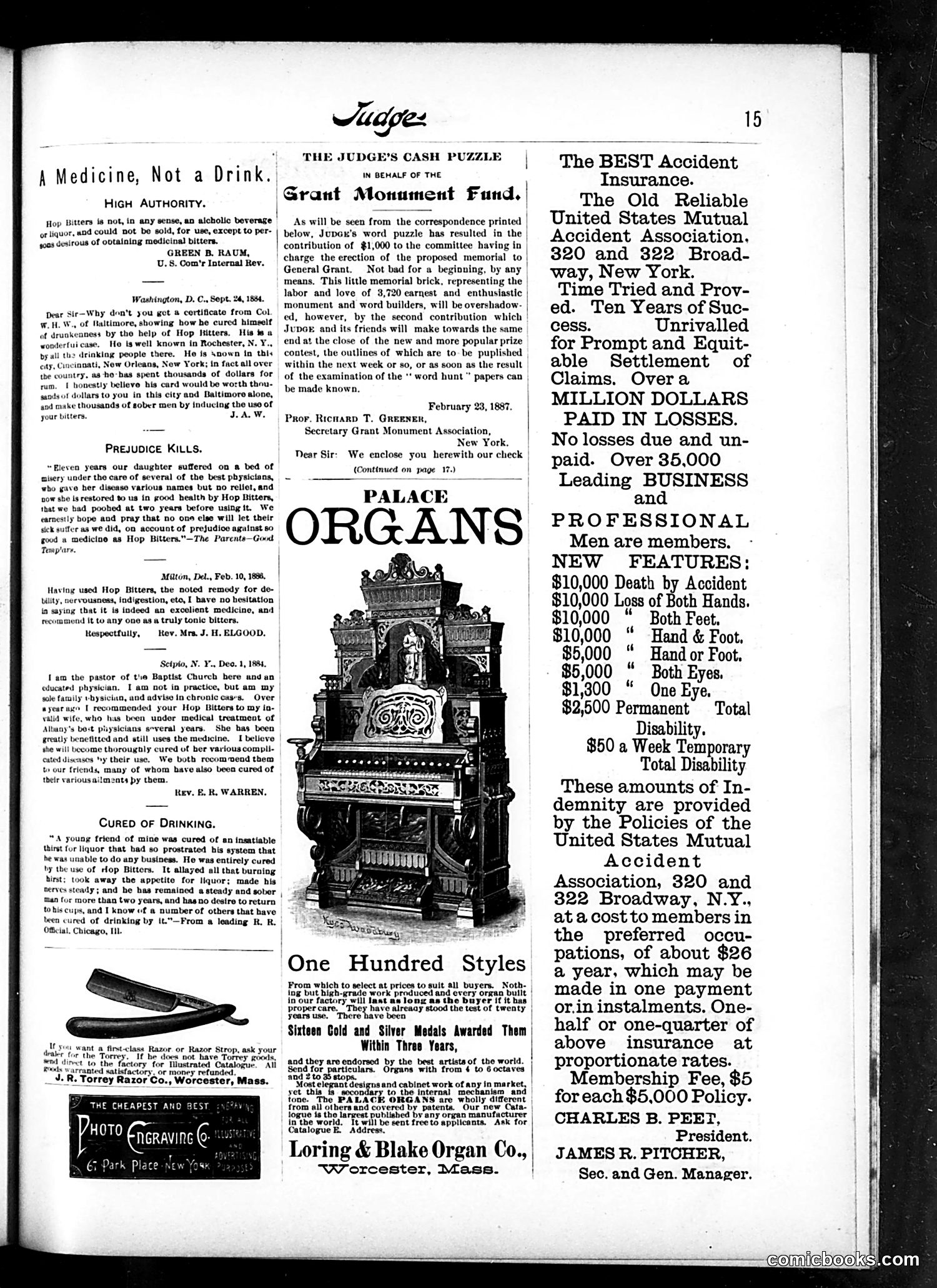
This page is primarily **advertising and testimonials**, not political satire. The dominant content promotes **Hop Bitters**, a patent medicine marketed as a health tonic rather than an alcoholic beverage. The testimonials use authority figures—a U.S. Commissioner of Internal Revenue, clergy, and physicians—to legitimize Hop Bitters as medicinal rather than liquor. This reflects late-19th-century tensions around Prohibition and "temperance" movements: the product's makers needed legal cover, claiming medicinal status while clearly marketing to heavy drinkers seeking to quit alcohol ("Cure of Drinking" section). The page also advertises **Palace Organs** and Torrey Razors, plus announces Judge magazine's **Grant Monument Fund puzzle contest**—a fundraising gimmick offering $1,000 in contributions. There is **no political cartoon visible**; the only illustration is an ornate organ. This appears to be a typical magazine interior page mixing advertisements with light editorial content.
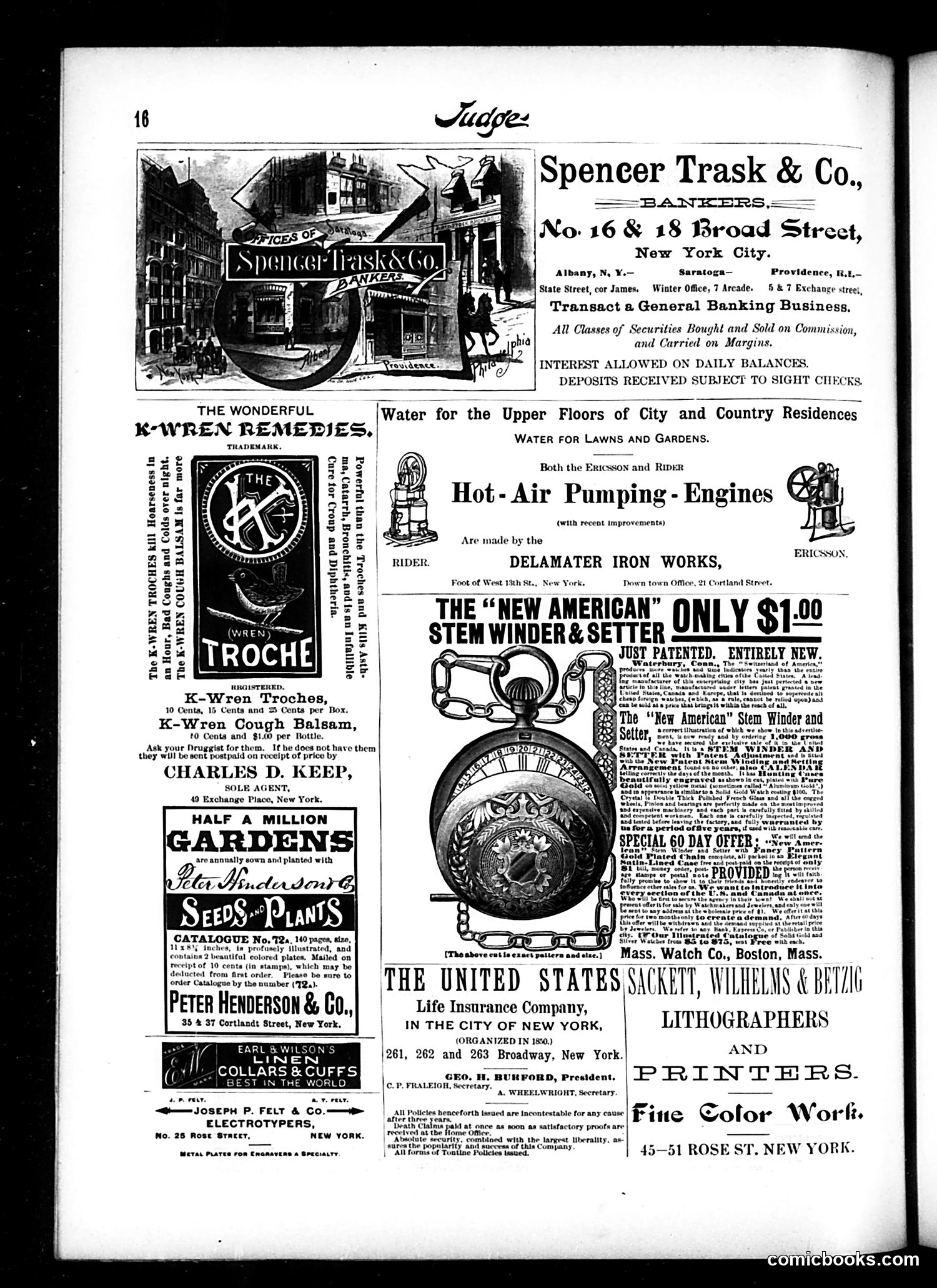
This page is primarily **advertising**, not political satire. It's from Judge magazine but contains commercial notices rather than cartoons with political commentary. The visible content includes: - **Spencer Trask & Co.** banking advertisement (top) - **K-Wren Remedies** ads for cough treatments and tonics—typical 19th-century patent medicines claiming to cure various ailments - **Hot-Air Pumping Engines** advertisement from Delamater Iron Works - **"New American" Stem Winder & Setter** watch mechanism—a newly patented product advertised at only $1 - Various other period business ads (seeds, lithography, life insurance) The single illustration shows a detailed mechanical watch face, promoting the patented stem-winding feature as innovative technology. There are **no political cartoons or satirical commentary visible** on this page—it functions as a revenue-generating advertising section typical of 19th-century magazines, which subsidized editorial content through paid advertisements.
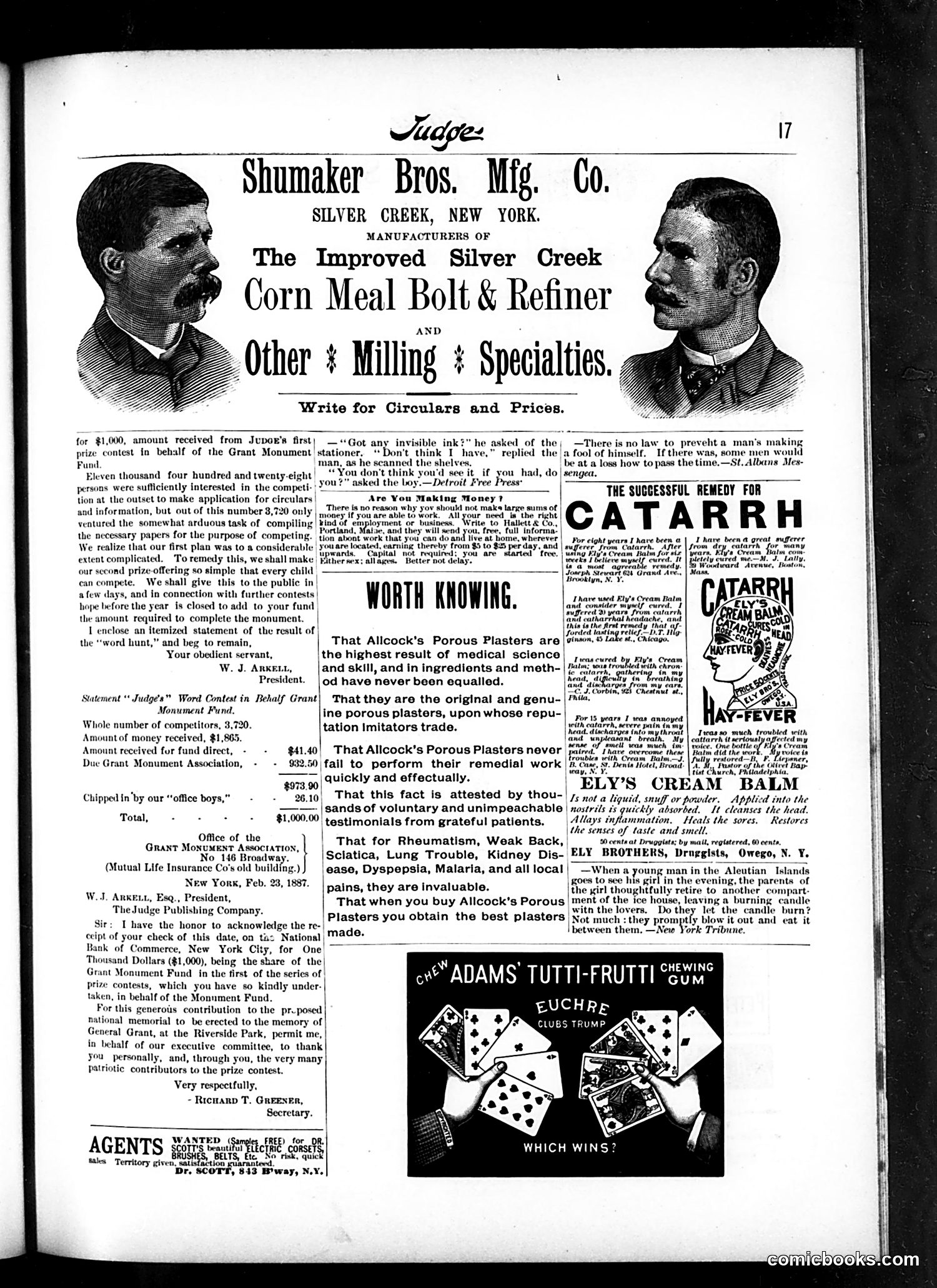
This is primarily a page of **advertisements and business announcements**, not political satire. Judge magazine mixed ads with content. **Key visible content:** 1. **Shumaker Bros. Manufacturing** (top): An ad for corn meal milling equipment from Silver Creek, New York, featuring two men's portraits. 2. **Grant Monument Prize Contest Results** (left column): A summary of Judge's fundraising effort for the Grant Monument. Of 11,400 applicants, only 3,720 completed the word-puzzle competition. The fund received $1,000 total—described straightforwardly as a public fundraising effort. 3. **"Worth Knowing"** section: Multiple medical ads (Allcock's Porous Plasters, Ely's Cream Balm for catarrh) with testimonial quotes. 4. **Bottom right**: Adam's Tutti-Frutti Chewing Gum advertisement. The page contains **no apparent political cartoons or satire**—it's dominated by period product advertising typical of 19th-century magazines. The small dialogue jokes scattered throughout are generic, not tied to specific contemporary events or figures.
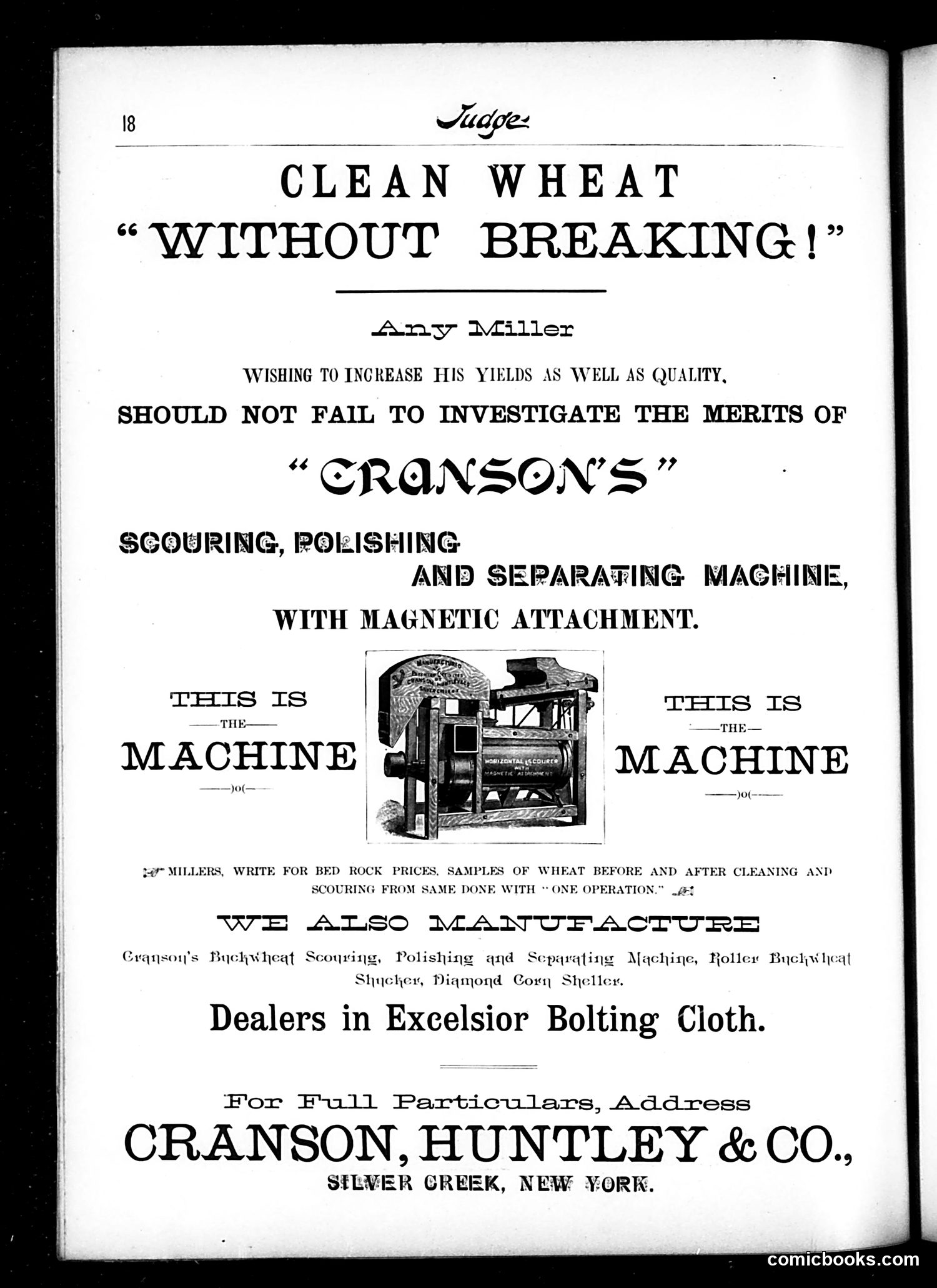
This page is primarily an **advertisement**, not a political cartoon. It promotes Cranson, Huntley & Co.'s wheat-cleaning machinery, specifically their "Scouring, Polishing and Separating Machine" with magnetic attachment. The ad targets **millers** seeking to increase crop yields and quality without grain breakage. It features an engraved image of the machine and emphasizes its efficiency—the company offers sample wheat cleaned in "one operation" to demonstrate results. The reference to "Any Miller" in the header appears to be a generic address to the target audience rather than a specific person. The page also advertises related products: buckwheat equipment, corn shellers, and bolting cloth. This represents typical 19th-century agricultural trade advertising in *Judge* magazine, where industrial machinery companies purchased space alongside satirical content.
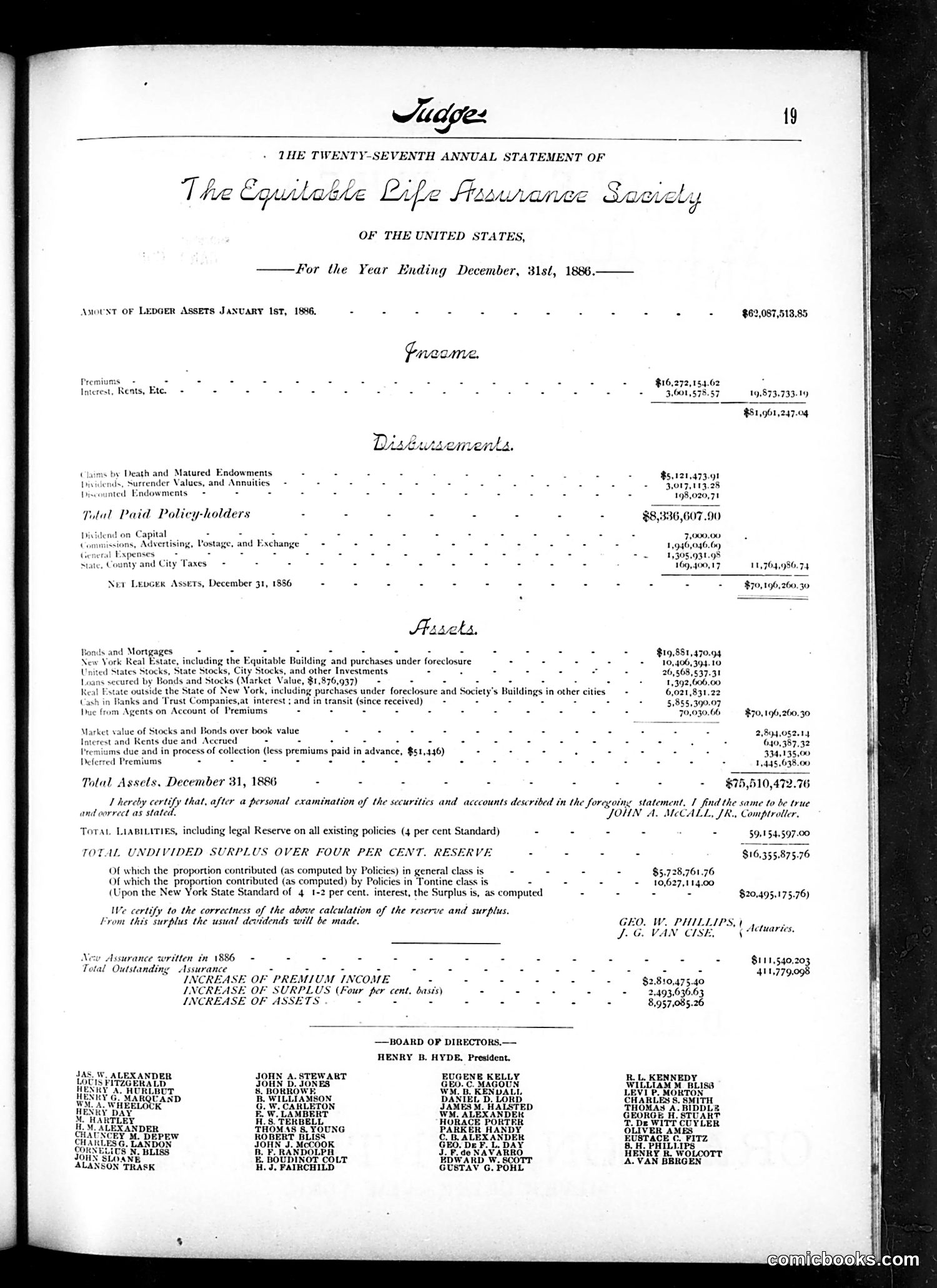
This page is **not a cartoon or satirical content**—it's a financial statement, specifically the 27th annual report of the Equitable Life Assurance Society for the year ending December 31, 1886. The document lists the company's income (premiums and interest), disbursements (claims paid to policyholders totaling $8.3 million), and detailed assets (bonds, mortgages, real estate, stocks totaling $75.5 million). It certifies the company's financial reserves and surplus, signed by Comptroller John A. McCall Jr. The page includes a Board of Directors roster featuring prominent 19th-century businessmen and financiers. This appears in **Judge magazine**, but is purely an insurance company advertisement/financial disclosure—common paid content in period publications. It contains no satire or political commentary.
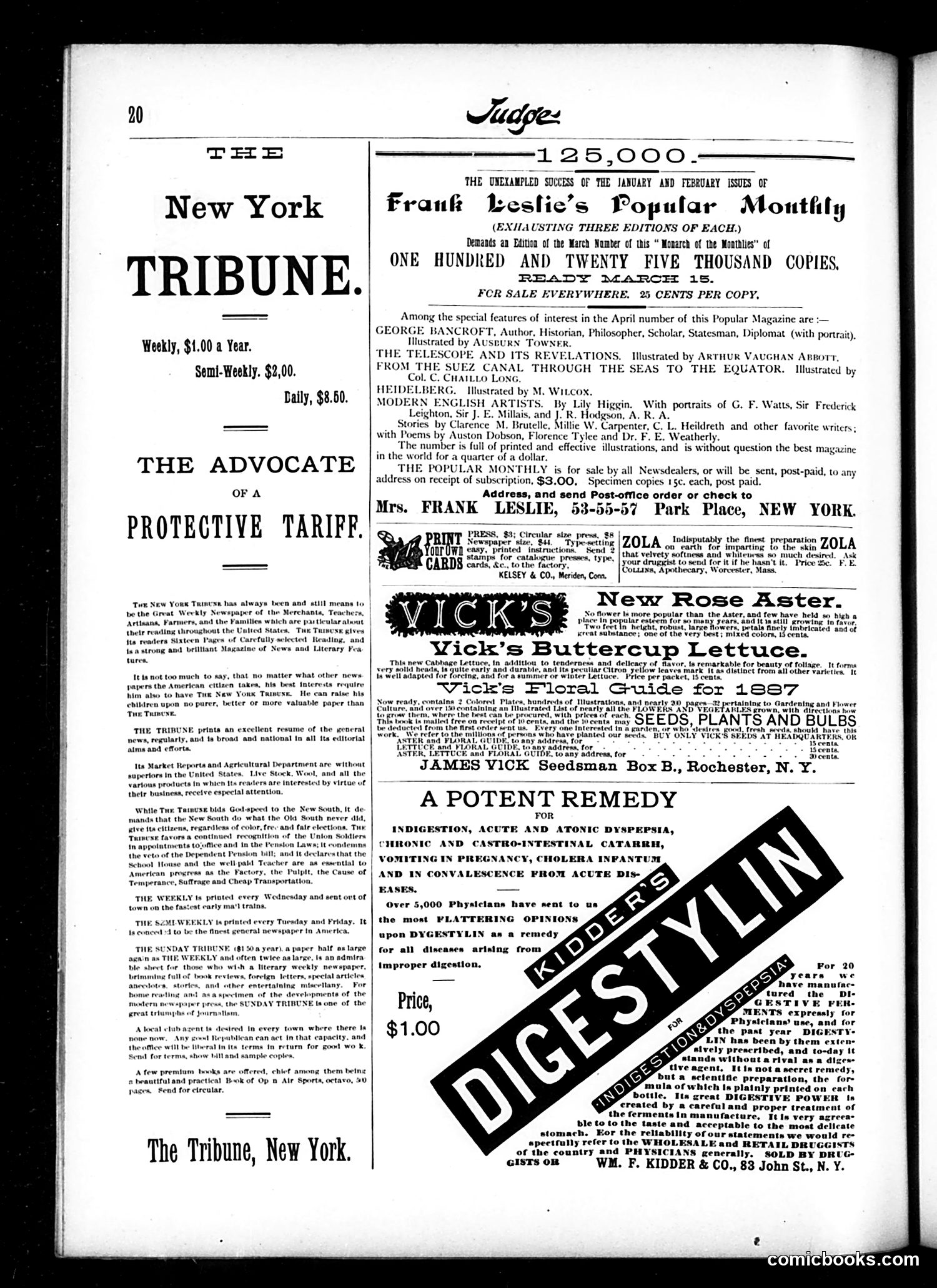
This page is primarily **advertising and promotional material** rather than political satire. The main content includes: - Advertisements for *The New York Tribune* (a major newspaper advocating protective tariffs) - A large advertisement for *Frank Leslie's Popular Monthly* magazine, promoting its March edition with 125,000 copies printed - Product advertisements including Vick's seeds and lettuce, Zola beauty preparation, and Digestylin digestive remedy The only editorial content visible is the Tribune's statement promoting itself as essential reading for understanding national interests, particularly regarding tariffs and industrial progress. **Notable absence**: There are no visible political cartoons on this page—just commercial advertisements typical of 1880s-90s magazine publishing, where revenue from ads subsidized editorial content.
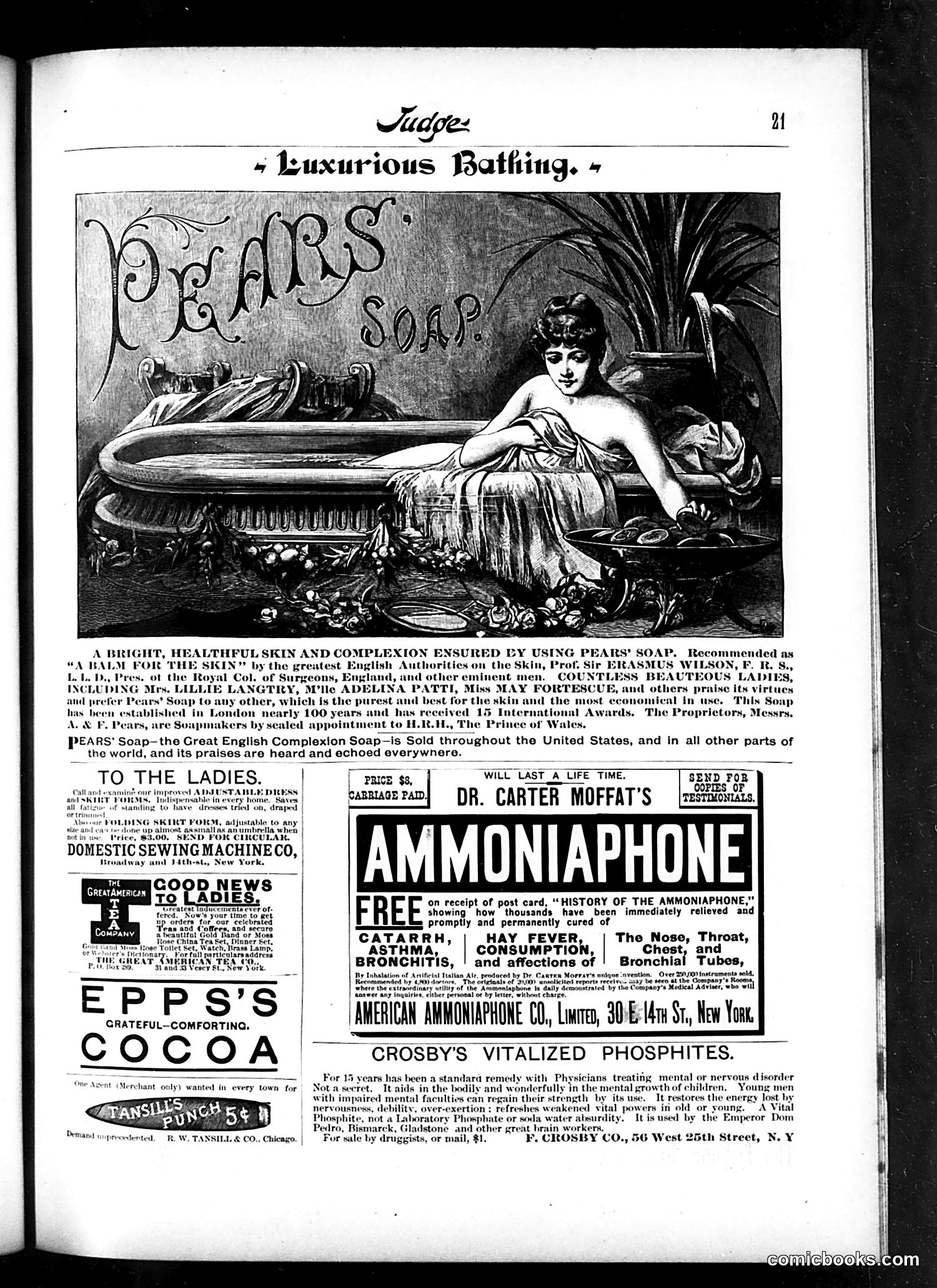
The page contains product advertisements rather than political cartoons. The dominant ad features **Pears' Soap**, which uses a classical bathing scene illustration and endorsements from Victorian-era celebrities (Lillie Langtry, Adelina Patti) and medical authorities to promote skin care. Below are remedies for common ailments: **Dr. Carter Moffat's Ammoniaphone** (a device claiming to cure catarrh, hay fever, asthma, and consumption), **Epps's Cocoa**, and **Crosby's Vitalized Phosphites** (for mental exhaustion and nervousness). These ads reflect late-19th-century consumer culture and quack medicine. The appeals to celebrity endorsement, medical authority, and scientific-sounding devices ("Ammoniaphone") were typical marketing tactics of the era, many promoting ineffective or dubious treatments. The page demonstrates how satirical magazines like Judge generated revenue through advertising alongside editorial content.
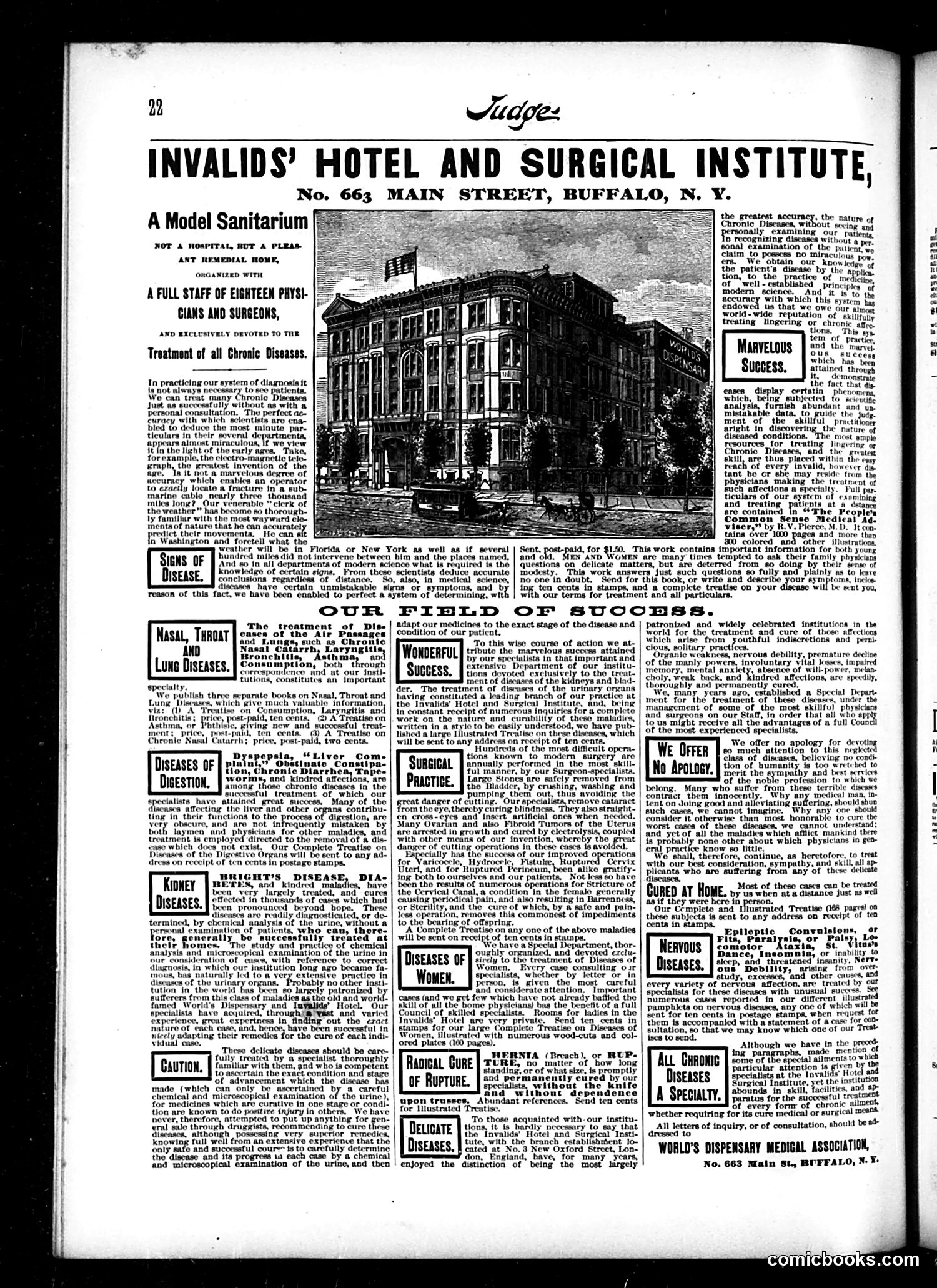
This page is primarily **medical advertising**, not satire or political cartoons. It promotes the "Invalids' Hotel and Surgical Institute" in Buffalo, New York—a private chronic disease treatment facility. The advertisement uses pseudo-scientific language to market remote diagnosis capabilities. It compares the institute's ability to diagnose patients without in-person examination to telegraph operators locating submarine cable breaks and weather forecasters making predictions from distance. This is clearly promotional hyperbole. The multiple boxed sections advertise treatments for conditions including nasal/throat diseases, lung diseases, kidney ailments, digestive disorders, and women's diseases. The institute boasts "eighteen physicians and surgeons" and claims a "world-wide reputation." There is **no apparent political satire** on this page. It represents genuine (if dubious) medical marketing from the late 19th century, when such long-distance "diagnosis by mail" schemes were common. The page reveals period attitudes about medical authority and disease treatment rather than offering social commentary.
This page is primarily **advertising**, not political satire. It's from Judge magazine but contains mostly patent medicine and commercial advertisements typical of early 20th-century publications. The notable exception is a **brief satirical item** at the top about striking coopers (barrel-makers) in New York. The joke references a labor dispute where non-union workers were attacked by strikers. The victim, showing his injuries, supposedly quipped that the "envious casker made" them—a pun on "casket" (coffin) versus his trade (barrel-making). The humor relies on dark wordplay about violence. The rest of the page advertises remedies for constipation, quinine tonics, hair products, men's clothing, and dress goods—typical period advertisements making broad health claims now considered fraudulent. These ads reflect historical attitudes toward patent medicines before FDA regulation.
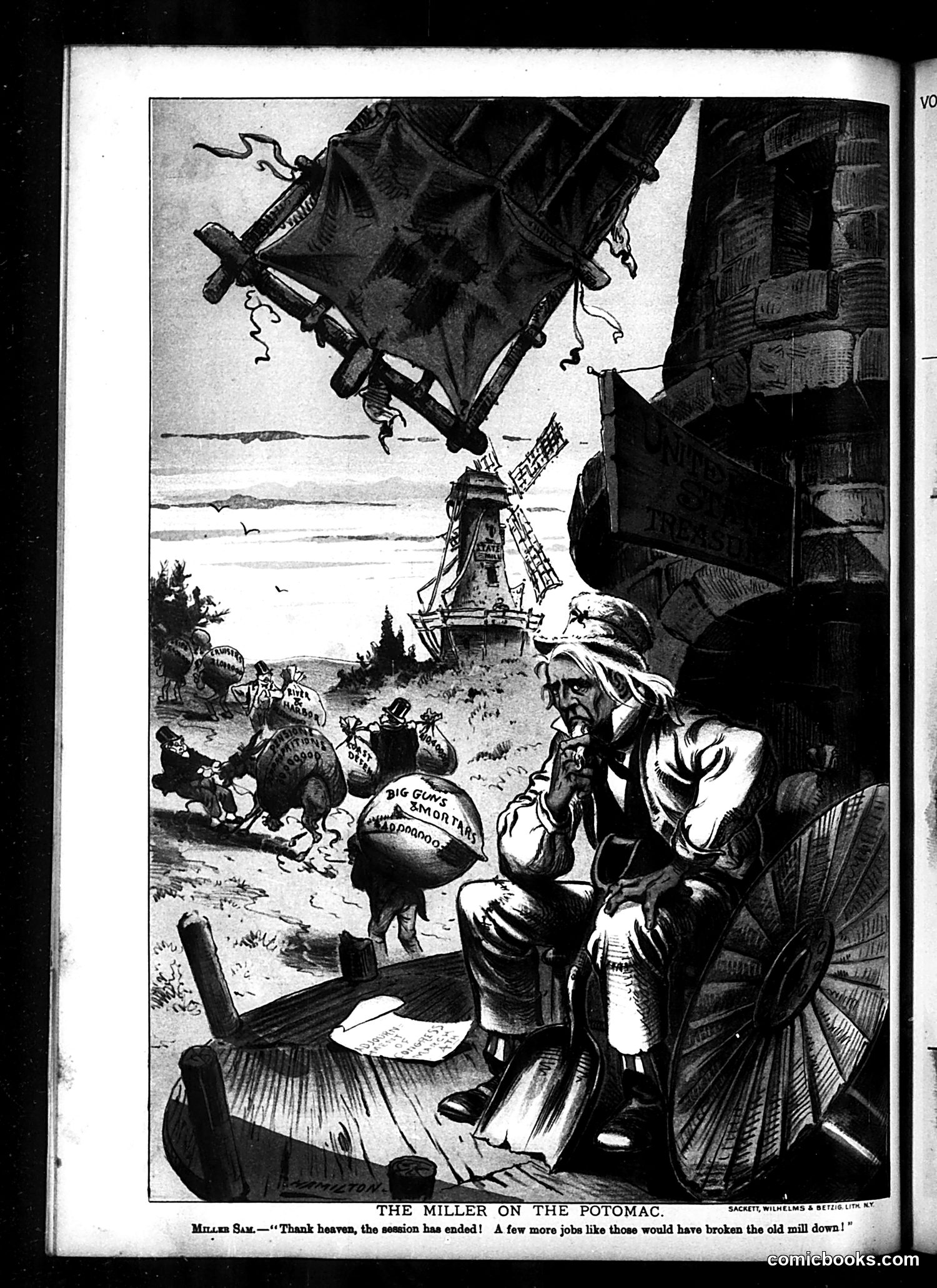
This political cartoon satirizes congressional spending and wasteful government jobs. The "miller" operates a mill on the Potomac River (Washington, D.C.'s location), which appears to represent the federal government or Treasury. The massive gears and machinery shown being strained suggest Congress is overworking the government apparatus through excessive appropriations—"jobs" that drain resources. The miller's relief that the legislative session ended implies Congress regularly votes for spending that exhausts government capacity. The caricatured figures appear to represent politicians or lobbyists involved in this wasteful process. The satire criticizes how Congressional spending threatens to break or overburden the nation's finances, a common theme in Gilded Age political commentary about government inefficiency and corruption.