
A complete issue · 16 pages · 1887
Judge — February 5, 1887
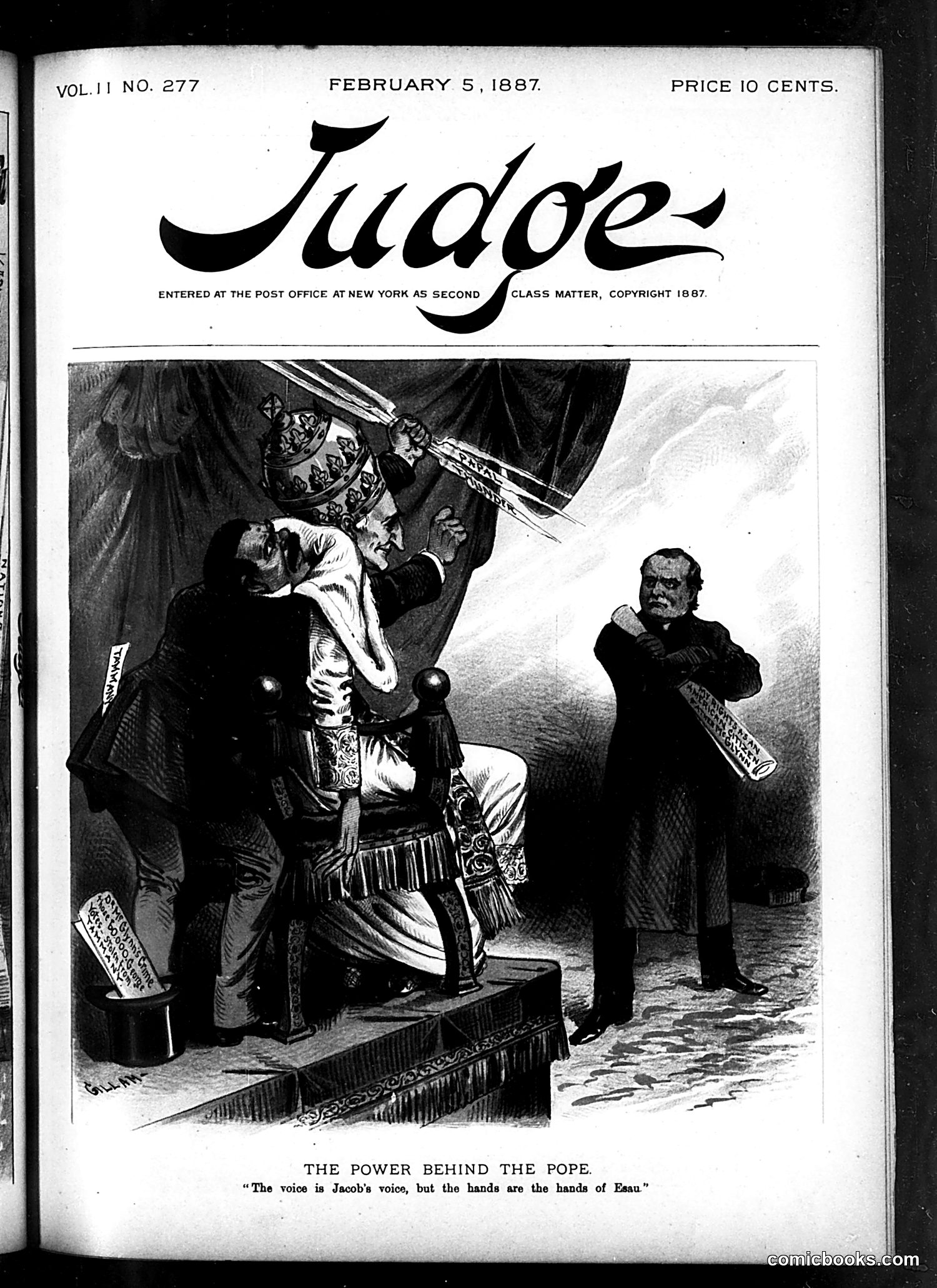
This political cartoon satirizes Vatican influence through a biblical reference. The caption quotes Genesis 27:22 ("The voice is Jacob's voice, but the hands are the hands of Esau"), suggesting that while the Pope appears to hold authority, someone else—likely representing a political or ecclesiastical power—actually controls him from behind the scenes. The figure in elaborate papal robes (center) is being manipulated by a hand-puppeteer figure (left), while another official observes (right). The cartoon critiques hidden manipulation of the Church's leadership, a common 19th-century Protestant and anticlerical concern about Vatican politics and alleged foreign influence over papal decisions. The specific historical context—which power or nation is meant—remains unclear without additional documentation.
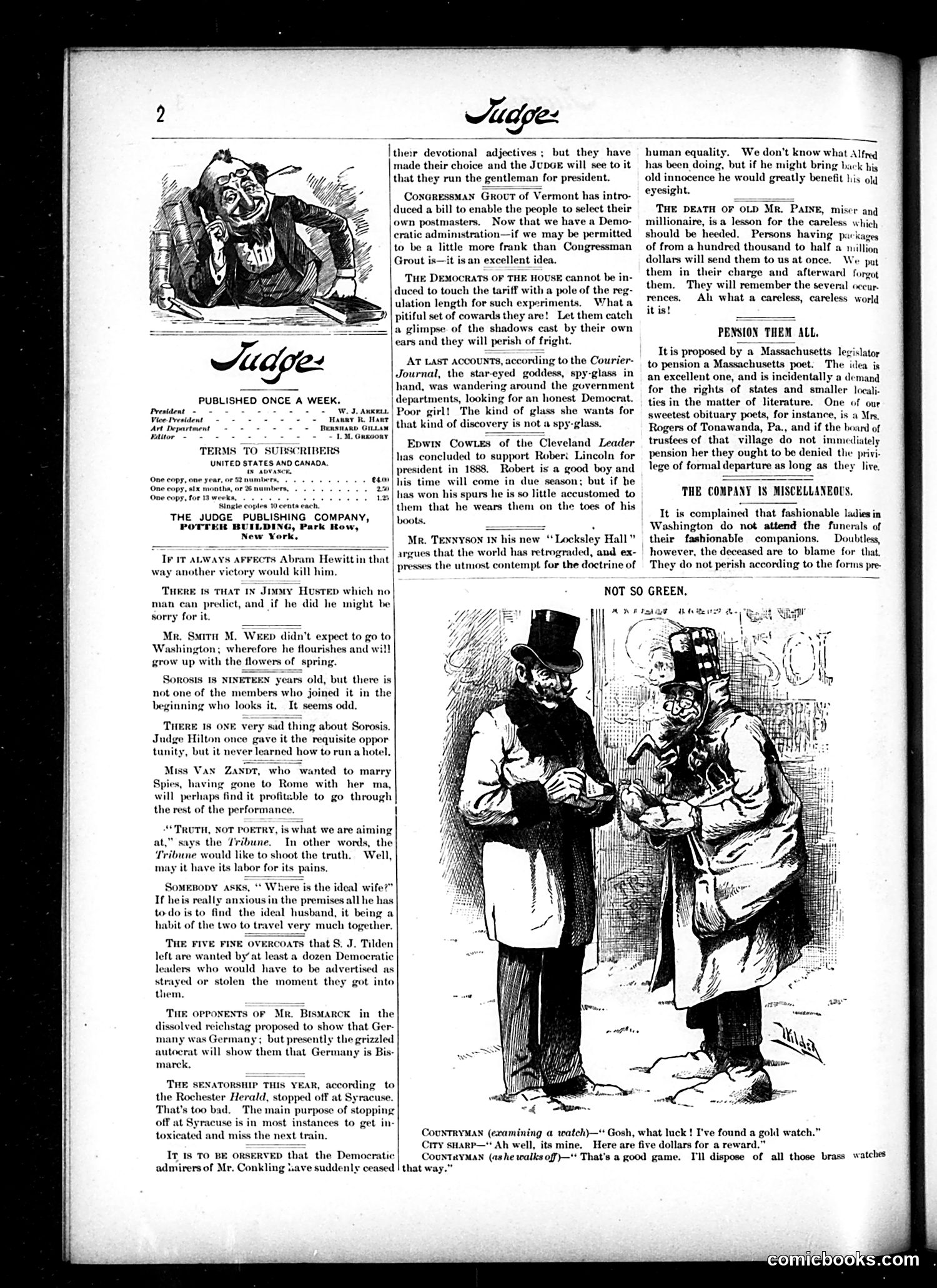
This page contains political commentary and satirical items typical of Judge's editorial content. The main cartoon titled "Not So Green" (bottom) depicts two country men, one claiming to have found a gold watch. The city man dismisses it as worthless, but when told it's valuable, suddenly wants it—satirizing urban greed and hypocrisy. The text items mock various political figures and social issues of the era, including references to Congressional proposals, tariff debates, and the presidential selection process. Without clearer identification of specific dates or named figures in the visible text, the exact political targets remain somewhat unclear, though the satirical tone targets government incompetence and aristocratic pretension generally.
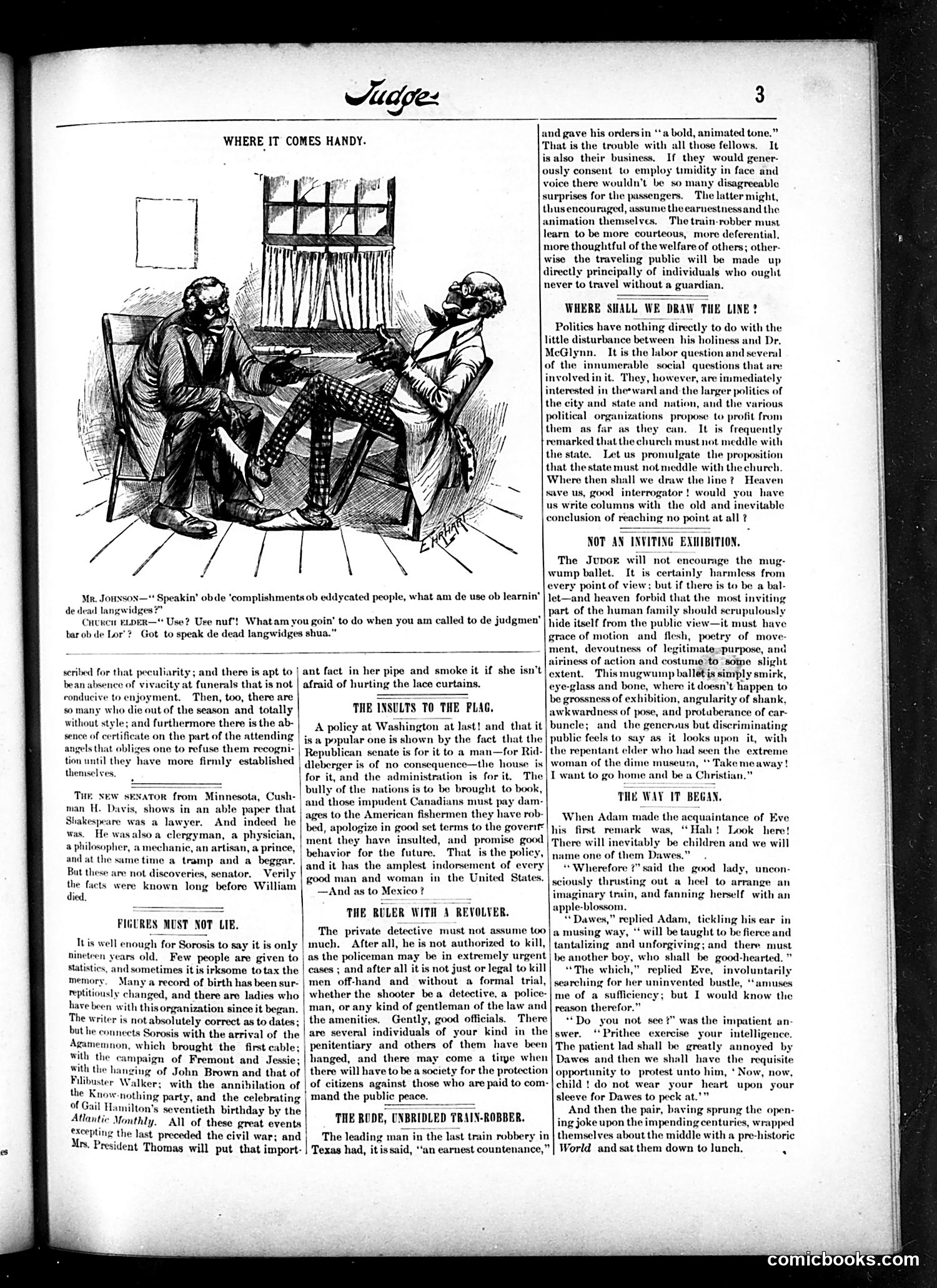
This page contains several satirical editorial columns typical of Judge's political commentary, circa the 1880s-90s. **Main cartoon** (top): Shows two men in conversation—likely a politician and constituent—discussing government matters in a domestic setting. The satire mocks politicians' tendency to speak in grandiose, complex language about simple issues. **Key articles satirize:** 1. **"The Insults to the Flag"**: Praises American policy demanding Canadian apologies for fishery disputes and flag incidents. Appears to reference actual U.S.-Canadian tensions of this era. 2. **"The Ruler with a Revolver"**: Critiques overzealous private detectives and police using lethal force without trial—warning such officers risk penitentiary or execution themselves. 3. **"The Rude, Unbridled Train-Robber"**: Humorously "advises" train robbers to be more courteous and timid during robberies, satirizing the era's frequent train thefts. The writing style is characteristically acerbic, using exaggeration and irony to critique government incompetence, judicial overreach, and crime.
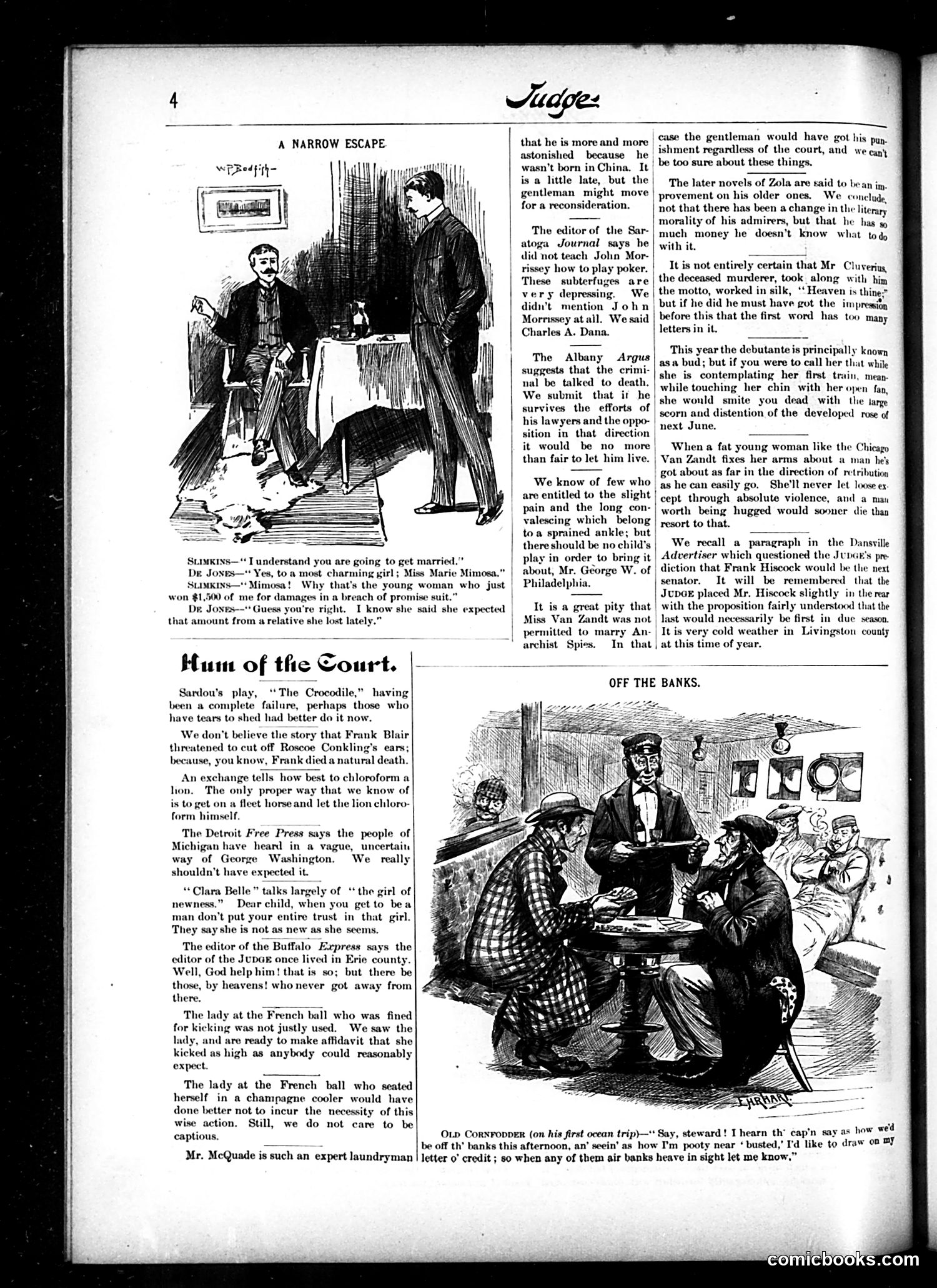
This page contains several brief satirical items mocking contemporary figures and social foibles, plus two illustrated cartoons. **Top cartoon ("A Narrow Escape")**: De Jones plans to marry Miss Marie Mimosa, but Slimkins warns he previously lost $1,500 to her in a breach-of-promise suit—suggesting she's a serial litigant who seduces men for financial gain. The joke is De Jones is walking into an obvious trap. **Various brief items** mock: - Roscoe Conkling (politician threatened by someone named Frank Blair) - Buffalo and Detroit newspaper editors - A woman who sat in a champagne cooler at a French ball - "Clara Belle" (likely an actress/performer) for falsely claiming newness - A woman named Miss Van Zandt prevented from marrying "Anarchist Spies" **Bottom cartoon ("Off the Banks")**: An elderly immigrant asks a ship's steward to draw on his letter of credit when the ship passes banks, misunderstanding "banks" (financial institutions) for land masses visible from the ocean. The humor relies on wordplay, social commentary about fraud and pretense, and immigrant confusion.
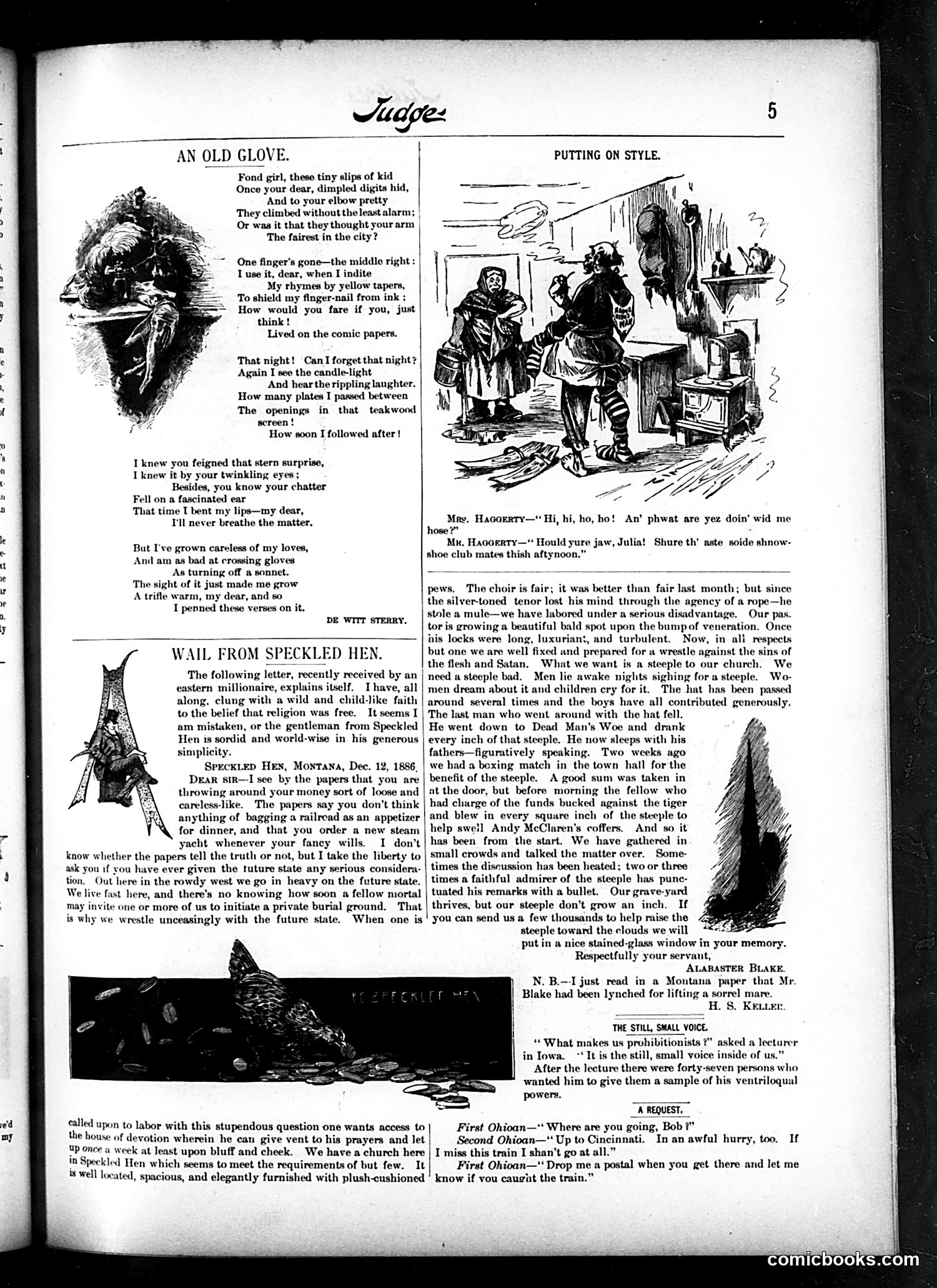
This page contains several distinct pieces of satirical content: **"An Old Glove"** (left): A sentimental poem by De Witt Sterry about a worn glove that belonged to a romantic interest. The satire appears gentle—mocking the overwrought sentimentality of Victorian romance writing through exaggerated emotion about a discarded garment. **"Wail from Speckled Hen"** (lower left): A letter from a Montana resident to a wealthy eastern millionaire, requesting funds for a church steeple. The satire targets Western frontier religiosity and financial desperation—the writer describes the rough frontier life ("rope," implied suicide by the choir tenor) while making an awkward solicitation for donations, mixing crude frontier dialect with earnest spiritual need. **"Putting On Style"** (right): A brief comic dialogue between Irish characters (indicated by phonetic dialect spelling) about using a horse for a snowshoe club meeting, likely mocking pretentious social climbing or the absurdity of frontier "society" imitating Eastern gentility. The page satirizes American social pretension, excessive sentimentality, and frontier life's collision with Victorian values.
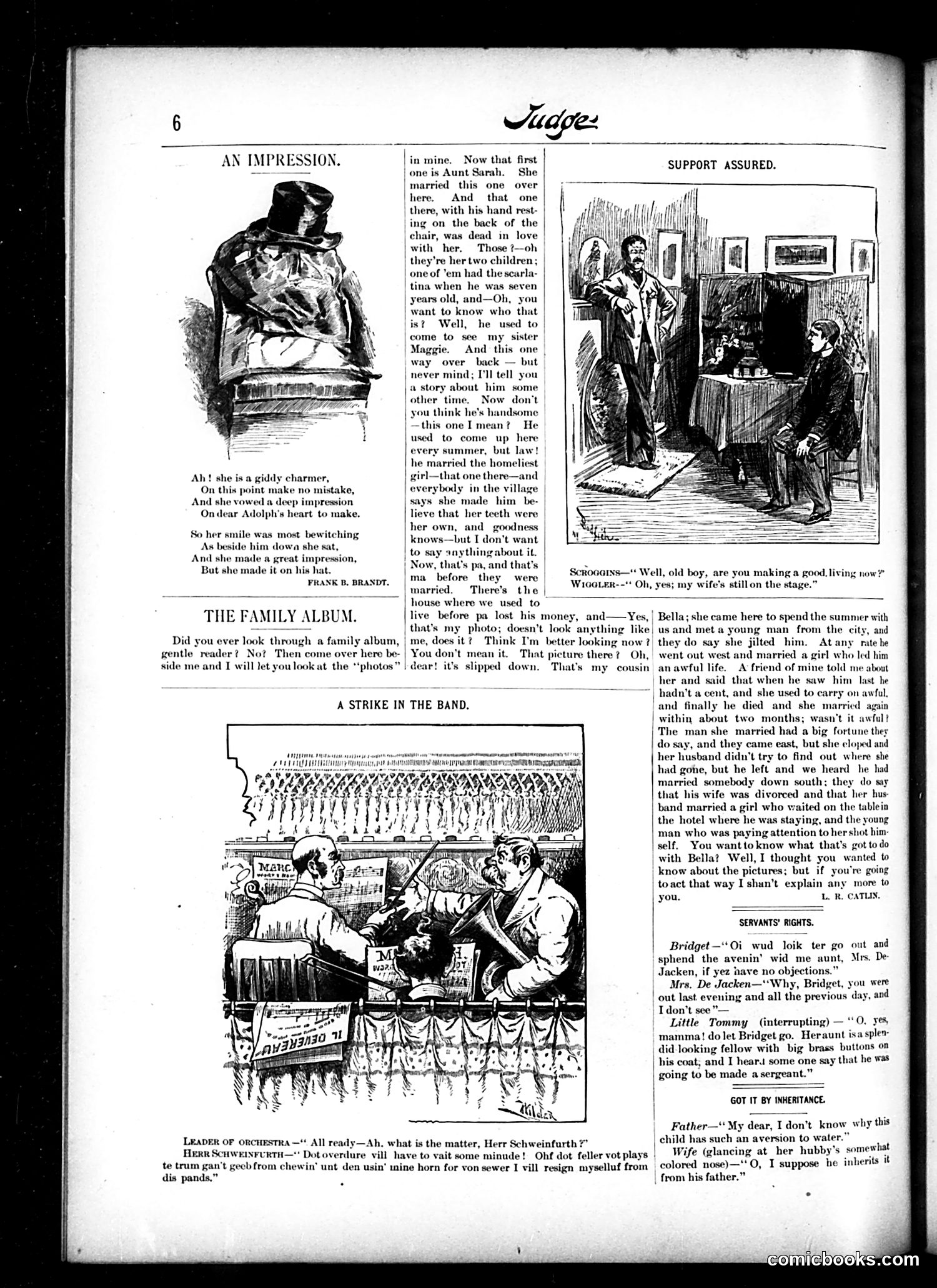
This page contains three distinct satirical pieces: **"An Impression"** mocks romantic sentimentality—a young woman makes an "impression" on a suitor named Adolph, but the punchline (cut off) likely plays on the double meaning of "impression" as physical mark rather than emotional impact. **"The Family Album"** parodies the Victorian custom of sharing family photos by having a character deliver an endless, gossipy monologue about relatives. The satire targets both the tedium of album-viewing and small-town scandal-mongering—each photo triggers increasingly dramatic stories of jilted lovers, poverty, elopements, and remarriage. **"A Strike in the Band"** shows an orchestra conflict: the conductor demands the hornist wait because he's still chewing tobacco. The musician threatens resignation. This satirizes labor disputes and worker dignity in the entertainment industry. **"Servants' Rights"** jokes about a maid requesting evening off; a child interrupts asking to let her go, mentioning her aunt's boyfriend might become a "sergeant"—implying military recruitment or arrest. **"Got It by Inheritance"** uses the child's water-aversion to make a crude joke about the father's drinking problem (his "colored nose").
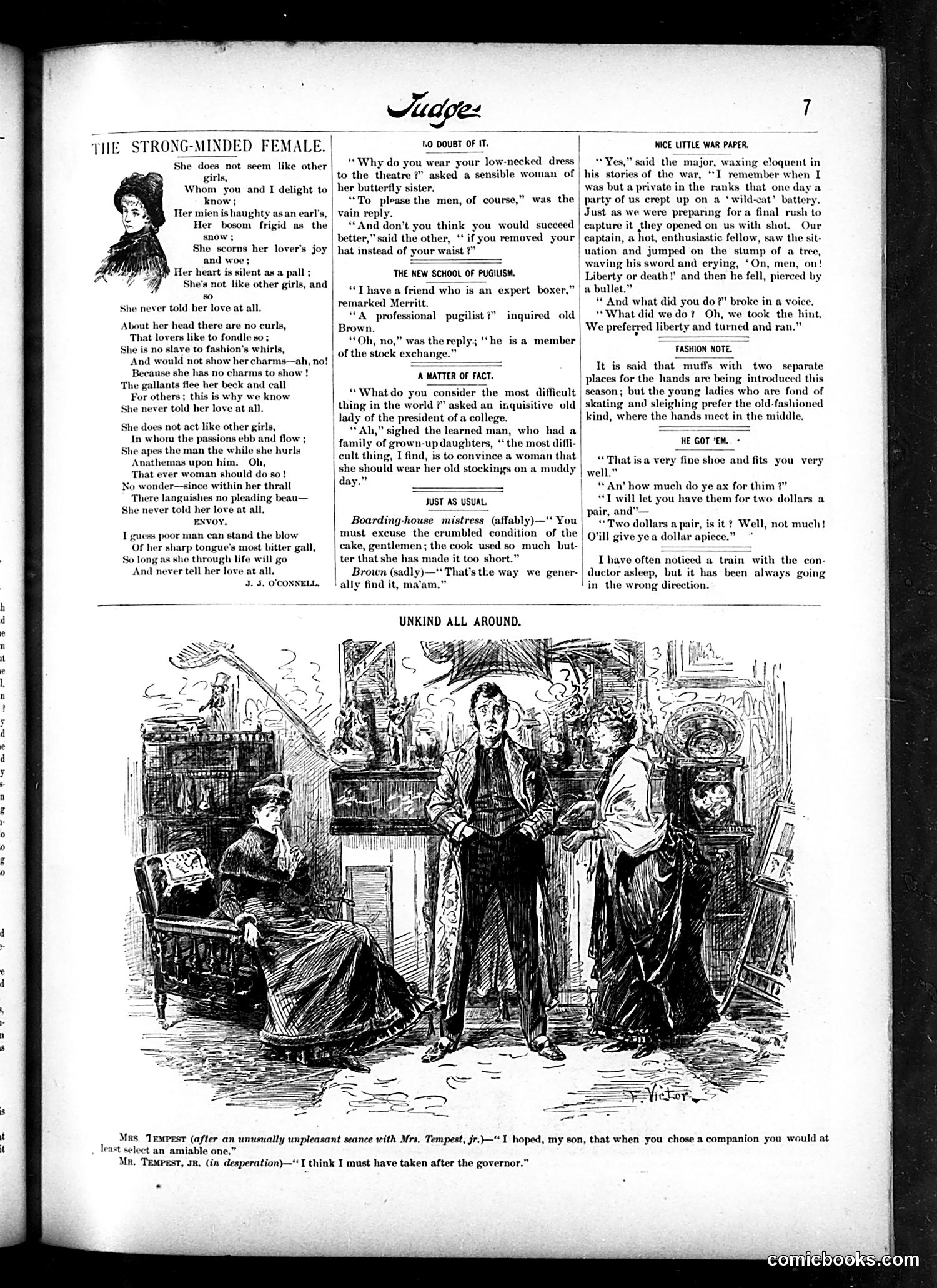
This page contains satirical short pieces and cartoons typical of 1880s-90s American humor: **"The Strong-Minded Female"** mocks women seeking independence or education. The poem ridicules an unmarried woman as unattractive, unfeminine, and man-like—implying her lack of romantic success stems from rejecting traditional female roles rather than any legitimate choice. **Minor jokes** satirize predictable targets: vain women, stock-market traders as "fighters," college presidents struggling with daughters, and boarding-house food quality. **The main cartoon** ("Unkind All Around") depicts a domestic quarrel. Mrs. Tempest criticizes her son's choice of wife as disagreeable; he retorts he "took after the governor"—implying his father is similarly difficult. The satire targets marital discord and suggests bad temperament runs in families. The page reflects Victorian anxieties about women's changing roles and traditional gender expectations, using humor to reinforce conventional values.
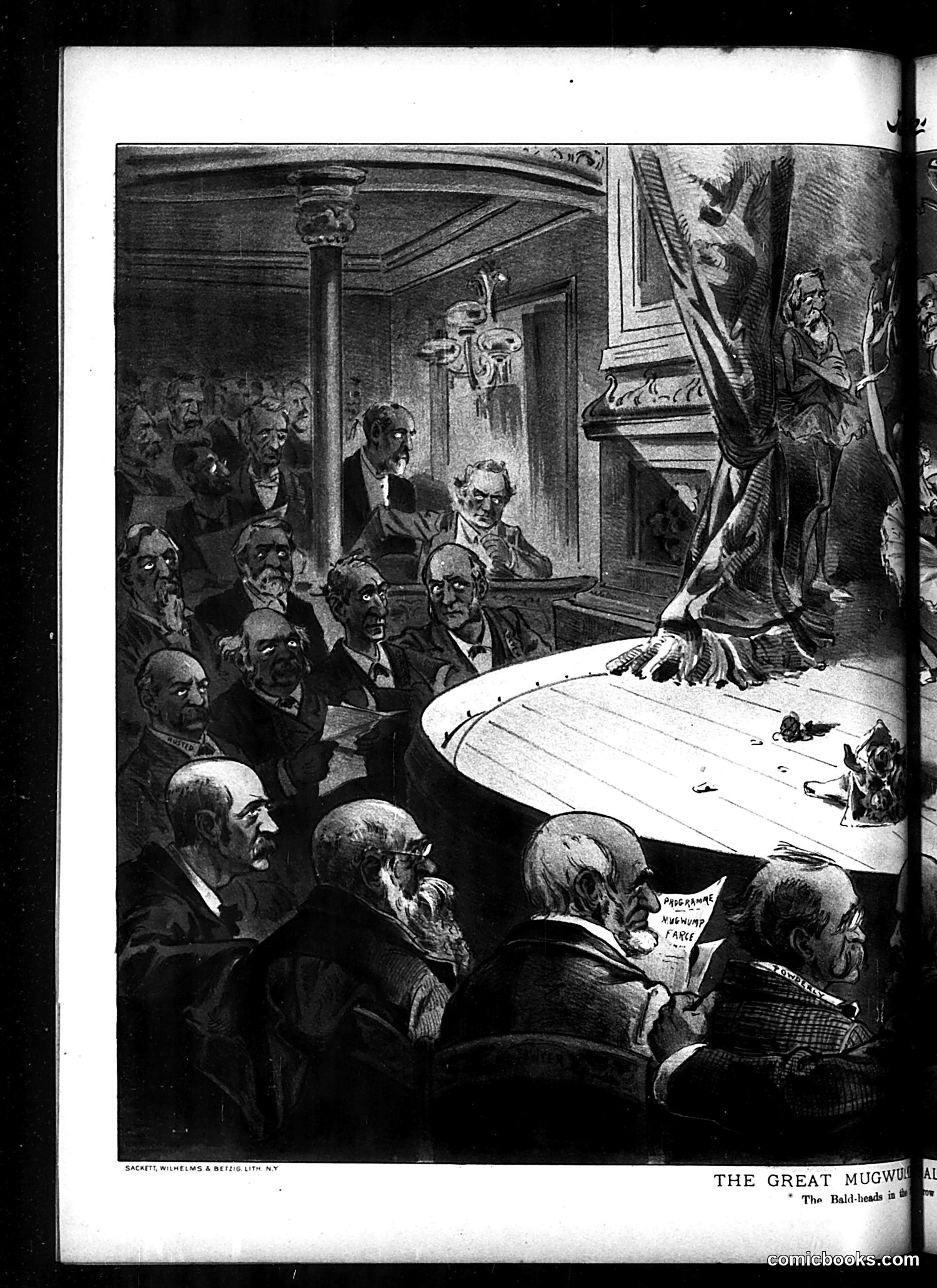
This Judge magazine cartoon satirizes a meeting of "Mugwumps"—a term for independent Republicans who broke party loyalty, particularly during the 1884 presidential election. The scene depicts elderly, bearded men gathered around a table, suggesting backroom political dealings or party dissension. The bald-headed figures (noted in the caption as a visual joke) represent these so-called independent politicians perceived as self-important or ridiculous by Judge's perspective. The formal interior setting implies secretive deliberation among these political outsiders. The satire mocks Mugwumps as ineffectual or comically vain—emphasizing their advanced age and eccentricity. Judge, generally Republican-leaning, used the cartoon to ridicule party members who prioritized personal principle over party unity, portraying them as somewhat absurd characters rather than principled reformers.
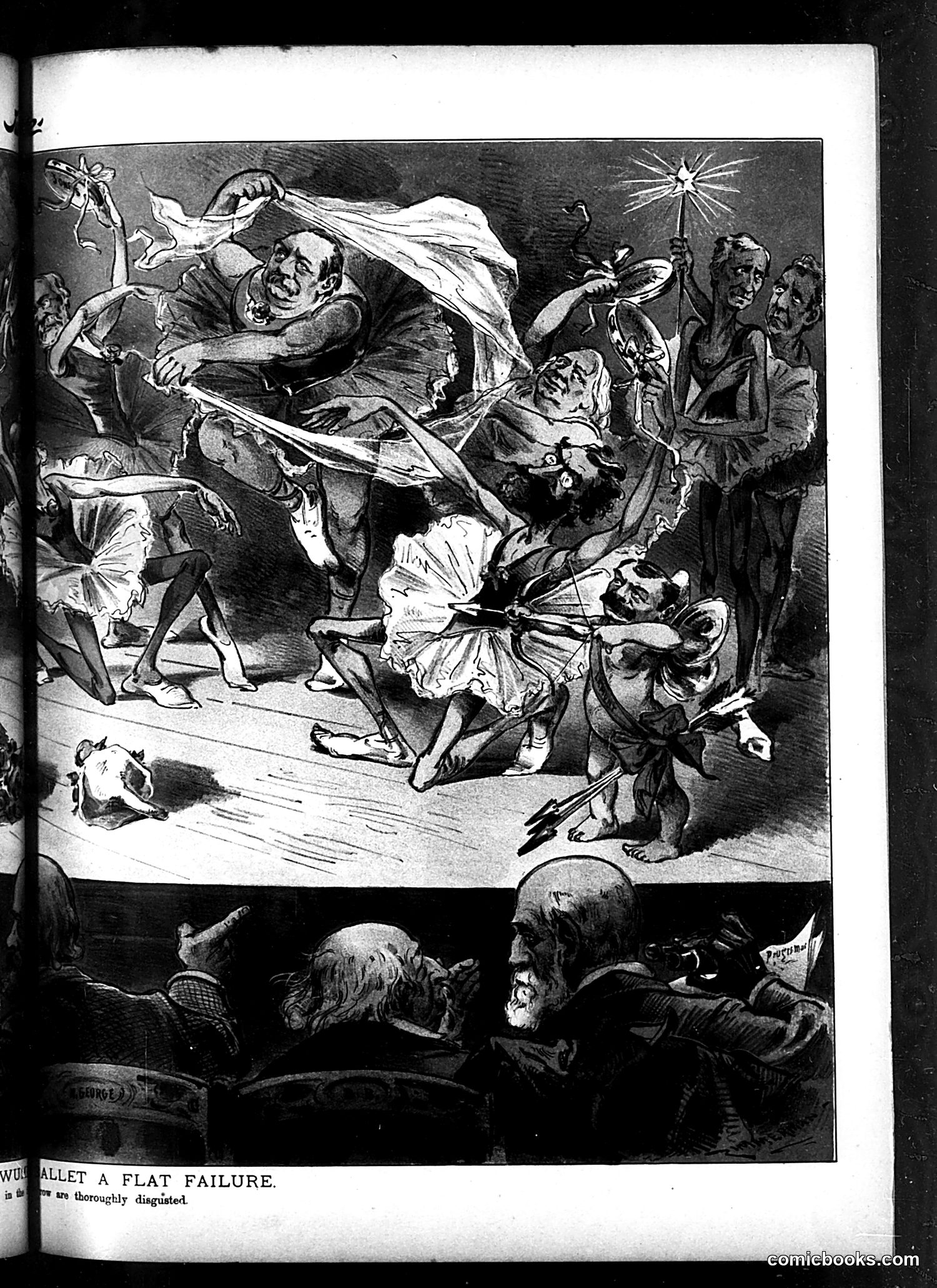
This satirical cartoon depicts what appears to be a chaotic theatrical performance. The central figure—a rotund man in formal dress—dominates the stage, seemingly presiding over or participating in a disastrous ballet. Around him are exaggerated caricatures of performers, some appearing distressed or falling. The title "Ballet a Flat Failure" suggests the satire targets a specific ballet production that was critically or commercially unsuccessful. The audience members shown at the bottom appear thoroughly unimpressed, matching the OCR text stating they "are thoroughly disgusted." The cartoon likely mocks either the ballet's poor execution, its pretentious artistic merit, or possibly a specific impresario's failed theatrical venture. Without the publication date or additional context, the specific production referenced remains unclear, though the visual humor relies on physical comedy and exaggerated performance chaos.
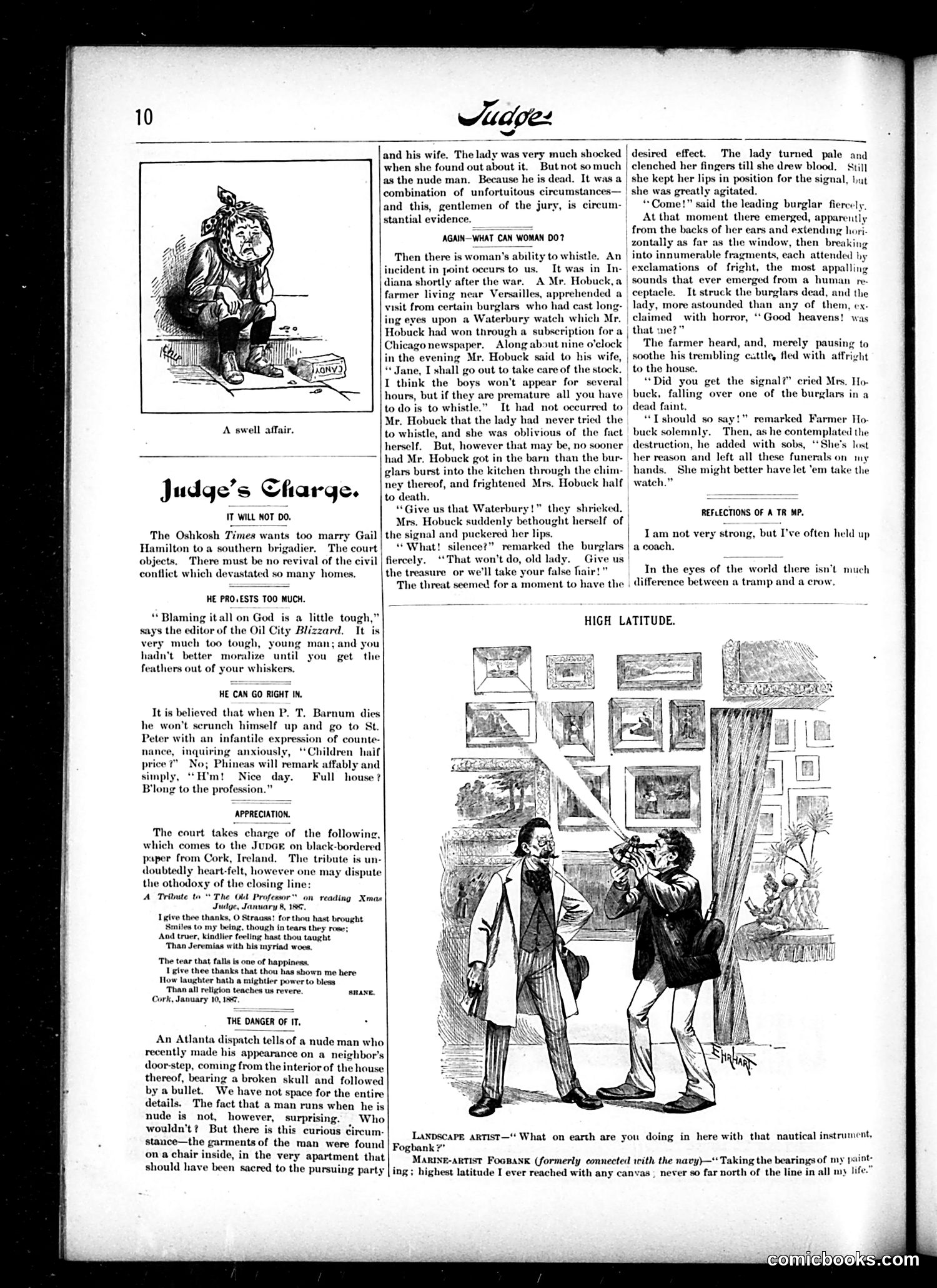
This page contains several humorous anecdotes mocking Victorian-era assumptions about women's capabilities and behavior. The main cartoon illustrates a story about a farmer (Hobuck) who instructs his wife Jane to whistle as a burglar alarm. When actual burglars break in, Mrs. Hobuck attempts to whistle but produces an ear-splitting, horrifying shriek instead—so loud it frightens the burglars unconscious and sends her husband fleeing. The satire targets the absurd expectation that an untrained woman could execute a critical task, and mocks both her panic and the ridiculous solution itself. The section "Again—What Can Woman Do?" sarcastically questions women's practical abilities, using this failed whistle-alarm as evidence of their incompetence. The article also includes brief satirical commentary on other social issues and includes a tribute poem from Ireland praising Judge's humor. The overall tone ridicules both foolish male assumptions about women and women's supposed inability to handle emergencies—typical 19th-century American magazine humor.
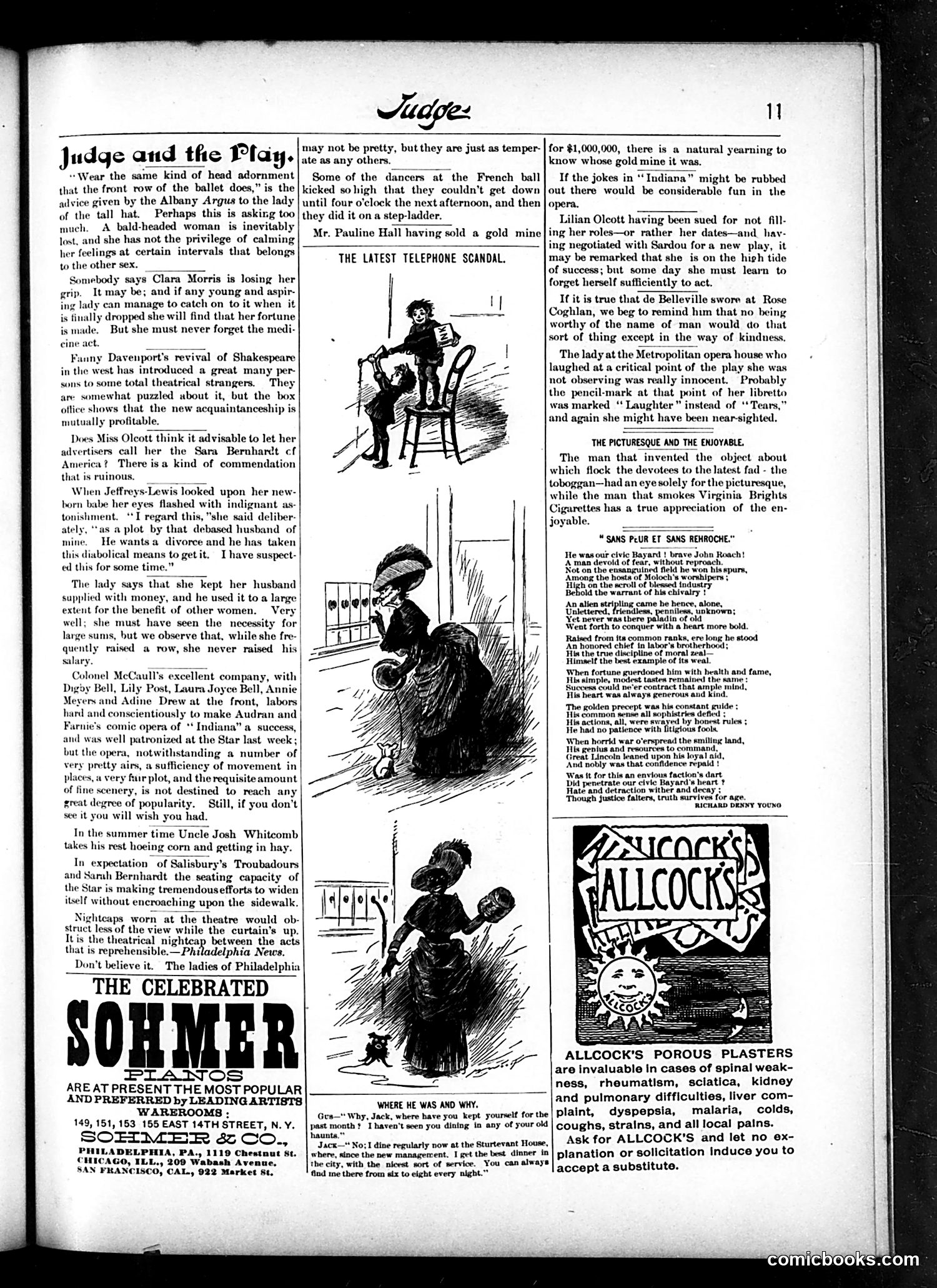
This page contains **theater criticism and satirical commentary** on 1880s theatrical personalities and productions, typical of Judge's entertainment coverage. **Main subjects:** - **Clara Morris** and **Fanny Davenport**: Established actresses whose careers Judge comments on, with Morris allegedly "losing her grip" - **Lilian Olcott**: Criticized for being called "Sara Bernhardt of America"—Judge suggests the comparison is damaging rather than flattering - **Jeffreys-Lewis**: A performer whose husband allegedly squandered money she provided - **Colonel McCull's company**: Performing the comic opera "Indiana," which Judge finds musically pleasant but dramatically weak **The satirical cartoons** (appearing to show telephone-related mishaps) illustrate "The Latest Telephone Scandal"—likely mocking recent telephone technology and social anxieties around it. **Broader point**: Judge mockingly critiques both theatrical pretension and the emerging entertainment industry's marketing practices, while defending theater-goers (particularly Philadelphia women) against snobbish criticism. The page is primarily **entertainment journalism** rather than political satire.
This page is primarily **advertising and reader testimonials**, not political satire. The main content consists of: **Testimonials for Judge magazine** from readers in Chicago and Oakland praising the publication's humor, scarcasm, and "truthfulness to human nature." These validate Judge's reputation as a successful satirical weekly. **Commercial advertisements** for products typical of 1887: sealskin garments (Henry Siede furrier), toilet soap, sewing machines, theatrical productions, and patent medicines (cure for deafness, Saratoga Vichy water). **The soap advertisement** includes a humorous letter claiming a competitor's soap contains adulterants—likely satirizing the era's common fraudulent product claims and misleading advertising. There are no identifiable political cartoons or caricatures on this page. The content reflects Judge's role as both a satirical magazine and a platform for period advertisements, demonstrating the publication's commercial success and influence in 1880s America.
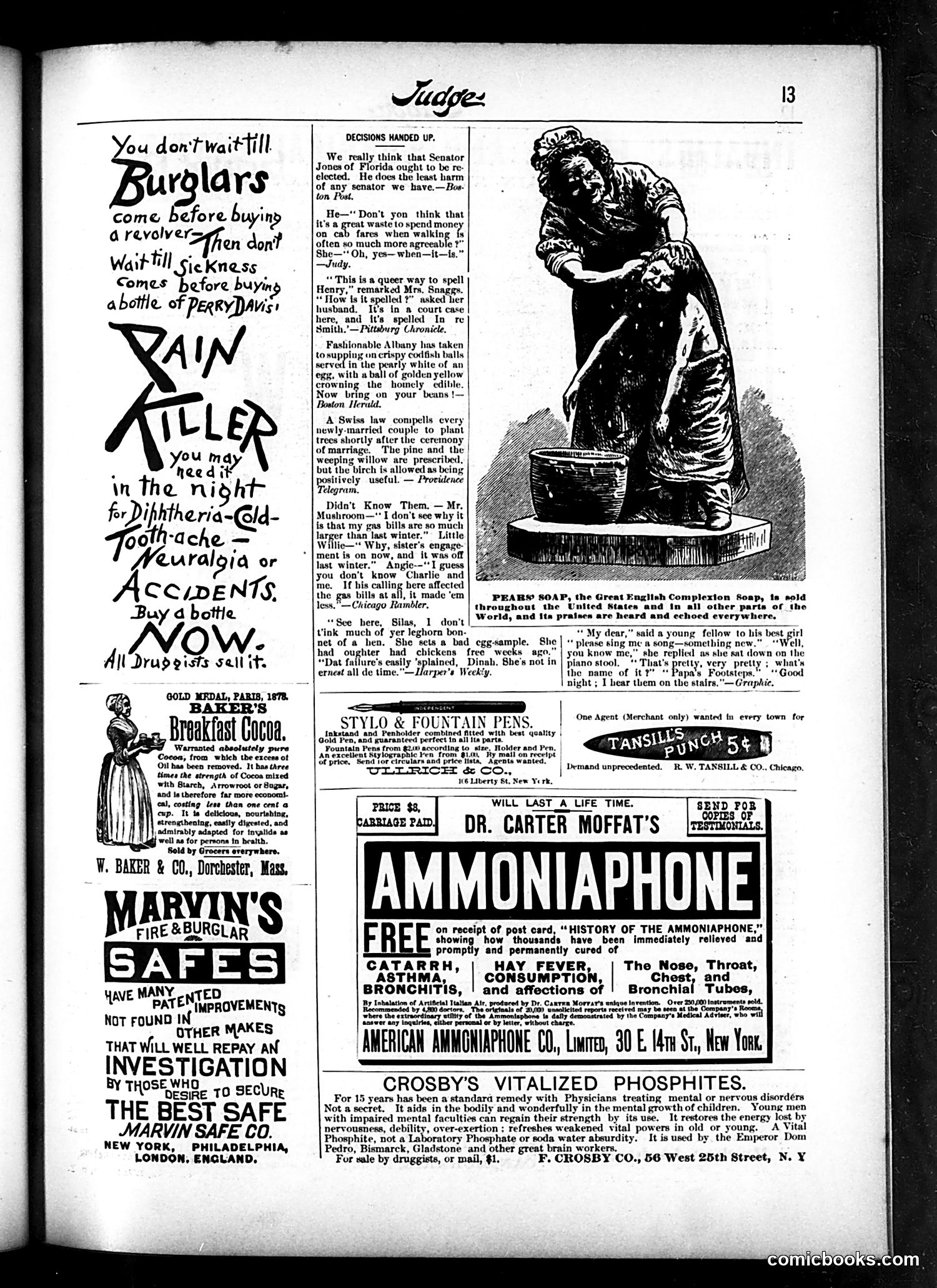
This page is primarily **advertising with minimal editorial content**, typical of late-19th-century magazines. The visible editorial content includes brief humor items ("Decisions Handed Up"), short jokes about spelling, Albany dining trends, and suburban domestic situations. These lack clear political significance for modern readers. **The advertising dominates**: Baker's Cocoa, Marvin Safes, Pear's Soap, and notably Dr. Carter Moffat's "Ammoniaphone"—a now-notorious patent medicine claiming to cure hay fever, asthma, and consumption through inhalation, typical of the unregulated medical fraud era. The illustrated figure (right side) appears to be part of the Pear's Soap advertisement, showing a woman in period dress, though her identity is unclear from the image alone. **No obvious political cartoons or caricatures are present.** The page reflects Judge's commercial nature and the patent medicine industry's free rein before FDA regulation.
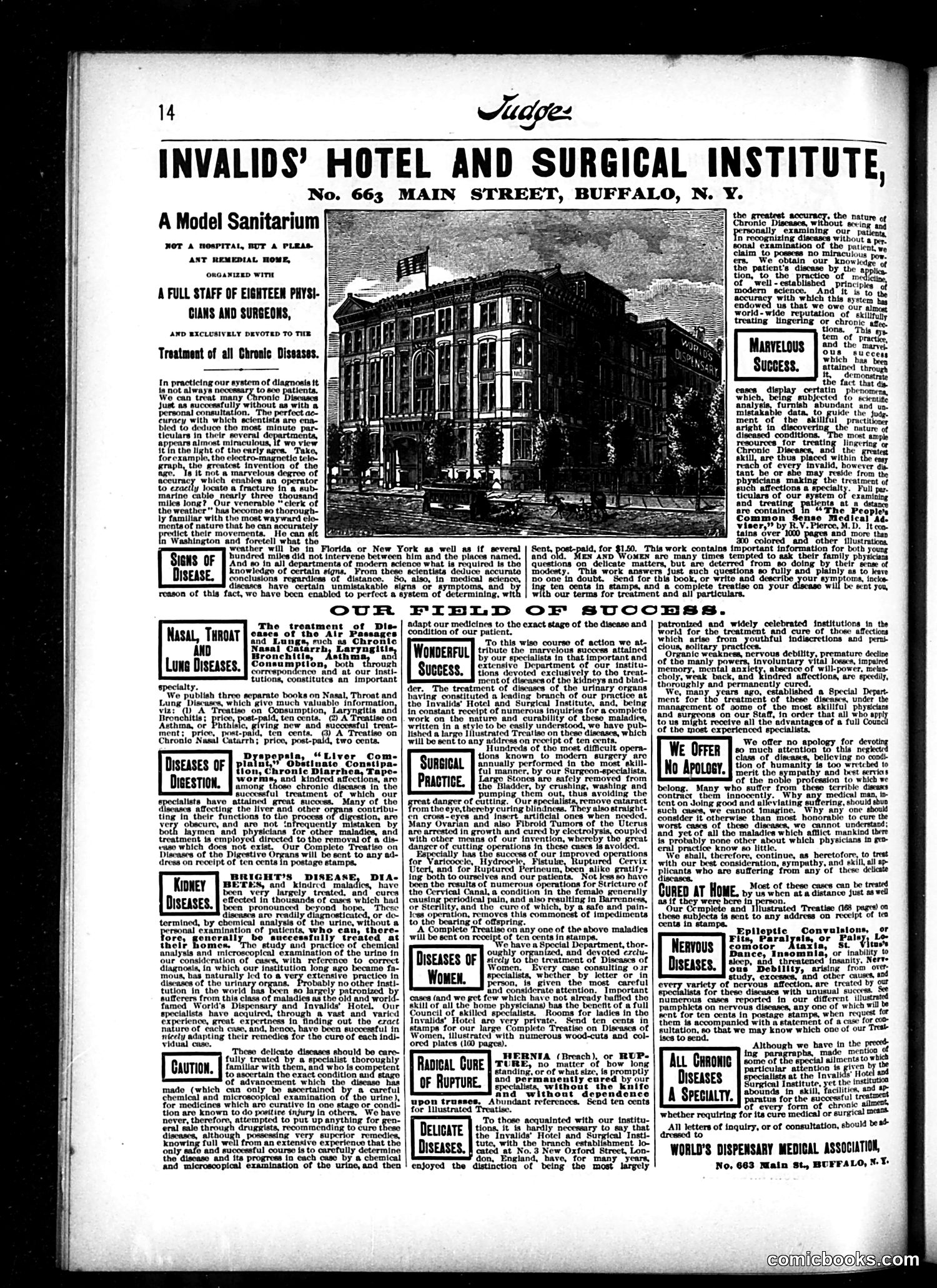
This page is primarily **medical advertising**, not satire or political commentary. It promotes the Invalids' Hotel and Surgical Institute in Buffalo, New York—a 19th-century private medical facility. The institution claims to treat chronic diseases through an innovative diagnostic system that allegedly doesn't require the patient to be physically present (distance treatment via examination of symptoms). This was characteristic of medical practice in the late 1800s, when such claims were common but often dubious by modern standards. The page emphasizes "marvelous success" and compares their diagnostic accuracy to telegraphy—suggesting cutting-edge science. The various treatment categories (nasal/throat, lung diseases, kidney diseases, etc.) and claims of expertise reflect typical period medical marketing. By today's standards, the promise to treat serious conditions remotely without physical examination appears fraudulent. The page represents an era when medical regulation was minimal and advertising made extraordinary claims with little evidence.
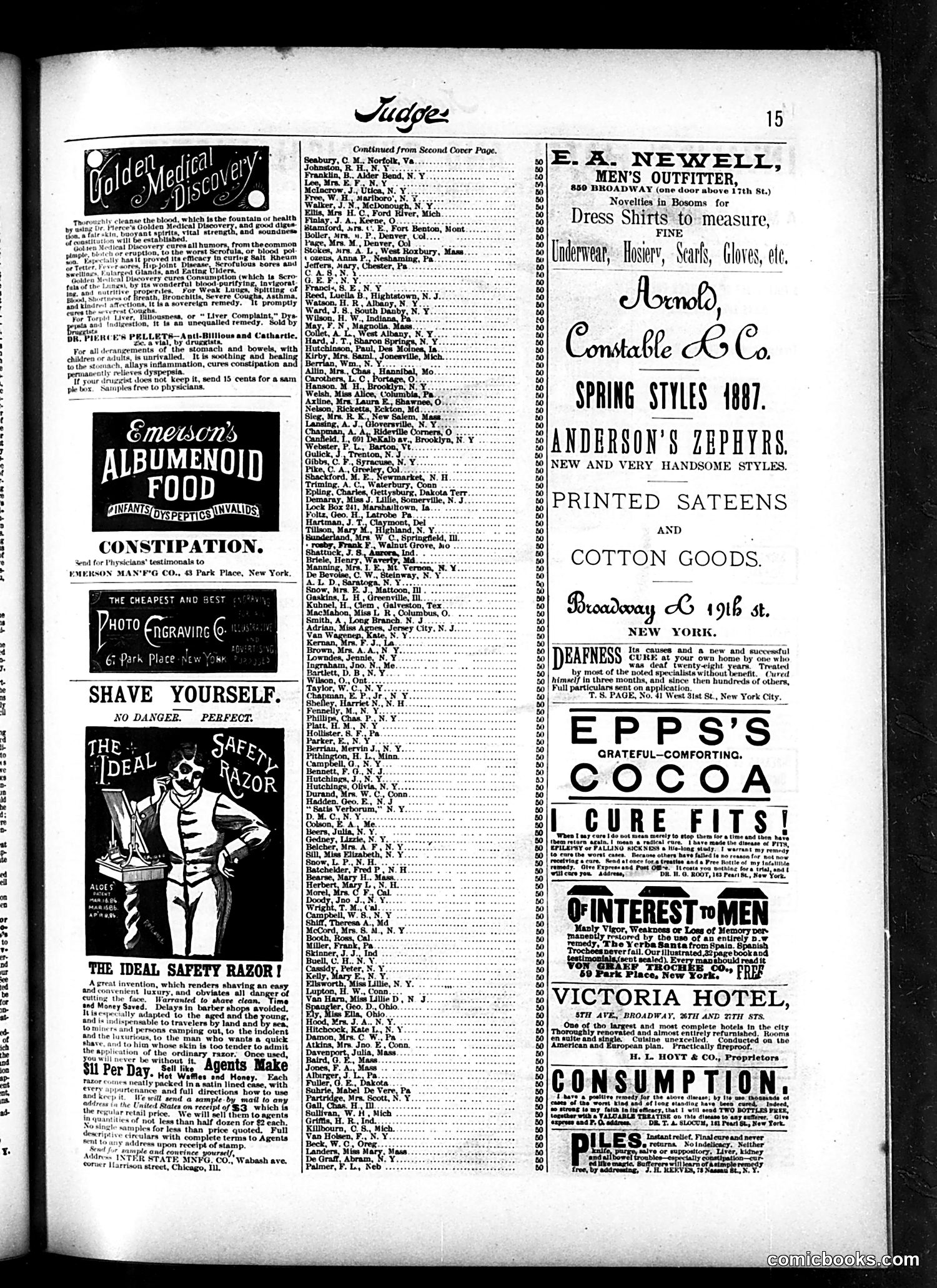
This page is **primarily advertisements** with no visible political cartoons or satirical content. The ads promote patent medicines and dubious health products typical of the 1880s era: Emerson's Albumenoid Food for constipation, "cures" for deafness and consumption (tuberculosis), treatments for "manly vigor" and lost memory, and Epps's Cocoa. These remedies—many containing unregulated ingredients—exploited public health anxieties before FDA oversight existed. Other ads include men's clothing (E.A. Newell's outfitter), hotels, and the "Ideal Safety Razor," a commercial innovation promising to eliminate barbershop visits. The page also lists names (likely Judge's subscribers or contributors) in small type, a common feature in magazines of this period. There is no satire or political commentary visible on this page—it functions as a standard advertising section within the magazine.
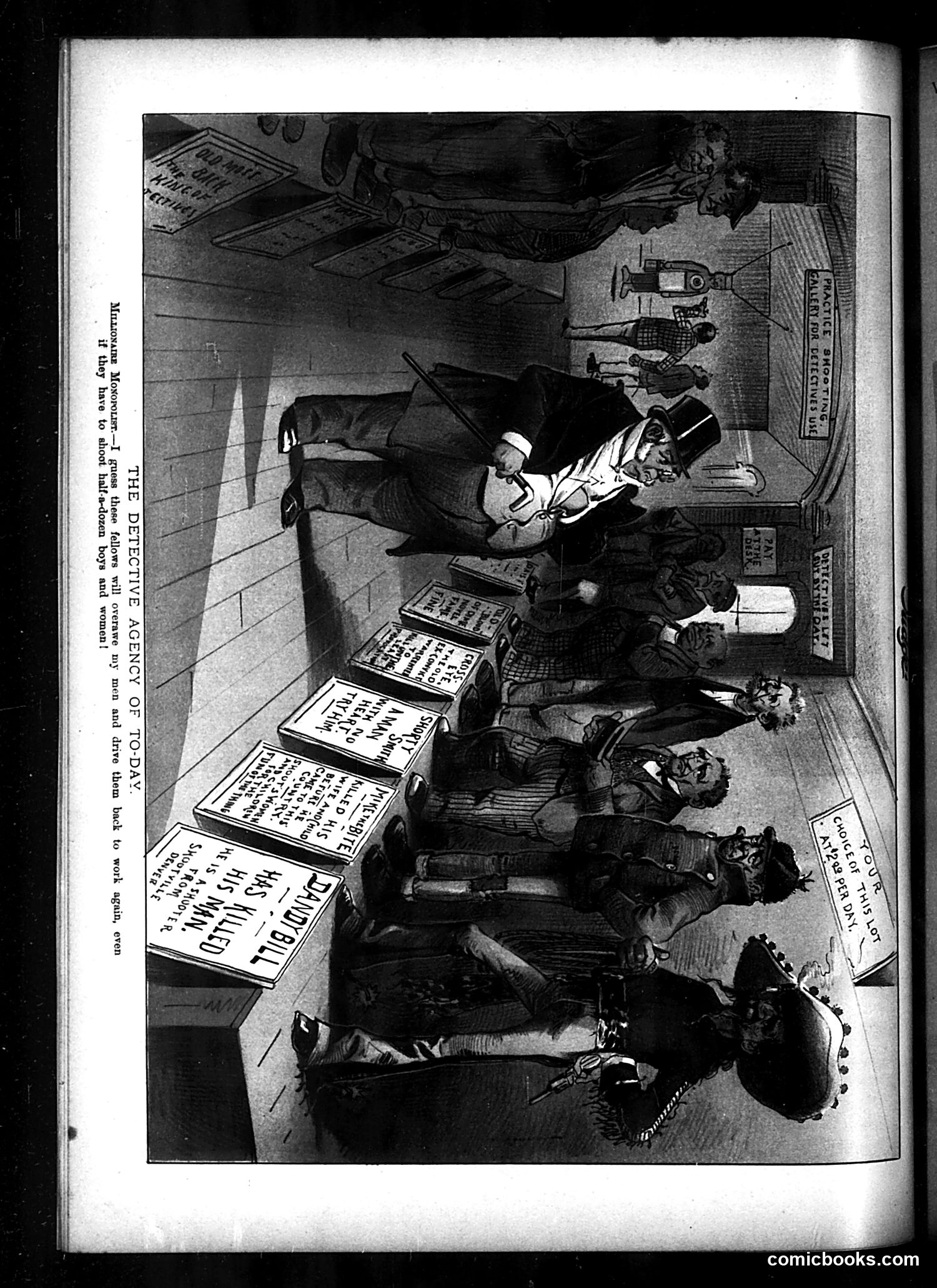
This cartoon satirizes the use of private detectives—likely Pinkerton agents—as strikebreakers during labor disputes. The image shows armed men confronting striking workers, with large placards displaying their demands. The caption's speaker (identified as "Moxorouist," likely a play on "Moxie" or a satirical name for a factory owner or police official) expresses cynical confidence that these intimidating armed agents will force strikers back to work through threat or violence, callously accepting potential casualties among the workers, including "boys and women." The satire targets the brutal tactics of industrial detective agencies hired to suppress labor organizing in the Gilded Age/Progressive Era. Judge magazine frequently criticized the violent suppression of workers' rights during this period.