
Judge, 1887-02-05 · page 5 of 16
Judge — February 5, 1887 — page 5: what you’re looking at
What you’re looking at
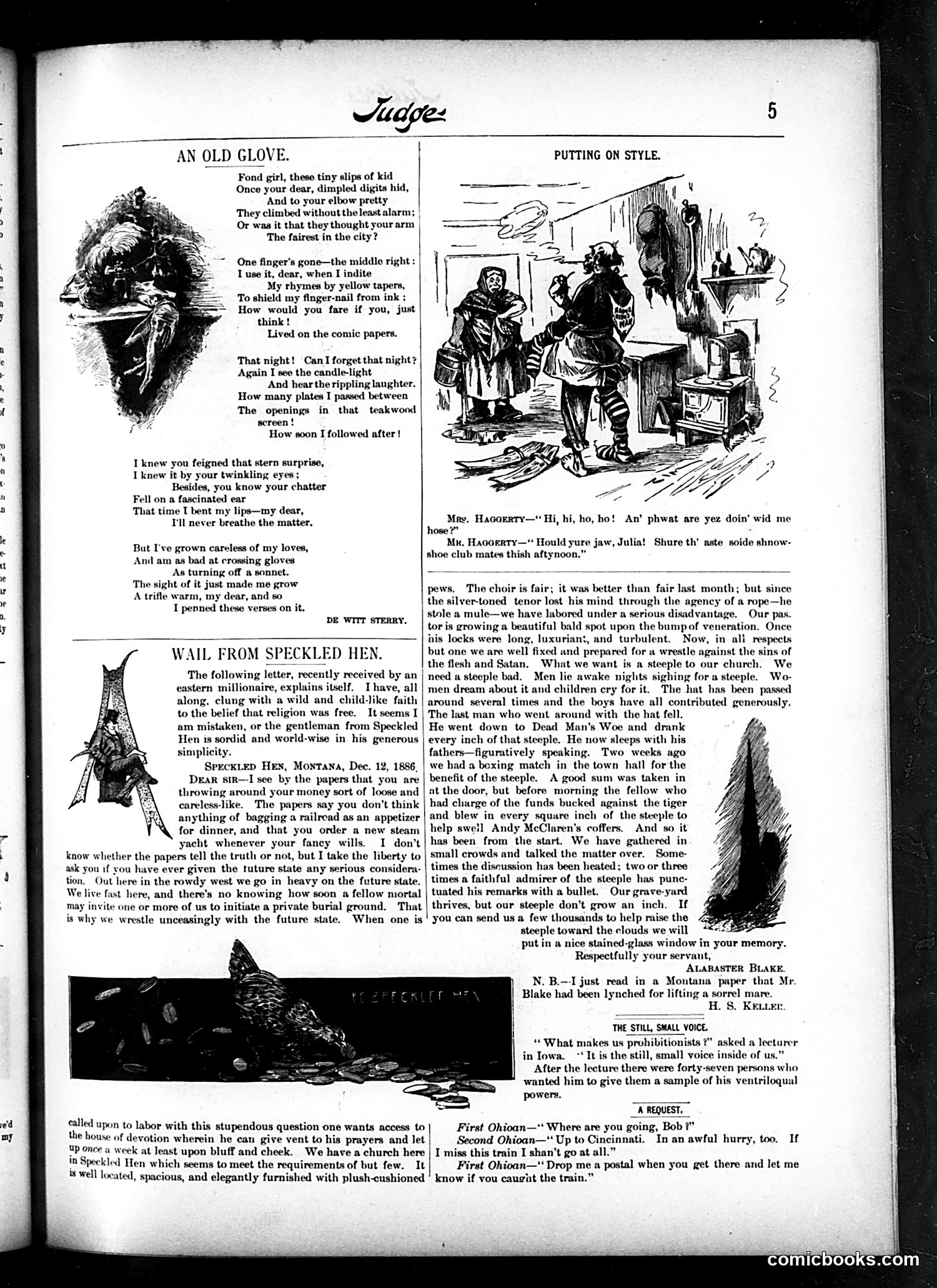
This page contains several distinct pieces of satirical content: **"An Old Glove"** (left): A sentimental poem by De Witt Sterry about a worn glove that belonged to a romantic interest. The satire appears gentle—mocking the overwrought sentimentality of Victorian romance writing through exaggerated emotion about a discarded garment. **"Wail from Speckled Hen"** (lower left): A letter from a Montana resident to a wealthy eastern millionaire, requesting funds for a church steeple. The satire targets Western frontier religiosity and financial desperation—the writer describes the rough frontier life ("rope," implied suicide by the choir tenor) while making an awkward solicitation for donations, mixing crude frontier dialect with earnest spiritual need. **"Putting On Style"** (right): A brief comic dialogue between Irish characters (indicated by phonetic dialect spelling) about using a horse for a snowshoe club meeting, likely mocking pretentious social climbing or the absurdity of frontier "society" imitating Eastern gentility. The page satirizes American social pretension, excessive sentimentality, and frontier life's collision with Victorian values.
📄 Transcribed text from this page (OCR, searchable)
Machine-transcribed from the original scan — historical spelling and the odd misread are preserved.
temtintts ZF VIL ed By AN OLD GLOVE. Fond girl, these tiny slips of kid Once your dear, dimpled digits hid, And to your elbow pretty They climbed without the least alarm; Or was it that they thought your arm The fairest in the city? One finger’s gone—the middle right : T use it, dear, when I indite My rhymes by yellow tapers, To shield my finger-nail from ink ; How would you fare if you, just think! Lived on the comic papers. That night! Can I forget that night? Again I see the candle-light ‘And hearthe rippling laughter. How many plates I passed between The openings in that teakwood screen! How soon I followed after ! I knew you feigned that stern surprise, I knew it by your twinkling eyes; Besides, you know your chatter Fell on a fascinated ear That time T bent my lips—my dear, I'll never breathe the matter. But I've grown careless of my loves, And am as bad at crossing gloves As turning off a sonnet. The sight of it just made me grow A trifle warm, my dear, and 60 I penned these verses on it. DE WITT STERRY. WAIL FROM SPECKLED HEN. The following letter, recently received by an eastern millionaire, explains itself. Ihave, all along, clung with a wild and child-like faith to the belief that religion was free. It seems I am mistaken, or the gentleman from Speckled Hen is sordid and world-wise in his generous simplicity. SprcKLED HEN, Montana, Dec. 12, 1886, Dear siR—I see by the papers that you are throwing around your money sort of loose and like. The papers say you don’t think anything of bagging a railroad as an appetizer for dinner, and that you order a new steam yacht whenever your fancy wills. I don't know whether the papers tell the truth or not, but I take the liberty to ask you if you have ever given the tuture state any serious considera- tion. Out here in the rowdy west we go in heavy on the future state. We live fast here, and there's no knowing how soon a fellow mortal may invite one or more of us to initiate a private burial ground. That is why we wrestle unceasingly with the future state. When one is called upon to labor with this stupendous question one wants access to the house of devotion wherein he can give vent to his prayers and let UP once a week at least upon bluff and cheek. We have a church here in Speckled Hen which seems to meet the requirements of but few. It 's well located, spacious, and elegantly furnished with plush-cushioned PUTTING ON STYLE. Marv, Hacoerty—“ Hi, hi, ho, ho! An’ phwat are yez doin’ wid me hose?" . Mx. Hacorrty—" Hould yure jaw, Julia! Shure th’ aste soide shnow- shoe club mates thish aftynoon.” pews. The choir is fair; it was better than fair last month; but since the silver-toned tenor lost his mind through the agency of a rope—he stole a mule—we have labored under a serious disadvantage. Our pas. tor is growing a beautiful bald spot upon the bump of veneration. Once his locks were long, luxuriant, and turbulent. Now, in all respects but one we are well fixed and prepared for a wrestle against the sins of the flesh and Satan. What we want is a steeple to our church. We need a steeple bad. Men lie awake nights sighing fora steeple. Wo- men dream about it and children cry for it. The hat has been passed around several times and the boys have all contributed generously. The last man who went around with the hat fell. He went down to Dead Man’s Woe and drank every inch of that steeple. He now sleeps with his fathers—figuratively speaking. Two weeks ago we had a boxing match in the town hall for the benefit of the steeple. A good sum was taken in at the door, but before morning the fellow who had charge of the funds bucked against the tiger and blew in every square inch of the steeple to help sweil Andy McClaren’s coffers. And so it has been from the start. We have gathered in small crowds and talked the matter over. Some- times the discussion has been heated; two or three times a faithful admirer of the steeple has punc- tuated his remarks with a bullet. Our grave-yard thrives, but our steeple don’t grow an inch. If you can send us a few thousands to help raise the steeple toward the clouds we will put in a nice stained-glass window in your memory. Respectfully your servant, ALABASTER BLAKE. N. B.—-I just read in a Montana paper that Mr. Blake had been lynched for lifting a sorrel mare. “What makes us prohibitionists ¢” asked a lecturer in Iowa. *‘ It is the still, small voi side of us.” After the lecture there were forty-seven persons who wanted him to give them a sample of his ventriloqual powers. _A REQUEST First Ohioan— Where are you going, Bob ?” Second Ohioan—"' Up to Cincinnati. In an awful hurry, too. If I miss this train I shan’t go at all.” Firat Ohioan—" Drop me a postal when you get there and let me know if you caught the train.”