
A complete issue · 16 pages · 1887
Judge — January 15, 1887
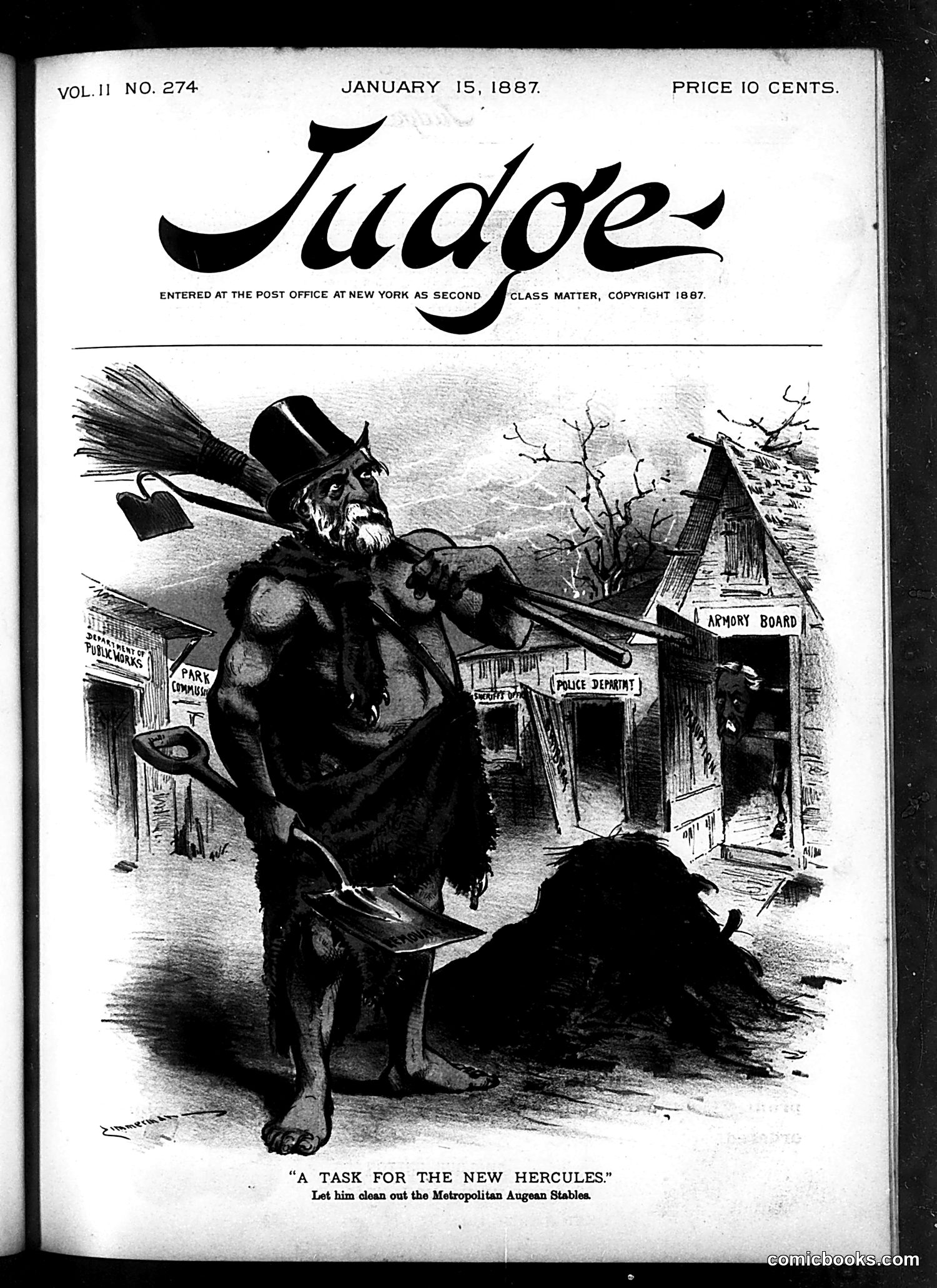
This 1887 *Judge* cartoon satirizes the challenge facing New York City's newly appointed police commissioner or similar official (the "new Hercules"). The figure, depicted as a classical strongman wielding a broom and shovel, confronts the filthy "Metropolitan Augean Stables"—a reference to the mythological labor of cleaning King Augeas's stables. The cartoon mocks the scale of corruption and disorder plaguing New York's municipal government and police department. Buildings labeled "Park Police" and "Armory Board" suggest institutional rot across multiple city agencies. The dead animal and general decay symbolize the pervasive problems the new administrator must remedy—a seemingly impossible task without genuine reform, not merely cosmetic cleanup.
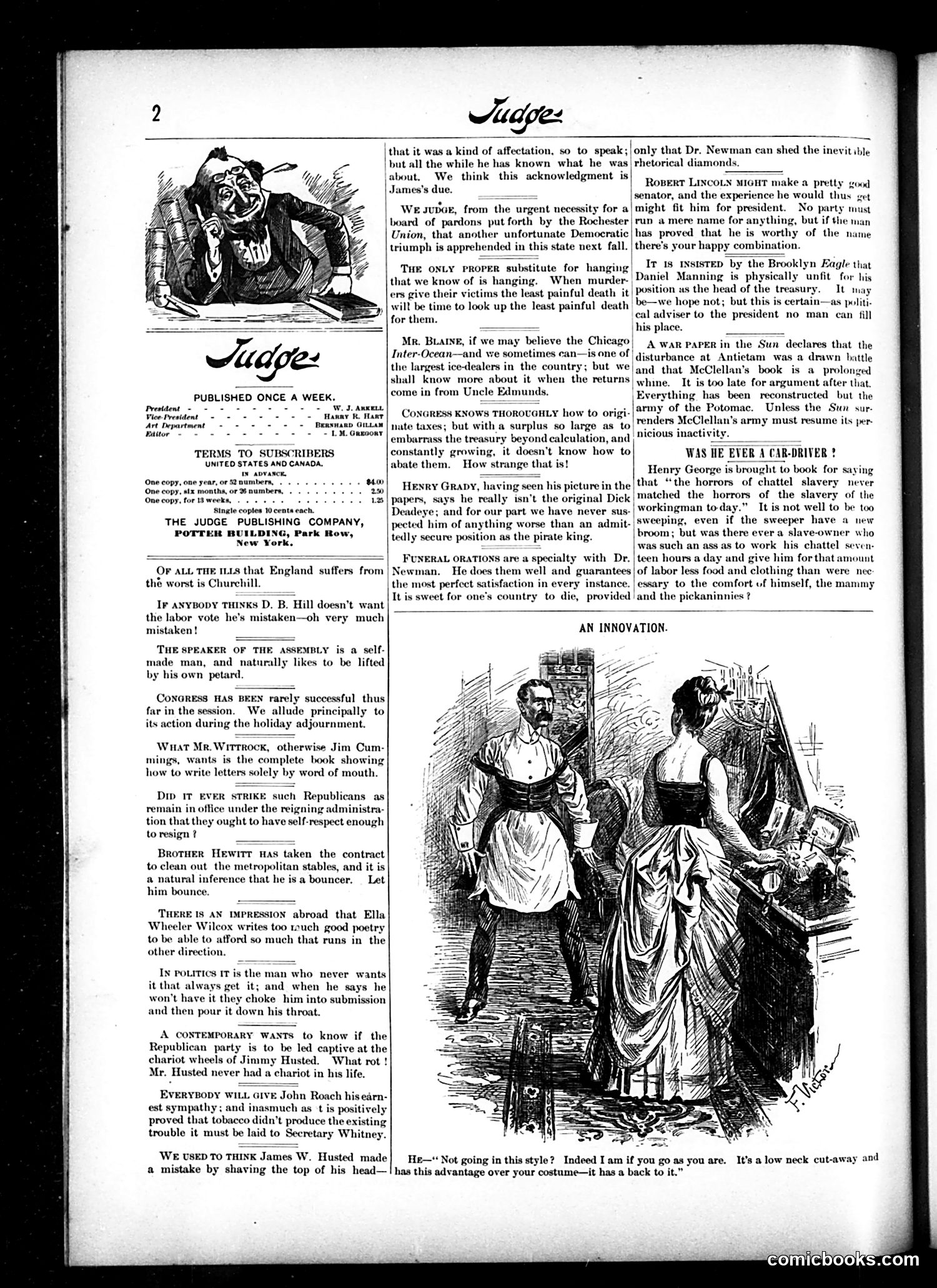
**Top Cartoon:** Shows a grotesque caricature labeled "Judge's" - likely representing the magazine's editorial voice or a political figure being satirized. The exaggerated features are typical of 19th-century satirical art. **Main Editorial Content:** The page contains political commentary addressing several figures: Dr. Newman (mentioned regarding Democratic troubles), Robert Lincoln (as potential senator), and critiques of various political positions including labor votes and Republican administration policies. **Bottom Illustration ("An Innovation"):** Depicts two women in period dress, with a caption about "low neck cut-away" style and costume advantages. This appears to be fashion satire, possibly mocking women's dress reforms or social pretensions. The page reflects Judge's typical approach: mixing political satire with social commentary and fashion humor. Without clearer date context, specific historical figures remain difficult to definitively identify.
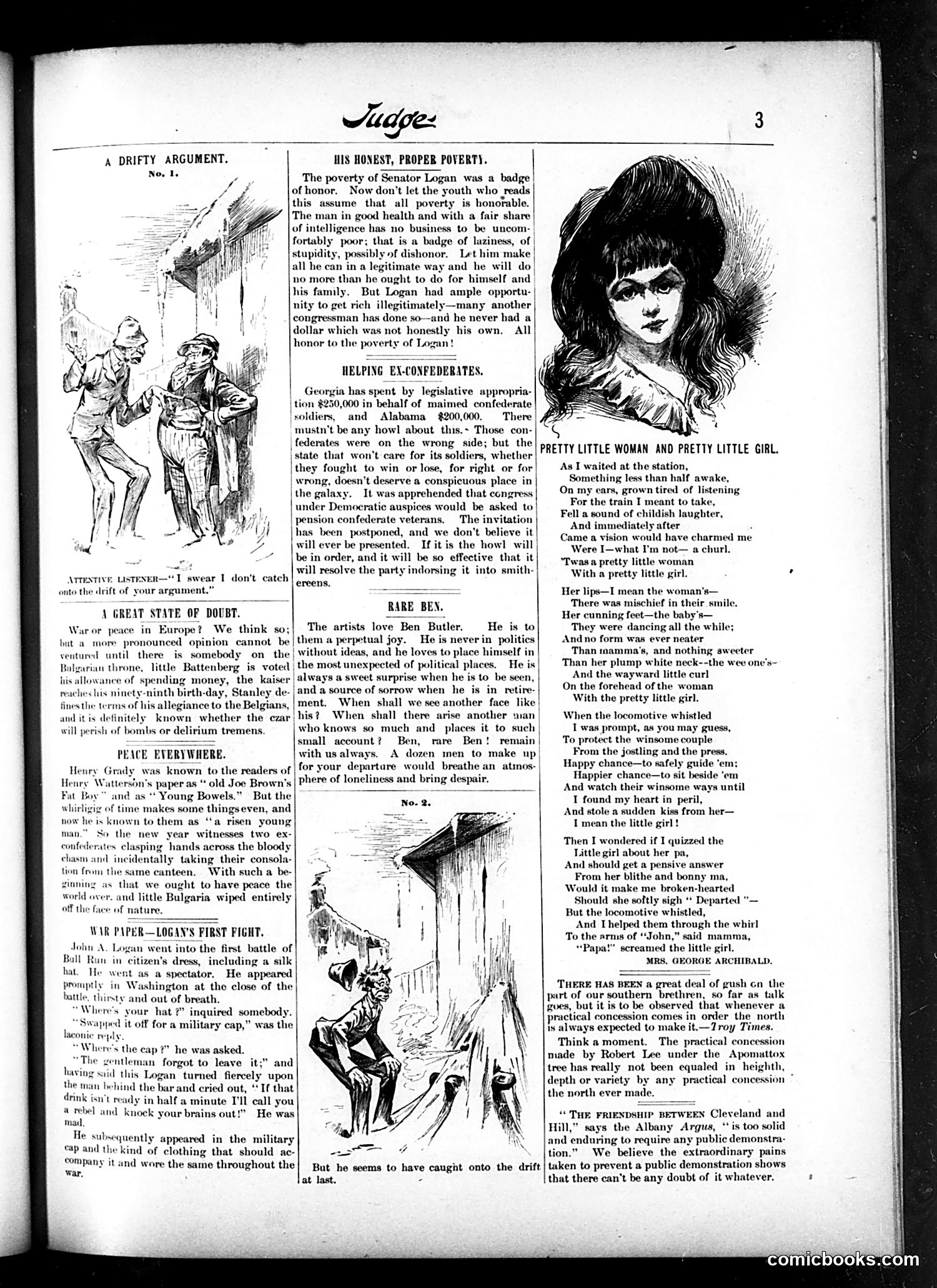
This page contains political commentary and poetry from an American satirical magazine. Key sections: **"His Honest, Proper Poverty"** defends Senator Logan's honorable poverty, contrasting it with congressmen who enriched themselves illegally. Logan represents integrity in public service. **"Helping Ex-Confederates"** argues that states caring for wounded Confederate veterans—Georgia and Alabama's $250,000 appropriations—deserve no criticism, despite the South's defeat. The piece argues that supporting soldiers regardless of which side they fought for reflects proper national character. **"Rare Ben"** celebrates Ben Butler, a controversial Union general and politician known for unexpected political positions and strong opinions. The satire portrays him as perpetually surprising and valuable to public discourse. **The poetry "Pretty Little Woman and Pretty Little Girl"** is sentimental verse about observing an attractive woman and child at a train station—typical Victorian-era light content. The cartoons illustrate these pieces with period sketches. This represents Judge's mix of political argument, celebrity commentary, and genteel entertainment for educated readers.
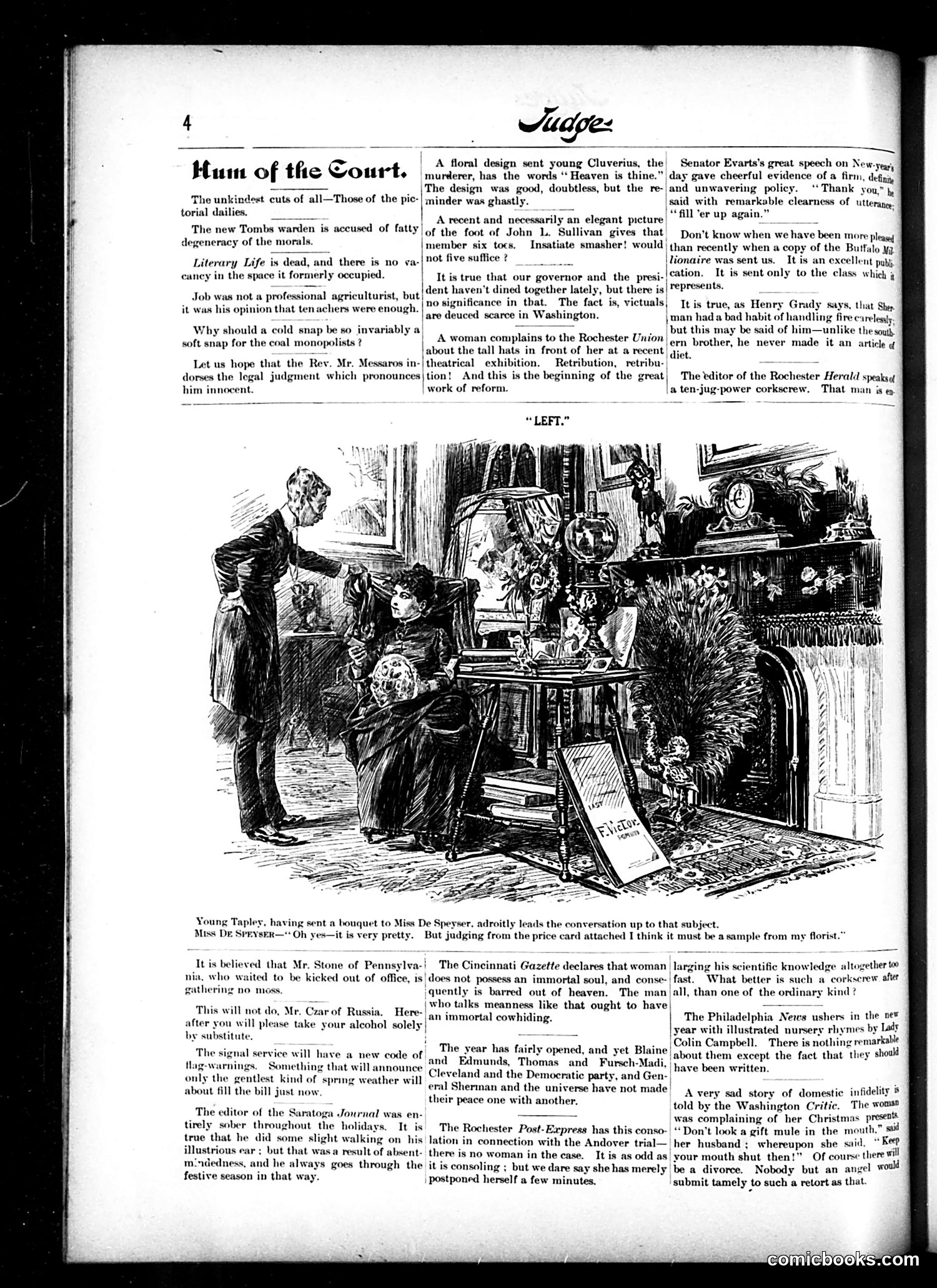
This page contains several short satirical items typical of Judge's political commentary. Key targets include: **"Mist of the Court"** section mocks various public figures and institutions: the new Tombs warden (accused of moral decay), Senator Evarts (praised sarcastically), and references to Governor Cleveland and President Arthur's recent dinner absence. **The main cartoon "LEFT"** depicts a young man (Young Tapley) presenting a bouquet to Miss De Speyser at what appears to be a social gathering. The joke turns on her noticing the florist's price card attached—suggesting his romantic gesture is calculated and economical rather than genuinely affectionate. **Scattered commentary** jabs at: woman's rights (Cincinnati Gazette's claim women lack immortal souls), the Czar of Russia, and various newspaper editors. The satire reflects Gilded Age concerns: gender roles, political maneuvering, commercialism undermining romance, and press commentary. Most references are now obscure without historical context about specific politicians and publications mentioned.
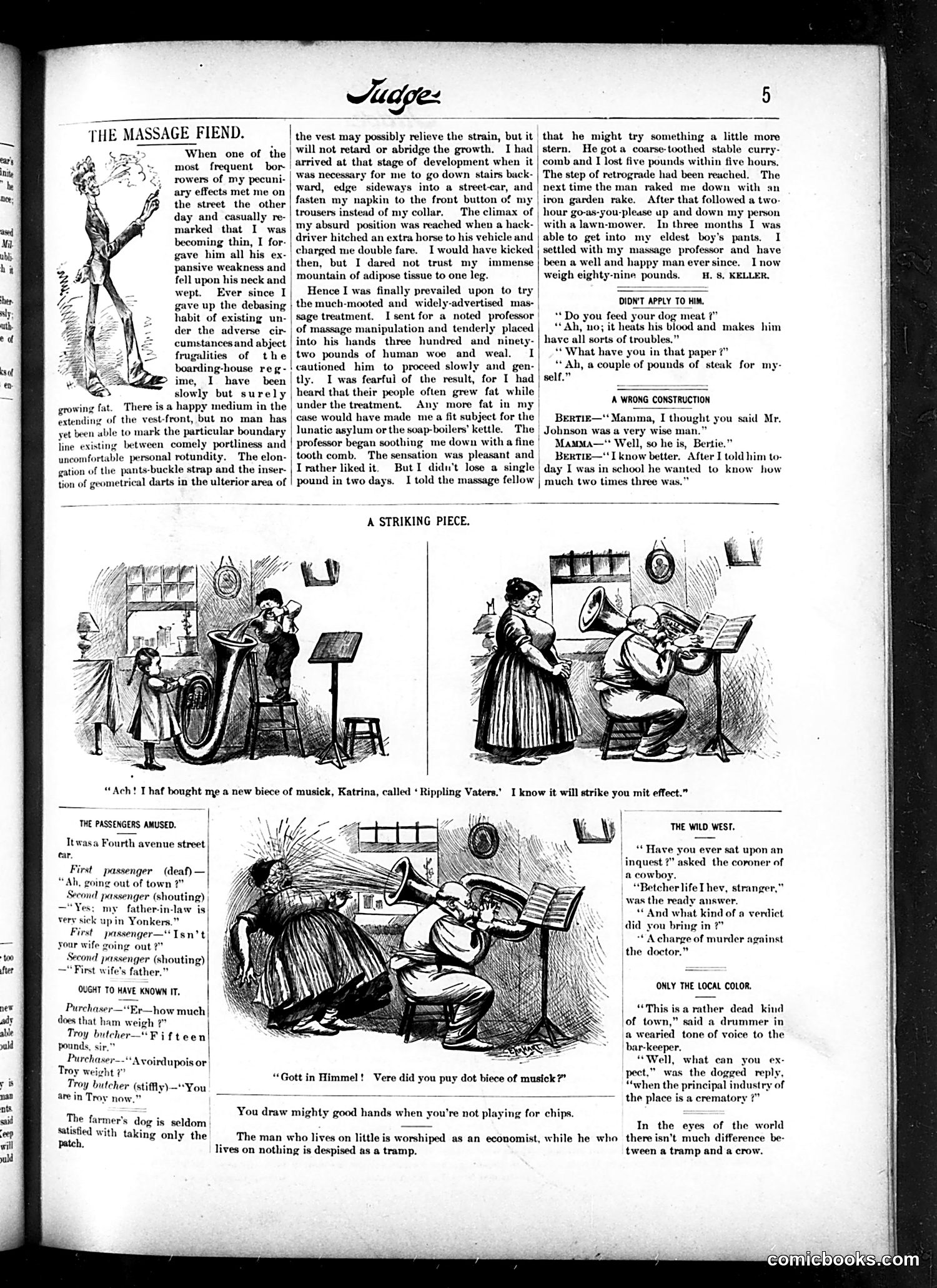
This page satirizes the early 20th-century American obsession with weight loss and "massage cure" fads. **"The Massage Fiend"** mocks a wealthy man who hires a massage professor to treat obesity. The narrative humorously escalates from gentle massage to brutal treatments (curry comb, iron rake, lawn mower) that paradoxically shrink him from 392 to 89 pounds—suggesting these trendy "cures" were dangerous pseudoscience. The smaller cartoons offer unrelated humor: **"A Striking Piece"** depicts a woman presenting her new musical instrument; **"The Passengers Amused"** plays on miscommunication when a deaf passenger misunderstands shouted news about someone's illness; **"The Wild West"** jokes about a cowboy's ignorance of courtroom procedure; **"Only the Local Color"** mocks a mortician mistaken for a town historian. These items are typical Judge magazine fare—topical satire mixed with absurdist humor targeting contemporary fads, social pretension, and cultural misunderstandings. The massage treatment story specifically ridicules Americans' gullibility toward dubious health trends.
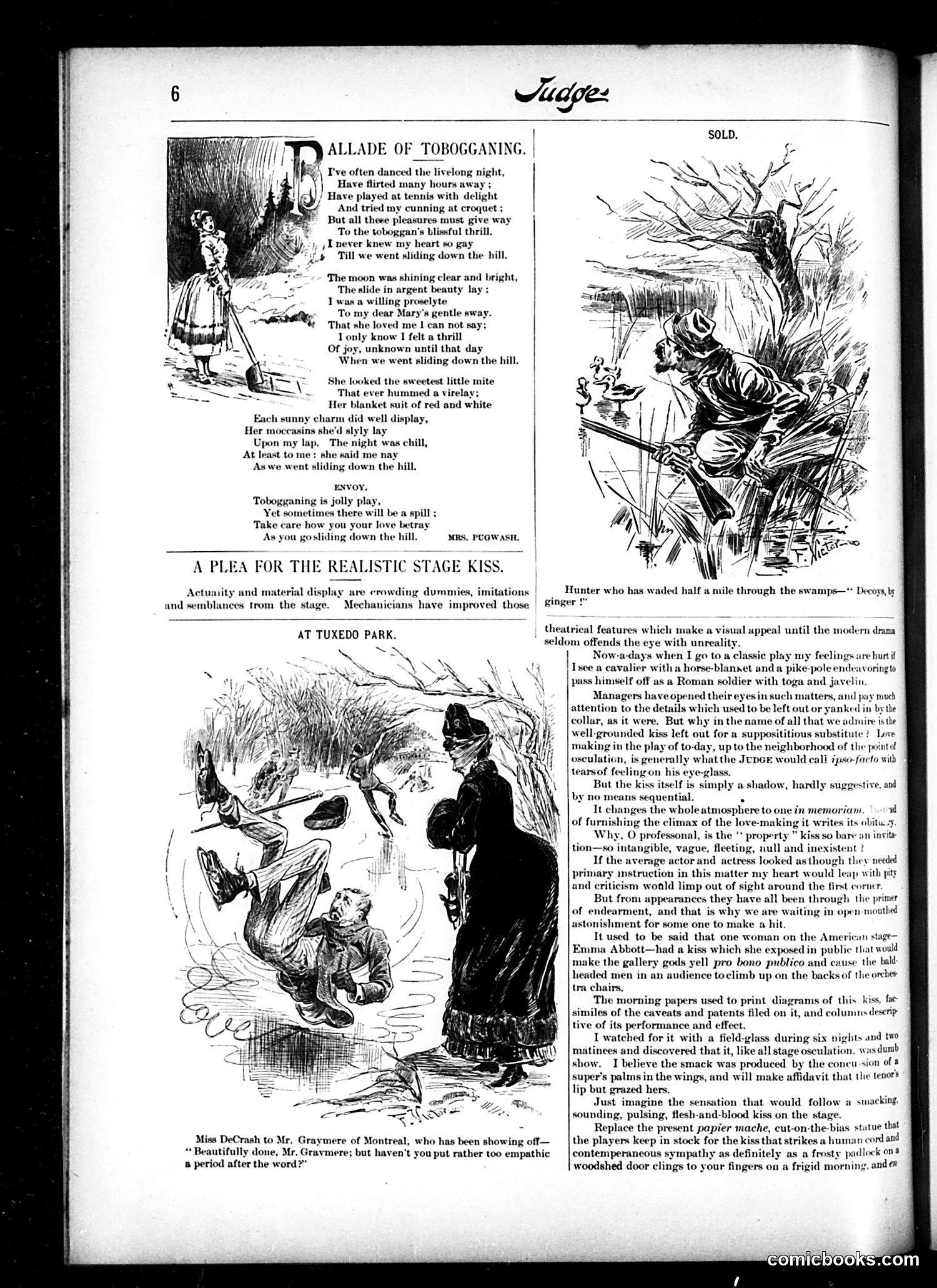
This page contains two distinct pieces of satire: **"Ballade of Tobogganing"** (left): A romantic poem by Mrs. Pugwash about sledding, where the narrator courts "Mary" while toboganning down a snowy hill. The joke is that this Victorian-era winter sport is treated with the same dramatic intensity as serious courtship. The accompanying illustration shows a couple sledding. **"A Plea for the Realistic Stage Kiss"** (right): The main satirical article attacks theatrical conventions of the era. The author criticizes actors for using fake, symbolic kisses on stage instead of genuine ones. The referenced "Emma Abbott" (a famous 19th-century opera singer) supposedly performed a kiss so scandalous it made headlines and was diagrammed in newspapers. The satire mocks both prudish theatrical practices and the public's obsession with the "kiss," demanding more authentic passion in drama. The accompanying illustration shows a couple at "Tuxedo Park" with minimal physical contact—exactly what the article criticizes. Both pieces satirize Victorian social propriety and restraint.
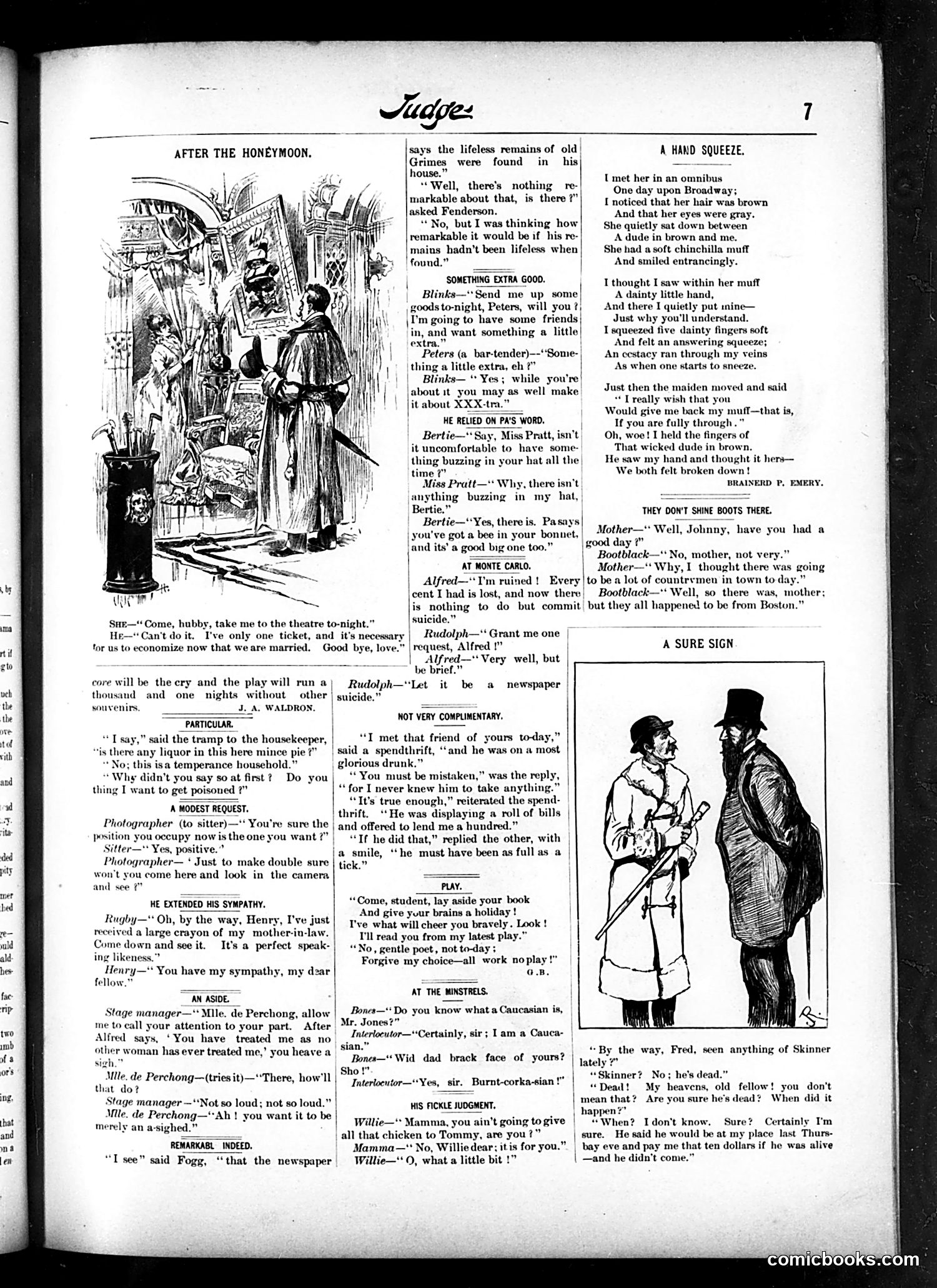
This page from *Judge* contains multiple short humorous sketches typical of the magazine's satirical style. The content is primarily social satire rather than political commentary. **Notable sketches:** - "After the Honeymoon" (with illustration): A husband refuses to take his newlywed wife to the theater to economize—satirizing the financial burdens of marriage. - "A Hand Squeeze": A poem about encountering a woman with prematurely gray hair, ending with the narrator's hand getting squeezed—likely satirizing awkward social encounters. - "A Sure Sign" (illustrated): Two men discussing a third man named Skinner who's "dead"—the punchline plays on whether he's literally or figuratively deceased (unclear without more context). - Multiple brief jokes about photographers, temperance households, stage managers, and minstrel show performers. The page reflects late 19th/early 20th-century middle-class anxieties: marital finances, social propriety, courtship conventions, and entertainment culture. The "burnt-cork" minstrel joke reflects the racist entertainment practices of the era.
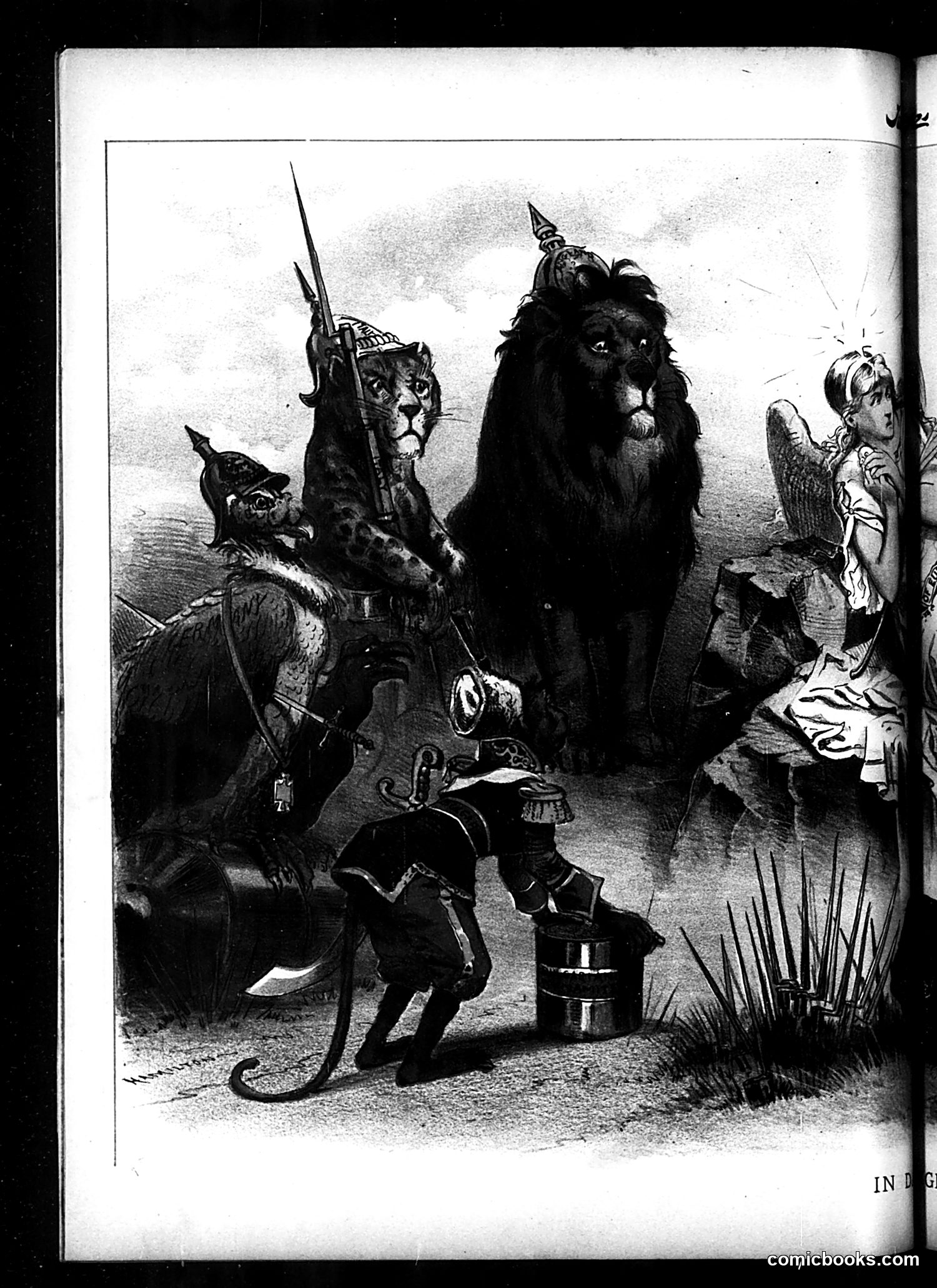
This appears to be a satirical illustration from *Judge* magazine depicting anthropomorphized animals in military dress as political figures. The central figure is a large lion wearing a spiked helmet (reminiscent of German/Prussian military headgear), flanked by smaller animals in military uniforms with weapons. On the right stands a figure in lighter clothing, possibly representing a civilian or opposing force. The imagery suggests commentary on militarism, imperial aggression, or international conflict—likely referencing European political tensions. The anthropomorphic characterization through exaggerated animal features was typical of *Judge*'s satirical approach to critiquing foreign powers or political movements. Without additional caption text visible, the specific historical moment remains unclear, though the German-style military aesthetics suggest early 20th-century context.
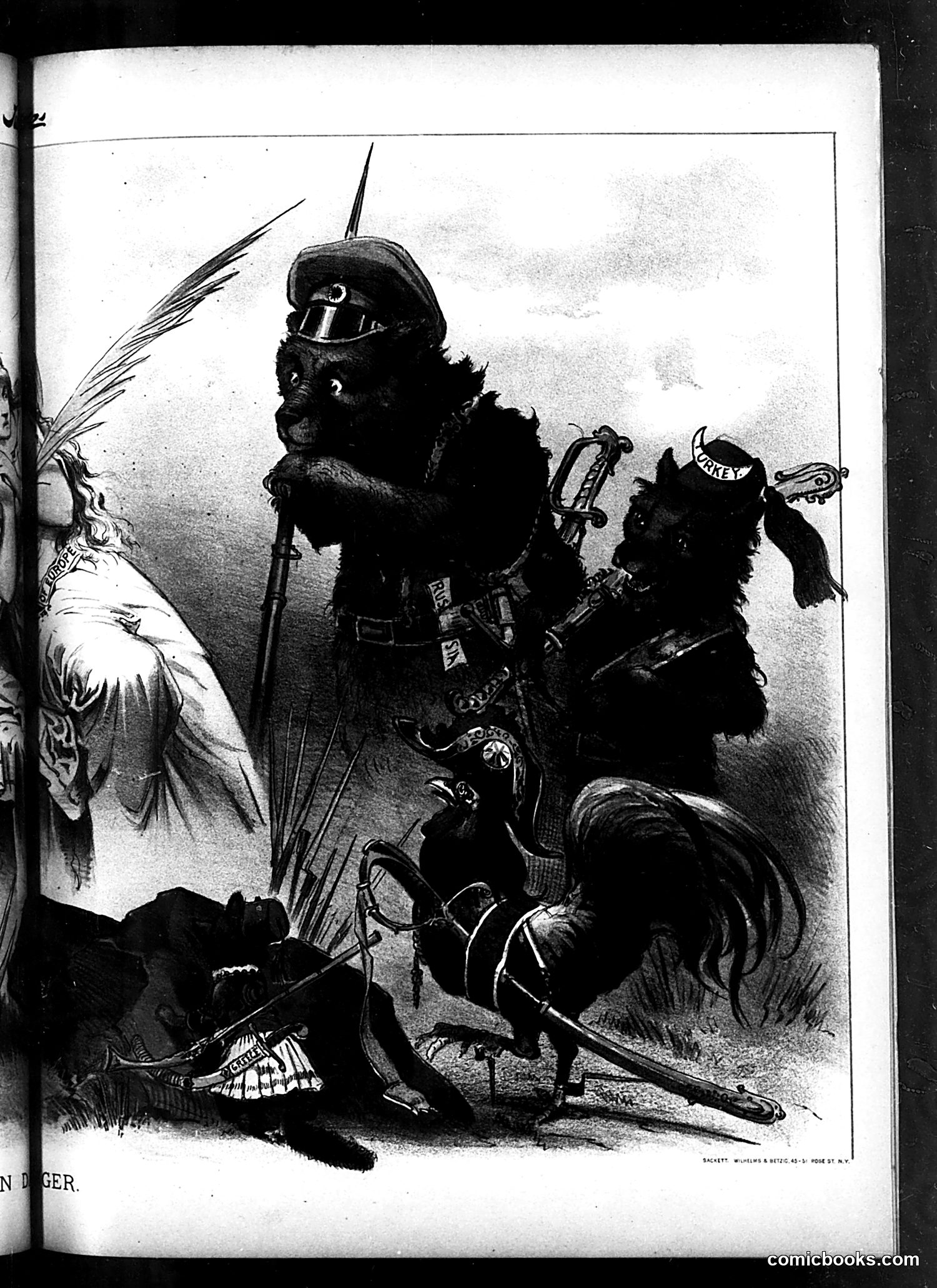
This appears to be a satirical cartoon from *Judge* magazine depicting anthropomorphized animals in military attire. The central figure is a tall ape or monkey wearing a spiked German military helmet (Pickelhaube) and armor, flanked by smaller animal soldiers also in military dress. A figure on the left appears partially visible. The cartoon likely comments on German militarism, using animal caricature—a common *Judge* technique—to mock Germanic military aggression or expansionism. The exaggerated physical features and animalistic depiction served to dehumanize the subject for satirical effect. Without a visible date or caption text, the specific historical moment remains unclear, though the German military imagery suggests commentary on pre-WWI or WWI-era tensions.
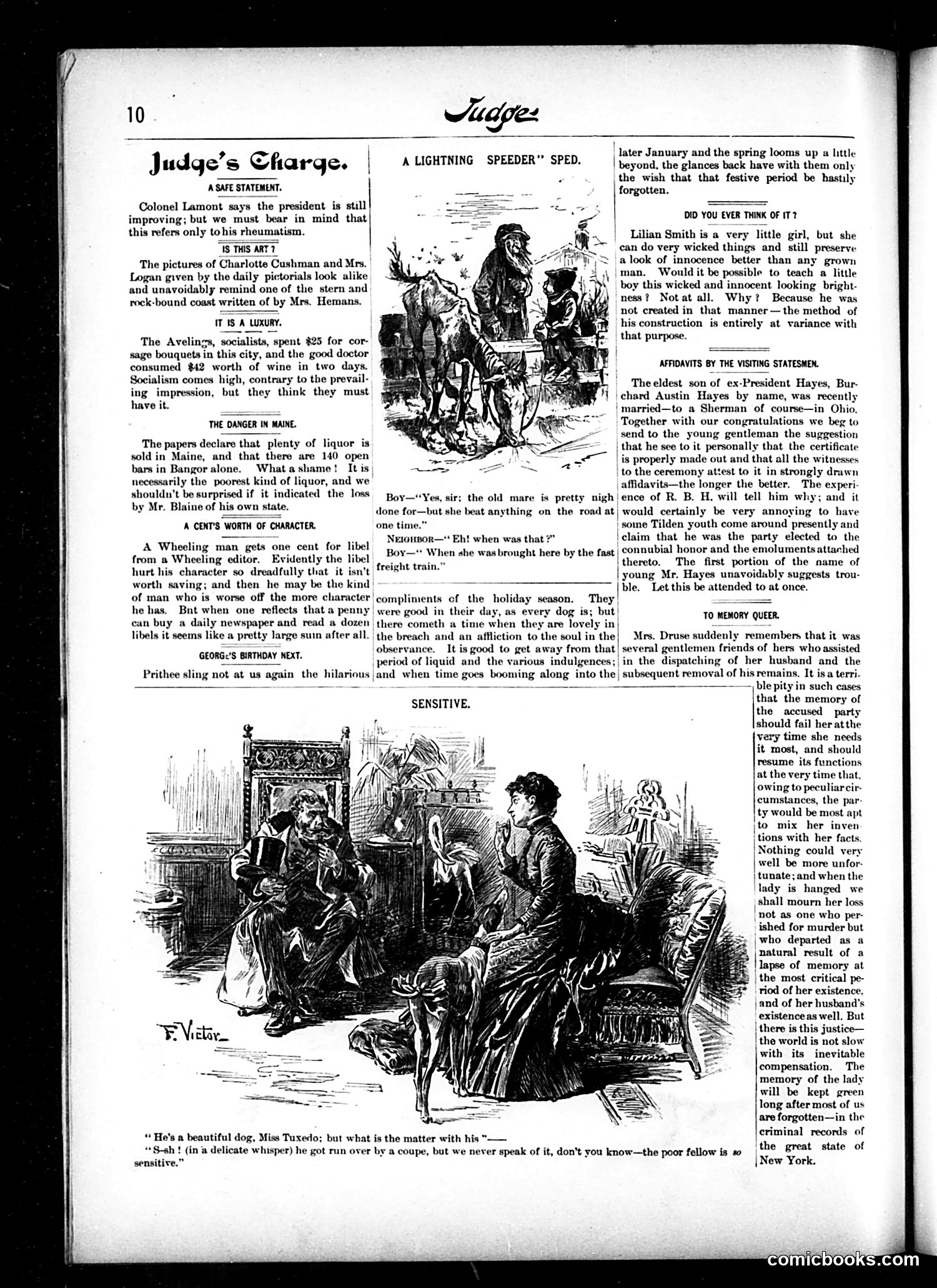
This page from the satirical magazine **Judge** contains several short political and social commentaries typical of American humor circa the 1880s: **Main cartoons and sections:** 1. **"A Lightning Speeder Sped"** — A joke about an old mare that once outran a fast freight train, mocking exaggerated claims about past performance. 2. **"Sensitive"** — Depicts a woman delicately explaining her dog's injuries from being hit by a carriage, using euphemistic language to avoid mention of the accident—satirizing excessive social politeness. 3. **Brief commentary pieces** mock: - President's health (Colonel Lamont's optimistic statements) - Socialist hypocrisy (the Avelings spending lavishly despite socialist principles) - Alcohol regulation in Maine and James G. Blaine's political standing - A libel case with trivial damages **The Hayes reference** alludes to Rutherford B. Hayes and the disputed 1876 election against Samuel Tilden, suggesting humorous concern about potential future electoral confusion through similar names. The page exemplifies Judge's satirical approach: deflating pretension, exposing hypocrisy, and commenting on contemporary political figures and social customs.
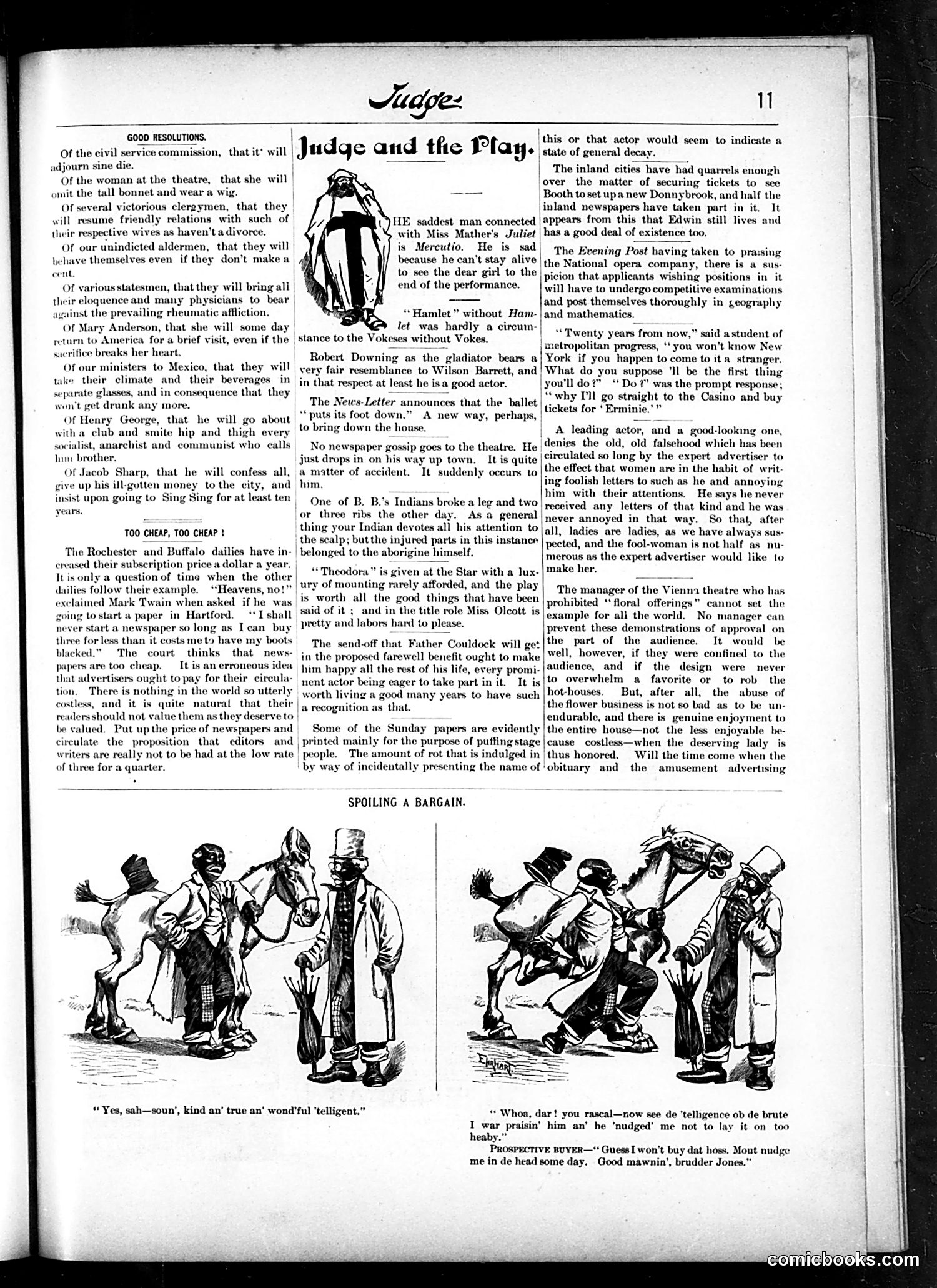
This page from Judge contains theater criticism and satirical commentary on 1880s New York cultural life. **"Judge and the Play"** section mocks theatrical absurdities: an actor playing Mercutio is "sad" because he dies before seeing Juliet's final scene; references to the Vokes theatrical family suggest even removing one performer drastically diminishes a production. The piece ridicules newspapers' obsession with theater gossip and ticket disputes. **"Spoiling a Bargain"** cartoons (bottom) depict working-class figures in comic dialect, apparently depicting a transaction or negotiation, though the exact scenario is unclear from the visible text. **"Too Cheap, Too Cheap!"** section criticizes newspapers for charging too little—Mark Twain supposedly refuses to start a Hartford paper because he could "buy three for less than it costs me to have my boots blacked." Judge argues editors deserve better compensation and that low newspaper prices devalue journalism. The overall tone reflects fin-de-siècle urban anxieties about entertainment, media economics, and cultural standards.
This page is primarily **advertising and opinion columns**, not political cartoons. The visible content includes: **Main features:** - Short humorous aphorisms reprinted from various newspapers (Philadelphia Call, Fall River Advocate, New Orleans Picayune, etc.), offering satirical observations on everyday life - Product advertisements for toilet soap, prepared food, fountain pens, and other goods - Theater advertisements (Harrigan's Park Theatre, Madison Square Theatre, Wallack's Theatre) **The humor targets:** Social pretension (Mrs. Parvenu's new house), fashion-obsessed women, gender relations, and human foibles rather than specific political figures or events. **Key point:** This appears to be a typical Judge page from the late 19th/early 20th century, blending satirical commentary on contemporary manners and morals with commercial advertising. There are no identifiable political cartoons or caricatures of named public figures visible on this particular page.
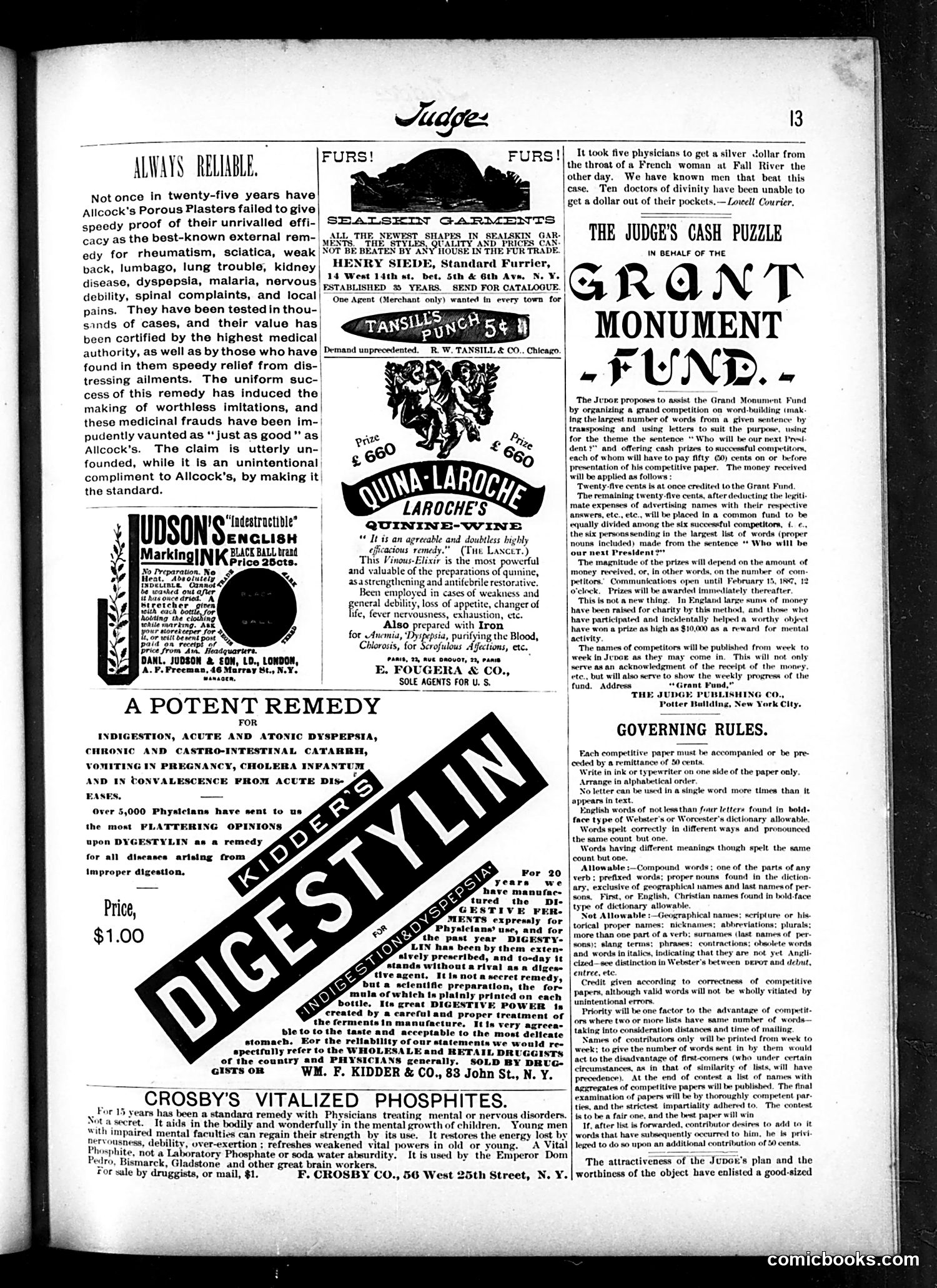
This page is primarily **advertisements**, not political satire. It's from an American satirical magazine, but this particular spread showcases patent medicines and commercial products common to the late 19th century. The ads promote dubious remedies: Allcock's Porous Plasters (claimed to cure rheumatism, malaria, and numerous other ailments), Hudson's English Marking Ink, Quinine-Wine, Digestylin (for indigestion), and Crosby's Vitalized Phosphites (for mental/nervous disorders). These advertisements are notable to modern readers because they represent an era before FDA regulation, when manufacturers made sweeping medical claims without scientific evidence. The page also includes "The Judge's Cash Puzzle"—a word puzzle competition offering prize money for the Grand Monument Fund. The satirical value here lies not in explicit commentary but in the *existence* of these outlandish health claims, which Judge's readers would have recognized as typical of the era's medical marketplace.
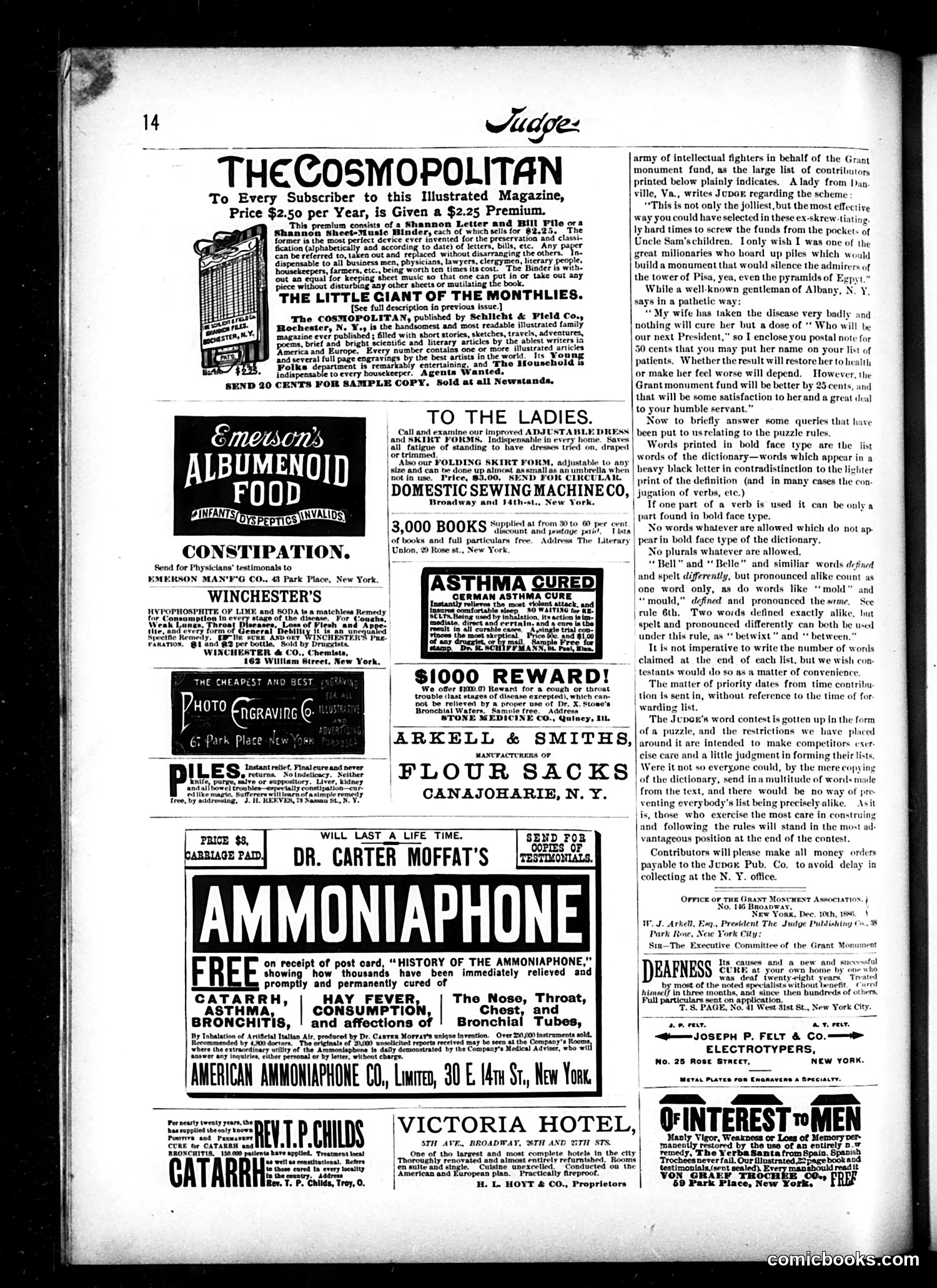
This page is primarily advertising and magazine subscription materials. There is no prominent political cartoon visible. The page features ads for products like Emerson's Albumenoid Food, Winchester's Hypophosphite, Ammoniaphonie, and various household items. The only substantive editorial content is a brief note discussing the Grant Monument Fund, mentioning contributions from supporters. A correspondent from Danville, Virginia humorously remarks that the fundraising campaign cleverly extracts donations "in these ex-skrew-tating.ly hard times" — essentially satirizing the difficulty of raising money during an economic downturn (likely the post-Civil War period). This appears to be the page's satirical element, though it's minimal compared to the extensive advertising.
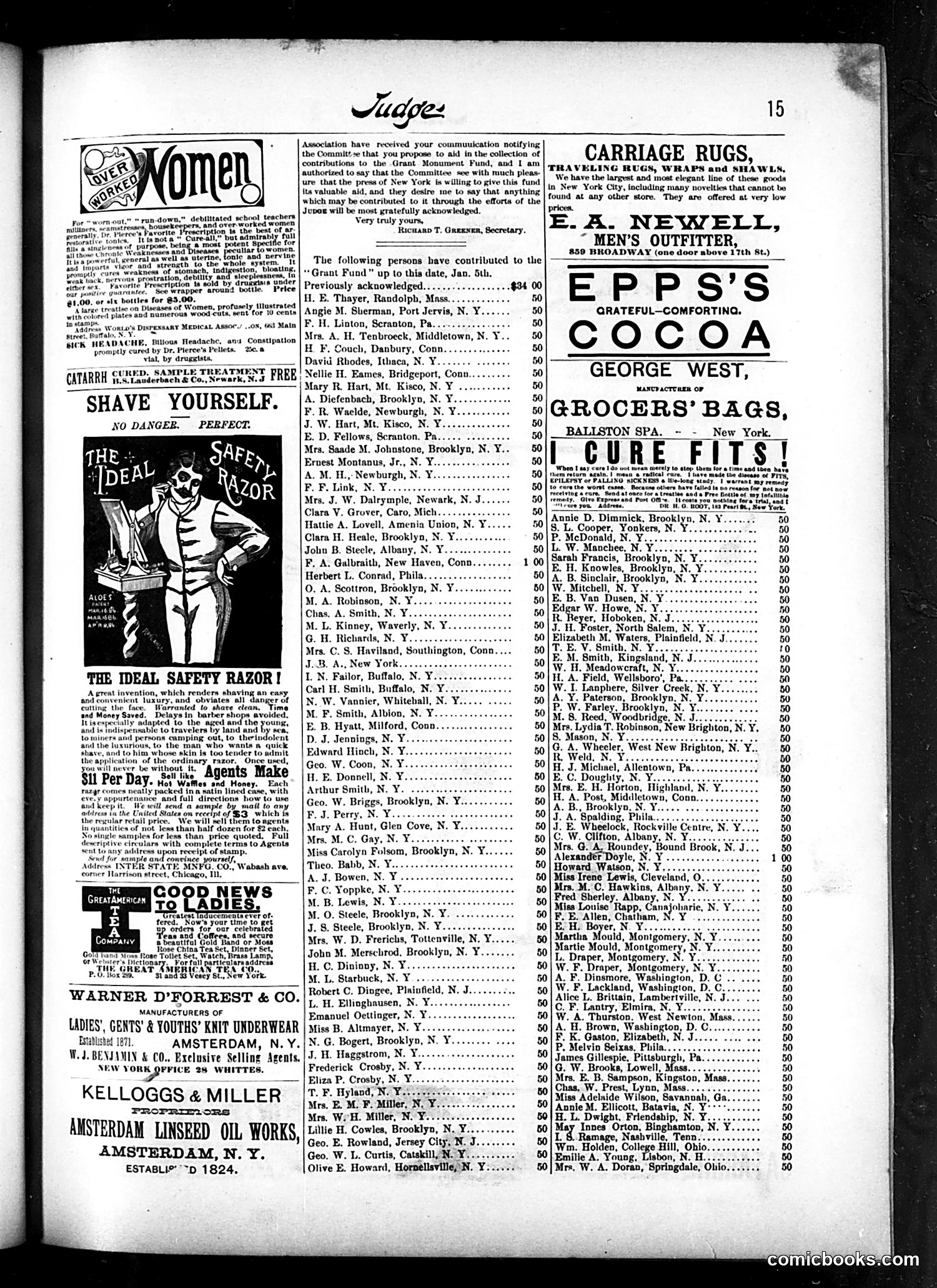
This page is primarily **advertising and business notices** from Judge magazine, with minimal editorial or cartoon content visible. The main illustrated element is **"The Ideal Safety Razor"** advertisement, which depicts a smiling man demonstrating the new safety razor technology—a device that promised risk-free shaving compared to the traditional straight razor that required professional barbers. The dominant content is a **list of contributors to the Grant Monument Fund**, a fundraising initiative (likely for Ulysses S. Grant's memorial). A letter from Richard T. Greener, Secretary, thanks the press for supporting the collection effort. The remaining space contains **standard commercial advertisements** for patent medicines, linseed oil, knitted underwear, cocoa, and other consumer goods typical of 1880s publications. Without additional editorial cartoons or satirical pieces visible, this appears to be a pages from Judge devoted to fundraising announcements and revenue-generating advertisements rather than political or social satire.
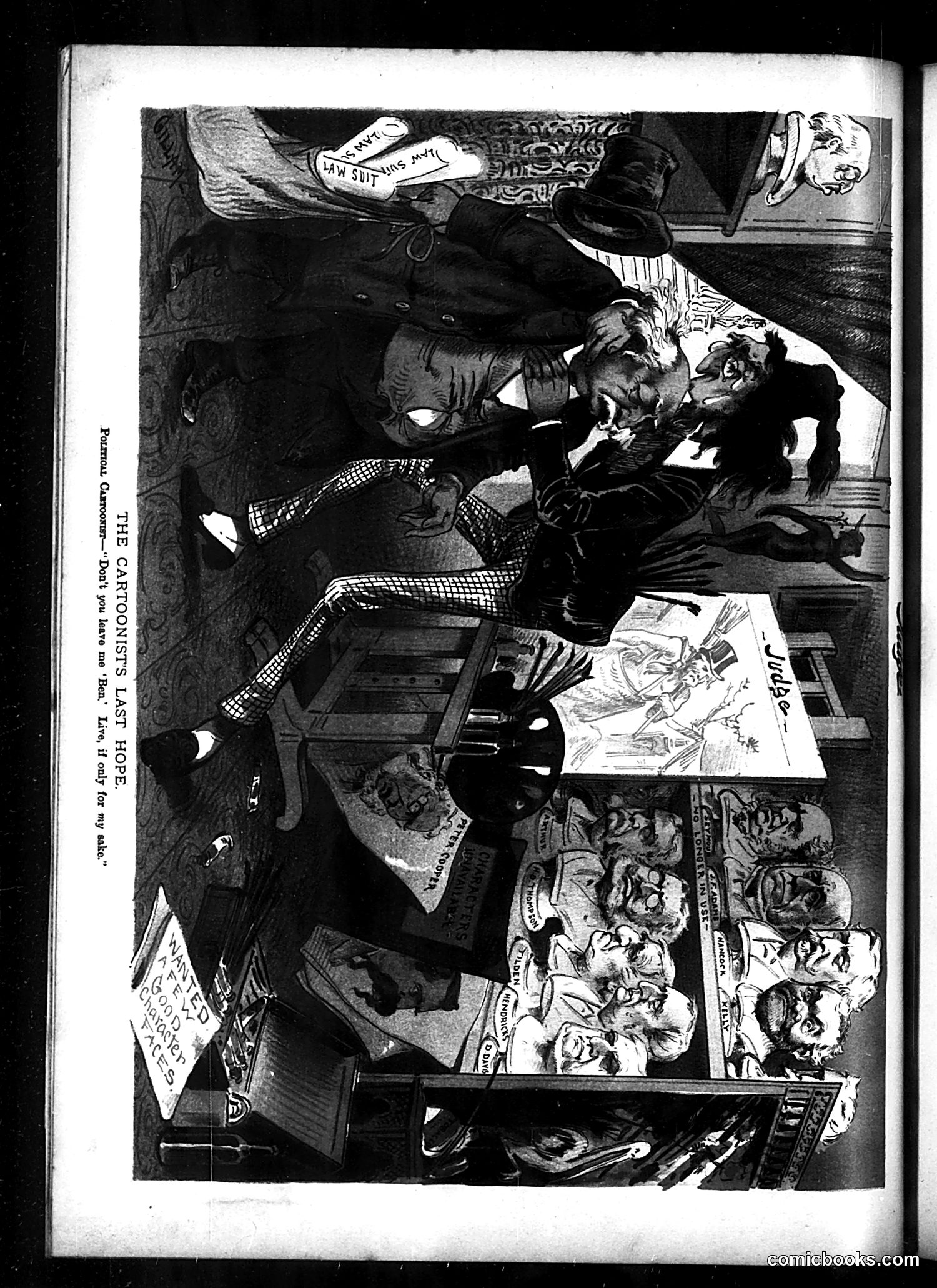
This cartoon depicts a political cartoonist pleading with a figure labeled "Ben" (likely Ben Franklin, given the historical context and iconography) not to abandon him. The cartoonist is shown surrounded by his work—sketches, caricatures, and satirical drawings scattered about—suggesting his livelihood and creative output. The satire appears to comment on the cartoonist's dependence on political figures or historical symbols for inspiration and relevance. By personifying "Ben" as the cartoonist's last hope, the piece humorously suggests that without such figures to satirize, the political cartoonist has no material and thus no purpose—a meta-commentary on the profession's reliance on controversial subjects and personalities to sustain itself.