
Judge, 1887-01-15 · page 11 of 16
Judge — January 15, 1887 — page 11: what you’re looking at
What you’re looking at
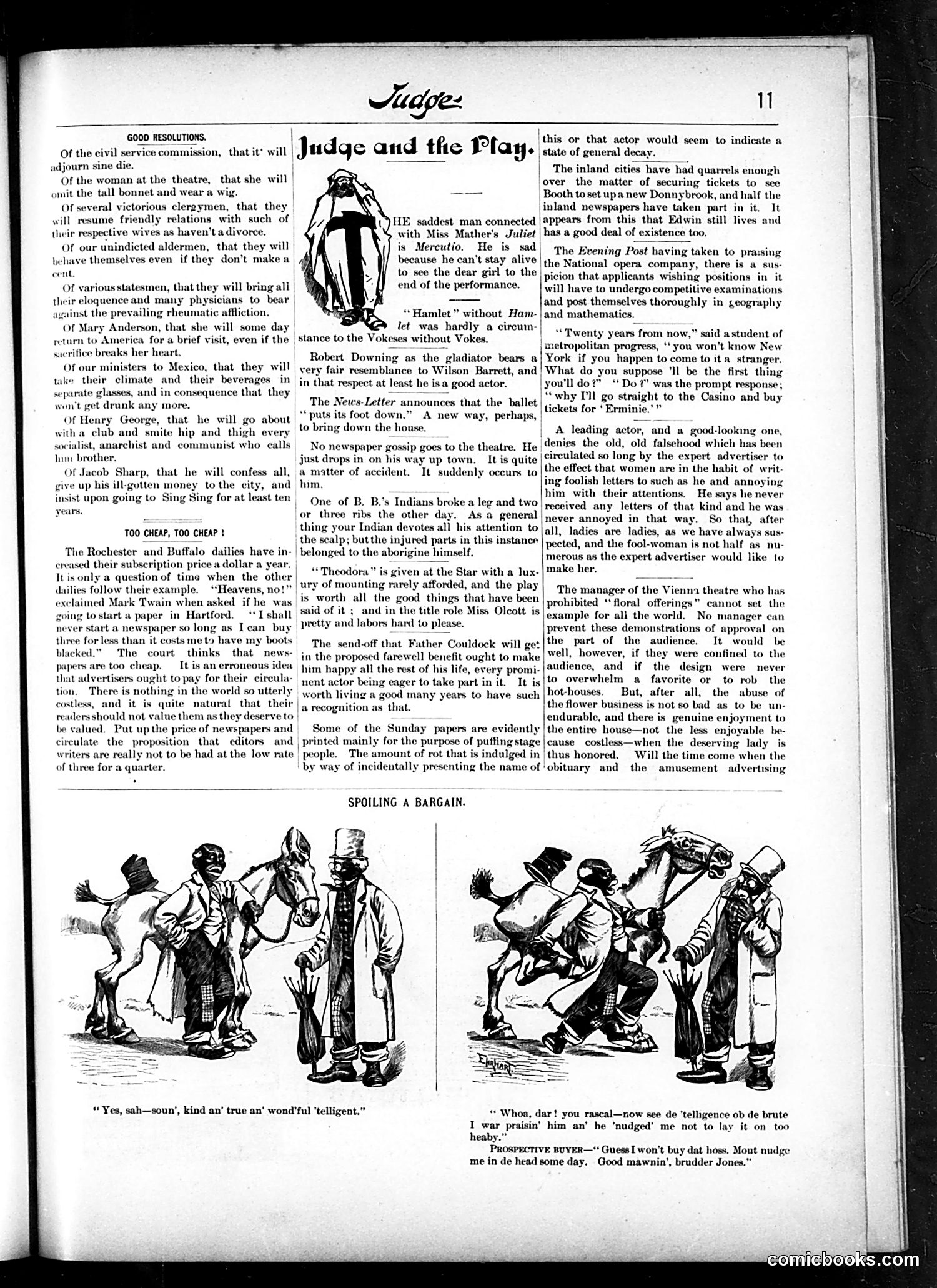
This page from Judge contains theater criticism and satirical commentary on 1880s New York cultural life. **"Judge and the Play"** section mocks theatrical absurdities: an actor playing Mercutio is "sad" because he dies before seeing Juliet's final scene; references to the Vokes theatrical family suggest even removing one performer drastically diminishes a production. The piece ridicules newspapers' obsession with theater gossip and ticket disputes. **"Spoiling a Bargain"** cartoons (bottom) depict working-class figures in comic dialect, apparently depicting a transaction or negotiation, though the exact scenario is unclear from the visible text. **"Too Cheap, Too Cheap!"** section criticizes newspapers for charging too little—Mark Twain supposedly refuses to start a Hartford paper because he could "buy three for less than it costs me to have my boots blacked." Judge argues editors deserve better compensation and that low newspaper prices devalue journalism. The overall tone reflects fin-de-siècle urban anxieties about entertainment, media economics, and cultural standards.
📄 Transcribed text from this page (OCR, searchable)
Machine-transcribed from the original scan — historical spelling and the odd misread are preserved.
vgyes GOOD RESOLUTIONS, Of the ion, that it* will adjourn s Of the woman at the theatre, that she will omit the tall bonnet and wear a wi Of several victorious clergymen, that they will resume friendly relations with such of their respective wives as haven't a divorce. Of our unindicted aldermen, that they will ve themselves even if they don’t make a cent. Of various statesmen, that they will bring ali eloquence and many physicians to bear against the prevailing rheumatic affliction. Of Mary Anderson, that she will some day to America for a brief visit, even if the s her heart. Of our ministers to Mey take their climate and their beverages in separate glasses, and in consequence that they won't get drunk any more. Of Henry George, that he will go about with a club and smite hip and thigh every socialist, anarchist and communist who calls lun brother. Of Jacob Sharp, that he will confess all, give up his ill-gotten money to the city, and insist upon going to Sing Sing for at least ten rs. that they will TOO CHEAP, TOO CHEAP ! The Roches crvased their subscription pri It is only a question of time when the oth: ies follow their example. ‘Heavens, no exclaimed Mark Twain when asked if he was going tostart a paper in Hartford. ‘* I shall never start a newspaper so long as Tean buy three for less than it costs me to have my boots blacked.” The court thinks that news- papers are too cheap. It is an erroneous idea that advertisers ought to pay for their circula- tion. There is nothing in the world so utterly costless, and it is quite natural that their readersshould not value them as they deserve to be valued. Put up the price of newspapers and circulate the proposition that editors and writers are really not to be had at the low rate of three for a quarter. “Yes, sah—soun’, kind an’ true an’ wond’ful ‘telligent.” Judge and the Play. - belonged to the aborigine himself. ‘this or that actor would seem to indicate a | state of general decay. | The inland cities have had quarrels enough over the matter of securing tickets to see | Booth to set upa new Donnybrook, and half the |inland newspapers have taken part in it. It HE saddest man connected appears from this that Edwin still lives and with Miss Mather's Juliet has a good deal of existence too. is Mercutio, He is sad) The Evening Post having taken to prasing because he can’t stay alive | ; the National opera company, there is a sus- to see the dear girl to the | picion that applicants wishing positions in it end of the performance. | \i}] have to undergo competitive examinations and post themselves thoroughly in geography “Hamlet” without Ham-| and mathematics. let_was hardly a circum: stance to the Vokeses without Vokes. Robert Downing as the gladiator bears a very fair resemblance to Wilson Barrett, and in that respect at least he is a good actor. “Twenty years from now," * said astudent of netropolitan progress, ‘* you won't know New York if you happen to come to it a stranger. What do you suppose ‘Il be the first thing you'll do?” “Do ?” was the prompt response ; “why I'll go straight to the Casino and buy The News-Letter announces that the ballet | ictets for ‘Erminie.’” “puts its foot down.” A new way, perhaps, to bring down the house. A leading actor, and a good-looking one, ies the old, old falsehood which has been jcirculated so long by the expert advertiser to the effect that women are in the habit of writ ing foolish letters to such as he and annoying him with their attentions. He says he never received any letters of that kind and he was never annoyed in that way. So that, after all, ladies are ladies, as we have always sus- pected, and the fool-woman is not half as nu- merous as the expert advertiser would like to make her. No newspaper gossip goes to the theatre. He just drops in on his way up town. It is quite a matter of accident. It suddenly occurs to lim. One of B. B.’s Indians broke a leg and two or three ribs the other d As a general thing your Indian devotes all his attention to the scalp; butthe injured parts in this instance “Theodora” is given at the Star with a lux- ury of mounting rarely afforded, and the play is worth all the good things that have been said of it ; and in the title role Miss Olcott is pretty and labors hard to please. The manager of the Vienna theatre who has prohibited ‘floral offerings” cannot set the example for all the world. No manager can prevent these demonstrations of approval on the part of the audience. It would be in the proposed farewell benefit ought to make | Well, however, if they were confined to the him happy all the rest of his life, every promi-|@udience, and if the design were never nent actor being eager to take part in it. It is|t@ overwhelm a favorite or to rob the worth living a good many years to have such |hot-houses. But, after all, the abuse of a recognition as that. the flower business is not so bad as to be un- endurable, and there is genuine enjoyment to the entire house—not the less enjoyable be- The send off that Father Couldock will ge* nev me of the Sunday papers are evidently | printed mainly for the purpose of puflingstage |cause costless—when the deserving lady is people. The amount of rot that is indulged in | thus honored. Will the time come when the by way of incidentally presenting the name of ‘obituary and the amusement advertising SPOILING A BARGAIN. “ Whoa, dar! you rascal—now see de ‘telligence ob de brute I war praisin’ him an’ he ‘nudged’ me not to lay it on too heaby.” PROSPECTIVE BUYER—“ Guess I won't buy dat hoss, Mout nudge me in de head some day. Good mawnin’, brudder Jones.”