
A complete issue · 16 pages · 1886
Judge — December 11, 1886
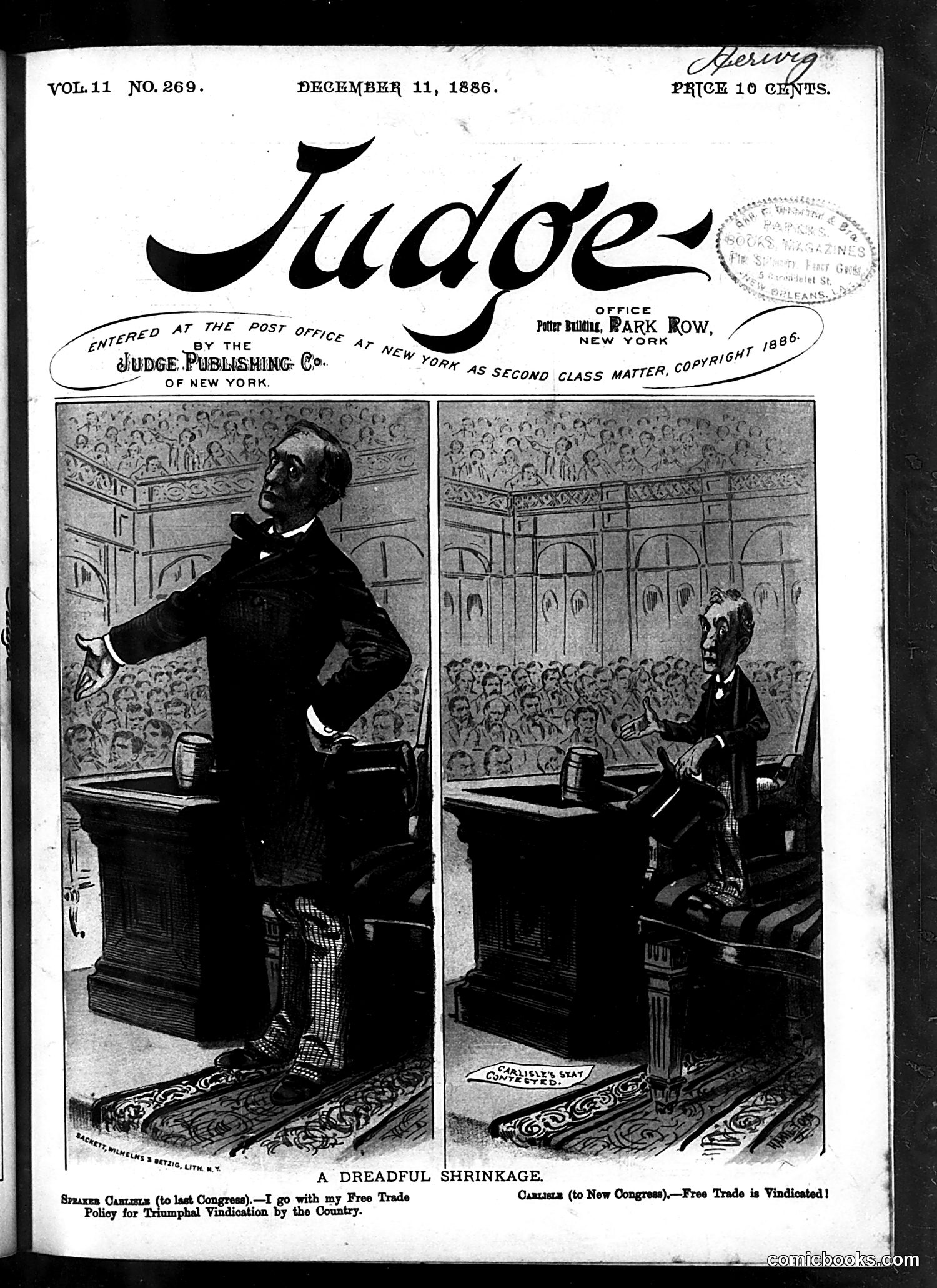
This political cartoon satirizes the consequences of free trade policy. The left panel shows a robust congressman confidently advocating "Free Trade" to a packed chamber. The right panel depicts the same figure visibly diminished in size, representing the devastating effects of free trade on American prosperity. The caption contrasts two positions: Speaker Carlisle entering Congress with free trade optimism versus the same figure emerging with his policy vindicated but the country economically shrunken. The satire suggests that while free trade advocates might claim victory, the actual result is national economic contraction. This reflects the protectionist versus free trade debates of the 1880s, with Judge's editors clearly opposing free trade policies they believed harmed American interests.
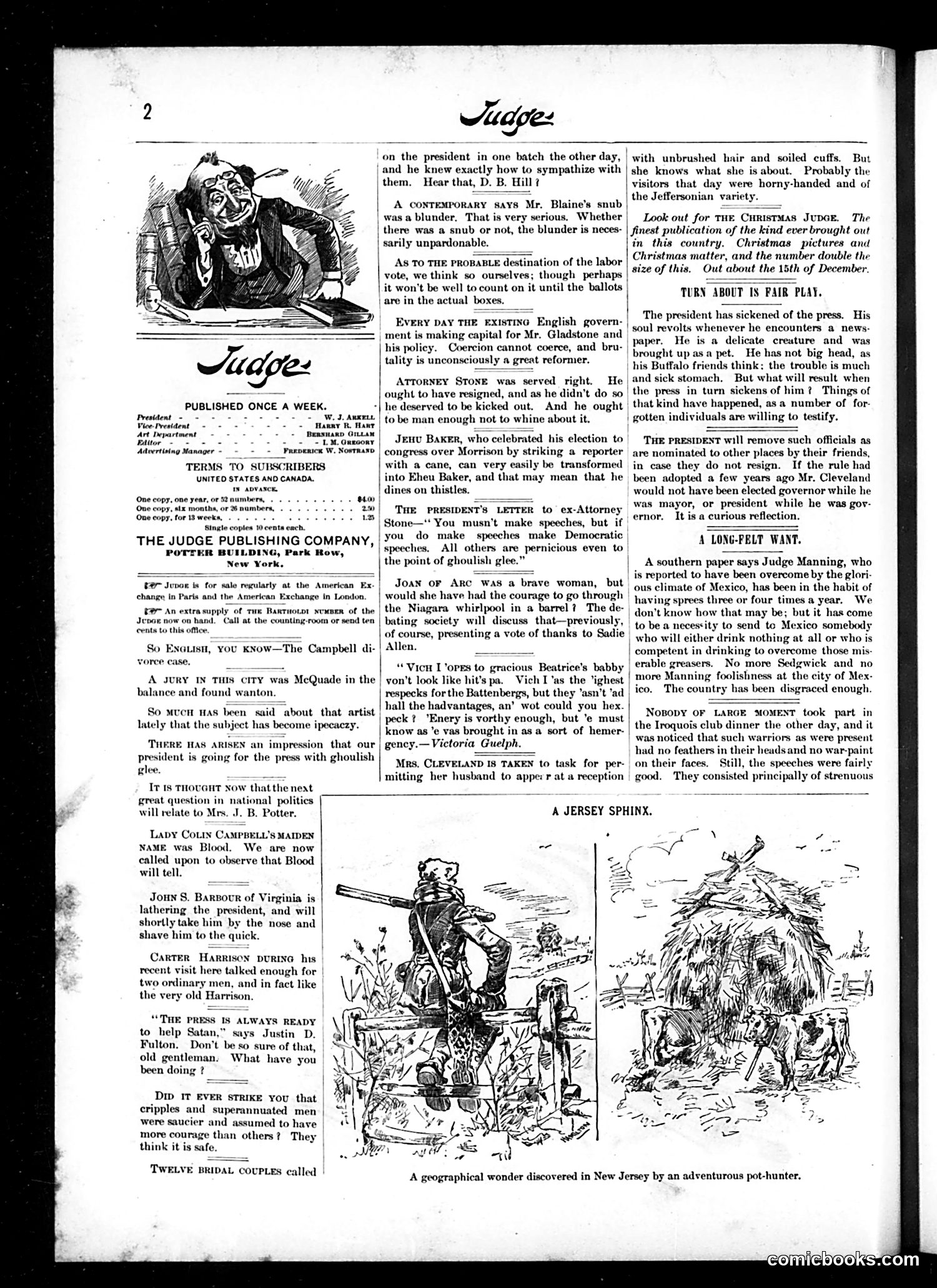
This page contains political commentary and satirical items rather than a unified cartoon. The content critiques President Cleveland and his administration. One item mocks Cleveland's sensitivity to press criticism, characterizing him as a "delicate creature" upset by negative coverage. Another attacks a statement attributed to ex-Attorney General Stone, ridiculing his advice that speeches should avoid "ghostly glee." The text also satirizes various political figures and situations: a celebratory congressman named Morrison, discussion of potential Cleveland-backed gubernatorial candidates, and commentary on Judge Manning's role in Mexican climate disputes. The page's humor relies on contemporary political knowledge—specific officials, recent events, and administration policies that would have been immediately recognizable to 1880s readers but require historical context to fully understand today.
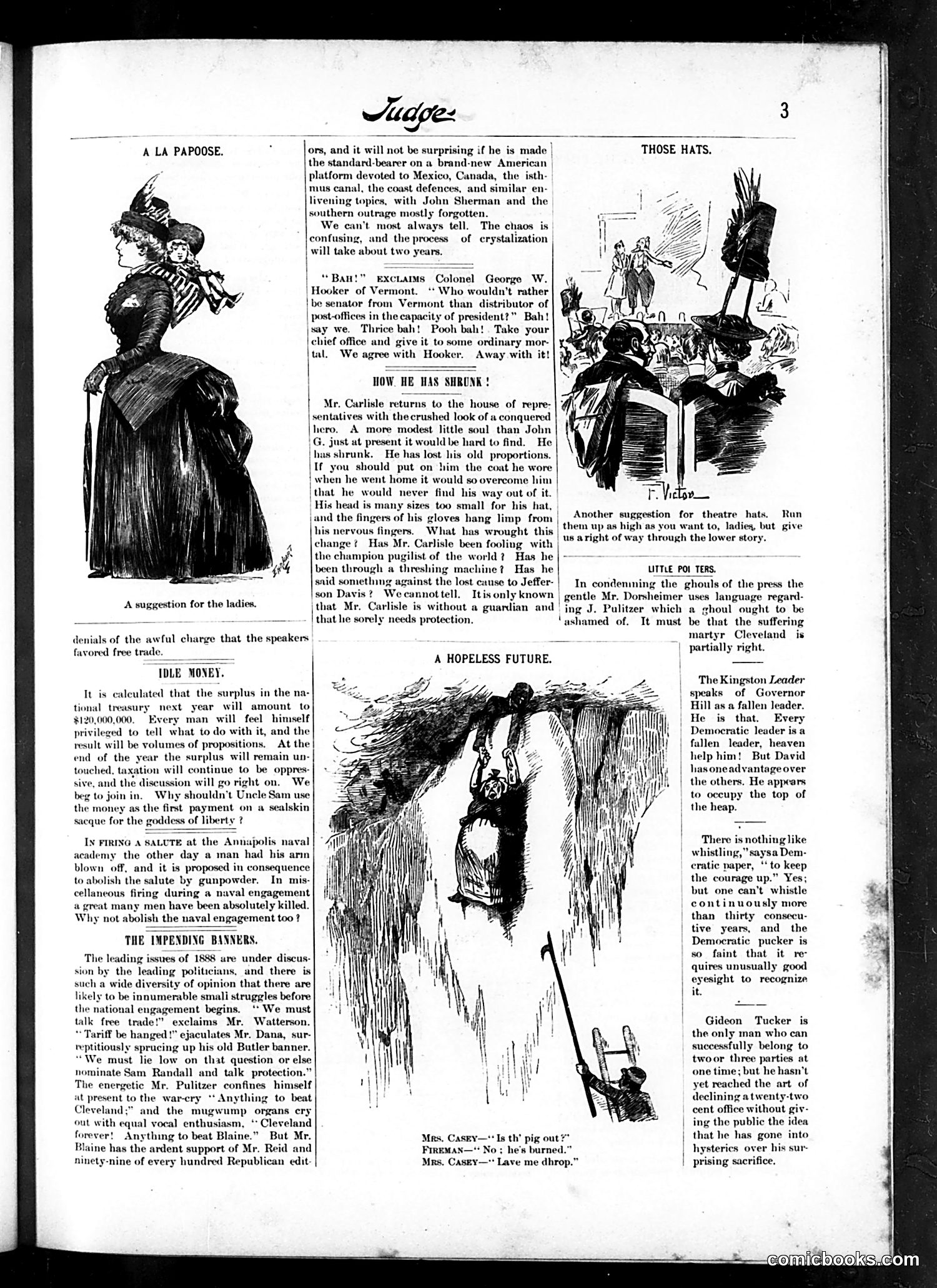
This page satirizes American politics circa 1888, focusing on several figures and issues: **"How He Has Shrunk"** ridicules **John G. Carlisle**, Speaker of the House, depicting his return to Congress as physically diminished and emotionally defeated—suggesting he's lost confidence and stature, possibly from political defeats. **"A Hopeless Future"** shows a man falling into a pit, likely depicting **Governor David B. Hill** of New York, whom the Kingston Leader called a "fallen leader." The text notes every Democratic leader is a "fallen leader," but Hill at least "appears to occupy the top of the heap"—dark humor about Democratic decline. **"Those Hats"** offers satirical fashion suggestions—absurdly tall theatrical hats for women attending theater. The page's dominant theme: **Democratic Party decline**. References to Carlisle's shrinkage, Hill's fall, and continuous Democratic collapse suggest the party faces the 1888 election weakened. The "impending banners" section mentions free trade debates, a key Democratic position being attacked by Republicans.
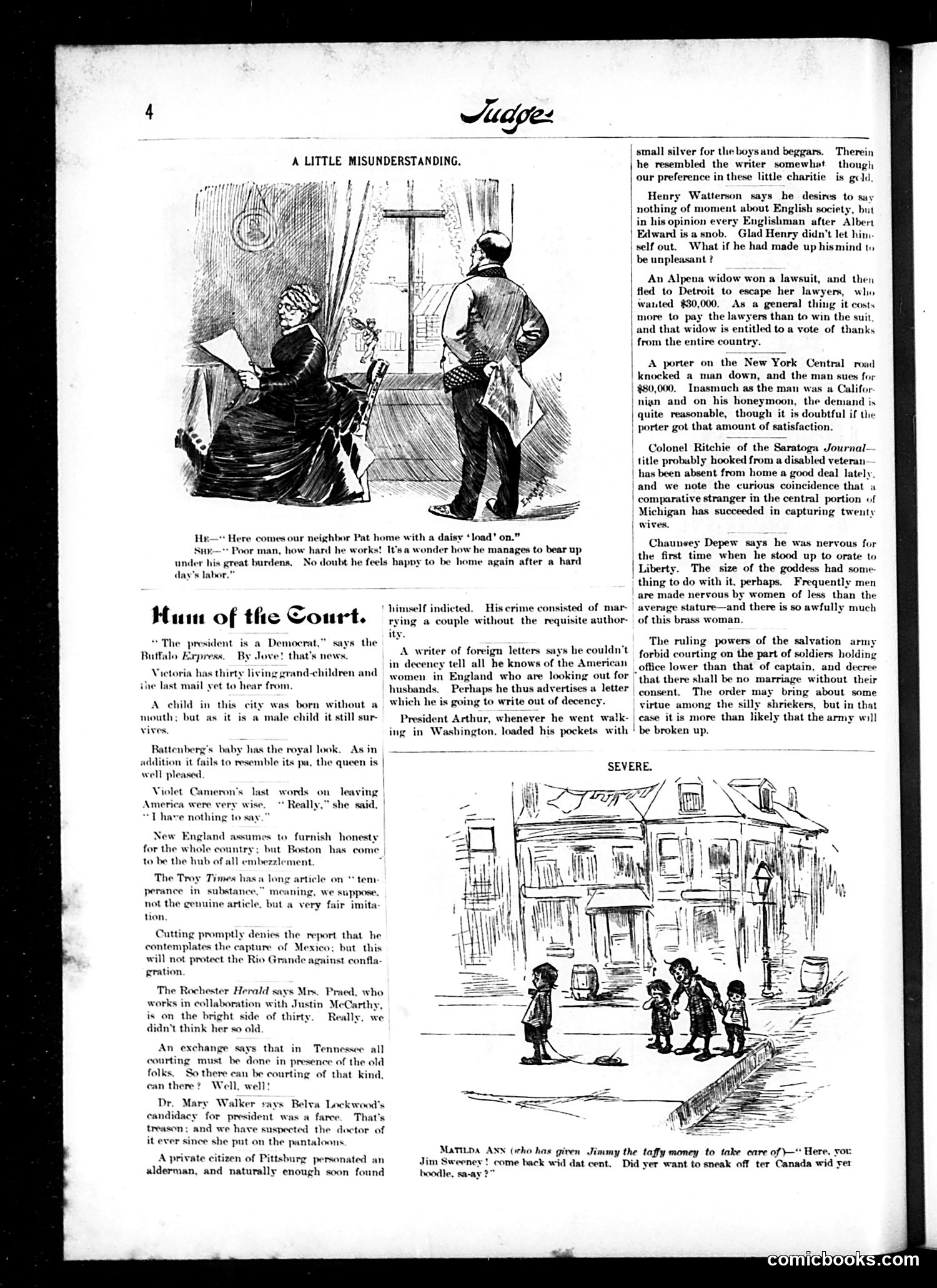
This page from the satirical magazine *Judge* contains several brief social and political jokes targeting late 19th-century American figures and issues. **Top cartoon** ("A Little Misunderstanding"): A woman tells a man returning home with flowers that their neighbor Pat arrived "with a daisy load on"—meaning drunk. The joke plays on misunderstanding "load" (drunkenness vs. a literal load of flowers). **"Hum of the Court"** section consists of short satirical items mocking: - President Arthur's charity toward street children (contrasted with the writer's preference for gold donations) - Henry Watterson's snobbish views of Englishmen - A widow who won a lawsuit but fled to escape lawyer fees - Various other contemporary figures and social absurdities **"Severe" cartoon** (bottom): Shows poor children in a tenement, with text referencing "Jimmy the Lad's money to take care of"—satirizing childhood poverty and street life. The overall tone is typical *Judge* fare: punching at political figures, social hypocrisy, and contemporary news items with dry wit.
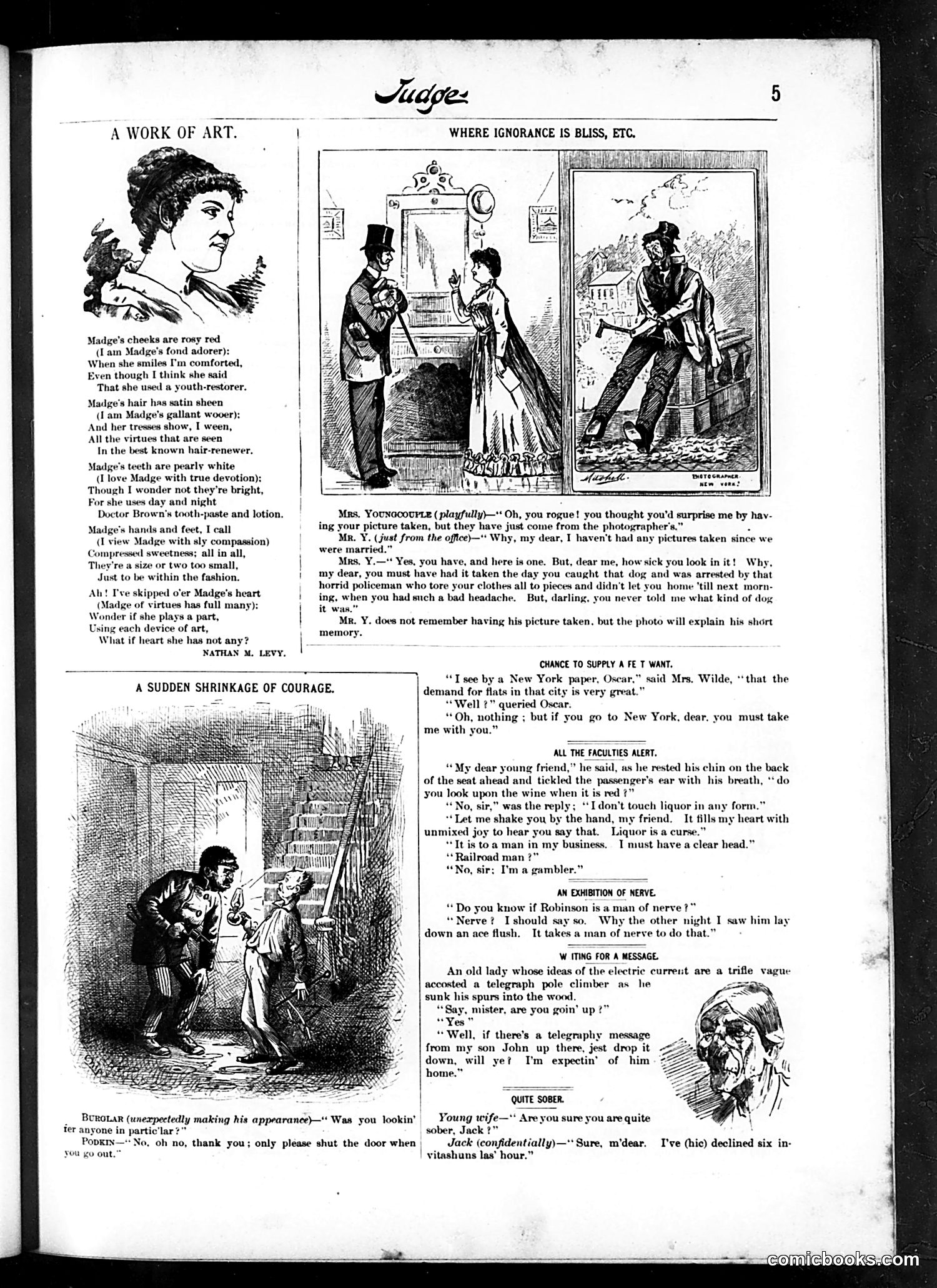
This page contains several satirical sketches typical of late 19th-century American humor: **"A Work of Art"** mocks women's cosmetic use, suggesting a woman named Madge's beauty is entirely artificial—achieved through youth-restorer, hair-renewer, and tooth-paste. The poem's final lines question whether she has genuine virtue or merely performs beauty through "devices of art." **"Where Ignorance is Bliss"** jokes about a wife showing her husband a photograph he claims never having taken. The implication: the disheveled man in the photo (torn clothes, arrested by dog-catcher) was so drunk/disreputable he's forgotten the incident entirely. **"A Sudden Shrinkage of Courage"** depicts a burglar encountering an unexpected resident and immediately losing his nerve. The remaining anecdotes humorously contrast appearances with reality: a railroad worker who's actually a gambler; a drunk husband denying intoxication; and an elderly woman's literal misunderstanding of telegraph poles. The satire targets vanity, marital deception, and human pretense generally.
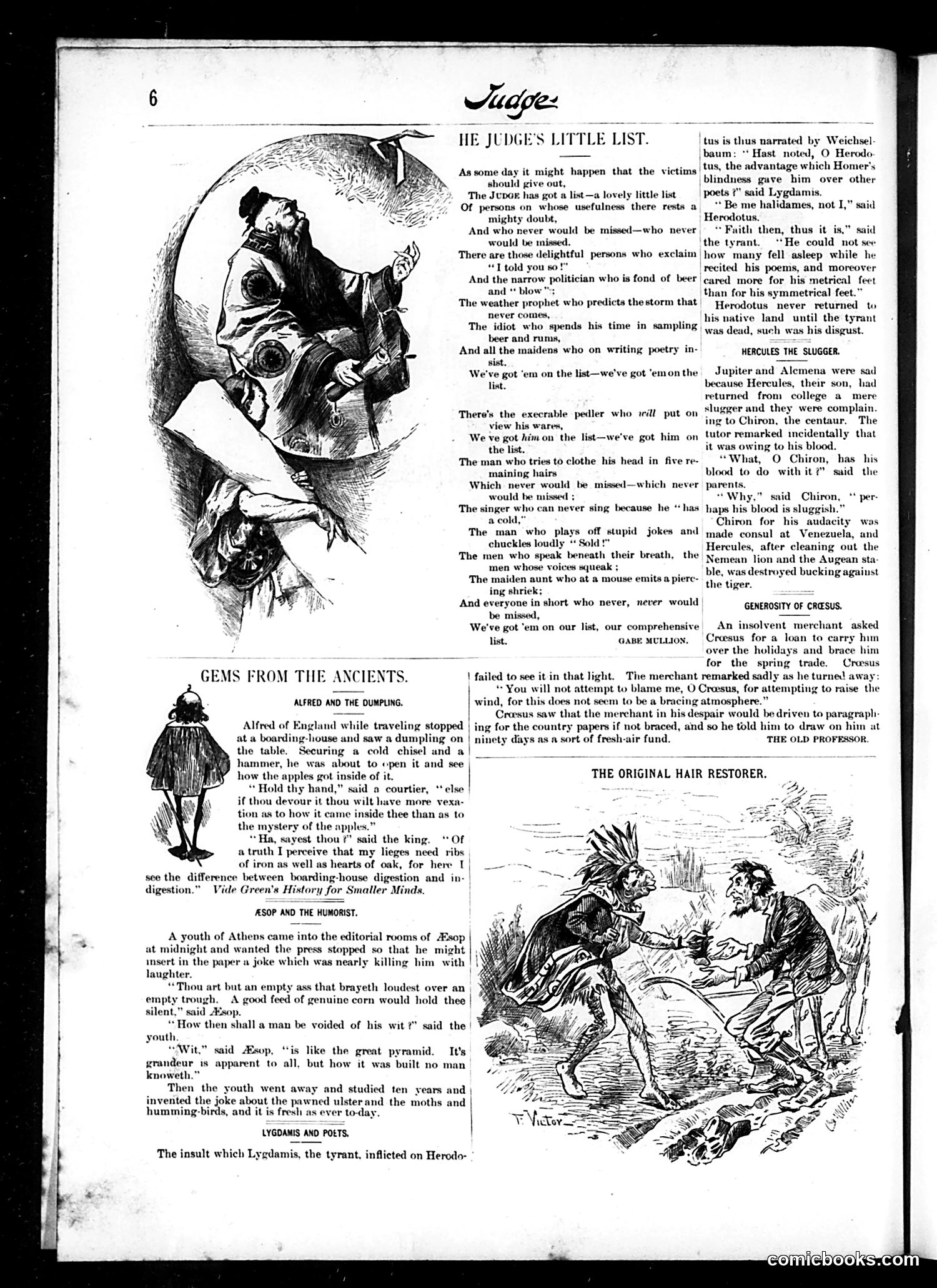
This page from *Judge* magazine features satirical commentary using classical references. The main article "The Judge's Little List" parodies Gilbert & Sullivan's *The Mikado*, listing contemporary annoyances: self-important know-it-alls ("I told you so"), beer-loving politicians, failed weather predictors, and poetasters. The satire targets everyday frustrations of Victorian society. The accompanying classical anecdotes ("Hercules the Slugger," "Generosity of Croesus," "Alfred and the Dumpling") use historical figures to mock modern problems: lazy college graduates, stingy wealthy men, and boarding-house digestion troubles. The cartoons feature grotesque illustrations typical of *Judge*'s style. The humor relies on readers recognizing both classical allusions and contemporary social types. The overall message critiques American society's flaws by treating them as timeless human follies worthy of ancient legend.
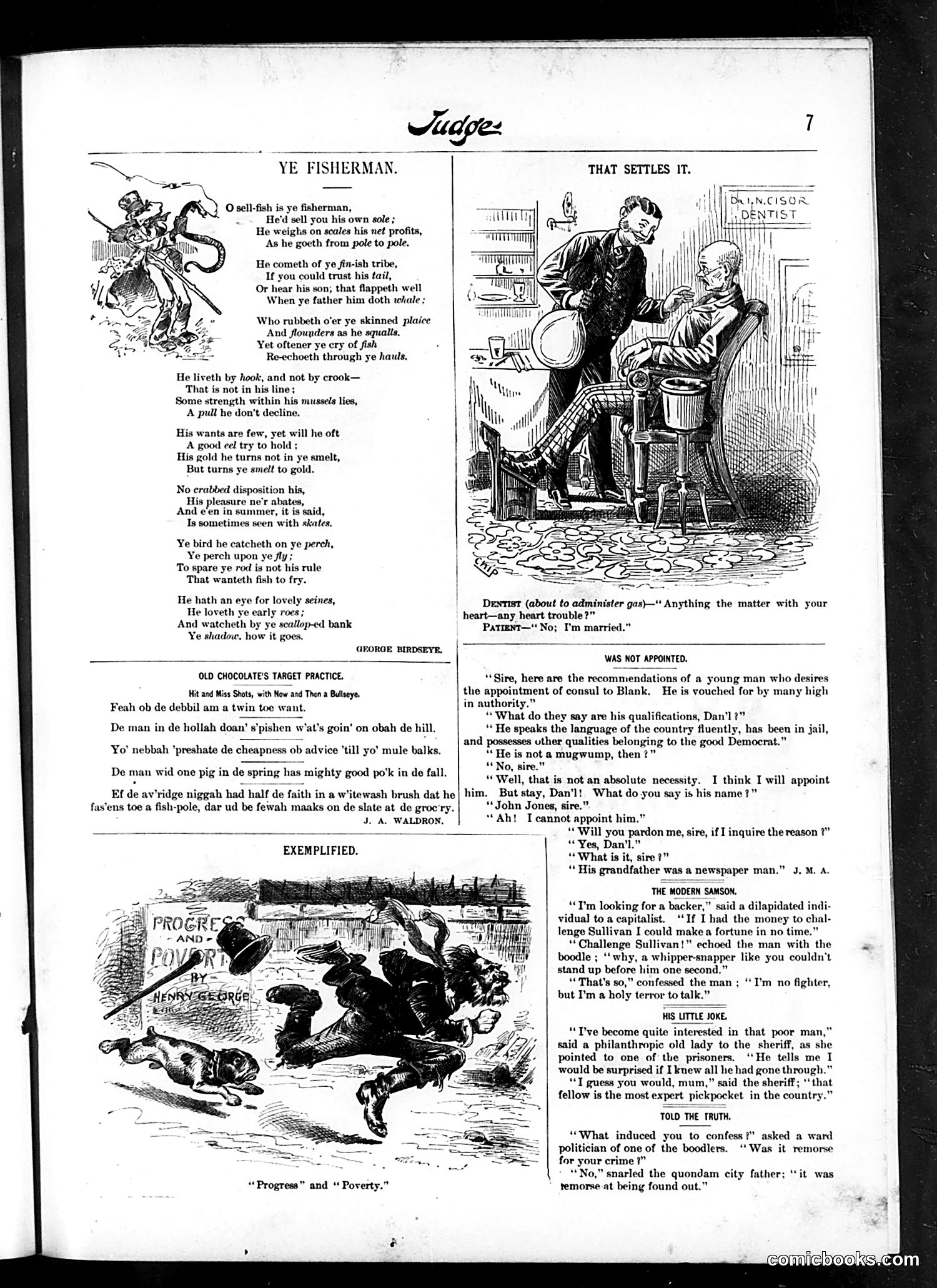
This satirical page from Judge magazine contains multiple jokes targeting contemporary social issues: **"Ye Fisherman"** (top left): A mock-archaic poem ridiculing fishermen through fish-related puns ("sell-fish," "scales," "hook"). The satire mocks their greed and obsession with profit. **"That Settles It"** (top right): A dentist-patient joke where the patient claims marriage—not heart trouble—is his affliction, satirizing marriage as a health hazard. **"Was Not Appointed"** (middle right): Political satire mocking patronage systems. A young man with solid qualifications is rejected as consul solely because his grandfather was a newspaper man—implying newspaper owners were considered disreputable or dangerous to political machines. **"Exemplified"** (bottom): An illustration titled "Progress and Poverty" appears to reference social inequality, though details are unclear. **Additional jokes** mock con artists, prize-fighters, pickpockets, and corrupt politicians ("boodlers"), reflecting Gilded Age anxieties about urban crime and political corruption.
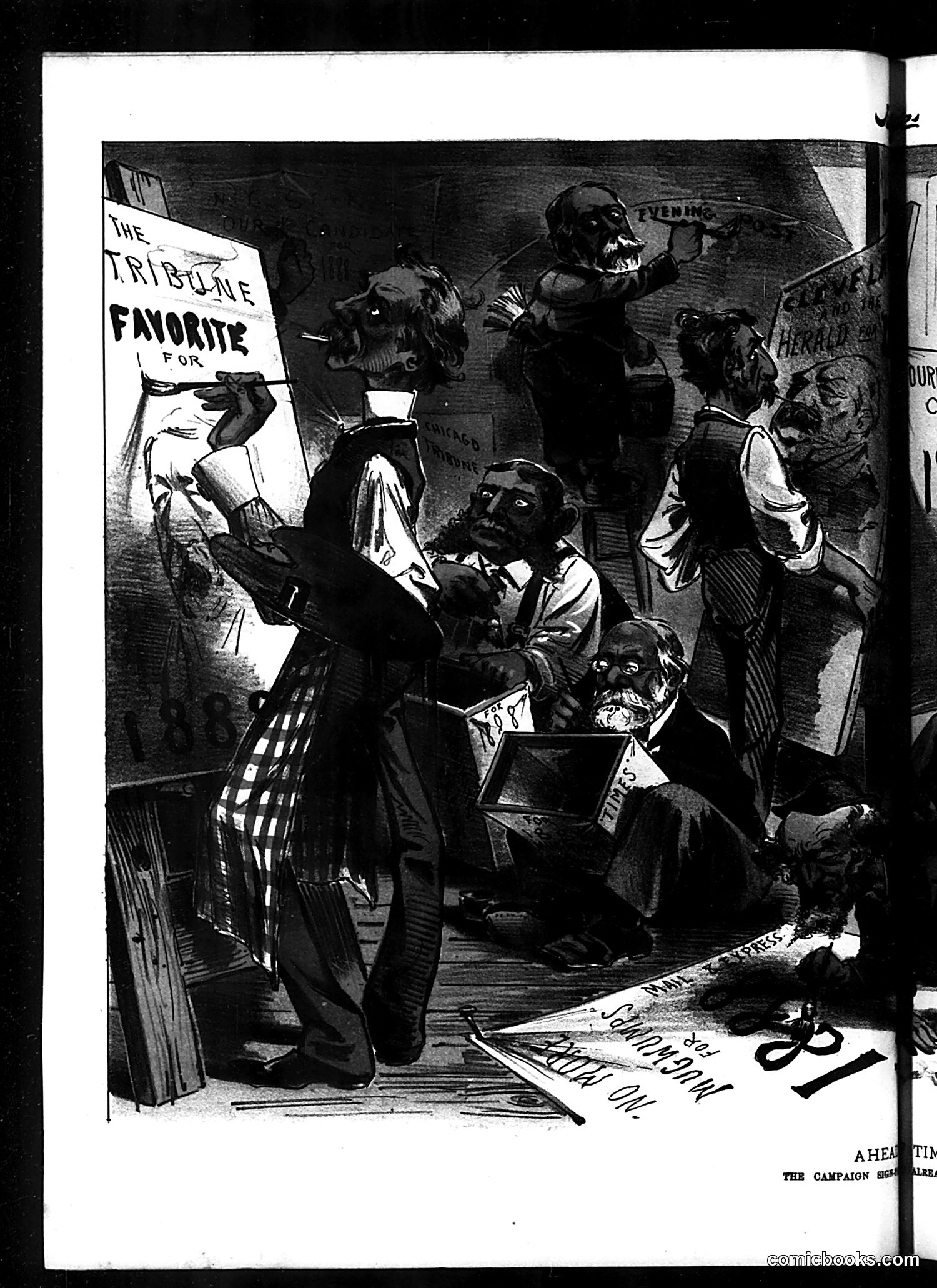
This is a satirical cartoon depicting anthropomorphic dogs engaged in what appears to be a political campaign or election scenario. The dogs are dressed in human clothing and holding signs reading "THE TRIBUNE FAVORITE FOR" and other campaign-related text (partially legible as "EVENING" and "HERALD"). The cartoon satirizes newspaper endorsements and editorial favoritism in political campaigns. The dogs represent rival newspapers or their editors, each promoting their preferred candidate. The crowded, animated scene suggests the competitive nature of journalism and the influence newspapers wielded over public opinion during elections. Without clearer visibility of specific names or dates on the signs, I cannot identify the particular election or candidates being referenced, but the satire targets how publications used their platforms to influence electoral outcomes.
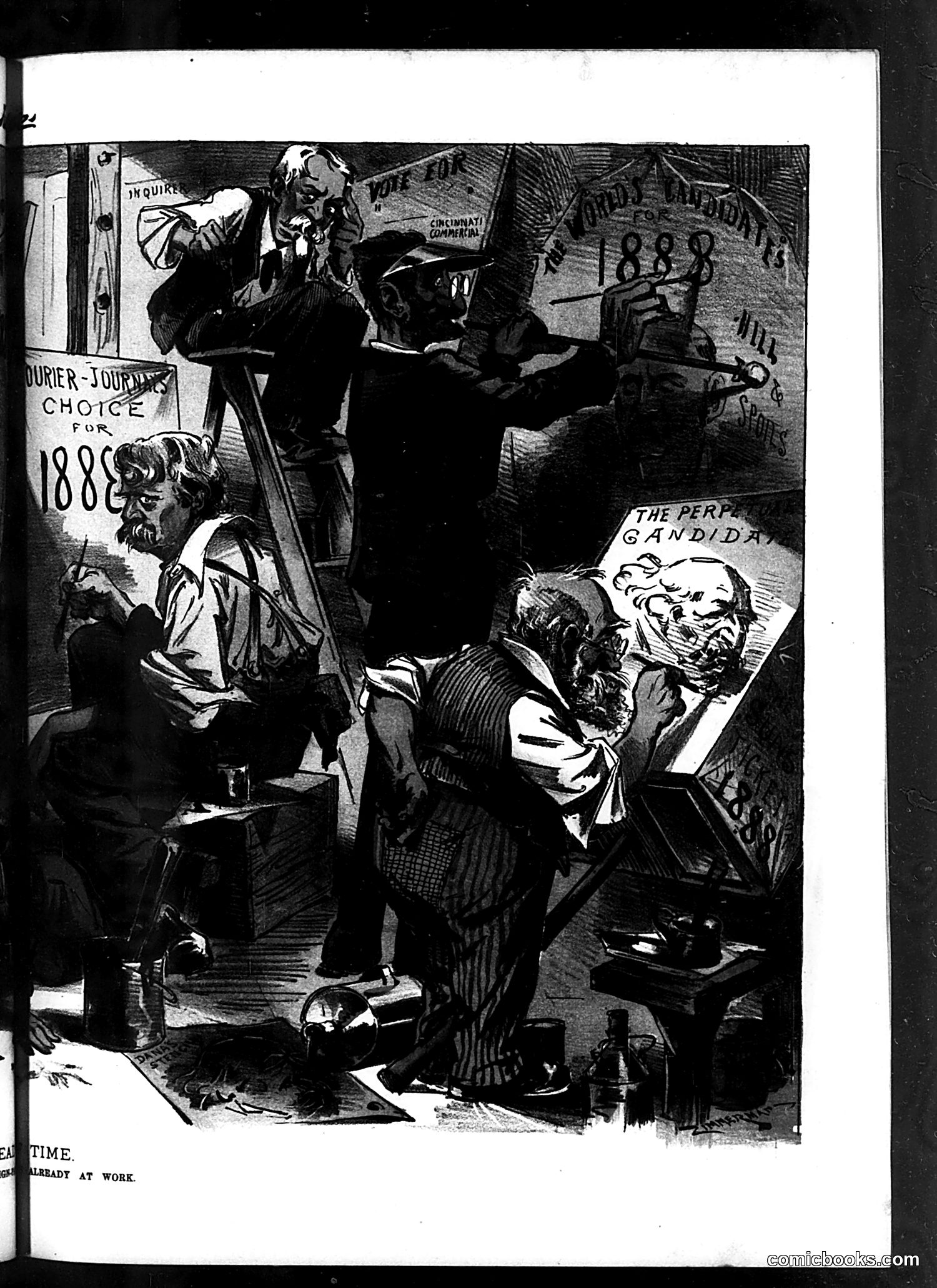
This appears to be a satirical cartoon from Judge magazine depicting the 1888 U.S. presidential election. The visible text references "COURIER-JOURNAL'S CHOICE FOR 1888" and shows what appears to be political candidates or figures being manipulated or controlled like puppets. The cartoon satirizes media influence in politics, suggesting that newspapers (specifically the Louisville Courier-Journal, a major Democratic publication) were actively promoting their preferred candidate rather than providing neutral coverage. The exaggerated caricatures and puppet-like positioning mock the idea that candidates were being orchestrated by press interests rather than representing genuine popular choice. The style and signage visible suggest this critiques the commercialization and manipulation inherent in late 19th-century American electoral politics.
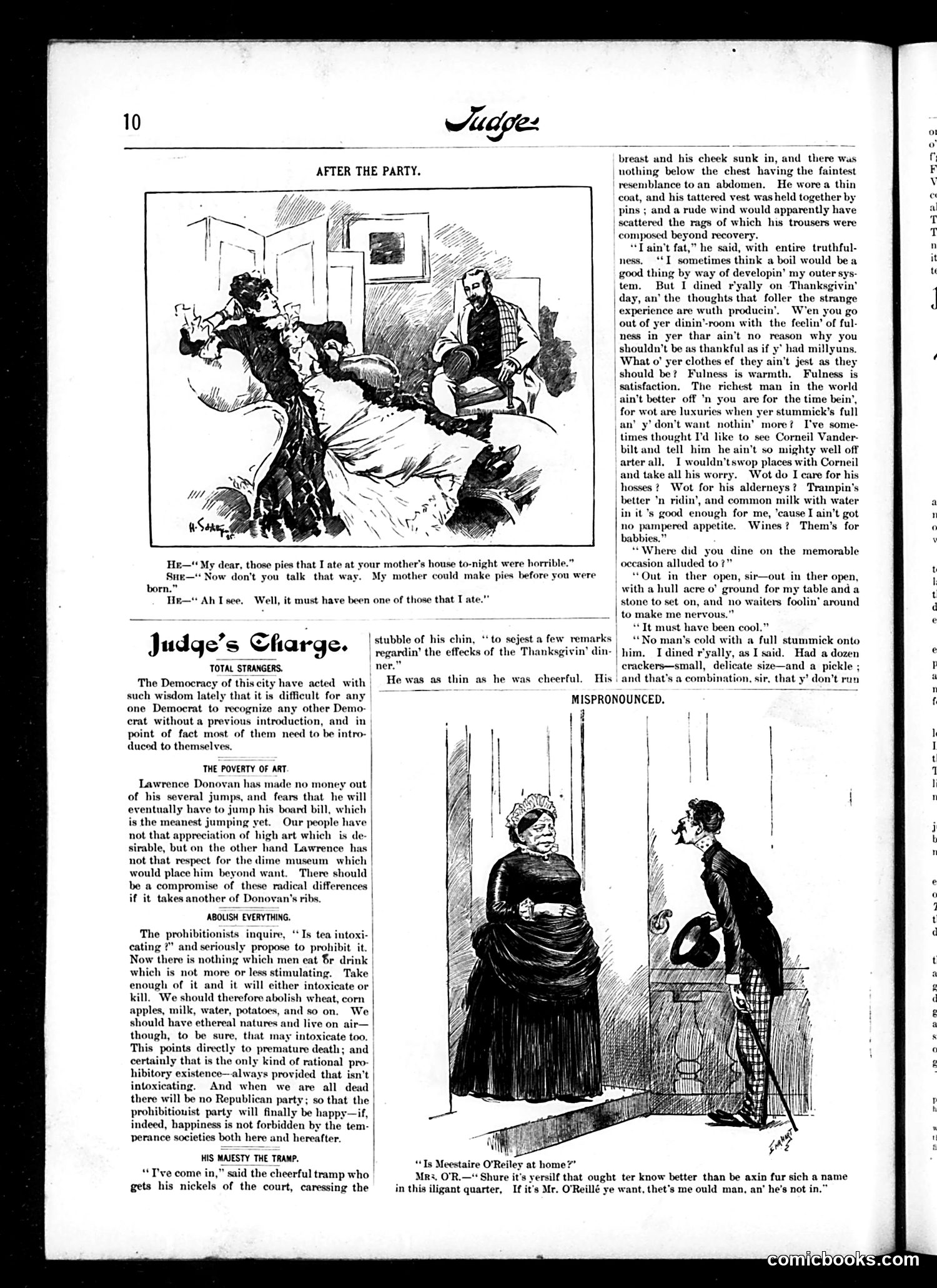
This page contains several satirical pieces typical of 19th-century American humor journalism. **"After the Party"** (top illustration): Shows a conversation between two men about Thanksgiving dinner. One speaker, depicted as extremely thin and poorly dressed, philosophizes about the satisfaction of a full stomach, claiming it equals wealth. He references Cornell Vanderbilt, suggesting that a vagrant who ate well on Thanksgiving is as content as the richest man in America. The satire mocks both extreme poverty and the pretensions of the wealthy. **"Judge's Charge"** and other brief sections below mock Democratic party disunity, criticize artist Lawrence Donovan's financial struggles, and satirize prohibitionists' logic (suggesting if tea should be banned for mild intoxication, so should food and water). **"Mispronounced"** (right illustration): Shows working-class figures, likely satirizing mispronunciation or social pretension. The overall tone reflects Judge magazine's typically irreverent approach to American politics, class divisions, and social reform movements of the era.
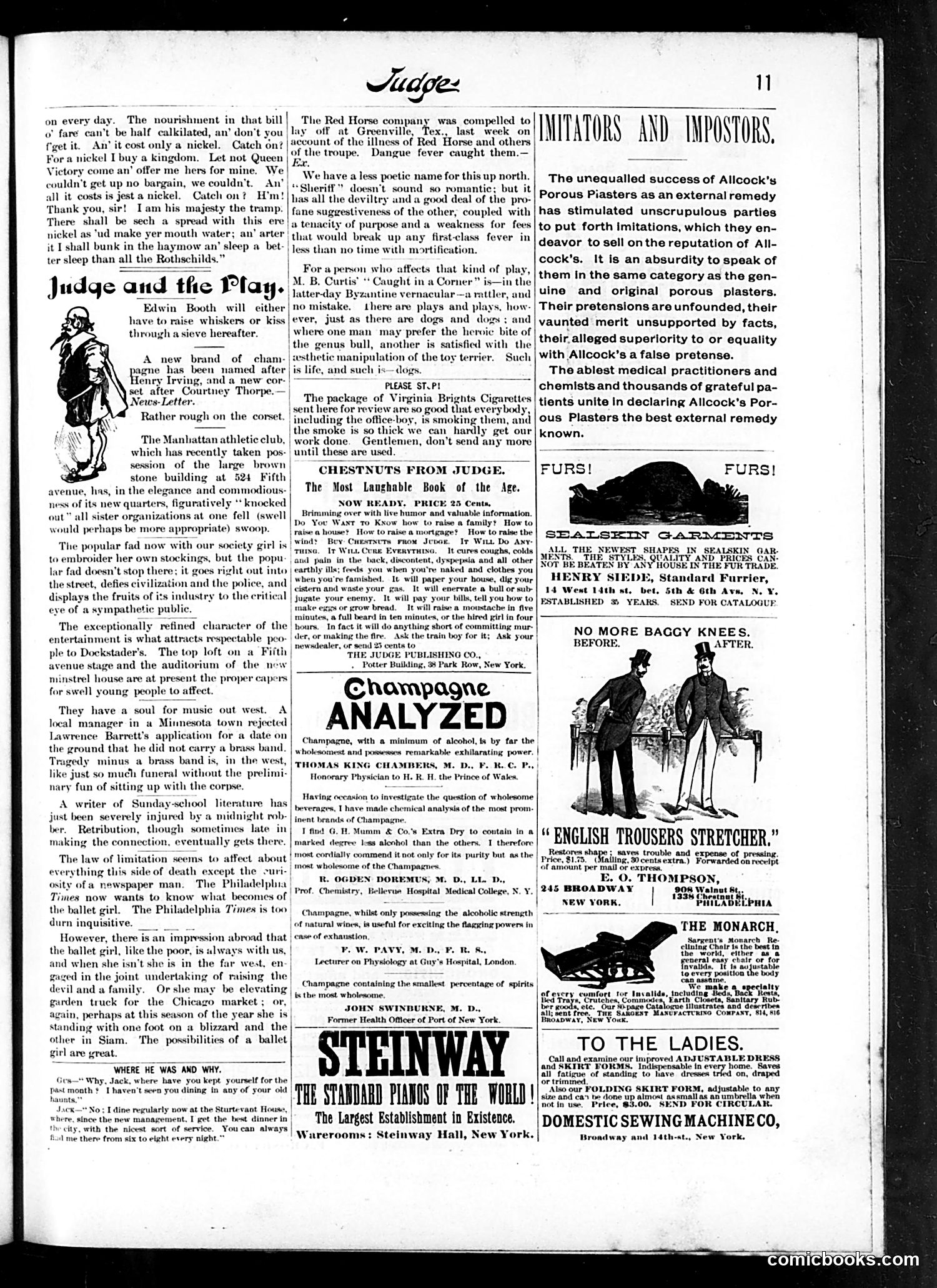
This page is primarily **advertising and miscellaneous entertainment commentary**, not political satire. The visible content includes: **"Judge and the Play"** section: Brief theatrical gossip about actors Edwin Booth and Henry Irving, written as light humor rather than serious satire. References to a corset named after performer Courtney Thorpe mock the era's trend of naming products after celebrities. **Commentary on social trends**: Jokes about society girls embroidering stockings and the popularity of minstrel shows at respectable venues—reflecting 1880s-90s class anxieties about entertainment and propriety. **Various advertisements**: Including notices for Allcock's Porous Plasters, Seakin Garments fur company, Steinway pianos, and sewing machines—typical period advertising. **A brief dialogue** at bottom about the Sturtevant House restaurant's new management. The page contains **no identifiable political figures or sharp political satire**—it's primarily lifestyle commentary, theatrical gossip, and commercial advertising typical of Judge's miscellaneous content pages.
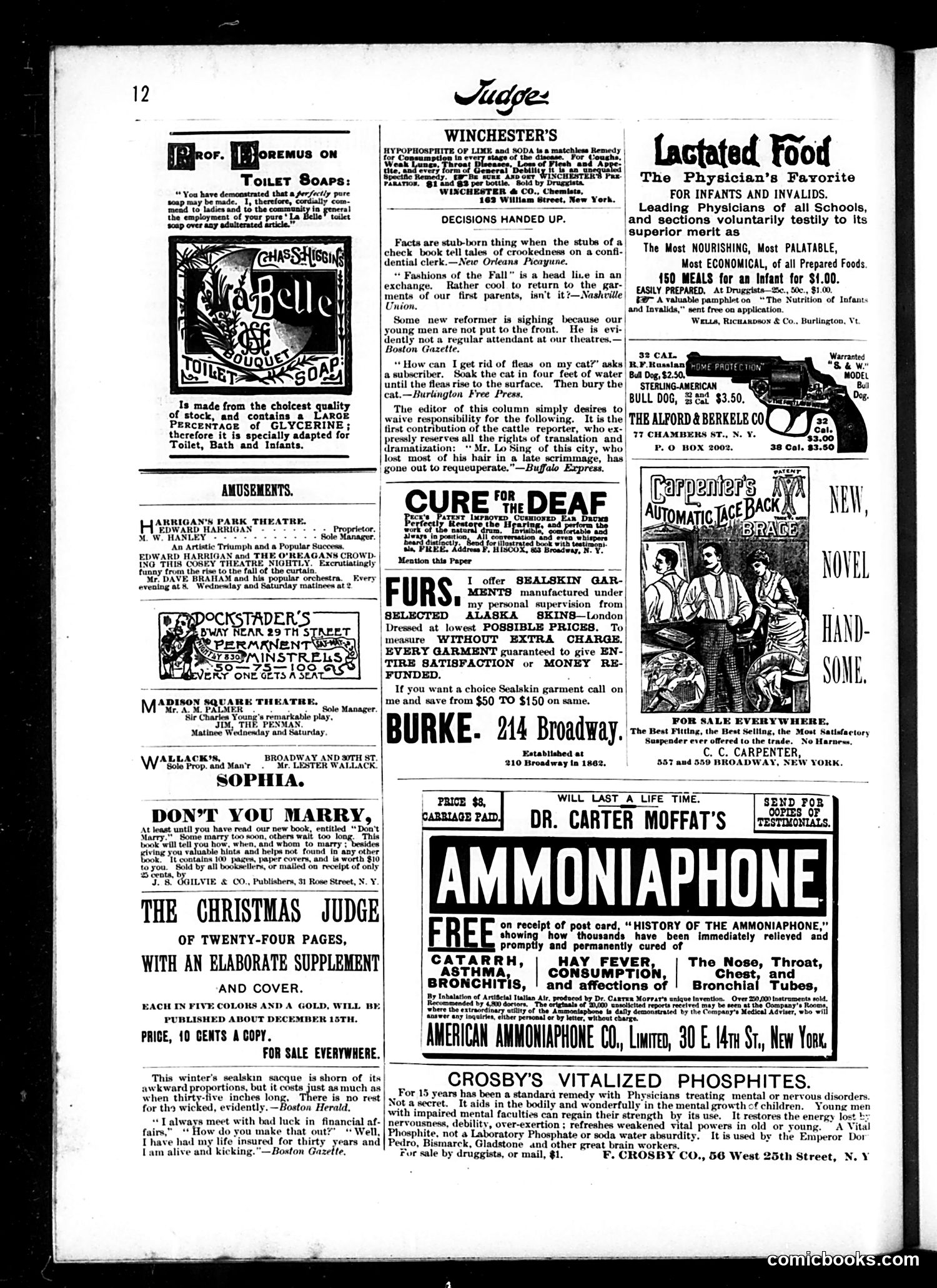
This page is primarily **advertising and entertainment listings**, typical of late 19th-century American magazines. The content includes: **Advertisements:** Lactated Food (infant formula endorsed by physicians), Winchester firearms, Ammoniophone (a patent medicine for deafness and respiratory ailments), Dr. Carter Moffat's products, and sealskin garments. **Theater listings:** Multiple Broadway theaters advertise current productions, including "The O'Reagans Crowd" at Harrigan's Park Theatre and "Jim the Penman" at Madison Square Theatre. **Filler humor columns:** Short jokes appear under "Amusements," including comedic exchanges about cat fleas and fashion—typical of Judge's satirical style. **Notable:** The page reflects Victorian-era consumer culture, with heavy promotion of patent medicines (common before FDA regulation) and theatrical entertainment as primary leisure activities for Judge's readership. The layout mirrors typical 1880s-90s magazine design: dense text, small illustrations, and mixed commercial/editorial content.
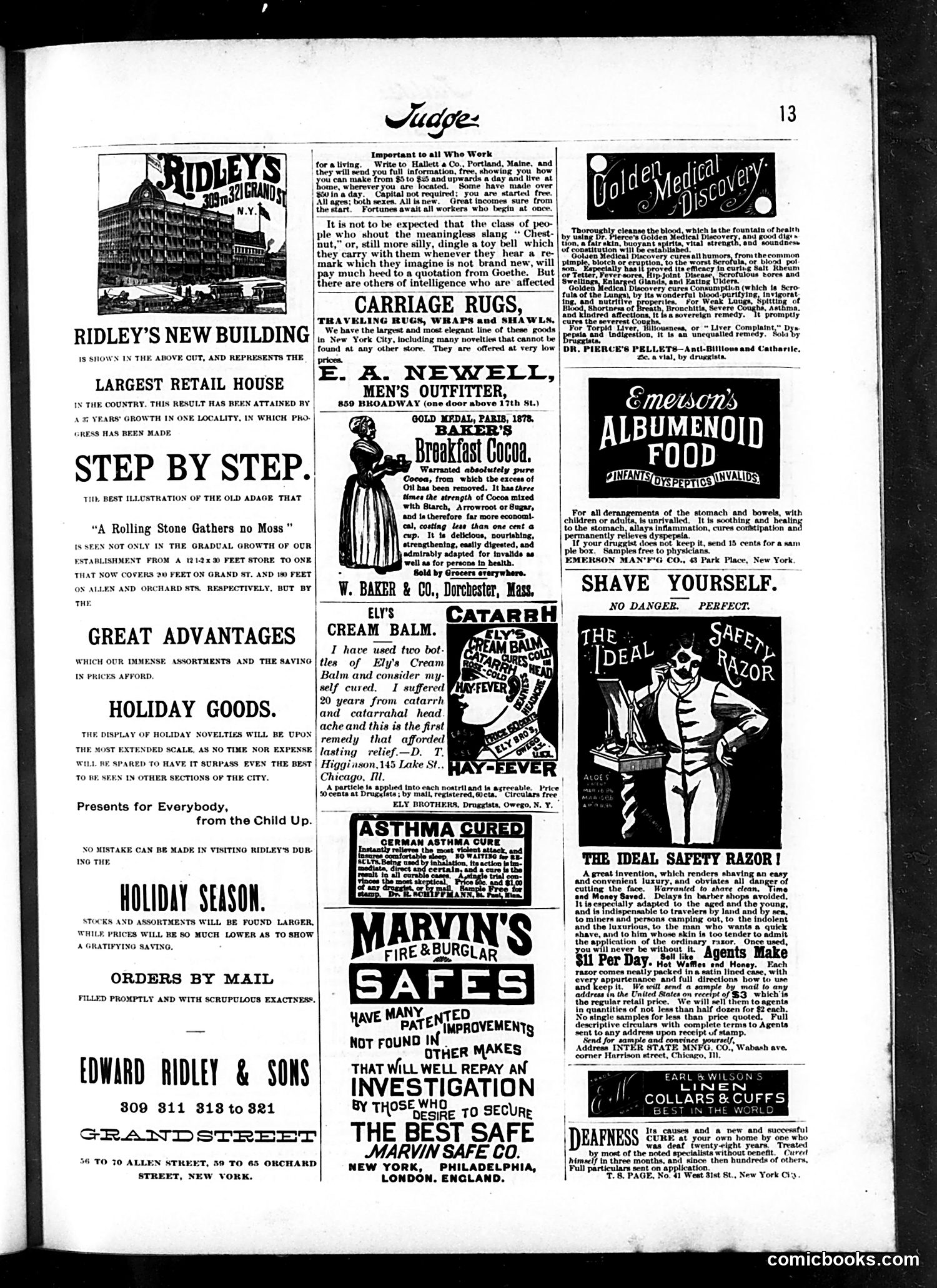
This is primarily an **advertising page** from Judge magazine, with minimal satirical content. The page showcases late 19th-century commercial advertisements rather than political cartoons. **Notable advertisements include:** - **Ridley's New Building**: A prominent New York City department store advertising its expansion and holiday goods selection - **Baker's Breakfast Cocoa**: A gold-medal product claiming purity and economy - **Ely's Cream Balm**: A patent medicine for catarrh (a common respiratory ailment) - **Marvin Safe Company**: Industrial safes marketed to businesses - **Golden Medical Discovery** and **Dr. Pierce's products**: Patent medicines claiming to cure consumption, asthma, and various ailments **Historical context for modern readers:** These advertisements reveal the era's trust in unregulated patent medicines making extraordinary health claims, the importance of department stores as retail centers, and advertising's prominent role in satirical magazines like Judge. The pseudo-scientific language and grandiose claims reflect pre-FDA regulation standards.
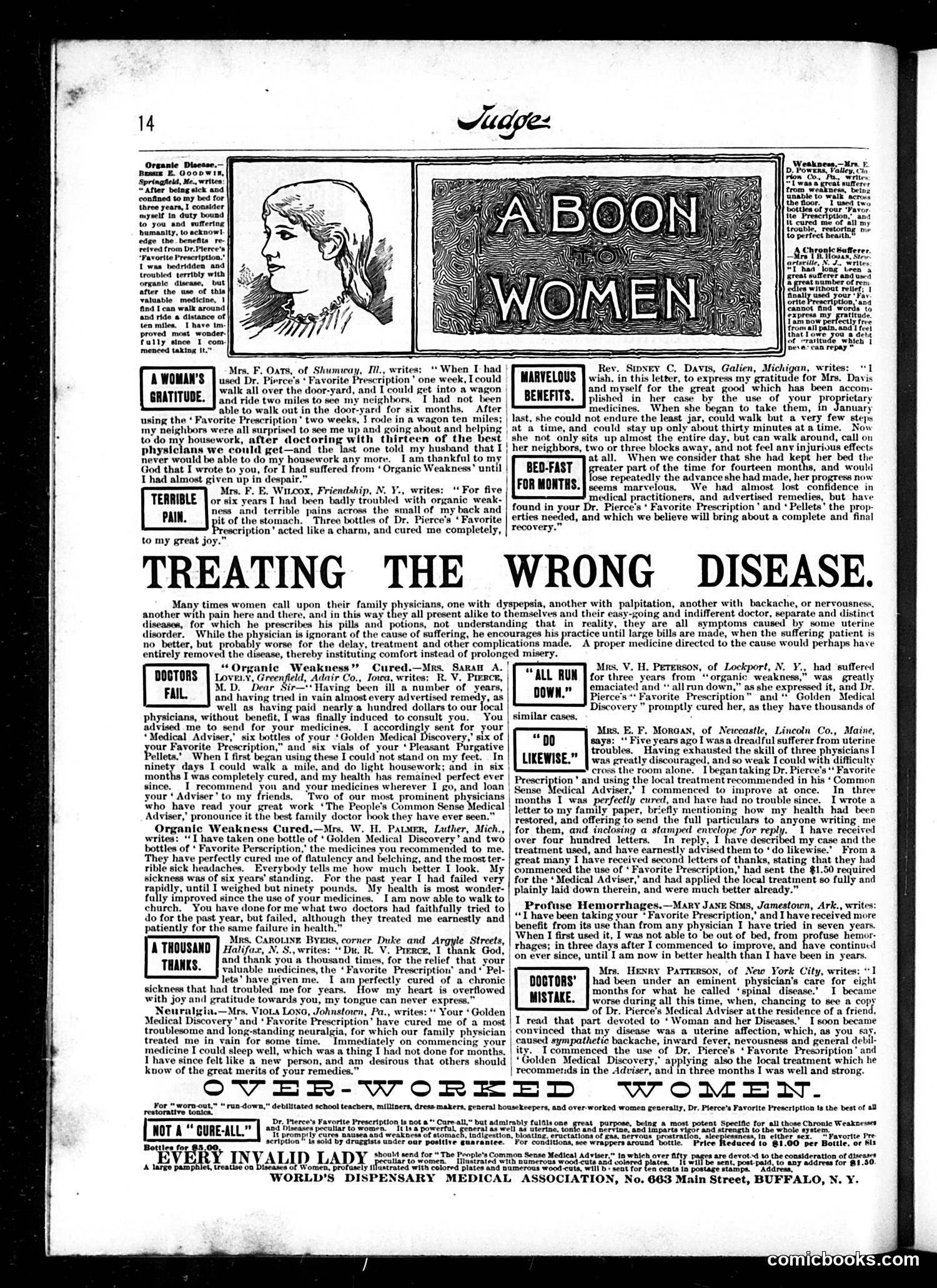
This page comprises **medical advertisements masquerading as testimonials**, not political satire. The central feature is "A Boon for Women," promoting Dr. Pierce's "Favorite Prescription"—a patent medicine marketed for "organic weakness," female ailments, and various chronic conditions. The page presents fabricated patient testimonials claiming miraculous cures: women allegedly bedridden for years suddenly able to walk miles, work, or travel after using the product. The repeated phrase "organic weakness" appears to reference vague female health complaints that actual doctors couldn't diagnose effectively. This represents **turn-of-century medical fraud**. The advertisements exploit women's genuine suffering and distrust of (male) physicians, offering false hope through unregulated patent medicines. The page's appeal to gratitude and the invocation of "DOCTORS FAIL" underscores the marketing strategy: positioning proprietary remedies as superior to legitimate medicine—a common deceptive practice in this era before FDA regulation.
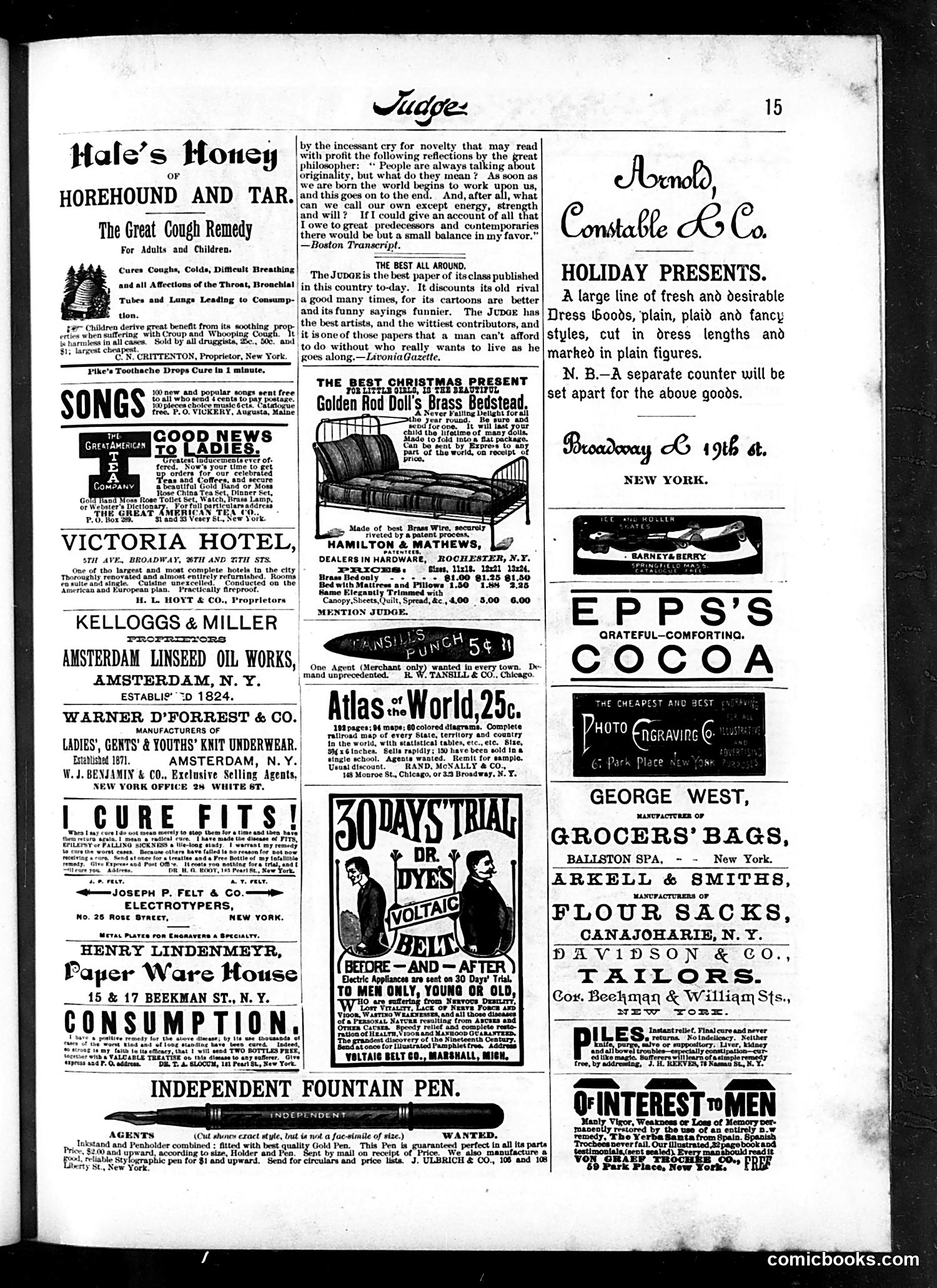
This is primarily an **advertising page** from Judge magazine with minimal editorial content. The notable elements are: **Top Left - Editorial Note:** A brief comment praising Judge as "the best paper of its class published in this country to-day," claiming superior cartoons and humor compared to rivals, and asserting it's essential for anyone wanting to "live as he goes along." **Main Content:** The page is dominated by **commercial advertisements** typical of the era—patent medicines (Hale's Honey cough remedy, a "30 Days Trial" hair dye product), hotel promotions, manufacturing goods, and household products. The "30 Days Trial" advertisement features before-and-after images of men, hawking a hair/beard treatment "to men only, young or old." **No significant political cartoons appear** on this visible page. The self-promotion of Judge itself is the only satirical element—a brief boast about the magazine's editorial quality aimed at potential subscribers. The page reflects **late 19th-century American publishing:** heavy reliance on advertising revenue and bold product claims without modern regulatory oversight.
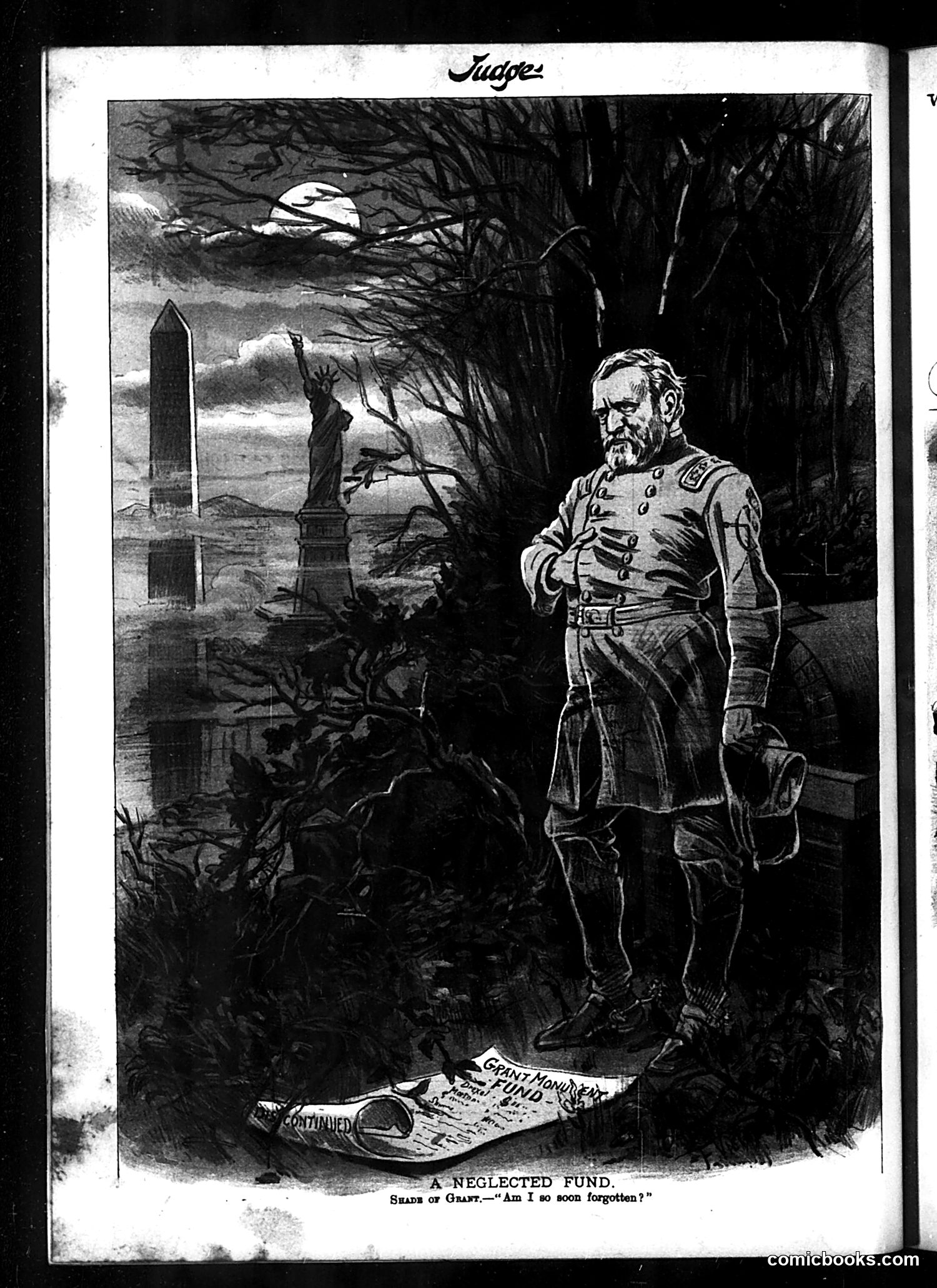
This Judge cartoon depicts a bearded military officer in Civil War-era uniform standing in a dark, desolate landscape near the Washington Monument. At his feet lies a neglected document labeled "CONTINUED" (partially visible), apparently relating to a military pension or benefit fund. The caption—"Shade of Grant. 'Am I so soon forgotten?'"—suggests this is either General Ulysses S. Grant's ghost or a personification of his legacy. The satire criticizes the government's failure to properly fund or maintain benefits promised to Grant or his soldiers. The ominous setting and ghostly theme emphasize how quickly post-Civil War military support was abandoned or forgotten by politicians. The exact historical moment remains unclear without additional context.