
Judge, 1886-12-11 · page 10 of 16
Judge — December 11, 1886 — page 10: what you’re looking at
What you’re looking at
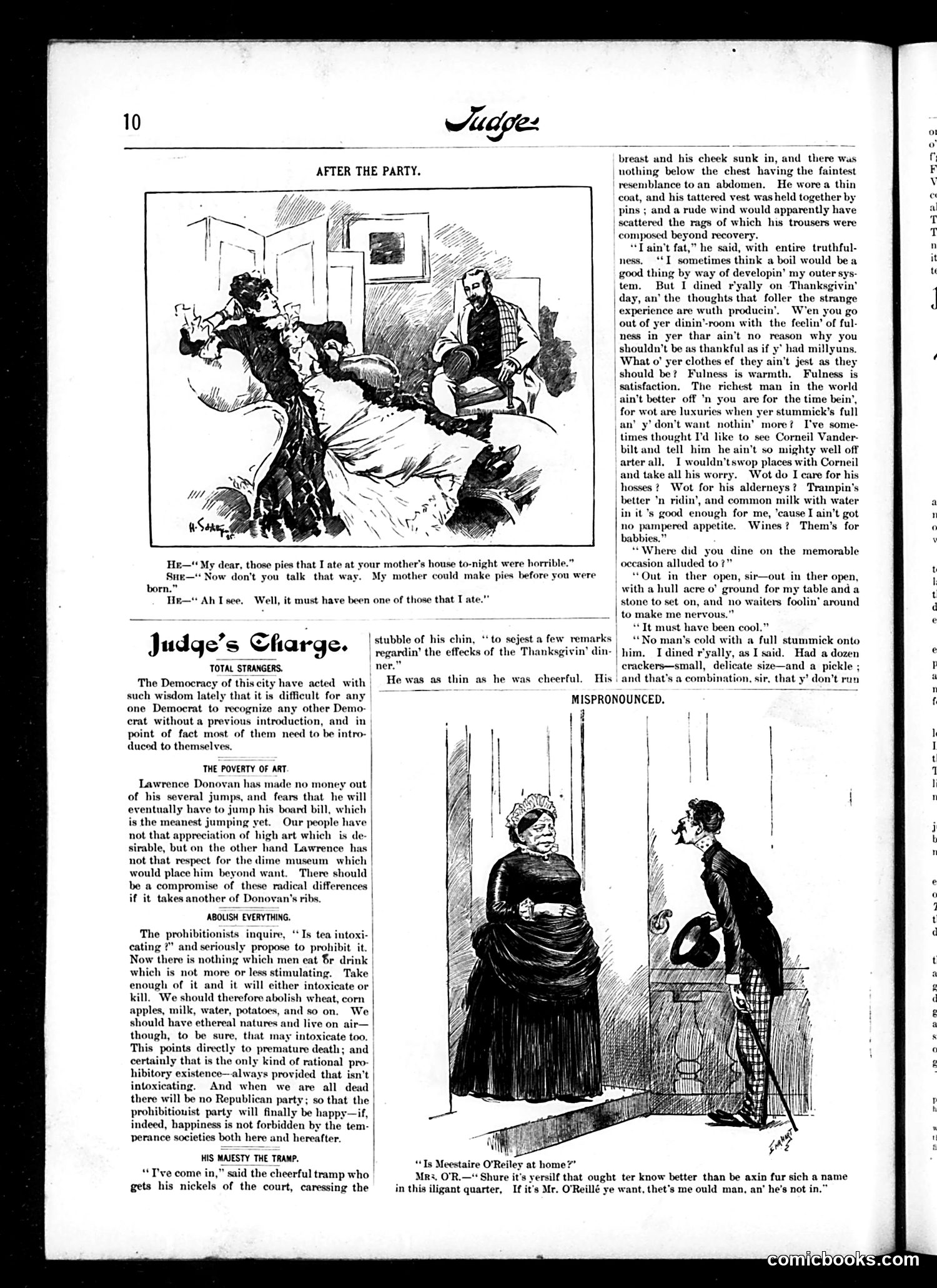
This page contains several satirical pieces typical of 19th-century American humor journalism. **"After the Party"** (top illustration): Shows a conversation between two men about Thanksgiving dinner. One speaker, depicted as extremely thin and poorly dressed, philosophizes about the satisfaction of a full stomach, claiming it equals wealth. He references Cornell Vanderbilt, suggesting that a vagrant who ate well on Thanksgiving is as content as the richest man in America. The satire mocks both extreme poverty and the pretensions of the wealthy. **"Judge's Charge"** and other brief sections below mock Democratic party disunity, criticize artist Lawrence Donovan's financial struggles, and satirize prohibitionists' logic (suggesting if tea should be banned for mild intoxication, so should food and water). **"Mispronounced"** (right illustration): Shows working-class figures, likely satirizing mispronunciation or social pretension. The overall tone reflects Judge magazine's typically irreverent approach to American politics, class divisions, and social reform movements of the era.
📄 Transcribed text from this page (OCR, searchable)
Machine-transcribed from the original scan — historical spelling and the odd misread are preserved.
breast and his cheek sunk in, and there was nothing below the chest having the faintest resemblance toan abdomen. He wore a thin coat, and his tattered vest was held together by pins ; and a rude wind would apparently have scattered the rags of which his trousers were composed beyond recovery. “Tain't fat,” he said, with entire truthful- ness, ‘I sometimes think a boil would bea good thing by way of developin’ my outer sys- tem. But I dined r'yally on Thanksgivin' | day, an’ the thoughts that foller the strange experience are wuth producin’. W'en you go out of yer dinin’-room with the feelin’ of ful- ness in yer thar ain't no reason why you shouldn't be as thankful as if y’ had millyuns, What o’ yer clothes ef they ain’t jest as they | should be? Fulness is warmth. Fulness is satisfaction. The richest man in the world ain't better off ‘n you are for the time bein’, for wot are luxuries when yer stummick’s full an’ y’ don’t want nothin’ more? I've some- | times thought I'd like to see Corneil Vander- bilt and tell him he ain't so mighty well off arter all, I wouldn't swop places with Corneil and take all his worry. Wot do I care for his hosses ? Wot for his alderneys? Trampin’s | better ‘n ridin’, and common milk with water in it 's good enough for me, ‘cause I ain't got no pampered appetite. Wines? Them’s for babbies.” Where did you dine on the memorable My dear, those pies that I ate at your mother's house to-night were horrible.” occasion alluded to ?” My mother could make pies before you were | “Out in ther open, sir—out in ther open, with a hull acre o’ ground for my table anda | stone to set on, and no waiters foolin’ around = ___. | to make me nervous.” “It must have been cool.” Judge’s Charge. | stubble of his chin, ‘to sejest a few remarks | ‘No man’s cold with a full stummick onto regardin’ the effecks of the Thanksgivin’ din- | him. I dined r’yally, as I said. Had a dozen TOTAL STRANGERS. ner.” crackers—small, delicate size—and a pickle ; The Democracy of this city have acted with | He was as thin as he was cheerful. His and that’s a combination, sir, that y’ don't run such wisdom lately that it is difficult for any one Democrat to recognize any other Demo- crat without a previous introduction, and in point of fact most of them need to be intro- | duced to themselves. | MISPRONOUNCED. THE POVERTY OF ART. Lawrence Donovan has made no money out of his several jumps, and fears that he will | ntually have to jump his board bill, which | the meanest jumping yet. Our people have not that appreciation of high art which is de- sirable, but on the other hand Lawrence has not that respect for the dime museum which would place him beyond want. There should be a compromise of these radical differences | if it takes another of Donovan's ribs. | ABOLISH EVERYTHING. | The prohibitionists inquire, ‘ Is tea intoxi- cating ?” and seriously propose to prohibit it. | Now there is nothing which men eat 6r drink which is not more or less stimulating. Take enough of it and it will either intoxicate or kill. We should therefore abolish wheat, corn apples, milk, water, potatoes, and so on. We should have ethereal natures and live on air— | though, to be sure, that may intoxicate too. This points directly to premature death; and certainly that is the only kind of rational pro- hibitory existence—always provided that isn’t intoxicating. And when we are all dead there will be no Republican party; so that the prohibitionist party will finally be happy | indeed, happiness is not forbidden by the tem- perance societies both here and hereafter. HIS MAJESTY THE TRAMP. a — ‘Is Meestaire O'Reiley at home?” I've come in,” said the cheerful tramp who Mrz. O'R.—“ Shure it’s yersilf that ought ter know better than be axin fur sich a name gets his nickels of the court, caressing the in this iligant quarter, If it's Mr. O’Reillé ye want, thet’s me ould man, an’ he’s not in,”