
A complete issue · 16 pages · 1886
Judge — November 13, 1886
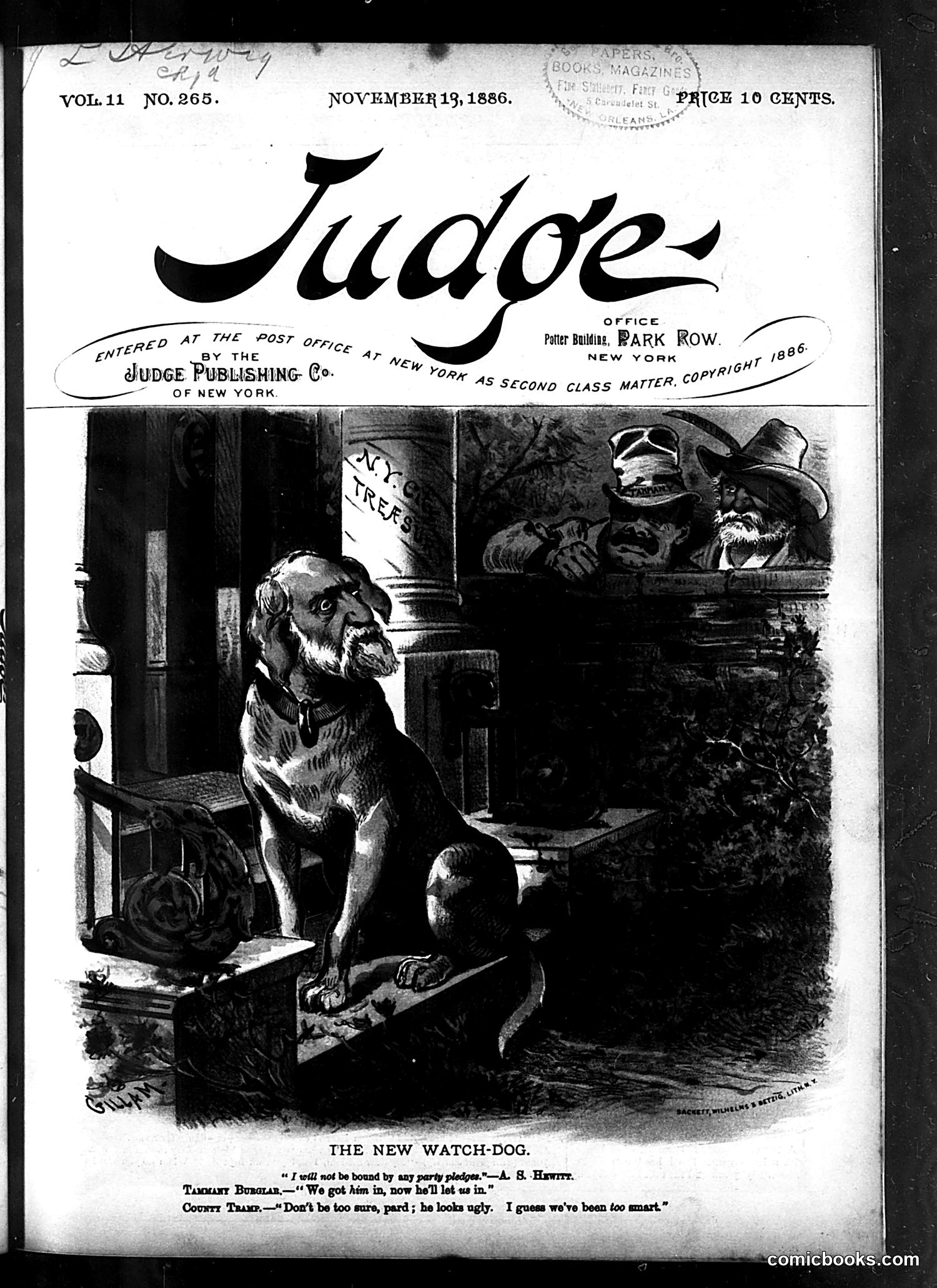
This political cartoon depicts a large, stern watchdog being presented to three men peering from a window or doorway above. The caption quotes A.S. Hewitt and references "Tammany Burglar" and "Covert Tramp." The satire appears to concern New York City politics, specifically Tammany Hall's corruption. The "new watch-dog" represents either a reform candidate or anti-corruption measure meant to guard against Tammany's criminal activities ("burglars" and "tramps"). The men above—likely Tammany politicians—express skepticism about this watchdog's effectiveness, with one saying he "looks ugly" and questioning whether it will actually prevent wrongdoing. The cartoon mocks Tammany's confidence that no reform effort will truly stop their corrupt practices.
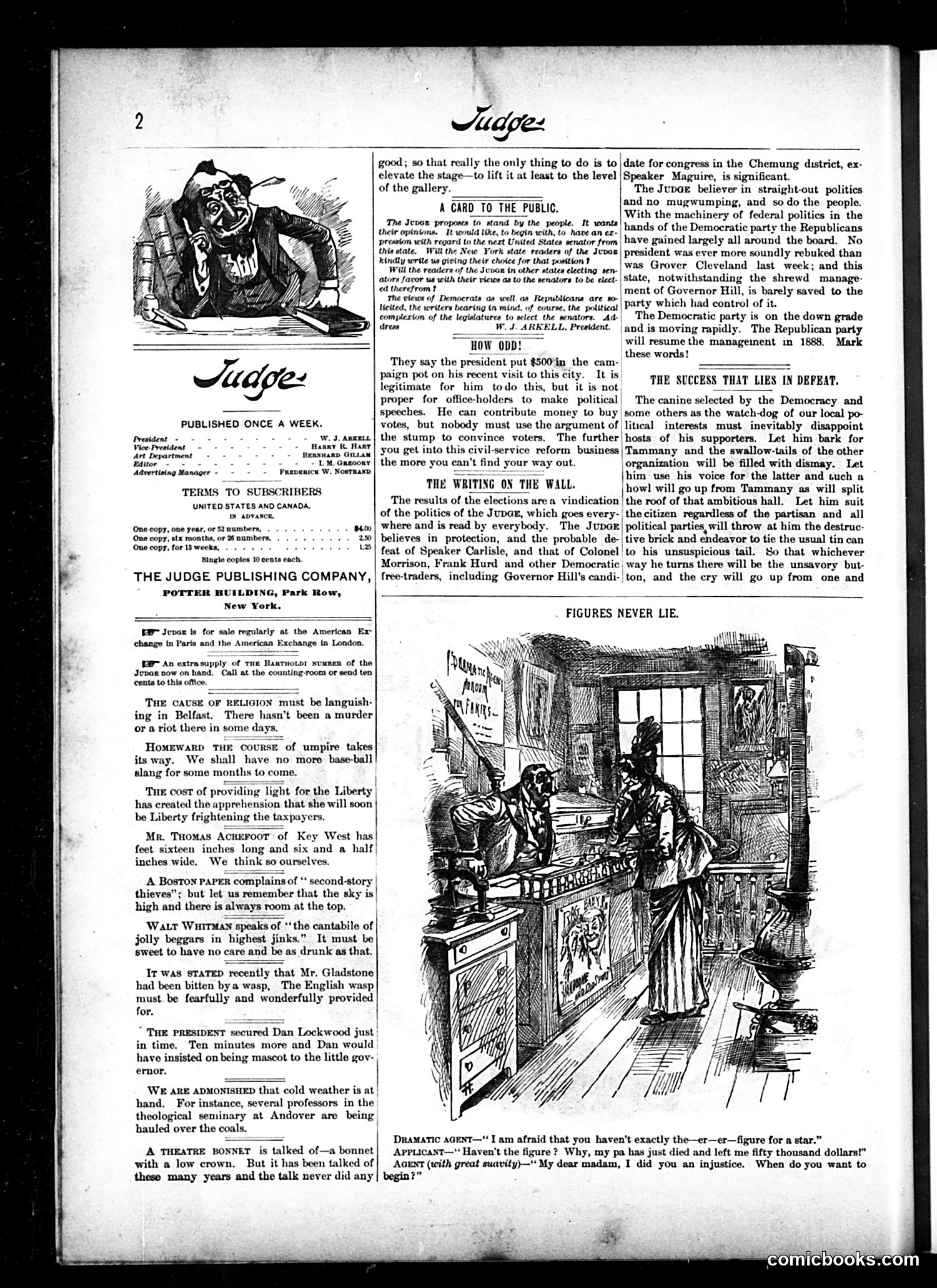
The main cartoon, "Figures Never Lie," depicts a dramatic agent (left) confronting an applicant (right) in what appears to be a theatrical office. The agent claims the applicant lacks the exact "figure for a star," while the applicant protests that her deceased father left her fifty thousand dollars—asking when she'll want an injustice remedied. The satire targets theatrical casting practices and financial desperation. The joke hinges on the agent's double meaning: "figure" refers both to physical appearance (required for stardom) and literal monetary wealth. The applicant misunderstands, assuming the agent means her financial "figure," revealing how stage aspirants conflate money with talent—and how agents exploit this confusion to prey on wealthy but untalented hopefuls seeking stage careers.
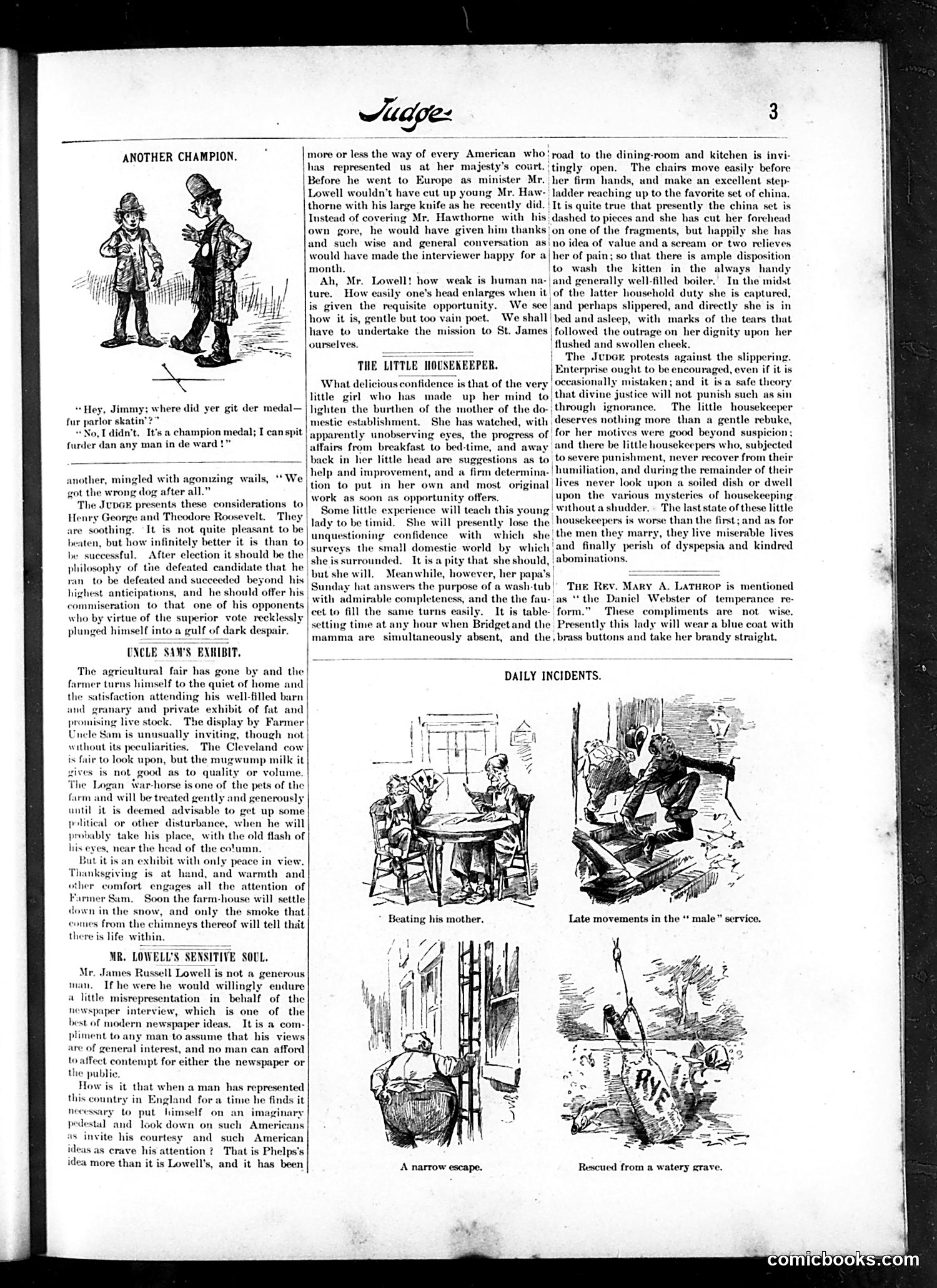
This page satirizes American attitudes toward authority and social hierarchy through several pieces: **"Another Champion"** mocks Minister Lowell's supposed change in behavior after being appointed to represent America at the English court. The cartoon suggests that official position inflates one's ego—Lowell wouldn't have physically attacked young Hawthorne before his appointment, but now does so casually. **"The Little Housekeeper"** celebrates a young girl's industrious confidence in helping with household tasks, despite causing minor damage (breaking china). Judge defends her against harsh punishment, arguing her good intentions and ignorance deserve gentleness, not severe rebuke. **"Daily Incidents"** are illustrations of domestic mishaps—beating mothers, narrow escapes, water-grave rescues—typical period humor about household chaos. The common thread critiques how power corrupts character while defending innocent ambition in children and the working classes, reflecting Progressive-era social commentary on American democracy.
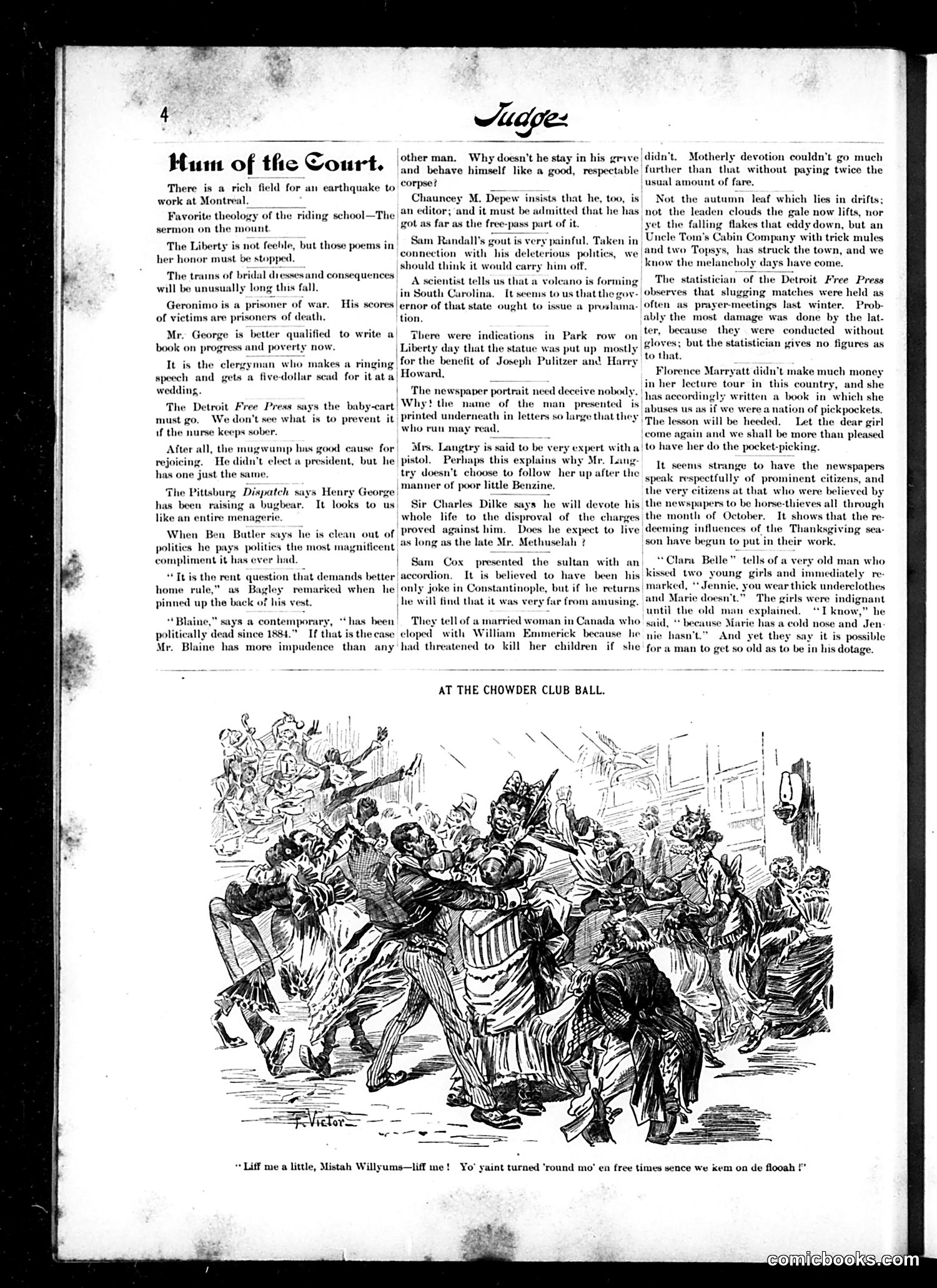
This page from Judge (a 19th-century satirical weekly) contains brief political commentary and a cartoon titled "At the Chowder Club Ball." The text consists of short jabs at contemporary figures and issues: Chauncey M. Depew (a railroad executive and politician), Sam Randall, Henry George (the economist), Ben Butler (the general and politician), and Sir Charles Dilke (a British politician facing scandal). References to volcanic formation in South Carolina and Geronimo appear to be topical jokes. The cartoon depicts a raucous, chaotic dance scene with exaggerated caricatures of working-class or immigrant figures in disorderly celebration. The caption quotes dialect speech: "Lift me a little, Mistah Willyums—lift me! Yo saint turned 'round me' on free times since we kem on de Bowah!" The satire appears to mock urban immigrant culture and lower-class entertainment, representing them as crude and ridiculous for middle-class readers' amusement—typical of Judge's approach in this era.
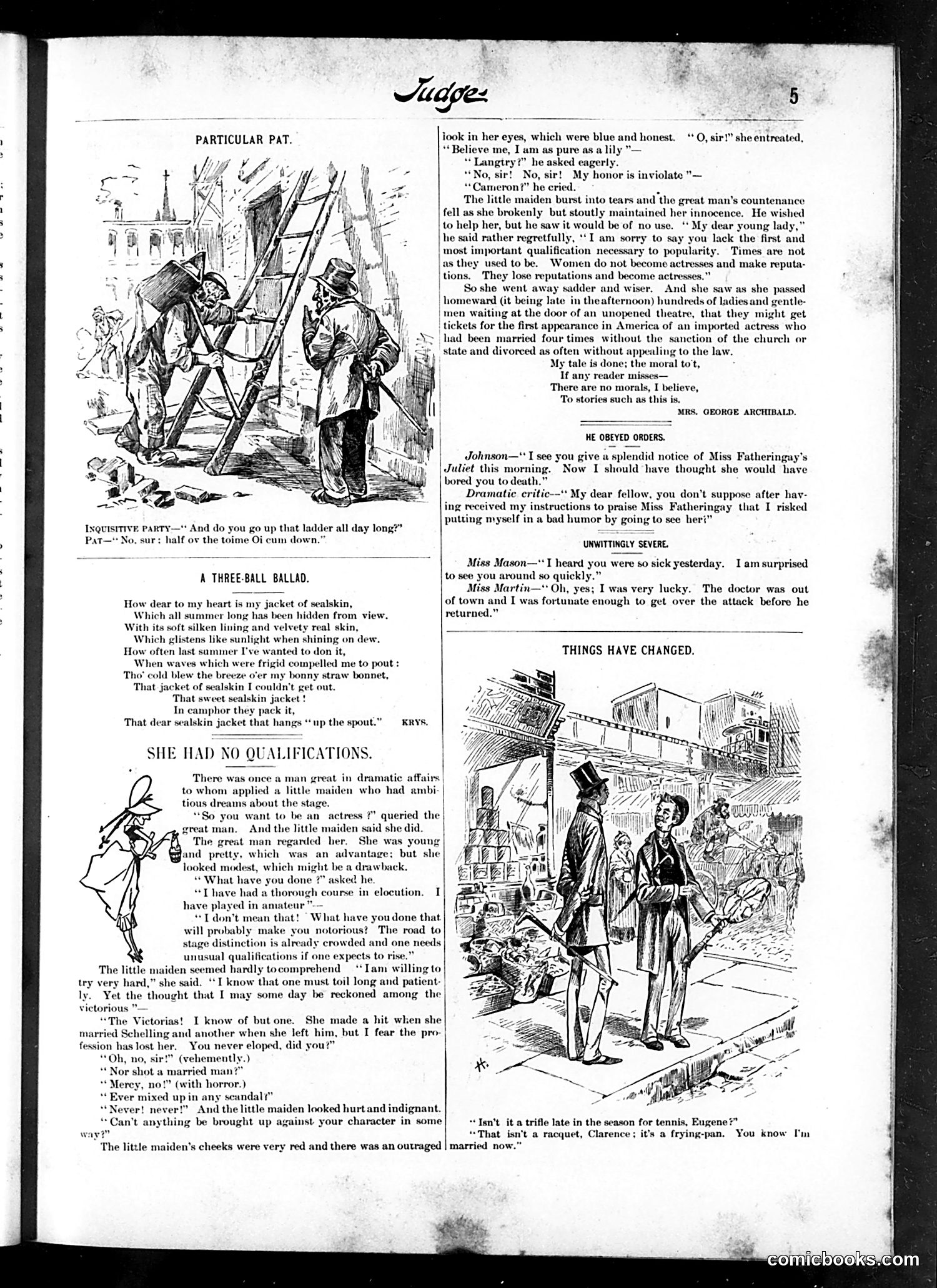
This page satirizes late-19th-century theatrical hypocrisy and the morality double standard. The main cartoon, "She Had No Qualifications," mocks how actresses achieved fame through scandal rather than talent. A young, modest, unmarried woman seeks acting advice from a "great man" (likely a theater manager). He dismisses her because she lacks the essential qualification: notoriety. She hasn't eloped, shot a married man, or created scandal—therefore she cannot succeed. The satire inverts moral expectations: virtue disqualifies her from the stage. The accompanying story reinforces this: while the modest girl leaves defeated, hundreds wait outside a theater for an "imported actress" who's been married four times and divorced without church sanction. Judge criticizes both the public's appetite for scandalous actresses and society's strange standard that equates personal infamy with professional success. References to "Langtry" and "Cameron" (likely Lillie Langtry, a famous actress-courtesan, and a politician's affair) suggest contemporary scandals fueling this critique of theatrical morality.
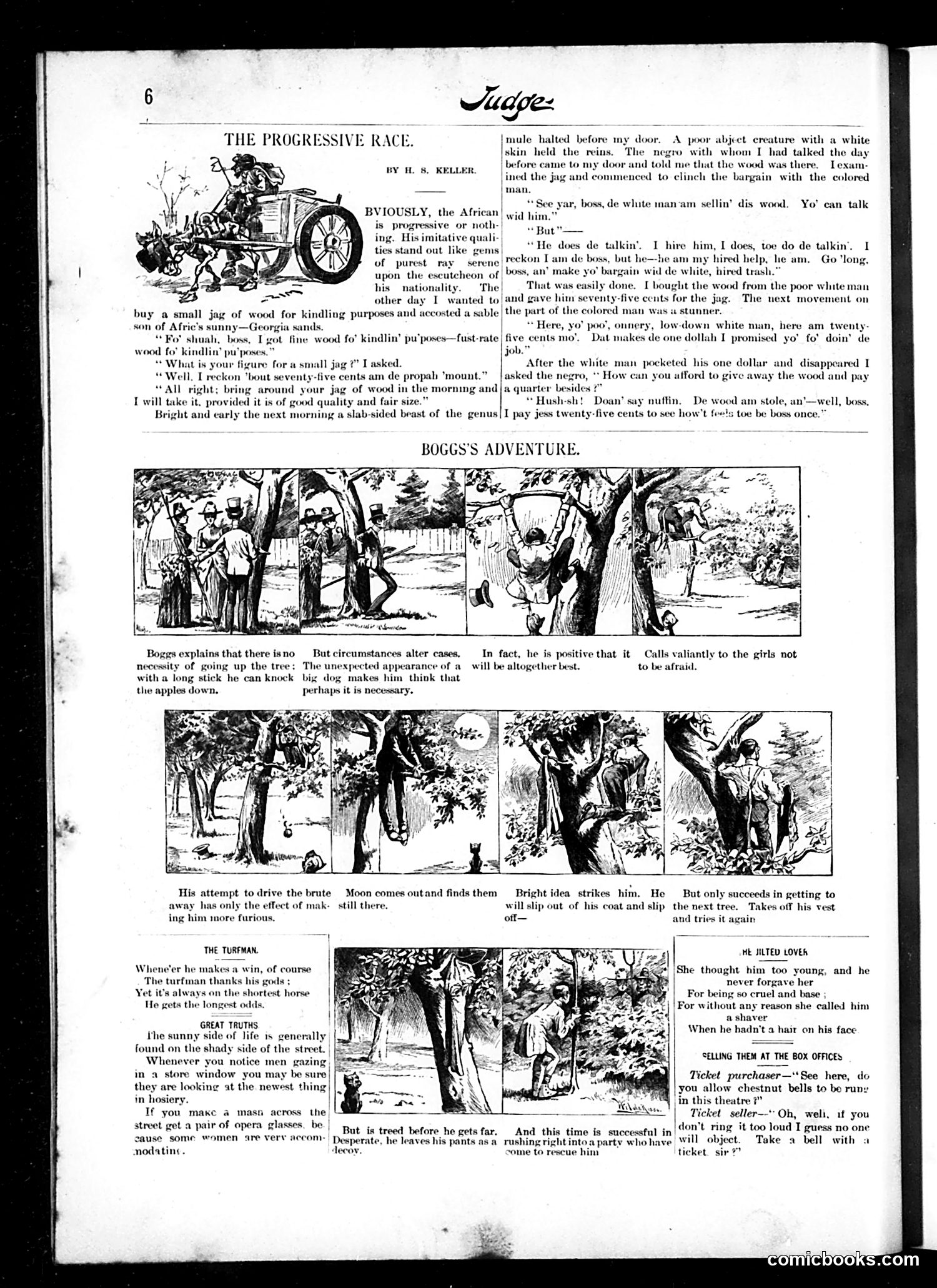
This satirical story uses offensive racial stereotypes common to 1890s Judge magazine. It depicts a white man hiring an African American man to deliver wood. The humor relies on dialect caricature and a "twist" ending: the Black worker reveals he stole the wood and paid the poor white man to help him do so. The satire's target appears ambiguous—it could mock either the Black worker's criminality or critique white poverty and exploitation. However, given the story's title "The Progressive Race" and its emphasis on the Black character's cunning, it likely satirizes African American aspiration in the post-Reconstruction era, presenting such advancement as dishonest or undeserving. The page also includes "Boggs's Adventure" (a comedic sequence about a boy in a tree) and various short humorous observations, typical of Judge's mixed-content format.
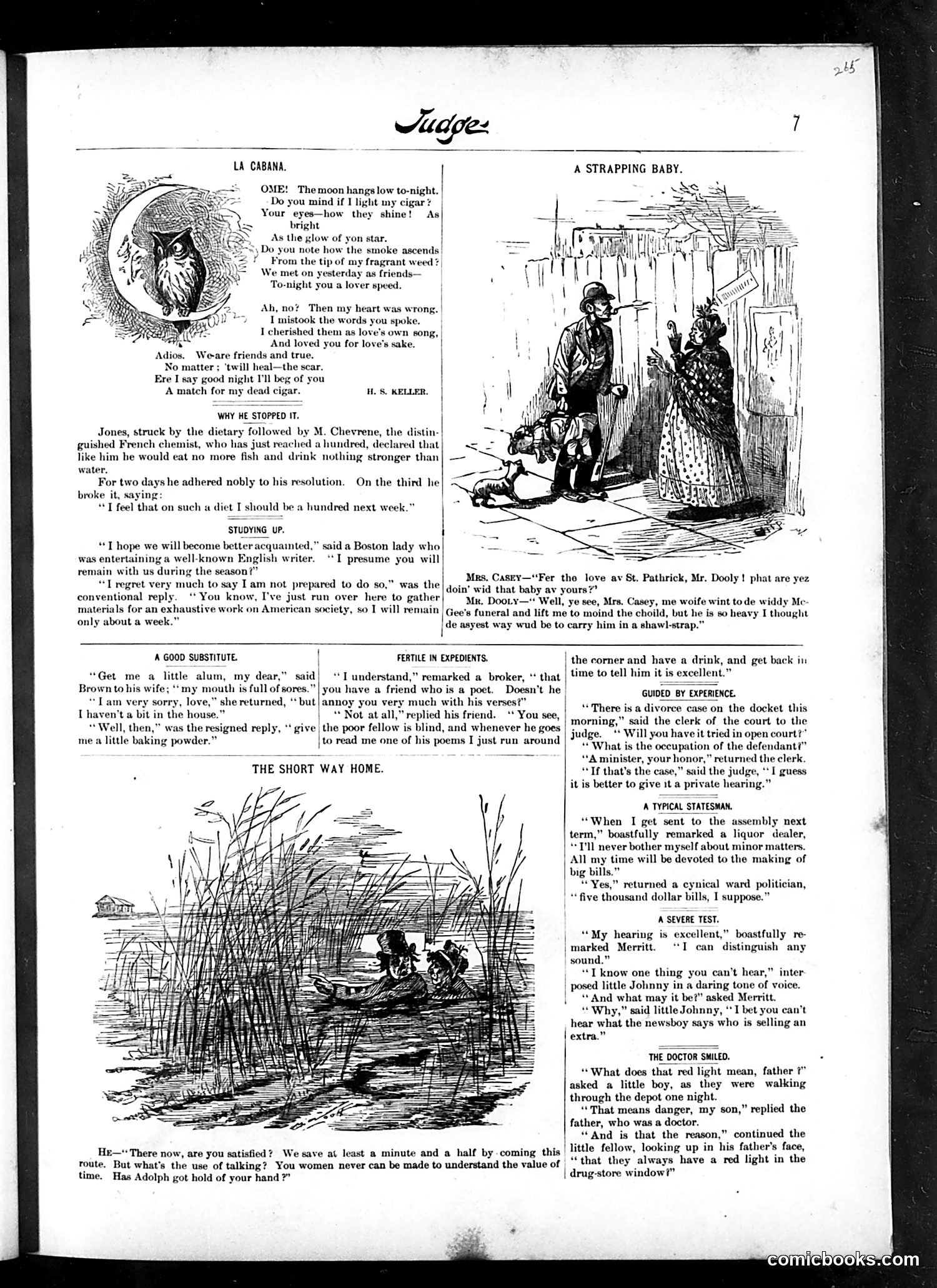
This page from **Judge** (a late 19th/early 20th-century American satirical magazine) contains multiple brief humorous sketches rather than a single political cartoon. The sketches mock various social types: a French chemist's longevity diet (mocked as impractical), an English writer studying American society (satirizing pretentious European observation), Irish immigrants' struggles (the "strapping baby" sketch uses dialect humor), marital dynamics, and political corruption. Most notably, "A Typical Statesman" directly satirizes **political graft**—a liquor dealer elected to the assembly boasts he'll focus on "big bills," prompting a cynical politician's retort about "five thousand dollar bills," suggesting the politician will pursue bribes rather than legislation. This reflects Progressive Era concerns about municipal corruption. The magazine's humor relies on ethnic stereotypes (Irish dialect), class commentary, and cynical observations about American institutions—characteristic of Judge's satirical approach to contemporary society.
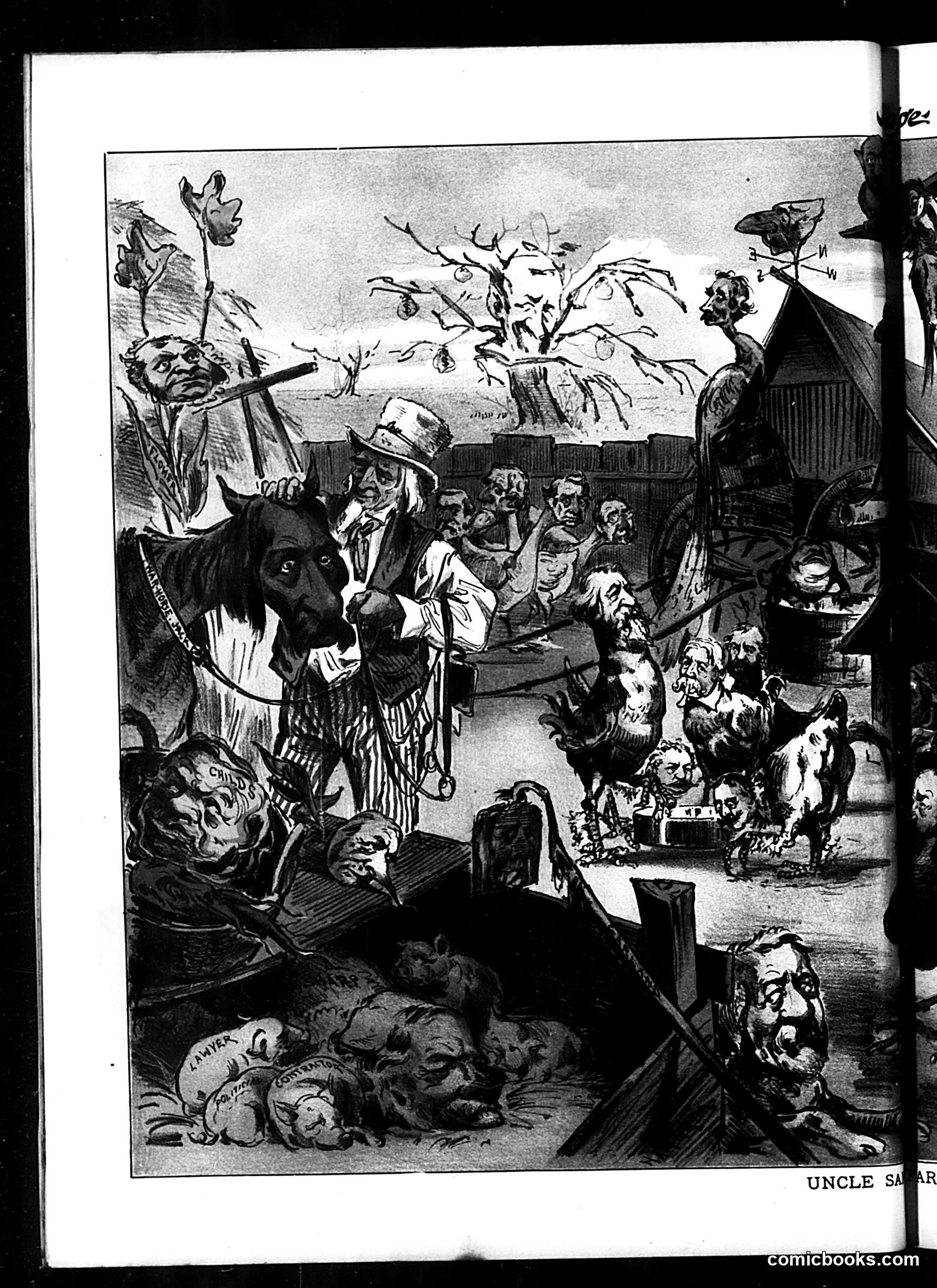
This appears to be a satirical engraving from *Judge* magazine depicting a chaotic street scene with anthropomorphic animals and human figures. The central figure is a large dog in formal dress holding a telescope or similar instrument, appearing to direct or command a crowd below. The scene suggests political commentary through animal caricature—a common satirical device of the era. The dead or fallen figures in the foreground and the chaotic crowd suggest social upheaval or political conflict. The dead plants overhead may symbolize decay or failed policies. Without clear labels or date visible, I cannot identify the specific political figures or events referenced. The style suggests late 19th-century American political satire, but the exact subject remains unclear from the image alone.
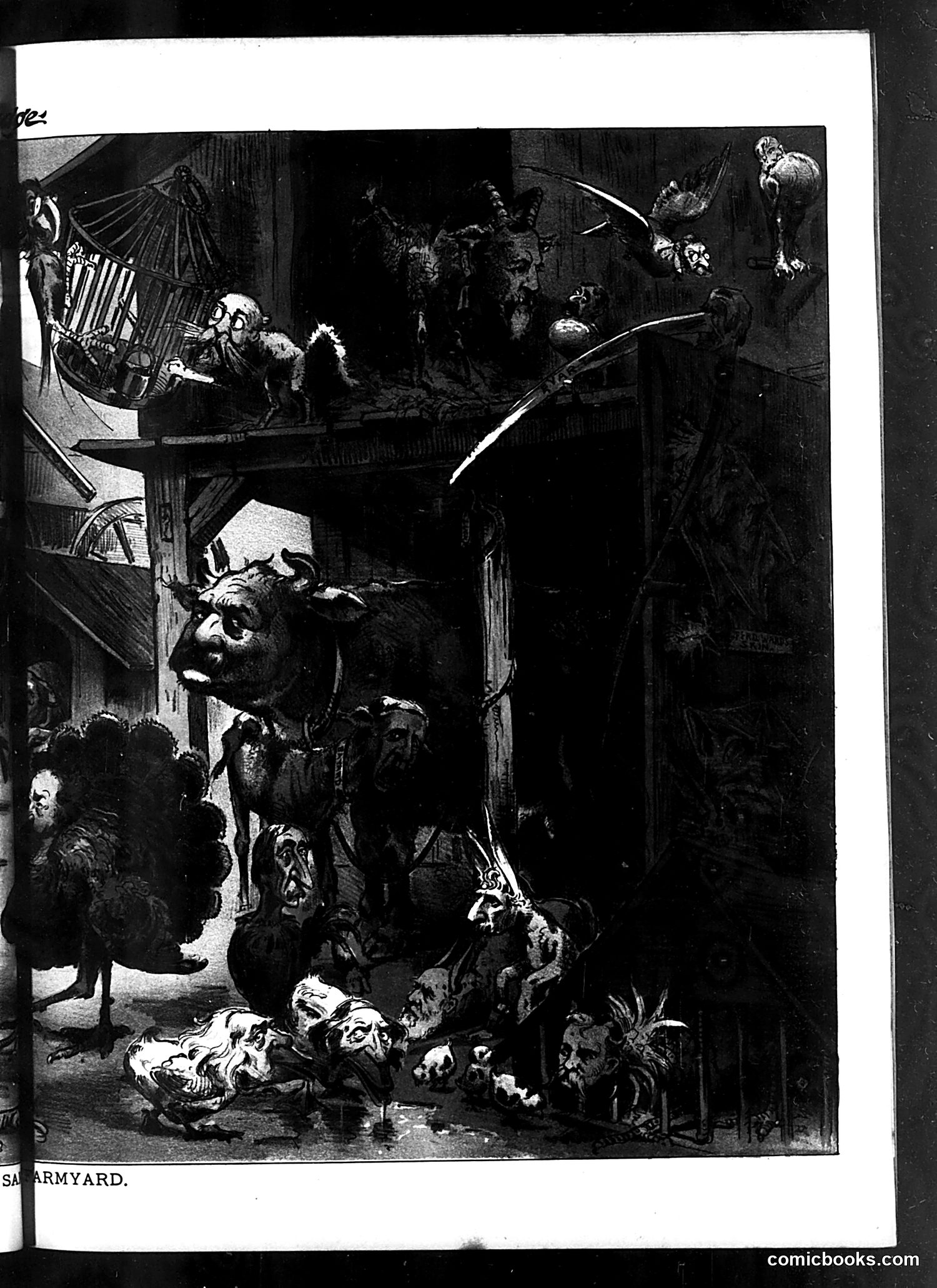
The OCR text is illegible and provides no usable information. However, the image itself is a detailed satirical engraving depicting what appears to be a medieval or fantastical scene. A figure stands elevated on a platform or scaffold, addressing a crowd of grotesque, demonic, or monstrous creatures below. The style suggests 19th-century political satire, common to Judge magazine. Without clear text identifying the specific figures, historical moment, or political commentary, I cannot confidently explain what this cartoon satirizes. The grotesque imagery and hierarchical composition suggest social or political criticism—possibly depicting a leader addressing an unruly or "base" populace—but the specific targets and historical context remain unclear from the image alone. To accurately interpret this cartoon, legible caption text or publication date would be essential.
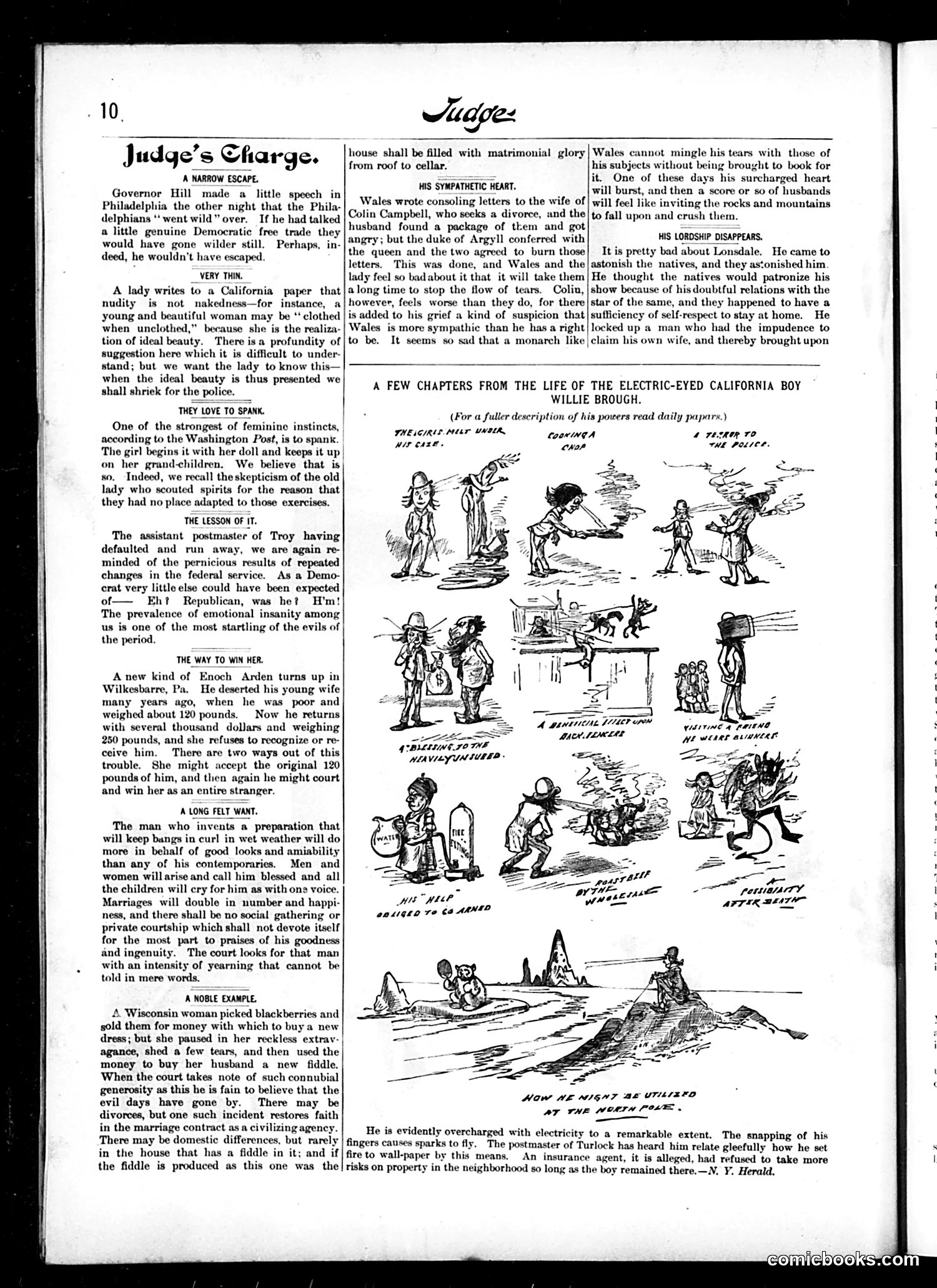
This page from Judge contains multiple short satirical pieces typical of the magazine's style. The main cartoon, "A Few Chapters from the Life of the Electric-Eyed California Boy Willie Brough," depicts a mischievous boy causing chaos through various pranks and mishaps—setting fires, disrupting events, and generally creating mayhem. The accompanying text pieces mock contemporary social issues: Governor Hill's political speeches, a woman's philosophical claim that nudity differs from nakedness, female impulses toward spanking, federal employment corruption, a man attempting to win back his abandoned wife after becoming wealthy, and a woman's virtuous sacrifice (buying her husband a fiddle instead of a dress). The final piece satirizes the Prince of Wales's involvement in a divorce scandal, suggesting his sympathetic letters were self-serving and his grief performative. The humor relies on social commentary about politics, gender roles, marriage, and upper-class hypocrisy typical of 1880s-90s American satire.
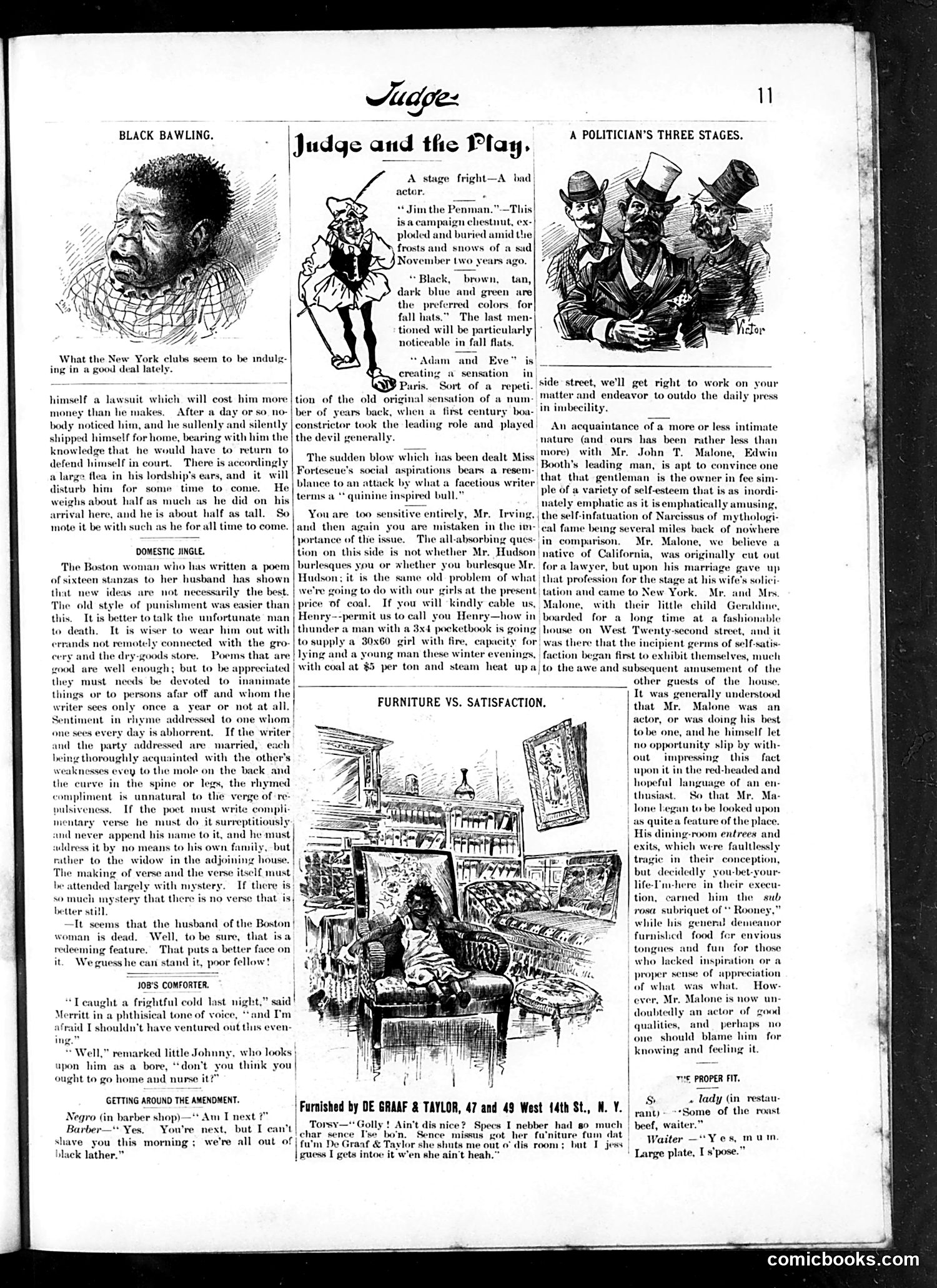
This page contains three satirical pieces typical of Judge's late 19th-century humor: **"Black Bawling"** (left): A caricature mocking what appears to be an African American man, with offensive racial exaggeration. The accompanying text discusses a lawsuit and social embarrassment. **"Judge and the Play"** (center): Theater criticism satirizing recent Broadway productions and actors. It references "Jim the Penman" (a play that "exploded and buried" two years prior) and comments on Miss Fortescue and actor Edwin Booth's leading man, John T. Malone, whose vanity the writer mocks. The piece jokes about theatrical scandals and the "quinine inspired bull" (nonsensical dramatic moments). **"A Politician's Three Stages"** (right): Three illustrated stages of a politician's career or behavior, though details are unclear from the OCR. The page also includes "Domestic Jingle" (poetry criticism), "Furniture vs. Satisfaction" (an advertisement illustration), and miscellaneous jokes about shaving and amendments. The content reflects Judge's focus on theatrical gossip, social commentary, and period-specific humor inaccessible without historical context.
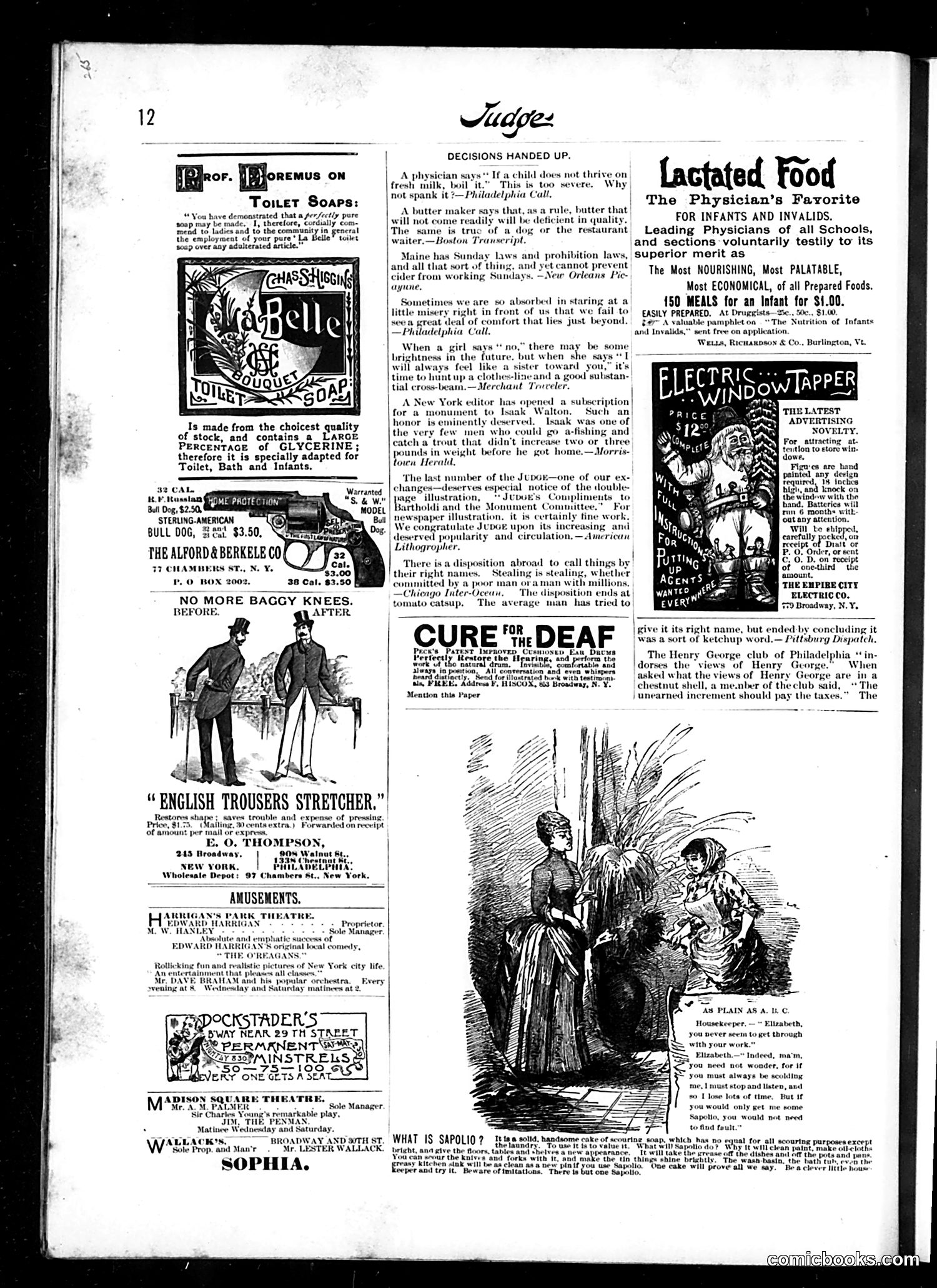
This page is primarily **advertising and satirical commentary**, not a unified cartoon. The left column features product advertisements (La Belle toilet soap, trouser stretcher, theater announcements) interspersed with brief satirical "Decisions Handed Up"—short witty observations on contemporary life. These include jokes about child-rearing methods, butter-making, Maine's prohibition laws, and the hypocrisy of calling theft by its proper name regardless of the thief's social class. The right side advertises **Lactated Food** (an infant formula endorsed by physicians) and the **Electric Window Tapper** (a novelty advertising device with motorized figures that knock on store windows). The page's only substantial illustration shows **a domestic scene** with the caption "AS PLAIN AS A B.C.," humorously depicting a housekeeper explaining her duties. Below appears commentary on Henry George's economic philosophy. Overall, this is a typical Judge page mixing commercial advertisements with mild social satire rather than substantive political commentary.
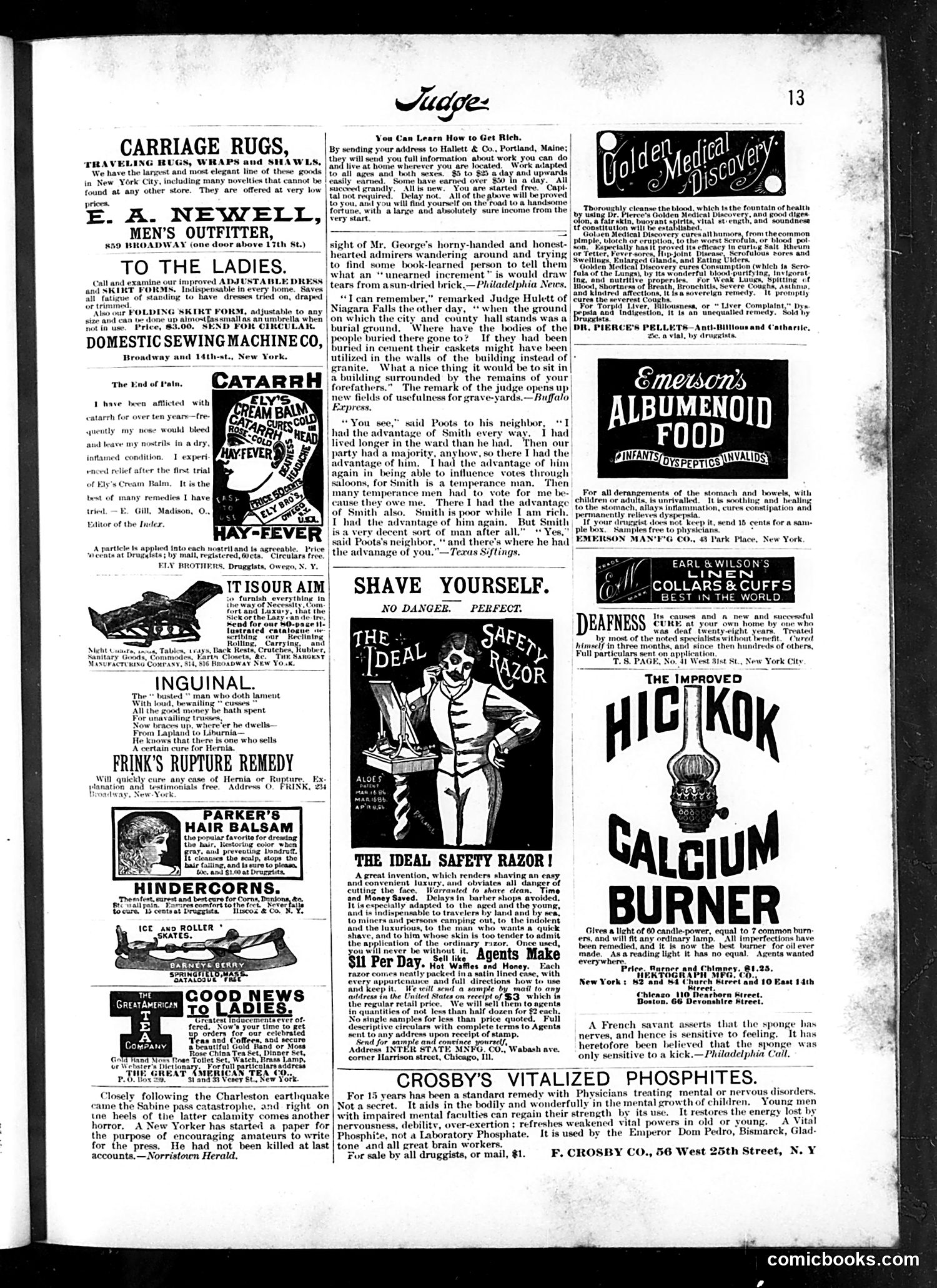
This page is primarily **advertising** with minimal political cartooning. The content reflects late 19th/early 20th-century consumer culture and patent medicine marketing. ## Notable Elements: **The "Ideal Safety Razor"** advertisement features an illustrated man promoting this new consumer product—representing the era's fascination with modern conveniences and safety innovations. **"Golden Medical Discovery"** and similar patent medicine ads dominated magazines of this period. These products made sweeping health claims (treating "all humors," curing deafness, etc.) without FDA regulation—a practice now recognized as fraudulent but then commonplace. **The text snippets** include humor about politics and social observation (Judge Hulett's graveyard comment, a story about political advantages), typical of Judge's satirical style. **The overall tone** reflects Gilded Age consumer capitalism: promises of wealth-building schemes, medical miracles, and gentlemanly goods. For modern readers, this page illustrates how unregulated advertising once exploited public trust before consumer protection laws existed.
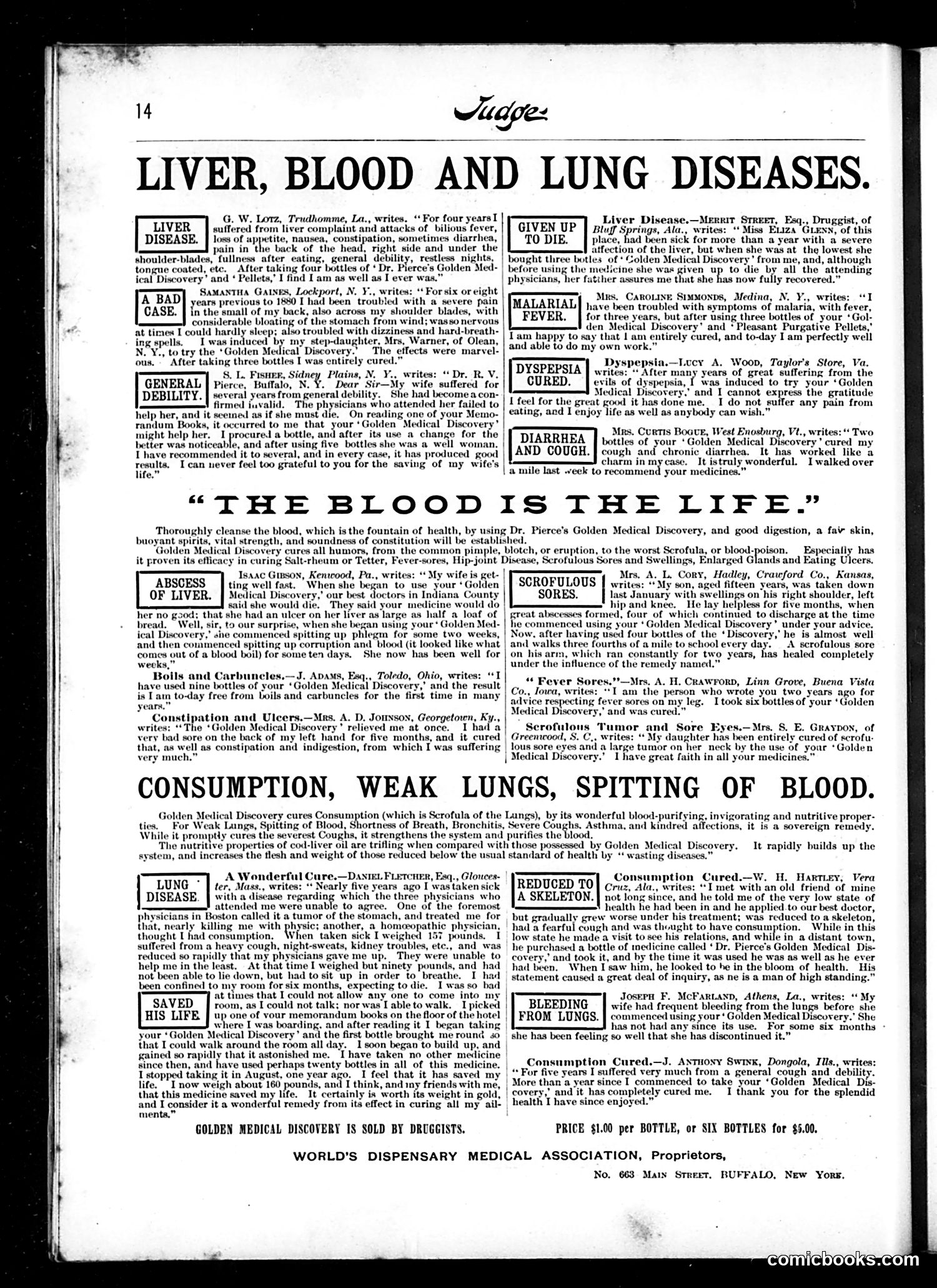
This page is **entirely advertising**, not satire or political commentary. It contains testimonial advertisements for "Golden Medical Discovery," a patent medicine promoted by the World's Dispensary Medical Association (Buffalo, New York). The layout mimics Judge magazine's format to lend credibility, but the content is straightforward medical marketing. Multiple testimonials from named individuals claim the product cured liver disease, malaria, dyspepsia, diarrhea, lung disease, and other ailments. The repeated tagline "The Blood Is the Life" emphasizes the medicine's purported blood-purifying properties. **No satire is present.** This represents a common 19th-century practice: patent medicine companies purchasing advertising space in publications while adopting the publication's visual style to appear editorial. The "Judge" header at top is the magazine's masthead; everything below is paid advertisement. Such claims would be illegal under modern FDA regulations, but were standard in this era.
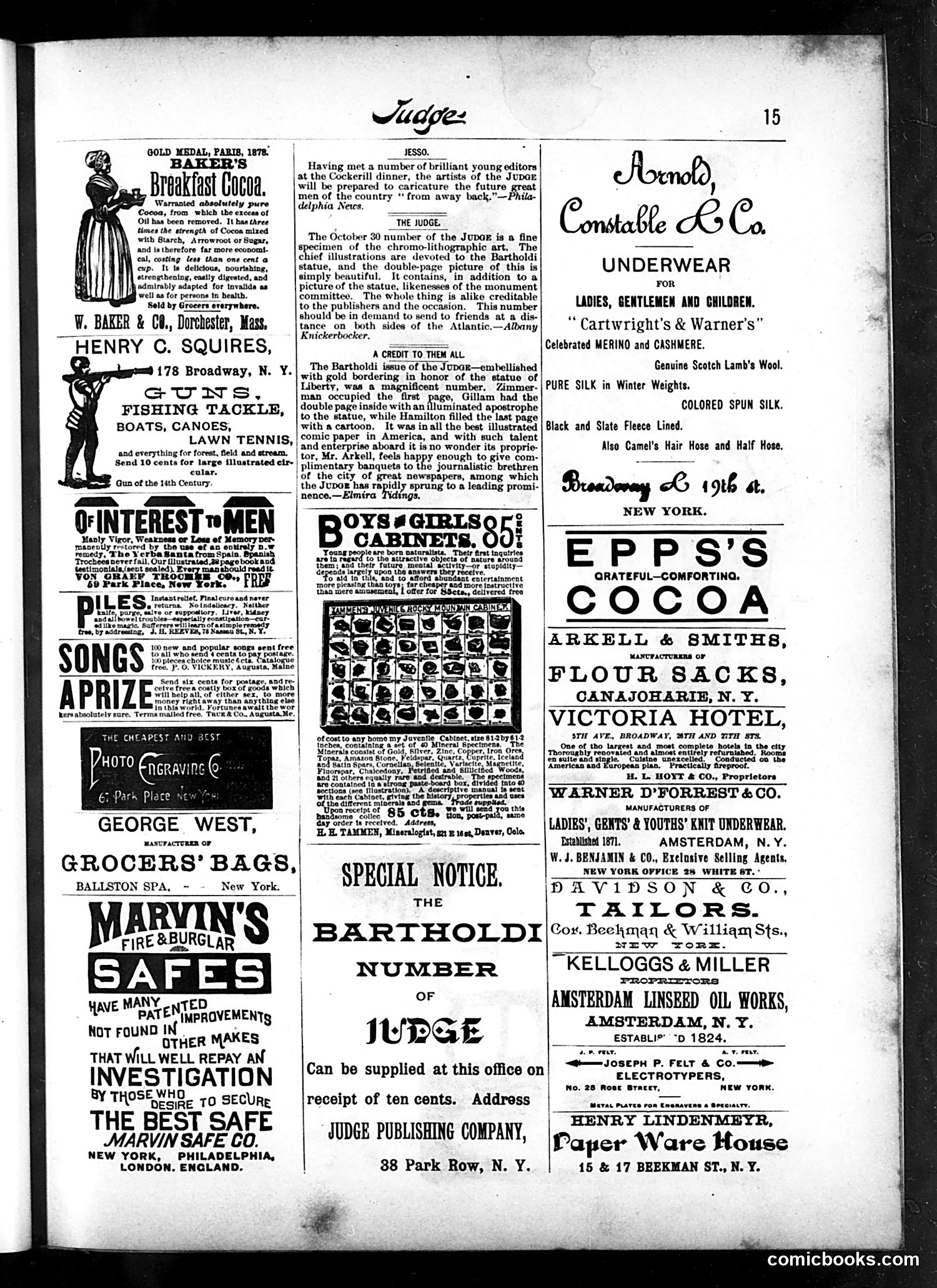
This page is predominantly advertisements with minimal cartoon content visible. The main editorial material concerns Judge magazine's recent "Bartholdi Number," which celebrated the Statue of Liberty with gold-bordered illustrations and contributions from cartoonists Zimmerman, Gillam, and Hamilton. The brief editorial excerpt from *Philadelphia News* jokes that Judge artists, having met brilliant young editors at a Cockerill dinner, will now be able to caricature these future "great men of the country" retrospectively—a lighthearted self-congratulatory reference to Judge's artistic capabilities. The surrounding text consists entirely of period advertisements for products including cocoa, firearms, sailing equipment, medical treatments, safes, and undergarments. No significant political or satirical cartoons are visible on this particular page.
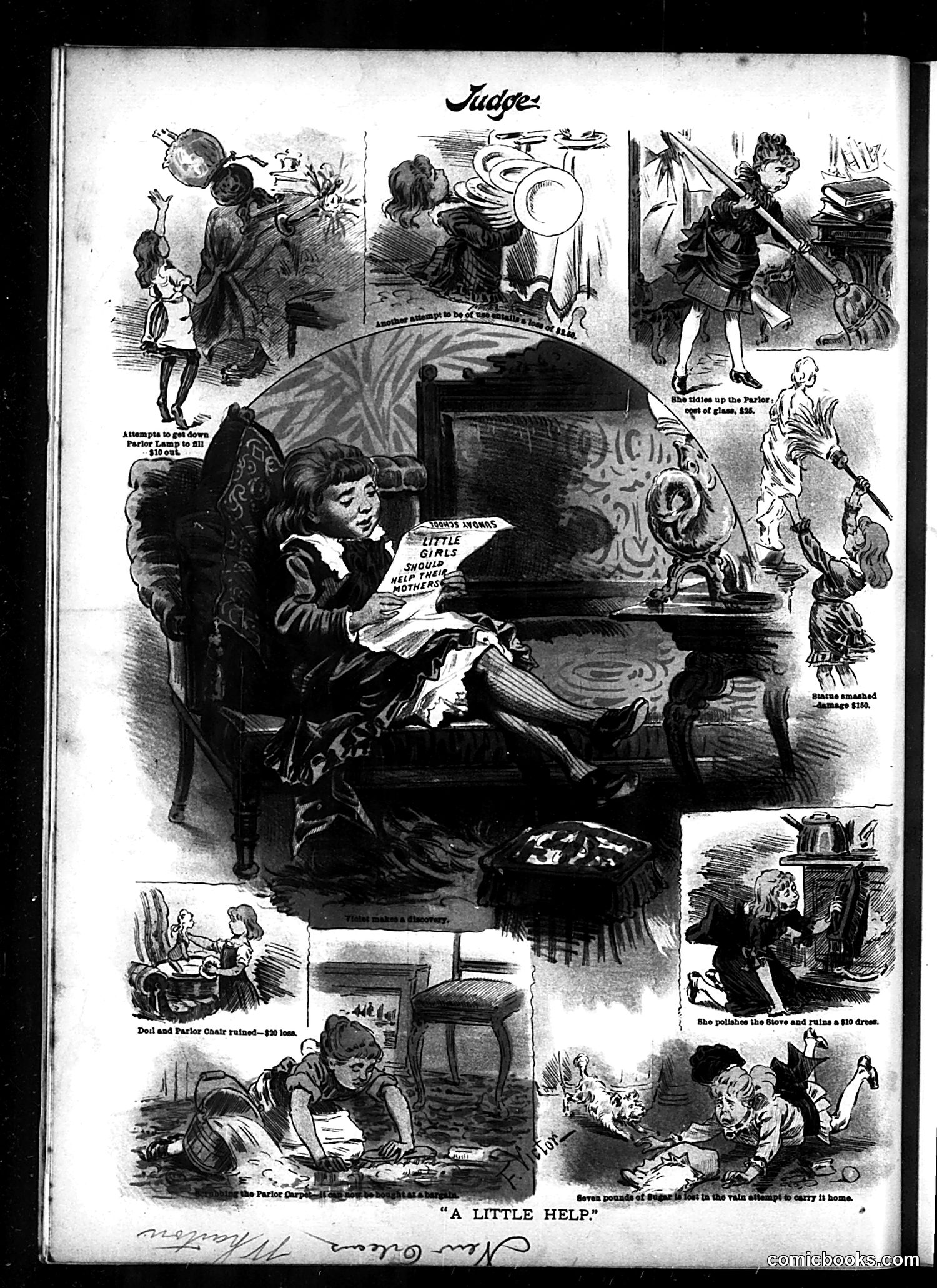
This Judge page satirizes a woman seeking domestic help. The central image shows a woman reading "Servant's Agencies" advertisements while sitting in an ornate chair, surrounded by vignettes depicting household chaos—children misbehaving, servants quitting, furniture broken, and domestic disorder. The title "A Little Help" is ironic: the woman desperately needs household staff, but the surrounding scenes show the difficulties of finding and keeping reliable servants. Various captions reference specific disasters (damaged furniture priced at $25, servant-related incidents). The satire targets upper-class women's dependence on domestic servants and the frustrations of the "servant problem"—a late 19th/early 20th-century social issue where finding competent household help was increasingly difficult. The cartoon mocks both the chaos of understaffed homes and perhaps the employers' expectations.