
Judge, 1886-11-13 · page 10 of 16
Judge — November 13, 1886 — page 10: what you’re looking at
What you’re looking at
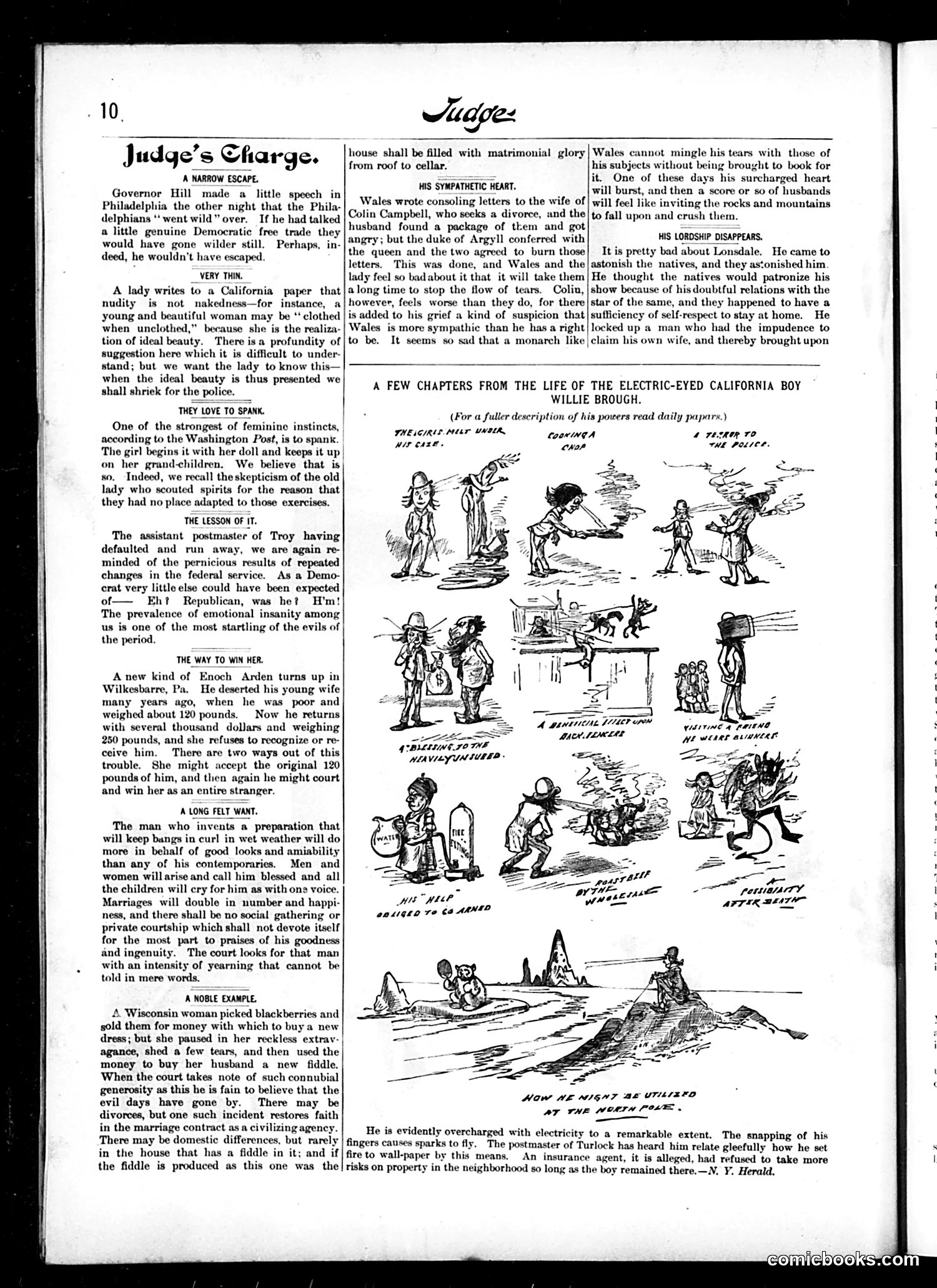
This page from Judge contains multiple short satirical pieces typical of the magazine's style. The main cartoon, "A Few Chapters from the Life of the Electric-Eyed California Boy Willie Brough," depicts a mischievous boy causing chaos through various pranks and mishaps—setting fires, disrupting events, and generally creating mayhem. The accompanying text pieces mock contemporary social issues: Governor Hill's political speeches, a woman's philosophical claim that nudity differs from nakedness, female impulses toward spanking, federal employment corruption, a man attempting to win back his abandoned wife after becoming wealthy, and a woman's virtuous sacrifice (buying her husband a fiddle instead of a dress). The final piece satirizes the Prince of Wales's involvement in a divorce scandal, suggesting his sympathetic letters were self-serving and his grief performative. The humor relies on social commentary about politics, gender roles, marriage, and upper-class hypocrisy typical of 1880s-90s American satire.
📄 Transcribed text from this page (OCR, searchable)
Machine-transcribed from the original scan — historical spelling and the odd misread are preserved.
10, Judge’s Charge. ‘A NARROW ESCAPE, Governor Hill made a little speech in Philadelphia the other night that the Phila- delphians “went wild” over. If he had talked a little genuine Democratic free trade they would have gone wilder still. Perhaps, in- deed, he wouldn't have escaped. VERY THIN, A lady writes to a California paper that nudity is not nakedness—for instance, a young and beautiful woman may be ‘clothed when unclothed,” because she is the realiza- tion of ideal beauty. There is a profundity of suggestion here which it is difficult to under- stand; but we want the lady to know this— when the ideal beauty is thus presented we shall shriek for the police. THEY LOVE TO SPANK. One of the strongest of feminine instincts, according to the Washington Post, is to spank. The girl begins it with her doll and keeps it up| on her grand-children, We believe that is so. Indeed, we recall the skepticism of the old lady who scouted spirits for the reason that they had no place adapted to those exercises. THE LESSON OF IT. The assistant postmaster of Troy having defaulted and run away, we are again re- minded of the pernicious results of repeated changes in the federal service. As a Demo- crat very little else could have been expected of— Eh? Republican, was he? H’m! The prevalence of emotional insanity among us is one of the most startling of the evils of the period. THE WAY TO WIN HER. Anew kind of Enoch Arden turns up in Wilkesbarre, Pa. He deserted his young wife many years ago, when he was poor and weighed about 120 pounds. Now he returns with several thousand dollars and weighing 250 pounds, and she refuses to recognize or re- ceive him. There are two ways out of this trouble. She might accept the original 120 pounds of him, and then again he might court and win her as an entire stranger. WANT. a preparation that will keep bangs in curl in wet weather will do more in behalf of good looks and amiability than any of his contemporaries. Men and women will arise and call him blessed and all the children will cry for him as with one voice. Marriages will double in number and happi- ness, and there shall be no social gathering or private courtship which shall not devote itself for the most part to praises of his goodness and ingenuity. The court looks for that man with an intensity of yearning that cannot be told in mere words. A NOBLE EXAMPLE, 4. Wisconsin woman picked blackberries and sold them for money with which to buy a new dress; but she paused in her reckless extrav- agance, shed a few tears, and then used the money to buy her husband a new fiddle. When the court takes note of such connubial generosity as this he is fain to believe that the evil days have gone by. There may be divorces, but one such incident restores faith in the marriage contract as a civilizing agency. ‘There may be domestic differences, but rarely in the house that has a fiddle in it; and if the fiddle is produced as this one was the house shall be filled with matrimo! from roof to cellar. glory HIS SYMPATHETIC HEART. Wales wrote consoling letters to the wife of Colin Campbell, who seeks a divorce, and the husband found a package of them and got angry; but the duke of Argyll conferred with the queen and the two agreed to burn those letters. This was done, and Wales and the lady feel so bad about it that it will take them along time to stop the flow of tears. Colin, however, feels worse than they do, for there is added to his grief a kind of suspicion that Wales is more sympathic than he has a right to be. It seems so sad that a monarch like} Wales cannot mingle his tears with those of his subjects without being brought to book for it. One of these days his surcharged heart will burst, and then a score or so of husbands will feel like inviting the rocks and mountains to fall upon and crush them. HIS LORDSHIP DISAPPEARS. It is pretty bad about Lonsdale. He came to astonish the natives, and they astonished him He thought the natives would patronize his show because of his doubtful relations with the star of the same, and they happened to have a sufficiency of self-respect to stay at home. He locked up a man who had the impudence to claim his own wife, and thereby brought upon A FEW CHAPTERS FROM THE LIFE OF WILLIE THE ELECTRIC-EYED CALIFORNIA BOY BROUGH. (For a fuller description of his powers read daily papars.) THEAG/RES. MELT UNDER aS A TBILESING 70 THE HEAVILY UM SUEED a HS” heh enLigho re 63 AAMEO Loan Inga 4 TENOR TO THE Posies. VIStTINE AERIEND HE SARE BAUER ay ao fassiassiTY paett a AFTER BEAT wosd Now AE NIGNT AE UTILIZED He is evidently overcharged with electricity fingers causes sparks to fly. fire to wall-paper by this means. Onn Pow . to a remarkable extent. The snapping of his The postmaster of Turlock has heard him relate gleefully how he set An insurance agent, it is alleged, had refused to take more risks on property in the neighborhood so long as the boy remained there.—N. Y. Herald.