
Judge, 1886-11-13 · page 7 of 16
Judge — November 13, 1886 — page 7: what you’re looking at
What you’re looking at
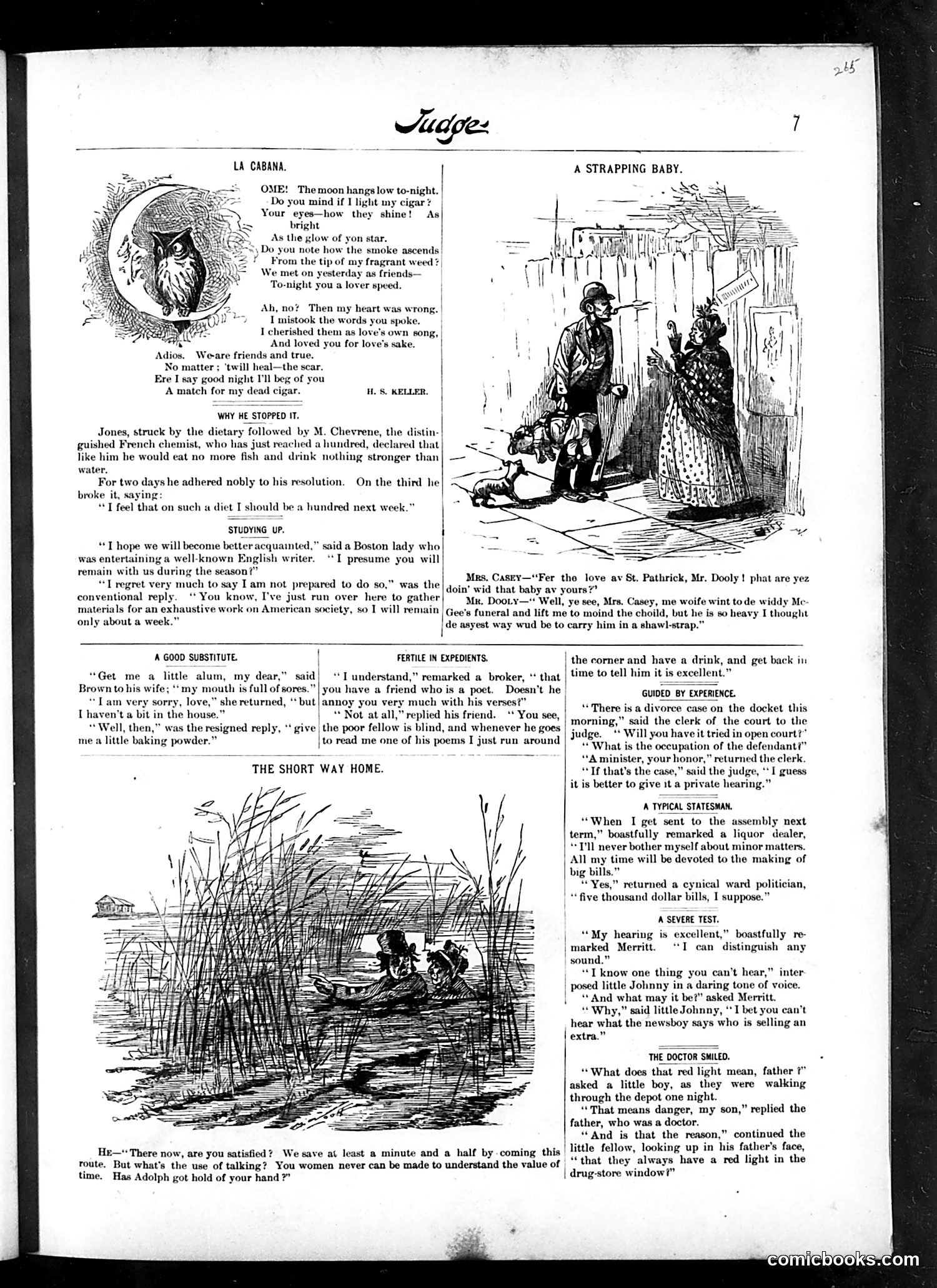
This page from **Judge** (a late 19th/early 20th-century American satirical magazine) contains multiple brief humorous sketches rather than a single political cartoon. The sketches mock various social types: a French chemist's longevity diet (mocked as impractical), an English writer studying American society (satirizing pretentious European observation), Irish immigrants' struggles (the "strapping baby" sketch uses dialect humor), marital dynamics, and political corruption. Most notably, "A Typical Statesman" directly satirizes **political graft**—a liquor dealer elected to the assembly boasts he'll focus on "big bills," prompting a cynical politician's retort about "five thousand dollar bills," suggesting the politician will pursue bribes rather than legislation. This reflects Progressive Era concerns about municipal corruption. The magazine's humor relies on ethnic stereotypes (Irish dialect), class commentary, and cynical observations about American institutions—characteristic of Judge's satirical approach to contemporary society.
📄 Transcribed text from this page (OCR, searchable)
Machine-transcribed from the original scan — historical spelling and the odd misread are preserved.
Hi LA CABANA. | : | OME! The moon hangs low to-night. Do you mind if I light my cigar? Your eyes—how they shine! As bright As the glow of yon star. | Do you note how the smoke ascends From the tip of my fragrant weed We met on yesterday as friends— To-night you a lover speed. Ah, not Then my heart was wrong. I mistook the words you spoke. I cherished them as love's own song, And loved you for love's sake, | Adios. Weare friends and true. No matter ; ‘twill heal—the scar. Ere I say good night I'll beg of you | A match for my dead cigar. WHY HE STOPPED IT. Jones, struck by the dietary followed by M. Chevrene, the distin-| guished French chemist, who has just reached a hundred, declared that like him he would eat no more fish and drink nothing stronger than water, For two days he adhered nobly to his resolution. broke it, saying: **T feel that on such a diet I should be a hundred next week.” On the third he STUDYING UP. *T hope we will become better acquainted,” said a Boston lady who was entertaining a well-known English writer. ‘I presume you will remain with us during the season?” “T regret very much to say Iam not prepared to do so,” was the conventional reply. ‘* You know, I've just run over here to gather materials for an exhaustive work on American society, so I will remain only about a week.” A STRAPPING BABY. Mus, Casey—“Fer tho love av St. Pathrick, Mr. Dooly ! phat are yez doin’ wid that baby av yours?? ‘Mx. Dooty—“ Well, ye see, Mrs, Casey, me woife wint tode widdy Mc- Gee's funeral and lift me to moind the choild, but he is 80 heavy I thought [de asyest way wud be to carry him in a shawl-strap.” A GOOD SUBSTITUTE. “Get me a little alum, my dear,” said Brown to his wife; ‘my mouth is full of sores. “Tam very sorry, love,” she returned, “but I haven't a bit in the house.” you have a friend who * Not at all,” replied “Well, then,” was the resigned reply, “‘ give the poor fellow is blind, and whenever he goes | |to read me one of his poems I just run around | me a little baking powder.” THE SHORT WAY HOME. He—* There now, are you satisfied? We save at least a minute and route. But what's the use of talking? You women never can be made to understand the value of time. Has Adolph got hold of your hand ?” FERTILE IN EXPEDIENTS. “T understand,” remarked a broker, “ that annoy you very much with his verses?” | the corner and have a drink, and get back in time to tell him it is excellent.” GUIDED BY EXPERIENCE. | “There is a divorce case on the docket this | morning,” said the clerk of the court to the judge.‘ Will you have it tried in open court?” “What is the occupation of the defendant?” “A minister, your honor,” returned the clerk. ““Tf that’s the case,” said the judge, ‘I guess it is better to give it a private hearing.” is a poet. Doesn't he his friend. “* You see, ‘A TYPICAL STATESMAN. “When I get sent to the assembly next term,” boastfully remarked a liquor dealer, “I'll never bother myself about minor matters. All my time will be devoted to the making of big bills.” “Yes,” returned a cynical ward politician, “five thousand dollar bills, 1 suppose.” ‘A SEVERE TEST. | ‘My hearing is excellent,” boastfully re- | marked Merritt. “I can distinguish any sound.” ““T know one thing you can't hear,” inter posed little Johnny in a daring tone of voice. ‘And what may it be?” asked Merritt. “Why,” said little Johnny, “I bet you can’t hear what the newsboy says who is selling an | extra.” THE DOCTOR SMILED. “What does that red light mean, father ?” asked a little boy, as they were walking through the depot one night. “That means danger, my son,” replied the father, who was a doctor. “And is that the reason,” continued the little fellow, looking up in his father’s face, “that they always have a red light in the | drug-store window?” a half by-coming this |