
Judge, 1886-11-13 · page 5 of 16
Judge — November 13, 1886 — page 5: what you’re looking at
What you’re looking at
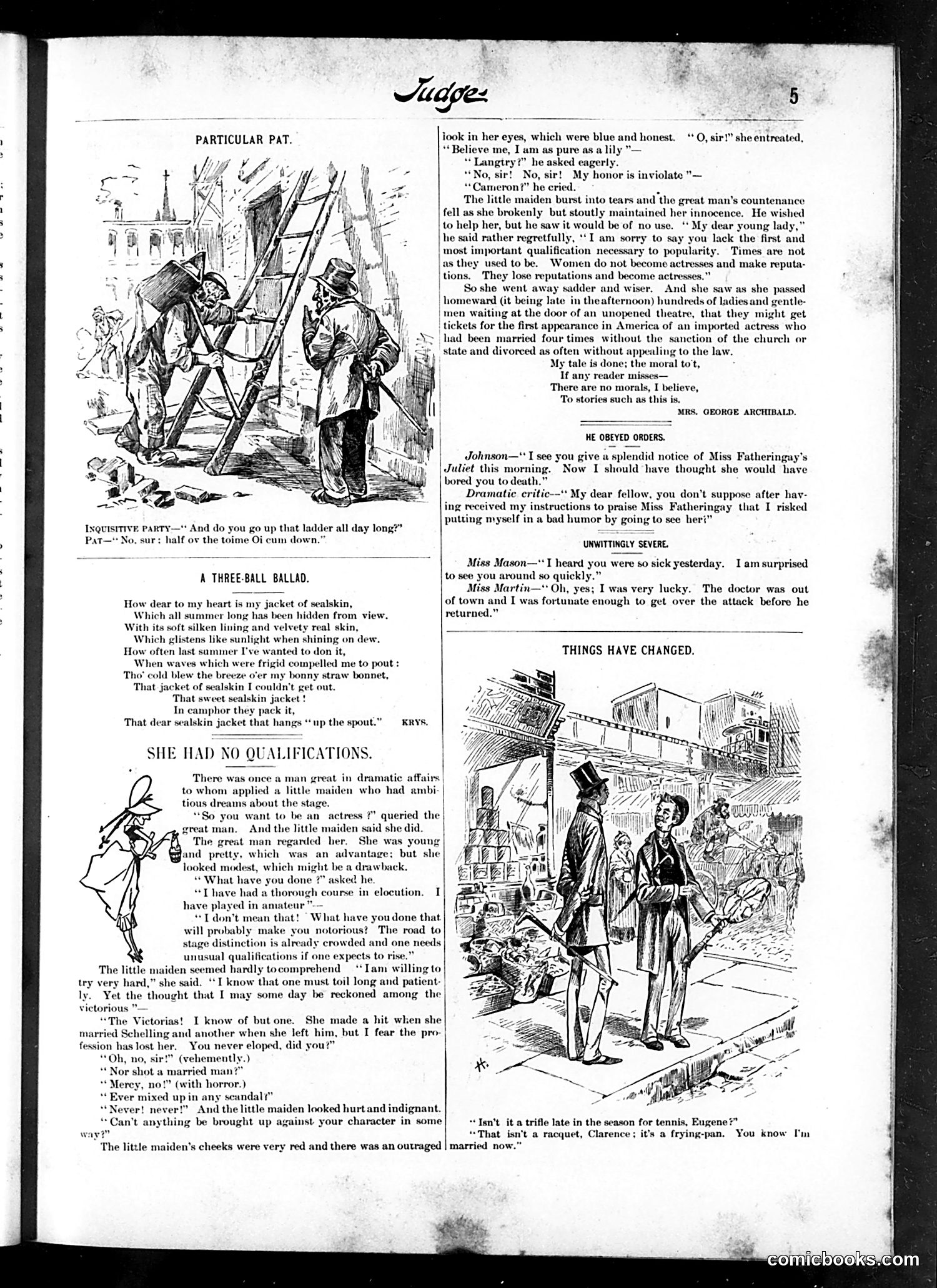
This page satirizes late-19th-century theatrical hypocrisy and the morality double standard. The main cartoon, "She Had No Qualifications," mocks how actresses achieved fame through scandal rather than talent. A young, modest, unmarried woman seeks acting advice from a "great man" (likely a theater manager). He dismisses her because she lacks the essential qualification: notoriety. She hasn't eloped, shot a married man, or created scandal—therefore she cannot succeed. The satire inverts moral expectations: virtue disqualifies her from the stage. The accompanying story reinforces this: while the modest girl leaves defeated, hundreds wait outside a theater for an "imported actress" who's been married four times and divorced without church sanction. Judge criticizes both the public's appetite for scandalous actresses and society's strange standard that equates personal infamy with professional success. References to "Langtry" and "Cameron" (likely Lillie Langtry, a famous actress-courtesan, and a politician's affair) suggest contemporary scandals fueling this critique of theatrical morality.
📄 Transcribed text from this page (OCR, searchable)
Machine-transcribed from the original scan — historical spelling and the odd misread are preserved.
PARTICULAR PAT. iook in her eyes, which were blue and honest. “0, sir!” she entreated, “Believe me, I um as pure as a lily "— “Langtry?” he asked eagerly. “No, sir! No, sir! My honor is inviolate "— “Cameron?” he cried - The little maiden burst into tears and the great man’s countenance fell as she brokenly but stoutly maintained her innocence. He wished |to help her, but he saw it would be of no use. ‘* My dear young lady,” | he said rather regretfully, ‘‘I am sorry to say you lack the first and | most important qualification necessary to popularity. ‘Times are not jas they used to be. Women do not become actresses and make reputa- |tions. They lose reputations and become actresses. | So she went away sadder and wiser. And she saw as she passed | homeward (it being late in theafternoon) hundreds of ladies and gentle- | men waiting at the door of an unopened theatre, that they might get tickets for the first appearance in America of an imported actress who > had been married four times without the sanction of the church or "state and divorced as often without appealing to the law. i ly tale is done; the moral to't, If any reader misses— There are no morals, I believe, To stories such as this is, MRS. GEORGE ARCHIBALD. HE OBEYED ORDERS. Johnson—"* I see you give a splendid notice of Miss Fatheringay’ Juliet this mornin, Now I should have thought she would have bored you to death. Dramatic critic--"* My dear fellow, you don’t suppose after hav- ing received my instructions to praise Miss Fatheringay that I risked putting myself in a bad humor by going to see heri ery—* And do you go up that ladder all day long?” half ov the toime Oi cum down.” UNWITTINGLY SEVERE, Miss Mason—*I heard you were so sick yesterday. I am surprised A THREE-BALL BALLAD. to see you around so quickly.” Miss Martin—* Oh, yes; I was very lucky. The doctor was out How dear to my heart is my jacket of sealskin, of town and I was fortunate enough to get over the attack before he ¥ summer long has been hidden from view. returned.” How often last sammer I've wanted to don it, THINGS HAVE CHANGED. When waves which were frigid compelled me to pout : Tho’ cold blew the breeze o'er my bonny straw bonnet, That jacket of sealskin I couldn't get out. That sweet sealskin jacket ! In camphor they pack it, That dear sealskin jacket th: up the spout.” KRYS. 0 Qt ALIFICATIO SHE HAD } There was once a man great in dramatic affairs to whom applied a little maiden who had ambi- | tious dreams about the stage. | “So you want to be an actress 7” queried the | great man, And the little maiden said she did. | The great man regarded her, She was young and pretty, which was an advantage; but she looked modest, which might be a drawback. 71 you done 2” asked he. thorough course in elocution. I ve played in amateur "-— T don’t mean that! “What have you done that will probably make you notorious? The road to stage distinction is already crowded unusual qu ations if one expects to r The little maiden seemed hardly tocomprehend — “Tam willing to very hard,” she said. ‘I know that one must toil long and patient- Yet the thought that I may some day be reckoned among the victorious *. “The Victorias! I know of but one. She made a hit wken she married Schelling and another when she left him, but I fear the pro- fession has lost her. You never eloped, did you?” “Oh, no, sir!” (vehemently. “Nor shot a married mat ** Mercy, no!” (with horror.) “Ever mixed up in any scandal” “Never! And the little maiden looked hurt and indignant. “Can't anything be brought up against your character in some] + Isn't it a trifle late in the season for tennis, Eugene?" 3 “That isn't a racquet, Clarence ; it’s a frying-pan, You know I'm The little maiden’s cheeks were very red and there was an outraged | married now.”