
A complete issue · 16 pages · 1886
Judge — July 10, 1886
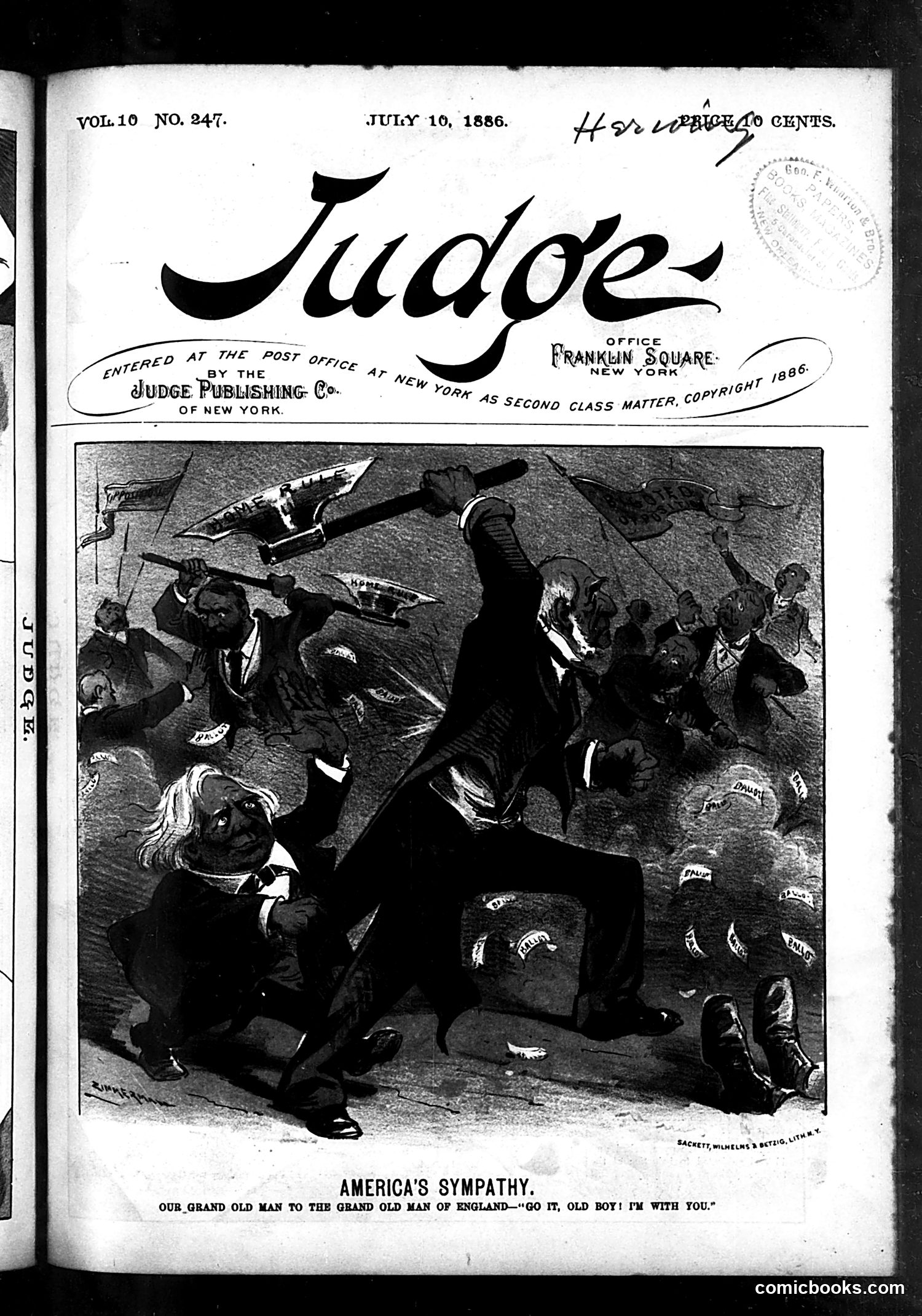
This satirical cartoon titled "America's Sympathy" depicts Uncle Sam (the bearded American figure in the center, shown flying/leaping) enthusiastically supporting "the Grand Old Man of England"—a reference to British Prime Minister William Ewart Gladstone—with the quote "Go it, old boy! I'm with you." The cartoon likely celebrates American support for Gladstone's Irish Home Rule efforts, which were contentious in British politics. The hostile figures surrounding Uncle Sam represent political opposition to Gladstone's policies. The flying objects above suggest turmoil or conflict. The satire expresses American sympathy for Gladstone's liberal agenda while mocking the fierce domestic resistance his reforms encountered in Britain.
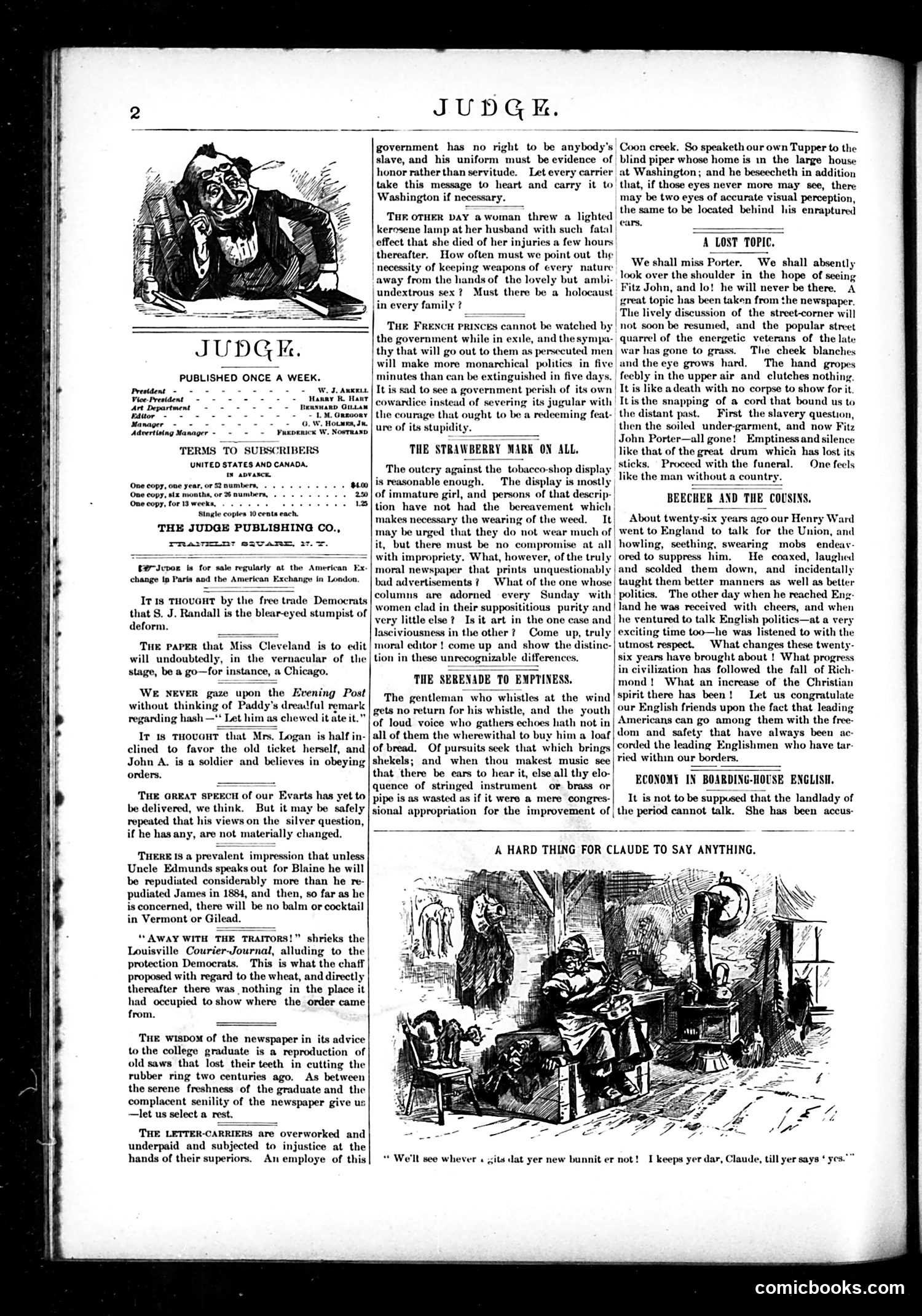
This page contains several satirical pieces typical of late 19th-century American political humor. The main cartoon titled "A Hard Thing for Claude to Say Anything" depicts a domestic scene where a woman confronts a man, with the caption suggesting marital conflict over his behavior or fidelity ("We'll see whever 'tis dat yer new banuit er not! I keeps yer day, Claude, till yer says 'yres.'"). The surrounding editorial sections satirize various contemporary issues: government overreach regarding weapons, tobacco shop displays, women's fashion choices, and newspaper editorial hypocrisy. The pieces mock inconsistent moral positions—particularly editors who criticize women's dress while publishing questionable content themselves. The cartoons use exaggerated working-class dialects and domestic situations as vehicles for social commentary on gender relations and journalistic standards of the period.
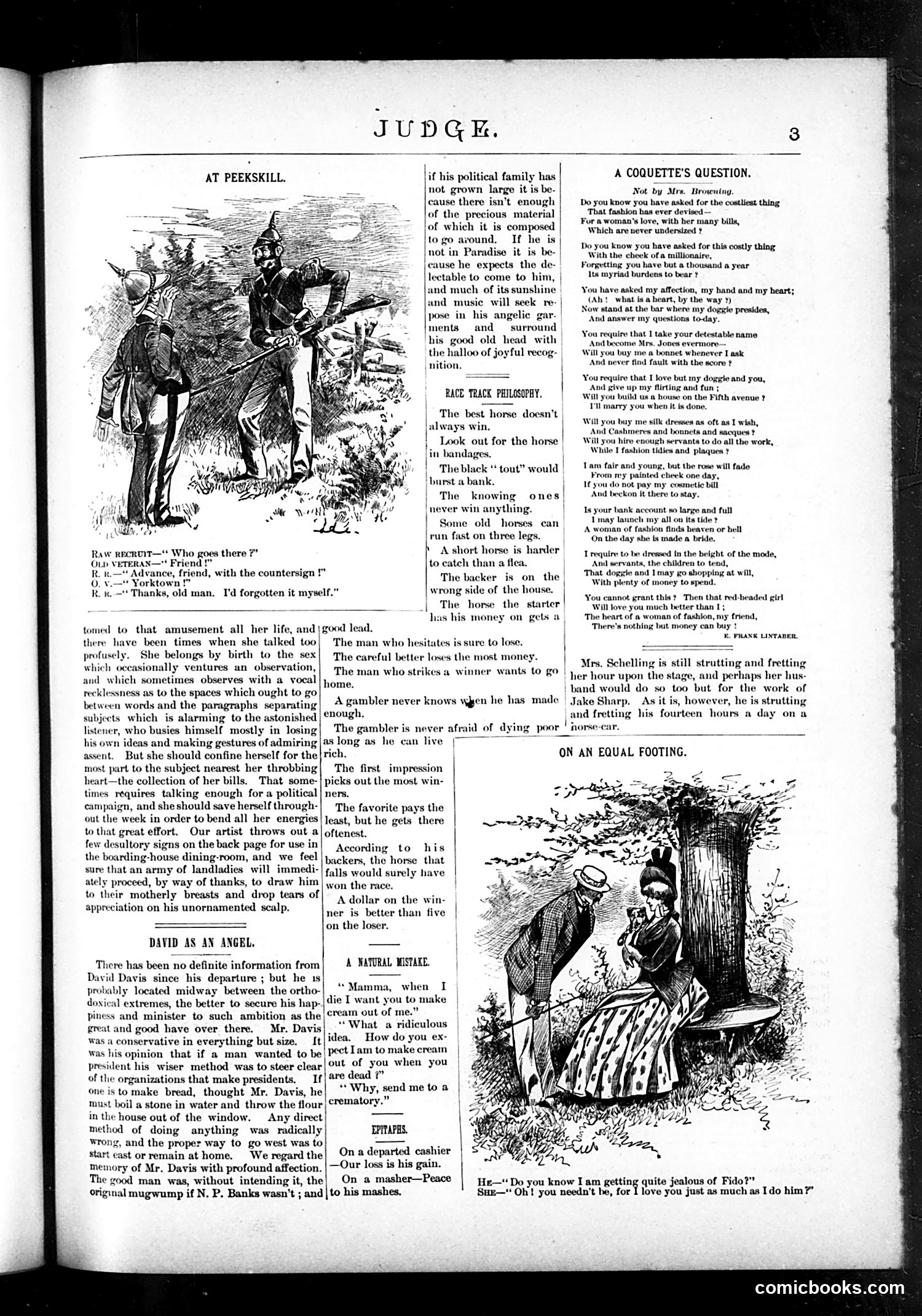
This page contains **three distinct satirical pieces**: 1. **"At Peekskill"** (top left): A Civil War-era cartoon showing soldiers exchanging a countersign. The joke plays on forgetfulness about military protocol during wartime. 2. **"A Coquette's Question"** (right): A poem satirizing wealthy women's materialism and entitlement. It mocks a woman demanding luxuries—Fifth Avenue houses, silk dresses, servants—as conditions for marriage, suggesting female vanity and financial greed. The poem's subtitle notes it's "Not by Mrs. Browning," parodying serious romantic poetry. 3. **"Race Track Philosophy"** and other short quips: Cynical gambling aphorisms reflecting 19th-century skepticism about betting. The page also mentions **Mrs. Schelling** and **Jake Sharp** (a real Tammany Hall politician involved in scandal), suggesting contemporary New York political corruption. Overall, the satire targets **female materialism, military incompetence, and gambling culture**—typical Judge magazine preoccupations.
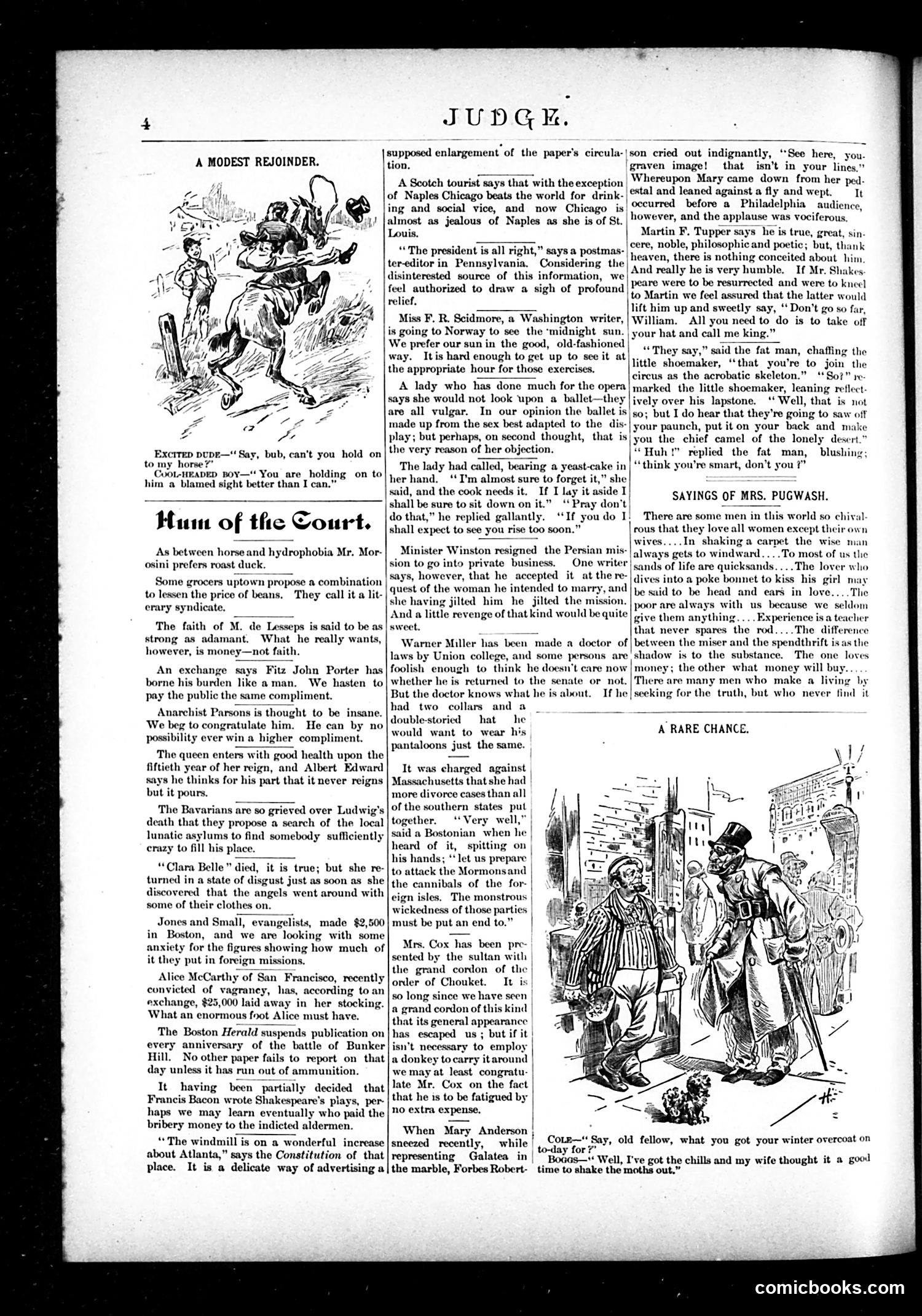
This *Judge* magazine page contains brief satirical items mocking contemporary figures and absurdities. Key targets include: **"Hui of the Court"** section: Sharp one-liners ridiculing notable people—Ferdinand de Lesseps (the canal builder, criticized for pursuing money over faith), Anarchist Parsons (deemed insane, which *Judge* "congratulates"), and various public figures caught in compromising situations. **Main cartoons**: - "A Modest Rejoinder" depicts a boy and man struggling with what appears to be a donkey, joking about restraint. - "A Rare Chance" shows a street interaction between two men discussing a winter overcoat. The humor relies on topical references (now obscure) to scandals, public figures, and social pretensions. The tone is cynical and dismissive—typical of Gilded Age satirical magazines that attacked hypocrisy, greed, and foolishness among politicians, entrepreneurs, and the wealthy. Without identifying specific historical contexts for each reference, the overall message remains: *Judge* existed to deflate pomposity.
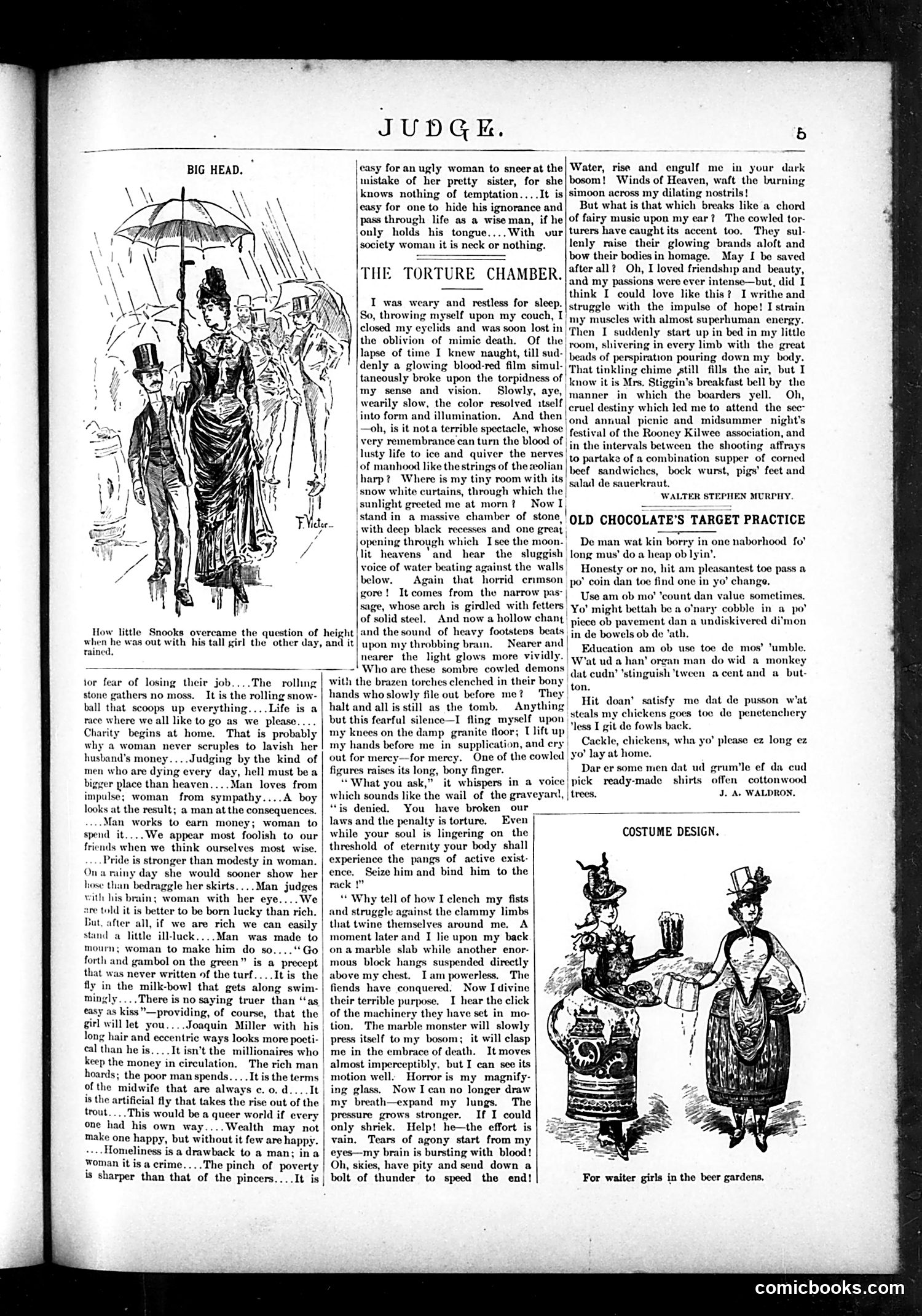
This page contains two distinct pieces of satirical content: **"Big Head"** (left illustration): A cartoon showing a woman with an exaggerated large head under an umbrella. The accompanying text cynically compares women's weaknesses—particularly society women's social vulnerability and lack of discretion—to men's ability to hide ignorance through silence. The "big head" likely satirizes female vanity or foolishness. **"The Torture Chamber"** (center): A gothic short story by Walter Stephen Murphy about a man's nightmare involving medieval torture, which abruptly resolves as the mundane breakfast bell of his boarding house. This satirizes the contrast between romantic fantasy and dreary reality—a common Judge theme mocking sentimental fiction and the disappointing practicality of boarding-house life. **"Old Chocolate's Target Practice"** (right): Dialect humor featuring an African American character offering folk wisdom about borrowing money and honesty. This reflects period stereotypes common in Judge's humor. The page mixes social commentary on gender, class, and everyday life with illustrations, representing typical satirical magazine content of the era.
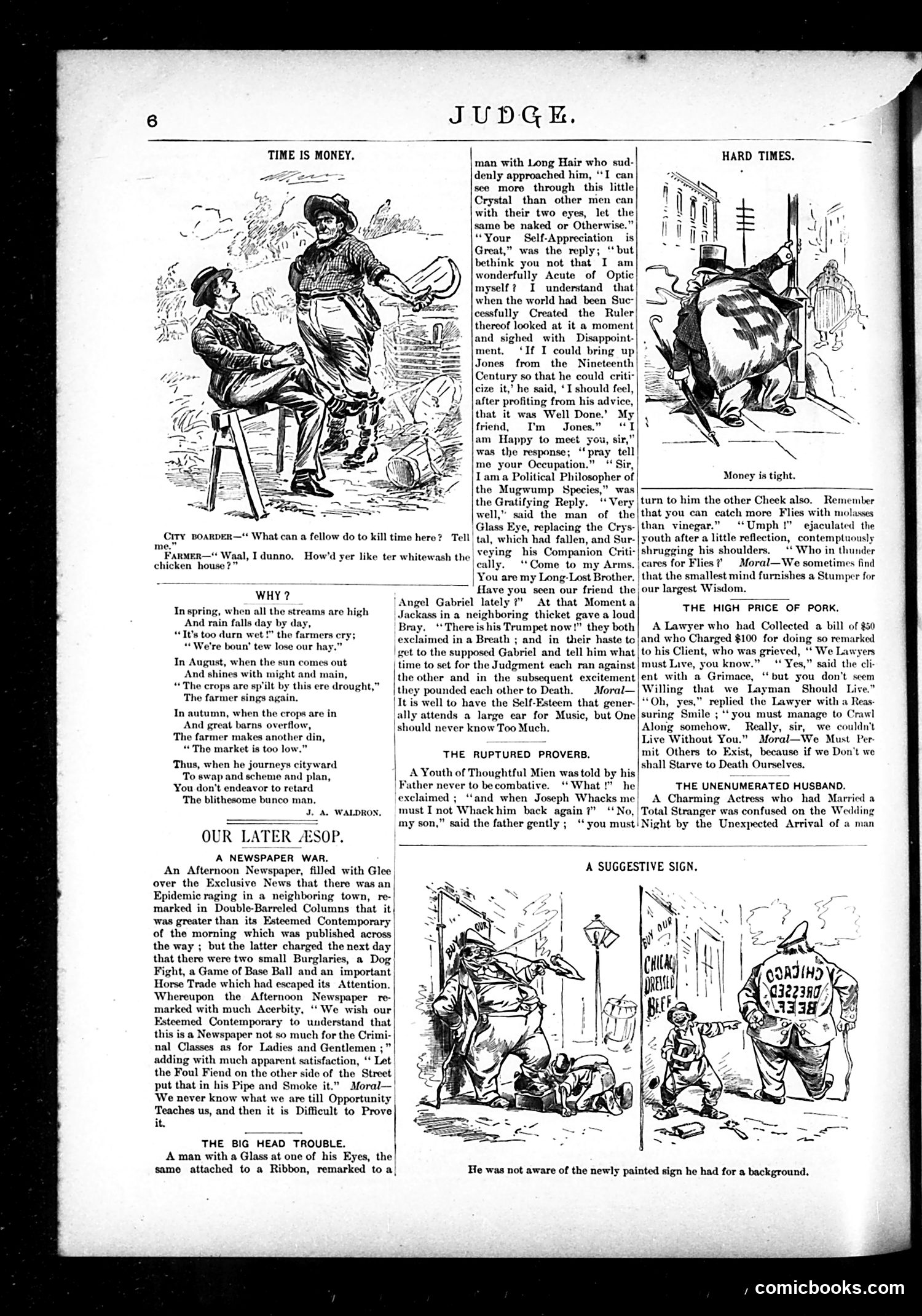
This page from the satirical magazine *Judge* contains several moral fables and cartoons mocking contemporary American types and attitudes. **"Time is Money"** depicts a charlatan with a monocle claiming superior perception, only to meet a self-proclaimed "Political Philosopher of the Mugwump Species"—a jab at the Mugwumps, reformers who switched parties and were widely mocked as self-righteous hypocrites. **"Why?"** satirizes the perpetually complaining farmer: he gripes about rain, drought, and low market prices regardless of circumstances—a commentary on rural discontent and the "bunco man" (con artist) who exploits such grievances. **"Our Later Aesop"** critiques newspaper rivalry, with afternoon and morning papers competing sensationally over trivial events, exposing their hypocrisy about serving "Ladies and Gentlemen" versus covering crime. The fables mock vanity, self-deception, and foolish pride. Overall, the page represents *Judge*'s characteristic blend of illustrated humor targeting farmer gullibility, newspaper sensationalism, and inflated self-regard among various American social types.
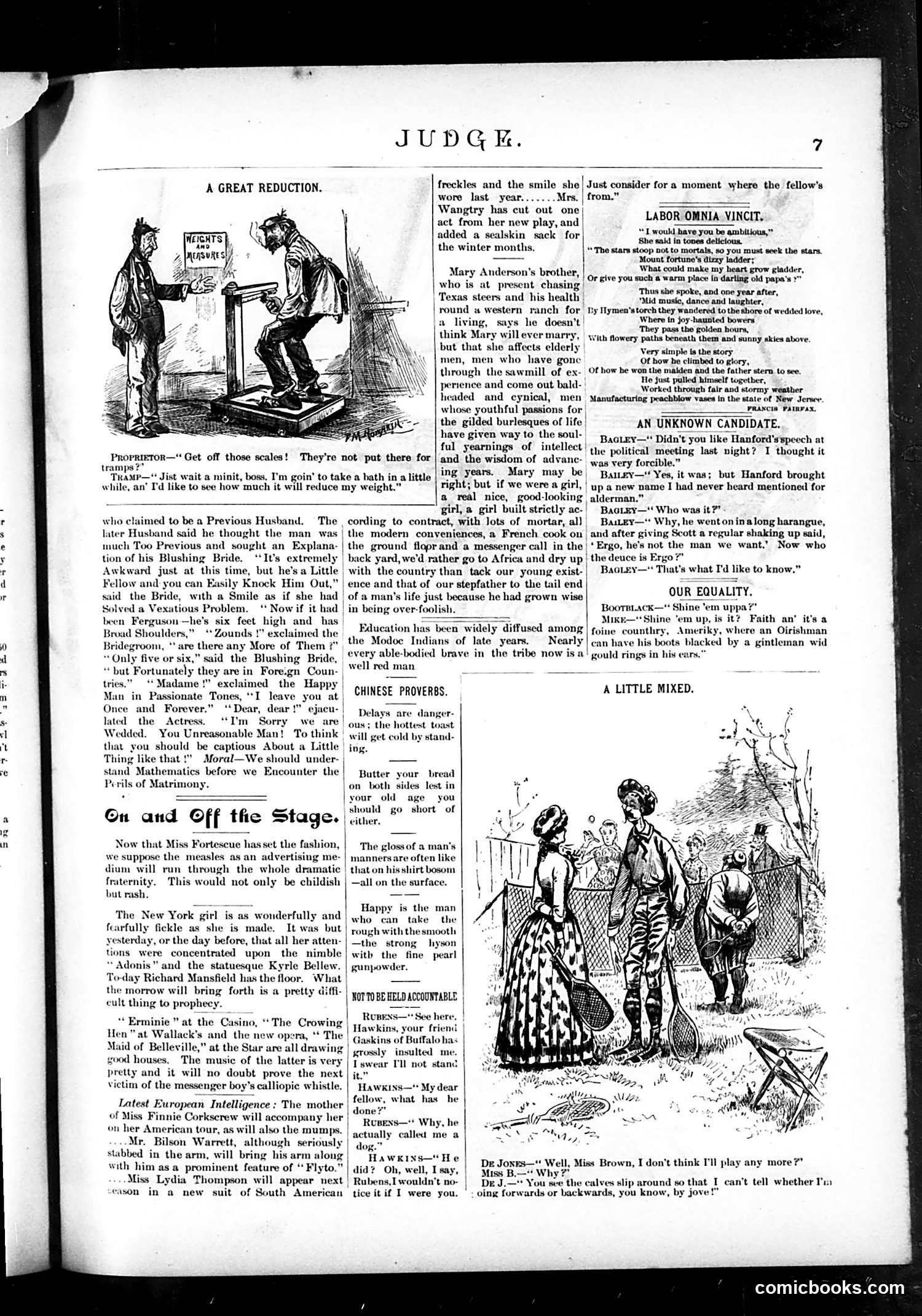
This page contains satirical humor typical of late 19th-century American magazines. The main cartoon depicts a vagrant or tramp requesting to use scales at what appears to be a bathhouse, claiming a bath will reduce his weight—a joke about the poor's desperation and the absurdity of their situations. The page also includes theatrical gossip and commentary on actresses' romantic lives, reflecting Judge's focus on entertainment-world scandal. References to "Miss Fortescue" setting fashion trends through measles suggest the magazine mocked celebrity culture's superficiality. Chinese proverbs scattered throughout serve as humorous observations on human nature—commentary on manners being superficial ("gloss") and advice about self-care. The overall tone is irreverent, mocking both working-class poverty and upper-class theatrical pretension, characteristic of Judge's satirical approach to American society of this era.
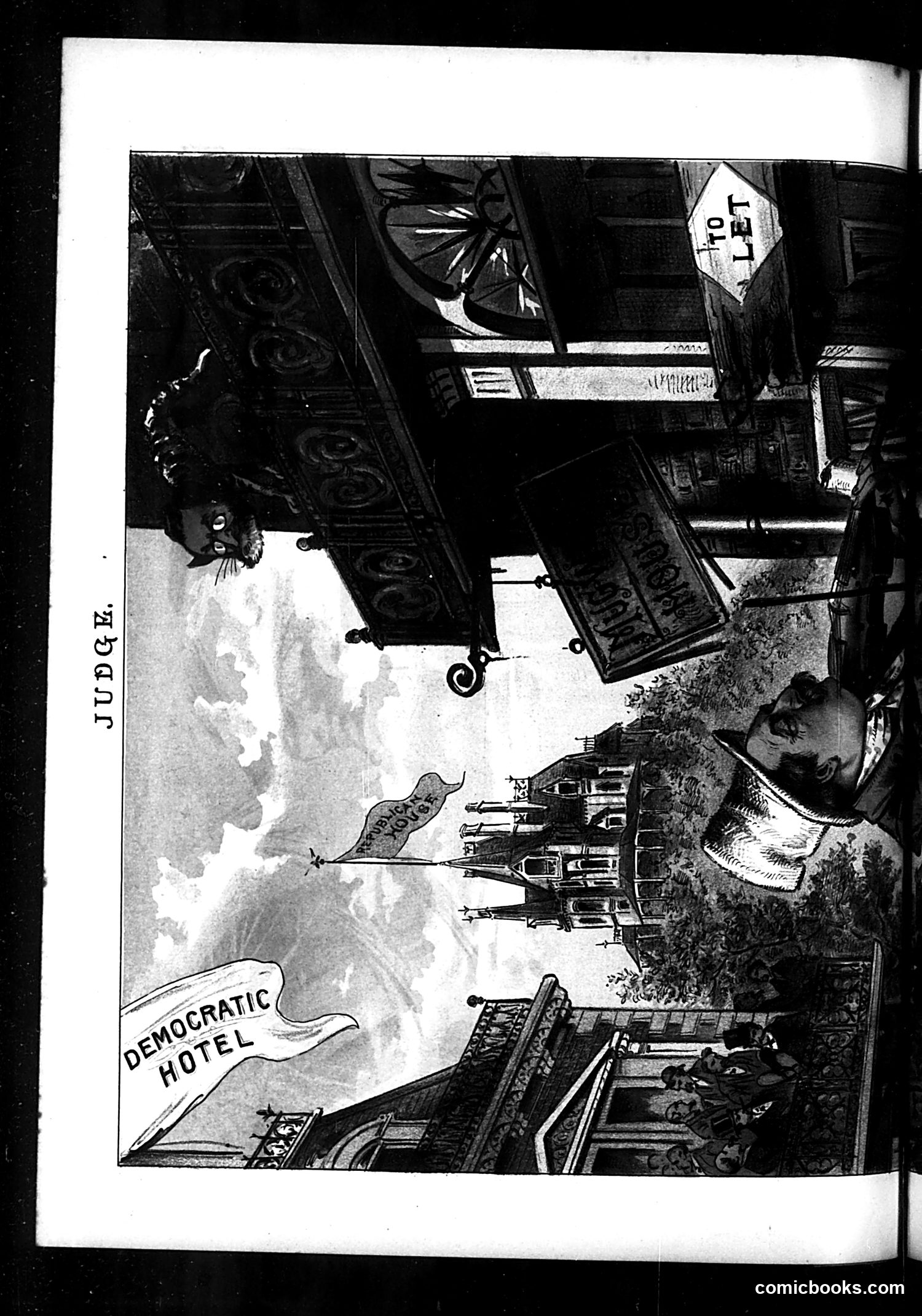
This page shows a satirical cartoon labeled "DEMOCRATIC HOTEL" depicting what appears to be a grand, ornate building interior. The image is rotated 90 degrees, requiring the viewer to turn the page sideways to read it properly. The cartoon appears to critique the Democratic Party, using the "hotel" metaphor—likely suggesting the party as a gathering place or establishment. The architectural details and decorative elements suggest grandeur or pretension being mocked. Without clearer visibility of specific figures or captions identifying particular politicians or events, the exact political targets remain unclear. The satire likely comments on Democratic Party politics, leadership, or policy during Judge magazine's active period, but the specific historical context would require additional documentation to confirm accurately.
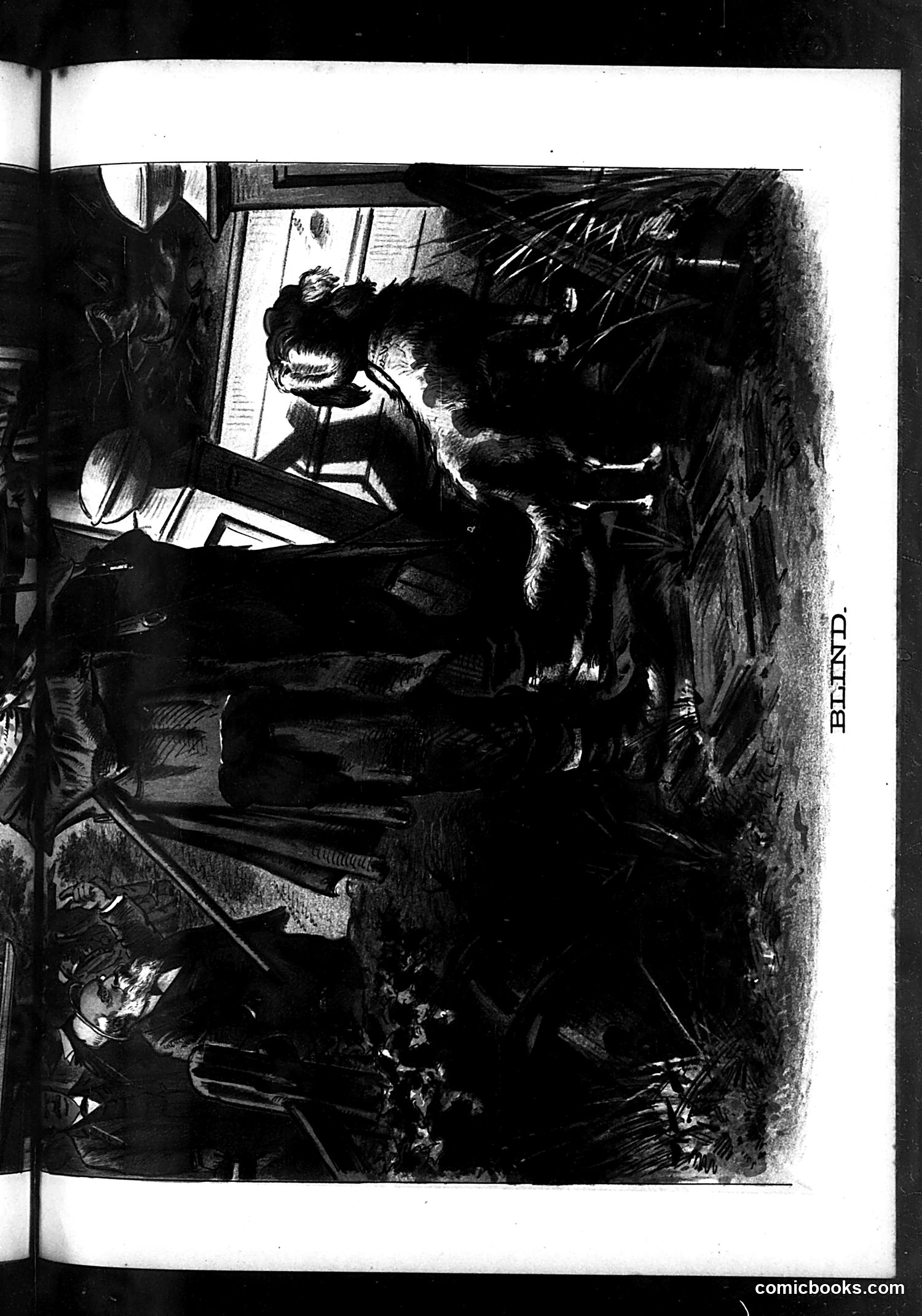
I can see this is a black and white illustration from Judge magazine, marked "BLIND" on the right margin. The image shows figures in what appears to be an interior scene with dramatic shadowing and cross-hatching typical of early satirical newspaper art. However, I cannot reliably make out enough detail in this reproduction to identify specific figures or their caricatured characteristics with confidence. The OCR text provided only contains a URL and the word "BLIND," which doesn't clarify the cartoon's subject or message. Without being able to read any caption, title, or clearer visual details identifying the figures, I cannot accurately explain what political or social satire this cartoon represents. To properly analyze this, I would need either higher image resolution or accompanying text explaining the cartoon's subject.
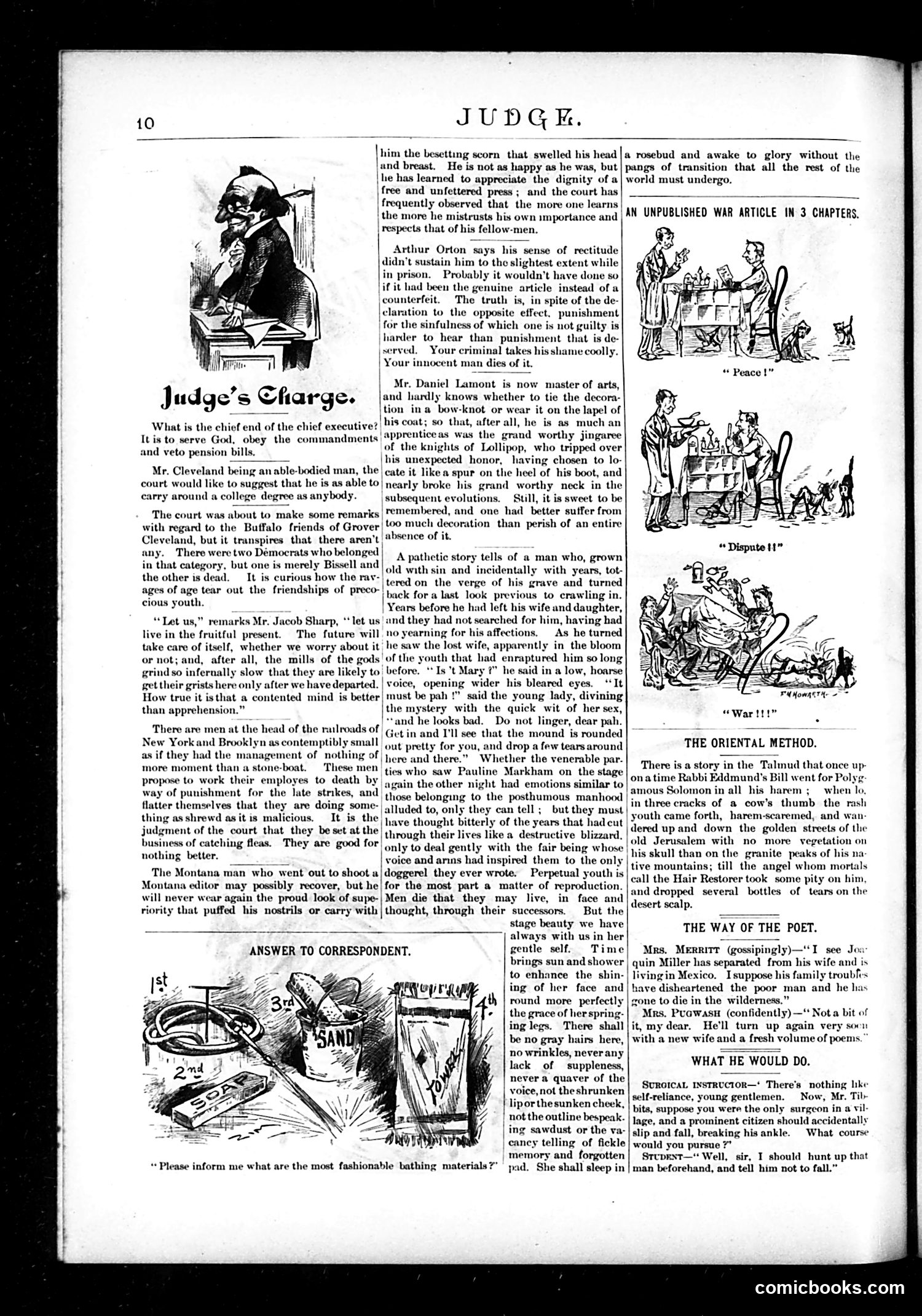
This page from the satirical magazine **Judge** contains multiple brief editorial commentaries and cartoons typical of the publication's format. The main piece, "Judge's Charge," mocks **President Cleveland** through supposed judicial pronouncements—suggesting he's as capable of carrying a college degree as anyone, and sarcastically noting his lack of Buffalo Democratic friends. The commentary is lighthearted political ribbing of the administration. Other sections include anecdotes about **Arthur Orton** (apparently a legal case about rectitude and punishment), and commentary on **Daniel Lamont** (likely a government official receiving honors). The cartoons illustrate absurdist humor typical of Judge: one asks about fashionable bathing materials, another discusses a man encountering his estranged wife near death. The page reflects Judge's characteristic blend of **political commentary, social satire, and absurdist humor** aimed at contemporary figures and situations, though without dates or clearer context, specific references remain partially obscure to modern readers.
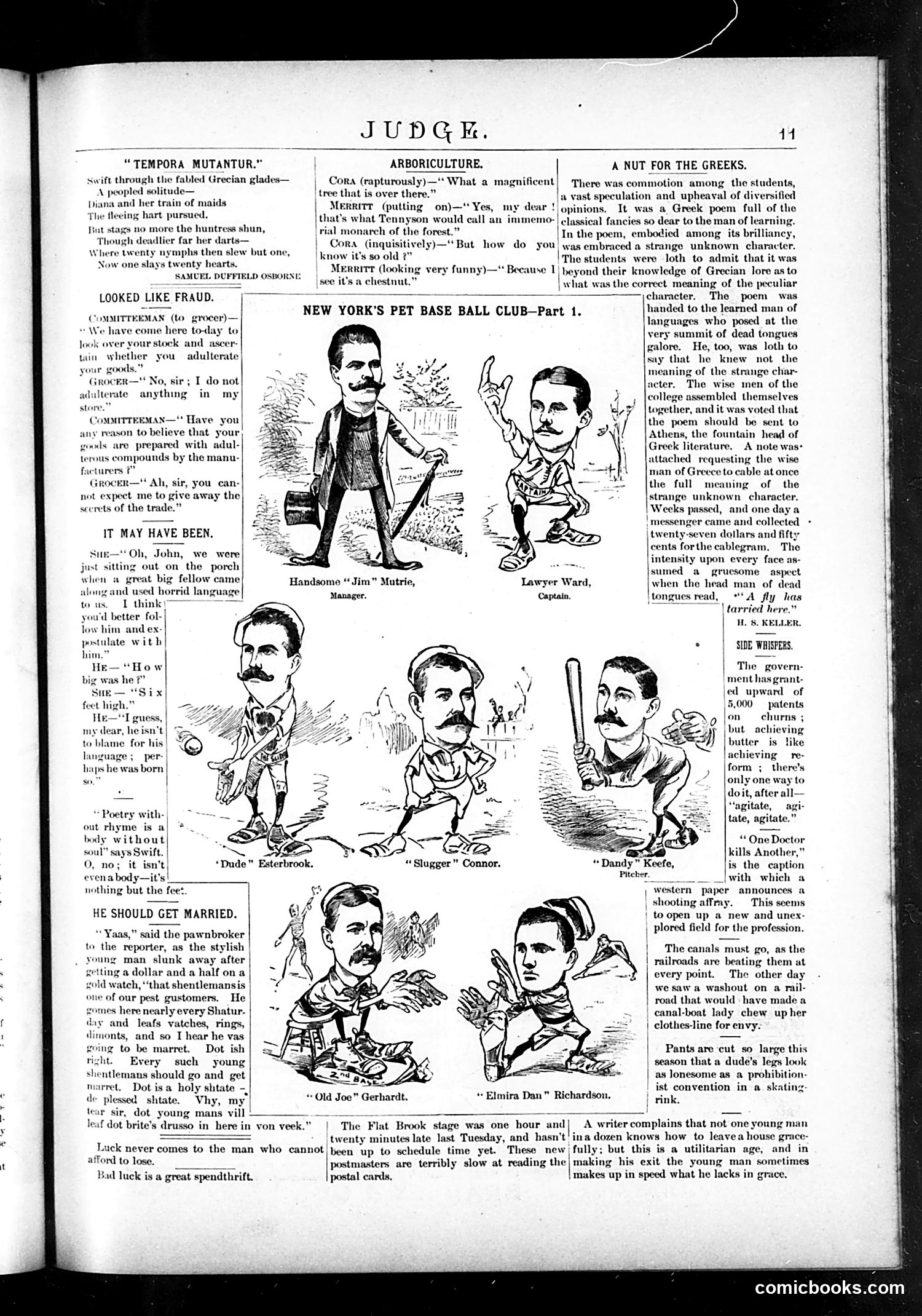
This Judge magazine page contains several satirical pieces mocking contemporary American life circa the 1880s-1890s. **"New York's Pet Base Ball Club"** features caricatured portraits of New York baseball players (Manager "Jim" Mutrie and players like "Dude" Esterbrook and "Slugger" Conser), lampooning the sport's personalities. **"A Nut for the Greeks"** ridicules academic pretension: college scholars receive a Greek poem and, unable to decipher a mysterious character, send it to Athens for expert analysis. The punchline—after weeks and high cable costs—the answer is merely "A fly has tarried here." This mocks pedantic over-intellectualization and the pomposity of classical scholars. **Other sketches** satirize common social vices: grocery adulterations, pawnbrokers enabling spendthrift gentlemen, and marital advice. The humor targets fraud, class pretension, and human folly through irony and exaggeration. The cartoons use caricature and visual grotesquerie typical of Victorian-era satirical magazines.
This page is primarily **advertising**, typical of Judge magazine's revenue model. However, it contains several satirical "Decisions Handed Up" at the top—brief humorous editorial comments: **The Satire:** - A quip about **Dixey** (likely Edward Dixey, a popular comedian) and "cockney" audiences, mocking theatrical tastes - Commentary on **male political maturity**, suggesting that entering politics makes a man's judgment far inferior to his legal adulthood - A joke about **black plug hats** (formal wear) being rarely "stung" (attacked/criticized)—likely poking fun at formal Victorian society conventions **The Context:** These are light social commentary rather than hard political satire—typical Judge fare mocking manners, theater, and politics without targeting specific controversies. The "bud" and "blossom" poem celebrates idealized womanhood. **Otherwise:** The page is dominated by period advertisements for soaps, infant formula ("Lactated Food"), whiskey, clothing, and farm equipment—reflective of 1880s-90s consumer culture.
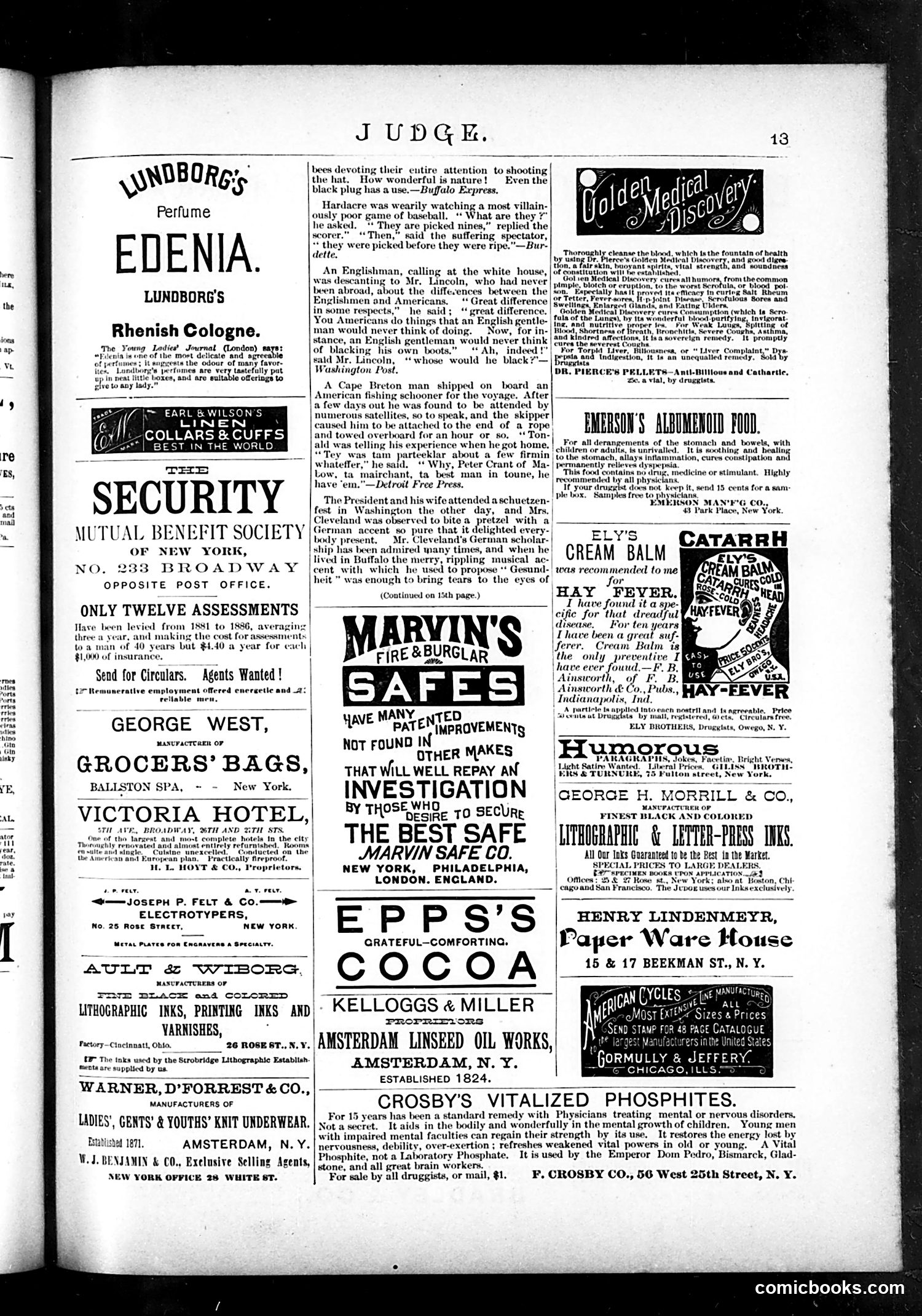
This is primarily an **advertising page** from Judge magazine, with minimal cartoon or satirical content visible. The few textual anecdotes present include: 1. A joke about "picked nines" (baseball teams) that plays on the double meaning of "picked"—selected versus harvested unripe. 2. A brief exchange where an Englishman lectures President Lincoln on differences between English and American gentlemen, with Lincoln's response apparently cut off (the text reads "Continued on 15th page"). 3. A humorous account of a Breton fisherman being towed overboard as punishment, told in exaggerated dialect. The page is dominated by period **product advertisements**—perfume, collar manufacturers, mutual benefit societies, lithographic services, and various patent medicines (Dr. Pierce's Pills, Crosby's Phosphites, Ely's Cream Balm). These ads are typical of 1880s-era Judge issues and reflect contemporary commercial and medical marketing rather than satirical commentary.
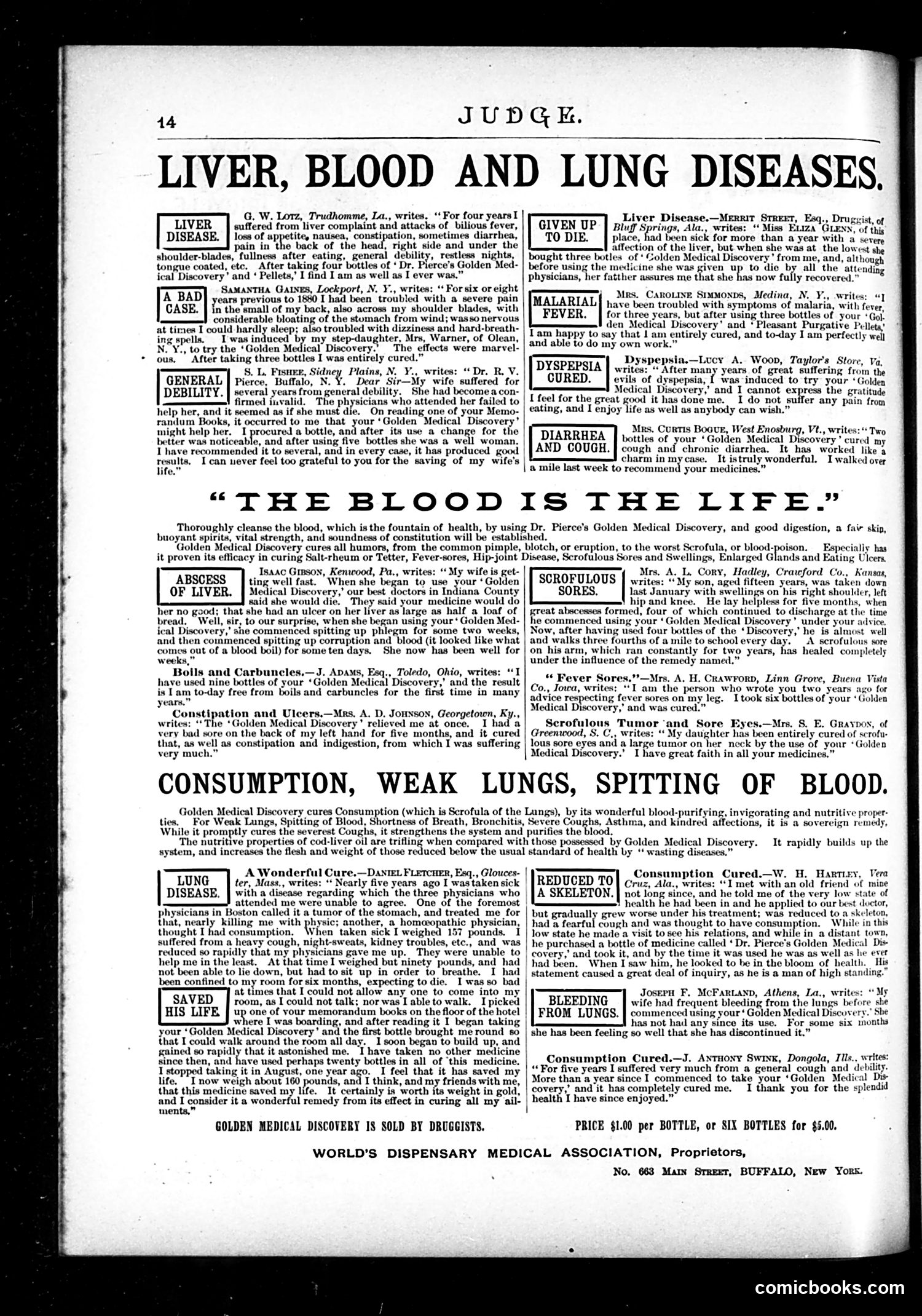
This page is **entirely advertising**, not satire or political commentary. It's a full-page advertisement for Dr. Pierce's "Golden Medical Discovery," a patent medicine marketed as a cure-all for liver disease, blood disorders, lung problems, malaria, dyspepsia, and consumption. The page features **testimonials** from purported patients (with names and locations) claiming miraculous recoveries. This was standard advertising practice in 19th-century publications like *Judge*. **Key context for modern readers:** Patent medicines were largely unregulated and often contained ineffective or dangerous ingredients. The claim that one product cured dozens of serious diseases was fraudulent by today's standards. However, this type of advertisement was commonplace and considered legitimate in that era. The phrase "THE BLOOD IS THE LIFE" reflects period medical theory emphasizing blood purification as essential to health. **Bottom line:** This represents early American medical quackery, not editorial content or satire.
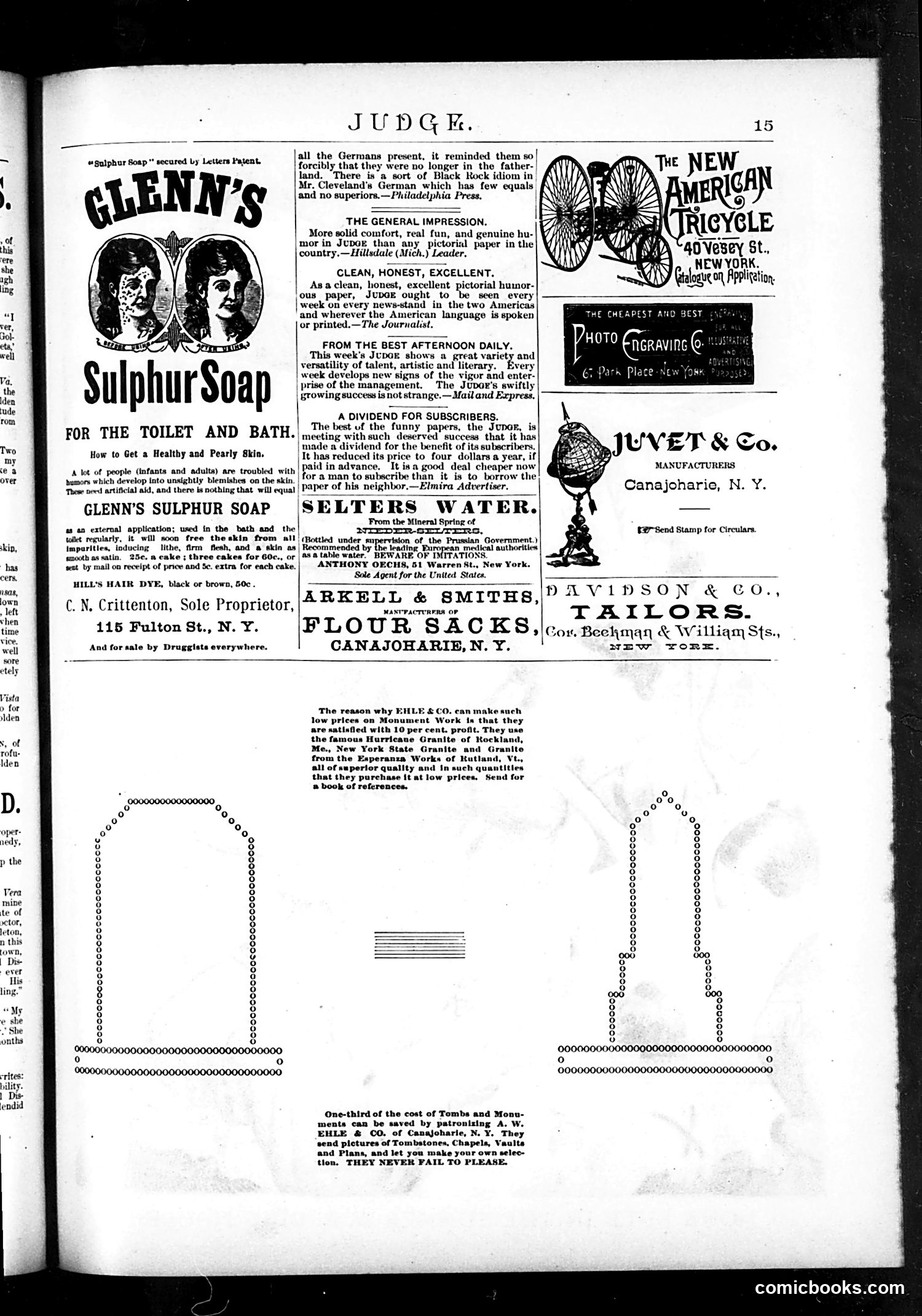
This page is primarily **advertising and promotional content** rather than political cartoons. It showcases Judge magazine's self-promotion alongside period advertisements. The top section contains **testimonials praising Judge's humor and quality**, referencing Cleveland's German-language abilities (likely President Grover Cleveland) as a point of humor. These quotes position Judge as a superior pictorial humor publication. **The advertisements** reflect late 19th-century products: Glenn's Sulphur Soap, Seltzer Water, flour sacks, tricycles, photo engraving, and monument works. The tomb/monument ads emphasize cost savings, suggesting middle-class accessibility to memorial architecture. **Notable context**: References to "the two Americas" and emphasis on "American language" reflect contemporary American expansionism and English-language dominance concerns of the era. The page demonstrates Judge's business model—combining satirical content with lucrative advertising revenue—while the ads themselves reveal period consumer culture priorities: hygiene products, food goods, and commemorative monuments for the middle class.
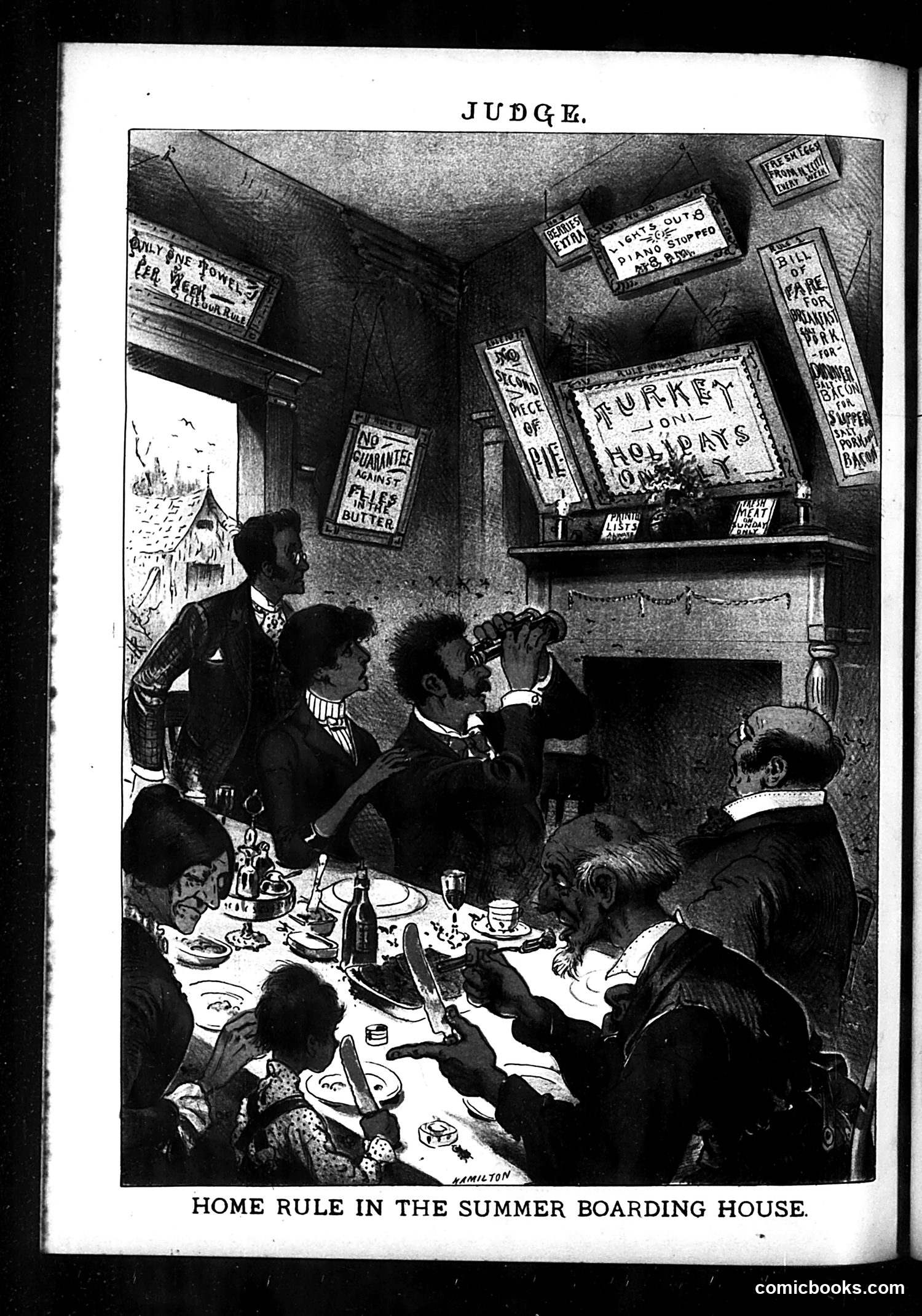
This Judge cartoon satirizes the chaos of a summer boarding house. The illustration shows multiple guests at a dining table beneath signs advertising various meat dishes (turkey, pork, beef, etc.) and guarantees "against rancid butter." The title's reference to "Home Rule" is political satire—it puns on the Irish Home Rule debate of the era while depicting the boarding house as a chaotic "kingdom" where guests compete loudly for food and service. The crowded, disorderly scene with men in formal dress arguing and gesturing suggests that this communal living arrangement lacks any real authority or order. The satire mocks both the pretensions of boarding house life and the era's political conflicts through domestic chaos.