
A complete issue · 16 pages · 1886
Judge — June 26, 1886
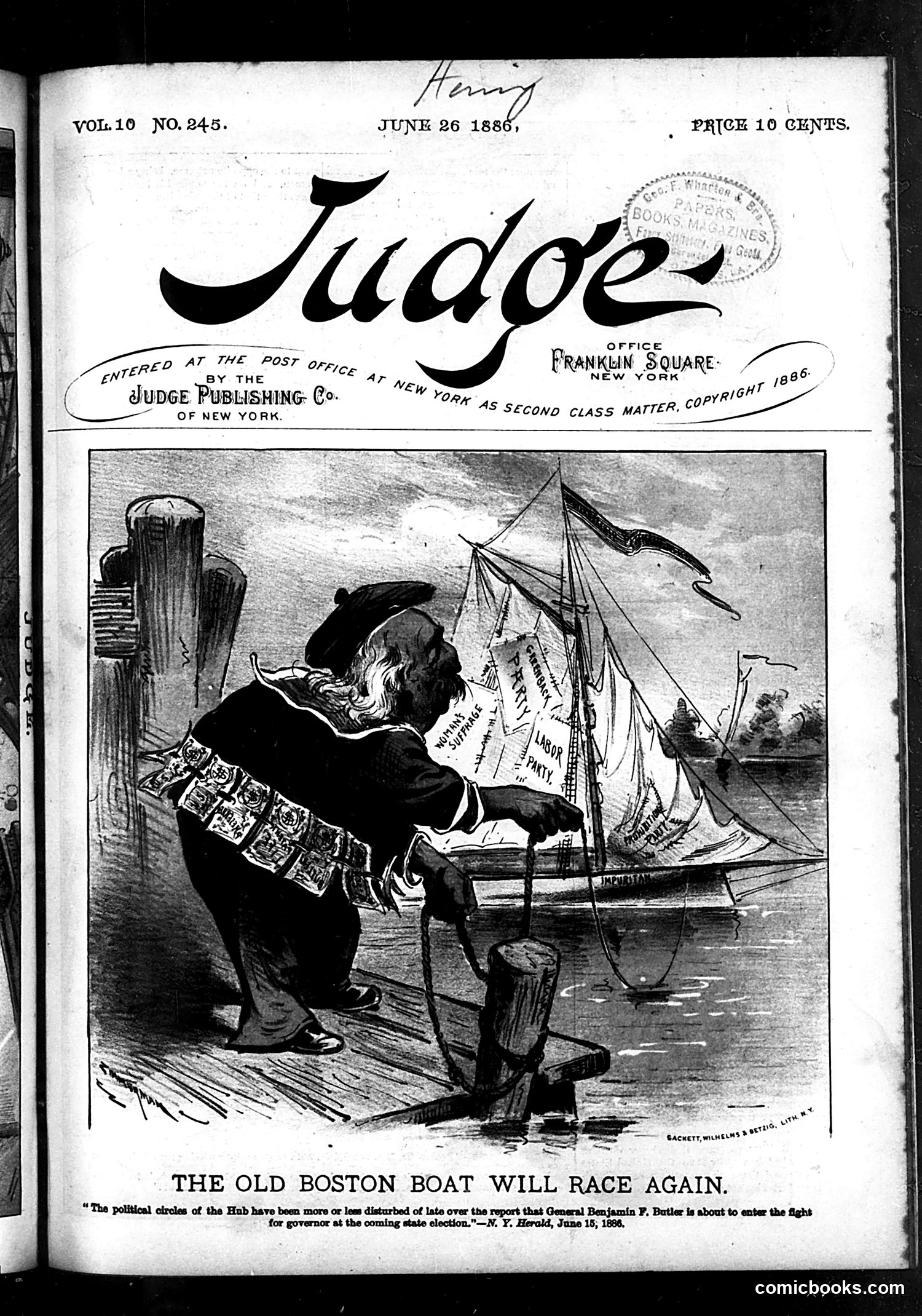
This June 1886 Judge cartoon satirizes Massachusetts politics. The figure appears to be a politician or party operative preparing an old, worn ship labeled with what seem to be political positions or candidates for the upcoming governor's race. The ship's tattered sails and weathered appearance suggest the Massachusetts Republican Party is recycling tired, outdated political strategies. The caption references General Benjamin F. Butler entering the race for governor—a controversial political figure whose involvement apparently alarmed Republican establishment circles. The satire mocks the party's desperation in reviving old political vessels and strategies to compete against Butler's challenge to the state election. The cartoonist criticizes this as ineffective political nostalgia during a significant election cycle.
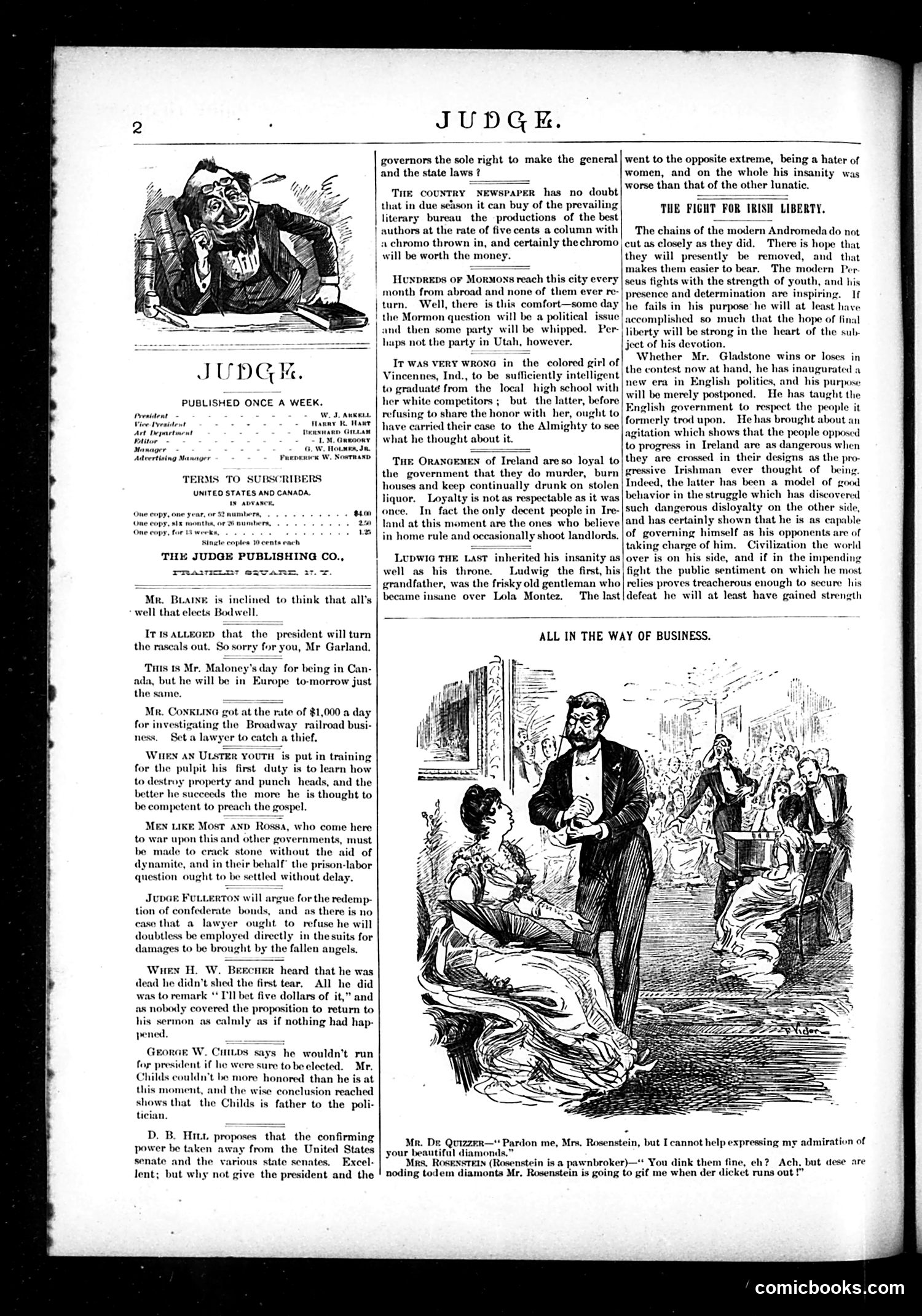
This page contains satirical commentary and two cartoons. The top cartoon mocks a disheveled figure labeled "JUDGE" himself, establishing the magazine's self-deprecating tone. The main cartoon, "ALL IN THE WAY OF BUSINESS," depicts a man (labeled Mr. De Quezzer) admiring a woman's diamonds while addressing "Mrs. Rosenstein." The caption reveals his hypocrisy: he flatters her jewels while planning to swindle her—"You think them fine, ch? Ach, but dese are looking better dan dese are looking because Mr. Rosenstein is going to gif me when der ticket runs out!" This satirizes antisemitic stereotypes about Jewish businessmen and their supposed dishonesty in dealing with wealthy clients, reflecting the prejudiced attitudes common in Gilded Age American satire.
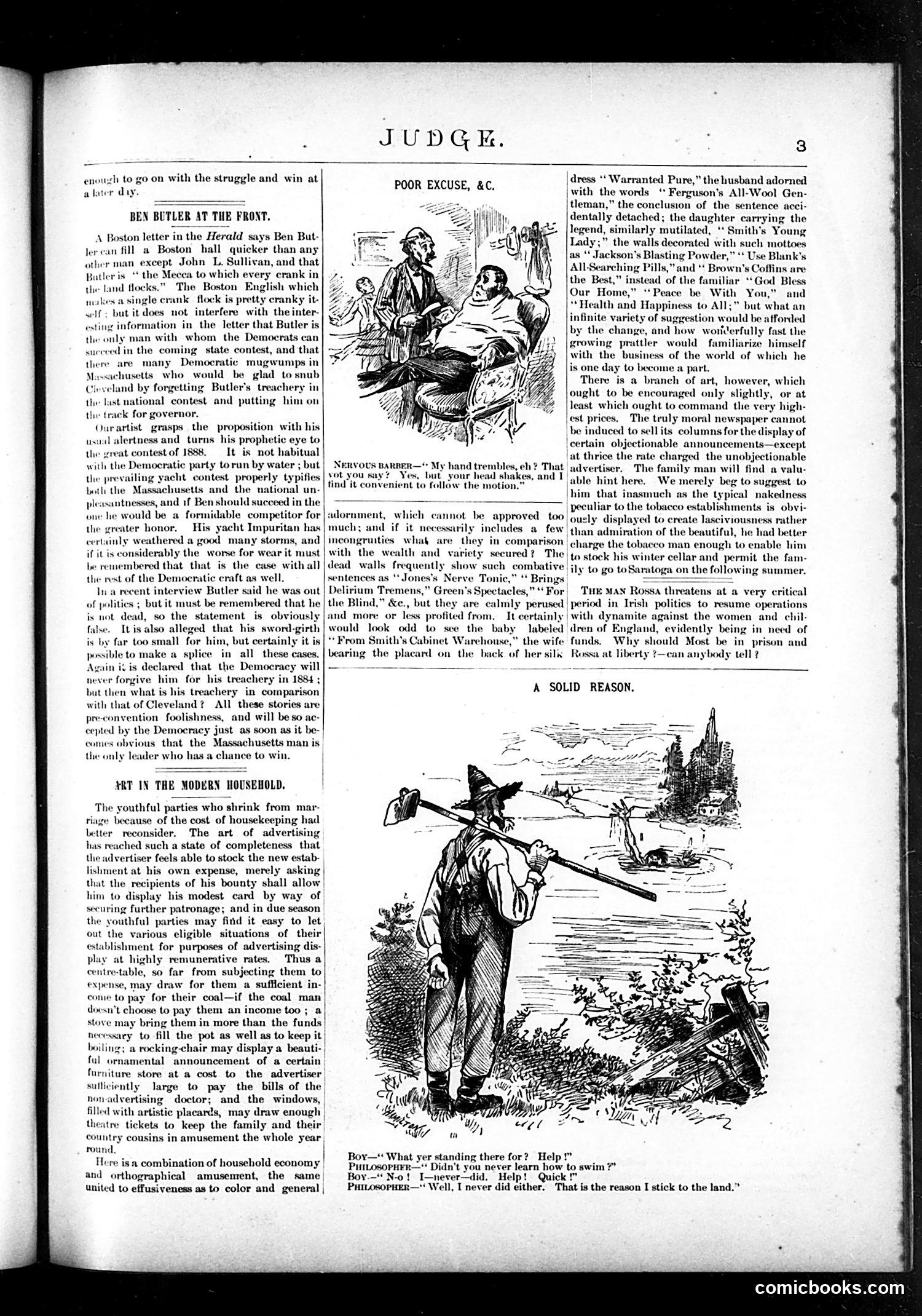
This *Judge* magazine page contains three distinct pieces of political and social satire: **"Ben Butler at the Front"** discusses General Benjamin Butler, a controversial Massachusetts political figure. The article mocks Democratic party interest in Butler as a gubernatorial candidate despite his alleged "treachery" in 1884 (likely referring to his third-party presidential run). The yacht imagery suggests Butler's political ship has weathered many storms. The satire targets Democratic desperation and inconsistency. **"Art in the Modern Household"** ironically praises a trend where young couples furnish homes with advertiser-sponsored furniture and household goods, displaying commercial placards in exchange. The satire highlights how commercialism infiltrates domestic life and how people compromise domestic aesthetics for financial benefit. **"A Solid Reason"** (lower cartoon) shows a peasant/farmer who claims he "sticks to the land" rather than learning to swim—a simple joke about preferring what's familiar over new skills, possibly satirizing resistance to modernization. The overall page reflects Gilded Age anxieties: political corruption, commercialism's reach into private life, and social change.
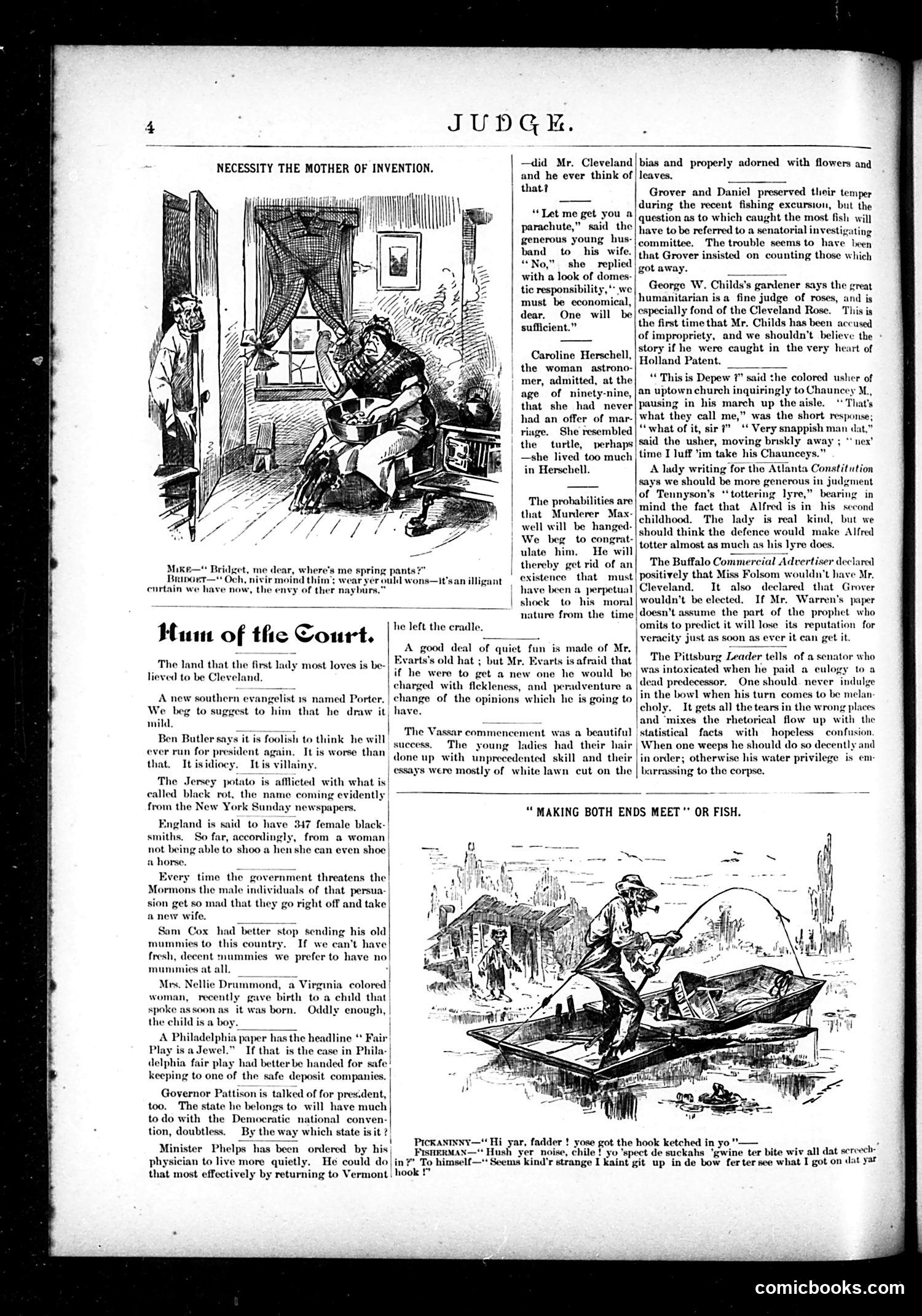
This page from *Judge* magazine contains multiple brief satirical items and two illustrated cartoons mocking contemporary figures and events. **Top cartoon**: Shows a husband offering his wife a parachute during what appears to be a domestic crisis. The joke plays on the phrase "necessity is the mother of invention"—the wife refuses, insisting they "must be economical," suggesting economic hardship forces creative (if absurd) solutions. **"Hum of the Court" section**: A collection of one-liners targeting prominent figures, including: - References to Cleveland (likely President Grover Cleveland) - Ben Butler (a controversial political figure) - The Jersey potato crop's "black rot" disease - Mormon polygamy - Various social oddities (a talking baby, etc.) **Bottom cartoon**: "Making Both Ends Meet on Fish"—depicts a fisherman with exaggerated catch, satirizing the recent fishing trip between Cleveland and Daniel (likely Daniel Manning, Cleveland's Secretary of Treasury), with a joke about conflicting accounts of who caught more fish. The overall tone is light political mockery typical of 1880s satirical journalism.
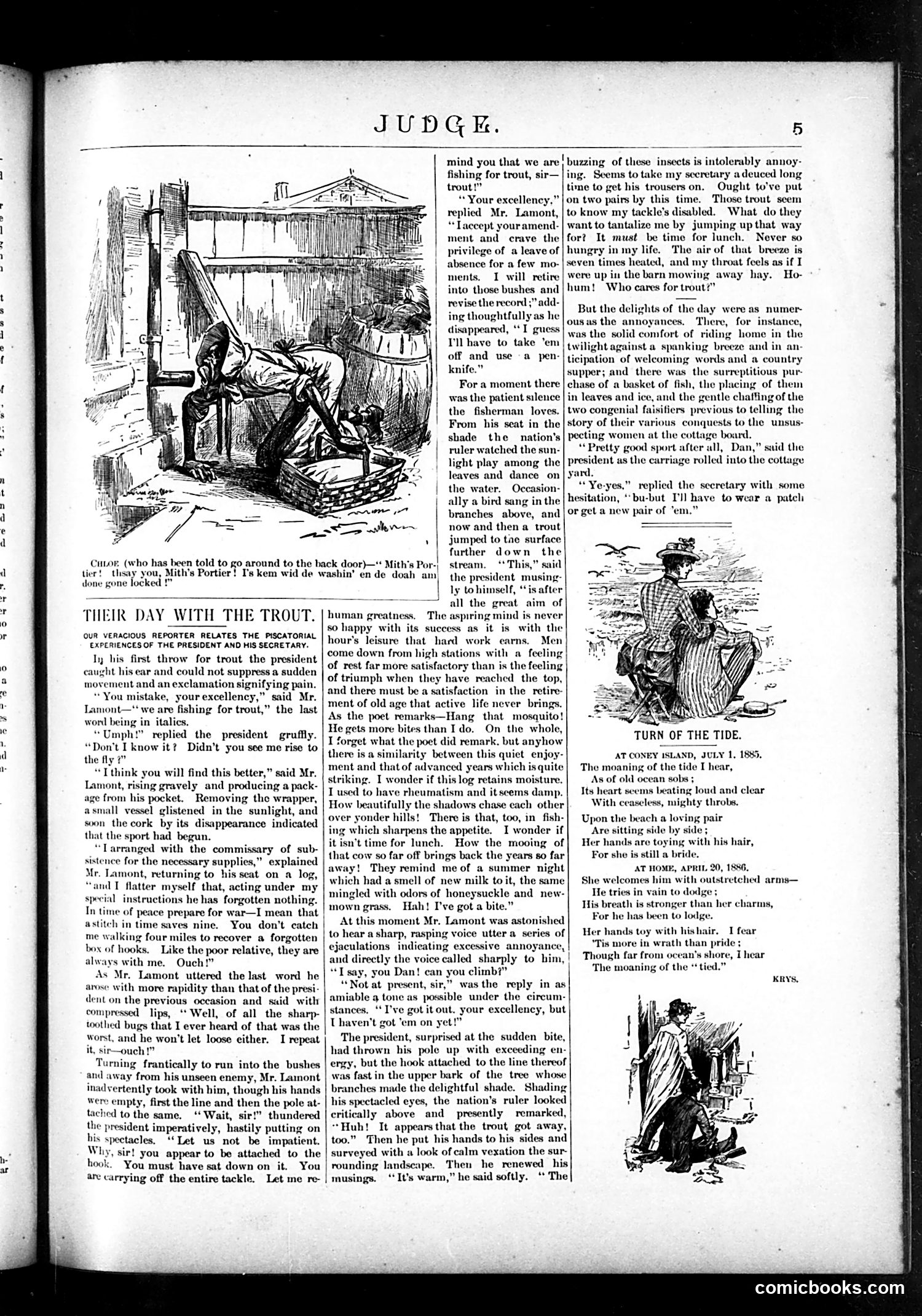
This page satirizes President Grover Cleveland's fishing trip with Secretary of the Treasury Daniel S. Lamont. The elaborate narrative mocks their leisurely outing as disconnected from serious governance. The humor centers on Cleveland repeatedly getting hooked and injured despite Lamont's careful preparations—a physical comedy suggesting the president's incompetence even at relaxation. When Cleveland becomes entangled in fishing line and pole, the absurdity escalates. The accompanying poem "Turn of the Tide" and illustration of a woman appear unrelated to the main satire. The cartoon's political point: Judge ridicules Cleveland for prioritizing recreation while national business demands attention. The detailed description of his discomfort—getting hooked, swatting mosquitoes, complaining about lunch—portrays him as petulant and unfocused. Lamont's deferential, over-prepared demeanor emphasizes the president's neediness. This reflects late-1880s Republican criticism of Cleveland's Democratic administration as frivolous and self-indulgent.
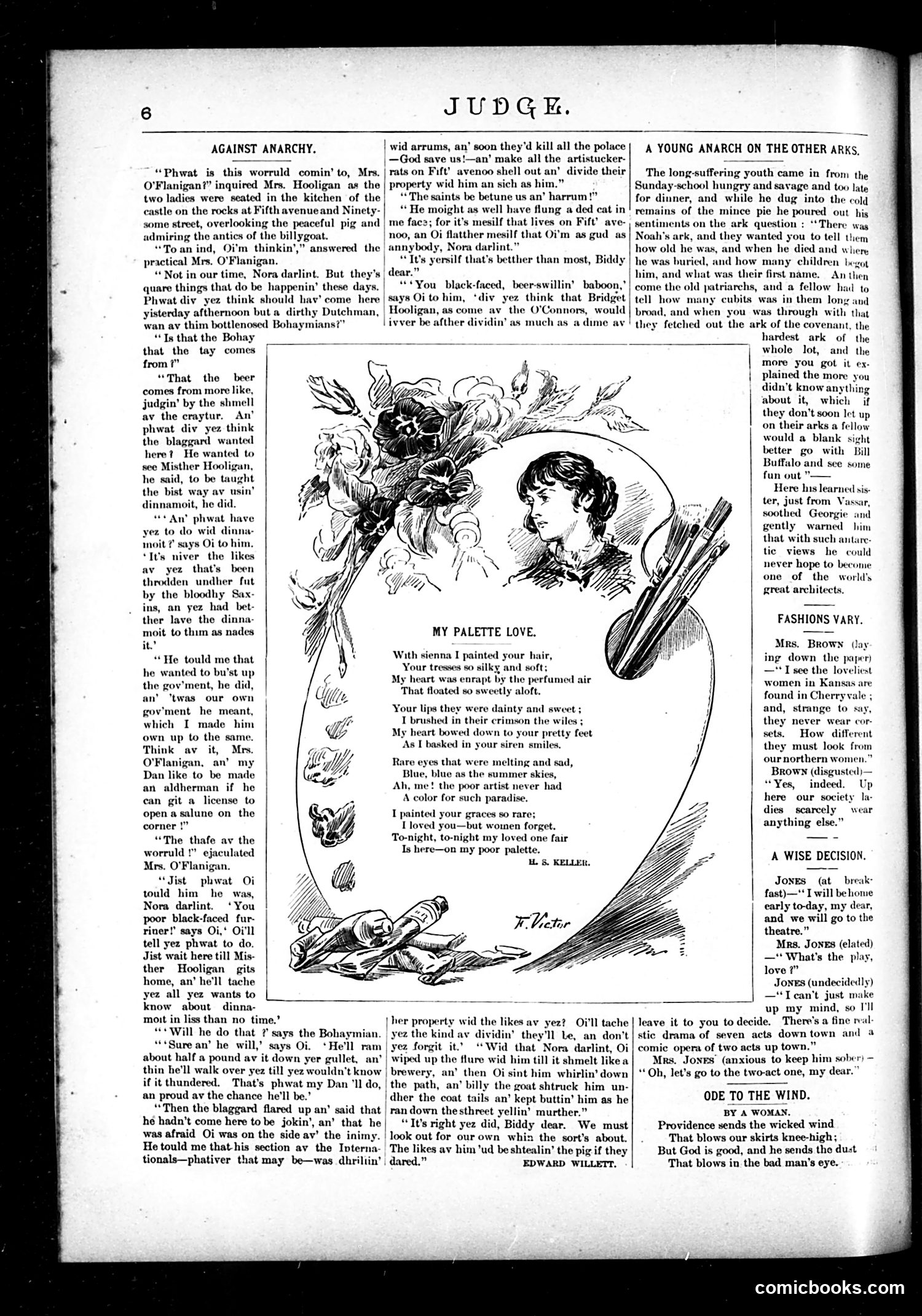
This page contains working-class Irish immigrant satire typical of 1880s-90s Judge magazine. **"Against Anarchy"**: Two Irish domestic workers (Mrs. O'Flanigan and Mrs. Hooligan) discuss a dangerous radical—a "dirthy Dutchman" or Bohemian anarchist who visited seeking their employer, wanting to teach proper use of dynamite. The satire targets both anarchist threats and working-class Irish fears of radical agitators infiltrating American society. The dialogue mocks Irish dialect while presenting anarchism as a genuine contemporary threat. **Other content** includes romantic/literary poetry ("My Palette Love"), humor about Sunday school Bible instruction, and a fashion column—typical Judge filler material. The cartoon's point: anarchism represents a foreign danger to ordinary (even immigrant) Americans; the joke relies on ethnic caricature and period anxieties about radical violence and political instability.
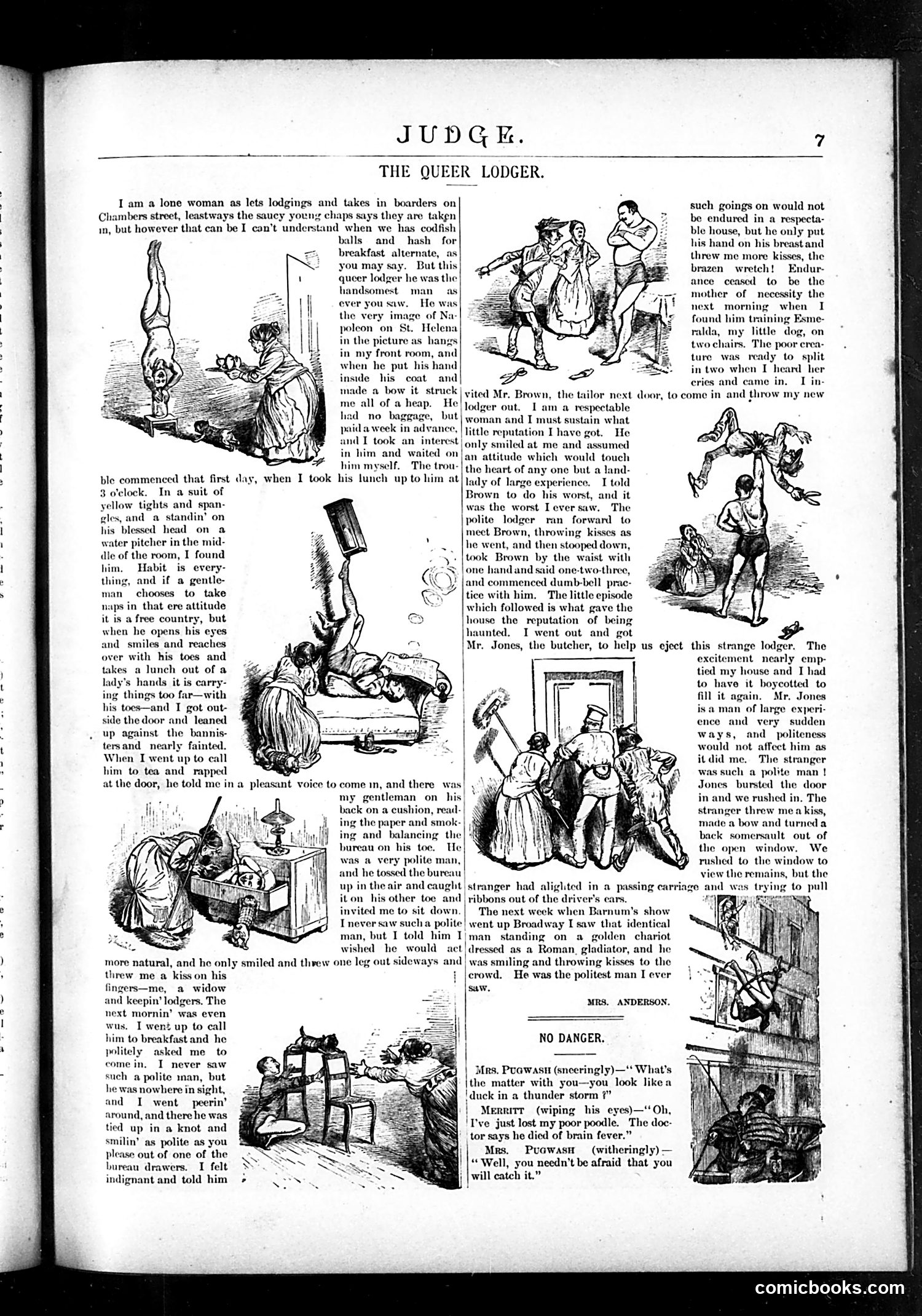
This page contains two unrelated comic pieces typical of Judge's satirical humor. **"The Queer Lodger"** mocks a peculiar lodger through a landlady's exasperated first-person account. The man, described as handsome as Napoleon, behaves absurdly—sleeping in an inverted yoga position, eating with his toes, performing acrobatics with furniture. His excessive politeness and constant kissing parody affected gentility. The punchline reveals he's actually a circus performer: the landlady later spots him on P.T. Barnum's Broadway parade float, dressed as a Roman gladiator, throwing kisses to crowds. The satire ridicules both eccentric showmen and the landlady's social pretensions about maintaining a "respectable" boarding house. **"No Danger"** is a brief joke where a widow, Merritt, mourns her dead poodle from "brain fever." Mrs. Pcowash witheringly replies she needn't worry about catching it—implying Merritt herself lacks brains. It's a simple insult-based gag. Both pieces reflect late 19th-century urban American humor, targeting class anxieties and social manners.
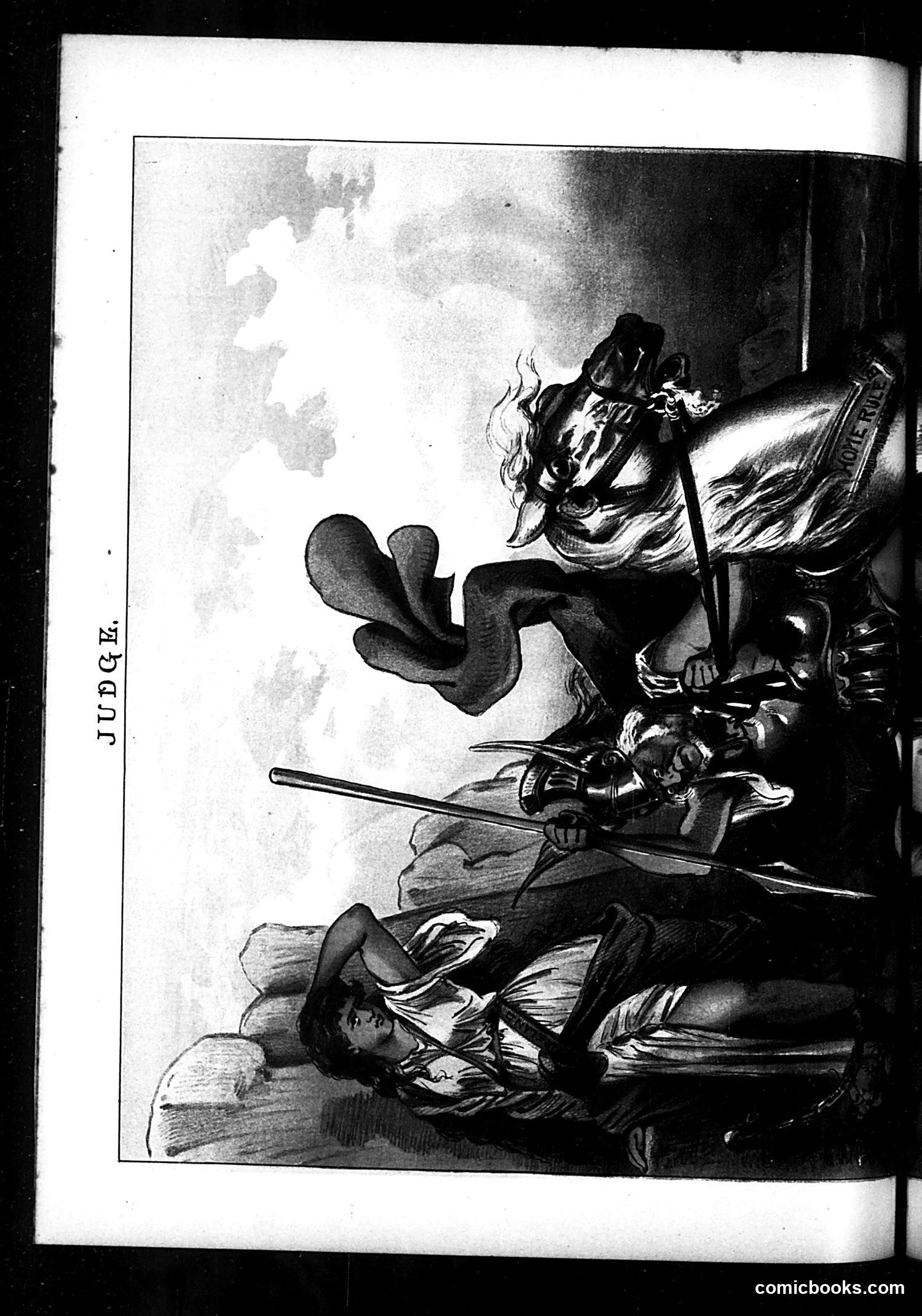
This page appears to be primarily a **title page or section header** for Judge magazine, with the word "JUDGE" visible on the left margin in vertical text. The main image shows a **classical allegorical scene** rendered in black and white engraving style. It depicts figures in period costume—possibly representing classical or historical personages—in what appears to be a dramatic moment, though the exact satirical reference is **unclear without additional context or caption text**. The image quality and reproduction style are consistent with late 19th or early 20th-century Judge magazine content. However, **without visible captions, dates, or clearer text**, the specific political or social commentary this cartoon intended remains difficult to determine with certainty.
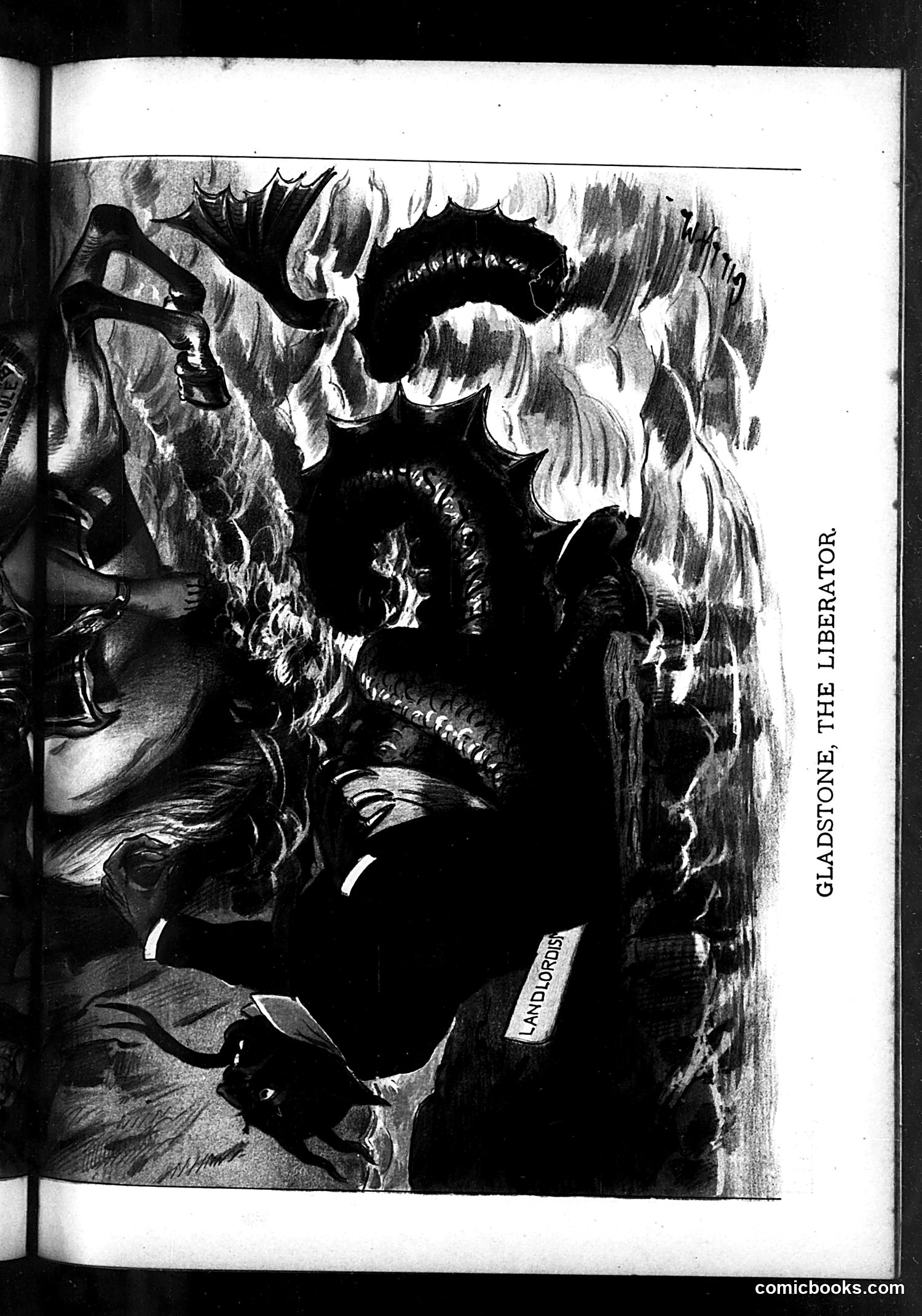
This page shows a dramatic black and white illustration labeled "GLADSTONE, THE LIBERATOR" (text visible on right margin). The image depicts a bearded man's face emerging from or surrounded by flames, rendered in bold, expressive charcoal or ink strokes. The style suggests this is political satire from Judge magazine. The caption identifies the figure as Gladstone, likely referring to William Ewart Gladstone, the prominent 19th-century British Liberal politician. The "liberator" reference and fiery imagery suggest the cartoon comments on Gladstone's political impact—either celebrating his reform efforts as "liberating" or satirizing his policies as dangerously radical. Without a clearer date or additional context, the specific historical moment being referenced remains unclear.
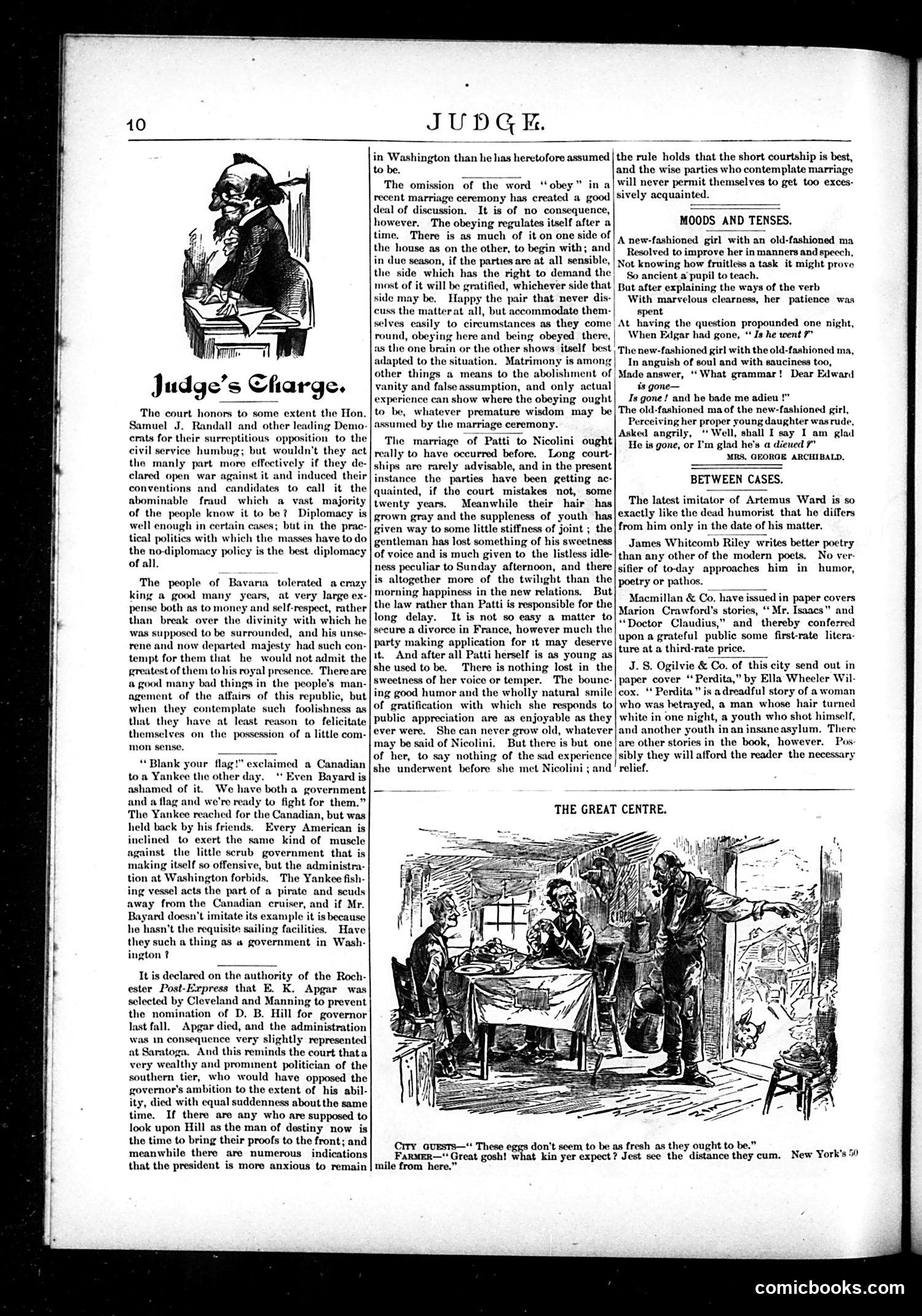
This page contains **editorial commentary** rather than comic cartoons. The main "Judge's Charge" argues that Democratic politicians should openly oppose civil service reform rather than using diplomatic opposition—comparing American timidity to Bavarian tolerance of a mad king. The editor criticizes the Cleveland administration's weak response to Canadian fishing vessel incidents, suggesting the government lacks backbone. There's also gossip about political deaths: E.K. Apgar allegedly died conveniently after opposing D.B. Hill's gubernatorial nomination, with the implication that the administration benefited. The final section discusses a recent marriage (possibly referring to opera singer Adelina Patti's marriage to tenor Nicolini, mentioned at page's end), arguing that marital obedience naturally balances itself without prescribed rules. **"The Great Centre"** illustration at bottom depicts a domestic/working-class scene with dialogue about freshness and distance—its satirical meaning is unclear without fuller context.
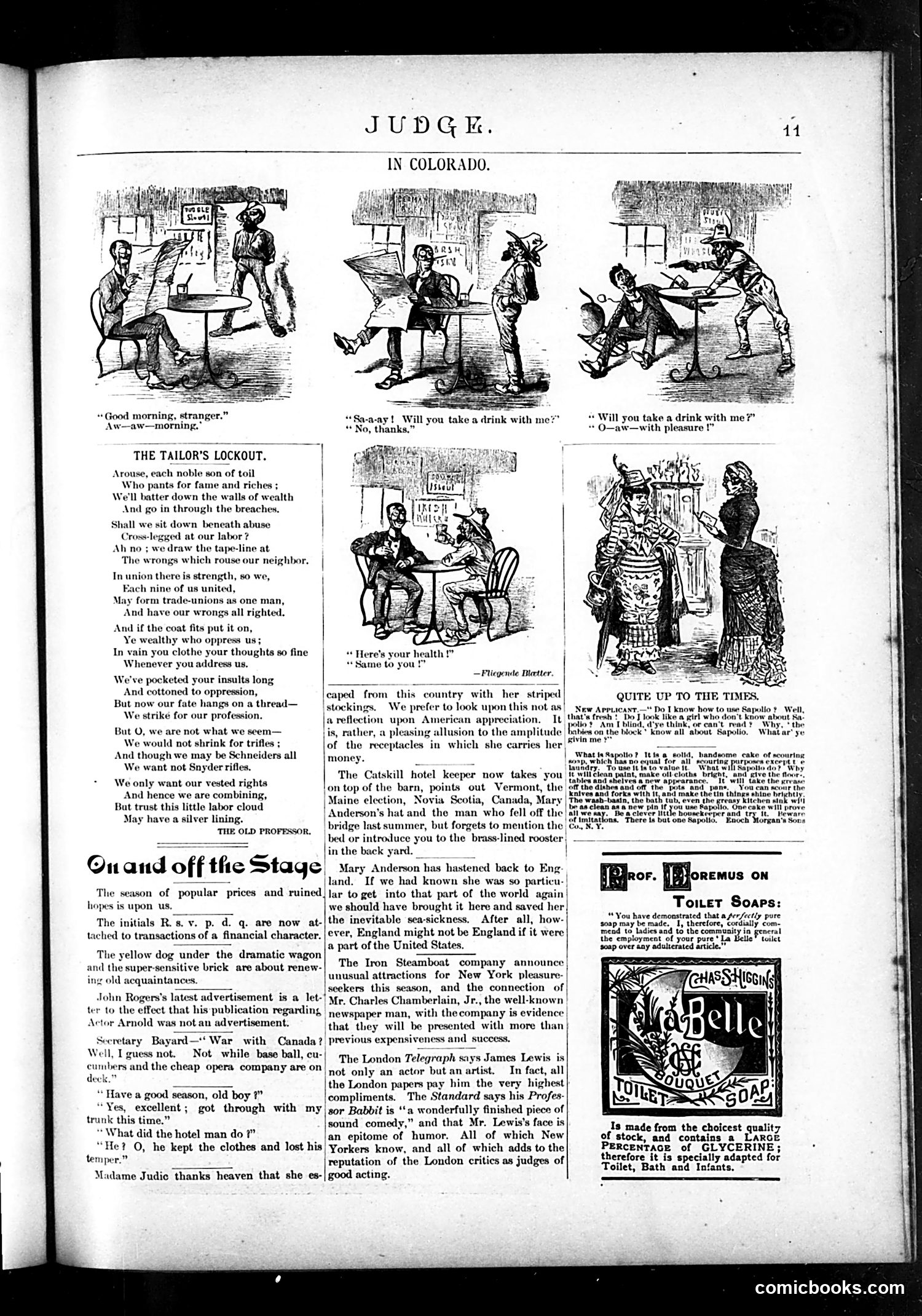
This page satirizes late-19th-century labor disputes and American pretensions. The top three comic panels mock Western frontier stereotypes—rough miners offering/refusing drinks with exaggerated dialect ("Aw—aw—morning"). **"The Tailor's Lockout"** poem ridicules labor organizers, particularly the formation of trade unions. It sardonically suggests striking tailors are noble workers demanding justice, but the satire undermines them by mocking their inflated rhetoric about "unity" and "wrongs"—implying their grievances are trivial compared to genuine suffering. The reference to "Schneiders" and "Snyder rifles" appears to mock specific union leaders or labor figures (names unclear from image alone). The scattered theatrical and advertisement content below includes commentary on actress Mary Anderson's departure to England and promotional material for Sapolio soap, typical of Judge's mixed satirical and commercial format. Overall: Judge uses ridicule to dismiss labor activism as self-important posturing by workers with minor complaints, reflecting the magazine's conservative, anti-union editorial stance.
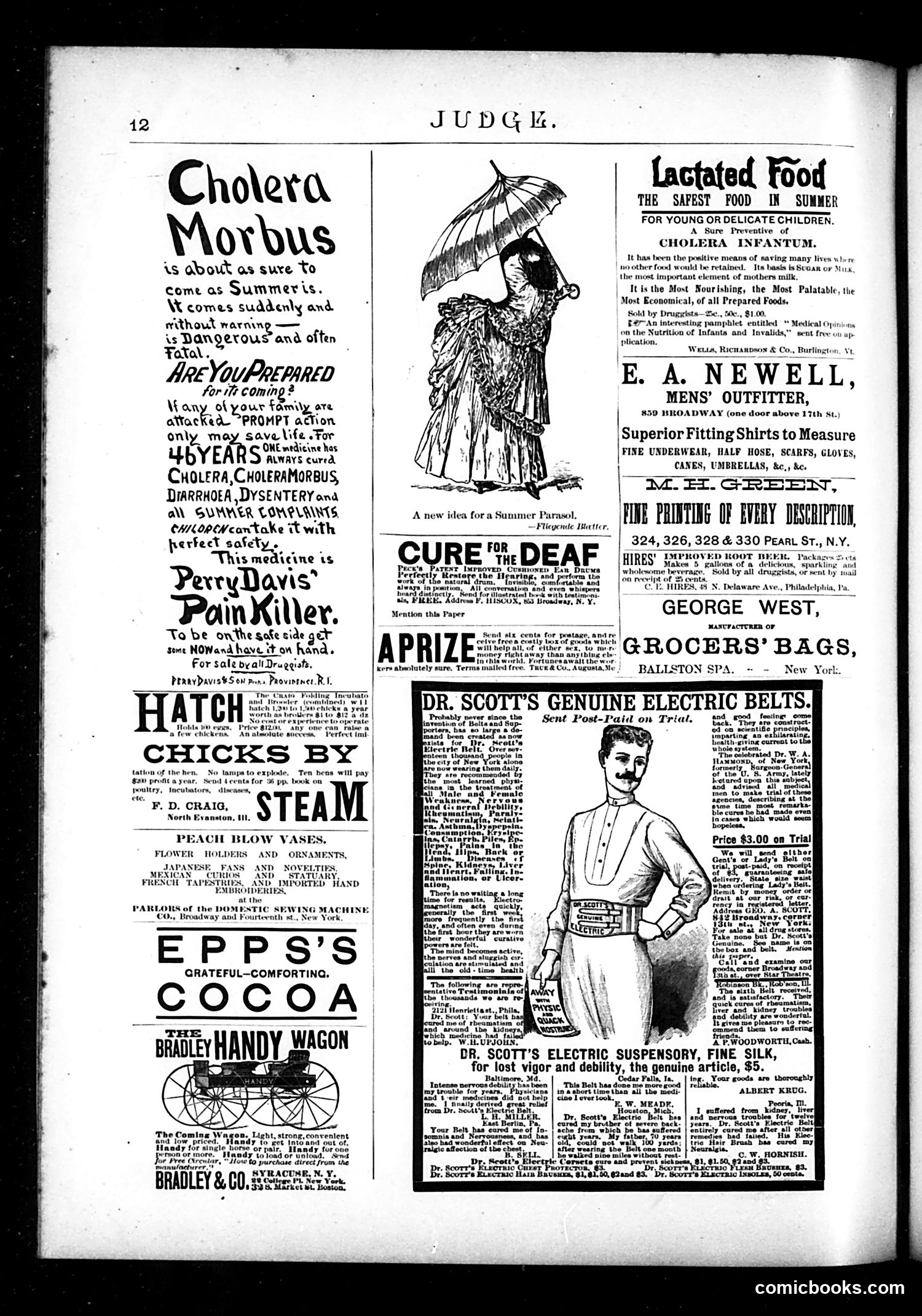
This page is primarily **advertising**, not political satire. It's from Judge, a satirical magazine, but this particular page showcases commercial ads typical of late 19th-century publications. The dominant advertisement warns of **cholera morbus** (acute gastroenteritis), a genuine summer health threat before modern sanitation. Perry Davis's Pain Killer is promoted as a cure-all for cholera, diarrhea, and dysentery—common killers, especially of children. Competing ads like "Lactated Food" market infant formula as protection against "cholera infantum." Other ads reflect period anxieties: Dr. Scott's "Electric Belt" promises to restore "lost vigor and debility"—a quack remedy exploiting male anxiety about vitality. The small illustration shows a woman with an umbrella labeled "A new idea for a Summer Parasol," likely satirizing frivolous fashion. The page reflects genuine Victorian health fears (cholera was real) alongside pseudoscientific snake oil—the actual satire being Judge's willingness to publish such dubious medical claims.
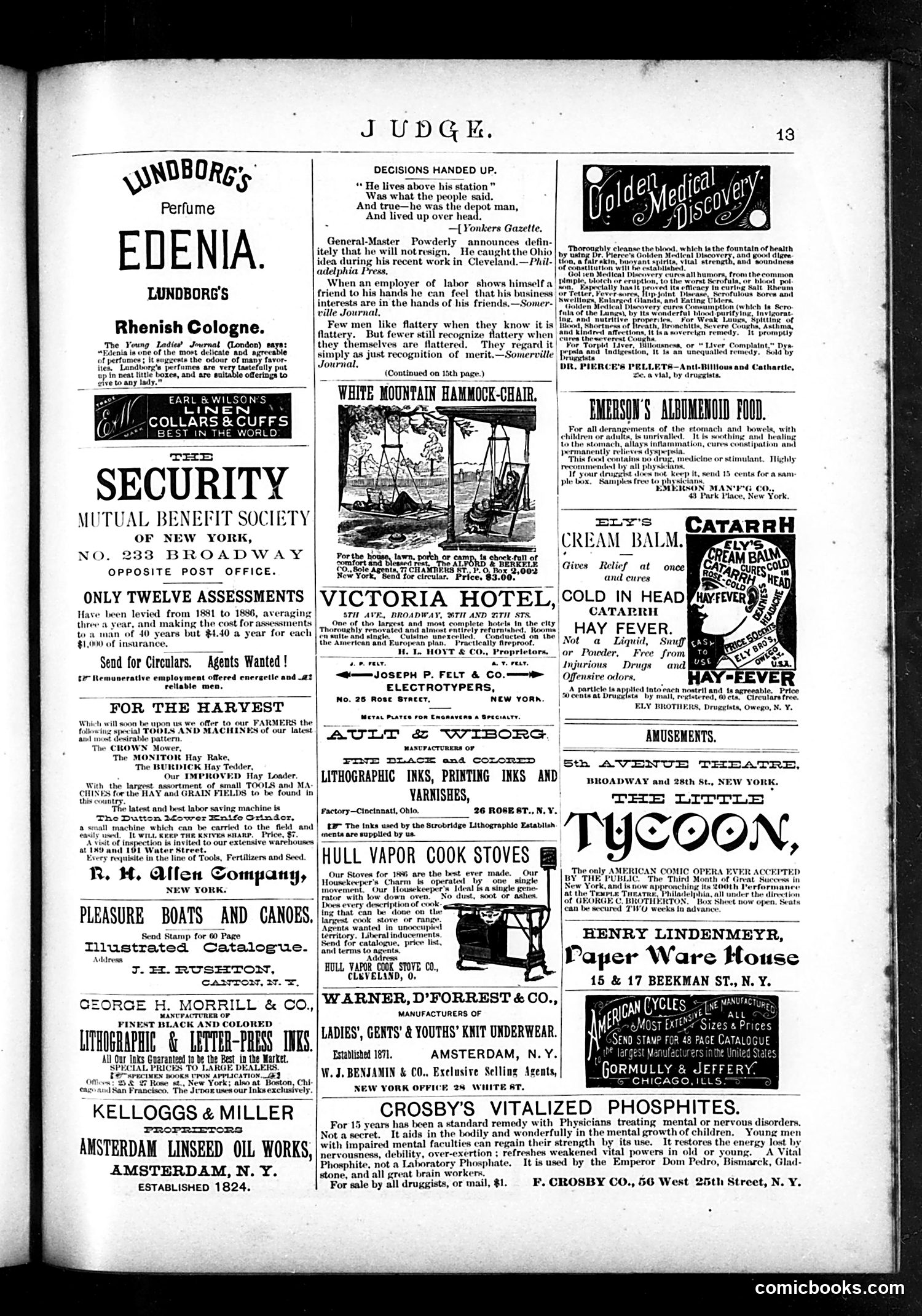
This page is primarily **advertising** with a small section of quoted editorial content at the top ("Decisions Handed Up"). The editorial quotes are brief satirical observations on contemporary issues: one references General-Master Powderly (leader of the Knights of Labor) refusing to resign after recent work in Cleveland; another notes how employers who befriend their workers gain their loyalty; a third observes that people rarely recognize flattery when they're the ones being flattered. The bulk of the page contains Victorian-era commercial advertisements for products including perfume, industrial machinery, boat manufacturers, lithographic inks, medical remedies (Crosby's Vitalized Phosphites, Ely's Cream Balm for hay fever), kitchen stoves, and paper goods. There's also promotion for "The Tycoon," a comic opera at the 5th Avenue Theatre. **No significant political cartoons appear on this page.** It represents Judge's revenue model: satirical content mixed with extensive paid advertising.
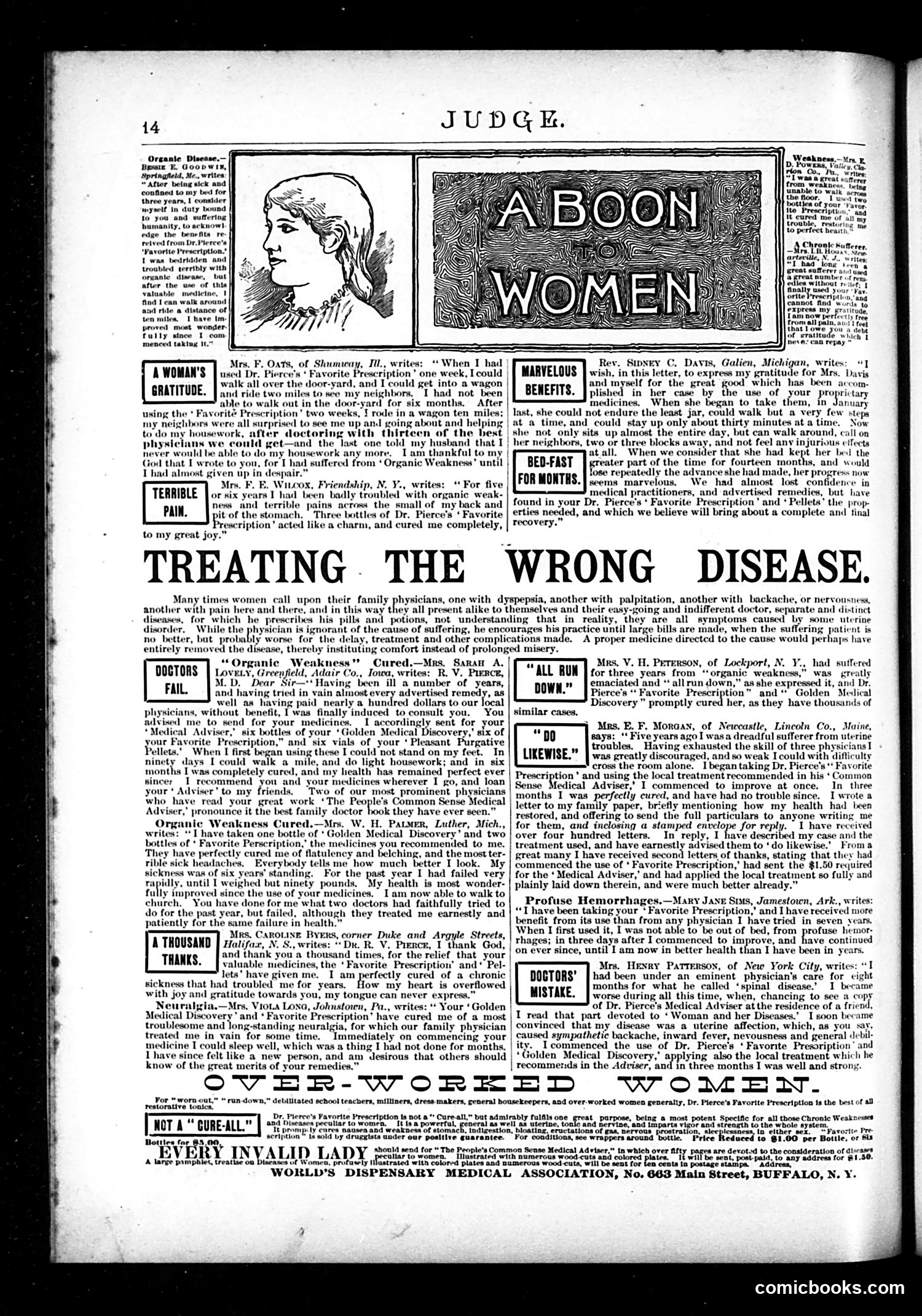
This page is primarily **medical advertising**, not political satire. It promotes Dr. Pierce's "Favorite Prescription" patent medicine for women's ailments, particularly "organic weakness" and uterine troubles. The page contains: 1. **A portrait sketch** (top left) of an unidentified woman, likely meant to represent satisfied patients 2. **Testimonial letters** from women claiming miraculous cures—bedbound patients walking miles after treatment 3. **A central article** titled "Treating the Wrong Disease," which argues that doctors misdiagnose women's complaints, missing the real uterine causes **The satirical angle** (if any): The implicit criticism targets male physicians who supposedly overlook women's actual medical problems. However, this "satire" primarily serves to *sell the product* by undermining trust in conventional medicine. **Modern context**: This exemplifies turn-of-the-century patent medicine fraud. The testimonials lack verifiable sources, and the promised cures are wildly exaggerated. Such advertisements exploited women's legitimate health concerns while offering ineffective treatments.
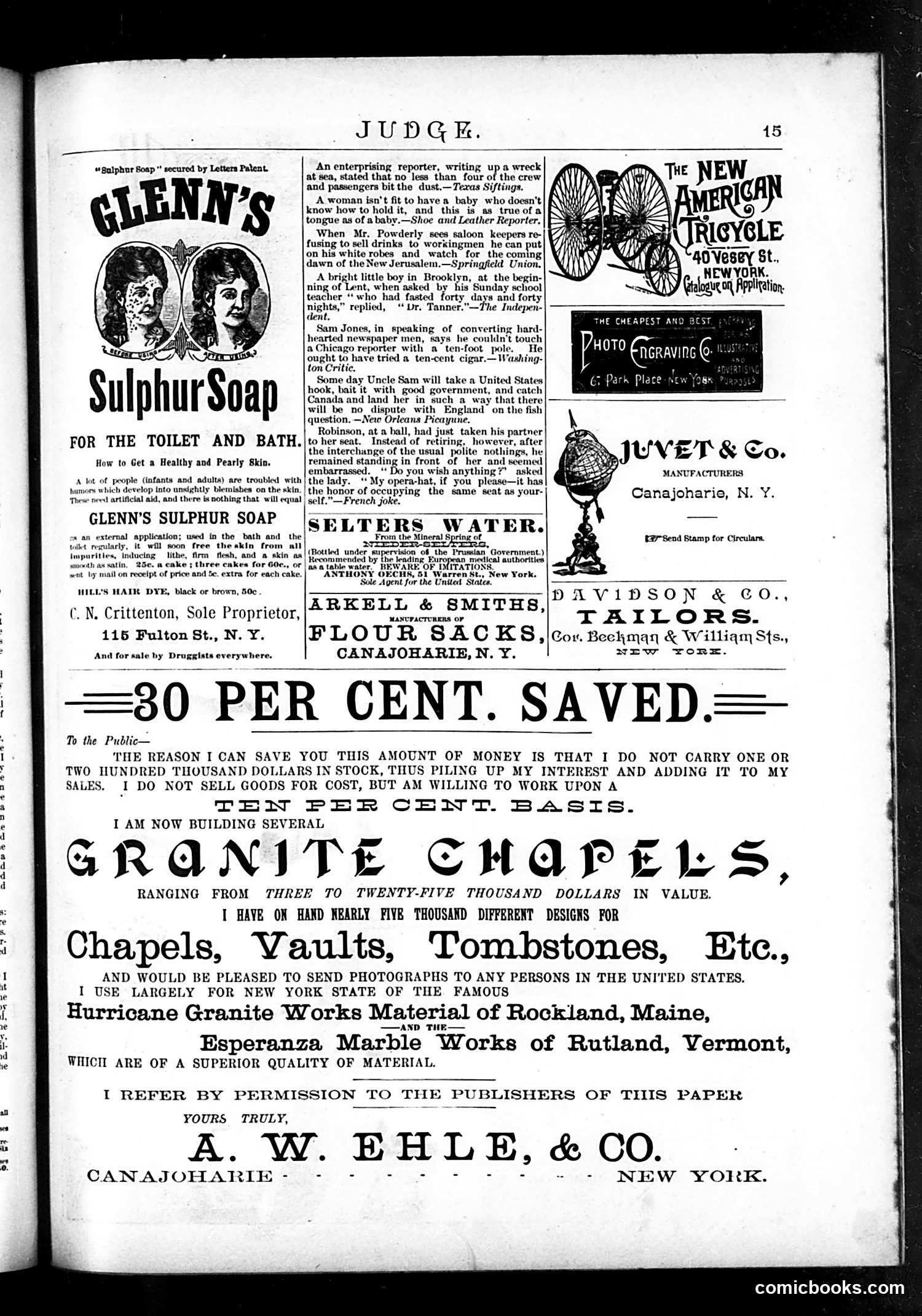
This page is primarily **advertising**, not political satire. The dominant content is a large advertisement from A.W. Ehle & Co. of Canajoharie, New York, promoting granite chapels, vaults, and tombstones—claiming to save customers 30 percent by operating on low profit margins rather than maintaining large inventory. The page also contains typical period advertisements for Glenn's Sulphur Soap, Selters Water, and other products. At the top is a small section of humor items—brief jokes from various sources. These are genteel, non-partisan quips: a joke about a newspaper reporter exaggerating a shipwreck, wordplay about babies and tongues, a reference to "Dr. Tanner" (likely a fasting enthusiast of the era), and gentle ribbing of newspaper reporters' character. The only potentially political reference appears in a snippet mentioning "Mr. Powderly" (likely Terence Powderly, labor leader), but it's just a passing joke about saloon keepers, not developed satire.
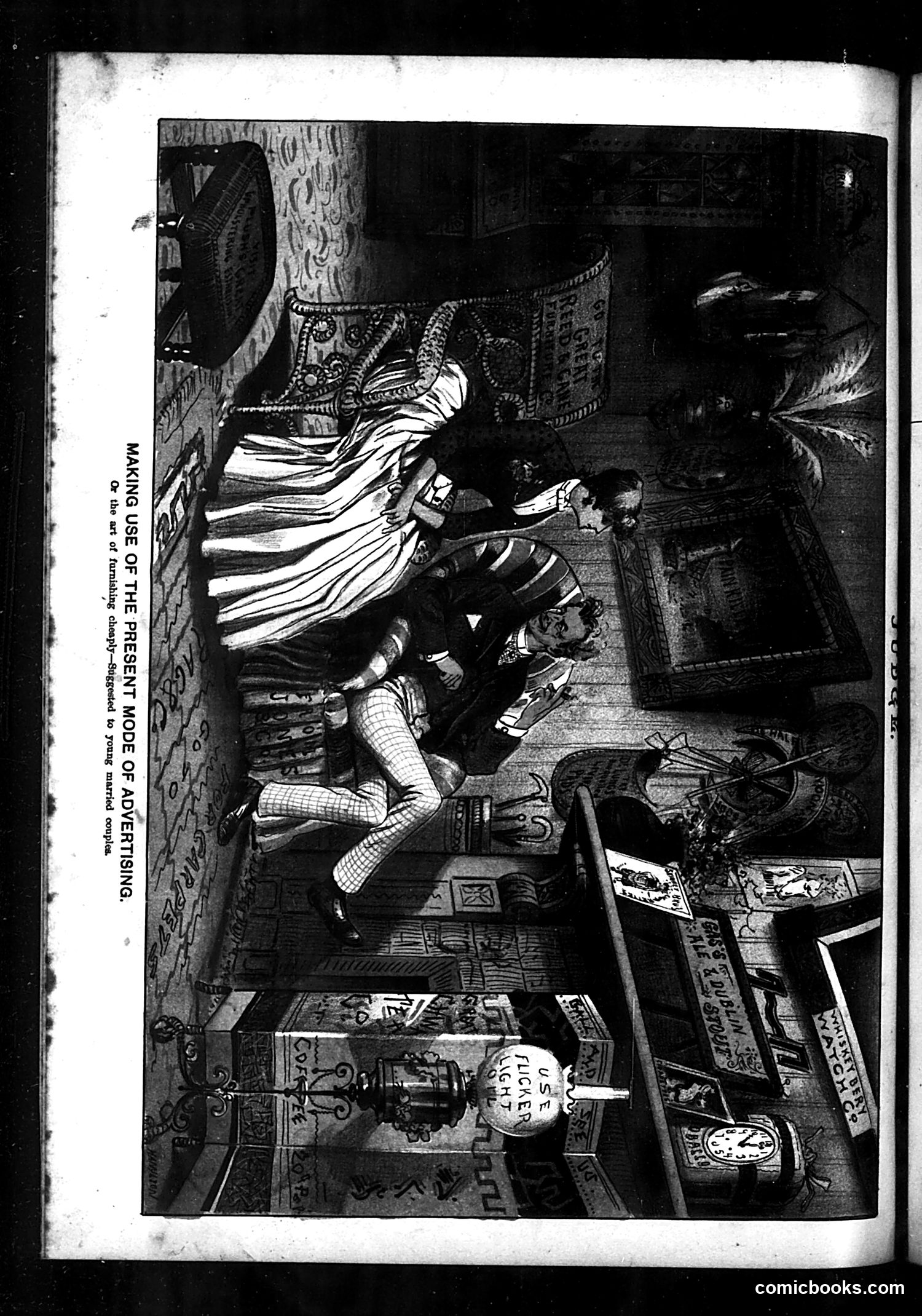
This appears to be a satirical cartoon about budget-conscious newlyweds using advertising as interior decoration. The image shows a couple in what looks like a sparsely furnished room adorned with various advertisements and commercial signage instead of traditional artwork or decorations. The satire mocks both the commercialization of domestic life and the financial constraints of young married couples. By literally "furnishing cheaply" with ads rather than proper artwork, the cartoon critiques how advertising permeates even intimate home spaces. The title suggests this is a tongue-in-cheek "suggestion" for economical decorating—free advertising posters serving as wall hangings. This reflects Gilded Age anxieties about consumerism and advertising's expanding influence on American life and domestic culture.