
Judge, 1886-06-26 · page 10 of 16
Judge — June 26, 1886 — page 10: what you’re looking at
What you’re looking at
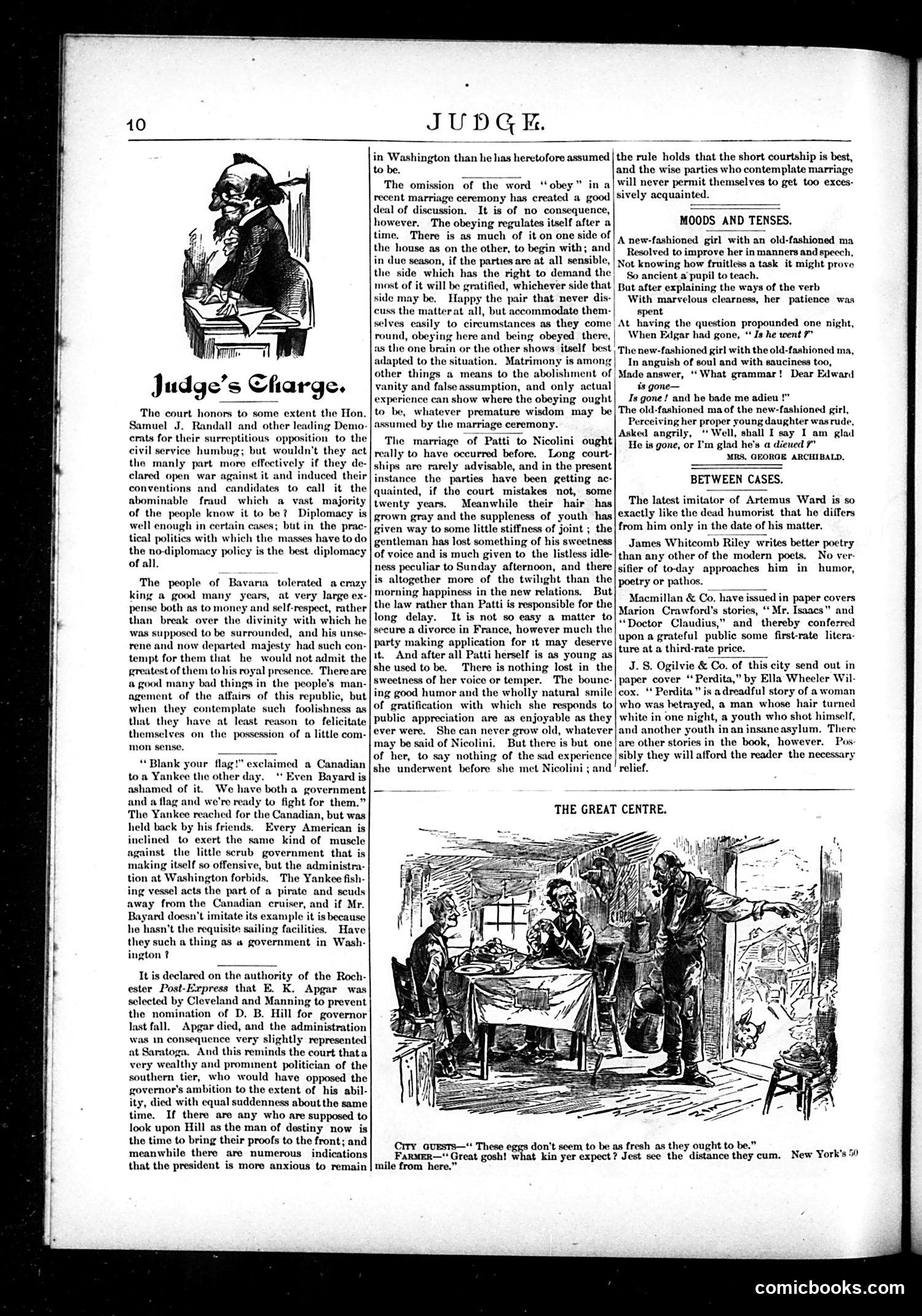
This page contains **editorial commentary** rather than comic cartoons. The main "Judge's Charge" argues that Democratic politicians should openly oppose civil service reform rather than using diplomatic opposition—comparing American timidity to Bavarian tolerance of a mad king. The editor criticizes the Cleveland administration's weak response to Canadian fishing vessel incidents, suggesting the government lacks backbone. There's also gossip about political deaths: E.K. Apgar allegedly died conveniently after opposing D.B. Hill's gubernatorial nomination, with the implication that the administration benefited. The final section discusses a recent marriage (possibly referring to opera singer Adelina Patti's marriage to tenor Nicolini, mentioned at page's end), arguing that marital obedience naturally balances itself without prescribed rules. **"The Great Centre"** illustration at bottom depicts a domestic/working-class scene with dialogue about freshness and distance—its satirical meaning is unclear without fuller context.
📄 Transcribed text from this page (OCR, searchable)
Machine-transcribed from the original scan — historical spelling and the odd misread are preserved.
JUDGE. Judge’s Charge. The court honors to some extent the Hon. Samuel J. Randall and other leading Demo- crats for their surreptitious opposition to the civil service humbug; but wouldn't they act the manly part more effectively if they de- clared open war against it and induced their conventions and candidates to call it the abominable fraud which a vast majority of the people know it to be? Diplomacy is well enough in certain cases; but in the prac- tical politics with which the masses have to do the no-diplomacy policy is the best diplomacy of all. The people of Bavaria tolerated acrazy king a good many years, at very large ex- pense both as to money and self-respect, rather than break over the divinity with which he was supposed to be surrounded, and his unse- rene and now departed majesty had such con- tempt for them that he would not admit the greatest of them to his royal presence. There are a good many bad things in the people's man- agement of the affairs of this republic, but when they contemplate such foolishness as that they have at least reason to felicitate themselves on the possession of a little com- mon sense. “Blank your flag!” exclaimed a Canadian toa Yankee the other day.‘ Even Bayard is ashamed of it. We have both a government and a flag and we're ready to fight for them.” The Yankee reached for the Canadian, but was held back by his friends. Every American is inclined to exert the same kind of muscle against the little scrub government that is making itself so offensive, but the administra- tion at Washington forbids. The Yankee fish- ing vessel acts the part of a pirate and scuds away from the Canadian cruiser, and if Mr. Bayard doesn't imitate its example it is because he hasn't the requisite sailing facil they such a thing as a government in Wash- ington t It is declared on the authority of the Roch- ester Post-Express that E. K. Apgar was selected by Cleveland and Manning to prevent the nomination of D. B. Hill for governor last fall. Apgar died, and the administration was in consequence very slightly represented at Saratoga. And this reminds the court thata very wealthy and prominent politician of the southern tier, who would have opposed the governor's ambition to the extent of his abil- ity, died with equal suddenness about the same time. If there are any who are supposed to look upon Hill as the man of destiny now is the time to bring their proofs to the front; and meanwhile there are numerous indications that the president is more anxious to remain in Washington than he has heretofore assumed to be. * a recent marriage ceremony has created a good deal of discussion. It is of no consequence, however. The obeying regulates itself after a time. There is as much of it on one side of the house as on the other, to begin with; and in due season, if the parties are at all sensible, the side which has the right to demand the) most of it will be gratified, whichever side that side may be. selves easily to circumstances as they come round, obeying here and being obeyed there, as the one brain or the other shows itself best adapted to the situation. Matrimony is among other things a means to the abolishment of vanity and false assumption, and only actual experience can show where the obeying ought to be, whatever premature wisdom may be assumed by the marriage ceremony. The marriage of Patti to Nicolini ought really to have occurred before. Long court- ships are rarely advisable, and in the present instance the parties have been getting ac- quainted, if the court mistakes not, some twenty years. Meanwhile their hair has grown gray and the suppleness of youth has given way to some little stiffness of joint ; the gentleman has lost something of his sweetness of voice and is much given to the listless idle- ness peculiar to Sunday afternoon, and there is altogether more of the twilight than the morning happiness in the new relations. But the law rather than Patti is responsible for the long delay. It is not so easy a matter to secure a divorce in France, however much the party making application for it may deserve it. And after all Patti herself is as young as she used to be. There is nothing lost in the sweetness of her voice or temper. The bounc- ing good humor and the wholly natural smile of gratification with which she responds to public appreciation are as enjoyable as they ever were. She can never grow old, whatever may be said of Nicolini. But there is but one of her, to say nothing of the sad experience she underwent before she met Nicolini ; and Crry FarMer—‘‘ Great gosh! mile from here.” Happy the pair that never dis-| cuss the matter at all, but accommodate them-| the rule holds that the short courtship is best, and the wise parties who contemplate marriage will never permit themselves to get too exces- sively acquain MOODS AND TENSES. A new-fashioned girl with an old-fashioned ma Resolved to improve her in manners and specch, Not knowing how fruitless a task it might prove So ancient a’ pupil to teach. But after explaining the ways of the verb With marvelous clearness, her patience was spent At having the question propounded one night, When Edgar had gone, “Is he went ?” The new-fashioned girl with the old-fashioned ma, In anguish of soul and with sauciness too, Made answer, ‘What grammar! Dear Edward is gone— Is gone! and he bade me adieu !” The old-fashioned maf the new-fashioned girl, Percei er proper young daughter was rude, Asked angrily, ‘Well, shall I say I am glad He is gone, or I'm glad he's a dieued #” MRS, GEORGE ARCHIBALD, BETWEEN CASES. The latest imitator of Artemus Ward is so exactly like the dead humorist that he diifers from him only in the date of his matter. James Whitcomb Riley writes better poctry than any other of the modern poets. No ver- sifier of to-day approaches him in humor, poetry or pathos. Macmillan & Co. have issued in paper covers Marion Crawford's stories, “Mr, Isaacs” and “Doctor Claudius,” and thereby conferred upon a grateful public some first-rate litcra- ture at a third-rate price. J. 9. Ogilvie & Co. of this city send out in paper cover ‘ Perdita,” by Ella Wheeler Wil- cox. ‘ Perdita” is adreadful story of a woman who was betrayed, a man whose hair turned white in one night, a youth who shot himself, and another youth in an insancasylum. There are other stories in the book, however. Pos THE GREAT CENTRE. sibly they will afford the reader the necessary relief. GUESTs—‘' These eggs don't seem to be as fresh as they ought to be.” what kin yer expect? Jest see the distance they cum. New York's 50 comicbooks.com