
A complete issue · 16 pages · 1886
Judge — June 19, 1886
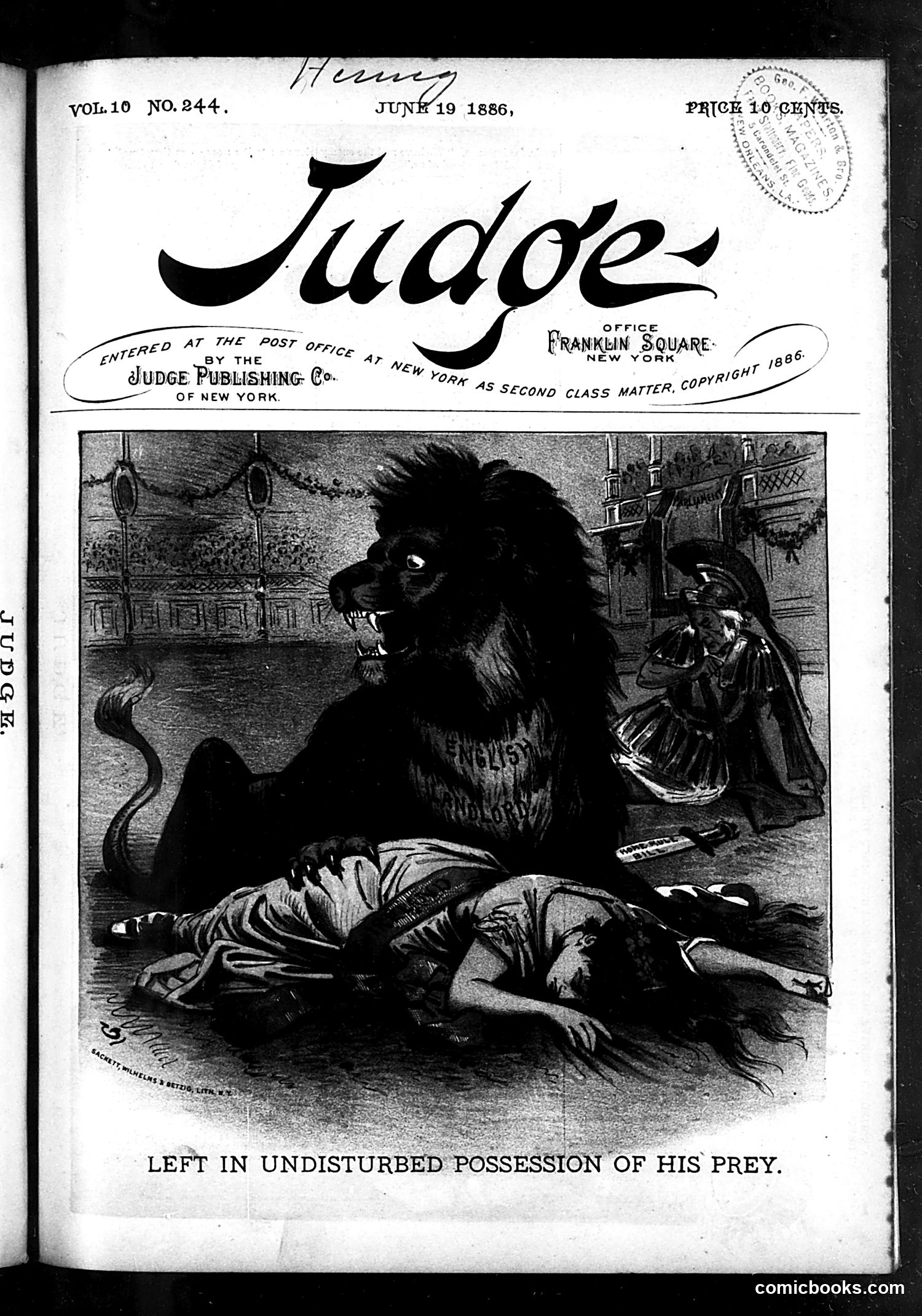
This political cartoon depicts a large, menacing creature—appearing to be a demon or beast—looming over a fallen human figure in what looks like a European street setting. The caption reads "LEFT IN UNDISTURBED POSSESSION OF HIS PREY." The imagery suggests social commentary on predatory power or danger, likely referencing contemporary political or social threats of 1886. The beast's dominance over the helpless victim serves as a visual metaphor for unchecked harmful forces. Without additional context clues or text identifying specific figures or events, the exact political reference remains unclear, though the ominous tone suggests Judge was warning readers about some perceived threat to public safety or social order during this period.
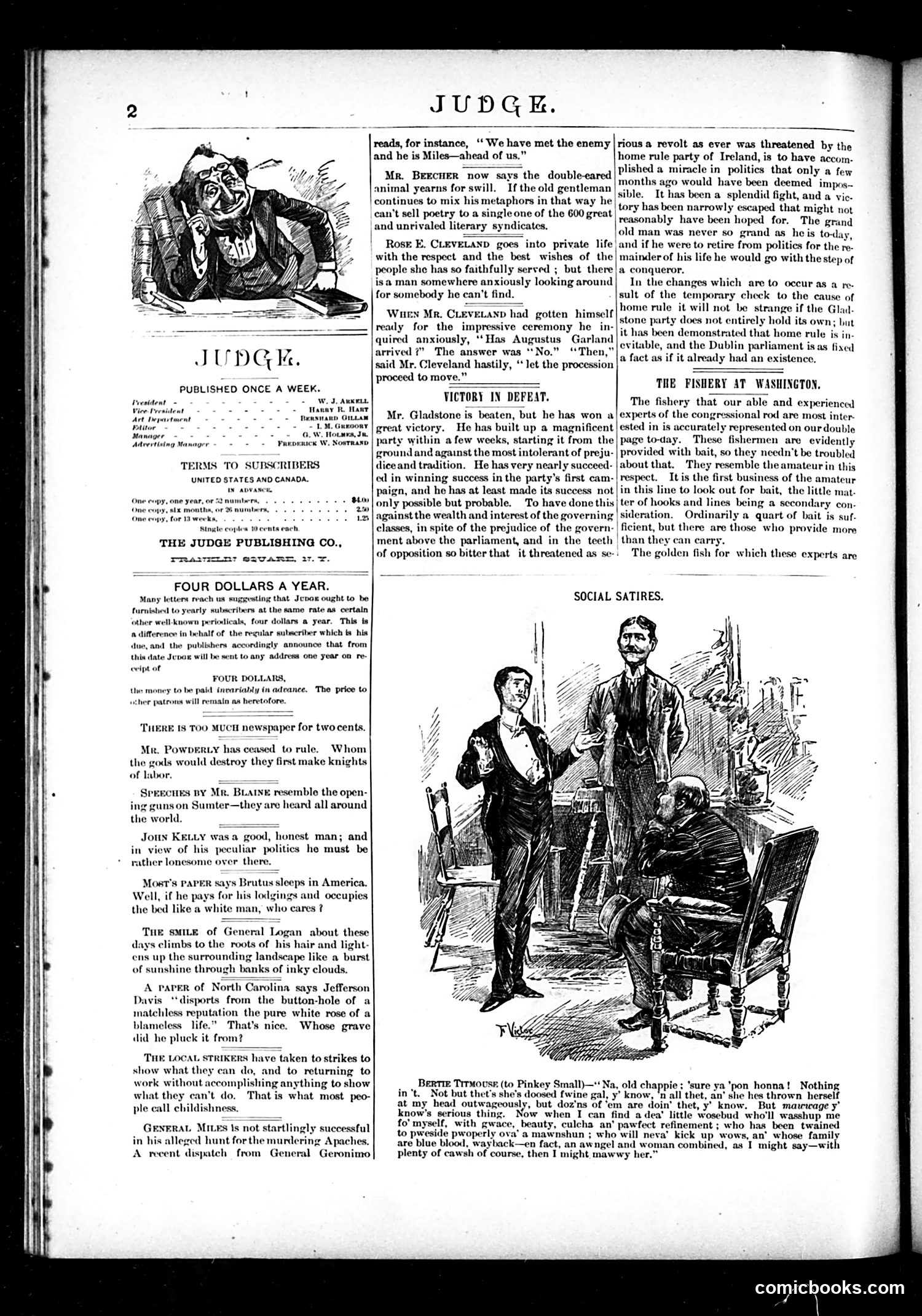
This page contains political commentary and social satire typical of Judge magazine's editorial approach. The main cartoon titled "SOCIAL SATIRES" depicts what appears to be a domestic scene with three figures—likely satirizing social behavior or relationships of the era. The text sections include brief satirical observations about contemporary political and social figures, though most names in the OCR are unclear or partially legible. References mention Cleveland (likely President Grover Cleveland), General Logan, and various commentary on political conduct and public figures' behavior. The satire employs the magazine's characteristic approach: mocking politicians' contradictions, commenting on social pretensions, and critiquing public figures through humorous anecdotes. Without clearer OCR text and specific dates, the precise targets and historical context remain partially obscured, though the general intent—ridiculing political hypocrisy and social absurdity—is evident.
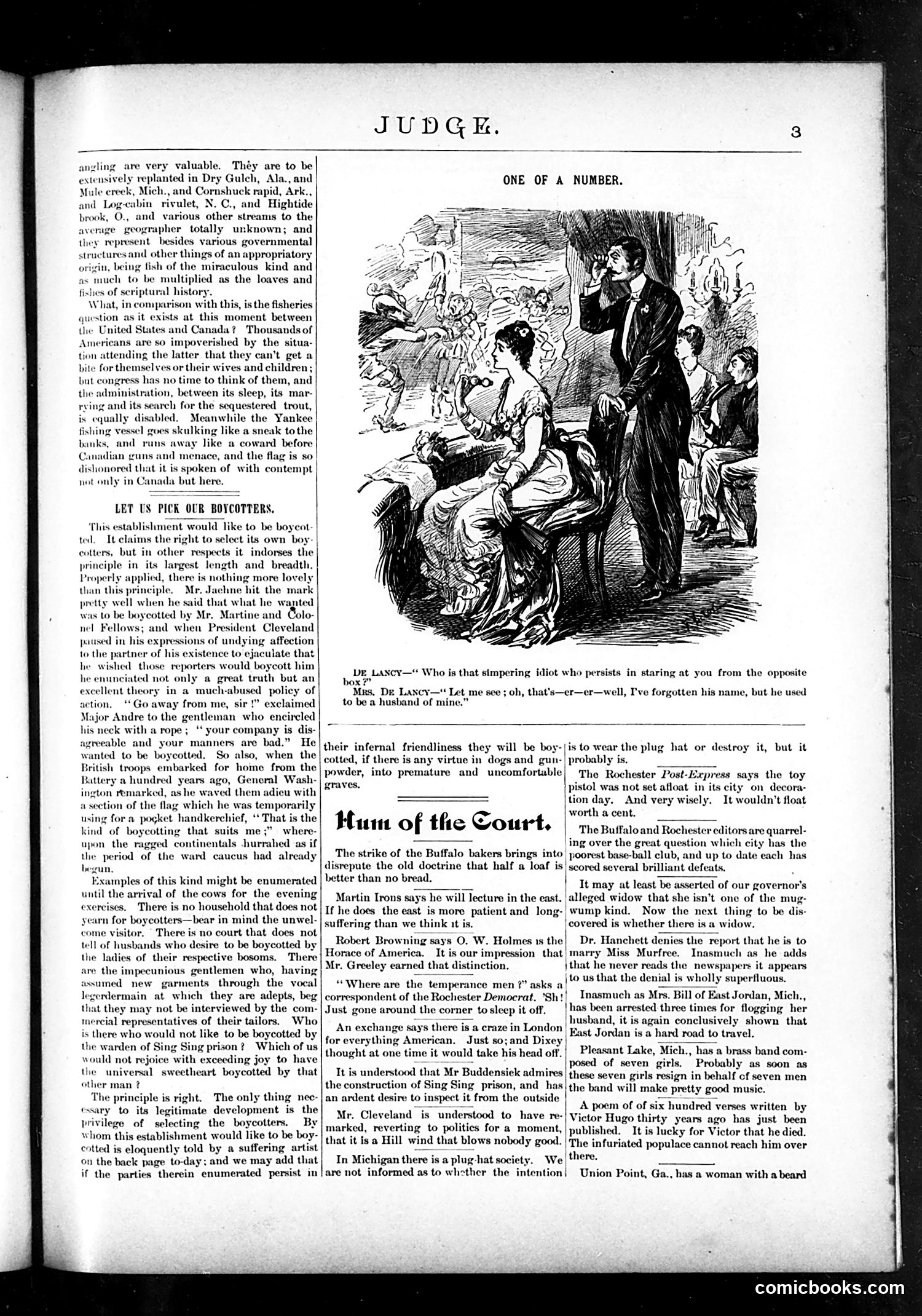
This page contains two distinct pieces of social commentary: **"One of a Number"** (the cartoon): A theater-box scene satirizing divorced women's casual attitude toward ex-husbands. The joke mocks the proliferation of divorces among the wealthy, treating former spouses as forgettable acquaintances rather than significant relationships. It's a barb at upper-class marital instability and women's increasing independence. **"Let Us Pick Our Boycotters"** (the essay): A clever inversion of the boycott concept, arguing that people should have the *right to choose who boycotts them*—celebrating the removal of unwanted people from one's life. The piece uses historical examples (General Washington, prisoners) to humorously argue that being boycotted by certain people (annoying visitors, creditors, prison wardens) is actually desirable. It's satire about social nuisance and the fantasy of selective social rejection. Both pieces reflect Gilded Age anxieties about changing social order, divorce, and class relations, using humor to critique contemporary behavior.
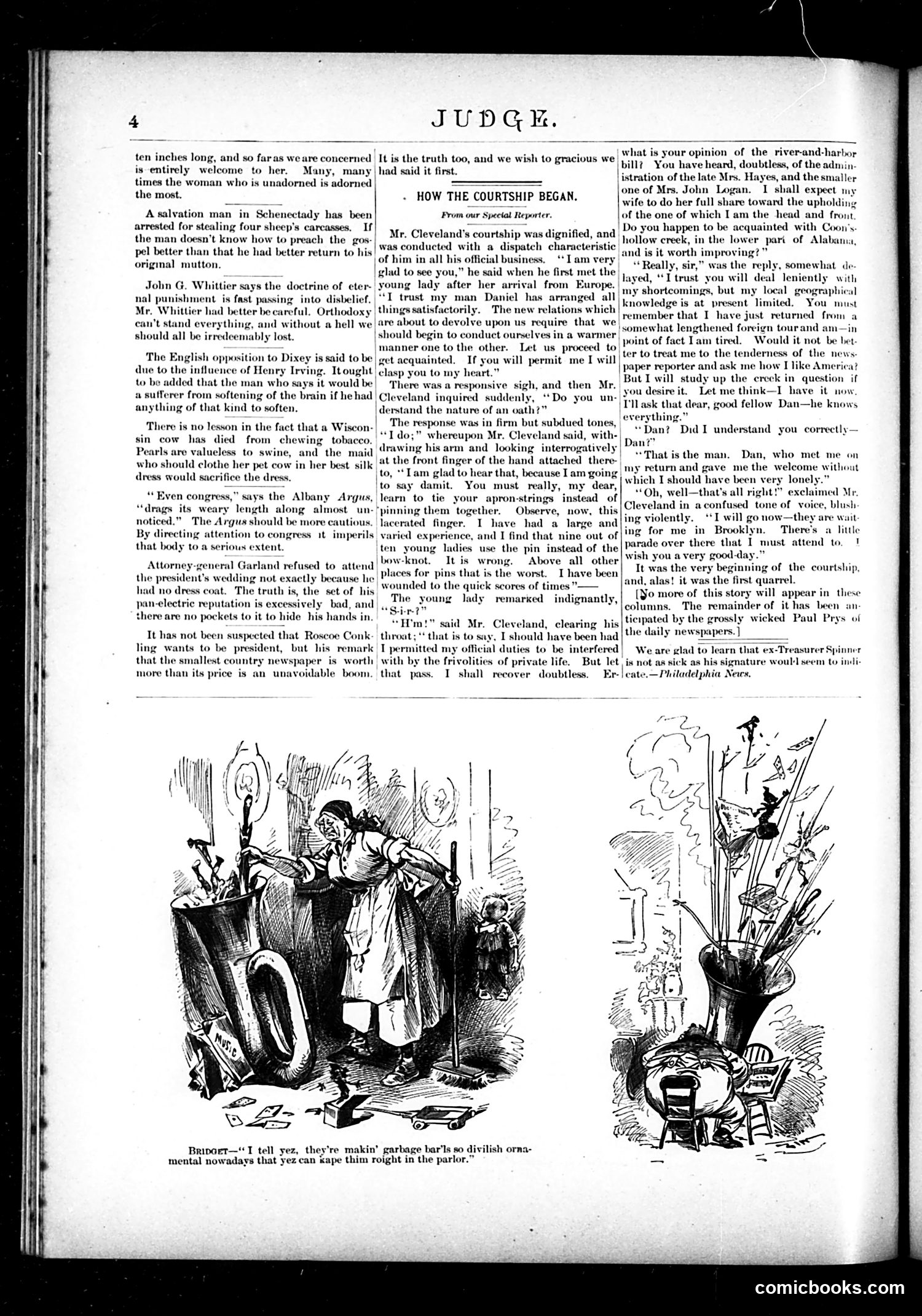
This page satirizes President Grover Cleveland's courtship and impending marriage through mock dialogue. The "How the Courtship Began" section presents Cleveland as absurdly formal and pedantic—discussing administrative policy and critiquing his fiancée's use of pins instead of bows to fasten clothing, even complaining about an injury from a pin. The satire mocks Cleveland's reputation for stern, bureaucratic behavior by suggesting he conducts his personal life with the same rigid officiousness he applies to governance. References to "Mrs. Hayes" and "Mrs. John Logan" invoke previous First Ladies, implying expectations that his wife perform official duties. The left cartoon depicts domestic disorder (likely related to the garbage "bar'ls" mentioned in the caption), while the right shows chaotic household management—visual jokes about the incompetence Cleveland's marriage might remedy or complicate. The humor targets Cleveland specifically as an excessively serious, detail-obsessed administrator unable to relax even in courtship.
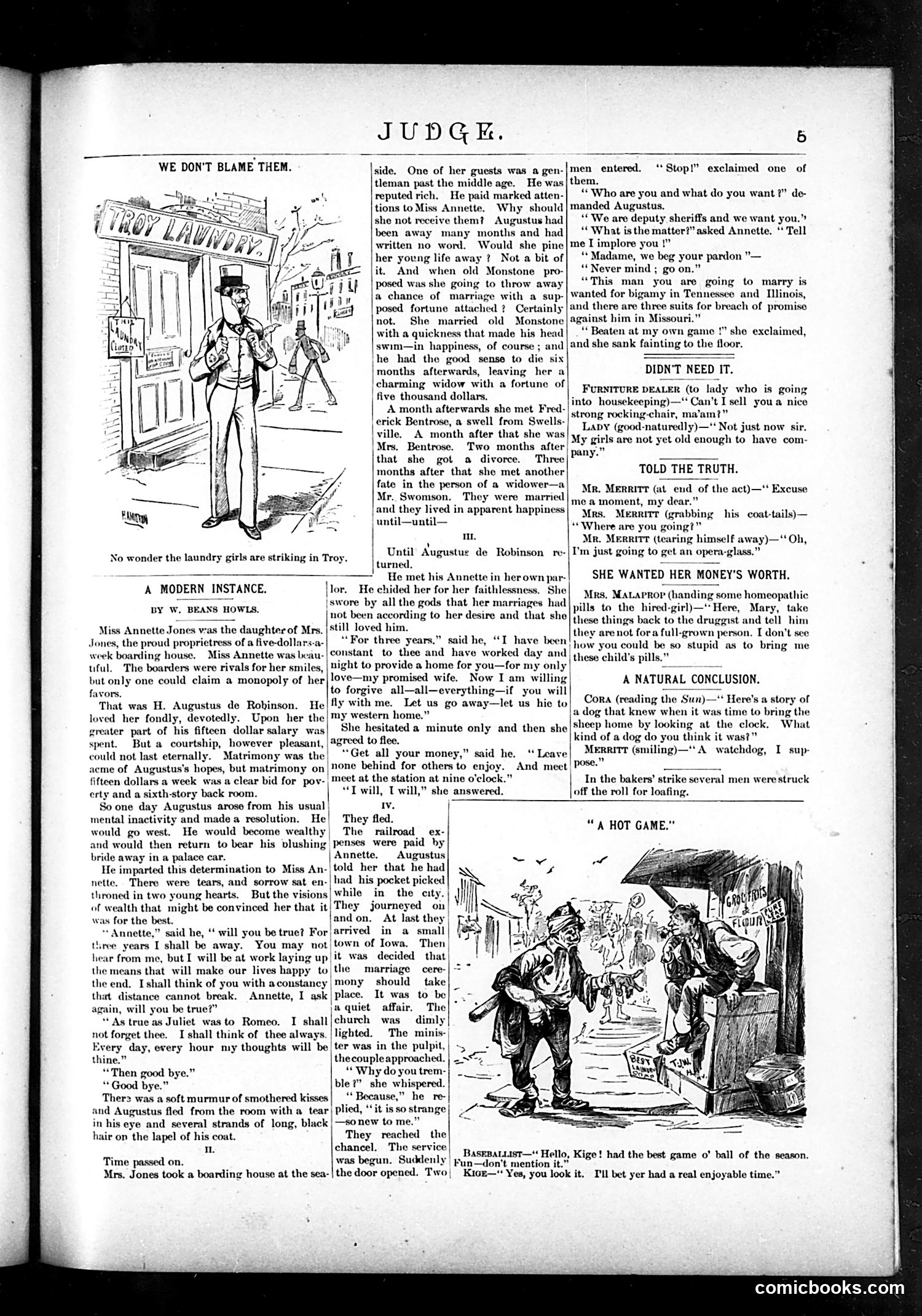
This story satirizes female opportunism and serial marriage among the working poor. Annette, a boarding-house proprietor, marries a succession of men for money rather than love—first the elderly Monstone (who conveniently dies), then Bentrose (whom she divorces), then Swomson. When her original suitor Augustus returns wealthy, she agrees to elope with him, but deputies arrest him for bigamy in Tennessee and Illinois, plus breach-of-promise suits in Missouri. The joke's bitter twist: Annette—who married for gain three times over—is "beaten at my own game" by a man whose criminal deceptions exceed her mercenary ones. The cartoon critiques both working-class marriage as transactional and the era's weak enforcement against serial bigamists. The caption "No wonder the laundry girls are striking in Troy" suggests desperation drives such marriages.
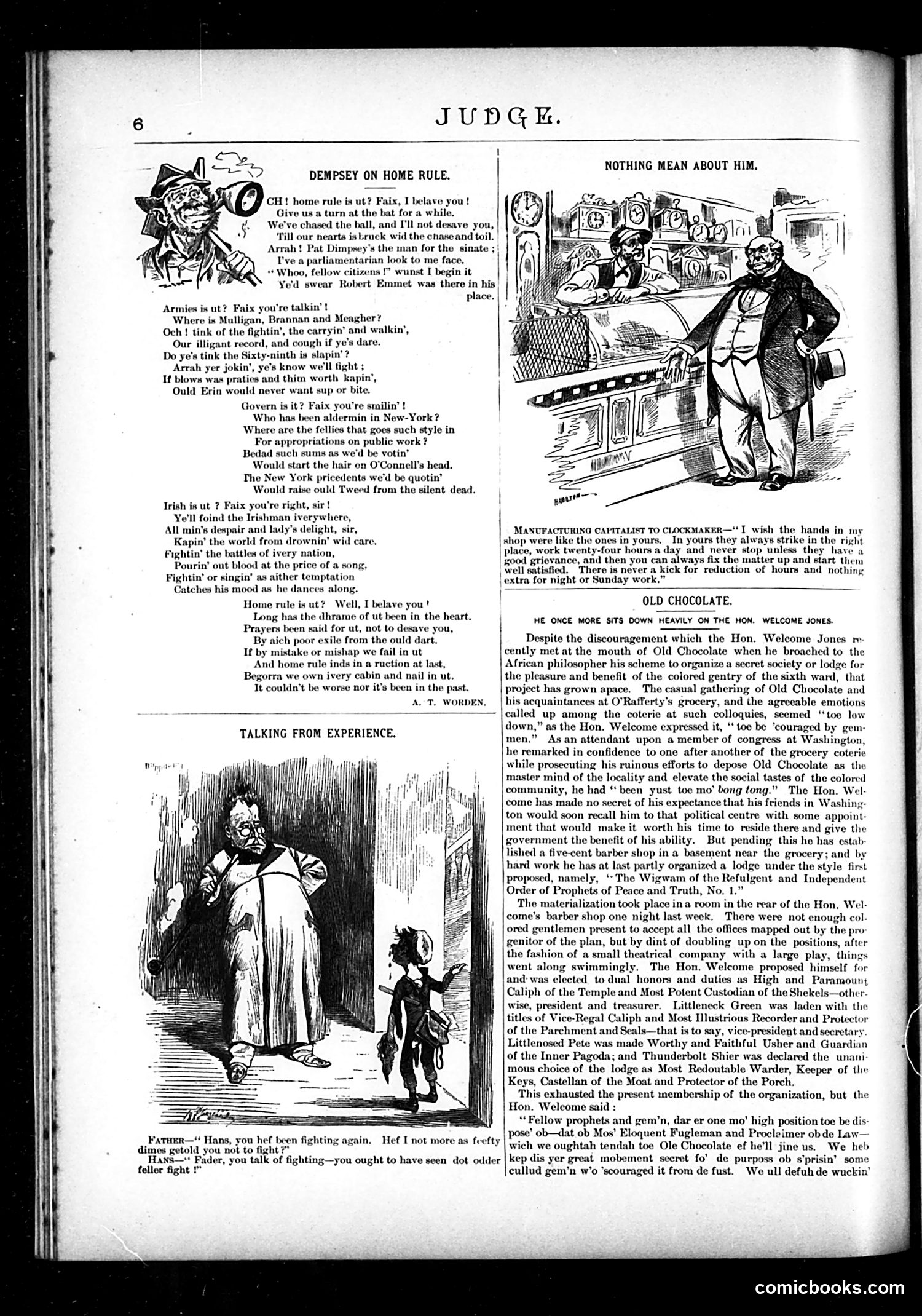
This page contains satirical content mocking Irish-American political ambitions and African-American social organizing in the late 19th century. **"Dempsey on Home Rule"** presents an Irish immigrant's boastful monologue (in heavy dialect) about Irish contributions to America—fighting in wars, winning political positions, and securing public funds—while ironically supporting Irish independence ("home rule"). The satire targets Irish-American politicians' claims of patriotism and competence. **"Nothing Mean About Him"** depicts workplace conditions, apparently celebrating an employer's fairness toward workers. **"Old Chocolate"** satirizes an African-American social climber named Welcome Jones who, having worked for a congressman in Washington, attempts to organize an exclusive lodge among Black residents of the sixth ward. The satire mocks his pretentiousness and his abandonment of authentic community figures (Old Chocolate) in pursuit of status. The cartoons reflect period attitudes of condescension toward both immigrant and Black communities, portraying their political participation and social aspirations as laughable rather than legitimate.
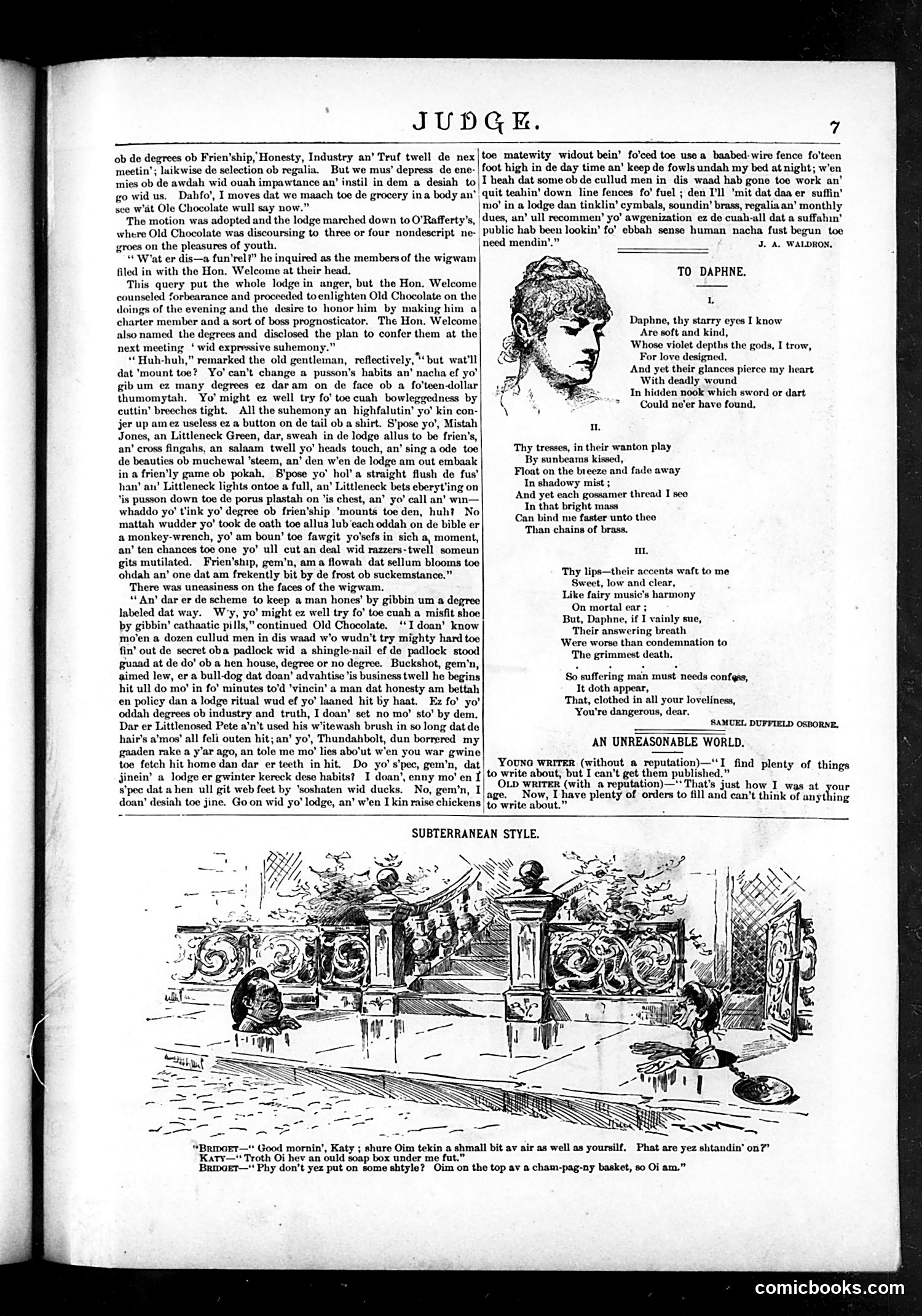
This page satirizes African American fraternal lodge organizations through racist caricature and dialect. The main cartoon depicts "Old Chocolate" (a derogatory name) cynically questioning the value of elaborate lodge rituals and degrees—arguing that ceremonial robes, oaths, and titles cannot change human nature or prevent members from cheating each other at poker or breaking friendship vows. The satire targets both the lodges themselves and the aspirational Black middle class, presenting their organizational structures as pretentious theater masking moral hypocrisy. The accompanying poem "To Daphne" appears unrelated to the cartoon, serving as filler content. The piece relies entirely on racist stereotypes, dialect mockery, and the assumption that readers would find Black self-improvement organizations inherently laughable—reflecting Judge magazine's typical approach to minority communities during this era.
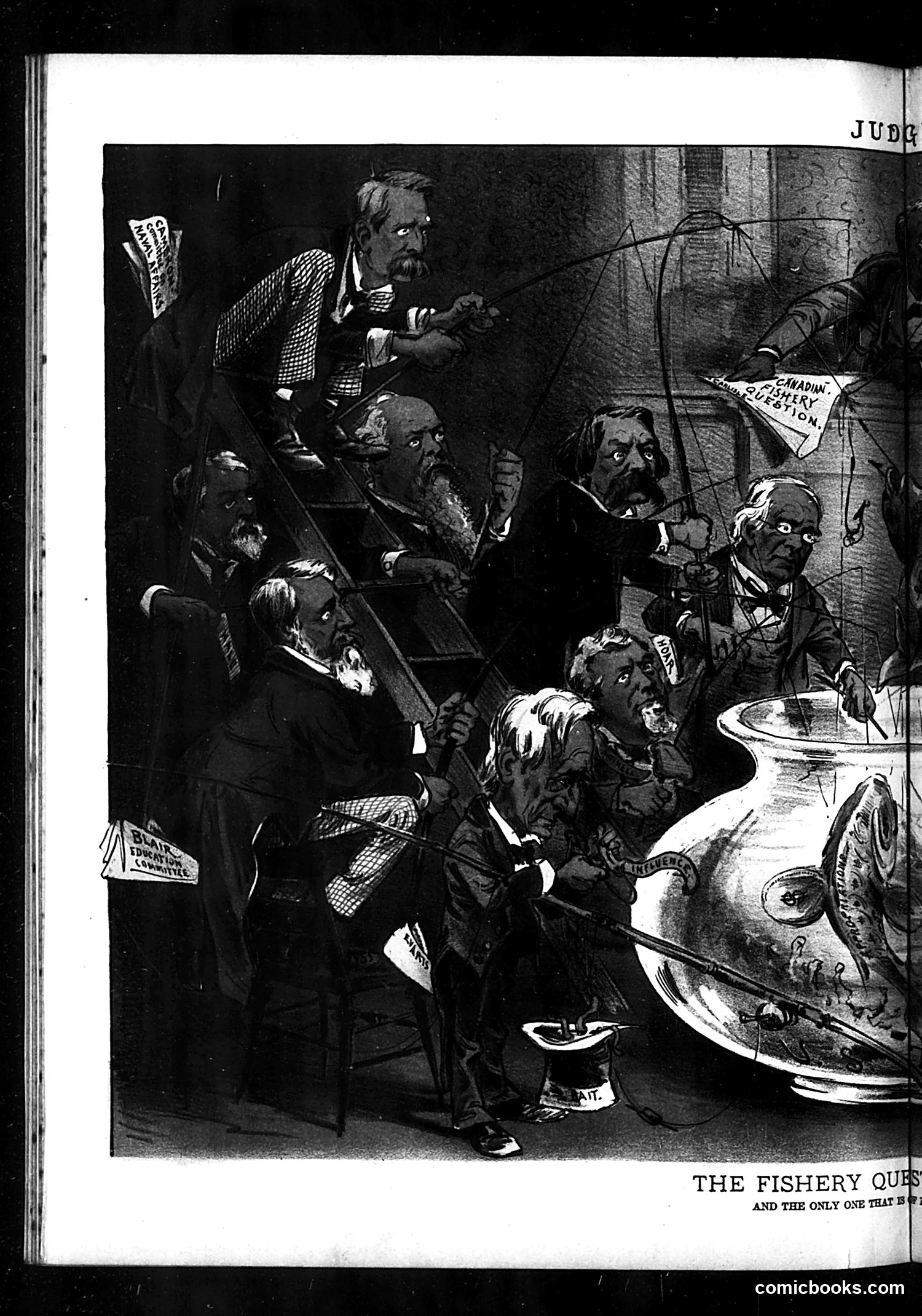
This appears to be a political cartoon from *Judge* magazine satirizing disputes over fishing rights. The title references "The Fishery Question," likely concerning international fishery disputes—a significant diplomatic issue in late 19th/early 20th century American politics, particularly regarding Canadian-American fishing rights. The cartoon depicts multiple bearded men (presumably political figures or national representatives) gathered around large fish or fishing-related vessels, seemingly in conflict or competition. The men's caricatured features and formal dress suggest they represent different nations or political factions arguing over fishing territories and resources. Without clearer identification of specific figures or the exact date, the precise political context remains unclear, but the satire clearly mocks international tensions over valuable maritime resources.
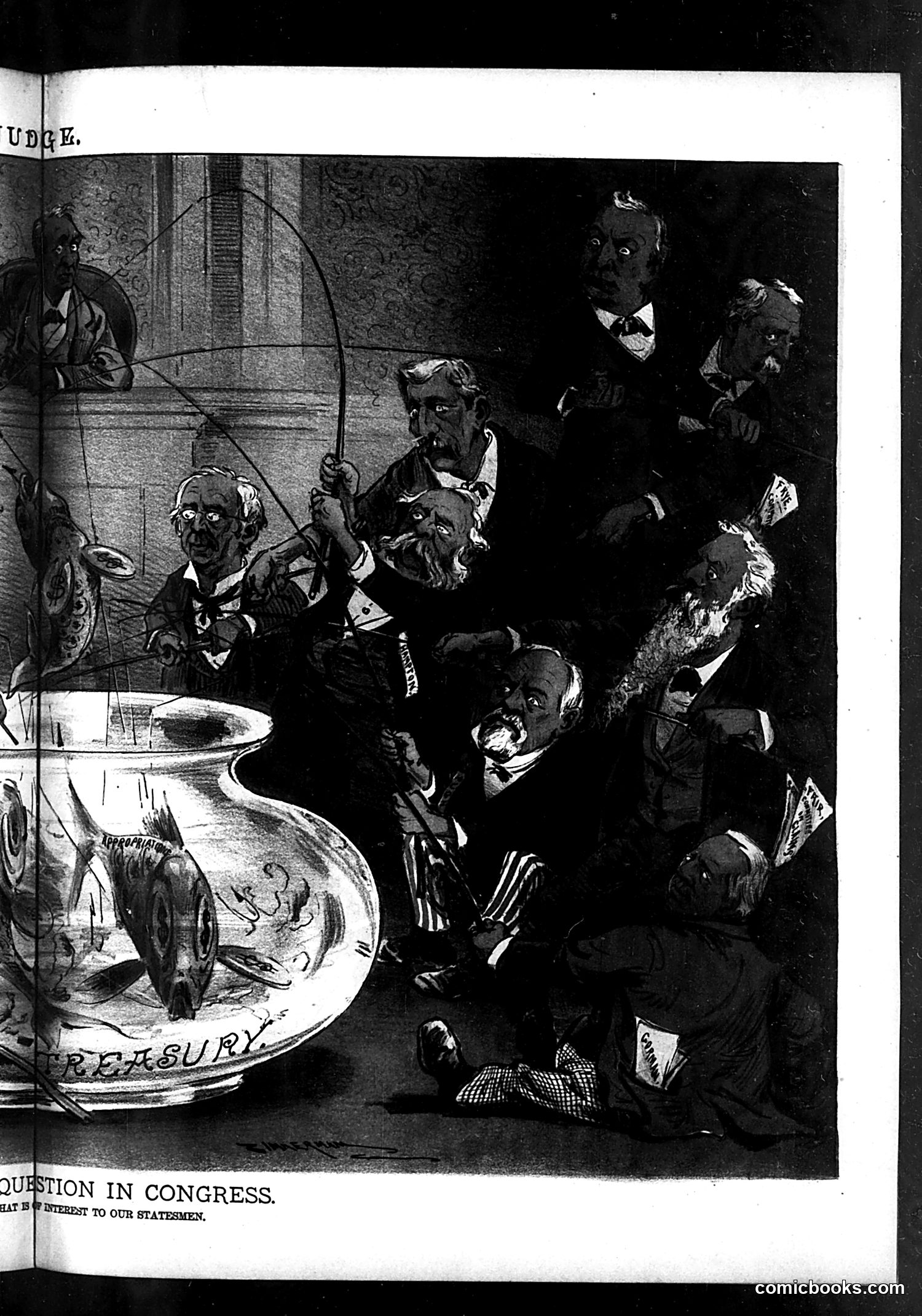
This political cartoon satirizes congressional debate, depicting caricatured politicians as monkeys or ape-like figures around a large pot labeled "MERCURY." The text references "A QUESTION IN CONGRESS" and mentions it being "OF INTEREST TO OUR STATESMEN." The imagery suggests the cartoon mocks politicians as behaving like squabbling primates, likely debating over mercury—possibly relating to currency, medicine, or industrial policy from the late 19th/early 20th century. The dehumanizing animal caricatures were a common satirical device in Judge magazine to criticize political figures as base, irrational, or self-interested. Without visible dates or clearer text, the specific congressional debate remains unclear, but the overall message condemns politicians as intellectually undignified.
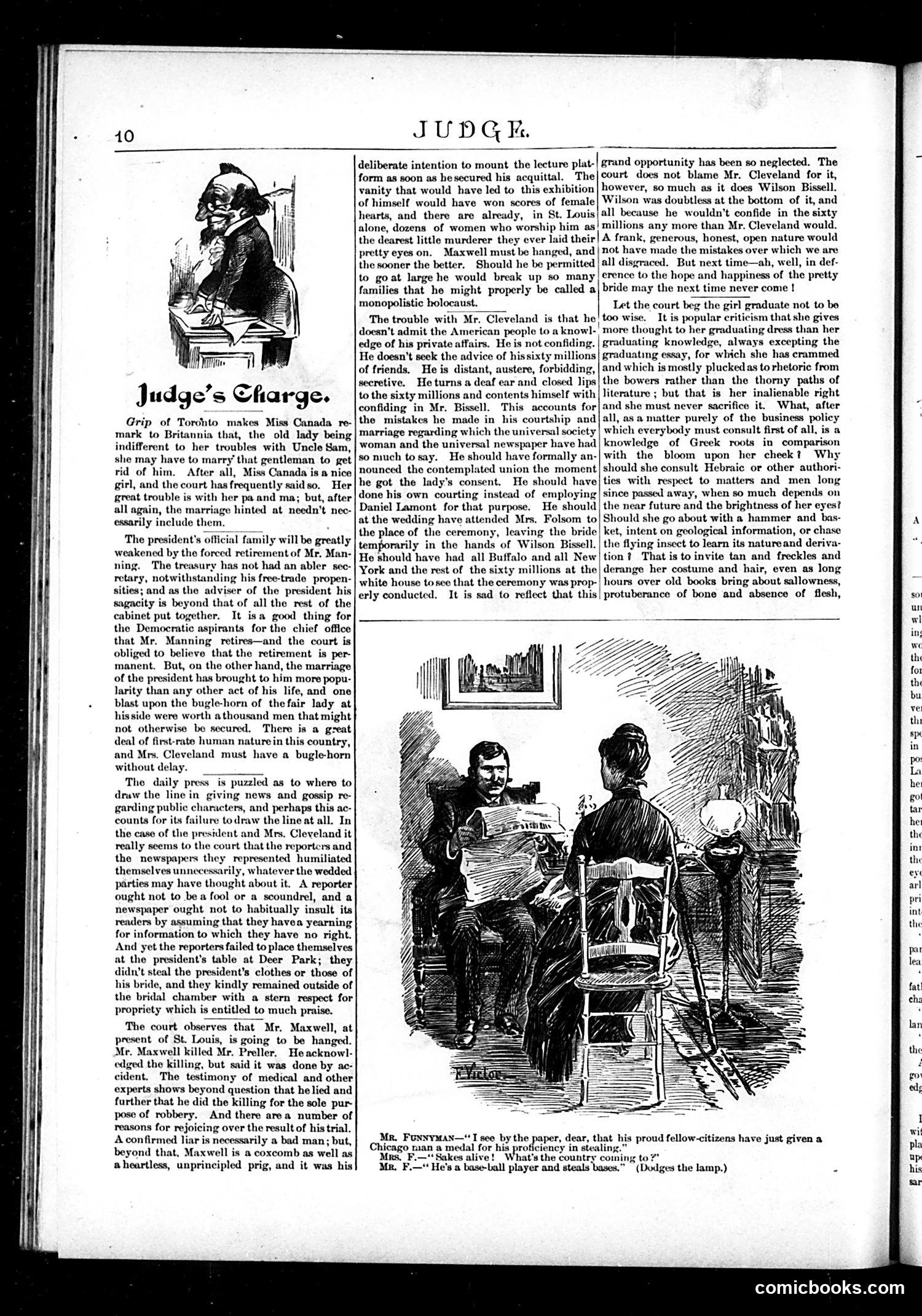
This page from *Judge* magazine contains editorial commentary on three separate topics: **Cleveland's Marriage:** The main article criticizes President Cleveland's privacy regarding his wedding to Frances Folsom. The court (the magazine's satirical "judge") argues that while reporters were overly intrusive in covering the wedding, Cleveland himself is problematically secretive and distant from the public he serves. The satire suggests a president should be more accessible to "his sixty millions" of citizens. **Treasury Secretary Manning's Retirement:** The piece notes Manning's departure weakens the Democratic cabinet but acknowledges his retirement may help other Democratic presidential candidates. **Maxwell's Execution:** The court celebrates the upcoming execution of a St. Louis murderer named Maxwell, who killed for robbery and planned to capitalize on acquittal through lecture tours. The satire mocks women who idolize criminals, describing Maxwell as a "monopolistic holocaust" of family destruction. The bottom illustration depicts a domestic scene, likely related to the Cleveland commentary, showing a couple in conversation.
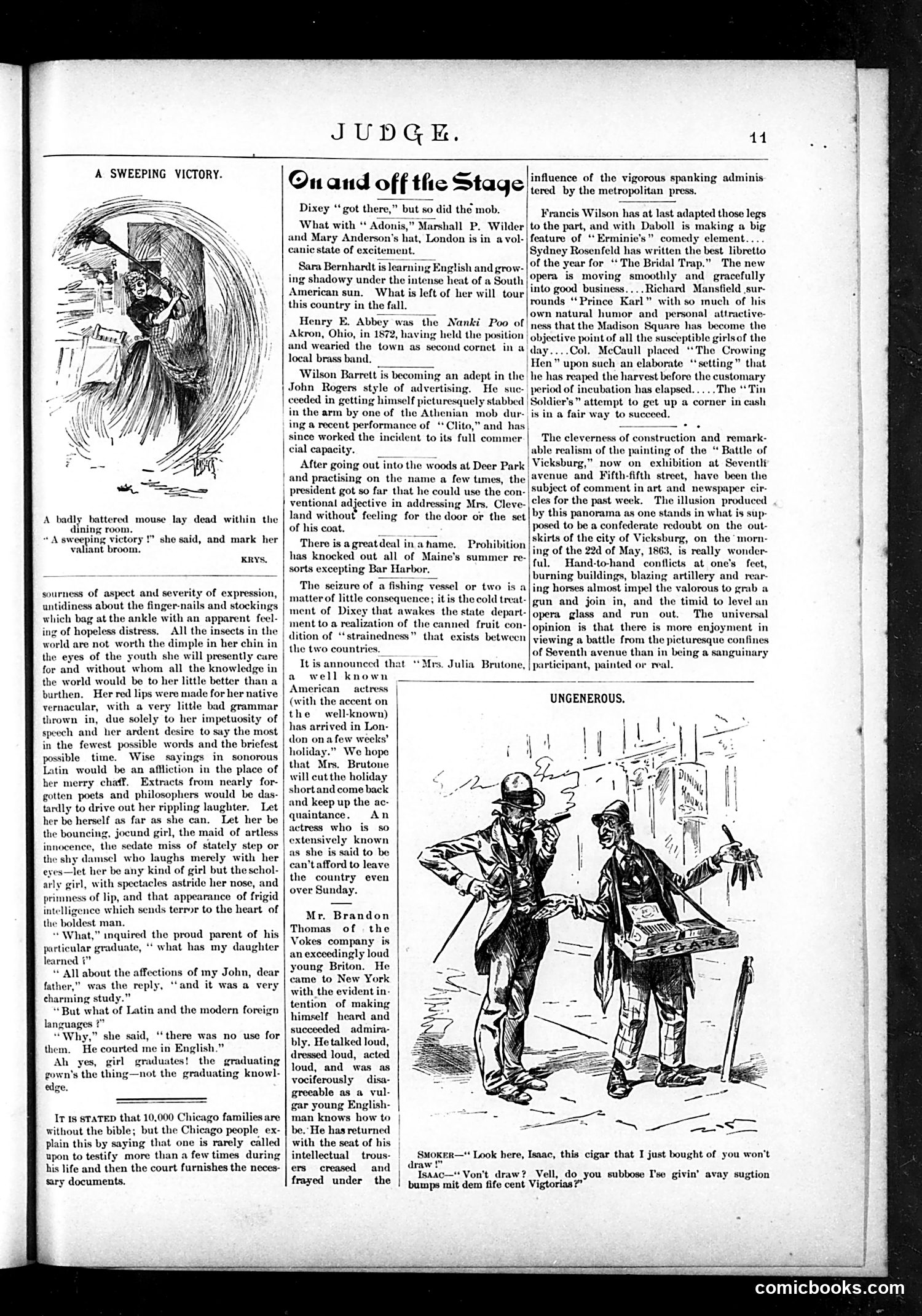
This page contains theatrical gossip and social commentary typical of Judge's "Amusements" section from the 1880s. **"A Sweeping Victory"** (top left cartoon): A woman has killed a mouse with a broom. The caption treats this mundane household task as if it were a military triumph—satirizing women's limited sphere of activity and achievement in Victorian society. **"Amusements/Off the Stage"** (main text): Brief, gossipy items about 1880s theater personalities including Sara Bernhardt, Mary Anderson, and others performing in London and America. References include "Adonis" (a popular musical), "Erminie," and "Clito"—contemporary theatrical productions. **"Ungenerous"** (right cartoon): Shows two men examining or discussing what appears to be a cigar, with dialogue about the product's quality—a common advertising joke format. The page represents Judge's mixture of illustrated humor and theatrical commentary aimed at educated urban readers interested in entertainment news and social satire.
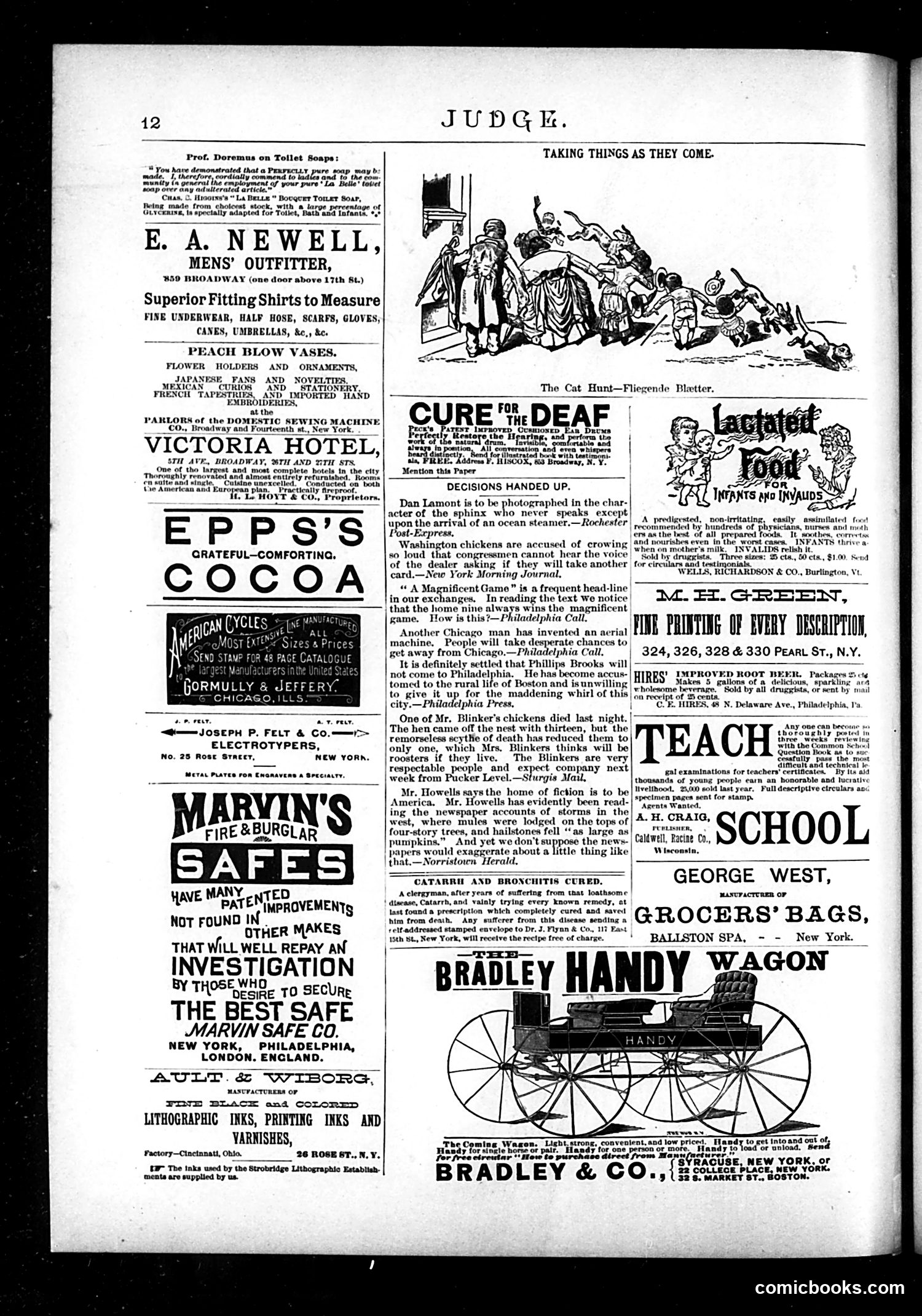
This is primarily an **advertising page** from Judge magazine, with limited editorial content. The main illustrated cartoon, titled "The Cat Hunt—Fliegende Blatter" (a reference to a German humor publication), shows a chaotic street scene of children chasing a cat—a simple, universal comedy gag requiring no historical context. Below that is a section called "Decisions Handed Up," which appears to be Judge's signature satirical commentary feature. These are brief, tongue-in-cheek "news items" mocking contemporary figures and absurdities: - **Dan Lamont** (Secretary of War under Cleveland) is joked about as silent as the Sphinx - **Washington chickens** supposedly crow so loudly congressmen can't hear dealers during card games—mocking both noisy Washington and corrupt gambling - **Phillips Brooks** (famous Boston clergyman) humorously refuses Philadelphia for Boston's "rural life" - Various other small-town newspaper absurdities are gently ridiculed The page is otherwise filled with period product advertisements (safes, cocoa, clothing, hotels), typical of 1880s-90s magazine layouts. The satire requires little explanation today—it's simply observational humor about contemporary politics and small-town life.
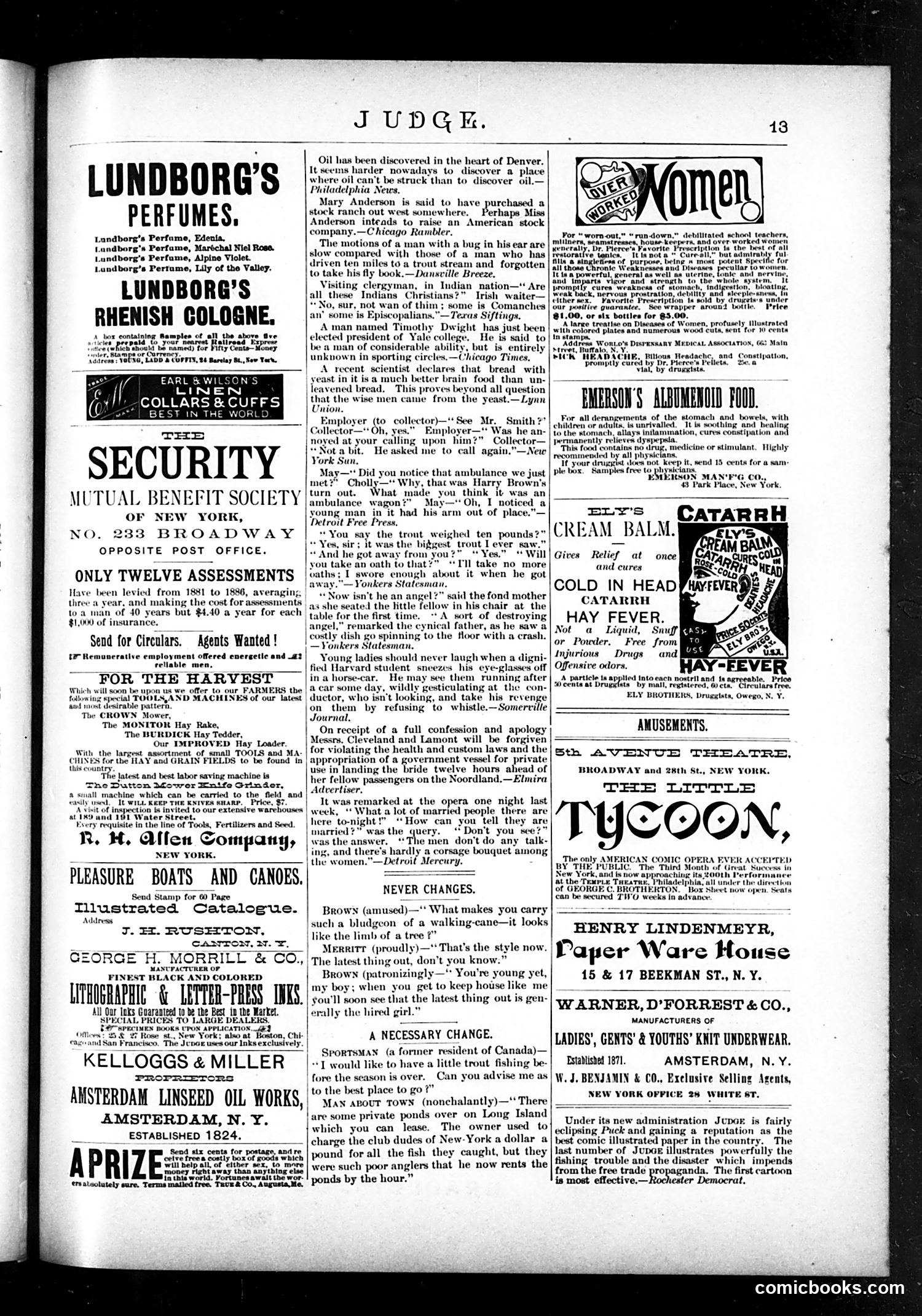
This page is primarily **advertising**, featuring various late-19th-century product advertisements (perfumes, farm equipment, ink manufacturers, linseed oil works). The small satirical content consists of brief humorous **anecdotes and jokes** scattered among ads, typical of Judge's format. Notable examples include: - **Oil discovery in Denver**: A dry joke about oil being discovered everywhere except where you'd expect it - **Timothy Dwight/yeast bread joke**: A pun suggesting "wise men came from yeast" (biblical reference to Magi) - **Trout fishing humor**: Multiple jokes about fishermen and their mishaps—reflecting the era's leisure culture - **Harvard student sneezing**: A joke about proper young ladies' behavior in public transit The cartoons appear to be small illustrations accompanying these jokes rather than major political commentary. The overall tone is **genteel, domestic humor** aimed at the magazine's middle-class readership—focusing on courtship, travel mishaps, and social etiquette rather than political satire. The page demonstrates Judge's mixed format of advertising revenue subsidizing satirical content.
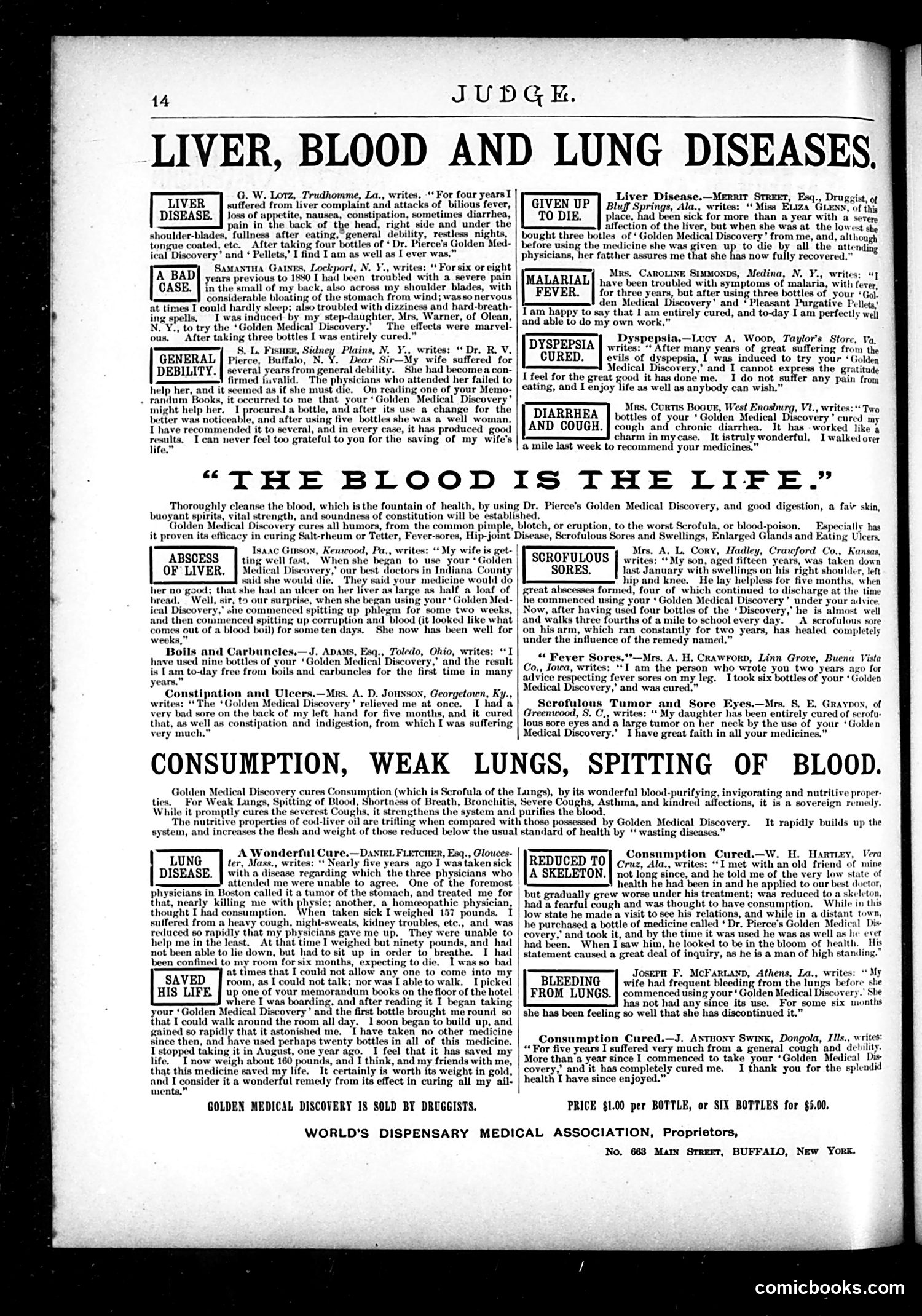
This page is almost entirely **patent medicine advertising**, not satire or editorial content. It's a full-page advertisement for "Dr. Pierce's Golden Medical Discovery," a commercial nostrum marketed as a cure-all for liver disease, consumption, malaria, dyspepsia, and lung ailments. The "content" consists of testimonial letters from purported patients describing miraculous recoveries. Notable: one woman was "given up to die" by physicians but recovered after three bottles. Another claims the product saved his wife's life. **Historical context**: This represents the pre-FDA era (pre-1906) when patent medicines made extravagant, unregulated health claims. The advertisements filled legitimate publications like *Judge* magazine. Modern readers should recognize these testimonials as unverified marketing claims—likely fabricated or cherry-picked. The motto "The Blood is the Life" invokes pseudo-scientific vitalism popular then. The product cost $1.00/bottle, manufactured by the "World's Dispensary Medical Association" in Buffalo, New York. This reveals how differently magazines monetized content and how credulously consumers accepted medical advertising before modern regulation.
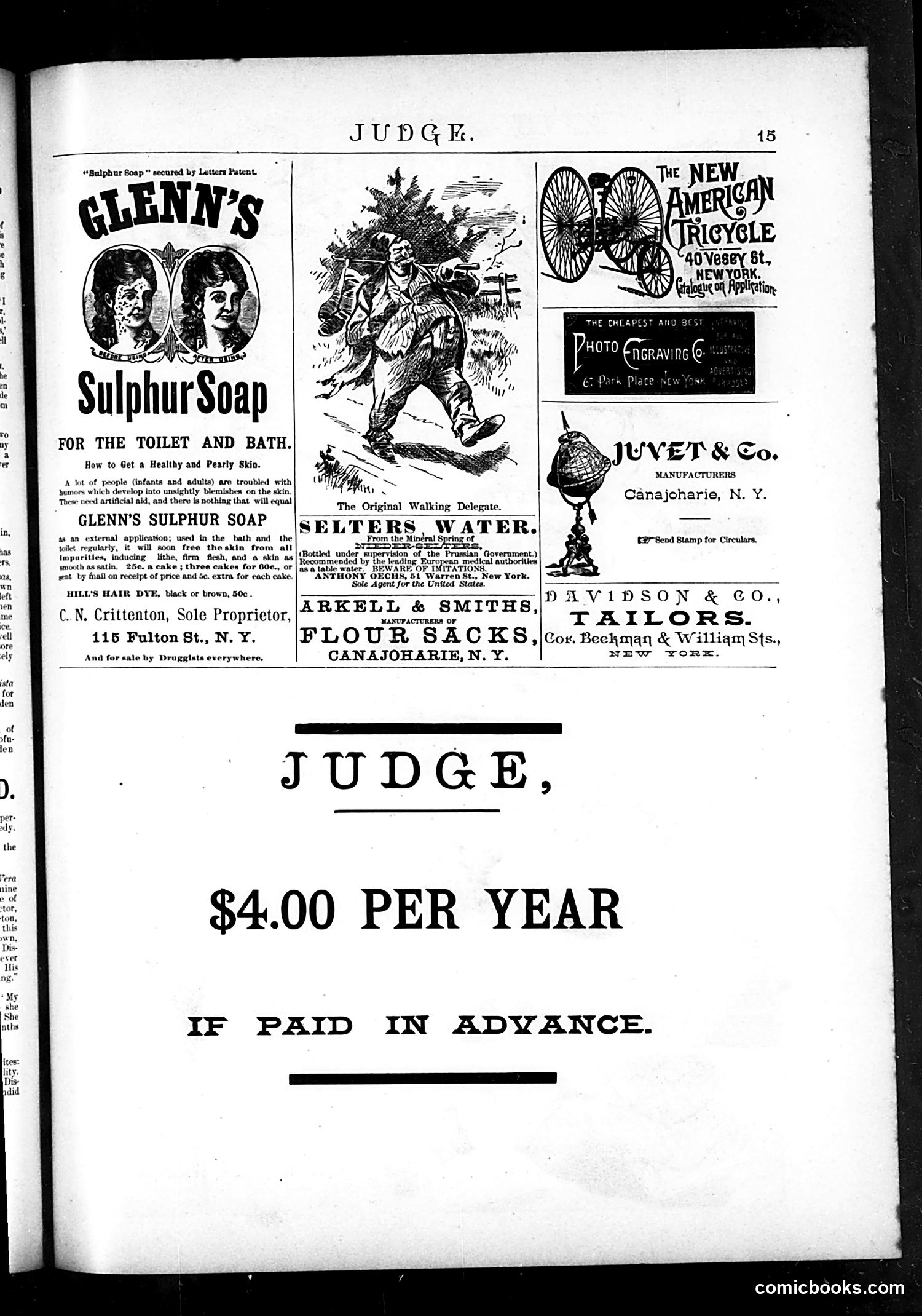
This page is primarily **advertisements** with one central political cartoon. The cartoon depicts "The Original Walking Delegate"—a figure carrying a large bundle, appearing to be a laborer or union representative. The caricature likely satirizes labor organizers or union delegates of the era, who were increasingly visible and controversial in 1880s-90s America. The "walking delegate" was a specific role: union representatives who moved between worksites organizing workers. To conservatives and business interests (Judge's audience), these figures represented disruption and socialist agitation. The exaggerated, somewhat grotesque depiction suggests the cartoon mocks them as troublemakers or buffoons. The satire's point: labor activism was viewed with suspicion by mainstream publications; organizers were portrayed as ridiculous rather than sympathetic figures advocating for workers' rights. The surrounding advertisements (soap, hair dye, flour sacks, tailors) represent typical period commerce—no political content.
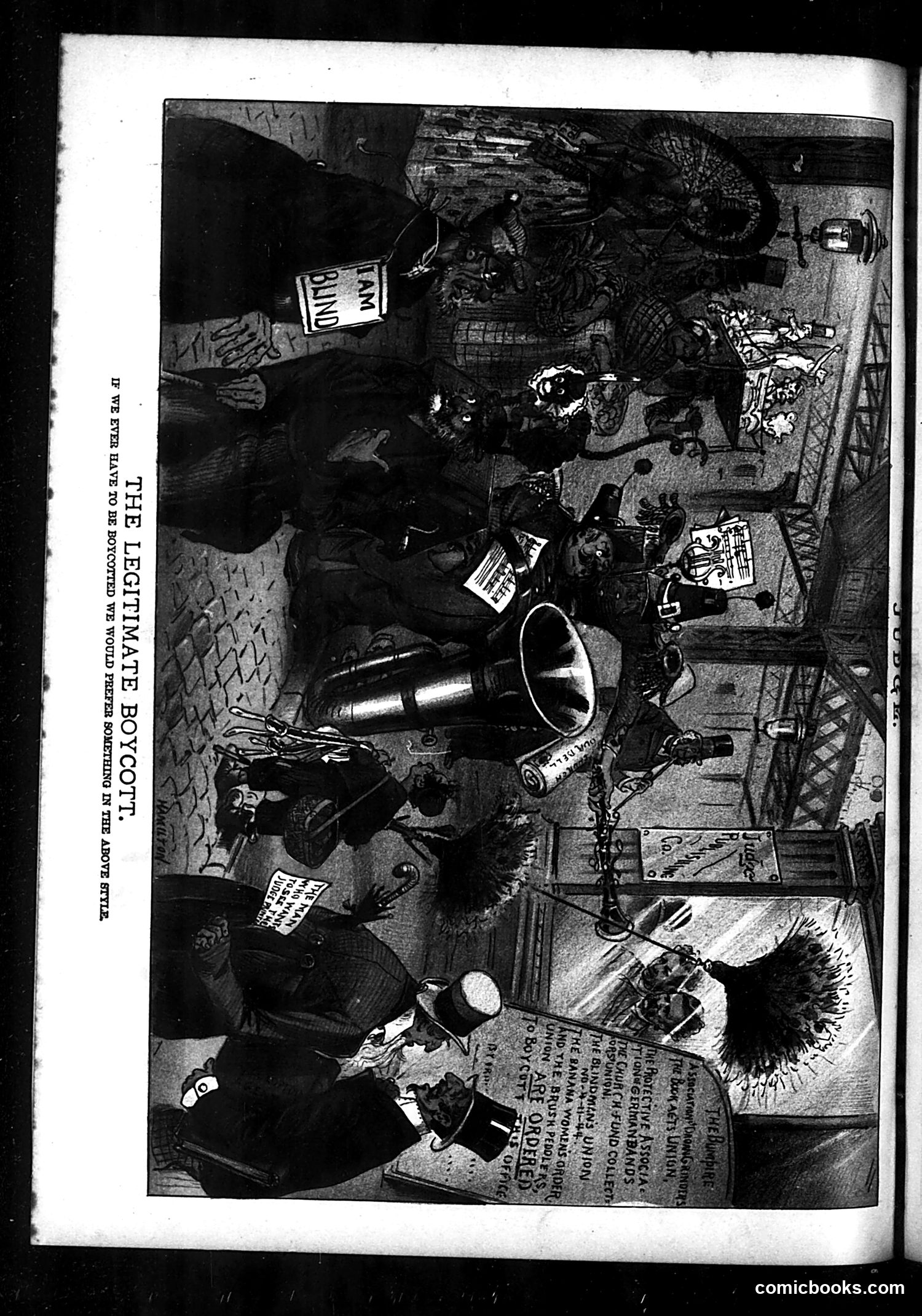
This Judge cartoon satirizes boycotts through exaggeration. The image shows a chaotic domestic scene—people arguing, furniture overturned, a megaphone prominent—depicting a "boycott" as violent household chaos rather than an organized economic protest. The caption suggests that if Judge magazine itself faced boycotting, they'd prefer it happen in this absurdly destructive manner rather than through actual organized consumer action, which would be more effective and threatening. The satire mocks both the messiness of labor disputes/boycotts (common in the era) and implies Judge finds the prospect of organized opposition laughable—better an impotent tantrum than a coordinated effort. It's simultaneously dismissive of boycott movements as disorderly and self-aware about their potential power.