
A complete issue · 18 pages · 1886
Judge — June 12, 1886
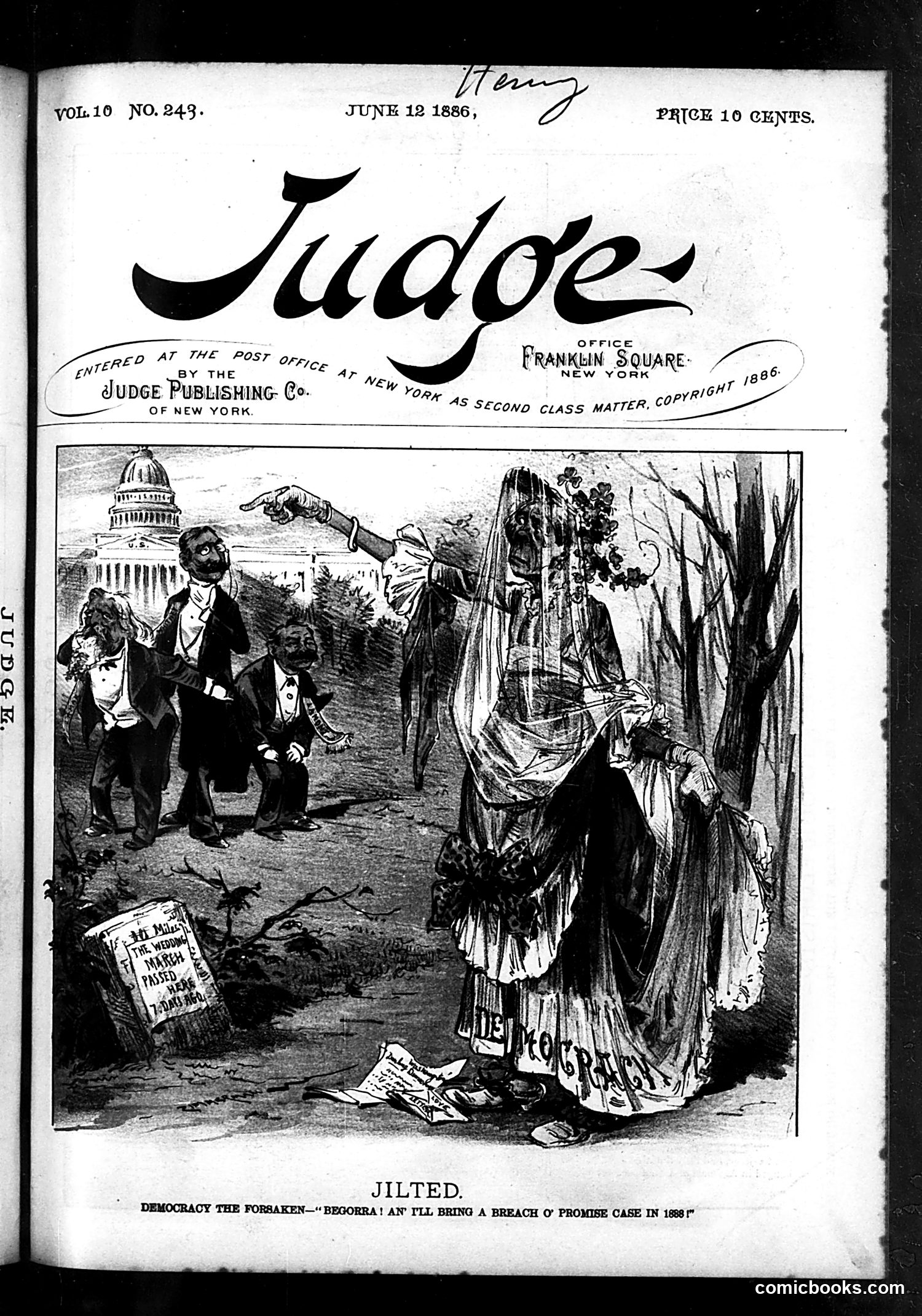
This political cartoon satirizes broken campaign promises. The caption reads: "Democracy the Forsaken—'Begorra! At I'll bring a breach o' promise case in 1888!'" The image shows a jilted woman in a wedding dress labeled "Democracy," abandoned by politicians in formal dress (likely representing the Democratic Party leadership). The Capitol building appears in the background. A gravestone marked with broken promises sits in the foreground. The satire criticizes Democratic politicians for failing to fulfill pledges made to their constituency ("Democracy"). The Irish accent in the caption ("Begorra") suggests this may reference Irish-American Democratic voters. The threat of a "breach of promise case in 1888" alludes to the upcoming 1888 presidential election, when voters might punish the party for unfulfilled commitments.
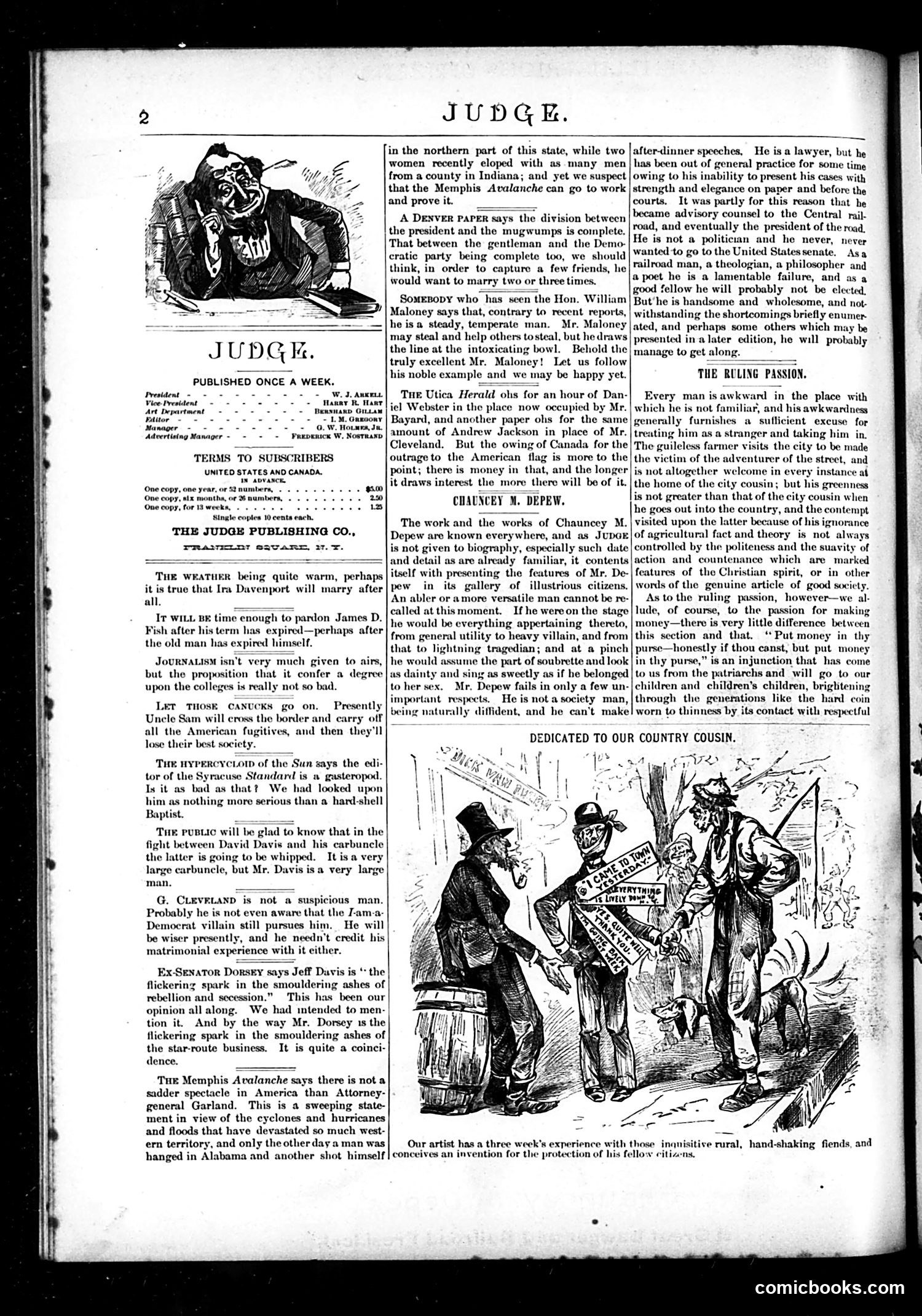
This page contains satirical commentary on late 19th-century American political figures. The main cartoon, "Dedicated to Our Country Cousin," depicts what appears to be rural or frontier characters encountering urban figures, likely satirizing the contrast between American rural and urban life or politics of that era. The text includes commentary on various public figures: William Maloney (described as "temperate"), Chauncy Depew (a prominent railroad lawyer and politician), and references to David Davis and G. Cleveland. The satire mocks these politicians' contradictions and failings—particularly regarding their public versus private behavior and their relationships with business interests. The overall tone criticizes political hypocrisy and the influence of wealthy interests on American governance during this period.
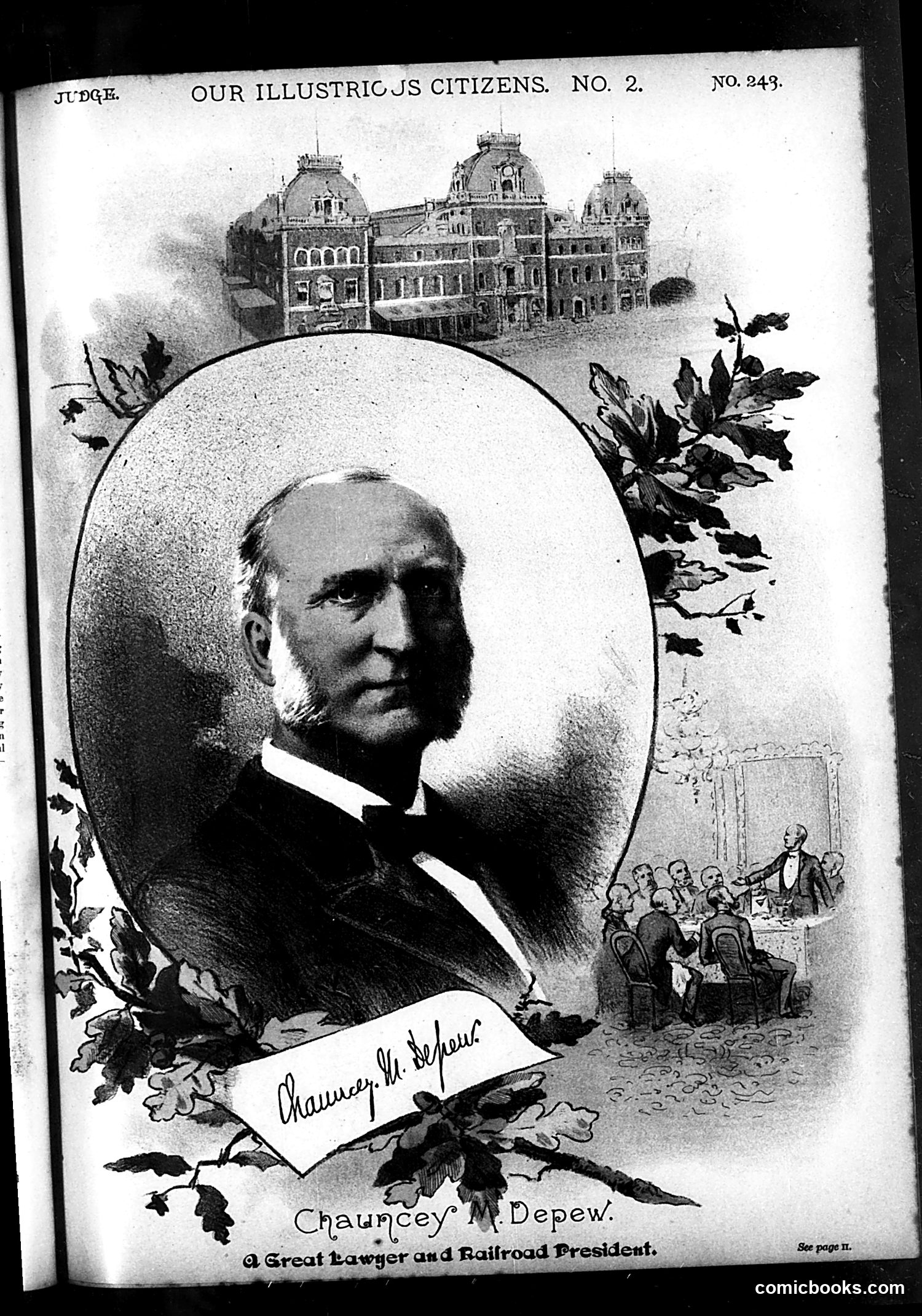
This is a profile of **Chauncey Depew**, identified as "a Great Lawyer and Railroad President." The engraving shows a distinguished older gentleman in formal attire, surrounded by decorative elements including a grand building (likely representing his professional achievements) and a formal meeting scene below. The page appears part of Judge magazine's "Illustrious Citizens" series, which typically profiled prominent American figures. Depew was a genuine Gilded Age railroad magnate and lawyer of significant power. Without additional satirical text visible, the "joke" may be gentle—celebrating or perhaps ironically inflating the importance of wealthy industrialists who dominated American public life in this era. The ornate treatment typical of such profiles could contain subtle mockery of their self-importance.

I cannot reliably read the OCR text from this page—it appears to contain only scattered letters and symbols without coherent words or phrases. The image itself shows what appears to be a blank or nearly blank page from a historical publication, with only faint marks and possible binding visible on the left edge. Without legible text or visible cartoon content, I cannot identify specific figures, political references, or satirical points. This may be a blank page, a page with very faded printing, or a scanning/OCR error. To provide accurate historical analysis, I would need a clearer image with readable content.
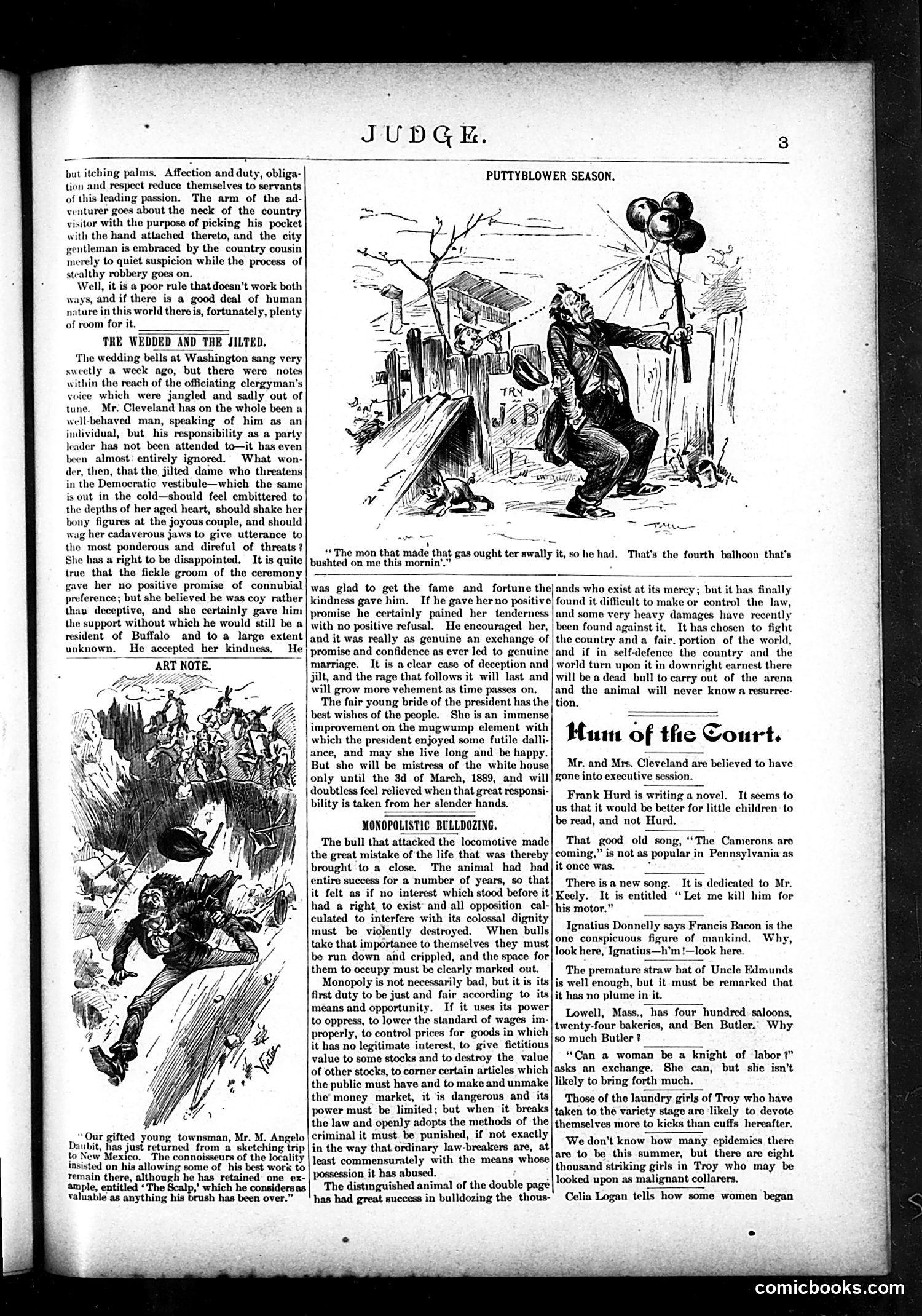
This page from the satirical magazine *Judge* contains multiple political commentaries: **"The Wedded and the Jilted"** (main article): A metaphorical critique of President Cleveland's relationship with the Democratic Party. The "jilted dame" represents the party faithful who feel betrayed—Cleveland promised support ("positive promise of connubial preference") but failed to deliver ("no positive refusal"), leaving them bitter as his term ends March 3, 1889. The "fair young bride" is his actual wife, whom the author praises as preferable to the "mugwump element" (Republicans who defected). **"Puttyblower Season"** (cartoon): Shows children playing with toy balloons that keep bursting. The dialect-heavy caption satirizes cheap, defective products—likely critiquing consumer fraud or shoddy manufacturing practices. **"Monopolistic Bulldozing"** (section): Uses a bull's attack on a locomotive as metaphor for monopolies overreaching their power and needing governmental restraint. The page reflects *Judge's* focus on political disappointment, consumer protection, and anti-monopoly sentiment in 1880s America.
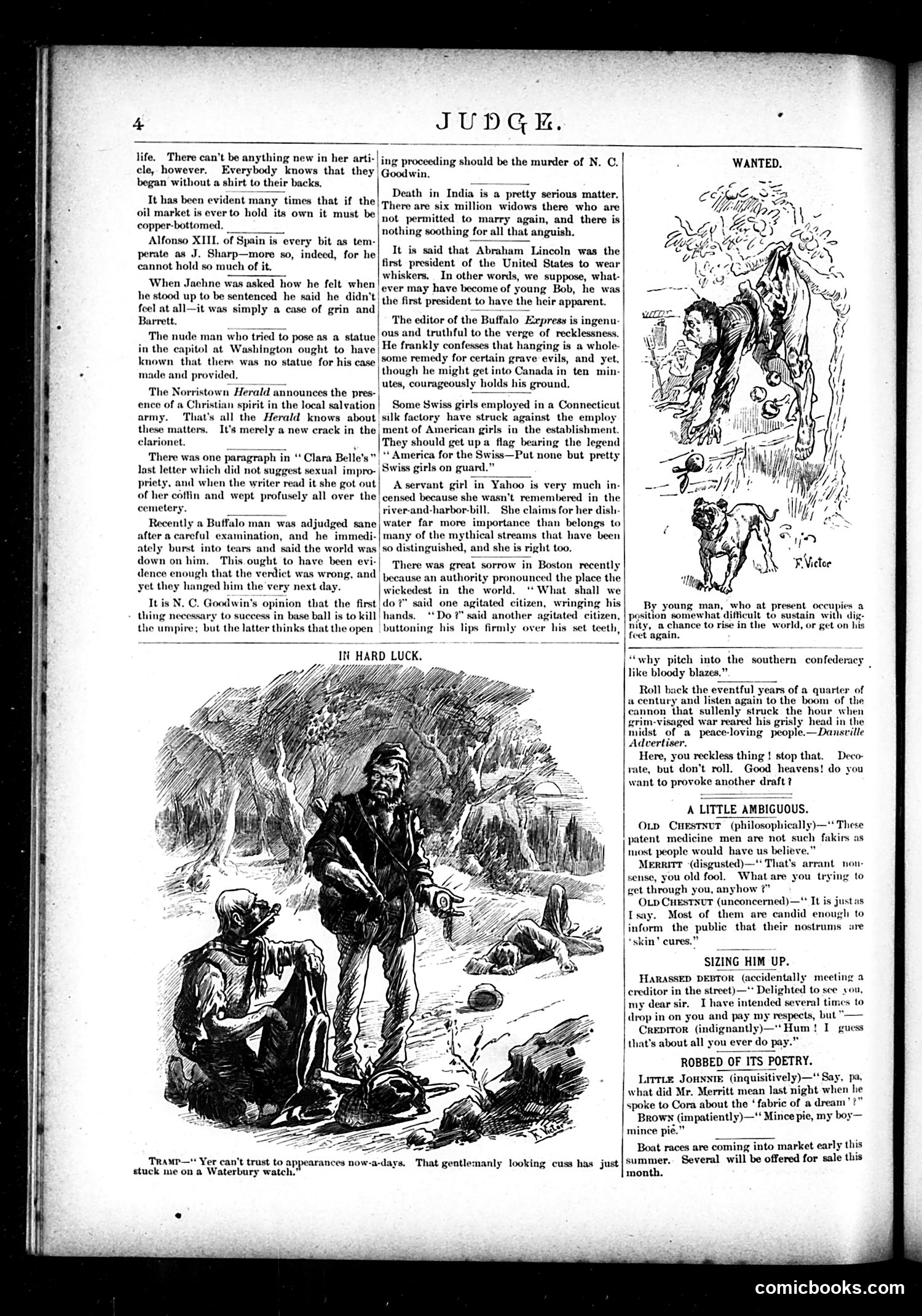
This page contains satirical commentary typical of Judge magazine's irreverent humor. The main cartoon, "In Hard Luck," depicts a tramp and another figure—likely social commentary on poverty and vagrancy. The caption suggests skepticism about judging people by appearances. The text above consists of brief satirical "items" mocking contemporary figures and issues: Alfonso XIII of Spain (regarding temperance/drinking), N.C. Goodwin (a baseball personality), Buffalo newspaper editors, Indian widow customs, and Swiss factory workers protesting American employment. The jokes rely on wordplay ("grin and Barrett"), legal absurdities (a man declared sane who then weeps), and social contradictions. The satire targets political figures, religious hypocrisy, labor disputes, and American exceptionalism—hallmarks of Judge's Gilded Age commentary. The magazine presents itself as society's critic, exposing pretension and illogic through brief, biting observations aimed at educated readers familiar with current events.
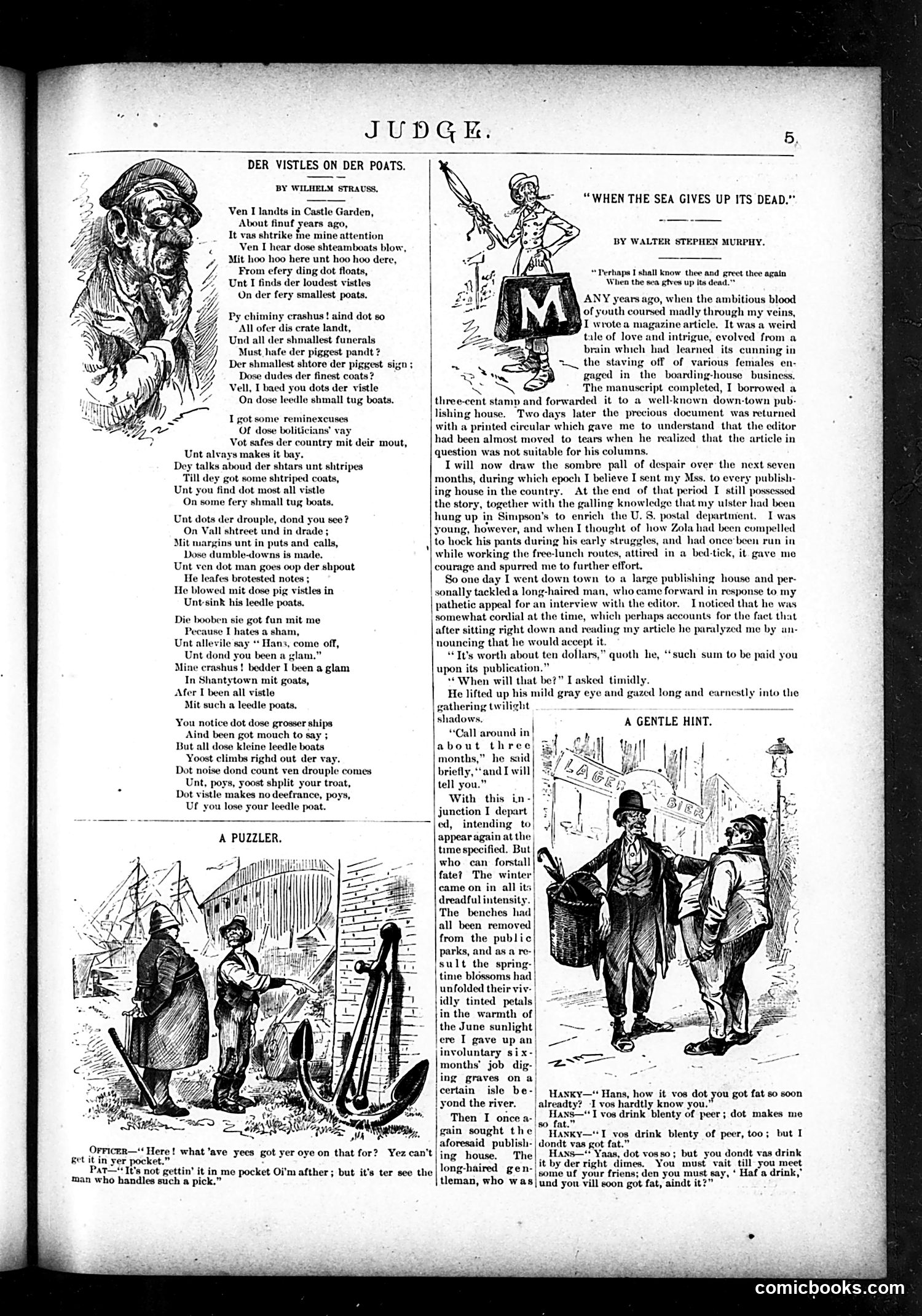
This page features German-immigrant satire mocking American pretension. Wilhelm Strauss's poem, written in exaggerated German-accented English, uses the metaphor of tugboats with disproportionately loud whistles to critique social hypocrisy: small, insignificant people and things making the most noise. The poem specifically targets politicians who "talk about der shtars unt shtripes" loudly while accomplishing little, and Wall Street speculators whose "dumble-downs" collapse spectacularly. The refrain suggests that bluster and self-promotion—"vistle"—matter more than actual substance or value in American society. "A Gentle Hint" depicts street workers, while "A Puzzler" shows dock laborers. The humor relies on ethnic stereotype humor common to 1880s-90s *Judge* magazine, using the immigrant perspective to satirize American corruption and vanity.
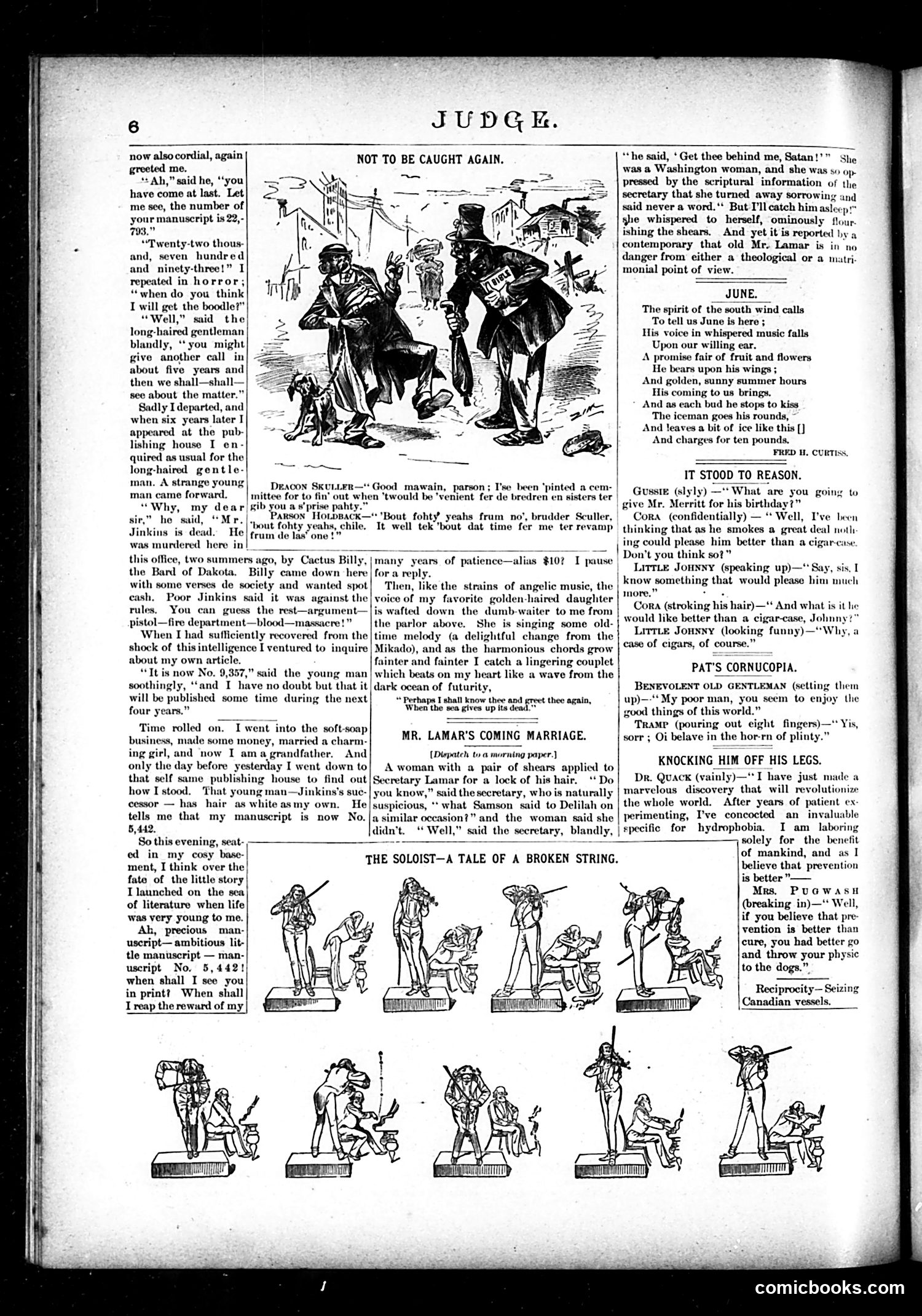
This page contains satirical sketches mocking American publishing and social pretensions circa the 1880s-90s. **Main narrative ("NOT TO BE CAUGHT AGAIN")**: A writer's comedic lament about manuscript submission. He submits work as #22,793, waits years for publication, returns to find the editor murdered, and discovers his manuscript is now #9,357—then later #5,442. The joke: publishing houses are absurdly slow and chaotic bureaucracies that lose or perpetually delay submissions. The murdered editor (apparently killed over payment to poet "Billy") adds dark humor. **"THE SOLOIST"**: Sequential illustrations showing a musician's string breaking mid-performance—visual slapstick humor. **"MR. LAMAR'S COMING MARRIAGE"**: Secretary of the Interior L.Q.C. Lamar was reportedly propositioned by a woman seeking a lock of his hair (likely for romantic purposes). The joke references the Samson/Delilah biblical story—the secretary warns her away with religious caution, humorously suggesting he fears feminine trickery. The page satirizes publishing delays, government figures, and romantic presumption through exaggeration and wordplay.
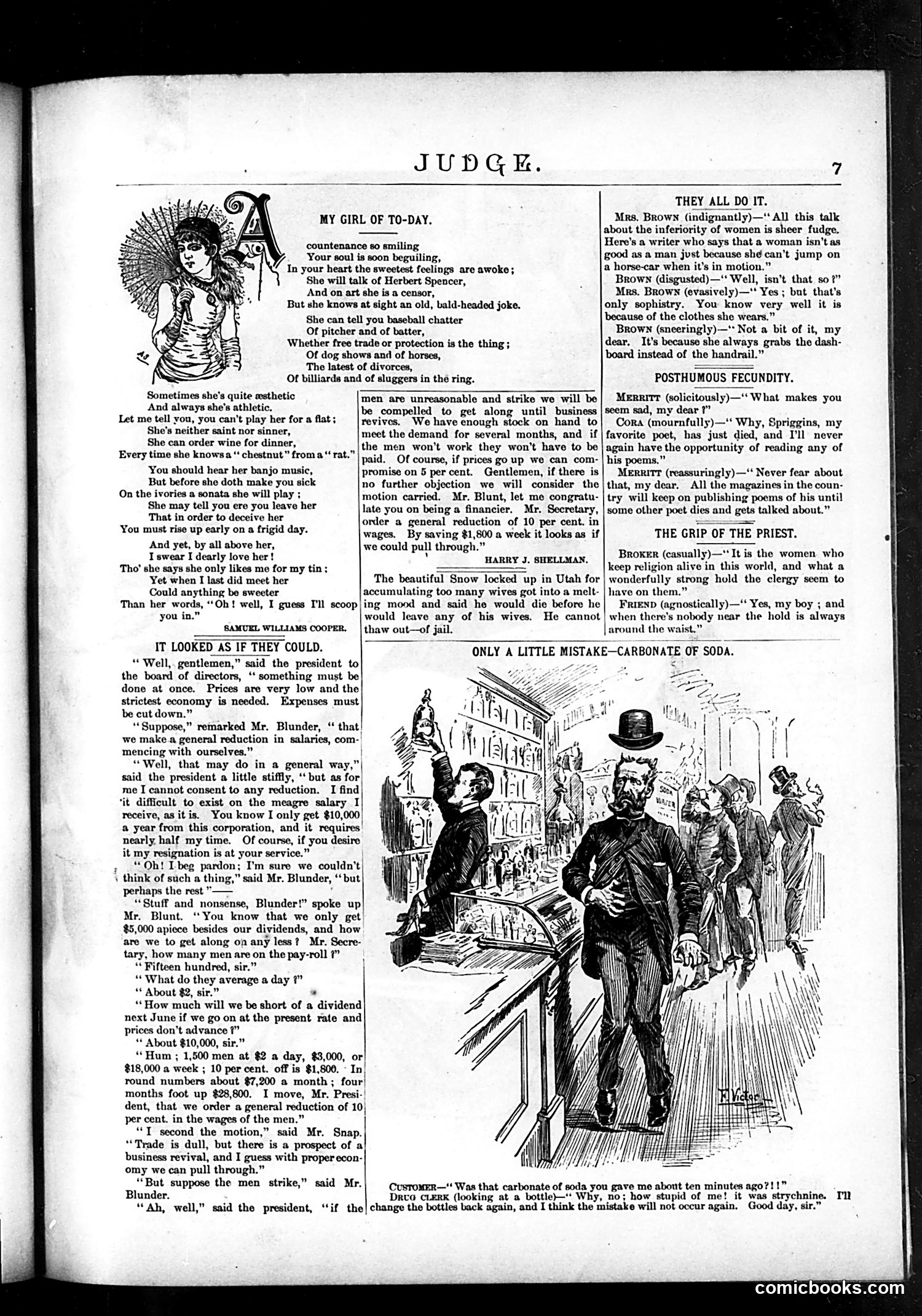
This cartoon satirizes incompetence in a pharmacy or apothecary shop. A druggist has apparently given a customer the wrong substance—carbonate of soda instead of what was requested—causing an unfortunate reaction. The customer complains about the mistake, while the druggist dismisses it casually, promising to "change the bottles back" and assuring him "the mistake will not occur again." The satire targets the casual negligence of service workers and their glib reassurances despite serious errors. In an era before modern pharmaceutical regulation, such mistakes could be genuinely dangerous, making the druggist's breezy attitude darkly comic. The cartoon mocks both professional incompetence and the false confidence with which mistakes are glossed over.
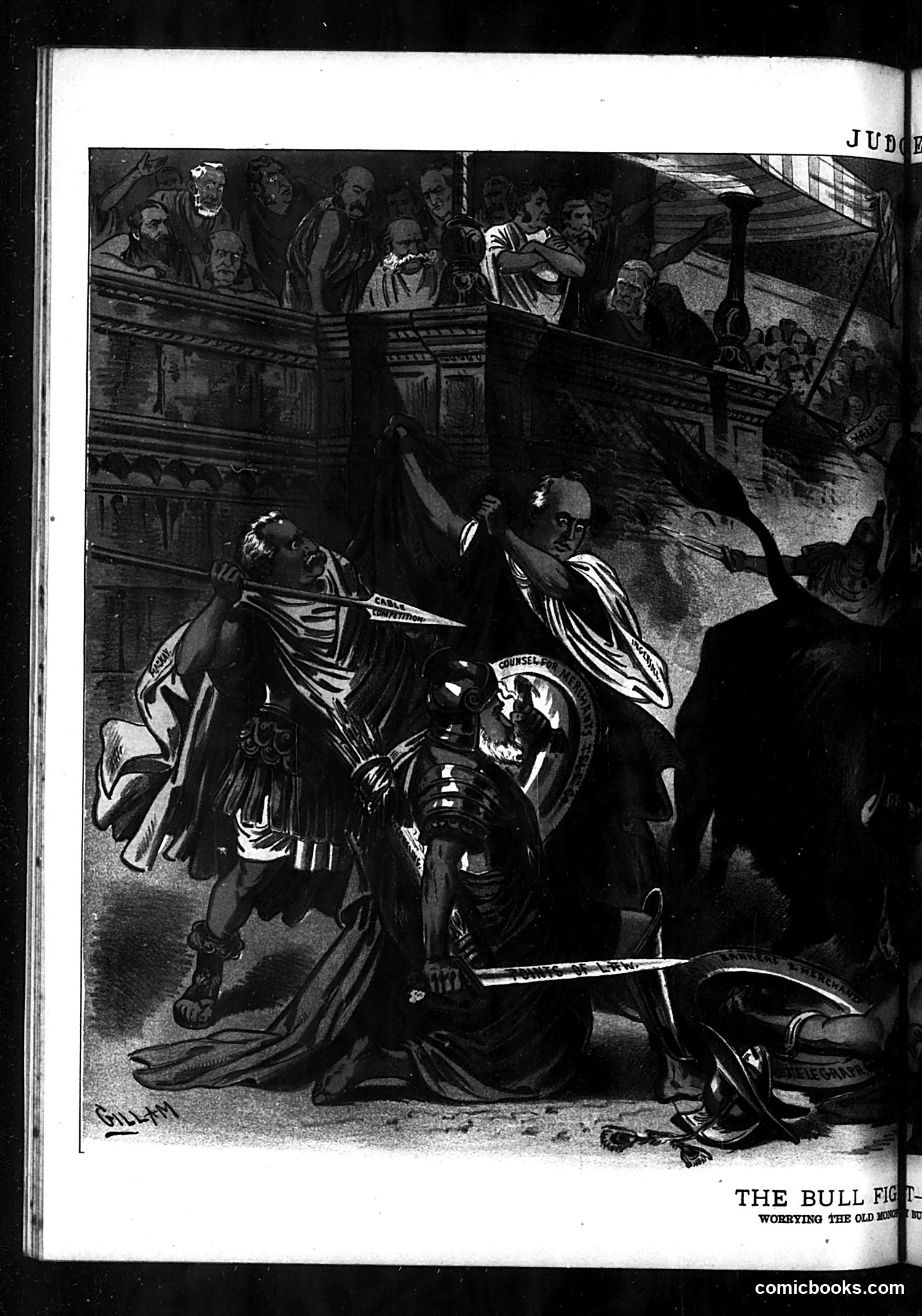
This political cartoon depicts a bullfighting scene as metaphor for political conflict. Two Roman soldiers (likely representing political opponents or factions) wield weapons against a figure labeled "the Old Man"—probably referring to an established political institution or aging leader being challenged. The amphitheater setting with spectators watching from above suggests public political theater. The soldiers' aggressive posture and the title "Worrying" indicates harassment or destabilization of traditional power. The cartoon's satire likely critiques contemporary political struggles, using the bullfight as symbol for how powerful institutions are being attacked or "worn down" by opposing forces. Without a date visible, the specific political conflict remains unclear, though the imagery suggests late 19th or early 20th-century American political tensions.
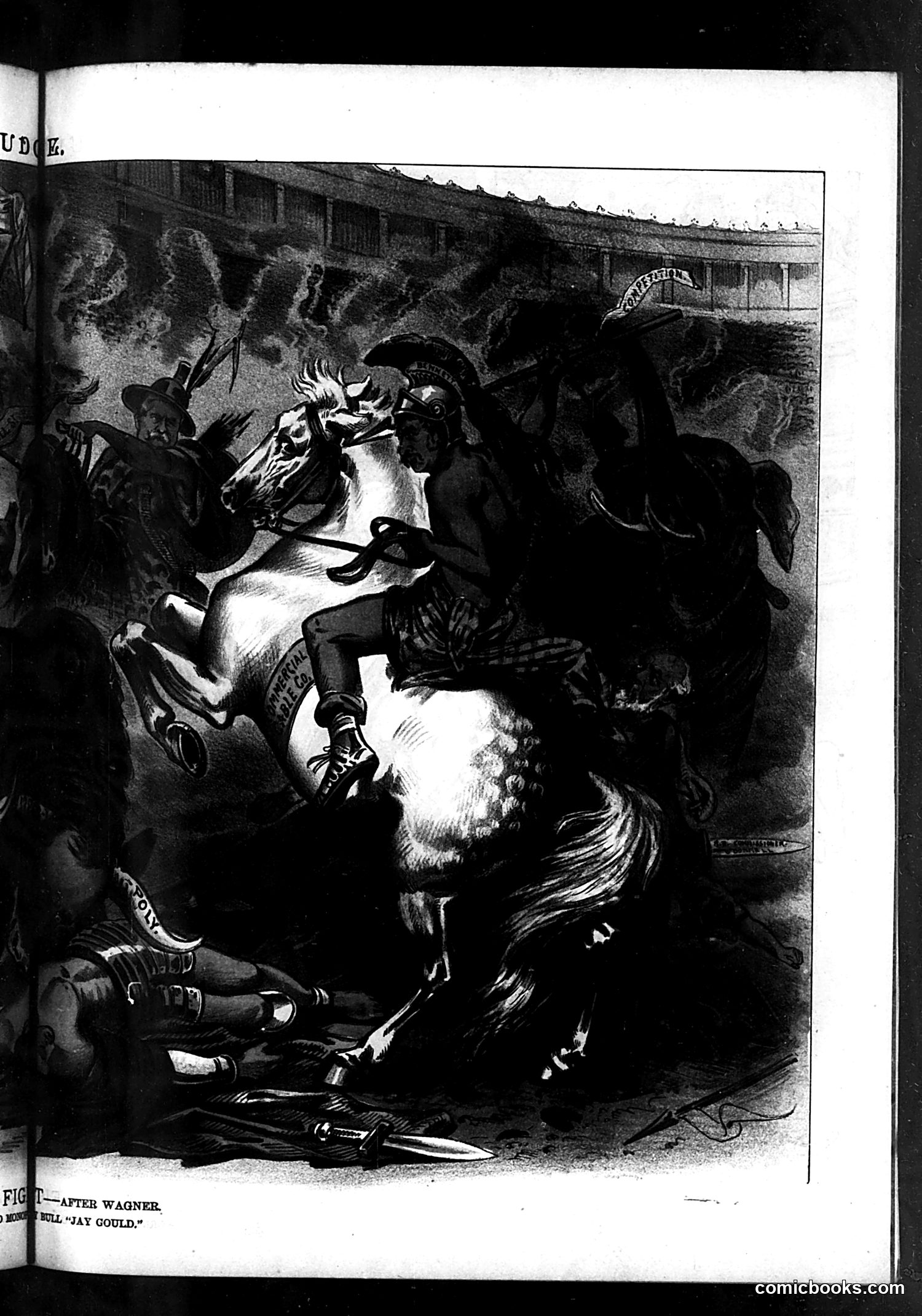
This appears to be a political cartoon titled "After Wagner" with a caption referencing "Jay Gould." The image depicts a dramatic scene in what looks like a circus or arena setting, with a rearing white horse that appears to be bucking or out of control. Multiple figures surround the scene, seemingly in distress or reacting to the chaos. The cartoon likely satirizes Jay Gould, the controversial Gilded Age railroad magnate and financier. The "After Wagner" reference and circus setting suggest this may be mocking Gould's financial recklessness or unpredictable business dealings—comparing them to an uncontrollable horse creating chaos. However, without additional context about the specific date and Wagner reference, the exact satirical target remains unclear.
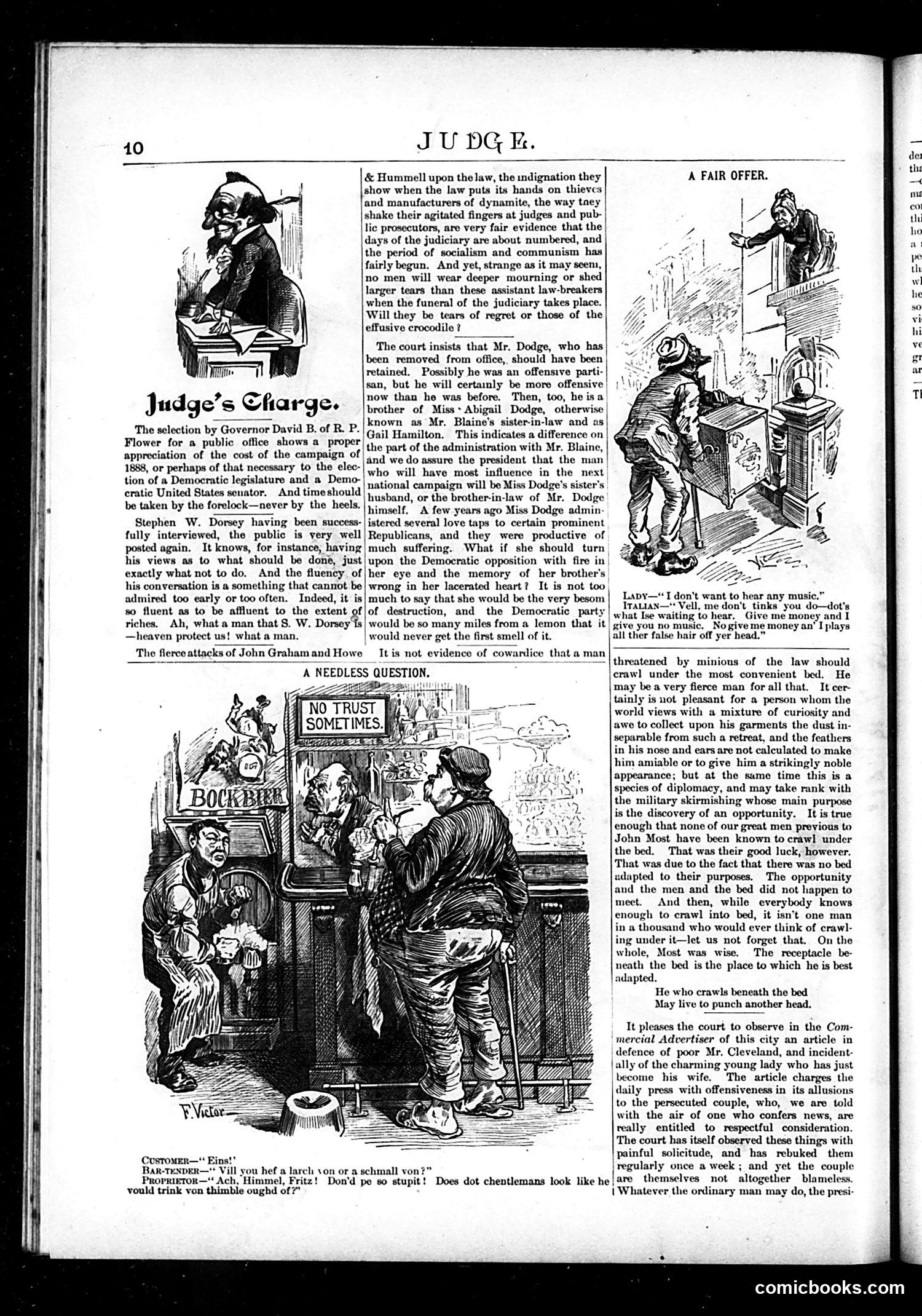
This page contains three distinct political cartoons and commentaries from Judge, a satirical publication: 1. **"Judge's Charge"**: Commentary on Governor David B. Flower's appointment of an official, criticizing political patronage related to the 1888 campaign and Democratic politics. 2. **"A Needless Question"**: A cartoon mocking a German-accented bartender ("Bockbier") and his "NO TRUST SOMETIMES" sign—satirizing both immigrant speech patterns and credit practices of the era. 3. **"A Fair Offer"**: A brief comic exchange between a woman and an Italian street musician, playing on ethnic stereotypes and the crude behavior of street performers. The longer editorial text discusses removed official Mr. Dodge, his connection to Republican Gail Hamilton (sister-in-law of James Blaine), and implications for Democratic politics—suggesting partisan grievances could influence upcoming campaigns. The cartoons employ period-typical ethnic caricature and mockery of immigrant populations common to 1880s American political satire.
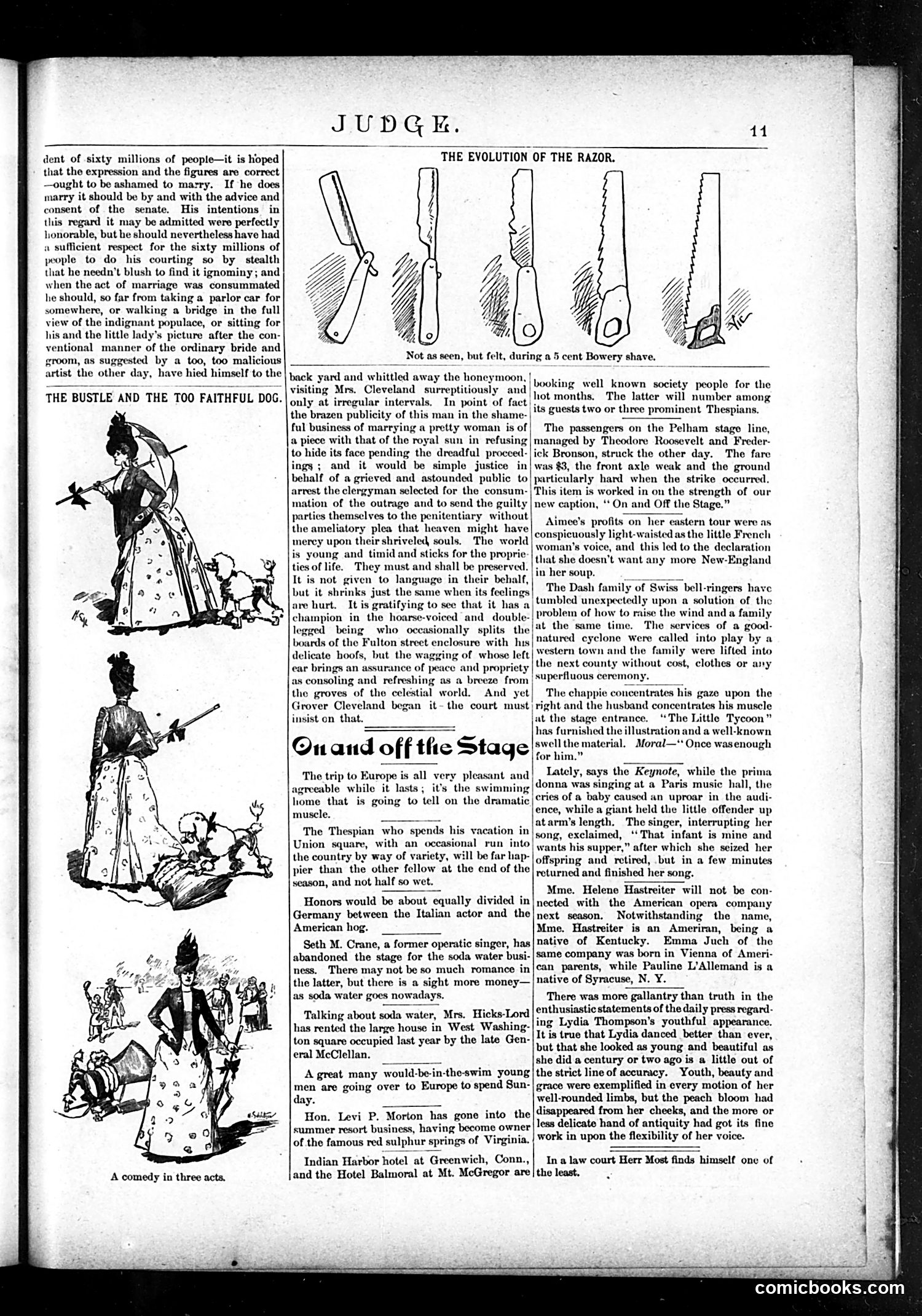
This page satirizes President Grover Cleveland's recent marriage to Frances Folsom, a scandal that shocked Victorian sensibilities. The main editorial ridicules Cleveland for publicly courting and marrying—behavior the author considers disrespectful to the nation's sixty million citizens. The writer argues the president should have conducted courtship secretly and avoided public displays like honeymoon travel or posed photographs. The cartoon illustrations labeled "A comedy in three acts" mock conventional wedding sentimentality through exaggerated domestic scenes. The page also contains miscellaneous gossip items about theatrical figures and society people, including references to operatic singer Seth Crane abandoning performance for soda water business, and Vice President Levi P. Morton entering the resort business. The "Evolution of the Razor" diagram at top appears unrelated—likely advertising or filler content.
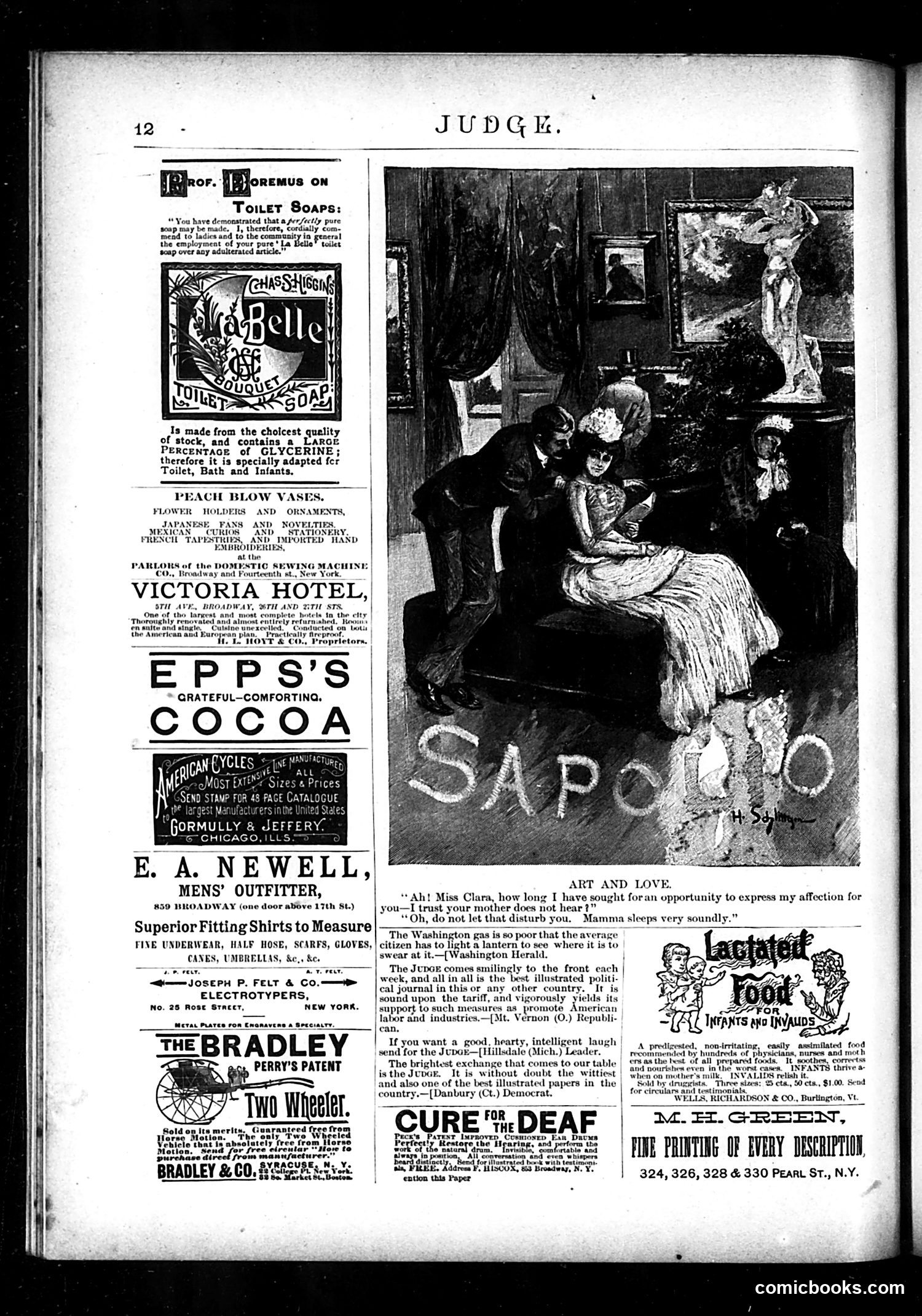
This page is primarily **advertising**, with one small cartoon titled "Art and Love" in the upper right. The cartoon depicts a domestic scene: a man leans toward a seated woman (Miss Clara), declaring his affection while asking if her mother can hear. Clara's reply—"Mamma sleeps very soundly"—is the joke's punchline, suggesting she's willing to receive his romantic advances without parental interference. The humor is gentle Victorian-era courtship satire: it mocks the social convention of chaperoning (mothers supervising unmarried women) and plays on the tension between propriety and desire. The cartoon suggests that young women were constrained by strict maternal oversight, making private moments with suitors rare and precious. The page otherwise consists of period advertisements for toilet soap, hotels, shirts, cocoa, bicycles, printing services, and other goods—typical of Judge's revenue model. The publication promoted itself (via quoted praise) as witty, well-illustrated, and sound on the tariff question.
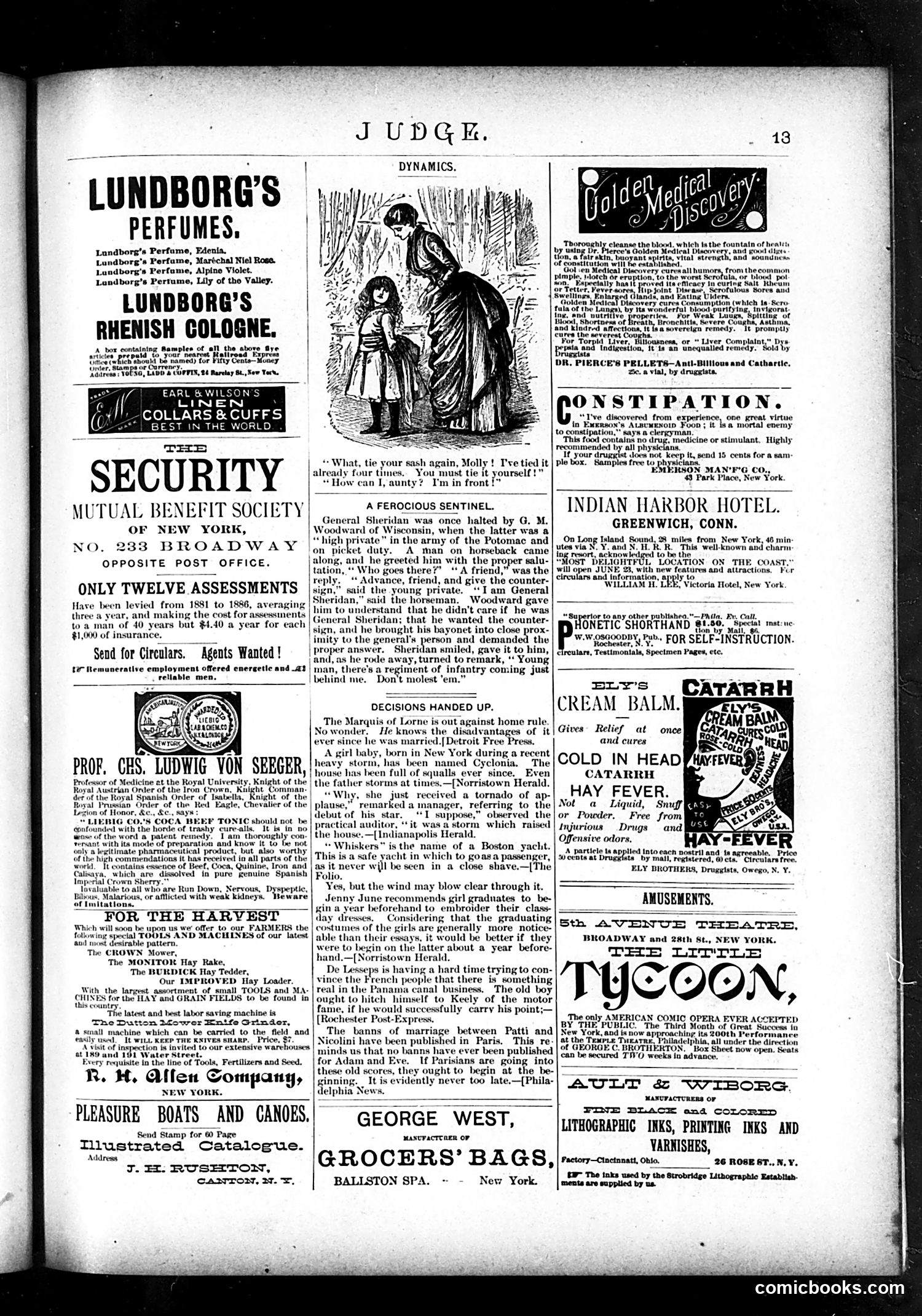
This page is primarily **advertising**, typical of late 19th-century magazines. However, it contains two brief satirical pieces in the "DYNAMICS" section: 1. **"What, tie your sash again, Molly?"** - A mild joke about a child unable to tie her own sash, relying on an adult repeatedly. The humor is domestic and gentle. 2. **"A Ferocious Sentinel"** - An anecdote about General Philip Sheridan during the Civil War, stopped at a military checkpoint by a young private soldier who demands the proper password. The joke is that the private doesn't recognize Sheridan and insists on protocol despite his rank—the "ferocious" private is humorously rigid about duty. The page also includes brief jokes under "DECISIONS HANDED UP" about the Marquis of Lorne (resisting home rule) and a newborn named Cyclonia (puns on weather/storms). The rest is commercial advertising for perfumes, insurance, and farm equipment—standard for *Judge* magazine.
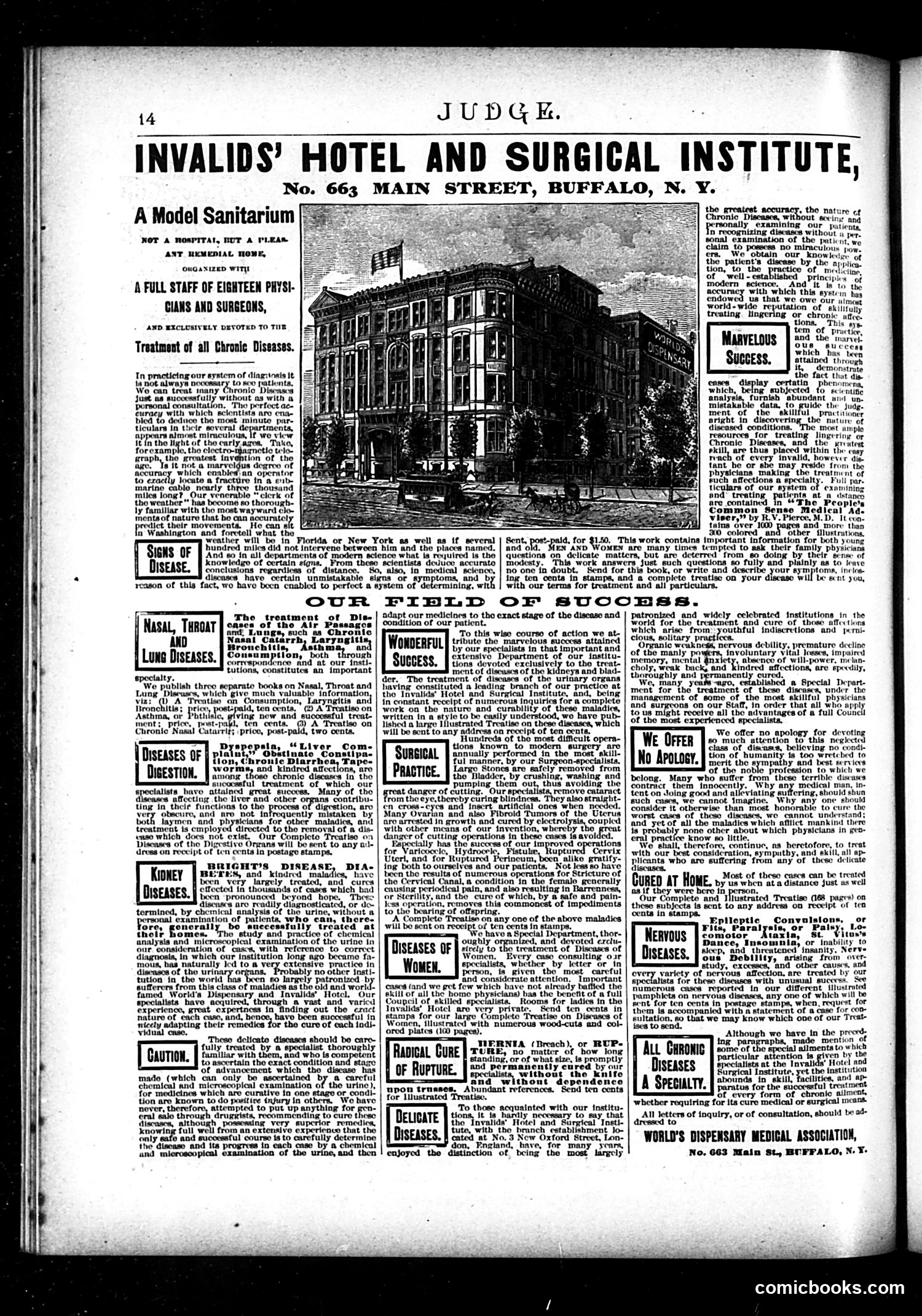
This page is primarily **advertising, not satire or political cartoon content**. It's a full-page advertisement for the "Invalids' Hotel and Surgical Institute" in Buffalo, New York — a mail-order medical practice claiming to diagnose and treat chronic diseases without in-person examination. The text makes extraordinary claims: doctors can diagnose patients from distance just as telegraph operators locate cable breaks thousands of miles away, or as weather forecasters predict conditions. The ad promises that by sending ten cents (in stamps) and describing symptoms, patients receive diagnosis and treatment advice. This represents **late 19th-century medical quackery**. The Institute offers mail-order treatment of diseases involving organs, kidneys, liver, and nervous ailments, with titles like "Radical Cure of Rupture" and "Hernia." For a modern reader: this reveals how unregulated American medicine once was, allowing practitioners to advertise wildly implausible diagnostic abilities before FDA oversight and medical licensing became standard. The ad's confident tone masks what we'd recognize today as fraudulent medical practice.
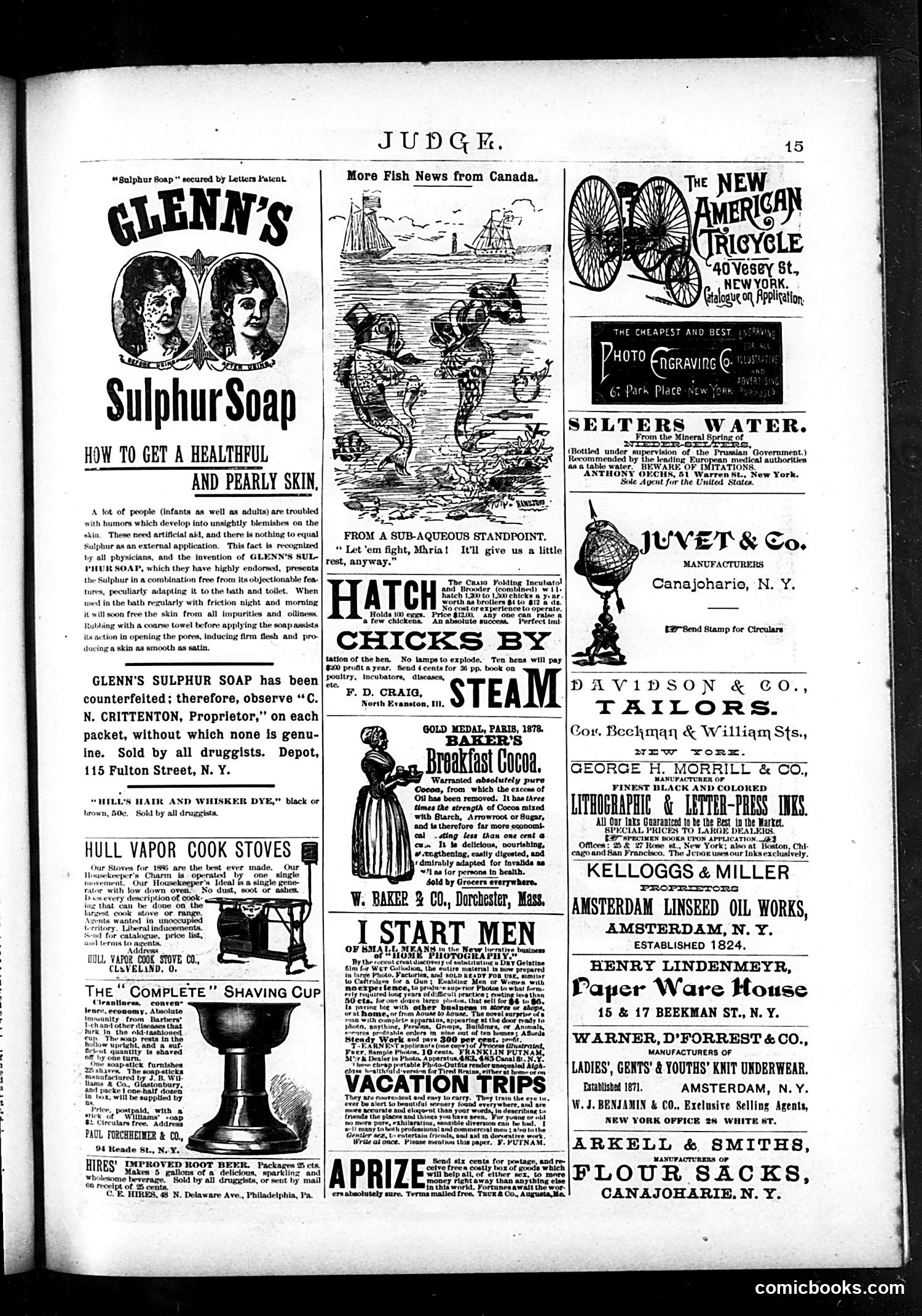
This page is primarily **advertisements**, not political cartoons. The editorial cartoon shown is small and titled "FROM A SUB-AQUEOUS STANDPOINT," depicting two fish observing humans fighting above water with the quip "Let 'em fight, Maria! It'll give us a little rest, anyway." The joke appears to reflect **contemporary labor unrest or social conflict** of the 1890s—the implication being that while humans are distracted fighting each other, they leave nature (here, fish populations) undisturbed. This is a light satirical commentary on human disputes and their unintended consequences. The rest of the page consists of patent medicine advertisements, household goods, and commercial products typical of Judge magazine's revenue model—including soaps, cook stoves, and food products with exaggerated health claims common to the era.
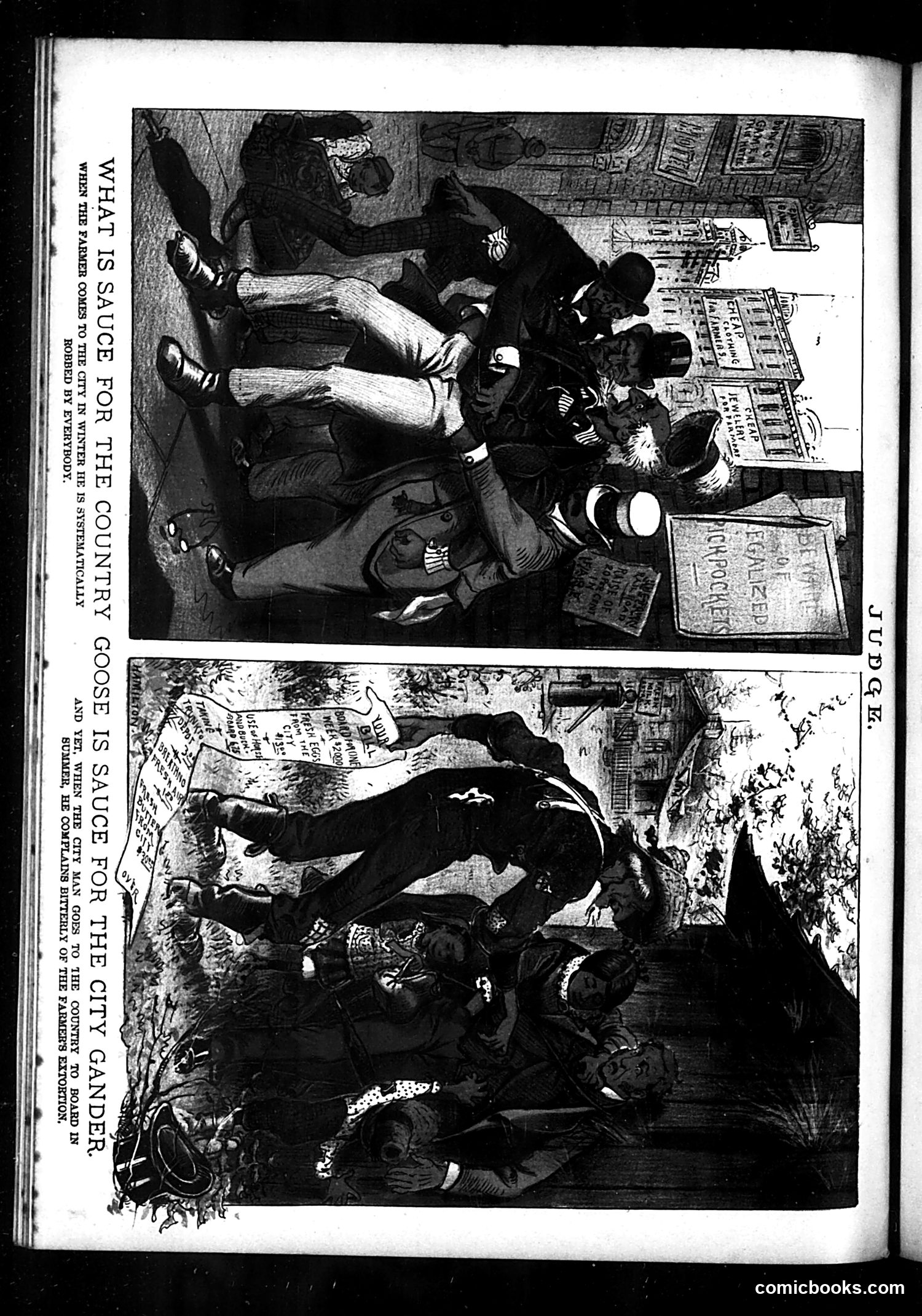
This cartoon presents a satirical comparison of economic exploitation between rural and urban populations. The caption establishes the central irony: both farmers and city dwellers systematically rob each other. The top panel shows a city visitor being fleeced by urban merchants and service providers during winter. The bottom panel depicts a city boarder being overcharged by rural farmers during summer. The satire criticizes the hypocrisy and mutual resentment between these two economic groups. City dwellers complain about farmers' "extortion" when buying produce in summer, yet when they visit the country as paying guests, they themselves become victims of the same exploitative pricing they condemn. Conversely, farmers are robbed by city merchants in winter when they visit. The phrase "sauce for the goose is sauce for the gander" means what's fair for one should be fair for all—here applied ironically to show neither group acknowledges their own similar predatory behavior. The satire critiques economic inequality and hypocritical standards between rural and urban America.