
Judge, 1886-06-12 · page 5 of 18
Judge — June 12, 1886 — page 5: what you’re looking at
What you’re looking at
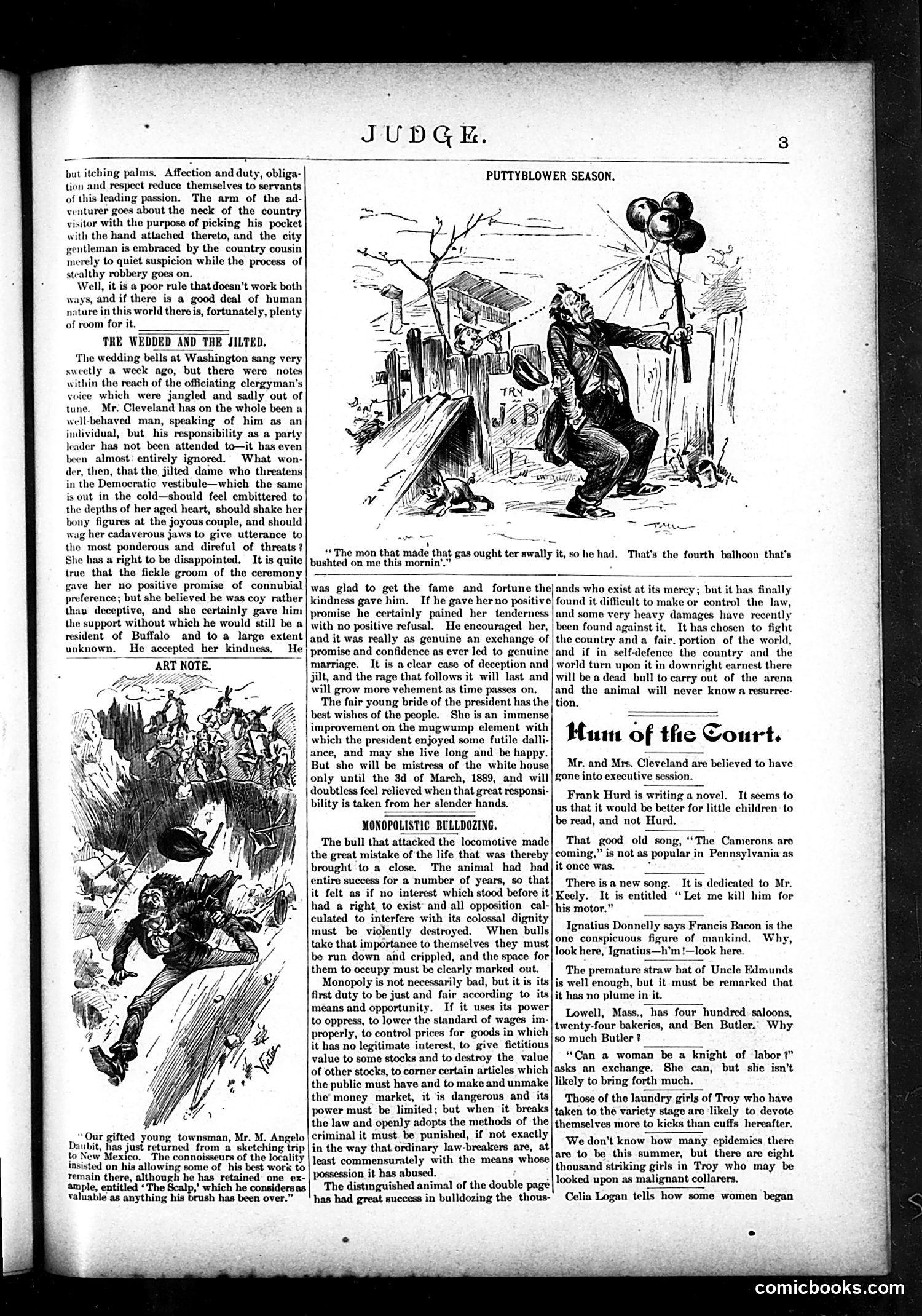
This page from the satirical magazine *Judge* contains multiple political commentaries: **"The Wedded and the Jilted"** (main article): A metaphorical critique of President Cleveland's relationship with the Democratic Party. The "jilted dame" represents the party faithful who feel betrayed—Cleveland promised support ("positive promise of connubial preference") but failed to deliver ("no positive refusal"), leaving them bitter as his term ends March 3, 1889. The "fair young bride" is his actual wife, whom the author praises as preferable to the "mugwump element" (Republicans who defected). **"Puttyblower Season"** (cartoon): Shows children playing with toy balloons that keep bursting. The dialect-heavy caption satirizes cheap, defective products—likely critiquing consumer fraud or shoddy manufacturing practices. **"Monopolistic Bulldozing"** (section): Uses a bull's attack on a locomotive as metaphor for monopolies overreaching their power and needing governmental restraint. The page reflects *Judge's* focus on political disappointment, consumer protection, and anti-monopoly sentiment in 1880s America.
📄 Transcribed text from this page (OCR, searchable)
Machine-transcribed from the original scan — historical spelling and the odd misread are preserved.
but itching palms, Affection and duty, obliga- tion and respect reduce themselves to servants of this leading passion. The arm of the ad- venturer goes about the neck of the country visitor with the purpose of picking his pocket with the hand attached thereto, and the city gentleman is embraced by the country cousin merely to quiet suspicion while the process of stealthy robbery goes on. Well, it is a poor rule thatdoesn’t work both ways, and if there is a good deal of human nature in this world there is, fortunately, plenty of room for it. THE WEDDED AND THE JILTED. The wedding bells at Washington sang very sweetly a week ago, but there were notes within the reach of the officiating clergyman’s voice which were jangled and sadly out of tune. Mr. Cleveland has on the whole been a well-behaved man, speaking of him as an individual, but his responsibility as a party leader has not been attended to—it has even been almost: entirely ignored. What won- der, then, that the jilted dame who threatens in the Democratic vestibule—which the same is out in the cold—should feel embittered to the depths of her aged heart, should shake her bony figures at the joyous couple, and should wag her cadaverous jaws to give utterance to the most ponderous and direful of threats? She has a right to be disappointed. It is quite true that the fickle groom of the ceremony gave her no positive promise of connubial preference; but she believed he was coy rather thav deceptive, and she certainly gave him the support without which he would still be a resident of Buffalo and to a large extent He accepted her kindn “Our gifted young townsman, Mr. M. Angelo Daubit, has just returned from a sketching trip to New Mexico. The connoisseurs of the locality insisted on his allowing some of his best work to remain there, although he has retained one ex- ample, entitled ‘The Scalp,’ which he considersas valuable as anything his brush has been over.” PUTTYBLOWER SEASON. 4 eee “The mon that made that gas ought ter swally it, so he had. That's the fourth balhoon that's bushted on me this mornin’.” was glad to get the fame and fortune the If he gave her no positive kindness gave him. promise he certainly pained her tenderness with no positive refusal. He encouraged her, and it was really as genuine an exchange of promise and confidence as ever led to genuine marriage. It is a clear case of deception and jilt, and the rage that follows it will last and will grow more vehement as time passes on. The fair young bride of the president has the best wishes of the people. She is an immense improvement on the mugwump element with which the president enjoyed some futile dalli- ance, and may she live long and be happy. But she will be mistress of the white house only until the 3d of March, 1889, and will doubtless feel relieved when that great responsi- bility is taken from her slender hands. MONOPOLISTIC BULLDOZING. The bull that attacked the locomotive made the great mistake of the life that was thereby brought to a close. The animal had had entire success for a number of years, so that it felt as if no interest which stood before it had a right, to exist’ and all opposition. cal- culated to interfere with its colossal dignity must be violently destroyed. When bulls take that importance to themselves they must be run down and crippled, and the space for |them to occupy must be clearly marked out. Monopoly is not necessarily bad, but it is its first duty to be just and fair according to its means and opportunity. If it uses its power to oppress, to lower the standard of wages im- properly, to control prices for goods in which it has no legitimate interest, to give fictitious value to some stocks and to destroy the value of other stocks, to corner certain articles which the public must have and to make and unmake the money market, it is dangerous and its power must be limited; but when it breaks the law and openly adopts the methods of the criminal it must be punished, if not exactly in the way that ordinary law-breakers are, at least commensurately with the means whose possession it has abused. : The distinguished animal of the double page has had great success in bulldozing the thous- ands who exist at its merey; but it has finally found it difficult to make or control the law, and some very heavy damages have recently been found against it, It has chosen to fight the country and a fair. portion of the world, and if in selflefence the country and the world turn upon it in downright earnest there will be a dead bull to carry out of the arena and the animal will never know a resurrec- | tion. Mum of the Court. Mr. and Mrs. Cleveland are believed to have gone into executive session. Frank Hurd is writing a novel. It seems to us that it would be better for little children to be read, and not Hurd. That good old song, “The Camerons are coming,” is not as popular in Pennsylvania as it once was, i There is a new song. It is dedicated to Mr. Keely. It is entitled ‘Let me kill him for his motor.” Ignatius Donnelly says Francis Bacon is the one conspicuous figure of mankind. Why, look here, Ignatius—h'm !—look here. The premature straw hat of Uncle Edmunds is well enough, but it must be remarked that it has no plume in it, Lowell, Mass., has four hundred: saloons, twenty-four bakeries, and Ben Butler. Why so much Butler ¢ “Can a woman be a knight of labor?” asks an exchange. She can, but she isn't likely to bring forth much. Those of the laundry girls of Troy who have taken to the variety stage are ‘likely to devote themselves more to kicks than cuffs hereafter. We don't know how many epidemics there are to be this summer, but there are eight thousand striking girls in Troy who may be looked upon as malignant collarers, Celia Logan telis how some women began