
A complete issue · 16 pages · 1886
Judge — June 5, 1886
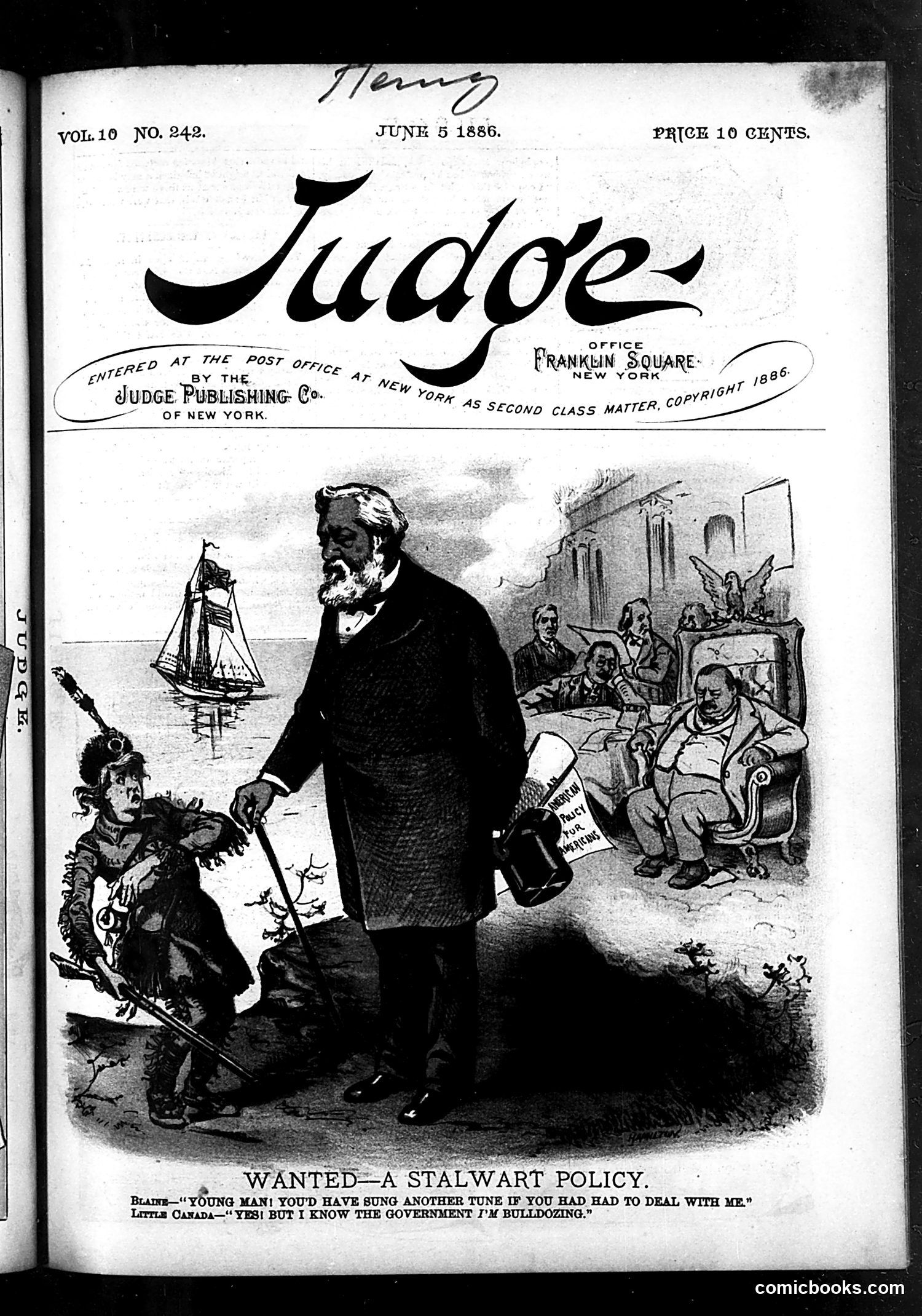
This June 5, 1886 *Judge* cartoon satirizes Republican political strategy regarding Canada. The bearded gentleman (likely a Republican leader or policy figure) holds a document labeled "STALWART POLICY" while addressing "Little Canada," represented as a small, somewhat foolish figure. The caption reads: "Young man! You'd have been better off if you'd had to deal with me" / "Yes! But I know the government I'm bulldozing." The satire criticizes Republican "stalwart" (hardline conservative) approaches as ineffectual bluster. The background shows observers discussing trade or diplomatic matters. The ship and figures suggest commercial/colonial policy debates of the era. The cartoon mocks Republican posturing as mere intimidation ("bulldozing") without substantive policy.
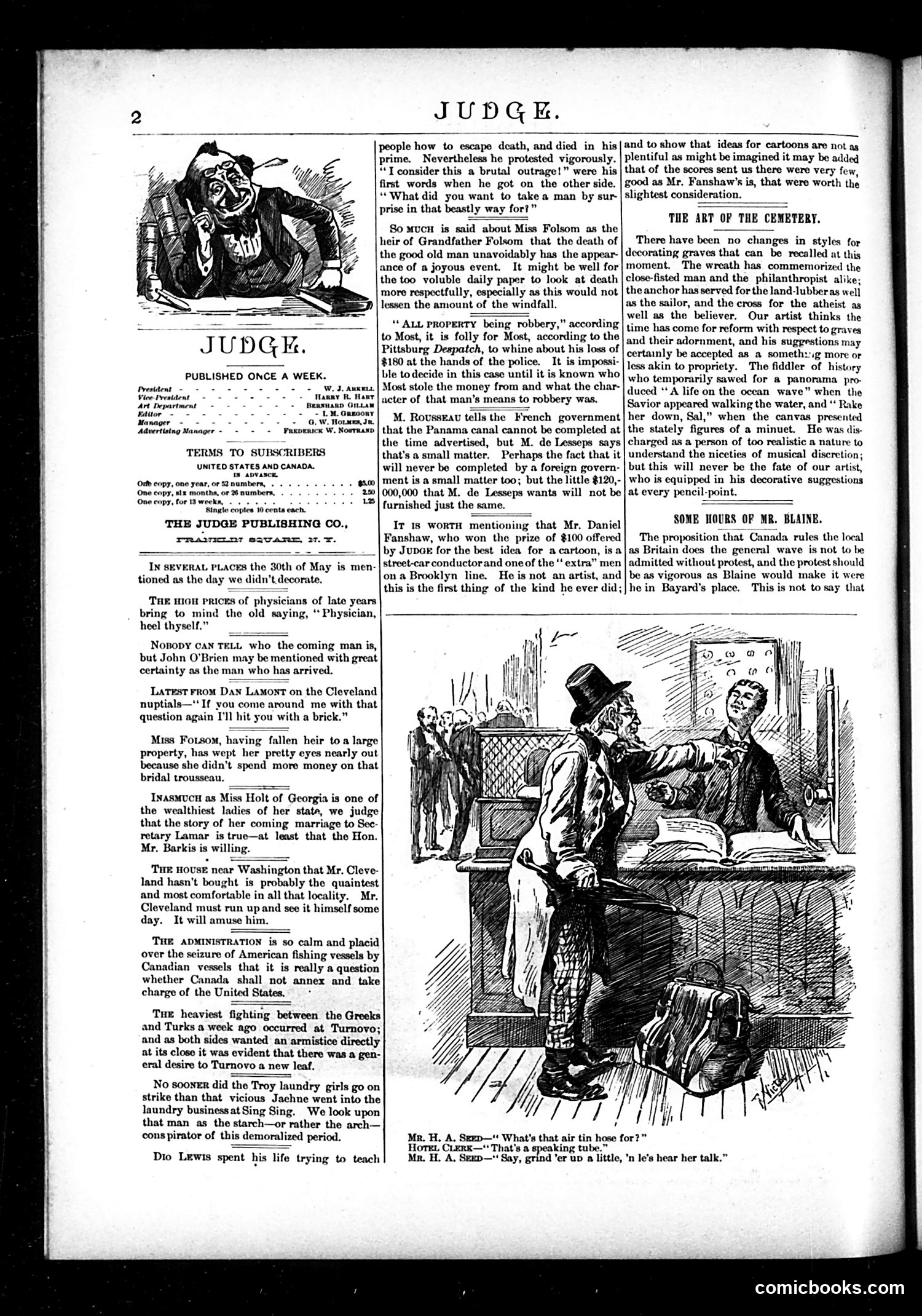
This page primarily contains miscellaneous editorial commentary rather than a cohesive political cartoon. The visible cartoon depicts a hotel or boarding house scene with a man in a top hat attempting to rent a room. The caption references "a speaking tube" and suggests wordplay about hearing someone talk—likely a mild domestic humor joke about eavesdropping through building communication systems. The text snippets address various topics: Miss Folsom's inheritance, the Panama Canal's completion, Daniel Fanshaw's cartoon prize, and Canadian-British relations regarding fishing vessels. Most commentary appears light and gossipy rather than hard political satire. Without clearer visual identification of specific caricatured figures or dated references, the deeper satirical intent remains unclear from this page alone.
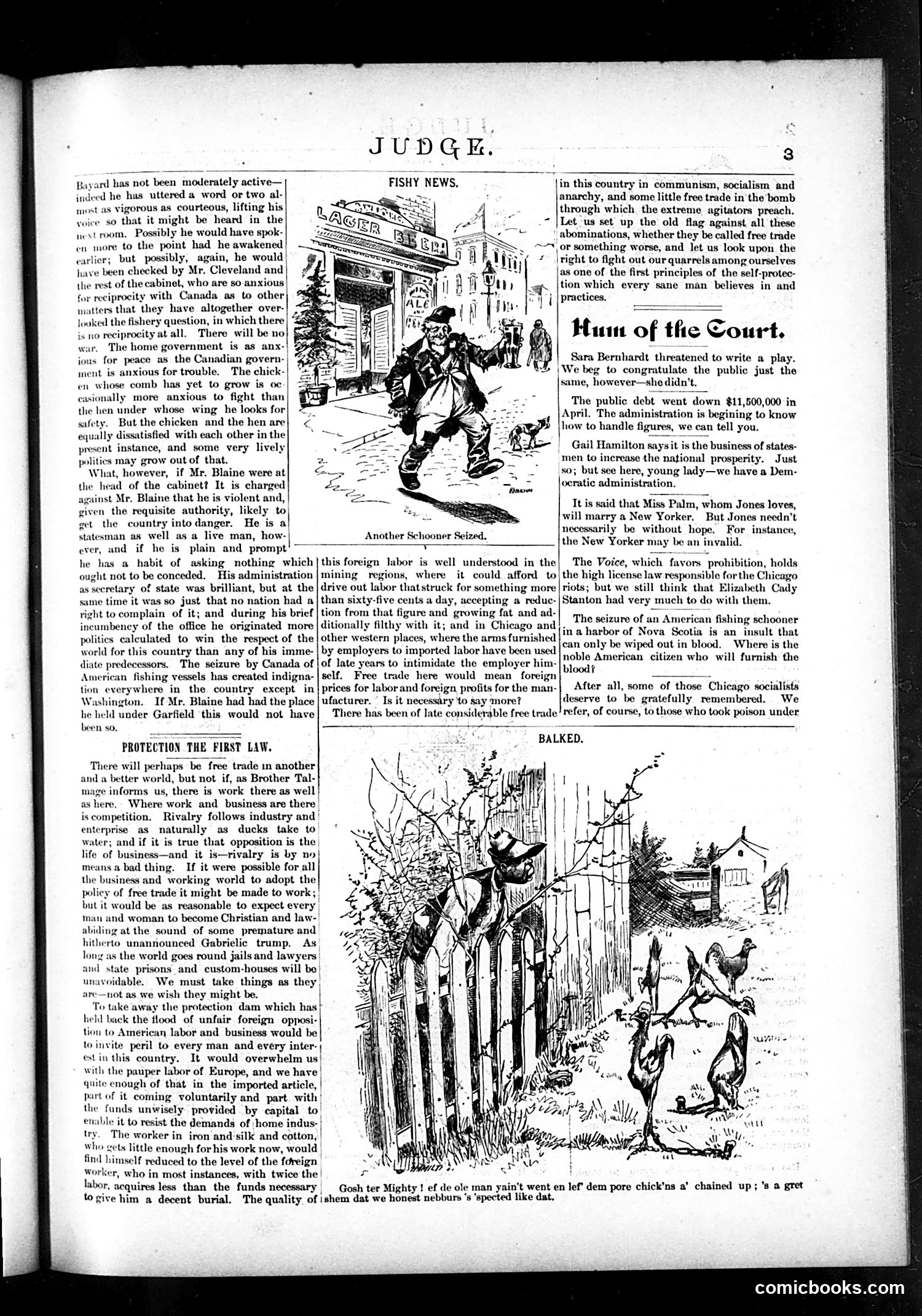
This page addresses the **U.S.-Canada fishing dispute** of the 1880s. The top cartoon "Another Schooner Seized" depicts Canadian authorities seizing an American fishing vessel—a recurring source of diplomatic tension. The accompanying editorial criticizes Secretary of State **Thomas Bayard** for his passive handling of the crisis, contrasting him unfavorably with **James G. Blaine** (former Secretary of State under Garfield). The writer argues Blaine would have been more assertive in defending American fishing rights, suggesting the Cleveland administration has neglected this issue while pursuing Canadian reciprocal trade agreements. The second cartoon "Balked" appears unrelated—a rural humor piece about farm animals escaping confinement. The lengthy essay "Protection the First Law" defends American tariffs and protectionism against free trade, arguing that unrestricted competition with cheaper European labor would devastate American workers. This reflects the intense protectionist vs. free-trade debate dominating 1880s politics.
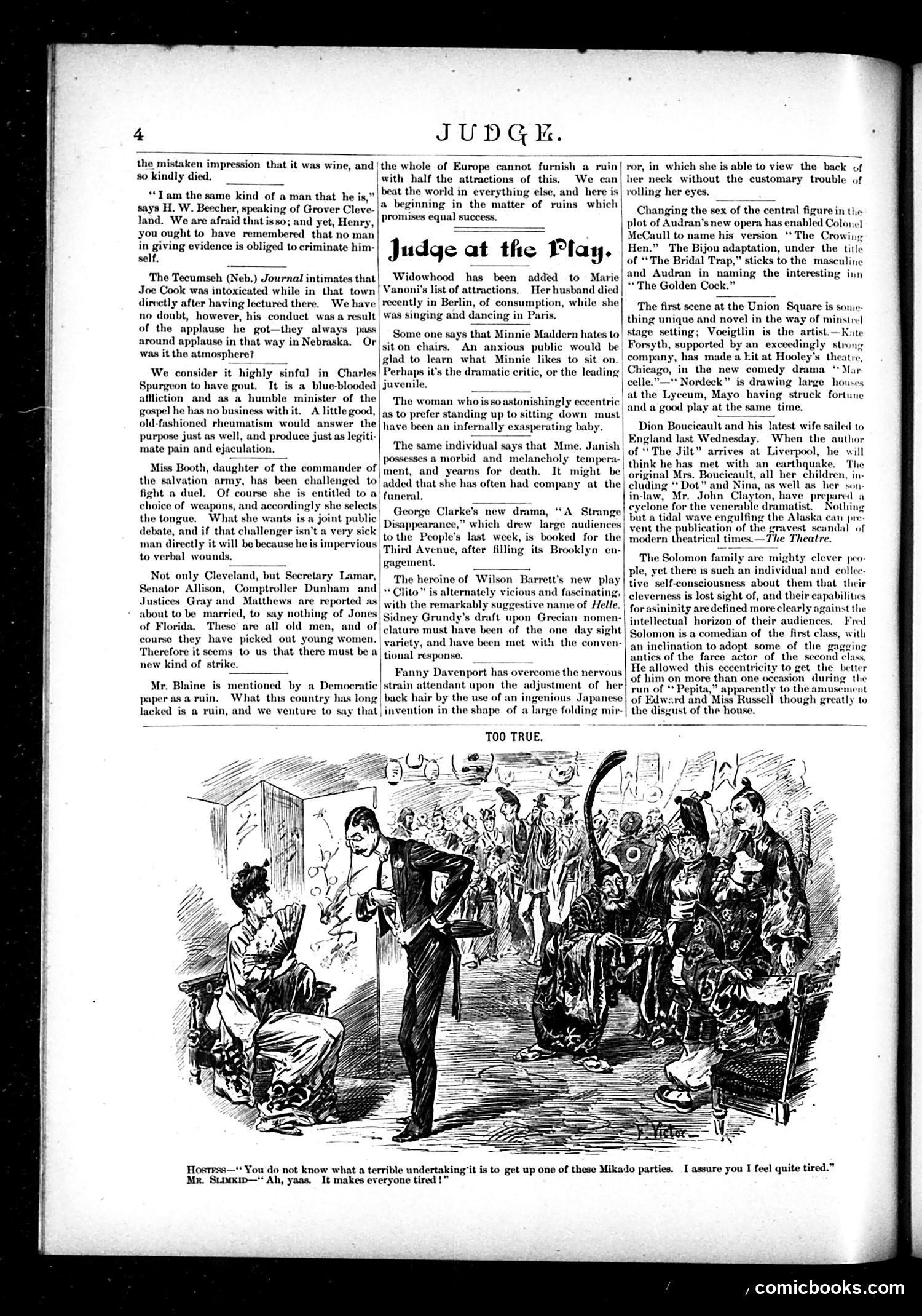
This page from the satirical magazine *Judge* contains two sections: editorial commentary on public figures and a theatrical review column. The **editorial section** mocks various celebrities and politicians of the era (likely 1880s based on references to Cleveland and Blaine). It includes witty jabs at religious figures (Spurgeon's gout), performers (Joe Cook's intoxication), and political figures. The references to Cleveland, Blaine, and other politicians suggest commentary on contemporary political controversies, though specific scandals aren't entirely clear from the text alone. The **"Judge at the Play"** section reviews theatrical productions and performers, making light jokes about actresses' eccentricities—like Minnie Maddern's seating preferences and Fanny Davenport's hair-adjustment struggles. These are gossipy, personality-focused critiques typical of theatrical journalism. The **cartoon below** titled "TOO TRUE" depicts a crowded social gathering where a tired host complains about the exhaustion of hosting a Mikado party, playing on the popularity of Gilbert and Sullivan's *The Mikado*.
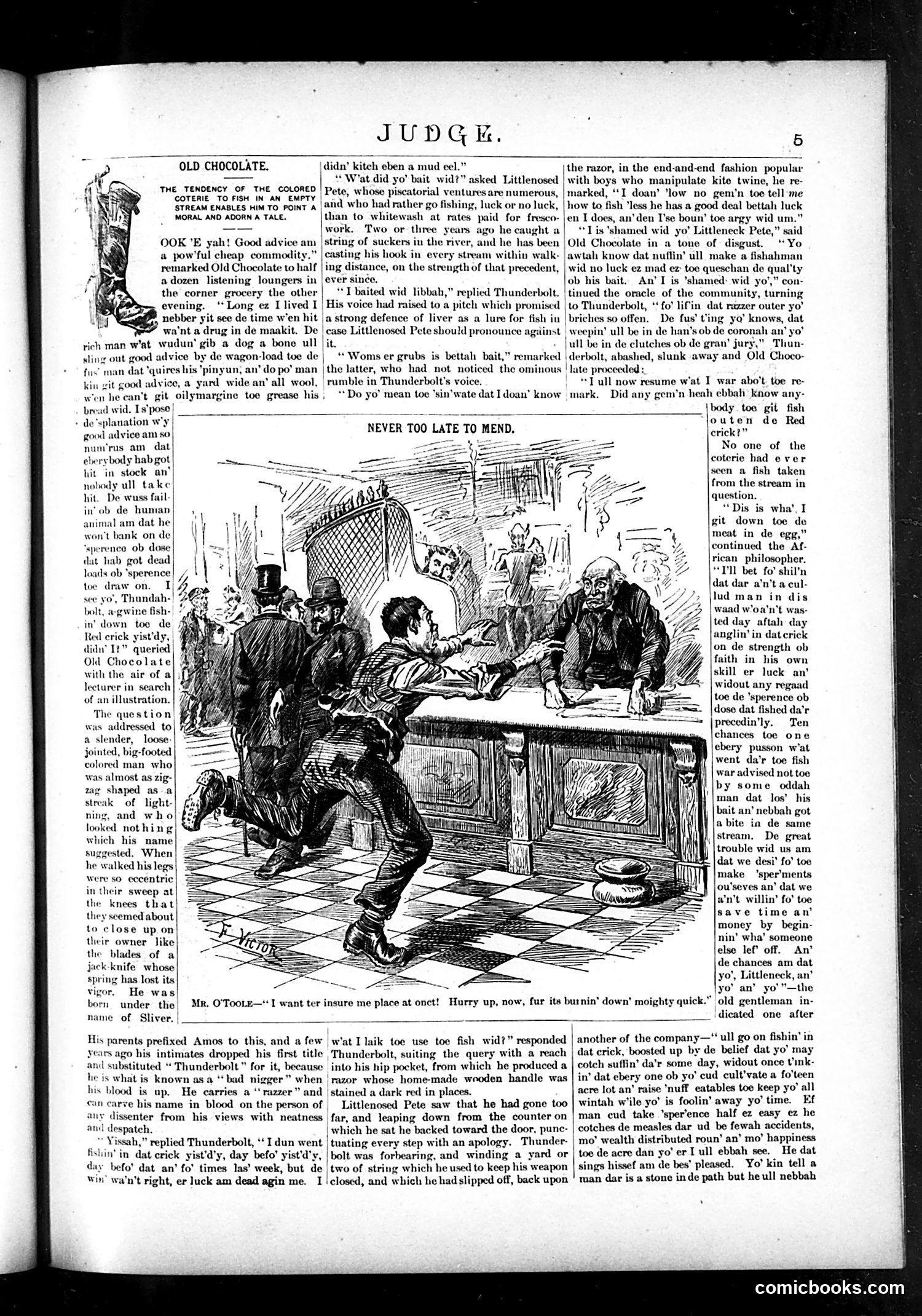
This page presents "Old Chocolate," a dialect-humor story using racist stereotypes common to late 19th-century American satire. The narrative features an African American character dispensing folksy fishing advice to other Black men in a grocery store setting. The satire targets not the Black characters themselves but rather **pretentious advice-giving and false expertise**. Old Chocolate's central joke is that cheap advice abounds everywhere—rich men give it freely, poor men receive it eagerly—yet it's worthless. The fishing anecdotes illustrate how people cling to past luck (one lucky catch years ago) and argue stubbornly about methods despite consistent failure. The accompanying sketch labeled "Never Too Late to Mend" depicts what appears to be a domestic confrontation, likely illustrating another moral about human behavior. The humor relies entirely on the racial caricature and dialect conventions of the era rather than sophisticated satire. While the underlying observation about human nature has merit, its delivery through dehumanizing stereotypes is offensive by modern standards.
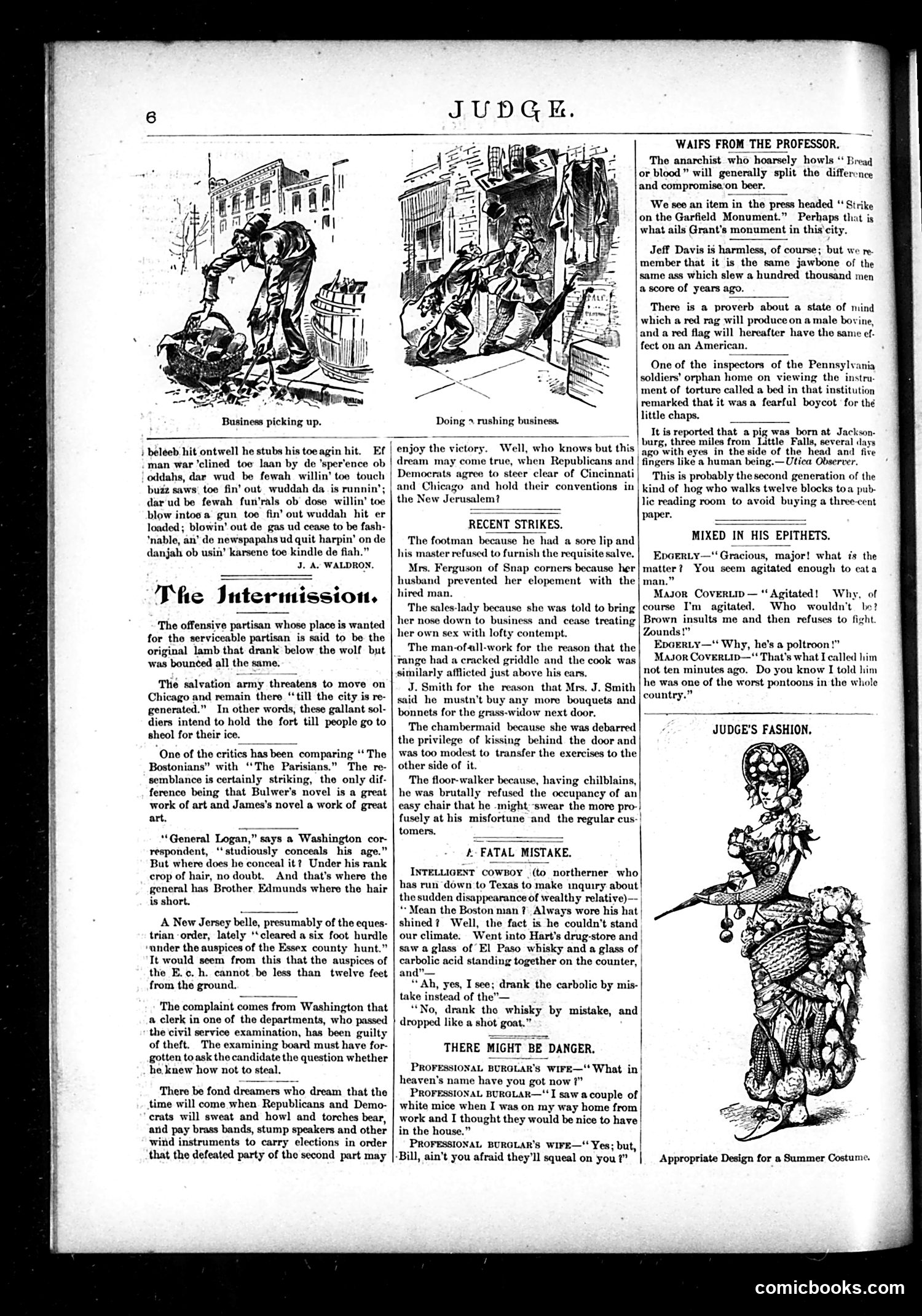
This page contains several satirical pieces typical of 1880s American humor. **The two cartoons** ("Business picking up" and "Doing rushing business") appear to depict street violence or labor unrest, with figures engaged in physical conflict. The dialect-heavy captions suggest commentary on working-class disputes or social disorder. **"The Intermission"** is a collection of political jokes mocking both Republicans and Democrats, particularly referencing General Logan and the Civil War era. One joke suggests Republicans and Democrats will never cooperate, even holding conventions in "the New Jerusalem" (heaven) before they agree. **"Recent Strikes"** humorously lists frivolous worker complaints—a footman striking over a sore lip, a chambermaid over kissing privileges—satirizing labor disputes as petty. **"A Fatal Mistake"** depicts an absurd scenario where a Boston businessman dies from drinking carbolic acid mistaken for whiskey in Texas, mocking both Eastern urbanites and frontier roughness. The overall tone reflects late-19th-century class anxieties and partisan political mockery.
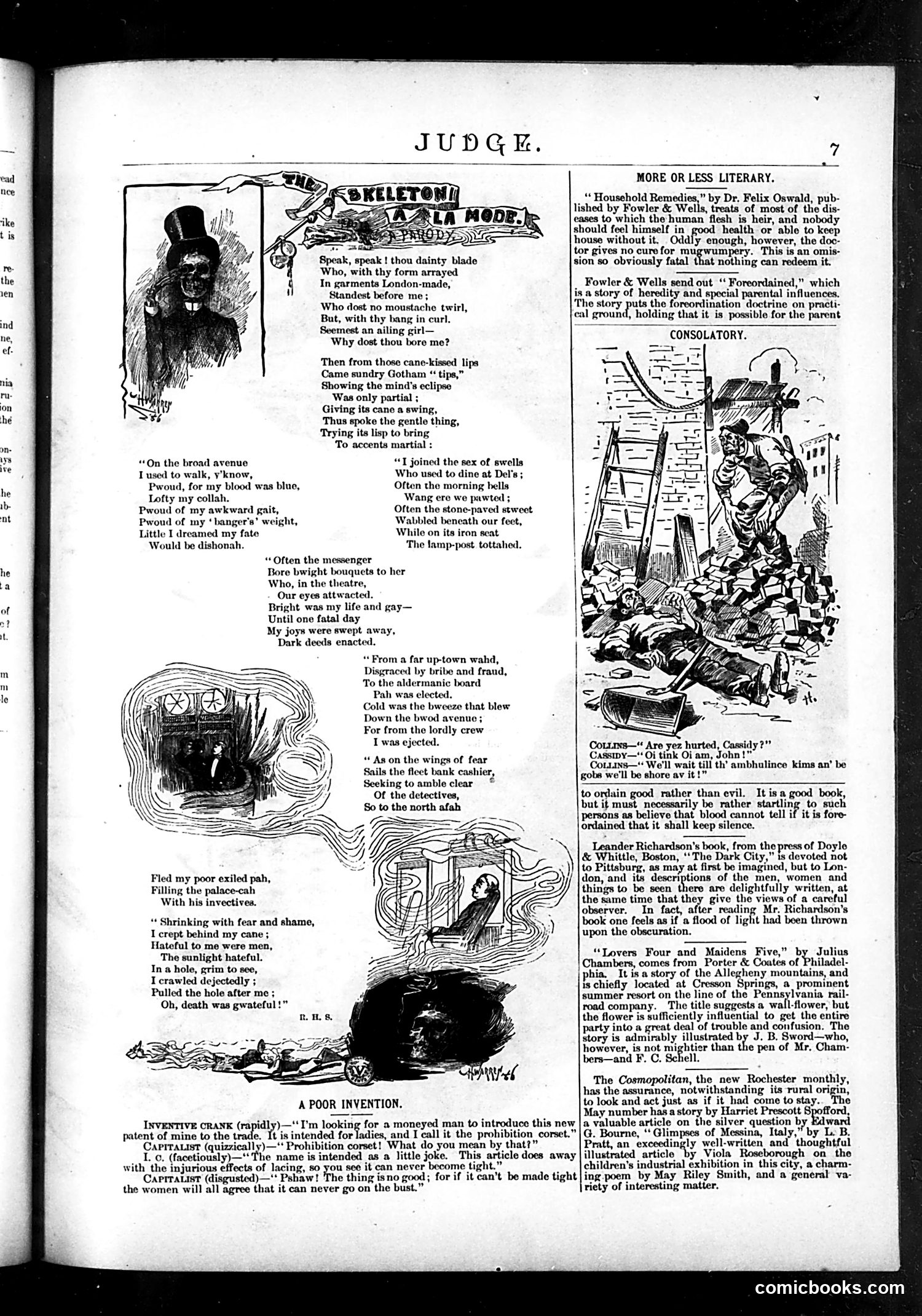
This page contains satirical poetry and comics typical of 1880s-90s Judge magazine. The main "Skeletona Mode" cartoon is a sentimental parody of a upper-class dandy recounting his social downfall. The poem mocks a vain, aristocratic man ("Pwoud of my blood...Pwoud of my awkward gait") who discovers his girlfriend is actually the disgraced daughter of a corrupt New York alderman and a fugitive bank cashier. The exaggerated affected speech ("bwight," "pwoud," "wabbled") satirizes both pretentious upper-class affectation and the hypocrisy of maintaining social respectability while connected to political corruption and financial crime. The page also includes a "Poor Invention" joke about a "prohibition corset"—wordplay suggesting a corset so loose it prohibits/prevents the intended tightening effect—mocking women's fashion and possibly temperance movements. Book reviews fill the right column, typical of Judge's literary commentary sections.
This appears to be a title page or section header from *Judge* magazine, marked simply "JUDGE & Z" on the left margin. The image shows what seems to be a classical or allegorical female figure in flowing robes, positioned vertically on the page. The figure's garment bears text reading "ANNUAL FACETIOUS" (though partially obscured or unclear in the OCR). Without additional context, caption text, or visible date information, I cannot definitively identify the specific satirical subject or political reference this illustration addresses. The classical styling suggests it may represent an abstract concept or institution being satirized, but the exact target and commentary remain unclear from the image alone.
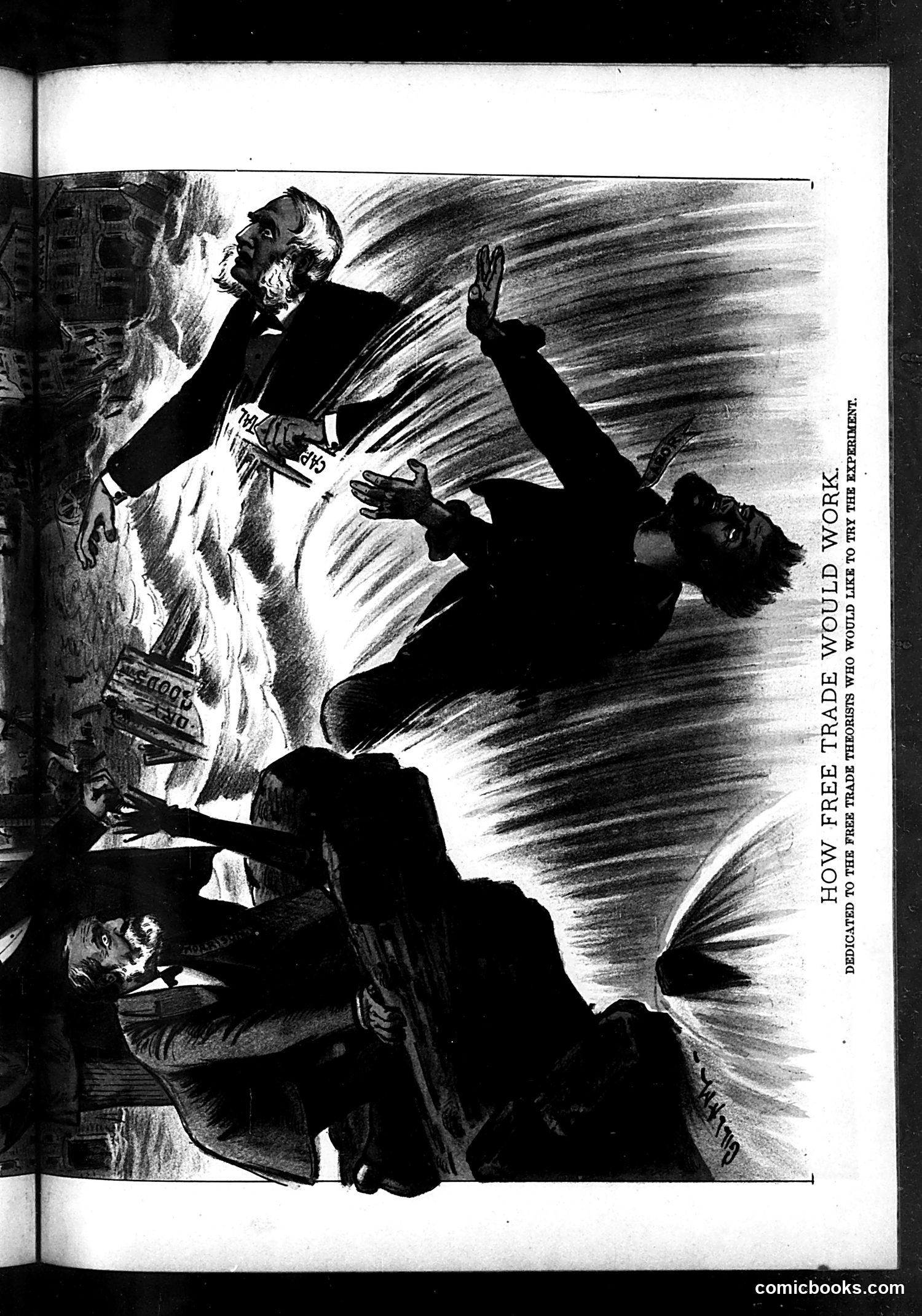
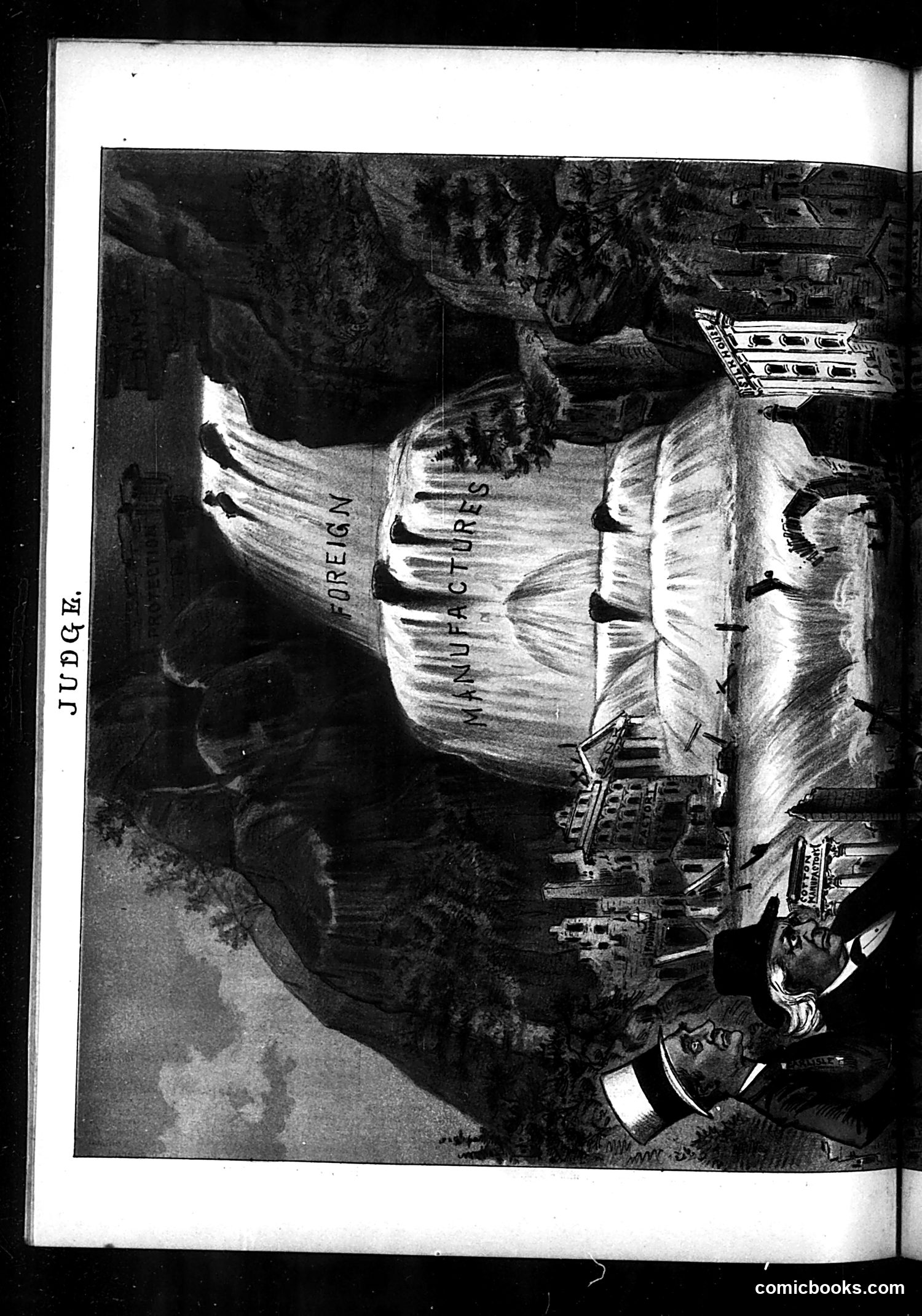
This Judge magazine cartoon depicts a dramatic scene titled "HOW FREE TRADE WOULD WORK" (visible on the right margin). The image shows figures being thrown or falling violently through space, with flames visible on the left side—suggesting destruction or chaos. The cartoon satirizes the concept of free trade, likely from the late 19th or early 20th century when protectionist versus free-trade debates were prominent in American politics. The violent, chaotic imagery suggests the cartoonist viewed free trade as economically destructive, throwing workers or the nation into turmoil. The OCR text is too corrupted to provide specific details about which trade policy or political figures are being targeted, but the visual metaphor of catastrophic upheaval clearly expresses opposition to free-trade policies.
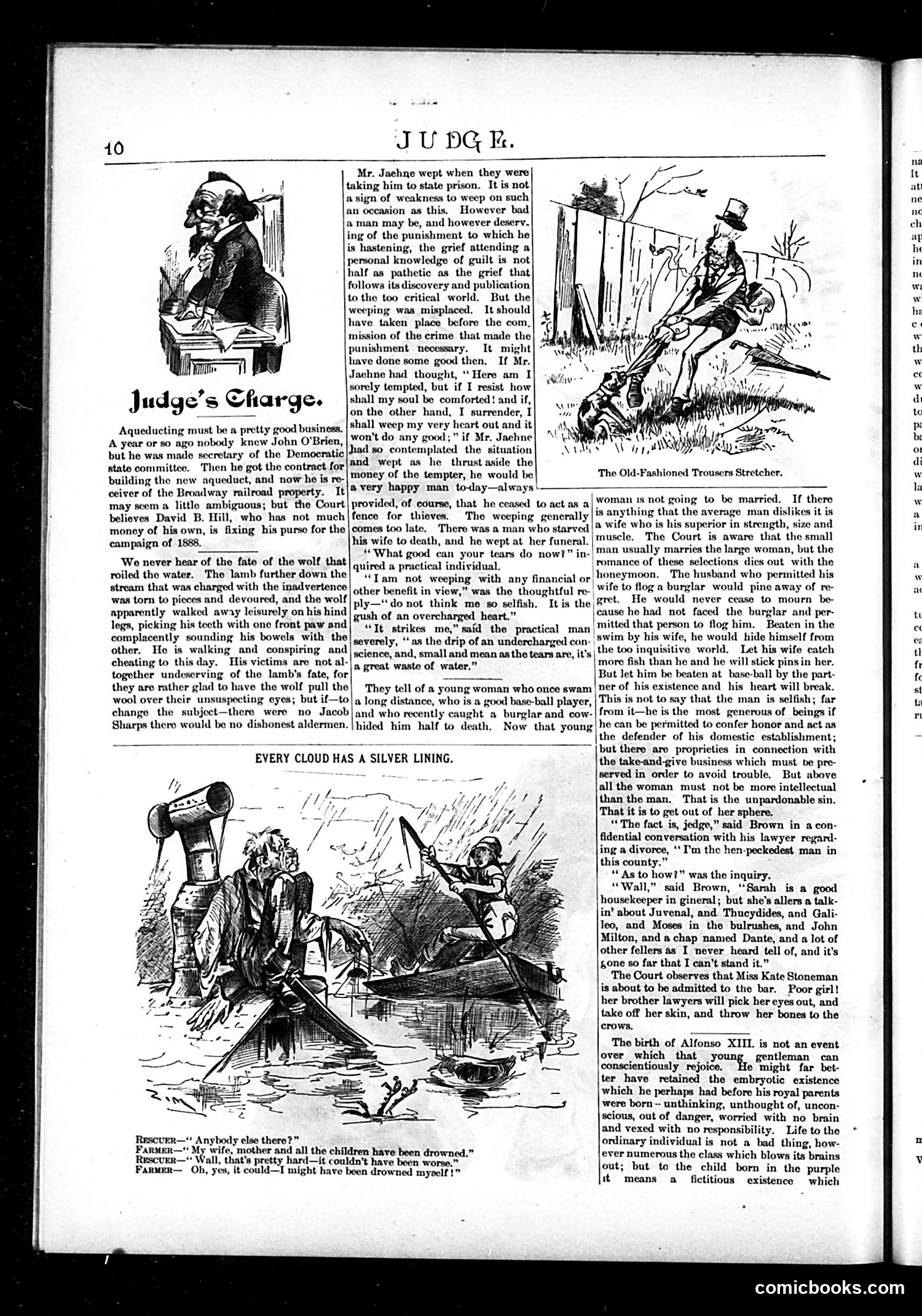
This page from *Judge* contains two distinct satirical pieces: **"Judge's Charge"** (left): A commentary on John O'Brien's appointment as secretary of the Democratic state committee and receiver of Broadway railroad property. The satire suggests the appointment appears suspicious—O'Brien was unknown until suddenly receiving lucrative positions, implying Democratic boss David B. Hill is using public resources to fund his 1888 campaign. The wolf/lamb metaphor criticizes how corruption victimizes the public while perpetrators escape justice. **"Every Cloud Has a Silver Lining"** (center): Depicts a rescue scene where a farmer's family has drowned. The dark humor lies in the rescuer's silver lining: he can now marry a widow without her children—a grotesque "optimistic" take on tragedy. **Right column**: Discusses a woman strong enough to catch burglars, using her strength as a satirical lens to mock male insecurity about female superiority in domestic contexts. The overall tone is cynically humorous about political corruption, domestic anxiety, and social hypocrisy.
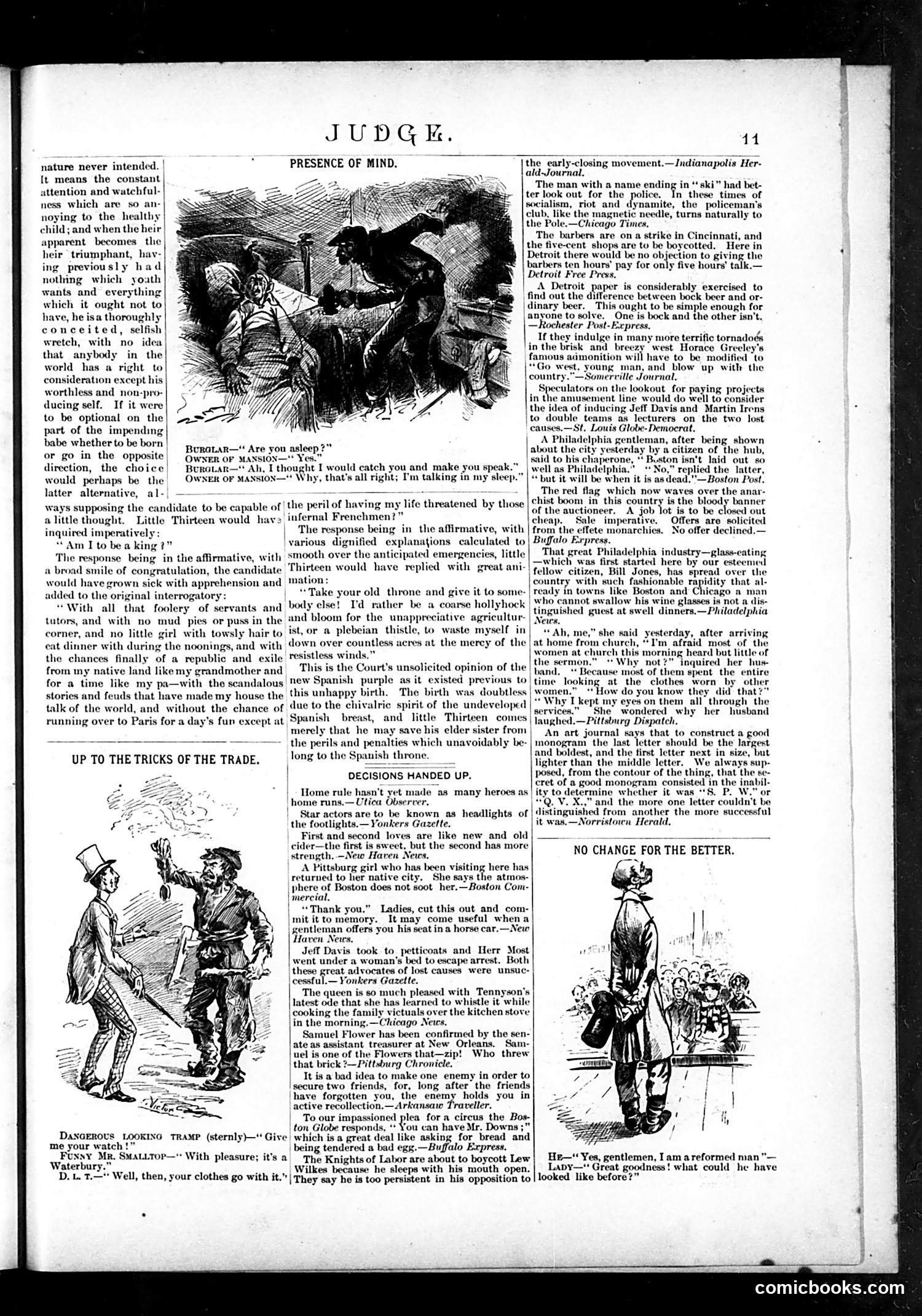
This *Judge* magazine page contains three satirical cartoons and various comic "Decisions Handed Up" (short jokes). **"Presence of Mind"** (top): A tramp threatens a homeowner at night. The owner claims to be asleep, so the tramp demands his clothes instead of his watch. The joke: the "presence of mind" is the tramp's quick thinking when his original threat fails. **"Up to the Tricks of the Trade"** (left): A con man and victim exchange dialogue about clothes—likely satirizing street swindlers' tactics and quick verbal manipulations. **"No Change for the Better"** (right): A well-dressed woman surrounded by ragged children. The caption suggests reformed individuals facing societal judgment—possibly critiquing Victorian charity work or social hypocrisy. The "Decisions" are brief satirical quips on contemporary topics: Spanish royalty, theater actors, romance, and political figures like Jeff Davis. The humor relies on wordplay and social commentary typical of 1880s American satire.
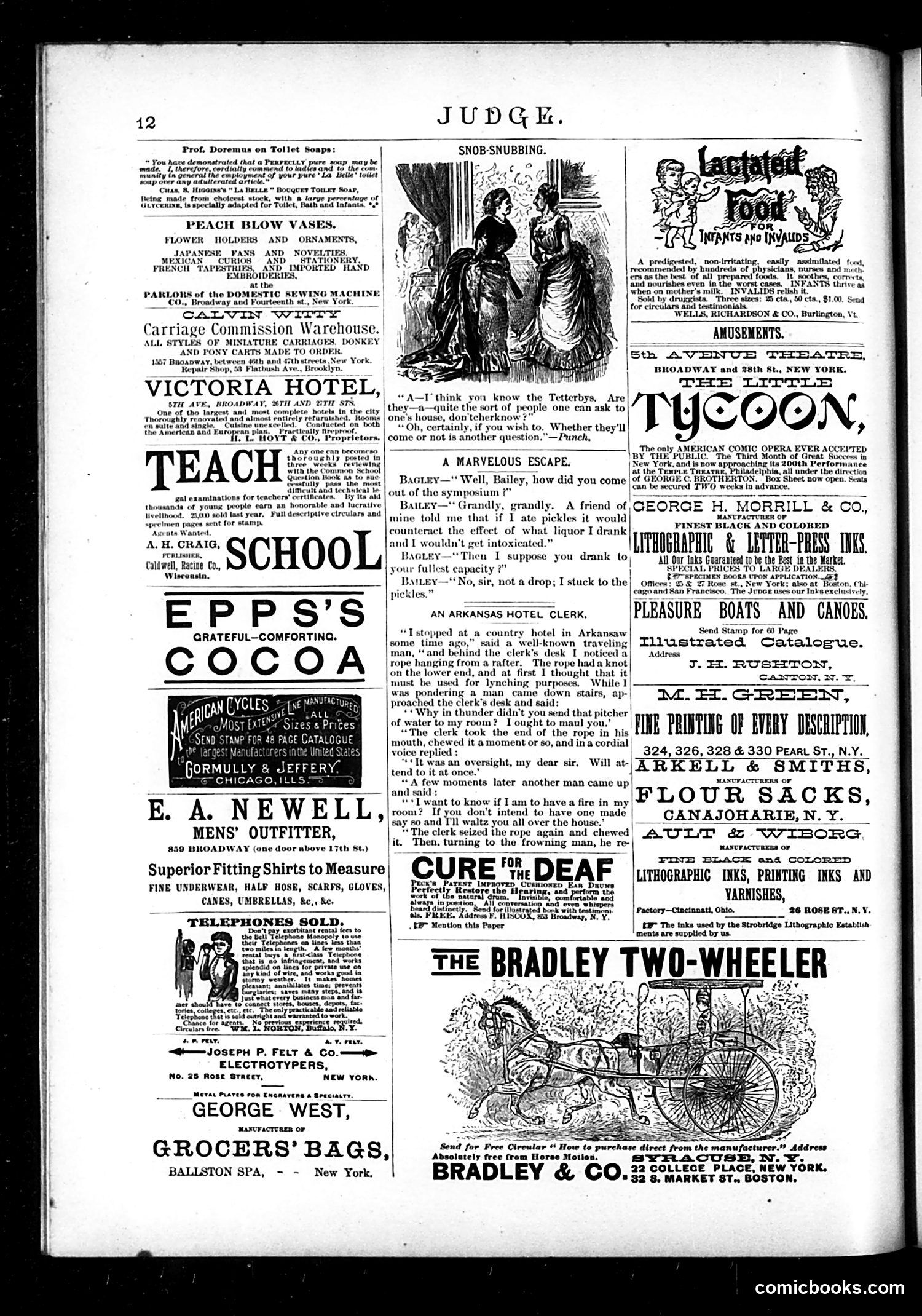
This page is primarily **advertisements** with two humorous anecdotes. The cartoons are minimal—mostly small woodcuts accompanying ads. The notable content includes: **"Snob-Snubbing"** (top): A brief social satire about the snobbish Tetterbys, suggesting they're insufferable characters one wouldn't want to invite—typical Victorian-era mockery of social pretension. **"A Marvelous Escape"** and **"An Arkansas Hotel Clerk"**: Two humorous tall tales. The first involves a man who ate pickles thinking they'd prevent drunkenness. The second depicts a rustic Arkansas hotel clerk who responds to guest complaints by chewing a rope hanging from the ceiling—apparently a strange regional custom. Both mock rural/unsophisticated behavior for urban readers' amusement. The page is dominated by period advertisements for soap, cocoa, cycles, typewriters, flour sacks, and lithographic services—typical late-19th century *Judge* fare. The overall tone treats rural Americans and social climbers as comic subjects for metropolitan satirical humor.
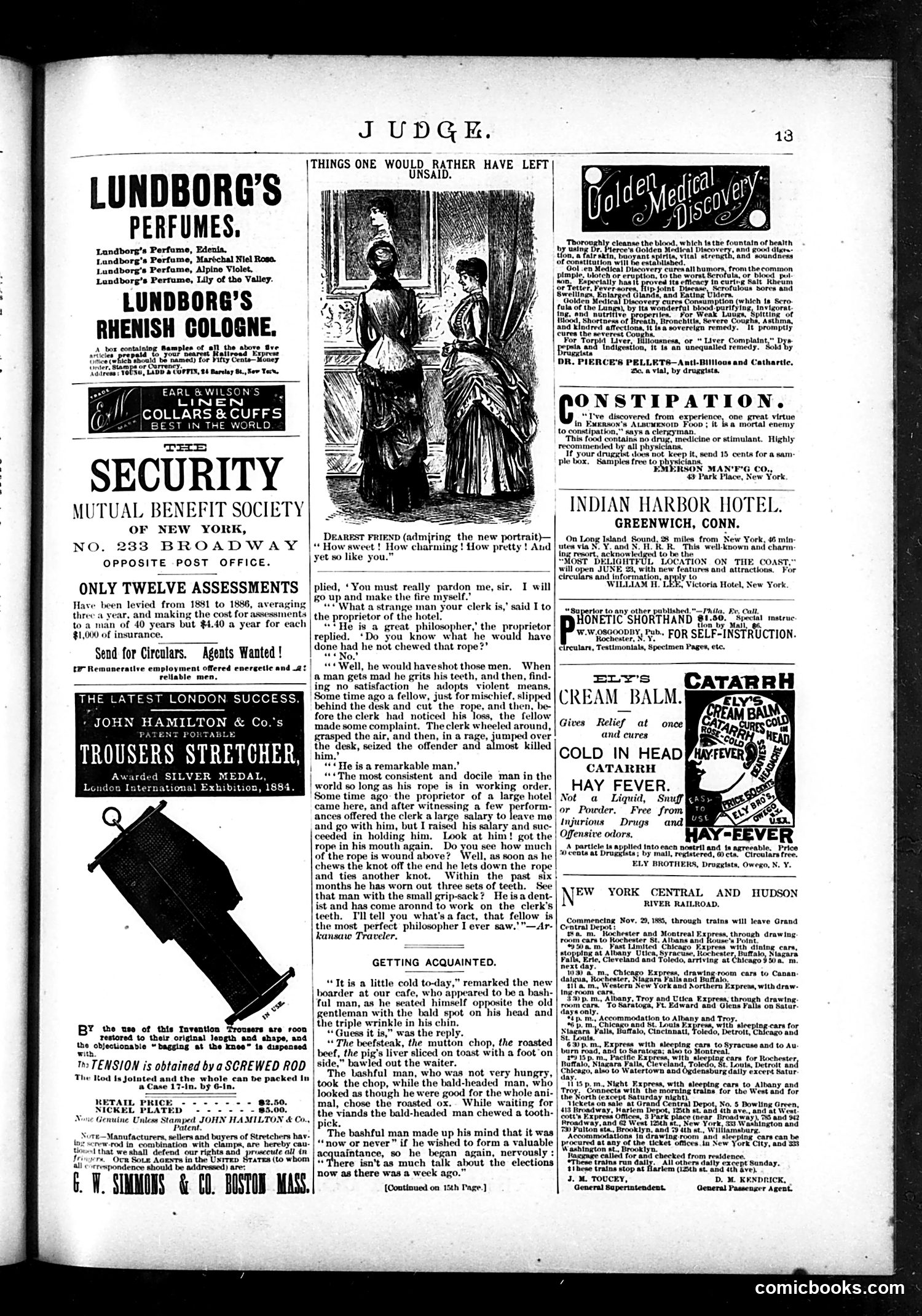
This page is primarily **advertising with one substantial cartoon narrative** ("Things One Would Rather Have Left Unsaid"). ## The Main Cartoon The illustrated story depicts a social awkwardness joke: a woman admires a friend's new portrait, calling it "charming" and "pretty"—then adds "yet so like you," implying the original person is unattractive. The friend's mortified response ("You must really pardon me, sir. I will go up and make the fire myself") suggests he's so embarrassed he'll perform menial labor to escape. The accompanying anecdotes mock similar social blunders: a hotel clerk's violent temperament when his rope (which he constantly chews) is cut, and a bashful boarder's awkward dinner conversation. All three stories illustrate **the Victorian social anxiety about inadvertent insults**—moments where polite conversation backfires embarrassingly. ## Context This reflects 1880s concerns about **social propriety and the mortification of unintentional rudeness** in an era where etiquette was paramount. The humor relies on recognition of uncomfortable social situations familiar to Judge's middle-class readership.
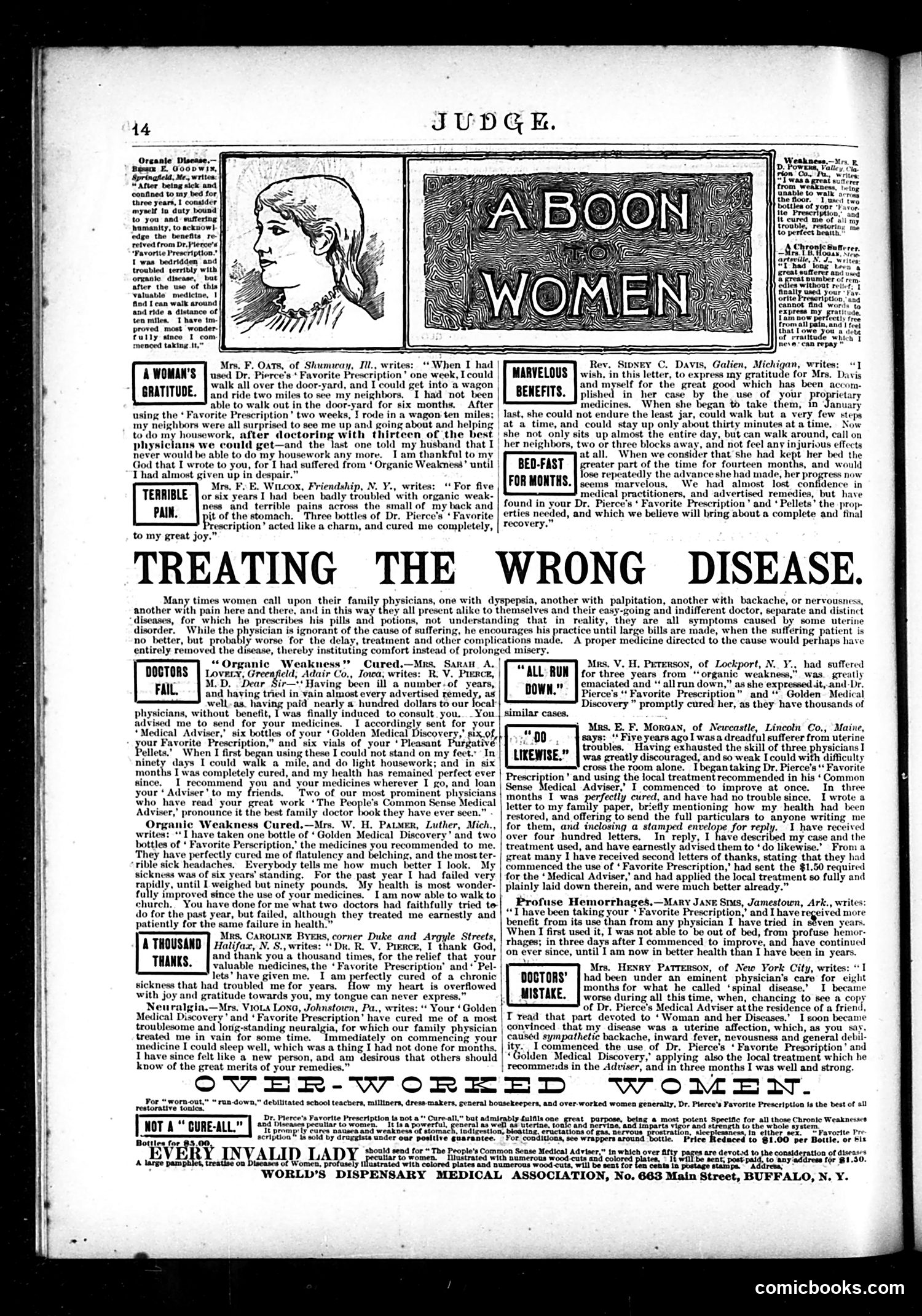
This page is primarily **advertisement**, not satire or political commentary. The main content showcases testimonials for Dr. Pierce's "Favorite Prescription," a patent medicine marketed to women for "organic weakness," uterine troubles, and various female ailments. The small illustration at top left shows a woman's profile, likely representing the product's target demographic. The page includes multiple patient letters praising the medicine's efficacy, contrasting it with failures by conventional physicians ("Doctors Fail"). This was typical period advertising strategy—using testimonials to build consumer trust in unregulated patent medicines. The prominent banner "A BOON WOMEN" and sections like "A Woman's Gratitude" emphasize emotional appeals to female readers. This reflects late-19th/early-20th-century medical advertising practices, before FDA regulations on medical claims. The content has no discernible political satire—Judge magazine simply sold advertising space to pharmaceutical companies.
This page is primarily **advertising**, not political satire. It contains two brief humorous anecdotes alongside numerous commercial notices typical of 19th-century magazines. The two jokes are: 1. **"The Bald-Headed Eagle"** — A man dining with a companion insults his baldness by asking about "hair invigorator." The companion, offended, chokes while eating and rushes away. The humor relies on embarrassment and physical comedy. 2. **"Dairymaids with Kid Gloves"** — Upper-class young women, preparing for a "dairymaids' festival," arrive wearing expensive kid gloves, misunderstanding the costume requirement. The joke satirizes their ignorance of actual farm work—you cannot milk cows in fancy gloves. It mocks class pretension and the gap between wealthy ladies and actual labor. Both are gentle social humor rather than political commentary. The page otherwise advertises patent medicines, clothing manufacturers, granite monuments, and other period goods.
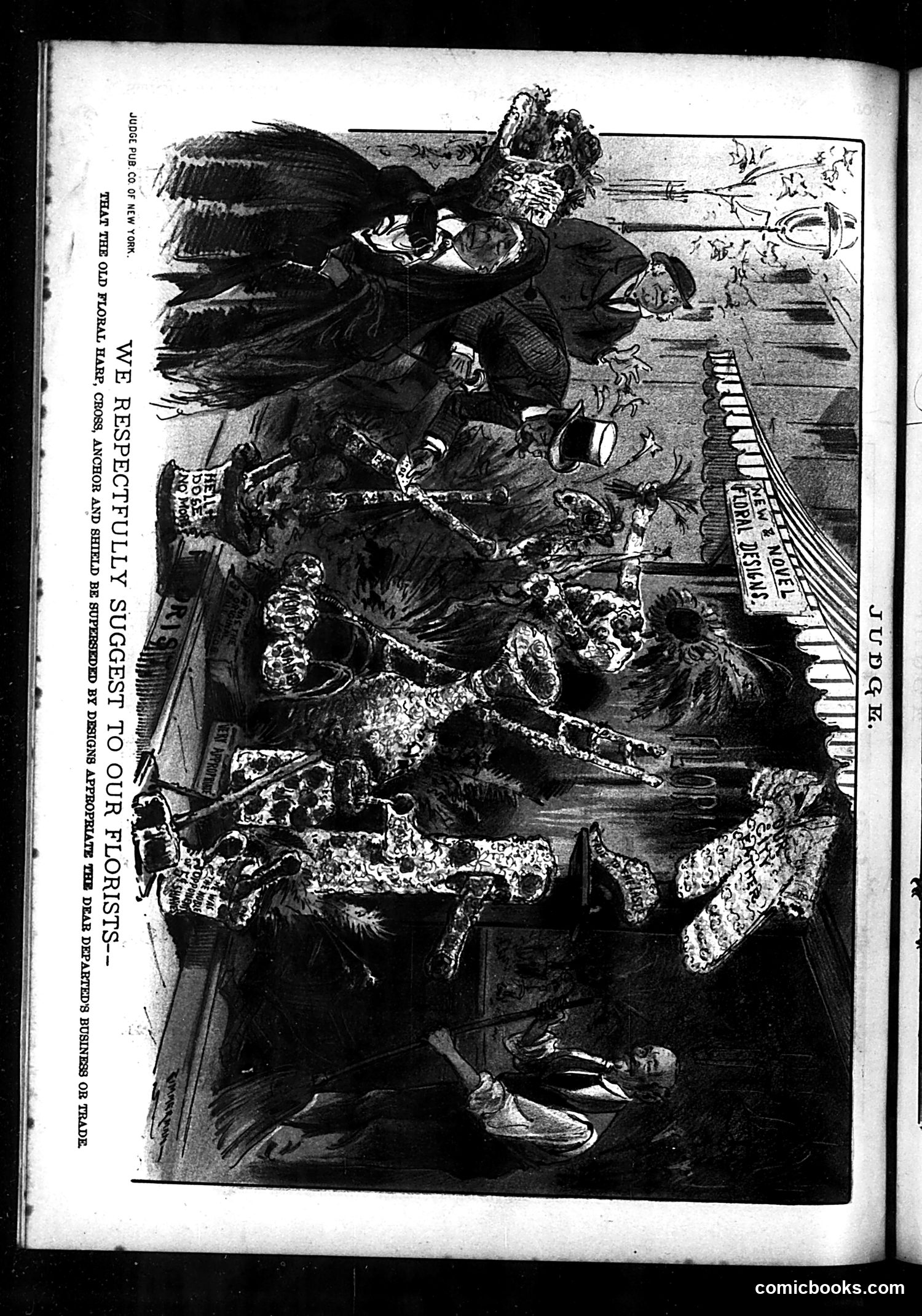
This cartoon satirizes funeral floral arrangements by suggesting florists replace traditional symbolic designs (harp, cross, anchor, shield) with flowers arranged to represent the deceased's profession or trade. The image depicts an elaborate funeral scene with multiple figures examining ornate floral displays. The joke targets Victorian-era funeral customs and the florist industry's conventions. Rather than generic religious or classical symbols, the satire proposes that flowers should commemorate what the departed *did*—their occupation or business—making arrangements more personalized and presumably more lucrative for florists. The cartoon appears to mock both sentimental funeral practices and commercial opportunism in the flowers-and-mourning industry. Without visible dates or specific individuals, this reflects broader Gilded Age social commentary on commercialization of death rituals.