
A complete issue · 16 pages · 1886
Judge — May 1, 1886
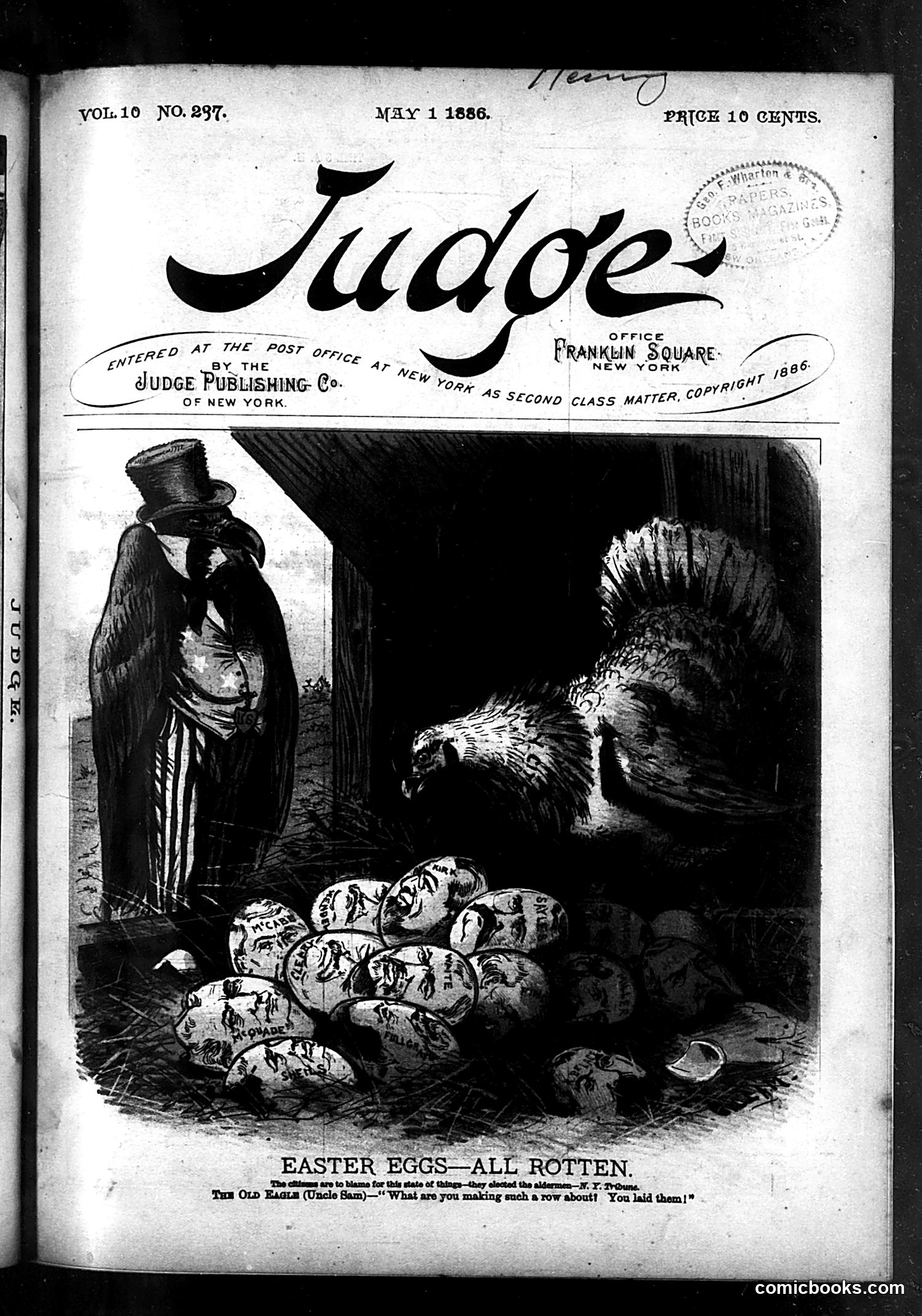
This political cartoon satirizes the Republican Party's failed promises to voters. The title "Easter Eggs—All Rotten" uses holiday imagery to critique broken commitments. The elderly figure on the left (labeled "The Old Fogies" in dialogue) appears to represent traditional Republican leadership or voters. The roosters symbolize boastful political rhetoric, while the rotten eggs represent failed policies or unfulfilled campaign promises. The caption quote—"What are you making such a row about? You laid them!"—suggests Republicans are responsible for their own disappointments, blaming themselves rather than external factors. The satire mocks Republican credibility in 1886, during a period when the party faced voter disillusionment over unmet expectations from the post-Civil War era.
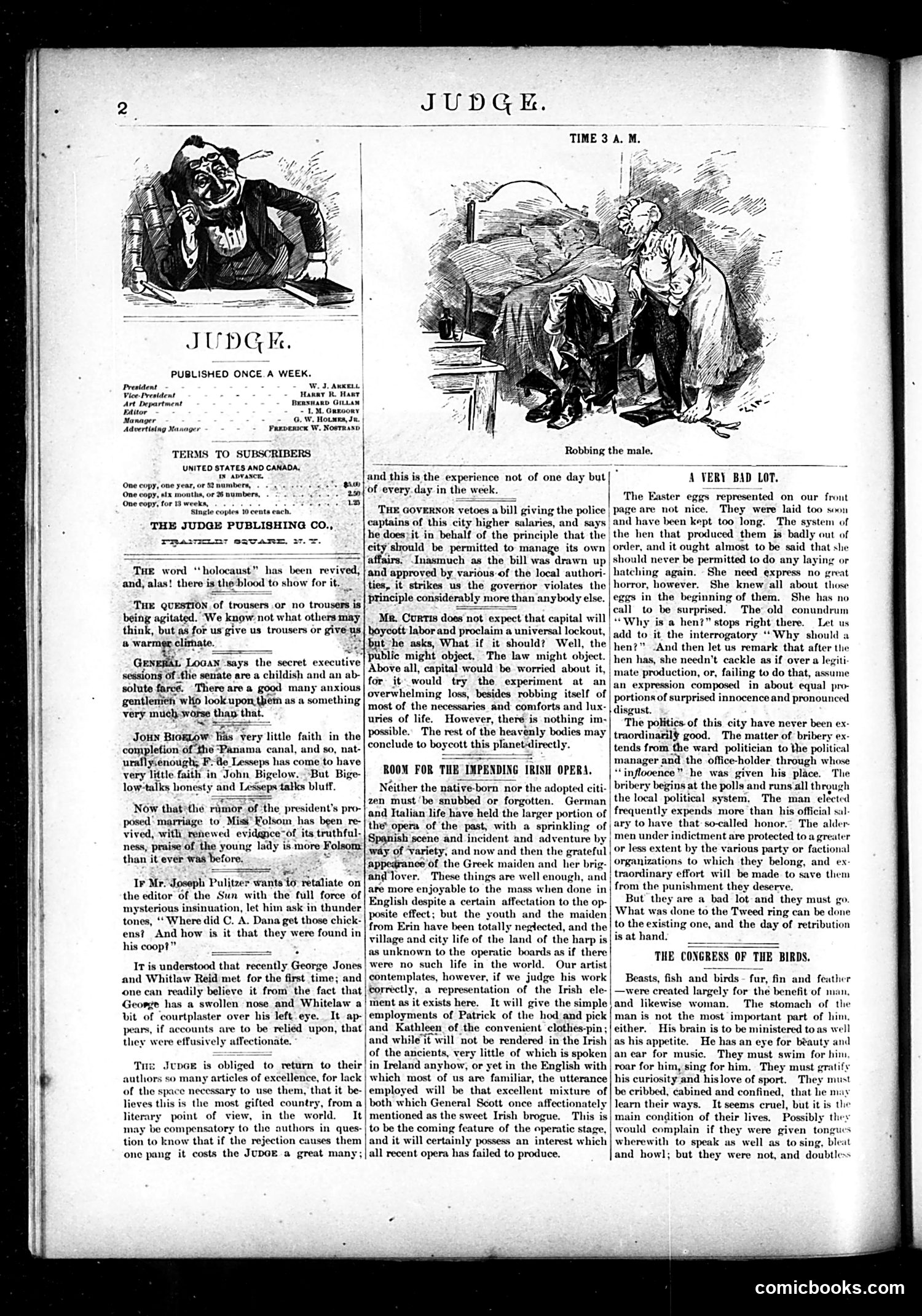
This page from *Judge* magazine contains several editorial items and illustrations satirizing late 19th-century American politics and social issues. The main cartoon "Robbing the male" (top right, captioned "TIME 3 A.M.") depicts figures stealing from a sleeping man—likely satirizing corrupt politicians or officials plundering public resources under cover of darkness. The left illustration labeled "JUDGE" shows a grotesque caricatured face, apparently commenting on judicial corruption or incompetence. The text addresses various political matters including a governor's veto on police salary increases, questions about wearing trousers, and discussion of an impending Irish opera production. "The Congress of the Birds" article critiques how birds are portrayed in opera, using them as metaphor for theatrical or political absurdity. The overall tone is critical of political/judicial establishments and cultural pretension.
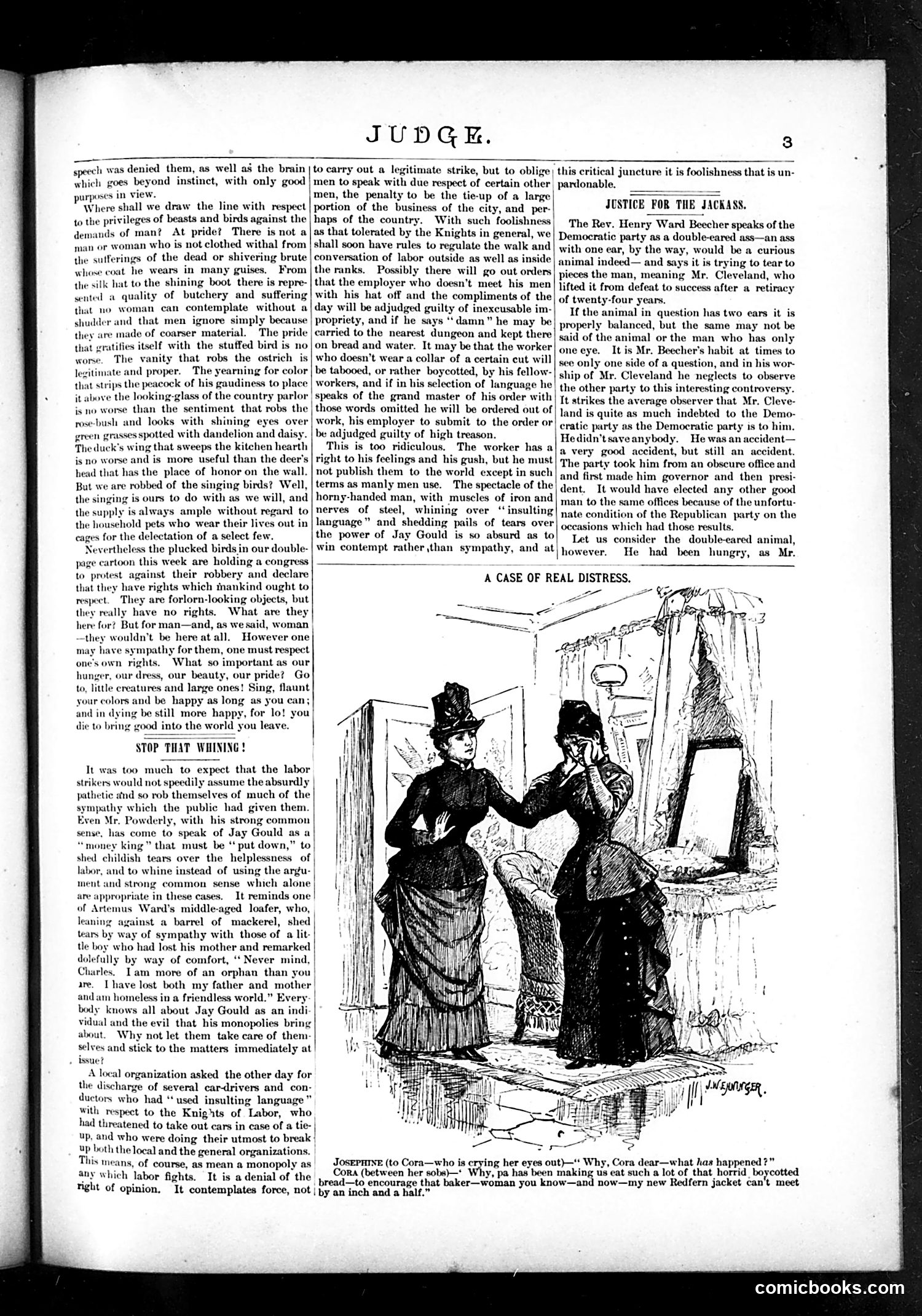
This page contains two distinct pieces of social commentary: **"Stop That Whining!"** critiques labor leaders, particularly Terence Powderly (implied), for using emotional rhetoric about Jay Gould instead of rational argument. The author argues that while Gould's monopolies are problematic, sentimental appeals undermine labor's credibility and distract from concrete issues. **"A Case of Real Distress"** cartoon satirizes a woman (likely representing a labor activist or reformer) lecturing another woman about a baker's boycott due to labor disputes. The image mocks the disconnect between abstract labor principles and practical hardship—the struggling woman needs bread, not ideological purity. The page reflects *Judge*'s editorial position: sympathetic to labor's legitimate grievances but skeptical of emotional manipulation, hypocrisy, and tactics that harm ordinary workers. The satire targets both overzealous reformers and the gap between activist rhetoric and workers' actual needs.
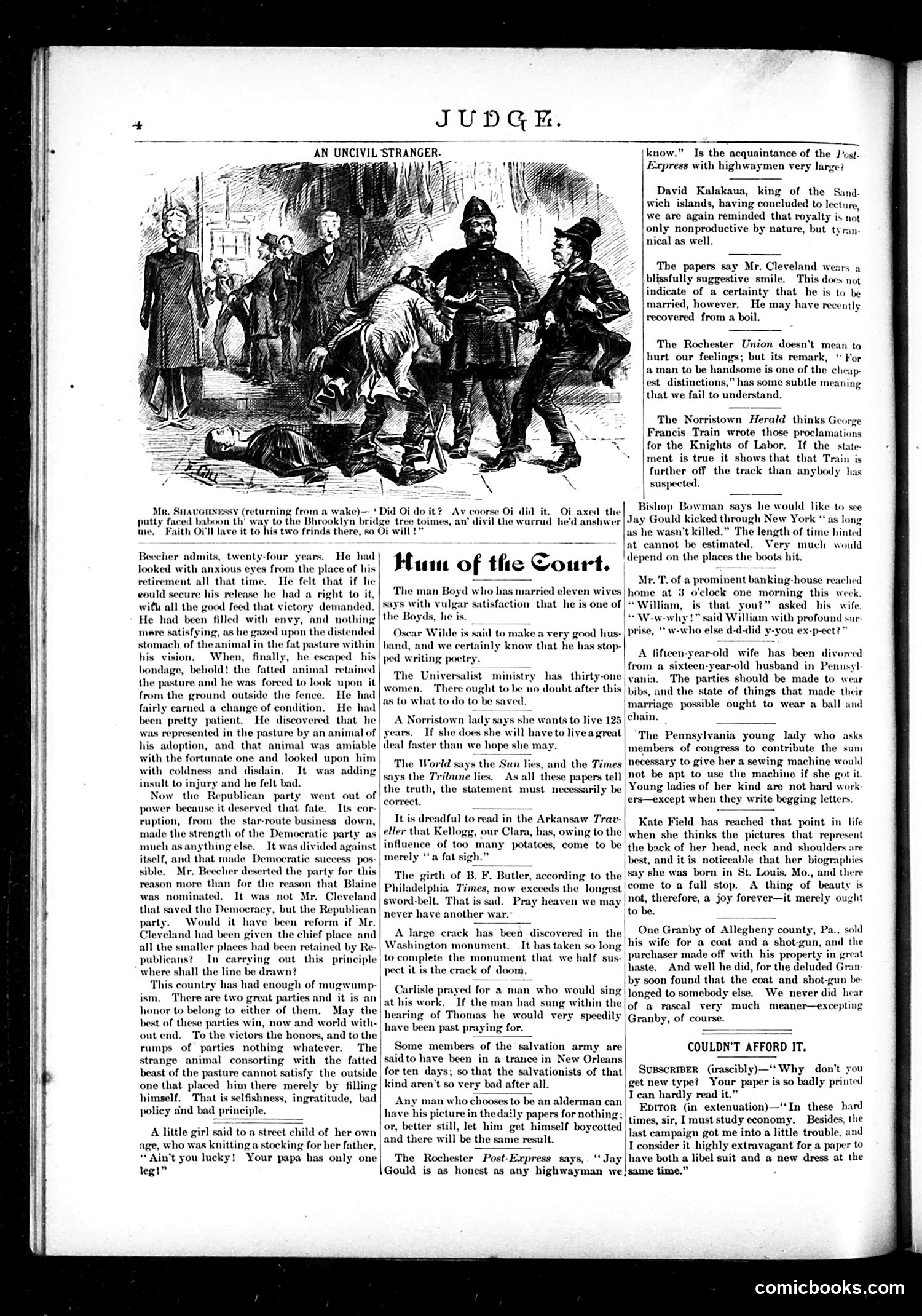
This page contains multiple satirical pieces attacking the Republican Party after their electoral defeat. The main cartoon "An Uncivil Stranger" depicts an Irish immigrant (stereotypically portrayed) at a wake, making crude jokes—likely commentary on urban political violence and corruption. The "Hum of the Court" section uses animal fables (a fatted calf allegory) to criticize Republicans who lost power due to "corruption, from the star-route business down." The piece argues the GOP deserved defeat and mocks the "Mugwumps"—reform Republicans who abandoned the party. It questions why defeated Republicans retained minor offices while Democrats took major positions. Other items mock figures like Oscar Wilde, B.F. Butler (whose girth is compared to a sword-belt), and political hypocrisies. The overall message: Republicans earned their loss through corruption; party loyalty matters more than reform principles; defeated parties shouldn't expect continued power. The tone is sharply partisan Democratic propaganda disguised as humor.
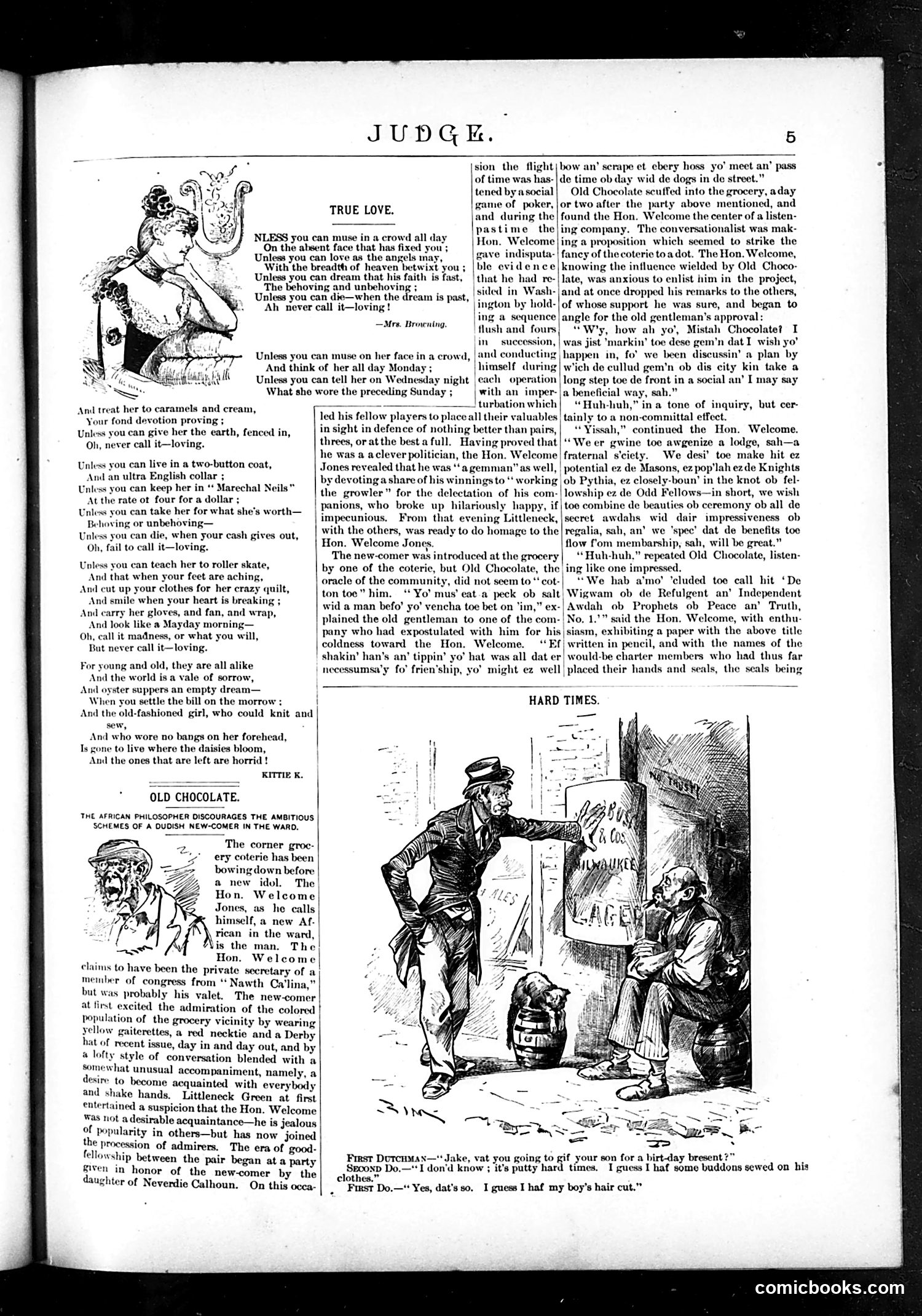
This page contains two distinct pieces of satirical commentary on African American social life in a working-class urban neighborhood. **"TRUE LOVE"** (top left) is a humorous poem mocking romantic idealization, listing increasingly absurd requirements for "true love"—from constant devotion to financial self-sacrifice to physical degradation. It's generic social satire about courtship expectations. **"OLD CHOCOLATE"** and **"HARD TIMES"** (bottom) offer racial satire. The narrative mocks "the Hon. Welcome Jones," a newly arrived African American man in the neighborhood who affects pretensions—claiming to be a congressman's secretary, wearing fashionable clothing, using grandiose language. The piece satirizes both his social climbing and his neighbors' gullibility in admiring him. The dialogue cartoon below depicts working-class hardship: a man asking another about affording a birthday present for his son, revealing economic struggle. The satire targets aspirational African Americans performing respectability while also mocking the community's susceptibility to such performances—typical of period racial humor that presented Black social life as inherently comic or fraudulent.
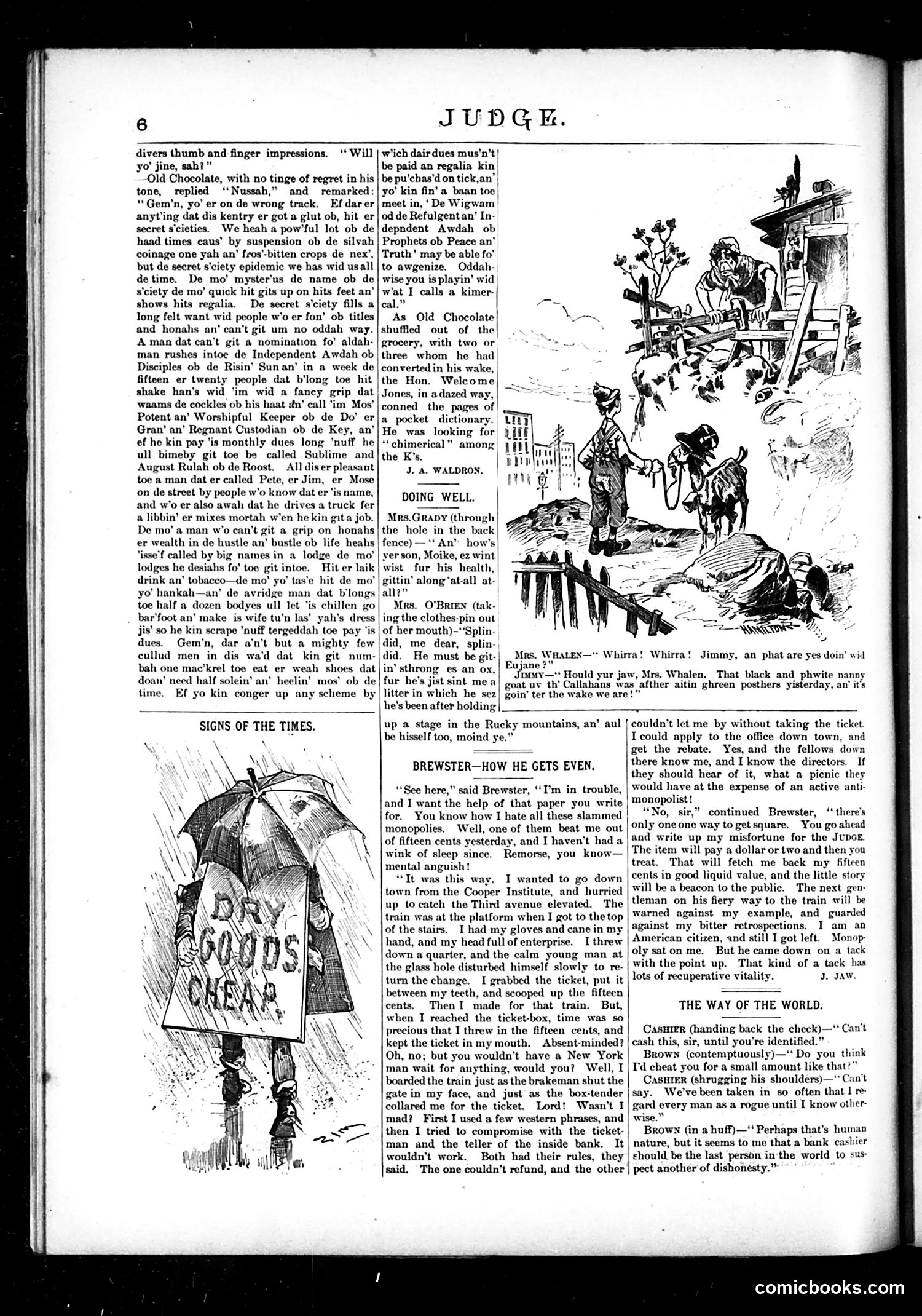
This page contains three satirical pieces targeting late-19th-century American social issues, primarily focused on African American communities: **"Old Chocolate's" monologue (top)**: A character in dialect criticizes the proliferation of secret fraternal societies among Black men. The satire argues these organizations exploit working-class men who cannot achieve status through wealth or legitimate politics, leading them to waste money on dues and regalia for empty titles ("Sublime and August Ruler"). The joke is that a man scorned on the street as "Pete" or "Mose" gets respect only within these lodges—revealing the desperation behind their appeal. **"Signs of the Times" (bottom left)**: Depicts someone looking up "chimerical" (meaning fanciful/unrealistic) in a dictionary, apparently in response to Old Chocolate's speech. The illustration reinforces the satire's message about delusion. **"Doing Well" and "The Way of the World"** (right): Brief working-class Irish and Irish-American dialect pieces about poverty and survival, suggesting similar social commentary across ethnic groups. The page's primary target is the susceptibility of poor Black Americans to fraternal organization schemes.
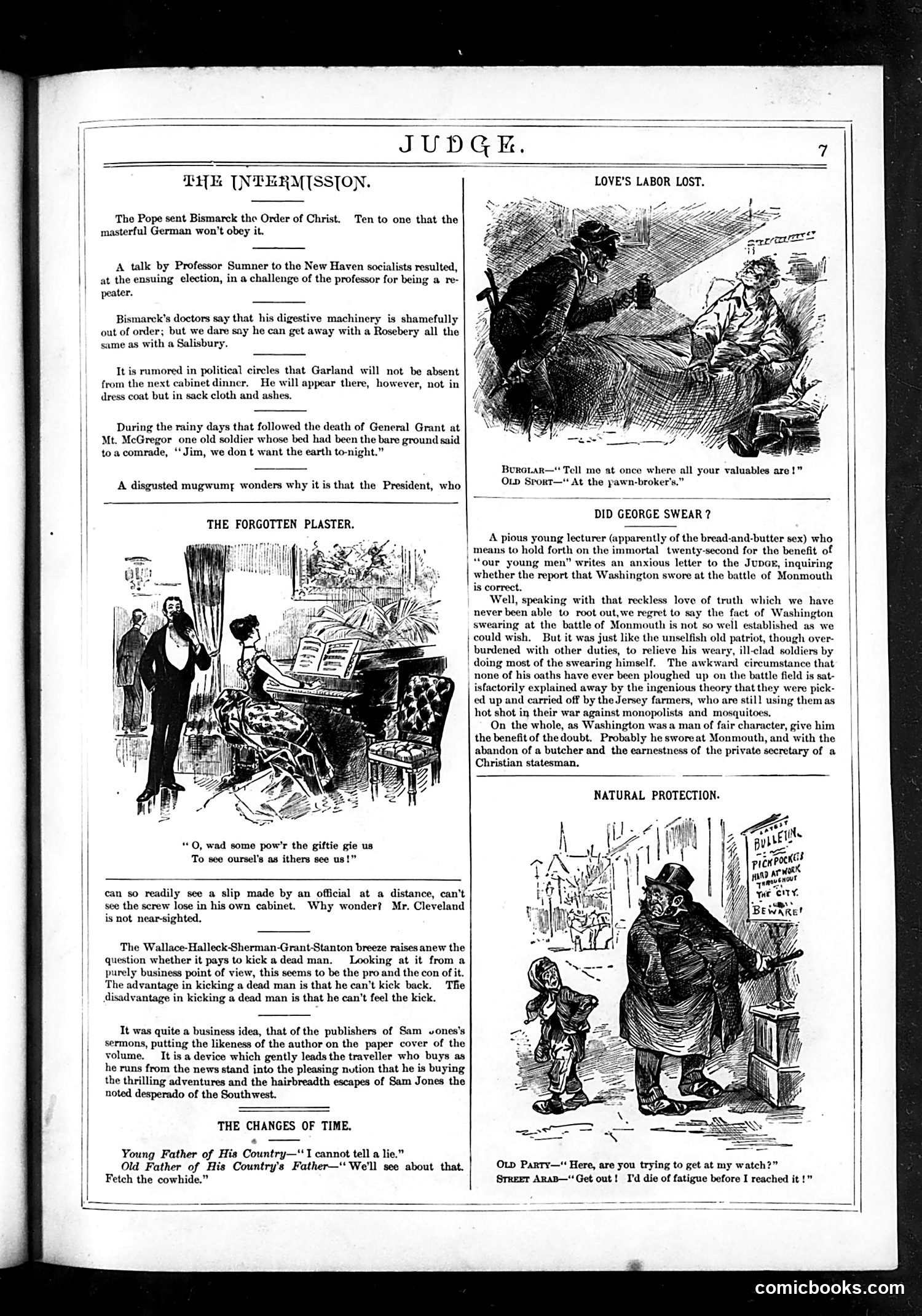
This 1880s-era satirical page contains brief political quips and cartoons mocking contemporary figures and events: **"The Intermission"** section includes jokes about Bismarck defying the Pope, Professor Sumner's socialist lecture in New Haven, and President Cleveland's blindness to cabinet scandals while criticizing others. **"The Forgotten Plaster"** cartoon satirizes nostalgia for Civil War heroes (Wallace, Halleck, Sherman, Grant, Stanton), questioning whether it benefits anyone to "kick a dead man." **"Did George Swear?"** responds to a reader's question about whether George Washington swore at Monmouth. Judge humorously suggests yes, though conveniently no evidence remains—Jersey farmers allegedly picked up the oaths for use against "monopolists and mosquitoes." **"Natural Protection"** and **"Love's Labor Lost"** are brief joke cartoons about burglary and con artists. The page's humor relies on topical references (Cleveland administration scandals, Civil War nostalgia) and assumes readers knew contemporary political debates. Most specific identities and events are now obscure without historical context.
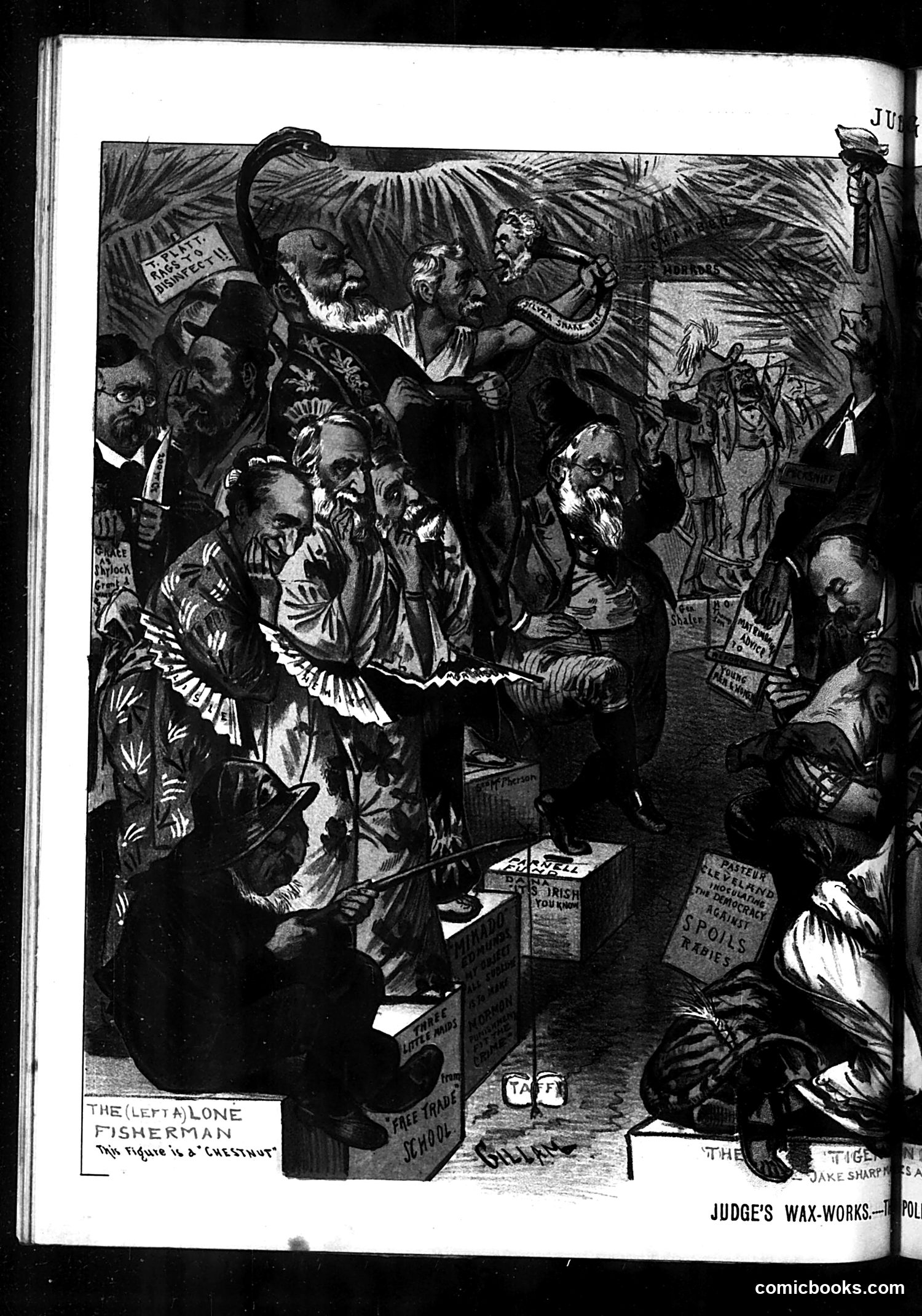
This appears to be a satirical cartoon titled "Judge's Wax-Works" depicting political or public figures as museum wax figures. The visible labels identify "The (Left) Alone Fisherman" (marked as "a chestnut"—meaning an old, tired joke) and what appears to be "The Tiger" or similar figure labeled "Jake Sharp." The crowded scene with multiple bearded men in period dress suggests this is political satire from the late 19th or early 20th century, likely mocking prominent politicians or scandals of that era. The "wax-works" conceit allows the cartoonist to freeze and ridicule these figures as artificial or outdated relics. However, without clearer text or historical context, I cannot definitively identify the specific political figures or events being referenced.
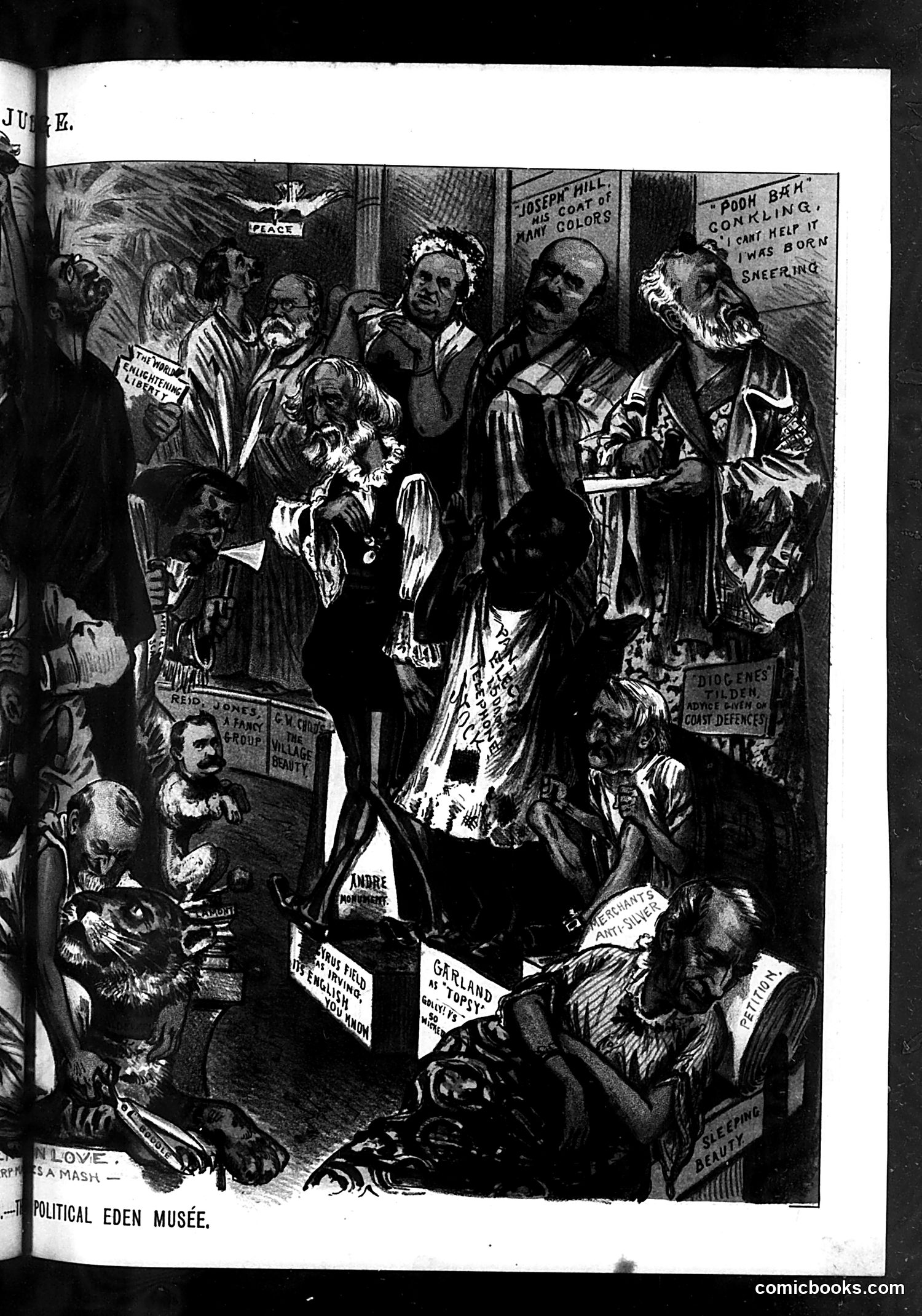
This cartoon satirizes prominent political figures of its era as wax museum displays—a "Political Eden Musée" (playing on "Eden Musée," a real New York wax museum). The figures are labeled with identifying names and quotes. The central female figure appears to represent a political personality, surrounded by caricatured male politicians in period dress. Speech bubbles contain their attributed statements. The satire works by presenting living politicians as static museum specimens—implying they're outdated, artificial, or worthy only of exhibition rather than active governance. The use of animal companions and exaggerated features emphasizes the mockery. Without clear date markers or all legible labels, precise identification of specific figures remains difficult, but the overall message critiques the political establishment as stiff, artificial, and belonging in a museum rather than in power.
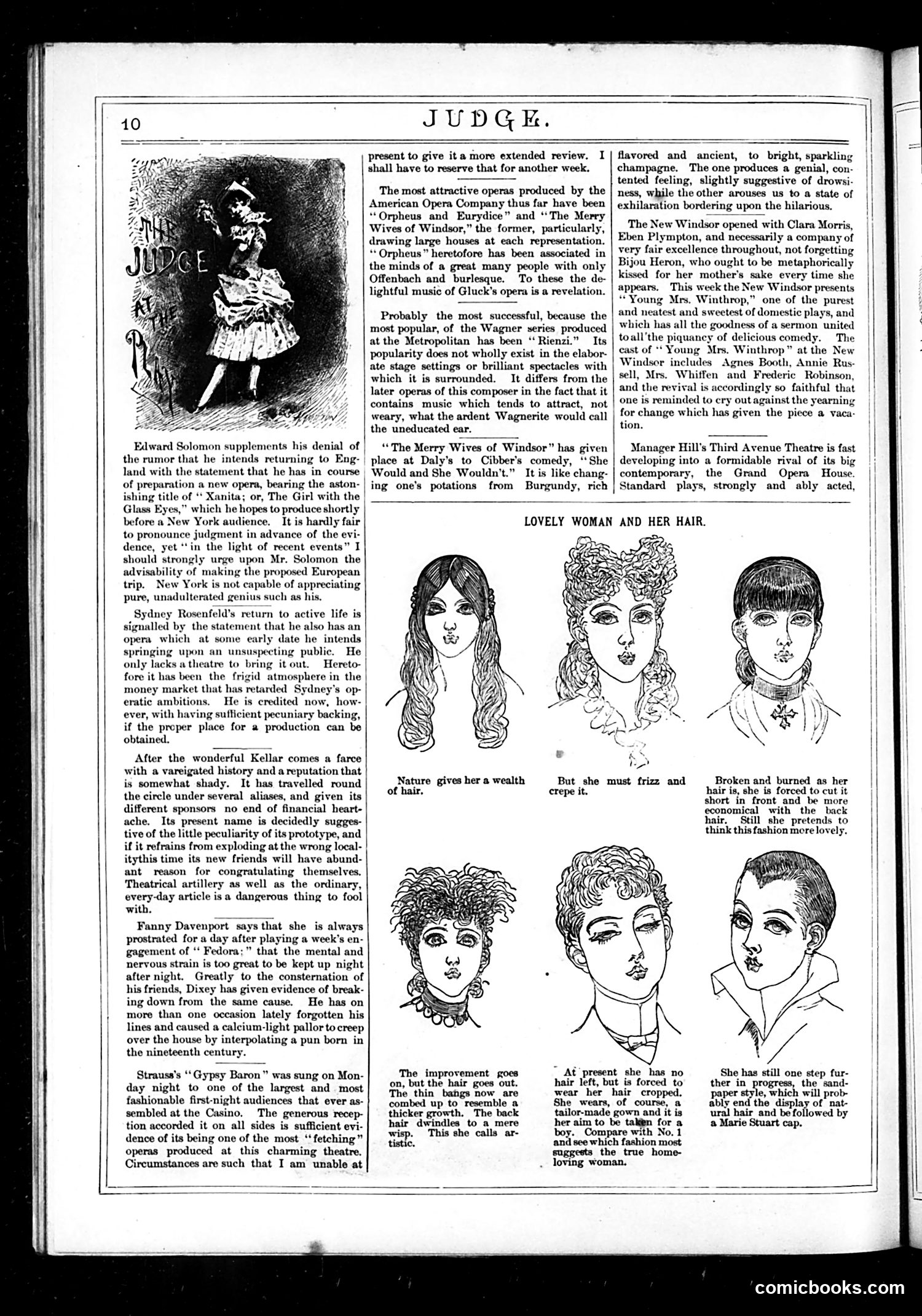
This page reviews theatrical productions and performers from late 19th-century New York. The satire targets opera composers and actors of the era: **Key figures mocked:** - Edward Solomon and Sydney Rosenfeld are ridiculed for preparing new operas, with the writer sarcastically suggesting Solomon leave New York because the city cannot appreciate his "genius"—clearly the opposite is meant - Fanny Davenport and Maurice Barrymore are noted for exhaustion from performing demanding roles **The humor:** The satire criticizes both the pretentiousness of aspiring opera composers and the physical toll of theatrical work. There's also mockery of forgettable farces with "shady" histories recycled under new titles. **Right side content:** Six illustrated female hairstyles labeled "Lovely Woman and Her Hair" show period fashion variations, discussing whether women should frizz, cut, or maintain their hair—a beauty/fashion commentary typical of the magazine's society coverage. The page blends theatrical criticism with lifestyle commentary for Judge's educated readership.
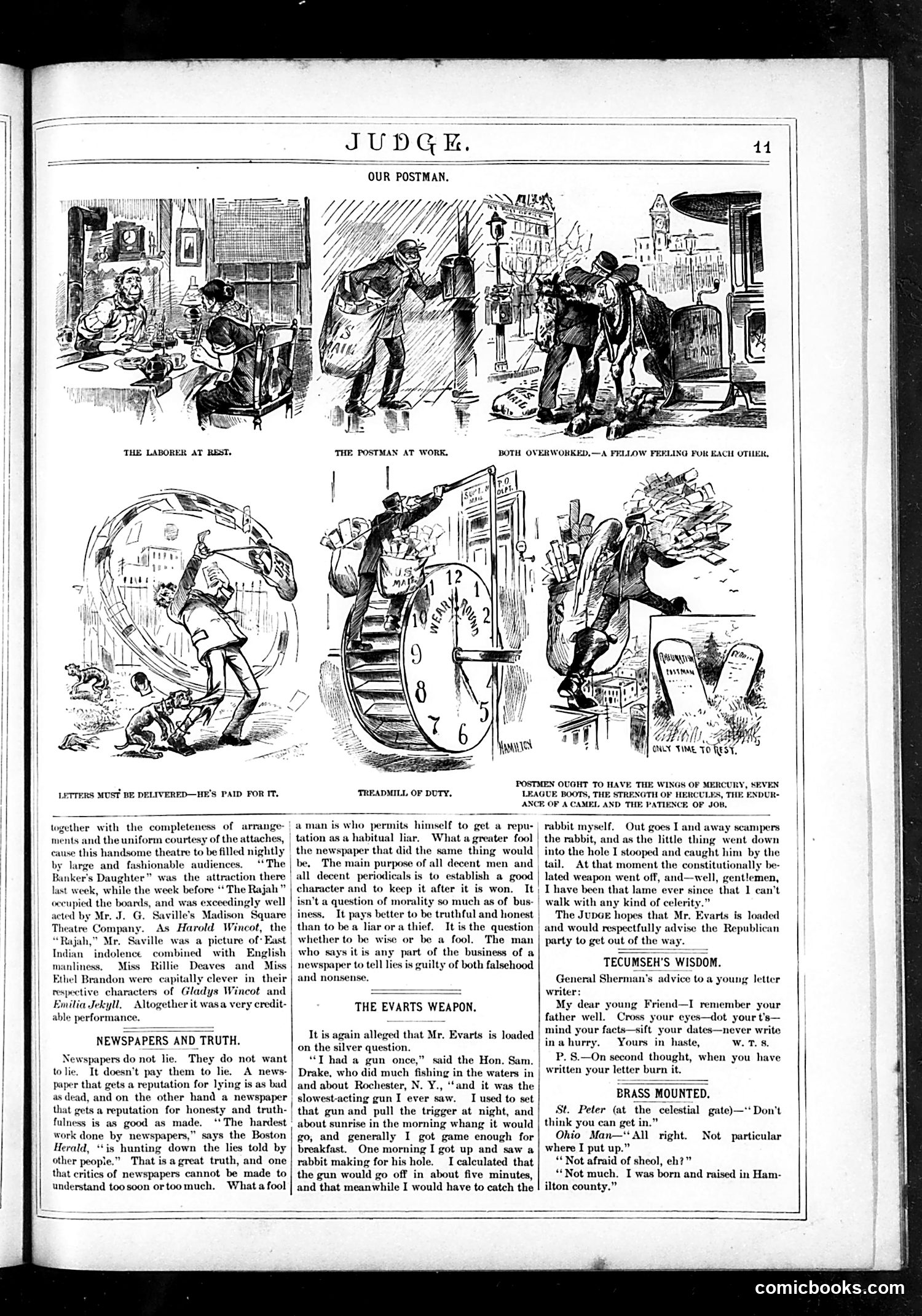
This page satirizes the postal service through six comic vignettes showing a postman's grueling workday. The title "Our Postman" frames the central joke: the postman is simultaneously "at rest" (lounging indoors), "at work" (delivering mail in harsh weather), and "overworked" with both laborers and postmen exhausted by their duties. The cartoons depict the postman as a figure of sympathy—trudging through rain, carrying impossibly heavy loads, working around the clock (shown by the treadmill and clock imagery). The accompanying text notes postmen need "the endurance of a camel and the patience of Job," mocking the grueling conditions they endure for meager pay. This reflects late-19th-century labor concerns: the page contrasts postal workers' hardship with editorials praising newspapers' "truthfulness" and morality—suggesting irony about institutions' actual treatment of working people. The satire critiques both inadequate working conditions and the gap between stated values and reality.
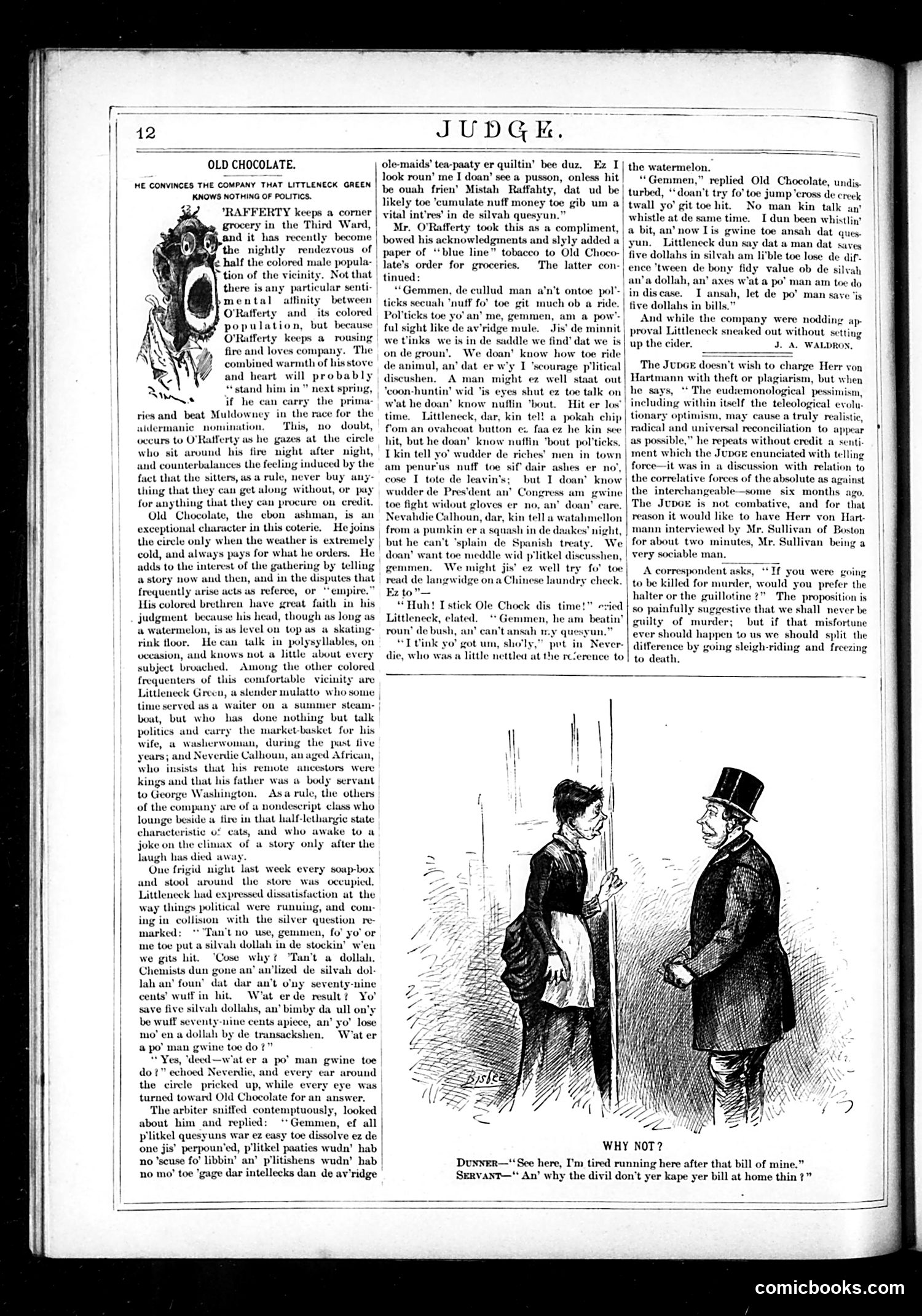
This Judge magazine page satirizes late-19th-century urban political and racial dynamics. The main story concerns "Old Chocolate," a Black ash-man and neighborhood figure who frequents O'Rafferty's corner grocery in the Third Ward. The piece depicts him as articulate and respected among other Black men despite his humble occupation. The cartoon illustrates a political debate: Littleneck Green complains that silver dollars contain only 79 cents' worth of silver, so hoarding them is pointless. Old Chocolate dismissively responds that if political questions were this easily solved, politicians would have nothing to argue about. The satire targets two things: politicians' self-interest in perpetuating complex debates, and—through the exaggerated dialect and caricature—contemporary racial stereotypes. The piece presents Black characters as both politically aware yet effectively powerless ("the cullud man ain't ontoe pol'ecuah 'nuff"). The humor relies on period audience assumptions about race and class hierarchy.
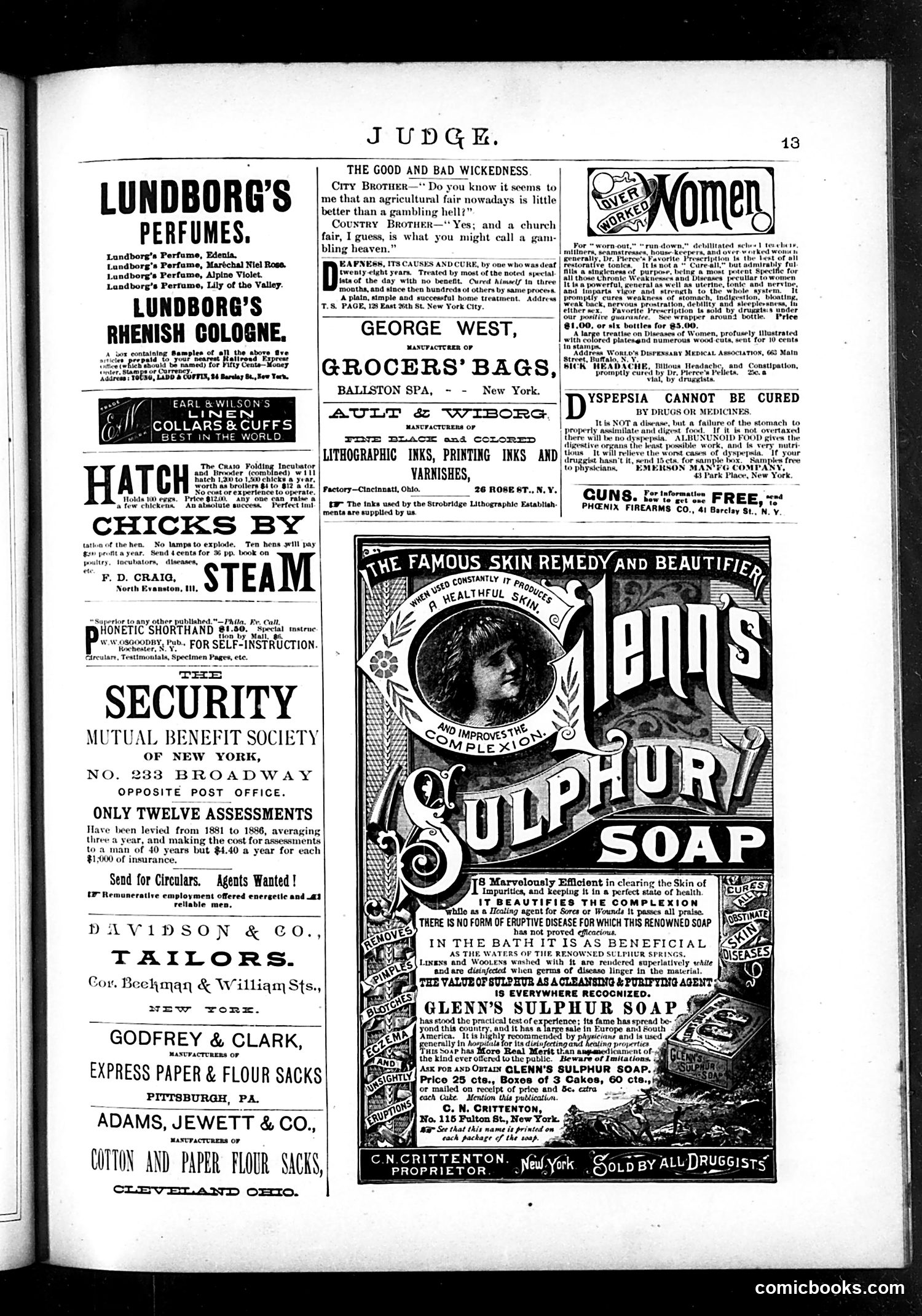
This is primarily an **advertising page** from Judge magazine, with minimal editorial content. The page consists almost entirely of commercial advertisements for various products and services typical of the 1880s era. The only satirical content is a brief dialogue labeled "THE GOOD AND BAD WICKEDNESS" at the top, featuring a City Brother and Country Brother discussing the moral equivalence between agricultural fairs and gambling halls, and between church fairs and "gambling heaven." This is light social satire about rural hypocrisy—suggesting that country folk engage in the same vices as city dwellers, just under different pretenses. The remaining content advertises perfumes, collating equipment, poultry incubators, shorthand courses, insurance, tailoring, paper sacks, guns, and medicinal soaps (notably Glenn's Sulphur Soap, prominently featured). The ads reflect late-19th-century commercial concerns and patent medicine marketing practices common to the era.
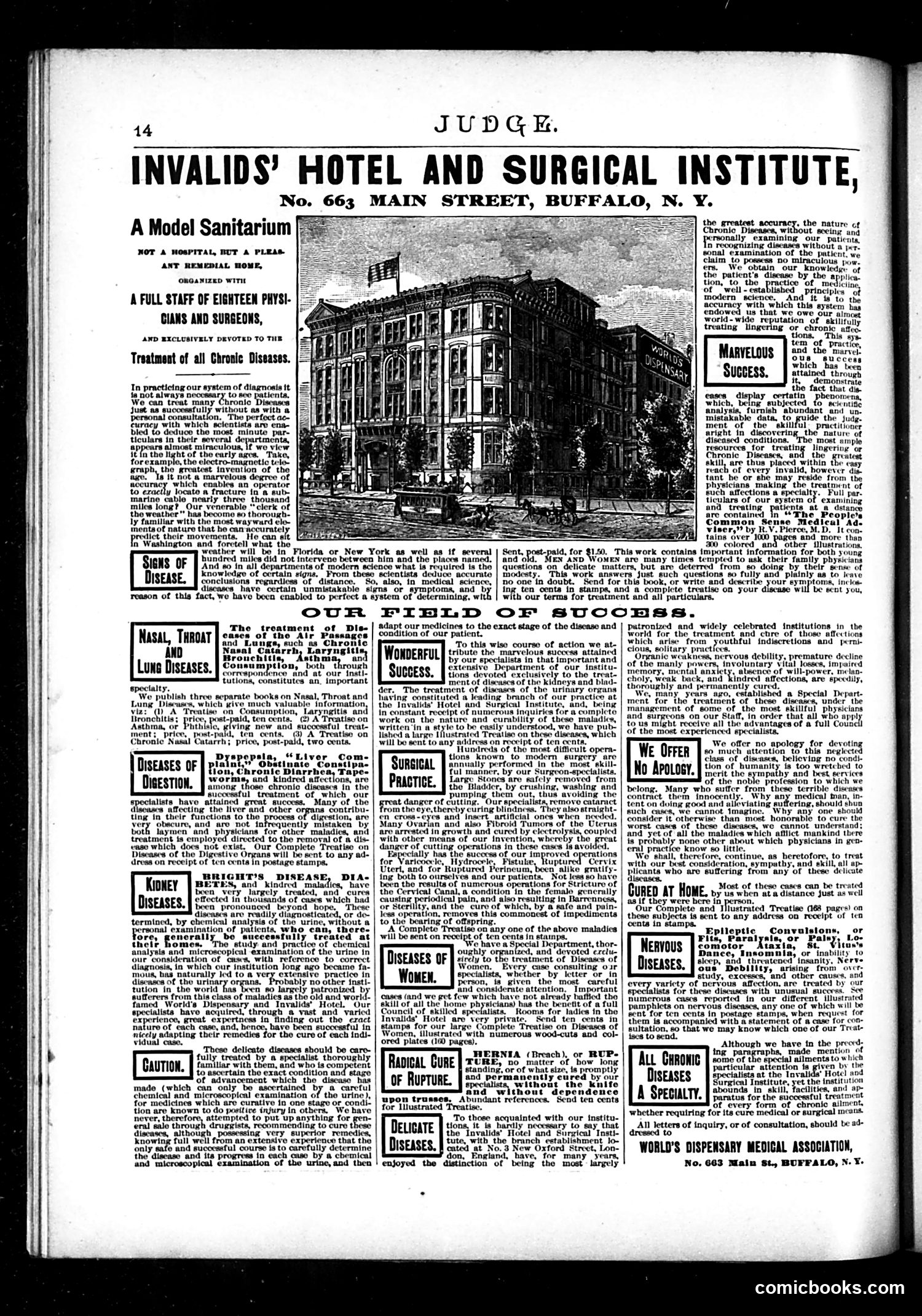
This page is primarily **advertising**, not political satire. It's a full-page advertisement for the "Invalids' Hotel and Surgical Institute" in Buffalo, New York—a medical facility claiming to treat chronic diseases. The ad promotes the institute's purported ability to diagnose and treat patients remotely through "chemical analysis" and without personal examination, drawing analogies to telegraph operators and weather forecasters. It lists specialties including respiratory diseases, digestive disorders, kidney disease, and urinary conditions. There are no political cartoons or satirical commentary visible. The small boxed sections on the left (with headers like "Signs of Disease," "Nasal, Throat and Lung Diseases," etc.) are organizational headings for the advertisement's medical claims, not cartoons. For modern readers: This represents 19th-century medical advertising making claims that would now be considered fraudulent—diagnosing serious illnesses by mail without examination.
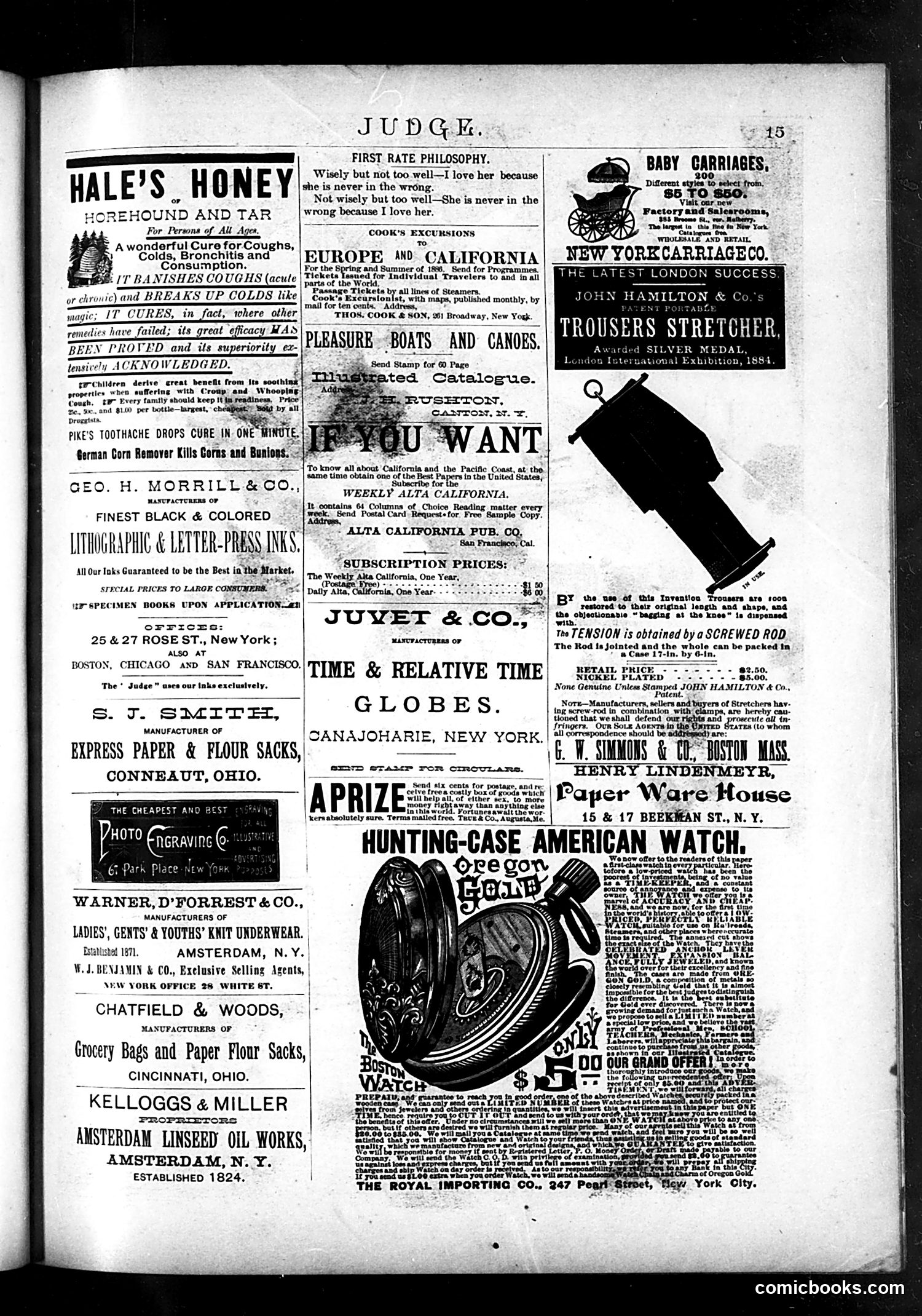
This is primarily an **advertising page** from Judge magazine, with minimal editorial content. The notable satirical element is the small section titled "FIRST RATE PHILOSOPHY" at the top, which presents two contrasting perspectives on love: 1. "Wisely but not too well—I love her because she is never in the wrong" (suggesting rational love) 2. "Not wisely but too well—She is never in the wrong because I love her" (suggesting blind, excessive love) This is a **gentle satire on romantic delusion**—poking fun at how love clouds judgment, making men rationalize their beloved's faults. The piece plays on Victorian-era anxieties about masculine reason being overwhelmed by emotion. The remainder of the page consists entirely of period advertisements for patent medicines (Hale's Honey, Pike's Toothache Drops), paper goods, watches, and travel services—typical of Judge's revenue model. There are no other political cartoons or satirical illustrations visible.
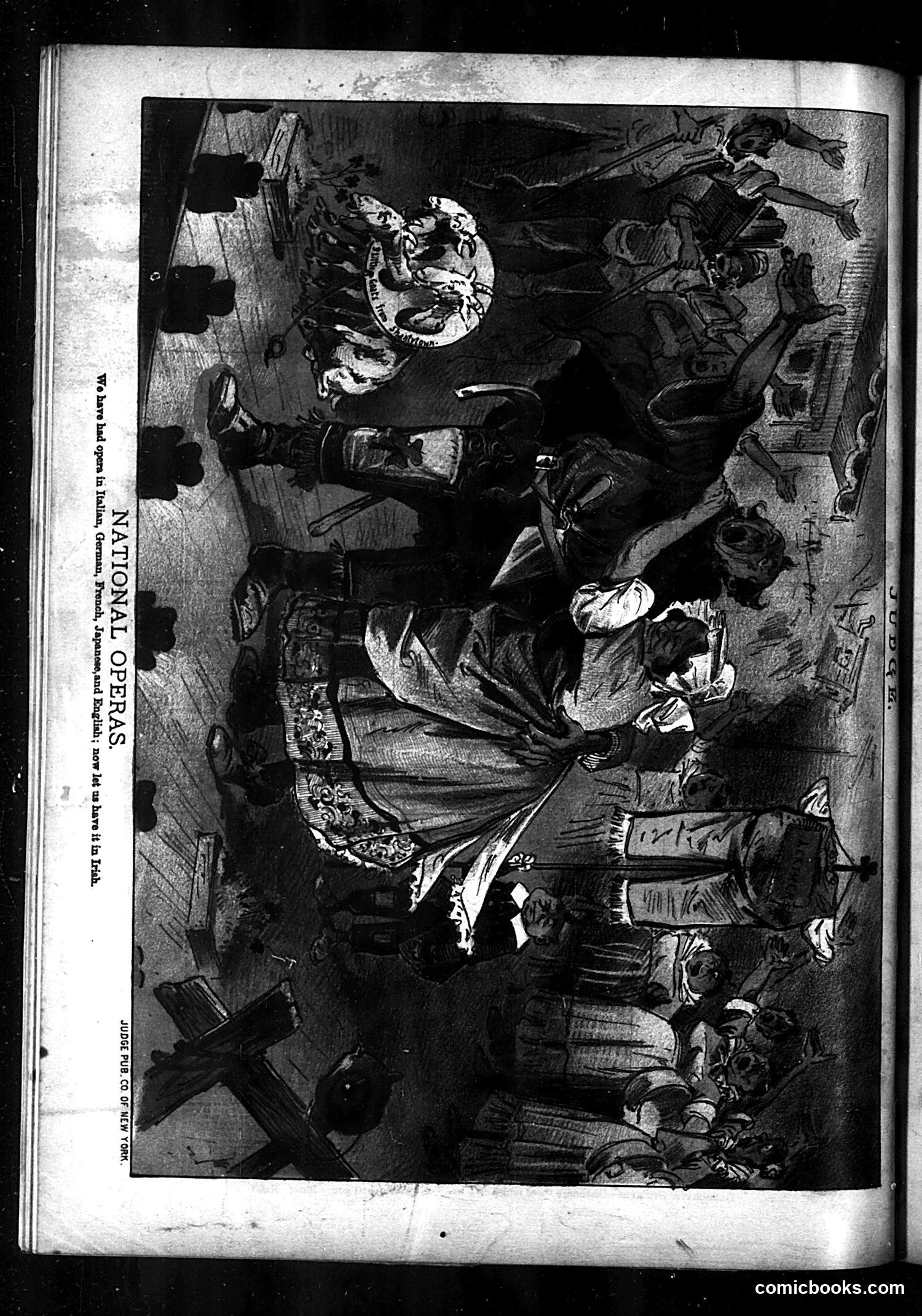
This appears to be a satirical cartoon titled "National Operas" commenting on the proliferation of operas in various languages and national styles in late 19th/early 20th-century America. The caption lists Italian, German, French, Japanese, and English operas, then proposes adding Irish opera—likely satirizing both the growing Irish-American population's cultural influence and the contemporary trend of ethnic nationalism expressed through operatic traditions. The cartoon appears to depict a chaotic opera scene with multiple figures, suggesting absurdity in this proliferation of national operatic forms. The joke targets how every ethnic or national group was claiming cultural legitimacy through opera, with the Irish being the latest addition to this competitive cultural landscape. The satire reflects period anxieties about immigration and ethnic identity in America.