
Judge, 1886-05-01 · page 7 of 16
Judge — May 1, 1886 — page 7: what you’re looking at
What you’re looking at
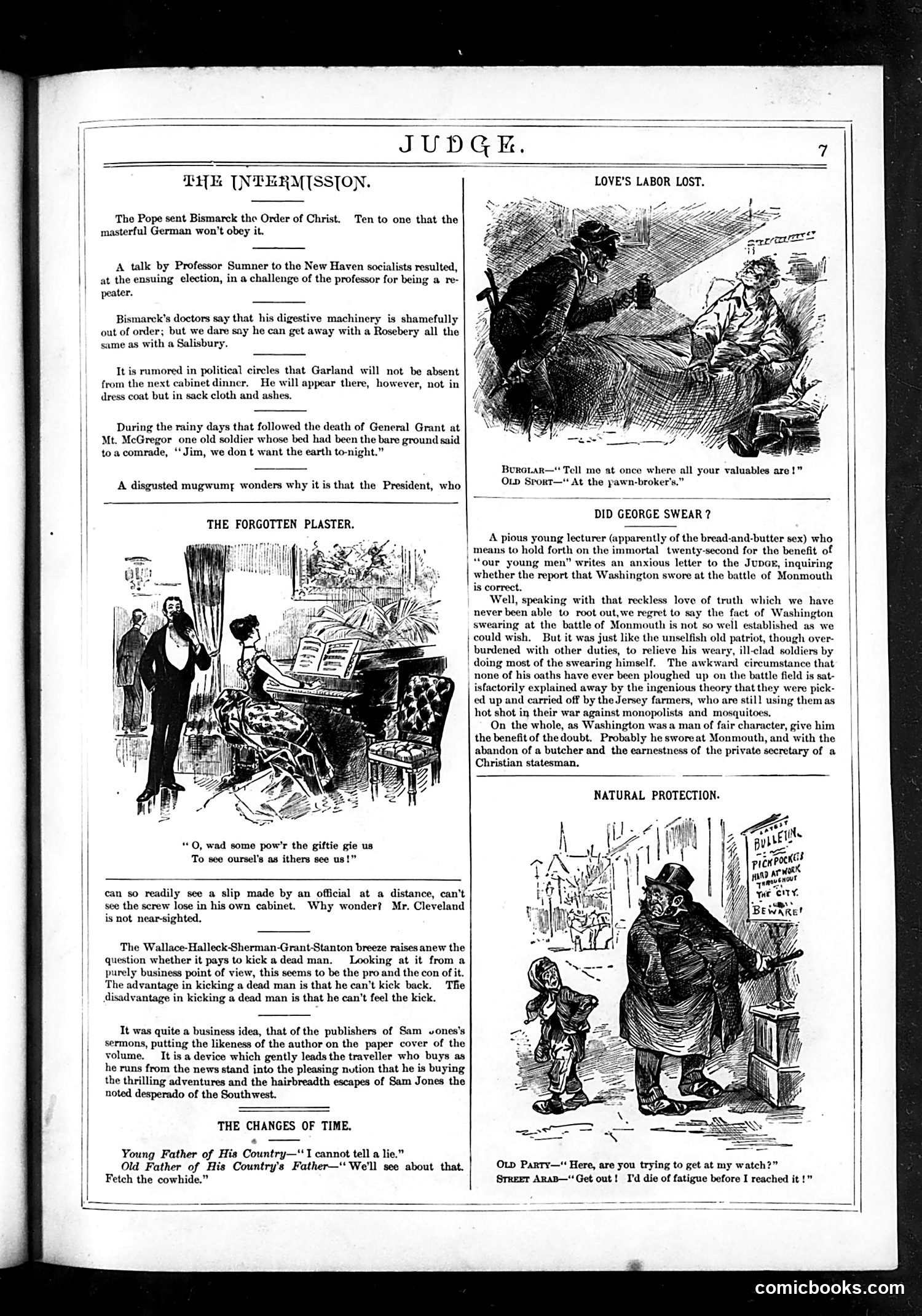
This 1880s-era satirical page contains brief political quips and cartoons mocking contemporary figures and events: **"The Intermission"** section includes jokes about Bismarck defying the Pope, Professor Sumner's socialist lecture in New Haven, and President Cleveland's blindness to cabinet scandals while criticizing others. **"The Forgotten Plaster"** cartoon satirizes nostalgia for Civil War heroes (Wallace, Halleck, Sherman, Grant, Stanton), questioning whether it benefits anyone to "kick a dead man." **"Did George Swear?"** responds to a reader's question about whether George Washington swore at Monmouth. Judge humorously suggests yes, though conveniently no evidence remains—Jersey farmers allegedly picked up the oaths for use against "monopolists and mosquitoes." **"Natural Protection"** and **"Love's Labor Lost"** are brief joke cartoons about burglary and con artists. The page's humor relies on topical references (Cleveland administration scandals, Civil War nostalgia) and assumes readers knew contemporary political debates. Most specific identities and events are now obscure without historical context.
📄 Transcribed text from this page (OCR, searchable)
Machine-transcribed from the original scan — historical spelling and the odd misread are preserved.
TYE [NEERM[SSTON. The Pope sent Bismarck the Order of Christ. Ten to one that the masterful German won't obey it. A talk by Professor Sumner to the New Haven socialists resulted, at the ensuing election, in a challenge of the professor for being a re- peater. Bismarck’s doctors say that his digestive machinery is shamefully out of order; but we dare say he can get away with a Rosebery all the same as with a Salisbury, It is rumored in political circles that Garland will not be absent from the next cabinet dinner. He will appear there, however, not in dress coat but in sack cloth and ashes. During the rainy days that followed the death of General Grant at Mt. McGregor one old soldier whose bed had been the bare ground said toacomrade, “Jim, we don t want the earth to-night.” A disgusted mugwumy wonders why it is that the President, who THE FORGOTTEN PLASTER. “0, wad some pow'r the giftie gie us To see oursel’s as ithers see us!” can so readily see a slip made by an official at a distance, can't see the screw lose in his own cabinet. Why wonder? Mr. Cleveland is not nearsighted. The Wallace-Halleck-Sherman-Grant-Stanton breeze raises anew the question whether it pays to kick adead man. Looking at it from a purely business point of view, this seems to be the pro and the con of it. The advantage in kicking a dead man is that he can’t kick back. THe disadvantage in kicking a dead man is that he can't feel the kick. It was quite a business idea, that of the publishers of Sam vones's sermons, putting the likeness of the author on the paper cover of the volume. It is a device which gently leads the traveller who buys as he runs from the news stand into the pleasing nution that he is buying the thrilling adventures and the hairbreadth escapes of Sam Jones the noted desperado of the Southwest. THE CHANGES OF TIME. Young Father of His Country—''I cannot tell a lie.” Old Father of His Country's Father—‘ We'll see about that. Fetch the cowhide.” | could wish. | burdened with other duties, to relieve his wea | doing most of the swearing himself. BurGLar—“ Tell mo at once where all your valuables are!” Otp Srort—“ At the pawn-broker's.” DID GEORGE SWEAR? A pious young lecturer (apparently of the bread-and-butter sex) who | means to hold forth on the immortal’ twenty-second for the benefit of “our young men” writes an anxious letter to the JupGE, inquiring whether the report that Washington swore at the battle of Monmouth is correct. Well, speaking with that reckless love of truth which we have never been able to root out,we regret to say the fact of Washington swearing at the battle of Monmouth is not so well established as we But it was just like the unselfish old patriot, though over- ill-clad soldiers by The awkward circumstance that none of his oaths have ever been ploughed up on the battle field is sat- isfactorily explained away by the ingenious theory that they were pick- ed up and carried off by the Jersey farmers, who are still using them as hot shot in their war against monopolists and mosquitoes. On the whole, as Washington was a man of fair character, give him the benefit of thedoubt. Probably he sworeat Monmouth, and with the abandon of a butcher and the earnestness of the private secretary of a Christian statesman. NATURAL PROTECTION. /ABEWane! Otp Party—‘“ Here, are you trying to get at my watch?” Srreet AraB—‘Get out! I'd die of fatigue before I reached it!” comicbooks.com