
Judge, 1886-05-01 · page 3 of 16
Judge — May 1, 1886 — page 3: what you’re looking at
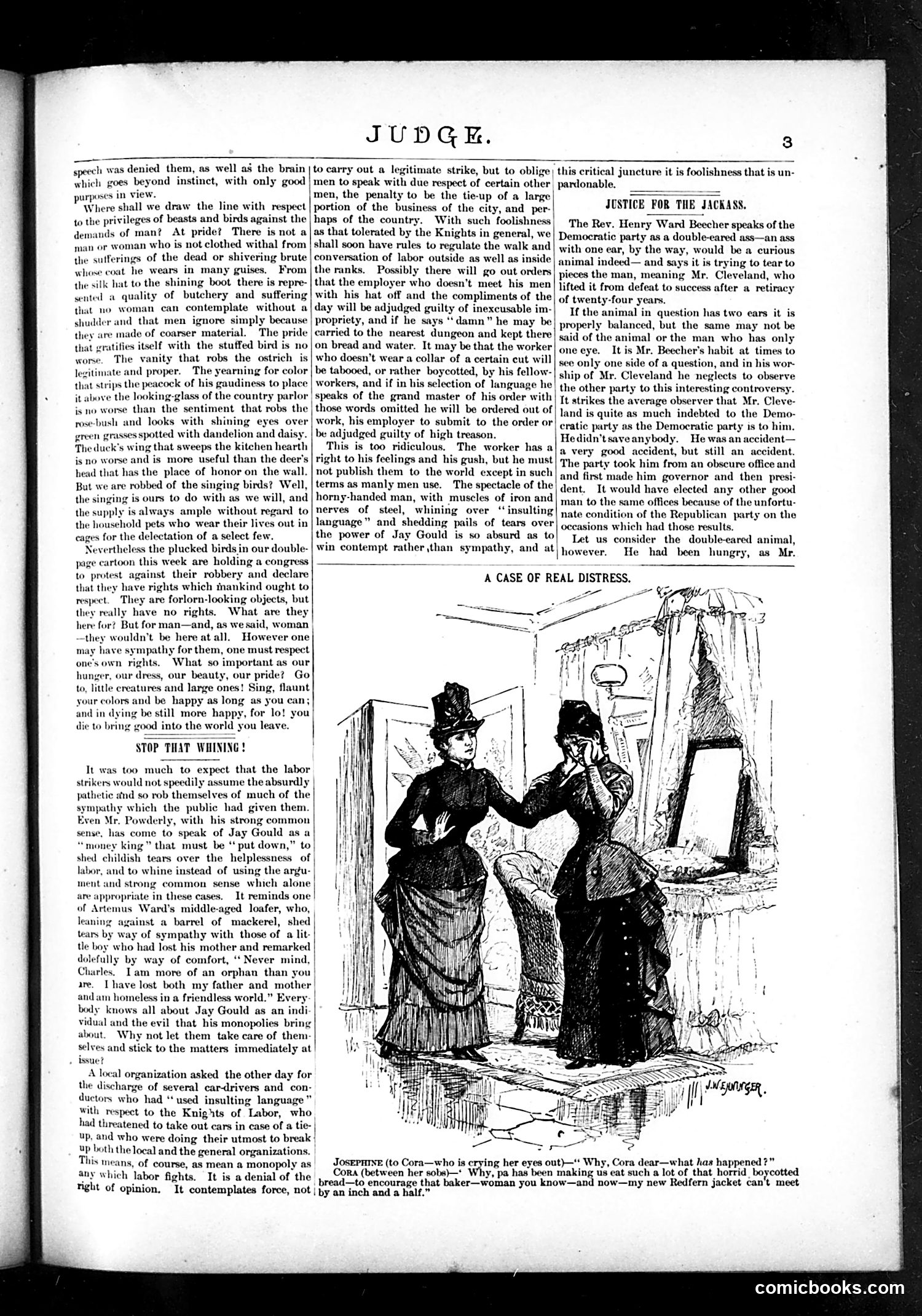
What you’re looking at
This page contains two distinct pieces of social commentary: **"Stop That Whining!"** critiques labor leaders, particularly Terence Powderly (implied), for using emotional rhetoric about Jay Gould instead of rational argument. The author argues that while Gould's monopolies are problematic, sentimental appeals undermine labor's credibility and distract from concrete issues. **"A Case of Real Distress"** cartoon satirizes a woman (likely representing a labor activist or reformer) lecturing another woman about a baker's boycott due to labor disputes. The image mocks the disconnect between abstract labor principles and practical hardship—the struggling woman needs bread, not ideological purity. The page reflects *Judge*'s editorial position: sympathetic to labor's legitimate grievances but skeptical of emotional manipulation, hypocrisy, and tactics that harm ordinary workers. The satire targets both overzealous reformers and the gap between activist rhetoric and workers' actual needs.
📄 Transcribed text from this page (OCR, searchable)
Machine-transcribed from the original scan — historical spelling and the odd misread are preserved.
JUDGE. 3 speech was denied them, as well as the brain which goes beyond instinct, with only good | purposes in view. — Where shall we draw the line with respect to the privileges of beasts and birds against the | demands of man? At pride? There is not a man or woman who is not clothed withal from the sutferings of the dead or shivering brute whose coat he wears in many gui From the silk hat to the shining boot there is repre- sented a quality of butchery and suffering that no woman can contemplate without a shudder and that men ignore simply because they are made of coarser material. The pride that gratifies itself with the stuffed bird is no worse. The vanity that robs the ostrich is legitimate and proper. The yearning for color that strips the peacock of his gaudiness to place it above the looking-glass of the country parlor is no worse than the sentiment that robs the rose-bush and looks with shining eyes over green grasses spotted with dandelion and dai: ‘Theduck’s wing that sweeps the kitchen hearth is no worse and is more useful than the deer's head that has the place of honor on the wall. But we are robbed of the singing birds? Well, the singing is ours to do with as we will, and the suppl. ample without regard to the household pets who wear their lives out in cages for the delectation of a select few. theless the plucked birds in our double- rtoon this week are holding a congress to protest against their robbery and declare that they have rights which mankind ought to respect. They are forlorn-looking objects, but they really have no rights. What are they for? But for man—and, as we said, woman | wouldn't be here at all. However one have sympathy for them, one must respect own rights. What so important as our hunger, our dress, our beauty, our pride? Go to, little creatures and large ones! Sing, flaunt your colors and be happy as long as you can; and in dying be still more happy, for lo! you} die to bring into the world you leave. STOP THAT WHINING ! are It was too much to expect that the labor rs would not speedily pathetic and so rob themse sympathy which the publ jad given them. n Mr. Powderly, with his strong common sense, has come to speak of Jay Gould as a king” that must be “put down,” to} shed childish tears over the helplessness of | labor, and to whine instead of using the argu- ment and strong common sense which alone are appropriate in these cases, It reminds one of Artemus Ward’s middle-aged loafer, who, | leaning against a barrel of mackerel, shed of sympathy with those of a lit- y who had lost his mother and remarked dolefully by way of comfort, ‘Never mind, | Charles. Iam more of an orphan than you are. Ihave lost both my father and mother andam homeless in a friendless world.” Every: body knows all about Jay Gould as an indi vidual and the evil that his monopolies bring about. W) t let them take care of them- selves and stick to the matters immediately at issue? A local organization asked the other day for the discharge of several car-drivers and con- ductors who had ‘used insulting language” with respect to the Knights of Labor, who had threatened to take out cars in case of a tie- up, and who were doing their utmost to break up both the local and the general organizations. This means, of course, as mean a monopoly as any which labor fights. It is a denial of the Fight of opinion. It contemplates force, ssume the absurdly es of much of the . | be adjudged guilty of high treason, to carry out a legitimate strike, but to oblige, men to speak with due respect of certain other men, the penalty to be the tie-up of a large portion of the business of the city, and per- haps of the country. With such foolishness] as that tolerated by the Knights in general, we shall soon have rules to regulate the walk and conversation of labor outside as well as inside} the ranks, Possibly there will go out orders that the employer who doesn’t meet his men with his hat off and the compliments of the} day will be adjudged guilty of inexcusable im-| propriety, and if he says ‘‘damn” he may be| carried to the nearest dungeon and kept there on bread and water. It may be that the worker who doesn’t wear a collar of a certain cut will be tabooed, or rather boycotted, by his fellow- workers, and if in his selection of language he speaks of the grand master of his order with those words omitted he will be ordered out of work, his employer to submit to the order or This is too ridiculous. The worker has a right to his feelings and his gush, but he must not publish them to the world except in such terms as manly men use. The spectacle of the horny-handed man, with muscles of iron and nerves of steel, whining over ‘insulting language” and shedding pails of tears over the power of Jay Gould is so absurd as to win contempt rather than sympathy, and at this critical juncture it is foolishness that is un- pardonable. JUSTICE FOR THE JACKASS. The Rev. Henry Ward Beecher speaks of the Democratic party as a double-eared ass—an ass with one ear, by the way, would be a curious animal indeed— and says it is trying to tear to pieces the man, meaning Mr. Cleveland, who lifted it from defeat to success after a retiracy of twenty-four years. If the animal in question has two ears it is properly balanced, but the same may not be said of the animal or the man who has only one eye. It is Mr. Beecher’s habit at times to see only one side of a question, and in his wor ship of Mr. Cleveland he neglects to observe the other party to this interesting controvers; It strikes the average observer that Mr. Clev land is quite as much indebted to the Demo- cratic party as the Democratic party is to him. Hedidn’tsaveanybody. He was an accident— a very good accident, but still an accident. The party took him from an obscure office and and first made him governor and then presi- dent. It would have elected any other good man to the same offices because of the unfortu- nate condition of the Republican party on the occasions which had those results. Let us consider the double-eared animal, however. He had been hungry, as Mr. A CASE OF REAL DISTRESS. JOSEPHINE (to Cora—who is c1 ing her eyes out)—* Why, Cora dear—what has happened RA (between her sobs)—* Why, pa has been making us eat such a lot of that horrid boycotted read—to encourage that baker—woman you know—and now—my new Redfern jacket can't meet not | by an inch and a half.” comicbooks.com