
A complete issue · 16 pages · 1886
Judge — April 24, 1886
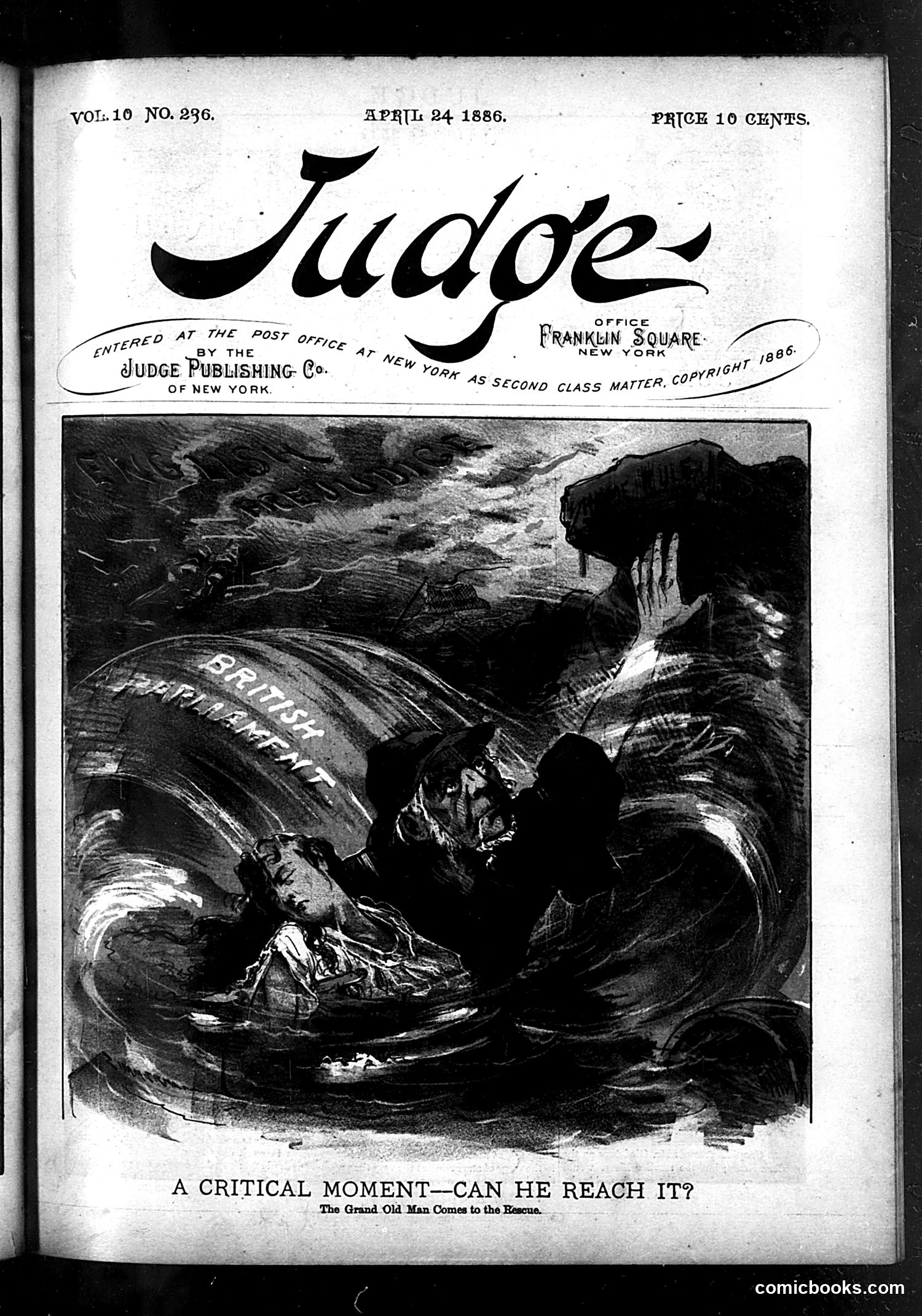
This political cartoon depicts a dramatic rescue scene titled "A Critical Moment—Can He Reach It? The Grand Old Man Comes to the Rescue." The barrel labeled "BRITISH DYNAMITE" appears to be sinking, with a figure labeled "BRITISH" attempting to rescue it. The "Grand Old Man" likely refers to William Ewart Gladstone, the elderly British Prime Minister prominent during this period. The cartoon likely satirizes contemporary anxieties about Irish dynamite terrorism (associated with Irish independence movements in the 1880s) and British political responses. The rescue imagery suggests either Gladstone's political intervention or commentary on Britain's ability to contain the threat. The dramatic, turbulent composition emphasizes the perilous situation. Without additional context or clearer labeling, the precise political message remains somewhat unclear, though it certainly engages with Irish-British tensions of the era.
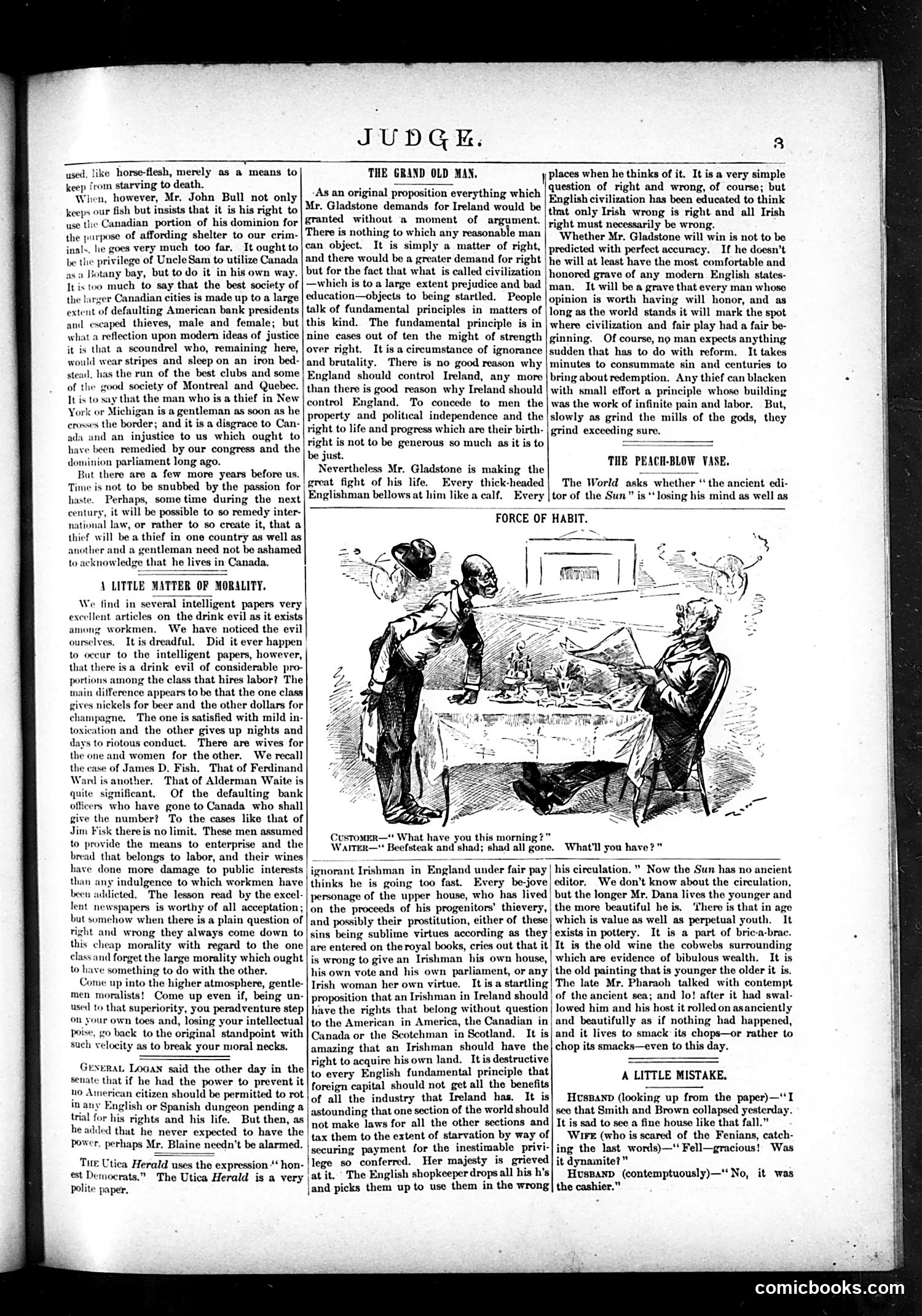
This page from Judge (an American satirical weekly) contains three distinct pieces critiquing social hypocrisy and political issues: **"The Grand Old Man"** addresses William Gladstone's Irish demands, arguing England should grant Ireland self-governance as a matter of principle—though the full text is cut off. **"A Little Matter of Morality"** is the editorial's main thrust: it mocks the moral double standard of wealthy elites versus working class. While reformers denounce workers' drinking, the article notes that wealthy industrialists (referencing James D. Fish, Ferdinand Ward, Jim Fisk—notorious 1870s-80s financiers) engage in far more destructive excess. Their champagne and "riotous conduct" damage public interests more than workers' beer, yet escape moral censure. **The cartoon "Force of Habit"** (center) shows a man compulsively reaching toward an empty box labeled "CIGARS," illustrating addiction's grip regardless of supply—likely satirizing how habits persist absurdly. The page exemplifies Judge's crusading satirical style: exposing class-based moral hypocrisy in Gilded Age America.
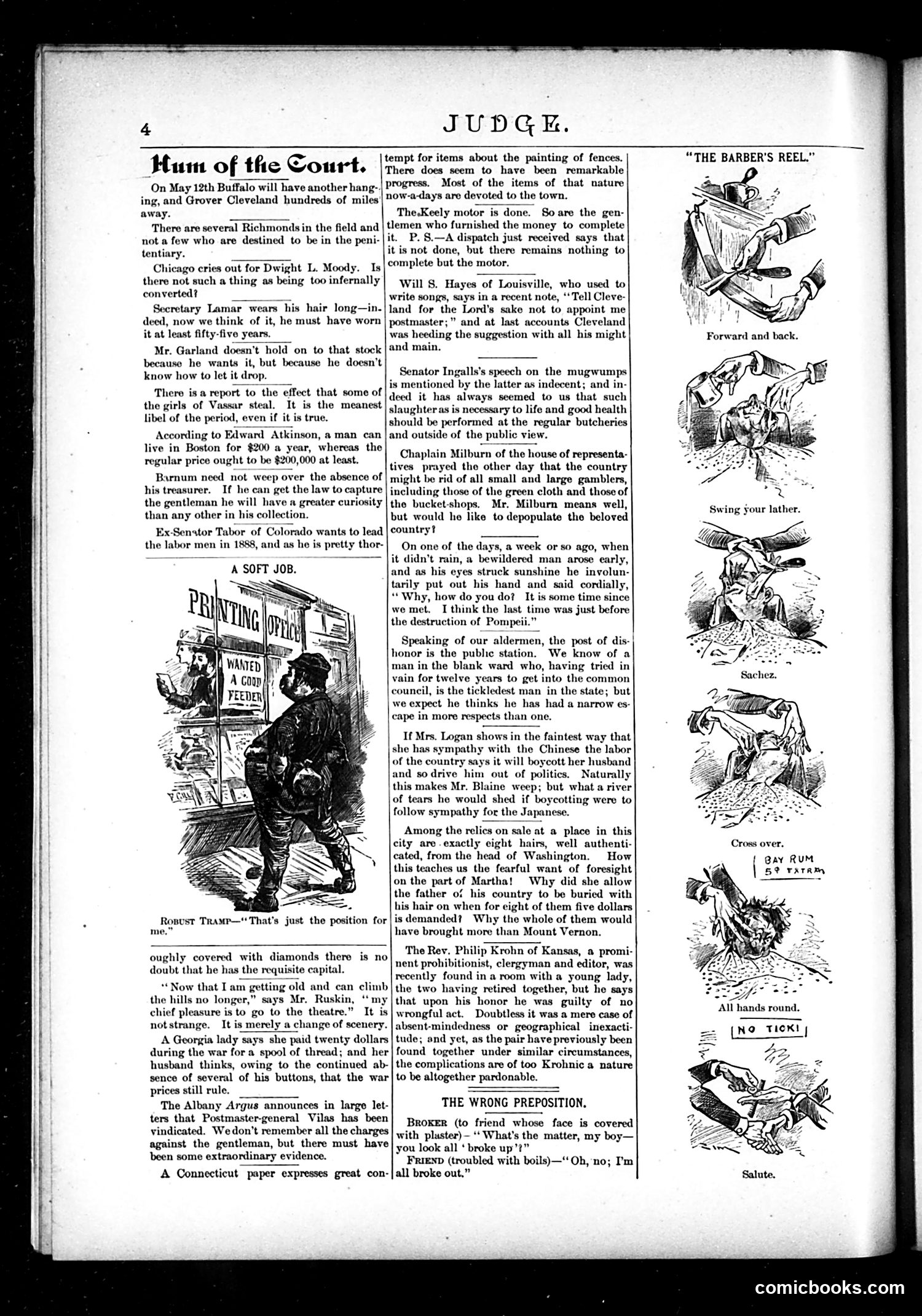
This page collects brief political jabs and social commentary typical of Judge's satirical style. Key targets include: **Political figures**: References to **Grover Cleveland** (president), **Secretary Lamar**, **Mr. Garland**, and **Postmaster-general Vilas**—mocking their policies and character flaws through sardonic one-liners. **Social absurdities**: Jokes about the **Keely motor** (a fraudulent perpetual motion machine that attracted investors), **Vassar girls stealing**, and **Senator Tabor's diamonds** (ironically funding labor advocacy). **The cartoon "A Soft Job"** depicts someone posting a "Printing Office Wanted" notice—satirizing job-seeking or patronage politics. The humor relies on insider knowledge of 1880s political scandals and personalities. Most jabs are obscure today without historical context, though the mockery of charlatan inventions and political hypocrisy remains clear. The tone is cynical, targeting both politicians and public gullibility.
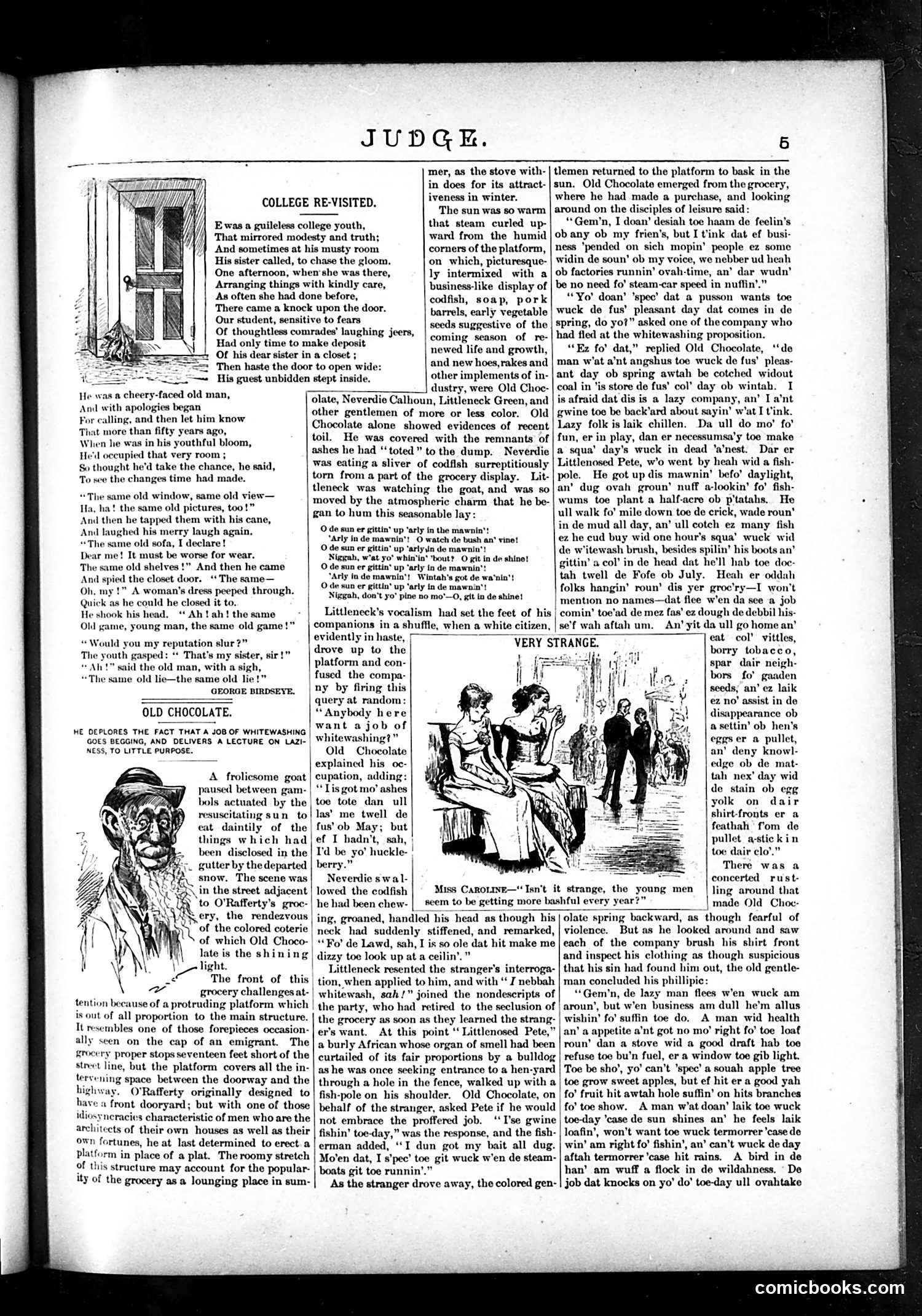
This page contains two separate satirical pieces: **"College Re-visited"** (top): A morality tale about a college student caught in an embarrassing situation. When an elderly alumnus visits his old dorm room, he discovers the student's sister hiding in a closet—suggesting improper conduct. The old man cynically remarks "The same old lie—the same old lie," implying such deceptions are timeless college traditions. The satire mocks both student hypocrisy and the predictability of youth's excuses. **"Old Chocolate"** (bottom): This depicts a group of African American laborers lounging outside O'Rafferty's grocery. "Old Chocolate" has actually worked (covered in ashes), while his companions idle away their time. The piece satirizes laziness among working-class Black men, with the narrative disapproving of their refusal to embrace labor. One character sings about the warming season, seemingly indifferent to the whitewashing job that "goes begging." The satire critiques idleness as moral failing. Both pieces employ period-typical racial stereotypes and dialect in the second story.
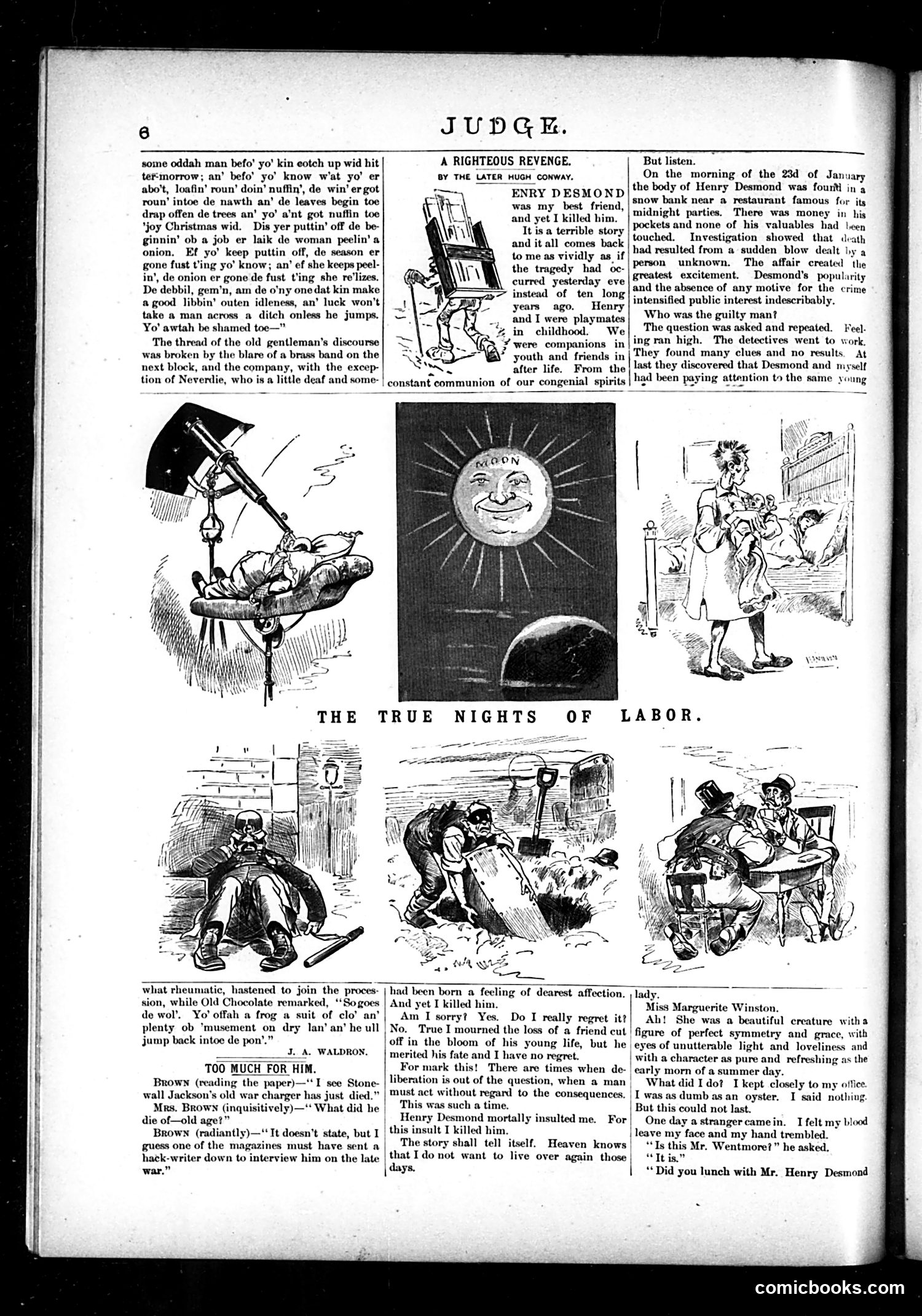
This *Judge* page contains two distinct pieces of satirical content: **"A Righteous Revenge"** (right column and continuing text) is a serialized dramatic story—not satire—about a man who killed his best friend Henry Desmond over a woman named Marguerite Winston. It reads like melodramatic Victorian fiction rather than political commentary. **"The True Nights of Labor"** (bottom section with illustrations) appears to be a humorous commentary on work and laziness, showing various working-class figures in different states of labor or idleness. The accompanying dialogue emphasizes themes of procrastination and the consequences of avoiding work. The page also includes "Too Much for Him," a brief joke about a journalist interviewing a dead horse. Overall, this page mixes serialized drama, labor-themed humor, and light comedic pieces typical of *Judge's* entertainment-focused content rather than focused political satire.
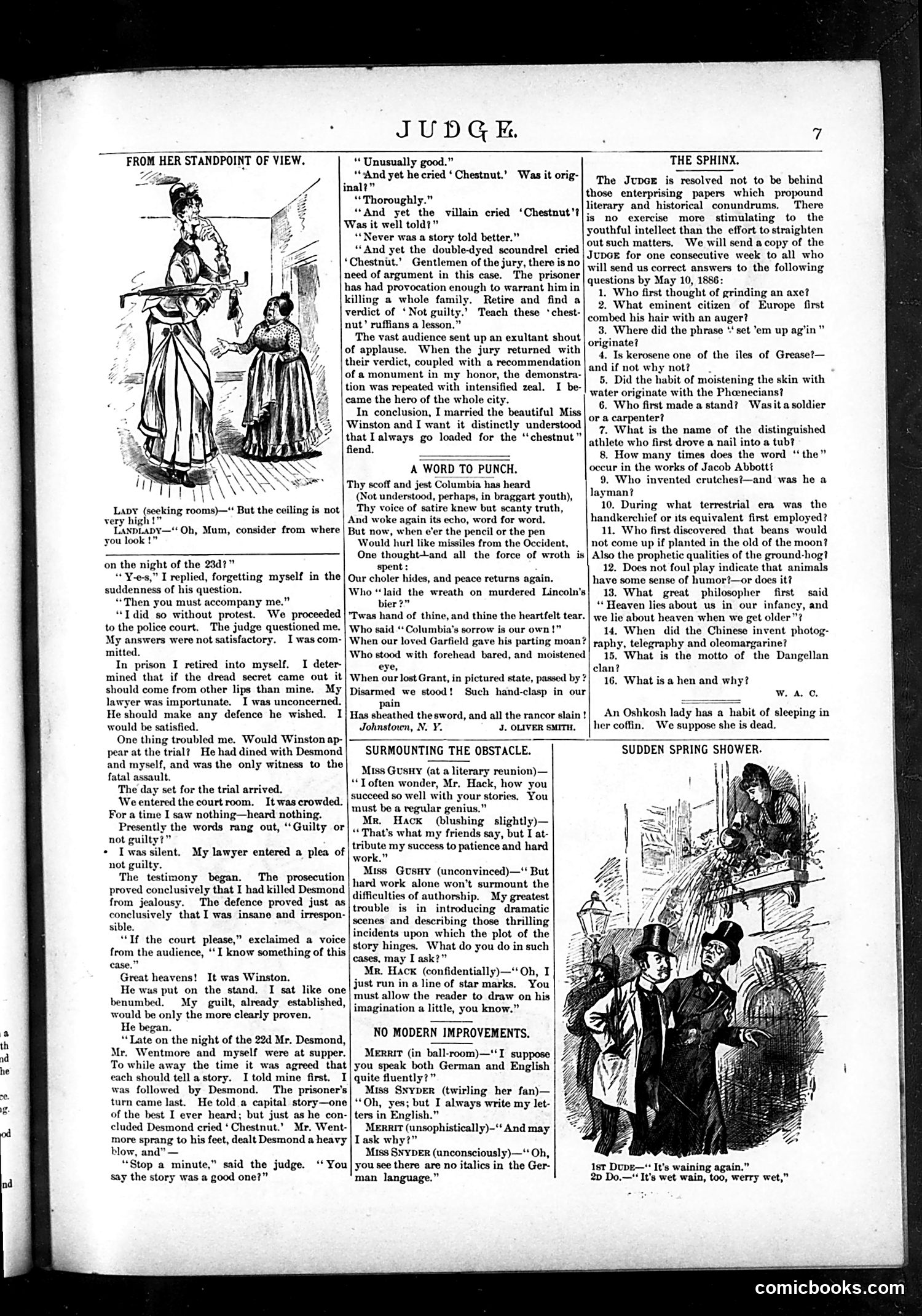
This page contains two unrelated pieces of satire: **"From Her Standpoint of View"** (top left): A brief joke about a landlady showing rooms. When a prospective tenant complains the ceiling is too low, she suggests he view it from where *she* stands—implying she's shorter, so it seems higher to her. It's gentle satire on perspective and real estate salesmanship. **The main story** (center and right): A narrative about a murder trial where the defendant killed a man named Desmond. The twist: the murder was provoked because Desmond called the defendant's story a "chestnut" (slang for an old, overused joke). The judge, outraged at this insult to storytelling, directs the jury to acquit. This satirizes how juries might respond to sympathetic circumstances over legal facts. **"A Word to Punch"** (bottom right): A poem praising *Punch* magazine (Britain's satirical rival) for its respectful coverage of American tragedies—Lincoln's assassination, Garfield's death, Grant's passing—which apparently softened American-British tensions. The illustrations are decorative vignettes unrelated to the text content.
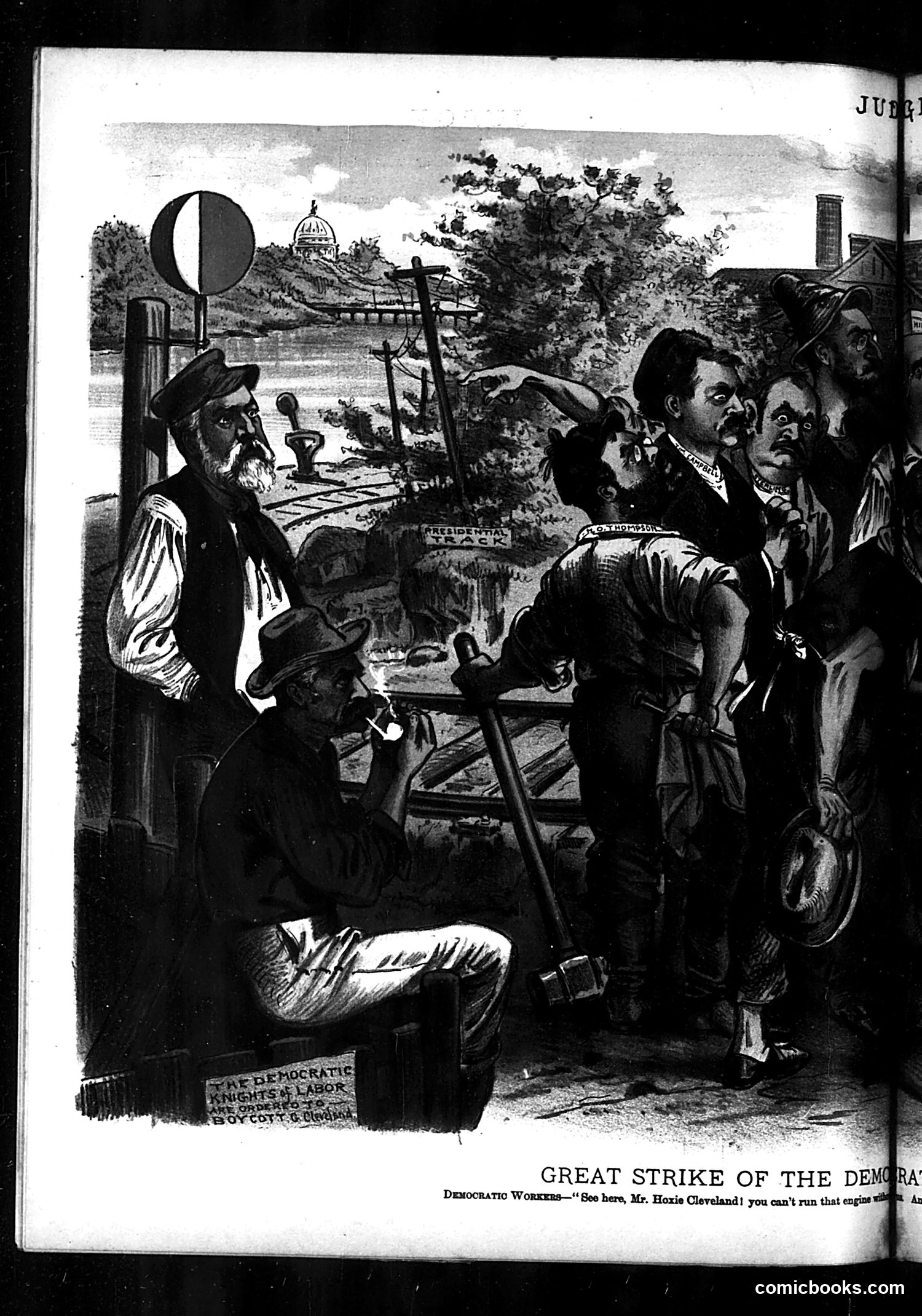
This political cartoon satirizes the Democratic Party's internal conflict during the labor movement era. The caption references "See here, Mr. Hoosie Cleveland! you can't run that engine" — invoking President Grover Cleveland and the Democratic Party (the "engine"). The cartoon depicts workers or party members in apparent rebellion or strike against Democratic leadership. The setting includes industrial elements (machinery, a wheel mechanism) and a riverside industrial landscape, reflecting late 19th-century labor disputes. The satire appears to mock Democratic attempts to control or manage labor interests, suggesting the party has lost authority over its working-class base. The "Knights of Labor" reference indicates this relates to actual labor organizing of that era, likely the Pullman Strike period (early 1890s).
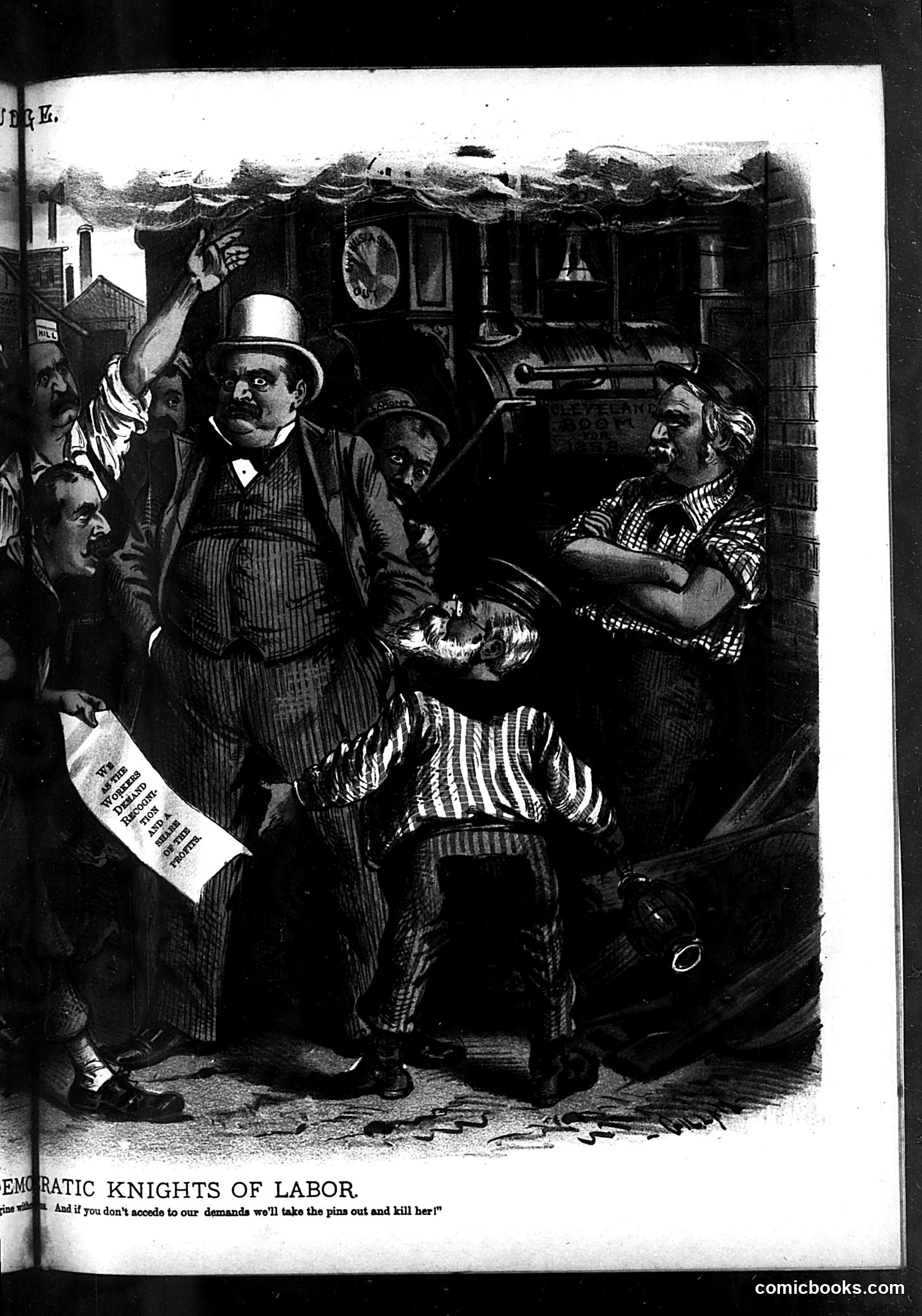
This political cartoon satirizes the **Knights of Labor**, a major 19th-century labor organization. The caption's threatening quote—"And if you don't accede to our demands we'll take the pins out and kill her"—depicts labor unionists as violent extortionists holding a woman (likely representing the nation or industry) hostage with a pin through her body. The cartoon uses grotesque caricatures of working-class men to portray organized labor as dangerous radicals. The woman in striped clothing and the various menacing figures suggest labor activists were viewed by *Judge* magazine's middle-class audience as threatening social order through coercive tactics rather than legitimate negotiation. This reflects late-19th-century anti-labor sentiment among affluent commentators.
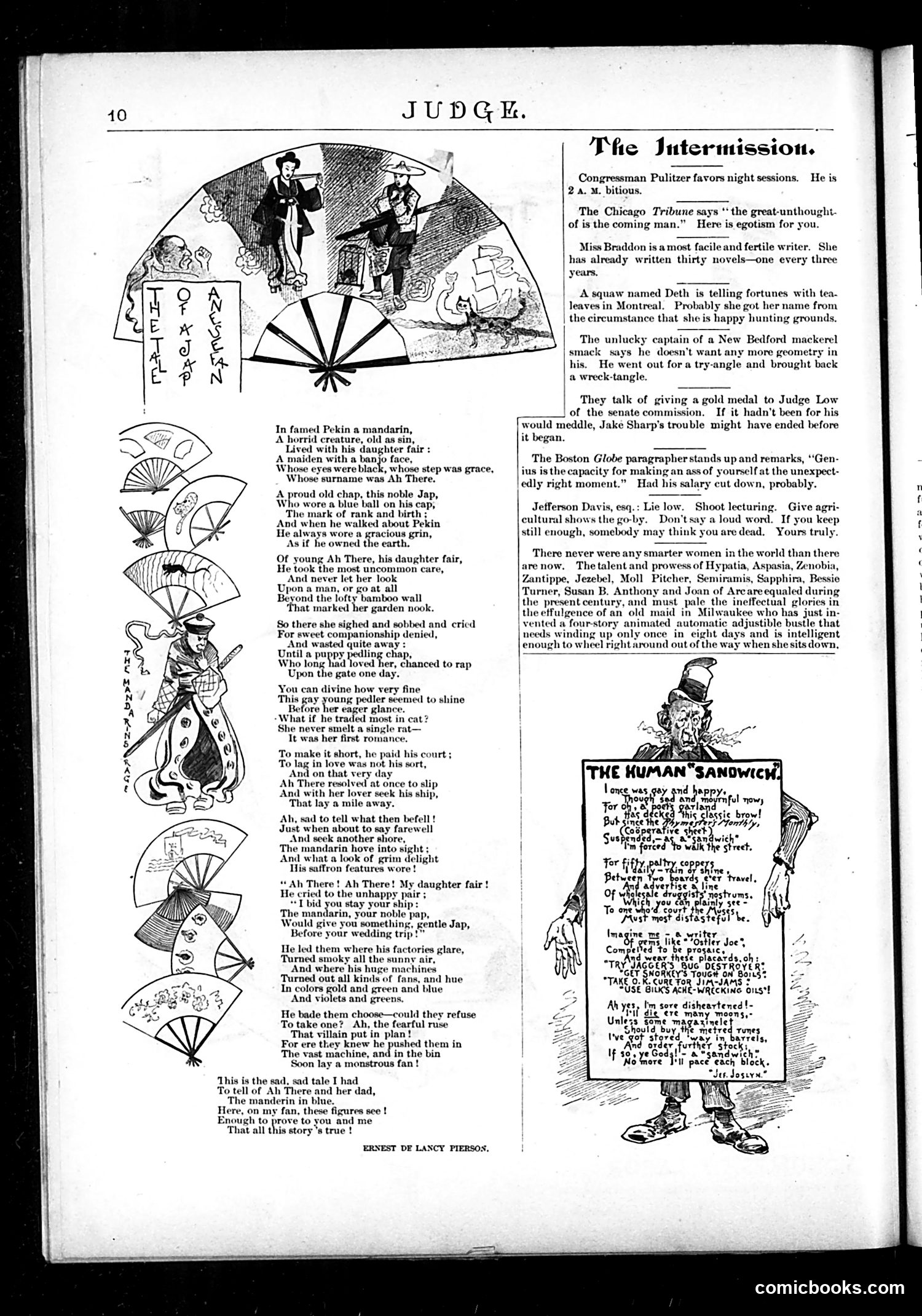
This page contains a serialized poem titled "In Famed Pekin a Mandarin" by Ernest de Lancy Pierson, illustrated with decorative Japanese fans. The narrative mocks Oriental stereotypes through a melodramatic tale: an elderly Mandarin guards his daughter Ah There until a peddler suitor appears. The father tricks the couple into a massive fan-making machine, transforming them into decorative fans—the punch line illustrated by the ornamental fans depicted throughout. The satire relies on racist caricature (the "horrid creature, old as sin") and exoticized orientalism typical of 1870s-80s American humor. The right column contains "The Intermission"—brief gossip items mocking contemporary figures: Congressman Pulitzer's ambition, author M.E. Braddon's prolific output, and Jefferson Davis (the former Confederate president, here advised to stay silent). These short jabs represent typical Judge magazine social commentary targeting public figures and pretension.
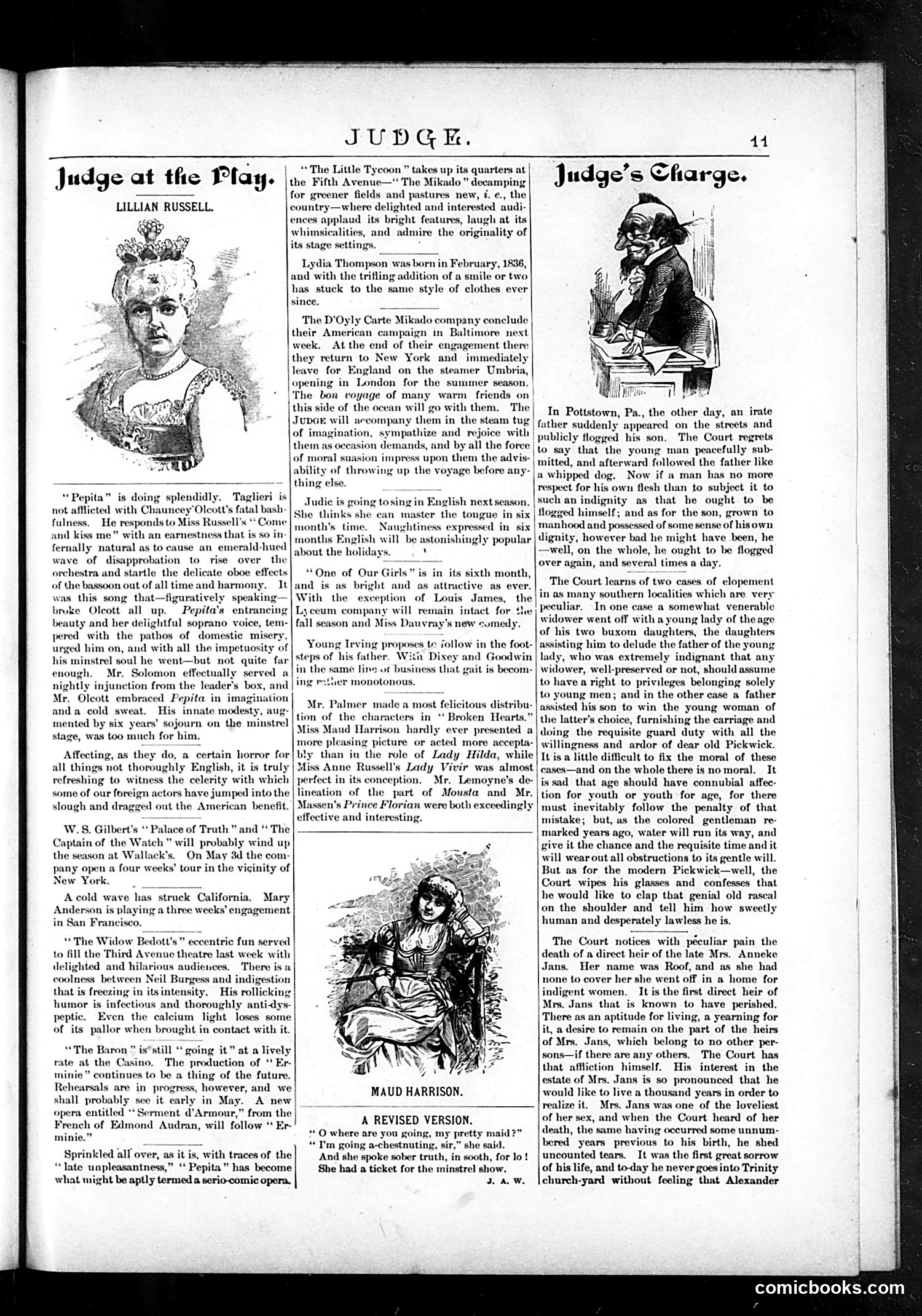
This page features theatrical reviews and gossip from Judge magazine. The left column discusses **Lillian Russell** (portrait shown), the famous American actress and singer, performing in the operetta "Pepita." The reviewer notes that her co-star Taglieri is more comfortable with physical stage business than the bashful American composer Chauncey Olcott, whose modesty apparently limits his on-stage performance alongside Russell. The remaining theatrical notes cover touring productions of the era: "The Little Tycoon," "The Mikado," and "One of Our Girls." References include the D'Oyly Carte company's return to England and various performers' activities. The right column, titled "Judge's Charge," contains a separate satirical piece (with illustration) about a court case regarding a disreputable father and inheritance rights—likely a commentary on moral judgment and social propriety. The content reflects Judge's dual focus: theatrical entertainment coverage mixed with social satire typical of 1880s American magazines.
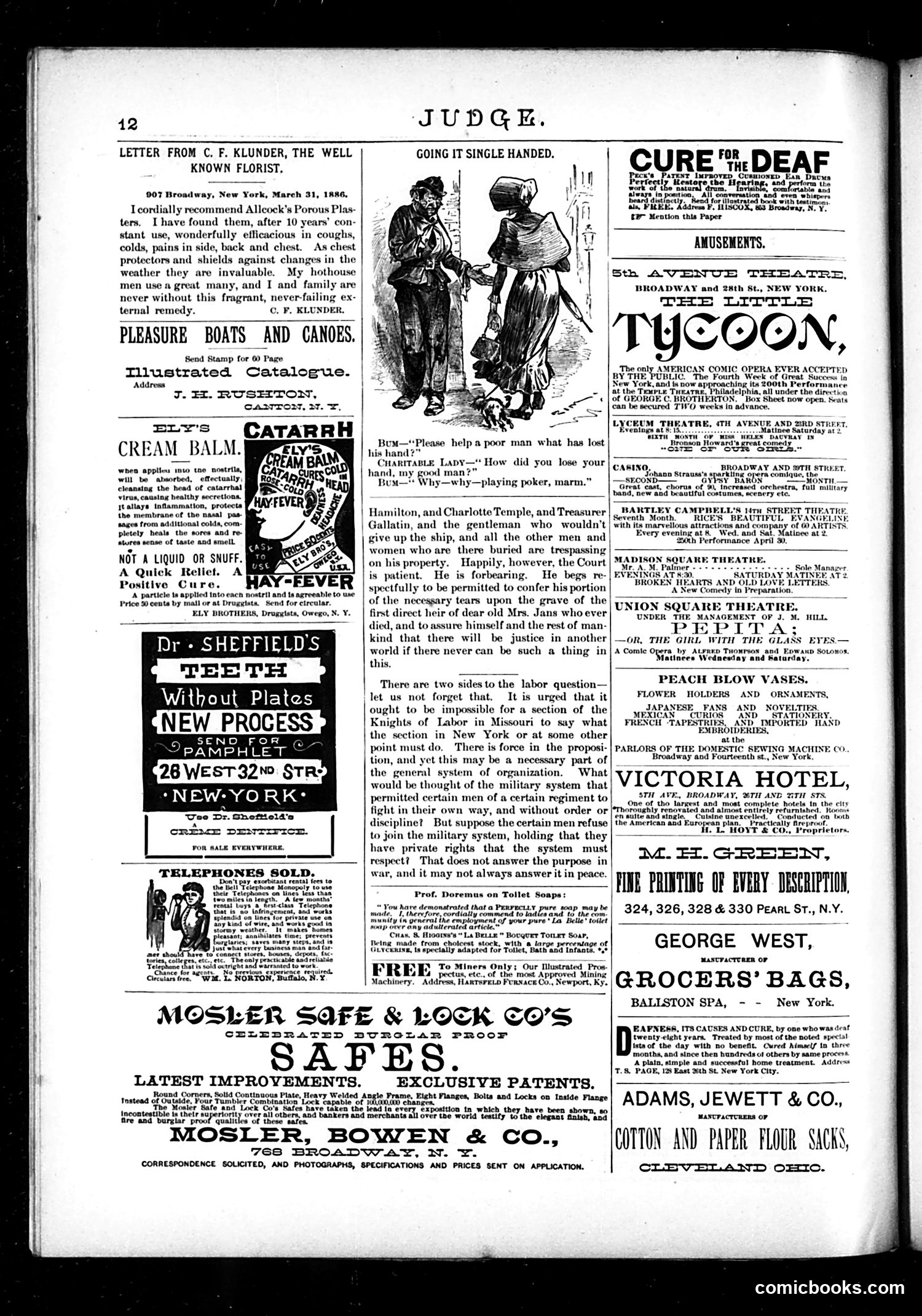
This page is primarily **advertisements and letters**, not political satire. However, it contains one small cartoon titled "GOING IT SINGLE HANDED." The cartoon shows a one-armed beggar asking a charitable lady for help. When she asks how he lost his hand, he admits he lost it "playing poker." The joke mocks the beggar's dishonesty—he's claiming poverty while implying an accident, when actually he gambled away his livelihood. It satirizes both professional beggars who exploit charity through deceptive stories and the foolishness of gambling. The bulk of the page consists of Victorian-era advertisements for patent medicines (Allcock's Porous Plasters, Ely's Cream Balm), dental products, safes, and other commercial goods—typical of 19th-century magazine content. The text on labor organization and the Knights of Labor appears to be a longer editorial article discussing labor disputes.
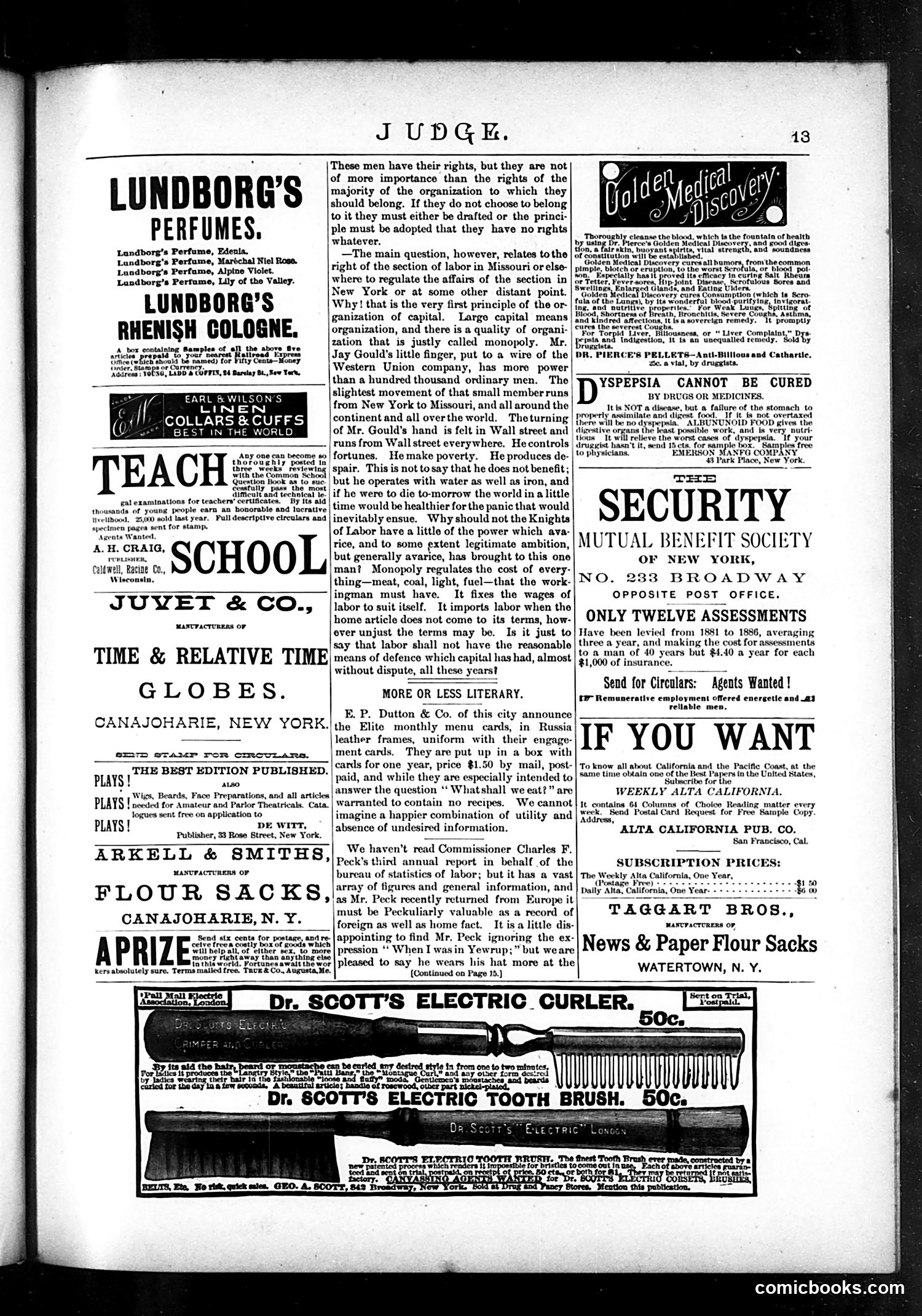
This is primarily an **advertising page** from Judge magazine, with a substantial editorial section discussing labor organizing and monopoly power. The main text (under "MORE OR LESS LITERARY") is a **political commentary defending the Knights of Labor's right to organize**. The author argues that labor unions deserve collective power comparable to what industrial monopolists like **Jay Gould** (Western Union magnate) wield over workers. The piece contrasts Gould's ability to control finances and set wages from New York across the continent with workers' lack of equivalent bargaining power, arguing it's hypocritical to deny labor the "reasonable means of defence which capital has had." This reflects **late-19th-century labor tensions** when the Knights of Labor were actively organizing against monopolistic capitalism. The rest of the page consists of period advertisements for perfumes, collars, educational materials, flour sacks, and novelty items like Dr. Scott's electric tooth brush and curler—typical commercial content for Judge's pages. No political cartoons appear on this particular page.
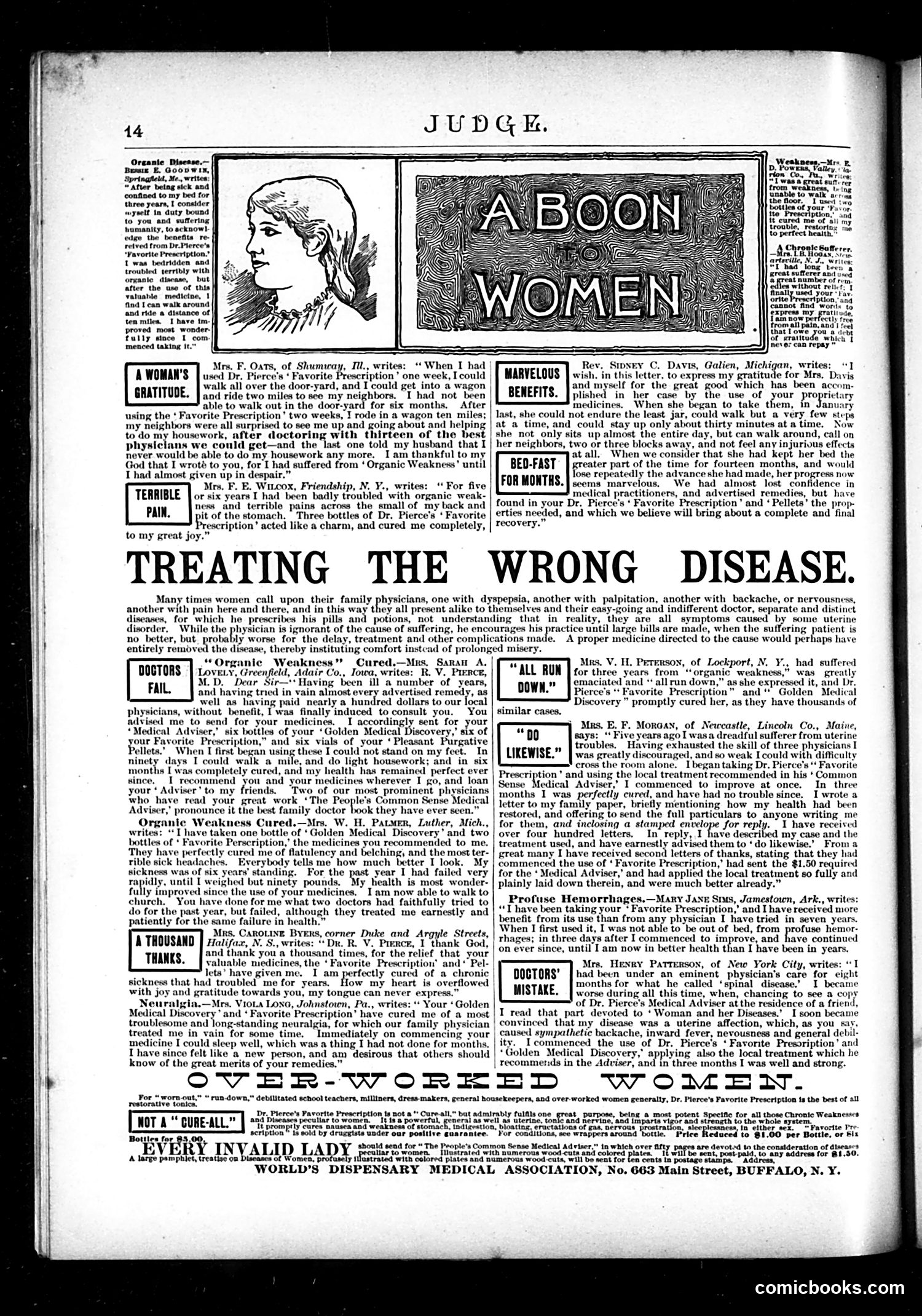
This is a **patent medicine advertisement** disguised as editorial content in *Judge* magazine. The page promotes Dr. Pierce's "Favorite Prescription," marketed to women for "organic weakness" and related ailments. The satire (in the central article "TREATING THE WRONG DISEASE") criticizes how doctors misdiagnose women's health complaints—attributing distinct symptoms (dyspepsia, palpitation, backache, nervousness) to separate diseases rather than recognizing a single underlying "uterine disorder." The irony: while *mocking* doctors' incompetence, the page simultaneously **sells the same remedy** through testimonials from satisfied women patients. This reflects early 1900s American medicine's tendency to attribute diverse female ailments to reproductive system problems, and the thriving industry of patent medicines marketed directly to women bypassing physicians entirely. The "gratitude" testimonials are likely fabricated advertising copy, not genuine letters—common practice for such publications. This represents both medical quackery and exploitative advertising targeting vulnerable, chronically ill women.
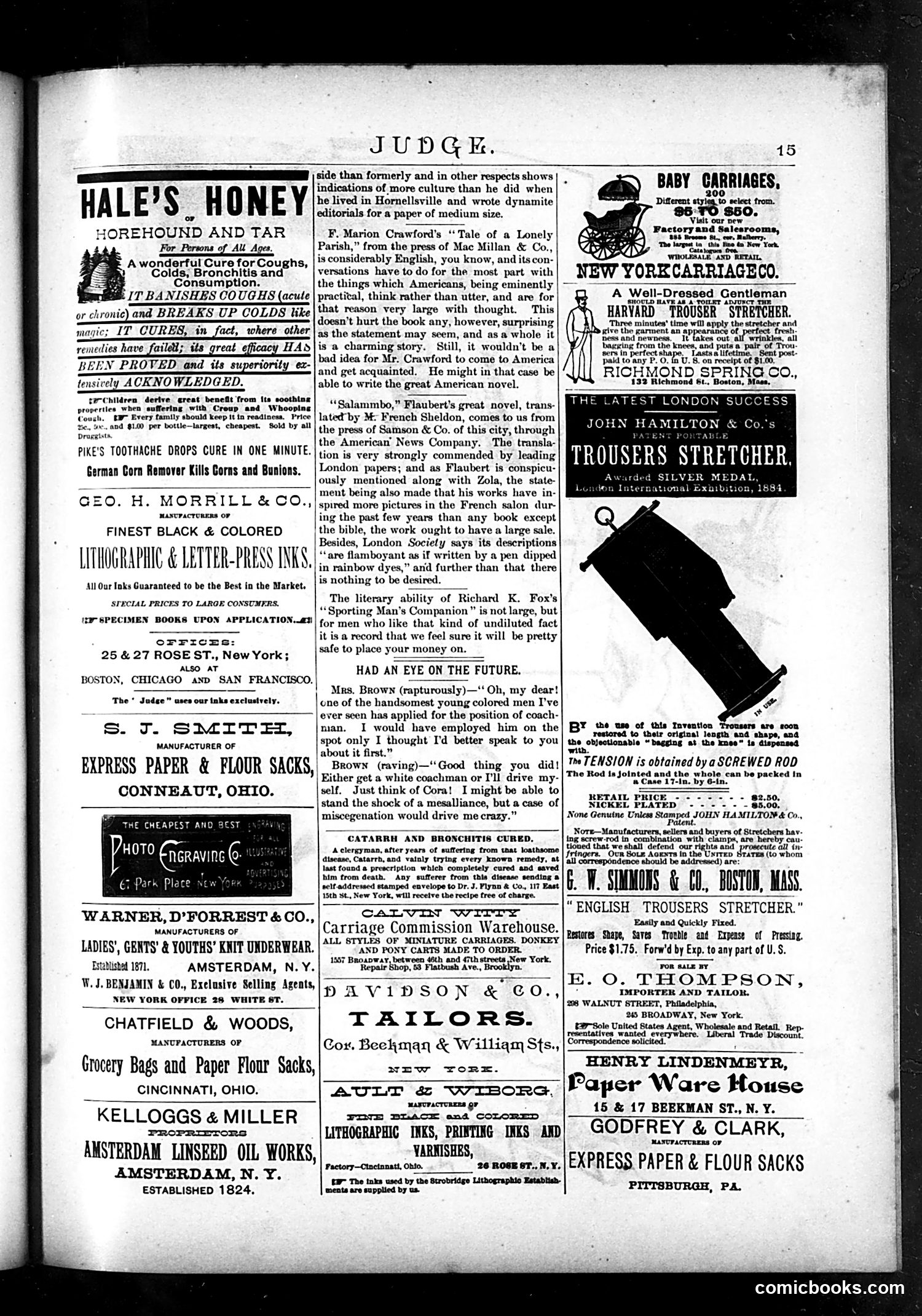
This page is primarily **advertisements and literary reviews**, with one brief satirical dialogue. The main satirical content is the "Had an Eye on the Future" piece—a dialogue between Mr. and Mrs. Brown about hiring a Black coachman. Mrs. Brown suggests employing him; Mr. Brown refuses, claiming he couldn't endure the "miscegenation" and fears for his daughter Cora's future. The satire mocks the absurd anxieties of white Americans about racial mixing, treating Mr. Brown's panic as comically overblown. This reflects late 19th-century racial attitudes and the satirical critique of such prejudice. The literary reviews discuss works by F. Marion Crawford, Flaubert, and Richard K. Fox—typical cultural commentary for the magazine. The remainder consists of period advertisements for medicines (Hale's Honey cough remedy, Pike's Toothache Drops), baby carriages, tailors, printing companies, and flour sacks—standard commercial content for a magazine of this era.
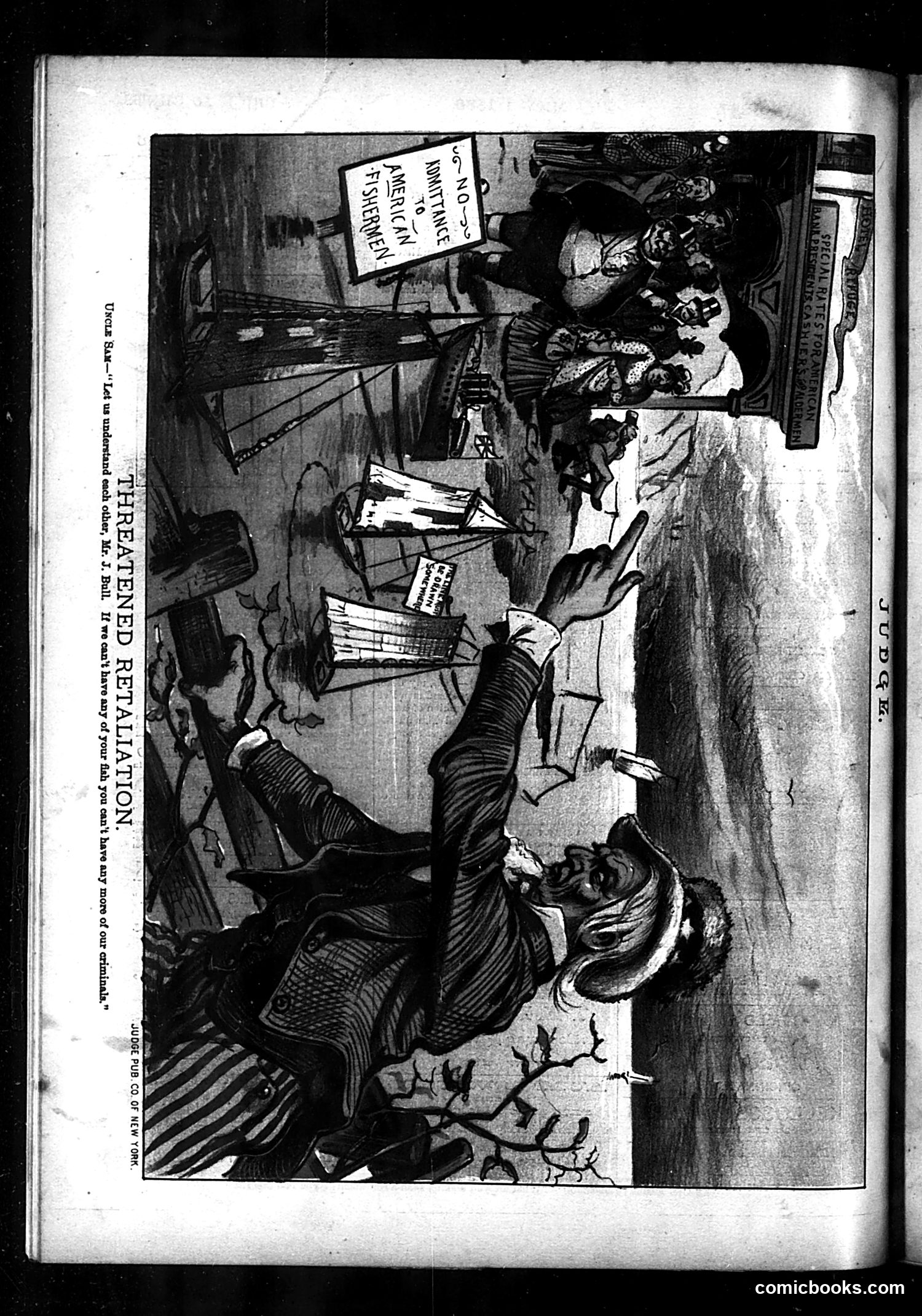
This page appears to be from *Judge* magazine's satirical content, though the OCR provides minimal legible text. The image itself shows a political cartoon (rotated 90 degrees) depicting what appears to be a chaotic scene of "THREE-TENED REHABILITATION" based on the visible title text. The cartoon illustrates figures in apparent distress or struggle, with papers scattered about bearing labels. The style and composition suggest commentary on a social or political issue involving institutional reform or rehabilitation efforts—likely early 20th century based on the artistic style. However, **I cannot reliably identify the specific figures, the exact event being satirized, or the precise political context** from this reproduction's quality and orientation. To accurately explain the satirical point to modern readers, I would need clearer text or additional contextual information about the publication date and political climate.