
Judge, 1886-04-24 · page 11 of 16
Judge — April 24, 1886 — page 11: what you’re looking at
What you’re looking at
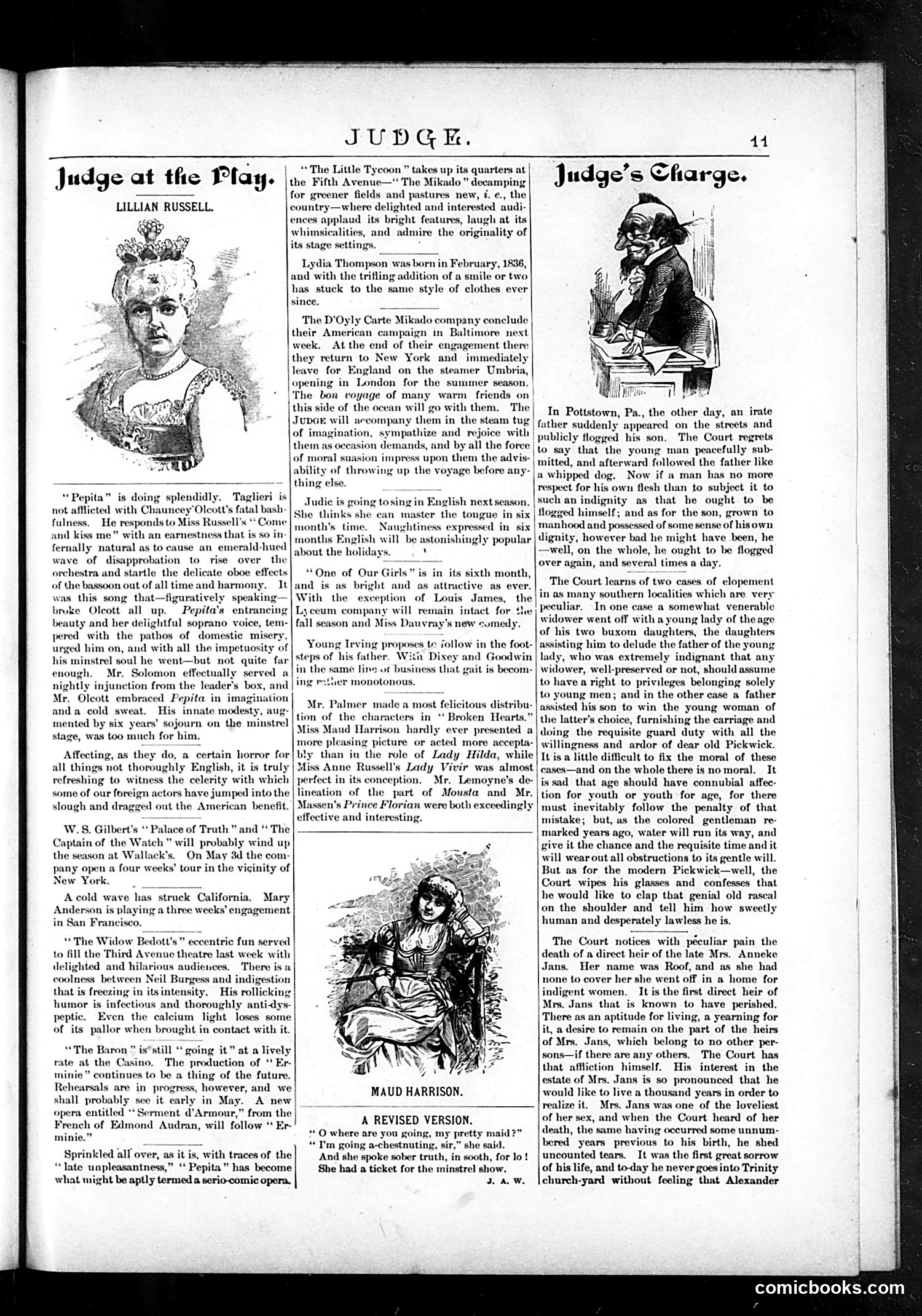
This page features theatrical reviews and gossip from Judge magazine. The left column discusses **Lillian Russell** (portrait shown), the famous American actress and singer, performing in the operetta "Pepita." The reviewer notes that her co-star Taglieri is more comfortable with physical stage business than the bashful American composer Chauncey Olcott, whose modesty apparently limits his on-stage performance alongside Russell. The remaining theatrical notes cover touring productions of the era: "The Little Tycoon," "The Mikado," and "One of Our Girls." References include the D'Oyly Carte company's return to England and various performers' activities. The right column, titled "Judge's Charge," contains a separate satirical piece (with illustration) about a court case regarding a disreputable father and inheritance rights—likely a commentary on moral judgment and social propriety. The content reflects Judge's dual focus: theatrical entertainment coverage mixed with social satire typical of 1880s American magazines.
📄 Transcribed text from this page (OCR, searchable)
Machine-transcribed from the original scan — historical spelling and the odd misread are preserved.
LILLIAN RUSSELL, & D.. “Pepita” is doing splendidly. Taglieri is not afflicted with Chauncey Olcott's fatal bash- fulness. He responds to Miss Russell's ** Come and kiss me” with an earnestness that is so in fernally natural as to cause an emerald-hued wave of disapprobation rise over the orchestra and startle the delicate oboe effects assoon out of all time and harmon; It this song that—figurati Olcott all up. Pepita’s entran auty and her delightful soprano voice, tem- pered with the pathos of domestic misery, urged him on, and with all the impetuosity of his minstrel soul he went—but not quite far enough. Mr. Solomon effectually served a nightly injunction from the leader's box, Mr. Olcott embraced Pepita in imagination anda cold sweat. His innate modesty, aug- mented by six years’ sojourn on the minstrel stage, was too much for him. Affecting, as they do, a certain horror for all things not thoroughly English, it is truly refreshing to witness the celerity with whi some of our foreign actors have jumped into the | slough and dragged out the American benefit. of Truth "and “ The ill probably wind up On May 3d the com- pany open a tour in the vicinity of New York. Accold wave has struck California, Mary Anderson is playing a three weeks’ engagement in San Francisco. “The Widow Bedott’s” e to fill the TI Avenue the: ted and hilarious audiences. There coolness between Neil Burgess and indigestion that is freezing in itsintensity. His rollicking humor is infectious and thoroughly anti-dys- . Even the calcium light loses some of its pallor when brought in contact with it. “The Baron ” is*still “ going it” at a lively rate at the Casino. The production of ‘ Er- minie” continues to be a thing of the future. Rehearsals are in progress, however, and we| shall probably see it early in May. A new | opera entitled ** Serment d’Armour,” from the French of Edmond Audran, will follow ‘ Er minie.” entric fun served e last week with Sprinkled all over, as it is, with traces of the “late unpleasantness,” ‘“ Pepita” has become | this side of the o “ The Little Tycoon ” takes up its quarters at | the Fifth Avenue—‘ The Mikado ” decamping for greener fields and pastures new, i. ¢., the country—where delighted and interested audi- laud its bright features, |; and admire the originality of its stage settings. Lydia Thompson was born in February, 1836, and with the trifling addition of a smile or two has stuck to the same style of clothes ever since, The D’Oyly Carte Mikado company conclude their American campaign in Baltimore next week. At the end of their engagement there they return to New York and immediately leave for England on the steamer Umbria, opening in London for the summer season. The bon voyage of many warm friends on ean will go with them, The | JupGE will accompany them in the steam tug of imagination, sympathize and rejoice with occasion demands, and by all the force ral suasion impress upon them the advis: of throwing up the voyage before any: thing else. is going tosing in English next season. She thinks she can master the tongue in six month's time. ughtiness expressed in six months English will be astonishingly popular about the holida, , “‘One of Our Girls” is in its sixth month, and is as bright and as attrac as ever, With the exception of Louis James, Lyceum company will remain intact for fall season and Miss Dauvray’s new comedy. Young Irving prope follow in the foot- steps of his father, W nd Goodwin in the same line ut business that gait is becom- nd | ing Peter monotonou: tion of the cha Miss Maud I more pleasing picture or acted more accepta- bly than in the role of Lady Hilda, while (iss Anne Russell's Lady Vivir was almost perfect in its conception. Mr. Lemoyne’s de- lineation of the part of Mousta and Mr. Massen’s Prince Florian were both exceedingly effective and interesting. ented a MAUD HARRISON. A REVISED VERSION. “ O where are you going, my pretty “ I'm going a-chestnuting, sir,” |. And she spoke sober truth, in sooth, for lot what might be aptly termed a serio-comic opera. She had a ticket for the minstrel show. the | i Judge’s Charge. In Pottstown, Pa., the other day, an irate father suddenly appeared on the streets and publicly flogged his son. The Court regrets to say that the young man peacefully sub- mitted, and afterward followed the father like a whipped dog. Now if a man has no more respect for his own flesh than to subject it to |such an indignity as that he ought to be flogged himself; and as for the son, grown to manhood and possessed of some sense of hisown dignity, however bad he might have been, he —well, on the whole, he ought to be flogged over again, and several times a day. The Court learns of two cases of elopement ny southern localities which are very In one case a somewhat venerable widower went off with a young lady of theage of his two buxom daughters, the daughtei assisting him to delude the father of the young ly, who was extremely indignant that any widower, well-preserved or not, should assume to have a right to privileges belonging solely to young men; and in the other case a father assisted his son to win the young woman of : latter's choice, furnishing the carriage and g the requisite guard duty with all the ingness and ardor of dear old Pickwick. It is a little difficult to fix the moral of these cases—and on the whole there is no moral. It is sad that age should have connubial affec- tion for youth or youth for age, for there must inevitably follow the penalty of that mistake; but, as the colored gentleman re- marked years ago, water will run its way, and give it the chance and the requisite time and it will wear out all obstructions to its gentle will. But as for the modern Pickwick—well, the Court wipes his glasses and confesses that he would like to clap that genial old rascal on the shoulder and tell him how sweetly human and desperately lawless he is. The Court notices with péculiar pain the death of a direct heir of the late Mrs. Anneke Jans. Her name was Roof, and as she had none to cover her she went off in a home for indigent women. It is the first direct heir of Mrs. Jans that is known to have perished, There as an aptitude for living, a yearning for it, a desire to remain on the part of the heirs of Mrs, Jans, which belong to no other per- sons—if there are any others. The Court has that affliction himself. His interest in the estate of Mrs. Jans is so pronounced that he would like to live a thousand years in order to realize it. Mrs. Jans was one of the loveliest of her sex, and when the Court heard of her death, the same having occurred some unnum- bered years previous to his birth, he shed uncounted tears. It was the first great sorrow of his life, and to-day he never goes into Trinity SALW. church-yard without feeling that Alexander comicbooks.com