
Judge, 1886-04-24 · page 3 of 16
Judge — April 24, 1886 — page 3: what you’re looking at
What you’re looking at
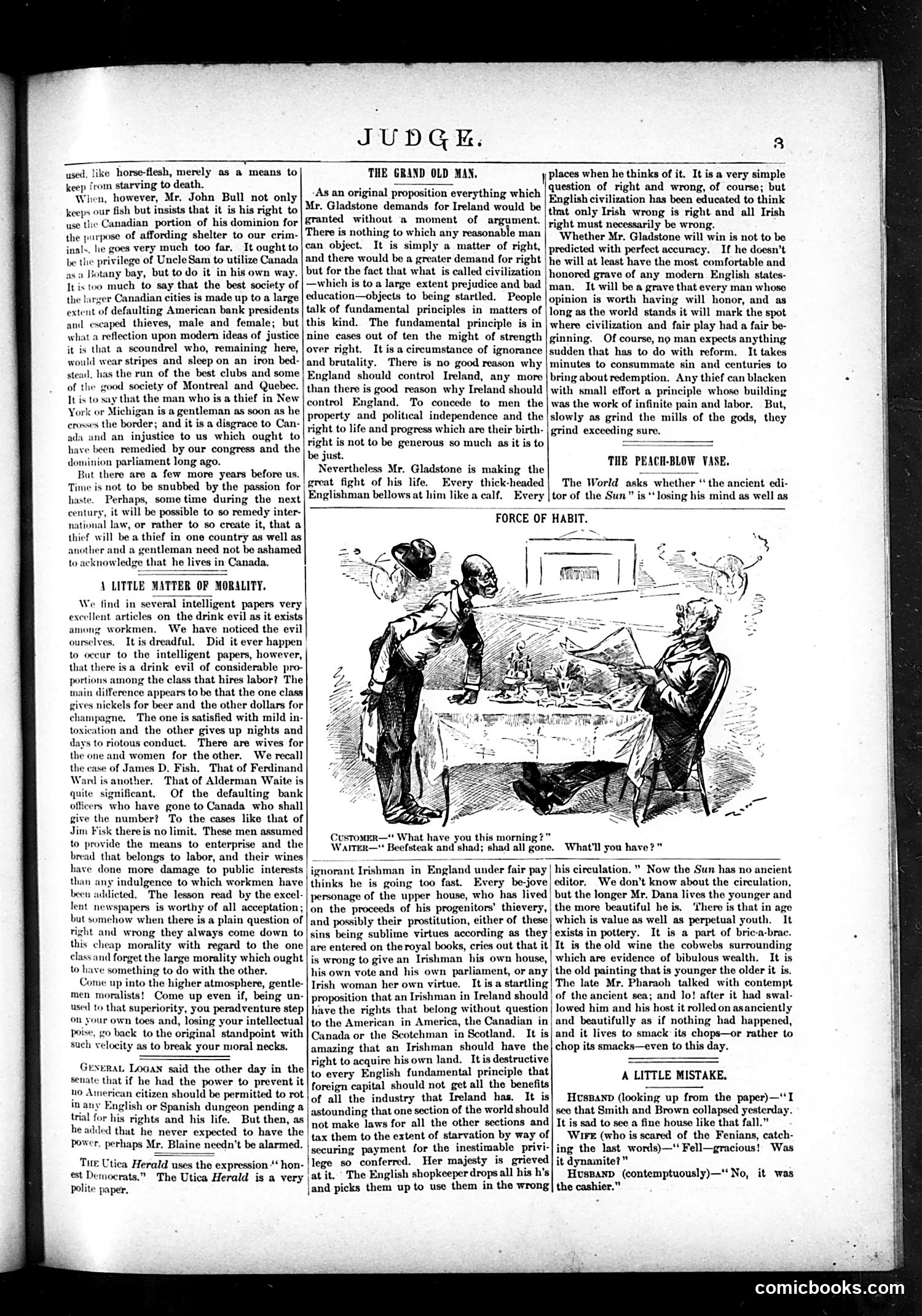
This page from Judge (an American satirical weekly) contains three distinct pieces critiquing social hypocrisy and political issues: **"The Grand Old Man"** addresses William Gladstone's Irish demands, arguing England should grant Ireland self-governance as a matter of principle—though the full text is cut off. **"A Little Matter of Morality"** is the editorial's main thrust: it mocks the moral double standard of wealthy elites versus working class. While reformers denounce workers' drinking, the article notes that wealthy industrialists (referencing James D. Fish, Ferdinand Ward, Jim Fisk—notorious 1870s-80s financiers) engage in far more destructive excess. Their champagne and "riotous conduct" damage public interests more than workers' beer, yet escape moral censure. **The cartoon "Force of Habit"** (center) shows a man compulsively reaching toward an empty box labeled "CIGARS," illustrating addiction's grip regardless of supply—likely satirizing how habits persist absurdly. The page exemplifies Judge's crusading satirical style: exposing class-based moral hypocrisy in Gilded Age America.
📄 Transcribed text from this page (OCR, searchable)
Machine-transcribed from the original scan — historical spelling and the odd misread are preserved.
JUDGE. 38 used, like horse-flesh, merely as a means to ‘om starving to death. n, however, Mr. John Bull not only keeps our fish but insists that it is his right to he Canadian portion of his dominion for the purpose of affording shelter to our crim- inals. he goes very much too far, It ought to be the privilege of Uncle Sam to utilize Canada asa Botany bay, but to do it in his own way. Itis too much to say that the best society of the larger Canadian cities is made up to a large extent of defaulting American bank presidents and escaped thieves, male and female; but what a reflection upon modern ideas of justice it is that a scoundrel who, remaining here, would wear stripes and sleep on an iron bed- stead, has the run of the best clubs and some of the good society of Montreal and Quebec. It is to say that the man who is a thief in New York or Michigan is a gentleman as soon as he crosses the border; and it is a disgrace to Can- ada and an injustice to us which ought to have been remedied by our congress and the dominion parliament long ago. But there are a few more years before us. Time is not to be snubbed by the passion for haste. Perhaps, some time during the next century, it will be possible to so remedy inter- national law, or rather to so create it, that a thief will bea thief in one country as well as another and a gentleman need not be ashamed to acknowledge that he lives in Canada. A LITTLE MATTER OF MORALITY. We find in several intelligent papers very excellent articles on the drink evil as it exists among workmen. We have noticed the evil ss. Itis dreadful. Did it ever happen ur to the intelligent papers, however, that there isa drink evil of considerable pro- portions among the class that hires labor? The main difference appears to be that the one class gives nickels for beer and the other dollars for champagne. The one is satisfied with mild in- toxication and the other gives up nights and days to riotous conduct. There are wives for the one and women for the other. We recall se of James D. Fish. That of Ferdinand Ward is another. That of Alderman Waite is quite significant. Of the defaulting bank icers who have gone to Canada who shall the number? To the cases like that of Jim Fisk thereis no limit. These men assumed to provide the means to enterprise and the bread that belongs to labor, and their wines have done more damage to public interests than any indulgence to which workmen have been addicted. The lesson read by the excel- lent newspapers is worthy of all acceptation; but somchow when there is a plain question of right and wrong they always come down to this cheap morality with regard to the one class and forget the large morality which ought to have something to do with the other. Come up into the higher atmosphere, gentle- men moralists! Come up even if, being un- used to that superiority, you peradventure step on your own toes and, losing your intellectual poise, go back to the original standpoint with such velocity as to break your moral necks. GeyeraL Logan said the other day in the senate that if he had the power to prevent it uo American citizen should be permitted to rot in any English or Spanish dungeon pending a trial for his rights and his life. But then, as he added that he never expected to have the Power, perhaps Mr. BI Tue Utica Herald uses the expression est Democrats.” The Utica Herald is a very Polite paper, THE GRAND OLD MAN. As an original proposition everything which Mr. Gladstone demands for Ireland would be granted without a moment of argument. There is nothing to which any reasonable man can object. It is simply a matter of right, and there would be a greater demand for right but for the fact that what is called civilization —which is to a large extent prejudice and bad education—objects to being startled. People talk of fundamental principles in matters of this kind. The fundamental principle is in nine cases out of ten the might of strength over right. It is a circumstance of ignorance and brutality. ‘There is no good reason why England should control Ireland, any more than there is good reason why Ireland should control England. To concede to men the property and political independence and the right to life and progress which are their birth- right is not to be generous so much as it is to be just. Nevertheless Mr. Gladstone is making the great fight of his life. Every thick-headed Englishman bellows at him like a calf. Every Customer—‘* What have you this morning? Warter—"* E FORCE OF HABIT. = efsteak and shad; shad all gone. Places when he thinks of it, It is a very simple question of right and wrong, of course; but English civilization has been educated to think that only Irish wrong is right and all Irish right must necessarily be wrong. ‘Whether Mr. Gladstone will win is not to be predicted with perfect accuracy. If he doesn’t |he will at least have the most comfortable and honored grave of any modern English states- man, It will be a grave that every man whose opinion is worth having will honor, and as long as the world stands it will mark the spot where civilization and fair play had a fair be- ginning. Of course, no man expects anything sudden that has to do with reform. It takes minutes to consummate sin and centuries to bring about redemption. Any thief can blacken with small effort a principle whose building was the work of infinite pain and labor. But, slowly as grind the mills of the gods, they grind exceeding sure. THE PEACH-BLOW VASE. The World asks whether ‘the ancient edi- tor of the Sun” is ‘losing his mind as well as What'll you have?” ignorant Irishman in England under fair pay thinks he is going too fast. Every be-jove personage of the upper house, who has lived on the proceeds of his progenitors’ thievery, and possibly their prostitution, either of these sins being sublime virtues according as they are entered on the royal books, cries out that it is wrong to give an Irishman his own house, his own vote and his own parliament, or any Irish woman her own virtue. It is a startling have the rights that belong without question to the American in America, the Canadian in Canada or the Scotchman in Scotland. It is amazing that an Irishman should have the right to acquire his own land. It is destructive to every English fundamental principle that foreign capital should not get all the benefits of all the industry that Ireland has. It is astounding that one section of the world should not make laws for all the other sections and tax them to the extent of starvation by way of it. The English shopkeeper drops all his h’s lat land picks them up to use them in the wrong jan proposition that an Irishman in Ireland should] his circulation. ” Now the Sun has no ancient editor. We don’t know about the circulation, but the longer Mr. Dana lives the younger and the more beautiful he is, There is that in age which is value as well as perpetual youth. It exists in pottery. It is a part of bric-a-brac. It is the old wine the cobwebs surrounding which are evidence of bibulous wealth. It is the old painting that is younger the older it is. The late Mr. Pharaoh talked with contempt of the ancient sea; and lo! after it had swal- lowed him and his host it rolled on asanciently |and beautifully as if nothing had happened, and it lives to smack its chops—or rather to chop its smacks—even to this day. A LITTLE MISTAKE. HvsBanp (looking up from the paper)—‘‘I see that Smith and Brown collapsed yesterday. It is sad to see a fine house like that fall.” Wire (who is scared of the Fenians, catch- ine needn't be alarmed. ‘securing payment for the inestimable privi-| ing the last words)—‘ Fell—gracious! Was ‘hon- \lege so conferred. Her majesty is grieved| it dynamite?” HvsBanp (contemptuously)—" No, it was the cashier.” comicbooks.com