
Judge, 1886-04-24 · page 7 of 16
Judge — April 24, 1886 — page 7: what you’re looking at
What you’re looking at
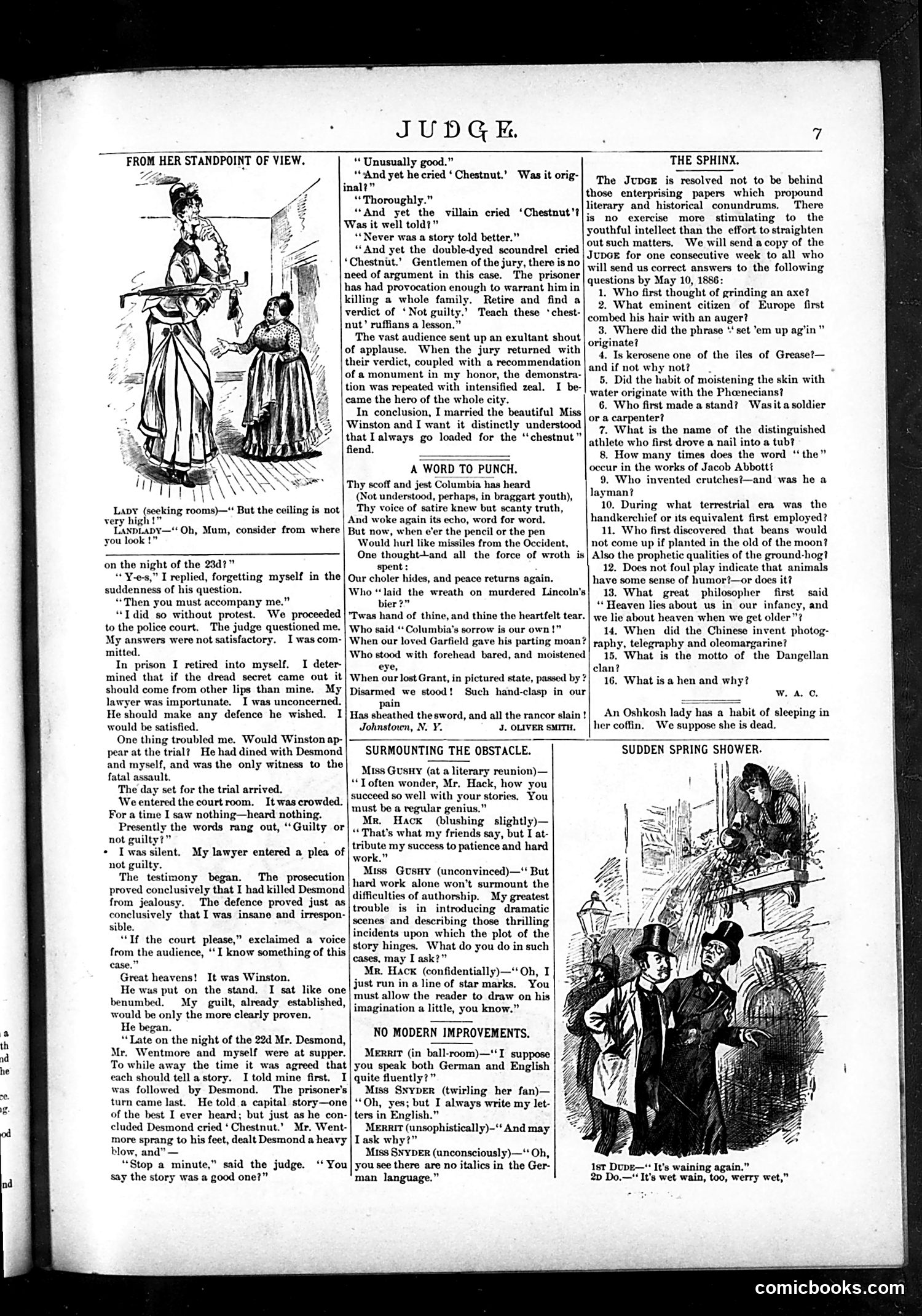
This page contains two unrelated pieces of satire: **"From Her Standpoint of View"** (top left): A brief joke about a landlady showing rooms. When a prospective tenant complains the ceiling is too low, she suggests he view it from where *she* stands—implying she's shorter, so it seems higher to her. It's gentle satire on perspective and real estate salesmanship. **The main story** (center and right): A narrative about a murder trial where the defendant killed a man named Desmond. The twist: the murder was provoked because Desmond called the defendant's story a "chestnut" (slang for an old, overused joke). The judge, outraged at this insult to storytelling, directs the jury to acquit. This satirizes how juries might respond to sympathetic circumstances over legal facts. **"A Word to Punch"** (bottom right): A poem praising *Punch* magazine (Britain's satirical rival) for its respectful coverage of American tragedies—Lincoln's assassination, Garfield's death, Grant's passing—which apparently softened American-British tensions. The illustrations are decorative vignettes unrelated to the text content.
📄 Transcribed text from this page (OCR, searchable)
Machine-transcribed from the original scan — historical spelling and the odd misread are preserved.
JUDGE FROM HER STANDPOINT OF VIEW. Lavy (seeking rooms)—“‘ But the ceiling is not very high!” LaxpLapy—“ Oh, Mum, consider from where you look !” on the night of the 23d?” “Yes,” I replied, forgetting myself in the suddenness of his question. “Then you must accompany me.” “I did so without protest. We proceeded to the police court. The judge questioned me. My answers were not satisfactory. I was com- mitted. In prison I retired into myself. I deter mined that if the dread secret came out it should come from other lips than mine. My lawyer was importunate. I was unconcerned. He should make any defence he wished. I would be satisfied. One thing troubled me. Would Winston ap- pear at the trial? He had dined with Desmond and myself, and was the only witness to the fatal assault. The day set for the trial arrived. We entered the courtroom. It was crowded. For a time I saw nothing—heard nothing. Presently the words rang out, “Guilty or not guilty?” I was silent. not guilty. The testimony n, ‘The prosecution proved conclusively that I had killed Desmond from jealousy. The defence proved just as conclusively that I was insane and irrespon- sible. “If the court please,” exclaimed a voice from the audience, ‘I know something of this case.” Great heavens! It was Winston. He was put on the stand. I sat like one benumbed. My guilt, already established, would be only the more clearly proven. He began. “Late on the night of the 22d Mr. Desmond, Mr. Wentmore and myself were at supper. To while away the time it was agreed that each should tell a story. I told mine first. I was followed by Desmond. The prisoner's turn came last. He told a capital story—one of the best I ever heard; but just as he con- cluded Desmond cried ‘ Chestnut.’ Mr. Went- more sprang to his feet, dealt Desmond a heavy blow, and” — “Stop a minute,” said the judge. say the story was a good one?” My lawyer entered a plea of “You “ Unusually good.” ‘‘cand yet he cried ‘Chestnut.’ Was it orig- inal?” “Thoroughly.” “And yet the villain cried ‘Chestnut’? Was it well told?” “Never was a story told better.” “And yet the double-dyed scoundrel cried ‘Chestnit.’ Gentlemen of the jury, there is no need of argument in this case. The prisoner has had provocation enough to warrant him in killing a whole family. Retire and find a verdict of ‘Not guilty.’ Teach these ‘chest- nut’ ruffians a lesson.” The vast audience sent up an exultant shout of applause. When the jury returned with their verdict, coupled with a recommendation of a monument in my honor, the demonstra- tion was repeated with intensified zeal. I be- came the hero of the whole city. In conclusion, I married the beautiful Miss Winston and I want it distinctly understood that always go loaded for the “chestnut” fiend. s A WORD TO PUNCH. Thy scoff and jest Columbia has heard (Not understood, perhaps, in braggart youth), Thy voice of satire knew but scanty truth, And woke again its echo, word for word. But now, when e’er the pencil or the pen Would hurl like missiles from the Occident, One thought-and all the force of wroth is spent : Our choler hides, and peace returns again. Who “laid the wreath on murdered Lincoln's bier?” ’Twas hand of thine, and thine the heartfelt tear. Who said “Columbia's sorrow is our own !” When our loved Garfield gave his parting moan? Who stood with forehead bared, and moistened eye, When cur lost Grant, in pictured state, passed by ? Disarmed we stood! Such hand-clasp in our pain Has sheathed thesword, and all the rancor slain! Johnstown, N. Y. J. OLIVER SMITH. THE SPHINX. The JupcE is resolved not to be behind those enterprising papers which propound literary and historical conundrums. There is no exercise more stimulating to the youthful intellect than the effort to straighten out such matters. We will send a copy of the JupGE for one consecutive week to all who will send us correct answers to the following questions by May 10, 1886: 1. Who first thought of grinding an axe? 2. What eminent citizen of Europe first combed his hair with an auger? 3. Where did the phrase ‘' set ‘em up ag’in” originate? 4. Is kerosene one of the iles of Grease?— and if not why not? 5. Did the habit of moistening the skin with water originate with the Phaenecians? 6. Who first made a stand? Wasitasoldier or a carpenter? 7. What is the name of the distinguished athlete who first drove a nail into a tub? 8. How many times does the word “the” occur in the works of Jacob Abbottt 9. Who invented crutches?—and was he a layman? 10, During what terrestrial era was the handkerchief or its equivalent first employed? 11. Who first discovered that beans would not come up if planted in the old of the moon? Also the prophetic qualities of the ground-hog? 12, Does not foul play indicate that animals have some sense of humor?—or does it? 13. What great philosopher first “Heaven lies about us in our infanc: we lie about heaven when we get older”? 14. When did the Chinese invent photog- raphy, telegraphy and oleomargarine? 15. What is the motto of the Dangellan clan? 16. What is a hen and why? said and Ww. A. 0. An Oshkosh lady has a habit of sleeping in her coffin, We suppose she is dead. SURMOUNTING THE OBSTACLE. Miss Gusny (at a literary reunion)— “‘Toften wonder, Mr, Hack, how you succeed so well with your stories. You must be a regular genius.” Mr. Hack (blushing slightly)— “That's what my friends say, but I at- tribute my success to patience and hard work.” Miss GusHy (unconvinced)—‘ But hard work alone won't surmount the difficulties of authorship. My greatest trouble is in introducing dramatic scenes and describing those thrilling incidents upon which the plot of the story hinges. What do you do in such cases, may I ask?” Mr. Hack (confidentially)—‘ Oh, I just run in a line of star marks. You must allow the reader to draw on his imagination a little, you know.” NO MODERN IMPROVEMENTS. Merit (in ball-room)—"I. suppose you speak both German and English quite fluently?” Miss SyypeR (twirling her fan)— “Oh, yes; but I always write my let- ters in English.” Merrit (unsophistically)-“‘ And may Task why?” Miss SNYDER (unconsciously)—‘‘ Oh, you see there are no italics in the Ger- man language.” SUDDEN SPRING SHOWER. ist Dupe— It's waining again.” 2 Do.— It's wet wain, too, werry wet,” comicbooks.com