
Judge, 1886-04-24 · page 2 of 16
Judge — April 24, 1886 — page 2: what you’re looking at
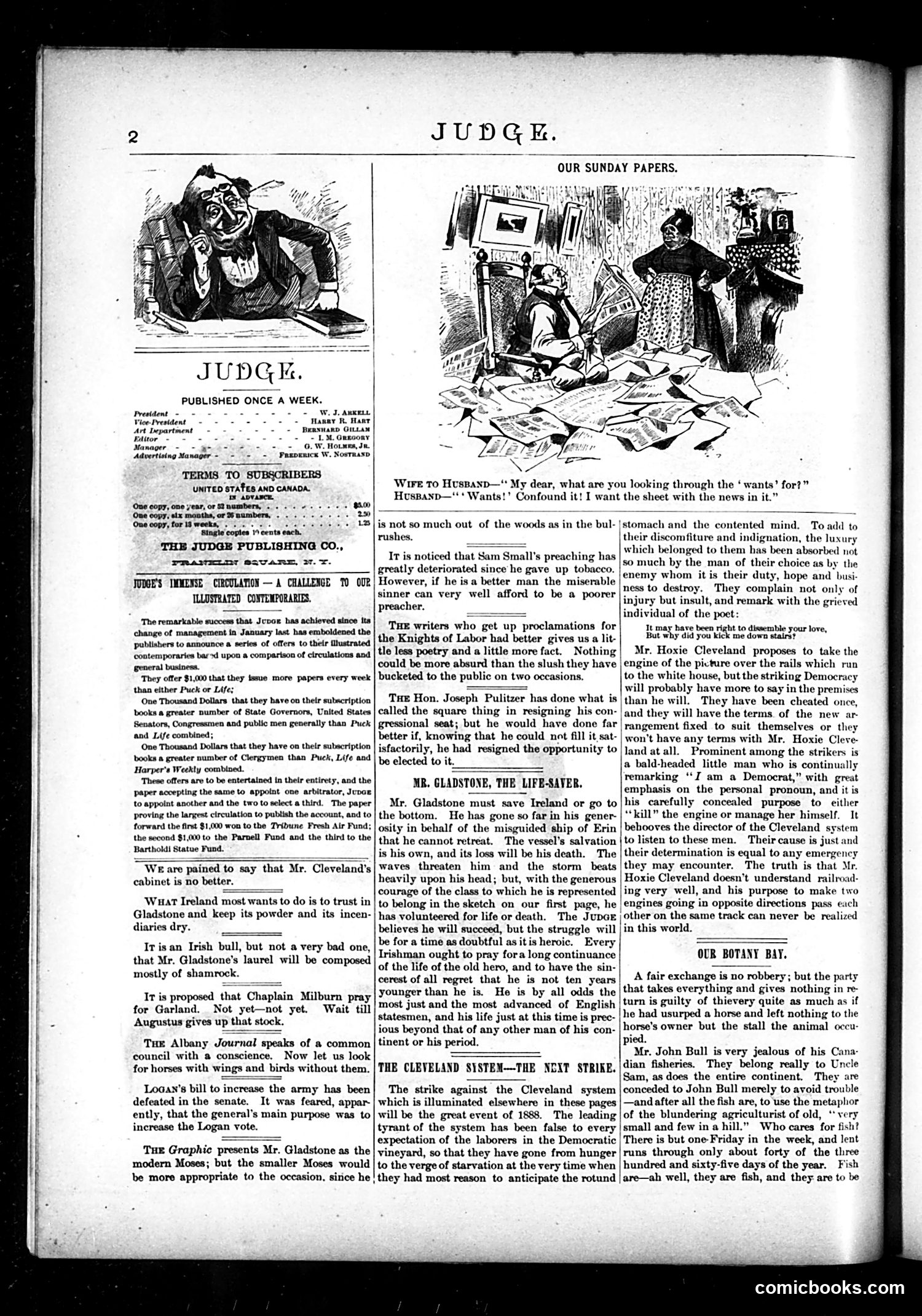
A restored page from Judge, 1886-04-24. Page through the whole issue in the reader above.
📄 Transcribed text from this page (OCR, searchable)
Machine-transcribed from the original scan — historical spelling and the odd misread are preserved.
JUDGE. PUBLISHED ONCE A WEEK. Predent - = - =~ - - WW, J. Ameen Vice-President - Art Department Faitor ~~~ Manager ~~ ye o- + > - ‘Advertising Manager - = ~~ TERMS TO SUBSCRIBERS UNITED STATES AND CANADA. 1 ADVASCE, THE JUDGE PUBLISHING CO., PMAHELNT S2vART, 2. r. TODGE'S IMMENSE CIRCULATION — A CHALLENGE 10 OUR ILLUSTRATED CONTEMPORARIES. ‘The remarkable success that Jcpor has achieved since Its change of management in January last has emboldened the publishers to announce a series of offers to their Mustrated contemporaries barsd upon a comparison of circulations and general business. ‘They offer $1,000 that they issue more papers every week than either Puck or Life; ‘One Thousand Dollars that they have on their subscription books a greater number of State Governors, United States Senators, Congressmen and public men generally than Puck ‘and Life combined; ‘One Thousand Dollars that they have on thelr subscription books a greater number of Clergymen than Puck, Life and Harper's Weekly combined. ‘These offers are to be entertained in their entirety, and the paper accepting the same to appoint one arbitrator, Jupae to appoint another and the two to select a thini. The paper proving the largest circulation to publish the account, and to forward the first $1,000 won to the Tribune Fresh Air Fund; the second $1,000 to the Parnell Fund and the third to the Bartholdi Statue Fund. “We are pained to say that Mr. Cleveland's cabinet is no better, ‘Wuat Ireland most wants to do is to trust in Gladstone and keep its powder and its incen- diaries dry. Irisan Irish bull, but not a very bad one, that Mr, Gladstone's laurel will be composed mostly of shamrock. Iris proposed that Chaplain Milburn pray for Garland. Not yet—not yet. Wait till Augustus gives up that stock. Tue Albany Journal speaks of a common council with a conscience, Now let us look for horses with wings and birds without them. Logan's bill to increase the army has been defeated in the senate. It was feared, appar. ently, that the general's main purpose was to increase the Logan vote. ‘Tue Graphic presents Mr. Gladstone as the modern Moses; but the smaller Moses would be more appropriate to the occasion, sirice he! Wire To Huspayp—“* Huspanp—‘‘* Wants!’ Confound it! I want is not so much out of the woods as in the bul- | rushes. Tr is noticed that Sam Small's preaching has greatly deteriorated since he gave up tobacco. However, if he is a better man the miserable | sinner can very well afford to be a poorer preacher. ‘Tue writers who get up proclamations for the Knights of Labor had better gives us a lit- tle less poetry and a little more fact. Nothing could be more absurd than the slush they have bucketed to the public on two occasions. Tae Hon. Joseph Pulitzer has done what is called the square thing in resigning his con- gressional seat; but he would have done far better if, knowing that he could not fill it sat- isfactorily, he had resigned the opportunity to be elected to it. MR. GLADSTONE, THE LIFB-SAVER. Mr. Gladstone must save Ireland or go to the bottom. He has gone so far in his gener- osity in behalf of the misguided ship of Erin that he cannot retreat. The vessel's salvation is his own, and its loss will be his death. The waves threaten him and the storm beats heavily upon his head; but, with the generous courage of the class to which he is represented to belong in the sketch on our first page, he has volunteered for life or death. The JupGE believes he will succeed, but the struggle will be for a time as doubtful as itis heroic. Every Irishman ought to pray fora long continuance of the life of the old hero, and to have the sin- cerest of all regret that he is not ten years younger than he is. He is by all odds the most just and the most advanced of English statesmen, and his life just at this time is prec- ious beyond that of any other man of his con- tinent or his period. THE CLEVELAND SYSTEM—THE NOXT STRIKE. The strike against the Cleveland system which is illuminated elsewhere in these pages will be the great event of 1888. The leading tyrant of the system has been false to every | expectation of the laborers in the Democratic vineyard, so that they have gone from hunger to the verge of starvation at the very time when 'y dear, what are you looking through the ‘ wants’ for?” the sheet with the news in it.” stomach their discomfiture and indignation, the luxury which belonged to them has been absorbed not so much by the man of their choice as by the enemy whom it is their duty, hope and busi- ness to destroy, They complain not onl. injury but insult, and remark with the grievi individual of the poet: It may have been right to dissemble your love, But why did you kick me down stairs? Mr. Hoxie Cleveland proposes to take the engine of the picture over the rails which run to the white house, but the striking Democracy will probably have more to say in the premises than he They have been cheated once, and they will have the terms. of the new ar- |rangement fixed to suit themselves or they | won't have any terms with Mr. Hoxie Cleve- land at all. Prominent among the strikers is a bald-headed little man who is continually remarking “I am a Democrat,” with great emphasis on the personal pronoun, and it is his carefully concealed purpose to either “kill” the engine or manage her himself. behooves the director of the Cleveland to listen to these men. Their cause is jus their determination is equal to any emergency they may encounter. The truth is that Mr. Hoxie Cleveland doesn’t understand railroad- ing very well, and his purpose to make two engines going in opposite directions pass each other on the same track can never be realized in this world. OUR BOTANY BAY. A fair exchange is no robbery; but the party that takes everything and gives nothing in re- turn is guilty of thievery quite as much as if he had usurped a horse and left nothing to the horse's owner but the stall the animal occu- pied. Mr. John Bull is very jealous of his Cana- dian fisheries. They belong really to Uncle Sam, as does the entire continent. They conceded to John Bull merely to avoid trouble —and after all the fish are, to use the metaphor of the blundering agriculturist of old, “very small and few in a hill.” Who cares for fish? There is but one-Friday in the week, and lent runs through only about forty of the three hundred and sixty-five days of the year. Fish they had most reason to anticipate the rotund are—ah well, they are fish, and they: are to be comicbooks.com