
A complete issue · 16 pages · 1886
Judge — April 3, 1886
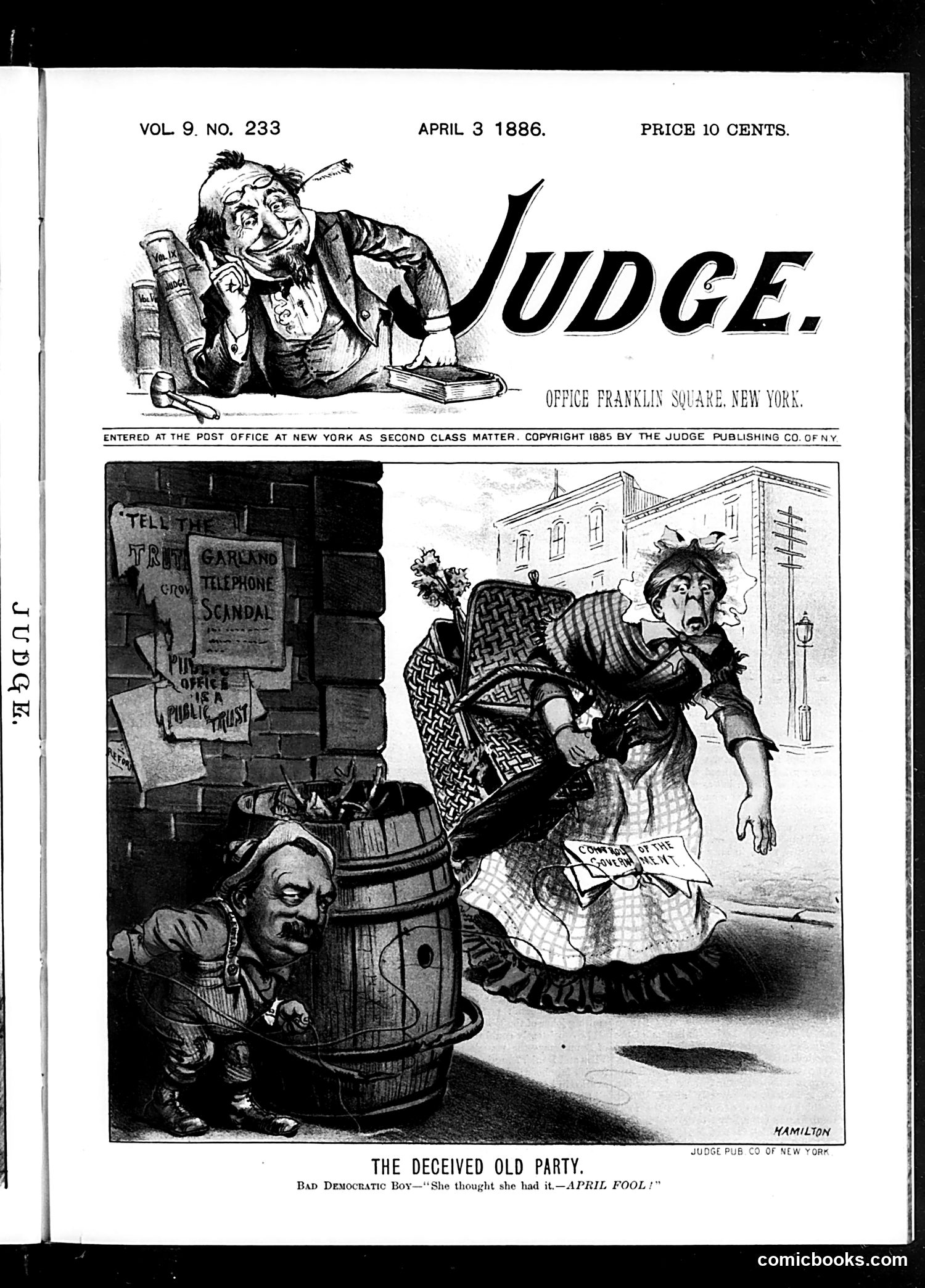
This political cartoon satirizes the Democratic Party as a foolish woman ("Bad Democratic Boy") who has been tricked by an April Fool's joke. The figure labeled "Corrupt State Machine" (the barrel at left) appears to be deceiving the Democratic Party personified as a gullible woman on the right, who looks shocked and dismayed—realizing "she thought she had it" but has been fooled. The satire suggests Democrats were duped by machine politics or political corruption, particularly regarding state-level operations. The "April Fool" reference mocks Democratic leadership for being naive about political manipulation. This reflects late-19th-century criticism of urban political machines and their control over party operations.
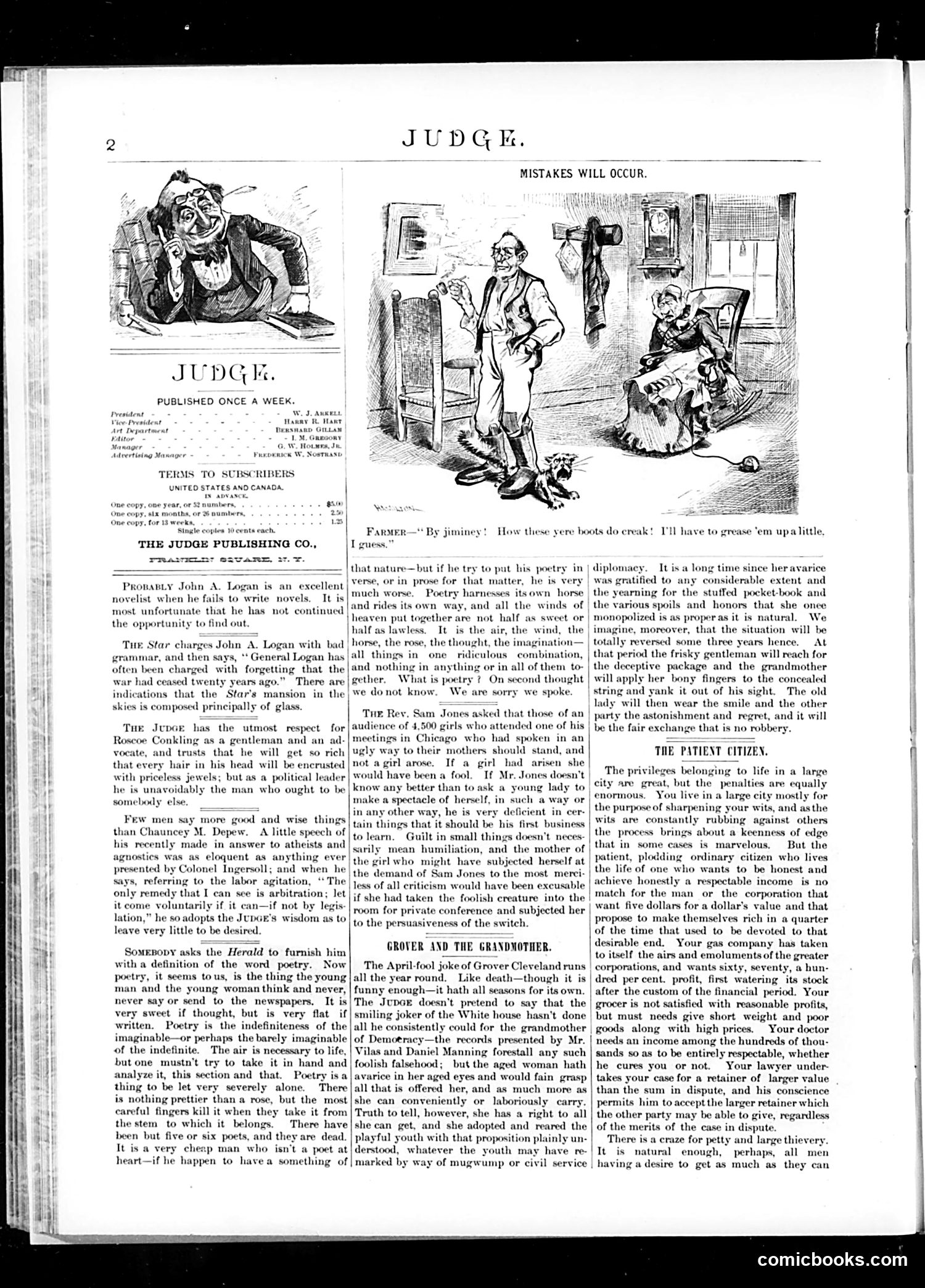
The main cartoon is titled "Mistakes Will Occur" and depicts a domestic scene where a farmer complains to his wife about worn-out boots, while a child sits nearby. The satire appears to mock incompetence or mismanagement—the farmer's comment about boots needing to be "greased" suggests poor maintenance or care. The accompanying editorial discusses poetry's limitations and references a controversy involving Grover Cleveland and his grandmother, appearing to critique Cleveland's handling of a domestic or personal matter that became public scandal. The overall page satirizes human folly and poor judgment in both domestic and political spheres, using humor to comment on contemporary figures and social behavior. The specific Cleveland reference suggests this dates to his presidency era.
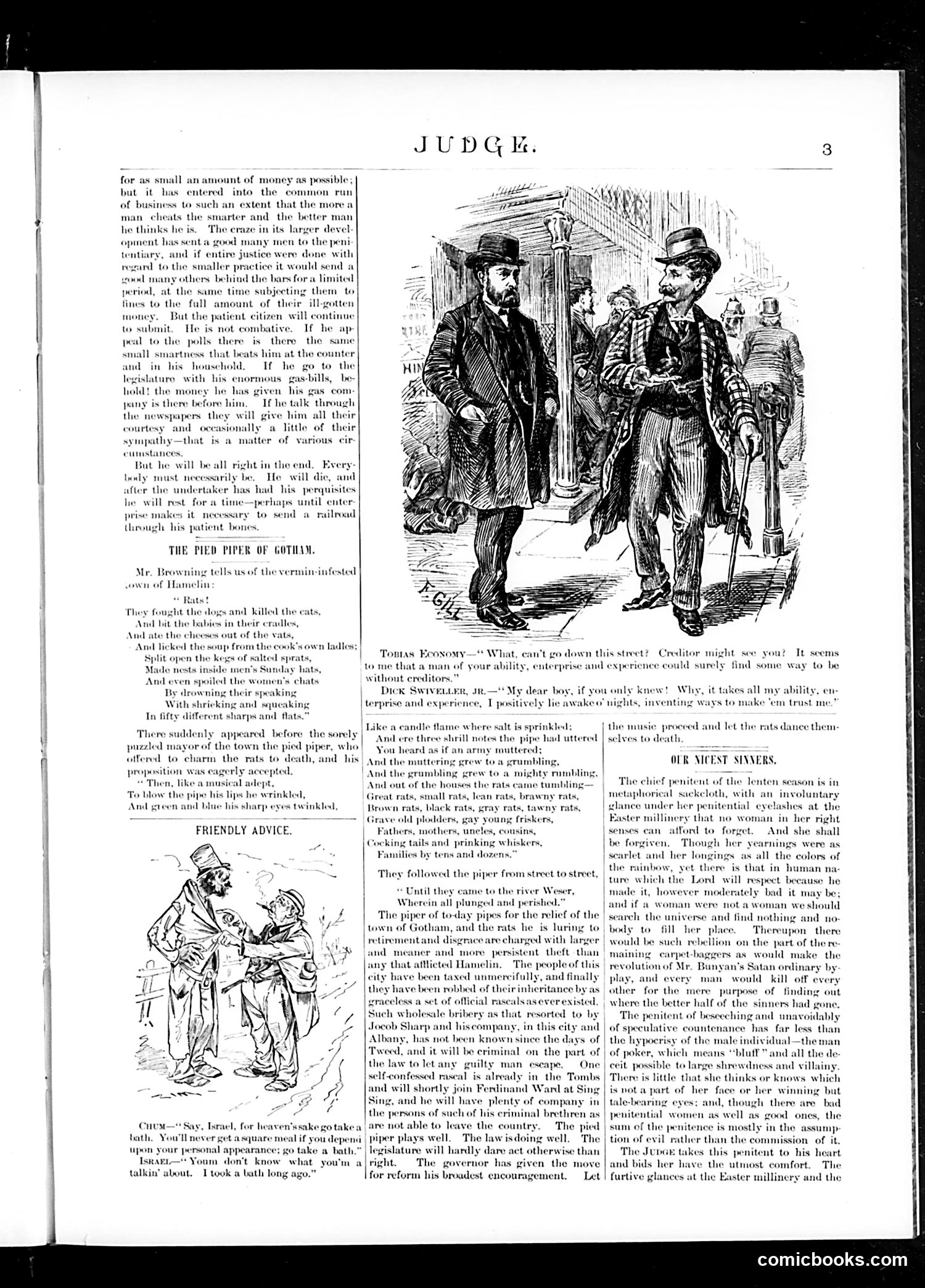
This page satirizes corruption in "Gotham" (New York City). The main cartoon, "The Pied Piper of Gotham," adapts Browning's poem to critique official theft and bribery. Like the legendary piper who led rats to destruction, a modern "piper" (appears to represent a reform-minded official or reformer) is attempting to expose and lead corrupt city officials to justice—officials who have "taxed unmercifully" and "robbed" citizens through "wholesale bribery." The cartoon references recent corruption scandals (likely Tammany Hall corruption; the text mentions "Tweed," the notorious Boss Tweed era). The satire suggests that just as the piper eliminated Hamelin's rats, aggressive prosecution of these "official rascals" is necessary. Supporting text includes "Friendly Advice" (a humorous dialogue about bribing creditors) and "Our Nicest Sinners" (mocking women's Easter fashion indulgences as their form of "penance"), maintaining the magazine's general satirical tone about urban hypocrisy and vice.
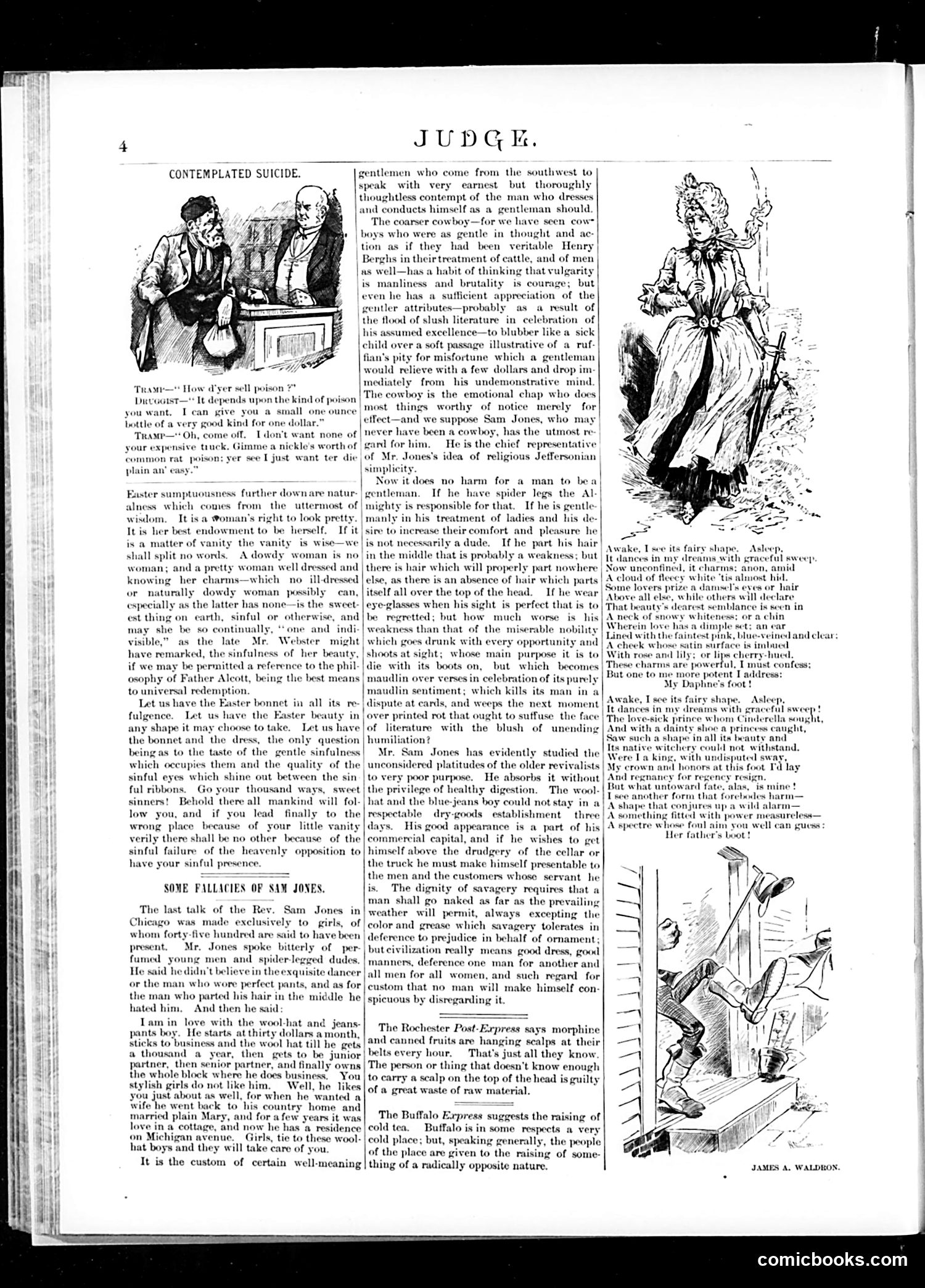
This page contains two distinct satirical pieces attacking what the *Judge* editors saw as hypocrisy and sentimental nonsense. **"Contemplated Suicide"** (top) depicts a dialogue between a man considering poison and a chemist. The joke plays on the man's casual dismissal of life—he wants cheap poison because he's not serious about the attempt. **"Some Fallacies of Sam Jones"** (main article) mocks the famous evangelist Rev. Sam Jones, who had recently given talks to young women in Chicago. Jones preached admiration for working-class "wool-hat and jeans-pants boys" who build businesses through hard work and disdain for effeminate "dudes" who part their hair in the middle or wear perfect pants. The satire ridicules Jones's romanticization of working-class virtue and his contempt for gentlemen's refinement—suggesting his "religious Jeffersonian simplicity" is itself a sentimental fallacy. The piece defends gentle manners, proper dress, and aesthetic cultivation against Jones's crude valorization of roughness as manliness.
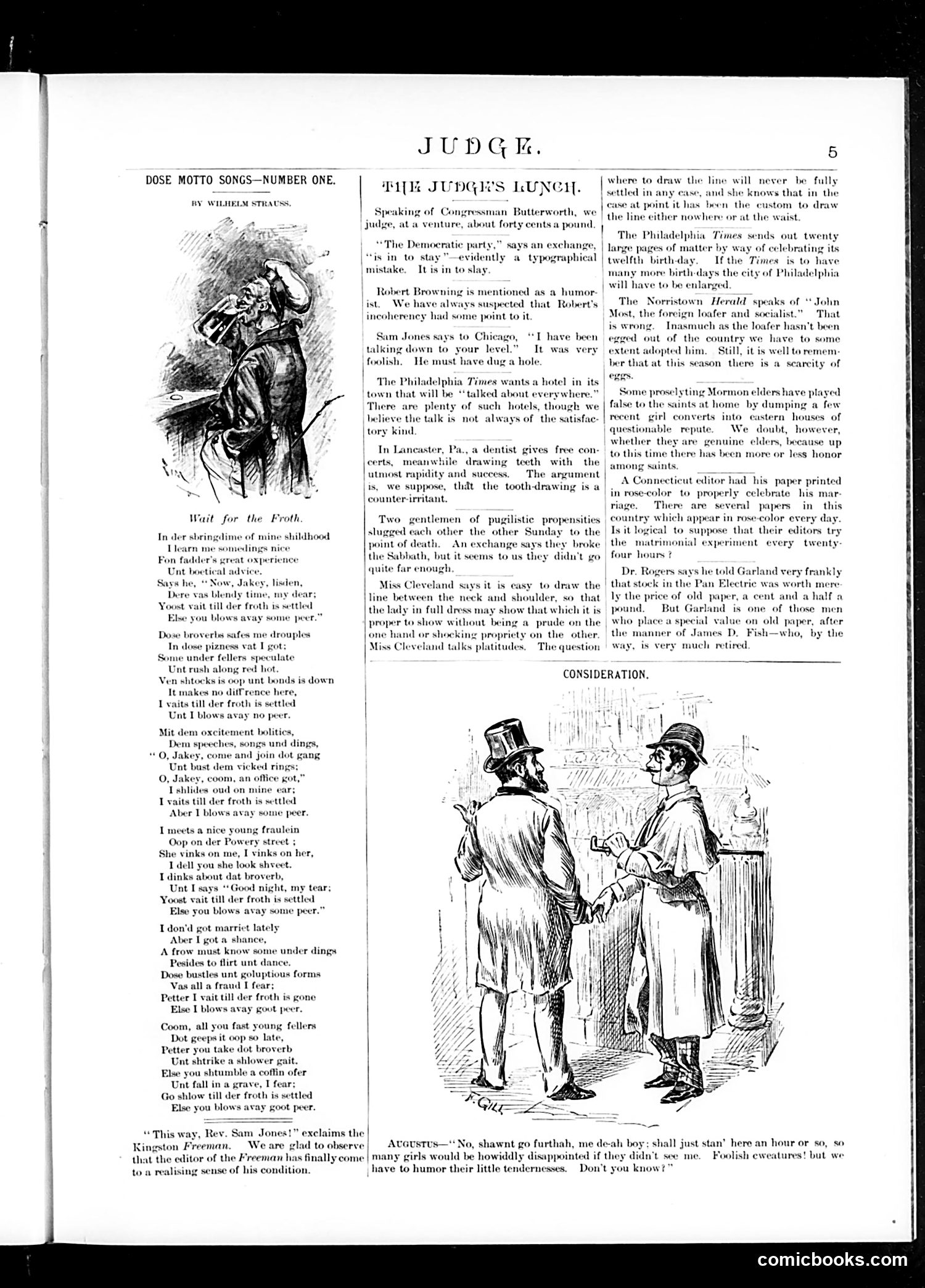
This page contains two main satirical pieces: **"Dose Motto Songs—Number One"** (left): A comic poem in exaggerated German-immigrant dialect mocking the advice to "wait for the froth to settle" before acting rashly. The piece satirizes various contemporary anxieties—stock market speculation, politics, romance, and marriage—by presenting a German character counseling patience across all life situations. The satire targets both impulsive behavior and immigrant stereotypes through comedic dialect humor. **"Consideration"** (right): A cartoon showing two men, one appearing to proposition the other. The caption suggests seduction or impropriety. The accompanying text discusses social boundaries and propriety, likely satirizing Victorian-era rules about what women could publicly display or how gentlemen should behave. Both pieces employ *Judge*'s typical late-19th-century approach: combining social commentary with ethnic stereotyping and humor about contemporary manners and morality.
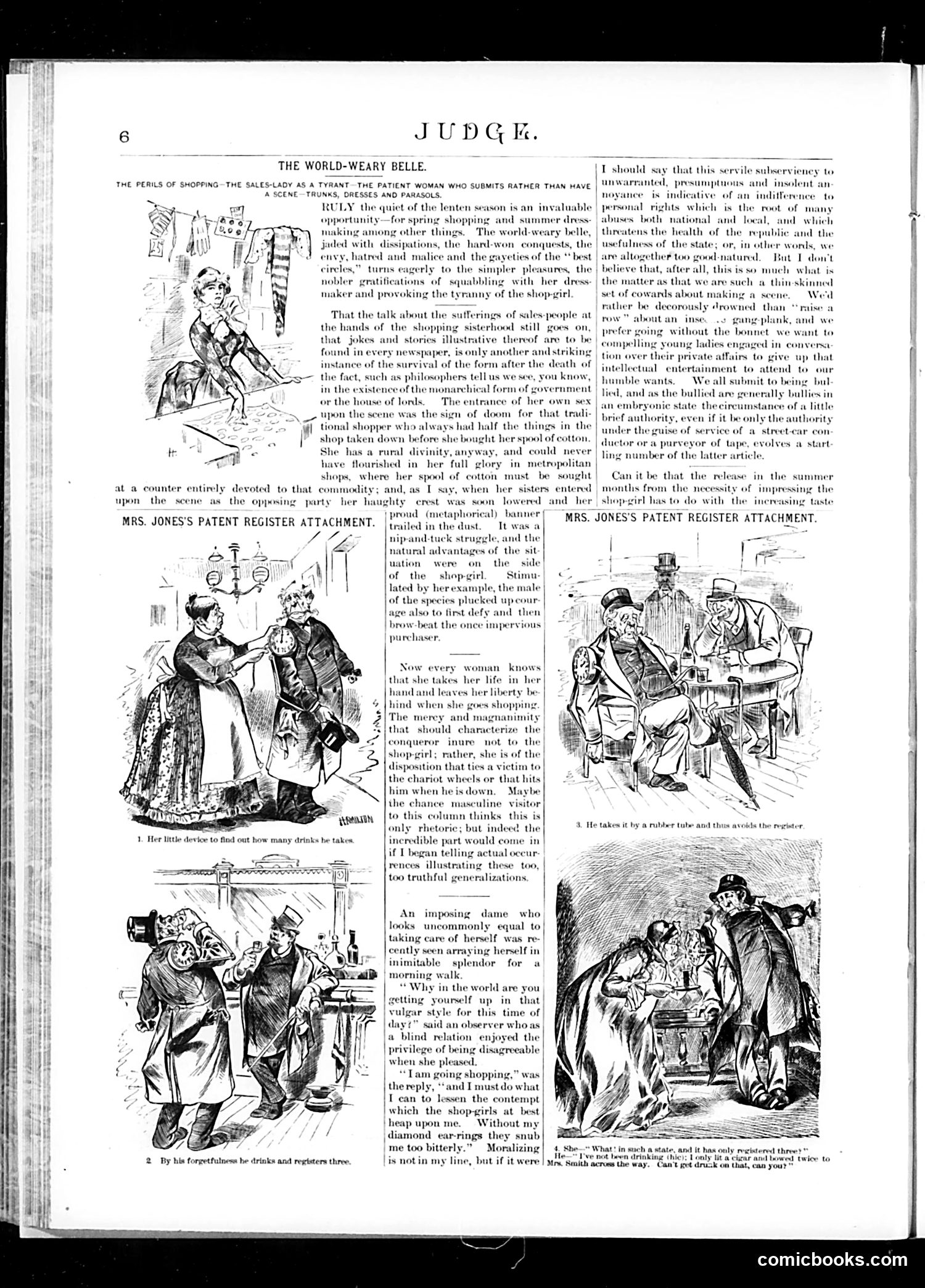
This page satirizes the power dynamics between shoppers and salesgirls in late 19th-century department stores. The article argues that shop assistants have become tyrannical, exploiting their position to demean customers—reversing traditional class hierarchies where wealthy women should hold power. The central complaint: affluent female shoppers now must dress elaborately and curry favor with working-class salesgirls to avoid rudeness and contempt. One cartoon shows a woman telling her relative she must wear diamond ear-rings while shopping to prevent salesgirls from "snubbing" her. The satire mocks both groups—the servile shop-girls' newfound arrogance and the absurd situation where ladies of leisure must appease retail workers. "Mrs. Jones's Patent Register Attachment" likely references a contemporary device or social phenomenon related to this shopping-class conflict, though specifics are unclear from the OCR text.
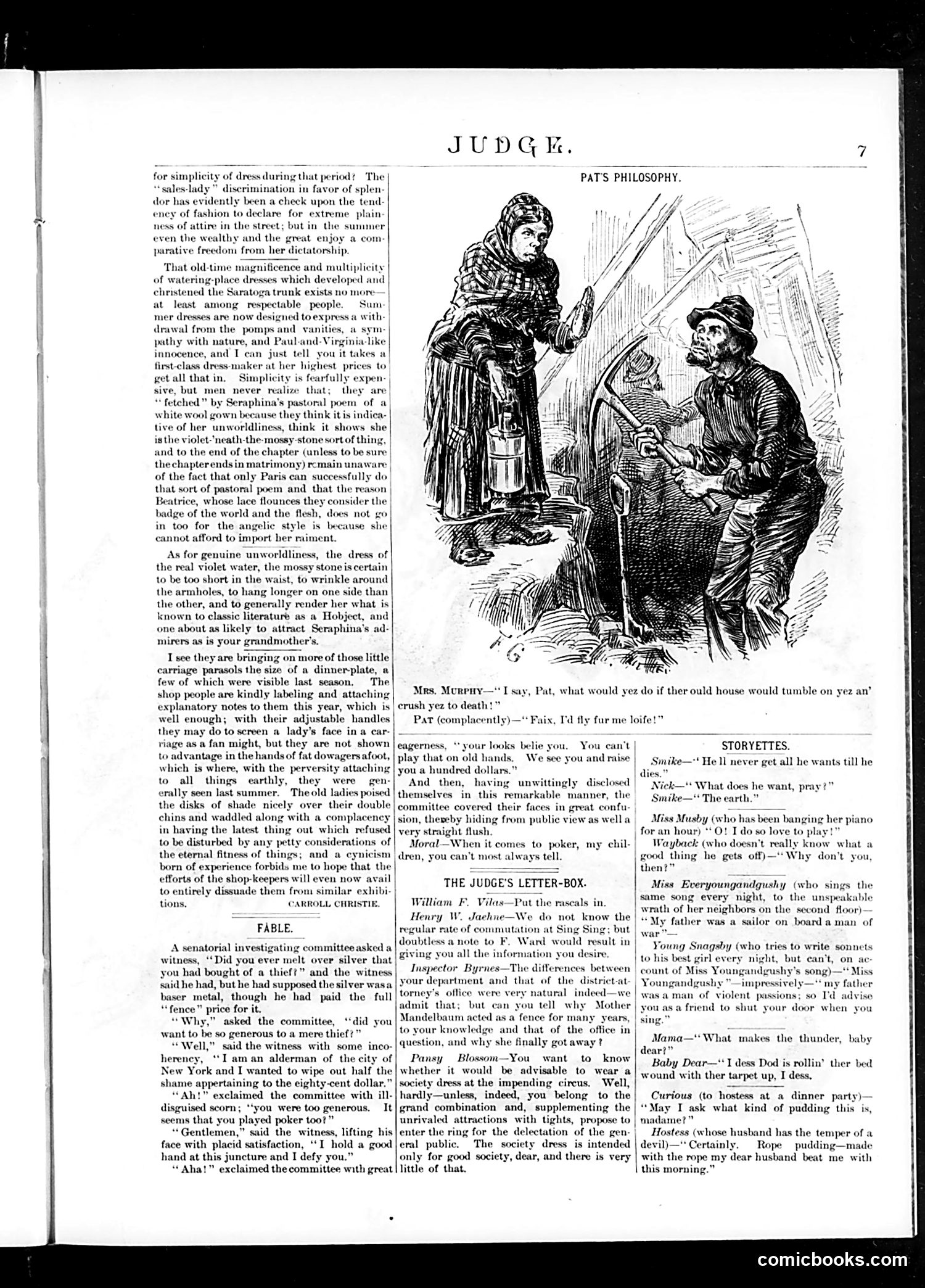
This page from the satirical magazine **Judge** contains several distinct pieces of social commentary typical of the publication's format. The main illustration, titled "Pat's Philosophy," depicts an Irish laborer and woman in working-class dress. The accompanying dialogue—where Pat says he'd "fly fur me loife" if their house collapsed—appears to mock Irish immigrant speech patterns and working-class fatalism through ethnic caricature, a common (though offensive by modern standards) form of 1880s-90s American humor. The text above discusses women's fashion, critiquing both the affectation of "pastoral" simplicity in dress and the absurdity of wealthy dowagers using tiny parasols. The "Fable" section satirizes political corruption: a New York alderman admits to buying stolen silver, justifying it as helping redeem the city's "eighty-cent dollar"—likely referring to municipal fiscal mismanagement or graft. The page exemplifies Judge's formula: combining visual caricature with social satire aimed at contemporary figures and behaviors.
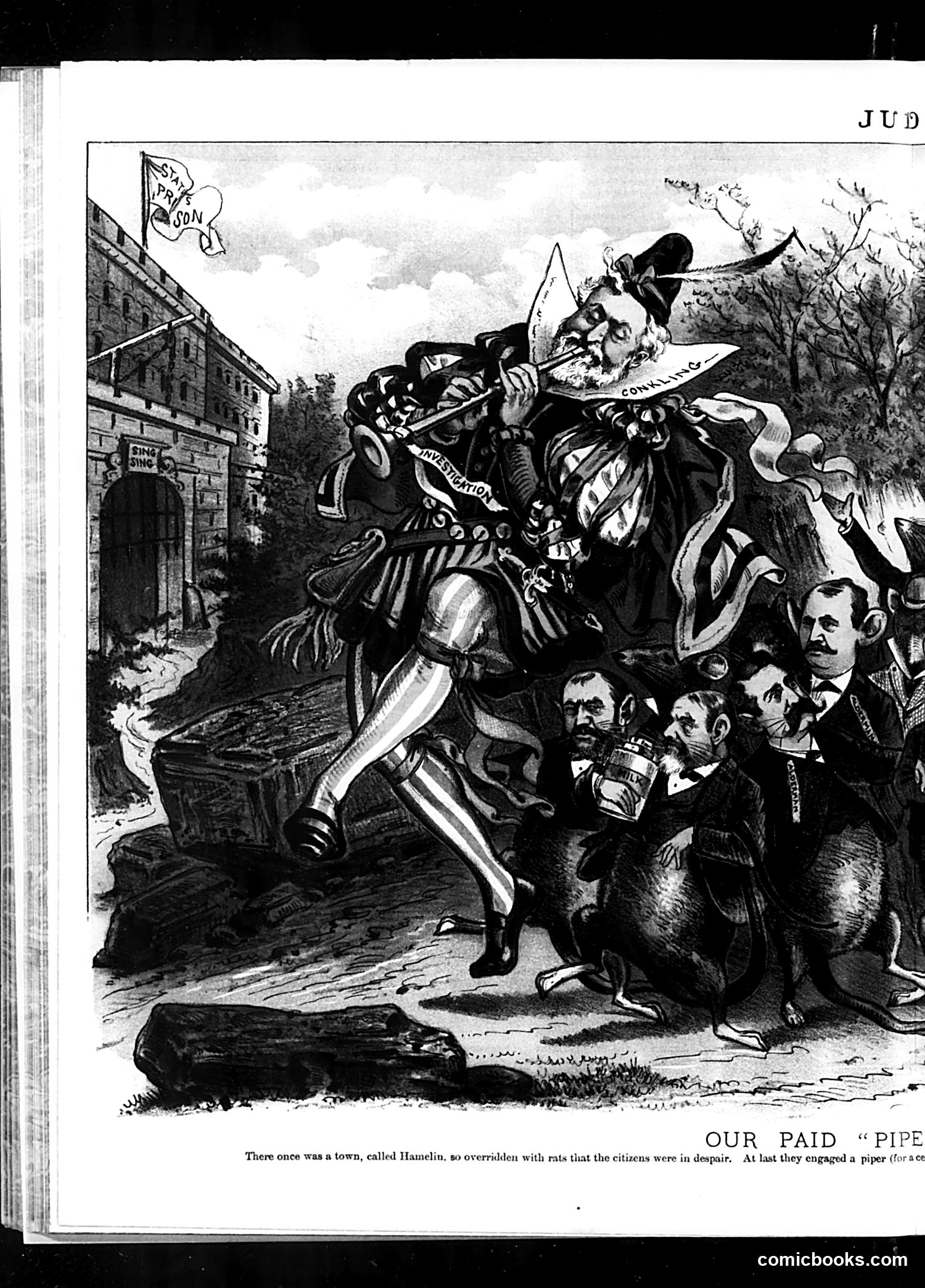
This cartoon references the classic "Pied Piper of Hamelin" legend. The image shows a fantastical piper figure in elaborate costume leading away a group of men depicted as rats—a common antisemitic caricature used in 19th-century political satire. The incomplete caption suggests this is satirizing a political or social figure hired to "solve" a problem by removing an unwanted group. Without the full text or publication date visible, the specific target is unclear, but the visual language employs dehumanizing imagery typical of period propaganda. The satire likely critiques either hiring someone to eliminate a perceived threat or mocks those being portrayed as the "problem" to be removed. Judge magazine frequently used such inflammatory caricatures in its political commentary, reflecting deeply prejudicial attitudes of its era.
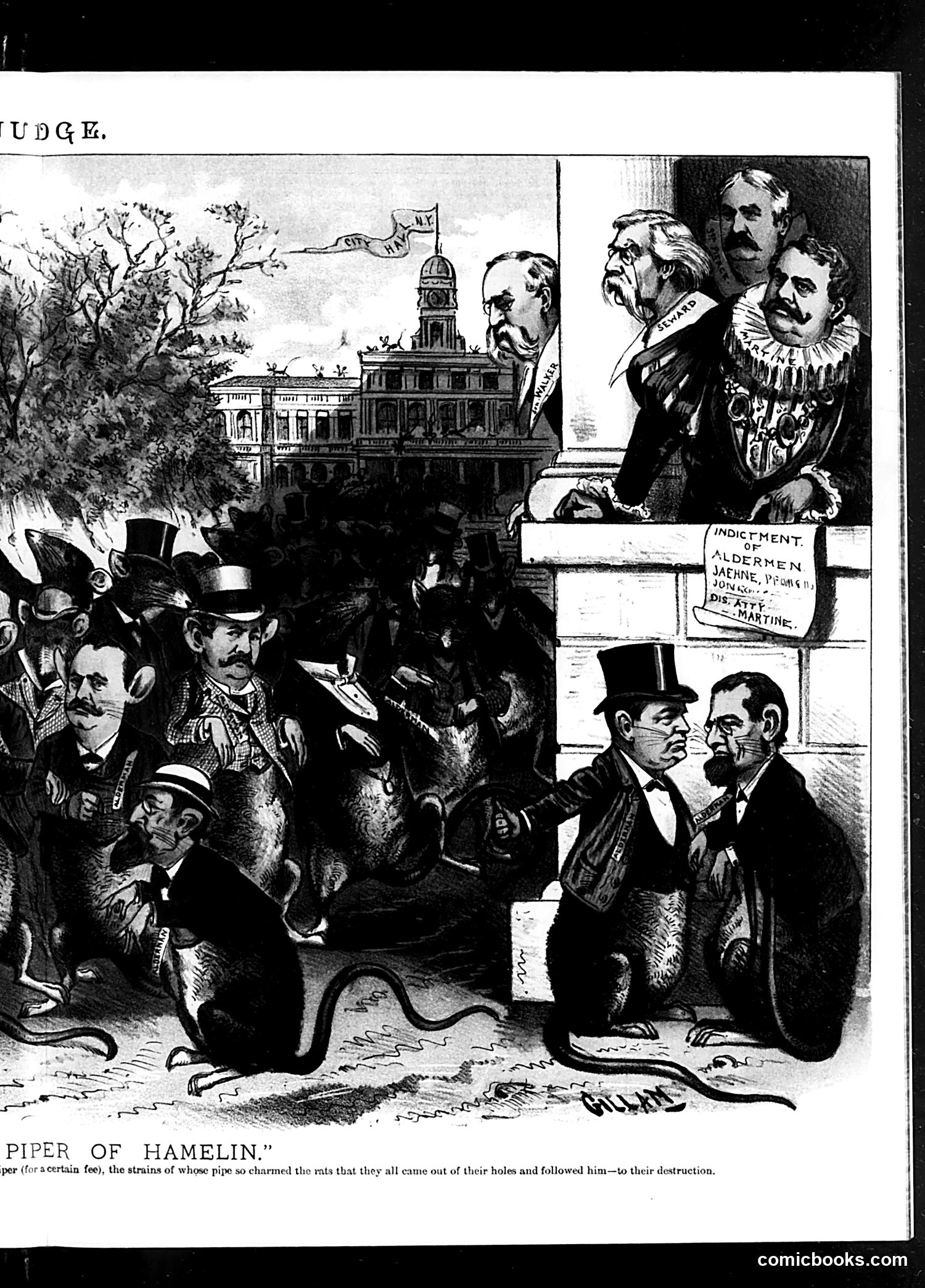
This cartoon adapts the German folktale of the Pied Piper, using it as political allegory. The rats emerging from holes represent political figures or citizens following a charismatic leader to their doom. The building in the background appears to be a courthouse or government building, and visible text references "INDICTMENT" and mentions of "JARDINE" and "DIE SMARTINE." The figures in top hats are caricatured as rats being led away, suggesting prominent politicians or public figures are being manipulated or corrupted by some "piper"—likely a political leader or influence of the era. The satire critiques how charismatic figures can lead groups blindly toward destruction. Without the specific date and full context, the exact targets remain unclear, but the cartoon uses the classical tale to warn about political manipulation and gullibility.
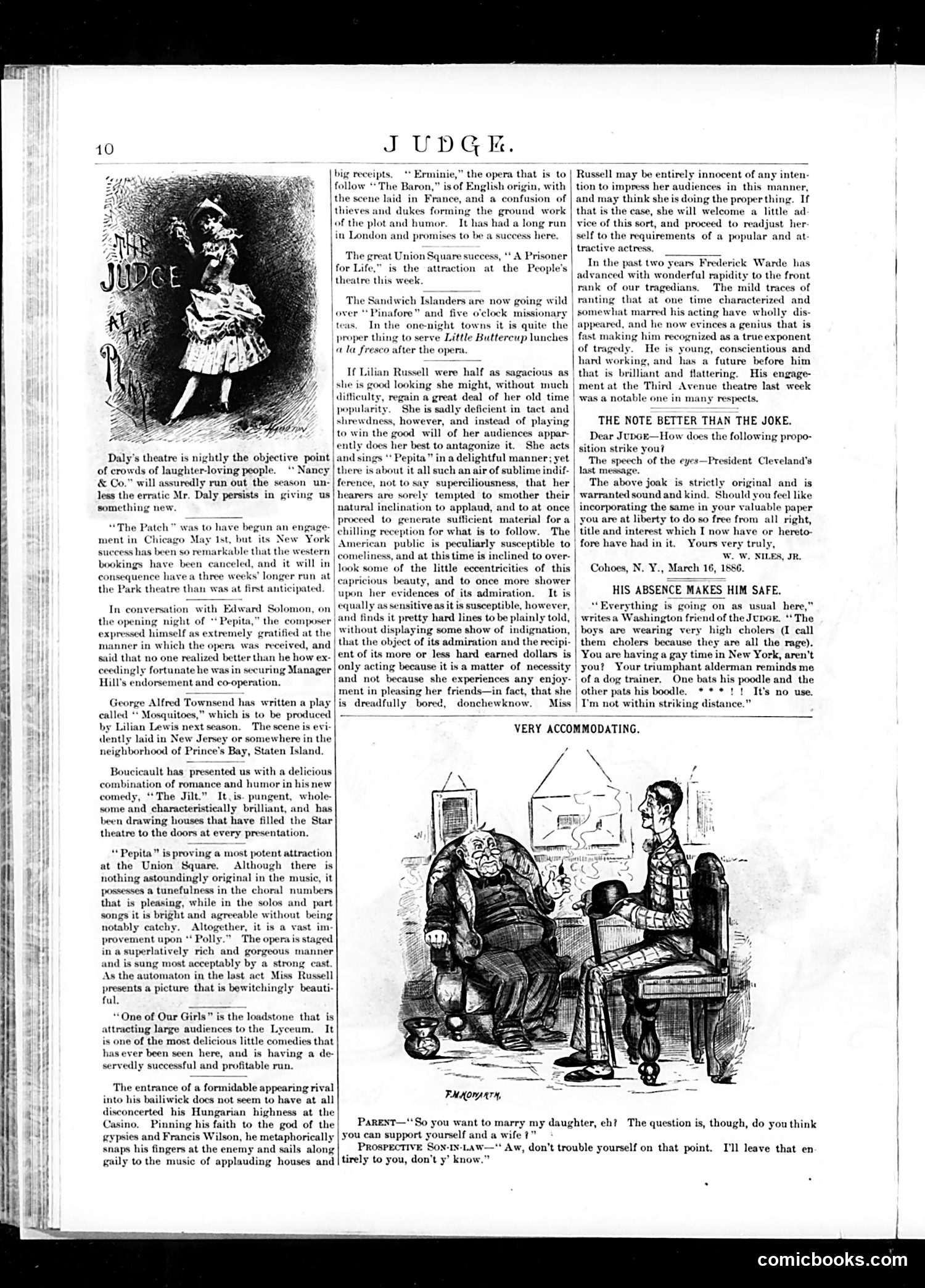
This theatrical review page discusses current Broadway productions, with particular focus on **Lilian Russell**, a famous opera singer of the era. The satire criticizes Russell's stage demeanor in the opera "Pepita." **The Key Criticism:** Russell is described as talented but arrogant and indifferent to her audiences. The reviewer accuses her of performing out of financial necessity rather than genuine engagement with her role or public. He notes her "sublime indifference" and "superciliousness" toward applauds from admirers, suggesting she treats her admirers with disdain. **The Cartoon "Very Accommodating"** (below, uncaptioned in OCR) depicts a prospective son-in-law discussing marriage with a father. The dialogue suggests casual acceptance of an unsuitable match—typical Judge satire about social pretense and practical compromise in marriage among the working or lower classes. The page reflects 1880s theatrical culture and celebrity criticism, where public persona mattered greatly to an actress's popularity.
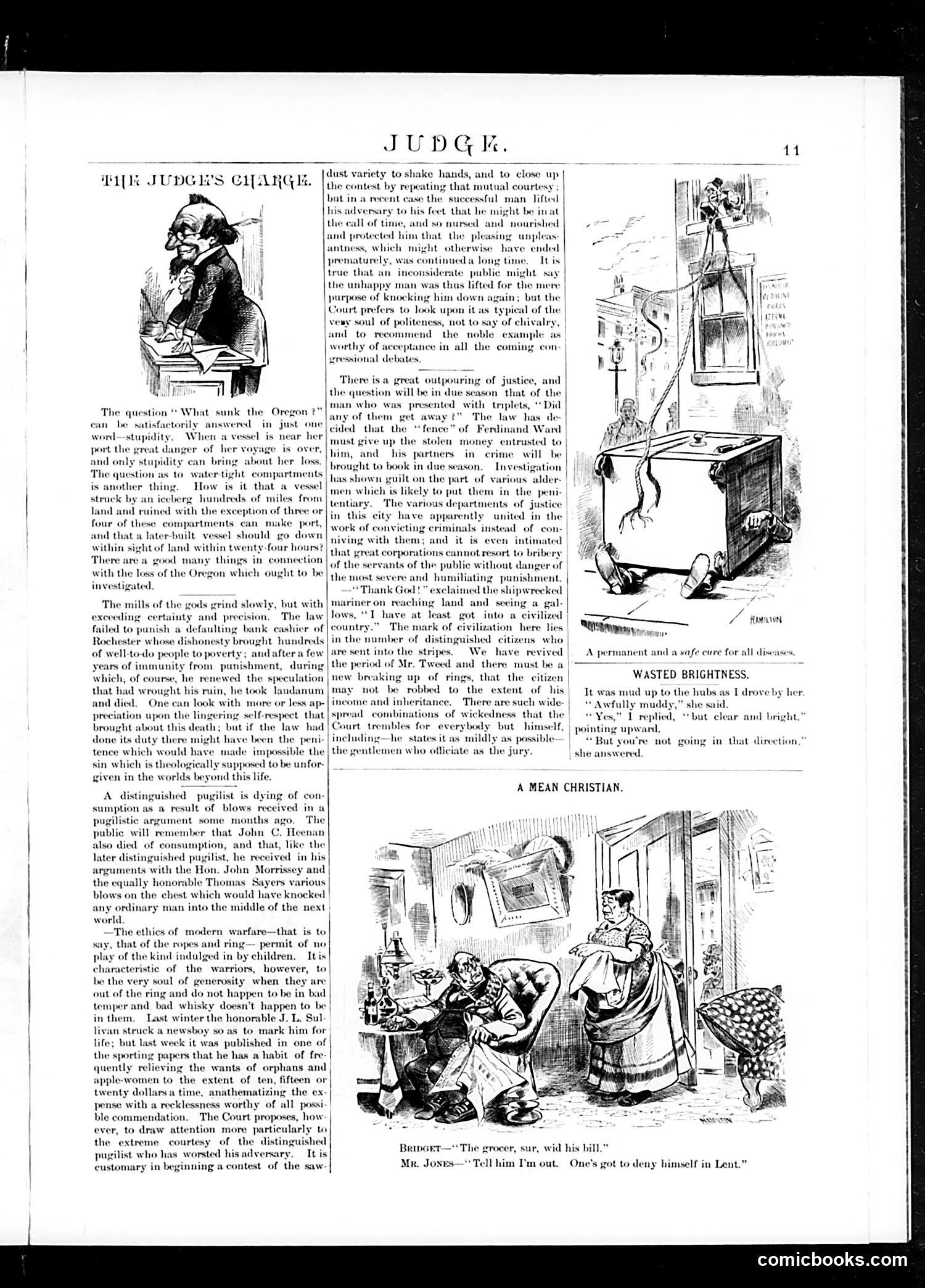
This page from the satirical magazine *Judge* contains several editorial commentaries on contemporary issues: **"The Judge's Charge"** (left column): Critiques the sinking of the USS *Oregon*, attributing it to "stupidity" rather than inevitable maritime accident. The piece sarcastically comments on legal/moral failures—specifically a cashier who embezzled, died unpunished, and whose speculation ruined poor families, while wealthy criminals face minimal consequences. **The cartoons and brief pieces** address: - Boxer violence: A "distinguished pugilist" dying from blows received in fights, with ironic commentary that boxers show generosity *outside* the ring while being brutal within it. References to John C. Heenan and J.L. Sullivan. - "A Mean Christian" (bottom): Mr. Jones denies himself Lent while asking his grocer for credit—satirizing hypocritical religious observance among the poor. **Overall thrust**: Social hypocrisy—the wealthy escape justice, boxers practice ritualized brutality, and the poor performatively suffer while struggling financially. The satire targets both institutional failures and individual moral inconsistency.
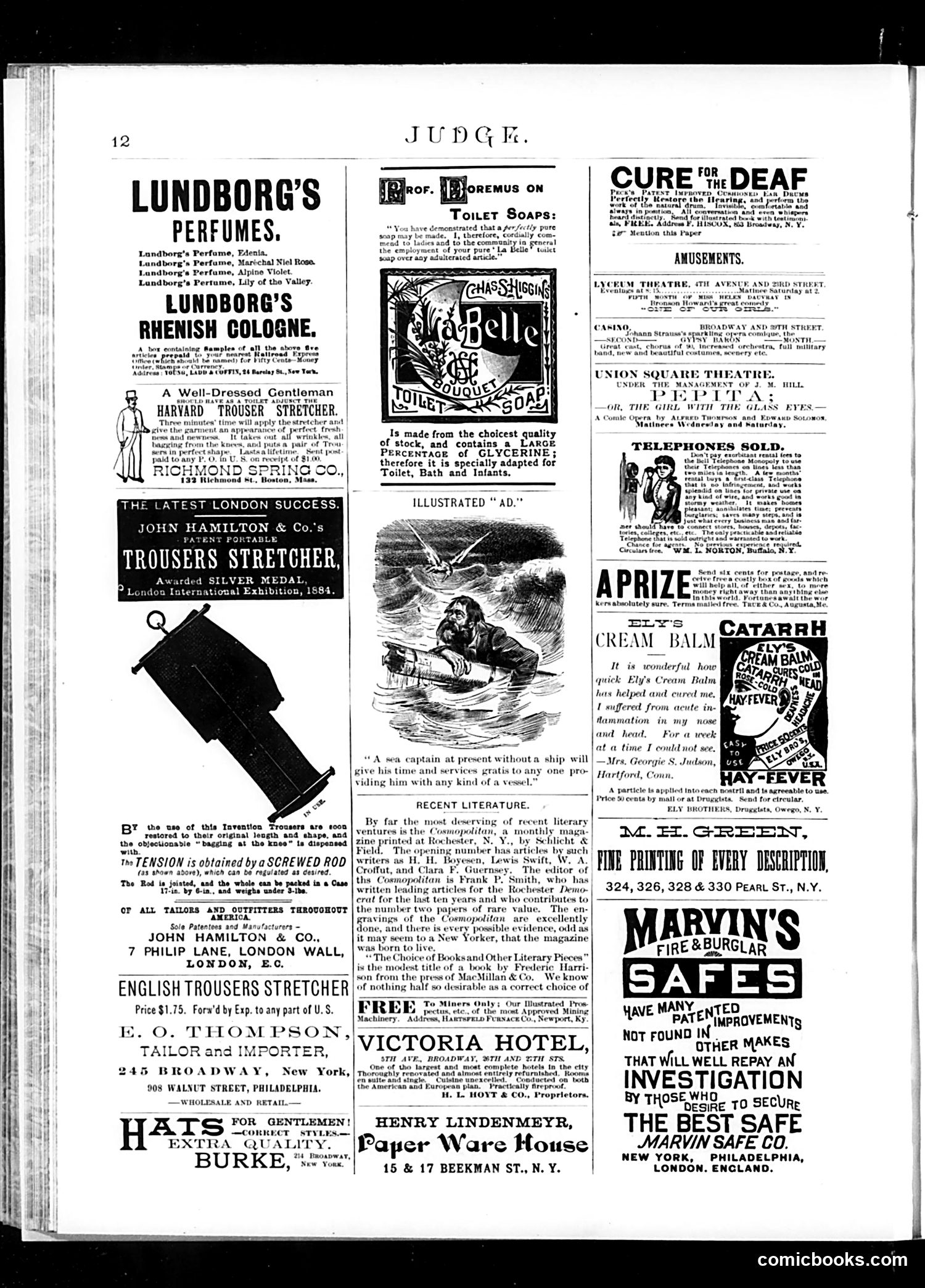
This is primarily an **advertising page** from Judge magazine, not a satirical cartoon page. The layout features various commercial advertisements typical of late 19th-century publications. The most prominent ads include: - **Lundborg's Perfumes** and Rhenish Cologne (cosmetics) - **Trousers Stretcher** by John Hamilton & Co.—a device using a screwed rod to restore trouser shape and prevent "bagging at the knee," reflecting Victorian concerns about gentleman's appearance - **Ely's Cream Balm** for catarrh (nasal inflammation) - **Marvin's Safes** with patented improvements - Various theatrical announcements and other commercial products The single illustrated "ad" shows a figure in a boat—apparently a scene meant to accompany an advertisement, though its specific product connection is unclear from this page. The content reflects 1880s consumer culture: grooming products, tailoring innovations, patent medicines, and luxury goods marketed to middle and upper-class readers.
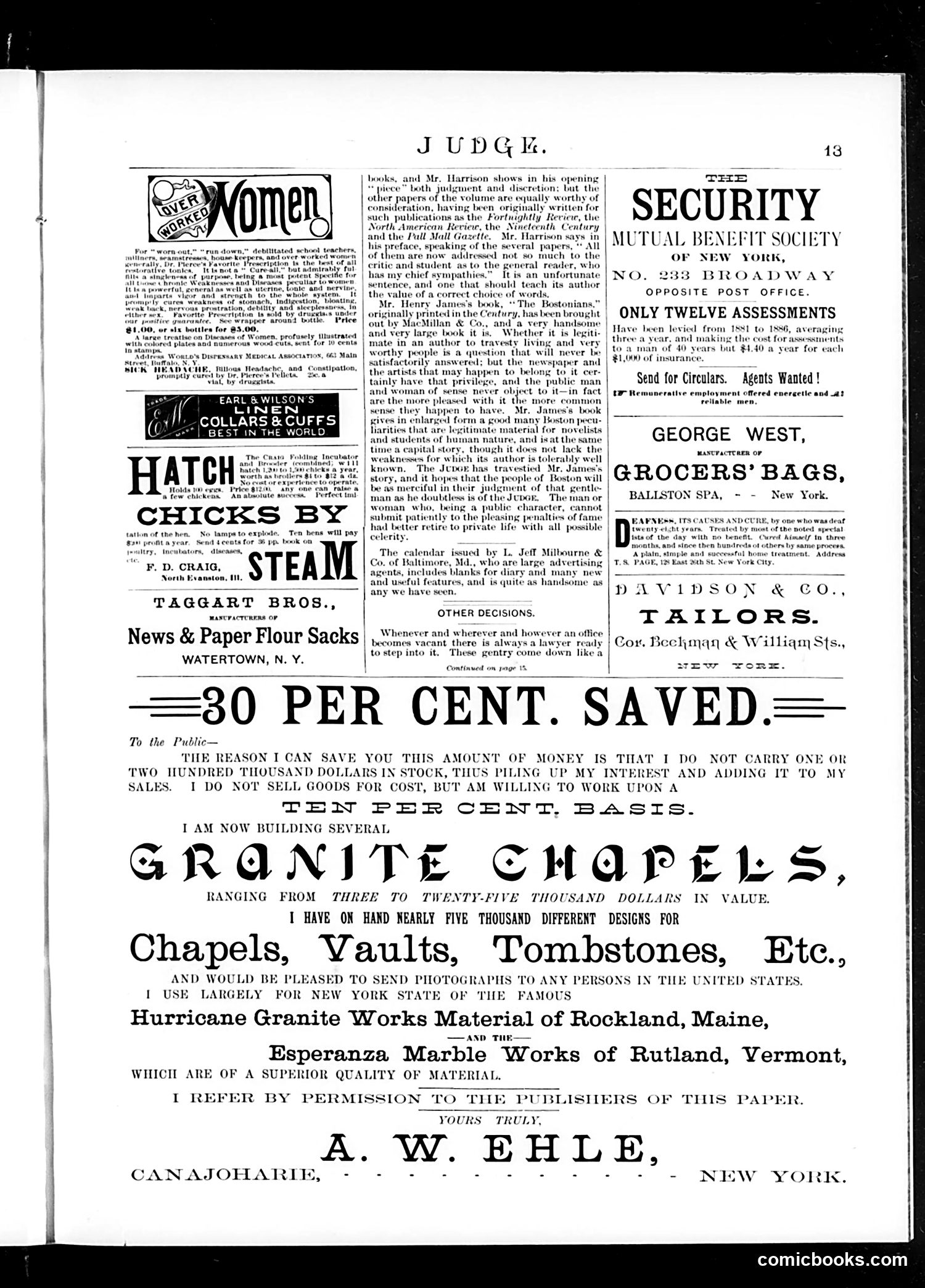
This page is **primarily advertising**, not satirical content. The dominant feature is a large advertisement from A. W. Ehle of Canajoharie, New York, promoting his granite chapel, vault, and tombstone business. He emphasizes saving 80% through low overhead costs and offers thousands of design options using materials from Rockland, Maine, and Rutland, Vermont granite and marble works. The page includes various smaller advertisements for period goods: collars and cuffs, flour sacks, grocers' bags, tailoring services, and a mutual benefit insurance society offering low assessment rates since 1881. At the top is a brief section titled "Other Decisions" discussing legal matters regarding office vacancies and lawyers stepping down. There is **no visible political cartoon or satirical commentary** on this page—it represents the commercial character of late-19th-century magazine publishing, where advertising revenue substantially subsidized editorial content.
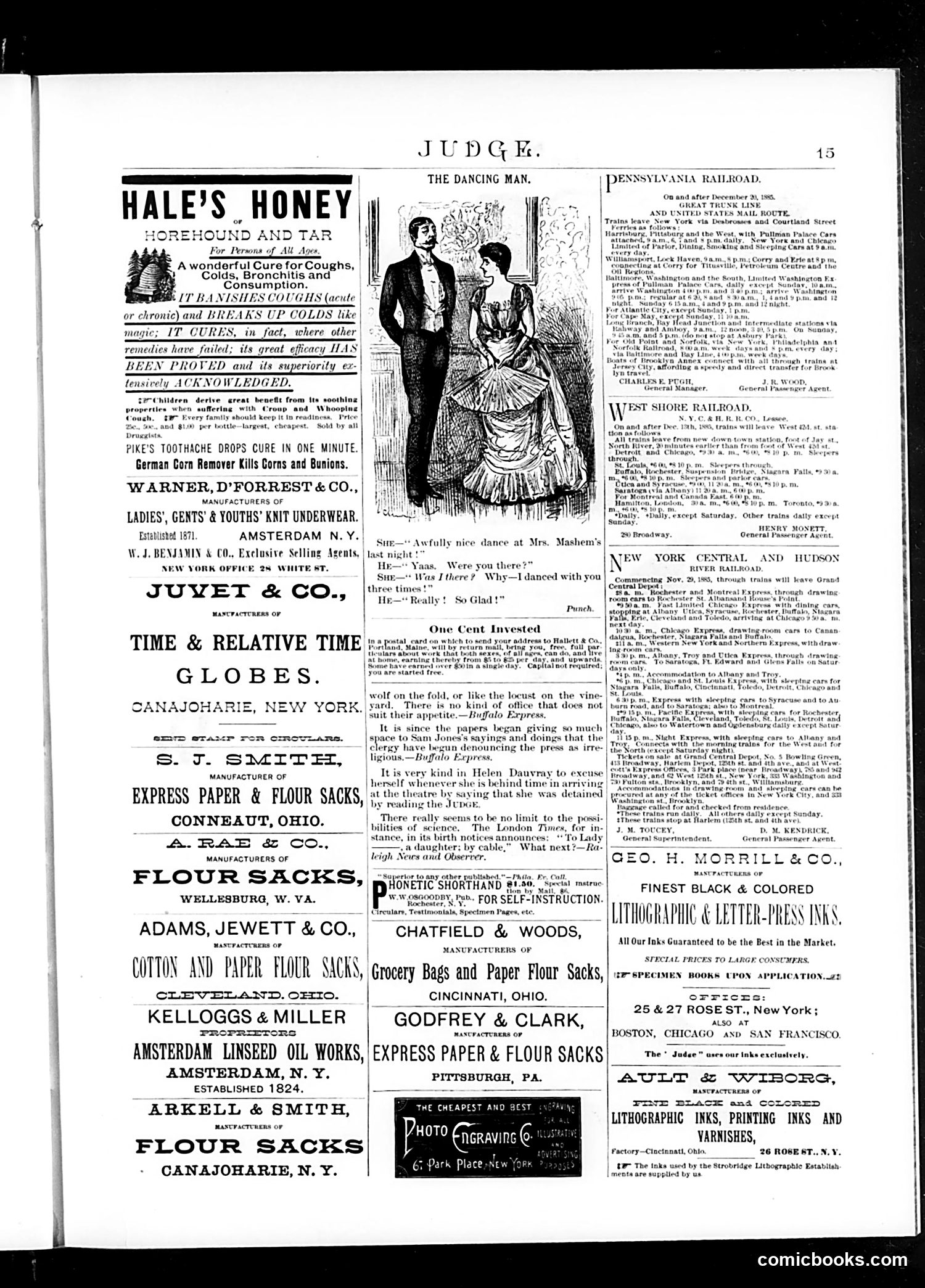
This page is primarily **advertising**, with a small cartoon at the top titled "The Dancing Man." The cartoon depicts a man and woman in Victorian dress; the woman wears an elaborate fan-shaped dress. The dialogue reads: "A fully nice dance at Mrs. Mashem's last night?" / "Yes. Were you there?" / "No—Why I danced with you three times." / "Really? So Glad!" **The joke**: The man claims he danced with the woman three times at a party he didn't attend—an obvious absurdity highlighting the social pretense and false claims common in Victorian society. The woman's polite acceptance ("So Glad!") satirizes how people accept obvious lies to maintain social courtesy. The surrounding text contains brief humorous anecdotes about newspapers' absurd announcements and Helen Dauvray's theatrical excuses—all mocking Victorian society's tolerance for obvious falsehoods in public discourse. The rest of the page consists entirely of period advertising for patent medicines, flour sacks, railroad schedules, and printing inks.
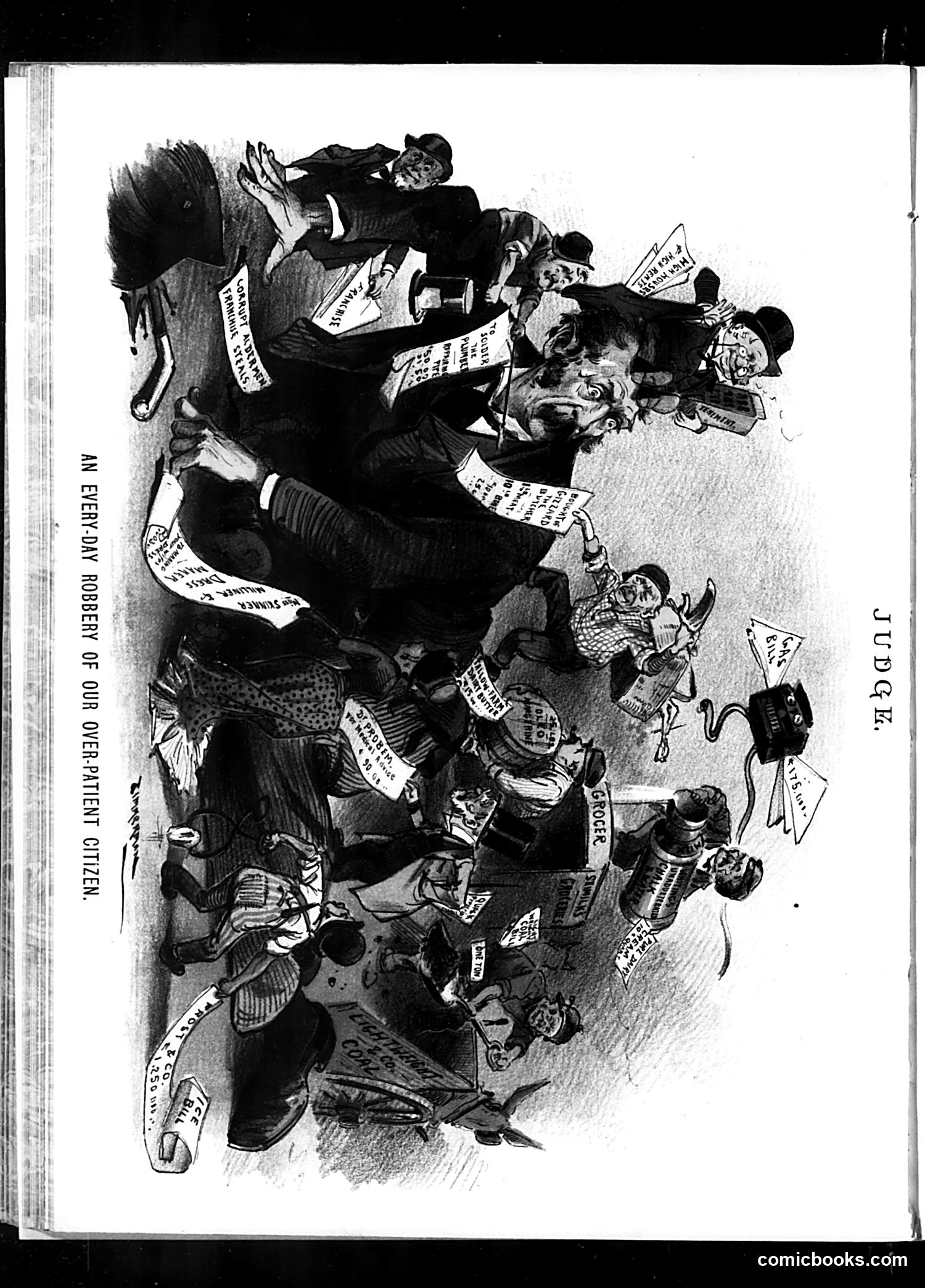
The OCR text is too corrupted to read clearly, making full interpretation difficult. However, the image shows a political cartoon titled "AN EVERODY ROBBER OF OUR MERCHANT CITCLE" (text appears partially illegible). The cartoon depicts a large central figure (likely representing a political or corporate villain) surrounded by smaller figures engaged in what appear to be corrupt transactions. Multiple figures hold papers or documents, suggesting fraud, bribery, or financial malfeasance. The style and composition suggest this satirizes widespread corruption or theft affecting the merchant class during Judge magazine's era (likely late 19th or early 20th century). Without clearer text identification, I cannot definitively name specific individuals or pinpoint the exact historical event being criticized. The general message appears to target systemic corruption or exploitation in business circles.