
Judge, 1886-04-03 · page 7 of 16
Judge — April 3, 1886 — page 7: what you’re looking at
What you’re looking at
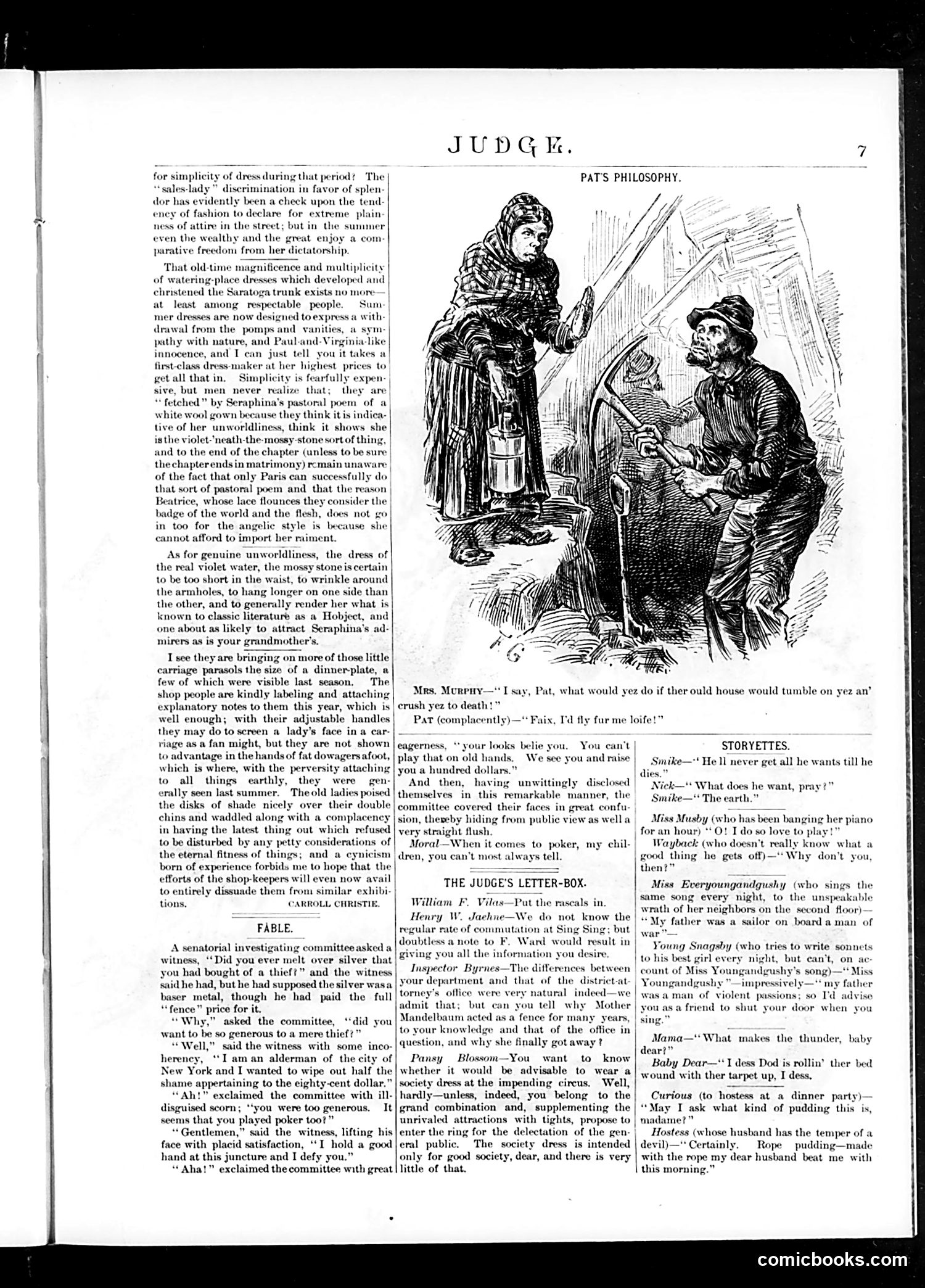
This page from the satirical magazine **Judge** contains several distinct pieces of social commentary typical of the publication's format. The main illustration, titled "Pat's Philosophy," depicts an Irish laborer and woman in working-class dress. The accompanying dialogue—where Pat says he'd "fly fur me loife" if their house collapsed—appears to mock Irish immigrant speech patterns and working-class fatalism through ethnic caricature, a common (though offensive by modern standards) form of 1880s-90s American humor. The text above discusses women's fashion, critiquing both the affectation of "pastoral" simplicity in dress and the absurdity of wealthy dowagers using tiny parasols. The "Fable" section satirizes political corruption: a New York alderman admits to buying stolen silver, justifying it as helping redeem the city's "eighty-cent dollar"—likely referring to municipal fiscal mismanagement or graft. The page exemplifies Judge's formula: combining visual caricature with social satire aimed at contemporary figures and behaviors.
📄 Transcribed text from this page (OCR, searchable)
Machine-transcribed from the original scan — historical spelling and the odd misread are preserved.
oe for simplicity of dress during that period The imination in favor of splen s evidently been a check upon the tend -y of fashion to declare for extreme plain ness of attire in the street; but in the summer even the wealthy and the great enjoy parative freedom from her dictatorship. a com magnificence and multiplicity ering-place dresses which developed and christened the Saratoga trunk exists no more at least among respectable people. mer dresses are now designed to express : drawal from the pomps an pathy with nature, and Paul-and-Virginia-like 1 you it takes a est prices to rarfully exper um with first-class dress-m: get all that in, sive, but * fetched” by Seraphina’s pastoral poem of white wool gown because they think it is ind tive of her unworldliness, think it shows she is the violet-neath-the-mossy-stone sort of thing, and to the end of the chapter (unless to be sure thechapterends in matrimony) remain unaware of the fact that only Paris can successfully do that sort of pastoral poem and that the reason Beatrice, whose lace flounces they consider the badge of the world and the flesh, does not in too for the angelic style is because she cannot afford to import her raiment, As for genuine unworldliness, the dress of the real violet water, the mossy stone is certain to be too short in the waist, to wrinkle around the armholes, to hang longer on one side than the other, and to generally render her what is known to classic literature as a Hobject, and one about as likely to attract Seraphina’s ad- mirers as is your grandmother’ I see they are bringing on more of those little | carriage parasols the size of a dinnerplate, a of which were visible last season, The p people are kindly labeling and attaching natory notes to them this year, which is well enough; with their adjustable handles they may do to screen a lady’s face in a car-| - riage as a fan might, but they are not shown to advantage in the hands of fat dowagers afoot, which is where, with the perversity attaching to all things earthly, they were erally seen last summer. 2s poised the disks of shade nici double chins and waddled along with a complacen| in having the latest thing out which refused to be disturbed by any petty considerations of the eternal fitness of things; and a cynicism born of experience forbids me to hope that the efforts of the shop-keepers will e 1 to entirely dissuade them from sim’ tions. CARROL n now ava CHRISTIE, FABLE, A senatorial investigating committee asked a witness, ‘‘Did you ever melt over silver tha you had bought of a thief?” and the witness | said he had, but he had supposed the silver was a baser metal, though he had paid the full “fence” price for it. “Why,” asked the committee, ‘did you|} t want to be so generous to a mere thief?” ** Well,” said the witness with some inco- herency, “I aman alderman of the city of New York and I wanted to wipe out half the shame appertaining to the eighty-cent dollar.” “Ah!” exclaimed the committee with ill- disguised scorn; “you were too generous. It seems that you played poker too?” “Gentlemen,” said the witness, lifting his face with placid satisfaction, ‘‘I1 hold a good hand at this juncture and I defy you.” y | sion, theseby hiding from public view as w exhibi- | JUDGE. ’ PATS PHILOSOPHY. Mrs. Murpny crush yez to death Tsay, Pat, what would yez do if ther ould house would tumble on yez an’ Pat (compla ently) —" T'd fly fur me loife!” nu. You can't | STORYETTES. see you and ra Smike—* He 11 never get all he wants till he Sagara, © 9Giir locke Wall play that on old hi you a hundred dol | And then, having unwittingly disclosed |" yjek—s What does he want, pray?” themselves in this remarkable manner, the ‘Smike—“Theearth.” committee covered their faces in great confu = 1a) Miss Musby (who has been ba very straight flush for an hour) “0! I do so love to p Moral—When it comes to poker, my chil-| Wayback (who doesn’t really know what a dren, you can’t most always tell. | good thing he gets off)—"Why don't you, = then?” di 1g her piano THE JUDGE'S LETTER-BOX. William F. Vilas—Pat the s in. Henry W. Jaehne—We do not know the regular rat amutation at Sing Sing; but doubtless a note to F. Ward would result in giving you all the information you desire. | Miss Everyoungandgushy (who sings the same song every night, to the unspea wrath of her neighbors on the second floor) “My father was a sailor on board a man of Young Snagsby (who tries to write sonnets to his best girl e ight, but can’t, on - The differences between | count of Miss song)—** Miss id that of the district-at- | Youngandgushy —" my father natural indeed—we | was a man of violent passions; so I'd advise but can you tell, why Mother | you asa friend to shut your door when you sa fence for many years, | sing ge and that of the office in question, and why she finally got aw: Inspector Byrn your dep your knowl Mama—"What makes the thunder, baby dear?” Baby Dear—'*I dess Dod is rollin’ ther bed wound with ther tarpet up, I dess, Pansy Blossom—You want to know whether it would be advisable to wear a 80 y dress at the impending circus. Well, o ie hardly—unless, indeed, you belong to the| Curious (to hostess at a dinner party) grand combination and, supplementing the | ‘May I ask what kind of pudding this is, unrivaled attractions with tights, propose to | madame?” enter the ring for the delectation of the gen- Hostess (whose husband has the temper of a eral public. The soci dress is intended | devil)—* Certainly Rope —pudding—made only for good society, dear, and there is very | with the rope my dear husband beat me with ** Aha!” exclaimed the committee with great little of that. | this morning.” comicbooks.com