
A complete issue · 16 pages · 1886
Judge — January 9, 1886
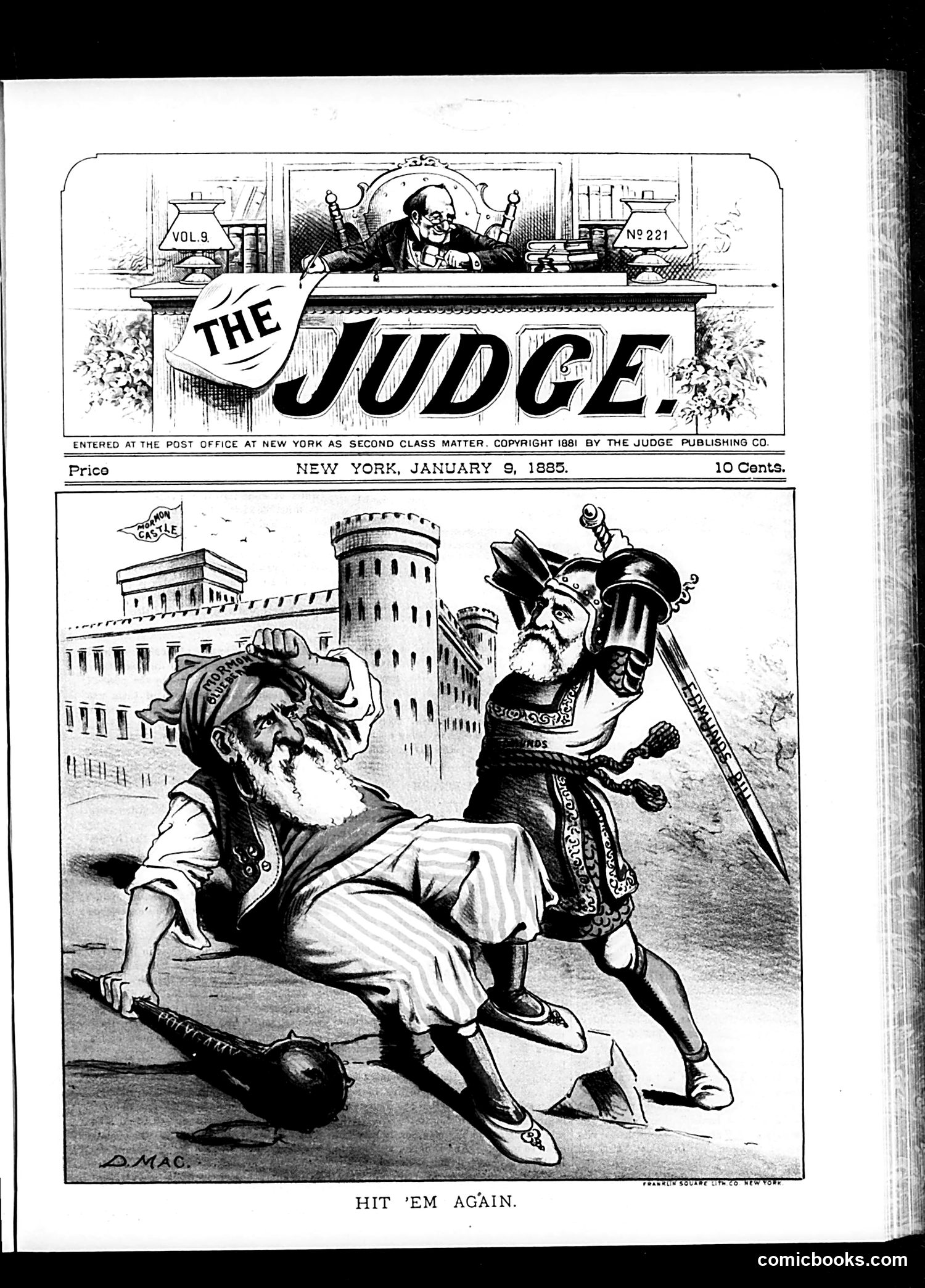
This cartoon depicts a caricatured figure labeled "THE IRISH VOTE" being struck repeatedly by a well-dressed man wielding a club. The satire appears to criticize how Irish-American voters were being manipulated or mistreated by political forces in the 1880s. The exaggerated facial features and ethnic stereotyping reflect the period's prejudiced cartooning style. The repeated blows suggest political exploitation—likely referencing how Irish voters were courted, used, then discarded by politicians, or possibly depicting violence/coercion at polling places. Without additional context from the magazine's editorial content, the specific political event referenced remains unclear, though it likely concerns 1884 election aftermath or contemporary political maneuvering regarding Irish-American political power in New York.
The main cartoon "The Man in the Ticker" satirizes Wall Street speculation during the Gilded Age. The illustration shows a disheveled figure emerging from a stock ticker machine, suggesting that Wall Street operators have become enslaved to—or literally consumed by—the mechanical ticker system that drives financial trading. The accompanying editorial argues that Wall Street's obsession with rapid speculation has corrupted sound business principles. It criticizes how financiers prioritize momentary market fluctuations over genuine economic value, making the "Man in the Ticker" a cautionary figure representing those who've sacrificed integrity for profit in the relentless pursuit of stock market gains. The page also contains separate satirical commentary on contemporary political issues including polygamy reform and military spending.
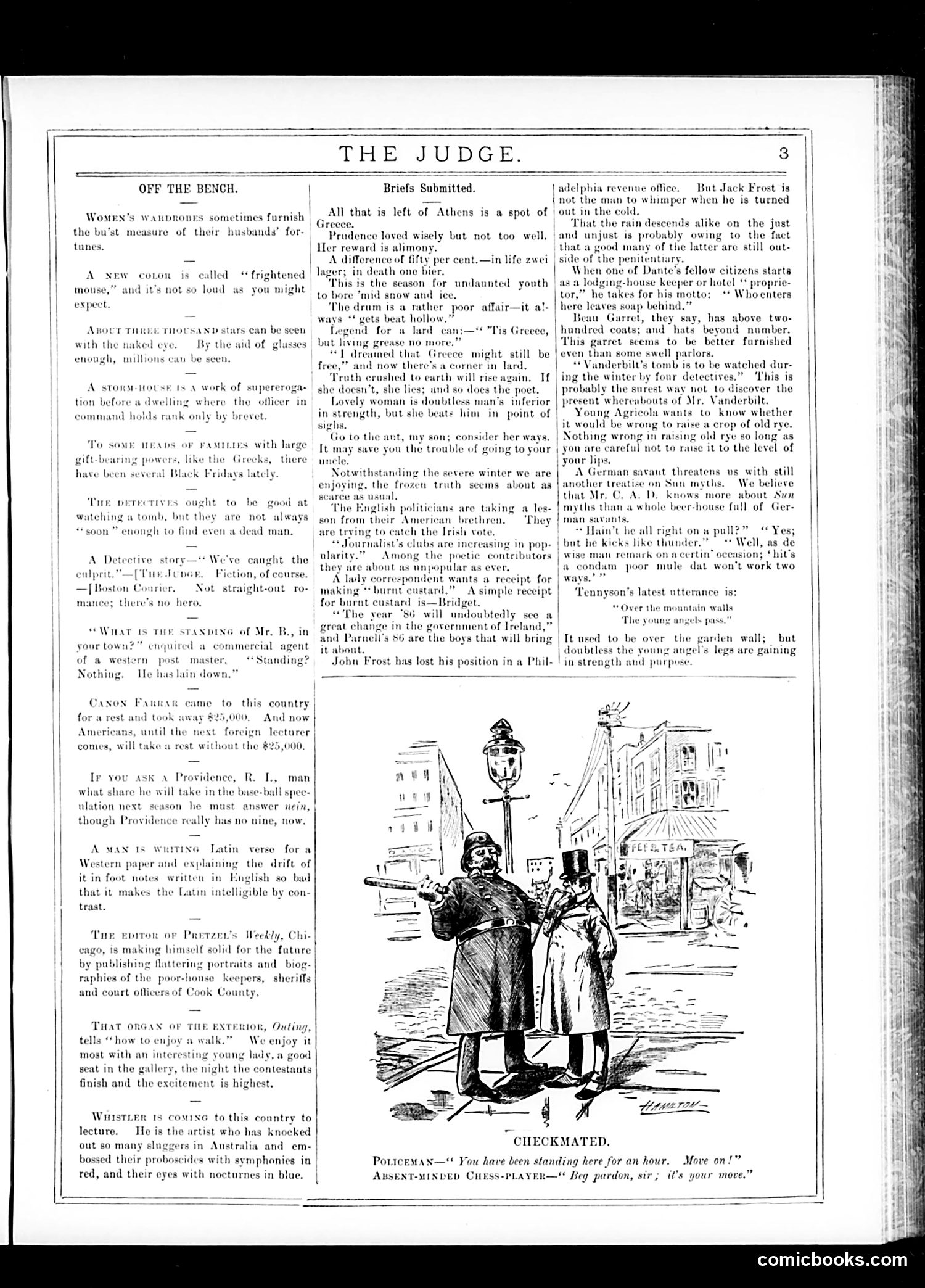
This page from *Judge* magazine contains a single cartoon titled "Checkmate" depicting a police officer and an absent-minded chess player on a city street. The officer says, "You have been standing here for an hour. Move on!" The chess player responds, "Beg pardon, sir; it's your move." **The Joke:** The satire plays on the chess player's absent-mindedness—he's so absorbed in his mental game that he's oblivious to the real world around him, including a police officer's direct order. He treats the officer's command as merely the next move in his chess match, remaining literally immobile despite being told to move along. **Social Commentary:** This mocks a common urban type of the era—the impractical intellectual so lost in abstract thought that he ignores practical reality and authority. The cartoon gently satirizes disconnection from everyday life, suggesting that excessive intellectualism can render one oblivious to social rules and civil obligations.
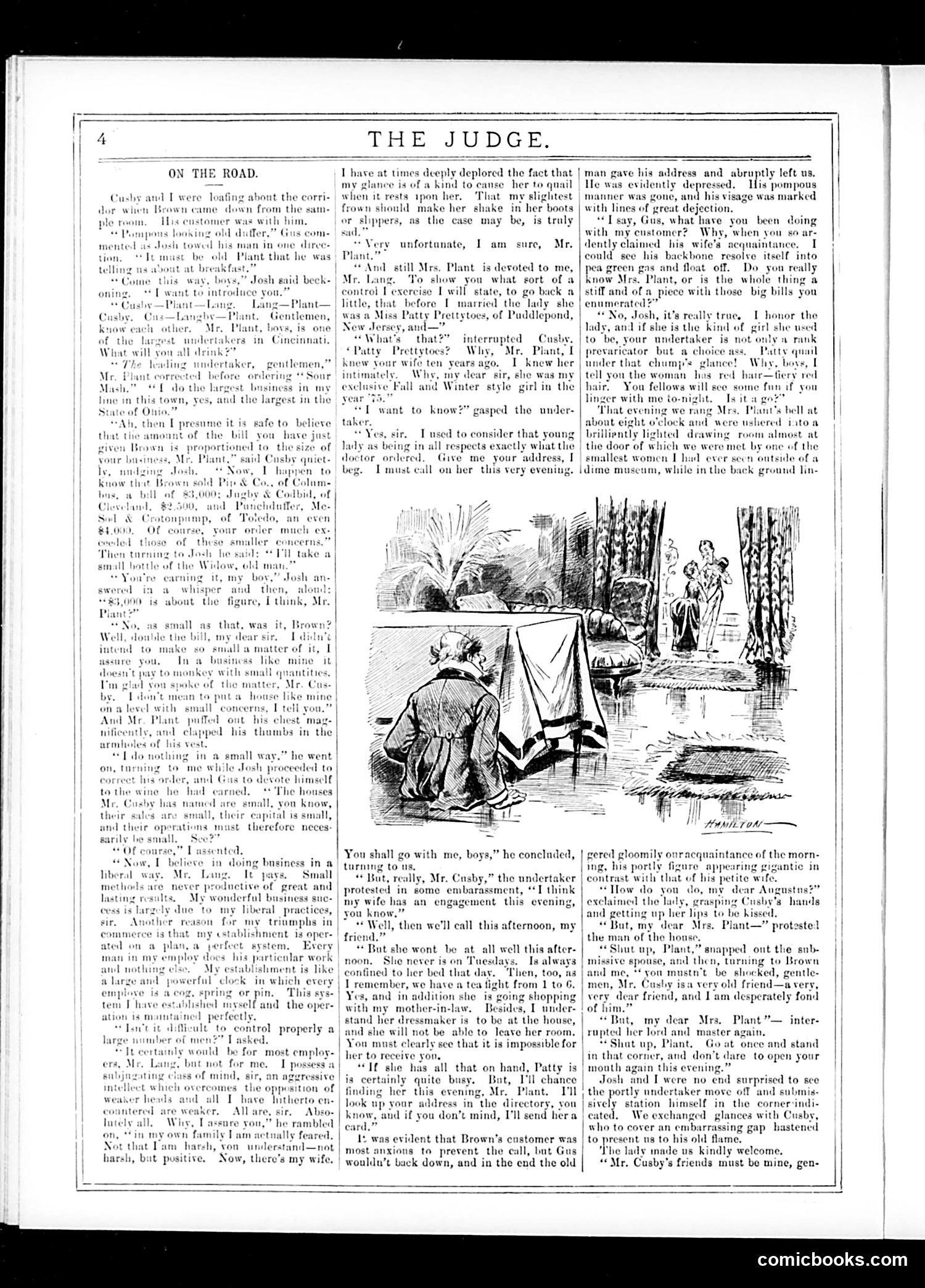
This page presents a satirical dialogue between a pompous undertaker named Mr. Cusby and a traveling salesman named Plant, along with observers named Cosby and Josh. **The Satire:** Cusby exemplifies the bloviating businessman—boasting about his undertaking monopoly in Ohio while obsessively detailing his "perfect system" and organizational methods. His verbosity masks opportunism: he pressures Plant into a social engagement by claiming intimate knowledge of Plant's wife (whom he doesn't actually know), then becomes visibly deflated when rebuffed. **The Joke:** The satire targets self-important small-town businessmen who conflate petty local success with genuine accomplishment, and who use false familiarity as a sales tactic. Cusby's elaborate justifications for his business dominance—his "system," his capital, his methods—ring hollow against his transparent social manipulation. The accompanying illustration shows the men in conversation beside a waterway, reinforcing the "traveling salesman" setting where such encounters and tall tales occur.
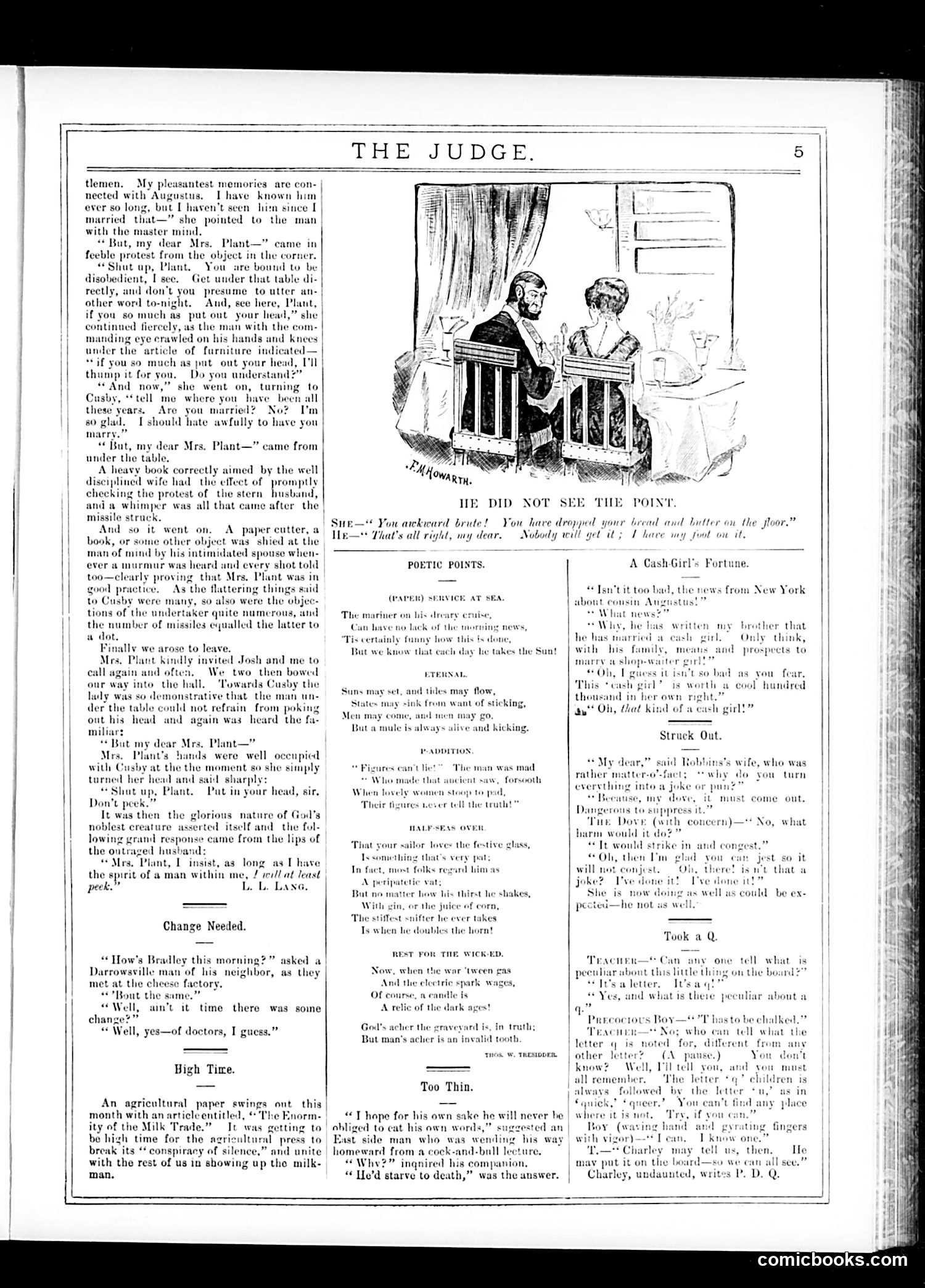
This page contains domestic satire centered on the cartoon "He Did Not See the Point." The humor depicts a henpecked husband named Plant being literally beaten into submission by his domineering wife during a social visit from an old friend, Cusby. **The Satire:** The wife's physical abuse of her cowering husband—hitting him with books, paper cutters, and other objects whenever he attempts to speak—satirizes the Victorian ideal of the "master mind" husband. The joke inverts gender power dynamics: despite pretensions to authority, Plant is completely subordinate and fearful. His repeated protests ("But, my dear Mrs. Plant") are met with violence, making their marriage a comic inversion of expected male dominance. **The Point:** When Plant accidentally drops butter on the floor and the wife steps on it, her response—"Nobody will get it"—misses his actual concern (waste), highlighting her obliviousness despite her control. The satire mocks both domineering spouses and the false authority of henpecked husbands. The surrounding text contains unrelated humorous verse and anecdotes typical of *Judge*'s miscellaneous content.
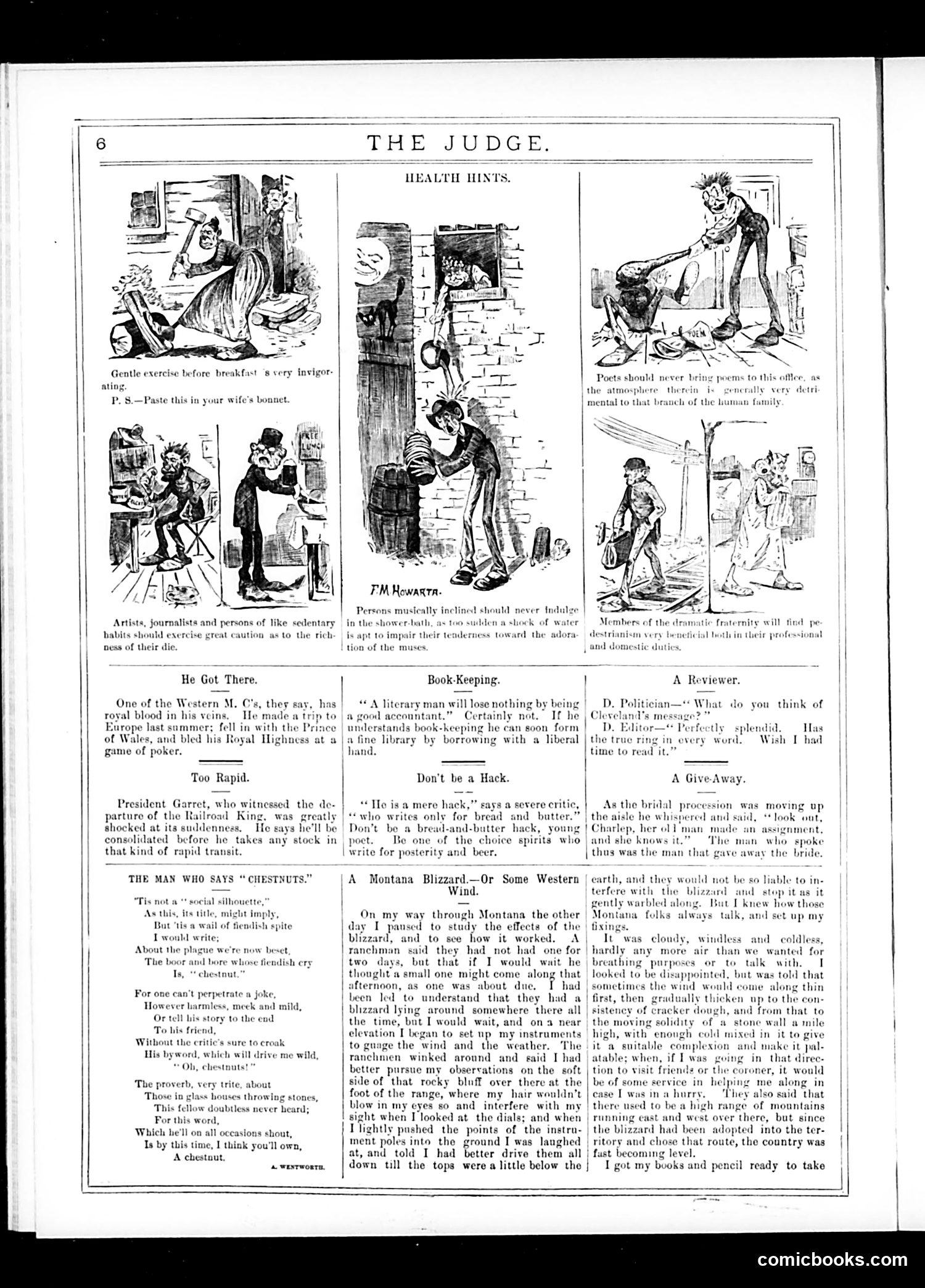
This page from Judge magazine contains several satirical pieces mocking contemporary social types and behaviors: **"He Got There"** ridicules a Western politician who claims royal ancestry after allegedly winning money from the Prince of Wales at poker—satirizing social climbers and their dubious tales. **"Too Rapid"** appears to joke about President Garfield's assassination (1881), using "rapid transit" as dark wordplay about his sudden death. **"The Man Who Says 'Chestnuts'"** mocks a pedantic critic who reflexively calls every joke a tired "chestnut," making himself insufferable. **"Health Hints"** section offers comic advice: poets shouldn't visit offices (bad atmosphere), musicians shouldn't shower (damages their "vibrations"), and dramatic actors need domestic duties. **"Montana Blizzard"** recounts a humorous anecdote about a visitor's failed attempt to scientifically measure Montana's famous blizzards, while locals provide exaggerated descriptions—poking fun at regional tall tales and outsider naivety. The cartoons throughout illustrate these satirical scenarios with period engravings depicting Victorian-era characters in absurd situations.
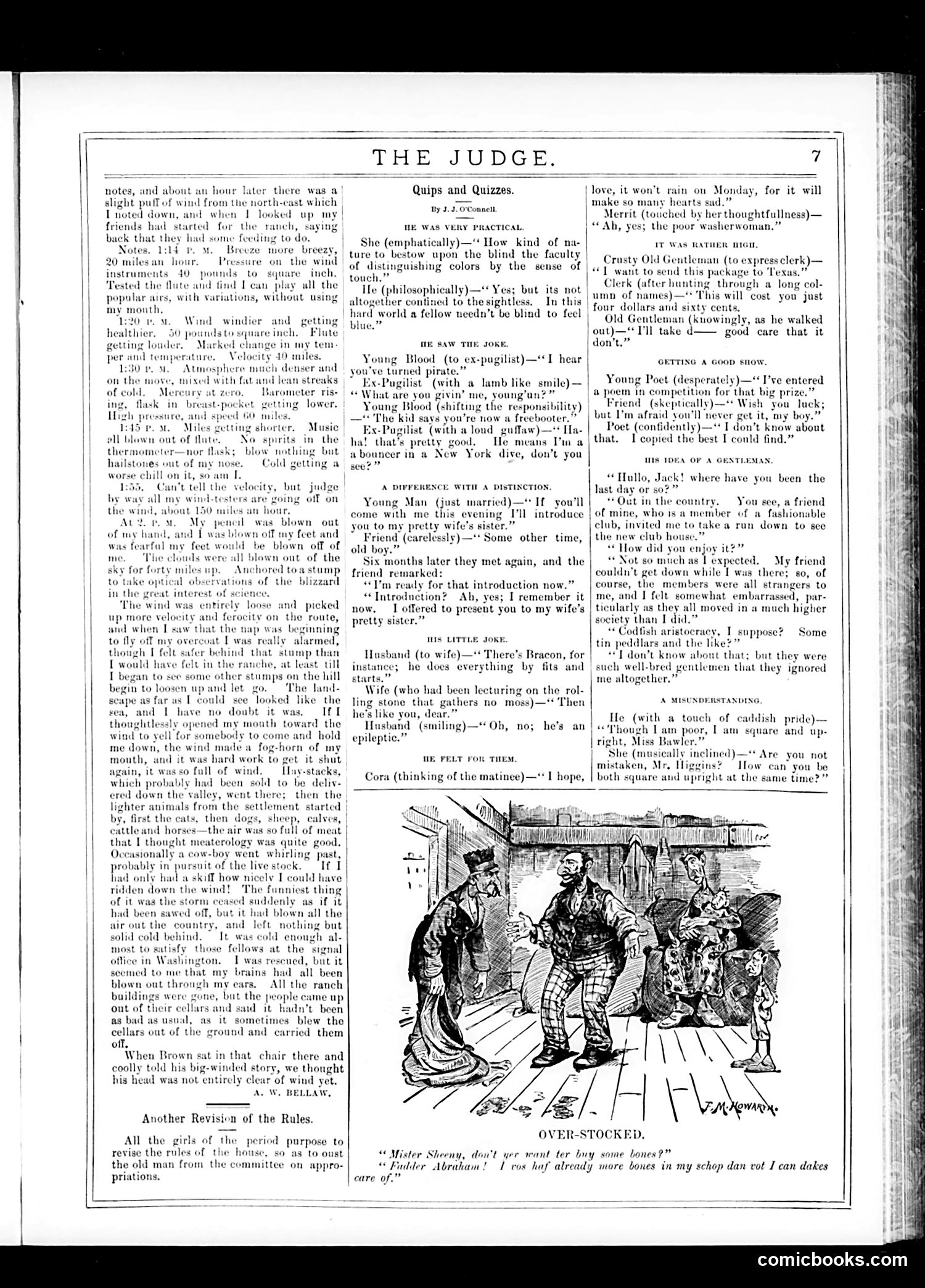
This page from *Judge* magazine contains several short humorous dialogues ("Quips and Quizzes") rather than a single political cartoon. The main cartoon shows a domestic scene labeled "OVER-STOCKED" where a man and woman discuss livestock management—likely satirizing household management or marital dynamics. The text pieces are genteel Victorian-era social humor: a woman's kind thought about rain affecting a washerwoman, a blind man who doesn't need eyesight to feel hardship, an ex-boxer turned pirate, a young poet copying his work, and various observations about social climbing and etiquette. The satire targets pretension and social awkwardness among the middle and upper classes—people struggling with status, propriety, and self-presentation. There are no clear references to specific political figures or events. This represents typical *Judge* content: gentle mockery of American manners and social conventions rather than hard-hitting political commentary.
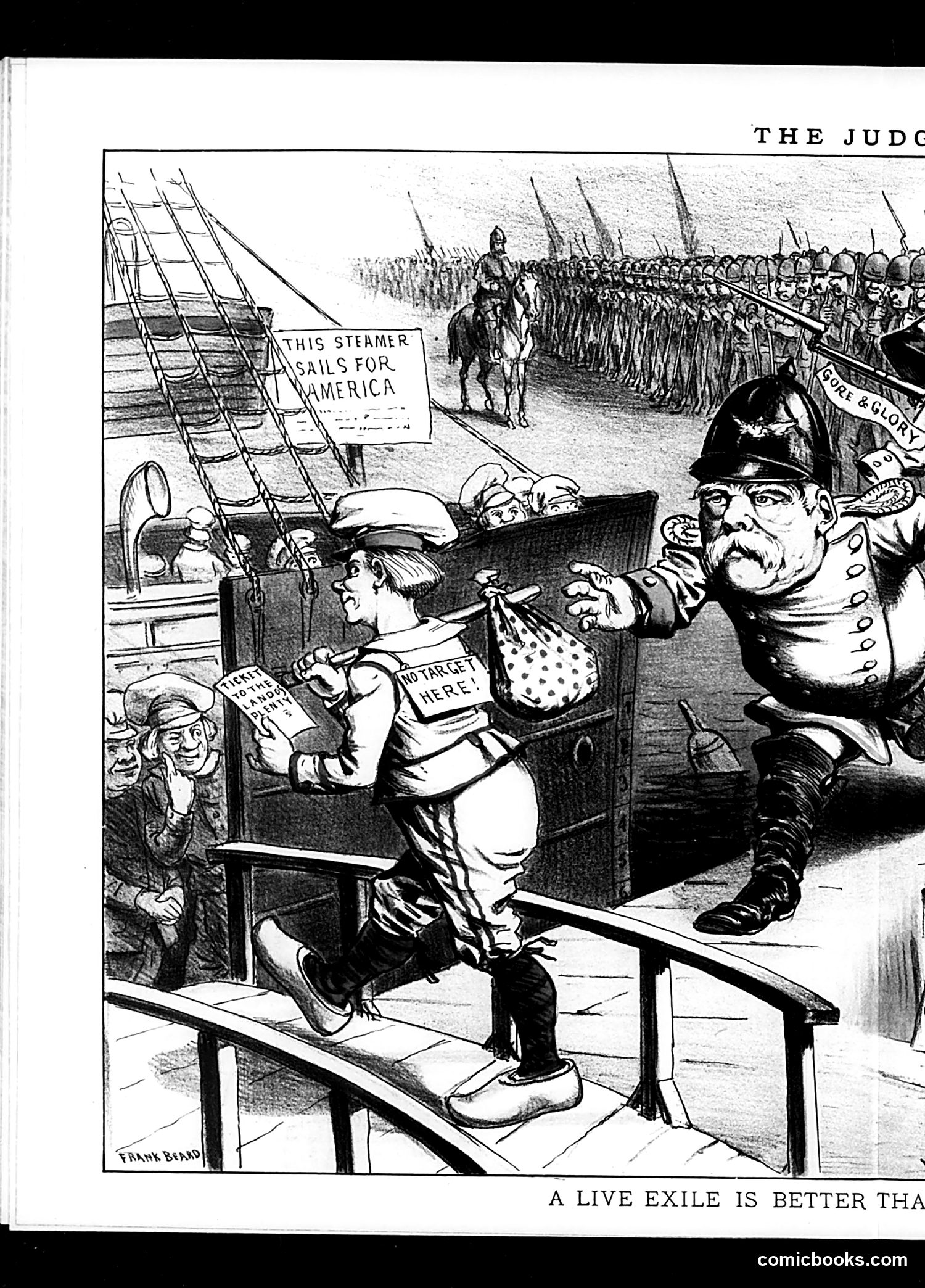
This Judge magazine cartoon satirizes a military or political figure (the large man in spiked Prussian helmet on the right) being escorted away by guards. The caption "This Steamer Sails for America" and the bottom text "A Live Exile Is Better Than" suggest the cartoon depicts someone being forced into exile or deportation, likely a German military official or leader during a period of international tension. The crowded soldiers with raised weapons in the background, combined with the Prussian military regalia, indicates this references Germanic militarism. The figure appears to be a caricature of German leadership being removed from power. The comic portrays this forced departure satirically, presenting exile as preferable to remaining in power—possibly mocking the figure's fate or the political situation of the era.
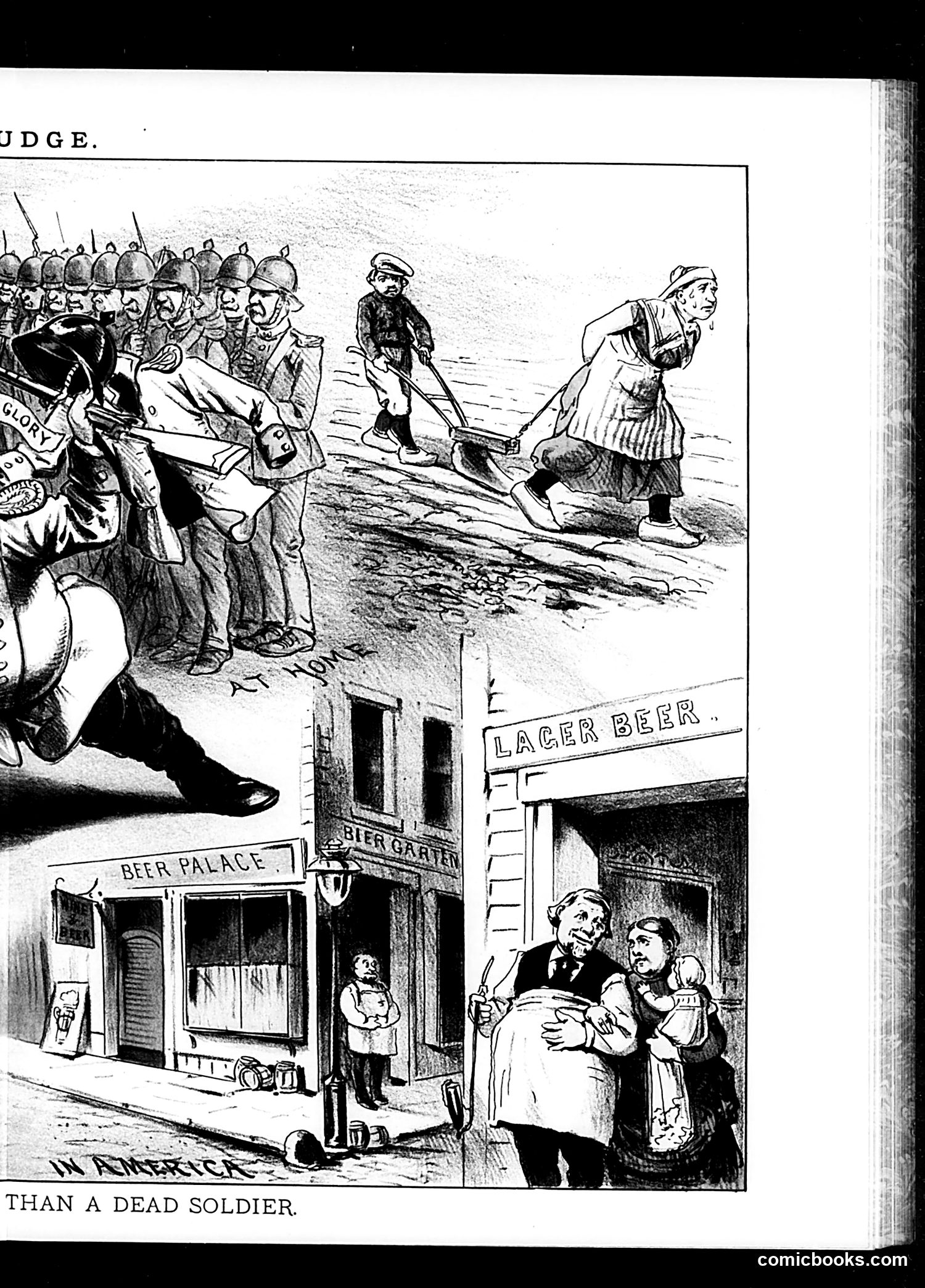
This appears to be a Judge magazine satirical cartoon comparing German militarism to beer culture. The upper panel shows German soldiers with spiked helmets (Pickelhaube) engaged in street violence or enforcement, while the lower panels depict German beer establishments ("Beer Palace," "Biergarten," "Lager Beer"). The cartoon's title—"Than a Dead Soldier"—suggests a dark commentary, likely criticizing German military aggression and its cultural glorification. The juxtaposition implies that German society prioritizes military conquest and violence over civilian welfare. The exaggerated beer-hall scenes may mock German stereotypes while making a pointed critique about militarism superseding ordinary civilian life. The specific historical period is unclear without a date, but the German military uniforms suggest pre-WWI or WWI-era commentary.
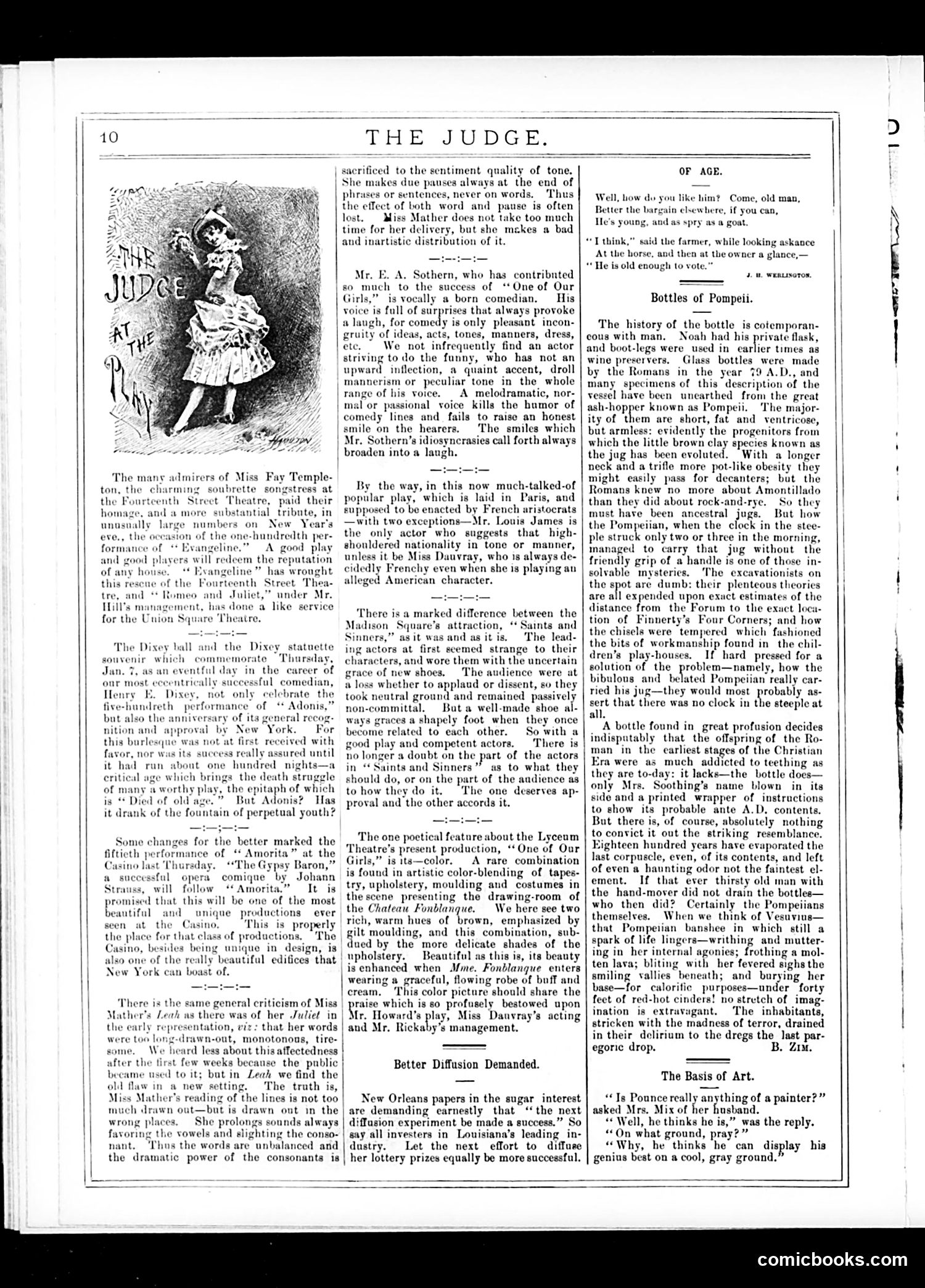
This page from *Judge* magazine contains theatrical reviews rather than political cartoons. The main illustration shows a female performer in period costume, likely representing one of the actresses discussed. The text reviews several Broadway productions: Miss Fay Templeton's "Evangeline" at the Fourteenth Street Theatre (celebrating its hundredth performance on New Year's Eve), Henry Dixey's "Adonis" (marking both its hundredth performance and the play's anniversary of critical success), and various other productions. The reviews critique performers' techniques—notably actress Miss Mather, whose vocal delivery is faulted for prolonging vowels while slighting consonants, thus undermining dramatic power. The critics praise comedians like Mr. Sothern for vocal quirks that enhance humor, and note casting choices in French-set plays. This represents *Judge's* coverage of popular entertainment and theatrical culture rather than political satire.
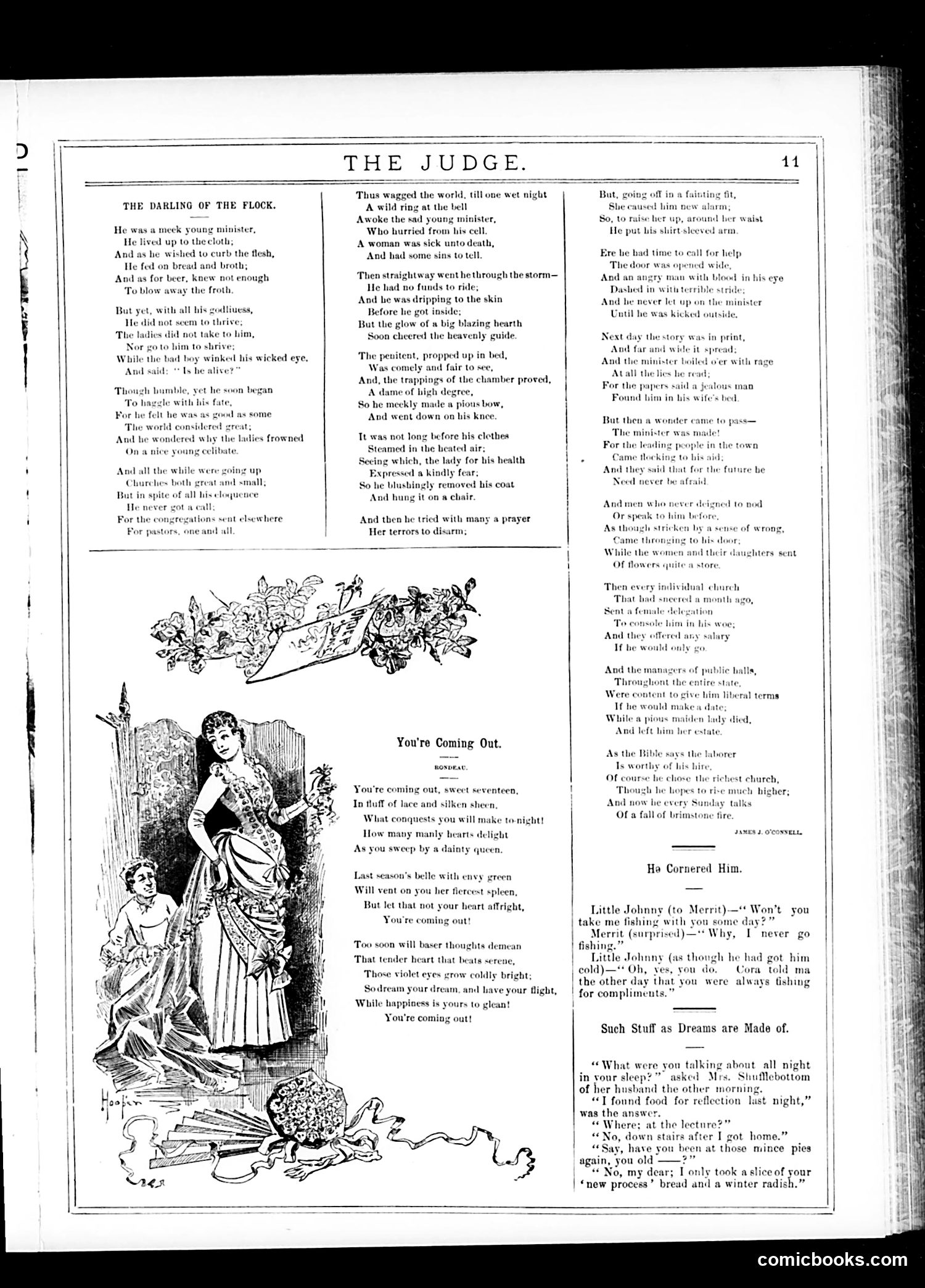
This poem satirizes clerical pretense and opportunism. A humble, pious minister—living ascetically on bread and broth—struggles to attract a congregation. But when scandal strikes (he's found in a parishioner's bed after innocently comforting a dying woman), public sympathy transforms him into a sought-after figure. Suddenly, churches compete for his services, wealthy widows pursue him, and he grows wealthy and prominent. The satire's point: the public values scandal and controversy over genuine virtue. The minister succeeds not through actual piety but through notoriety. By story's end, he's a prosperous hypocrite "talking of a fall of brimstone fire"—preaching hellfire while having profited from scandal. The poem mocks both corrupt clergy and the gullible public that elevates them.
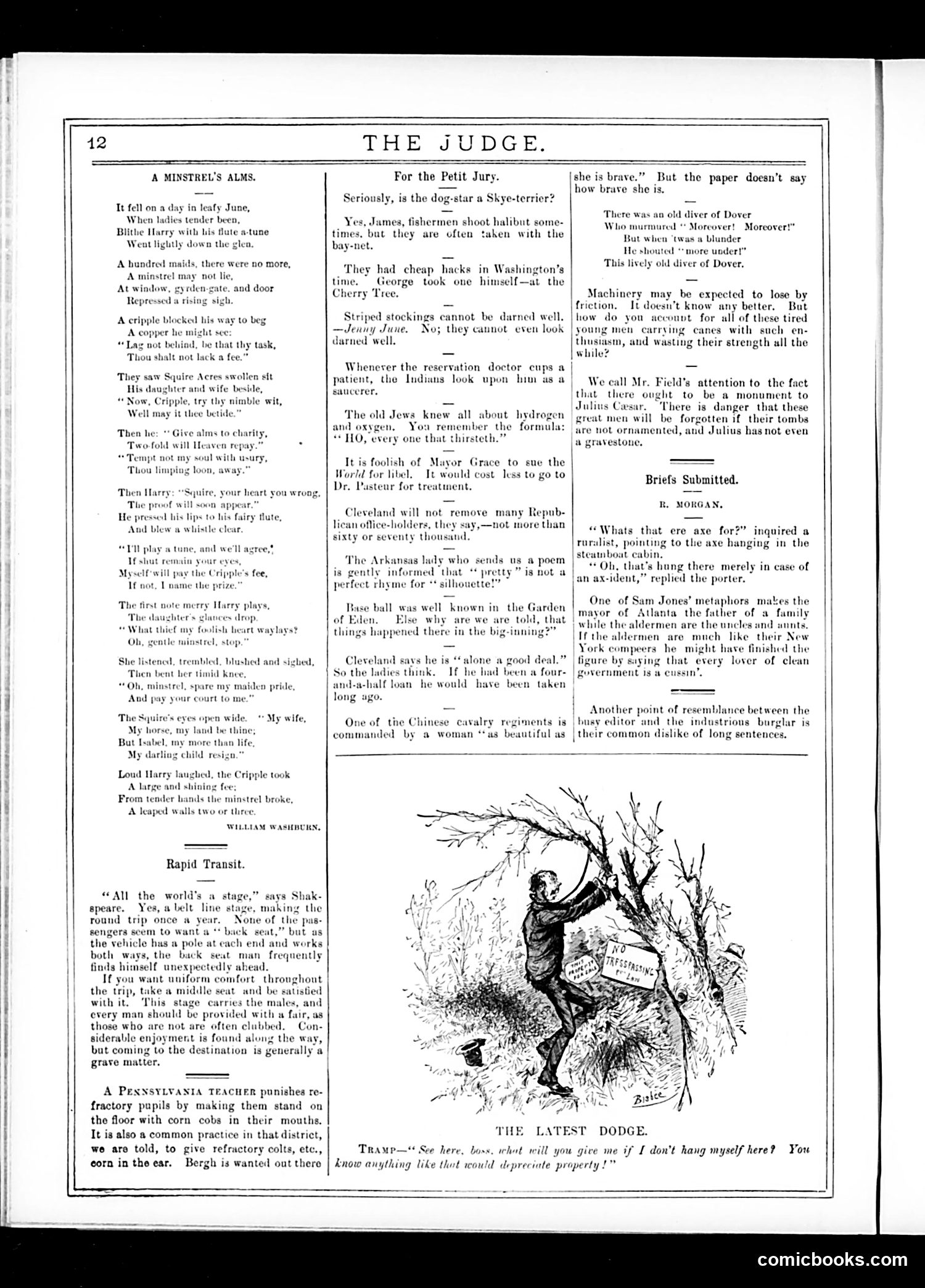
This page from *Judge* contains several satirical pieces typical of 19th-century American humor: **Main Cartoon ("The Latest Dodge"):** Shows a tramp threatening a homeowner, demanding money or he'll "hang myself here." The satire mocks the era's vagrants who used self-harm threats as extortion tactics against property owners. **"A Minstrel's Alms":** A narrative poem by William Washburn satirizing sentimentality in popular literature—a minstrel's music seduces a squire's daughter, and a beggar profits from the chaos. **"For the Petit Jury":** Brief satirical quips on contemporary topics: Cleveland's removal of Republican office-holders, the dog-star (Sirius), cheap Washington hacks, and wordplay on poetry. **"Rapid Transit":** Mocks the discomfort and chaos of urban streetcar travel, where passengers compete for seats and violence ("clubbed") is commonplace. **Final note:** A Pennsylvania teacher's cruel punishment of students using corn cobs—compared unfavorably to animal treatment, invoking Henry Bergh (animal welfare advocate).
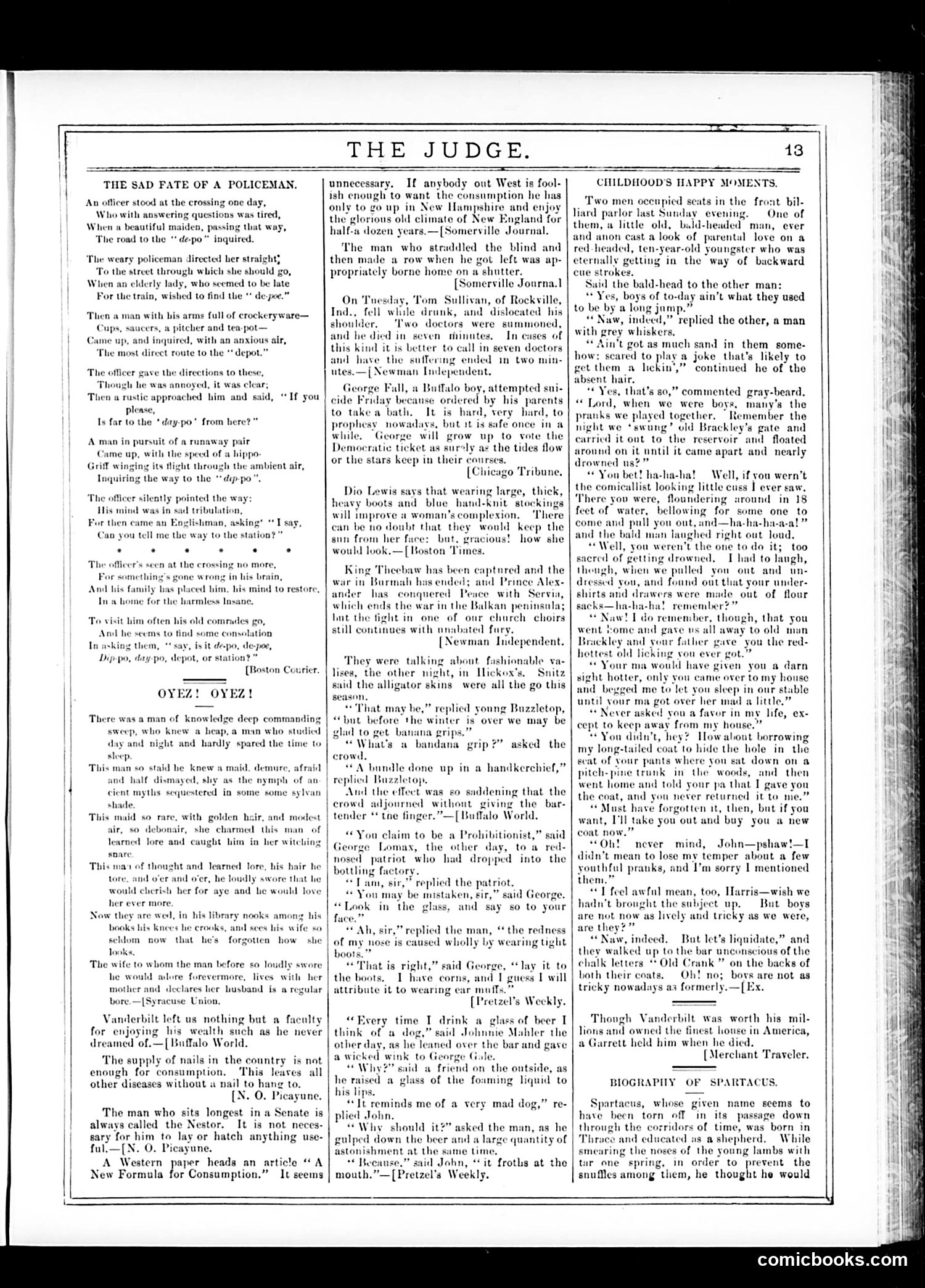
This page from Judge magazine contains several humorous anecdotes and satirical pieces typical of 19th-century American wit: **"The Sad Fate of a Policeman"** mocks a policeman's mental breakdown from repeatedly being asked directions to the "depot" by various people mispronouncing it as "day-po," "de-poe," and "station." The joke hinges on the absurdity of accumulated minor frustrations driving someone to insanity—a commentary on urban life's trivial annoyances. **"Oyez! Oyez!"** tells a cautionary tale in doggerel verse about a scholarly man who falls for a beautiful woman, marries her, then ignores her while absorbed in his library books. The wife eventually leaves him, declaring him insane. It satirizes absent-minded intellectuals and neglectful husbands. **Miscellaneous quips** attack various targets: Vanderbilt's inherited wealth, medical consumption treatments, Senate longevity, and women's fashion (heavy boots supposedly improving complexion). The overall tone is lighthearted social commentary on contemporary domestic life, gender relations, and urban absurdities—typical of Judge's satirical mission.
This page is primarily **advertising**, not a satirical cartoon. However, it includes a serialized story about **Spartacus**, the famous Roman gladiator who led a slave revolt around 73 BCE. The narrative humorously recounts Spartacus's life: a desperate young man forced into gladiatorial slavery, he organizes a rebellion and establishes a hideout in Mount Vesuvius's crater. The tone is comedic and irreverent—describing his rebellion as a "hold up" industry, joking about "Roman spring chicken," and mockingly noting he consulted the "Fifth Reader" as a historical source. The story appears designed as light entertainment for Judge's readers, mixing classical history with colloquial American humor. The point seems satirical commentary on authority and freedom rather than serious historical instruction. The remainder of the page consists of period advertisements for perfumes, safes, jewelry, and furniture—typical late 19th-century commercial notices with no apparent satirical content.
This page is primarily **advertisements and filler content** rather than political satire. The main editorial text discusses **gladiatorial combat and Spartacus**, appearing to critique American fascination with violent spectacle. The author (likely Bill Nye, based on signature) argues that Americans who pay money to watch brutal entertainments (referencing boxer John L. Sullivan) and attend funerals should not "puff up with false pride" about civilization. The page includes a domestic humor sketch ("That's All") mocking corset-wearing and marital disagreements—typical period comedy. The bulk consists of **product advertisements**: printing inks, lithography services, book binding, honey tonics, candy, and medical remedies. This reflects Judge's business model of selling advertising space to support publication. **No specific political figures or dated events are clearly identifiable** on this page. The content reflects general Gilded Age concerns about taste, consumption, and morality rather than contemporary political satire.
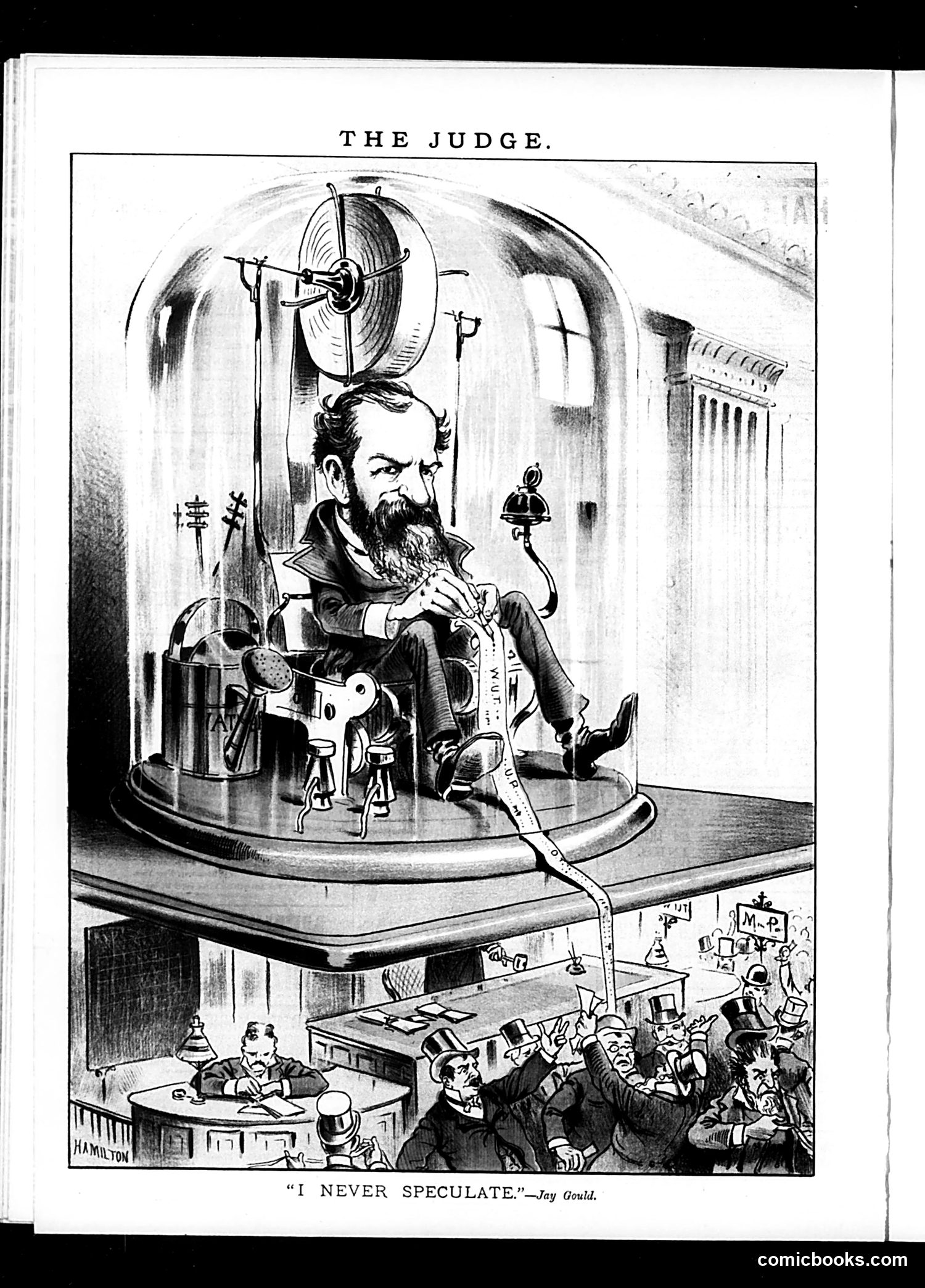
This satirical cartoon mocks **Jay Gould**, a famous Gilded Age railroad magnate and financier, through his famous quote "I never speculate." The image depicts Gould as a bearded man trapped in a glass dome/laboratory apparatus, surrounded by mechanical and scientific equipment above him. Below, a crowd of well-dressed men (likely investors, politicians, or business associates) gestures upward, seemingly following his direction or trapped within his schemes. The satire suggests that despite Gould's public claim of avoiding speculation, his actual business practices involved elaborate financial manipulation and scheming that affected numerous people. The glass dome isolates him while keeping others below, implying his detachment from consequences while controlling others' fates through speculative ventures. The cartoon critiques the hypocrisy of wealthy industrialists who denied engaging in risky financial practices while their operations demonstrably harmed public interests.