
Judge, 1886-01-09 · page 10 of 16
Judge — January 9, 1886 — page 10: what you’re looking at
What you’re looking at
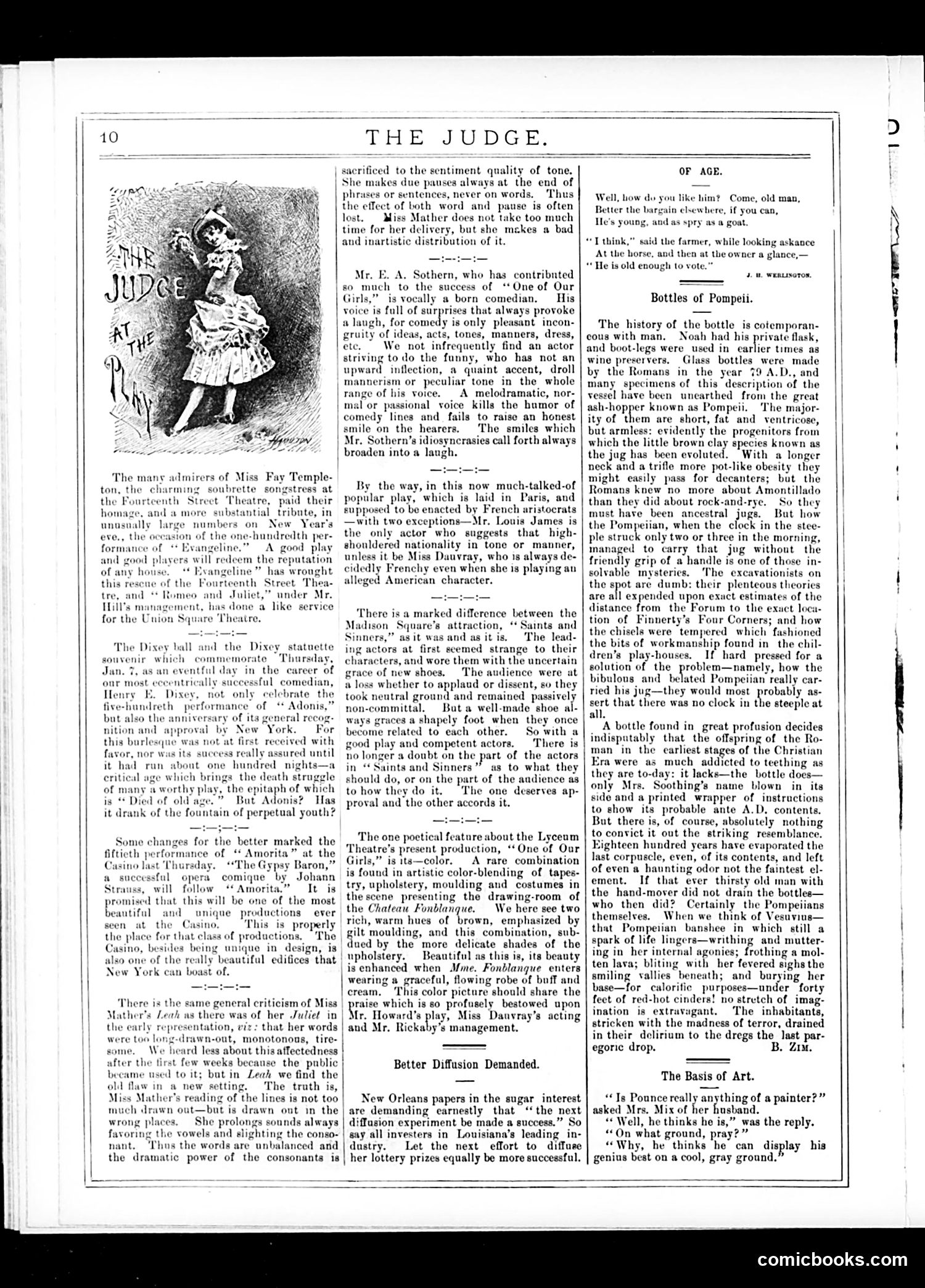
This page from *Judge* magazine contains theatrical reviews rather than political cartoons. The main illustration shows a female performer in period costume, likely representing one of the actresses discussed. The text reviews several Broadway productions: Miss Fay Templeton's "Evangeline" at the Fourteenth Street Theatre (celebrating its hundredth performance on New Year's Eve), Henry Dixey's "Adonis" (marking both its hundredth performance and the play's anniversary of critical success), and various other productions. The reviews critique performers' techniques—notably actress Miss Mather, whose vocal delivery is faulted for prolonging vowels while slighting consonants, thus undermining dramatic power. The critics praise comedians like Mr. Sothern for vocal quirks that enhance humor, and note casting choices in French-set plays. This represents *Judge's* coverage of popular entertainment and theatrical culture rather than political satire.
📄 Transcribed text from this page (OCR, searchable)
Machine-transcribed from the original scan — historical spelling and the odd misread are preserved.
The many admirers of Miss y Temple- ton, the charming soubrette songstress at the Fourteenth Strect Theatre, paid their ho and a more subst | tribute, in unusually large numbers on w Year's eve., the occasion of the one-hundredth per- formance of‘ Evangelin A good play and g players will redeem the reputation of any hou “Eva line ” has wrought this r {the Fourteenth Street The tre, and “* R o and Juliet,” under Mr. Hill's m: ment, h for the L tion Square The Dixey ball and the Dixey venir which commemorate "Thursday, as aneventful day in the eer of cceentrically successful com Dixey, not only ecelebri iundreth performance of‘ Adoni but also the anniversary of its general re nition and approval by New York. — For this burlesque was not at first received with favor, nor w success really assured until it had ran about hundred nights— critical age which brings the death struggle of many a worthy play, the epitaph of which is * Died of old age.” But Adoni Has it drank of the fountain of perpetual youth? me chan, ked the fiftieth performance of ‘* Amorita” at the Casino last Thursday. he Gypsy Baron,” a successful opera comique by Johann Strauss, will follow rita, It is promised that this will be one of the most utiful and unique productions ever nut the Casino. This is properly wce for that class of productions, ‘The les being unique in design, is f the really beautiful edifices that ork can boast of. New Y There is the same general criticism of Miss Mather’s Leah as there was of her Juliet in the early representation, viz: that her words were too lor We heard less about this affectedne: rst few weeks because the public d to it; but in Leah we find the a new setting. The truth is, Miss Mather’s reading of the lines is not too much drawn out—but is drawn out in the wrong places. She prolongs sounds always vowels and slighting the conso- nant. ‘Thos the words are unbalanced and the dramatic power of the consonants is some after the became uw old flaw in lrawn-out, monotonons, tire- | THE JUDGE. | sacrificed to the sentiment quality of tone. | She makes due pauses always at the end of | phrases or sentences, never on words. ‘Thus the effect of both word and pause is often lost. Miss Mather does not take too much time for her delivery, but she makes a bad and inartistic distribution of it. ‘othern, who has contributed to the success of ‘One of Our Girls,” is vocally a born comedian, His voice is full of surprises that always provoke a laugh, for comedy is only pleasant incon- gruity of ideas, acts, tones, manners, dress, etc, We not infrequently find an actor striving todo the funny, who has not an upward inflection, a quaint accent, droll mannerism or peculiar tone in the whole range of his voic A melodramatic, nor- | mal or passional voice kills the humor of comedy lines and fails to raise an honest smile on the hearers. The smiles which Mr, Sothern’s idiosyncrasies call forth always broaden into a laugh. | Mr, | so. much By the way, in this now much-talked-of popilar play, which is laid in Paris, and supposed to be enacted by French aristocrats vith two exceptions—Mr. Louis James is the only actor who suggests that high- shouldered nationality in tone or manner, unless it be Miss I who 1s always de- cidedly Frenchy even when she is playing au American character. ‘There is a marked difference between the Madison Square's attraction, ** Saints and 8 it was and as it i The lead- , and wore them with the uncertain e of new shoes, The audience were a s whether to applaud or dissent, so they took neutral ground and remained passively non-committal. But a well-made shoe al- w ces a shapely foot when they once become related to each other. So with a good play and competent actors. There is no longer a doubt on the part of the actors in ‘Saints and Sinners” as to what they should do, or on the part of the andience as to how they do it. The one deserves ap- proval and the other accords it. The one poetical feature about the Lycenm Theatre's present production, ‘One of Our Girls,” is its—color. A rare combination is found in artistic color-blending of tapes- try, upholstery, moulding and costumes in the scene presenting the drawing-room of the Chateau Fonblanque. We here see two rich, warm hues of brown, emphasized by gilt moulding, and this combination, sub- dued by the more delicate shades of the upholstery. Beautiful as this is, its beauty is enhanced when Mme. Fonblangue enters wearing a graceful, flowing robe of buff and cream. This color picture should share the praise which is 80 profusely bestowed upon Mr. Howard's play, Miss Dauvray’s acting | and Mr. Rickaby's management. Better Diffusion Demanded. New Orleans papers in the sugar interest are demanding earnestly that ‘‘ the next | diffusion experiment be imade a success.” So | say all investers in Louisiana’s leading in- [dustry. Let the next effort to diffure | her lottery prizes equally be more successful. im? Come, old man, » elsewhere, if you can, He's young, and as spry as a goat. “think,” said the farmer, while looking askance At the horse, and then at the owner a glance,— “ He is old enough to vot 4. M. WERLINOTON, Bottles of Pompeii. The history of the bottle is cotemporan- cous with man. Noah had his private flask, and boot-legs were used in earlier times as wine preservers. Glass bottles were made by the Romans in the year 79 A.D., and many specimens of this description of the vessel have been unearthed from the great ash-hopper known as Pompeii. ‘The major- ity of them are short, fat and ventricose, but armless: evidently the progenitors from which the little brown clay species known as the jug has been evoluted. With a longer neck and a trifle more pot-like obesity they might easily pass for decanters; but the Romans knew no more about Amontillado than they did about rock-and-rye. So they must have been ancestral jugs. But how the Pompeiian, when the clock in the stee- ple struck only two or three in the morning, managed to carry that jug without the friendly grip of a handle is one of those in- solvable mysteries. The excavationists on the spot are dumb: their plenteous theories are all expended upon exact estimates of the distance from the Forum to the ct le tion of Finnerty’s Four Corners; and how the chisels were tempered which fashioned the bits of workmanship found in the chil- dren’s play-houses. If hard pressed for a solution of the problem—n y, how the bibulous and belated Pompeiian really car- ried his jug—they would most probably as- sert that there was no clock in the steeple at all. A bottle found in great profusion decides indisputably that the offspring of the Ro- man in the carliest stages of the Christian Era were as much addicted to teething as they are to-day: it lacks—the bottle does— only Mrs. Soothing’s name blown in its side and a printed wrapper of instructions to show its probable ante A.D. contents. But there is, of course, absolutely nothing to convict it out the striking resemblance. Eighteen hundred years have evaporated the last corpuscle, even, of its contents, and left of even a haunting odor not the faintest el- ement. If that ever thirsty old man with the hand-mover did not drain the bottles— who then did? Certainly the Pompeiians themselves. When we think of Vesuvius— that Pompeiian banshee in which still a spark of life lingers—writhing and mutter- ing in her internal agonies; frothing a mol- ten lava; bliting with her fevered sighs the smiling vallies beneath; and burying her base—for calorific purposes—under forty feet of red-hot cinders! no stretch of imag- ination is extravagant. The inhabitants, stricken with the madness of terror, drained in their delirium to the dregs the last par- egoric drop. B. Zim. The Basis of Art. “<Ts Pounce really anything of a painter?” asked Mrs. Mix of her husband. “* Well, he thinks he is,” was the reply. “On what ground, pray?” “Why, he thinks he can display his genius best on a cool, gray ground.” comicbooks.com