
A complete issue · 16 pages · 1885
Judge — December 19, 1885
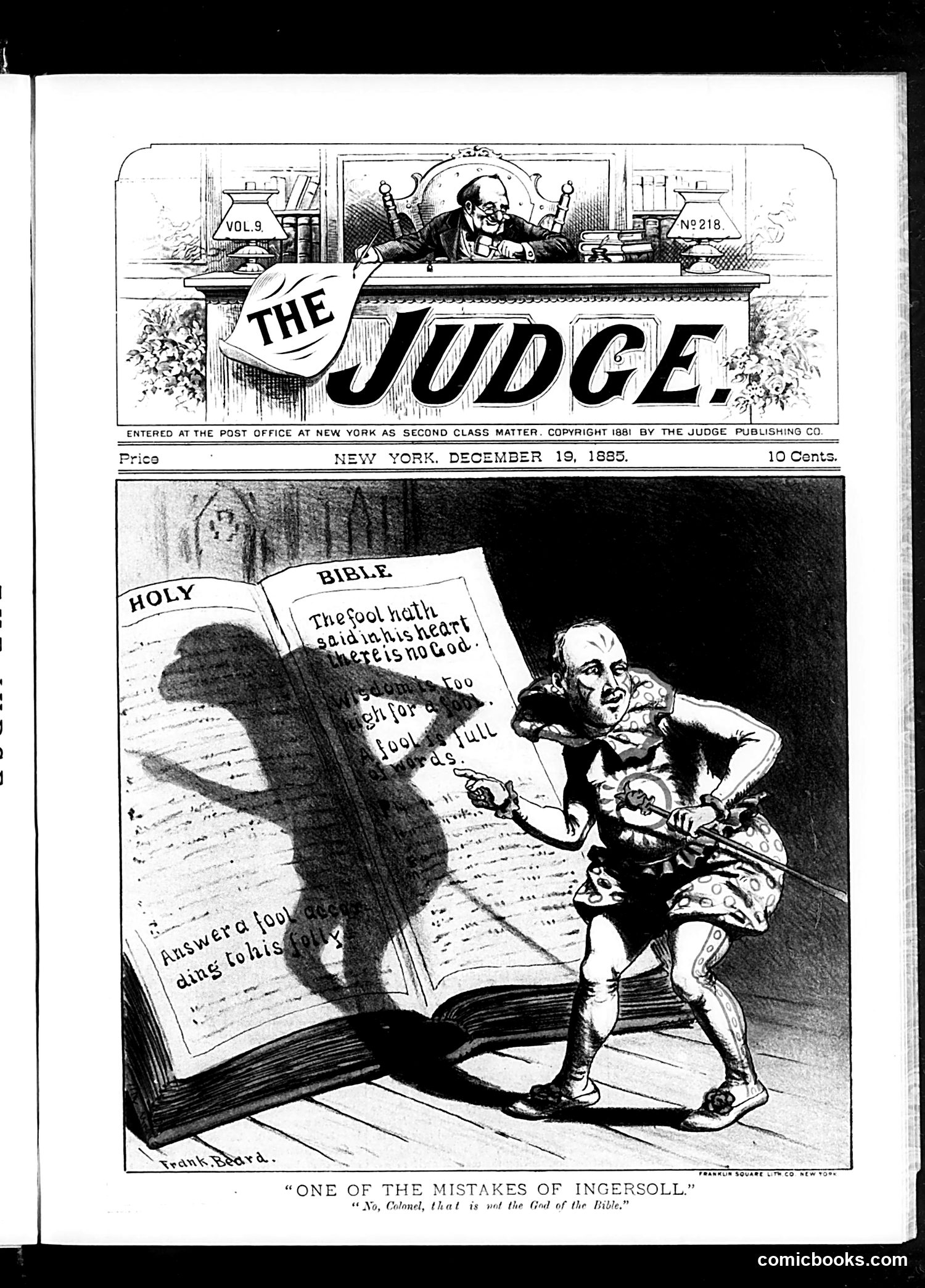
This cartoon satirizes **Robert G. Ingersoll**, a prominent 19th-century atheist lecturer and freethinker. The caption quotes his famous assertion: "No, Colonel, that is not the God of the Bible." The image depicts a small, armed man (Ingersoll) defending himself against a large, menacing shadow cast by an open Bible. The Bible's pages display passages affirming God's existence, mocking Ingersoll's attempt to argue the Biblical God is incompatible with reason or morality. The satire suggests Ingersoll's atheist arguments are absurdly inadequate against religious faith—he's a tiny, vulnerable figure battling something vastly more powerful. This reflects late-19th-century American anxiety about religious skepticism and the "New Atheism" movement that challenged traditional Christianity.
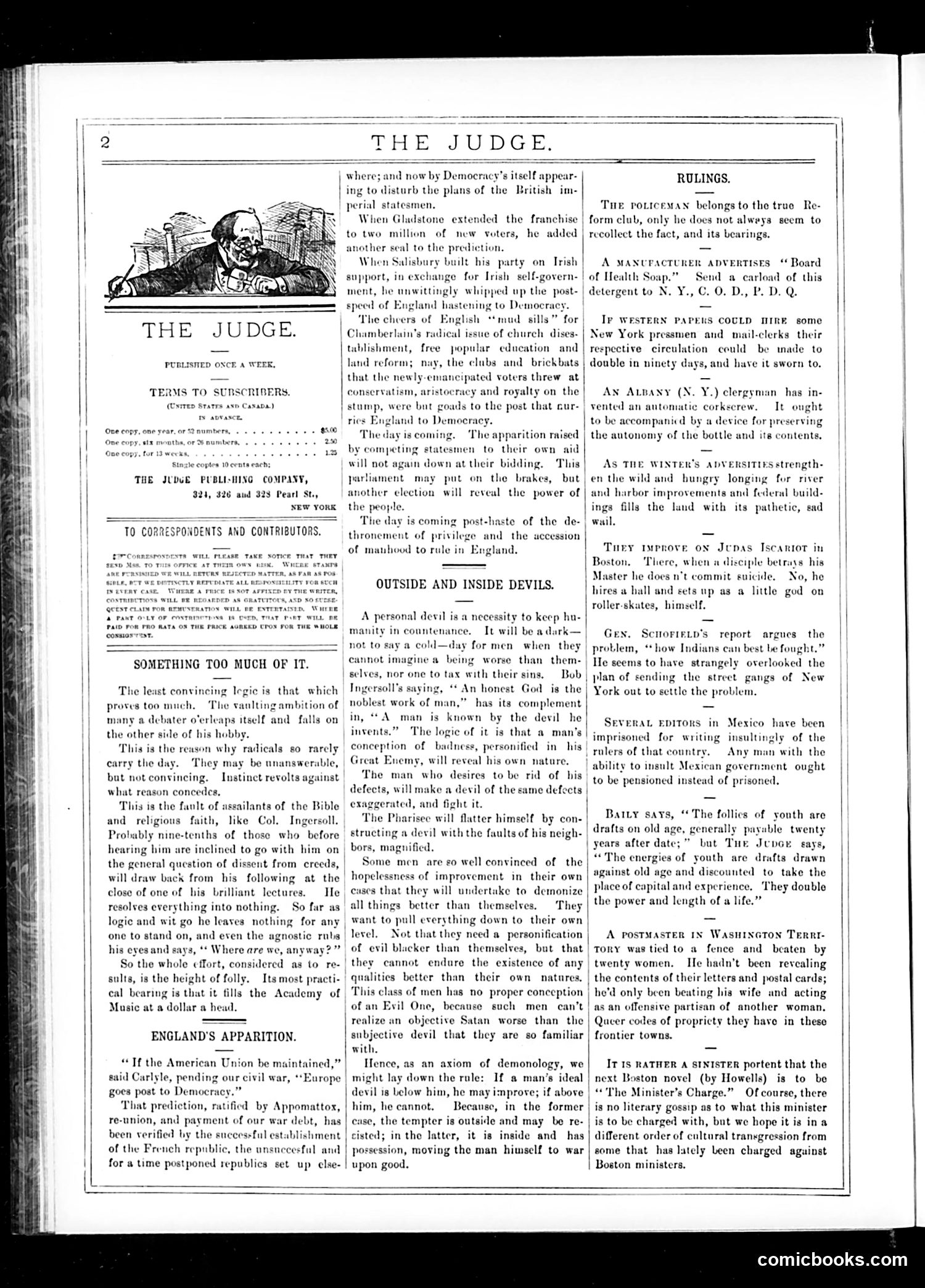
The page contains editorial commentary rather than political cartoons. The masthead illustration shows a disheveled man at a desk—likely representing the magazine's satirical voice or editor. The "RULINGS" section offers brief satirical jabs at contemporary issues: policemen, newspaper advertisers, western papers, Albany clergy, and writers seeking river/harbor improvements. These appear to be topical quips targeting recognizable public figures or institutions of the period. The main article "SOMETHING TOO MUCH OF IT" criticizes excessive logic and ambition in politics and religion, arguing these reveal hidden character flaws. "OUTSIDE AND INSIDE DEVILS" discusses hypocrisy—how outwardly moral people harbor inner corruption. The remaining pieces comment on American democracy, Indian policy, and Boston gossip. Without identifying specific dates or figures beyond these textual hints, the page reflects typical late-19th-century American satirical journalism.
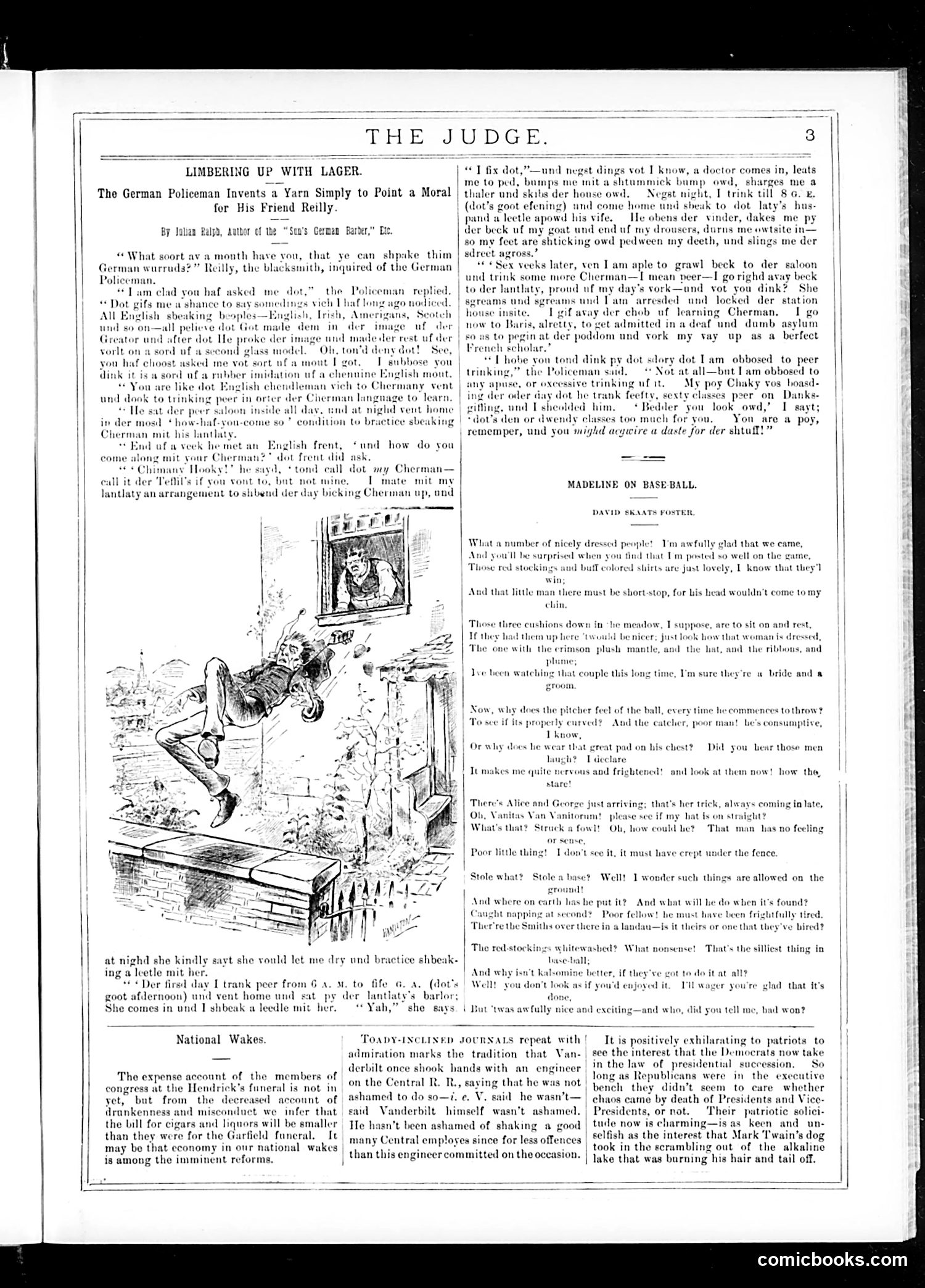
This satirical piece mocks German immigrants through an exaggerated dialect monologue. A German policeman tells his Irish friend Reilly an elaborate cautionary tale about a Englishman who learned German by drinking beer in saloons, ultimately becoming so intoxicated he lost his job and was arrested. The satire targets two immigrant groups: Germans (depicted as heavy drinkers and poor English speakers) and their stereotypical vices. The policeman's thick, phonetically-rendered accent ("vot," "dot," "peer" for "what," "that," "beer") is meant to be humorous but also reinforces xenophobic stereotypes about language barriers and cultural assimilation. The moral—that drinking leads to ruin—masks underlying prejudice against German-American communities, particularly their beer-drinking culture. This reflects late 19th-century American anxieties about immigration and ethnic difference.
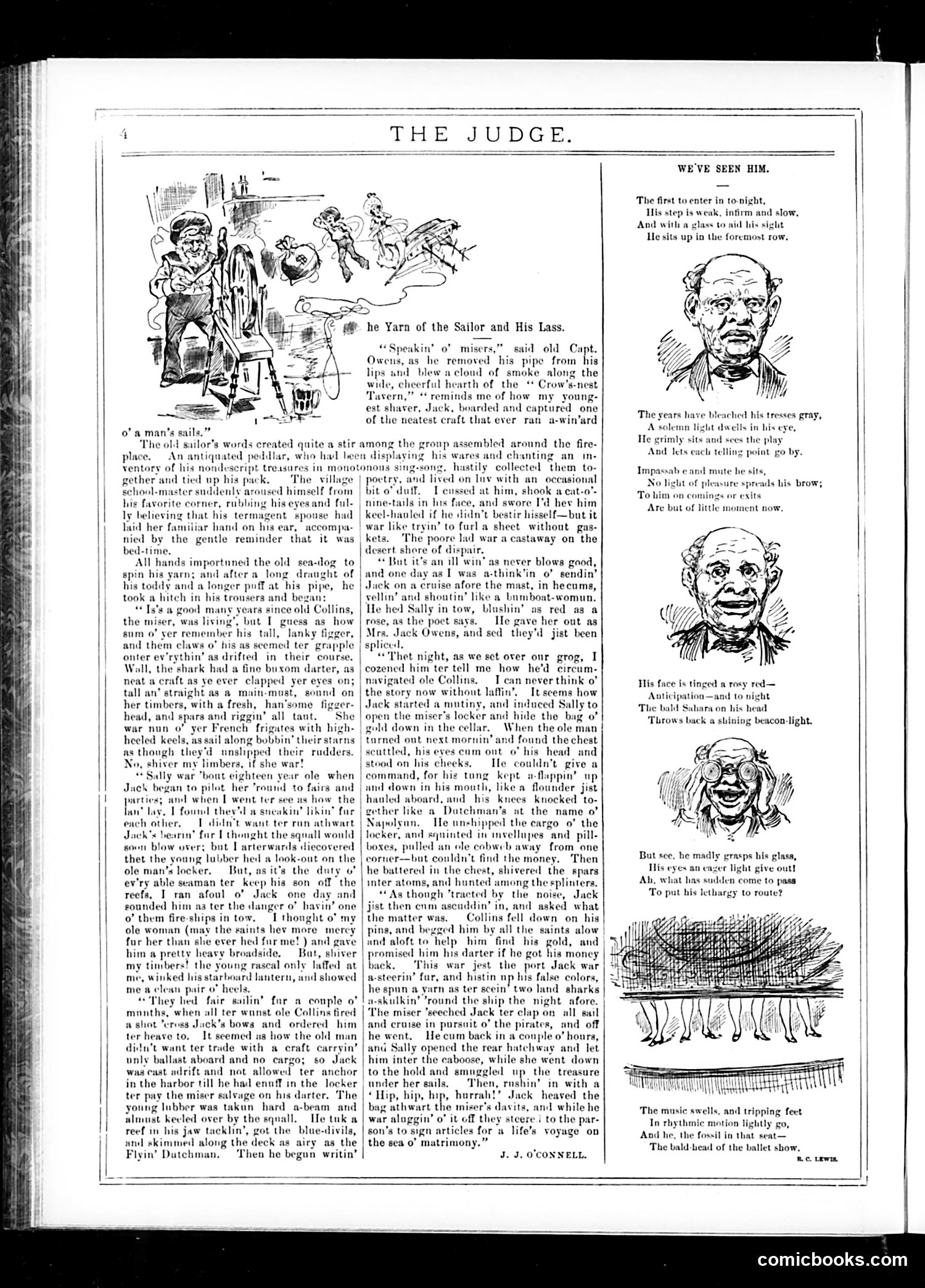
This page presents a sentimental short story rather than political satire. Written by J. J. O'Connell, it's a nautical tall tale told by an old sea captain at a tavern ("Crow's-nest Tavern"), recounting how a young sailor named Jack won the hand of Sally—the attractive daughter of a miserly man named Collins. The story uses maritime metaphors throughout: Sally is described as "a neat a craft," Jack must prove his worth before being allowed to "anchor" with her, and her father initially "cast[s] him adrift" when Jack lacks sufficient financial "cargo." The accompanying illustrations are character sketches of weathered sailors and a final image of dancing figures. This appears to be lighthearted entertainment fiction—common filler content in Judge magazine—rather than satirical commentary on contemporary politics or social issues.
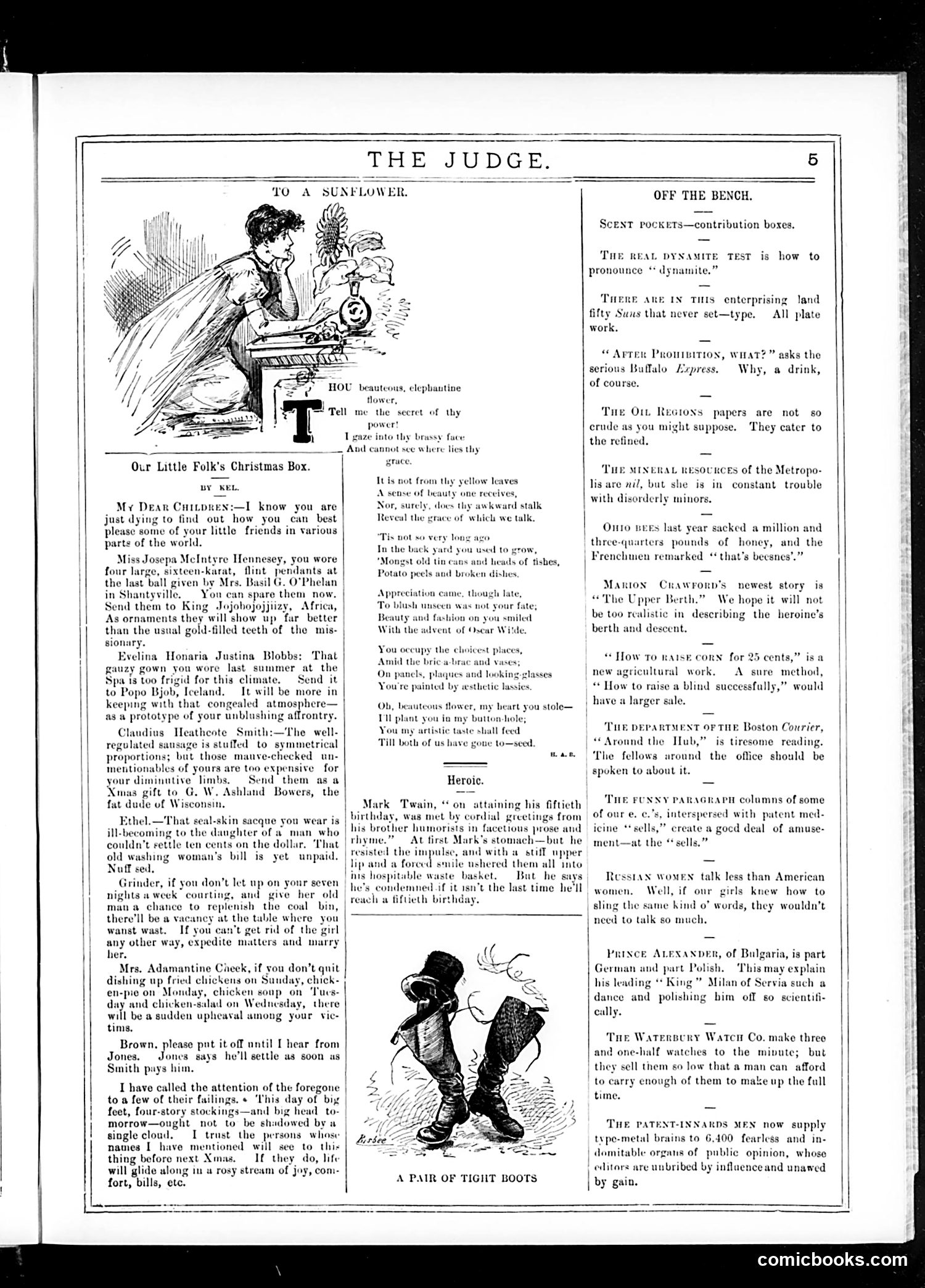
This page from the satirical magazine *Judge* contains two main elements: **"Our Little Folk's Christmas Box"** (left): A humorous advice column by "Kel" offering tongue-in-cheek Christmas gift suggestions. The author sarcastically recommends that wealthy people donate their worn-out luxury items (seal-skin coats, jewelry, etc.) to poor people in remote places like "Shantyville" and "Iceland." The jokes target class pretension—the wealthy are portrayed as simultaneously flaunting their status and being stingy enough to regift cast-offs. **Right column**: Brief satirical commentary on contemporary topics: dynamite (likely referencing Anarchist concerns of the era), religious hypocrisy ("oil regions"), and Mark Twain's fiftieth birthday reception (showing him graciously accepting congratulations while privately dismissing them). The illustrations depict a sunflower and a figure in tight boots, accompanying the text humorously. The overall tone mocks upper-class attitudes and social pretense typical of *Judge's* satirical approach.
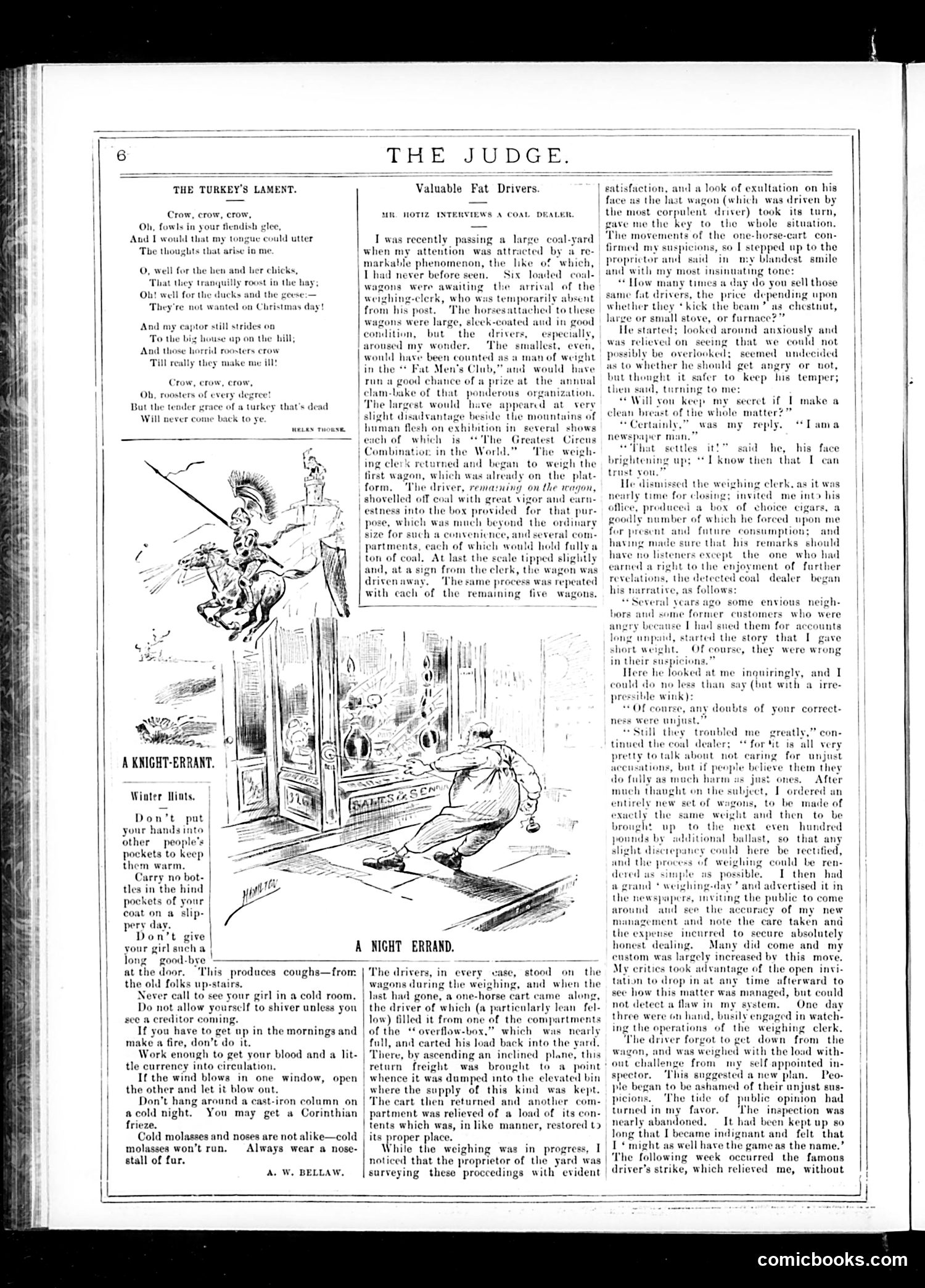
This page satirizes a coal yard's deceptive weighing practices. The main cartoon, "Valuable Fat Drivers," depicts a scheme where unusually obese coal drivers deliberately remain on wagons during weighing to artificially inflate the recorded weight—making the coal appear heavier than it actually is. The proprietor then uses a thin driver with a small cart to remove the excess coal that was "sold" as part of the inflated weight, keeping the profit. The satire exposes consumer fraud: customers unknowingly pay for coal that includes the drivers' body weight. The joke hinges on the drivers' remarkable corpulence being a deliberate business asset rather than coincidence. The accompanying "Winter Hints" and other content are filler material typical of Judge magazine. This reflects late 19th-century consumer skepticism about merchant honesty and measurement standards.
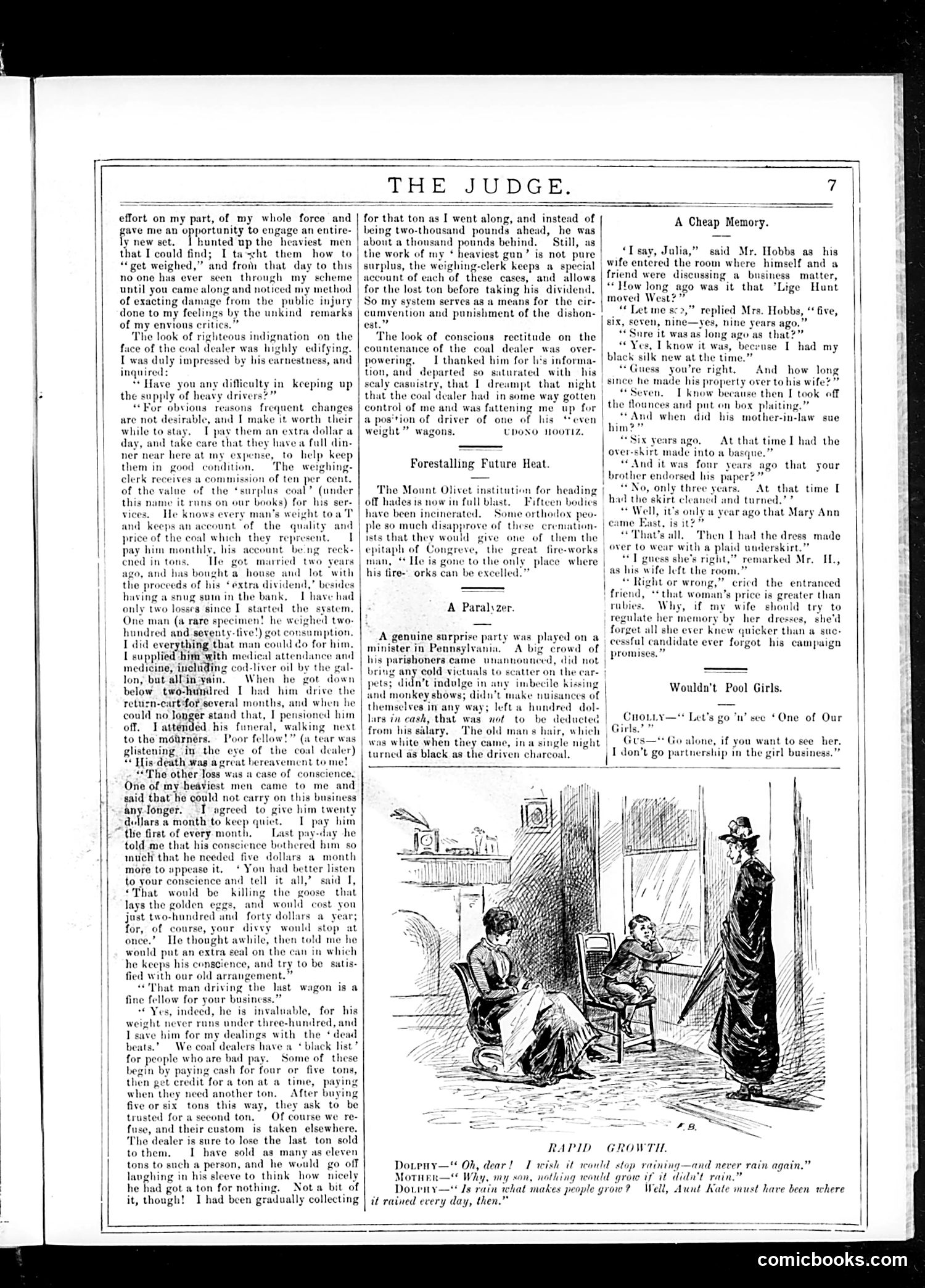
This page contains a long anecdotal article (likely by a coal dealer) describing a scheme to defraud customers by using overweight drivers to increase coal delivery cart loads without detection. The narrator explains how he hired the heaviest men possible, paid them extra to stay loyal, and had a weighing clerk (on commission) track their weights—allowing him to systematically cheat customers by delivering less coal than paid for. The accompanying cartoon titled "Rapid Growth" satirizes this same practice: a mother tells her son "I wish it would stop raining—and never rain again," while the son replies that rain makes things grow. The visual gag likely comments on how such dishonest schemes artificially inflate profits (rapid growth) through deceptive practices rather than legitimate business. This is a scathing critique of corporate fraud in the coal industry—mocking how merchants exploited weight-based commerce to cheat working-class customers.
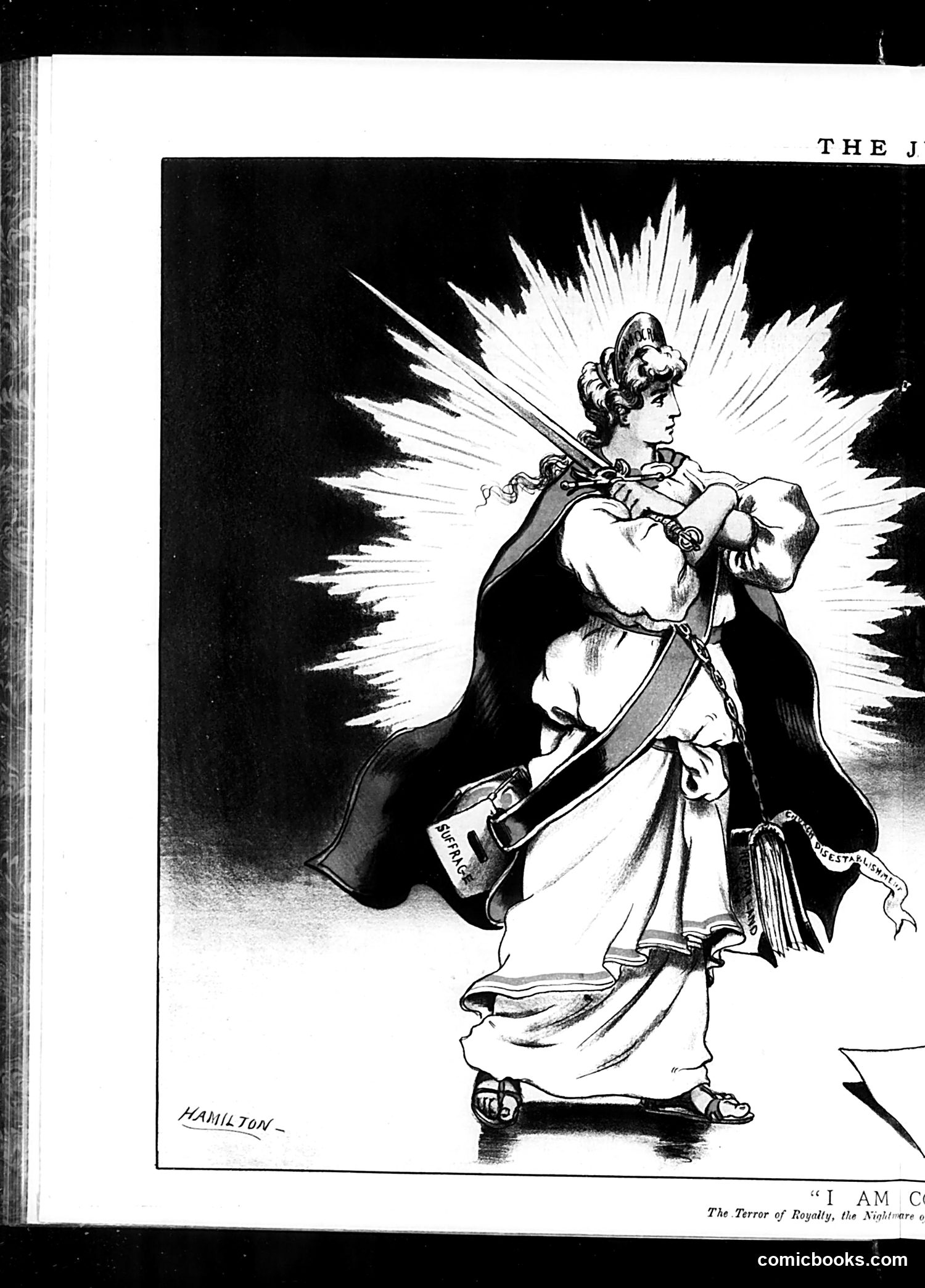
This is a satirical illustration by Hamilton depicting a female allegorical figure—likely representing either Socialism, Republicanism, or Democratic reform—as a nightmarish specter haunting royalty. The winged, ethereal female figure carries a sword or blade and wears classical drapery, suggesting revolutionary ideals. The dramatic radiating lines behind her emphasize her as an ominous, supernatural force. The caption "The Terror of Royalty, the Nightmare o[f]" (text cuts off) confirms the cartoon critiques how monarchical establishments fear progressive or revolutionary movements. The figure appears drawn to embody both beauty and menace—an idealized vision to some, but portrayed as terrifying to the established order. This reflects Judge magazine's satirical commentary on late 19th/early 20th-century tensions between traditional monarchy and emerging democratic or socialist movements.
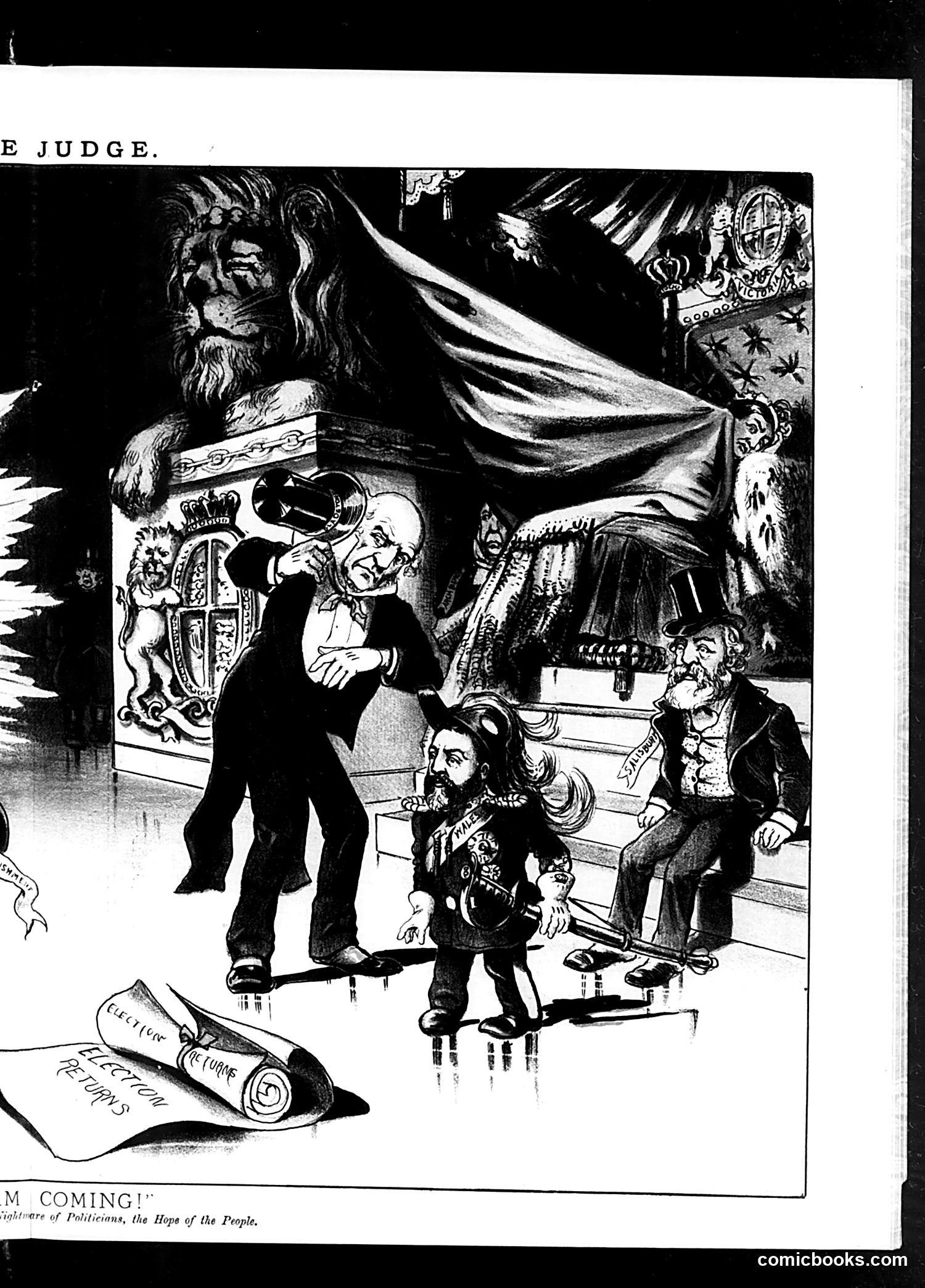
This is a satirical cartoon titled "Coming!" subtitled "Nightmare of Politicians, the Hope of the People." The image depicts a bearded man (appearing to represent a judge or authority figure) looming large above a scene where several smaller politicians or officials cower anxiously. The cartoon uses size disparity to show power dynamics—the judge-like figure dominates the composition while politicians appear diminished and frightened below. The caption suggests this represents public justice or accountability that politicians fear but common people welcome. The ornate throne and regalia visible indicate this concerns state power and governance. Without additional context about Judge magazine's publication date, the specific individuals depicted remain unclear, though the satire critiques political corruption or misconduct that public judgment will address.
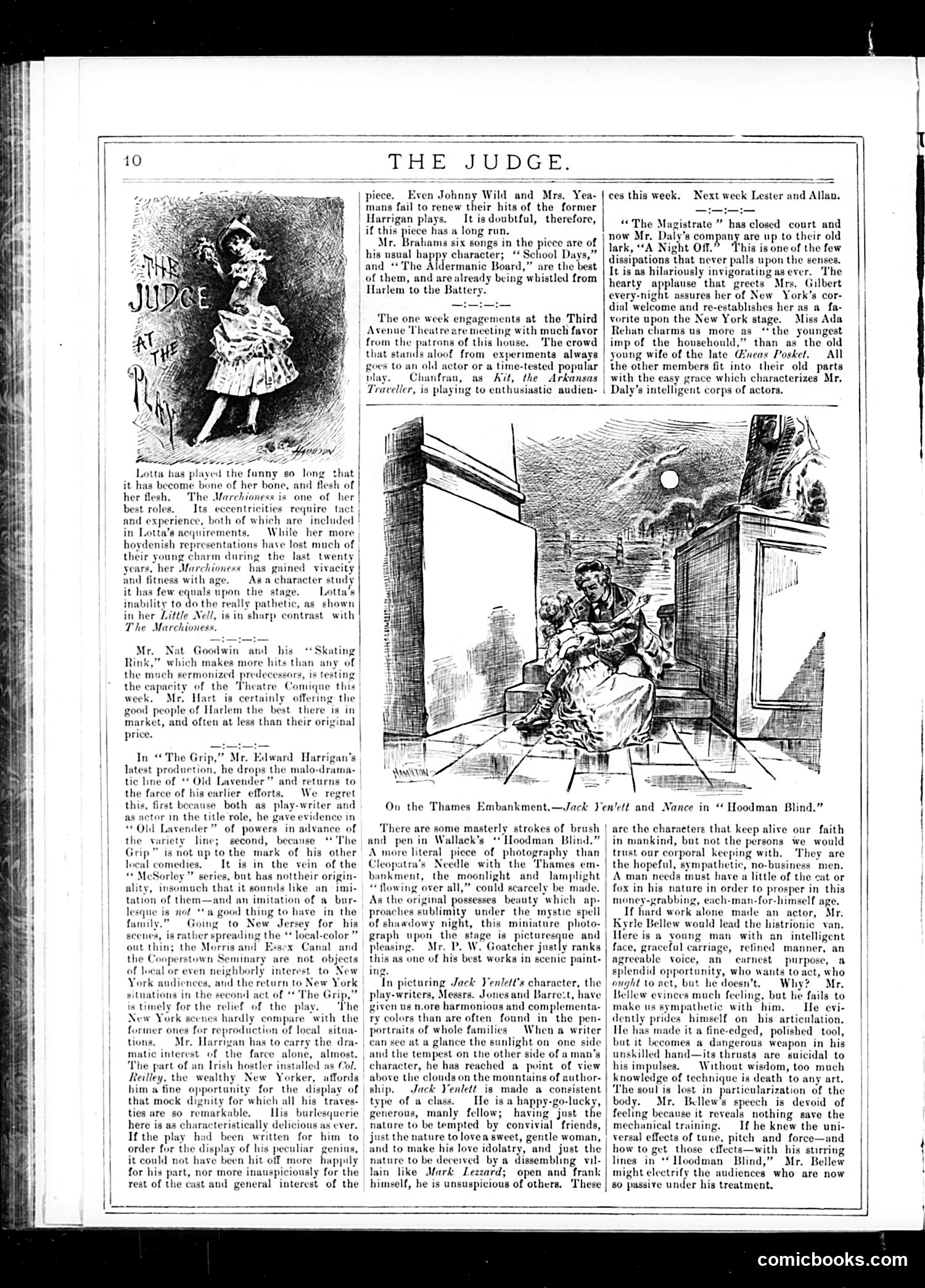
This page from *Judge* magazine consists primarily of theatrical reviews and commentary, not political satire. The main illustration—a sketch labeled "On the Thames Embankment—Jack Yeats and Nancy in 'Hoodman Blind'"—depicts a scene from a stage production, showing figures in an urban riverside setting. The text discusses contemporary theatrical performances, including reviews of "The Marchioness" (starring the actress Lotta), "The Skating Rink," and "The Grip" (featuring Edward Harrigan). The critic praises some performances while critiquing others' originality or structure. The content reflects *Judge*'s coverage of New York's theater scene in what appears to be the 1880s-1890s, focusing on popular entertainment rather than political commentary. The tone is theatrical criticism written for an audience interested in stage productions and performers' talents.
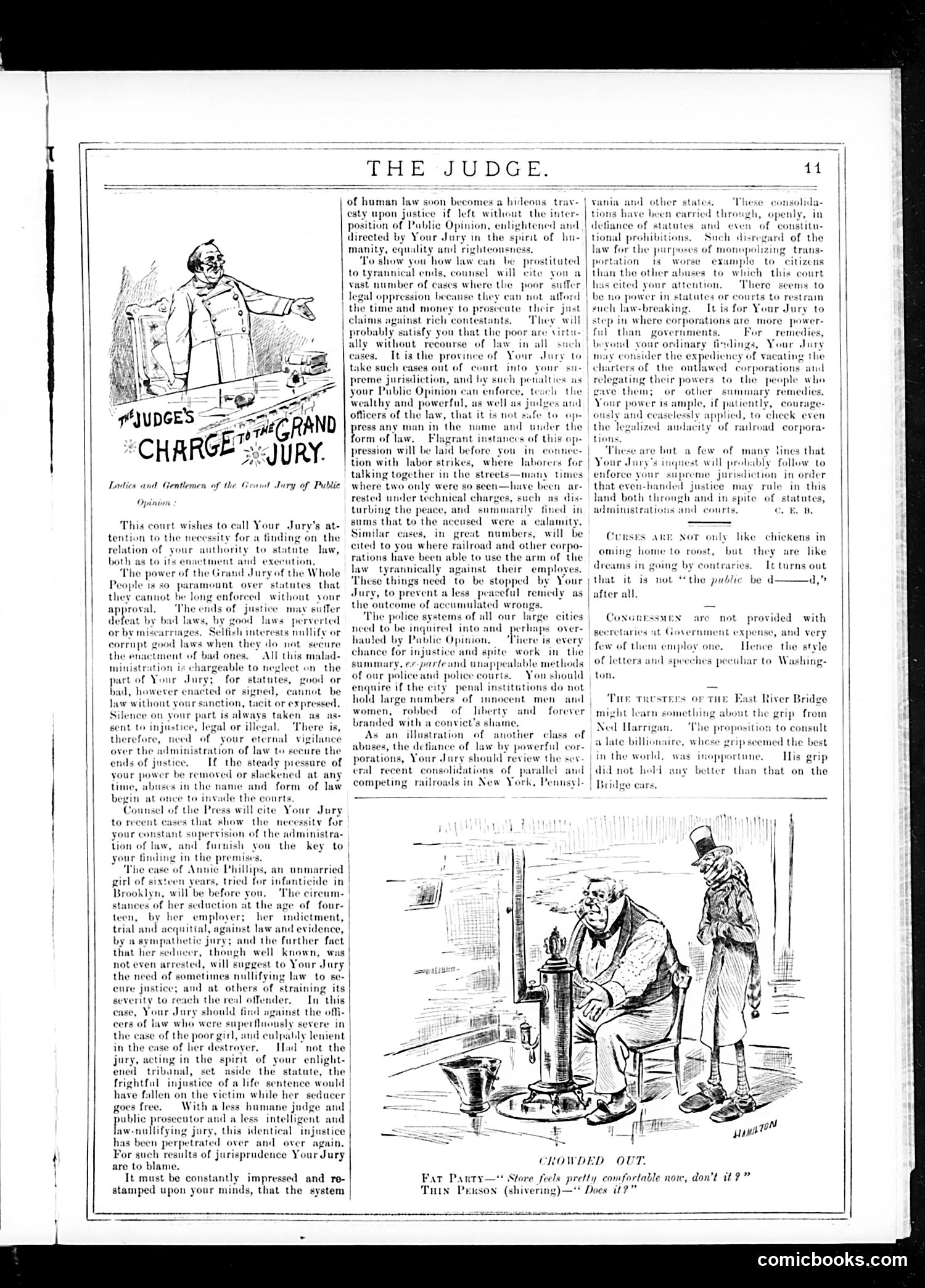
This page presents an editorial essay on grand jury power, illustrated with two cartoons. The left illustration shows a judge addressing jurors about their authority to oversee corporate and governmental abuses. The text argues that grand juries possess near-sovereign power to check "tyrannical ends" pursued by wealthy interests and corporations, particularly railroads. It critiques how the poor lack legal recourse against the rich, while corporations escape accountability through corrupt courts. The essay urges jurors to use their power to void corporate charters and penalize abuses "beyond ordinary findings." The lower cartoon, titled "Crowded Out," depicts working-class people displaced or overwhelmed, illustrating the essay's concern about ordinary citizens' powerlessness against entrenched wealth and corporate monopolies. The piece reflects Gilded Age anxieties about railroad power, judicial corruption, and labor exploitation—positioning the grand jury as a democratic check on institutional abuse.
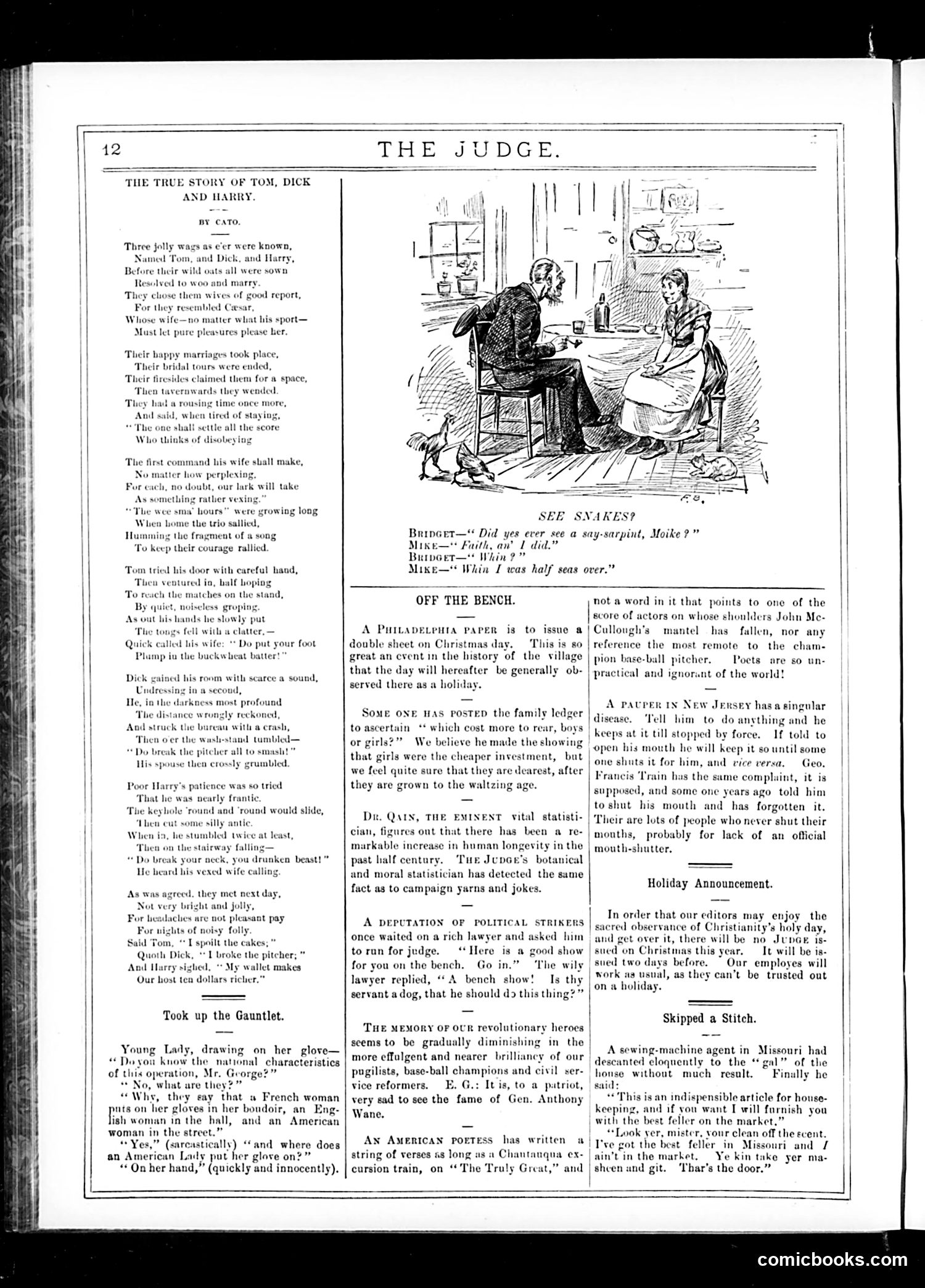
This page from *Judge* contains several satirical pieces. The main cartoon "See Snakes!" depicts a domestic scene where a woman asks a man if he's seen a "say-serpint" (sea serpent)—he replies he saw one when "half seas over" (drunk). The joke mocks both sensationalist newspaper claims about sea serpents and male drunkenness excuses. The surrounding text includes a poem about three married men ("Tom, Dick and Harry") who drunkenly stumble home and accidentally destroy household items—satirizing male rowdiness and the consequences wives endure. The "Off the Bench" column contains brief social commentary mocking various absurdities: a Philadelphia newspaper's Christmas double-issue treated as major news, debates over raising boys versus girls, an indiscreet New Jersey politician, and Francis Train (a notorious loudmouth of the era) who allegedly can't stop talking. The overall tone ridicules male excess, journalistic sensationalism, and public figures of the day through lighthearted domestic and social satire typical of Victorian-era humor magazines.
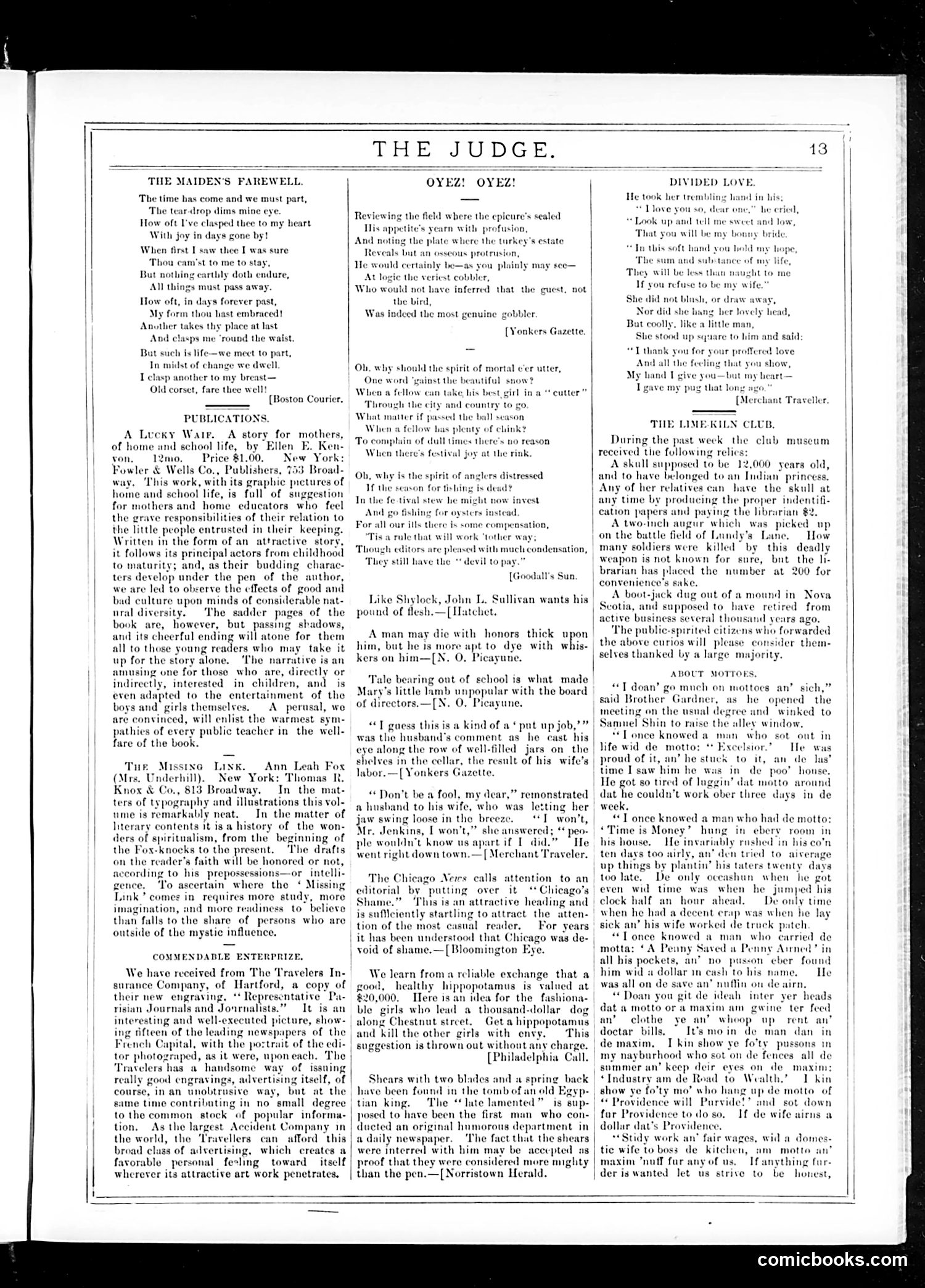
This page from the satirical magazine *Judge* contains three separate literary pieces rather than political cartoons. **"The Maiden's Farewell"** is a humorous poem (credited to Boston Courier) presenting a woman's emotional goodbye—not to a person, but to her old corset. The joke plays on Victorian sentimentality by treating the worn-out garment as a departing lover, complete with nostalgic reminiscence of their time together. **"Oyez! Oyez!"** (a court crier's call) is a brief satirical verse mocking someone's flawed logic about poultry. It jokes about a man observing turkey bones and incorrectly concluding he's found a "gobbler" (male turkey). The remaining content consists of book reviews and advertising for insurance companies—typical *Judge* filler material. These pieces represent *Judge's* style of gentle domestic humor and wordplay rather than sharp political satire, targeting Victorian domestic life and pretentious reasoning for laughs.
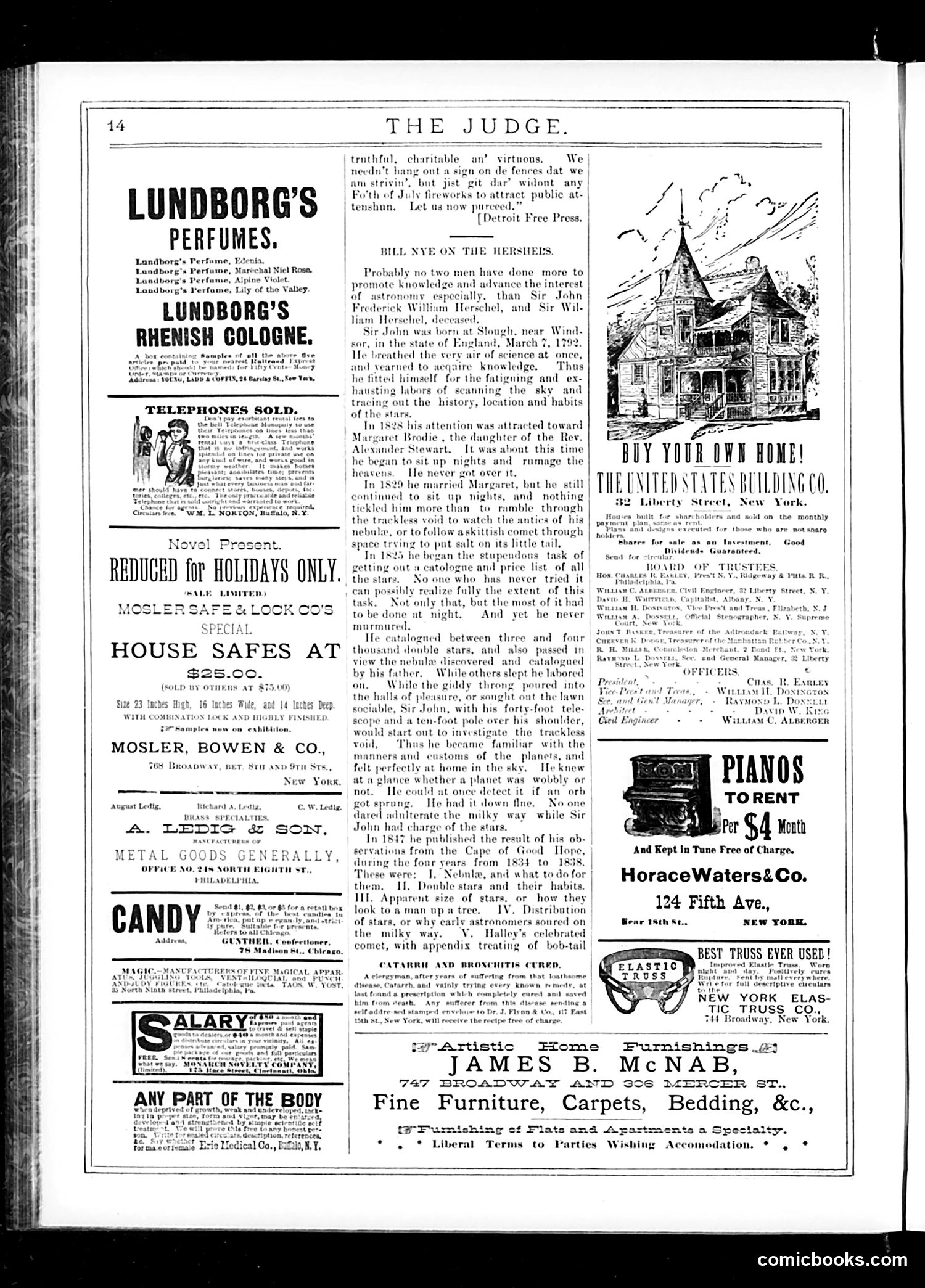
This page is primarily **advertising**, with one notable satirical article. The main content is "Bill Nye on the Herschels," a humorous essay by popular 19th-century humorist Bill Nye about astronomers Sir John Herschel and Sir William Herschel. Nye uses exaggeration and deadpan absurdity to mock earnest scientific writing—describing Herschel's celestial observations with silly domestic comparisons (trying to "put salt on" a comet's tail, detecting wobbly planets "at a glance"). The page header includes a brief joke attributed to the *Detroit Free Press* about July Fourth celebrations and patriotic display—mocking those who tout their virtue while needing public fireworks for validation. Otherwise, the page consists entirely of period advertisements for perfumes (Lundborg's), safes, candy, pianos for rent, furniture, trusses, and medical remedies—typical Judge magazine revenue sources. No political cartoons or satirical images appear on this particular page.
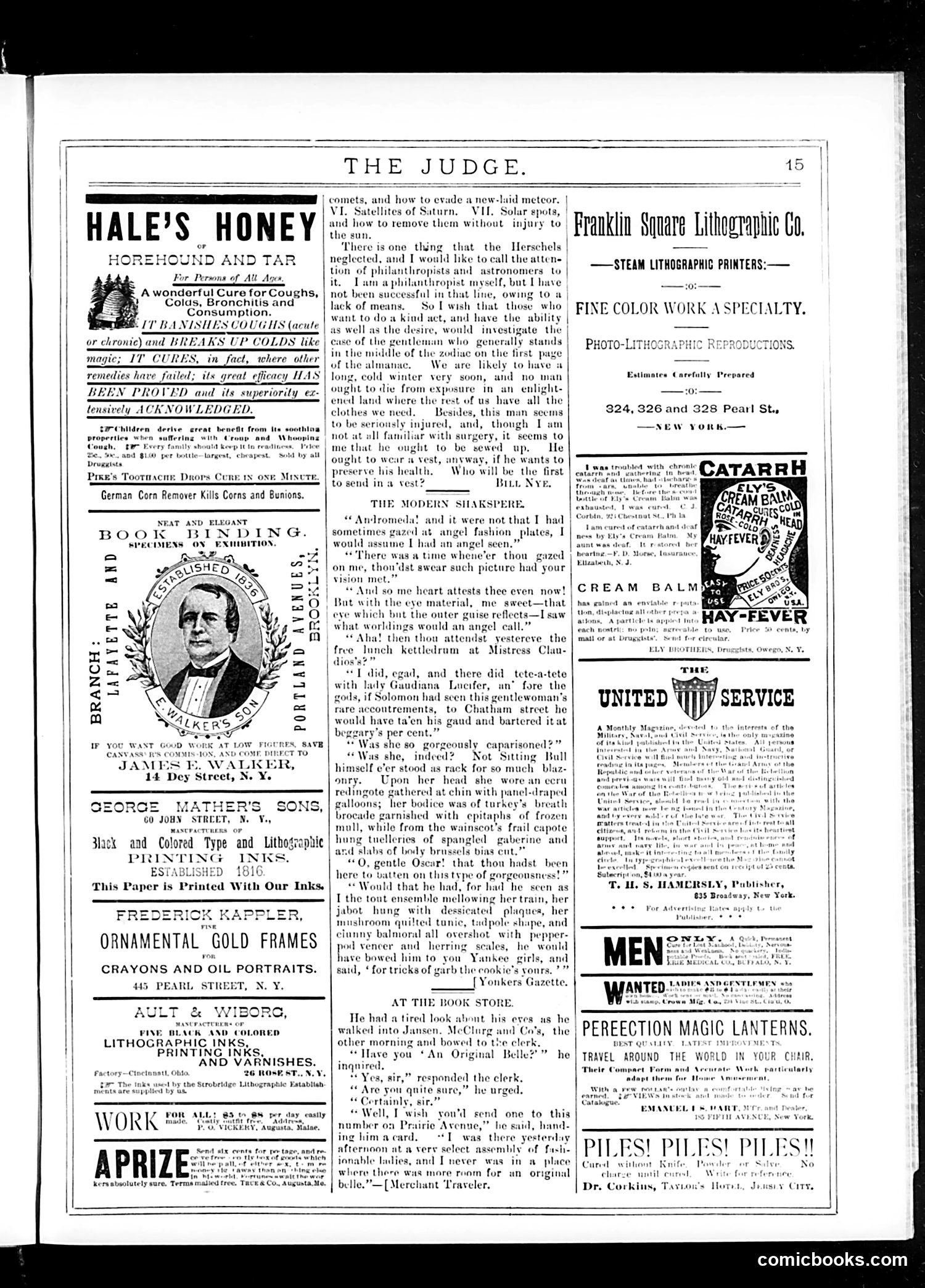
This page is primarily **advertisements and filler content**, not political satire. The bulk consists of period product ads: Hale's Honey cough remedy, book binding services, lithographic printing, gold frames, and various patent medicines. The one substantial editorial piece is "The Modern Shakspere," a satirical poem mocking the overwrought language of contemporary fashion writing and society gossip. It parodies Shakespearean dramatic verse applied absurdly to describing a woman's elaborate outfit at a social gathering—using mock-grandiose language about "turkey's breath brocade" and "spangled gabardine." The joke ridicules both pretentious society fashion-obsession and the affected literary style magazines used to describe it. The piece signed by Bill Nye offering to help a poor "zodiac man" is humorous but not clearly political. Overall, this reflects Judge's typical mix of advertising revenue and light satirical humor about social fashion and manners rather than political commentary.
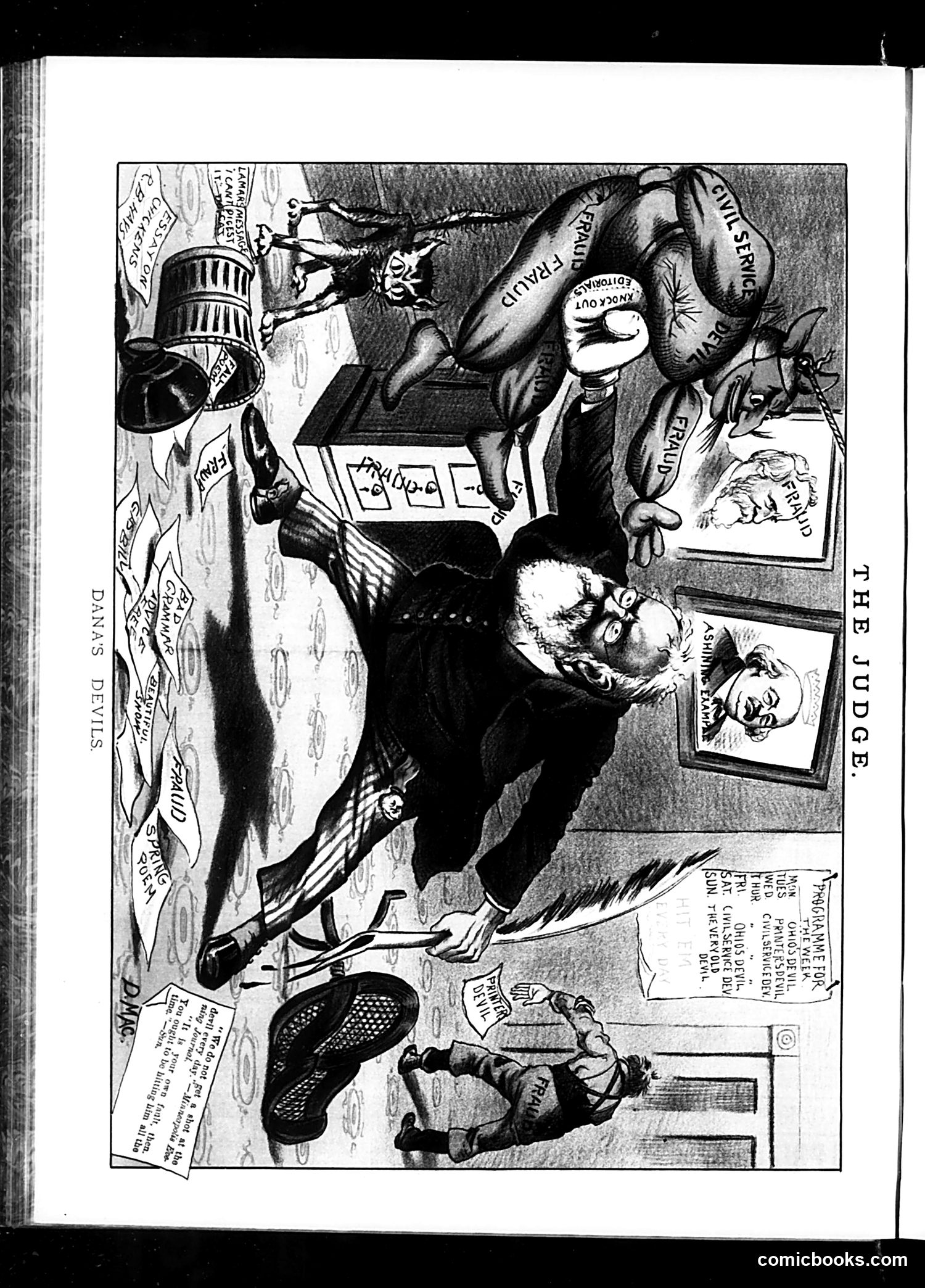
This appears to be a political cartoon titled "Dana's Devils" from Judge magazine. The central figure is a judge examining what appear to be portraits or case files, suggesting a legal or investigative proceeding. Multiple demonic or devil-like figures surround him, labeled as "Dana's Devils"—likely referring to Charles A. Dana, a prominent newspaper editor and public figure of the late 19th century. The satire suggests corruption or misconduct associated with Dana's circle or influence. The cartoon mocks the notion that Dana controls various problematic individuals or interests ("devils"), presenting them for the judge's scrutiny. The tone is critical, using demonic imagery to delegitimize Dana's associates or business dealings. Without the publication date clearly visible, the specific scandal referenced remains unclear, though the cartoon's intent is clearly derisive toward Dana's reputation or activities.