
Judge, 1885-12-19 · page 10 of 16
Judge — December 19, 1885 — page 10: what you’re looking at
What you’re looking at
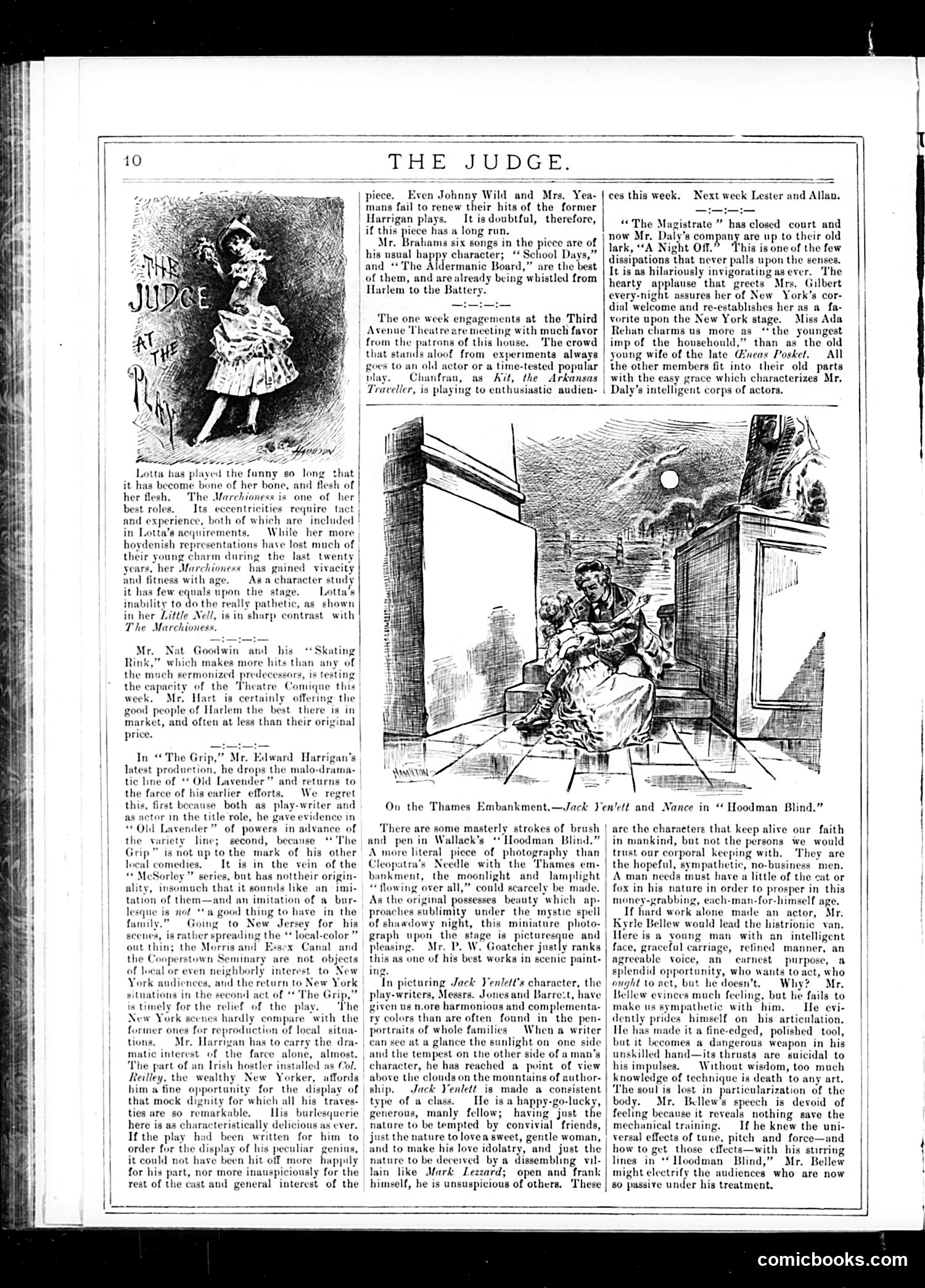
This page from *Judge* magazine consists primarily of theatrical reviews and commentary, not political satire. The main illustration—a sketch labeled "On the Thames Embankment—Jack Yeats and Nancy in 'Hoodman Blind'"—depicts a scene from a stage production, showing figures in an urban riverside setting. The text discusses contemporary theatrical performances, including reviews of "The Marchioness" (starring the actress Lotta), "The Skating Rink," and "The Grip" (featuring Edward Harrigan). The critic praises some performances while critiquing others' originality or structure. The content reflects *Judge*'s coverage of New York's theater scene in what appears to be the 1880s-1890s, focusing on popular entertainment rather than political commentary. The tone is theatrical criticism written for an audience interested in stage productions and performers' talents.
📄 Transcribed text from this page (OCR, searchable)
Machine-transcribed from the original scan — historical spelling and the odd misread are preserved.
Lotta has played the funny so long that | it has become bone of her bone, and flesh of | her flesh. The Marchioness is one of her! best roles. Its eccentricities require tact and experience, both of which are included in Lotta’s acquirements. While her more hoydenish representations have lost much of | their young charm during the last twenty | years, her Marchioness. has gained vivacity | and fitness with age. As a character ana) | it has few equals upon the stag Lott inability to do the really pathetic, as shown in her Little Nell, is in sharp contrast with The Marchioness. Mr. Skating Rink,” which n of the much serme the capacity of the Theatre Comique this week, Mr. Hart is certainly offering the good people of Harlem the best. there is in market, and often at less than their original price. | ing In The Grip,” Mr. Edward Harri latest production, he drops the malo-drama- tie line of * Old Lavender” and returns to the farce of his earlier efforts. We regret nd first because both as play-writer or in the title role, he gave evid in Lavender” of powers in advance of the variety line; gecond, because ‘The Grip” is not up tothe mark of his other local comedies, It _is in the vein of the “ McSorley ” series, but has nottheir origin- ality, insomuch that it sounds like an imi- tation of them—and an imitation of a bur- lesque is not good thing to have in the family.” Going to New Je for his , is rather spreading the * local-color ” interest. to New Y of local or even neighborl York audiences, and the return t situations in the second act of is timely for the relief of the play The New York scenes hardly compare with the riner ones for reproduction of local sit tions. = Mr. Harrigan has to carr: interest of the farce alone rt of an Trish hostler installed as Col. the wealthy New Yorker, affords him a fine opportunity for the disp that mock dignity for which all his tra ties are so remarkable. — His bur! here is as characteristically delicious If the p 1 written for him to order for lay of his peculiar genius, it could not have been hit off more happily for his part, nor more inauspiciously for the THE JUDGE. piece. Even Johnny Wild and Mrs. Yea- | mans fail to renew their hits of the former Harrigan plays. It is doubtful, therefore, if this piece has « long run, Mr. Brahms six songs in the piece are of his usual happy character; ‘‘ School Days,” and ‘The A Hermanie Board,” are the best of them, and are alre being whistled from Harlem to the Batte: The o1 » week engagements at the Third Avenue Theatre ere meeting with much favor from the patrons of this house. The crowd that stands aloof from experiments always goes to an old actor or a time-tested popular play, Chanfrau, as Avt, the Arkansas Traveller, is playing to enthusiastic audien- | ces this week. Next week Lester and Allan. “The Magistrate ” has closed court and | now Mr. Daly’s ompang are up to their old lark, “‘A Night Off.” This is one of the few dissipations that never palls upon the senses. It is as hilariously invigorating as ever. ‘The hearty applause that greets . Gilbert every-night assures her of New York’s cor- dial welcome and re-establishes her as a fa- vorite upon the New York stage. Miss Ada Rehan charms us more as ‘the youngest imp of the househould,” than as the old young wife of the late CZneas Posket. All | the other members fit into their old parts with the easy grace which characterizes Mr. \ Daly’s intelligent corps of actors. On the Thames Embankment.—Jack ‘There are some masterly strokes of brush and pen in Wallack’s ‘* Hoodman Blind.” A more literal piece of photography than Cleopatra’s Needle with the Thames em- bankment, the moonlight and lamplight “flowing over all,” could scarcely be made. As th nal possesses beauty which ap- proaches sublimity under the mystic spell of shawdowy night, this miniature photo- graph upon the stage is picturesque and | pleasing. Mr. P. W. Goatcher justly this as one of his best works in scenic F ing. In picturing Jack Yenlett's character, the play-writers, Messrs. Jones and Barr given us n.ore harmonious and complementa- ry colors than are often found in the pen- portraits of whole families and the tempest on the other side of a man’s character, he has reached a point of view above the clouds on the mountains of author- ship. Jack Venlett is made a consistent type of w class. Ie is a happy-go-lucky, generous, manly fellow; having just the nature to be tempted by convivial friends, just the nature to lovea sweet, gentle woman, and to make his love idolatry, and just the nature to be deceived by a dissembling vil- lain like Mark Lezzard; open and fr: have | When a writer | can see at a glance the sunlight on one side | ‘enlett and Nance in ‘ Hoodman Blind.” are the characters that keep alive our faith in mankind, but not the persons we would trust our corporal keeping with. They are the hopeful, sympathetic, no-business ‘men. A man needs must have a little of the cat or fox in his nature in order to prosper in this money-grabbing, each-man-for-himself age. If hard work alone made an actor, Mr. Kyrle Bellew would lead the histrionic van. Here is a young man with an intelligent face, graceful carriage, refined manner, an agreeable voice, an earnest purpose, a splendid opportunity, who wants to act, who ought to act, but he doesn't. Why? | Mr. Bellew evinces much feeling, but he fails to | make us sympathetic with him. — He evi- | dently prides himself on his articulation. He has made it a fine-edged, polished tool, but it becomes a dangerous weapon in his | unskilled hand—its thrusts are suicidal to | his impulses. Without wisdom, too much | knowledge of technique is death to any art. | The soul is lost in particularization of the body. Mr. Bellew’s speech is devoid of feeling becavse it reveals nothing save the | mechanical training, If he knew the uni- | Yersal effects of tune, pitch and force—and | how to get those cifects—with his stirring | lines in ** Hoodman Blind,” Mr. Bellew mightelectrify the audiences who are now rest of the cast aud general interest of the himself, he is unsuspicious of others. These | so passive under his treatment. comicbooks.com