
A complete issue · 16 pages · 1885
Judge — October 3, 1885
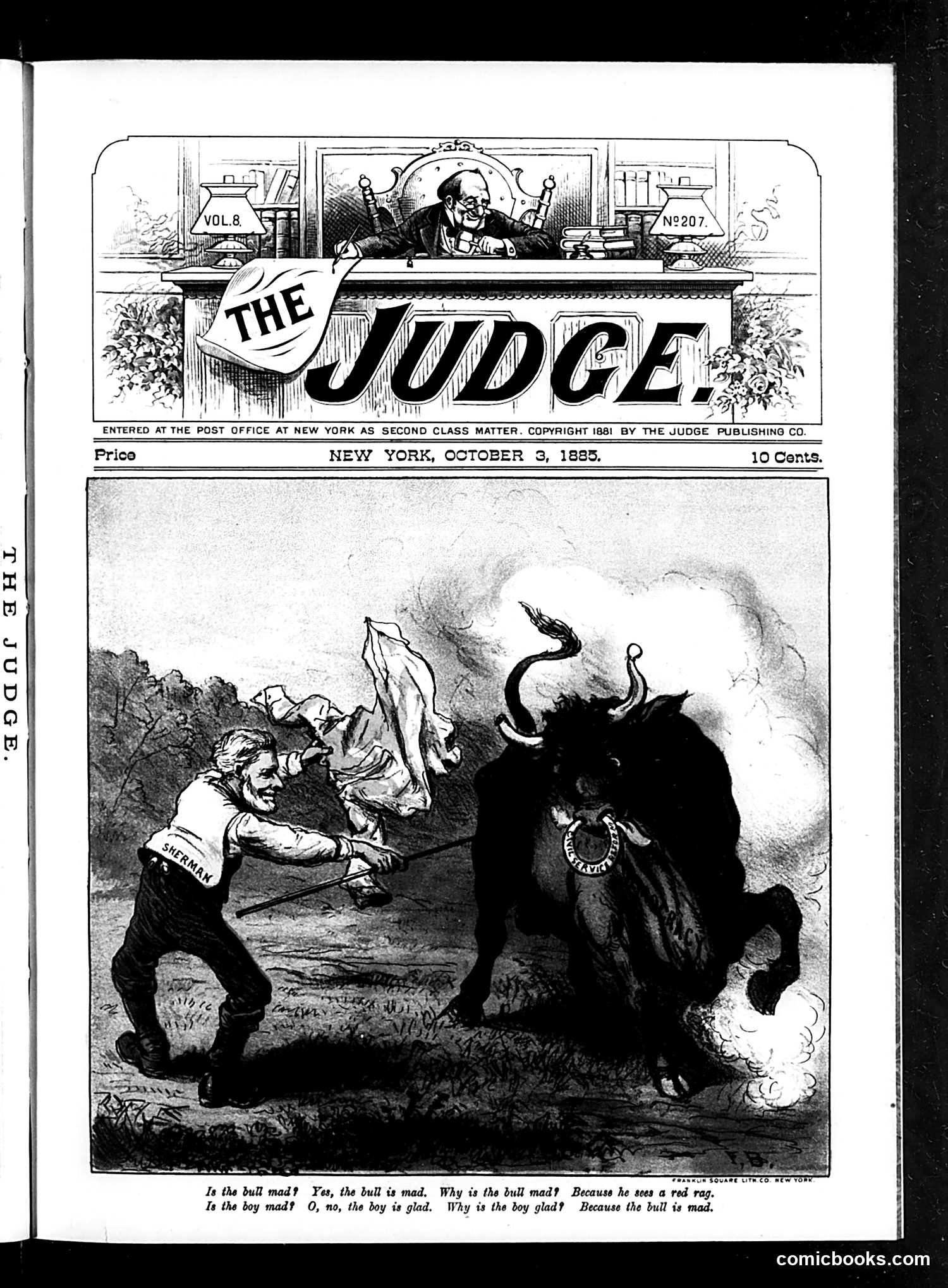
This political cartoon depicts a confrontation between a man labeled "SHERIFF" and an angry bull. The caption reads: "Is the bull mad? Yes, the bull is mad. Why is the bull mad? Because he sees a red rag. Is the boy mad? O, no, the boy is glad. Why is the boy glad? Because the bull is mad." The cartoon appears to be social commentary using the bull-and-red-rag metaphor—a common 1880s satirical device representing deliberate provocation. The sheriff figure likely represents law enforcement or authority being antagonized intentionally. Without additional context about specific 1885 events or controversies, the exact target of this satire remains unclear, though it likely comments on contemporary political or social agitation.
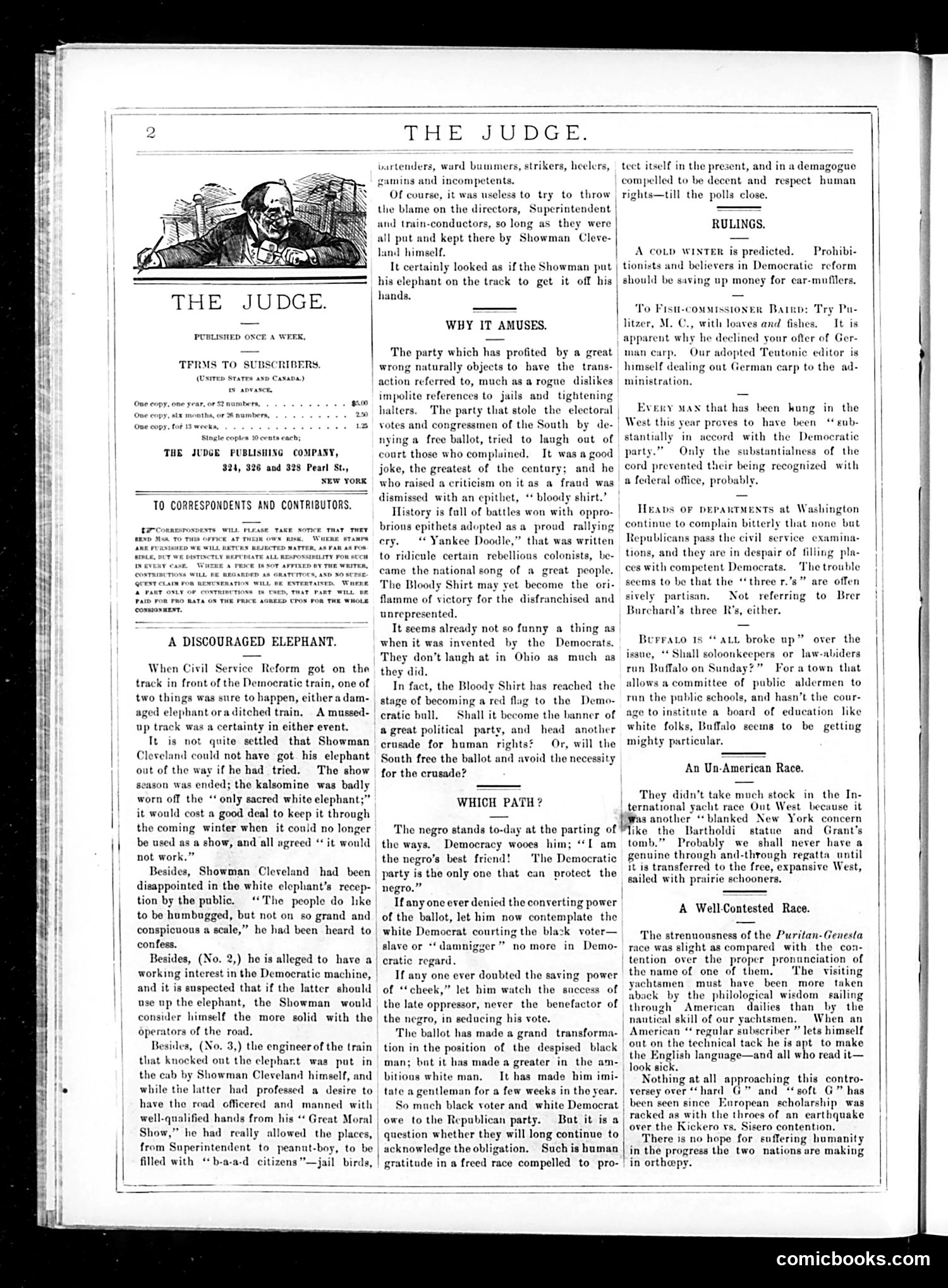
This 1880s political satire attacks President Cleveland and the Democratic Party using the "white elephant" metaphor. The cartoon depicts Cleveland as a showman who deliberately placed a Republican "elephant" (the GOP symbol) on Democratic railroad tracks to sabotage his own party—suggesting Cleveland's civil service reform efforts were cynically destructive. The satire argues Democrats are hypocrites: they mock Republicans' accusations of electoral fraud in the South (the "Bloody Shirt" reference) as outdated complaint-mongering, yet the Democrats themselves stole Southern votes by denying Black citizens ballots. The piece warns that this fraud—once seemed funny to Democrats—is becoming a serious liability. The final section questions whether Black voters will recognize Democrats' false claims of friendship, or support Republicans who genuinely protect voting rights. The satire's core point: Democratic cynicism and historical racism are unsustainable politically.
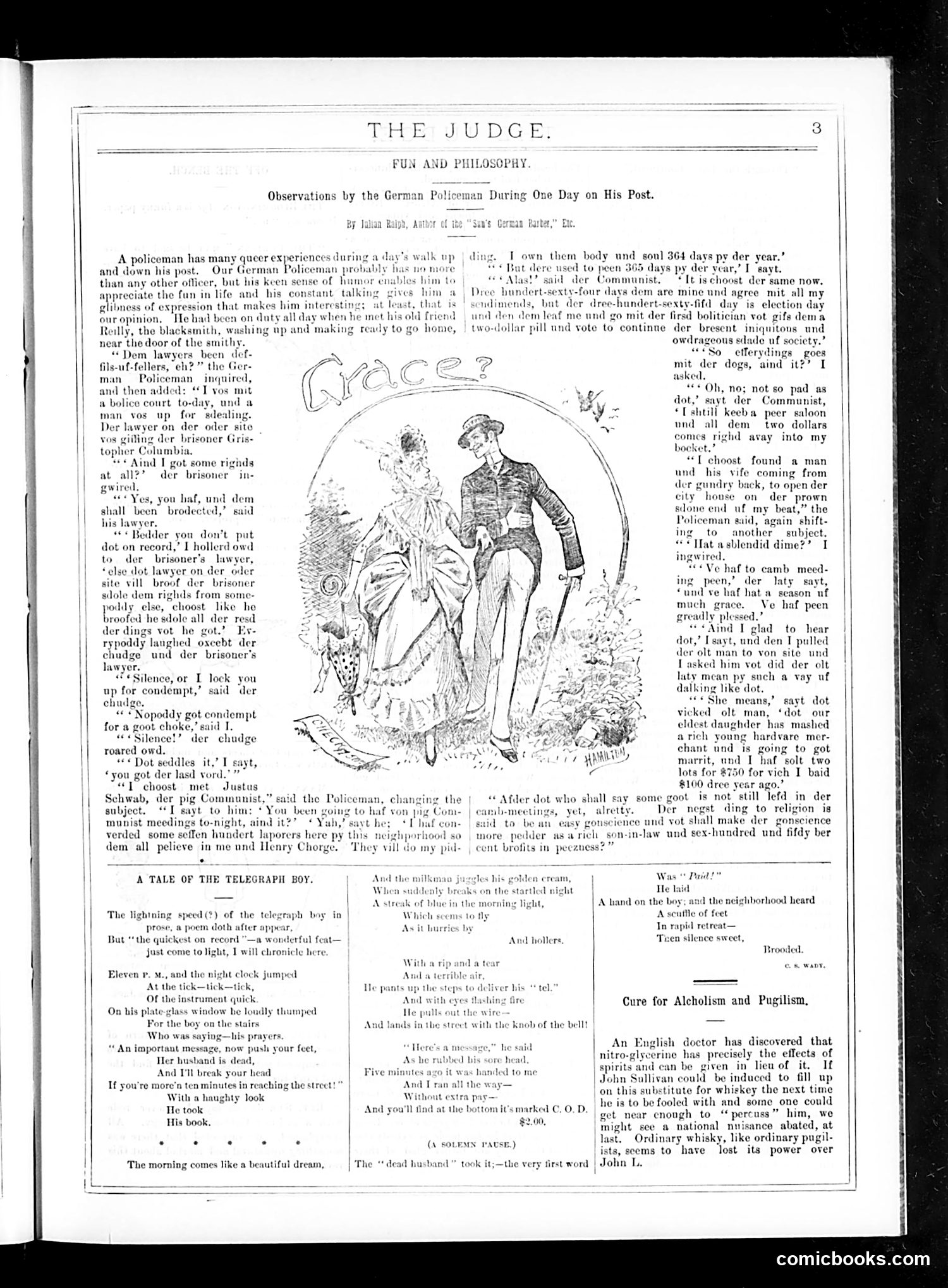
This page from *Judge* magazine features a satirical monologue by a German-accented policeman observing courtroom absurdities and street encounters. The humor relies on thick ethnic stereotyping—the officer's fractured English ("choost," "vos," "brisoner") marks him as a German immigrant. The main cartoon depicts the policeman encountering a Communist agitator named Justus Chwab. The satire mocks both the legal system's contradictions (a lawyer can simultaneously prove his client innocent and guilty) and radical politics—the Communist character argues workers should only believe in "Henry George" (a real 19th-century reformer), revealing class anxieties. The secondary story about the telegraph boy and the "dead husband" is a separate humorous piece about rapid communication. The satire targets Progressive-era tensions: corrupt courts, immigrant radicalism, and labor activism—common *Judge* themes attacking reformers and working-class organizing as inherently ridiculous through caricature.
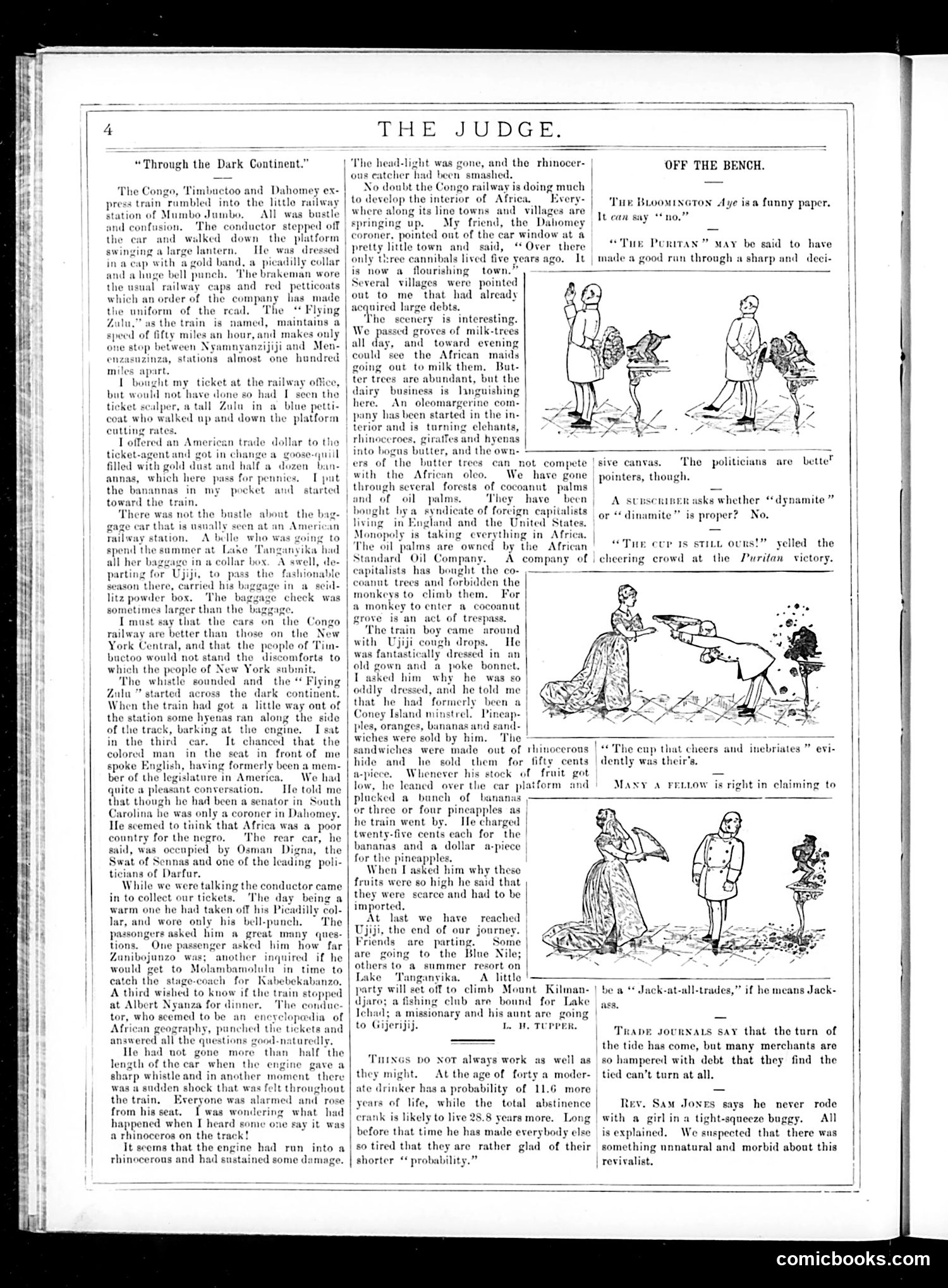
This is a humorous travel narrative mocking Victorian-era "African adventure" literature and colonial attitudes. The author describes an absurdly fictionalized journey on the "Congo railway" through invented African locations ("Mumbo Jumbo," "Nyamnyanzi"), populated with caricatured stereotypes. The satire targets several things: the pretentious exoticism of travel writing, colonialism's "civilizing mission" rhetoric (villages "springing up" where "cannibals lived five years ago"), and the casual racism embedded in Victorian adventure tales. The anachronistic details—paying with bananas and gold dust, a Zulu ticket agent in "blue petticoat," passengers discussing whether trains stop at "Lake Tanganyika for dinner"—are absurdist humor designed to mock the genre's implausibility. The cartoons on the right appear to illustrate comic scenes from the narrative, reinforcing the satirical tone. This is Judge magazine's typically irreverent commentary on contemporary attitudes toward African colonization.
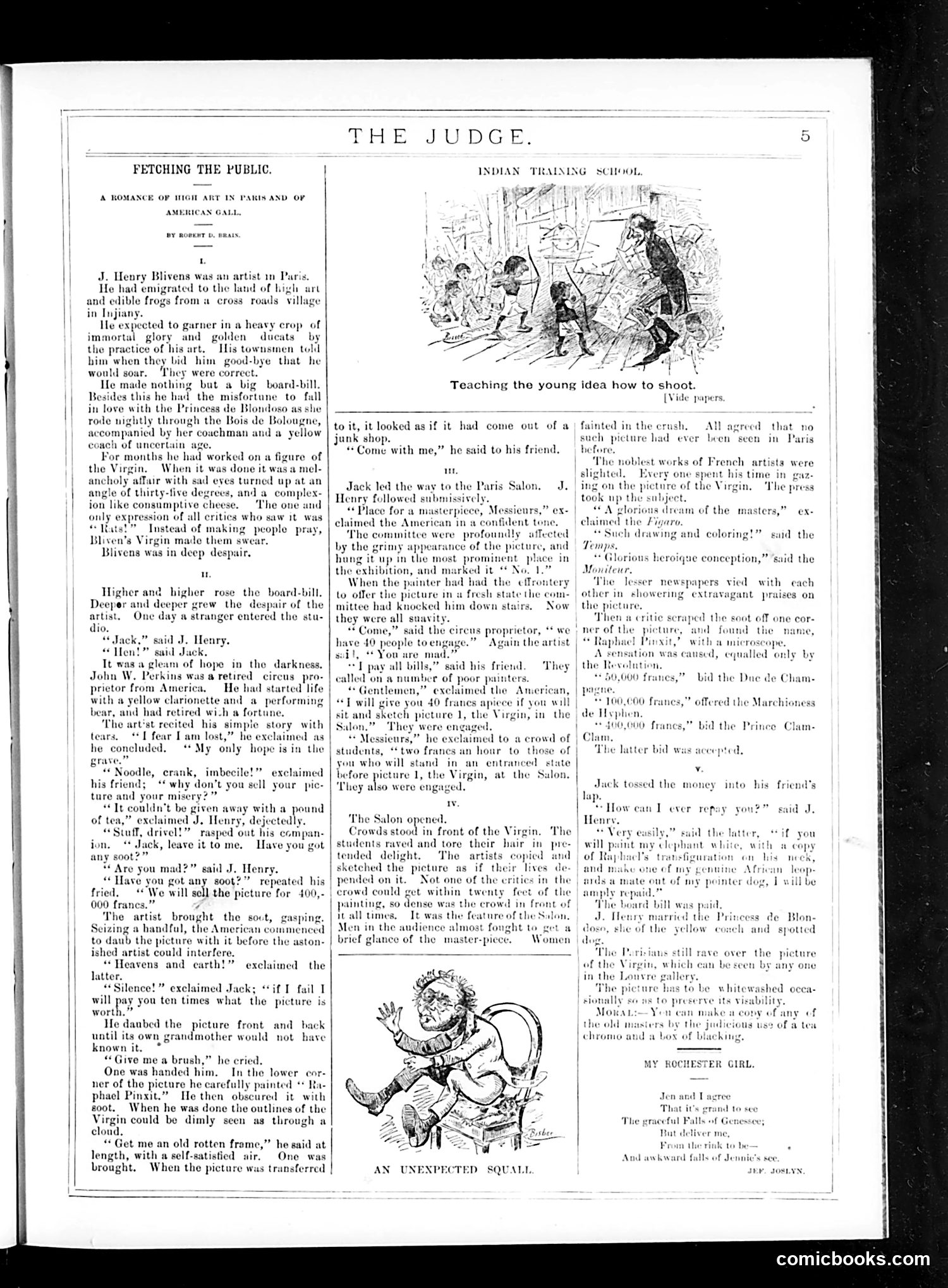
This story mocks the gullibility of Paris's high-art establishment. An American circus promoter named John W. Perkins helps struggling artist J. Henry Blivens sell an unsaleable painting by deliberately obscuring it with soot and aging it in a broken frame to make it appear authentically old and valuable. He even forges "Raphael Pinxit" (attributed to Renaissance master Raphael) on it. When displayed at the Paris Salon, the deliberately ruined painting becomes a sensation—crowds crush to see it, students copy it devotedly, and critics cannot approach it. The satire targets both the pretentiousness of the French art world and the American hustle that exploits it: sophisticated connoisseurs are duped into valuing something precisely because it appears ancient and obscure rather than for any genuine artistic merit. The title "Fetching the Public" captures the con at its heart.
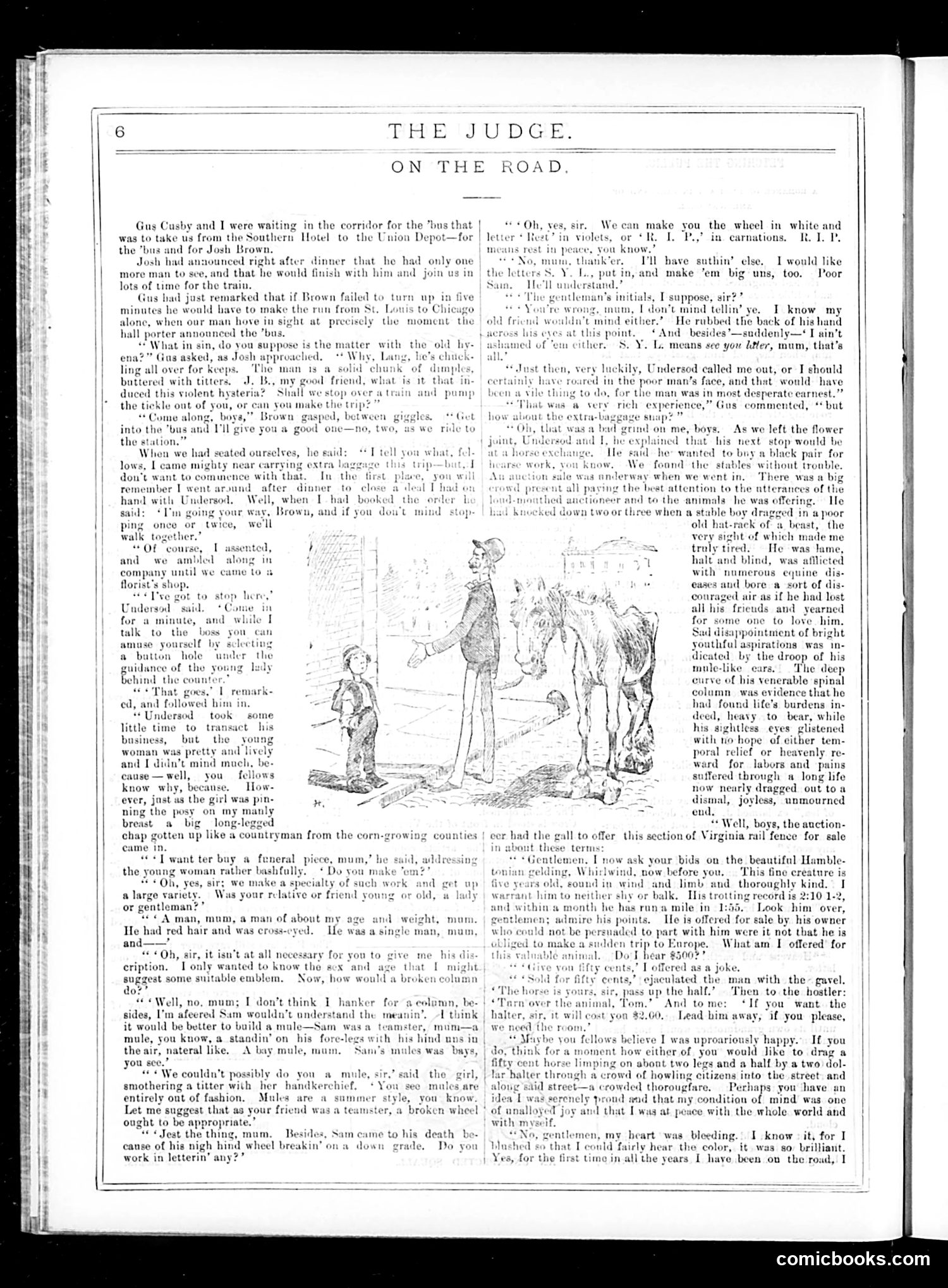
This page presents a humorous story rather than a political cartoon. The narrative follows two travelers waiting for a bus, encountering a man named Josh Brown who takes them to a horse auction and florist shop along the way. The satire targets the absurdity of rural commerce and courtship customs. A country gentleman arrives seeking a "funeral piece" (flowers), which the florist interprets as flowers for someone deceased—until he clarifies he wants them to impress a young woman. The scene mocks both rustic manners and overly sentimental Victorian courtship rituals. The auction scene, where a decrepit horse is being sold alongside a rail fence, satirizes the economic desperation of rural areas and the crude mixing of livestock with property sales. The illustration captures the worn-out elderly horse and the auctioneer's patter. The overall tone is gentle mockery of American rural life and small-town social conventions, typical of *Judge* magazine's satirical humor from this era (appears to be late 19th century based on style).
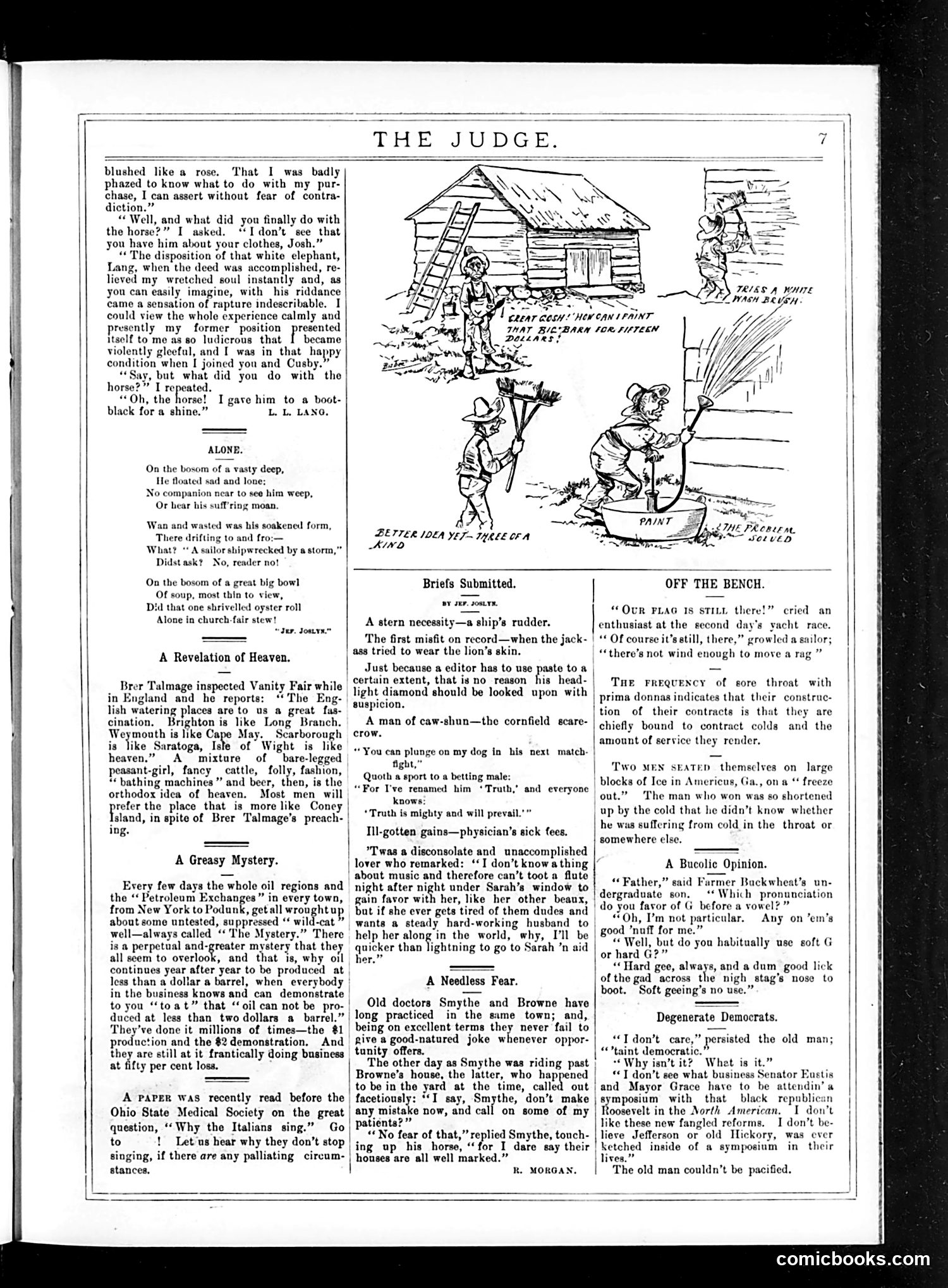
This is a satirical magazine page mixing humor pieces and social commentary typical of late 19th-century American wit. **Main Content:** The page features several short humorous pieces. "A Revelation of Heaven" mocks Reverend Henry Ward Beecher (referenced as "Brer Talmage"), who compared English seaside resorts to heaven—the satire suggests his vision of paradise is shallow, mixing "bare-legged peasant-girls, fancy cattle, folly, fashion" and beer. "A Greasy Mystery" satirizes the oil industry's paradox: operators claim oil cannot be profitably produced below $2/barrel yet consistently produce at $1, then demonstrate $2 costs—mocking their willful self-deception about losses. **Cartoons:** The illustrated vignettes appear to depict rural/working-class scenes with humorous captions about horses and farm life, typical of Judge's visual humor. The tone throughout is cynical about American institutions—clergy, business, and industry—reflecting Gilded Age skepticism toward authority figures and economic contradictions.
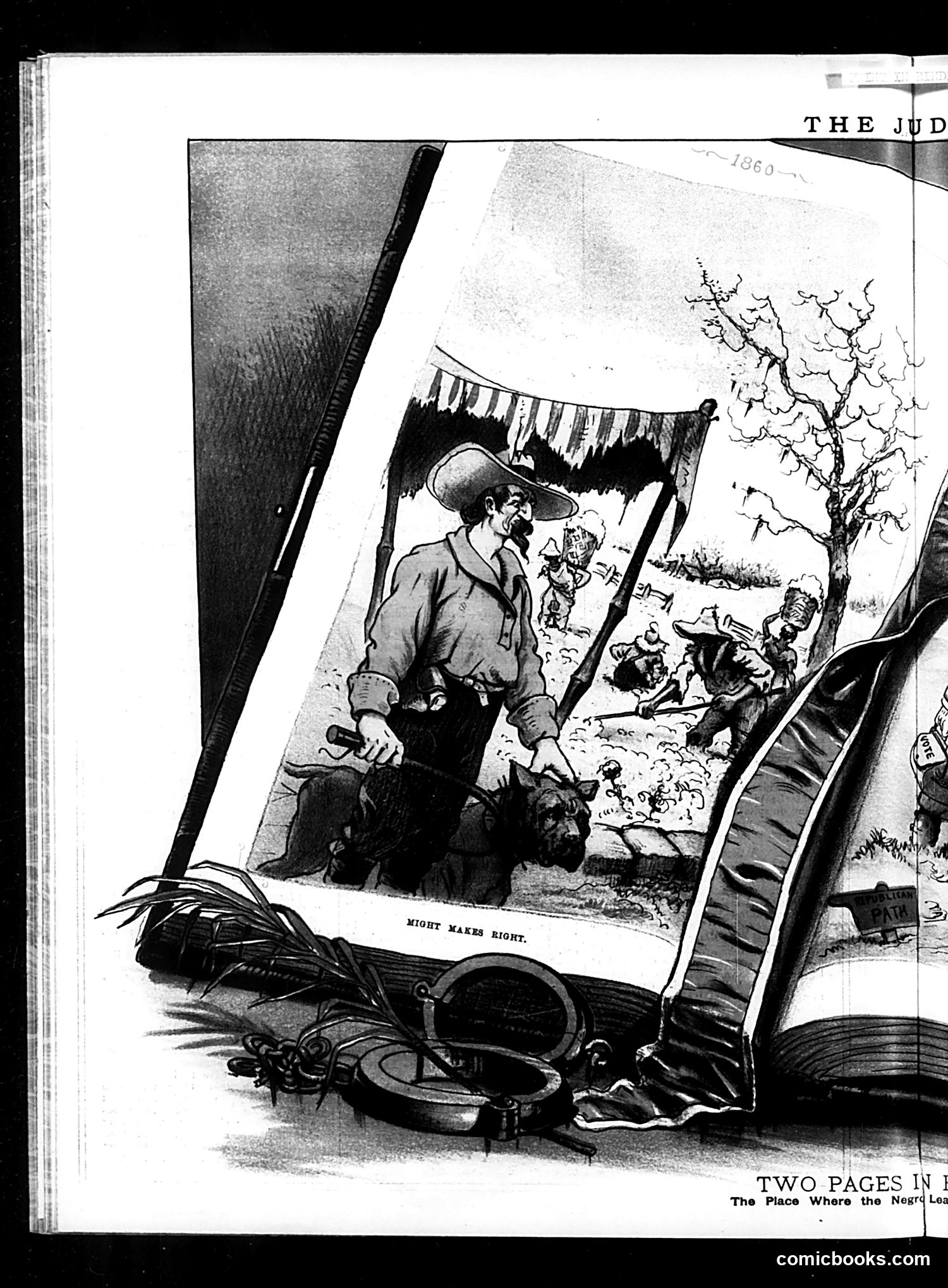
This page from *Judge* magazine shows a framed illustration titled "Might Makes Right," depicting what appears to be a colonial or frontier scene with armed figures and enslaved or subordinate Black individuals in a landscape with a bare tree. The caption "The Place Where the Negro Lea[ds]" (text cut off) suggests commentary on racial hierarchy and power dynamics. The framing device—with the image literally contained within an open book or publication—appears to be satirizing prevailing attitudes about racial subjugation, presenting them as something documented or "published" ideology. Without the complete text or date visible, the precise satirical point remains unclear—whether *Judge* is critiquing or endorsing these racial attitudes. The presentation suggests commentary on American racial politics, likely from the late 19th or early 20th century.
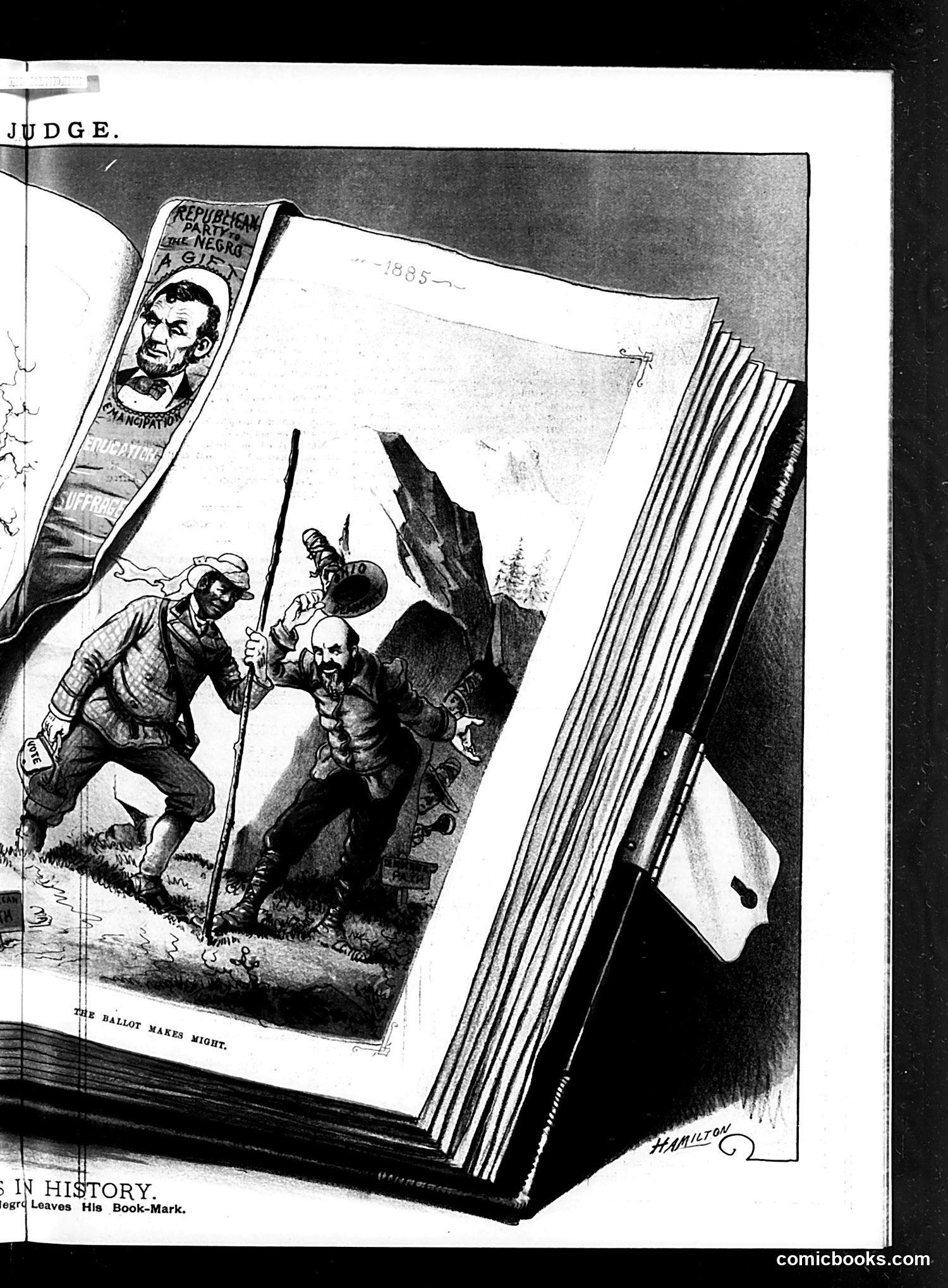
This page depicts a political cartoon titled "The Ballot Makes Might," showing a large book labeled "1885" with a Republican Party banner (featuring Lincoln's portrait) as a bookmark. Two figures appear to be engaged in a violent struggle inside or emerging from the book—one wielding what looks like a club or ballot-related weapon. The cartoon satirizes the use of political force and intimidation during elections, particularly regarding Republican tactics around voting and ballot access in 1885. The "book-mark" visual pun suggests that political violence or coercion is literally marking history. The Republican imagery indicates this is likely critical commentary on GOP practices during the Reconstruction or post-Reconstruction era, when ballot manipulation and violence were serious political issues. The overall message appears to be satirizing the correlation between political power and violent intimidation.
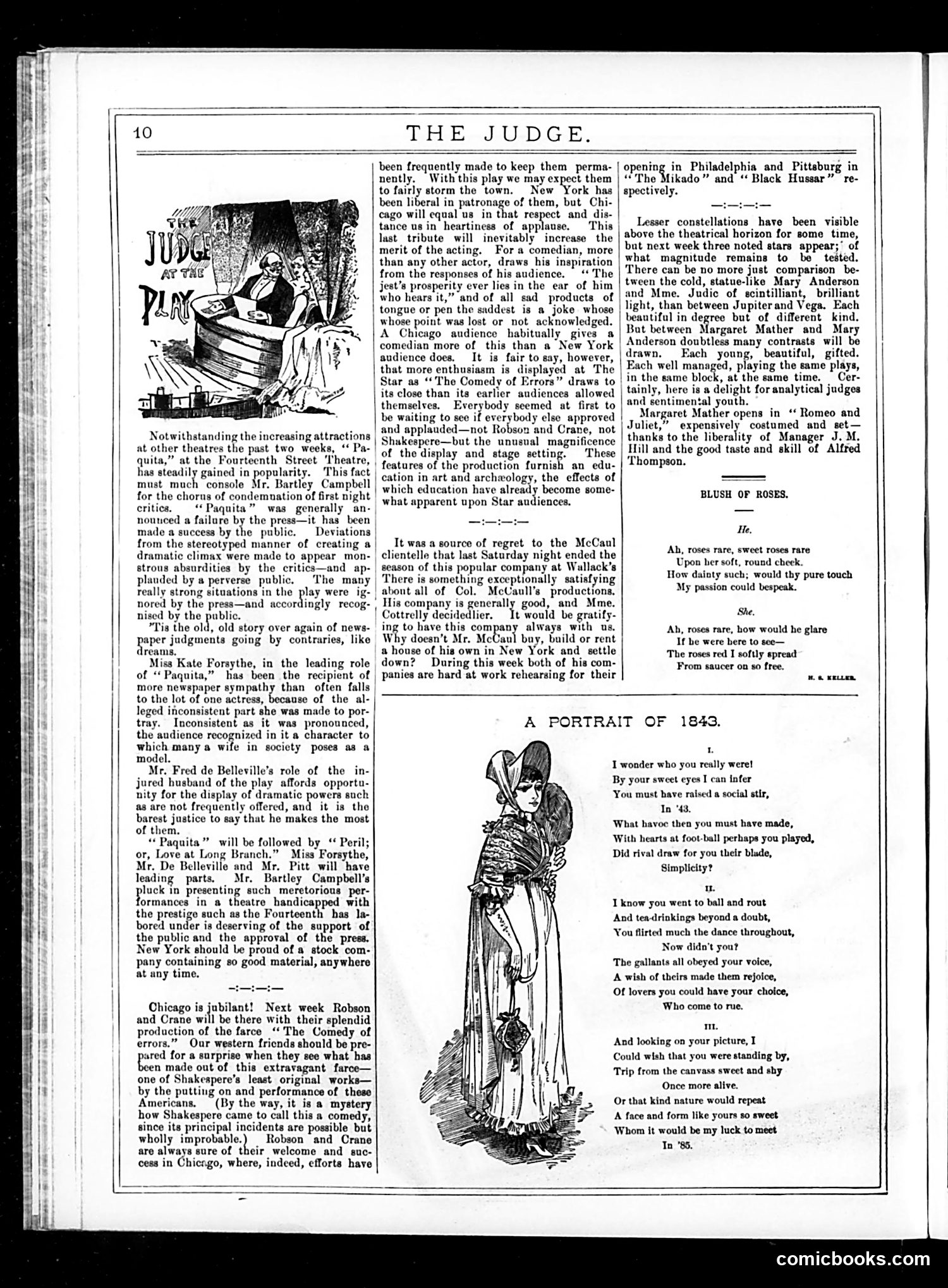
This page contains theater reviews from what appears to be the 1880s. The main cartoons and commentary discuss: **"Paquita" at the Fourteenth Street Theatre**: The review praises the play's public success despite initial critical failure, highlighting Miss Kate Forsythe's performance as the lead. The critic notes the irony that critics condemned it while audiences embraced it—a common tension between professional reviewers and popular taste. **Robson and Crane's "The Comedy of Errors"**: Anticipating their Chicago performance, the reviewer celebrates their Shakespeare adaptation, playfully mocking both the original play's implausibility and the mystery of Shakespeare calling it a comedy. **The Poetry Section ("A Portrait of 1843")**: A sentimental poem about a woman from an earlier era, questioning her identity and life choices. The page reflects Victorian-era theater culture, critic-versus-audience debates, and the celebrity status of popular actors. The satire targets the pretension of theater critics who dismiss what audiences genuinely enjoy.
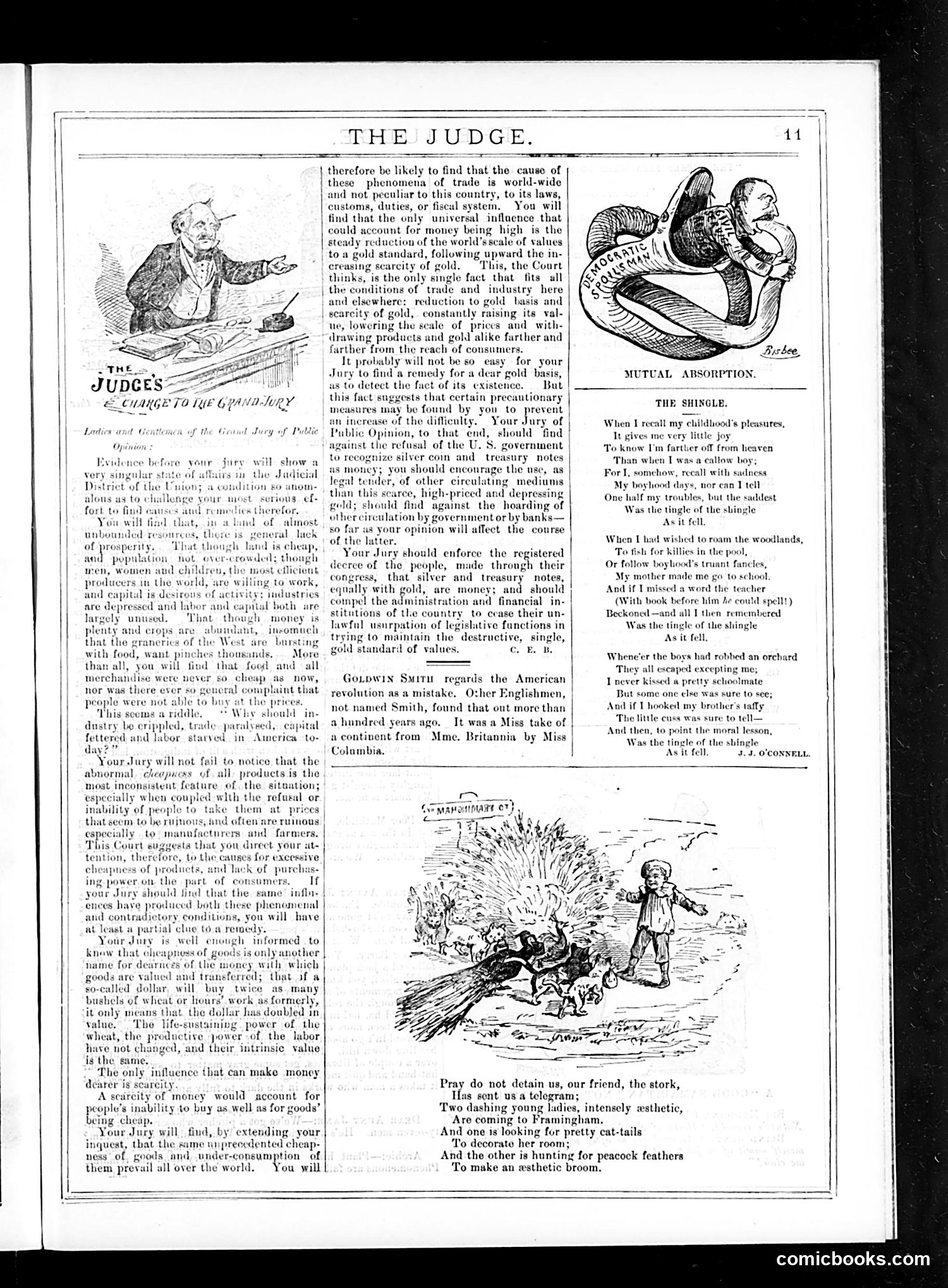
This page from the satirical magazine *Judge* addresses the economic paradox of the 1890s: widespread industrial depression despite abundant cheap goods and willing workers. The main feature is "The Judge's Charge to the Grand Jury of Public Opinion"—a long judicial address using courtroom language to frame economic analysis as a legal investigation. The judge (illustrated left) argues that money scarcity, not overproduction, causes the crisis. He traces this to the gold standard's restrictive effect on currency supply, which deflates prices, reduces purchasing power, and paralyzes commerce. The cartoons supporting this text show "Mutual Absorption" (two figures locked together) and illustrate the economic entanglement. A separate poem, "The Shingle," appears unrelated—a nostalgic childhood reminiscence. The satire's point: treating economic policy as a legal case requiring jury deliberation, suggesting the government should recognize silver as legal tender alongside gold to increase money supply and restore prosperity.
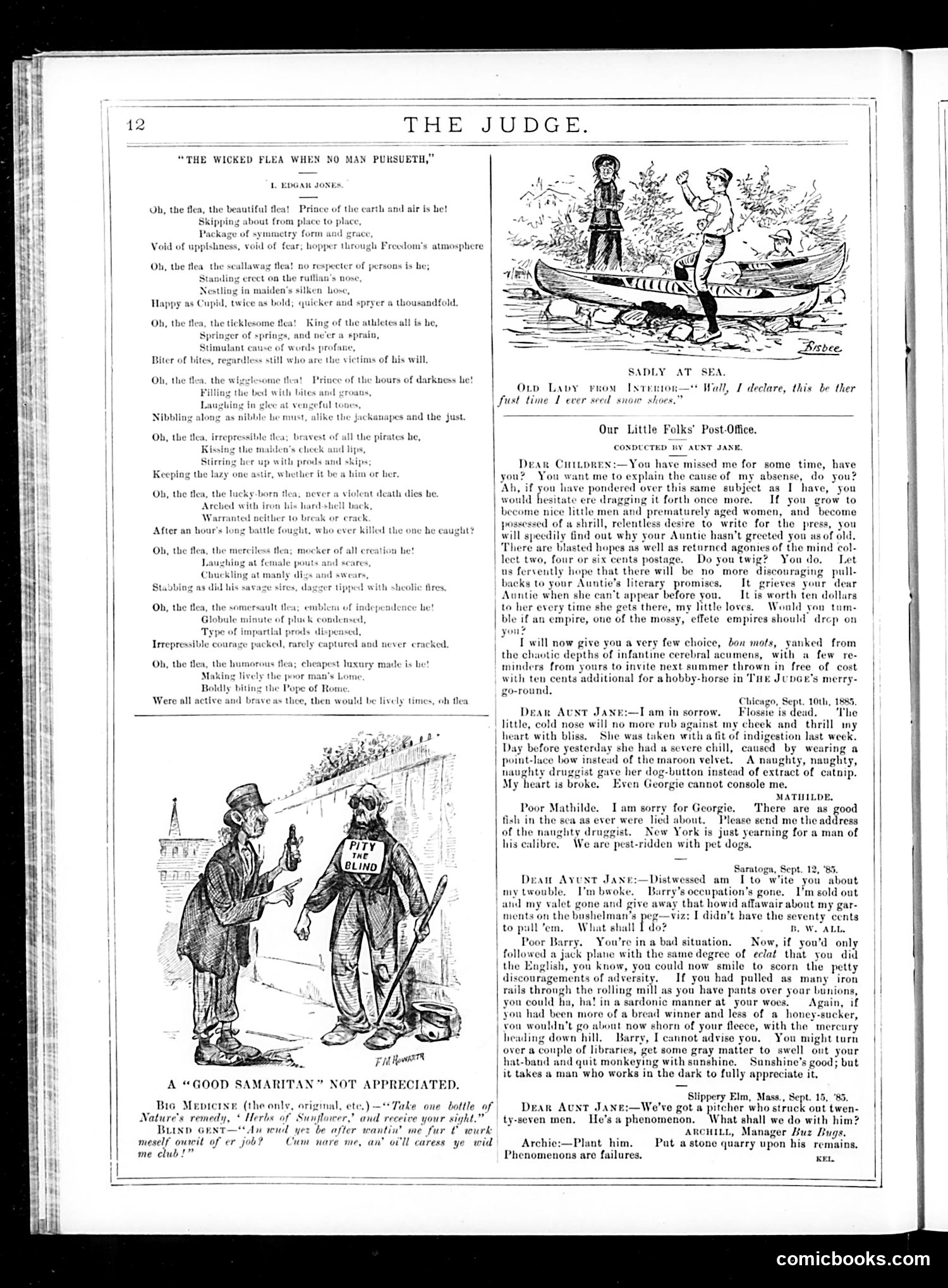
This page contains two distinct satirical pieces: **The Poem (top):** A mock-heroic celebration of the flea by I. Edgar Jones. It ironically praises the flea's virtues—its beauty, courage, and democratic disregard for social rank—using grandiose language. The satire mocks both the flea's actual pest status and possibly human pretension by elevating an insignificant nuisance to heroic status. **"A Good Samaritan" Not Appreciated (bottom):** Two comic characters exchange dialogue. One offers medical help ("Big Medicine") using "Nature's remedy" to restore the other's sight. The recipient responds ungraciously, complaining he's lost his job and wants money instead. The satire ridicules both false charity (the dubious "cure") and ingratitude, presenting a cynical view of urban poverty and charity relief efforts of the 1880s. The page exemplifies *Judge* magazine's use of humor to comment on social absurdities.
This page from *Judge* magazine contains mostly humorous prose and poetry rather than political cartoons. The main piece, "Mullins, the Agnostic," is a dialect poem satirizing religious skepticism through the character of William Mullins, a cantankerous farmer whose constant questioning of everything ("Now, how do ye know?") extends to his inability to maintain anything properly—his fields, fences, and even his own body become twisted and crooked. The joke culminates when his skepticism literally kills him: standing on railroad tracks, he refuses warnings with his signature phrase until a train scatters him. The satire targets rigid agnosticism and doubt-for-doubt's-sake as a foolish, destructive philosophy that paralyzes practical action. The "Sawdust" section contains brief social jokes, including religious humor about evangelist Sam Jones and commentary on marriage and modern life. The page reflects late-19th-century American skepticism toward both aggressive atheism and religious dogmatism.
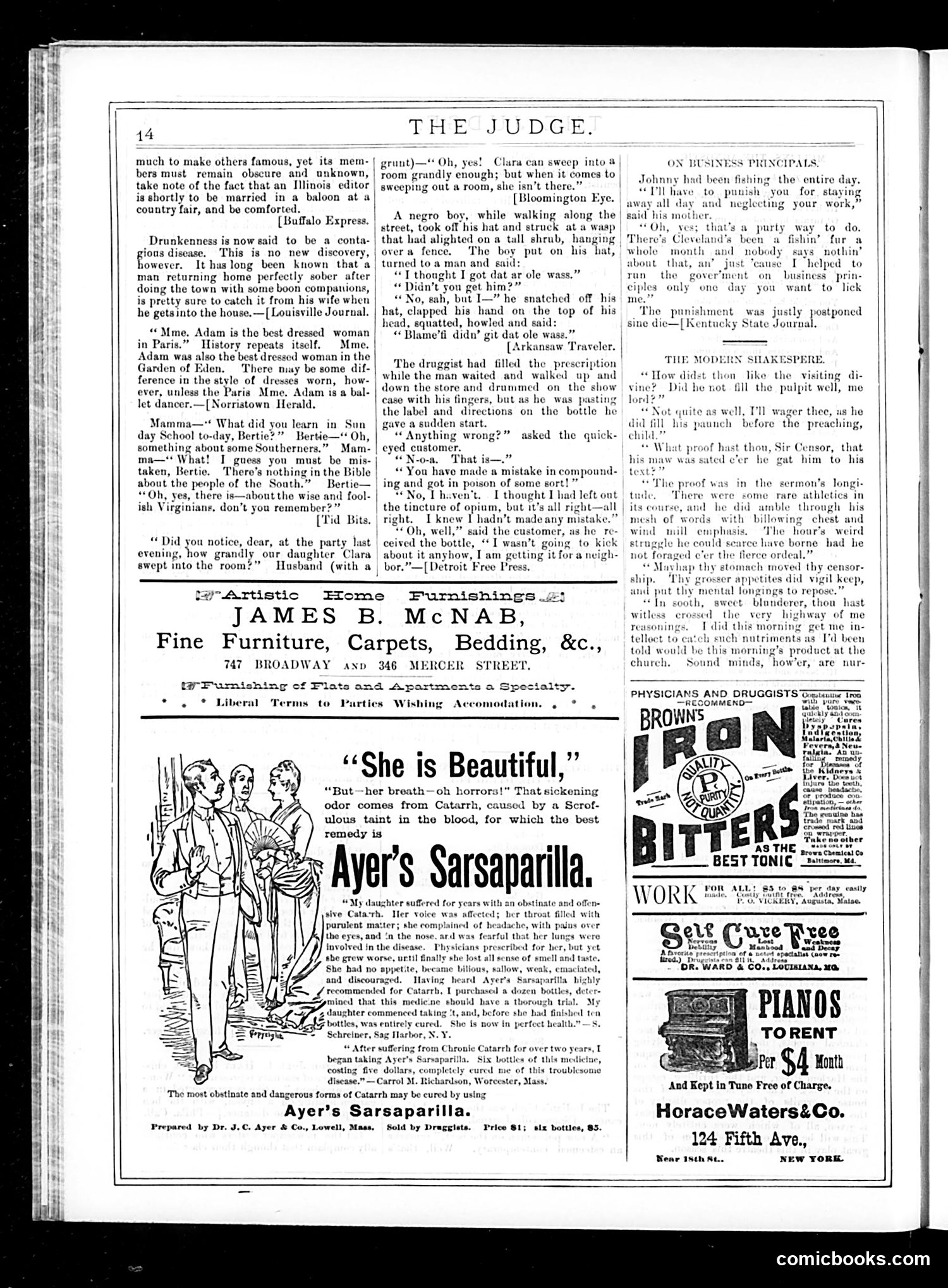
This page from *Judge* magazine contains several short humorous anecdotes and advertisements rather than a single political cartoon. The content includes satirical quips about contemporary life: a joke about a Black boy chasing a wasp, a dialogue about a woman's housekeeping skills, and a story about a druggist mislabeling medicine. There's also a parody titled "The Modern Shakespeare" mocking verbose preaching styles. The most substantive content is **Ayer's Sarsaparilla advertisement**, a patent medicine claiming to cure "Catarrh" (a vague respiratory condition). The ad features a testimonial from a "suffering" woman healed by the product—typical of late-19th-century advertising that exploited health anxieties to sell largely ineffective tonics. The remaining advertisements promote pianos for rent, furniture, and iron bitters "tonic." The satire is mild and localized rather than political—targeting social pretension, marital dynamics, and medical quackery rather than major political figures or events.
This page is primarily composed of period advertisements and brief humorous anecdotes rather than political cartoons. The content includes: **Advertisements:** Patent medicines (Pond's Extract), bicycles, electric belts, printing services, and medical devices typical of the era. **Humor pieces:** Short comic dialogues, including: - A rivalry between two young men named Phlit and Charlie over a girl - A woman who caught cold at the theater when she lost a note on her chest - A meeting between Attorney General Garland and an old acquaintance (Lem) who assumes Garland has left politics for carpentry The Garland piece appears to reference William Henry Hardin Gould Garland, a real political figure, used here for gentle satire about his departure from public life. The page reflects Judge's typical mix of commercial content and lighthearted social humor rather than sharp political satire.
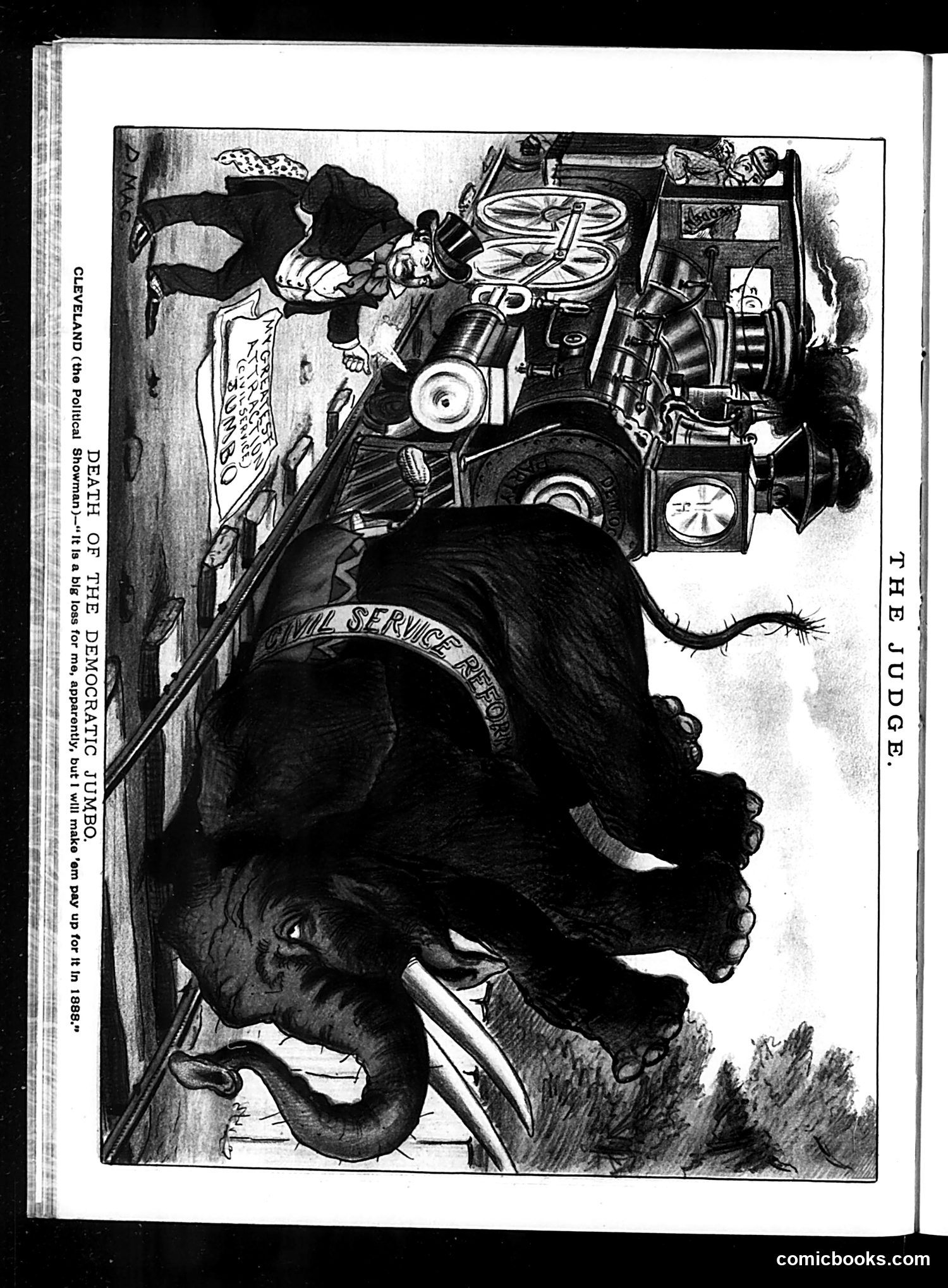
This political cartoon satirizes President Grover Cleveland as a circus showman mourning the death of a large elephant labeled "Civil Service Reformer." The elephant, representing the Democratic Party's commitment to civil service reform, lies dead while Cleveland calculates how to profit from its demise ("make 'em pay up for it in 1888"). The satire suggests Cleveland exploited civil service reform—a key Democratic platform promise—as a spectacle for political gain rather than genuine principle. The 1888 reference indicates this was published during Cleveland's reelection campaign. The "jumbo" (circus terminology) mockingly compares Democratic promises to a carnival attraction, implying the party treated reform as entertainment rather than substantive policy. The cartoon criticizes Cleveland's apparent opportunism and insincerity regarding the reform agenda.