
A complete issue · 16 pages · 1885
Judge — July 4, 1885
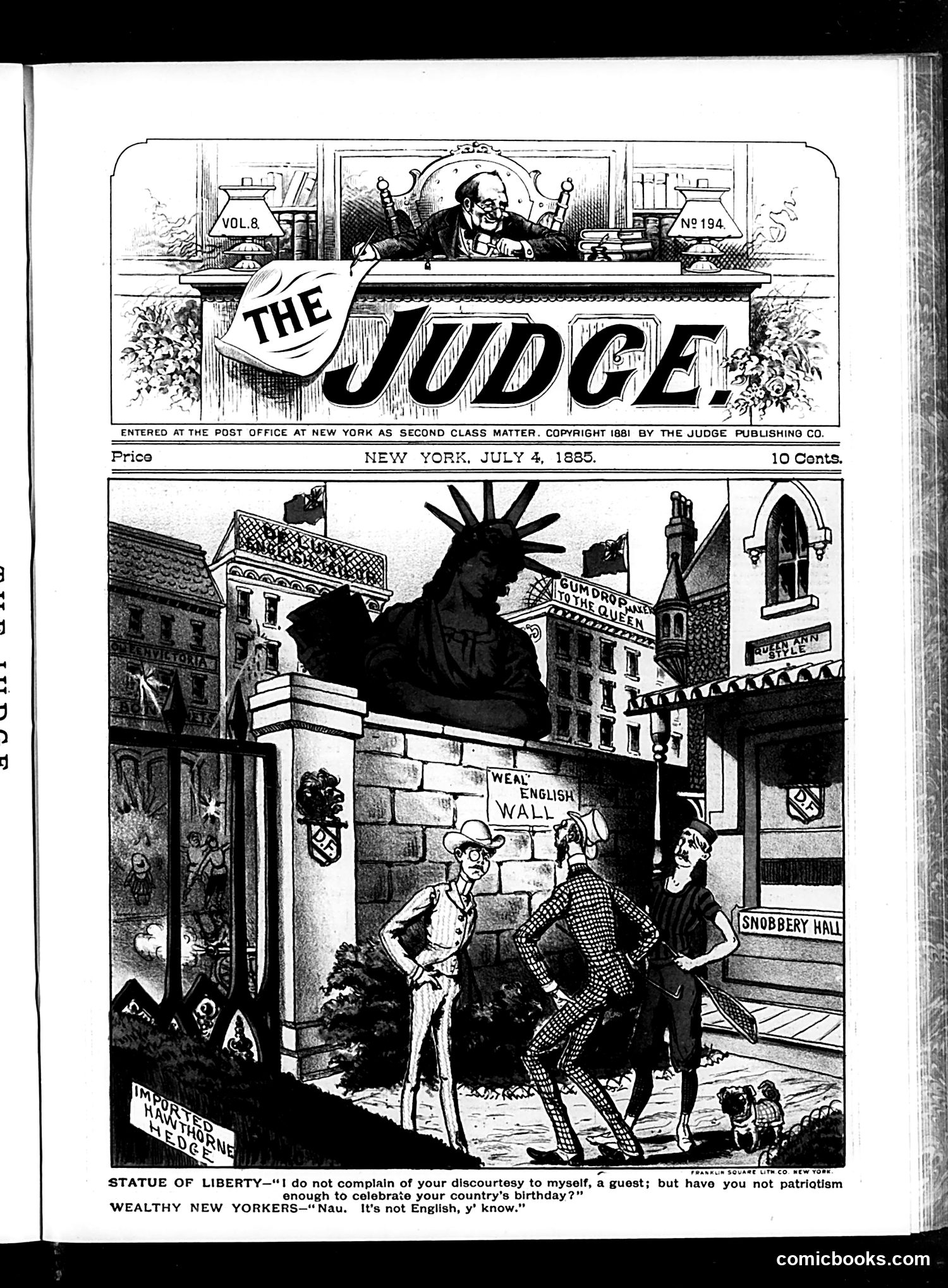
This cartoon satirizes wealthy New Yorkers' lack of patriotism on Independence Day. The Statue of Liberty (a recent gift from France, dedicated in 1884) confronts three well-dressed figures near a "Weak English Wall," asking if they have "patriotism enough to celebrate your country's birthday." Their response—"Nau... It's not English, y'know"—mocks the pretensions of wealthy Americans who mimicked English fashions and culture, viewing American identity as inferior to British customs. The cartoon criticizes this class for being so Anglophile that they cannot even summon patriotic feeling on the nation's founding day. The crude caricatures and exaggerated clothing emphasize the satire of their affectation and snobbery.
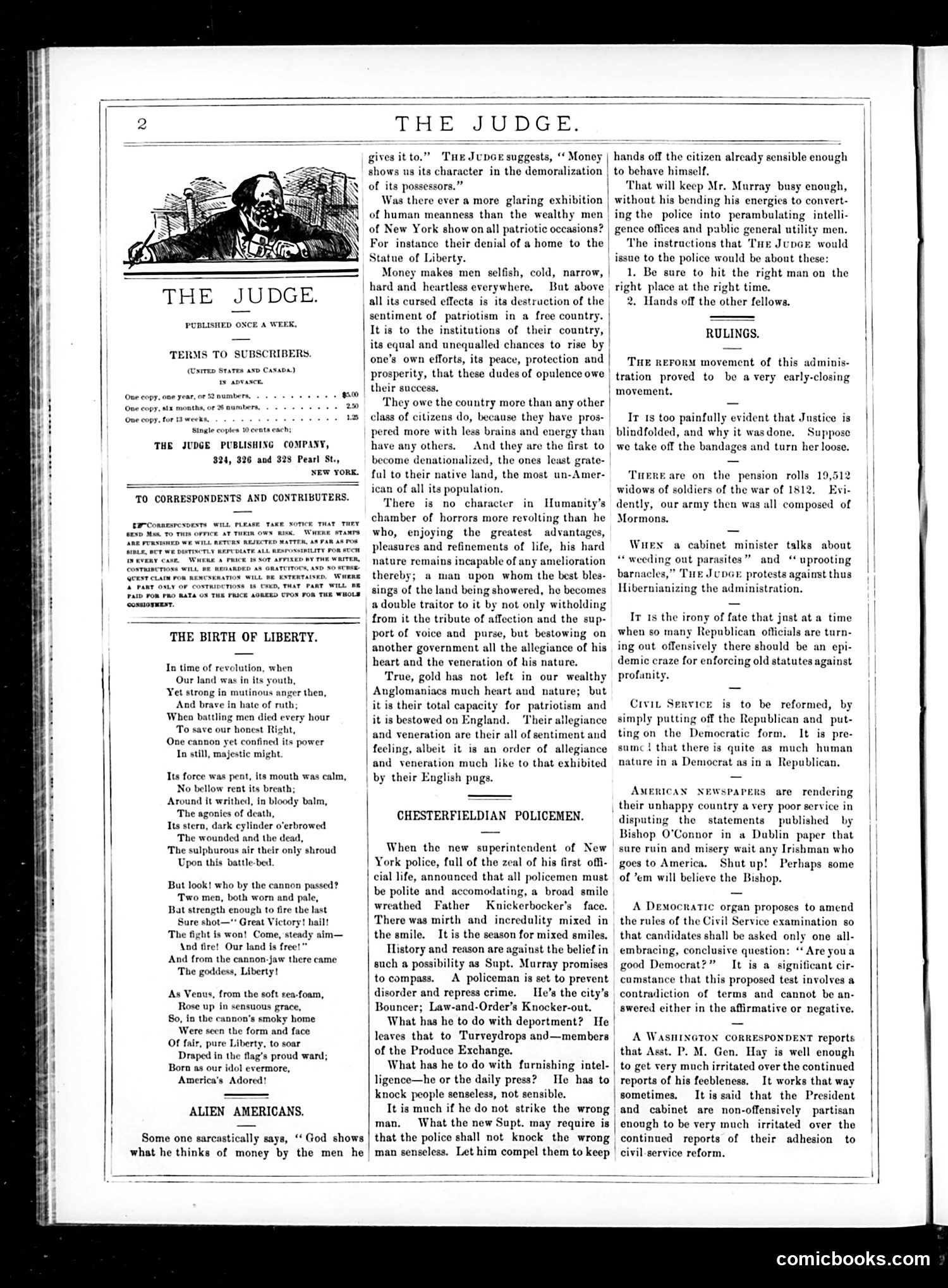
**The Main Cartoon ("The Birth of Liberty"):** This allegorical illustration depicts Liberty emerging from a cannon's mouth like Venus from the sea, born during America's Revolutionary War. It romanticizes patriotic sacrifice and national founding ideals. **The Editorial Content ("Alien Americans"):** Judge attacks wealthy New York businessmen—specifically those refusing to fund a home for the Statue of Liberty (a contemporary controversy). The magazine argues that rich men, having prospered from America's institutions, show ingratitude by: 1. Lacking patriotic sentiment 2. Being "demoralized" by wealth 3. Directing their allegiance toward England rather than America (Anglomaniac references) The satire suggests these wealthy elites are "alien" to American values despite their citizenship—more loyal to British culture and class interests than to their own nation. This reflects Gilded Age anxieties about industrialists' perceived un-American materialism and Anglophilia. The piece ultimately uses patriotic mythology to shame the rich into supporting public monuments.
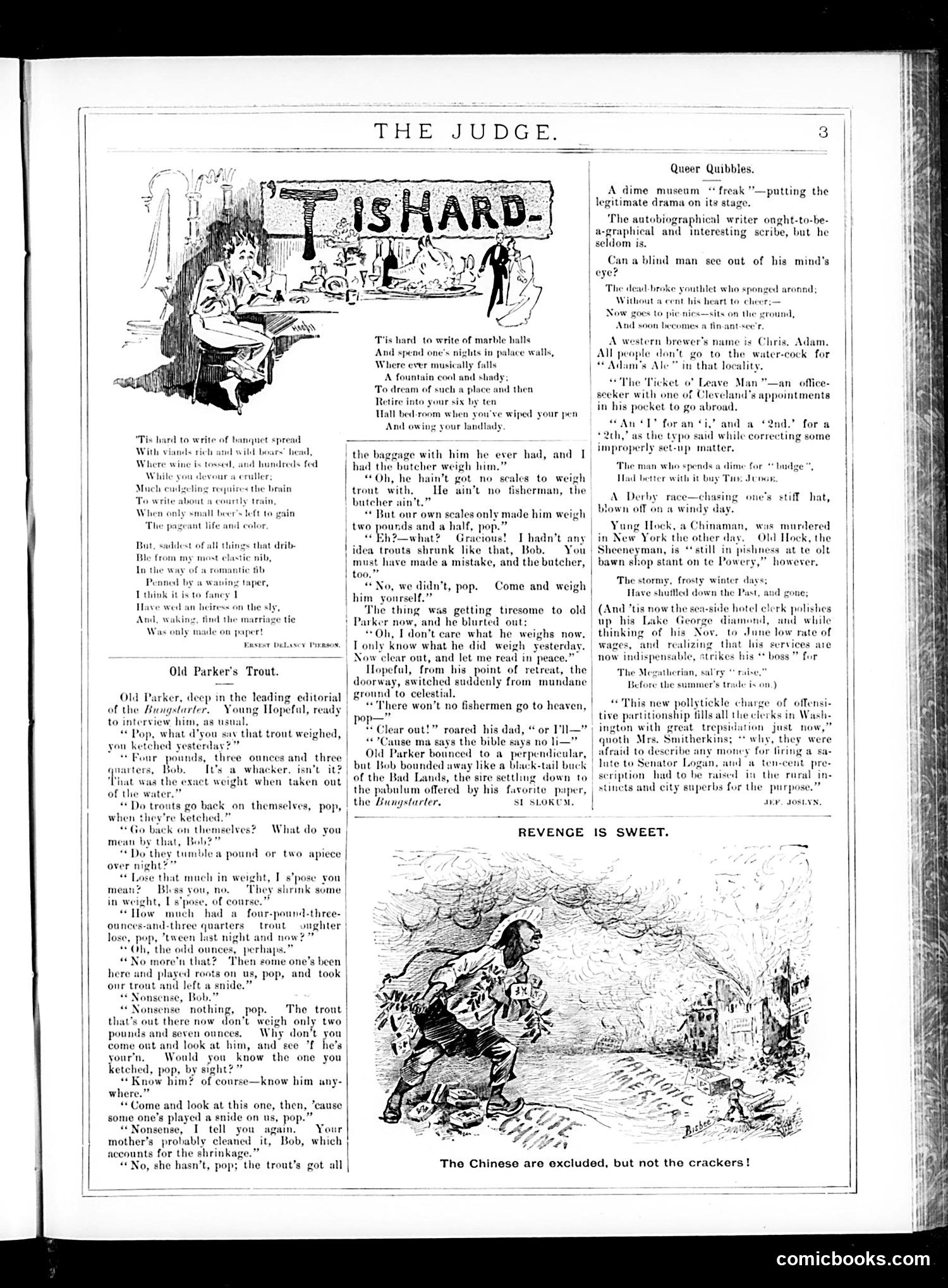
This page contains several satirical pieces typical of Judge magazine's social commentary. The main cartoon, captioned "The Chinese are excluded, but not the crackers!," appears to reference **Chinese Exclusion Act** tensions of the 1880s-90s. The image shows a figure (likely representing a white American "cracker" or lower-class white person) engaged in behavior the cartoonist presents as equally objectionable to Chinese immigration, creating ironic commentary: white criminals/undesirables aren't excluded from America despite being "unfit," yet Chinese laborers face blanket exclusion. The surrounding text snippets offer general satirical observations about writing, poverty, and urban life—typical Judge fare mocking pretentious literary aspirations and economic hardship. The juxtaposition suggests Judge's critique: America excludes Chinese people wholesale while tolerating native-born social problems.
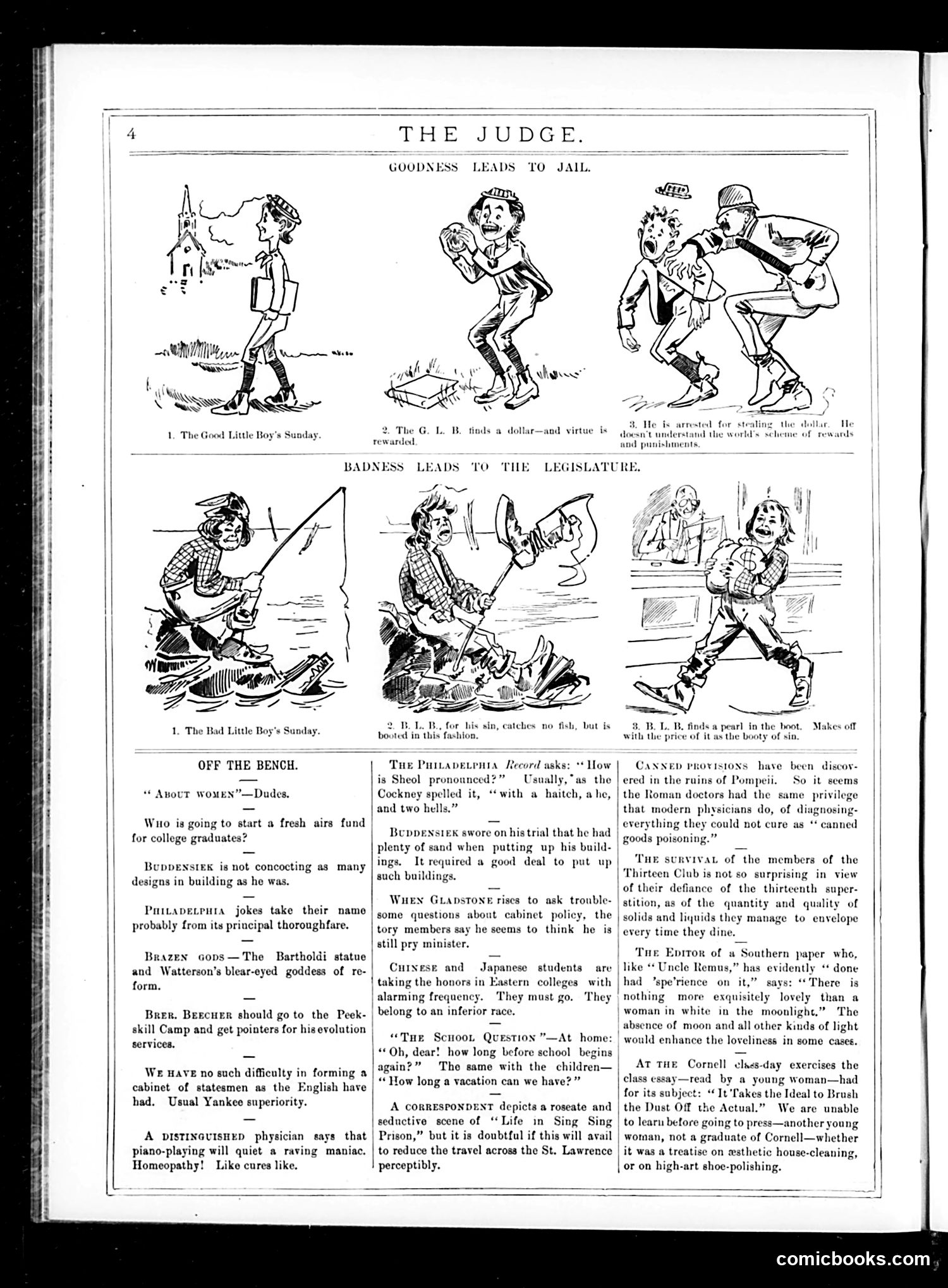
This page presents two parallel illustrated narratives contrasting moral outcomes: **"Goodness Leads to Jail"** mocks society's inverted values. A virtuous boy who finds a dollar and returns it gets arrested for theft, while a dishonest boy who steals and conceals stolen goods escapes punishment. The satire critiques a corrupt system where honesty is punished and crime rewarded. **"Badness Leads to the Legislature"** extends this theme: a morally corrupt figure engaged in destructive behavior (fishing destructively, stealing) prospers and eventually reaches political office. The implication is that corruption is the pathway to legislative power. The accompanying "Off the Bench" section contains brief satirical quips about public figures and contemporary issues—Gladstone's cabinet politics, Chinese/Japanese students at American colleges, pronunciation debates, and social observations. The overall message: Victorian-era Judge magazine satirizes systemic hypocrisy, suggesting that American institutions reward vice while punishing virtue, and that political success correlates with moral corruption rather than merit.
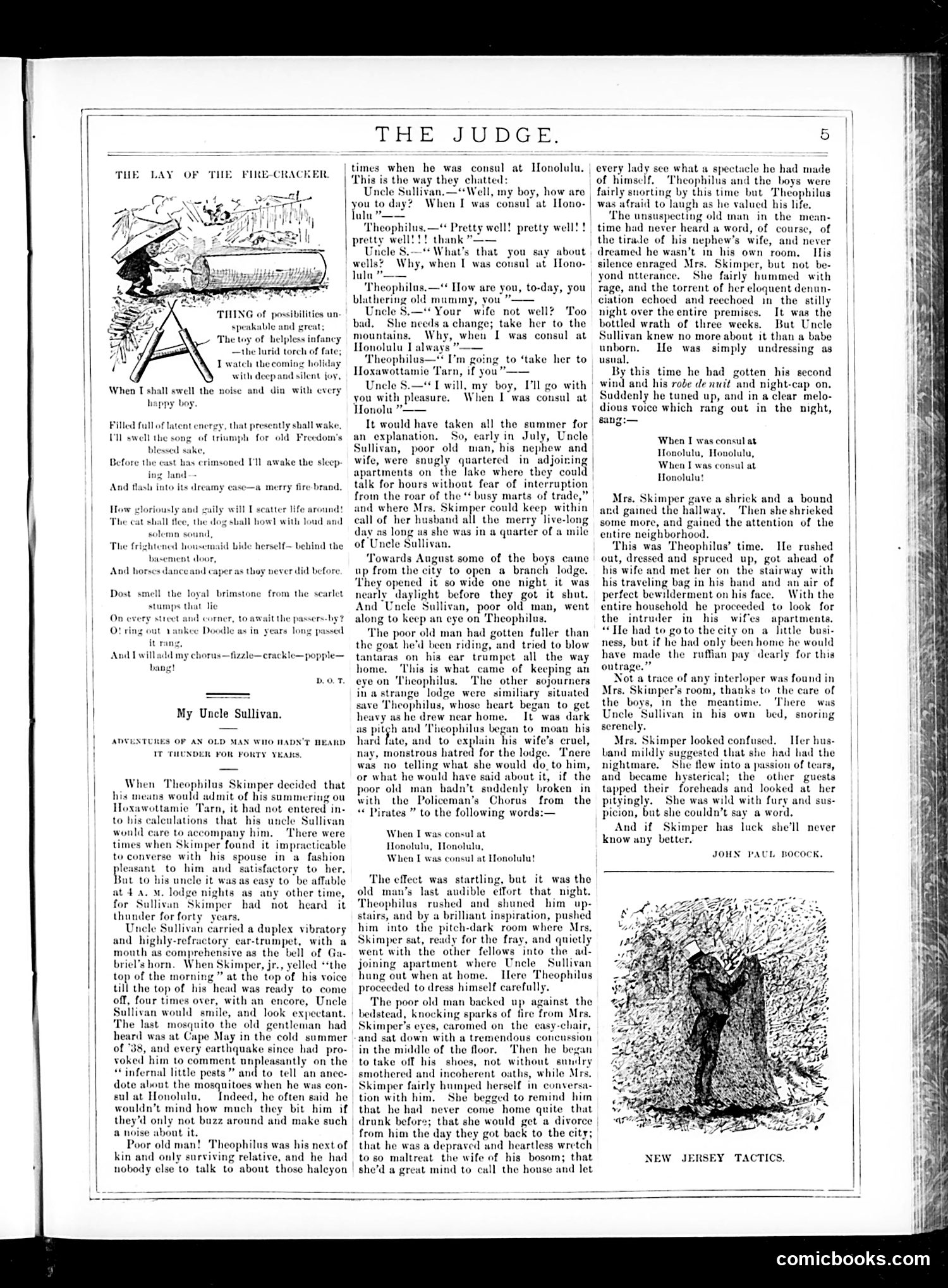
This humorous story-cartoon satirizes a particular social type: the tedious bore who constantly references his own past importance. Uncle Sullivan, apparently a retired consul at Honolulu, annoys everyone by constantly prefacing every comment with "When I was consul at Honolulu." The joke targets self-aggrandizing elderly men who dwell obsessively on their former positions and accomplishments, regardless of context or audience interest. The satire works by showing how Uncle Sullivan's repetitive boasting isolates him from family life—his nephew's wife despises him, yet he remains blissfully unaware, still launching into the same tired refrain even after a drunken night out. The cartoon mocks both his obliviousness and the universal experience of enduring such unbearable reminiscence from older relatives. The humor relies on exaggeration of a recognizable social annoyance rather than specific political reference.
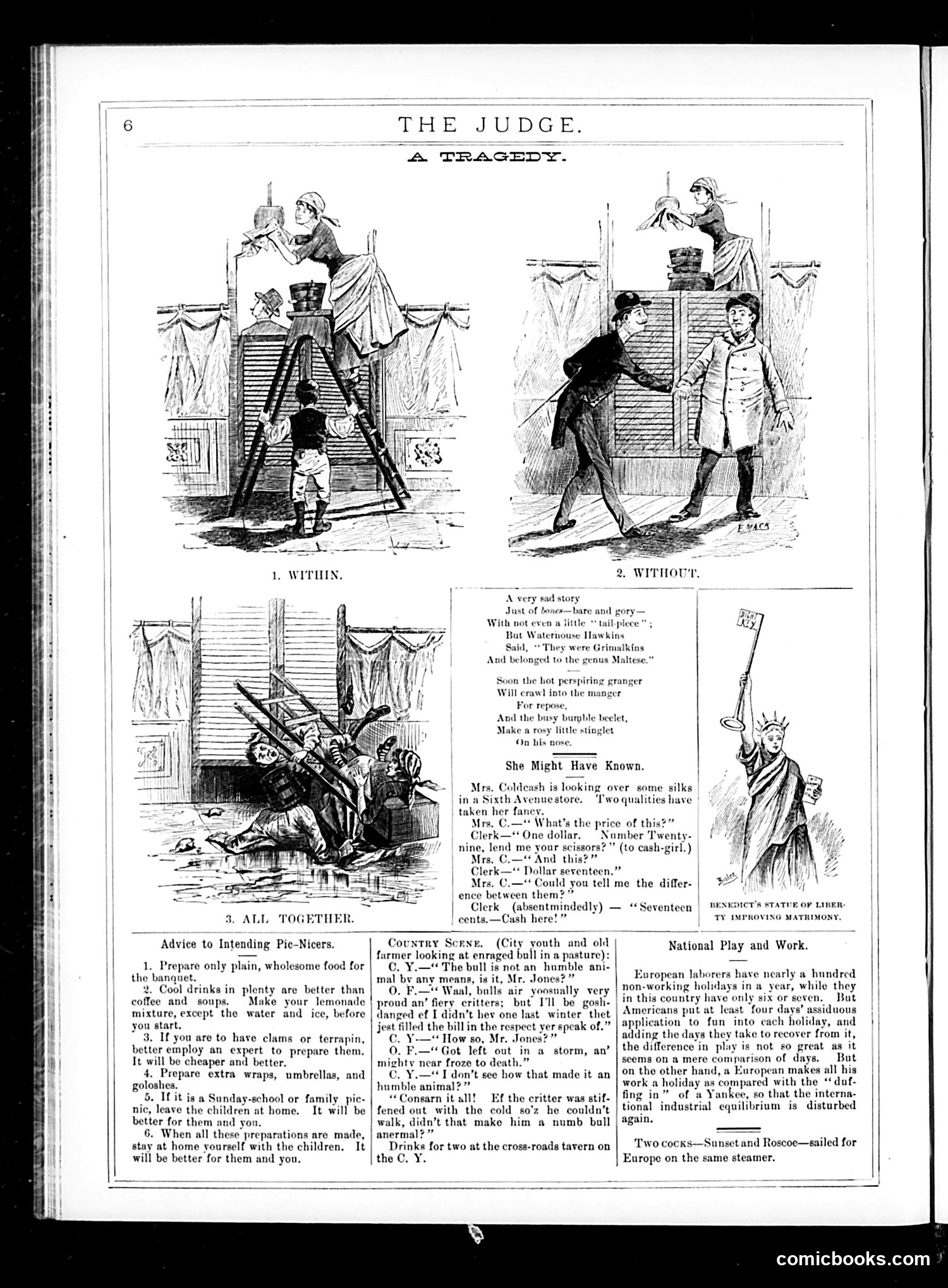
This page presents three related satirical cartoons about judicial proceedings, titled "A Tragedy." The three panels labeled "Within," "Without," and "All Together" appear to depict courtroom scenes involving executions or severe punishment, with figures in formal dress and gallows-like structures visible. The accompanying text is mostly humorous advice and anecdotes unrelated to the main cartoon—notably, satirical "picnic tips" that humorously conclude one should "stay at home" instead, and a story about a woman shopping for silks who misses a price difference joke. **The core satire appears to critique the judicial system itself**—likely commenting on capital punishment or the severity of court verdicts—though the specific case or controversy referenced isn't entirely clear from the image alone. The juxtaposition of formal justice proceedings with the trivial, mundane text below may suggest ironic commentary on how serious legal matters appear in public discourse. The exact political or legal event being satirized requires additional historical context beyond what this page supplies.
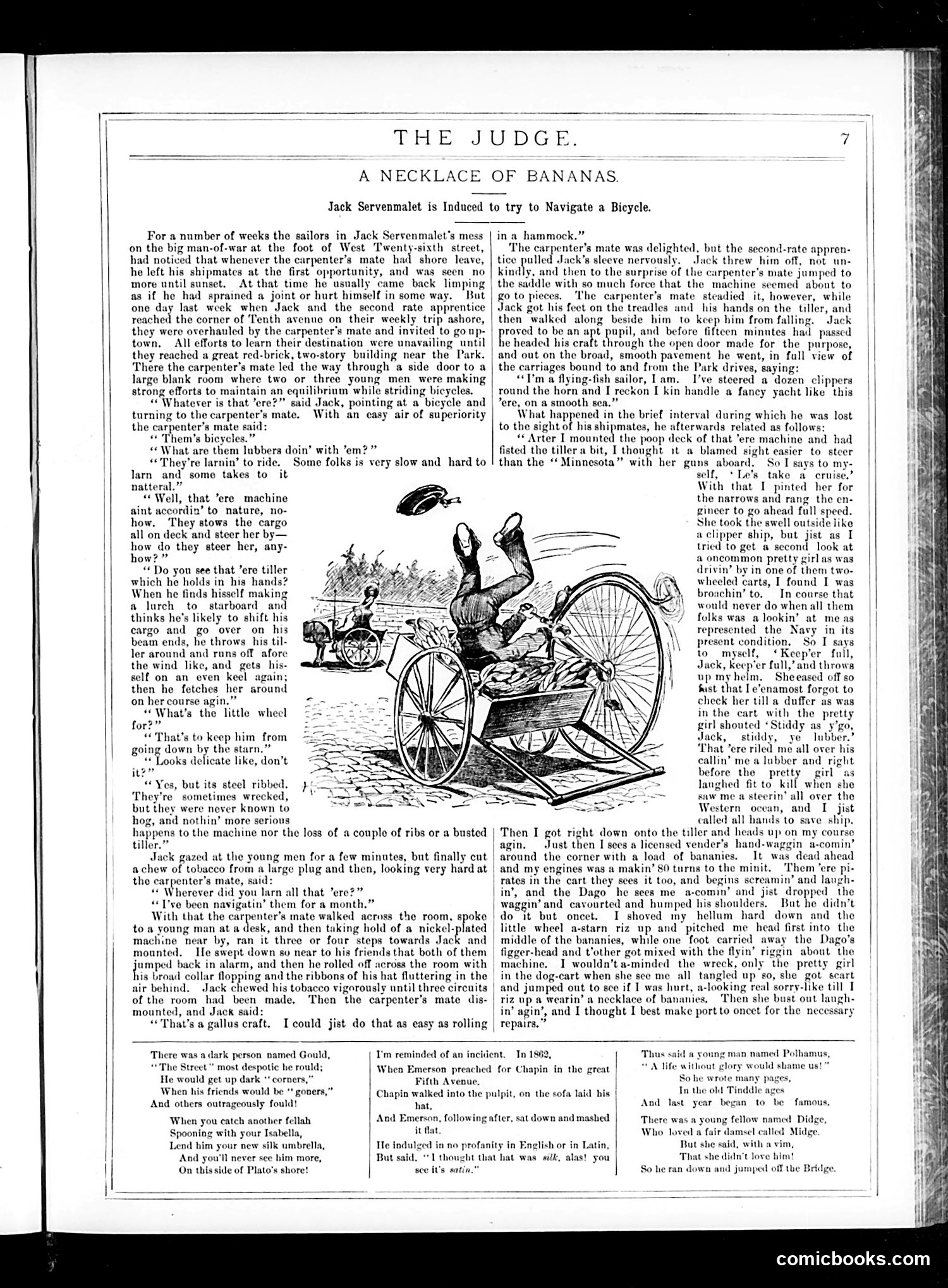
This is a comedic story about Jack Servenmalet, a Navy sailor, attempting to ride a bicycle for the first time. The humor derives from translating bicycle mechanics into nautical terminology—a carpenter's mate (an experienced sailor) explains the bicycle to Jack using ship language: the handlebars are a "tiller," maintaining balance is "keeping even keel," the small wheel prevents going "down by the stern." The satire mocks both sailors' unfamiliarity with modern technology and the era's class/occupational dialect humor. The title "A Necklace of Bananas" appears to reference the story's punchline (bananas mentioned in the text as cargo), playing on the absurdity of the situation. The accompanying illustration shows men learning to ride bicycles—a relatively novel activity for the 1880s-90s period. The humor relies on audience recognition that bicycles were still exotic machines requiring instruction, particularly amusing to working-class sailors encountering urban leisure technology.
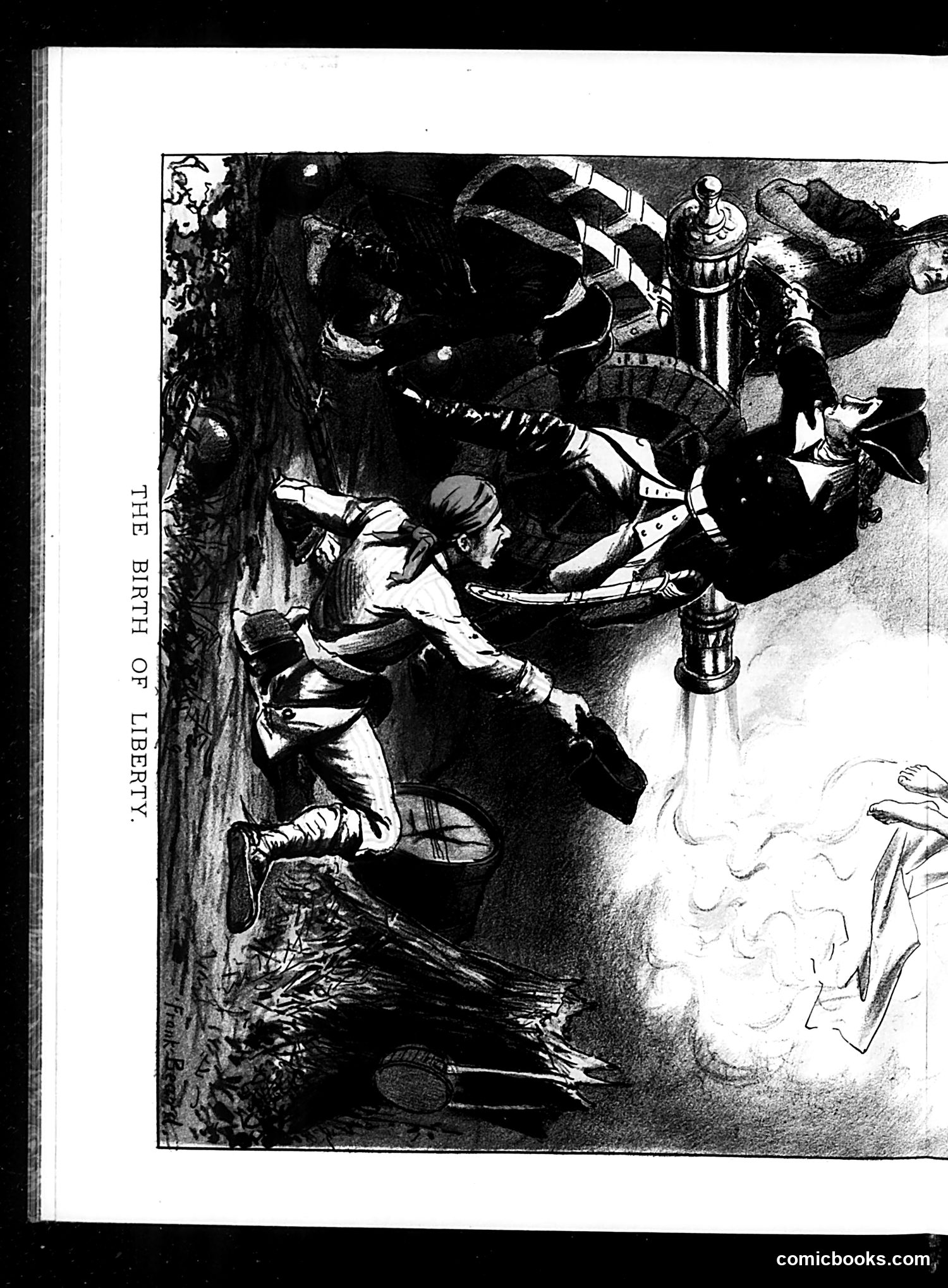
This appears to be a symbolic/allegorical illustration rather than a political cartoon with specific contemporary figures. The title "THE BIRTH OF LIBERTY" (visible on the left margin) suggests it depicts the founding or creation of American independence. The image shows dramatic action: a figure in period dress (likely representing a Founding Father or revolutionary) appears to be actively engaged in some struggle or effort, with horses, military equipment, and smoke visible. The style and composition emphasize heroic struggle and effort rather than mocking satire. Without a date on the visible page, the specific historical moment referenced remains unclear, though the revolutionary/foundational imagery suggests commentary on American origins or independence. This reads as celebratory rather than satirical in intent.
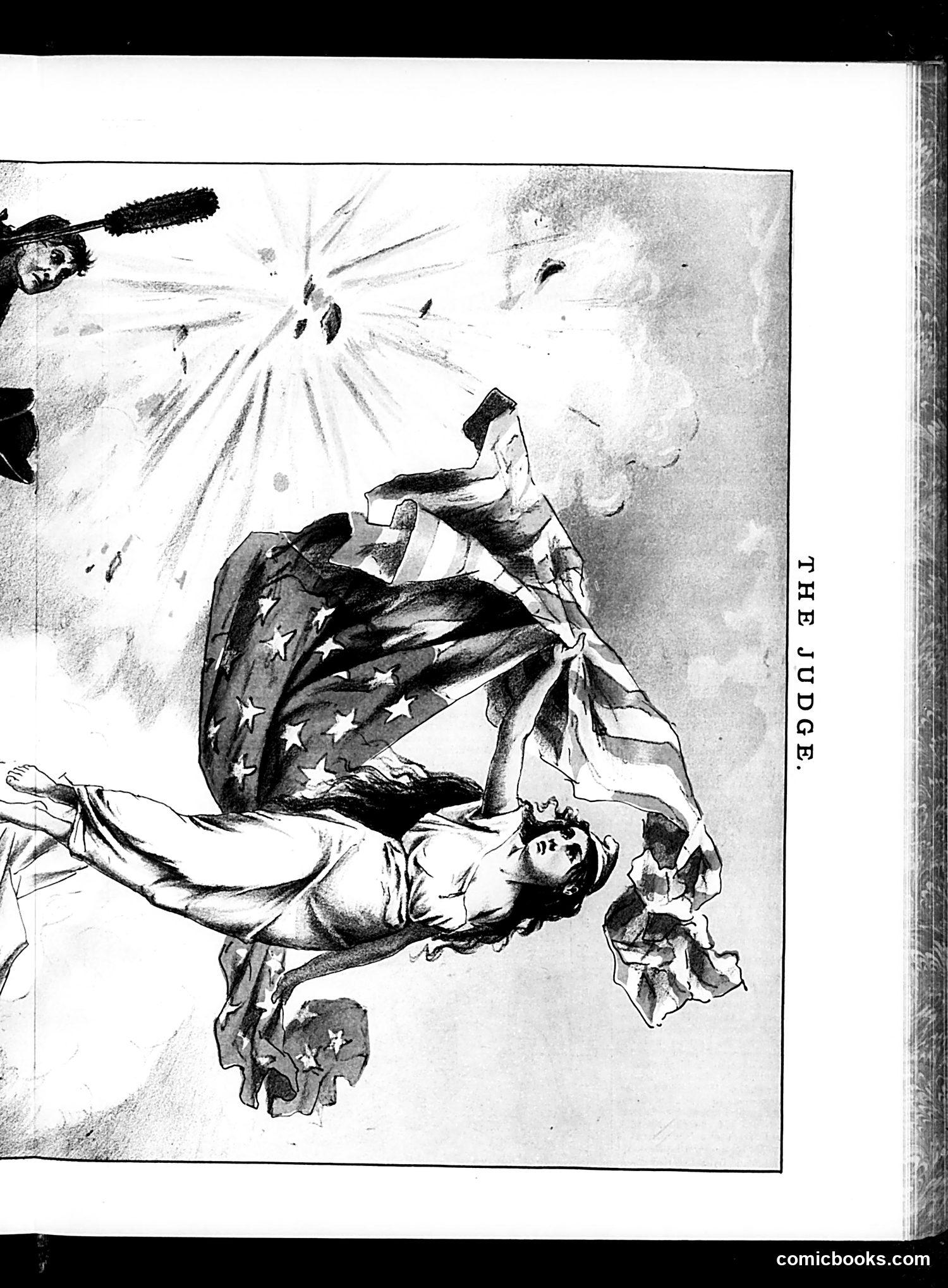
This appears to be a political allegory cartoon titled "The Judge." The image shows a female figure (likely representing Justice or America, suggested by the star-spangled garment) wielding a large gavel or judge's mallet. She stands over a prone male figure below her, with radiating lines suggesting forceful impact or judgment. The cartoon seems to depict justice being administered or judgment being rendered upon the figure beneath. Without clearer context about the specific date or political circumstances, the exact identity of the figure being judged remains unclear. The visual metaphor emphasizes the power and authority of judicial force, though the specific historical event or political situation this references cannot be determined with certainty from the image alone.
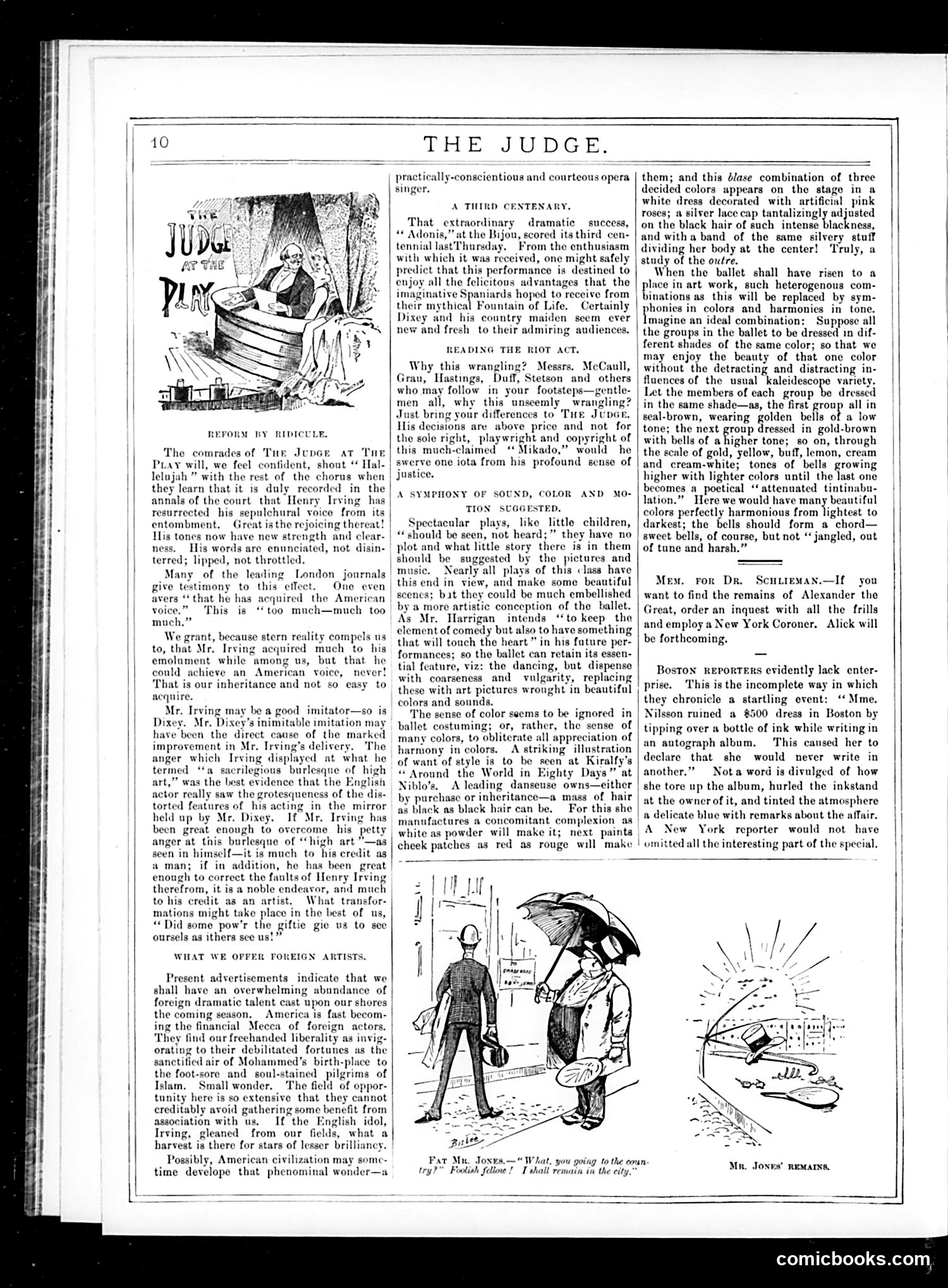
This page satirizes Henry Irving, the celebrated English actor, through a piece titled "Reform by Ridicule." The text praises Irving for improving his theatrical delivery after being mocked by Mr. Dixey (who apparently performed a burlesque parody of Irving's exaggerated acting style). The satire suggests that ridicule can actually improve performers—Irving supposedly corrected his faults after seeing himself mocked in a mirror held up by satire. The page also discusses the theater boom attracting foreign actors to America for financial gain, and debates about operatic productions like "Adonis" and "The Mikado." Two cartoon illustrations show theatrical scenes, including one captioned "Pat Mr. Jones" about someone remaining in the city despite travel plans. The overall thrust: public ridicule of theatrical pretension can be constructive reform.
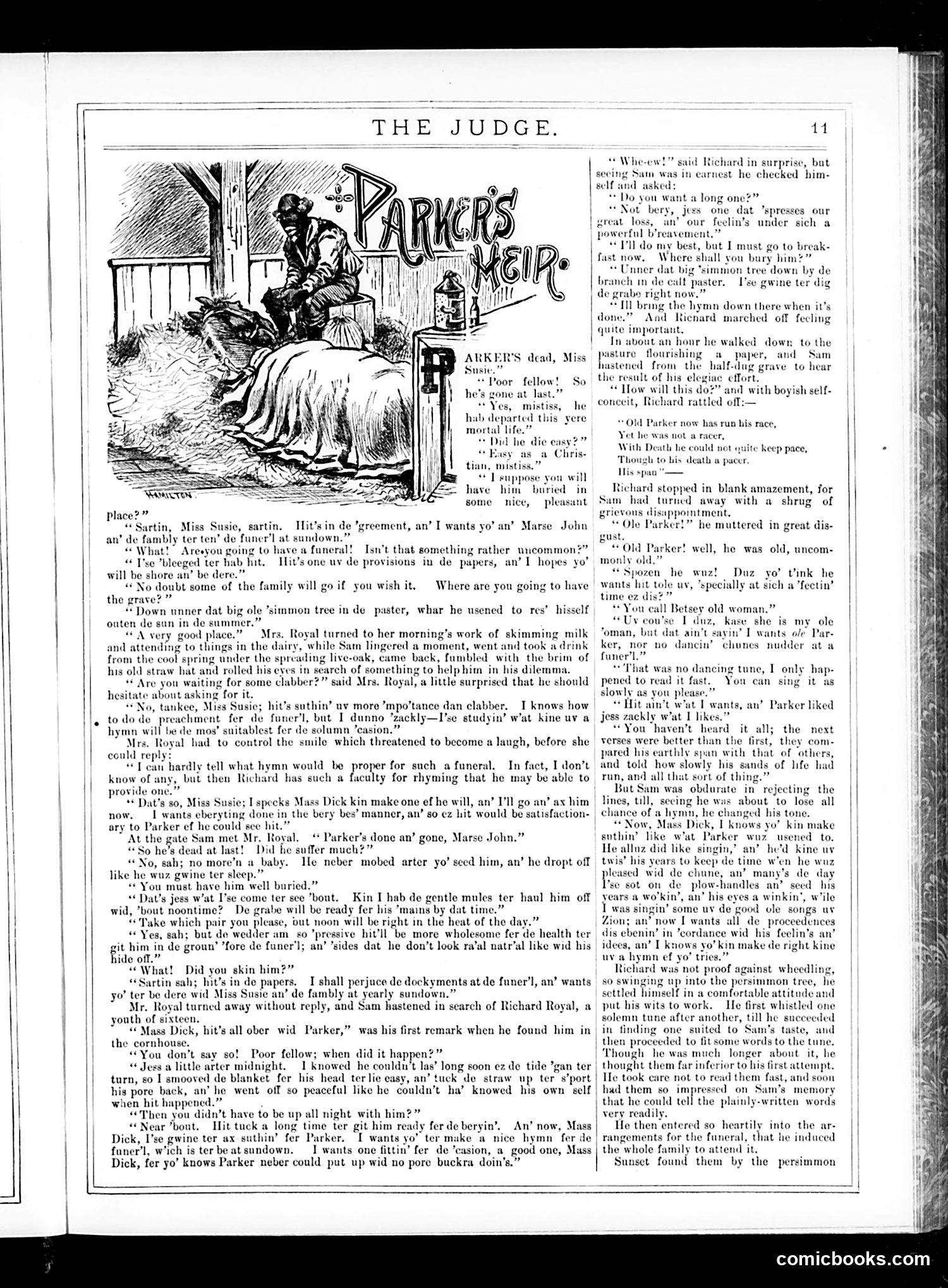
This story-cartoon depicts a deceased enslaved man named Parker and the arrangements for his funeral, told through dialect-heavy dialogue between Sam (Parker's friend) and white characters Mrs. Royal and her son Richard. The satire targets **sentimental rural funeral practices and the earnestness of Black mourning rituals** as viewed through a patronizing lens. Sam's insistence on a proper funeral—complete with a hymn composed specifically by Richard—becomes comedic to the white characters, who find his solemnity over a dead laborer excessive or amusing. The humor relies on **exaggerated dialect** and **Sam's dignified determination** contrasted with the white characters' casual dismissal ("Poor fellow"). Richard's attempted hymn and Sam's rejection of it for being insufficiently respectful adds ironic layers. The piece reflects **late 19th-century Judge magazine attitudes**: simultaneously mocking Black expression while depicting genuine emotional bonds among enslaved/formerly enslaved people—attitudes that modern readers would recognize as deeply racist stereotyping.
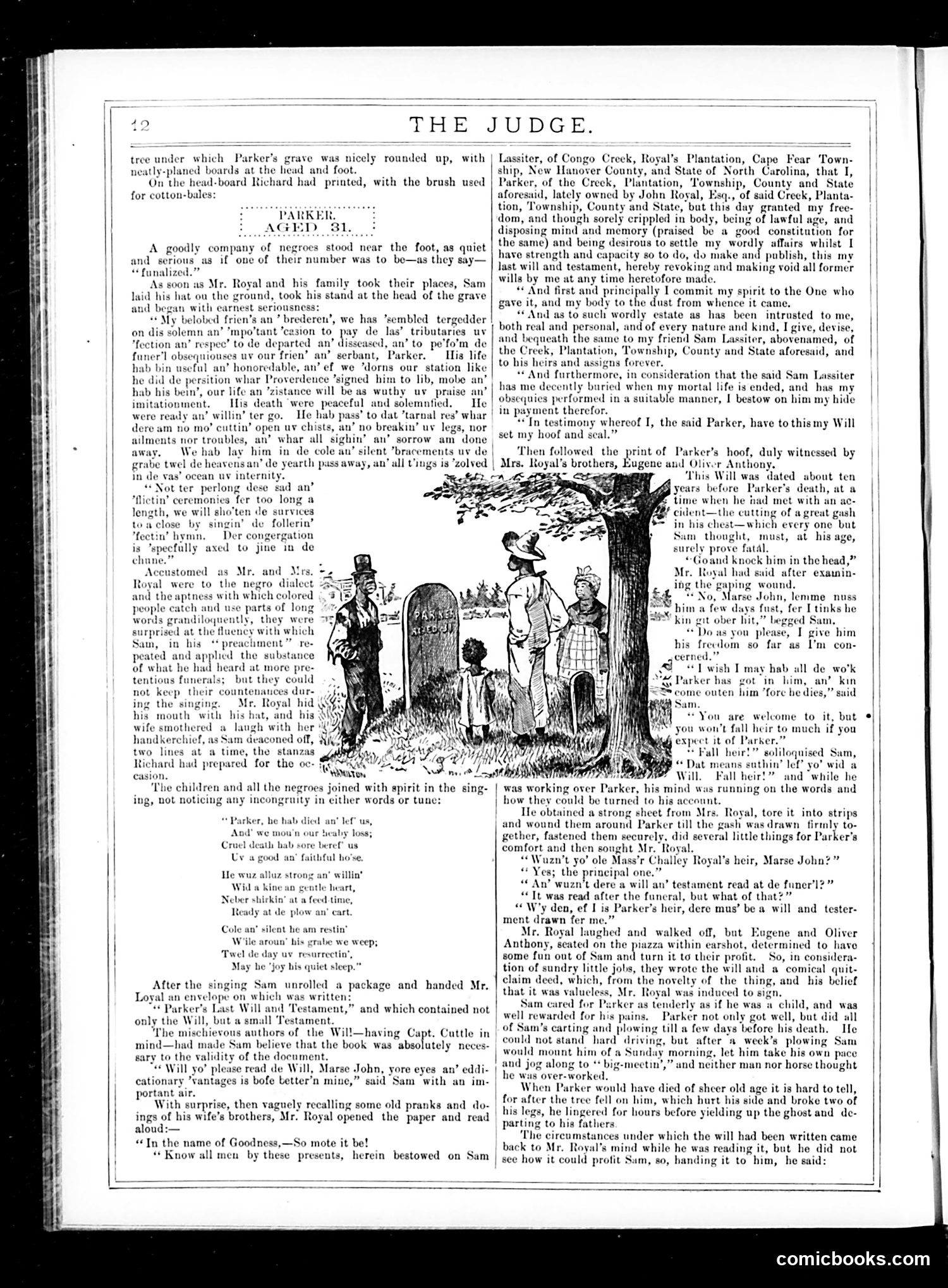
This page depicts the funeral of Parker, an enslaved man on a Southern plantation. The central cartoon shows his grave being blessed by Sam, the plantation's enslaved preacher, while white onlookers (Mr. and Mrs. Royal) struggle to suppress laughter at the proceedings. The satire targets the patronizing attitudes of white Southerners toward enslaved people. Sam's dialect-heavy sermon—phonetically exaggerated throughout—and his earnest solemnity about a horse's death become the joke's focal point. The Royals find humor in the perceived incongruity between Sam's flowery religious language and his lack of education. The accompanying text reveals Parker was actually granted freedom in Mr. Royal's will—a detail the Royals withheld from Sam, planning to profit from it. The satire ultimately mocks white hypocrisy: they mock enslaved people's speech and dignity while exploiting them financially, even in death. This reflects *Judge* magazine's Northern, anti-slavery editorial stance, using ridicule of Southern racial attitudes as its primary weapon.
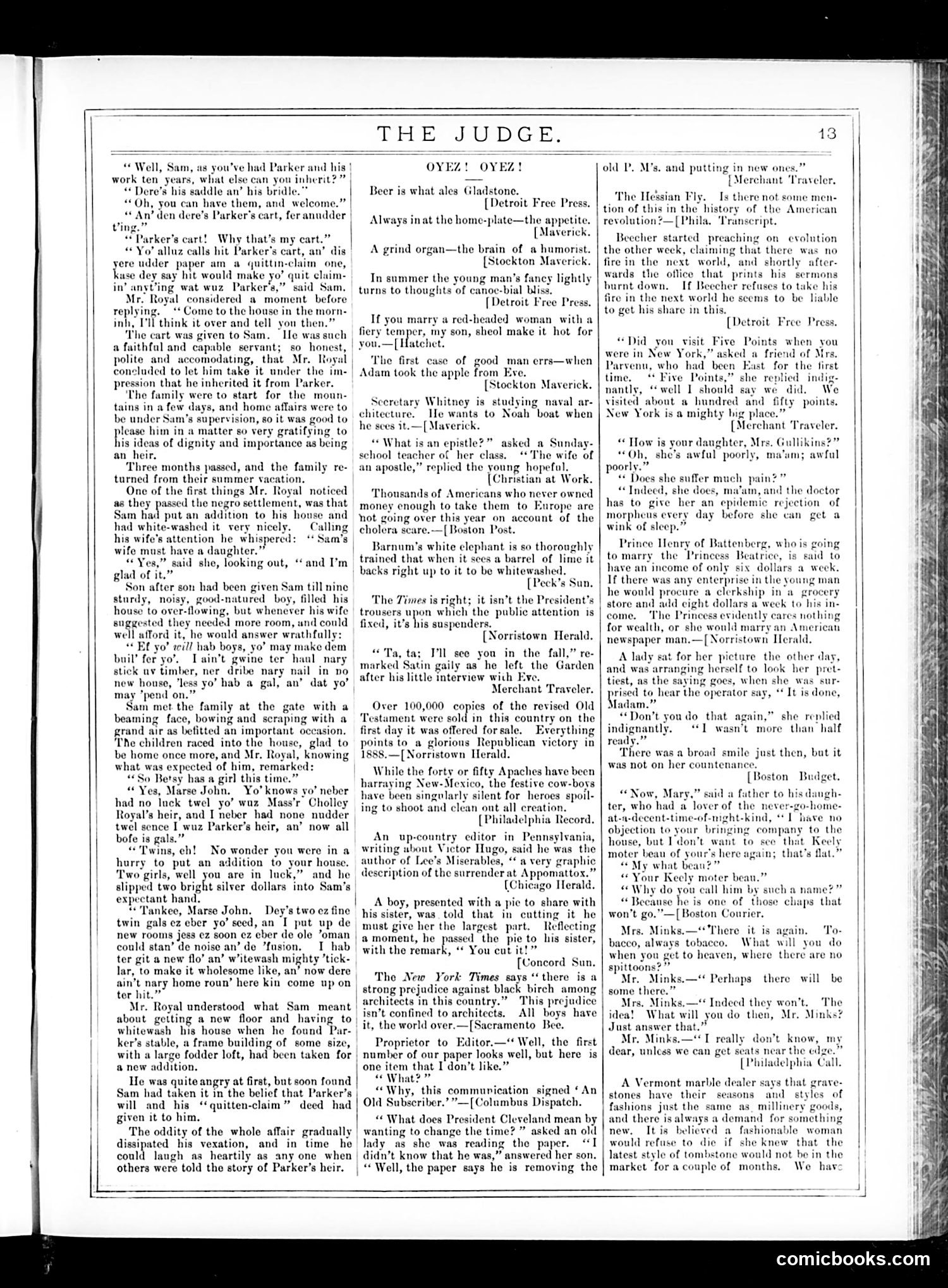
This page is primarily **textual humor and advertisements**, not political cartoons. The content includes several humorous anecdotes and a prominent advertisement for Brown's Iron Bitters. The notable satirical pieces are brief: 1. **"What an M.C. Will Stand"**: A congressman is willing to tolerate almost anything—including his future father-in-law painting the town red—if it means securing a wealthy marriage. This mocks the perceived mercenary nature of politicians and their flexibility on principles. 2. **"Bill Nye's Vision"**: A tall tale about a romantic fantasy of a beautiful woman at a hotel, deflated when the author realizes she's deliberately using her diamond ring for attention. It satirizes male vanity and attraction. 3. **Various short quips** criticize foreigners' political opinions, saloon-keeper interests, and customs enforcement absurdities. The **Brown's Iron Bitters advertisement** dominates the right side, featuring a Victorian house illustration—typical patent medicine marketing of the era claiming curative properties.
This page is primarily **advertising**, not satirical content. It's from Judge magazine (page 15) and contains two brief anecdotal humor pieces alongside numerous patent medicine and product ads typical of the era. The two jokes are: 1. A domestic story about a newly married couple where the wife mentions her mother will live with them "like her own son." The husband, taking this literally as a reference to a previous marriage, abruptly leaves and never returns—the satire being on masculine insecurity and misunderstanding. 2. A child at a concert is frightened by an "encore," thinking something went wrong. His mother jokes the singer is "done," and the next morning he claps at breakfast, hoping the meal is finished—simple wordplay humor. The ads promote period remedies (Pond's Extract, Dr. Pierce's "Golden Medical Discovery" for consumption/tuberculosis), medical devices (trusses for rupture), and bicycles. These reflect turn-of-century American consumer culture and the prevalence of dubious medical claims.
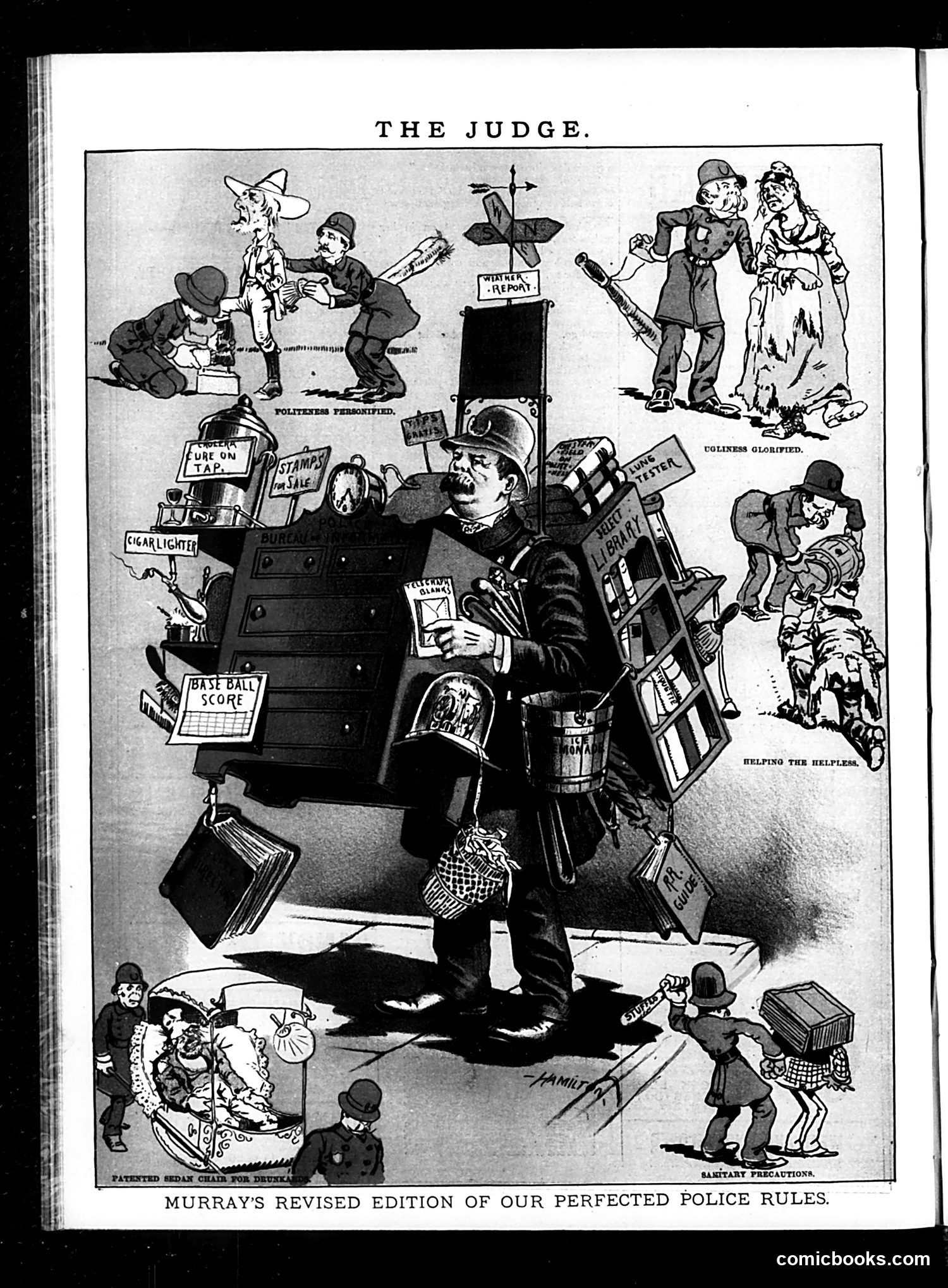
This political cartoon satirizes police corruption and incompetence. The central figure—a bloated judge or police official—is literally stuffed with contraband and vices: cigars, liquor bottles, gambling paraphernalia (base ball score), and other illicit goods. Around him, smaller vignettes show police failing their duties: "Politeness Terrified," "Coiness Glorified," "Helping the Helpless" (depicted ironically), and other scenes of malfeasance. The caption mocks "Murray's Revised Edition of Our Perfected Police Rules," suggesting that police reform efforts are hollow theater—rules exist only to line corrupt officials' pockets rather than serve justice. The cartoon criticizes how law enforcement ignored vice crimes while enriching themselves, a common Progressive-era complaint about urban police departments.