
Judge, 1885-07-04 · page 13 of 16
Judge — July 4, 1885 — page 13: what you’re looking at
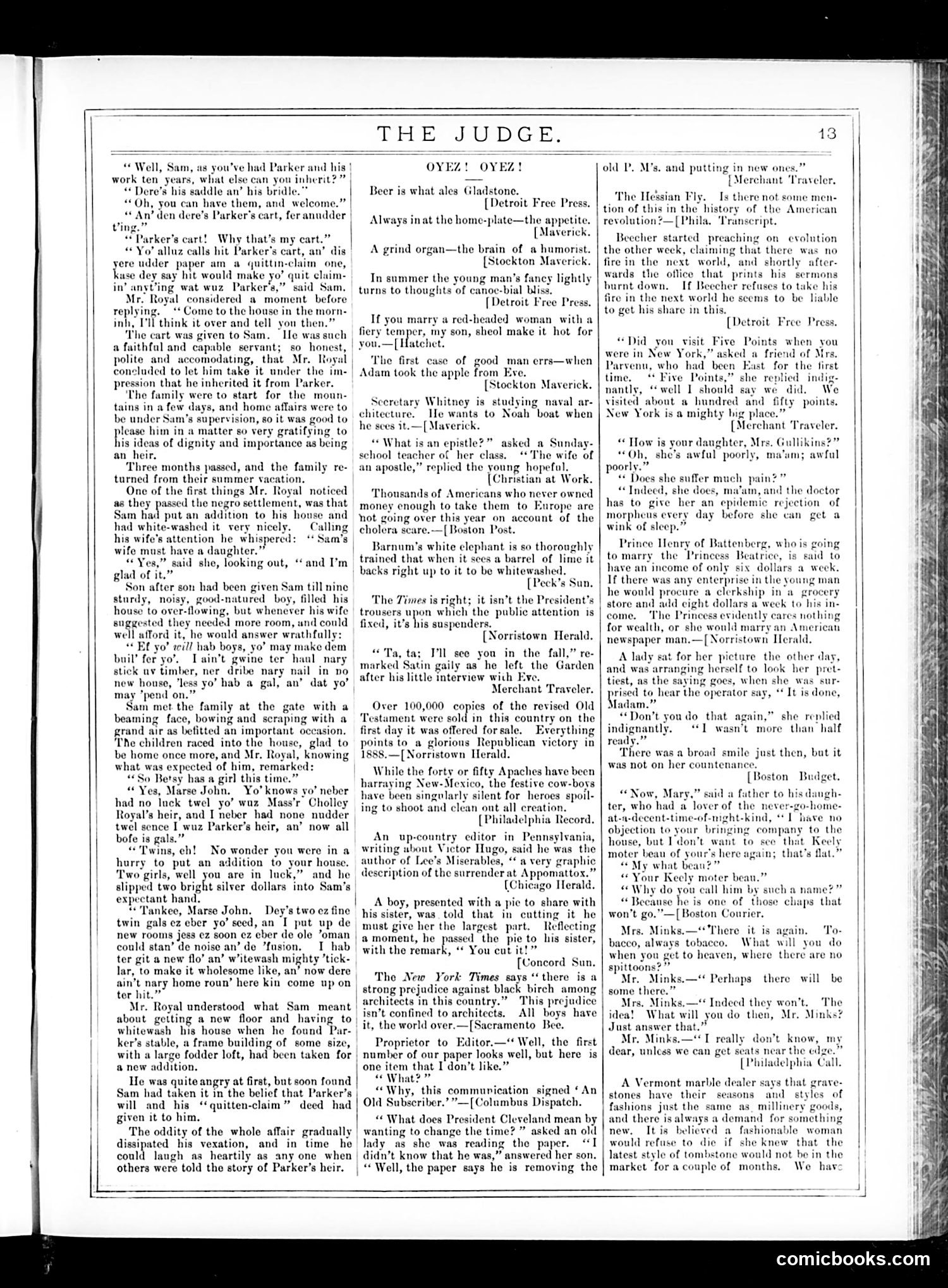
A restored page from Judge, 1885-07-04. Page through the whole issue in the reader above.
📄 Transcribed text from this page (OCR, searchable)
Machine-transcribed from the original scan — historical spelling and the odd misread are preserved.
you've had Parke work ten years, what else can you inherit?” “ Dere’s his saddle an’ his brid “Oh, you can have them, and welcome. n dere’s Parker's cart, fer anudder rker’s cart! Why that’s m. “ Yo’ alluz calls hit Parker's cart, an’ dis yere udder paper am a quittin-claim dey say hit would make yo’ quit ¢! in’ anyting wat wuz Parker's,” said $ Mr. Royal considered a moment before replying. ** Come to the house in the morn- inh, I'll think it over and tell you then. The cart was given to Sam. “He was such a faithful and capable servant; so honest, polite and accomodating, that Mr. al concluded to let him take it under the im- pression that he inherited it from Parker. Uhe family were to start for the moun- tains in afew days, and home affairs were to be under Sam’s supervision, so it was good to i ‘ase him in a matter so very gratifying to his ideas of dignity and importance as being an heir. Three months passed, and the family re- turned from their summer vacation. One of the first things Mr. Royal noticed as they ue assed the negro settlement, was that am had put an addition to his house and had white-washed it very nicel. his wife’s attention he whispered wife must have a daughter. * said she, looking out, “and I’m glad of it.” Son after son had been given Sam till nine sturdy, noisy, good-natured boy, filled his house to over-flowing, but whenever his wife suggested they needed more room, and could well afford it, he would answer wrathfall ** Ef yo’ will hab boys, yo’ may make dem buil’ fer yo’. Tain’t gwine ter haul nary stick uv timber, ner dribe nary nail in no new house, ‘less yo’ hab a gal, an’ dat yo" may ’pend on.” am met the family at the gate with a beaming face, bowing and scraping with a grand air as betitted an important occasion, The children raced into the house, glad to be home once more, and Mr. Royal, knowing what was expected of him, remarked: “So Betsy has a girl this time. “Yes, Marse John. Yo’ knows yo’ neber had no luck twel yo’ waz Mass’r Cholley Royal’s heir, and I neber had none nudder twel sence I wuz Parker's heir, an’ now all bofe is gals.” “Twins, eh! No wonder you were in a hurry to put an addition to your house. ‘Two girls, well you are in luck,” and he slipped two bright silver dollars into Sam’s expectant hand. ankee, Marse John. Dey’s two ez fine twin gals ez eber yo" seed, an I put up de new rooms jess ez soon ez eber de ole ’oman could stan’ de noise an’ de ’fusion, I hab ter git a new flo’ an’ w’itewash m ighty ’tick- lar, to make it wholesome like, an’ now dere ain’t nary home roun’ here kin come up on ter hit.” Mr. Royal understood what Sam meant about getting a new floor and having to whitewash his house when he found Par- ker’s stable, a frame building of some size, with a large fodder loft, had been taken for a new addition. He Sam had taken it in the belief that Parker’s | will and his ‘quitten-claim” deed had | given it to him. The oddity of the whole affair gradually dissipated his vexation, and in time he could laugh as heartily as any one when others were told the story of Parker's heir. cart.” Calling nd his | | a moment, he pa as quite angry at first, but soon found | THE - JUDGE. “OY E ! OYEZ! Beer is what ales Gladstone. [Detroit Free Press. inat the home-plate—the appetite. [Maverick A grind organ—the brain of a humorist. [Stockton Maverick. Alw: In summer the young man’s fancy lightly turns to thoughts of canoc-bial bliss, [Detroit Free Press. If you marry a red-headed woman with a fiery emper, my son, sheol make it hot for you.—[Hatchet. a The first case of good man errs—when Adam took the apple from Eve. [Stockton Maverick. Sceretary Whitney is studying na itecture. He wants to Noah boat when he sces it.—[ Maverick. “ What is an epistle school teacher of her class. “The wife of an apostle,” replied the young hopeful. [Christian at Work. Thousands of Americans who never owned money enough to take them to Europe are hot going over this year on account of the cholera scare.—{ Boston Pos Barnum’s white elephant is so thoroughly trained that when it sees a barrel of lime it backs right up to it to be whitewashed, [Peck’s Sun. The Times is right; it isn’t the President’s trousers upon which the public attention is fixed, it’s his suspenders. [Norristown Herald. “Ta, ta: Tl see you in the fall,” re- ked Satin gaily as he left. the ‘den after his little interview wich Eve. Merchant Traveler. Over 100,000 copies of the revised Old Testament were sold in this country on the first day it was offered forsale. Everything points to a glorious Republican victory in 1888.—[Norristown Herald. While the forty or fifty Apaches have been harraying New-Mexico, the festive cow-boys have been singularly silent for heroes spoil- ing to shoot and clean out all creation. [Philadelphia Record. An up-country editor in Pennsylvania, writing ubout Victor Hugo, said he was the thor of Lee's Miserables, “a very graphic description of the surrender at Appomattox.” (Chicago Herald. A boy, presented with a pic to share with his sister, was told that in cutting it he must give her the largest part. Reflecting d_ the pie to his sister, » You cut it!” [Concord Sun, The New York Times says ‘‘ there is a strong prejudice against black birch among architects in this country.” isn’t confined to architects. All boys have it, the world over.—[Sacramento Bee. Proprietor to Editor.—‘* Well, the first number of our paper looks well, but here is one item that I don’t like.” «What? ” “Why, this communication signed ‘An Old Subscriber.’”—[Columbus Dispatch. “ What does President Cleveland mean by wanting to change the time? ” asked an old with the remar! didn’t know that he was,” answered her son. | “Well, the paper says he is removing the This prejudice | dy as she was reading the paper. ‘I | old P. M's. and putting in new one {Merchant The Hessian Fly. _ Is there not some men- tion of this in the history of the American revolution?—[Phila, ‘Transcript. Beecher started prea the other week, claiming there was no fire in the next world, and shortly after- wards the oflice that prints his sermons burnt down to take his fire in the next world he seems to be liable to get his share in this, [Detroit Free Press. raveler, ing on evolution “Did you visit Five Points when you were in New York, ked a friend of Parvenu, who had been t for th time. ‘* Five Points,” e replied in “well I should say we did. We V about a hundred and fifty points. York is a mighty hig place.” [Merchant ‘Traveler. “ How is your daughter, Mrs. Gullikins?” 's awful poorly, ma'am; awful she suffer much pain “Indeed, she does, ma'am, and the doctor has to give her an epidemic rejection of morpheus every day before she can get a wink of sleep.” Prince Henry of Battenberg, who is going to marry the Princess Beat said to. have an income of only six do! week. | If there was any enterprise in the young man he would procure a clerkship in store and add cight dollars a week to his it come. ‘The Prince res nothing for wealth, or she would n n American newspaper man,—[ Norristown Herald. A lady sat for her picture the other day, and was arranging herself to look her p tiest, as the saying goes, when she sur- prised to hear the operator say, * It is done, evidently ca ry she replied indignantly. “1 wasn’t. more than half re There was a broad smile just then, but it was not on her countenance. [Boston B her to his “Now, Mai ye”? said gh- ter, who had a lover of the nev home- at-a-decent-time-of-mght-kind, “1 have no objection to your bringing company to the house, but I'don’t want to Keely moter beau of your's here again; that’s flat.” “My what beau? “ Your Keely moter be: “ Why do you call him by such a name?” « Because he is one of those chaps that won't go.”—[Boston Courier. Mrs. Minks.—‘There_it is bacco, always tobacco. What wi sill when you get to heaven, where there spittoons?” Mr. Minks. | some there.” Mrs. Minks,—‘‘ Indeed they won't, The idea! What will you do then, Mr. Minks? Just answer that.” Mr. Minks.—‘‘T really dear, unless we can get u do re no —“ Perhaps there will be don’t know, my ts near the t [Philadelphia € r says that grave- A Vermont marble de stones have their seasons and styles of fashions just the same as. millinery goods, | and there is always a demand for something new. It is believed a fashionable woman would refuse to die if she knew that the latest style of tombstone would not be in the market for a couple of months. We hav comicbooks.com